Do humanities graduates find jobs? The case of postgraduates in classics at a South African university
Abstract
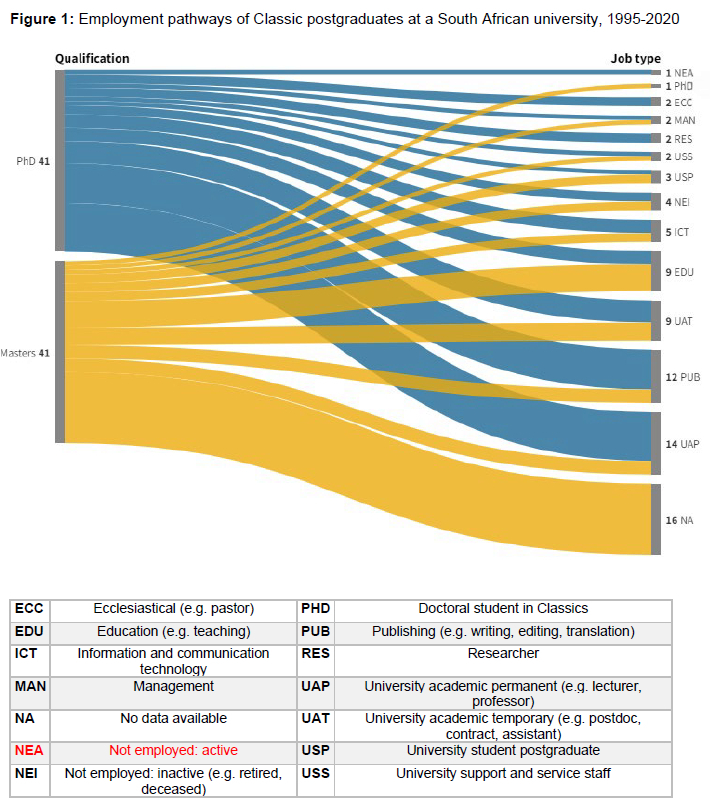
Graduates at higher levels of education attainment are regarded as particularly valuable in fostering innovation and economic growth. In this context, there is a pervasive discourse within universities and on the part of stakeholders external to the university that socio-economic development rests on the training of science, technology, engineering and mathematics graduates. Graduate degrees in Humanities disciplines, however, are less valued and there is a perception that these graduates are more likely to struggle to enter the non-academic labour market. This article tests that assumption by tracing the career pathways of postgraduates in Classics from a single university in South Africa for the period 1996 to 2022. The results show that, contrary to popular belief, Classics graduates have been highly successful in finding employment. The article concludes with a discussion of what the findings could mean for higher qualifications in Humanities in a rapidly changing workplace.
graduate employment; tracer study; Humanities; Classics
 Thumbnail