Do humanities graduates find jobs? The case of postgraduates in classics at a South African university
Abstract
Graduates at higher levels of education attainment are regarded as particularly valuable in fostering innovation and economic growth. In this context, there is a pervasive discourse within universities and on the part of stakeholders external to the university that socio-economic development rests on the training of science, technology, engineering and mathematics graduates. Graduate degrees in Humanities disciplines, however, are less valued and there is a perception that these graduates are more likely to struggle to enter the non-academic labour market. This article tests that assumption by tracing the career pathways of postgraduates in Classics from a single university in South Africa for the period 1996 to 2022. The results show that, contrary to popular belief, Classics graduates have been highly successful in finding employment. The article concludes with a discussion of what the findings could mean for higher qualifications in Humanities in a rapidly changing workplace.
graduate employment; tracer study; Humanities; Classics
INTRODUCTION
The dominant global, neo-liberal discourse about university education is that society needs highly-skilled knowledge workers, usually articulated as STEM (science, technology, engineering and mathematics) postgraduates. The specialised and sophisticated skills acquired by postgraduates, and by doctoral graduates in particular, differentiates them from university undergraduates. The expectation is that the university must prioritise the "production" of these highly-skilled postgraduates to "feed" the labour market, foster innovation (Teichler, 2009; Tight, 2023) and drive economic growth (Boughey and McKenna, 2022, 32-34, 72-73).
Conversely, the neo-liberal discourse implies that Humanities1 postgraduates offer relatively little economic value. The available data show that in developed countries, the Humanities have been losing prestige and enrolments numbers are tumbling (Goldstein, 2021; Pitt and Zhu, 2019).
However, it is not all doom and gloom for the Humanities. In a country often lauded for its economic development and highly-skilled workforce, South Korea, concerns have been raised that the country has been undervaluing Humanities degrees with its relentless focus on STEM fields (Jeung, 2024). Elite research universities in Africa may also be an exception to the decline as they have witnessed an increase in Humanities enrolments (Cloete, Bunting and Van Schalkwyk, 2018, 41). But this should be read against the relatively recent massification of higher education across the continent. It also masks whether a rising African tide lifts all ships. For example, a discipline such as Classics, often regarded as irrelevant and an ideological instrument in the post-colonial university (even when compared with other Humanities disciplines), has not benefitted from the continental upswing in enrolments (Masters, Nzungu and Parker, 2022, 5).
An emphasis on Humanities postgraduates, brings the university as employer into sharper focus. A unique organisational characteristic of the university is that one of its core functions is to reproduce itself. It does so by training postgraduates to take up positions in the academy when senior academic staff retire. But not all postgraduates will find a home at a university. As a consequence, many, if not most, masters and doctoral graduates will have to find their way into the non-academic labour market where they, too, may contribute to the innovation and development of national economies.
Teichler (2009) argues that perfect alignment between the number of graduates and corresponding positions in the labour market, or between the competences acquired at university and those required by employers, cannot be expected. University students are more ambitious and strive for a broader range of goals than they can expect to be rewarded for. Graduates need to be both highly qualified experts and sceptics as far as conventional wisdom is concerned, and they have to be prepared for indeterminate tasks. Teichler's position on graduate employability draws attention to a special role of universities: the production and transfer of powerful knowledge.
Powerful knowledge is characterised by specialisation, structure and the ability to make predictions and explanations about the world (McPhail, 2014; Muller and Young, 2019). It is distinct from everyday knowledge. One might expect that the types of knowledge skills acquired by Humanities postgraduates should be gaining in appreciation with the emergence and impact of rapidly advancing technologies such as robotics and artificial intelligence (AI) on the academy and society alike; a technological sea change that makes light of technical tasks at unprecedented speed and scale, but still falls short in matching the creative and conceptual work that university graduates, and Humanities postgraduates in particular, should be adept at (Petterson, 2018).
Powerful knowledge can also be linked to the notion of self-programmable labour - a critical skill which describes the ability of graduates to reskill themselves as the world of work changes rapidly and frequently: "Self-programmable labour has the autonomous capacity to focus on the goal assigned to it in the process of production, find the relevant information, recombine it into knowledge, using the available knowledge stock [...] the more what is required from labour is the capacity to search and recombine information [...] in terms of value-making [...] it is the self-programmable worker who counts for any organisation in control of resources" (Castells, 2009, 30). Castells describes a world of work in which the sources of profit, productivity and power are intangible and assume the forms of knowledge, creativity, information and intellectual assets. Digital products are reproducible at low cost for high returns, enabling capitalism to overcome scarcity and the limits of time and space. Firms, in turn, have evolved from purely hierarchical organisational forms into decentralised, flat and networked organisations.
Some argue that cultural geography can offer valuable powerful knowledge to enhance employability through skills such as situated knowledge, reflexivity, flexibility, and understanding cultural landscapes (Harvey, 2000; Waight, 2021). Others propose abandoning graduate attributes frameworks in favour of powerful knowledge that better equips graduates for diverse careers (Wald and Harland, 2019). Engineering education research suggests that an interdependent relationship between disciplinary knowledge and professional skills is crucial for employability (Winberg et al., 2018). However, studies have found mismatches between knowledge acquired in the university and competencies required in the job market, with graduates acquiring more theoretical knowledge than needed, and are found to be lacking important transferable skills (Hennemann and Liefner, 2010). This highlights the ongoing and possibly futile challenge of attempting to constantly align higher education curricula with rapidly changing labour market demands.
Tracer or graduate destination studies have consistently highlighted the significant impact of higher education on employability. These studies have revealed disparities in employability outcomes based on factors such as field of study, gender, and socio-economic background (Garcia-Aracil and Van der Velden, 2008). Internationally, several tracer studies have found a strong relationship between obtaining a university-level qualification and finding employment (see CHEC, 2013, for a review of international studies and, more recently, selected tracer studies from various regions around the world: Albina and Sumagaysay, 2020; Cuadra, Aure and Gonzaga, 2019; Fenta et al., 2019; McAlpine and Austin, 2018; Næss and Wiers-Jenssen, 2022).
Given the interests of the research presented in this article, the review of the literature is restricted to the primary job market open to university graduates. In other words, the focus is on a single country, South Africa, and on any of the regions or provinces in the country. Restricting the review to South Africa is justified by the country's relatively unique labour market in which unemployment is extremely high; Statistics South Africa's Quarterly Labour Force Survey reported an unemployment rate of 31,9 per cent in Q4: 2024 (Stats SA, 2025). An additional unique feature of the South African labour market is that 33.6 per cent of the country's youth are not in employment, education of training making South Africa an outlier in this regard (Branson and Whitelaw, 2025). It is therefore not the case that the country's relatively low level of university enrolment (World Bank, 2025) is driven by alternative, employment opportunities.
In 2013, CHEC (2013) reported that "graduate destination research is highly underdeveloped in South Africa and there is no systematic attempt to understand graduate pathways outside of a few sporadic institutionally-based surveys". Since then, tracer studies have remained sporadic and most often the level of analysis in the university.
Ashwin and Case (2018) in their edited volume on pathways from university to work, explore the complexities of South African undergraduate education's contribution to the public good. They highlight tensions in conceptualising undergraduate education; tensions between individual institutions and higher education systems, transformation and reproduction, homogenisation and differentiation, local and universal concepts of their public good, and complex research ideas versus dominant discourses. The implications for researching higher education include the need for more comparative research, publicly available system-wide data, and collective networks.
CHEC's (2013) survey of graduates from four universities in the Western Cape Province, South Africa, found that 8 per cent of graduates were unemployed and looking for work. The biggest predictor of employability was the social networks graduates developed during their university education. This finding was confirmed by Rogan and Reynolds (2016). The CHEC survey also found that unemployment in SET (science, engineering and technology) and Business and Commerce were higher than expected: 31 per cent had a SET qualification while 29 per cent had a Business and Commerce background. By comparison, 27 per cent were Humanities and Social Sciences graduates. In terms of qualification level, 37 per cent of the unemployed were bachelors' graduates, 6 per cent were masters' graduates and 2 per cent doctoral graduates.
Research conducted in 2011 at Nelson Mandela University (NMU) investigated graduates' perceptions of the extent to which their university qualification contributed to employability. The overwhelming majority of the 2 379 respondents reported that their qualifications and study experiences at NMU had enhanced their employability. This was supported by the research findings which demonstrated of all respondents had secured employment at the time of graduation (Nel and Neale-Shutte, 2013).
Rogan and Reynolds (2016) conducted a tracer study of 1 211 graduates who completed a bachelor's degree in either 2010 or 2011 at one of two universities in the Eastern Cape Province in South Africa, namely Rhodes University and the University of Fort Hare. The findings revealed that schooling background, race and gender were associated with study choices and unemployment. The study did not find any evidence that the risk of unemployment for Humanities graduates is significantly higher than for other fields of study. Baldry's (2015) online survey of 1 175 respondents who graduated between 2006 and 2012 found that the strongest determinants of graduate unemployment were their race, socio-economic status and year of their graduation. Neither graduates' field of study nor their level of study significantly influenced their employment status.
Case et al. (2018) adopted a different approach to graduate employment, arguing that little is known at a detailed level about how young people make use of their university experiences to steer their life courses. Furthermore, even less is known about those who drop out of university. Instead of targeting as many graduates as possible with a large-scale survey Case et al. (2018) opted to document and analyse the rich data collected from 73 young people, six years after they began their university studies at one of three South African public universities: University of Cape Town (UCT), University of Western Cape (UWC) and Rhodes University (RU). Their approach traces how going to university influenced not only the employment options of their respondent, but also how university nurtured the agency they required to chart their own course, and to engage critically with the world around them.
MacGinty (2024) relied on Quarterly Labour Force Survey (QLFS) to examine whether graduate unemployment has been rising in South Africa and finds that unemployment rates for most study fields have increased between 2015 and 2023. Administration, Science, and Arts and Social Sciences are fields that show the highest levels of graduate unemployment. In contrast, Education and Health fields of study have advantages in terms of employment returns (see also Bhorat et al., 2017). In terms of change over time, the data show that unemployment among Arts and Social Sciences graduates at all levels fell from 11.1 per cent in 2015 to 9.4 per cent in 2019 before almost doubling to 17.6 per cent in 2023. Fields such as Engineering, Science, Health and Law followed a similar pattern in terms of change over time; only Commerce, Education and Technology were more resilient.
A rare, national survey in 2020 of 6 452 doctoral graduates from South African public universities, found that only 2.3 per cent indicated that they could not find employment after completing their doctoral degree (Mouton et al., 2022). In keeping with the notion that the university must reproduce itself, the survey found that the single biggest group of doctoral graduates (53.6%) found employment in academia, where most of them had already been employed while pursuing their doctoral studies. The survey also found that 20.9 per cent of respondents secured postdoctoral fellowships after graduation. In other words, universities absorbed three-quarters (74.5%) of all doctoral graduates, while the remaining 23.2 per cent found employment outside of the university. The majority (70%) of doctoral graduates indicated that they found employment directly related to their fields of expertise or training. However, Humanities doctoral graduates reported more challenges in finding employment aligned with their qualifications than did doctoral graduates in STEM fields.
The above review of the literature suggests that unemployment among South Africa university graduates is increasing. However, no single study focuses on master's and doctoral graduates, and specifically on the Humanities, or specific disciplines with the Humanities, at these qualification levels.
What emerges from a consideration of the challenges faced by the humanities in rationalising their value in the neo-liberal university, and from a brief review of the literature on tracer studies, is that while the value of a Humanities qualification is contested, there is little real evidence in the current South African context to support the notion that Humanities postgraduates face bleak employment prospects.
This article presents the findings from a tracer study conducted to investigate the employment status and types of jobs obtained by postgraduates in a Humanities discipline at a university in South Africa. By examining their employment outcomes, this study aims to provide clarity in relation to the employability of Humanities postgraduates. In short, the question we ask is: Do postgraduates in the Humanities find jobs?
METHODOLOGY
The study followed the design of tracer study and focused on the particular case of a department of Classics2 at a South African university. Tracer studies are commonly used to track the career paths of graduates and assess the effectiveness of educational programmes in preparing students for the labour market.
The specific academic department in the Humanities was selected because it was able to provide access to data on a full cohort of master's and doctoral graduates. Classics as a discipline was selected because it represents an extreme and exemplary case. Our hypothesis is that if Classics postgraduates are able to secure employment, then other postgraduate job-seekers should be able to do the same. Among disciplines in the Humanities, Classics is often perceived as being irrelevant, anachronistic and exclusionary. Further justifying the selection is an awareness on the part of the authors of this article of academic staff members in the department having dissuaded undergraduate students from pursuing postgraduate degree in Classics on the basis that a higher degree would not enhance their employment prospects. All master's and doctoral graduates who obtained their degrees from the department for the period 1995 to 2020 were included in the study. This amounted to 41 master's graduates and 41 doctoral graduates.
Data were collected during the period 1 October 2021 to 30 January 2022. The study relied on publicly available data on several online professional and social media platforms, including LinkedIn, Google Scholar, and Twitter. The study also relied on current and former academic staff in the department to provide additional information about selected graduates. Graduates' surnames, degree(s), the year(s) in which they received their degree(s), and their supervisor(s) were retrieved from the department's website. The titles of their theses were listed on the websites and were used to query the university's publications repository to find their full names.
The following information of each individual, where known, was collected and captured in a Microsoft Excel spreadsheet: biographical and academic information including: the name and surname of the graduate, year of graduation, name of supervisor, name of co-supervisor. A column for each of the following online platforms was created: LinkedIn; Academia, Research Gate, et al.; Twitter; Facebook; Instagram; Other. The URL for each graduate was captured, if available. Finally, the sheet included columns for current position, job description, organization, previous position 1, previous position 2, previous position 3, previous/other qualification, year of previous/other qualification.
One coder was tasked to find collection data available online for each graduate by consulting the data sources. Once identified, the coder captured whether the graduate was currently employed, the employment type (as per the code book), any former positions held, and any additional qualifications obtained. Where a graduate could not be found online, or where the online data sources did not provide sufficient information, the supervisor of the candidate was contacted via email to establish whether they could provide any information about the employment status and history of the graduate.
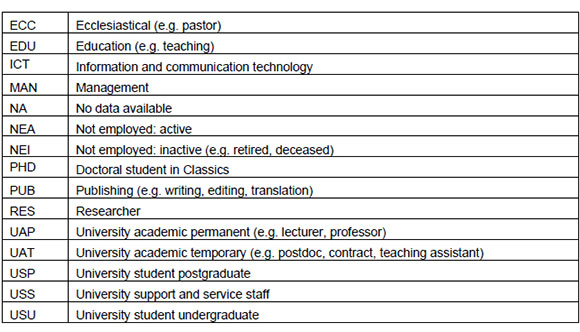
A code book was created to categorise types of employment taken up in the labour market by the postgraduate graduates. The code book was developed deductively and based on an analysis of a sample of the master's graduates. Once the data collection process had been completed, the coder entered the type of employment of each graduate for whom data was available, and for each position (i.e., current employment position as well as any previous positions held). A second coder checked and verified the data collected. Data was imported into Excel for analysis; Flourish Studio was used to create the Sankey Alluvial graph.
FINDINGS AND DISCUSSION
Of the 41 master's graduates, 25 were identified from the data sources used by the study. LinkedIn was the most prevalent data source: 18 (44%) of all the master's graduates had LinkedIn profiles, compared with the second-most prevalent source which was Facebook (10 or 24% master's graduates). Of the 41 doctoral graduates, all 41 (100%) were identified from the data sources used by the study. LinkedIn was the most prevalent data source: 29 (71%) of doctoral graduates had LinkedIn profiles, compared with the second-most prevalent source which included academic platforms such as ResearchGate and Academia.edu (7 or 17% of doctoral graduates).
In terms of employment, of the 25 master's graduates who could be identified from the data sources, 25 (100%) were currently employed or had previously been employed at the time of data collection. (Two master's graduates had retired at the time of data collection.) In the case of doctoral graduates, 3 (7%) were not employed at the time of data collection. However, only one was determined to be "Not employed: active" while the other two were "Not employed: inactive (e.g., retired, deceased)". In other words, only 1 out of 41 doctoral graduates was unemployed at the time of data collection.
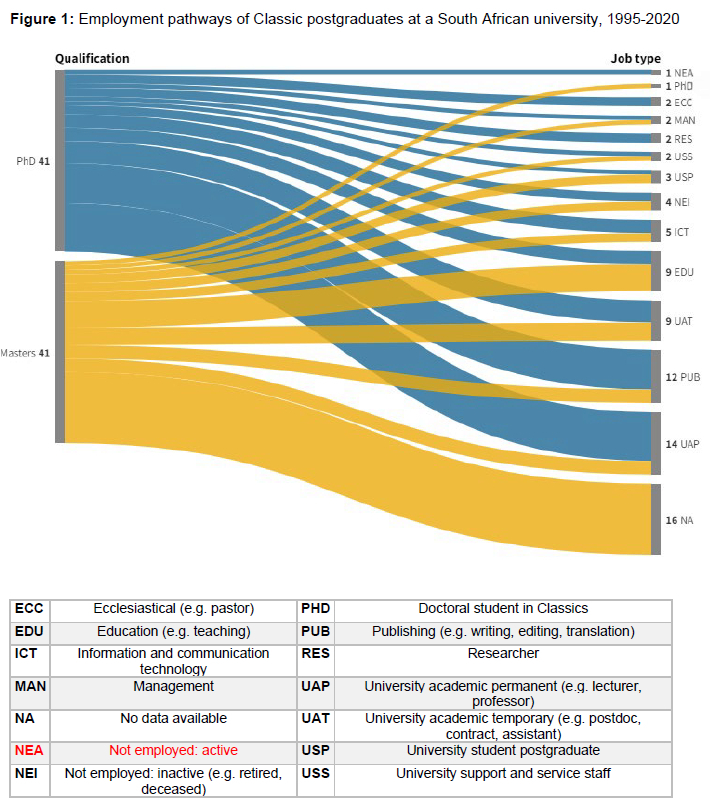
Figure 1 shows the employment pathways for master's and doctoral graduates from a single department in Classics at a South African university for the period 1995 to 2020.
Taken together, the data show that 14 out of 82 (or 17%) postgraduates were employed by a university (UAP: University academic permanent e.g., lecturer, professor) at the time of data collection. A temporary position at a university or being employed as educator at a school were the second-most common pathways with each accounting for 9 postgraduates (or 11%). Outside of the education sector, publishing- and IT-related (PUB, 9 or 11%; ICT, 5 or 6%) jobs were found to be most common for Classics postgraduates. It is worth repeating that none of the master's graduates who could be found online and only one of the doctoral graduates were unemployed and actively seeking employment at the time the data was collected. This high level of success in securing employment is consistent with the findings of less field-specific tracer studies conducted in South Africa (CHEC, 2013; Nel and Neale-Shutte, 2013; Rogan and Reynolds 2016).
Taking doctoral graduates on their own, the findings show that 16 (39%) were employed at a university in either a permanent (UAP, 11 or 27%) or temporary (UAT, 5 or 12%) position. Mouton et al.'s (2022) survey of South African doctoral graduates found that universities employed 74.5 per cent of those surveyed.
Clearly not all qualifications are perceived to be equal when it comes to their propensity to create opportunities for graduates in the labour market, including the university as potential employer. Nevertheless, the findings show that even in the case of a discipline in the Humanities regarded as potentially irrelevant, postgraduates find jobs. This finding supports the enthusiastic claims of Classics advocates such as Edith Hall: "Employers will love you: my former students run museums, civil service departments, schools, travel, data analysis and broadcasting companies, pop groups, theatres, banks and advertising agencies: one is now an MP" (quoted in Davies, 2024; see also Hall, 2020).
According to Brown, Hesketh and Williams (2005), some scholars focus on the upgrading of skills and the expansion of labour market opportunities for knowledge workers, whereas others focus on positional issues such as the exclusionary tactics of elites, and the reproduction of educational and occupational inequalities. Brown et al. (2005) argue that a major weakness of a focus on skills and labour market needs is it ignores differences in the power of social groups to enhance their employability at the expense of others. Employability is conceived as a technical problem, of ensuring that labour market entrants have the skillsets that match the requirements of employers. This focus on the supply side also gives scant regard to the social congestion that characterises the labour market in many economies. It assumes that the competition for education and jobs is based on a meritocratic contest that negates class, gender and racial inequalities.
It is possible then that more important than what the graduates in our sampled studied is where they studied. The perception of employers plays important role in this regard, as previous research has shown that one possible reason for the poorer employment prospects for graduates from historically black universities is that some employers perceive those universities as producing a lower quality of graduates (DPRU, 2006; Pauw et al., 2006). Conversely, then, the Classics graduates in this study who have graduated from a historically white university may receive preference among prospective employers. And this could, at least in part, account for their high levels of success in finding jobs. Van Broekhuizen (2016) provides further support for the relevance of university from which a degree is obtained, that is, that employment outcomes are likely attributable to differences in both the quality and type of university attended.
Employment trends may also mask other structural barriers including race, class, gender, and location (e.g., rural versus urban). Branson and Whitelaw (2025) show unemployment to be higher among African and female bachelor-degree holders than white individuals and males, and unemployment rate of degree holders in rural areas is higher than those graduating in urban areas. According to Branson and Whitelaw (2025), it is unclear how the graduating university affects employment outcomes (see also Rogan and Reynolds, 2016; Van Broekhuizen, 2016; Wildschut, Rogan and Mncwango, 2020) in the case of graduates in general. Their analysis focused on NSFAS-funded graduates (i.e., undergraduates only) being employed two years after graduating. Employment rates range from 57 per cent for graduates from the University of Limpopo to 91 per cent for the Cape Peninsula University of Technology (CPUT), with rates typically higher for graduates from traditional universities than comprehensive universities.
As has been demonstrated by previous studies in South Africa (CHE, 2013; Kraak, 2010; Rogan and Reynolds 2016), the social capital acquired from participating in the social activities offered by the universities, family connections, or simply by virtue of graduating from a highly regarded university, may be a determining factor in the success of graduates in securing employment. The same may be said of the reputation of the Classic department itself as distinct from the reputation of the university and perhaps in narrower and more specific networks, including academic and professional networks in theology and those related to cultural pursuits (e.g., museums, art galleries and the like). However, it seems highly unlikely that any network that unlocks job opportunities for Humanities postgraduates would provide access to employment unless the graduate was deemed to be adding value (Castells, 2009), irrespective of their social capital. Markets and networks do not typically tolerate free loaders. Finally, as per the findings of Case et al. (2018), the department may, relative to other departments in the university, have provided a highly nurturing environment for postgraduates and this may, in turn, have better equipped the Classics postgraduates for the labour market.
In the introduction we suggested that there appears to be a failure on the part of universities to appreciate the value of the powerful knowledge acquired by humanities graduates, including conferring on them the capacity to navigate a complex labour market. This failure sits not only with those in administration who succumb to the neo-liberal understanding of higher education, but also among those who teach in the Humanities. The capacity to navigate the labour market is not to be underrated if, as Teichler (2009) suggests, the university will never provide perfectly aligned pathways from graduation to employment or, as Castells (2009) argues, graduates must be able to reprogramme themselves for constantly changing opportunities in the labour market. The findings of this small tracer study suggest that Classics postgraduates at a South African university have successfully made their own way into the labour market, noting the fact that many were absorbed into the university either as permanent or temporary employees and despite the common rhetoric that they are studying a subject that is irrelevant and renders them unemployable.
LIMITATIONS AND FUTURE STUDIESThe study relied on graduates from a single department at one university. Partly this was because the authors had access to the data needed to operationalize the study. Future studies could select a larger sample of graduates from different universities and different disciplines in the Humanities. If the scope and size of the sample is increased, and if data collection can be done more frequently, then it will be possible to make more robust generalisations about the value of the Humanities and its disciplines. The absence of data on graduate outcomes (from institutionalised tracer studies) prevents universities from providing their postgraduates with assurances that they are receiving an education that prepares them to navigate the numerous pathways from university to work.
CONCLUSION
This study challenges the prevailing narrative that humanities graduates, particularly those in disciplines such as Classics, struggle to find employment in the current job market. Despite the global trend towards prioritising STEM fields, the findings show that graduates in Classics at a South African university have been largely successful in securing employment, with many entering academic roles or finding positions in diverse sectors such as publishing, education and IT. The concept of "powerful knowledge," which equips graduates with critical thinking and adaptability, appears to play a role in their employability, underscoring the value of a Humanities education in navigating complex and evolving labour markets. While the study is limited to a single department at one university, it provides important insights that challenge the assumption that Humanities graduates face bleak employment prospects. Future research could expand on these findings by examining a broader range of Humanities disciplines as well as a larger number of universities, thereby providing a more comprehensive understanding of the employability of Humanities graduates in the South African context.
REFERENCES
LITERATURE REVIEW
-
Albina, A. C., and L. P. Sumagaysay. 2020. "Employability Tracer Study of Information Technology Education Graduates from a State University in the Philippines." Social Sciences & Humanities Open 2 (1): 100055. https://doi.org/10.1016/j.ssaho.2020.100055.
» https://doi.org/10.1016/j.ssaho.2020.100055 -
Ashwin, Paul, and Jennifer M. Case, eds. 2018. Higher Education Pathways: South African Undergraduate Education and the Public Good. Cape Town: African Minds. https://doi.org/10.47622/9781928331902.
» https://doi.org/10.47622/9781928331902 -
Baldry, Kim. 2015. "Graduate Unemployment in South Africa: Social Inequality Reproduced." Journal of Education and Work 29 (7): 788-812. https://doi.org/10.1080/13639080.2015.1066928.
» https://doi.org/10.1080/13639080.2015.1066928 - Bhorat, Haroon, Ariane Lilenstein, Kezia Lilenstein, and Marisa Oosthuizen. 2017. "Youth Transitions from Higher Education into the Labour Market." Labour Market Intelligence Partnership.
- Bod, Rens. 2013. A New History of the Humanities: The Search for Principles and Patterns from Antiquity to the Present. Oxford: Oxford University Press.
-
Boughey, Chrissie, and Sioux McKenna. 2022. Understanding Higher Education: Alternative Perspectives. Cape Town: African Minds. https://doi.org/10.47622/9781928502210.
» https://doi.org/10.47622/9781928502210 -
Branson, Nicola, and Emma Whitelaw. 2025. "Post-School Education and Training Policies in South Africa from 1994 to Now." ERSA Policy Paper 35. https://doi.org/10.71587/93qn2656.
» https://doi.org/10.71587/93qn2656 -
Brown, Phillip, Anthony Hesketh, and Sara Williams. 2003. "Employability in a Knowledge-Driven Economy." Journal of Education and Work 16 (2): 107-26. https://doi.org/10.1080/1363908032000070648.
» https://doi.org/10.1080/1363908032000070648 - Cape Higher Education Consortium (CHEC). 2013. Pathways from University to Work: A Graduate Destination Survey of the 2010 Cohort of Graduates from the Western Cape Universities. Cape Town: CHEC.
-
Case, Jennifer M., Delia Marshall, Sioux McKenna, and Dineo Mogashana. 2018. Going to University: The Influence of Higher Education on the Lives of Young South Africans. Cape Town: African Minds. https://www.africanminds.co.za/going-to-university-the-influence-of-higher-education-on-the-lives-of-young-south-africans/.
» https://www.africanminds.co.za/going-to-university-the-influence-of-higher-education-on-the-lives-of-young-south-africans/ - Castells, Manuel. 2009. Communication Power. Oxford: Oxford University Press.
-
Cloete, Nico, Ian Bunting, and Francois van Schalkwyk. 2018. Research Universities in Africa. Cape Town: African Minds. https://doi.org/10.47622/9781928331872.
» https://doi.org/10.47622/9781928331872 -
Cuadra, L. J., M. R. Aure, and G. L. Gonzaga. 2019. "The Use of Tracer Study in Improving Undergraduate Programs in the University." Asia Pacific Higher Education Research Journal 16 (1): 13-25. https://po.pnuresearchportal.org/ejournal/index.php/apherj/article/download/1315/409.
» https://po.pnuresearchportal.org/ejournal/index.php/apherj/article/download/1315/409 -
Davies, Hannah. 2024. "What Should I Study at University? How to Choose Your Course." The Times, September 20, 2024. https://www.thetimes.com/uk-university-rankings/feature-guide/article/what-study-university-pick-degree-course-vpq6hgk3c.
» https://www.thetimes.com/uk-university-rankings/feature-guide/article/what-study-university-pick-degree-course-vpq6hgk3c - Development Policy Research Unit (DPRU). 2006. "Graduate Unemployment in Post-Apartheid South Africa: Nature and Possible Policy Responses." Research report for Standard Bank and Business Leadership South Africa. University of Cape Town.
-
Fenta, H. M., Z. S. Asnakew, P. K. Debele, S. T. Nigatu, and A. M. Muhaba. 2019. "Analysis of Supply Side Factors Influencing Employability of New Graduates: A Tracer Study of Bahir Dar University Graduates." Journal of Teaching and Learning for Graduate Employability 10 (2): 67-85. https://doi.org/10.21153/jtlge2019vol10no2art801.
» https://doi.org/10.21153/jtlge2019vol10no2art801 -
Goldstein, Ben. 2021. "Decline of the Humanities: Where Does It STEM From?" The Cornell Diplomat, no. 6: 28-30. https://journals.library.cornell.edu/index.php/tcd/article/view/635.
» https://journals.library.cornell.edu/index.php/tcd/article/view/635 -
Hall, Edith. 2020. "Professor Edith Hall: What Makes Classics Special." Between the Acts (blog), May 28, 2020. https://blogs.kcl.ac.uk/betweentheacts/edith-hall-what-makes-classics-special/.
» https://blogs.kcl.ac.uk/betweentheacts/edith-hall-what-makes-classics-special/ -
Harvey, Lee. 2000. "New Realities: The Relationship between Higher Education and Employment." Tertiary Education and Management 6 (1): 3-17. https://doi.org/10.1080/13583883.2000.9967007.
» https://doi.org/10.1080/13583883.2000.9967007 -
Hennemann, Stefan, and Ingo Liefner. 2010. "Employability of German Geography Graduates: The Mismatch between Knowledge Acquired and Competences Required." Journal of Geography in Higher Education 34 (2): 215-30. https://doi.org/10.1080/03098260903227400.
» https://doi.org/10.1080/03098260903227400 -
Jeung, Y. 2024. "Nobel Literature Prize Rekindles Debate on Humanities' Value." University World News, October 16, 2024. https://www.universityworldnews.com/post.php?story=20241016125855450.
» https://www.universityworldnews.com/post.php?story=20241016125855450 - Kraak, Andre. 2010. "The Collapse of the Graduate Labour Market in South Africa: Evidence from Recent Studies." Research in Post-Compulsory Education 15 (1): 81-102.
- MacGinty, H. 2024. Graduate Unemployment in South Africa. Master's thesis, University of Cape Town.
-
Masters, S., I. Nzungu, and G. Parker. 2022. "Nothing about Us? Reflections on Classics in Southern Africa." In (u)Mzantsi Classics: Dialogues in Decolonisation from Southern Africa, edited by S. Masters, I. Nzungu, and G. Parker, 1-18. Cape Town: African Minds. http://dx.doi.org/10.47622/9781928502302_1.
» http://dx.doi.org/10.47622/9781928502302_1 -
McAlpine, Lynn, and N. Austin. 2018. "Humanities PhD Graduates: Desperately Seeking Careers?" Canadian Journal of Higher Education 48 (2): 1-19. https://doi.org/10.7202/1057100ar.
» https://doi.org/10.7202/1057100ar -
McPhail, Graham. 2014. "Pathways to Powerful Knowledge: A Case for Music's 'Voice'." In Knowledge and the Future of the Curriculum, edited by B. Barrett and E. Rata. London: Palgrave. https://doi.org/10.1057/9781137429261_8.
» https://doi.org/10.1057/9781137429261_8 -
Mouton, Johann, M. van Lill, H. Prozesky, T. Bailey, M. Duncan, N. Boshoff, C. Albertyn, and R. Treptow. 2022. A National Tracer Study of Doctoral Graduates in South Africa. Water Research Commission. https://www0.sun.ac.za/scistip/wp-content/uploads/2022/07/National-Tracer-Study-of-Doctoral-Graduates-in-SA_DSI-approved.pdf.
» https://www0.sun.ac.za/scistip/wp-content/uploads/2022/07/National-Tracer-Study-of-Doctoral-Graduates-in-SA_DSI-approved.pdf -
Muller, Johan, and Michael Young. 2019. "Knowledge, Power and Powerful Knowledge Revisited." The Curriculum Journal 30 (2): 196-214. https://doi.org/10.1080/09585176.2019.1570292.
» https://doi.org/10.1080/09585176.2019.1570292 -
Næss, T., and J. Wiers-Jenssen. 2022. "Labour Market Mismatch among Master's Graduates in the Humanities from 1995 to 2015 in Norway." European Journal of Higher Education 13 (4): 558-77. https://doi.org/10.1080/21568235.2022.2105369.
» https://doi.org/10.1080/21568235.2022.2105369 - Nel, H., and M. Neale-Shutte. 2013. "Examining the Evidence: Graduate Employability at NMMU." South African Journal of Higher Education 27: 437-53.
- Pauw, Kalie, Haroon Bhorat, Sumayya Goga, L. Ncube, and C. van der Westhuizen. 2006. "Graduate Unemployment in the Context of Skills Shortages, Education and Training." DPRU Working Paper No. 06/115. Cape Town: DPRU.
-
Pettersen, L. 2018. "Why Artificial Intelligence Will Not Outsmart Complex Knowledge Work." Work, Employment and Society 33 (6): 1058-67. https://doi.org/10.1177/0950017018817489.
» https://doi.org/10.1177/0950017018817489 -
Pitt, Richard N., and Liang Zhu. 2019. "The Relationship between College Major Prestige/Status and Post-Baccalaureate Outcomes." Sociological Perspectives 62 (3): 325-45. https://doi.org/10.1177/0731121418803325.
» https://doi.org/10.1177/0731121418803325 -
Rogan, Michael, and Jeremy Reynolds. 2016. "Schooling Inequality, Higher Education and the Labour Market." Development Southern Africa 33 (3): 343-60. https://doi.org/10.1080/0376835X.2016.1153454.
» https://doi.org/10.1080/0376835X.2016.1153454 -
Statistics South Africa. 2025. "Quarterly Labour Force Survey (QLFS), 4th Quarter 2024." https://www.statssa.gov.za/?page_id=1854&PPN=P0211&SCH=73895.
» https://www.statssa.gov.za/?page_id=1854&PPN=P0211&SCH=73895 -
Teichler, Ulrich. 2009. Higher Education and the World of Work: Conceptual Frameworks, Comparative Perspectives, Empirical Findings. Rotterdam: Sense. https://brill.com/display/title/37088.
» https://brill.com/display/title/37088 -
Tight, Malcolm. 2023. "Employability: A Core Role of Higher Education?" Research in Post-Compulsory Education 28 (4): 551-71. https://doi.org/10.1080/13596748.2023.2253649.
» https://doi.org/10.1080/13596748.2023.2253649 - van Broekhuizen, Hendrik. 2016. "Graduate Unemployment and Higher Education Institutions in South Africa." Stellenbosch Economic Working Paper No. 08/16.
-
Waight, Emma. 2021. "What Can Cultural Geography Offer to the Employability Agenda?" Journal of Geography in Higher Education 46 (4): 516-22. https://doi.org/10.1080/03098265.2021.1957801.
» https://doi.org/10.1080/03098265.2021.1957801 -
Wald, N., and Tony Harland. 2019. "Graduate Attributes Frameworks or Powerful Knowledge?" Journal of Higher Education Policy and Management 41 (4): 361-74. https://doi.org/10.1080/1360080X.2019.1613310.
» https://doi.org/10.1080/1360080X.2019.1613310 -
Wildschut, Angelique, Michael Rogan, and Bongiwe Mncwango. 2020. "Transformation, Stratification and Higher Education." Higher Education 79 (6): 961-79. https://doi.org/10.1007/s10734-019-00450-z.
» https://doi.org/10.1007/s10734-019-00450-z -
Winberg, Christine, M. Bramhall, D. Greenfield, P. Johnson, P. Rowlett, O. Lewis, J. Waldock, and K. Wolff. 2018. "Developing Employability in Engineering Education." European Journal of Engineering Education 45 (2): 165-80. https://doi.org/10.1080/03043797.2018.1534086.
» https://doi.org/10.1080/03043797.2018.1534086 -
World Bank. 2025. "School Enrolment, Tertiary (% Gross)." World Development Indicators. https://databank.worldbank.org/source/world-development-indicators.
» https://databank.worldbank.org/source/world-development-indicators
2 Like many similar departments at other universities in South Africa and across the world, the department is not a Classics department in the strict sense of the word because it also offers courses in ancient cultures. However, we choose to use the term "Classics" for its more commonplace and universal understanding.