The significance of employing competitive intelligence at selected South African higher education institutions
For many years, Higher Education Institutions (HEIs) are experiencing changes in information and communication technology (ICT). Their role as intermediaries is being transformed from intermediaries to enablers due to the changes in information sources, management practices, and institutional cultures (Abolarinwa and Yaya 2015). This research sought to investigate the significance of employing Competitive Intelligence (CI) at selected South African higher education institutions. A survey design was used as a quantitative research method, and data was obtained using structured questionnaires. The results show that employing Competitive Intelligence (CI) can contribute significantly to the effective functioning of HEIs. The study contends that this can only be accomplished by identifying future opportunities and threats of CI while generating potential solutions.
HEIs; ICT; CI
The significance of employing competitive intelligence at selected South African higher education institutions
R. J. MogaleI; S.S. MkhomaziII; T. lyamuIII
IBusiness and Information Management Services, Tshwane University of Technology, Pretoria, South Africa. https://orcid.org/0000-0002-5288-3410
IIBusiness and Information Management Services, Tshwane University of Technology, Pretoria, South Africa. https://orcid.org/0000-0003-1648-3134
IIIDepartment of Information Technology, Cape Peninsula University of Technology, Cape Town, South Africa. https://orcid.org/0000-0002-4949-094X
For many years, Higher Education Institutions (HEIs) are experiencing changes in information and communication technology (ICT). Their role as intermediaries is being transformed from intermediaries to enablers due to the changes in information sources, management practices, and institutional cultures (Abolarinwa and Yaya 2015). This research sought to investigate the significance of employing Competitive Intelligence (CI) at selected South African higher education institutions. A survey design was used as a quantitative research method, and data was obtained using structured questionnaires. The results show that employing Competitive Intelligence (CI) can contribute significantly to the effective functioning of HEIs. The study contends that this can only be accomplished by identifying future opportunities and threats of CI while generating potential solutions.
Keywords: HEIs, ICT, CI
The key objective of Higher Education Institutions (HEIs) is to create graduates who are well-prepared, trained, and educated for employment. As a result of this increase in the competitive dynamics of HEIs, it has become essential for HEIs to possess a greater amount of information than their competitors. Considering the rapid changes in the HEI circumstances is an increasingly significant endeavor. CI is necessary for HEI management to make strategic intelligence decisions. HEIs are critical components for knowledge development and for fostering quality education. The role of CI is crucial in HEIs because it helps decision-makers examine or study the competitive landscape, including demands, concerns, stakeholders, and customer feedback. CI is an important component of strategic management because it works as the first link in the chain of perceptions and actions that allow a higher education institution to adapt to its surroundings (Nibakabeho and Kule 2016). Internal and external stakeholders are increasingly seeking enhanced outcomes in research, education, information transfer, job opportunities, and community involvement (Miotto, Del-Castillo-Feito, and Blanco-González 2021). To succeed in the competitive higher education market, HEIs must seek ways to satisfy their stakeholders by enhancing research outputs, delivering attractive programmes, offering online courses, and keeping clients. HEIs face competition in obtaining research grants. This suggests that HEIs must have specialised teaching and research features, as well as attract potential students through specific/innovative marketing that validates their teaching capacity (De Haan 2015). Higher education institutions face intense competition. Globalization, rankings, and reduced government financing have created a highly competitive environment for public colleges (Miotto et al. 2021). CI, self-analysis, focus, leadership, changes in educational patterns, industry connections, government financial assistance, international collaboration, and foreign investment can all help HEIs acquire a competitive advantage (Bisaria 2013). As a result, CI plays a strategic role in helping HEIs identify risks and opportunities, develop institutional strategies, and mitigate the impact of threats on their success. Rantanen (2017) notes that while HEIs, CI is necessary for HEIs to keep a competitive edge in today's unpredictable economy. HEIs rely on CI to keep ahead of trends and foresee future events.
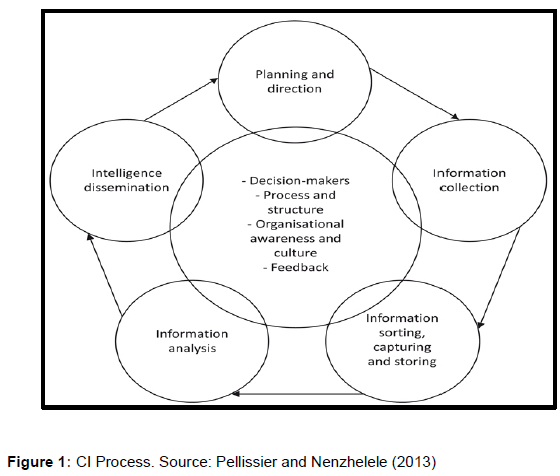
COMPETITIVE INTELLIGENCECI is about positioning oneself ahead of the competition beyond best practices by inventing new best practices to catch up and break out of an industry. The function of CI is to make available the current status of the business environment and trends to decision-makers and organisation executive management to reduce risks and uncertainties and find new opportunities (Dinu et al. 2022). HEIs have realised the importance of CI and are now utilising it for collecting, planning, distributing, updating, and decision-making for the HEI to stay competitive and relevant in the competitive environment. Therefore, CI is used to handle and decrease risk, profit from knowledge, avoid information overload, protect information privacy and security, and use organisational information strategically (Nibakabeho and Kule 2016). CI offers organisations with an impartial understanding of the market environment, reduces decision-making time, lowers risks and prevents surprises, and detects early warning signals of competitor moves, lowering uncertainty (Waithaka 2022). CI can be used in HEIs to design strategic competitiveness and comprehend the competitive environment and needs, the obstacles, stakeholders, and feedback from clients. It is an important aspect of strategic management because it is the initial link in the chain of perceptions and actions that allow an organisation to adapt to its surroundings (Nibakabeho and Kule 2016). CI should support the institution's needs to make efficient strategic planning and decisions and promote an efficient and effective decision-making process, which will lead HEI to avoid unnecessary risks while improving the strategic asset of the HEI. The CI process is essential to manage competitive advantage in the market efficiently and provide direction to act against rivals and readiness for threats and opportunities. The CI process entails monitoring competitors to give actionable and valuable intelligence to organisations (Ranjan and Foropon 2021). Figure 1 below shows the CI process.
PLANNING AND DIRECTION
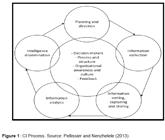
Planning is setting out activities to ensure the attainment of organisational vision and mission. In this case, it is the process of determining changes, overcasting future events, and developing the goals and objectives of the HEIs. However, planning and direction are the key steps in the CI processes because they guide strategic planning and strategic decisions of HEI management. This phase involves management deciding what intelligence is needed before formulating desired outcomes. In this light, the planning phase provides the necessary guidance for the competitive intelligence endeavor, ensuring that the operation focuses on obtaining and analyzing only important data relevant to specific intelligence objectives (Viviers, Saayman and Muller 2004). Planning is all about teamwork. Planning involves clear identification of vision and implementation plan.
Information collection
Information collection is the phase responsible for electronically extracting raw data from the public domain and converting such data into meaningful context and analysis. The collection phase entails acquiring raw data from which the necessary intelligence should be developed (Ikokoh and Ikokoh 2020). The ability to utilise the sources properly will provide several key benefits to creating and identifying the new product(s) and service(s) to develop niche markets. The main objective of the information-gathering phase is to collect information from various sources and evaluate the quality, trustworthiness, and utility of the information received (Stepanus and Endang 2019).
Information sorting, capturing and storing
The collected data is recorded, maintained, organised and delivered accurately by responsible CI practitioners. The collected information is recorded and organised using database management system software so it can be retrieved and easily accessed when needed for decision decision-making.
Information analysis
The third phase involves data analysis. It makes use of analytical tools to convert raw data into actionable intelligence (Asri and Mohsin 2020). The analysis step is the most important and challenging part of the CI cycle because it requires specialized skills and competences to provide actionable intelligence. The CI practitioner should know how to obtain and produce actionable intelligence requirements from clients. Nasri and Zarai (2013) Nasri and Zarai (2013) citing Fleischer and Bensoussan (2003) and Gray (2010) several strategic analytical techniques have been identified, including Strengths, Weaknesses, Opportunities, and Threats (SWOT) analysis, Competitor profiles, Environmental scanning, Modelling, Political, Economic, Social, Technological, Legal, and Environmental (PESTLE), Industry analysis (Porters Five Forces Model), and value chain analysis, among others.
Intelligence dissemination
The fourth phase is when the CI practitioner delivers the analytical results to those making decisions (Ikokoh and Ikokoh 2020). Intelligence dissemination involves sharing and distributing actionable intelligence with key decision-makers and strategic managers from which they formulate strategic plans. The actionable intelligence information can come in the form of electronic mail, monthly and annual reports, stakeholders' reports, budget reports, organisational memos and marketing strategies. Nasri (2012) shows that face-to-face, email, and intranet communication are also used. After the extraction and careful interaction, the designated CI practitioner analyses and understands collected information and processes such as acquired information into actionable intelligence and distributes it accordingly. The decision-makers and strategic managers check the actionable intelligence against relevancy, uncertainties, rationality and factuality. This will allow HEIs to respond quickly to a competitive environment where strategic and tactical decisions are made.
For that purpose, the CI cycle was developed to allow CI practitioners and management to prioritise information management and organisational data and even identify and analyse the risks and benefits connected with utilising CI in HEIs. The CI cycle is not only used by HEI to act against competitors, but it also enhances cooperation among different institutions and industries (Fernandez-Arais, Quevedo-Cano and Hildago 2017). CI is imperative for HEI to formulate plans and act against rivals in the competitive market and help HEI better understand how the academic industry is evolving, including how HEIs would thrill and stun their stakeholders and customers. Therefore, as stated succinctly by Fernandez-Arais, Quevedo-Cano and Hildago (2017), the CI cycle is used to collect offensive, defensive, and cooperative intelligence.
Benefits of competitive intelligence
CI has become an operative word and strategic priority for every HEI to maintain and improve its internal and external services. CI allows an organisation to have a deeper awareness of the commercial and industrial environment, as well as continual learning from competitors' strategies (Heras-Rosas and Herrera 2021). CI enables managers in organisations of any size to make decisions regarding marketing research and development, investments, and long-term organizational goals (Wathe et al. 2019). Organisations can establish a competitive advantage through CI when they commit to identifying actionable insights that lead to organizational success (Maluleka and Chummun 2023). HEIs utilise CI to monitor, grow, and sustain their edge over others in the present fourth digital revolution, where they seek to develop constant creativity to survive and prosper in the long run. An organisation's ability to succeed in the competitive landscape of today depends on its ability to mitigate the risk associated with its competitive strategy decisions (Heras-Rosas and Herrera 2021). CI has become a significant instrument in providing strategic organizational value from external data about competitors and the environment (Usaquén, García, and Otálora 2019). Organisations need to create a culture of competition and facilitate the sharing of ideas and knowledge between departments and individuals to achieve this goal (Viviers et al, 2005). Without well-defined strategic planning, HEIs will have difficulty to establish a competitive edge in the higher education market.
Challenges of competitive intelligence
There have historically been challenges and complaints from internal administrative and academic quarters when adopting a CI infrastructure within an academic institution (Barrett, 2010). Nenzhelele (2016) comments on the issue by noting that practicing CI can be challenging for organisations operating in developing nations. Despite the fact that corporate environments have effectively embraced CI tactics, comparable approaches are still not widely acknowledged as beneficial in the non-profit education sector (Barrett 2010). According to Barrett (2010), risks that are currently emerging for HEIs include dwindling enrollment, growing expenses, changing demographics, competition from online sources, fiercer fundraising circumstances, and accreditation requirements.
However, the challenges that CI presents in HEIs include but are not limited to public and private funds, resources, globalisation, competitive environment, and changes in state-market university relationships. Accessing HEI information and documentation, amongst others, in digital form has increased, making it difficult for individuals with a computer connected to the internet to access it. The internet has caused an information overload, making it challenging to practice CI (Nenzhelele, 2016). Delicate information to the HEI can be easily received by legal and ethical methods employing CI. Many HEIs publish documentation such as annual reports and the total enrolment of students for specific years.
HEIs are required to compete for research money, indicating that they possess unique traits in both teaching and research. Additionally, enticing students requires specific marketing skills to gain recognition for their competence (De Haan 2015). HEIs compete not just with private education organizations and institutions but also with one another for market share in recruiting overseas students who pay fees, providing for-profit training and education programs, and selling education services like accreditation or language testing (De Haan 2015). "These factors include the negative attitudes of managers; the organization's corporate culture not being conducive for CI; previous research failures of CI programs that have not worked out as a result of ineffective implementation; lack of understanding of the organization's strengths and weaknesses; a lack of resources to conduct CI; and, finally, the fact that CI is regarded as an additional cost for the organizations" (Sewdass 2009). Factors that hinder the use of CI in HEIs are:
• They do not see new opportunities
• Lack of innovative Thinking
• They do not have CI professionals or specialists within HEI
• Fear of the unknown
• Management skills
• There is no awareness of CI
• Lack of opportunities to expand
• Inadequate and lack of information communication technologies
• Limited resources when competing in the HEI market.
HEIs are facing mounting pressure to take a stand in any of the following areas: attracting the attention of other external agencies, securing talent (lecturers and researchers), securing students, or meeting the emergence of new social and economic demands (Garcia-Alsina, Cobarsi-Morales and Ortoll 2016).
Consequently, HEls are under increasing pressure to take on roles related to securing students, securing talent (lecturers and researchers), attracting the attention of other external agents, or meeting the emergence of new social and economic needs (Garcia-Alsina, Cobarsi-Morales, and Ortoll 2016). According to Nasri and Zarai (2013), competency-based initiatives (CI) are most successful when they are manned by skilled and trained personnel.
RESEARCH METHODOLOGY AND DESIGNMethodology and research design are necessary for every study to direct the investigation. The research approach used in this study was quantitative. Quantitative research utilizes models that are based on variables and extract information from individual cases (Borgstede and Scholz 2021). The main reason for selecting the quantitative research methodology was because it explains events by collecting exact, numerical data that is analyzed by mathematical methods, such as statistics that ask questions about who, what, where, when, how much, how many, and how (Mohajan 2020). Three HEIs in South Africa participated in a survey. The key objective for using the survey research design was to generate comparable data across subgroups of the chosen sample to identify similarities and differences. For this study, stratified sampling was chosen to select respondents for the study. The stratified sampling was chosen because it reduces the possibility of human bias in selecting cases to be included in the sample (Sharma 2017). Data was collected using a structured questionnaire. This method allows respondents to ask possible questions in case they have some doubts about the questionnaire (Mogale, Mkhomazi and Rankhumise 2018). 280 questionnaires were distributed. In this study, 280 employees were selected to whom the questionnaires were sent. Of the 280, 268 responses were received. The data was captured on a Microsoft Excel spreadsheet and further analysed using the Statistical Package for the Social Sciences (SPSS). Group #1 consisted of senior operational managers such as directors, heads of departments, and their deputies, whereas Group #2 consisted of ICT professionals working at the participating HEIs during the study period.
POPULATION AND SAMPLING OF DATA COLLECTED FROM THREE SOUTH AFRICAN HEIS NAMELY HEI A, HEI B AND HEI C.
A population is defined as the total number of items in a certain environment, whereas a research population is defined as the total number of participants in the research (Etikan, Musa and Alkassim 2016). South Africans have a total number of 26 universities and these universities are categories in two categories namely universities of technology and traditional universities (Universities South Africa 2022). Two institutions fall under the traditional universities and one falls under the University of Technology. The research that was carried out was conducted on both universities to see how competitive intelligence enhances the development and progress of these institutions. The total population that participated in this research was 1264 (N) from both HEIs.
The main objective of sampling is to obtain a representative sample consisting of a small number of units or examples chosen from a much larger group or population (Rahman et al. 2022). From the overall population of 1264 (N) that participated in the study, the sample size will be 295 (n). The sample size was determined using the Raosoft® calculator (Raosoft® Inc. USA) with a 5 per cent margin of error and a 95 per cent confidence interval (p > 0.5). The three higher education institutions stratified the sample. In this regard, the sample size was calculated by multiplying n/N by the total strata size.
The research was conducted in 3 HEIs and the participants were drawn from these selected HEIs based on their functionality, convenience, accessibility, and geographical proximity. The questionnaires were distributed to senior managers at the operational level, directors, heads of departments, and their deputies, as well as ICT staff employed by HEIs.
RESULTS
The results obtained from the 3 HEIs are presented and interpreted below from the questionnaires that were handed and collected from selected participants in three HEIs.
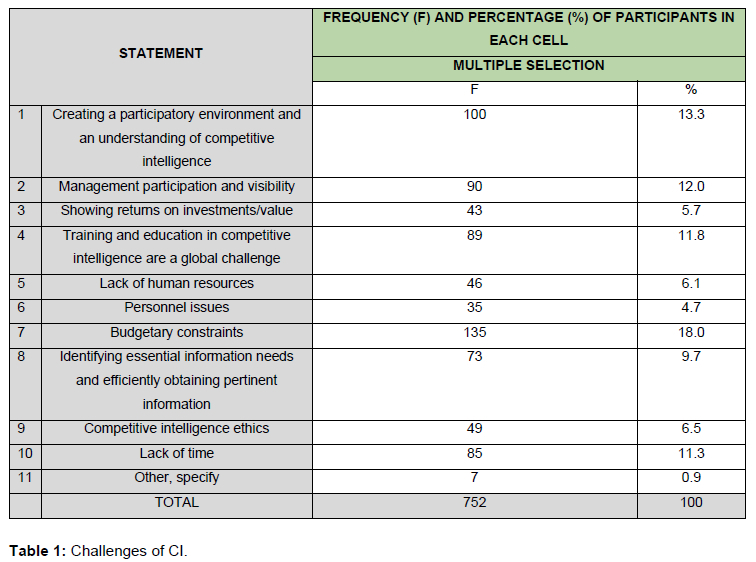
Table 1 deals with the challenges experienced by selected universities when practicing CI. The participants could select "No" or "Yes" to indicate whether they concur with the statement or not. The number of responses for each choice variable is provided in frequencies and percentages, as depicted in Table 1 below. The table is further discussed in detail below.
It is clear from Table 1 above that there were a few challenges in practicing CI in HEIs. As reported above, the participants indicated the following challenges, budgetary constraints (18.0%), creating the participatory environment and raising awareness of competitive intelligence (13.3%), Management participation and visibility (12.0%), Training and education for CI are a global challenge (11.8%), and lack of time (11.3%). According to Muller (2007), CI creates awareness and increases management visibility. This is followed by identifying important information needs and the effective and timely collection of relevant information (9.7%), CI ethics (6.5%), lack of human resources (6.1%), showing returns on investments/value (5.7%), personnel issues (4.7%) and others (0.9%). These findings contrast with those of Nenzhelele and Pellissier (2014), who discovered four major challenges for Medium-sized and small enterprises: a lack of time (99%), budgetary constraints (97%), a lack of human resources (97%), and creating a participatory environment and awareness of CI (64%). These results confirm that HEIs are facing challenges when using CI. This is a serious concern as it might hamper their ability to be more competitive. According to Nte et al. (2020:94), certain challenges of CI include organizational politics, insufficient resources, a lack of appropriate analysis and knowledge, politics, and collecting targets. According to Nenzhelele and Pellissier (2014), study participants identified additional challenges such as a lack of government support, a lack of computer skills, the unavailability of computers, the size of the organization, employees' unwillingness to collect information, and a lack of necessary skills. Muller (2007) noted that CI is on the rise and is seen as a valid management tool that enhances business and organizational competitiveness.
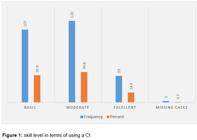
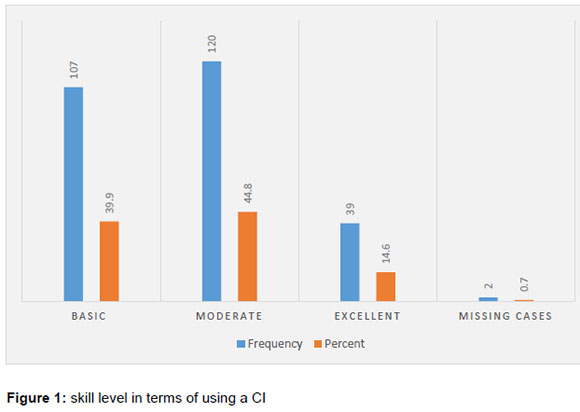
The study is also concerned with understanding the participants' skill level in utilising CI. In assessing skill level, the results in Figure 1 above indicate that half of the participants (44.3%) employed have moderate skills, followed by the basic skill, which accumulates 39.9 per cent. Evanson, Usoro and Umondo (2012) found in their studies that to properly integrate an organisation's functional areas, the employees need to possess a specialised knowledge of work applications, work measures, and work standards based on present-day technology. Strauss and Du Toit (2010) agree that CI practitioners must fully develop their talents to efficiently carry out the CI method. It is noteworthy that 14.6 per cent of the participants have excellent skills when using CI. This result clearly shows that the employees' skills in CI opportunities are concerning. This is in line with what Strauss and Du Toit (2010) It was discovered that, with a focus on CI, if personnel lack the necessary CI abilities, the CI process will not be carried out efficiently. 0.7 per cent declined to answer the question.
Question 1: "A tool to assist the university to remain competitive."
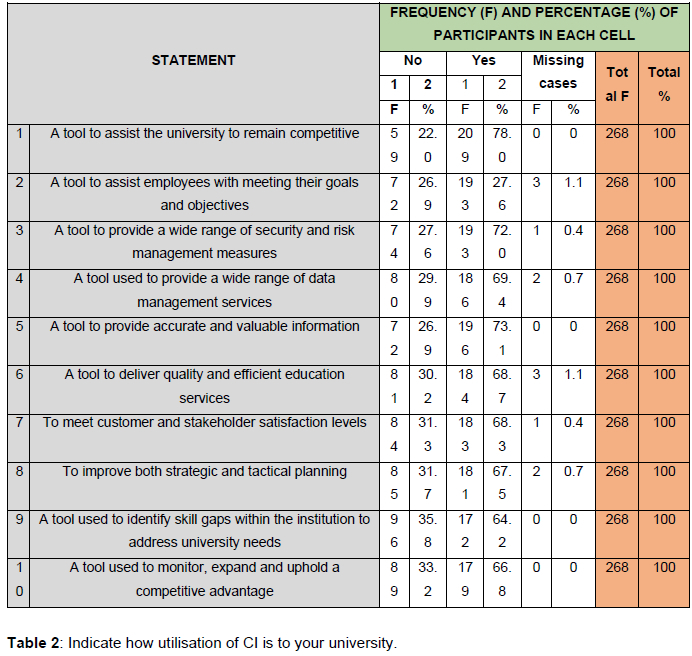
Table 2 shows that most participants, n = 209 believed that the CI is a tool to assist the university to remain competitive. This accounts for 78 per cent of the participants. A matter of concern is that 22 per cent of the n = 22 participants reported that CI is not a tool to assist the university in remaining competitive. The results show that most participants realised the importance of CI in their work environment. One can confirm that CI assists them in developing a usable set of tools and better strategies in the market. This is confirmed by Asghari et al. (2020) observed that the synergic and differentiated utilization of information and intelligent consequences of inefficient decision-making results in a competitive edge.
Question 2: "A tool to assist employees with meeting their goals and objectives."
The sample size for this question was n = 268. It is evident from the results that a majority of 72 per cent of the n = 193 participants said that CI is a tool to assist employees with meeting their goals and objectives. CI can improve the quality and expand their understanding of CI in carrying out their work. The reason n = 72 (26.9%) indicated "no" could be because they do not know what CI is or fear of the unknown. In their studies, Nte et al. (2020) concluded that CI plays an important part in the organization's growth, increased quality, and performance to establish a strong market position and compete effectively. These goals can only be achieved if all employees try to develop and sustain effective CI integration and even explore more of CI. Only 3 (1.1%) refrained from answering the question.
Question 3: "A tool to provide a wide range of security and risk management measures."
The results in Table 2 above show that the majority, 72 per cent of the 193 participants, said yes to the question, whereas the minority, 27.7 per cent of the n = 74 participants, said no. As a result, by keeping a close watch on processes and areas of business management, people can discover uncertainties and potential dangers. Then they may more correctly analyze the serious effects of the risk and find response measures employing numerous comprehensive approaches routinely and continually. (Zha and Chen 2009). These results strengthen the notion that CI would be better understood if all employees agreed on the question. CI's objectives are to manage and reduce risk, and use corporate information strategically to enhance a firm's competitiveness while lessening its rivals' competitive advantages (Tahmasebifard 2018).
Question 4: "A tool used to provide a wide range of data management services."
From the data depicted in Table 2 above, it is evident that the majority 69.9 per cent of the n = 186 participants indicated that CI is a tool used to provide a wide range of data management services whereas a low percentage of no answer was recorded from 29.9 per cent of the n = 80 participants. Data and information management are the cornerstone of CI. For clarification purposes, El-Fadili and Gmira (2017) provide that the crucial characteristic of knowledge is to be able to generate new knowledge through a feedback process. At the same time, information is extracted from data and is carried out simply by duplication, as indicated in Figure 5.7. Most organisations avoid the duplication of information and manage data to protect their organisation.

The researcher believes that data management and CI share a complementary aspect of organisational strategy or vice versa because both intend to have actionable intelligence and eventually improve HEI performance.
Question 5: "A tool to provide accurate and valuable information."
It is evident from the data in Table 2 that CI can provide accurate and valuable information in the selected HEIs. This is confirmed by the 73.1 per cent of the n = 196 participants, whereas 26.9 per cent of the 72 participants did not agree with the question. However, having relevant equipment will assist them in providing timely, accurate, and valuable information intended to identify and exploit the advantages.
Question 6: "A tool to deliver quality and efficient education services."
Table 2 above depicts that 68.7 per cent of the n = 84 participants answered with "yes", whereas a much smaller group of 30.2 per cent of the n = 81 answered with "no". This result suggests that for most participants, CI assists in delivering quality and efficient education services. This could assist the HEIs in ensuring that the employees are doing well and aligned with the strategic planning and goals of the HEIs.
Question 7: "To meet customer and stakeholder satisfaction levels."
It is evident that for a significant 68.3 per cent of the n = 183 participants, as indicated in Table 2, CI meets customer and stakeholder satisfaction levels. This result suggests that most participants are encouraged and committed to using the CI in their respective divisions. A matter of concern is that 31.3 per cent of the n = 84 participants reported that CI does not assist them in meeting customer and stakeholder satisfaction levels. This is confirmed by Heppes and Du Toit (2009) that CI professionals are educated from the start that their principal role is to service the customers' intelligence requests, whoever these customers are and whatever needs they may have. These results confirm that the success of selected HEIs relies on how satisfied your customer is with your services. Therefore, CI improves the satisfaction and retention of the customer.
Question 8: "To improve both strategic and tactical planning."
A total of 67.5 per cent of the n = 181 participants, as indicated in Table 2, selected "Yes", and 31.7 per cent of the 85 participants selected "No". The sample size for this question was n= 268. There is much difference between the percentages for "Yes" and "No". It is clear from the results that most participants were in favour of the statement. As indicated by Heppes and Du Toit (2009), the CI function is used to support several levels of decision-making. Miller (2000) contends that tactical needs are equally important as strategic needs, and that it is a mistake to believe that they are more important than tactical needs. In this sense, CI can be used in strategic or tactical planning to improve the quality of decisions. Cavallo et al. (2020) agreed that the primary goal is to assist decision-makers in strategic planning, transitioning from knowledge to intelligence with more insight or understanding. Badr, Madden, and Wright (2006) found in their study that 73.6 per cent of participants indicated that CI is important for developing new marketing strategies and tactics.
Question 9: "A tool used to identify skill gaps within the institution to address university needs."
The sample size for this question was n= 268. A total of 64.2 per cent of the n = 172 participants, as indicated in Table 2, selected "Yes", and 35.8 per cent of the 96 participants selected "No". The conclusion, As a result, there is a disparity between what participants consider significant skills and their competency levels in those specified skills (Strauss and Du Toit 2010).
Question 10: "A tool used to monitor, expand and uphold a competitive advantage."
For clarification purposes, Amiri et al. (2017) indicated the primary characteristics of competitive advantage are efficiency, quality, innovation, and client responsiveness. Table 2 shows that the majority (66.8 per cent) of participants stated that CI is used to monitor, expand and uphold a competitive advantage, whereas 33.3 per cent of the participants believed that CI is not a tool used to monitor, expand and uphold a competitive advantage. The results suggest that CI is imperative gain a competitive advantage. CI allows organizations to generate emergent strategies over time, which can assist retain and enhance competitive advantage to remain ahead of competitors and the market (Stenberg and Vu-Thi, 2017).
DISCUSSION
Based on the findings, the conclusion is that CI play a strategic role by aiding HEIs in identifying risks and opportunities, developing institutional strategies, and mitigating the effects of challenges to their performance. Rantanen (2017) discovered that HEIs are continually modifying their offerings, and CI is still vital for HEIs to keep a competitive advantage in today's uncertain environment. As a result, HEIs rely on CI to keep ahead of trends and anticipate future events. The obtained results from the selected HEIs indicate that the selected HEIs currently there rely on technological devices to carry out their operations on a daily basis including keeping taps on their competitors. However, the overall results show that with the adoption of competitive intelligence, HEIs can provide more effective and efficient service without any hassles and meet their mandate.
SIGNIFICANCE OF THE STUDY• This study adds value to how CI is implemented and managed in institutions of higher learning.
o It accelerates innovation and service delivery, as well as maintains stakeholders' satisfaction.
LIMITATIONS OF THE STUDYThe study was conducted during COVID-19's lockdown period, which made data collecting challenging due to limited access and lockdown constraints. Covid-19 contributed to the study's limitations, and not all questions were able to be collected, even though the researcher was able to collect some of the questionnaires. Another limitations was the data collection process as not all the questionnaires were returned for analysis. Finally, the study was limited to three selected HEIs, and the researcher did not approach all South African HEIs. As a result, the findings cannot be generalised.
RECOMMENDATIONSThe following recommendations are based on the empirical aim, findings, and interpretation of the study's conclusions acquired through questionnaire responses.
• This study recommends collaboration and cooperation between HEIs and CI consulting companies. This will allow the smooth delivery of services as the HEI will understand the importance of CI utilisation and its obligation to provide quality services with high commitment.
• HEIs should invest in CI to prioritise an ever-changing business environment. Moreover, CI professionals should possess the necessary key competencies like practical and theoretical skills (e.g. ability to plan, collect information, analyse information, disseminate information digitally, assess and solve problems, adapt and pay attention to details) stipulated by the CI department.
FURTHER RESEARCHThis study recommends that based on the data analysis, findings, conclusions, and limitations of the study, the following additional research studies be done in the future:
• This study could be conducted in over 26 public HEIs and private HEIs in South Africa. HEI ministers, directors general, vice-chancellors, and HEI councils.
• Study the benefits and challenges for employees who attend CI seminars and conferences as a training and development method.
CONCLUSION
CI has an imperative role in the succession of the HEIs when is well adopted and utilised. The research study showed how the utilisation of CI forms an integral part of the HEIs as confirmed by the participants. CI in HEIs is crucial because the facilitates information collection, information storage and information dissemination. In conclusion, the HEIs can meet their obligation through the utilisation of CI methods.
REFERENCES
LITERATURE REVIEW
- Abolarinwa, S.T. and J.A. Yaya. 2015. Utilization of competitive intelligence by health information workers of the Nigerian institute of medical research. Pyrex Journal of Library and Information Science, 1(5): 36-40.
- Amiri, N.S., S. Shirkavand, M. Chalak and N. Rezaeei. 2017. Competitive intelligence and developing sustainable competitive advantage. AD-minister, 173-194.
- Asghari, S., S. Targholi, A. Kazemi, S. Shahriyari and L. Rajabion. 2020. A new conceptual framework for identifying the factors influencing the effectiveness of competitive intelligence. Competitiveness Review: An International Business Journal, 30(5): 555-576.
- Asri, D.A.A.M and A.M.B.A. Mohsin. 2020. Competitive Intelligence Practices and Organizational Performance Linkage: A Review. Jurnal Intelek, 15(2): 101-115.
- Badr, A., E. Madden and S. Wright. 2006. The Contribution of CI to the Strategic Decision-Making Process: Empirical study of the European pharmaceutical industry. Journal of Competitive Intelligence and Management, 3(4): 15-35.
- Barrett, S.E. 2010. Competitive Intelligence: Significance in Higher Education. World Future Review, 2(4): 26-30.
- Bisaria, G. 2013. Achieving Competitive Advantage By Private Management Colleges or Private Universities. International Journal of Social Science & Interdisciplinary Research. 2: 1-12.
- Borgstede, M. and M. Scholz. 2021. Quantitative and qualitative approaches to generalization and replication-a representationalist view. Frontier Psychology, 12: 1-9.
- Cavallo, A., S. Sanasi, A. Ghezzi, and A. Rangone. 2020. Competitive intelligence and strategy formulation: connecting the dots. Competitiveness Review: An International Business Journal, 31(2): 250-275.
- De Haan, H.H. 2015. Competitive advantage, what does it really mean in the context of public higher education institutions? International Journal of Educational Management, 29(1): 44-61.
- Dinu, D.G., A.S. Karadeli, L. Mihoreanu, E.L.P. Gabará and M. Pãduraru. 2022. Competitive Intelligence and Academic Entrepreneurship as Innovative Vectors of a Resilient, Business-Oriented Education. Journal of Economic Development, Environment and People, 11(4): 110-122.
- El-Fadili, S. and F. Gmira. 2017. Competitive intelligence and knowledge management: an analysis of the literature. Saudi Journal of Business and Management Studies, 2(6): 614-620.
- Fernandez-Arais, M., P. Quevedo-Cano and A. Hidalgo. 2017. Relevance of the Competitive Intelligence process on the Spanish pharmaceutical companies. Brazilian Journal of Operations and Production Management. 14. 112-117.
- Garcia-Alsina, M., E. Cobarsi-Morales and E. Ortoll. 2016. Competitive intelligence theoretical framework and practices: The case of Spanish universities. Aslib Journal of Information Management, 68(1): 57-75.
- Heppes, S. and A. Du Toit, A. 2009. Level of maturity of the competitive intelligence function Case study of a retail bank in South Africa. Aslib Proceedings: New Information Perspectives, 61(1): 4866.
- Heras-Rosas, D.C. and J. Herrera. 2021. Innovation and Competitive Intelligence in Business. A Bibliometric Analysis. International Journal of Financial Studies, 9(31): 1-18.
- Ikokoh, C.E. and J.J. Ikokoh. 2020. Differences between competitive Advantage and competitive intelligence in Legislative libraries. Jewel Journal of Librarianship, 15(2): 118-128.
- Maluleka, M.L. and B.Z. Chummun. 2023. Developing a conceptual framework: influencing the competitive intelligence embeddedness in organisations. Academy of Strategic Management Journal, 22(2): 1-22.
- Miotto, G., C. Del-Castillo-Feito and A. Blanco-González. 2021. Reputation and legitimacy: Key factors for Higher Education Institutions sustained competitive advantage. Journal of Business Research, 112: 342-353.
- Mogale, R. J., S. S. Mkhomazi and R. M. Rankhumise. 2018. The Paradox of Emerging Technologies in Playing Fundamental Role on Administration Employees Roles and Responsibilities. Journal of Economics and Behavioral Studies, 10(1): 159-170.
- Mohajan, H. 2020. Quantitative Research: A Successful Investigation in Natural and Social Sciences. Journal of economic development, environment and people, 9(4): 52-79.
- Muller, M.L. 2007. Competitive intelligence in business: Latin America. South African Journal of Information Management, 9(3): 1-7.
- Nasri, W. 2012. Conceptual model of strategic benefits of competitive intelligence process. International Journal of Business and Commerce, 1(6): 25-35.
- Nasri, W. and M. Zarai. 2013. Key Success Factors for Developing Competitive Intelligence in Organisation. American Journal of Business and Management, 2(3): 239-244.
- Nenzhelele, T.E. 2016a. Competitive intelligence practice in the South African property sector. South African Journal of Information Management, 18(2): 1-11.
- Nenzhelele, T.E. 2016b. Competitive intelligence practice challenges in the South African property sector. Problems and Perspectives in Management, 14(2): 298-305.
- Nenzhelele, T.E. and R. Pellissier. 2014. Competitive Intelligence Implementation Challenges of Small and Medium-Sized Enterprises. Mediterranean Journal of Social Sciences, 5(16), 92-99.
- Nibakabeho, T. and J. W. Kule. 2016. Assessment of the effect of competitive intelligence on market success in the media industry in Rwanda: a case of nation media group. European Journal of Business and Social Sciences, 5(6): 224-245.
- Nte, N.D., K. N. Omede, B. K. Enokie and O. BienosE. 2020. Competitive Intelligence and Competitive Advantage in Pharmaceutical Firms in Developing Economies: A Review of Lagos State, Nigeria. Journal of Intelligence Studies in Business, 10(3): 38-68.
- Pellissier, R. and T.E. Nenzhelele. 2013. Towards a universal definition of competitive intelligence: South African Journal of Information Management, 15(2): 1-7.
- Rahman, M., M. Tabash, A. Salamzadeh S. Abduli and S. Rahaman. 2022. Sampling techniques (probability) for quantitative social science researchers: a conceptual guidelines with examples. SEEU Review, 17: 42-51.
- Ranjan, J. and C. Foropon. 2021. Big Data Analytics in Building the Competitive Intelligence of Organizations. International Journal of Information Management, 56: 1-13.
- Rantanen, A. 2017. Creation of competitive intelligence system. M.Tech Dissertation, Lappeenranta University of Technology.
- Sewdass, N. 2009. The implementation of competitive intelligence tools and techniques in public service departments in South Africa to improve service delivery: a case study of the Department of Home Affairs. DPhil Thesis, University of South Africa.
- Sharma, G. 2017. Pros and cons of different sampling techniques. International Journal of Applied Research, 3(7): 749-752.
-
Stenberg, E., and X. Vu-Thi. 2017. The Impact of Competitor Intelligence on Strategy Building, [ONLINE]. Available at: http://um.kb.se/resolve?um=um:nbn:se:hh:diva-33313 [Accessed: 23 March 2022].
» http://um.kb.se/resolve?um=um:nbn:se:hh:diva-33313 - Stepanus, S. and H. Endang. 2019. Competitive intelligence and sustainable competitive advantage in middle school institutions. Advances in Social Science, Education and Humanities Research, 400: 17 -22.
- Tahmasebifard, H. 2018. The role of competitive intelligence and its subtypes on achieving market performance. Cogent Business and Management, 5(1):1-16.
- Usaquén, M.Á.O., V.H.M. García and J.E. Otálora. 2019. Design of a competitive intelligence system for the meat sector in Colombia using business intelligence. Communications in Computer and Information Science, 1027: 489-499.
- Viviers, W., A. Saayman and M. L. Muller. 2004. Competitive intelligence in South Africa: 1999-2002 and beyond. Africa Insight, 34(3): 90-96.
- Viviers, W., A. Saayman and M. L. Muller. 2005. Enhancing a competitive intelligence culture in South Africa. International Journal of Social Economics, 32: 576-589.
- Waithaka, P. 2022. strategic inputs of competitive intelligence and competitive advantage among commercial banks, in Kenya. American Journal of Strategic Studies, 4(1): 1-29.
- Wathe, J. M.,M. A. Iravo, J. Nzulwa and A. Rukia. 2019. Influence of competitive intelligence on the relationship between strategy formulation and performance of companies listed on Nairobi Securities Exchange in Kenya. The Strategic Journal of Business and Change Management, 6(2): 1619-1634.
- Zha, X. and M. Chen. 2009. 2009. Competitive Intelligence Monitoring in the Risk Prevention of SMEs. Journal of Service Science and Management, 2(3): 230-235