The performance and analysis of pre-service teachers' cognitive demands and content domains in primary mathematics education
Abstract
Teacher educators in universities globally and in South Africa struggle to prepare and challenge primary school preservice teachers with mathematics content that demands them to reason at a higher level of cognition. This article provides an analysis of cognitive demands and content domains of fourth-year preservice teachers at a South African university who are trained to teach mathematics in the intermediate phase. In this mixed-method research study, a total of 30 fourth-year students participated in an online Primary Teacher Education (PrimTed) test. The data from the PrimTed online test were analysed using MS Excel version 2207 software and manually sorted to identify higher-order responses to answer the research question. The findings revealed that the fourth-year students performed high on lower-order concepts and low on higher-order concepts. The findings also reveal that preservice teachers performed low on decimals, measurement, and pattern tasks. The conclusion is that teacher education programmes in similar higher education institutions need to emphasise the analysis and interpretation of higher-order thinking skills for fourth-year student teachers.
Content domains; Cognitive demands; Higher-order thinking; Initial teacher education; Lower-order thinking
INTRODUCTION
The teacher educators in Universities in South Africa and globally struggle to challenge and prepare preservice teachers in primary schools with mathematics that demands higher-order reasoning. Kilic (2010) argues that the major goal of teacher education programmes is to help preservice teachers improve their knowledge and skills for effective teaching through coursework and practice. This means that when the curriculum for teacher education is designed and developed, it should consider the level of knowledge that the preservice teachers require to have an impact in mathematics classrooms (Koponen et al 2017).
Cognitive demands
Mathematical Knowledge for Teaching (MKT) has been the subject of interest in some studies that focus on the training of mathematics teachers. Hill, Rowan, and Ball (2004) defined MKT as the mathematical content and skills that enable individuals to teach mathematics. Most of the research in this area has concentrated on teachers who have already completed their preservice teacher training and are employed to teach mathematics in different primary and secondary schools. Some studies that investigated MKT of preservice teachers focused on using manipulatives and problem-based learning (Arnal-Bailera and Arnal-Palacián, 2023; Novikasari, 2020). A limited number of studies on preservice teachers have focused on cognitive demands and content domains in displaying MKT. However, one of the studies that have been undertaken on preservice teachers is by Ndlovu, Amin, and Samuel (2017) who found that preservice teachers in mathematics were able to solve problems on the topics of Functions and Inequalities. Moreover, Livy and Vale (2011) investigated the First year PSTs mathematical content knowledge in the following content areas: Numbers, Fractions, Decimals, Percentages, Ratio, Space, Area, Volume, Measurement, Chance, and Data. The results indicated that the first-year PSTs performed the lowest in the two content areas. Our article reports on a study that was undertaken to look at the cognitive demands and knowledge domains of PSTs, specifically looking at selected primary mathematics topics in grades 4-7. In South Africa, grades 4-7 are part of the primary school and primary schools start from grades R-7. There could be challenges related to content for preservice teachers when they are introduced to grade 7 content.
For this study, the Faculty of Education accepts student teachers who passed grade 12 mathematics with 50 per cent to the intermediate phase programme, and they are expected to perform at a high level of cognition when working with the intermediate phase mathematics content. Hence, this study selected fourth-year students who have acquired mathematics content knowledge in the first, second, and third years of study. The assumption is that they possess the cognitive demands and content knowledge to teach in grades 4-7 mathematics.
Cognitive Demands
Studies on cognitive demands reveal that fourth-year student teachers have difficulty distinguishing between the highest cognitive demand procedures with connections and doing mathematics (Basyal, Jones, and Thapa, 2023; Wakhata, Mutarutinya, and Balimuttajjo, 2023). Anthony, Walton, and Viviani (2020) examined how preservice teachers conceptualise cognitive demands when selecting a task. Their findings revealed that preservice teachers tend to operationalise the cognitive demands to support learners' disposition and ability to determine the problem difficulty. Moreover, when the objective of learning is to cultivate problem-solving skills, then, students should engage with tasks that require high levels of cognitive effort and can promote deeper thinking (Estrella, Zakaryan, Olfos, and Espinoza, 2020).
Cheng, Feldman, and Chapin (2011) conducted a study that focused on student teachers (preservice teachers). Our study is similar to that of Cheng et al. in several ways. Firstly, the study largely focused on primary school mathematics. The content domains we looked at are covered in the primary school mathematics content. This is similar to the study by Cheng, et al (2011) who also looked at the same content domains. The two studies also focused on a small group of PSTs' mathematical thinking in low and higher order. From the findings of Cheng et al. (2011), the PSTs maintained a high level of cognitive demand when these aspects of providing explanations, justifying procedures, and making generalisations were tested. Preservice teachers participating in the study consistently asked each other (in their small groups) for explanations and were often dissatisfied with correct solutions that they did not understand clearly.
Our study aligns with the study of Rinjaya and Halimi (2022) who state that the last three levels of the revised Bloom's Taxonomy (RBT) namely create, evaluation, and synthesis are the high cognitive demands also known as higher-order thinking skills (HOTS). Our view is that the content domain is essential to determine the level of cognitive demand of tasks of fourth-year student teachers; however, through observation of fourth-year student teachers' selection of tasks, they identify low-level tasks as high-level tasks, such as acquiring manipulatives and real-world context (Lin and Tsai, 2015).
Multiple choice items
Developing well-crafted multiple-choice items require relevant knowledge and skills in analysing and interpreting the content domains and the cognitive demands. This view agrees with the work of Catanzano, Jordan and Lewis (2022) who argue that well-crafted multiple-choice items are a proven method of testing learners' understanding of a specific topic. However, the number of response options on an item increases the difficulty of the task and increases the test-taker chance of selecting a distractor item (Butler 2018). Multiple choice items provide an opportunity for test developers to analyse the scores of each test item quickly and use this information to improve future assessments (Scully, 2017). In our study, we selected specific mathematics topics to assess cognitive demands and knowledge domains through multiple-choice items in the Grade 4-7 curriculum. We agree with Scully (2017) that even though multiple-choice items are helpful and can be analysed quickly, such items do not measure a fully exhaustive range of thinking skills. Even though there are limitations with multiple-choice items, well-constructed items that require a high level of cognition may provide an opportunity to assess preservice teachers' knowledge of the content domains selected. However, the advantage is that multiple-choice items provide preservice teachers with an opportunity to use their reasoning.
"Assessing higher-order thinking skills (HOTS) related scores requires high cognitive effort from students because teachers assess them on multiple criteria and need to process complex structures and concepts" (Jansen & Möller, 2022, p. 3). For mathematical concepts to appropriately assess students' HOTS, teachers need not focus on lower-order thinking skills (LOTS) related to performance but should focus on the development of HOTS. In our study, we explain the lower cognitive demands in line with the work of Jansen and Moller (2022) in which the demands involve remembering, understanding, and applying given information. Students who have low-order thinking skills in mathematics content domains may struggle to develop and assess learners reasoning at a high-order level.
Conceptual Framework and Mathematical Tasks Framework
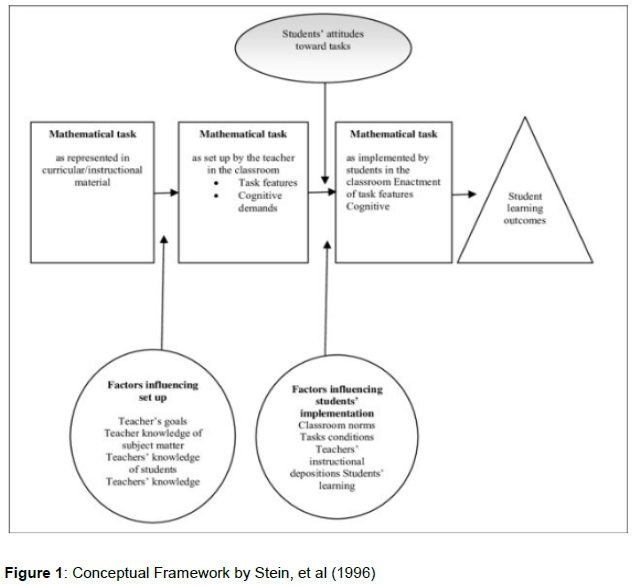
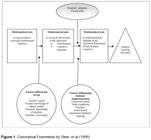
This study (as part of the bigger and broader PrimTEd Study) followed the Conceptual Framework developed by Stein, Grover, and Henningsen (1996).
Stein, et al. (1996, p. 460) state that a mathematical task is "a classroom activity, the purpose of which is to focus students' attention on a particular mathematical idea". Stein et al. (1996) further indicate that "[a]n activity is not classified as a different or new task unless the underlying mathematical idea toward which the activity is oriented changes" (Stein, et al. (1996, p. 460). The framework by Stein, et al. (1996) proposes a set of differentiated mathematics tasks in line with the different cognitive demands. The high-level cognitive demands require the students to engage in complex thinking and reasoning strategies as they solve the mathematics task, whereas the low-level cognitive demands would require students to solve problems through memorisation and the use of procedures and algorithms that are easy to follow and apply. Mathematics tasks at this level do not require the student to engage in deep thinking, analysis, and reasoning.
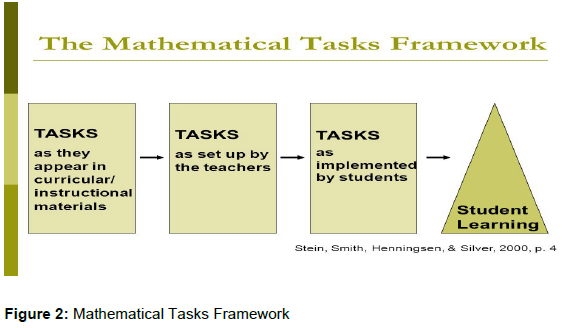
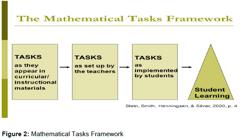
The Mathematics Task Framework (Stein et al, 2000) distinguishes three phases through which tasks pass. First, they appear in curricular or instructional materials on the printed pages of textbooks, ancillary materials, and so on. In the second phase, Tasks are set up or announced by the teacher to the students. Finally, they are implemented by students in the classroom - in other words, how students go about working on the task. All these, but especially the implementation phase, are viewed as important influences on what students learn and are illustrated by the triangle in Figure 2.
Context of the study
This article reports on an analysis of grades 4-7 selected mathematics topics when assessing student teachers' cognitive demands and knowledge domains in their fourth year of study. The PrimTEd online test was written under one unit (assessment strand) of a bigger study on the Teaching and Learning Development Capacity Improvement Programme (TLDCIP) which was funded by the Department of Higher Education and Training in partnership with the European Union. The PrimTEd assessment strand comprises teacher educators in South African universities who prepare preservice education students in the common core set of standards for primary school mathematics teaching. One of the roles of the initiators of Primed project was to develop and validate the standard of PrimTed online test and share learning materials and approaches to work-integrated learning. In the analysis reported in this article, the authors used the PrimTEd online mathematics test developed in 2018 to test the fourth-year student teachers' performance on the cognitive demands and the content domains.
Research questions
The research questions that we used to guide this study are:
What is the performance of fourth-year student teachers on content demands and cognitive domains on PrimTed online mathematics test?
How can the fourth-year student teachers' content domains with higher-order cognitive demands in a PrimTed Online Test be interpreted and understood?
METHODOLOGY
The mixed-method research approach used in this study followed an embedded design (Schooneboom, and Johnson, 2017). The PrimTed online test collected quantitative data in the form of scores and included the data on higher-order items. Data from the PrimTEd online test were analysed using MS Excel version 2207 software and data from selected higher-order items were sorted manually with a focus on answering the second research question. The ethical approval for the study was obtained from The Ethical Clearance Number: 2017-072 which was obtained through the University of Johannesburg ethics committee and permission was sought at the university where data was collected. A total of 30 fourth-year student teachers in University A in the Free State province of South Africa voluntarily participated in the online PrimTEd test and they completed the consent forms before completing the test. The Curriculum and Assessment Policy Statement (CAPS) was used as a guide to develop the PrimTEd online test. The five content domains from the CAPS document for the Senior Phase (Grades 7-9) were distributed as follows:
i. Whole Numbers: Twelve (12) questions out of 50 (24%)
ii. Rational Numbers: and Operations: Nineteen (19) questions out of 50 (38%)
iii. Patterns, Functions, and Algebra: Eight (8) questions out of 50 (16%)
iv. Geometry: Four (4) questions out of 50 (8%)
v. Measurement: Seven (7) questions out of 50 (14%)
The first part of the study focuses on all 50 items and the second part looks at 45 items that focus on low and higher-order cognitive demands. Data from the PrimTed Test were analysed descriptively and inferentially and the data from the higher-order thinking were analysed manually.
RESULTS
The results are presented in two ways, one descriptively and one thematically. Data presented descriptively helped to identify the lower-order and higher-order items in the PrimTed online test. Data presented thematically looked at selected higher-order thinking items from the PrimTed online test. The selected items are looked at in-depth to understand the fourth-year student teachers' performance concerning higher-order thinking skills.
The Performance and Analysis of Pre-Service Teachers' Cognitive Demands and Content Domains in Primary Mathematics Education
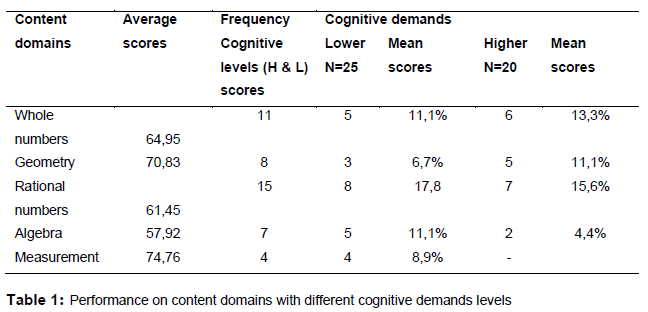
The results from Table 1 represent the content domains and cognitive demands. The content domains are subdivided into five categories and the cognitive demands are categorised into two lower and higher cognitive demands. Table 1 also shows the performance of participants in all five content domains. The PrimTEd test comprised 50 items, five of the items focused on pedagogy while 45 items focused on cognitive demands. We considered the scores of the participants on the higher-order concepts by interpreting the lowest scores obtained.
Table 1 also shows that participants performed lower in algebra and rational numbers as compared to the other topics. This suggests that the PSTs who participated in the study need to be supported more in the two topics. However, this does not suggest that they should not be supported in whole numbers, geometry, and measurement. Due to the selected items on the PrimTEd test, the participants require continuous assessment of the five content domains that are presented at a higher level of cognitive demands.
In this article, we classified the cognitive demands into two, low and high cognitive levels, and five content domains which are whole numbers, geometry, rational numbers, algebra, and measurement. Data show that a large part of the PrimTEd test was on lower-order cognitive demands and higher-order cognitive levels.
From the PrimTEd test, participants scored low on five items (items 37, 38, 41, 42, and 45) on higher-order cognitive domains. These items are presented below one after the other to explain each item and the difficulties associated with each task based on higher-order cognitive demands.
Item 37
In Item 37, attention is paid to participants (67,7%) who got an incorrect answer when they were required to choose the calculation with the largest answer from those given as (a). 72,4 ÷  , b. 72,4 ×
 , c. 72,4 ÷
 , d. 72,4 ×
 . Ten out of 30 (33.3%) participants got the answer correct of 72,4 × . The participants could have generalised the rule used in whole numbers that multiplication makes a number bigger (Bush, Karp, and Dougherty 2020), which creates confusion for the learners. For example, 1 x 0 = 0. This does not make the number bigger, and a contradiction exists which contributes to a few misconceptions. Another rule that may cause contradictions when working with a division of decimal numbers is when dividing you make the number smaller (Reifman, 2011), taken from natural and whole numbers. When teachers teach, they explain that division makes the number smaller which creates confusion in middle school and beyond (Bush, Karp, and Dougherty 2020), if the teacher has not clarified that division makes the number bigger in fraction and decimal numbers. If the confusion is not removed from the learners, they are likely to get the misconception from the preservice teachers when working with decimal numbers involving division and multiplication.
Further analysis of the multiple-choice item poses challenges to participants in selecting the correct answer. In addition, Simkin and Kuechler (2005) state that analysis is the ability to recognise and discuss why one type of data structure was chosen over another in each application. The participants need relevant knowledge of rational numbers. Furthermore, Chinnappan and Forrester (2014) state that the PSTs' knowledge of fractions involving division is less likely to support learners' conceptual knowledge due to the lack of a key construct that serves as a base for fractions that form part-whole relationships.
Item 38
In item 38 attention was paid to participants who got incorrect answers to non-standard measurements. They could not find the number of pieces of chalk that were relevant to measuring the height of a big house when the small house and big house were drawn on the blackboard. The small house is six small chalk pieces high, and when measured with a pencil, it was four pencils high. The correct answer for a big house was six pencils high, and 3 out of 30 (10%) participants got the correct answer. This suggests that the participants performed very poorly on measurement tasks that require higher-order cognitive demand. Our finding agrees with that of Uhlířová, Laitochová, and Kočařová (2022) who further state that future teachers often hesitate when working with non-standard problems and are not sure of the correctness of their solutions.
Item 41
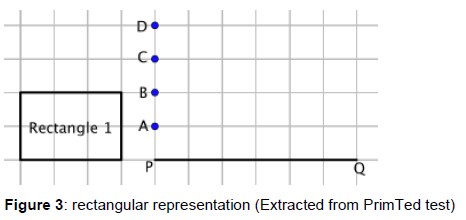
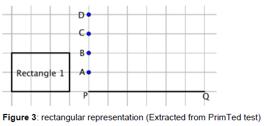
In Item 41, attention is given to participants who scored low on a task involving doubling the area of a rectangle drawn on a grid. Given the figure below, the participants were required to identify the point from A, B, C, and D that would be the corner for the new rectangle.
From Figure 3 above, item 41 also shows three out of 30 (10%) participants got the correct answer of B. This suggests that the participants lacked the knowledge of enlarging the object by doubling the squares in rectangle 1 to find the size of the new rectangle. Attention to developing ways of supporting participants who lack knowledge in enlarging the rectangle is warranted. In addition, inadequate teacher knowledge of transformation geometry (Mbusi and Luneta 2021) requires mediation that pays attention to preservice teachers' faulty reasoning shown in the errors they make. Furthermore, Makamure and Jojo (2020) pointed out the lack of literature on the way visual-spatial skills influence the coordinate geometry conceptualisation of content for preservice mathematics teachers.
Item 42
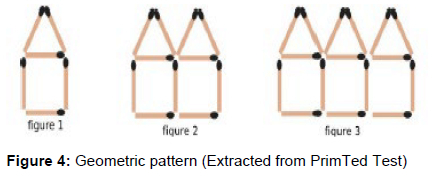
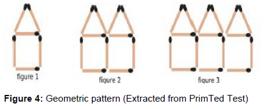
Item 42 deals with the performance of participants in geometric patterns. The participants were required to continue with the pattern below to find Figure 30.
In Figure 4, item 42, the participants were required to find the number of matchsticks needed to create Figure 30 on the pattern. Ten (33.3%) participants got the correct answer of 151 matchsticks. This suggests that most participants lack the spatial and patterning skills to answer item 42 which involves geometric patterns in a PrimTEd test. Learners may require spatial skills to complete repeated patterning tasks (Rittle-Johnson, Zippert, and Boice 2019, p. 168) when tasks include working with visual patterns constructed with objects.
Item 45
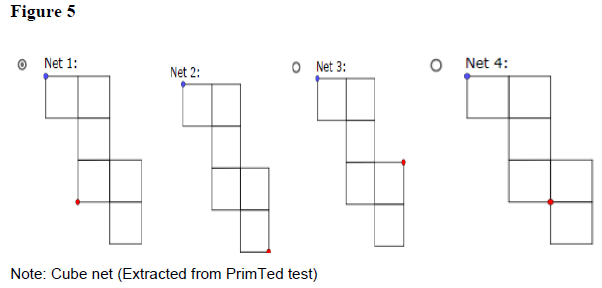
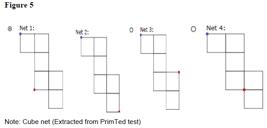
In Item 45, the student teachers were required to identify a net that completes a three-dimensional shape of a geometric shape involving a net of a cube. The participants were required to identify a net that would make a cube with a blue dot ending at the same corner as the red dot.
In Figure 5, item 45, net 1 can make a cube where the blue dot would be at the same corner as the red dot. Nine (30%) participants got the correct answer. This suggests that most of the participants struggle to visualise the net as it forms a cube. It is not difficult to identify that the net represents the cube, but it is more difficult to imagine that the marked sides also meet in the folded cube (Đokić, Jelić, and Ilić, 2020, p. 6). The participants struggle when working with nets and cubes that involve identifying the sides. Đokić et al (2020, p. 6) comprehend that this requires different types of mental transformations of three-dimensional objects to be explored such as rotation or folding and unfolding of figures. Nonetheless, the sample used in this study is small. However, this issue needs to be explored further using different types of mental transformation with a bigger sample size. According to Denizli and Erdoğan (2022), recognising and understanding the appearance of 3D objects from different directions is a basic skill of geometric thinking. Denizli and Erdoğan (2022) further argue that recognising structures made up of identical objects involves analysing and visualising objects with their views from various directions and mentally constructing their abstract components. Suselo, Wünsche, and Luxton-Reilly (2022) argue that students struggle to interpret and transform 3D images and make a suitable mental model due to a lack of spatial reasoning skills.
DISCUSSION OF THE FINDINGS
This study sought to consider the performance and analysis of pre-service teachers' cognitive demands and content domains in Primary Mathematics Education. The findings show that the fourth-year student teachers perform higher in three (measurement, geometry, and whole numbers) and lower in two (rational numbers and algebra) selected mathematics topics arranged in lower and higher cognitive demands. Moreover, the fourth-year students performed low in five content items on higher-order items, namely decimal numbers, non-standard units of measuring length, doubling area, patterns, and the net of a cube. Furthermore, they performed higher on lower-order items than on higher-order items. The results of our study agree with the study by Fonseca, Maseko, and Roberts (2018) regarding the higher scores of lower-order items than the higher-order items.
Fourth-year PSTs study decimal numbers in their second year of study, accommodating lower and higher-order cognitive demands. It should be noted that decimal numbers are important when working with fractions to understand part-whole relationships. The way the topic is presented may be a challenge to fourth-year student teachers. Ayieko, Moreano, and Harter (2022) assert that there is a missed opportunity for preservice teachers to expand their knowledge by studying important topics that have been identified as problematic in learners.
Although the CAPS document outlined the use of non-standard measurement, these non-standard units of measurement are not emphasised since that is not part of the syllabus for preservice teachers. Chamberlin and Candelaria (2018) assert that some activities may start with non-standard units and move to standard units when learners are ready. This could help the fourth-year student teachers to develop teaching activities that are related to learners' daily lives when working with non-standard units of measurement.
The fourth-year PSTs study area model their first year of study; however, the emphasis is on problem-solving strategies. Here attention is paid to the fourth-year students' low score on higher-order items in measurements involving doubling a rectangle. Most fourth-year students in University A failed to identify the point that doubles the given rectangle in size. This suggests that they may fail to teach doubling of areas in school mathematics.
We focused on the low scores of higher-order items involving repeated patterns to present and interpret higher-order concepts. Repeated patterns are important to school mathematics, thus, fourth-year students. Bowie, Venkat, and Askew (2019, p. 289) comprehend that the development of higher-order concepts in the PrimTed study was marked by more complex fraction problem-solving, some awareness of the nature of argumentation, and relationships among two-dimensional shapes. This suggests that fourth-year students need to be trained on tasks involving complex arguments to help prepare learners for complex arguments involving fractions.
Attention was paid to the low score of fourth-year students on higher-order items involving a net of a cube. Đokić, et al. (2020) found that the figural structure of a cube influences the geometric reasoning over the formal conceptual constraints of preservice teachers. This shows that without a clear image, an understanding of how the net sides are connected to form a cube is unlikely. Without this knowledge, the fourth-year students will fail to teach learners the nets of a cube for conceptual understanding.
The results above identified three categories of content domain problems involving working with decimal numbers, measurement, and patterns, where most preservice teachers failed to use their higher-order thinking skills to solve them. This suggests a relationship between higher-order thinking skills and the identified content domains in preservice teachers' performance. However, there is a need for further studies to investigate the significance of the identified content domains to the cognitive demands of preservice teachers. Though data from Table 1 shows that measurement was two items, most of the preservice teachers' performance was low.
CONCLUSION AND IMPLICATIONS
We have identified that the PrimTed online test seen through the lens of Stein, et al. (1996) provided some insights into the different multiple-choice tasks with challenges and opportunities for preservice mathematics teachers. This study calls for researchers to investigate how preservice teachers develop tasks on higher-order thinking to help learners in schools work with higher-order tasks.
The conclusion is that emphasis should be placed on the cognitive demands of content domain tasks for preservice teachers to help learners work with mathematics tasks at a higher level of thinking. This would help teacher education programmes to design, and emphasis on cognitively guided tasks that challenge students to effectively teach mathematics. This would mean more emphasis on multiple-choice items that trigger learners' higher-order reasoning in mathematics content. This is connected to the idea by Bowie et al (2019) who also found that fourth-year students performed lower on higher-order items than on lower-order items. The results from our study and those of Bowie et al (2019) suggest that there are major deficiencies in the ability of fourth-year student teachers in terms of their scores concerning higher-order items. The conclusion is that the training of fourth-year student teachers needs to emphasise higher-order thinking skills on tasks involving decimal numbers, nets of a cube, non-standard units of measuring length, doubling area, and patterns. The topics highlighted in the findings suggest that there is a need for multiple-choice items that are presented at a higher-order level of thinking to preservice teachers. The constructs and options on the multiple-choice items selected were used to help analyse preservice teachers' cognitive demands and content domains in grade 4-7 mathematics knowledge. The implication is that learners may not be taught the seven mathematics topics at a higher-order level of thinking.
Our motivation to analyse the content domains and the cognitive levels was the situation described by Mok, et al. (2015) that students' previous achievements predict their later achievement in mathematics in knowing and number domains. Their comments presented earlier in the study made us conclude that the fourth-year teachers' scores on higher-order items in a PrimTEd test could influence the primary school learners' scores in the selected content domains if taught by this group of fourth-year students. It is, therefore, necessary that the knowledge that is held by the PSTs in the topics selected in this study (and other similar studies) is investigated, and appropriate interventions are made in their training programs to improve their score in higher-order cognitive levels.
COMPETING INTERESTSThe authors declare that no financial or personal relationships exist that might have inappropriately influenced the writing of this article.
REFERENCES
LITERATURE REVIEW
-
Anthony, M., M. Walton, and W. Viviani. 2020. Pre-service teachers' operationalization of cognitive demand across context. Mathematics Education Across Cultures. Proceedings of the 42nd Meeting of the North American Chapter of the International Group for the Psychology of Mathematics Education. Mexico, Cinvestav / AMIUTEM / PME-NA. https:/doi.org/10.51272/pmena.42.2020
» https:/doi.org/10.51272/pmena.42.2020 -
Arnal-Bailera, A. and M. Arnal-Palacián. 2023. "Pre-service teachers develop their mathematical knowledge for teaching using manipulative materials in mathematics." EURASIA Journal of Mathematics, Science and Technology Education, 19(9): 1-12. https://doi.org/10.29333/ejmste/13470
» https://doi.org/10.29333/ejmste/13470 -
Ayieko, R. A., G. Moreano, and L. Harter. 2022. "A cross-national comparison of fourth and eighth-grade students' understanding of fraction magnitude." International Electronic Journal of Mathematics Education, 17(4): 1-6. https://doi.org/10.29333/iejme/12287
» https://doi.org/10.29333/iejme/12287 -
Basyal, D., Jones, D.L. & Thapa, M. 2023. Cognitive Demand of Mathematics Tasks in Nepali Middle School Mathematics Textbooks. Int J of Sci and Math Educ 21, 863-879. https://doi.org/10.1007/s10763-022-10269-3
» https://doi.org/10.1007/s10763-022-10269-3 -
Bowie, L., H. Venkat, and M. Askew, 2019. Pre-service primary teachers' mathematical knowledge for teaching: an exploratory study. African Journal of Research in Mathematics, Science and Technology Education 23(1): 286-297. https://doi.org/10.1080/18117295.2019.1682777
» https://doi.org/10.1080/18117295.2019.1682777 -
Butler, A. C. 2018. "Multiple-Choice Testing in Education: Are the Best Practices for Assessment Also Good for Learning?" Journal of Applied Research in Memory and Cognition, 7(3): 323-331. https://doi.org/10.1016/j.jarmac.2018.07.002
» https://doi.org/10.1016/j.jarmac.2018.07.002 -
Catanzano, T., S. G. Jordan, and P. J. Lewis, 2022. "Great question! The art and science of crafting high-quality multiple-choice items." Journal of American College of Radiology, 19(6): 687-692. https://doi.org/10.1016/j.jact.2022.01.016
» https://doi.org/10.1016/j.jact.2022.01.016 - Chamberlin, M. T. and M. Candelaria, 2018. "Learning from Teaching Teachers: A Lesson Experiment in Area and Volume with Prospective Teachers." Mathematics Teacher Education and Development 20(1), 86-111.
- Cheng, D., Z. Feldman, and S. Chapin, S. 2011. "Maintaining cognitive demands of tasks through small group discussion in preservice elementary mathematics classrooms." In Wiest, L. R., and T. Lamberg, (Eds.), Proceedings of the 33rd annual conference of the North American Chapter of the International Group for the Psychology of Mathematics Education. Reno, NV: University of Nevada, Reno.
-
Chinnappan, M. and P. Forrester, 2014. "Generating procedural and conceptual knowledge of fractions by pre-service teachers." Mathematics Education Research Journal 26: 871-896. DOI 10.1007/s13394-014-0131-x
» https://doi.org/10.1007/s13394-014-0131-x - Denizli, Zeynep Akkurt, and Abdulkadir Erdoğan. 2022. "An investigation on primary school students'3d geometric thinking." International Online Journal of Primary Education (IOJPE) 11, no. 1: 168-186.
- Đokić, O. J., M. S. Jelić, and S. M. Ilić, 2020. "The Correlation between Figural and Conceptual Properties of Angle and Cube in Pre-Service Teachers Geometric Reasoning." Inovacije u nastavi - časopis za savremenu nastavu, 33(1): 1-20.
-
Estrella, S., D. Zakaryan, R. Olfos, and G. Espinoza, 2020. How teachers learn to maintain the cognitive demand of tasks through Lesson Study. Journal of Mathematics Teacher Education, 23: 293-310. https://doi.org/10.1007/s10857-018-09423-y
» https://doi.org/10.1007/s10857-018-09423-y - Fonseca, K., J. Maseko, and N. Roberts. 2018. Students mathematical knowledge in a bachelor of education (foundation or intermediate phase programme. In Govender, R. and Junqueira. K. (2018). Proceedings of the 24th Annual National 23 Congress of the Association for mathematics education of South Africa. Free State 2018, 124-139, Free State, Bloemfontein,
- Hill, H., B. Rowan, and D. Ball, 2005. "Effects of Teachers' Mathematical Knowledge on Student Achievement." American Educational Research Journal, 42(2): 371-406.
-
Jansen, T. and J. Möller, 2022. "Teacher judgments in school exams: Influences of students' low order-thinking skills on the assessment of students' higher- order-thinking skills." Teaching and Teacher Education, 111: 1-10 Kessler, A. M., M. K. Stein, and C. D. Schunn, 2015. "Cognitive demand of model tracing tutor tasks: Conceptualizing and predicting how deeply students engage." Technology, Knowledge and Learning: Learning mathematics, science and the arts in the context of digital technologies 20(3): 317- 337. https://doi.org/10.1007/s10758-015-9248-6
» https://doi.org/10.1007/s10758-015-9248-6 - Kilic, H. 2010. The nature of preservice mathematics teachers' knowledge of students. Procedia Social and Behavioral Sciences, 9, 1096-1100
-
Koponen, M., M. A. Asikainen, A. I. Viholainen, and P. E. Hirvonen, 2017. "How Education Affects Mathematics Teachers' Knowledge: Unpacking Selected Aspects of Teacher Knowledge." EURASIA Journal of Mathematics Science and Technology Education 13(6): 1943-1980. DOI 10.12973/eurasia.2017.01209a
» https://doi.org/10.12973/eurasia.2017.01209a - Lin, P. J. & Tsai, W. H. 2015. Maintaining high level of cognitive demand using research based cases. In L. Fan, N. Y. Wong, J. Cai, & S. Li, (Eds). How Chinese teach mathematics: perspectives from insiders. London: World Scientific Publishing.
- Livy, S. and C. Vale. 2011. First Year Pre-service Teachers' Mathematical Content Knowledge: Methods of Solution for a Ratio Question. Mathematics Teacher Education and Development, 13(2), 22-43.
-
Mbusi, N. P. and K. Luneta. 2021. "Mapping Pre-service teachers' faulty reasoning in geometric translations to the design of Van Hiele phase-based instruction." South African Journal of Childhood Education, 11(1), 1-11. https://doi.org/10.4102/sajce.v11i1.871
» https://doi.org/10.4102/sajce.v11i1.871 - Mok, M., C. Mo, J. Z. McInerney, M. Dennis, and A. Or, 2015. "Growth in mathematics cognitive and content domains: A 6-year longitudinal study." Assessment & Learning 3: 129-159.
- Ndlovu, Z., N. Amin, and M. A. Samuel, 2017. "Examining Preservice Teachers' Subject Matter Knowledge of School Mathematics Concepts." Journal of Education 70: 46-72.
- Reifman, N. 2011. Certification review of pharmacy technicians. Ninth edition. United States of Ameica: Authorhouse.
-
Rinjaya, D., & Halimi, S. S. 2022. An Evaluation of Indonesian Textbooks Using Revised Bloom's Taxonomy. OKARA: Jurnal Bahasa Dan Sastra, 16(1), 1-18. https://doi.org/10.19105/ojbs.v16i1.5813
» https://doi.org/10.19105/ojbs.v16i1.5813 - Rittle-Johnson, B., E. L. B. Zippert, and L. Katherine, 2019. "The roles of patterning and spatial skills in early mathematics development." Early Childhood Research Quarterly, 46: 166-178.
-
Scully, D. 2017. "Constructing Multiple-choice Items to Measure Higher-Order Thinking." Practical Assessment, Research, and Evaluation 22(4): 1-13 https://doi.org/10.7275/swgt-rj52
» https://doi.org/10.7275/swgt-rj52 - Simkin, M. G. and W. L. Kuechler. 2005. "Multiple-Choice Tests and Student Understanding: What Is the Connection?" Decision Sciences Journal of Innovative Education 3(1): 73-97.
- Stein, M. K., M. S. Smith, M. A. Henningsen, and E. S. Silver, 2000. Implementing standards-based mathematics instruction: A casebook for professional development. New York: Teacher College
-
Stein, M. K., B. W. Grover, and M. Henningsen, 1996. Building student capacity for mathematical thinking and reasoning: An analysis of mathematical tasks used in reform classrooms. American Educational Research Journal, 33(2), 455-488. https://doi.org/10.2307/1163292
» https://doi.org/10.2307/1163292 -
Suselo, T., Wünsche, B. and A. Luxton-Reilly, 2022. Why are 3D formations in computer graphics so difficult? An analysis of a decade of exam questions. In Judy. Sheard, and Paul Denny (Eds.), ACE '22: Australasian computing Education Conference. Virtual event Australia, February 14-18. https://doi.org/10.1145/3511861.3511881
» https://doi.org/10.1145/3511861.3511881 -
Uhlířová, M., J. Laitochová, and E. Kočařová, 2022. Readiness of future primary-school teachers to solve non-standard mathematical problems. https://doi.org/10.36315/2022v1end051
» https://doi.org/10.36315/2022v1end051 -
Wakhata, R., V. Mutarutinya, and S. Balimuttajjo, 2023. "Exploring the impact of Stein et al.'s levels of cognitive demand in supporting students' mathematics heuristic problem-solving abilities." Front. Educ. 8:949988. https://doi.org/10.3389/feduc.2023.949988
» https://doi.org/10.3389/feduc.2023.949988