Online assessments for accounting: exploring students' experiences and perceptions
Abstract
South African Institute of Chartered Accountants (SAICA)-accredited universities aim to prepare students to pass the Initial Test of Competence (ITC) and there is mention that SAICA's ITC might change to an online assessment in the future. This study investigated the possibility of introducing online accounting assessments at SAICA accredited residential universities by exploring students' experiences of online assessments during the COVID-19 pandemic. In this qualitative study, a large South African residential university was selected as a single case. Fifteen accounting students were interviewed, and thematic analysis were used to analyse the data. The participants were not in favour of any form of online assessment for accounting, including online take-home assessments and online assessments written on campus in a venue equipped with reliable power supply and stable Internet connectivity under the supervision of invigilators. This study identified various issues and challenges based on accounting students' experiences of online assessments during the pandemic and identified opportunities to reduce stress in an online assessment and to facilitate a more effective transition to online assessments. An understanding of the issues, challenges, and opportunities found by this study is useful for SAICA-accredited universities in the context of future online assessment development.
accounting education; student experiences; online assessments; take-home assessments
INTRODUCTION
Universities need to properly prepare accounting students for the professional assessments that await them. Different economies are in various stages in the transition to online assessments. Within the context of this study, namely an emerging economy, online assessments face various challenges. When considering the first professional assessment (called the Initial Test of Competence [ITC]) written by prospective South African chartered accountants (CAs), there is mention that the current in-person assessment might change to an online assessment in the future. Considering that South African Institute of Chartered Accountants (SAICA)-accredited universities aim to prepare students to pass the ITC, it is crucial that the assessment method and format used at the university level are similar to those used in the ITC. This therefore calls for introducing online assessments at SAICA-accredited universities. The question that arises is how students of a residential SAICA-accredited university would feel about online assessments. This emphasises the relevance of this study and provides the motivation for the study.
Prior to the COVID-19 pandemic, residential universities made use of in-person assessments as their main assessments. However, during the pandemic, assessments could not be written in person and residential universities thus made use of various forms of online assessments (Ali, Narayan, and Sharma 2021; Djidjekh 2021; Gamage, Pradeep, and De Silva 2022; Morgan and Chen 2021; Terblanche and Lubbe 2023; White 2020). Many residential universities experienced online assessments for the first time during the COVID-19 pandemic. The context at the time of the study, namely the COVID-19 pandemic, provided the researcher with a unique opportunity to collect useful data on how students from residential universities experienced online assessments. Furthermore, the literature encourages education researchers to learn from COVID-19 teaching, learning, and assessment experiences (Boshoff-Knoetze, Duminy, and Du Toit 2022; Dube, 2023; Miihkinen 2023; Rose 2020; Toquero 2020) and to capitalise on the insights gained to inform future decision making (Abdel-Rahim 2021; Brink 2023; Du Plessis et al. 2022; Fogarty 2020; McGuigan 2021; Miihkinen 2023; Morgan and Chen 2021; Reedy et al. 2021). The pandemic created a distinct prospect to interrogate, redesign, and adapt accounting education, which could entail tactics that depart from the convenience of conventional forms (Sangster, Stoner, and Flood 2020; Tharapos 2021).
The literature indicates that students' experiences and perceptions can inform teaching, learning, and assessment approaches (McGuigan 2021). Sangster et al. (2020, 444) add that the investigation thereof "would enrich the field of accounting education research" and could inform future practices. Ali, Narayan, and Gedera (2022) specifically recommend exploring accounting students' experiences of online assessments during COVID-19 as a future research area to obtain a better understanding not only of the issues and challenges involved but more importantly of the opportunities of online assessment in the future. There is a need for research that explores online assessments used during the pandemic, including a wide range of issues pertaining to online assessments in accounting (Djidjekh 2021; Gamage et al. 2022; Sangster et al. 2020).
Previous studies have explored students' perceptions of online assessments (Dermo 2009; Khan and Khan 2018; Özden, Ertürk, and Sanli 2004; Reedy et al. 2021). However, not one of these studies explored accounting students' experiences of online assessments at an emerging economy residential university during the pandemic and their perceptions of introducing online assessments in the future. In developed economies, professional accounting associations are already administering professional examinations online (Swart and Shuttleworth 2021). However, emerging economies are faced with various constraints when it comes to online assessments, including the deliberate and planned reduction of power supply (i.e., loadshedding) and Wi-Fi or Internet problems.
The aim of this study was to investigate the possibility of introducing online assessments for accounting at residential universities in emerging economies by exploring students' experiences of online assessments during the COVID-19 pandemic. To achieve this aim, two research objectives were formulated:
• Obtain an understanding of accounting students' experiences of online assessments during the COVID-19 pandemic at an emerging economy residential university.
• Obtain accounting students' perceptions of introducing online assessments in the future.
The scope of this study is limited to the exploration of accounting students' experiences of summative1 online assessments.
This study took advantage of a pandemic-driven opportunity to investigate accounting students' experiences of online assessments. This study identified various issues and challenges based on accounting students' experiences of online assessments during the pandemic and identified opportunities to reduce stress in an online assessment and to facilitate a more effective transition to online assessments. An understanding of the issues, challenges, and opportunities found by this study is specifically useful for SAICA-accredited universities in the context of future online assessment development.
Assessments have multiple functions and are essential in any teaching and learning system (Ali et al. 2022; Djidjekh 2021; Kuh and Ewell 2010). Assessments can be defined as the process of gathering evidence relating to a student's performance and the extent to which a student has attained certain levels of understanding, knowledge, or skills, and applying judgement about these in relation to specific qualifications and standards (Kuh and Ewell 2010). There are limited studies on assessment (including online assessments) in accounting education (Miihkinen and Virtanen 2018) and, according to Ali et al. (2022), the concerns and challenges with online assessments during the pandemic have made studies into online assessments in accounting more significant.
Online assessments have various advantages, including cost benefits (Aishath et al. 2023; Amrane-Cooper, Hatzipanagos, and Tait 2023; Krasodomska and Godawska 2021; Mokhtari and Seddar Yagoub 2021), enhanced student learning and outcomes (Krasodomska and Godawska 2021), increased student motivation, engagement, and learning (Marriot 2009), development of information and technology skills (Aishath et al. 2023), reduced administrative burden (Mokhtari and Seddar Yagoub 2021; Reedy et al. 2021), and more accurate and faster grading (Aishath et al. 2023; Ebaid 2021; Marriot 2009; Mokhtari and Seddar Yagoub 2021). They also offer richer ways of measuring learning and achievement (Gamage, Pradeep, and De Silva 2022), provide a flexible and accessible way to measure students' learning (Aishath et al. 2023; Amrane-Cooper et al. 2023; Bull and McKenna 2004; Gamage et al. 2022; Mokhtari and Seddar Yagoub 2021; Reedy et al. 2021), and promote higher-order thinking skills (Djidjekh 2021). Aishath et al.'s (2023) study found that both lecturers and students perceive online assessments as an opportunity for self-growth.
The appropriateness and practicality of online assessments in higher education have been subject to scholarly scrutiny (Dube et al. 2023; Rahim 2020; Tuah and Naing 2020). On the one hand, Montenegro-Rueda et al. (2021) expressed concern regarding the suitability of online assessments for higher education; on the other hand, Dube et al. (2023) argues that assessment strategies in higher education institutions must evolve towards digital formats in the post-COVID-19 era, aligning with the imperative of modernizing higher education for the digital age. Sangster et al. (2020) reported apprehension among accounting lecturers about the compatibility of online assessments with accounting education. Online accounting assessment does not assure the same quality as in-person assessments (Azzali, Mazza, and Tibiletti 2023) and according to accounting students in Miihkinen's (2023) study, the traditional in-person assessments are more effective than online assessments. Accounting students are also more likely to prefer in-person assessments over online assessments (Edeigba, Opare, and Laswad 2024).
The shift to online assessment during the pandemic was often marked by the transference of traditional in-person assessments (i.e., invigilated, venue-based, pen-to-paper assessments) to an online format without adequate redesign (Gamage et al. 2022; Terblanche and Lubbe 2023). This approach may not align with the unique requirements of online assessments. Ali et al. (2022) and Terblanche and Lubbe (2023) advocate for sound design principles and the proper planning and redesign of online assessments in accounting to enhance authenticity. Similarly, Joshi et al. (2020) add alignment with learning objectives, which includes the integration of authenticity and diverse assessment methods such as simulations and problem-based learning. Given the broader access to information resources in the online environment, Terblanche and Lubbe (2023) recommend a shift towards application, reasoning, reflection, and critical thinking-type questions rather than theory-type questions in online accounting assessments. This is in line with other studies that suggest incorporating real-life scenarios into context-rich questions that require interpretation, reasoning, and reflection that encourage critical thinking and autonomous effort (Djidjekh 2021; Gamage et al. 2022; Henadirage and Gunarathne 2023; Montenegro-Rueda et al. 2021; Rahim 2020; Reedy et al. 2021; Senel and Senel 2021). The six levels of Bloom's (1956) taxonomy of educational objectives ("knowledge, comprehension, application, analysis evaluation and synthesis") can be used to develop these learning objectives for assessments. Properly designed online assessments would therefore fall within the last four levels of Bloom's taxonomy. Huber et al. (2024:102) designed a framework for online assessments in business education (including accounting) post COVID-19 and identified the following five key design considerations for online assessments: "assure academic integrity; allow for provision of quality feedback; support a positive learning experience for students; assure the integrity of student information; and ensure all students have an equal chance to complete the assessment successfully".
There are various ways to assess accounting students in an online environment. These include transaction analysis questions with pre-defined selection options, embedded answer questions (i.e., closed questions), and structured answer template written questions (Morgan and Chen 2021). Other accounting online assessment methods that specifically enhance academic integrity are the use of industry-based projects and authentic case studies where students must demonstrate the application of the skills they had learned (Ali et al. 2022). These authors add that authentic scaffolded assessments that culminate in interactive online oral examinations can also be used. Martins et al. (2023) also suggest oral exams and case studies and adds project presentations and small assignments as alternative accounting assessment methods.
Even though online assessments offer opportunities to gauge students' learning progress in accounting more flexibly and realistically than traditional assessments (Marriott and Lau 2008), many lecturers seem stuck in the past, show resistance to change, and prefer traditional assessment approaches such as in-person assessments (i.e., invigilated, venue-based, pen-to-paper assessments) (Fogarty 2020; Gamage et al. 2022). This hesitance may be due to the lecturers' lack of experience with using online technology (McBrien and Jones 2009; Sangster et al. 2020). It is important to take advantage of pandemic-driven opportunities, and lecturers are encouraged to adopt a growth mindset and challenge their current way of thinking about how learning in accounting is assessed (Ali et al. 2022; Morgan and Chen 2021) and to use existing and emerging technologies to transform assessments (Joint Information Systems Committee 2020; Stone, Fiedler, and Kandunias 2014). Given the digital age, Terblanche and Lubbe (2023) encourage accounting lecturers to identify and implement methods, procedures, applications, and policies for effective and valid online assessments.
Students should be assessed in ways that reflect their learning, which is increasingly digitally enabled (Poutasi 2017). This implies that traditional in-person assessments may not provide a complete representation of the academic aptitude of present-day students (Poutasi 2017). The growth of information technology (IT) (desktop computers, laptops, tablets, and smartphones are common elements in students' daily lives), the changing economy (an increase in the demand for employees who are technologically skilled), and the current student profile (Generation X, the first real IT generation) (Van Petegem et al. 2021) also support Poutasi's (2017) argument that students should be assessed electronically.
Non-invigilated online assessments, however, also come with challenges, as was evident during the COVID-19 pandemic. According to Sangster et al. (2020), the greatest challenge for accounting lecturers during this time was assessing students in an online environment. The challenges included lack of lecturer experience in using online platforms for assessment, increased student and staff workload, power failures, unreliable Internet connectivity, increased stress and anxiety, insufficient digital skills and academic misconduct or dishonesty (Ali, Narayan, and Gedera 2022; Azzali et al. 2023; Baidoo-Anu et al. 2023; Benhura et al. 2022; Djidjekh 2021; Gamage, Pradeep, and De Silva 2022; Henadirage and Gunarathne 2023; Khalil, Prinsloo, and Slade 2022; Miihkinen 2023; Mokhtari and Seddar Yagoub 2021; Ndlovu, Gumede, and Mthimkhulu 2023; Terblanche and Lubbe 2023; Waheeda et al. 2023). In a non-invigilated online assessment, verifying the identification of the students completing the assessment is challenging because students could hire ghost writers or contract writers to write on their behalf. In addition, students might have unauthorised access to resources (e.g., online materials and books), and there is the risk of student collaborations (Ebaid 2021; Gamage et al. 2022; Reedy et al. 2021). No form of academic misconduct or dishonesty can be overseen, especially in accounting because ethics is the cornerstone of the accounting profession (Terblanche and Lubbe 2023).
The use of software and video proctoring can to a certain extent identify academic misconduct by students during a non-invigilated online assessment (Gamage et al. 2022). However, voices in higher education globally have criticised the use of proctoring (Bosman et al. 2022; Khalil et al. 2022). The use of online proctoring is also unpopular with students for various reasons, including that it does not work effectively to identify misconduct, it causes additional stress and anxiety, and it invades privacy (Caplan-Bricker 2021; Woldeab and Brothen 2019). Furthermore, students exhibit adaptability in navigating around preventative measures in response to online proctoring systems (Ebaid 2021; Gamage et al. 2022; Reedy et al. 2021; Terblanche and Lubbe 2023). Bosman et al. (2022) recommend that alternative assessment practices should be considered before making use of proctoring tools. Most accounting students prefer in-person assessments owing to the perceived impact of online assessments on student performance (Mardini and Mah'd 2022). However, Edeigba, Opare, and Laswad (2024) found that there is no significant difference in student performance between in-person assessments and proctored online assessments.
The literature indicates that the lack of supervision in a non-invigilated online assessment is the main factor that contributes to student misconduct (Brown 2018; Benhura et al. 2022; Cluskey, Ehlen, and Raiborn 2011; Cramp et al. 2019; Dendir and Maxwell 2020; Reedy et al. 2021). This can be overcome by moving non-invigilated online assessments to invigilated, venue-based online assessments (Reedy et al. 2021). Accounting students questioned the ability of non-invigilated online assessments to signal their learning but reported that supervised online assessment were useful in the assessment of their learning (Miihkinen 2023). Miihkinen (2023) found the following benefits of supervised online assessment namely improved ability to focus, reduced stress levels and flexibility. Online assessment in accounting is expected to become more popular in the future despite many obstacles and uncertainties. If conducted properly, it has the potential to significantly improve teaching and learning (Ali et al. 2022; Morgan and Chen 2021).
METHODS
A qualitative exploratory approach was applied to gather descriptive and rich data on accounting students' experiences of online assessments during the pandemic (McKenzie and Danforth 2014; Myers 2009). The researcher's ontology and epistemology served as a guide for selecting the interpretivist paradigm (Lather 2006) to investigate accounting students' experiences. The interpretivist paradigm allowed the researcher to obtain insight into accounting students' experiences and their perceptions of the introduction of online assessments in the future. A phenomenological research strategy was used as it allowed the researcher to grasp the universal essence (Creswell and Poth 2018) of accounting students' experiences.
Participants selected for participation
A large residential2 SAICA-accredited university in South Africa was selected as a single case in this qualitative study (Given 2008) to explore how accounting students experienced online assessments during the pandemic. Prior to the pandemic, this university used in-person assessments3 to assess students. The routine practices in such assessments include invigilation, confirming the identity of students, checking for the possession of any unauthorised materials, and the distribution and collection of question papers and answer scripts on time. This university made use of take-home assessments4 as its main form of assessment in terms of emergency remote teaching, learning, and assessment during the pandemic.
The take-home assessment entailed a password-protected assessment being made available on the student management system at a certain time. Students would receive the password at the start of the assessment via the system and had to upload their answer scripts before the end of the allocated time on the system. Handwritten and electronically written answer scripts were accepted. Students were allowed limited open-book access to SAICA student handbooks only, and were required to electronically sign an ethical declaration. This assessment method was employed from March 2020 to December 2020. In January 2021, when some of the COVID-19 restrictions were lifted, the university reverted back to in-person assessments (while adhering to specific safety protocols). The university provided a stable online environment and ensured that all students had access to a laptop and the required data. This university also made changes to accommodate the drastic increase in network traffic (Du Plessis et al. 2022; Maharaj 2020; Schoonwinkel 2020; Viljoen 2021).
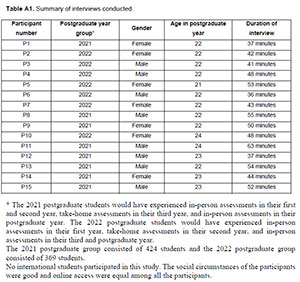
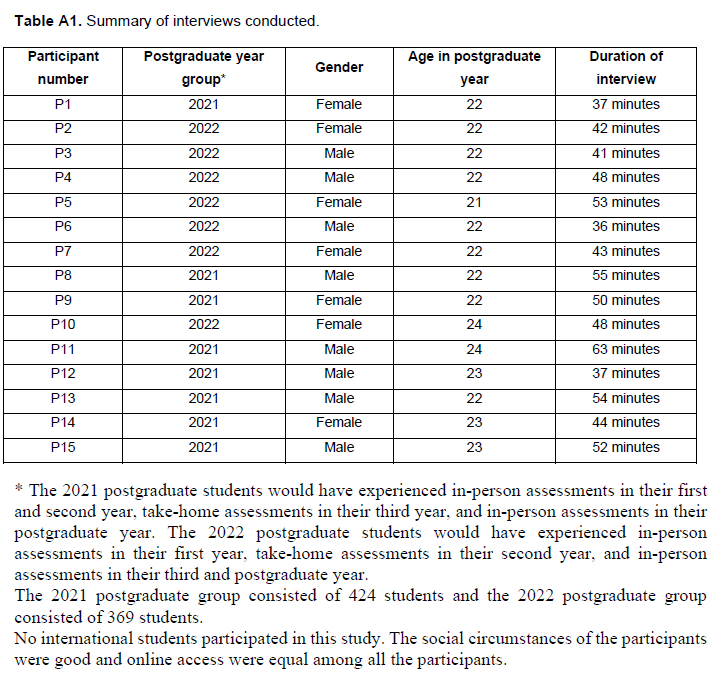
Accounting students who experienced in-person assessments (pre-COVID-19) and take-home assessments (during COVID-19) at the time of the study were purposively selected to form part of the population to ensure that comparative and meaningful data were obtained. The 2021 and 2022 accounting postgraduate (bachelor) students experienced both mentioned assessments methods and 15 participants (referred to as P1 to P15) from both postgraduate year groups agreed to take part in the study. These participants were interviewed (refer to Appendix A for demographic information on the participants interviewed) by the researcher towards the end of 2022. The selected participants would be able to compare their experiences and offer insightful recommendations. The student learning management system was used to sent a recruitment announcement. Institutional permission was obtained from the university, as well as informed consent from the accounting students who agreed to participate in the study (Project number: 25114)5.
Data-collection method
To obtain rich in-depth information semi-structured interviews were used. This allowed the researcher to ask less-structured questions, investigate spontaneous issues brought up by the participants, and clarify answers if necessary (Creswell and Guetterman 2019; Polkinghorne 2005; Ryan, Coughlan, and Cronin 2009). The participants were given the opportunity to react in their own words and in light of their own experiences through the open-ended questions and probes used (Ryan et al. 2009). The interview guide included the following two questions: (1) Tell me about your experience of the take-home assessments, and (2) How do you think students will react/feel about the introduction of online assessment for accounting (where students complete the assessment electronically but under supervision of invigilators on campus in a venue with reliable power supply and stable Internet connectivity)?
15 interviews in total were conducted to a point that data saturation had been reached and when nothing new was being added or no new insights were gained (Bowen 2008; Dai, Free, and Gendron 2018). In the exceptional cases when new data were obtained, the data did not enrich the thickness of the descriptions (Twining, Heller, and Tsai 2017). All interviews were recorded with the permission of the participants, and then transcribed.
Data analysis
To analyse the data thematic analysis was used as it enabled the researcher to recognise themes, codes, and regularities that were indicated by the participants regarding their perspectives on online assessments during the COVID-19 pandemic. The researcher engaged in coding the data, with codes and themes emerging from the participants' insights and experiences, following an inductive approach.
Ethical considerations
Ethical implications of online assessments include fairness, equity, and access. Online assessments may exacerbate existing disparities in access to technology and internet connectivity among students. Those without reliable access to technology or stable internet connections may be at a disadvantage compared to their peers. The university in this study ensured that all students had access to a laptop and the required data resulting in equitable access to online assessments for all students. In addition, students at this university were required to electronically sign an ethical declaration before getting access to the online assessment. This declaration mandated that students commit to acting ethically and honestly during the online assessment. Specific requirements included refraining from accessing the internet or any electronic database, maintaining no contact with others, and not seeking or providing assistance to others during the assessment.
Online assessments involve the collection and storage of sensitive student data. Ensuring the privacy and security of this data is crucial to maintain trust and protect students' rights. Universities must implement robust data protection measures, such as encryption, secure servers, and user authentication protocols, to safeguard student information from unauthorized access or breaches.
FINDINGS AND DISCUSSION
The findings are organised according to the two research objectives. Firstly, accounting students' experiences of take-home assessments employed during the COVID-19 pandemic at an emerging economy residential university are shared. Secondly, accounting students' perceptions of introducing online assessments in the future are discussed.
Take-home assessments
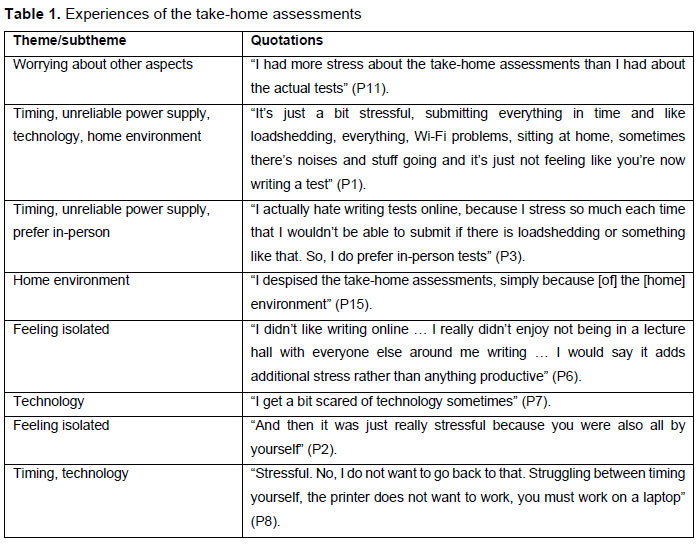
The participants experienced the take-home assessments as extremely challenging and, in a sense, traumatic. To refer to Participant 1's own words: "Online tests. I don't know if I can speak about that No, I hated that." Another three participants despaired, and stated: "I would not wish that on anyone Online tests is definitely not something that I would ever want to relive" (P9); "Yoh, awful, awful, awful. No, it was horrifying" (P11); and "It is the one thing that I don't ever want to do again, it was a terrible experience for me" (P14). The participants described their experience of the take-home assessments as presented in Table 1.
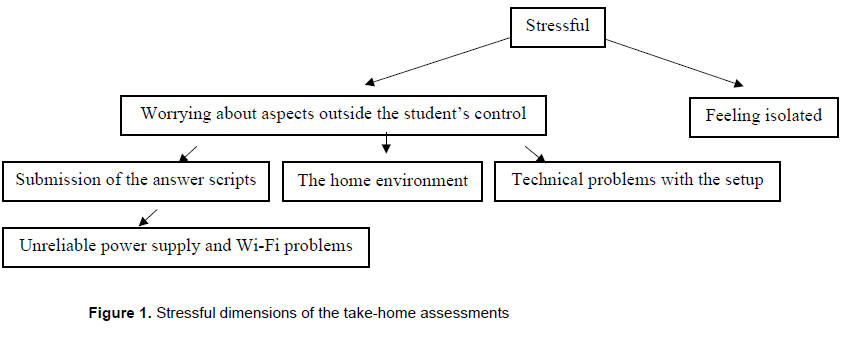
Thirteen of the participants used the word "stressful" in describing their experience of the take-home assessments6. This stress was created by aspects not related to the content of the assessment, but to aspects that were not within the students' control. These aspects included submission of the answer scripts on time, the home environment, and technical problems with the setup of the assessment. Challenges with unreliable power supply and Wi-Fi or Internet problems were directly linked to students' concerns about submitting their answer scripts on time. Feeling isolated also created stress for the students. Figure 1 illustrates the themes and subthemes identified, which are discussed next.
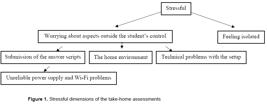
Worrying about aspects that were not within the students' control
Some participants (P2, P7, P9, P10, P11, and P14) explained that what made the take-home assessments stressful was that they were concerned about aspects outside their control. This was clearly articulated by Participant 2:
"Writing exams online was stressful because I think you worry about stuff that you shouldn't be worrying about I didn't like the fact that I was now stressing about things that were beyond my control . that weren't about the content of the test. It's like I was so worried about the handing-in process and was my Wi-Fi going to work and was everyone going to be quiet making sure that I got the password as soon as it came out."
Participant 7 compared her stress levels with writing an assessment in-person and stated that for an in-person assessment "you only have to worry about showing up on time". Participant 10 agreed and mentioned that many things could go wrong in a take-home assessment, "whereas in a [in-person] test, you just have to write and like everything else is ... somebody else's responsibility". Participant 5 elaborated:
"...because usually like you come in, you write, you give it to the invigilators and then your stress is over, you don't need to worry about getting it to the lecturer, making sure that it doesn't get missing between other papers or left behind, like we just need to come and write".
Finding the submission of the answer scripts on time to be challenging
Students were required to upload their answer scripts before the timed online assessment concluded. Students were allowed to type their answers in a Microsoft Word document or write their answers by hand. Most students used the handwritten pen-to-paper format (probably because that was what they were used to prior to the COVID-19 pandemic), where they were required to scan in their answer scripts and then upload the document in PDF format. Eleven participants (P1, P2, P3, P5, P6, P7, P9, P10, P12, P13, and P14) found the submission process to contribute to their stress levels. This aligns with literature that also reported on students struggling with the submission process during the pandemic (Benhura et al. 2022).
Participants 6 and 10 stated that the most stressful part of the take-home assessments was the submission process. Participant 5 agreed and said that students were more worried about submitting the assessment on time than about writing the assessment. Participant 2 explained some difficulties with the process:
"I would start taking pictures and then my hands would be shaking because I would be so stressed about getting it in on time, and then you take a picture and it was night time, so then the shadows from my lights in my room was ... so you could hardly see the work. And then I have to start again."
Participants 5 and 10 mentioned the extra pressure because of the increase in responsibility for the student, with Participant 10 stating:
"I felt like there was so much more responsibility on me to make sure I started at the right time, I finished at the right time, because ... it got quite confusing with our tests being different lengths. Sometimes I would think, oh my gosh, have I like missed the deadline for when it was supposed to be in."
Experiencing challenges with unreliable power supply and Wi-Fi or Internet problems
Various participants mentioned challenges with unreliable power supply (P1, P3, P5, and P9) and Wi-Fi or Internet problems (P1, P2, P5, and P7) as contributing factors to their negative experience of the take-home assessments. Most of these participants linked the submission process with concerns about unreliable power supply and Wi-Fi problems (P1, P2, P3, and P5). Participants 5 and 7 added that issues with Wi-Fi also resulted in problems with downloading the online assessment, which resulted in wasted time. These observations align with literature that also identified problems with unreliable power supply and Wi-Fi as obstacles in online assessments (Benhura et al. 2022; Gamage et al. 2022; Mokhtari and Seddar Yagoub 2021; Ojo, and Onwuegbuzie 2020; Waheeda et al. 2023).
Contending that the home did not provide a suitable assessment environment
Ten participants (P1, P2, P4, P5, P6, P7, P10, P12, P14, and P15) found that the home environment was not suitable for writing assessments. The home environment is unpredictable and comes with distractions (P7 and P12), such as "people walking by someone working in the garden" (P4), or "the lawnmower going in the background" (P6). Participant 10 shared an experience of her mother entering her room, not realising she was writing an examination. An in-person assessment helps students to get into "study mode" and contributes to increased focus and concentration (P2 and P15). Participant 15 elaborated:
"I felt like when you're in a venue, it was much better and focused, it's quiet in the venue, the aircon is on the right temperature, everybody around you is also focused, there is a bit of tension in the venue, but you need that little bit of tension because it gets the adrenaline going and you can write your test properly."
These findings align with literature (Waheeda et al. 2023) also listing unfavourable home environment as a challenge experienced by students in online assessments.
Technical problems with the setup of the assessment
Lecturers (not IT specialists) were required to set up the take-home assessments on the student management system, which required various settings to be in place. On some occasions errors occurred, such as the password not displaying on time. Participant 2 referred to such a case and mentioned that she felt isolated by not being able to ask anyone why the password was delayed. Students in Gamage's et al. (2022) study also expressed frustration with the technical hassles they experienced with take-home assessments during the pandemic.
Feeling isolated
On two occasions during the interview, Participant 2 mentioned how isolated she felt writing the take-home assessments: "It was just really stressful because you were also all by yourself". Participant 6 shared the same sentiment of feeling isolated.
Other experiences
Three participants (P4, P5, and P11) expressed their concern with student misconduct during take-home assessments. Participants 4 and 5 confessed that they knew of students who cheated. These observations align with the literature also noting the impact of online assessments on academic honesty, including unethical behavior by students (Djidjekh 2021; Gamage, Pradeep, and De Silva 2022; Henadirage and Gunarathne 2023; Khalil et al. 2022; Miihkinen, 2023; Ndlovu et al. 2023; Reedy et al. 2021; Terblanche and Lubbe 2023).
Online assessments present students with more options, which creates confusion: you can't decide whether you're going to print the test out or if it's going to be on the screen" (P15). Participant 5, who chose to type out her answers, mentioned that initially this was hard getting used to "because I had to do ... calculations and everything on my laptop, which is different".
Participant 3 was of the opinion that the standard of the take-home assessments was more difficult compared to the in-person assessments. This aligns with students' experiences in the literature (Cernicova-Buca 2021; Djidjekh 2021; Reedy et al. 2021) that online assessments are harder. Various participants (P2, P3, P5, P7, P9, and P14) specifically mentioned that they preferred in-person assessments. This preference aligns with literature indicating that most lecturers (Gamage's et al. 2022) and students prefer an in-person assessment above an online assessment (Edeigba, Opare, and Laswad 2024; Gamage's et al. 2022; Mardini and Mah'd 2022). One student in Djidjekh's (2021) study stated the preference for the traditional method due to it being more transparent and organised.
Introducing online assessments
Considering that all participants experienced the take-home assessments negatively, a possible solution to some of the challenges (such as unreliable power supply, unreliable Internet connectivity, and academic misconduct) could be to move to timed, invigilated, venue-based (on-campus) online assessments with reliable power supply and stable Internet connectivity, where students complete the assessment electronically but under supervision. This suggestion mitigates the mentioned challenges. Furthermore, an electronic assessment better prepares the students for the digital world after university. Terblanche and Lubbe (2023) recommended, as an area for future research, investigating the possibility of accounting assessments where students are assessed online, in a venue, with in-person invigilation.
The participants were asked what they thought about the proposed online assessment for accounting. The main difference compared to an in-person assessment is that the assessment would be written electronically (compared to handwritten) and students would view the paper on a screen (compared to having a printed-out paper). Most participants did not recommend moving accounting assessments from an in-person assessment to an online assessment as suggested (P1, P3, P4, P5, P6, P7, P8, P9, P12, P13, P14, and P15).
Completing an accounting assessment within the allocated time was reported as a "big problem" for most students; time was thus an issue when considering electronically written assessments and viewing the paper on a screen. Participants 12 and 15 stated:
"I would say the gap between writing and typing is too large at this moment in time; maybe it's being shortened by students moving to like online learning. But if you look at ...APC7 that's written on a computer, it might be something that I think students can maybe learn to adjust to that. But ... at this moment in time, the gap is too large" (P12).
"At a stage I would imagine that the way the world is going, we would... we are going to switch to that, but that will be a big change-over. And I think as an option, it wouldn't do too well" (P15).
Participants 3 and 7 were of the opinion that students could write faster than they could type. Accounting also involves many calculations (and fewer theory or discussion questions) that are easier and faster to write than to type (P1, P3, P4, P6, P7, P9, P12, and P13) and the format required for some answers (such as drawing up an analysis of group statements or compiling a statement of changes in equity) was easier to write than to type (P6 and P8). Some participants mentioned that for other subjects (e.g., auditing), they would not have a problem with typing their answers (P1, P3, P4, P5, and P7). Contemplating the difficulty of typing out calculations, Participant 10 recommended that students must be allowed to use Microsoft Excel for the calculations. This participant, however, added that this might create unfairness due to students having different levels of digital literacy (P10).
In contrast, Participant 4 mentioned that some students might be able to type faster and they would be interested in online assessments, especially for the discussion questions. Participants 4, 6, 8, 12, and 13 agreed with this assertion. Participant 10 added: "If you make a mistake, it is much easier to fix if you have a typed document" and it is neater. Participant 1 stated: "It's quite easy to take something out, add something in and it just works better". Participant 4 also stated that students who struggle with handwriting might benefit from online assessments because it will be easier for the marker to understand what the student typed, and the correct marks would be awarded (P4).
Participants 9 and 14 preferred a physical question paper. Participant 14 stated that it was difficult to get the bigger picture of the question when the paper was on a screen. It also took time to scroll up and down. Participant 14's observation aligns with literature that indicates that students found that it "was harder and more time consuming to navigate through multiple pages of the online assessments than it would be to scan pages in a written assessment" (Morgan and Chen 2021, 320). A student in Gamage's et al. (2022) study also mentioned that questions are sometimes overlooked when scrolling down the question page in online assessments. Participant 9 stated:
"I enjoy highlighting and making notes on the physical paper. That is not something I would be able to do if my paper was electronic or it will take me a lot longer or I might have to get a different iPad or laptop ... that I can have a pen that makes it easy for me to make notes and to highlight the information."
Participant 15 recommended that, if accounting were assessed online, an answer sheet with templates (such as the outline of the analysis or the framework for a statement of changes in equity) should be provided.
Participants 1 and 12 mentioned that, if the assessment format were to change, students would be able to adapt - "if you practise doing questions on a computer ... it won't be an issue" (P1). Participants 5, 11, and 15 recommended that, should assessments be moved to an online format, this should be implemented over time to give students the opportunity to adapt. "It would be something students would have to practise for a while to get used to", which takes time, but "everything is doable with enough practice" (P5) and some students would then prefer the online option (P11). These findings echo the literature that students have different levels of digital literacy and that some students may take longer to adjust to the online assessment environment (Morgan and Chen 2021). These authors also recommended that lecturers give students opportunities to practise before the formal online assessments. Participant 11 recommended introducing online assessments from the first year of study as a way for students to get used to this approach.
CONCLUSION AND RECOMMENDATIONS
There is a paucity of research on accounting students' experiences of online assessments at an emerging economy residential university during the COVID-19 pandemic and their perceptions of introducing online assessments in the future. There was a call to explore accounting online assessments used during the pandemic, as reflected by Ali et al. (2022, 539): "We can learn much from reflecting on our recent experiences in using online assessment [during COVID-19] as we chart a new path towards greater use of online technology for assessment of learning in accounting education." The aim of this study was to investigate the possibility of introducing online assessments for accounting at residential universities in an emerging economy by exploring students' experiences of online assessments during the COVID-19 pandemic.
The analysis of 15 semi-structured interviews conducted with accounting students revealed that all the participants experienced the take-home assessments negatively. This study identified aspects that lecturers at residential universities in emerging economies should take note of if they want to counter the negative aspects of online assessments. Based on the issues and challenges found, the researcher identified the following opportunities to reduce stress in online assessments and to facilitate a more effective transition to online assessments: Lecturers should eliminate aspects that are not within the student's control that cause stress. This could include providing an assessment venue for online assessments. Writing an online assessment in a venue will eliminate the unsuitable home environment and ensure that students do not feel isolated. In this way, reliable power supply and stable Internet connectivity can also be supplied. Using invigilators in the venue will address student misconduct and the invigilators can facilitate the submission of the answer scripts. In addition, providing proper training to lecturers could reduce technical problems with the setup of online assessments.
The participants were requested to share their perceptions of the introduction of timed, invigilated, venue-based online assessments with a reliable power supply and stable Internet connectivity. Most participants were not in favour of moving accounting assessments from in-person assessment to online assessment. The participants contemplated the main changes from in-person to online assessments, namely electronically writing the assessment and viewing the paper on a screen. The participants held contradicting views regarding electronically writing assessments. Some participants said that the nature of accounting answers (being numerical and the format for answers required) was more difficult to write electronically (i.e., to type), compared to other participants who viewed typing an answer as quicker and neater. Various participants preferred a physical question paper to get the bigger picture of the question and to highlight or make notes.
In some cases, students' perspectives on their experiences of online assessments aligned and confirmed literature (e.g. accounting students preferring in-person assessments above online assessments and identifying technical issues as an obstacle in online assessments). However, additional reasons and explanations behind the experiences were provided and new findings (e.g. students worrying about aspects that were not within their control and feeling isolated) were reported. The findings of this study did not contradict literature on online assessments. This study also contributed new insights by examining accounting students' perceptions of introducing timed, invigilated, venue-based online assessments, thereby enriching the existing body of accounting knowledge.
Although most participants preferred in-person assessments, SAICA is considering moving the ITC to an online format. It is crucial that the assessment method and format used at SAICA-accredited universities are similar to those used in the ITC. The ITC is currently an in-person assessment, but when the format changes in the future to a form of online assessment, SAICA-accredited universities should be ready to adapt and change their assessment methods to online assessments. This transition would entail implementing proper policies related to assessment integrity, data security and privacy, student support services, technological infrastructure, and lecturer training. Additionally, it is crucial to develop clear guidelines and protocols for conducting online assessments to ensure fairness and equity for all students. Should SAICA's assessment policy shift towards online assessments, it is recommended that university courses be redesigned to incorporate properly developed authentic online assessments in a format suitable for online delivery. These assessments should align with professional requirements and assess not only technical accounting knowledge but also critical thinking, problem-solving, and communication skills, which are essential for accounting professionals.
A recommendation for future research is to further investigate invigilated, venue-based online assessments for accounting. This study took advantage of a pandemic-driven opportunity to investigate accounting students' experiences of online assessments. An understanding of the issues, challenges, and opportunities found in this study is specifically useful for SAICA-accredited universities in the context of future online assessment developments.
This study contributes to the literature by responding to numerous calls to explore accounting students' experiences of online assessments during the pandemic to obtain a better understanding not only of the issues and challenges but more importantly of the opportunities of online assessment in future (Ali et al. 2022; Gamage et al. 2022; Sangster et al. 2020; Tharapos 2021). This study shared the experiences of accounting students, and the findings of the study could help lecturers and institutions understand students' perspectives regarding online assessments. This study provides a starting point when considering the possibility of online assessments for accounting and provides a foundation on which other researchers can build.
REFERENCES
LITERATURE REVIEW
- Abdel-Rahim, H. 2021. "The effectiveness of online teaching and learning tools: Students' perceptions of usefulness in an upper-level accounting course." Learning and Teaching 14(3): 52-69.
- Ali, I., A.K. Narayan, and D. Gedera 2022. "Transforming assessment in accounting education to align with online learning." Pacific Accounting Review 34(4): 536-547.
- Ali, I., A.K. Narayan, and U. Sharma. 2021. "Adapting to COVID-19 disruptions: Student engagement in online learning of accounting." Accounting Research Journal 34(3): 261-269.
- Aishath, W., M. Fathimath, S. Aishath, and S. Fathimath. 2023. "Benefits of online assessments in higher education institutions: lessons from COVID-19 pandemic." Journal of Business and Social Sciences, (03): 1-18.
- Amrane-Cooper, L., S. Hatzipanagos, and A. Tait. 2023. "Silver linings: rethinking assessment pedagogy under the pandemic." European Journal of Open, Distance and E-Learning, 25(1): 93103.
- Azzali, S., T. Mazza, and V. Tibiletti. 2023. "Student engagement and performance: Evidence from the first wave of COVID-19 in Italy." Accounting Education 32(4): 479-500.
- Baidoo-Anu, D., D. Asamoah, E.A. Quainoo, K. Gyamerah, E.Y. Amoateng, and E.O. Sasu. 2023. "Emergency remote assessment practices in higher education in sub-Saharan Africa during COVID-19." Frontiers in Education 8: 1221115.
- Benhura, A.R., H. Venganai, F. Zengeni, and M. Munodawafa 2022. Rethinking students' assessments in higher education during and post-COVID-19. In: Mare, A., Woyo, E. and Amandhile, E.M. Teaching and learning with digital technologies in higher education institutions in Africa: Case studies from a pandemic context. London: Routledge.
- Bloom, B.S. 1956. Taxonomy of educational objectives; the classification of educational goals. London: Longmans, Green & Co.
- Boshoff-Knoetze, A., L. Duminy, and Y. Du Toit. 2022. "Examining the effect of self-regulation failure on academic achievement in emergency remote teaching and learning versus face-to-face." Journal of Applied Research in Higher Education 15(2): 342-354.
- Bosman, J.P., M. De Villiers, E. Le Roux, and S. Strydom. 2022. Introduction to blended learning short course. Stellenbosch: Stellenbosch University.
- Bowen, G.A. 2008. "Naturalistic inquiry and the saturation concept: A research note." Qualitative Research 8(1): 137-152.
-
Brink, S.M. 2023. "Exploring accounting students' experiences during the COVID-19 pandemic to inform teaching and learning decision-making post pandemic." Journal of Applied Research in Higher Education 17(7): 114-130. https://doi.org/10.1108/JARHE-08-2023-0324.
» https://doi.org/10.1108/JARHE-08-2023-0324 -
Brown, V. 2018. Evaluating technology to prevent academic integrity violations in online environments. Online Journal of Distance Learning Administration, XXI(1). https://www.westga.edu/~distance/ojdla/spring211/brown211.html.
» https://www.westga.edu/~distance/ojdla/spring211/brown211.html - Bull, J. and C. McKenna. 2004. Blueprint for computer-assisted assessment. London: Routledge Falmer.
-
Caplan-Bricker, N. 2021. Is online test-monitoring here to stay? The New Yorker, 27 May. https://www.newyorker.com/tech/annals-of-technology/is-online-test-monitoring-here-to-stay.
» https://www.newyorker.com/tech/annals-of-technology/is-online-test-monitoring-here-to-stay -
Carnegie Mellon University. 2023. What is the difference between formative and summative assessment? https://www.cmu.edu/teaching/assessment/basics/formative-summative.html.
» https://www.cmu.edu/teaching/assessment/basics/formative-summative.html - Cernicova-Buca, M. 2021. Perspectives on the emergency remote assessment during the COVID-19 pandemic. In: Sánchez-García, J.C., Hernandez-Sanchez, B., Moreira, A.C. and Monteiro, A.P.A. Psychosocial, educational, and economic impacts of COVID-19. London: IntechOpen.
- Cluskey, G.R., C.R. Ehlen, and M.H. Raiborn. 2011. "Thwarting online exam cheating without proctor supervision." Journal of Academic and Business Ethics 4: 1-7.
- Cramp, J., J.F. Medlin, P. Lake, and C. Sharp. 2019. "Lessons learned from implementing remotely invigilated online exams." Journal of University Teaching & Learning Practice 16(1): 1-18.
- Creswell, J.W. and T.C. Guetterman. 2019. Educational research: Planning, conducting, and evaluating quantitative and qualitative research. Boston: Pearson Education.
- Creswell, J.W. and C.N. Poth. 2018. Qualitative inquiry and research design: Choosing among five approaches. Thousand Oaks: Sage Publications.
- Dai, N.T., C. Free, and Y. Gendron. 2018. "Interview-based research in accounting 2000-2014: Informal norms, translation and vibrancy." Management Accounting Research 42: 26-38.
- Dendir, S. and R.S. Maxwell. 2020. "Cheating in online courses: Evidence from online proctoring." Computers in Human Behavior Reports 2: 1-10.
- Dermo, J. 2009. "E-assessment and the student learning experience: A survey of student perceptions of e-assessment." British Journal of Educational Technology 40(2): 203-214.
- Djidjekh, R. 2021. Investigating students' attitudes toward take-home exam: A case study of third year EFL students at Mohamed Khider University of Biskra. Master's dissertation, University of Biskra.
- Dube, M., R., Masengu, S. Sibanda, and L. Mandongwe. 2023. Assessment: higher education institutions' innovative online assessment methods beyond the era of the COVID-19 pandemic. Digital Teaching, Learning and Assessment, 121-146.
-
Du Plessis, M., C.D. Jansen van Vuuren, A. Simons, J. Frantz, N. Roman, and M. Andipatin. 2022. "South African higher education institutions at the beginning of the COVID-19 pandemic: Sense-making and lessons learnt." Frontiers in Education 6: 21 January. https://www.frontiersin.org/articles/10.3389/feduc.2021.740016/full.
» https://www.frontiersin.org/articles/10.3389/feduc.2021.740016/full - Ebaid, I.E. 2021. "Cheating among accounting students in online exams during COVID-19 pandemic: Exploratory evidence from Saudi Arabia." Asian Journal of Economics, Finance and Management 4(1): 9-19.
- Edeigba, J., S. Opare, and F. Laswad. 2024. "Accounting students' performance in proctored online exams: early evidence from COVID-19 disrupted tertiary education learning." Accounting Education, 1-28.
- Fogarty, T.J. 2020. "Accounting education in the post-COVID world: Looking into the Mirror of Erised." Accounting Education 29(6): 563-571.
- Gamage, K.A.A., R.G.G.R. Pradeep, and E.K. De Silva. 2022. "Rethinking assessment: The future of examinations in higher education." Sustainability 14(3552): 1-15.
- Given, L.M. 2008. The SAGE encyclopedia of qualitative research methods. California: Sage Publications.
- Henadirage, A. and N. Gunarathne. 2023. "Retaining remote teaching and assessment methods in accounting education: Drivers and challenges in the post-pandemic era." The International Journal of Management Education, 21(2): 1-14.
- Huber, E., L. Harris, S. Wright, A. White, C. Raduescu, S. Zeivots, A. Cram, and A. Brodzeli. 2024. "Towards a framework for designing and evaluating online assessments in business education." Assessment & Evaluation in Higher Education, 49(1): 102-116.
-
Joint Information Systems Committee. 2020. The future of assessment: Five principles, five targets for 2025. http://repository.jisc.ac.uk/7733/1/the-future-of-assessment-report.pdf.
» http://repository.jisc.ac.uk/7733/1/the-future-of-assessment-report.pdf - Joshi, A., A. Virk, S. Saiyad, R. Mahajan, and T. Singh. 2020. "Online assessment: Concept and applications." Journal of Research in Medical Education & Ethics 10(2): 79-89.
- Khalil, M., P. Prinsloo, and S. Slade. 2022. "In the nexus of integrity and surveillance: Proctoring (re)considered." Journal of Computer Assisted Learning 38(6): 1589-1602.
- Khan, R. and S. Khan, 2018. "Online assessments: Exploring perspectives of university students." Education and Information Technologies 24: 661-677.
- Krasodomska, J. and J. Godawska. 2021. "E-learning in accounting education: The influence of students' characteristics on their engagement and performance." Accounting Education 30(1): 2241.
- Kuh, G.D. and P.T. Ewell. 2010. "The state of learning outcomes assessment in the United States." Higher Education Management and Policy 22(1): 1-20.
- Lather, P. 2006. "Paradigm proliferation as a good thing to think with: Teaching research in education as a wild profusion." International Journal of Qualitative Studies in Education 19(1): 35-57.
-
Maharaj, S. 2020. Emergency migration to online teaching in the COVID-19 pandemic: Impact on the mental health and wellness of lecturers. https://www.sun.ac.za/english/leaming-teaching/ctl/_layouts/15/WopiFrame.aspx?Sourcedoc=%7BC6B7EDF7-3626-4693-A9DC-3C2950208EE6%7D&file=Final_%20MH%20and%20Emergency%20migration%20to%20online%20teaching_with%20sound.pptx&action=default&DefaultItemOpen=1.
» https://www.sun.ac.za/english/leaming-teaching/ctl/_layouts/15/WopiFrame.aspx?Sourcedoc=%7BC6B7EDF7-3626-4693-A9DC-3C2950208EE6%7D&file=Final_%20MH%20and%20Emergency%20migration%20to%20online%20teaching_with%20sound.pptx&action=default&DefaultItemOpen=1 - Marriot, P. 2009. "Students' evaluation of the use of online summative assessment on an undergraduate financial accounting module." British Journal of Educational Technology 40(2): 237-254.
- Marriott, P. and A. Lau. 2008. "The use of online summative assessment in an undergraduate financial accounting course." Journal of Accounting Education 26(2): 73-90.
-
Mardini, G. H., and O. A. Mah'd. 2022. "Distance learning as emergency remote teaching vs. traditional learning for accounting students during the COVID-19 pandemic: Cross-country evidence." Journal of Accounting Education. https://doi.org/10.1016/j.jaccedu.2022.100814
» https://doi.org/10.1016/j.jaccedu.2022.100814 -
Martins, A., S. Gomes, L. Pacheco, and H. Martins. 2023. "Higher education students' perceptions of accounting online learning: The emergency context of the COVID-19 pandemic." Accounting Education. https://doi.org/10.1080/09639284.2023.2244947
» https://doi.org/10.1080/09639284.2023.2244947 - McBrien, J.L. and P. Jones. 2009. "Virtual spaces: Employing a synchronous online classroom to facilitate student engagement in online learning." International Review of Research in Open and Distance Learning 10(3): 1-16.
- McGuigan, N. 2021. "Future-proofing accounting education: Educating for complexity, ambiguity and uncertainty." Revista Contabilidade & Finanças 32(87): 383-389.
- McKenzie, K. and S. Danforth. 2014. Problem definition, exploratory research, and the research. San Francisco: John Wiley & Sons.
- Miihkinen, A. and T. Virtanen. 2018. "Development and application of assessment standards to advanced written assignments." Accounting Education 27(2): 121-159.
-
Miihkinen, A. 2023. "Business students' learning and assessment in a COVID-19 world: Empirical evidence from Finland". Accounting Education. https://doi.org/10.1080/09639284.2023.2211565
» https://doi.org/10.1080/09639284.2023.2211565 - Mokhtari, A. and S. Seddar Yagoub. 2021. Eliciting views on using the take-home exam as an assessment technique in the EFL context. Doctoral dissertation, Université Ibn Khaldoun-Tiaret.
- Montenegro-Rueda, M., A. Luque-de la Rosa, J.L. Sarasola Sánchez-Serrano, and J. Fernández-Cerero. 2021. "Assessment in higher education during the COVID-19 pandemic: A systematic review." Sustainability 13(19): 10509.
- Morgan, K.L. and W. Chen. 2021. "Pivoting in a COVID-19 teaching environment: Developing interactive teaching approaches and online assessments to improve students' experiences." Accounting Research Journal 34(3): 313-322.
- Myers, M.D. 2009. Qualitative research in business and management. London: Sage Publications.
- Ndlovu, N., P.R. Gumede, and S. Mthimkhulu. 2023. "Students' acceptance and perceptions of online assessments post-COVID-19 pandemic: A case of Community Extension students at a historically disadvantaged institution." Perspectives in Education, 41(2): 180-194.
- Ojo, E.O. and A.J. Onwuegbuzie. 2020. "University life in an era of disruption of COVID-19: A meta-methods and multi-mixed methods research study of perceptions and attitudes of South African students." International Journal of Multiple Research Approaches 12(1): 20-55.
- Özden,Y., I. Ertürk, and R. Sanli. 2004. "Students' perceptions of online assessment: A case study." Journal of Distance Education 19(2): 77-92.
- Polkinghorne, D.E. 2005. "Language and meaning: Data collection in qualitative research." Journal of Counseling Psychology 52(2): 137-145.
-
Poutasi, K. 2017. Address by Karen Poutasi. SPANZ 2017. https://www.nzqa.govt.nz/assets/About-us/Future-State/NZQA-SPANZ-address-2017.pdf.
» https://www.nzqa.govt.nz/assets/About-us/Future-State/NZQA-SPANZ-address-2017.pdf - Rahim, A.F.A. 2020. "Guidelines for online assessment in emergency remote teaching during the COVID-19 pandemic." Education in Medicine Journal 12(2): 59-68.
- Reedy, A., D. Pfitzner, L. Rook, and L. Ellis. 2021. "Responding to the COVID-19 emergency: Student and academic staff perceptions of academic integrity in the transition to online exams at three Australian universities." International Journal for Educational Integrity 17(1): 1-32.
- Rose, S. 2020. "Medical student education in the time of COVID-19." Journal of the American Medical Association 323: 2131-2132.
- Ryan, F., M. Coughlan, and P. Cronin. 2009. "Interviewing in qualitative research: The one-to-one interview." International Journal of Therapy and Rehabilitation 16(6): 309-314.
- Sangster, A., G. Stoner, and B. Flood. 2020. "Insights into accounting education in a COVID-19 world." Accounting Education 29(5): 431-562.
-
Schoonwinkel, A. 2020. Online learning at Maties: Golden opportunity for new era. http://www.sun.ac.za/english/Lists/news/DispForm.aspx?ID=7518.
» http://www.sun.ac.za/english/Lists/news/DispForm.aspx?ID=7518 - Senel, S. and H.C. Senel. 2021. "Remote assessment in higher education during COVID-19 pandemic." International Journal of Assessment Tools in Education 8(2): 181-199.
-
South African Institute of Chartered Accountants (SAICA). 2021. Competency Framework 2021 Guidance to the Academic Programme. https://www.saica.org.za/initiatives/competency-framework/ca-of-the-future-ca2025.
» https://www.saica.org.za/initiatives/competency-framework/ca-of-the-future-ca2025 - Stone, G., B.A. Fiedler, and C. Kandunias. 2014. "Harnessing Facebook for student engagement in accounting education: Guiding principles for accounting students and educators." Accounting Education 23(4): 295-321.
- Swart, O. and S.S. Shuttleworth. 2021. "The new face of alternative assessment in accounting sciences - Technology as an anthropomorphic stakeholder." South African Journal of Higher Education, 35(3): 200-219.
-
Terblanche, E.A.J. and I. Lubbe. 2023. "Assessments in accounting: Experiences and perceptions of educators during COVID-19." Accounting Education 24 August. https://doi.org/10.1080/09639284.2023.2250768.
» https://doi.org/10.1080/09639284.2023.2250768 - Tharapos, M. 2021. "Opportunity in an uncertain future: Reconceptualising accounting education for the post-COVID-19 world." Accounting Education 31(6): 640-651.
-
Toquero, C.M. 2020. "Challenges and opportunities for higher education amid the COVID-19 pandemic: The Philippine context." Pedagogical Research 5(4): em0063. https://doi.org/10.29333/pr/7947.
» https://doi.org/10.29333/pr/7947 - Tuah, N.A.A. and L. Naing. 2020. "Is online assessment in higher education institutions during COVID-19 pandemic reliable?" SirirajMedical Journal 73(1): 61-68.
- Twining, P., R.S. Heller, and C.C. Tsai. 2017. "Some guidance on conducting and reporting qualitative studies." Computers & Education 106: 1-9.
-
Van Petegem, W., C. Van Keer, W. Van der Hoeven, K. Mulyarchik, A. Abrahamyan, N. Dzamukashvili, A. Gigauri, and K. Trchounian. 2021. Innovative and technology advanced teaching and learning teacher's handbook. http://www.printel.am/uploads/page/pdfs/Teacher%E2%80%99s%20Handbook%20on%20Innovative%20and%20Technology-Enhanced%20Teaching%20and%20Leaming.pdf.
» http://www.printel.am/uploads/page/pdfs/Teacher%E2%80%99s%20Handbook%20on%20Innovative%20and%20Technology-Enhanced%20Teaching%20and%20Leaming.pdf -
Viljoen, M. 2021. "Challenges of learning during a pandemic: Stellenbosch University is responsive to the needs of students." Daily Maverick, 25 June. https://www.dailymaverick.co.za/article/2021-06-25-challenges-of-learning-during-a-pandemic-stellenbosch-university-is-responsive-to-the-needs-of-students/.
» https://www.dailymaverick.co.za/article/2021-06-25-challenges-of-learning-during-a-pandemic-stellenbosch-university-is-responsive-to-the-needs-of-students/ - Waheeda, A., F. Shaheeda, F. Muna, and A. Shina. 2023. "Online assessments in Maldivian higher education institutions: Challenges faced by students." Issues in Educational Research, 33(3): 1233-1249.
- White, A. 2020. "May you live in interesting times: a reflection on academic integrity and accounting assessment during COVID19 and online learning." Accounting Research Journal 34(3): 304-312.
- Woldeab, D. and T. Brothen. 2019. "21st century assessment: Online proctoring, test anxiety, and student performance." International Journal of E-Learning & Distance Education 34(1): 1-10.
2 For the purposes of this study, a residential university is defined as an educational institution that primarily offers on-campus housing to its students, but also accommodates a smaller portion of students who choose to live off-campus. Students who attend this university are mostly full-time students.
3 For the purposes of this study, in-person assessments are defined as timed, invigilated, venue-based (on-campus) pen-to-paper summative assessements.
4 For the purposes of this study, take-home assessments are defined as timed, non-invigilated summative online assessments (allowing handwritten and electronically written answers).
5 This study adhered to the university's policy on responsible research conduct.
6 Literature also reports on increased stress and anxiety experienced by students during online assessments (Ndlovu, Gumede, and Mthimkhulu 2023; Waheeda et al. 2023).
7 The Assessment of Professional Competence is the second part of SAICA's qualifying examination.
Appendix A
Table A1 includes the participant number, the year group of the participant, the gender and age of the participant, and the duration of the interview.