Training second language tertiary students as translators in a multilingual South Africa: translation from English into Afrikaans
Abstract
Due to South Africa's diverse speech community, and the needs of Afrikaans speakers, translation from English into Afrikaans has become relevant in making documents accessible. This study explored translation training of University of Technology (UoT) second year students who enrolled for a course in Language Practice engaged in translating. The study attempted to shed light on translation challenges experienced by Afrikaans second language translators translating from English into Afrikaans to bridge the knowledge gap on perceptions and challenges faced. Translation theories such as Skopos theory, and Communicative equivalence were used as theoretical lenses. A qualitative research approach was employed engaging students and lecturers in focus group interviews. It was revealed that students lacked the needed vocabulary, general knowledge, grammatical skills as well as application of translation strategies. A need for training in machine translation to improve the quality of translations surfaced from the research.
Assessment; Translation skills; Training; Communicative and Semantic equivalence; Reading skills; Editing skills
INTRODUCTION
South Africa as a country with a rich and diverse heritage has twelve (12) official languages (Stats SA, 2022), which focus attention on the importance of translation. Translation does not only involve the mere translation of words from one language into another but entails cognisance of cultural concepts and being informed about the grammar of the target language to efficiently build cultural bridges and achieve semantic and communicative equivalence (Simurka 2020, 1). Translators as readers and interpreters need technical vocabulary, specialised knowledge and translation skills to translate source texts into the target language (Duncan et al., 2016, 213). The challenges of training translators in a multicultural environment, prompted the researchers to formulate the following research question: What are the challenges experienced by Level 2 University of Technology (UoT) Applied Afrikaans students when translating texts from English into Afrikaans?
This study focused on second year Applied language students at a University of Technology (UoT) in Gauteng grappling with translation challenges when translating English texts into Afrikaans as part of their academic syllabus (TUT Prospectus, 2023). Translators are also sometimes second language speakers (L2 speakers) who attempt translating the English source texts into another target language which in the case of this study was Afrikaans. The ideal position is to be a mother tongue speaker of the language translated into (Obiso 2020). A competent translator must also dispose of the needed knowledge and translation skills to translate, which is facilitated by their semantic expertise. Training student translators, also involves exposure to various indigenous languages as part of their subjects taken at university. Mutepe, Makananise and Madima (2021, 1) assert that the ushering in of democracy in South Africa granted previously disadvantaged languages the opportunity to be used in education. Even though Afrikaans is not regarded as a disadvantaged language, given the Apartheid history in South Africa (Sall, 2018). Afrikaans is also taught as applied language within a multilingual context at university level and students therefore translate from English into Afrikaans to learn about translation and Afrikaans as second language speakers (TUT Prospectus, 2023).
The need to train future translators to translate into a second language brought this previously, neglected practice to the fore (Pokorn 2016, 33). According to Baachaoui (2014,153), the linguistic and cultural diversity in the world and the growing need to translate information into multiple languages, have compelled academics to deal with the practice of translating into a second language. This also rings true about the situation regarding translation needs in South Africa. Higher degrees of competence and cultural awareness are required in emerging fields including localisation, transcreation, and specialist translations e.g. in the legal, medical, educational, and technological domains. Furthermore, as remote work becomes more common, there is an increasing demand for translators with cross-cultural collaboration skills and digital platform navigation knowledge. The translation industry will continue to evolve if it strikes a balance between adopting new technology such as Artificial Intelligence (AI) and appreciating the invaluable human experience that gives translations their richness, complexity, and cultural context. In a world where connections are growing, this balance guarantees the profession's ongoing relevance and growth also involving training translators (Heruela, 2023). Research on the training of second language translators, translating from English into Afrikaans, is scarce, as research on translation into Afrikaans in South Africa focused more on Bible translations (Bedeker, 2012). This study focused mostly on Afrikaans second language speakers who translated from English into Afrikaans, involving second year tertiary students at a UoT and attempts to bridge the gap in this area of research and its challenges.
Levels of competencies such as intercultural, linguistic, pragmatic, sociolinguist as well as content-knowledge, research competence, monitoring, and ICT competence, all play a role when translating texts. Stats SA (2022) revealed that the percentage of Afrikaans speaking citizens decreased from 13,5 per cent in 2011 to 10,6 per cent in 2022, yet Afrikaans is the language that is spoken by the third largest population in the country, and it has a role to play in South Africa (Webb and Meyer 2012; Popescu 2016; STATS, SA 2022). IsiZulu is spoken by 24,4 per cent and isiXhosa by 16,3 per cent of the population (Du Plessis 2023). The cause of the decrease in Afrikaans-speaking citizens can be ascribed to anglicisation, because of the popularity of English and the global benefits thereof (Du Plessis 2023). Immigration of Afrikaans speaking citizens also plays a role. In the light of the persistently large number of Afrikaans-speaking citizens, translation of English texts into Afrikaans remains important.
THEORIESRelevant theories and concepts related to the realm of translating into Afrikaans are discussed as part of the literature review next.
Skopos theory
As-Safi (2011, 20) asserts that practical translation is of the utmost importance in translation and theoretical background should not be neglected when training students. Skopos theory (Baker and Saldanha 2001, 116; Nord 2018, 62) was used as theoretical lens as it emphasises the interactional and pragmatic aspects of translation focusing on the relevance of the purpose of the text when translating (Baker and Saldanha 2001, 117-118). Skopos theory was developed by the German translator, Vermeer in 1978 (Jabir 2006, 35-36) emphasising the interactional and pragmatic aspects of translation. The target text must be determined by the purpose of the translation, also known as the function of the product specified by the target audience. The word "skopos" is derived from Greek which means "aim" or "purpose". The awareness of the target text reader and the requirements of the "skopos" expand the possibilities of the translation and increase the number of translation strategies used. The focus was on the reader's experience and interpretation of the text. Skopos theory emphasises the role of the translator as creator of the target text and is therefore, deemed as a functional approach. Translation is in essence regarded as intercultural communication (Baker and Saldanha 2001, 118; Nord 2018).
Semantic and Communicative translation theory
Since the emphasis is on communicative equivalence, the Semantic and Communicative translation theories by Newmark (1988) also formed an integral part of this study. According to Newmark (1988, 48-49) communicative translation attempts to produce the same contextual meaning to the reader of the target text as the reader of the source text. Semantic translation focuses on the analysis of the meaning of words and sentences of the source text and aims to render the semantic and syntactic structures of the target text as close to the source text as possible (Shi 2014, 1214).
Newmark (1988, 12) postulates that text-to-text equivalence is more important than simply word-to-word equivalence (literal translation). He also states that different text types are suitable for different types of translation. Moreover, most non-literal texts such as news reports or popular fiction can be translated with communicative equivalence as goal. Texts on philosophy, religion, politics, science, and technology need to be translated semantically (Shi 2014,1216). Venuti (1995) distinguishes between domestication and foreignisation. He is of the view that if the American and British cultures are dominating a text, it affects the credibility of the translation. The finer nuances of the source text are negatively affected during domestication. Foreignisation occurs when developing a translation method excluding dominant cultural values in the target language. The readers are moved towards the translator who is left in peace to write what he or she prefers about his or her own cultural perceptions. Communicative translation which involves foreignisation will render a more user-friendly text that considers the readers' perceptions and interpretation.
TRANSLATING INTO A SECOND LANGUAGEThe need to train future translators to translate into a second language has been acknowledged by researchers such as Pokorn (2016, 33). In addition, Baachaoui (2014) asserts that the linguistic and cultural diversity in the world and the growing need to translate information into multiple languages, have obligated academics to deal with the practice of translating into a second language. In this regard the focus changed from opposing the practice, to exploring strategies reducing the disadvantages of such assignments (Baachaoui 2014, 153).
Some of the strategies to assist the translator to translate in a second language are specified by Baachaoui (2014, 143) as the cooperation between mother tongue and non-mother tongue translators as well as the knowledge of the specialised field of translation. Translators translating into a second language will be more efficient when translating informative texts, such as tourism brochures or scientific material, while first language translators will be able to translate literary source texts with the necessary stylistic eloquence (Mracek 2019, 9). Pokorn (2014) argues that translation into a second language is not unusual and is even dominant in peripheral language communities. He found that it has also become common in nucleus linguistic groups although the practice has been regarded as second-class.
ENGLISH AND AFRIKAANSEnglish and Afrikaans are two of the 12 official languages, that form part of the recognised national languages in South Africa (Alexander, 2023). Patrick and Bhengu (2023) note that sign language has now also become the 12th official language in South Africa. English is a world language, and it carries prestige within English-speaking countries. It has grown into power and English has become the norm. The English lexicon is comprehensive since English borrowed words from other languages. Another reason is the rapid expansion of technology that English-speaking countries have experienced in the last few hundred years and that English became a globally recognised tool of unification and communication (Traugott and Pratt, 1980, 103; Mohamadaid and Rasheed 2019, ii).
Afrikaans, just like English uses regular SVO grammar (Carstens 2013, 43), ascribed to certain influences by Dutch-creole languages. A huge proportion of vocabulary shows evidence of its South-Dutch origins. The Afrikaans language contains influences and roots from English, Khoi, Xhosa, Asian Malay, San, Portuguese and French; although many of these words do sound extremely different (Carstens 2013, 309-311). For the indigenous language speakers such as Xitsonga, Setswana and isiZulu, the SVO word order is not familiar. This difference poses challenges to translators belonging to indigenous African languages when translating into English or Afrikaans. Examples include: "The child plays in the park.'" The Afrikaans version as translated by indigenous African speakers is: "Die kind hy speel by die park." Indigenous speakers tend to use the prepositions incorrectly and inserts a pronoun after the common noun. The reason for this is that African languages do not have prepositions and that subject concord (perceived as pronouns) is commonly used following the subject noun.
Furthermore, language attitudes can also impact translators when dealing with other languages. Panda (2017) asserts that language attitudes is a subjective factor that plays an important role when translating as it impacts the choices the translator makes. The kind of stance translators take towards a language used when translating, can impact the way translators find equivalence. Words and terms carrying various cultural nuances are rather the challenge than common sentences as culture is inherently present in the words used. Language attitudes in South Africa were influenced by its Apartheid history embedded in Afrikaans. The oppression of indigenous African languages also played a role when studying the challenges students experienced when translating. Coetzee-Van Rooy and Peters (2017) investigated language attitudes in South Africa and found that Afrikaans and English were identified as languages of the White people in South Africa who enforced Apartheid as a discriminatory measure against the African languages. It stands to reason that if African language speakers must translate using English and Afrikaans there might be a negative attitude since it reminds of a painful history.
RESEARCH METHODOLOGYA qualitative approach with a case study design was implemented for this study. This approach sought to identify the challenges encountered in translating and editing a magazine article. A case study is defined as a systematic study relating to several variables, of a group of people, a person, or a unit, within its real-world context, with the aim to generalise the findings (Heale and Twycross 2017, 7). This study thus followed a case study design and focused on students at a UoT who are in the process of being trained as language practitioners who could edit texts and translate texts from English into Afrikaans. Lecturers' perspectives were also incorporated to add to the corpus of knowledge regarding the training of translators.
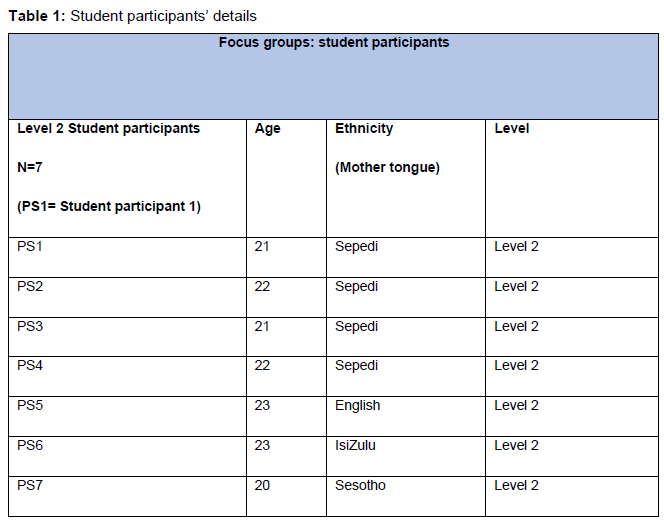
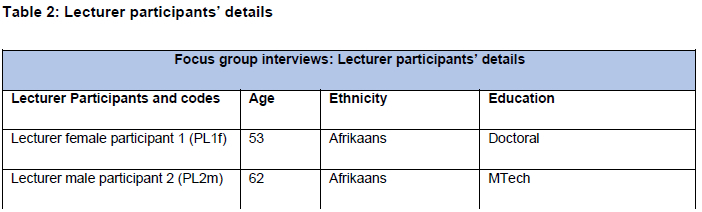
Focus group interviews with two (2) lecturers and seven (7) second year students were conducted. Purposeful sampling was used as suggested by Maree and Pieterse (2020). Four of the student participants were Sepedi mother tongue speakers. Furthermore, one isiZulu, one Sesotho and English mother tongue speaker were included as sample population. All participants were second year Applied Afrikaans students. As for the lecturer participants, two Mother tongue Afrikaans lecturers were included. One lecturer holds a doctoral degree in linguistics and the other a master's degree in applied languages.
FINDINGS
Thematic analysis of the focus groups is unpacked in the next section. Firstly, the themes surfacing from student responses and then themes emerging form the lecturer participants are covered.
Focus group interview data: students
Theme 1: A lack of editing, grammatical skills and knowledge
Students were reported to lack mastery of levels of ability needed to take translation courses, which imply proper speaking, listening, reading, and writing skills. It was found in previous research that there is a lack of educational, linguistic, cultural, and communicative proficiency in the target languages among translation students. For instance, English second language students in English departments are inadequately prepared to work as skilled and knowledgeable interpreters and translators (Abdulhafidh 2014).
This finding was echoed in the research since student participants reported that they realised at tertiary level that their English proficiency was not at the required level, since they had difficulty in excelling in subjects involving English and Afrikaans since these languages wee their second languages.
PS2 in this regard, explained:
"There are many tenses in English and only three in Afrikaans. Longer sentences are difficult to construct correctly in Afrikaans as word order is also different than in English. Prepositions in Afrikaans may pose a problem e.g. "Die vrou sit op die mat en drink uit 'n glas met 'n strooitjie voor werk," (The woman sits on the carpet and drinks from a glass with a straw before work). It can be a challenge because the prepositions "op", "uit", "voor" and "met" do not occur in African languages."
Without strong linguistic and cultural familiarity with both the source language and the target language, a translator cannot be considered competent. These difficulties may result in blunders like improper word choice, grammatical errors, or confusing phrase structures. A person may struggle to effectively communicate their intended meaning if they are not fully proficient in the language being used in the translation, leading to grammatical mistakes and the usage of colloquial idioms. Accurate spelling and punctuation are also influenced by linguistic proficiency. Misspellings, improper capitalisation, and other problems caused by a lack of acquaintance with spelling and punctuation rules might compromise the translation's credibility and intelligibility. Thus, when linguistic proficiency is noticeably low, it might affect the veracity and reliability of the information presented (Flusk 2023, 40).
Theme 2: A lack of confidence to engage in practical translation tasks
Abdulhafidh (2014) found in his study that students' lack of confidence in the target language when translating is a definite problem surfacing in translation. Flusk (2023, 39) identifies low self-confidence of students to translate as an aspect that needs to be recognised. Translators may doubt their ability and struggle to create reliable translations when they lack confidence in their language capabilities. This can result in blunders, omissions and cultural translation problems that could jeopardise the translation's accuracy and quality. Low self-esteem can also result in a lack of assertiveness when seeking explanation or feedback on grammatical errors which can lead to inaccuracy. In this study it was found that students appeared to be confident to translate, but considering their postponement of practical exercises, and their reluctance to do written tasks, it can be deduced that they indeed had less confidence than was apparent.
PS5 admitted her lack of confidence:
"Sometimes I wait until the last minute to do the translation and then there is no time to edit or proofread the work. I tend to postpone because I am unsure, because I am scared that the task is beyond my capacity."
Evidence of research regarding confidence in translation is scant. Yet, Lehka-Paul and Whyatt (2016, 319) state that the professional translator's profile must embrace features such as intelligence, assertiveness, self-assuredness, group dependence and expedience.
Theme 3: Attitudes towards Afrikaans
Willemse (2017) asserts that the Afrikaans language remains a debatable topic in South Africa given its past historical background. Biased behaviour is linked with the former Afrikaner Nationalist ruling party. Afrikaans is a creole language that evolved under colonialism in the 17th century at the southern tip of Africa. During Apartheid Afrikaans was used as a tribal tool to exert dominance. Afrikaans was viewed as the language of the oppressor. Twenty-nine (29) years into democracy, Afrikaans still bears evidence of political baggage. Many students who were born after 1994, are called "born-frees" and prefer to leave the history of Afrikaans behind to focus on present possibilities and opportunities it presents in South Africa.
PS6 stated:
"Nobody cares about the history of Afrikaans. Other students tend to laugh at those who take Afrikaans as a subject and ask, "Why did you choose Afrikaans?" They say there are so few Afrikaans-speaking people left."
Mullen (2019) refers to the born-frees as the first generation born after Apartheid. The history of Apartheid emerged and tended not to have such an influence on students' perceptions on the role of Afrikaans currently. The born-frees were not subject to past injustices and lived experiences of the Apartheid era.
PS2 asserted:
"We do not mind anyone reading what we translated as we do not have a negative attitude towards Afrikaans."
The study found that most student participants displayed a positive attitude towards Afrikaans, and thus they chose it as a language subject. However, they were aware of some negative attitudes displayed by students who opted for other languages. PS1-PS4 agreed with PS7 who opined that:
"We do not have a negative attitude towards Afrikaans, and we are willing to learn more about the subject."
PS5 disagreed and said:
"My parents are not positive about Afrikaans as they cannot forget Apartheid."
Theme 4: Student feedback
Ahea, Ahea and Rahman (2016, 38) are of the view that feedback to students on assessment remains of critical importance. Constructive feedback must be lucid and informative to equip students to grow and develop. Students need to be assisted on their challenges when translating and their errors must be addressed.
PS4 complained:
"We do not always receive our assessed translation tasks and are not able to learn from our mistakes. To develop and gain more knowledge from mistakes will benefit us."
I found in my study that most students admitted that they can benefit from more practical translation opportunities, even without continued assessment. Detailed feedback from lecturers is essential in supporting students in their growth and development during translation practice.
Theme 5: Using technology to translate
It was revealed that students use Google Translate to assist them in translating from English into Afrikaans. It was the only computer translation programme used by the students in their practical translations. Meikle (2022, 1) asserts that the following seven languages are available in Google Translate: Sepedi, Xitsonga, English, Afrikaans, Sesotho, isiXhosa, and isiZulu. Student participants admitted that they used Google translate to speed up the process of translating texts.
PS8 said:
"We are aware that Google Translate is not always reliable since many mistakes surface and the texts need to be edited and proofread in detail after machine translation. And we are not always doing proofreading meticulously."
PS1 shared this view:
"We would like to be trained to use computer programmes to translate. We also want to be informed about the latest technology."
Even though Google Translate has the potential to be helpful, unanticipated, and unnoticed errors can still slip through that can lead to confusion, irritation, and embarrassment, according to Robertson and Diaz (2022). They furthermore found that the uncertainty about understanding style caused confusion which led to negative social consequences of being misunderstood. It emerged that machine translations are not always true to the intended genre of the source text. Furthermore, as most students admitted directly or indirectly, MT still needs manual intervention to round off and finalise translated texts.
Online dictionaries are very helpful and have become a useful source to access spelling and meaning of words. Students reported that they could not use online dictionaries when they experienced a lack of signal our could not buy data due to a lack of funds. Boonmoh (2021) asserts that the primary goal of using dictionaries when reading, is to determine the precise meaning that is pertinent to the context of a new word or phrase rather than its spelling or grammatical features.
PS7 in this regard said:
"If I don't have money, it is a problem to get hold of a dictionary on the internet."
Focus group interview data: Lecturers
Theme 1: Lack of IT resources
Abdulhafidh (2014) asserts that translation as instructed component of the BA English First Language (EFL) courses is an area that is often neglected, yet it plays a vital role in communication. These courses' goals have been misrepresented by institutions. Fundamentally, interpreting and translation are both forms of paraphrase. The interpreter listens to a speaker speaking in one language, understands what is being said and then paraphrases what was heard using the vocabulary, grammar, and cultural aspects of the target language.
It emerged from the current study that little of the practical interpreting of the translation section covered in the translation syllabus could be conducted since there was a lack of headphones and a language laboratory conducive to practical interpretation as underscored in the following responses. Lecturers reported that access to technology posed problems because of Internet access and a lack of available computers. In this regard PL1F said:
"There is no laboratory with headsets to practise interpreting. Students are therefore not ready to join the corporate institutions that offer job opportunities for qualified translation practice students."
PL2m, mainly agreeing, reported:
"Some of the lecturer rooms are not conducive to implement technology. Lecturer rooms need attention also regarding the inadequate internet access."
Munje and Jita (2020, 263) found in their study on resources in education that a lack of resources to ameliorate impediments in academic environments are a serious challenge in effective teaching and learning. The UoT where research was conducted is situated in a disadvantaged area and these are usually the most affected as resources are not readily available. Using translation equipment for Machine Translation (MT), for instance, is a requirement for students who qualify as language practitioners. There is a need for students to access internet and computers specifically reserved for Translation Practice students.
Loadshedding was reported to exacerbate the situation as when there was no electricity, nor technological equipment that could be in operation. PL1F in this regard, stated that:
"Loadshedding affects class attendance negatively because students do not return to the lecture venues after loadshedding of two hours."
McCain and Ebrahim (2023, 1) are of the opinion that loadshedding has caused job shedding in especially township areas. The participants in this study were subjected to loadshedding and a non-conducive township environment; all negative factors leading to unmotivated students who become discouraged.
Theme 2: Lack of fundamental linguistic knowledge among students
The lecturer participants who formed part of this study said that training on using translation technology such as Google Translate, OmegaT (a computer assisted translation tool) in conjunction with Autshumato is paramount to equip lecturers and students with the needed skills. Lecturers must be trained in the most recent technology to be able to assist students to understand the application of the latest translation programmes and machines. Students must have the know-how to use technology and modern translation tools to function optimally in the corporate world.
PL1f commented as follows regarding this aspect:
"Lecturers who teach translation studies are positive about upgrading their skills, but they have not been trained in machine translation. A workshop to receive formal training on operating OmegaT will help."
PL2m opined further in this regard:
"Translation training must be part of the diploma in Language Practice. The department must address this issue during the recurriculation process. Interpreting must be an independent subject presented in the translation course offered."
Theme 3: Lack of understanding the target culture
The capacity to comprehend the source language within the cultural context of the nation concerned is one of the translators' major competencies. With the help of reliable reference books and dictionaries, they must then translate the content into the target language (TL) clearly and accurately. In other words, while proficiency in both languages and cultures is still essential, the ability to write clearly in the target language (TL) is the most significant indicator of a skilled translator (Abdulhafidh, 2014).
It was found in my study that culture did not surface as a serious challenge for students when translating from English into Afrikaans. Urbanisation, democratisation, and access to the internet, even though affected by loadshedding, caused South Africans to also share a universal South African culture. It was reported that various South African cultural groups avail themselves to become multilingual and to learn and acknowledge their respective cultural varieties.
PL2M confirmed the importance of cultural understanding:
"Most students are also from Gauteng and are used to learning in a multicultural environment. They rub shoulders with Afrikaans-speaking students and citizens in their community and engage in multilingual conversations. SePitori, a multilingual informal language mix, is also widely spoken in Soshanguve."
Ditsele and Mann (2014, 159) explain Sepitori as a mix of languages. In Setswana and Sepedi, a language name is normally prefixed by "se-". The name "Pretoria" stems from Pitori. Sepitori thus means "the language of Pretoria." Sepitori is the use of many languages spoken in the Gauteng area and Afrikaans spoken in Gauteng, thus also forms part of Sepitori. The tolerance of many languages used as a mixed language or Black Urban Vernacular (BUV), emphasises the acceptance of many speakers of different African cultures.
Chahrour (2018) asserts that the issue concerning the translation of cultural concepts is that some languages are overloaded with "cultural specific" phrases and expressions. These expressions are quite challenging to translate; even seasoned translators often struggle with them. This is due to the cultural context's overly nebulous representation of a society's worldview, beliefs, emotions, and values. Murdoch (2017, 3) cautions that translators need to note that idiomatic expressions in a language are usually culturally linked:
"This suggests that idioms present somewhat of a challenge to the translator: firstly, they form an intricate part of a particular language and specifically a way of representing its peoples' culture, and secondly, they often present the translator with the problem of how to translate them into a target language and culture which may be partially, or even wholly unfamiliar with the culture of the source language and translators thus do not necessarily have an appropriate idiom to replace it with."
The challenges regarding cultural concepts and the translation thereof surfaced as a prominent theme to be addressed, since participants reported that they often transpired into the absence of target language equivalents. Yet, dealing with the cultural aspects, was also affected by the division of classes within the specific UoT. The subject was taught by one lecturer who had to deal with many languages yet does not know all of them and does not understand all the different cultural nuances involved.
The university in question has IsiZulu, Setswana, Tshivenda, Sepedi, English, Xitsonga, Afrikaans, and sign language as offering types. IsiXhosa, Siswati and isiNdebele are not accommodated in this specific academic environment as they are not frequently spoken in the target region.
PL1F reported the following on the cultural aspects of language:
"Lack of cultural background of traditional Afrikaans idioms like "lunsriem"(a filthy person), lepel in die dak steek (to die) and "die agteros kom ook in die kraal"(Late comers can also be successful) and "'n Krakende wa loop die langste" (A sick person can outlast healthy people)" can cause challenges to those who do not know the Afrikaans culture and idiomatic expressions when translating from other languages into Afrikaans."
Idioms that are linked with cultural activities can indeed become challenging to translators if they are not familiar with the Afrikaans historical background. Excursions to expose students to other cultures and languages can promote cultural understanding for translation purposes.
RECOMMENDATIONS AND DISCUSSIONThe following recommendations are made:
• The most up-to-date methodology used in translation classes is the communicative approach to teaching translation. For instance, extracurricular activities such as intercultural meetings and machine translation sessions are a viable method to develop translation abilities and gain interpreting experience. To prevent boredom, students are required to translate from various outsider references;
• In addition, they should be assigned some interpretation duties to conduct interviews, have conversations, and attend conferences and meetings in several language and societal institutions;
• The use of technology in translation must be incorporated in practical translation to facilitate smooth and accurate translations that are done speedily. Students must be conscientised that any machine translations must still be edited and proofread, and manual human intervention is needed;
• Applied language lecturers must become more involved by being assigned a practical session to deal with translation texts. That will ensure accurate and grammatically correct translations;
• Embracing cultural diversity and respect for multilingualism must be prioritised and considered in curriculum planning. It must be integrated in Applied languages; and
• Participants were of the view that the negative Apartheid's history of Afrikaans is no longer of relevance. The new generation called born-frees, were not that much affected by the past and generally the translation students displayed a positive attitude towards all South African languages.
CONCLUSION
The objectives of the study were reached, and the research question was answered. It was revealed that students translating in Afrikaans experienced problems due to a lack of linguistic knowledge, intercultural communication, and monitoring skills. Since Afrikaans is a second language in the case of the target students, it was expected that the translation process would present challenges such as a lack of equivalence and understanding translation strategies to assist them. Yet, dealing with practical translations is informative and students can be equipped with translation skills that can benefit them as part of their prescribed subjects that they have to take at university level. Learning about other languages and cultures can sensitise translators and multilingual groups to learn tolerance and respect for other languages. Students must be motivated to specialise in formal texts such as the translation of brochures and commercial texts which can facilitate their productivity as professional translators. The results of this study may inform prospective translator trainers on improving the syllabus content and provide guidance on how to implement and integrate translation competencies such as linguistic, cultural, monitoring and ICT as part and parcel of teaching and learning content. Student translators and lecturers may benefit from the research in that they will be more informed about translation challenges and how to address them. Tertiary training institutions may implement the findings to strengthen and enrich their translation courses.
REFERENCES
-
Abdulhafidh, E. 2014. "The challenges of teaching translation to undergraduate students". In; VLTAL Conference, Volume 13, Oct., Erbil, Iraq. Retrieved from: https://www.researchgate.net/publication/311739877.
» https://www.researchgate.net/publication/311739877 - Ahea, M. R. K., Ahea, and I. Rahman 2016. "The Value and Effectiveness of Feedback in Improving Students' Learning and Professionalizing Teaching in Higher Education". Journal of education and practice 7(16):38-41.
-
Alexander, M. 2023. The 11 languages of South Africa. https://southafrica-info.com/arts-culture/11-languages-south-africa/.
» https://southafrica-info.com/arts-culture/11-languages-south-africa/ - As-Safi, A. B. 2011. Translation theories; Strategies and basic theoretical issues. Aman: Dar Amwaj.
- Baachaoui, M. M. 2014. "Translating into L2 - The unachievable perfection". Arab world English journal special issue on translation 3, May: 147-154.
- Baker, M. and G. Saldanha 2001. Routledge encyclopaedia of translation studies. London: Routledge.
-
Bedeker, L.M. 2012. Interferensie in die Afrikaanse Harry Potter. MPhil dissertation. University of Stellenbosch. Retrieved from: https://scholar.sun.ac.za/items/a6d7aaa1-0192-4cc2-abe3-acdf56b368e6/full. Accessed: 09/09/2023.
» https://scholar.sun.ac.za/items/a6d7aaa1-0192-4cc2-abe3-acdf56b368e6/full - Boonmoh, A. 2021. "Use of Dictionaries and Online Tools for Reading by Thai EFL Learners in a Naturalistic Setting". Lexikos 31, 239-258.
- Carstens, W.A.M. 2013. Norme vir Afrikaans; Enkele riglyne by die gebruik van Afrikaans. Pretoria: Van Schaik Publishers.
-
Chahrour, O. 2018. Cultural problems in translation. Translation Journal [Online], Accessed July 2018. https://translationjoumal.net/July-2018/cultural-problems-in-translation.html.
» https://translationjoumal.net/July-2018/cultural-problems-in-translation.html -
Coetzee-Van Rooy, S. and A. Peters. 2021. "A Portrait-corpus study of language attitudes towards Afrikaans and English". Language Matters, 52(20):3-28. https://doi.org/10.1080/10228195.2021.1942167.
» https://doi.org/10.1080/10228195.2021.1942167 -
Ditsele, T. and C. Mann. 2014. "Language contact in African urban settings: The case of Sepitori in Tshwane". South African Journal of African languages [Online], 34(2):159-165. https://doi.org/10.1080/02572117.2014.997052.
» https://doi.org/10.1080/02572117.2014.997052 - Du Plessis, C. 2023. Dit is waarom minder Afrikaans by huis praat. Netwerk 24. 12 Oct.
- Duncan, L. G., S. P. Mcgeown, Y.M. Griffiths, S. E. Stothard, and A. Dobai. 2016. "Adolescent reading skill and engagement with digital and traditional literacies as predictors of reading comprehension". British journal of psychology 107:209-238.
-
Flusk, S.T. 2023. An analysis of linguistic errors in translations of complainants' sworn statements. MA thesis, Cape Town, University of the Western Cape https://etd.uwc.ac.za/bitstream/handle/11394/10435/Flusk_arts_m_2023.pdf?sequence=1&isAllowed=y .
» https://etd.uwc.ac.za/bitstream/handle/11394/10435/Flusk_arts_m_2023.pdf?sequence=1&isAllowed=y - Heale, R. and Y. Twycross. 2017. "What is a case study?" Evidence-Based Nursing, 21(1): ebnurs-2017-102845.
-
Heruela, C. 2023. The future of language: Emerging top translation trends for 2024. https://www.tomedes.com/translator-hub/translation-industry-trends#:~:text=The%20future%20of%20translation%20jobs%20in%202024%20is%20evolving%20in,the%20need%20for%20human%20translators.
» https://www.tomedes.com/translator-hub/translation-industry-trends#:~:text=The%20future%20of%20translation%20jobs%20in%202024%20is%20evolving%20in,the%20need%20for%20human%20translators - Jabir, J. K. 2006. "Skopos theory: Basic principles and deficiencies." Journal of the College of Arts. University of Basrah 41:37-46.
- Lehka-Paul, O. and B. Whyatt. 2016. "Does personality matter in translation? Interdisciplinary research into the translation process and product." Poznan Studies in Contemporary Linguistics 52(2): 317349.
- Maree, K. and J, Pietersen. 2020. Sampling (Pp. 213-224). In: Maree, K. First steps in research 3. Hatfield: Van Schaik Publishers.
-
McCain, N. and N. Ebrahim. 2023. Load shedding has led to job shedding for township businesses, report finds. https://www.news24.com/news24/southafrica/news/load-shedding-has-led-to-job-shedding-for-township-businesses-report-finds-20230411,
» https://www.news24.com/news24/southafrica/news/load-shedding-has-led-to-job-shedding-for-township-businesses-report-finds-20230411 -
Meikle, T. 2022. Google Translate serves up two new official South African languages to users. https://stuff.co.za/2022/05/12/google-translate-serves-up-two-new-official-south-african-languages-to-users/ .
» https://stuff.co.za/2022/05/12/google-translate-serves-up-two-new-official-south-african-languages-to-users/ -
Mohamadaid, A and S. Rasheed. 2018. Can English considered to be a global language? Bachelor's degree, Research paper, Kurdistan Region/ Iraq, University of Duhok. https://files.eric.ed.gov/fulltext/ED608887.pdf.
» https://files.eric.ed.gov/fulltext/ED608887.pdf - Mracek, D. 2019. "The role(s) of native speakers in L2 translation." Studies in Applied Linguistics 10(1):7-25.
-
Mullen, J. 2019. Is South Africa's "Born Free" Generation Truly Free? https://www.wilsoncenter.org/blog-post/is-south-africas-bom-free-generation-truly-free.
» https://www.wilsoncenter.org/blog-post/is-south-africas-bom-free-generation-truly-free -
Munje, P.N. and T. Jita. 2020. "The impact of the lack of ICT resources on teaching and learning in selected South African primary schools." International journal of learning, teaching and educational research, 19(7):263-279. https://doi.org/10.26803/ijlter.19.7.15.
» https://doi.org/10.26803/ijlter.19.7.15 -
Murdoch, A. 2017." Strategies used in the translation of fixed expressions in magazines: A comparison of selected texts with Afrikaans as source language and South African English as target language." Literator, 38(2): 1-9. http://www.scielo.org.za/scielo.php?script=sci_arttext&pid=S2219-82372017000200008&lng=en&nrm=iso .
» http://www.scielo.org.za/scielo.php?script=sci_arttext&pid=S2219-82372017000200008&lng=en&nrm=iso - Mutepe, M., F. O. Makananis and S. E. Madima. 2021." Experiences of first year students with using English second language for teaching and learning at a rural based university in a democratic South Africa." Gender and behaviour 19(2):1-2.
- Newmark, P. 1988. A textbook of translation. Hempstead: Prentice Hall International.
- Nord, C. 2018. Translation as a purposeful activity. Functionalist approaches explained. New York: Routledge.
-
Obiso, W. M. 2020. Benefits of working with native translators. https://dubbingking.com/benefits-of-native-translators/.
» https://dubbingking.com/benefits-of-native-translators/ -
Panda, A. K. 2017. Attitude, Language and Translation. Translation Journal. https://translationjoumal.net/January-2017/attitude-language-and-translation.html#:~:text=Language%20attitude%20is%20one%20of,translator%20takes%20in%20a%20translation.&text= .
» https://translationjoumal.net/January-2017/attitude-language-and-translation.html#:~:text=Language%20attitude%20is%20one%20of,translator%20takes%20in%20a%20translation.&text= -
Patrick, A and C. Bhengu. 2023 Sign language officially becomes SA's 12th official language. https://www.news24.com/news24/southafrica/news/sign-language-officially-becomes-sas-12th-official-language-20230719,
» https://www.news24.com/news24/southafrica/news/sign-language-officially-becomes-sas-12th-official-language-20230719 -
Pokorn, N. K. 2016. "Is it so different? Competences of teachers and students in L2 translation classes." International journal of translation, 18:31-48. https://www.openstarts.units.it/server/api/core/bitstreams/e247542e-20b5-4ae6-8124-d363a3708577/content.
» https://www.openstarts.units.it/server/api/core/bitstreams/e247542e-20b5-4ae6-8124-d363a3708577/content -
Popescu, T. 2016. "Linguistic competence vs. translation competence: A pedagogic approach." International journal of translation 18:31-48. https://www.openstarts.units.it/server/api/core/bitstreams/e247542e-20b5-4ae6-8124-d363a3708577/content.
» https://www.openstarts.units.it/server/api/core/bitstreams/e247542e-20b5-4ae6-8124-d363a3708577/content - Robertson, S. and M. Diaz. 2022. Understanding and being understood: user strategies for identifying and recovering from mistranslations in machine translation-mediated chat. Proceedings of the 2022 ACM conference on fairness, accountability, and transparency, 2223-2238.
-
Sall, T. L. 2018. "The Rainbow Myth: Dreaming of a Post-Racial South African Society. Institute for Global Dialogue". JSTOR http://www.jstor.org/stable/resrep19352.
» http://www.jstor.org/stable/resrep19352 - Shi, X. 2014. "E-C advertisement translation on communicative translation and semantic translation theory." Theory and practice in language studies 4(6):1214-1218.
-
Šimurka, M. 2020. The importance of translation. Lexica: Translation and interpreting. https://www.lexika-translations.com/blog/the-importance-of-translation/.
» https://www.lexika-translations.com/blog/the-importance-of-translation/ -
Stats SA. 2022. Statistics South Africa. https://www.statssa.gov.za/?page_id=3839 .
» https://www.statssa.gov.za/?page_id=3839 - Traugott, E.C. and M. L. Pratt. 1980. Linguistics for students of literature. Orlando: Harcourt Brace Jovanovich.
-
TUT Prospectus. 2023. Applied Languages. Humanities Diploma. https://www.tut.ac.za/study-at-tut/i-want-to-study/what-to-study/prospectus/department?Department=6501&Faculty=50.
» https://www.tut.ac.za/study-at-tut/i-want-to-study/what-to-study/prospectus/department?Department=6501&Faculty=50 - Venuti, L. 1995. The Translator's Invisibility: A History of Translation. London and New York: Routledge.
- Webb, V. and M. Meyer. 2012. Sensus 2011: Taallandskap en taalpolitieke karakter. Litnet archive (2006-2012). argief@litnet.co.za.
-
Willemse, H. 2017. More than an oppressor's language: reclaiming the hidden history of Afrikaans. https://theconversation.com/more-than-an-oppressors-language-reclaiming-the-hidden-history-of-afrikaans-71838.
» https://theconversation.com/more-than-an-oppressors-language-reclaiming-the-hidden-history-of-afrikaans-71838