Measuring the legal protection of academic freedom: the scorecard for South Africa
Abstract
This article measures to what extent academic freedom as construed in terms of international human rights law, specifically UNESCO's Recommendation on the Status of Higher-Education Teaching Personnel of 1997, is protected in South African law. It determines the elements of this right, operationalises these by way of 37 human rights-based indicators, and then assesses whether South Africa's legal framework related to higher education and research adequately protects academic freedom and its structural safeguards, such as institutional autonomy, academic self-governance, and employment security, including tenure. The authors had previously applied this scorecard to determine the strength of the protection of academic freedom in the law of European countries. The analysis for South Africa shows that, as in Europe (and, as it were, most countries of the global North), rather than politically motivated "ideological" attacks, it is the utilitarian, economistic, and, in this sense, illiberal vision of higher education and research, reflected in law and in practice, that puts academic freedom under pressure in South Africa. As in European and in many other countries, market liberalism erodes academic freedom in South Africa, but, additionally, "transformationism" as well as the notion that universities should be development-oriented threaten academic freedom here. Remedying the situation, apart from legislative reform, will require reasserting the truth-seeking (and communicating) role of the university.
academic freedom; institutional autonomy; academic self-governance; collegiality; employment security; tenure; working conditions
INTRODUCTION
In 2016, the authors had developed a scorecard to measure the strength of the legal protection of academic freedom in European countries, to subsequently rank countries in accordance with their performance (Beiter, Karran, and Appiagyei-Atua 2016a; Beiter, Karran, and Appiagyei-Atua 2016b; Beiter, Karran, and Appiagyei-Atua 2016c; Karran, Beiter, and Appiagyei-Atua 2017)). The scorecard uses 37 human rights-based indicators to assess the robustness of a country's legal framework related to higher education and research, from an academic freedom perspective. Alongside the United Nations' 1966 human rights covenants, a major source of inspiration in designing the scorecard has been the United Nations Educational, Scientific and Cultural Organization's (UNESCO) Recommendation concerning the Status of Higher-Education Teaching Personnel (1997). This remains the most important legal reference point for academic freedom at the international level today. Apart from defining individual freedoms of teaching and research of academic staff, it postulates institutional autonomy, academic self-governance, collegiality, employment security, including tenure, and adequate working conditions as major structural safeguards of academic freedom. Our scorecard assesses academic freedom in all these "individual" and "structural safeguard" categories.
By virtue of South Africa's very international law-friendly Constitution, and seeing that the Constitution (1996), in its Bill of Rights, protects the right to "academic freedom and freedom of scientific research" (Section 16(1)(d)), our scorecard, which is universal in appeal, may usefully be applied to assess how robust the legal protection of academic freedom is in South Africa. A central piece of legislation relevant for academic freedom in South Africa is the Higher Education Act (1997). This, but also other relevant legislation, has, accordingly, been submitted to an assessment in terms of our scorecard. The assessment reflects trends similar to those we had already observed for most European countries. In important respects, the legal framework remains silent or lacks protective detail, in others, it clearly does not live up to international standards. These factors evidently contribute to, what may be considered, deficient levels of de facto protection of individual academic freedom, the concept of institutional autonomy being misconstrued in many ways, and academic self-governance and employment security having been subjected to processes of erosion (for a neoliberal perspective on the state 1of academic freedom in South Africa, see Beiter 2023a; Beiter 2023b).
The first half of the Article endeavours to define academic freedom, identify and describe its parameters, and then to operationalise these for measurement purposes in the Academic Freedom Scorecard. We view academic freedom here as a human right. The second half of the Article proceeds to measure the strength of the legal protection of academic freedom in the "individual" and "structural safeguard" categories in South Africa, using the Academic Freedom Scorecard. The final section provides an analytical overview of performance under the scorecard and draws some conclusions from the assessment. There will only be very limited space to comment on the fate of academic freedom under Apartheid. The analysis addresses the legal framework as it applies to public universities in South Africa. The restricted space does not allow the tone to be more argumentative than it currently is. A more detailed engagement with our findings will have to follow at a future point.
ACADEMIC FREEDOM UNDER INTERNATIONAL HUMAN RIGHTS LAWAcademic freedom is here considered a human right, linked to the personality of the enquirer as such, but also that of students and ordinary citizens benefiting from free higher education and research (Beiter 2019, 240; Beiter 2023b, 97-98). Its status as a human right is widely recognised, directly or indirectly, at both national and international level (Beiter, Karran, and Appiagyei-Atua 2016d, as regards international law; Quinn and Levine 2014, 912, as regards Constitutional law). No legally binding global or regional international agreement expressly protects academic freedom. Many international human rights treaties have, however, been authoritatively interpreted to cover protection for academic freedom, or aspects thereof.
At the global level, Article 19 of the International Covenant on Civil and Political Rights (ICCPR) (1966) protects the right to freedom of opinion and expression. Freedom of expression includes the freedom to "seek, receive and impart information and ideas of all kinds, regardless of frontiers, either orally, in writing or in print" (Art. 19(2)). The United Nations Special Rapporteur on the Promotion and Protection of the Right to Freedom of Opinion and Expression, in 2020, submitted a report specifically addressing "the freedom of opinion and expression aspects of academic freedom" (Kaye 2020, 2). The report subsumes academic freedom, but also its supportive elements, such as institutional autonomy and academic self-governance, under Article 19 (paras. 9-14, 37-41, 56(e)).
Article 13 of the International Covenant on Economic, Social and Cultural Rights (ICESCR) (1966) protects the right to education, including the right to higher education. Also Article 13 does not expressly mention academic freedom. However, in its General Comment No. 13 on the right to education, the Committee on Economic, Social and Cultural Rights, the independent expert body supervising implementation of the Covenant, has held that "the right to education can only be enjoyed if accompanied by the academic freedom of staff and students" (U.N. CESCR, General Comment No. 13, 1999, para. 38).
Article 15(1)(b) of the ICESCR protects the right to "enjoy the benefits of scientific progress and its applications," also termed the right to science. In its General Comment No. 25 on that right, the Committee considers as one of the five core elements of the right, "the protection of freedom of scientific research" (U.N. CESCR, General Comment No. 25, 2020, paras. 13, 20). As it were, Article 15(3) of the Covenant specifically calls upon states parties to "undertake to respect the freedom indispensable for scientific research." "Science," as understood in the Covenant (and also this Article) covers teaching and research in all fields, including the social sciences and the humanities (Porsdam Mann 2024, 168-69). Article 15 highlights that scientific or academic freedom is a prerequisite for scientific progress to occur, to whose benefits citizens, in turn, are accorded a human right.
Also at the regional African level, no human rights treaty expressly protects academic freedom. Article 9 of the African Charter on Human and Peoples' Rights (1981) protects the right to freedom of expression, and Article 17(1) the right to education. In the case of Good v. Botswana, the African Commission on Human and Peoples' Rights, the independent expert body supervising implementation of the Charter, found academic expression to be encompassed by Article 9, without, however, specifically addressing "academic freedom" (African Commission, Good v. Botswana 2010, paras. 199-200). In its Principles and Guidelines on the Implementation of Economic, Social and Cultural Rights in the African Charter on Human and Peoples' Rights, the Commission emphasises that the right to education in Article 17(1) imposes an obligation on states parties to "ensure academic freedom and institutional autonomy in all institutions of higher learning" (African Commission, Principles and Guidelines, 2010, para. 71(j)).
ACADEMIC FREEDOM UNDER UNESCO'S RECOMMENDATION CONCERNING THE STATUS OF HIGHER-EDUCATION TEACHING PERSONNEL OF 1997
The central standard of measurement to be relied on here in assessing the state of the legal protection of academic freedom in South Africa is UNESCO's Recommendation concerning the Status of Higher-Education Teaching Personnel (1997). This constitutes the only global standard that deals with academic freedom and its various supportive elements in some detail. The Recommendation is an international soft law document. The Recommendation may be seen as a human rights document, inter alia by virtue of its clear reference to Article 13(2)(c) of the ICESCR on the right to higher education (UNESCO Recomm. 1997, preamble, 2nd recital).
In terms of Paragraph 27 of the Recommendation, academic freedom means:
"the right [of teachers and researchers in higher education] without constriction by prescribed doctrine, to freedom of teaching and discussion, freedom in carrying out research and disseminating and publishing the results thereof, freedom to express freely their opinion about the institution or system in which they work, freedom from institutional censorship and freedom to participate in professional or representative academic bodies. All higher-education teaching personnel should have the right to fulfil their functions without discrimination of any kind and without fear of repression by the state or any other source. (para. 27) (for a more comprehensive account of entitlements covered by academic freedom, see Karran 2009, 170-75; Vrielink, Lemmens, and Parmentier 2023, paras. 31-67; specifically focusing on the "right to research," see Beiter 2022, 163-72; elaborating on entitlements in the context of commercialisation, see Beiter 2023b, 10412)
Paragraphs 28 and 29 reiterate the freedoms to teach and carry out research, respectively, and directly link these to professional responsibility (UNESCO Recomm. 1997, paras. 28, 29). Inherent in both freedoms are various academic duties, which the Recommendation sets out in a separate part (Part VII). The most significant rationale for granting academic freedom is that it facilitates the discovery of the truth (Dworkin 1996, 185-89; Barendt 2010, 53-63; Beiter et al. 2016d, 128-32). The Recommendation, in its preamble, thus considers higher education and research to be instrumental in "the pursuit of knowledge" (UNESCO Recomm. 1997, preamble, 3rd recital). Academic freedom may ultimately yield various "benefits" for society -from scientific information useful to citizens, to technology and innovation, to the strengthening of democracy (U.N. CESCR, General Comment No. 25, 2020, para. 8). In this way, academic freedom, as explained above, "enables" citizens' right to science.
There are five safeguard elements of academic freedom: institutional autonomy, academic self-governance, collegiality, employment security, including tenure, and adequate working conditions. Institutional autonomy is that degree of independence granted to higher education (HE) institutions that enables them to govern their own affairs (academic work, standards, management, etc.) (UNESCO Recomm. 1997, para. 17). It serves to protect HE institutions against external interference coming from any source (e.g., state, church, or business) (para. 19). The Recommendation describes institutional autonomy as "the institutional form of academic freedom" (para. 18). While the rationale for institutional autonomy also includes facilitating institutional pluralism in higher education, the primary reason for granting institutional autonomy therefore is to guarantee individual academic freedom (Barendt 2010, 29, 6369; Beiter et al. 2016d, 132-35). Institutional autonomy does not automatically produce individual academic freedom. A high degree of academic freedom could potentially be enjoyed in institutions with a low level of autonomy, and, conversely, only a low degree of academic freedom might be enjoyed in institutions with a high level of autonomy (Zgaga 2012, 19).
The Recommendation makes it clear that, while institutional autonomy is linked to institutional accountability in respect of quality teaching and research, the efficient use of resources, honest and open accounting, and so on (UNESCO Recomm. 1997, para. 22), autonomy may not be used to curtail internationally recognised staff rights, including academic freedom (paras. 17, 20). The Recommendation specifically points out that systems of accountability, including quality assurance mechanisms, may not harm academic freedom, and must be negotiated with those representing academic staff (para. 24). Similarly, autonomy cannot be relied on to justify undermining academic self-governance and collegiality - on the contrary, these are essential elements of autonomy (para. 21).
The European University Association (EUA) considers institutional autonomy to cover organisational, financial, staffing, and academic autonomy (EUA, Lisbon Declaration 2007, para. 26; Bennetot Pruvot, Estermann, and Popkhadze 2023). While these four dimensions are important, the EUA's conception of autonomy is lacking a crucial dimension, however, that of strategic autonomy, which would allow a university to determine what the purposes of its operations are, "what it is there for" (Matei and Iwinska 2018, 355-56). In the neoliberal era, this dimension of autonomy is customarily violated by predetermining that a university's primary mission is to serve the economy, leaving universities with mere technical autonomy (Beiter, Karran, and Roynard 2023, 292; Beiter 2023b, 117).
Academic self-governance refers to the right of academic staff to take part in the governing bodies of, and to elect a majority of representatives to academic bodies within, a HE institution (UNESCO Recomm. 1997, para. 31). Academic staff must have the determinant voice in decision-making on academic, but also many related matters, through senates and other institutional, faculty, or departmental collegial bodies. There may legitimately be bodies "more expert" in nature, such as councils, that play a crucial role in strategic (non-academic) affairs. Academic staff must be able to sufficiently participate in strategic decision-making through adequate representation on such bodies (Barendt 2010, 71). There must be clear limits on the inclusion or powers of external members in governing bodies. Leaders, including university rectors, faculty deans, and heads of departments, must be elected by, from within, and be accountable to, the academic community (see Karran 2009, 175-76; Beiter et al. 2016a, 286-88, 312-20; Bergan, Noorda, and Egron-Polak 2020, 50-51; Beiter et al. 2023, 268-70, for an overview of the entitlements covered by academic self-governance). Collegiality is the principle of joint decision-making on academic and many other matters (UNESCO Recomm. 1997, para. 32), intended to avoid hierarchisation of the academy through a concentration of powers in rectors, deans, heads of departments, etc., or their offices (Beiter 2016d, 137). Line management amounts to effectively abandoning the principle of collegiality (Beiter 2023b, 102, 118).
Both academic self-governance and collegiality serve to prevent such decisions of bodies and leaders that are not "adequate for science," compromise the disinterestedness of teaching and research vis-à-vis externally defined policy goals ("disinterestedness" constituting a crucial norm of academic science - Merton 1942/1973, 275-77; Ziman 2003, 38-40), or undermine academic freedom. This protection is a consequence of ensuring that those who, by virtue of their training and expertise, understand the needs of teaching and research best, take, or participate in taking, relevant decisions, and act jointly in doing so (Barendt 2010, 29, 69-71; Beiter et al. 2016d, 135-38).
Both elements have become eroded in current times. In the neoliberal era, universities are to be positioned as market players whose raison d'etre essentially is producing "useful" research and graduates for the economy. In this scenario, the installation of executive management, a weakening of senates, and other collegial bodies, and the creation of powerful governing councils comprising many external members, is to serve facilitating this mission. A strengthening of technical institutional autonomy has become the instrument to largely abolish academic self-governance and collegiality. Their abolition, in turn, has become a main lever for "deactivating" academic freedom in practice (Beiter et al. 2023, 269, 292-93).
The UNESCO Recommendation requires academic staff to enjoy security of employment. Provision is specifically made for "tenure or its functional equivalent." This entails that, academic staff should, after a reasonable period of probation, where objective criteria in teaching and research have been met, be granted permanent contracts of service that can ordinarily only be terminated on professional grounds (UNESCO Recomm. 1997, para. 46; see Karran 2009, 177-85; Beiter et al. 2016a, 288-90, 320-27, for an overview of the entitlements covered by employment security). In other words, such contracts may not easily be terminable on operational grounds, such as restructuring, down-sizing, reorganisation, or economic difficulties.
Termination on such grounds could occur in limited circumstances only, where a bona fide exigency exists and once "all reasonable alternative steps" to prevent termination have been taken (UNESCO Recomm. 1997, para. 46). In all cases of termination, due process must be observed (para. 46).
The Recommendation views tenure as "one of the major procedural safeguards of academic freedom and against arbitrary decisions" (para. 45). Contracts of service may never be terminated, or, in the case of fixed-term contracts, not renewed, for reasons of academic views held. Moreover, limiting the scope of recourse to operational grounds of termination prevents these serving as bogus justification for terminating a contract for reasons of academic views held. Beyond that, permanent contracts not easily terminable on operational grounds guarantee employment stability necessary for the exercise of academic freedom, and are, therefore, also a component of adequate working conditions (Beiter et al. 2016d, 138-40).
The neoliberal university typically casualises academic labour. Institutions employ fixed-term contracts. Contracts can easily be terminated for operational reasons. Moreover, in the absence of an academic merit-based and fair promotion system academic, promotion can be obstructed or prevented, for ideological or managerial reasons. There can be an excessive reliance on metrics-based, productivist performance systems.
Finally, the UNESCO Recommendation requires academic staff to enjoy adequate working conditions. They should earn a salary "such that they can devote themselves satisfactorily to their duties," their workload must be "fair and equitable," there should be a work environment "that does not have a negative impact on or affect their health and safety," and they must be protected by "social security measures" (UNESCO Recomm. 1997, paras. 57, 62, 63, generally Part IX, Sect. F). Ensuring adequate working conditions guarantees a full focus on one's work, and creates the necessary preconditions for being able to fully utilise the potentialities afforded by academic freedom.
HIGHER EDUCATION AND RESEARCH AND THE REQUIREMENT OF LEGISLATIONRequiring legislation to protect institutional autonomy and, simultaneously, to regulate matters of self-governance and employment security, including tenure, or various aspects of teaching and research, may seem contradictory. A natural reflex would be to say that autonomy requires regulation of these topics to be left to universities themselves. It should be remembered, however, that what is required is not for legislation to spell out governance arrangements, employment modalities, evaluation systems, or the parameters of teaching and research in any detail. Nevertheless, it is a fundamental principle of the state based on the rule of law that all salient elements in the definition of by necessity broadly formulated human rights, the general framework authorising measures of implementation, and possible limitations of those rights, be laid down in parliamentary legislation as the most stable and democratic form of concretisation (Beiter et al. 2016a, 259; see also Beiter 2019, 259). Such legislation restrains any subsequent arbitrariness on the part of the regulating state and, here, notably regulating universities. It increases the visibility of human rights, and their specific constituting claims, to those entitled to claim them. Moreover, it enables right-holders to easier enforce their claims before competent administrative or judicial tribunals (Beiter et al. 2016a, 259). Governmental regulations and policies can add certain detail to, and operationalise the norms contained in, parliamentary legislation, but cannot substitute the latter where it is mandatory. The definition of fundamental normative aspects cannot be left to the executive or state administration not directly legitimated by, and accountable to, the electorate. Governmental regulations and policies can, moreover, easily be changed or abrogated again (ibid., 259).
However, below a thin layer of crucial framework legislation that regulates important aspects of higher education and research, including academic freedom and its safeguard elements, state regulation, legislative or otherwise, pertaining to universities must remain at a minimum (Beiter 2019, 259-61). As science, from a systems theoretical perspective, is a highly autonomous system, concrete rules and policies are to be made by the academic community itself, because it understands the needs of science best (ibid., 238-39, 252-55, 259-61). As has been stated, "[i]t is this self-regulation by the scientific fraternity which becomes the idea of freedom of science" (Schulte, 2006 114).
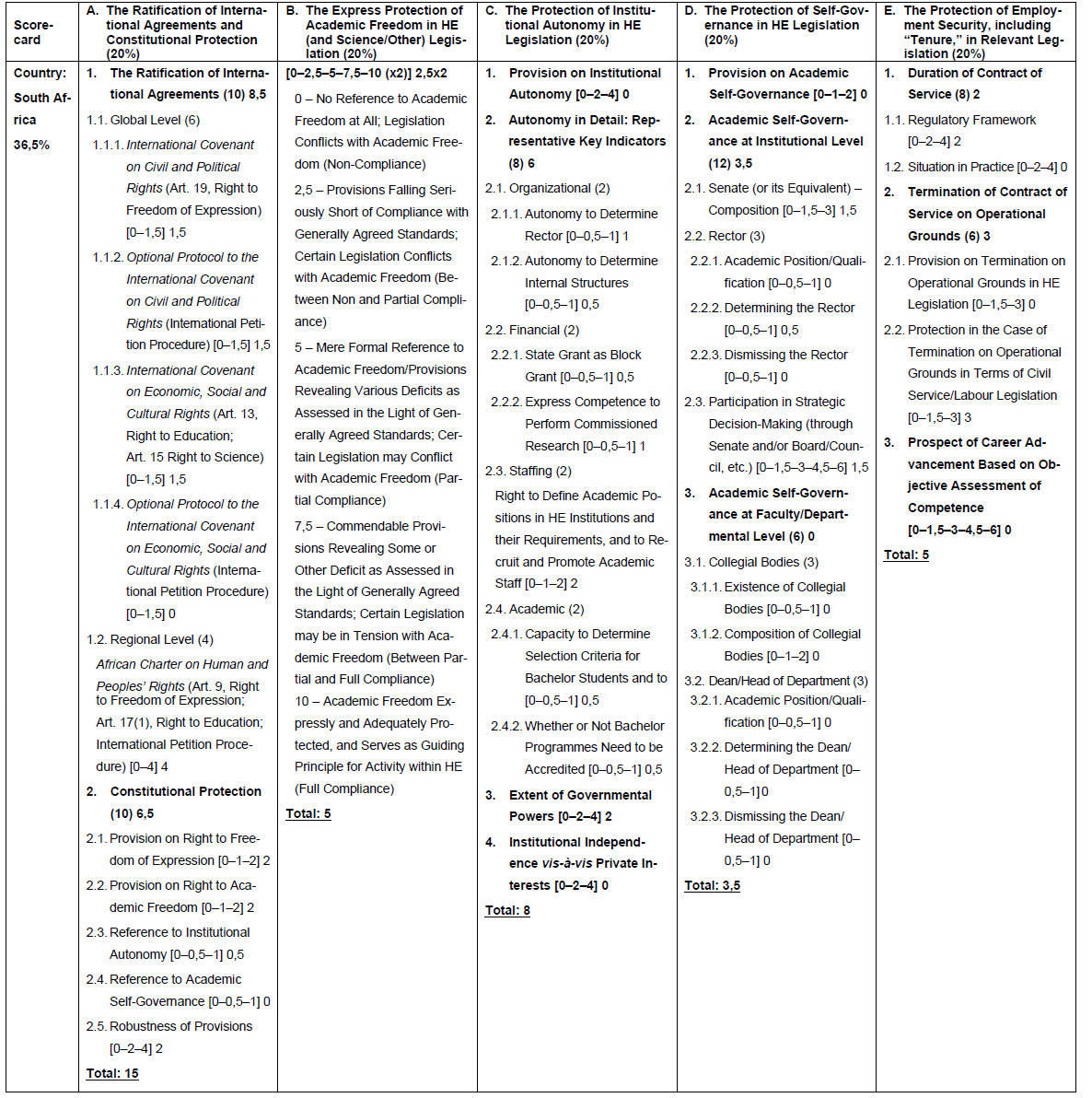
THE SCORECARD TO MEASURE ACADEMIC FREEDOMIn assessing the adequacy of South Africa's legal framework in the light of internationally agreed academic freedom criteria, this article relies on the scorecard which the authors had developed in 2016 to measure the strength of the legal protection of academic freedom in the then 28 European Union member states (see Introduction). Our scorecard measures protection in five main categories or columns:
• The ratification of international agreements and constitutional protection;
• The express protection of academic freedom in higher education (and science/other) legislation;
• The protection of institutional autonomy in higher education legislation;
• The protection of self-governance in higher education legislation; and
• The protection of employment security, including "tenure," in relevant legislation.
The five categories or columns are accorded equal weight in the scorecard - 20 per cent each, together totalling 100 per cent. With the exception of collegiality and adequate working conditions, a category/column has thus been allocated to each of what we termed, "academic freedom and its safeguard elements," earlier. Collegiality is assessed as part of inter alia academic self-governance, adequate working conditions as part of inter alia (individual) academic freedom. Additionally, we include a category/column on the ratification of international agreements and constitutional protection.
The Scorecard, with the results for South Africa, is shown below. This is followed by a Scorecard Explanation, mentioning the 37 specific indicators, spread over the five categories/columns, measuring compliance, as based on human rights law, notably the 1997 UNESCO Recommendation. Each indicator is defined, its numeric value shown, and the two-point, three-point, or five-point scale indicated in terms of which performance is measured as "non-compliance," a form of "partial non-compliance," or "full compliance."
SCORECARD EXPLANATION - INDICATORS
A. The Ratification of International Agreements and Constitutional Protection (20%)
1.
The Ratification of International Agreements (10%)1.1. Global Level (6%)
1.1.1. International Covenant on Civil and Political Rights (Art. 19, Right to Freedom of Expression) [0%-1,5%]
Has the state ratified the ICCPR (without the expression of a problematic reservation)?
1.1.2. Optional Protocol to the International Covenant on Civil and Political Rights (International Petition Procedure; Academic freedom complaints can be brought before the U.N. Human Rights Committee) [0%-1,5%]
Has the state ratified the Optional Protocol to the ICCPR (without the expression of a problematic reservation)?
1.1.3. International Covenant on Economic, Social and Cultural Rights (Art. 13, Right to Education; Art. 15, Right to Science) [0%-1,5%]
Has the state ratified the ICESCR (without the expression of a problematic reservation)?
1.1.4. Optional Protocol to the International Covenant on Economic, Social and Cultural Rights (International Petition Procedure; Academic freedom complaints can be brought before the U.N. Committee on Economic, Social and Cultural Rights) [0%-1,5%] Has the state ratified the Optional Protocol to the ICESCR (without the expression of a problematic reservation)?
1.2. Regional Level (4%)
African Charter on Human and Peoples' Rights (Art. 9, Right to Freedom of Expression; Art. 17(1), Right to Education; International Petition Procedure; Academic freedom complaints can be brought before the African Commission on Human and Peoples' Rights) [0%-4%] Has the state ratified the African Charter (without the expression of a problematic reservation)?
2.
Constitutional Protection (10%)2.1. Provision on Right to Freedom of Expression [0%-1%-2%]
Is there an adequate provision on the stated right in the Constitution?
2.2. Provision on Right to Academic Freedom [0%-1%-2%]
Is there an adequate provision on the stated right in the Constitution?
2.3. Reference to Institutional Autonomy [0%-0,5%-1%]
Is there an adequate reference of this nature in the Constitution?
2.4. Reference to Academic Self-Governance [0%-0,5%-1%]
Is there an adequate reference of this nature in the Constitution?
2.5. Robustness of Provisions [0%-2%-4%]
Does the general constitutional context adequately buttress the above rights? Inclusion of other related protective rights (e.g., rights to education or science)? Protectively-framed limitation clauses? Effective judicial enforcement of provisions/rich case law? Provisions perceptibly inspiring the legislature?
B.
The Express Protection of Academic Freedom in Higher Education (and Science/Other) Legislation (20%)Is there express protection of academic freedom in higher education (and science/other) legislation?
0% There is no reference to academic freedom at all in such legislation; legislation conflicts with academic freedom (non-compliance).
5% There are provisions on academic freedom, but they fall seriously short of compliance with generally agreed standards; certain legislation conflicts with academic freedom (between non and partial compliance).
10% There is mere formal reference to academic freedom, or there are provisions on academic freedom that reveal various deficits as assessed in the light of generally agreed standards; certain legislation may conflict with academic freedom (partial compliance).
15% There are commendable provisions on academic freedom, but these reveal some or other deficit as assessed in the light of generally agreed standards; certain legislation may be in tension with academic freedom (between partial and full compliance).
20% Academic freedom is expressly and adequately protected, and serves as a guiding principle for activity within higher education (full compliance).
C.
The Protection of Institutional Autonomy in Higher Education Legislation (20%)1.
Provision on Institutional Autonomy [0%-2%-4%]Is there a provision in higher education legislation adequately providing for institutional autonomy, including strategic autonomy?
2.
Autonomy in Detail: Representative Key Indicators (8%) [based on the EUA's autonomy indicators: Bennetot Pruvot et al., 2023]2.1. Organizational (2%)
2.1.1. Autonomy to Determine Rector [0%-0,5%-1%]
Is the state involved in the determination of the rector?
2.1.2. Autonomy to Determine Internal Structures [0%-0,5%-1%]
Does the law prescribe specific units (faculties, departments, or institutes), and does the state have a role in their creation/dissolution?
2.2. Financial (2%)
2.2.1. State Grant as Block Grant [0%-0,5%-1%]
Is there a line-item budget, or a block grant, and are there restrictions on the internal allocation of funding?
2.2.2. Express Competence to Perform Commissioned Research [0%-0,5%-1%]
Does legislation expressly mention the competence to perform commissioned research?
2.3. Staffing (2%)
Right to Define Academic Positions in HE Institutions and their Requirements, and to Recruit and Promote Academic Staff [0%-1%-2%]
Does the law specify more than minimal detail on the categories of academic posts and their requirements, impose restrictions on staff recruitments/promotions, or require that professorial appointments be made or confirmed by the state?
2.4. Academic (2%)
2.4.1. Capacity to Determine Selection Criteria for Bachelor Students and to Select the Latter [0%-0,5%-1%]
Does the university or the state determine entry criteria and select students?
2.4.2. Whether or Not Bachelor Programmes Need to be Accredited [0%-0,5%-1%]
Do degree programmes require accreditation to be introduced?
3.
Extent of Governmental Powers [0%-2%-4%]Does higher education legislation reflect wide competences for institutions and a minimal measure of state involvement in regulating their affairs? Does the state only supervise compliance with the law, or does it also review university acts/decisions on their merits? Do university acts/decisions require state approval/confirmation? Are university governing bodies subject to any state control?
4.
Institutional Independence vis-à-vis Private Interests [0%-2%-4%]Does the independence of institutions vis-à-vis private interests enjoy a notable measure of protection in higher education legislation? Does legislation require the source and size of private funding to be published? Does legislation impose restrictions on private sector representation on university governing bodies?
D. The Protection of Self-Governance in Higher Education Legislation (20%)
1.
Provision on Academic Self-Governance [0%-1%-2%]Is there a provision in higher education legislation adequately providing for academic self-governance (and collegiality)?
2.
Academic Self-Governance at Institutional Level (12%)2.1. Senate (or its Equivalent) - Composition [0%-1,5%-3%]
Are an overwhelming majority (60% or more) of senate members representatives of academic staff? Are there "democratic" deficiencies?
2.2. Rector (3%)
2.2.1. Academic Position/Qualification [0%-0,5%-1%]
Must the rector come from within the institution and hold a PhD or be of professorial rank?
2.2.2. Determining the Rector [0%-0,5%-1%]
Do academic staff exercise control over who is chosen as the rector? Are there "democratic" deficiencies?
2.2.3. Dismissing the Rector [0%-0,5%-1%]
Do academic staff exercise control over the dismissal of the rector? Are there "democratic" deficiencies?
2.3. Participation in Strategic Decision-Making (through Senate and/or Council/Board, etc.) [0%-1,5%-3%-4,5%-6%]
Do academic staff have at least 50% representation on the strategic decision-making bodies?
3.
Academic Self-Governance at Faculty/Departmental Level (6%)3.1. Collegial Bodies (3%)
3.1.1. Existence of Collegial Bodies [0%-0,5%-1%]
Are collegial bodies provided for?
3.1.2. Composition of Collegial Bodies [0%-1%-2%]
Are an overwhelming majority (60% or more) of members representatives of academic staff? Are there "democratic" deficiencies?
3.2. Dean/Head of Department (3%)
3.2.1. Academic Position/Qualification [0%-0,5%-1%]
Must the dean/head of department come from within the relevant unit and hold a PhD or be of professorial rank?
3.2.2. Determining the Dean/Head of Department [0%-0,5%-1%]
Do academic staff exercise control over who is chosen as the dean/head of department? Are there "democratic" deficiencies?
3.2.3. Dismissing the Dean/Head of Department [0%-0,5%-1%]
Do academic staff exercise control over the dismissal of the dean/head of department? Are there "democratic" deficiencies?
E. The Protection of Employment Security, including "Tenure," in Relevant Legislation (20%)
1.
Duration of Contract of Service (8%)1.1. Regulatory Framework [0%-2%-4%]
Does legislation envisage permanent contracts (or, potentially, during an initial phase, a probationary period or fixed-term contracts with long-term prospects) for academic staff at post-entry levels?
1.2. Situation in Practice [0%-2%-4%]
Do 66,7% or more of academic staff at post-entry levels have permanent contracts (or limited overall duration fixed-term contracts with long-term prospects)? Is casualisation of academic labour a phenomenon?
2.
Termination of Contract of Service on Operational Grounds (6%)2.1. Provision on Termination on Operational Grounds in Higher Education Legislation [0%-1,5%-3%]
Is there a provision providing protection to academic staff post probation where the termination of their contract on operational grounds is contemplated, requiring, inter alia, a bona fide exigency, consideration of alternatives, following of priority criteria, and compliance with procedural safeguards?
2.2. Protection in the Case of Termination on Operational Grounds in Terms of Civil Service/Labour Legislation [0%-1,5%-3%]
Does "ordinary" civil service/labour legislation provide adequate protection where termination of contract on operational grounds is contemplated (grounds of termination to be clearly stated, alternatives to termination (e.g., transfer to another similar position) be considered, and, where termination cannot be avoided, suitable priority criteria (e.g., length of service) be followed)?
3. Prospect of Career Advancement Based on an Objective Assessment of Competence [0%-1,5%-3%-4,5%-6%]
Does legislation make adequate provision for advancement to higher academic posts, based on an assessment of competence, e.g., by requiring the installation of an academic merit-based and fair promotion system?
OBLIGATIONS OF SUPERIOR NORMATIVE FORCE: HUMAN RIGHTS TREATIES AND THE CONSTITUTION, 1996
In Apartheid South Africa, there was no express constitutional or legislative protection for academic freedom or institutional autonomy. The formal implementation of Apartheid was accompanied by the enactment of various pieces of restrictive legislation, such as the Suppression of Communism Act of 1950 or the Publications and Entertainments Act of 1963, that could severely impact academic endeavours (Bozzoli 1975, 447-50). Despite the repression, it has been stated that, "within the universities, not excluding the fifty-niners [African/Indian/Coloured universities], a degree of academic freedom survived the pressures brought to bear upon it, but not without losses both to individuals and, in consequence, their institutions" (Moodie 1994, 14).
After the end of Apartheid in 1994, South Africa committed to complying with obligations of "superior normative force." On the one hand, South Africa ratified various international human rights treaties which it had previously deliberately refrained from accepting. Hence, as for treaties relevant to protecting academic freedom (see Academic Freedom Scorecard, column A.1.), South Africa ratified the ICCPR (right to freedom of expression) in 1998, and the Optional Protocol thereto creating an international complaints mechanism in 2002. It ratified the ICESCR (rights to education and science) in 2015, but has so far not taken any action in relation to its Optional Protocol, creating a corresponding complaints mechanism for economic, social, and cultural rights. South Africa also ratified the African Charter on Human and Peoples' Rights (rights to freedom of expression and education, and complaints mechanism) in 1996.
On the other hand, a democratically elected Constitutional Assembly drafted a new constitution. Adopted in 1996, this, for the first in South African history, contains a justiciable Bill of Rights. The Constitution renounces the principle of parliamentary sovereignty. All law or conduct contradicting the Constitution is invalid. A Constitutional Court is the final arbiter of constitutional disputes. Section 16 protects everyone's right to freedom of expression, and, as a part thereof, in Section 16(1)(d), "academic freedom and freedom of scientific research" (Constitution 1996). The drafting history shows that "academic freedom" was understood to be the freedom of enquiry applicable in the university context, while "freedom of scientific research" could also be exercised beyond that context, by individuals or separate research institutes (Constitutional Assembly, Theme Committee 4, 1995, 180, 182, 185).
In the absence of direct protection for academic freedom in international law, and the 1997 UNESCO Recommendation not yet having been adopted at the time, the drafters of the Constitution studied the protection of academic freedom in various national constitutions (ibid., 17980). They deliberated whether "academic freedom and freedom of scientific research" should be protected as part of one or more of the rights to education, freedom of religion, belief, and opinion, or freedom of expression, or as a separate provision, ultimately choosing the right to freedom of expression-option (ibid., 182-88; for a good description of the drafting history, see Krüger 2013, 13-22).
The application provisions of the Bill of Rights make it clear that, as appropriate, also legal entities can claim rights, and that rights can apply horizontally (Constitution 1996, Section 8(2)-(4)). Accordingly, nothing should stand in the way of universities being able to claim autonomy under Section 16(1)(d), and academics being able to enforce constitutional academic freedom not only against the state, but also directly against universities. Rights in the Bill of Rights must not only be negatively respected, but also positively protected, promoted, and fulfilled (Section 7(2)). This may be read as entailing a claim on state resources directed at "enabling" academic freedom.
Academic freedom and freedom of scientific research, as all rights in the Bill of Rights, can be limited by law under a general limitation clause, to promote certain goals considered important by government (Section 36). During the drafting process, it was emphasised that this provision, as well as rights to equality and education (Sections 9 and 29) would serve to prevent institutional autonomy from being abused to obstruct transformation towards an inclusive society (Constitutional Assembly, Theme Committee 4, 1995, 183).
So far, no case has been brought under Section 16(1)(d). This may indicate a persisting inability to comprehend academic freedom as now a constitutional right. Historically, universities in South Africa followed the British model. In the United Kingdom, academic freedom does not form part of that country's unwritten constitution. Academic freedom here, rather than a matter of law, has always been a matter of practical convention (Barendt 2010, 73-75). Many academic freedom challenges would have been conceivable. For instance, the government's Research Outputs Policy (2015), and its regime of government subsidies for publications in so-called "accredited" publications, urgently needs to be subjected to constitutional scrutiny. As we have argued elsewhere, the policy infringes on academics' right to freely publish the results of their research in the medium of their own choice (UNESCO Recomm. 1997, para. 12), damages public science, is arbitrary in character, and negatively affects the quality and reproducibility of papers (Beiter 2019, 267-68; Beiter 2023b, 106-107). Overall, one cannot really say that Section 16(1)(d) has in any way served as a guiding value in the design of the university system in South Africa.
From the perspective of the Academic Freedom Scorecard (see column A.2.), one may, therefore, conclude that there are express provisions on the right to freedom of expression and the right to academic freedom in the Constitution. Via Section 8(4), there is an indirect inclusion of institutional autonomy. There is no reference to academic self-governance. As for the robustness of the provisions, it has been noted that Section 16(1)(d) has remained largely a dead provision. One may also question the wisdom of protecting academic freedom under freedom of expression. Academic freedom "is not freedom of speech for academics" (Matei and Kapur 2022). Different from "ordinary" freedom of speech, academic freedom covers academic speech and conduct (e.g., conducting experiments), protects speech rights for truth rather than democracy reasons, only safeguards expert speech of high quality (there is "censorship" through peer review), and encompasses university organisation principles of self-governance and collegiality (Barendt 2010, 18-21, 54-55; Beiter 2016d, 157-63; Vrielink et al. 2023, paras. 53-65). An overarching freedom of expression focus may restrain academic freedom. While the Constitution (1996) protects the right to education, including "further education," which must be read to cover higher education (Section 29(1)(b)), it does not protect a right of citizens "to enjoy the benefits of scientific progress and its applications."
CHANGES IN THE UNIVERSITY SECTOR IN THE DEMOCRATIC ERAThe big challenge for the university sector since 1994 has been to "deracialise," and serve a young democratic state, facing many socio-economic challenges, in a more inclusive and comprehensive way. A National Commission on Higher Education produced a seminal report in 1996, outlining three features of a new framework for the sector. There was a need for increased student participation, it was essential for universities to be more responsive to societal interests or needs and advance national development, and increased co-operation and partnerships with the state, other HE institutions, commercial enterprises, NGOs, research bodies, and so on, were crucial (National Commission on Higher Education, A Framework for Transformation 1996, 5-8). As for the relationship between state and university, a model of weak state supervision or steering - termed "co-operative governance" - was envisaged. This was to acknowledge the need for moving away from the model of state control of the Apartheid years in relation to at least Black universities, but, simultaneously, to evince rejection of a system of maximum autonomy. Such an intermediate model was to facilitate pursuing the transformative agenda in universities and the country more widely (ibid., 16-19; Cross 2015, 355-56, 363-64).
In July 1997, the government released its Education White Paper 3: A Programme for Higher Education Transformation (Education White Paper 3, 1997) and later that year adopted the Higher Education Act 101 of 1997 (Higher Education Act 1997). The latter, in its preamble, appreciates that "it is desirable for higher education institutions to enjoy freedom and autonomy," not defining, or even mentioning again, institutional autonomy or academic freedom in the remainder of the Act. The White Paper, however, contains definitions of both. Academic freedom means - and this is the only definition of academic freedom available in an important official document:
"The principle of academic freedom implies the absence of outside interference, censure or obstacles in the pursuit and practice of academic work. It is a precondition for critical, experimental and creative thought and therefore for the advancement of intellectual inquiry and knowledge. Academic freedom and scientific inquiry are fundamental rights protected by the Constitution." (Education White Paper 3, 1997, para. 1.23)
The definition of institutional autonomy mentions academic and financial, but not strategic, organisational, or staffing autonomy (para. 1.24). It goes on to state that recourse to "institutional autonomy as a pretext for resisting democratic change" is forbidden (para. 1.24). While "impact" is a key concept in the government's more recent White Paper on Science, Technology and Innovation, the White Paper does not mention the term academic or scientific freedom even once (White Paper on Science, Technology and Innovation 2019).
Both Education White Paper 3 and the original Higher Education Act embody the notion of "co-operative governance." The White Paper envisages a "proactive, guiding and constructive role for government" (Education White Paper 3, 1997, para. 3.7). While the principle of public accountability required institutions to show how (well) money had been spent, the results achieved with resources, and how they had met national policy goals and priorities (para. 1.25), the Ministry could not "micro-manage" institutions, or be "too prescriptive" in regulatory frameworks established, and could intervene "only in extreme circumstance" (para. 3.33). The Act obliges what is now the Minister of Higher Education, Science and Innovation to determine HE policy - however, only after consulting the Council on Higher Education (CHE) (Higher Education Act 1997, Section 3(1)). This is an independent advisory body provided for in the Act, and created in 1998 (Section 8(2)(b)(i), (3), (4)). However, the Minister is not bound by the advice. The Minister may issue directives to a HE institution in defined cases, such as financial impropriety, mismanagement, inability to perform functions effectively, or failure to comply with any law (Section 42(1)-(3)). Where this proves ineffective, an independent assessor may, in serious cases, be appointed to investigate the matter (Sections 42(4)(a), 43-49A).
While the period from 1994 to 1998 reflected a "hands-off approach in the relation between government and universities (Cross 2015, 354), this changed in the late 1990s. The period up to 2006 reflects a move towards strong state steering (ibid., 366-72), "conditional" autonomy (Hall and Symes 2003), or, some have said, a reversion to (forms of) state control (Moja, Cloete, and Olivier 2003). There were perhaps three factors that triggered such tightened control (Cross 2015, 354, 366-67; Hall and Symes 2003, 10-12; Jansen 2005, 220-21). Firstly, from the late 1990s onwards, financial maladministration and chaotic institutional leadership were rife in a number of HE institutions. Secondly, the government's GEAR ("Growth, Employment and Redistribution") macro-economic plan of 1996 took effect. This envisaged fiscal discipline and constrained budgetary expenditures, emphasising inter alia efficiency, performance, and competitiveness in public service provision. This brought pressure to bear on universities to adopt a "business approach" and become "entrepreneurial." Thirdly, the government was of the opinion that its "hands-off" approach had failed to bring about transformation (National Plan for Higher Education 2001, para. 1.5.1).
Consequently, specifically addressing the first dilemma, the Higher Education Act (1997) was amended to enable the Minister to appoint an administrator to take over the role of the council of a university, execute the institution's management functions, and restore proper governance and management at the institution (Sections 42(4)(b), 49B-49J). In many cases, loan or overdraft agreements must now be approved by the Minister (Section 40(2)(b)). The same applies to immoveable property construction, purchases, or long-term leases exceeding a certain value (Section 40(3)(b)). The Minister is now also competent to "determine the scope and range of operations" of a university (Section 3(3)). Moreover, between 2002 and 2005, the Minister ordered a set of institutional mergers (Section 23). Eleven new institutions were created from 26 merger partners, affecting 62 per cent of the HE system in terms of student registrations (Hall 2015, 145). A range of steering mechanisms were put in place by government during this period (Cross 2015, 367-71; Hall and Symes 2003, 12; Jansen 2005, 217-19). One was a new funding formula for HE institutions introduced in 2006, more significantly linking disbursements to performance criteria (A New Funding Framework 2004). A process of Enrolment Planning and Funding was introduced, requiring ministerial approval for student enrolments, aimed at preventing an abuse of enrolments to secure public funding. Then there is the Programme Qualifications Mix (PQM) mechanism. Each university must now obtain ministerial approval for the specific mix of qualifications and learning programmes it wishes to offer. The mechanism seeks to ensure a diversity of offerings that equitably responds to national needs.
Finally, during this period, quality assurance has become highly formalised. In 2001, the Higher Education Quality Committee was created as a permanent committee of the CHE. It is the national body responsible for programme accreditation, national reviews of programmes, and institutional audits. It assesses quality against standards which it has formulated, and which are embedded in the Higher Education Qualifications Sub-Framework (Revised HEQSF 2014), in turn a part of the National Qualifications Framework (NQF), provided for in the National Qualifications Framework Act (2008). All possible qualifications are now assigned to one or more of ten levels. Characteristic of the NQF is that each of its levels is described in terms of learning outcomes (as it were skills) to be achieved at that level, rather than in terms of disciplinary knowledge to be mastered. This is true also for HE qualifications (for an overview of the CHE's quality assurance function, see Council on Higher Education 2023, 13-19).
The period from 2006 until now could be described as a third period, during which strong state steering has been consolidated and direct ministerial intervention has intensified (Cross 2015, 354). Since 2000, 16 universities have been the subject of investigations by independent assessors. A number of universities have been placed under administration (Mkize 2023). There are, moreover, ministerial or CHE oversight processes on transformation in public universities and on the recruitment, retention, and progression of Black academics in operation. The writing is on the wall that university laws will be changed further in the coming years, "to make the system run much better" (Nordling 2023).
"MEASURING" ACADEMIC FREEDOM AND INSTITUTIONAL AUTONOMY
Measuring performance in terms of the Academic Freedom Scorecard under columns B and C, only a low level of compliance for the express protection of (individual) academic freedom in HE (and science/other) legislation, and a low to intermediate level for institutional autonomy in HE legislation, can be attested to for South Africa. As regards the former, as has been seen under the previous section, except for a preambular reference to academic freedom in the Higher Education Act, neither the Act nor any other legislation grants and defines the freedoms to teach and carry out research, guarantees disinterested academic science, envisages academic freedom conflict-resolution bodies, and so on (see Academic Freedom Scorecard, column B). The (anyway few) references to academic freedom at policy level are not sufficient from a rule of law point of view.
Certain existing legislation conflicts, or may conflict, with academic freedom (and the right to science). Examples would be the Higher Education Act (1997) - e.g., university governance provisions inimical to academic freedom (see further on this in the next section), the Intellectual Property Rights from Publicly Financed Research and Development Act (2008) -stifling effects on disinterested science in universities, and on knowledge diffusion (Kenney and Patton 2009; Fabrizio 2007), or the National Qualifications Framework Act (2008) - stifling effects on disinterested teaching in universities and on teacher autonomy (Malherbe and Berkhout 2001, 68-69; Young 2003, 225).
As regards institutional autonomy, the Higher Education Act (1997) contains no provision expressly and adequately providing that HE institutions should enjoy autonomy at strategic, organisational, financial, staffing, and academic levels (Scorecard, column C.1.). This does not mean that autonomy would be operationally absent from the Act (Scorecard, column C.2.): It is thus stated that HE institutions constitute separate juristic persons (Section 20(4)). HE institutions can determine their rectors without state involvement (Section 34(2)). By and large, they exercise autonomy in determining their internal structures (faculties, departments, institutes, etc.), but larger structural changes, such as the creation of new faculties, effectively require ministerial consent. University statutes, and changes thereto, must be approved by the Minister (Section 33(1)).
Roughly 85 per cent of state funding is awarded to institutions in the form of block grants. A limited percentage of funding is regularly earmarked (e.g., for infrastructure) (Section 39(3); Ministerial Statement on University Funding 2021). HE institutions may gather funds through study fees, earnings from investments, donations, or "other receipts from whatever source" (Higher Education Act 1997, Section 40(1)). They may also receive funds "for services rendered to any other institution or person," for example, also for commissioned research (Section 40(1)(f)). Immovable property acquired with state funds can only be sold with the Minister's consent (Section 20(5)). The restrictions in the cases of loan or overdraft agreements, and immoveable property construction, purchases, or long-term leases have already been mentioned.
HE institutions possess autonomy to define academic posts, and recruit and promote staff. While HE institutions may, in principle, determine entry criteria in respect of Bachelor (and other) degree programmes and select students autonomously, the CHE's quality assurance activities often do seem to narrowly tie in with "state vision," and the stated activities may have a disciplining effect on the setting of entry requirements (e.g., national reviews of programmes, and entry criteria, linked to possibilities of withdrawing accreditation). Degree programmes need to be accredited in South Africa. The CHE, performing the accreditation, often emphasises that actual quality control endeavours are performed by academic peers. However, the regulatory framework "seem[s] to be based on 'his master's voice'" (Waghid et al. 2005, 1179), and peers involved in this type of exercise also readily buy into the regulatory mindset at stake (ibid.). The better solution would be to provide for institutional accreditation; once this has taken place, HE institutions should be free to introduce programmes without accreditation (Bennetot Pruvot et al. 2023, 48-52). They should be able to freely select quality assurance mechanisms and providers (ibid., 51-52). It would be good if HE institutions could opt for another provider than the CHE. Ideally, there should be a genuinely university-sustained quality assurance provider that applies a less prescriptive framework.
Overall, there is an intermediate to high level of state involvement in regulating the affairs of universities in South Africa (Scorecard, column C.3.). Legislation, moreover, fails to protect the independence of HE institutions vis-à-vis private interests (Scorecard, column C.4.). There is, for instance, no obligation of institutions to publish the source and size of private funding. Regarding institutional autonomy, a clear trend is noticeable. As Jonathan Jansen correctly points out, while some of the state's measures may, individually, have been meaningful or understandable, cumulatively, they have altered universities' self-image as autonomous institutions, legitimising ever-intensifying state intervention in the future (Jansen 2005, 221-22). An effective legislative safeguard of institutional autonomy might well have served to prevent many of the inroads on institutional autonomy noted, ultimately also offering better protection to individual academic freedom.
"MEASURING" ACADEMIC SELF-GOVERNANCE AND EMPLOYMENT SECURITY, INCLUDING TENURE
Measuring performance in terms of the Academic Freedom Scorecard, here under column D, it may be noted that the Higher Education Act contains no provision expressly and adequately providing for academic self-governance (and collegiality) (Scorecard, column D.1.).
As for governance arrangements at the institutional level, the Higher Education Act (1997) prescribes that HE institutions must have, inter alia, a council, a senate, and a principal (Section 26(2)). The council governs the institution (Section 27(1)). It is to embody broad accountability towards society - at least 60 per cent of its members must not be employed by, or students of, the institution (Section 27(6)). The senate is "accountable to the council" for "the academic and research functions" of an institution (Section 28(1)). The majority of its members must be academic employees of the institution (Section 28(4)). The principal (rector, vice-chancellor) manages or administers the institution (Section 30).
Assessing these provisions in terms of the scorecard (Scorecard, column D.2.), focusing on the senate first, while 50 per cent plus of its members must be academic employees, in practice, often much fewer such employees sit on senates (Ballim 2024). This may also have to do with the fact that the Higher Education Act does not clearly state that delegates of institutional, faculty, or departmental management on academic or governing bodies, even if (former) academics, are not to be counted as representatives of academic staff. Many senates have become dysfunctional (ibid.). A recent study prepared for the CHE finds that senate decisions are often overridden by councils and management (Coetzee and Lottering 2024). With staff feeling that top management is deciding even academic matters without any consultation, many feel disenfranchised (ibid.).
Councils, for their part, have become involved in universities' daily affairs, introduced a corporate mind-set to university governance, and push for quantitative measurement systems around teaching and research (Hornsby 2015). While senates should be in control of all teaching, learning, research, and related financial and administrative matters - and, moreover, function as the prime guardian of academic freedom in an institution (Ballim 2024) - the Higher Education Act (1997) does not quite reflect this crucial role of the senate. It states that the council "must govern" the HE institution (Section 27(1)), and that the senate "is accountable to" the council (Section 28(1)), confirming a rather subordinate position for the senate.
Ideally, half the members of university bodies responsible for strategic decision-making should represent academic staff (Beiter et al. 2016a, 288), the least favourable reading of the Higher Education Act could result in only a three per cent representation of academic staff on university councils (one of thirty members) (Section 27(4)). In practice, representation may lie around 30 per cent (as reflected on the websites of various universities). As seen, the Higher Education Act actually sets a minimum of 60 per cent external members. These include even persons appointed by the Minister (Section 27(4)(c)). Jansen notes that many councils have become detached from the academic project, governors lacking professional expertise, or seeing councils as a source of business, to collect allowances or do business with the university (Jansen 2023). The Minister's appointees are often party cadres deployed to pursue a distinct political mission (ibid.).
Under the Higher Education Act, rectors are appointed by the council "after" (not "in") consultation with the senate (Section 34(2)). This signifies a form of staff participation, but clearly not the exercise of control over who is chosen as the rector. The Act is silent on the rector's credentials or their dismissal. Staff is not guaranteed the express right to bring a vote of no-confidence in the rector. Rectors have been shown to earn absurdly high salary packages at a time when precarious working conditions in academia are becoming widespread (Council on Higher Education, Remuneration of Vice-Chancellors) - evidence, as has been claimed, of "a broken higher education system" (Hlatshwayo 2024). Rector is now a separate career far removed from the academic enterprise.
Applying the scorecard to the faculty or departmental level is a straightforward matter (Scorecard, column D.3.). The Higher Education Act does not comment on the existence of collegial bodies, their composition, or the credentials, determination, or dismissal of deans or heads of departments. The Act, therefore, does not guarantee the determinant voice of academic staff in academic matters at this level, or the principle that leaders should be elected by, from within, and be accountable to, the academic community. In practice, deans are executive deans. As André Du Toit observes, "executive deanship" can hardly be reconciled with the consensual enterprise and the functions of a faculty board (Du Toit 2000, 100-101).
Legislation, as already noted, does not expressly protect the principle of collegiality - the principle of joint decision-making - mandatory under UNESCO's 1997 Recommendation. Instead, hierarchisation has occurred in South African universities through inter alia the introduction of line management - which constitutes a perversion of the principle of collegiality. If line management is one element of, what has been called, new public management (NPM) in the university sector, then a significant second element is performance management, as notably embodied in the "incentive and audit" logic applied to academics individually and universities as a whole (for a description of NPM in higher education and research with references to further relevant literature, see Beiter et al. 2023, 293-95; Beiter 2023b, 117-20). Incentives reduce genuine academic autonomy and thus disrupt natural scientific progress (Beiter 2023b, 103). There is, moreover, no empirical evidence that any scientific revolution ever has been the product of incentivisation strategies (Muller 2021). As for audits, the values underlying them "penetrate deep into the core of organizational operations," where they, over time, create "new mentalities" far removed from any discourse about content and meaning (Power 1999, 97-98). NPM, intended to enhance efficiency, but in South Africa also to accelerate transformation and facilitate the achievement of national development goals, has led to a burgeoning bureaucracy in universities. Academic staff in some South African universities now constituting less than 50 per cent of staff (VitalStats 2021, 2023, 66). A huge chasm has developed between academics and management/administration (Chetty and Merrett 2014, 135). The CHE study mentioned above finds that South African academics feel they are subject to a regime of micromanage-ment, surveillance, and fear, which prevents them from engaging in genuine academic deliberation. They feel that they have lost their creativity and ability to think innovatively (Coetzee and Lottering 2024).
Finally, legislative protection for employment security, including tenure has been measured under column E of the Academic Freedom Scorecard. Legislation in South Africa does not lay down a requirement of permanent contracts of service for academic staff at post-entry levels (positions from lecturer onwards) (Scorecard, column E.1.). Provision is also not made for the viable alternative of permanency (and tenure) to ensue once competence has been proven after a probationary period of five years or so. Such a provision would ensure that only highly competent teachers and researchers work (can remain) in academia, simultaneously providing them with the required employment security. The conclusion of permanent contracts is left to the university's discretion in circumstances where the Labour Relations Act (1995) provides some protection to those employed under fixed-term contracts (Section 186(1)(b)). More than 60 per cent of academic staff have only fixed-term contracts (VitalStats 2021, 2023, 75). There are clear trends of casualisation (Callaghan 2018). For example, while there is an increase in postdoctoral fellows, the number of permanent junior staff is decreasing (Van Schalkwyk et al. 2022, 9-10).
Tenure does not exist in South Africa (Scorecard, column E.2.). There is no express provision in the Higher Education Act providing strictest possible protection to academic staff where the termination of their contract on operational grounds is contemplated. The protection of ordinary labour law for dismissals based on "operational requirements" would be applicable. There is notably a consultation requirement aimed at agreeing on measures to avoid dismissals or mitigate their adverse effects; in the case of collective dismissals, a facilitator should be appointed (Labour Relations Act 1995, Sections 189, 189A). South Africa needs to develop a proper system of tenure to procedurally safeguard academic freedom (Du Toit 2000, 101-102). Furthermore, neither legislation nor prominent/sector-wide collective agreements, government regulations, or university statutes make adequate provision for advancement to higher academic posts, based on an assessment of competence, for example, by requiring the installation of an academic merit-based and fair promotion system. This would constitute another procedural safeguard of academic freedom as it would prevent punitive non-promotion (Scorecard, column E.3.).
THE SCORECARD: OVERVIEW OF PERFORMANCE
The Academic Freedom Scorecard reveals that the state of the legal protection of academic freedom in South Africa - as in European countries, for which we had used the scorecard initially to assess the strength of legal protection (see the sources mentioned in the Introduction) - is one of ill-health. However, South Africa fares particularly badly, ranking together with what would be the lowest quarter of states in the overall European ranking. The European average lies at 53 per cent compliance with accepted academic freedom standards, South Africa's final result is 36,5 per cent. Still obtaining a score of 75 per cent for its commitment to obligations "of superior normative force" that protect, or are supportive of, academic freedom in international agreements and the Constitution (column A), South Africa receives only 20 per cent for (individual) academic freedom (column B), 40 per cent for institutional autonomy (column C), a very low 17,5 per cent for academic self-governance (column D), and an almost equally low 20 per cent for employment security, including tenure (column E). While the South African scores in the categories "international agreements and constitution" and "institutional autonomy" are comparable to the European averages for these categories (78 per cent and 46 per cent, respectively), its results for "(individual) academic freedom," "academic self-governance," and "employment security, including tenure," are much lower than the European averages for these categories (59 per cent, 43 per cent, and 37 per cent, respectively).
(Individual) academic freedom, as seen, is absent in South African legislation. As for institutional autonomy, a look at the individual indicators shows that, while government, by and large, wants universities to be autonomous in the sense of being free actors in the market, the mission of all endeavour is non-negotiable and will, if needs be, be enforced with few qualms. Technical autonomy is not the central issue, but rather the fact that strategic autonomy is non-existent. As for Europe, leaving aside South Africa's score for (individual) academic freedom, results are lowest for the two categories "academic self-governance" and "employment security, including tenure." This seems to indicate that, here and there, at least some similar forces may be at work that undermine academic freedom. Commenting on academic self-governance, we had earlier emphasised that its abolition, like that of collegiality, regularly serves positioning the university as a market operator with economic goals. As for employment security, the casualisation of academic labour transmutes searchers of the truth into manoeuvrable production factors and similarly serves the university's overall economic mission.
In South Africa, as in Europe, politically motivated "ideological" attacks on academic freedom are not the primary concern. It is the utilitarian, economistic, and, in this sense, illiberal vision of higher education and research, reflected in law and in practice, that puts academic freedom under pressure. In South Africa, however, it is also notions of accelerating transformation and advancing national development that have diminished academic freedom (as regards "transformationism," see Chetty and Merrett 2014; Tomaselli 2021; as regards "developmental universities," see Paterson and Luescher 2022), notably by justifying a weakening of the structural safeguards of academic freedom - institutional autonomy, academic self-governance, and employment security.
To improve the situation of academic freedom in South Africa, as a first step, legislation needs to be reformed. Amongst others, legislation should define academic freedom protection, including against commercialisation, protect universities' strategic autonomy, reestablish academic self-governance and collegiality, and create a formal tenure system. Once legal reform has been accomplished, much of the actual work will start. As the normality in South African universities is not that of "lived" academic freedom, but that of its constant violation (Muller 2024), it is urgent that all government, independent body (funders, research councils, etc.), and university policies, rules, and procedures in South Africa be reviewed for their compliance with academic freedom norms laid down in legislation (Duncan 2007). As part of its quality assurance function, the CHE, or the alternative body proposed earlier, should review compliance with these norms by - and, more broadly, assess the state of academic freedom in - South African universities on a periodic basis (on the idea of linking academic freedom reviews to quality assurance, see Craciun, Matei, and Popović 2021).
Nevertheless, the success of any such reforms needs to go hand in hand with a reappreci-ation of what universities are there for. As has been stated,
"Universities are not just supermarkets for a variety of public and private goods that are currently in demand To define the university enterprise by these specific outputs, and to fund it only through metrics that measure them, is to misunderstand the nature of the enterprise and its potential to deliver social benefit." (Boulton and Lucas, 2008 para. 62)
Universities' primary mission is not serving the economy, transformation, or national development. Rather, it is the truth-seeking (and communicating) role of the university and its academics that needs to be reasserted. Yet a massive bureaucracy has been created to hold universities and their staff imminently accountable for various deliverables. Coetzee and Lottering's (2024) CHE study shows that staff in South African universities hold that this "takes away from their freedom to engage in academic endeavour." They feel universities are moving away from their core mission. Accountability, thus the sentiment, is no more an instrument to support the system, but has become the system itself. What is, moreover, particularly disturbing is that the Constitutional protection of academic freedom in South Africa has so far not served any tangible purpose. We reiterate therefore what we have stated elsewhere: insofar as academic freedom is concerned, "government and universities are lacking a moral, a human rights compass. Despite the Constitution renouncing parliamentary sovereignty in 1994, the age of Constitutional supremacy has not yet arrived in the university sector" (Beiter 2023b, 100).
REFERENCES
- A New Funding Framework. 2004. How Government Grants Are Allocated to Public Higher Education Institutions. Ministry of Education (February 2004).
- African Charter on Human and Peoples' Rights. 1981.
- African Commission on Human and Peoples' Rights. 2010. Good v. Botswana, Communication 313/05 (May 26, 2010).
- African Commission on Human and Peoples' Rights. 2010. Principles and Guidelines on the Implementation of Economic, Social and Cultural Rights in the African Charter on Human and Peoples' Rights (2010).
- Ballim, Yunus. 2024. "Promoting and Protecting Academic Freedom: The Role of Senate." Deepening the Discourse on Academic Freedom, Institutional Autonomy and Public Accountability in South African Higher Education, Higher Education Conference (February 28-March 1, 2024), Council on Higher Education.
- Barendt, Eric. 2010. Academic Freedom and the Law: A Comparative Study. Oxford: Hart.
-
Beiter, Klaus D. 2019. "Where Have All the Scientific and Academic Freedoms Gone? And What Is 'Adequate for Science'? - The Right to Enjoy the Benefits of Scientific Progress and Its Applications." Israel Law Review 52(2): 233-91. https://doi.org/10.1017/S0021223719000062.
» https://doi.org/10.1017/S0021223719000062 -
Beiter, Klaus D. 2022. "Reforming Copyright or Toward Another Science? A More Human Rights-Oriented Approach under the REBSPA in Constructing a 'Right to Research' for Scholarly Publishing." Brooklyn Journal of International Law 48(1): 88-214. https://brooklynworks.brook-law.edu/bjil/vol48/iss1/2.
» https://brooklynworks.brook-law.edu/bjil/vol48/iss1/2 -
Beiter, Klaus D. 2023a. "'The Emperor Is Naked!' - Rebuilding Moral Universities in the Light of the Rights to Education and Science of International Law." Inaugural Lecture, North-West University, Potchefstroom, South Africa, June 8, 2023. https://www.youtube.com/watch?v=mSR8j2hl4Xg.
» https://www.youtube.com/watch?v=mSR8j2hl4Xg -
Beiter, Klaus D. 2023b. "Academic/Scientific Freedom? Or 'New' Freedom (Neoliberalism)? - Rebuilding Moral Universities in the Light of the Rights to Education and Science of International Law." Zeitschrift für Menschenrechte/Journal for Human Rights [2023](2): 94-130. https://drive.google.com/file/d/1AJP8uwb6-VBcF8f5pPPUwUSLXzeDvQxH/view.
» https://drive.google.com/file/d/1AJP8uwb6-VBcF8f5pPPUwUSLXzeDvQxH/view -
Beiter, Klaus D., Terence Karran, and Denis Roynard. 2023. "The Commercial Attack on Universities: Academic Freedom - An Orphan under the European Human Rights Framework?" In European Yearbook on Human Rights: 2023, edited by Philip Czech, Lisa Heschl, Karin Lukas, Manfred Nowak, and Gerd Oberleitner, 261-314. Cambridge: Intersentia. https://doi.org/10.1017/9781839704543.011.
» https://doi.org/10.1017/9781839704543.011 -
Beiter, Klaus D., Terence Karran, and Kwadwo Appiagyei-Atua. 2016a. "Academic Freedom and Its Protection in the Law of European States: Measuring an International Human Right." European Journal of Comparative Law and Governance 3(3): 254-345. https://doi.org/10.1163/22134514-00303001.
» https://doi.org/10.1163/22134514-00303001 -
Beiter, Klaus D., Terence Karran, and Kwadwo Appiagyei-Atua. 2016b. "'Measuring' the Erosion of Academic Freedom as an International Human Right: A Report on the Legal Protection of Academic Freedom in Europe." Vanderbilt Journal of Transnational Law 49(3): 597-691. https://scholarship.law.vanderbilt.edu/vjtl/vol49/iss3/1.
» https://scholarship.law.vanderbilt.edu/vjtl/vol49/iss3/1 -
Beiter, Klaus D., Terence Karran, and Kwadwo Appiagyei-Atua. 2016c. "Retrogression in the Legal Protection of the Right to Academic Freedom in Europe." New Zealand Journal of Research on Europe 10(1): 1-60. https://www.auckland.ac.nz/assets/europe/EI%20Journals/NZJRE_UNIKE_19122016_Beiter_Karran_Atua.pdf.
» https://www.auckland.ac.nz/assets/europe/EI%20Journals/NZJRE_UNIKE_19122016_Beiter_Karran_Atua.pdf -
Beiter, Klaus D., Terence Karran, and Kwadwo Appiagyei-Atua. 2016d. "Yearning to Belong: Finding a 'Home' for the Right to Academic Freedom in the U.N. Human Rights Covenants." Intercultural Human Rights Law Review 11: 107-90. https://scholarship.stu.edu/ihrlr/vol11/iss1/7.
» https://scholarship.stu.edu/ihrlr/vol11/iss1/7 - Bennetot Pruvot, Enora, Thomas Estermann, and Nino Popkhadze. 2023. University Autonomy in Europe IV: The Scorecard 2023. Brussels/Geneva: European University Association (March 2023).
- Bergan, Sjur, Sijbolt Noorda, and Eva Egron-Polak. 2020. "Academic Freedom and Institutional Autonomy: What Role in and for the EHEA?" In Academic Freedom, Institutional Autonomy and the Future of Democracy, edited by Sjur Bergan, Tony Gallagher, and Ira Harkavy, 41-55. Strasbourg: Council of Europe.
- Boulton, Geoffrey and Colin Lucas. 2008. What Are Universities For? (League of European Research Universities, September 2008).
-
Bozzoli, Guerino R. 1975. "Academic Freedom in South Africa: The Open Universities in South Africa and Academic Freedom 1957-1974." Minerva 13(3): 428-65. https://doi.org/10.1007/BF01097849.
» https://doi.org/10.1007/BF01097849 -
Callaghan, Chris. 2018. "The Coming of a Perfect Storm? 'Forced Privatisation' and Precarious Labour in South African Academia." Global Labour Journal 9(1): 82-91. https://doi.org/10.15173/glj.v9i1.3426.
» https://doi.org/10.15173/glj.v9i1.3426 - Chetty, Nithaya and Christopher Merrett. 2014. The Struggle for the Soul of a South African University: The University of KwaZulu-Natal: Academic Freedom, Corporatisation and Transformation. South Africa: The Authors.
- Coetzee, Daniella and Roderick Lottering. 2024. "The Impact of Managerialism and New Managerialism on Academic Freedom and Institutional Autonomy in a Dominant Bureaucratic Climate Environment at South African Higher Education Institutions." Deepening the Discourse on Academic Freedom, Institutional Autonomy and Public Accountability in South African Higher Education, Higher Education Conference (February 28-March 1, 2024), Council on Higher Education.
- Constitution of the Republic of South Africa, No. 108 of 1996.
- Constitutional Assembly, Theme Committee 4. 1995. Draft Bill of Rights, Volume One: Explanatory Memoranda, "Section 24: Academic Freedom" (October 9, 1995) 178-88.
- Council on Higher Education, Inquiry into the Remuneration of University Vice-Chancellors and Senior Executive Managers in South Africa (Report forthcoming).
- Council on Higher Education. 2023. History and Trajectories: A Brief Overview (September 2023).
-
Craciun, Daniela, Liviu Matei, and Milica Popović. 2021. "A Study on the Relationship between the Fundamental Values of Higher Education and Quality Assurance." Strasbourg: Council of Europe. https://doi.org/DOI:10.13140/RG.2.2.14848.92163.
» https://doi.org/DOI:10.13140/RG.2.2.14848.92163 -
Cross, Michael. 2015. "State Power, Transition and New Modes of Coordination in Higher Education in South Africa." In Higher Education in the BRICS Countries, Investigating the Pact between Higher Education and Society, edited by Simon Schwartzman, Rómulo Pinheiro, and Pundy Pillay, 353-76. Dordrecht: Springer. https://doi.org/10.1007/978-94-017-9570-8_18.
» https://doi.org/10.1007/978-94-017-9570-8_18 -
Du Toit, André. 2000. "Critic and Citizen: The Intellectual, Transformation and Academic Freedom." Pretexts: Literary and Cultural Studies 9(1): 91-104. https://doi.org/10.1080/713692703.
» https://doi.org/10.1080/713692703 -
Duncan, Jane. 2007. "Rise of the Disciplinary University." Mail & Guardian, May 22, 2007. https://mg.co.za/article/2007-05-22-rise-of-the-disciphnary-university.
» https://mg.co.za/article/2007-05-22-rise-of-the-disciphnary-university - Dworkin, Ronald. 1996. "We Need a New Interpretation of Academic Freedom." In The Future of Academic Freedom, edited by Louis Menand, 181-98. Chicago: University of Chicago Press.
- Education White Paper 3. 1997. A Programme for the Transformation of Higher Education. Department of Education (July 24, 1997).
- European University Association (EUA). 2007. Lisbon Declaration: Europe's Universities beyond 2010: Diversity with a Common Purpose (April 13, 2007).
-
Fabrizio, Kira R. 2007. "University Patenting and the Pace of Industrial Innovation." Industrial and Corporate Change 16(4): 505-34. https://doi.org/10.1093/icc/dtm016.
» https://doi.org/10.1093/icc/dtm016 - Hall, Martin and Ashley Symes. 2003. "Co-operative Governance or Conditional Autonomy? Principles for Governance of South African Higher Education." In Kagisano No. 2 - Good Governance in Higher Education: Reflections on Co-operative Governance in South African Higher Education, 5-29. Council on Higher Education.
- Higher Education Act, No. 101 of 1997.
-
Hlatshwayo, Mlamuli N. 2024. "Exorbitant Vice-Chancellor Salary Packages Suggest Something Is Fundamentally Broken in Our Higher Education System." Daily Maverick, August 22, 2024. https://www.dailymaverick.co.za/opinionista/2024-08-22-exorbitant-vice-chancellor-salary-packages-suggest-something-is-fundamentally-broken-in-our-higher-education-system.
» https://www.dailymaverick.co.za/opinionista/2024-08-22-exorbitant-vice-chancellor-salary-packages-suggest-something-is-fundamentally-broken-in-our-higher-education-system -
Hornsby, David J. 2015. "How South African Universities Are Governed Is the Biggest Challenge." The Conversation, September 8, 2015. https://theconversation.com/how-south-african-universities-are-governed-is-the-biggest-challenge-47075.
» https://theconversation.com/how-south-african-universities-are-governed-is-the-biggest-challenge-47075 - Intellectual Property Rights from Publicly Financed Research and Development Act, No. 51 of 2008.
- International Covenant on Civil and Political Rights (ICCPR). 1966.
- International Covenant on Economic, Social and Cultural Rights (ICESCR). 1966.
- Jansen, Jonathan D. 2005. "Accounting for Autonomy." South African Journal of Higher Education 19(2): 214-28.
- Jansen, Jonathan D. 2023. Corrupted: A Study of Chronic Dysfunction in South African Universities. Johannesburg: Wits University Press.
-
Karran, Terence, Klaus D. Beiter, and Kwadwo Appiagyei-Atua. 2017. "Measuring Academic Freedom in Europe: A Criterion Referenced Approach." Policy Reviews in Higher Education 1(2): 209-39. https://doi.org/10.1080/23322969.2017.1307093.
» https://doi.org/10.1080/23322969.2017.1307093 -
Karran, Terence. 2009. "Academic Freedom in Europe: Time for a Magna Charta?" Higher Education Policy 22(2): 163-89. https://doi.org/10.1057/hep.2009.2.
» https://doi.org/10.1057/hep.2009.2 - Kaye, David. 2020. Report of the Special Rapporteur on the Promotion and Protection of the Right to Freedom of Opinion and Expression: Promotion and Protection of the Right to Freedom of Opinion and Expression, U.N. Doc. A/75/261 (July 28, 2020).
-
Kenney, Martin and Donald Patton. 2009. "Reconsidering the Bayh-Dole Act and the Current University Invention Ownership Model." Research Policy 38(9): 1407-22. https://doi.org/10.1016/j.respol.2009.07.007.
» https://doi.org/10.1016/j.respol.2009.07.007 - Krüger, Rosaan. 2013. "The Genesis and Scope of Academic Freedom in the South African Constitution." In Kagisano No. 8 - Academic Freedom, 5-27. Council on Higher Education.
- Labour Relations Act, No. 66 of 1995.
- Malherbe, Rassie and Sarie J. Berkhout. 2001. "The National Qualifications Framework and the Unconstitutional Limitation of Academic Freedom." South African Journal of Higher Education 15(2): 62-73.
-
Matei, Liviu and Julia Iwinska. 2018. "Diverging Paths? Institutional Autonomy and Academic Freedom in the European Higher Education Area." In European Higher Education Area: The Impact of Past and Future Policies, edited by Adrian Curaj, Ligia Deca, and Remus Pricopie, 345-68. Cham: Springer. https://link.springer.com/chapter/10.1007/978-3-319-77407-7_22.
» https://link.springer.com/chapter/10.1007/978-3-319-77407-7_22 - Merton, Robert K. 1973. "The Normative Structure of Science" (1942). In The Sociology of Science: Theoretical and Empirical Investigations, edited by Norman W. Storer, 267-78. Chicago: University of Chicago Press.
- Ministerial Statement on University Funding. 2021. [On years:] 2022/23 and 2023/24 (Statement of December 2021).
-
Mkize, Phumla. 2023. "Placing Unisa under Administration May Not Solve Problems." Sunday World, August 20, 2023. https://sundayworld.co.za/education/placing-unisa-under-administration-may-not-solve-problems.
» https://sundayworld.co.za/education/placing-unisa-under-administration-may-not-solve-problems - Moja, Teboho, Nico Cloete, and Nic Olivier. 2003. "Would Moving from Co-operative Governance to Conditional Autonomy Contribute to Effective Governance?" In Kagisano No. 2 - Good Governance in Higher Education: Reflections on Co-operative Governance in South African Higher Education, 30-46. Council on Higher Education.
-
Moodie, Graeme C. 1994. "The State and the Liberal Universities in South Africa: 1948-1990." Higher Education 27(1): 1-40. https://doi.org/10.1007/BF01383758.
» https://doi.org/10.1007/BF01383758 - Muller, Seán M. 2021. The Incentivised University: Scientific Revolutions, Policies, Consequences. Cham: Springer.
- Muller, Seán M. 2024. "Academic Freedom in the 'Incentivised University.'" Deepening the Discourse on Academic Freedom, Institutional Autonomy and Public Accountability in South African Higher Education, Higher Education Conference (February 28-March 1, 2024), Council on Higher Education.
- National Commission on Higher Education. 1996. A Framework for Transformation, Report, 1996.
- National Plan for Higher Education. 2001. Ministry of Education (February 2001).
- National Qualifications Framework Act, No. 67 of 2008.
-
Nordling, Linda. 2023. "Minister Hints at University Law Change." ResearchProfessional News, July 20, 2023. https://www.researchprofessionalnews.com/rr-news-africa-south-2023-7-minister-hints-at-university-law-change-in-south-africa.
» https://www.researchprofessionalnews.com/rr-news-africa-south-2023-7-minister-hints-at-university-law-change-in-south-africa -
Paterson, Mark and Thierry M. Luescher. 2022. "African Universities Are 'Diploma Mills.'" Mail & Guardian, November 25, 2022. https://mg.co.za/education/2022-11-25-african-universities-are-diploma-mills.
» https://mg.co.za/education/2022-11-25-african-universities-are-diploma-mills -
Porsdam Mann, Sebastian. 2024. "The Right to Science or to Wissenschaft? Five Lessons from the travaux préparatoires." Netherlands Quarterly of Human Rights 42(2): 153-73. https://doi.org/10.1177/09240519241246129.
» https://doi.org/10.1177/09240519241246129 - Power, Michael. 1999. The Audit Society: Rituals of Verification. Oxford: OUP.
-
Quinn, Robert and Jesse Levine. 2014. "Intellectual-HRDs and Claims for Academic Freedom under Human Rights Law." International Journal of Human Rights 18(7-8): 898-920. https://doi.org/10.1080/13642987.2014.976203.
» https://doi.org/10.1080/13642987.2014.976203 - Research Outputs Policy. 2015. Government Gazette, No. 38552 (March 11, 2015) 3.
- Revised Higher Education Qualifications Sub-Framework (HEQSF). 2014. Government Gazette, No. 38116 (October 17, 2014) 3.
- Schulte, Martin. 2006. "Grund und Grenzen der Wissenschaftsfreiheit." In Veröffentlichungen der Ver-einigung der deutschen Staatsrechtslehrer, Kultur und Wissenschaft, Vol. 65, 110-45. Berlin: De Gruyter.
- Tomaselli, Keyan G. 2021. Contemporary Campus Life: Transformation, Manic Managerialism and Academentia. Boulder: Lynne Rienner.
- U.N. Committee on Economic, Social and Cultural Rights (CESCR). 1999. General Comment No. 13: The Right to Education (Art. 13 of the ICESCR), U.N. Doc. E/C.12/1999/10 (December 8, 1999).
- U.N. Committee on Economic, Social and Cultural Rights (CESCR). 2020. General Comment No. 25: Science and Economic, Social and Cultural Rights (Art. 15(1)(b), (2), (3), and (4) of the ICESCR), U.N. Doc. E/C.12/GC/25 (April 30, 2020).
- UNESCO General Conference. 1997. Recommendation concerning the Status of Higher-Education Teaching Personnel, Doc. 29 C/Res 11 (November 11, 1997).
- Van Schalkwyk, Francois (with some inputs from Heidi Prozesky and Palesa Mothapo). 2022. "The 'Academic Precariat': Postdoctoral Fellows in South African Higher Education." Briefly Speaking No. 20, March 2022. Council on Higher Education.
- VitalStats. 2023. Public and Private Higher Education 2021. Council on Higher Education, 2023.
- Vrielink, Jogchum, Koen Lemmens, Paul Lemmens, and Stephan Parmentier. 2023. Challenges to Academic Freedom as a Fundamental Right (League of European Research Universities, Advice Paper No. 31, April 2023).
- Waghid, Yussuf, Sarie Berkhout, David Taylor, and Jeanette de Klerk. 2005. "In Defence of Institutional Autonomy and Academic Freedom: Contesting State Regulation of Higher Education." South African Journal of Higher Education 19(6): 1177-85.
- White Paper on Science, Technology and Innovation. 2019. As approved by Cabinet.
-
Young, Michael F. 2003. "National Qualifications Frameworks as a Global Phenomenon: A Comparative Perspective." Journal of Education and Work 16(3): 223-37. https://doi.org/10.1080/1363908032000099412.
» https://doi.org/10.1080/1363908032000099412 -
Zgaga, Pavel. 2012. "Reconsidering University Autonomy and Governance: From Academic Freedom to Institutional Autonomy." In University Governance and Reform: Policy, Fads, and Experience in International Perspective, edited by Hans G. Schuetze, William Bruneau, and Garnet Grosjean, 11-22. New York: Palgrave Macmillan. https://doi.org/10.1057/9781137040107_2.
» https://doi.org/10.1057/9781137040107_2 - Ziman, John. 2003. Real Science: What It Is, and What It Means. Cambridge: CUP.