Navigating research and publishing trends at Jinka University: Insights from Ethiopia
Abstract
This study explores the current trends in research and academic publishing at Jinka University, Ethiopia. The objectives include assessing the university's research practices, examining the status of academic publications, and identifying factors influencing research and publication activities. A descriptive survey research design employing mixed methods was utilized, with data collected both quantitatively and qualitatively. Findings reveal that while Jinka University allocates sufficient research budgets and conducts periodic research review workshops, there is room for improvement in adherence to research guidelines, peer-reviewed proposal evaluations, and the provision of adequate research facilities. Academic publishing trends were found to be influenced by factors such as limited financial support, lack of incentives, insufficient training on predatory journals, and restricted access to reputable journals. Researchers also highlighted the importance of addressing attrition of experienced staff, enhancing research skills, and streamlining financial processes. The study underscores the need for improved research management, targeted training, and stronger institutional support systems to enhance research productivity and academic publishing outcomes at Jinka University.
research productivity; academic publishing; higher education; institutional support; Ethiopia
INTRODUCTION
Research and academic publishing in Ethiopian public universities have experienced steady growth in recent years, driven by factors such as the expansion of higher education, enhancements in academic standards, and policy reforms. Yizengaw (2008) notes that the development of Ethiopia's higher education system has facilitated greater research engagement and scholarly output. Likewise, Government initiatives aimed at strengthening research capacity and granting universities more institutional autonomy have contributed to increased research productivity in public institutions.
The increasing demand for academic staff to publish in reputable journals as part of promotion requirements has also significantly contributed to this growth. For instance, Alemu (2019) underscores the role of academic staff promotion criteria in motivating research and publication activities, particularly in encouraging publication in indexed journals. Furthermore, the introduction of policies such as the "Harmonized Standard for Academic Staff Promotion in Public Universities" (FDRE MoE, 2020) has formalized the need for peer-reviewed publications, pushing academic staff to actively engage in research and publishing activities.
Conferences and journal initiatives organized by public and private higher education institutions have provided critical platforms for researchers to present their findings and publish conference proceedings. Many Ethiopian universities have established their own journals to promote the dissemination of research outputs and encourage academic publishing among their staff. For example, Taye and Zeleke (2015) note that institutional journals in Ethiopia have become a vital outlet for early-career researchers to share their work. Moreover, conference proceedings often serve as a stepping stone for publishing in peer-reviewed journals, as highlighted by Mekonnen and Tesfaye (2020), who emphasize the role of conferences in building networks and enhancing the research visibility of academic staff.
Doctoral education has played a significant role in boosting research productivity in Ethiopia, as PhD candidates are increasingly required to publish their work in reputable journals as part of their graduation requirements. According to Damtew (2017), the integration of publication mandates in PhD programs has created a structured pathway for producing high quality research outputs. The growth of doctoral programs in Ethiopian universities has not only improved research productivity but has also contributed to the development of a research culture within the institutions.
The increasing visibility and accessibility of Ethiopian academic research have also been facilitated by the growth of international collaborations and partnerships. These collaborations have significantly enhanced research funding, improved the quality of research outputs, and expanded the global reach of Ethiopian publications (Alemayehu and Bekele (2021). For instance, collaborative research projects with international partners have provided Ethiopian researchers with access to advanced methodologies, training, and co-authorship opportunities. Additionally, advancements in technology and the availability of online submission systems for journals have streamlined the publication process, making it more efficient and accessible. As noted by Alemayehu and Bekele (2021), the adoption of digital platforms for journal submissions has reduced barriers to publication, particularly for researchers in developing countries.
Inadequate funding remains a critical issue hindering research activities in Ethiopian public universities. Most institutions operate with limited budgets, and a significant portion is often allocated to infrastructure rather than research, affecting the quality and scope of studies conducted. Yizengaw (2008) highlights that the lack of adequate research funding limits access to essential resources, including updated scientific literature and modern equipment, which are necessary for high-quality research. Similarly, Alemu and Tekleselassie (2021) emphasize that financial constraints prevent universities from fostering an enabling research environment, ultimately affecting their output.
The shortage of qualified and experienced academic staff further exacerbates challenges in research productivity. Ethiopian universities face difficulty recruiting and retaining well trained researchers due to competition from better-funded institutions and international opportunities. In addition, the high student-to-staff ratio places heavy teaching responsibilities on academic staff, leaving little time for research (Teferra, 2016). He also points out that limited capacity-building programs and incentives for researchers contribute to this challenge, undermining efforts to improve the quality of academic publications.
The absence of a robust national research policy and centralized support for research funding and management is another significant barrier. Ethiopia lacks a dedicated national research funding body, which results in fragmented and inefficient allocation of resources. Moreover, the absence of a dedicated government department for research coordination prevents universities from aligning their priorities with national development goals. According to Damtew (2017), establishing a centralized research policy would ensure better resource allocation and promote collaboration across institutions.
The quality and accessibility of academic publishing platforms in Ethiopia also pose challenges. While many universities have launched their own journals, these are often not indexed internationally, limiting their global visibility and credibility (Ayalew et al., 2022). Publishing in reputable international journals requires rigorous peer review and adherence to high standards, which many researchers find challenging due to limited experience in academic writing. Alemayehu and Bekele (2021) further note that the high costs associated with publication fees often discourage researchers from pursuing publication in recognized journals.
Limited collaboration between Ethiopian universities and international institutions restricts opportunities for joint research and skill development. International partnerships can provide funding, training, and access to advanced methodologies, but such opportunities remain scarce (Mekonnen and Tesfaye, 2020). Furthermore, the scarcity of PhD programs reduces the number of highly trained researchers capable of conducting advanced studies. Teferra (2016) emphasizes the importance of expanding doctoral education to strengthen the research capacity of Ethiopian universities.
The absence of mechanisms to track and ensure that completed research projects result in publications is a pressing issue. Many studies funded by universities fail to culminate in reputable journal articles due to weak follow-up systems and lack of institutional support (Alemayehu and Bekele (2021). Without proper incentives or monitoring systems, completed research projects remain underutilized.
Addressing these challenges requires a comprehensive approach. This includes increasing research funding, strengthening academic staff capacity, improving national policies and frameworks, fostering international collaborations, and creating supportive environments for research and publication. According to Taye and Zeleke (2015), a multi-pronged strategy would help Ethiopian universities fulfill their role in contributing to global knowledge production while meeting national development goals.
Despite these positive trends, the quality and impact of publications remain inconsistent. Older and more established institutions produce more research outputs compared to newer universities, creating disparities in research productivity (Yizengaw, 2008). Furthermore, the lack of mechanisms to convert completed research projects into publications hinders the visibility and credibility of Ethiopian universities. Teferra (2016) calls for systematic follow up mechanisms to ensure that research findings are published and disseminated, aligning with the mission outlined in the Higher Education Proclamation No. 650/2009.
Given this context, it is crucial to explore the trends surrounding research and academic publishing at Jinka University. This study aims to identify the factors influencing research output and publication, assess how completed research aligns with publication requirements, and provide recommendations for improving the university's research and publication practices. By addressing these issues, the study seeks to contribute to the broader effort of enhancing the research and publication capacity of Ethiopian public universities.
OBJECTIVES OF THE STUDYTo assess the current trends in research practices and academic publishing at Jinka University.
To identify factors influencing research output and publication at Jinka University.
To explore the research objectives and address the study's key questions, a descriptive survey research design was adopted. A mixed-methods approach was implemented, combining both qualitative and quantitative techniques. By integrating these methods, the study was able to provide a well-rounded understanding, blending qualitative perspectives with quantitative data to offer a more comprehensive analysis of the findings.
Study Setting and Participants
This study was conducted at Jinka University, a public institution in Ethiopia, which was purposefully selected for its relevance to the research topic. The participants included key stakeholders such as the Vice Presidents for Research and Community Engagement, research coordinators from the College of Social Sciences and Humanities, the college dean, and academic staff. Initial interviews were carried out with a small group of participants, followed by multiple rounds of data collection involving academic and research staff, graduate and postgraduate students, as well as research and publication officers. This approach allowed for a more in-depth exploration of perspectives across different levels of the university.
Data Collection Instruments
To ensure a thorough and well-rounded data collection process, four different methods were employed. A structured questionnaire was distributed to academic and administrative staff to collect quantitative data. In-depth interviews were conducted with selected academic and research staff to obtain qualitative insights into the research and publication landscape. Additionally, Focus Group Discussions (FGDs) were organized with a diverse group of participants to explore multiple perspectives on the topic. Document analysis was also carried out by reviewing both physical and digital records, including policies, directives, research and publication guidelines, research project reports, publication records, innovation patents, and reports from research and publication offices. Furthermore, quantifiable data, such as the number of completed, ongoing, and delayed research projects, as well as publication statistics, were retrieved from online sources.
Data Analysis
For the analysis, quantitative data was processed using descriptive statistical methods, such as frequencies and percentages, with the help of SPSS version 20. These statistical techniques were also applied to numerical data extracted from document analysis, including research project statuses and publication records. Meanwhile, qualitative data obtained from interviews, FGDs, and open-ended questionnaire responses were analyzed thematically. This thematic approach allowed for an in-depth exploration of key themes, providing richer contextual insights that enhanced the overall interpretation of the findings.
Ethical Considerations
The researcher ensured ethical compliance by obtaining an official letter of ethical clearance from Arba Minch University. Prior to data collection, the study's aims were explained to all participants, and their informed consent was obtained. Participants were assured that their responses would remain confidential, their identities would remain anonymous, and their personal information would not be disclosed without their explicit consent. These ethical considerations were integral to the study, as they enhanced the credibility and integrity of the research findings.
PARTICIPANTS' RESPONSES ON RESEARCH ACTIVITY TRENDS
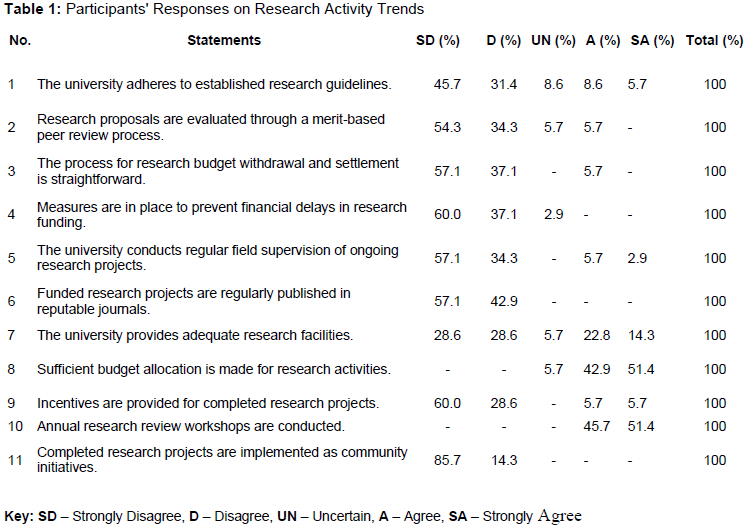
The responses from participants at Jinka University highlight significant challenges in research activities. A majority (45.7%) strongly disagreed, and 31.4 per cent disagreed that the university follows its research guidelines, while 54.3 per cent strongly disagreed, and 34.3 per cent disagreed with the fairness of merit-based peer-reviewed proposal evaluations. Financial processes are viewed as problematic, with 57.1 per cent strongly disagreeing and 37.1 per cent disagreeing on the simplicity of budget withdrawal and settlement, and 60 per cent strongly disagreeing and 37.1 per cent disagreeing on the system for avoiding financial delays. Supervision of research projects is insufficient, as 57.1 per cent strongly disagreed, and 34.3 per cent disagreed that frequent field supervision is conducted. Publication in reputable journals is another issue, with 57.1 per cent strongly disagreeing, and 42.9 per cent disagreeing on this matter. While 51.4 per cent agreed the university allocates sufficient research budgets, incentives are lacking, with 60 per cent strongly disagreeing, and 28.6 per cent disagreeing about motivating rewards. Periodic research review workshops are conducted annually according to 51.4 per cent, though 45.7 per cent were undecided. On a positive note, 85.7 per cent agreed, and 14.3 per cent strongly agreed that completed research is implemented as community projects. Overall, while research funds and community-based initiatives show promise, areas like financial management, publication practices, and staff incentives need improvement.
Results of Trends of Academic Publication
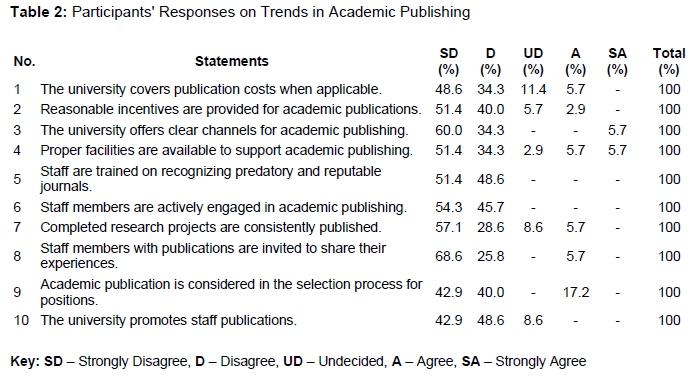
The responses highlight significant barriers to academic publishing at Jinka University. A majority of respondents (48.6%) indicated the university does not consistently cover publishing costs, and 51.4 per cent reported insufficient incentives for publication. Additionally, 60 per cent stated that proper channels for academic publishing are lacking, while 51.4 per cent noted inadequate publishing facilities. Training on identifying predatory journals was also cited as a concern by 51.4 per cent. Staff engagement in academic publishing is low, with 54.3 per cent indicating limited participation, and 57.1 per cent noted that research projects do not always lead to publications. While 68.6 per cent acknowledged efforts to invite published staff to share experiences, 42.9 per cent felt that publications are not prioritized for academic promotions, and 42.9 per cent noted that staff publications are not adequately promoted. These challenges underscore the need for improved financial support, infrastructure, and recognition to enhance academic publishing and the university's research culture.
Results Obtained from Qualitative Data
The findings obtained from qualitative data analysis reveal that Jinka University annually allocates research funds, provides equipment for fieldwork, and organizes skill development training. Despite these efforts, research participation among staff in the College of Social Science and Humanities remains low, with an average of 12 projects initiated annually since 2019. Staff participation in research has declined significantly, from approximately 50 per cent in 2019 to 17.9 per cent in 2022. This highlights the limited engagement of academic staff in research activities. In terms of academic publishing, activity remains limited due to several factors. Staff members reported challenges in identifying reputable journals, writing publishable articles, and effectively addressing peer review feedback. The introduction of the "Harmonized Standard for Academic Staff Promotion in Public Universities" in 2020, which mandates publications in indexed journals, has influenced publication rates, with many staff members unfamiliar with indexing platforms like Scopus and Web of Science.
Overall, while the university has established thematic research areas and funding mechanisms, the centralized management system, insufficient capacity-building efforts, and weak monitoring and evaluation processes hinder progress. Research outputs are often underutilized, with limited transformation into practical applications or publication in reputable academic platforms. These findings highlight the need for strategic interventions to foster a more robust research culture and improve academic publishing outcomes at the university.
CONCLUSIONS AND RECOMMENDATIONS
Conclusions
The findings of the study reveal several critical trends in research and academic publication at Jinka University, particularly in the College of Social Science and Humanities. Staff participation in research activities has significantly declined over recent years, primarily due to heavy workloads, insufficient experience, and a centralized research management system that slows decision-making. Academic publishing faces barriers such as a lack of clear guidelines, financial support, and essential skills such as journal selection, article writing, and responding to peer reviews. Many staff members are unfamiliar with indexing platforms and the requirements of reputable journals. Furthermore, the university's financial management for research and academic publishing is inadequate, characterized by delays in fund disbursement and a lack of incentives to motivate staff. Insufficient infrastructure and training opportunities exacerbate these issues. The introduction of the 2020 "Harmonized Standard for Academic Staff Promotion in Public Universities," which mandates publications in indexed journals, has added pressure on staff who are already ill-equipped to meet such demands. Despite efforts to establish thematic research areas and allocate funds, research findings remain underutilized, with limited transformation into practical applications or publications in reputable journals. These factors collectively hinder the university's research productivity and academic visibility.
Recommendations
To provide a clear and actionable roadmap for Jinka University stakeholders, the proposed recommendations have been prioritized based on their feasibility and potential impact. Capacity building should be strengthened by organizing regular training workshops on research methodology, journal article writing, and the peer review process. Raising awareness about reputable journals and indexing platforms, such as Scopus and Web of Science, is essential to equip staff with the skills needed to enhance research and publication outcomes. Financial processes should be simplified by decentralizing and streamlining fund withdrawal and settlement procedures to avoid delays. Additionally, establishing a dedicated budget for academic publishing will ease administrative bottlenecks and allow researchers to focus on their work.
Clear and comprehensive research and publication guidelines should also be developed to simplify proposal evaluations and make them merit-based and efficient. A reward system can be implemented to incentivize staff who publish in reputable journals or conduct impactful research, with publications being promoted through university platforms, newsletters, and events to encourage productivity. Research monitoring and evaluation systems should be established to ensure accountability, transparency, and quality. Furthermore, reducing teaching and administrative workloads for active researchers is critical, as it will allow them to dedicate more time to research and publication activities.
The university should also promote research outputs by transforming findings into practical applications that benefit local communities, thereby strengthening societal relevance and reputation. Collaboration and partnerships with other universities, research institutions, publishers, and platforms should be fostered to share resources, access reputable journals, and exchange knowledge, which will enhance long-term research capacity. Additionally, there should be a targeted focus on indexed publications by providing support to researchers to publish in Scopus and Web of Science journals while establishing collaborations with indexing platforms and publishers to improve academic visibility and ranking.
To implement these recommendations, an action plan is proposed. In the short term, Jinka University should launch training workshops on research methodologies and academic publishing, simplify financial processes, and establish clear guidelines for research funding and publication, while also announcing incentive programs for published researchers. In the medium term, the university should implement monitoring systems for research progress, reduce workloads for active researchers, and promote research outputs through community-based initiatives. In the long term, efforts should be focused on fostering national and international collaborations with universities and publishers and prioritizing the publication of research in indexed journals to enhance the institution's visibility and impact. By following this roadmap, Jinka University can address its challenges and foster a robust research culture, ultimately improving the quality and impact of its research activities.
CONFLICT OF INTERESTThe author affirms that there are no conflicts of interest associated with this research.
DECLARATIONI, the undersigned author, hereby confirms that this research is my original work. It has not been published, in whole or in part, in any other forum or for any other purpose.
ACKNOWLEDGEMENTS
I would like to sincerely express my gratitude to Arba Minch University for generously funding this research. Our appreciation also extends to the Vice President's Office for Research and Community Engagement, as well as the staff, research coordinators, and the Dean of the College of Social Sciences and Humanities at Jinka University for their valuable support and cooperation in facilitating data collection for this study.
REFERENCES
-
Abebaw, A., M. Muchie, Z. Sime, and W. Ezezew. 2022. "Factors affecting the innovation ecosystem in public universities in Ethiopia". African Journal of Science, Technology, Innovation and Development. https://doi.org/10.1080/20421338.2022.2043809
» https://doi.org/10.1080/20421338.2022.2043809 - Addis Ababa University (AAU). 2019. Addis Ababa University Senate Legislation. Revised: AAU Printing Press.
- Alemayehu, T., and S. Bekele. 2021. "The role of digital technology in facilitating academic publishing in Ethiopia". Journal of African Higher Education Technology Studies, 5(3), 12-28.
- Alemu, D. S. 2019. "Academic staff promotion and research productivity in Ethiopian public universities". Ethiopian Journal of Higher Education Studies, 9(2), 45-61.
- Alemu, D. S., and A. A. Tekleselassie. 2021. "Challenges in academic research and publishing in Ethiopia". African Journal of Higher Education Studies, 14(2), 27-39.
- Ashcroft, K. 2010. "Ethiopia: Expanding and improving higher education". University World News: African Edition, 22 August, (0066).
- Ayalew, A., M. Getahun, and S. Demeke. 2022. "Challenges and opportunities of research and publication in Ethiopian public universities". Journal of African Higher Education, 14(1), 23-38.
- Federal Democratic Republic of Ethiopia (FDRE). 2003. "Higher Education Proclamation" (No. 351/2003). Federal Negarit Gazeta, 9(72), 2235-2263.
- Federal Democratic Republic of Ethiopia (FDRE). 2009. "Higher Education Proclamation" (No. 650/2009). Federal Negarit Gazeta, 15(64), 4976-5044.
- Federal Democratic Republic of Ethiopia Ministry of Education (FDRE MoE). (2020). Harmonized Standard for Academic Staff Promotion in Public Universities. Addis Ababa: FDRE MoE.
- Mekonnen, B., and H. Tesfaye. 2020. "The role of academic conferences in enhancing research and publication in Ethiopian universities". Ethiopian Journal of Research and Innovation, 3(1), 45-58.
- Ministry of Education (MoE). 2018. Ethiopian Education Development Roadmap (2018-30). Addis Ababa: MoE.
- Taye, B., and Zeleke, W. 2015. "Institutional journals in Ethiopian universities: Opportunities and challenges". East African Higher Education Journal, 9(2), 17-30.
- Teferra, D. 2016. "Research in higher education: The challenges and prospects for Africa". Journal of African Higher Education Studies, 6(4), 123-137.
- Yizengaw, T. 2008. "Challenges and prospects of research in Ethiopian public universities". Higher Education Policy and Management Studies, 3(2), 67-89