Graffiti, AI, and decolonial knowledge-making in psychology education
Abstract
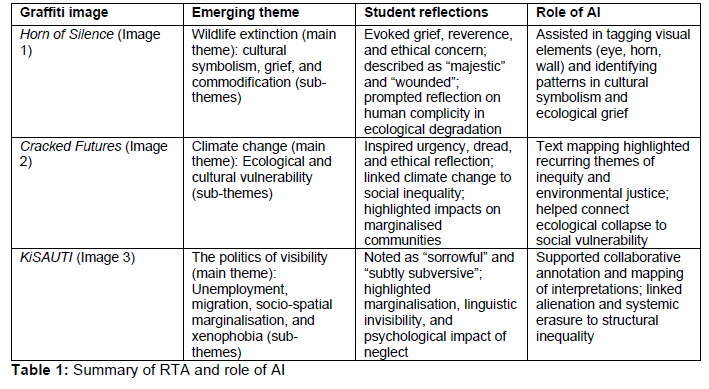
South Africa's higher education sector remains marked by structural inequalities that shape access, participation, and the recognition of knowledge. This study explores how carefully constrained uses of artificial intelligence (AI) might support decolonial psychology education while acknowledging that many AI systems reproduce Eurocentric epistemologies, dominant language hierarchies, and neoliberal assumptions that risk reinforcing exclusion. Twelve postgraduate psychology students participated voluntarily in a participatory, arts-based project in which graffiti was documented and analysed as a situated expression of social commentary, emotion, and resistance. Conducted over one academic semester, the study unfolded in three phases: orientation and training, data generation, and collaborative interpretation. A limited set of accessible digital tools and AI-supported features were used to promote inclusive participation, including Google Lens for image recognition, Google Translate for multilingual engagement, Microsoft Word transcription for speech-to-text conversion, and Google Docs and WhatsApp to coordinate asynchronous and synchronous participation. Importantly, AI was positioned as a pedagogical resource rather than an authoritative source of truth. While AI assisted with transcription, translation, and pattern identification, interpretation remained grounded in participants' contextual, cultural, and historical understandings. AI-generated outputs were critically discussed, accepted, revised, or rejected through collective reflection. Findings suggest that, when used reflexively within a decolonial-critical pedagogical framework, carefully delimited AI tools can support more inclusive and socially engaged psychology education in the Global South by amplifying marginalised epistemologies, fostering critical reflexivity, and encouraging context-sensitive forms of knowledge production.
artificial intelligence (AI); arts-based pedagogy; critical pedagogy; decolonisation; graffiti; social unconscious