Graffiti, AI, and decolonial knowledge-making in psychology education
Abstract
South Africa's higher education sector remains marked by structural inequalities that shape access, participation, and the recognition of knowledge. This study explores how carefully constrained uses of artificial intelligence (AI) might support decolonial psychology education while acknowledging that many AI systems reproduce Eurocentric epistemologies, dominant language hierarchies, and neoliberal assumptions that risk reinforcing exclusion. Twelve postgraduate psychology students participated voluntarily in a participatory, arts-based project in which graffiti was documented and analysed as a situated expression of social commentary, emotion, and resistance. Conducted over one academic semester, the study unfolded in three phases: orientation and training, data generation, and collaborative interpretation. A limited set of accessible digital tools and AI-supported features were used to promote inclusive participation, including Google Lens for image recognition, Google Translate for multilingual engagement, Microsoft Word transcription for speech-to-text conversion, and Google Docs and WhatsApp to coordinate asynchronous and synchronous participation. Importantly, AI was positioned as a pedagogical resource rather than an authoritative source of truth. While AI assisted with transcription, translation, and pattern identification, interpretation remained grounded in participants' contextual, cultural, and historical understandings. AI-generated outputs were critically discussed, accepted, revised, or rejected through collective reflection. Findings suggest that, when used reflexively within a decolonial-critical pedagogical framework, carefully delimited AI tools can support more inclusive and socially engaged psychology education in the Global South by amplifying marginalised epistemologies, fostering critical reflexivity, and encouraging context-sensitive forms of knowledge production.
artificial intelligence (AI); arts-based pedagogy; critical pedagogy; decolonisation; graffiti; social unconscious
INTRODUCTION
Higher education in the Global South continues to operate under deep inequality. Colonial histories shape both access to education and whose knowledge is legitimised, while neoliberal reforms have intensified competition, insecurity, and exclusion (Le Grange 2020; Jansen, Motala, and Singh 2025). In South African postgraduate psychology, these tensions are especially evident, as Eurocentric curricula foreground universalised Western models of mental health that separate psychological experience from local realities and obscure the historical, political, and communal forces shaping subjectivity (Auld 2024, 2025a; Hook 2004; Ratele 2019; Singh 2024). Addressing these inequalities demands decolonial pedagogies that transform how knowledge is produced, interpreted, and shared, and emerging technologies must support inclusion, reflection, and social change rather than compound psychology's embedded biases (Mohamed, Png, and Isaac 2020; Hayward 2024). The rapid rise of artificial intelligence (AI), and particularly generative large language models (LLMs), intensifies these concerns, raising questions about whose voices are amplified and whose remain marginalised in the production of knowledge.
Most AI systems have been developed in the Global North and shaped by Western epistemologies that privilege individualism, rationality, efficiency, and quantification (Mohamed, Png, and Isaac 2020). AI, therefore, reproduces Eurocentric norms about legitimate knowledge, language, and intelligence, while marginalising relational, communal, embodied, and spiritual epistemologies common in the Global South (Langeveldt and Pietersen 2024; Mohamed, Png, and Isaac 2020; Nemorin 2024; Shams, Zowghi, and Bano 2025). One source of this bias is training data: LLMs and computer vision systems are trained primarily on Western texts, media, and academic sources where English and other European languages dominate, rendering non-Western contexts less visible (Bender et al 2021; Langeveldt and Pietersen 2024). In African settings, indigenous languages, oral traditions, and locally grounded meaning-making remain underrepresented, reinforcing long-standing patterns of colonialism and prompting Africans to see themselves through the eyes of the coloniser (Wa Thiong'o 1986). A deeper source lies in the ontological and epistemological assumptions built into AI's design: classificatory schemes rooted in Enlightenment traditions that privilege measurement, order, and control sit uneasily with decolonial emphases on relationality, ambiguity, history, and context, and struggle to engage the narrative, symbolic, affective, embodied, and collective ways of knowing foundational to many African and indigenous epistemologies (Chilisa 2012; Le Grange 2016; Mohamed, Png, and Isaac 2020).
This misalignment is reinforced by AI governance and ethics frameworks that universalise Western moral norms - individual rights, rational autonomy, fairness - while overlooking the collective histories of exploitation, dispossession, and structural violence shaping postcolonial contexts (Birhane 2021). Applied as one-size-fits-all solutions, such frameworks impose external standards and reinscribe colonial power. In educational and mental healthcare contexts, they risk pathologising non-Western subjectivities and normalising deficit-based readings of marginalised communities, treating Global South perspectives as supplementary rather than epistemically legitimate (Pillay and Laher 2018; Maldonado-Torres 2017; Samuel and Ortiz 2021).
Taken together, these critiques underscore that AI - and especially generative LLMs - is not a neutral technology. Without reflexive and decolonial scrutiny, AI risks reproducing the hierarchies and exclusions that decolonial education seeks to unsettle.
This study responds by deliberately constraining AI to a small number of well-specified, mostly non-generative features, placing these in dialogue with graffiti in an attempt to support inclusive, critical, and socially transformative learning in psychology education. Grounded in a decolonial-critical orientation (Zembylas 2025), AI is framed not as an authoritative arbiter of knowledge, but as a pedagogical resource embedded within ethically informed and contextually situated processes of meaning-making (Langeveldt and Pietersen 2024; Mohamed, Png, and Isaac 2020; Nemorin 2024). The study attempts to align technological engagement with socially transformative pedagogical aims, fostering reflection and dialogue while preserving the cultural, historical, and relational forms of knowledge through which learning is produced (Soudien 2023).
CONTEXTIn South Africa, graffiti is increasingly recognised as a socio-political and pedagogical resource that gives visual form to public dissent, memory, and struggle (Jubas and Lenters 2019; Penfold 2017; Sitas 2020). Emerging from histories of inequality, spatial segregation, and youth marginalisation, graffiti documents lived experience outside formal institutional channels (Chapman 2019; Brown-Edwards 2020). Research in Durban, KwaZulu-Natal, for example, demonstrates how urban walls function as contested public spaces where residents articulate experiences of unemployment, migration, violence, and belonging, particularly within neglected and economically marginalised neighbourhoods (Chapman 2019). Similarly, work by the Gauteng City-Region Observatory highlights how informal visual expressions reflect broader socio-economic pressures, including precarity, exclusion, and contested citizenship (Hamann 2024). Studies in Cape Town further position graffiti as a form of protest art and community archive through which marginalised voices challenge dominant narratives and assert visibility (Brown-Edwards 2020; Makhubu 2017). Collectively, this body of work positions graffiti not merely as an aesthetic artefact, but as a public pedagogical resource embedded in everyday urban life, offering insight into the social, political, and psychological conditions shaping post-apartheid South Africa.
OPERATIONAL DEFINITION OF GRAFFITIDrawing on this scholarship, graffiti is operationally defined in this study as unsanctioned or semi-sanctioned visual inscriptions, images, symbols, or text situated within public urban spaces that function as expressions of social commentary, affect, and resistance. Rather than treating graffiti as decoration or vandalism, the study approaches it as an embodied and context-dependent pedagogical practice through which lived realities - including inequality, exclusion, environmental degradation, migration, and historical trauma - become publicly visible (Giroux 2004; Jubas and Lenters 2019). Graffiti is understood as inseparable from the spatial, historical, and socio-political conditions in which it emerges (Ferrell 2016; Ouzman 2010). Read through the group analytic concept of the social unconscious, it can further be understood as expressing shared, but often unspoken, social anxieties, defenses, and collective memories that continue to shape subjectivity and identity (Hopper 2003; Weinberg 2007; Auld 2025c). In this sense, graffiti operates as a visual-textual archive through which questions of identity, belonging, justice, and historical memory are negotiated in public space (Brown-Edwards 2020; Becker 2018).
By situating AI within the embodied, context-rich learning environment created through engagement with graffiti, the study explores how participatory, arts-based pedagogy might inform more ethical, inclusive, and socially responsive uses of technology in psychology education in the Global South. The project brings together four intersecting areas: the decolonisation of psychology education (Maldonado-Torres 2017; Zembylas 2018); graffiti as public pedagogy (Giroux 2004); participatory, arts-based methodologies (Leavy 2017); and the inclusive pedagogical possibilities of AI (Mohamed, Png, and Isaac 2020; Nemorin 2024). Considered together, these strands position the Global South not as a passive testing ground for technological innovation, but as a generative site for reimagining human-AI collaboration around inclusion, reflexivity, and epistemic justice.
OPERATIONAL DEFINITION OF AIFollowing Williamson's (2024) caution against conflating disparate technologies under the umbrella term "AI", this study uses the term narrowly to refer to four AI-enabled features: computer-vision tagging that proposes labels for objects, colours, and text within images; automatic speech-to-text transcription; neural machine translation between languages; and cloud collaboration tools used to coordinate asynchronous and synchronous participation. These features function primarily as pattern-recognition and processing tools. AI was not used as a search engine, autonomous content generator, or substitute for literature engagement and analysis. The term "AI" hereafter refers only to these four features, employed in the constrained ways outlined in the methodology.
DECOLONIAL PEDAGOGY AND PSYCHOLOGY EDUCATIONAcross the Global South, psychology education continues to rely on Eurocentric theories that conceptualise mental health as a universal, individual phenomenon detached from historical, cultural, and environmental conditions (Pillay and Laher 2018). In South Africa, postgraduate psychology education has traditionally prioritised diagnostic systems such as the DSM-5 (American Psychiatric Association 2013) alongside cognitive-behavioural and evidence-based approaches developed largely in the Global North. While these frameworks provide important clinical tools, they narrow understandings of distress by locating difficulties primarily within the individual. Consequently, experiences shaped by apartheid legacies, racialised inequality, poverty, violence, dispossession, and environmental insecurity risk being interpreted as personal dysfunction rather than responses to structurally produced precarity (Hook 2004; Ratele 2019), marginalising relational, collective, and contextually grounded understandings of psychological life.
Intellectual decolonisation challenges this universalising orientation, not by rejecting European thought outright, but by critically interrogating how knowledge is produced, legitimised, and applied. Chetty (2023, 2025) describes this process as a "conceptual audit": a reflexive examination of the assumptions embedded within disciplines, institutions, and dominant knowledge systems. Importantly, this approach differs from broader decoloniality theories in that it does not propose a singular account of coloniality. Instead, it asks how knowledge functions, whose interests it serves, and what realities it makes visible or obscures. The emphasis, therefore, shifts from whether knowledge is "Western" or "non-Western" to how knowledge operates within relations of power.
This critical orientation creates an important point of connection between intellectual decolonisation and transformative pedagogical approaches concerned with challenging inequality and exclusion in education. Although critical and decolonial pedagogies emerge from different intellectual traditions, both seek to confront injustice and transform oppressive educational structures. Critical pedagogy, shaped by Marxist and liberationist traditions, foregrounds dialogue, conscientisation, and critique of capitalist inequality (Freire 2018). Decolonial pedagogy, by contrast, focuses more explicitly on the enduring effects of coloniality on knowledge, identity, and power in the Global South (Maldonado-Torres 2017; Zembylas 2018). Rather than positioning these traditions in opposition, Zembylas (2025) argues that bringing them into dialogue opens richer possibilities for transformative education.
This study adopts such a dialogical position through graffiti as a pedagogical resource. Graffiti enables psychology students to engage critically with visible traces of inequality, exclusion, resistance, and collective memory embedded in everyday urban spaces. Encounters with graffiti may evoke emotional responses connected to broader histories of privilege, marginalisation, and belonging, revealing aspects of what Hopper (2003) and Weinberg (2007) describe as the social unconscious. In this sense, graffiti functions as a pedagogy of discomfort, confronting students with unsettling realities while creating facilitated spaces for dialogue, emotional containment, and reflexive engagement (Boler and Zembylas 2003). Such encounters align with critical pedagogy's emphasis on reflexivity (Freire 2018) while advancing decolonial aims by foregrounding lived experience, context, and power within psychological knowledge production (Maldonado-Torres 2017; Zembylas 2018).
The study extends this dialogue by situating AI within embodied, contextually grounded engagements with graffiti. AI is treated not as neutral or authoritative, but as a pedagogical resource whose meanings and effects depend on the social and historical contexts in which it is used (Couldry and Mejias 2019; Birhane 2021). When approached reflexively, AI may support collaborative learning, multilingual engagement, and the organisation of complex visual and textual material (Knox 2020; Selwyn 2019). Decolonial pedagogy may also require forms of technological refusal where AI reproduces exclusionary assumptions; following Selwyn (2019), AI is therefore approached as a bounded tool, while ethical responsibility and interpretive authority remain grounded in human relationships and decolonial-critical practice.
METHODOLOGY
Research approach
This study employed a qualitative, participatory, arts-based research design to explore how graffiti and AI might function as interconnected pedagogical resources in support of decolonising postgraduate psychology education in South Africa. The methodology prioritised student voice, situated knowledge, and collaborative meaning-making, positioning participants not simply as subjects of research, but as active co-constructors of interpretation and knowledge (Chilisa 2012; Leavy 2020).
Grounded in both decolonial and critical pedagogical traditions, the study sought to create learning environments in which students could engage reflexively with the social, political, and emotional realities represented in public urban space. Graffiti was approached as a contextually embedded form of public pedagogy through which issues of inequality, exclusion, environmental degradation, migration, and historical trauma could be explored collectively. Within this framework, AI was introduced as a carefully bounded pedagogical support to assist processes such as transcription, translation, and collaborative annotation, while interpretation and ethical judgement remained grounded in human dialogue and contextual understanding.
The project was further informed by a pedagogy of discomfort, which created facilitated spaces in which students could critically engage with inherited assumptions, emotional responses, and public expressions of social injustice (Boler and Zembylas 2003). Rather than avoiding discomfort, the study treated emotional unease as a potentially productive site for reflexivity, dialogue, and socially transformative learning.
Research paradigm
The study was positioned within decolonial and critical pedagogical traditions. Decolonial perspectives framed knowledge as situated, relational, and historically embedded, foregrounding the importance of context, lived experience, and epistemic justice within psychology education (Kessi 2017; Le Grange 2020). Critical pedagogy informed the facilitation of dialogue, collective interpretation, and reflexive engagement, emphasising education as a process through which students critically examine power, inequality, and social conditions (Zembylas 2015; Freire 2018). Together, these paradigms informed an approach that sought to position learning as collaborative, context-sensitive, and socially engaged.
Ethical considerations
Ethical considerations were central to the study, particularly given the emotionally provocative nature of some graffiti images and discussions. Structured facilitation, reflective surveys, and guided group dialogue were used to support students in processing emotional responses, while allowing discomfort to function as a pedagogical resource rather than something to be avoided (Boler and Zembylas 2003). Participation was voluntary and based on informed consent, with pseudonyms used to maintain confidentiality. Free university counselling services were made available to participants should additional support be required. Ethical clearance for the study was granted by The Independent Institute of Education's Research Ethics Committee (R.0002103 [REC]).
Data collection tools
Data were generated over one academic semester in three phases: orientation and training, data generation, and collaborative interpretation.
During orientation, participants were introduced to participatory, arts-based research methods, ethical documentation of graffiti, and reflective journaling. In collaboration with the facilitator the students discussed the use of a deliberately small set of digital tools and AI features. Following the operational definition of AI above, the specific tools and features used were: (i) Google Lens (computer-vision tagging) for automated tagging of visible elements within graffiti photographs (objects, colours, text); (ii) Microsoft Word's built-in transcription (non-generative speech-to-text) for transcribing group discussions; (iii) Google Translate (neural machine translation) for translating non-English graffiti text into English; and (iv) Google Docs and WhatsApp (cloud collaboration tools used here in their non-AI configurations) to coordinate asynchronous and synchronous participation. Tools were chosen for their low data requirements, free or freemium access, smartphone compatibility, and the relatively narrow technical functions they could be confined to. Importantly, AI outputs were treated as provisional, contestable suggestions, never as definitive findings.
During the data generation phase, students used smartphones to photograph graffiti within their local communities. Each image was accompanied by a reflective journal entry completed through a structured template designed to support both detailed description and critical interpretation of the graffiti's social, psychological, and political meanings. The digital submission process enabled students to reflect individually and asynchronously before participating in facilitated group discussions, where interpretations could be collectively explored and debated. Carefully constrained AI-enabled tools were then used to assist in linking visual and textual material through functions such as tagging and transcription. These tools were intended to support, rather than direct, participants' engagement by helping to reveal connections across images, reflections, and discussions, thereby enriching the emotional, relational, and dialogical dimensions of the learning process.
Data analysis
Collaborative analysis took place in group sessions where students collectively examined patterns across the graffiti images and reflective journals. These sessions focused on dialogue, debate, and reflection on the social, historical, and psychological dimensions of the data, including the workings of the social unconscious (Hopper 2003; Weinberg 2007). AI-supported visualisation was used to assist in mapping thematic connections and points of disagreement, while human interpretation remained central to the analytic process (Mitchell 2011; Nemorin 2024).
Analysis followed Braun and Clarke's (2006, 2019, 2023) six-phase reflexive thematic analysis (RTA), adapted for participatory, decolonial-critical inquiry. Consistent with RTA, codes and themes were treated not as patterns lying dormant in the data, awaiting discovery, but as analytic constructions actively generated through the researcher's and participants' situated, theoretically informed engagement with the material (Braun and Clarke 2019).
Familiarisation with the data
Participants re-read their reflective journals, re-viewed photographs, and worked through transcripts of group discussions produced using Microsoft Word's speech-to-text function, recording memos on early impressions, affective responses, and questions.
Generating initial codes
Participants worked individually and then collaboratively to assign descriptive and interpretive codes to segments of journal text, transcripts, and visual data. Google Lens tags and Google Translate outputs were imported as provisional, machine-generated codes that were interrogated alongside, but never substituted for, participant-generated codes.
Constructing candidate themes
Codes were clustered into candidate themes organised around a shared central concept (Braun and Clarke 2019), with particular attention to patterns connecting affect, decolonial concerns, and the social unconscious.
Reviewing themes
Candidate themes were tested against the full data set and against the study's theoretical framework, namely decolonial pedagogy, critical pedagogy, the social unconscious, and the pedagogy of discomfort. Themes that fragmented or failed to hold a coherent organising concept were collapsed, split, or reworked.
Defining and naming themes
Each retained theme was given a precise definition and a name capturing its central organising concept, with deliberate attention to whose voice was being foregrounded or marginalised by particular formulations.
Producing the analysis
The analysis was written up through the selection of extracts and graffiti images that illustrated each theme and linked student voice explicitly to the theoretical framework.
Reflexivity ran through all six phases. The facilitator maintained a reflexive journal documenting her positionality, emotional engagement, and decisions about AI use, and participants engaged in iterative member-checking through group discussion (Braun and Clarke 2023).
The group followed an explicit accept/reject/adapt protocol in relation to AI suggestions. For each AI-generated tag or translation, participants asked four questions in dialogue: (a) Does this output reflect our cultural, historical, and situated knowledge of the image or text? (b) Does it reproduce a Eurocentric, individualised, or deficit-based framing? (c) Does it miss anything visible only from a situated South African vantage point? (d) Does engaging this output advance our decolonial-critical aims, or would refusal be more appropriate? Outputs that survived these questions were accepted; outputs judged unhelpful, or distorting were rejected; outputs that were partly useful were adapted by re-coding, rewording, or re-framing. The facilitator audited these decisions in her reflexive journal. AI, thus, accelerated pattern detection and supported multilingual engagement, but did not author meaning - disagreement, embodied response, and situated knowledge remained the core interpretive resources (Bender et al 2021).
Facilitator's reflexive note
The facilitator (lecturer-researcher) kept an ongoing reflective journal, attending to her dual role, her own engagement, emotional responses, and positionality, as well as to evolving group dynamics and the interaction between AI tools and human interpretation. The journal also recorded discomforts associated with AI itself - including the environmental costs of training and running AI (Bender et al 2021) and the extractive labour conditions through which much AI is produced (Mohamed, Png, and Isaac 2020) - so that the pedagogy of discomfort extended to the technology, not only to the graffiti. These reflexive notes documented group processes, moments of discomfort, and any emerging insights not always visible in the visual or textual data, adding an additional layer of analytical depth (Finley 2008).
FINDINGS
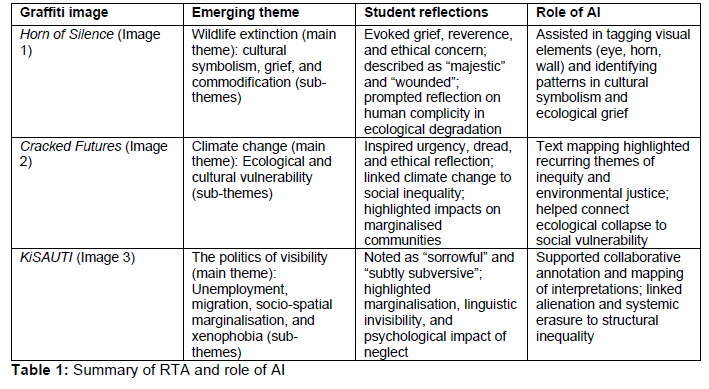
Three interrelated themes emerged: wildlife extinction, climate change, and the politics of visibility. Each is presented through a representative graffiti image, students' interpretations, the role of AI in scaffolding analysis, and an explicit linking of student voice to the study's theoretical framework.
Wildlife extinction
Across graffiti images, journals, and discussions, students engaged with wildlife extinction, using depictions of endangered animals as entry points for reflecting on biodiversity loss in South Africa. They connected ecological loss to broader processes of cultural degradation, colonialism, and capitalism. The graffiti image entitled Horn of Silence (Image 1) was identified by students as a particularly powerful articulation of these concerns.

Rendered in vibrant greens and golds, the rhino in Horn of Silence elicited strong emotional responses associated with ecological destruction and cultural loss. Positioned against a crumbling wall, the image evoked feelings of grief, unease, and reverence. Students described the rhino as "wounded", "watchful", and "majestic". Read through a pedagogy of discomfort, these emotional reactions were understood not as obstacles to learning, but as starting points for deeper critical engagement (Boler and Zembylas 2003). The unsettling nature of the image encouraged students to move beyond immediate affective responses and reflect on both personal and collective complicity in environmental harm, as well as the extractive ideologies driving wildlife extinction across the Global South.
AI-supported features assisted this interpretive process in carefully constrained and facilitative ways. Google Lens generated automated tags for visible elements within the graffiti image, including the rhino's eye, horn, and the cracked wall. Rather than accepting these outputs uncritically, students collectively reviewed the tags, accepting, rejecting, or adapting them before linking them to broader sub-themes such as cultural symbolism, grief, commodification, and ecological loss. The participants and facilitator then clustered these tags alongside language drawn from reflective journals and group discussions, producing tentative thematic groupings that highlighted recurring motifs of mourning, disconnection, and resilience across the dataset. In this way, AI functioned as a pedagogical support that helped organise and visualise connections, while interpretive authority remained grounded in collaborative human reflection and contextually situated meaning-making.
Drawing on the rhino's symbolic significance in many African contexts as a marker of strength, leadership, protection, and sacred power (Mbiti 1990), students suggested that the animal's endangerment represented more than ecological vulnerability alone. For them, the threatened rhino symbolised the erosion of culturally meaningful identities, collective dignity, and relationships between people, land, and wildlife. Particular attention was given to the rhino's horn, which students interpreted as illustrating the transformation of sacred life into a marketable commodity. This discussion enabled participants to critically examine how capitalist desire, colonial extraction, and ecological precarity intersect within contemporary wildlife exploitation (Dovey, Wollan, and Woodcock 2012).
Participants also reflected on the continued commodification of rhino horn within illicit transnational markets, where it is valued both for traditional medicine and as a marker of prestige and wealth. Through these discussions, students recognised how local experiences of wildlife loss are entangled with global systems of consumption, status, and exploitation. Read through the lens of the social unconscious (Hopper 2003; Weinberg 2007), the rhino appeared to function as a symbolic container for collective grief, anxiety, and historically layered forms of violence that participants struggled to articulate directly in everyday language. In this sense, students' reflections embodied critical pedagogy's concern with conscientisation (Freire 2018), as the graffiti enabled them to connect personal emotional responses to the wider historical, economic, and cultural systems through which environmental harm is produced and sustained.
Climate change
Across graffiti images, journals, and discussions, students repeatedly engaged with climate change, drawing connections between ecological vulnerability, human responsibility, and the social and environmental consequences of global warming. These concerns came into focus in the graffiti image Cracked Futures (Image 2), which depicts parched, fissured earth accompanied by the phrases "is this the future?" and "SAVE SOIL."
Students interpreted the cracked earth both literally, as a representation of drought and environmental collapse, and symbolically, as an expression of broader social and cultural precarity. The stark contrast between the barren soil and faint traces of green elicited strong emotional responses, including dread, despair, guilt, and uncertainty about the future. These affective reactions prompted students to reflect critically on ethical responsibility and the obligations they felt toward future generations and communities most vulnerable to ecological crisis (Pihkala 2020). Their interpretations resonated with Nixon's (2011) concept of slow violence, which describes how environmental harm unfolds gradually and often invisibly, disproportionately affecting marginalised populations. Through this lens, climate change came to be understood not simply as an environmental issue, but as a form of structural violence that erodes livelihoods, cultural continuity, and future possibilities.
Collaborative analysis across journals, annotations, and discussions further highlighted recurring themes of dispossession, inequality, ecological vulnerability, and uneven access to land and resources in South Africa (Bond 2011; Sultana 2022). During facilitated dialogue, students also recognised how Western individualist narratives about climate responsibility had shaped aspects of their own thinking. Initially, some participants tagged and mapped environmental responsibility primarily in terms of personal behaviour and consumer choice. Through critical discussion, however, they began questioning these assumptions, recognising how such framings can obscure the structural and historical dimensions of environmental harm. This reflexive process functioned as a form of conscientisation in Freire's (2018) sense, enabling students to examine how dominant ideologies become normalised within everyday thought.
Participants subsequently re-centred their interpretations on the context-specific realities shaping climate change in South Africa, arguing that ecological collapse cannot be separated from histories of land dispossession, poverty, inequality, and uneven development. They further highlighted how environmental degradation intensifies vulnerabilities linked to food insecurity, health, migration, and displacement. In this way, students moved beyond universalised and individualised explanations toward a more relational, historically situated, and place-based understanding of climate change, reflecting the decolonial-critical orientation described by Zembylas (2025). AI-supported mapping tools assisted by making thematic connections visible across the data, but interpretive authority remained grounded in collective human reflection and participants' lived realities.
The politics of visibility
Across the data, students engaged with the politics of visibility, including migration and xenophobia in post-apartheid urban spaces. Concerns about economic precarity, displacement, and systemic neglect converged in the graffiti tag KiSAUTI (Image 3), painted in uneven lettering on the decaying wall of a neglected city street.
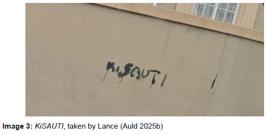
Participants used Google Translate's neural machine translation to explore the Swahili word sauti, which can mean "voice", "sound", "volume", or "speaking aloud". Its appearance within a South African urban environment unsettled taken-for-granted assumptions about language, belonging, and visibility. Under apartheid, European languages, alongside a narrow selection of indigenous languages, were institutionalised as markers of legitimacy and social inclusion (Davids 2016; Manyike and Shava 2018; Segalo and Cakata 2017). As a transnational African language situated outside these dominant linguistic hierarchies, Swahili disrupted assumptions about whose voices are recognised, whose speech is considered intelligible, and who is permitted social and political visibility (Heugh 2013). In this sense, the graffiti tag exposed how migrant and economically marginalised populations are often hyper-visible as labouring or "foreign" bodies, while remaining invisible as political, cultural, and social subjects.
Students described the tag as "subtly subversive" and "sorrowful", recognising how a single word could evoke the silencing of communities shaped by migration, unemployment, and structural exclusion. Viewed through the lens of the social unconscious (Hopper 2003; Weinberg 2007), the tag appeared to carry unspoken anxieties linked to xenophobia, displacement, and post-apartheid struggles over belonging. This discomfort became pedagogically productive, enabling students to reflect collectively on experiences that initially felt difficult to articulate (Boler and Zembylas 2003).
Collaborative annotation in Google Docs enabled participants to map interpretations directly onto the image, while the participants and facilitator highlighted recurring links between migration, unemployment, invisibility, and psychological distress across journals and discussions. Importantly, these AI-supported patterns functioned only as prompts for dialogue rather than as authoritative interpretations. Meaning remained grounded in participants' contextual, historical, and lived understandings, illustrating how decolonial-critical pedagogy relocates psychological distress within broader histories of inequality, mobility, and political economy (Massey 2008; Miraftab 2012).
SUMMARY
DISCUSSION
The findings indicate that, within participatory, arts-based pedagogy, carefully bounded AI features can extend rather than replace human interpretation, dialogue, and relational engagement. Across the three themes, automated tagging, transcription, and machine translation made patterns visible across images, journals, and discussions, while interpretive authority remained with participants. In resource-constrained settings, these functions also supported more inclusive participation by enabling students from different linguistic, cultural, and socio-economic backgrounds to engage equitably in collaborative analysis (Binti Yahaya and Aziz Zalay 2025; Langeveldt and Pietersen 2024).
A defining feature of the project was the accept/reject/adapt protocol applied to every AI output. When students analysed graffiti about climate change and wildlife extinction, AI tagging initially reflected individualised, Western framings of environmental responsibility. Through facilitated dialogue, participants interrogated these outputs and re-centred relational, structural, and historically situated understandings of ecological harm. The protocol made the workings of algorithmic bias pedagogically visible, transforming AI from an absolute authority into a contestable resource. These findings have implications not only for decolonial psychology education, but also for broader debates about the ethical integration of AI within higher education in the Global South:
Contribution to decolonial pedagogy
Decolonial scholarship has called for technologies that support epistemic justice (Mohamed, Png, and Isaac 2020; Nemorin 2024), and arts-based, participatory methods are well established within decolonial education (Leavy 2020; Soudien 2012). What this study adds is an empirical demonstration of how AI - widely critiqued as Eurocentric (Birhane 2021) - can be cautiously incorporated into decolonial-critical practice through a reproducible classroom protocol. It moves the conversation from whether AI can be decolonised to how it can be bounded, audited, and, where appropriate, refused in pedagogical encounters.
Wider implications for higher education pedagogy
Although situated within psychology, the protocol has broader relevance for higher education pedagogy in the Global South. The accept/reject/adapt cycle, use of low-cost accessible tools, and explicit pairing of arts-based inquiry with a pedagogy of discomfort (Boler and Zembylas 2003) offer a transferable model for disciplines such as sociology, education, public health, and the humanities, where lecturers face similar tensions between AI integration and the protection of local knowledge systems (Macleod, du Plessis, and Mogonong 2024).
CONCLUSION
This study explored how participatory, arts-based pedagogy, digital collaboration, and decolonial-critical approaches can contribute to transforming postgraduate psychology education in the Global South. By engaging with graffiti alongside carefully constrained AI features, students critically examined themes of unemployment, migration, xenophobia, environmental degradation, and urban neglect. In this context, graffiti functioned as a public pedagogical resource and as a living archive of struggle, memory, and resistance through which students reflected on the entanglements of history, identity, power, and psychological well-being (Brown-Edwards 2020; Makhubu 2017). The project challenged individualised and decontextualised understandings of distress that often dominate psychology curricula by foregrounding the social, historical, and environmental conditions shaping lived experience.
Grounded in a pedagogy of discomfort (Boler and Zembylas 2003), the study created dialogical learning spaces in which students engaged critically with difficult social realities as well as with their own assumptions and positionalities. Within this process, AI was positioned neither as neutral nor as authoritative. Instead, selected features such as tagging, transcription, translation, and mapping functioned as carefully bounded pedagogical supports that extended multilingual participation, collaborative reflection, and the visibility of thematic patterns across the data. Meaning-making, however, remained grounded in participants' situated cultural, historical, relational, and embodied interpretations. The accept/reject/adapt protocol further enabled students to interrogate algorithmic outputs critically, transforming AI from an unquestioned technological authority into a contestable and reflexive pedagogical resource.
The study also suggests that meaningful engagement with AI in higher education does not necessarily depend on expensive technological infrastructures. Rather, it requires pedagogical frameworks that prioritise facilitated dialogue, reflexive engagement, and context-sensitive interpretation, alongside institutional recognition that arts-based and place-based inquiry constitute legitimate forms of scholarship (Macleod, du Plessis, and Mogonong 2024; Langeveldt and Pietersen 2024). Although the project involved a small cohort of twelve postgraduate students over a single semester, its context-specific focus provided nuanced insight into how local histories, inequalities, and cultural realities shape professional learning and knowledge production.
Beyond the immediate classroom context, the findings speak to broader institutional and policy debates within higher education across the Global South. Universities are increasingly confronted with two intersecting pressures: the demand to decolonise curricula and knowledge production, and the rapid expansion of AI and digital technologies within teaching and learning (Jansen, Motala, and Singh 2025; Williamson 2024). These agendas are frequently positioned in opposition, with AI associated with standardisation, automation, and the reproduction of Eurocentric knowledge systems. The findings of this study, however, suggest that this tension is not inevitable. When AI is deliberately constrained, reflexively governed, and embedded within participatory and contextually grounded pedagogical practices, it can support rather than undermine decolonial educational aims.
The study, therefore, highlights the importance of policy frameworks that move beyond technologically deterministic approaches to AI adoption. Rather than positioning AI as a universal solution or a replacement for human interpretation, institutions may need to prioritise ethically mediated and pedagogically bounded uses of technology. This includes supporting multilingual and accessible digital infrastructures, protecting lecturers' pedagogical autonomy, and recognising that ethical judgement and meaning-making remain grounded in local histories, relationships, and lived realities. In this sense, institutional policy, curriculum frameworks, and funding priorities can either constrain or enable epistemic transformation. Policies that support participatory, reflexive, and context-sensitive uses of AI may help create conditions in which decolonial pedagogies can flourish, enabling technology to contribute to socially just and locally meaningful forms of knowledge production rather than reproducing existing global hierarchies of power and knowledge.
REFERENCES
- Auld, Sharon Margaretta. 2024. "Reconceptualising Academic Citizenship in the Global South via an Interdisciplinary Debate Club." In Academic Citizenship in African Higher Education: Towards a Socioeconomic Development Agenda, edited by Chux Gervase Iwu, 87-108. Cham: Springer Nature.
- Auld, Sharon Margaretta. 2024. 2025a. "Peer-Assisted Learning as a Pedagogical Strategy for Decolonising Higher Education in the Global South." Critical Conversations in Higher Education: 31.
- Auld, Sharon Margaretta. 2024. 2025b. "Student Photograph for Graffiti Project." Durban, South Africa.
-
Auld, Sharon Margaretta. 2024. 2025c. "Trauma, Reflexivity, and the Social Unconscious: Decolonising Psychology Education in South Africa." International Journal of Studies in Psychology 5 (3): 1-10. https://doi.org/10.38140/ijspsy.v5i3.1159.
» https://doi.org/10.38140/ijspsy.v5i3.1159 -
Becker, Heike. 2018. "Remembering Marikana: Public Art Intervention and the Right to the City in Cape Town." Social Dynamics 44 (3): 455-471. https://doi.org/10.1080/02533952.2018.1481683.
» https://doi.org/10.1080/02533952.2018.1481683 - Bender, Emily M., Timnit Gebru, Angelina McMillan-Major, and Shmargaret Shmitchell. 2021. "On the Dangers of Stochastic Parrots: Can Language Models Be Too Big?" In Proceedings of the 2021 ACM Conference on Fairness, Accountability, and Transparency. New York.
- Binti Yahaya, Sumiyah, and Abdul Aziz Zalay. 2025. "Integrating AI in Art Education: Opportunities, Challenges, and Future Directions." International Journal of Innovative Science and Research Technology 10 (7): 1224-1229.
-
Birhane, Abeba. 2021. "Algorithmic Injustice: A Relational Ethics Approach." Patterns 2 (2): 100205. https://doi.org/10.1016/j.patter.2021.100205.
» https://doi.org/10.1016/j.patter.2021.100205 - Boler, Megan, and Michalinos Zembylas. 2003. "Discomforting Truths: The Emotional Terrain of Understanding Difference." In Pedagogies of Difference, edited by P. Trifonas, 107-130. London: Routledge.
- Bond, Patrick. 2011. "Climate-Crisis Capitalism, Global Environmental Governance and Geopolitical Competition in Emissions Laxity." Paper presented at the International Labour Rights Information Group Globalization School on Capitalism and the Environment, Cape Town.
-
Braun, Virginia, and Victoria Clarke. 2006. "Using Thematic Analysis in Psychology." Qualitative Research in Psychology 3 (2): 77-101. https://doi.org/10.1191/1478088706qp063oa.
» https://doi.org/10.1191/1478088706qp063oa - Braun, Virginia, and Victoria Clarke. 2019. "Reflecting on Reflexive Thematic Analysis." Qualitative Research in Sport, Exercise and Health 11 (4): 589-597.
- Braun, Virginia, and Victoria Clarke. 2023. "Toward Good Practice in Thematic Analysis: Avoiding Common Problems and Becoming a Knowing Researcher." International Journal of Transgender Health 24 (1): 1-6.
-
Brown-Edwards, Storm Jade. 2020. "Visual Communicative Practices: Towards a More Inclusive Visual Rhetoric?" Image & Text, no. 34: 1-21. https://doi.org/10.17159/2617-3255/2020/n34a3.
» https://doi.org/10.17159/2617-3255/2020/n34a3 - Chapman, Daniel. 2019. "Street Art and Mural Art as Visual Activism in Durban: 2014-2017.
- "
-
Chetty, Kavish. 2023. "The Politics of Decolonial Investigations." Social Dynamics 49 (2): 386-388. https://doi.org/10.1080/02533952.2023.2239010.
» https://doi.org/10.1080/02533952.2023.2239010 -
Braun, Virginia, and Victoria Clarke. 2025. "Decoloniality Theory at Large." Critical Arts: 1-8. https://doi.org/10.1080/02560046.2025.2490932.
» https://doi.org/10.1080/02560046.2025.2490932 - Chilisa, Bagele. 2012. Postcolonial Indigenous Research Paradigms: Indigenous Research Methodologies. Thousand Oaks, CA: Sage.
- Couldry, Nick, and Ulises A. Mejias. 2019. "Data Colonialism: Rethinking Big Data's Relation to the Contemporary Subject." Television & New Media 20 (4): 336-349.
-
Davids, Nuraan. 2016. "On Extending the Truncated Parameters of Transformation in Higher Education in South Africa into a Language of Democratic Engagement and Justice." Transformation in Higher Education 1 (1): 1-7. https://doi.org/10.4102/the.v1iL7.
» https://doi.org/10.4102/the.v1iL7 -
Dovey, Kim, Simon Wollan, and Ian Woodcock. 2012. "Placing Graffiti: Creating and Contesting Character in Inner-City Melbourne." Journal of Urban Design 17 (1): 21-41. https://doi.org/10.1080/13574809.2011.646248.
» https://doi.org/10.1080/13574809.2011.646248 - Ferrell, Jeff. 2016. "Graffiti, Street Art and the Politics of Complexity." In Routledge Handbook of Graffiti and Street Art, edited by Jeffrey Ian Ross. New York: Routledge.
- Finley, Susan. 2008. "Arts-Based Research." In Handbook of the Arts in Qualitative Research: Perspectives, Methodologies, Examples, and Issues, edited by J. Gary Knowles and Ardra I. Cole, 71-81. Thousand Oaks, CA: Sage.
- Freire, Paulo. 2018. Pedagogy of the Oppressed. 50th anniversary ed. New York: Bloomsbury.
-
Giroux, Henry A. 2004. "Cultural Studies and the Politics of Public Pedagogy: Making the Political More Pedagogical." Parallax 10 (2): 73-89. https://doi.org/10.1080/1353464042000208530.
» https://doi.org/10.1080/1353464042000208530 - Hamann, Christian. 2024. Segregation and Socio-Economic Sorting in Gauteng. Gauteng City-Region Observatory.
- Hayward, Katy. 2024. "Artificial Intelligence, Neoliberalism and Universities in Crisis." Australian Socialist 30 (3): 6-8.
-
Heugh, Kathleen. 2013. "Multilingual Education Policy in South Africa Constrained by Theoretical and Historical Disconnections." Annual Review of Applied Linguistics 33: 215-237. https://doi.org/10.1017/S0267190513000135.
» https://doi.org/10.1017/S0267190513000135 - Hook, Derek. 2004. "Fanon and the Psychoanalysis of Racism." In Critical Psychology, edited by Derek Hook, 114-137. Cape Town: UCT Press.
-
Jansen, Jonathan, Shireen Motala, and Marcina Singh. 2025. "Beyond Decolonisation: Criticism, Comparison and Conjectures from the Global South." Comparative Education 61 (1): 1-12. https://doi.org/10.1080/03050068.2024.2410756.
» https://doi.org/10.1080/03050068.2024.2410756 -
Jubas, Kaela, and Kimberly Lenters. 2019. "Extemporaneous Lessons on Place, Space, and Identity: Graffiti as a Pedagogical Disruption." Studies in the Education of Adults 51 (1): 18-35. https://doi.org/10.1080/02660830.2018.1535904.
» https://doi.org/10.1080/02660830.2018.1535904 -
Kessi, Shose. 2017. "Community Social Psychologies for Decoloniality: An African Perspective on Epistemic Justice in Higher Education." South African Journal of Psychology 47 (4): 506-516. https://doi.org/10.1177/0081246317737917.
» https://doi.org/10.1177/0081246317737917 -
Knox, Jeremy. 2020. "Artificial Intelligence and Education in China." Learning, Media and Technology 45 (3): 298-311. https://doi.org/10.1080/17439884.2020.1754236.
» https://doi.org/10.1080/17439884.2020.1754236 -
Langeveldt, Dean Collin, and Doniwen Pietersen. 2024. "Decolonising AI: A Critical Approach to Education and Social Justice." Interdisciplinary Journal of Education Research 6 (S1): 1-9. https://doi.org/10.38140/ijer-2024.vol6.s1.04.
» https://doi.org/10.38140/ijer-2024.vol6.s1.04 -
Le Grange, Lesley. 2016. "Decolonising the University Curriculum." South African Journal of Higher Education 30 (2): 1-12. https://doi.org/10.20853/30-2-709.
» https://doi.org/10.20853/30-2-709 - Le Grange, Lesley. 2020. "Decolonising the University Curriculum: The What, Why and How." In Transnational Education and Curriculum Studies, edited by William F. Pinar, 216-233. London: Routledge.
- Leavy, Patricia. 2017. Handbook of Arts-Based Research. New York: Guilford Publications.
- Leavy, Patricia. 2020. Method Meets Art: Arts-Based Research Practice. 3rd ed. New York: Guilford Publications.
-
Macleod, Catriona Ida, Ulandi du Plessis, and Laurah Mogonong. 2024. "Decolonisation and South African Psychology Research 30 Years after Democracy." South African Journal of Psychology 54 (4): 488-502. https://doi.org/10.1177/00812463241267715.
» https://doi.org/10.1177/00812463241267715 -
Makhubu, Nomusa. 2017. "Changing the City after Our Heart's Desire: Creative Protest in Cape Town." Journal of Postcolonial Writing 53 (6): 686-699. https://doi.org/10.1080/17449855.2017.1391729.
» https://doi.org/10.1080/17449855.2017.1391729 -
Maldonado-Torres, Nelson. 2017. "Frantz Fanon and the Decolonial Turn in Psychology: From Modern/Colonial Methods to the Decolonial Attitude." South African Journal of Psychology 47 (4): 432-441. https://doi.org/10.1177/0081246317737918.
» https://doi.org/10.1177/0081246317737918 - Manyike, Tintswalo V., and Soul Shava. 2018. "The Decolonial Role of African Indigenous Languages and Indigenous Knowledges in Formal Education Processes." Indilinga African Journal of Indigenous Knowledge Systems 17 (1): 36-52.
- Massey, Douglas S. 2008. New Faces in New Places: The Changing Geography of American Immigration. New York: Russell Sage Foundation.
- Mbiti, John S. 1990. African Religions & Philosophy. 2nd ed. Oxford: Heinemann.
-
Miraftab, Faranak. 2012. "Colonial Present: Legacies of the Past in Contemporary Urban Practices in Cape Town, South Africa." Journal of Planning History 11 (4): 283-307. https://doi.org/10.1177/1538513212447924.
» https://doi.org/10.1177/1538513212447924 - Mitchell, Claudia. 2011. Doing Visual Research. London: Sage.
-
Mohamed, Shakir, Marie-Therese Png, and William Isaac. 2020. "Decolonial AI: Decolonial Theory as Sociotechnical Foresight in Artificial Intelligence." Philosophy & Technology 33: 659-684. https://doi.org/10.1007/s13347-020-00405-8.
» https://doi.org/10.1007/s13347-020-00405-8 -
Nemorin, Selena. 2024. "Towards Decolonising the Ethics of AI in Education." Globalisation, Societies and Education: 1-13. https://doi.org/10.1080/14767724.2024.2412345.
» https://doi.org/10.1080/14767724.2024.2412345 - Nixon, Rob. 2011. Slow Violence and the Environmentalism of the Poor. Cambridge, MA: Harvard University Press.
- Ouzman, Sven. 2010. "Graffiti as Art(e)fact: A Contemporary Archaeology." Seminar paper presented to the Department of Sociology, University of the Western Cape.
-
Penfold, Tom. 2017. "Writing the City from Below: Graffiti in Johannesburg." Current Writing: Text and Reception in Southern Africa 29 (2): 141-152. https://doi.org/10.1080/1013929X.2017.1347429.
» https://doi.org/10.1080/1013929X.2017.1347429 -
Pihkala, Panu. 2020. "Anxiety and the Ecological Crisis: An Analysis of Eco-Anxiety and Climate Anxiety." Sustainability 12 (19): 7836. https://doi.org/10.3390/su12197836.
» https://doi.org/10.3390/su12197836 -
Pillay, Anthony, and Sumaya Laher. 2018. "Rethinking Public Mental Health Care: A Call for Action." South African Journal of Psychology 48 (2): 162-165. https://doi.org/10.1177/0081246318774200.
» https://doi.org/10.1177/0081246318774200 - Ratele, Kopano. 2019. The World Looks Like This From Here: Thoughts on African Psychology. Johannesburg: Wits University Press.
-
Samuel, Cara A., and Drexler L. Ortiz. 2021. "'Method and Meaning': Storytelling as Decolonial Praxis in the Psychology of Racialized Peoples." New Ideas in Psychology 62: 100868. https://doi.org/10.1016/j.newideapsych.2021.100868.
» https://doi.org/10.1016/j.newideapsych.2021.100868 -
Segalo, Puleng, and Zethu Cakata. 2017. "A Psychology in Our Own Language: Redefining Psychology in an African Context." Psychology in Society, no. 54: 29-41. https://doi.org/10.17159/2309-8708/2017/n54a3.
» https://doi.org/10.17159/2309-8708/2017/n54a3 - Selwyn, Neil. 2019. Should Robots Replace Teachers?: AI and the Future of Education. Cambridge: Polity.
-
Sham, Rifat Ara, Didar Zowghi, and Muneera Bano. 2025. "AI and the Quest for Diversity and Inclusion: A Systematic Literature Review." AI and Ethics 5 (1): 411-438.https://doi.org/10.1007/s43681-023-00362-w.
» https://doi.org/10.1007/s43681-023-00362-w -
Singh, Marcina. 2024. "Potholes in the Academy: Navigating Toxic Academic Practices in South Africa." Journal of Education (University of KwaZulu-Natal), no. 94: 106-126. https://doi.org/10.17159/2520-9868/i94a06.
» https://doi.org/10.17159/2520-9868/i94a06 -
Sitas, Rike. 2020. "Creative Cities, Graffiti and Culture-Led Development in South Africa: Dlala Indima ('Play Your Part')." International Journal of Urban and Regional Research 44 (5): 821-840. https://doi.org/10.1111/1468-2427.12894.
» https://doi.org/10.1111/1468-2427.12894 - Soudien, Crain. 2012. Realising the Dream: Unlearning the Logic of Race in the South African School. HSRC Press.
- Soudien, Crain. 2023. "Transformation Dynamics in South African Universities: Emergent Trends." Southern African Review of Education with Education with Production 28 (1): 102-119.
-
Sultana, Farhana. 2022. "Critical Climate Justice." The Geographical Journal 188 (1): 118-124. https://doi.org/10.1111/geoj.12417.
» https://doi.org/10.1111/geoj.12417 -
Wa Thiong'o, Ngugi. 1986. "The Writer in a Neocolonial State." The Black Scholar 17 (4): 2-10. https://doi.org/10.1080/00064246.1986.11414439.
» https://doi.org/10.1080/00064246.1986.11414439 -
Weinberg, Haim. 2007. "So What Is This Social Unconscious Anyway?" Group Analysis 40 (3): 307-322. https://doi.org/10.1177/0533316407076114.
» https://doi.org/10.1177/0533316407076114 -
Williamson, Ben. 2024. "The Social Life of AI in Education." International Journal of Artificial Intelligence in Education 34 (1): 97-104. https://doi.org/10.1007/s40593-023-00342-5.
» https://doi.org/10.1007/s40593-023-00342-5 -
Zembylas, Michalinos. 2015. "'Pedagogy of Discomfort' and Its Ethical Implications: The Tensions of Ethical Violence in Social Justice Education." Ethics and Education 10 (2): 163-174. https://doi.org/10.1080/17449642.2015.1039274.
» https://doi.org/10.1080/17449642.2015.1039274 -
Zembylas, Michalinos. 2018. "Decolonial Possibilities in South African Higher Education: Reconfiguring Humanising Pedagogies as/with Decolonising Pedagogies." South African Journal of Education 38 (4): 1-11. https://doi.org/10.15700/SAJE.V38N4A 1699.
» https://doi.org/10.15700/SAJE.V38N4A 1699 -
Zembylas, Michalinos. 2025. "Synergizing Critical Theory and Decolonial Approaches in Educational Philosophy and Theory: Tensions and Insights." Studies in Philosophy and Education 44 (5): 475-492. https://doi.org/10.1007/s11217-025-09993-4.
» https://doi.org/10.1007/s11217-025-09993-4