Toxic leadership in higher education: lived experiences of academics in South African universities
Abstract
Leadership in higher education plays a crucial role in shaping the success and sustainability of academic institutions. However, the phenomenon of toxic leadership, which is characterised by destructive behaviours such as manipulation, narcissism, and authoritarianism, can severely undermine the effectiveness and well-being of individuals and institutions. This article investigates the lived experiences of academics under toxic leadership in South African universities, a context where little research has been done on toxic leadership. Drawing on qualitative data collected from five academics through open-ended questionnaires, this article examines the specific toxic behaviours encountered, their impacts on professional and personal lives, and the coping strategies employed by the affected academics. The findings of this article reveal that toxic leadership in South African universities is marked by behaviours including micromanagement, favouritism, and erratic decision-making. These behaviours contribute to stress, burnout, decreased job satisfaction, and impaired professional relationships among academics. This article accentuates the need for improved leadership development, grievance mechanisms, and regular evaluations of leadership practices to create healthier academic environments. Further research is suggested to assess the long-term impact of toxic leadership and its intersection with demographic factors.
Toxic leadership; destructive behaviour; leadership; higher education; experience; grievances; coping mechanisms
INTRODUCTION
Leadership in higher education is vital for institutional success as it encompasses more than administrative oversight. Leaders, including heads of departments, deans, and programme managers, are responsible for fostering environments that support teaching, research, and the development of both staff and students (Khasawneh, Abu-Alruz, Oliemat, Hailat, and Bataineh 2024). Effective leadership promotes collaboration, innovation, and inclusivity, essential for academic freedom and intellectual growth (Baskan 2020). However, toxic leadership, characterised by manipulation, narcissism, and authoritarianism, can undermine these goals, resulting in negative consequences for individuals and institutions (Goodchild 2014).
Toxic leaders, as defined by Lipman-Blumen (2005), engage in destructive, unethical behaviours that harm staff and the broader organisation. Such leaders, often lacking empathy, create hostile work environments marked by fear and mistrust (Goldman 2009; Schmidt 2008). In higher education, toxic leadership can severely affect academics' well-being, leading to burnout, reduced job satisfaction, and long-term psychological impacts (Padilla, Hogan, and Kaiser 2007; Pelletier 2010; Maistry and Le Grange 2023). It also affects students, administrative staff, and the wider academic community (Pelletier 2010).
This article examines the lived experiences of academics in South African universities who have encountered toxic leadership, focusing on its impact on both their professional and personal lives. By presenting these narratives, the article contributes to understanding the detrimental effects of toxic leadership within South African higher education.
The article is relevant to academics, university administrators, and policymakers. For academics, it provides a platform to voice their challenges. For administrators and policymakers, it highlights the need for leadership reforms. The findings of this article offer practical implications for leadership development, emphasising positive leadership to enhance well-being and professional growth. This article, therefore, addresses three key objectives:
To identify toxic behaviours experienced by academics in South African universities.
To examine the impact of toxic leadership on academics' professional and personal lives.
To explore the coping strategies used by academics to deal with toxic leadership.
The literature review provides a comprehensive overview of existing research on toxic leadership. This review is organised into several key themes, including leadership dynamics and systemic factors enabling toxic leadership in South African higher education, its prevalence in higher education, and the impact on academics.
Leadership dynamics and systemic factors enabling toxic leadership in South African higher education
South Africa's higher education sector has seen significant transformation, aiming to address historical inequalities, broaden access, and enhance teaching and research quality (Maistry and Le Grange 2023). However, leadership challenges persist, and toxic leadership remains a critical but underexplored issue (Mahlangu 2020). The legacy of apartheid, coupled with socio-political pressures, has created a complex leadership landscape. Power dynamics, resource limitations, and the demand for both local and global academic excellence exacerbate leadership issues (Mahlangu 2020). According to Thompson (2024), South African universities are often poorly governed, with dysfunctional systems and unqualified leaders exacerbating toxicity. Leadership deficiencies, politicisation, and external pressures further contribute to this crisis, limiting effective governance (Thompson 2024).
Although global research on leadership in higher education is abundant (Conger 1990; Hogan, Raskin, and Fazzini 1990), toxic leadership in South Africa remains under-researched (Baloyi 2020). This gap highlights the need to understand how unique socio-cultural and institutional factors shape toxic leadership locally. Additionally, the experiences of academics working under toxic leaders in South Africa remain largely undocumented (Hogan and Kaiser 2005; Kellerman 2004).
Toxic leadership is not merely an individual issue; systemic factors such as governance structures and national policies create environments where it can thrive. Weak or overly centralised governance often enables leaders to act without accountability, engaging in behaviours like micromanagement, bullying, and favouritism (McCaffery 2019). In South Africa, governance is influenced by national policies that place heavy demands on academic institutions to meet performance metrics like graduation rates and research outputs (Council on Higher Education 2016). This fosters a high-pressure environment where toxic leadership can emerge as leaders prioritise institutional demands over staff well-being (Dlamini and Dlamini 2024).
Furthermore, the hierarchical structure of university governance can disempower academics, limiting their ability to challenge toxic behaviour (Bennis 2003). A lack of transparency, alongside poorly enforced leadership accountability frameworks, allows toxic leadership to persist, leaving academics vulnerable (Soudien 2010). Addressing these issues requires both individual and systemic reforms, including enhancing governance transparency and promoting inclusive decision-making (de Wet and Goussard 2020; Dlamini and Dlamini 2024).
Prevalence of toxic leadership in higher education
Toxic leadership is prevalent in higher education, where hierarchical structures, along with pressures from competition, tenure, and institutional politics, create conditions for its emergence. Toxic leaders often engage in micromanagement, power exploitation, and suppression of academic freedom, prioritising research output and rankings over staff well-being (Eddy and Van der Linden 2006; Khasawneh et al. 2024), leading to overwork, stress, and burnout.
Micromanagement stifles creativity and autonomy, diminishing innovation and job satisfaction (Mahlangu 2020). Furthermore, toxic leaders suppress academic freedom, fostering environments that promote conformity over critical thinking (Baskan 2020). Authoritarian behaviour, favouritism, destructive criticism, and self-serving practices are commonly observed traits of toxic leadership (Olabiyi, Du Plessis and van Vuuren 2024).
These leaders may also exploit their power to manipulate faculty, engaging in nepotism and misusing institutional resources for personal gain. Bullying and harassment are additional concerns, as toxic leaders frequently resort to verbal abuse and intimidation, creating hostile work environments that undermine the mental and emotional well-being of staff (Khasawneh et al. 2024). Such behaviours not only affect individuals but also damage the institution's culture, performance, and reputation.
Impact of toxic leadership on academics
Toxic leadership has significant professional and personal consequences for academics, leading to reduced job satisfaction, decreased motivation, and lower productivity (Balwant 2016). Academics may feel isolated and unsupported in their research and teaching, resulting in frustration. The continuous stress from toxic leadership often causes burnout, characterised by emotional exhaustion and a diminished sense of achievement (Maslach, Schaufeli and Leiter 2001).
Career progression can also be hindered, as toxic leaders may favour certain individuals, creating inequality and resentment, further lowering morale (Mahlangu 2020). The personal toll includes stress, anxiety, and depression, with long-term psychological effects like diminished self-esteem and confidence (Caldwell and Okpala 2022). This stress often spills into personal lives, affecting relationships and contributing to health issues such as cardiovascular disease and weakened immunity (Sparks, Faragher and Cooper 2001).
Beyond individual impacts, toxic leadership damages organisational culture, fostering fear, mistrust, and reluctance to challenge unethical behaviour (Baskan 2020). This can stifle transparency, accountability, and innovation, leading to higher staff turnover and loss of talent, which undermines institutional performance and reputation (Neves and Schyns 2018; Okpala 2023). Addressing toxic leadership requires strengthening accountability, promoting positive leadership, and creating a supportive, inclusive academic environment.
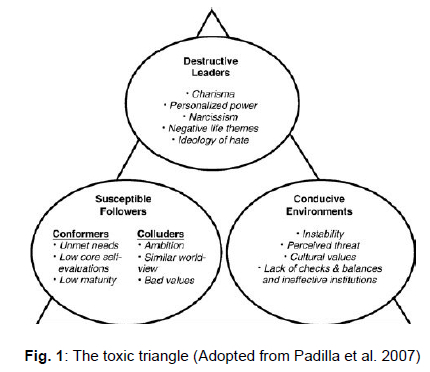
THEORETICAL FRAMEWORKThis article adopts the Toxic Triangle theory (Padilla et al 2007), which offers a comprehensive framework for examining toxic leadership. The Toxic Triangle Theory has been widely used by researchers to examine the dynamics of destructive leadership, particularly in contexts where toxic leaders, susceptible followers, and conducive environments interact to foster harmful leadership practices. Researchers have applied this theory across various contexts, including corporate, military, and academic settings. For instance, Thoroughgood et al. (2012) explored how toxic leaders influence organisational behaviour, while Schyns and Schilling (2013) examined follower susceptibility in enabling toxic leadership. In higher education, Pelletier (2010) and Mahlangu (2020) used the theory to highlight environmental factors contributing to toxic leadership.
The hierarchical and competitive nature of academia often fosters environments where toxic leaders can exert influence, while academic staff, as susceptible followers, may feel compelled to comply with the leader's demands. This theory suggests that toxic leadership arises from the interplay of three key elements: destructive leaders, susceptible followers, and conducive environments (Padilla et al. 2007).
Destructive leaders are individuals who display traits and behaviours such as narcissism, authoritarianism, and unethical conduct (Xia, Zhang and Li 2019). Susceptible followers are those within the organisation who are vulnerable to the influence of toxic leaders, often becoming complicit in the leader's actions due to fear, loyalty, or a lack of alternatives (Mahlangu 2020). Conducive environments, meanwhile, refer to the organisational contexts that enable toxic leadership to flourish (Padilla et al. 2007). In this article, destructive leaders are understood as line managers, susceptible followers as the academics they lead, and conducive environments as the departments, faculties, and centres within the institutions. Factors such as a lack of checks and balances, a culture of fear, and prioritising short-term results over ethical considerations contribute to creating environments where toxic leadership can thrive.
The Toxic Triangle theory identifies five key traits of toxic leaders: charisma, a personalised need for power, narcissism, negative life themes, and an ideology of hate (Padilla et al 2007). While charisma is not inherently harmful, it becomes toxic when used for self-serving purposes. Such leaders exploit their influence to manipulate others, as seen in figures like Hitler and Stalin. Their personalised need for power drives them to prioritise authority and self-promotion over ethics, using coercion to suppress dissent (Xia et al. 2019). Narcissism fosters arrogance and grandiosity, leading to reckless, ego-driven decisions (Baskan 2020).
Negative life themes and an ideology of hate further influence toxic leaders' behaviour. Traumatic early experiences, like those of Stalin and Hitler, shape a worldview driven by insecurity, coercion, and dehumanisation. This leads to harmful organisational practices. An ideology of hate, rooted in personal grievances, drives leaders to justify violence and retribution against perceived enemies (Baskan 2020). These elements of the Toxic Triangle theory are relevant to toxic leadership in South African higher education, offering insight into how leaders' personal traits can create damaging environments for academics.
The Toxic Triangle Theory, though useful, has been criticised for oversimplifying complex leadership dynamics. Knoll and Dick (2013) argue that it overlooks the role of organisational culture and external socio-political pressures, which influence leadership behaviour. Tourish (2013) critiques its failure to address structural power imbalances that sustain toxic leadership, regardless of individual traits. Reed and Olsen (2010) further challenge the portrayal of followers as passive, arguing that it underestimates their potential for resistance. Despite these criticisms, the theory remains valuable for analysing toxic leadership by integrating key aspects of destructive leadership and its broader context.
RESEARCH APPROACHA qualitative research approach was employed to gain in-depth insights into the experiences of academics affected by toxic leadership. This methodology was chosen due to its ability to capture the nuanced and subjective nature of individuals' experiences within their specific institutional contexts. Qualitative research is well-suited for understanding complex social phenomena and capturing the richness of participants' lived experiences (Creswell 2014). Focusing on personal narratives and subjective perceptions facilitates a deeper examination of how toxic leadership impacts academics in South African higher education institutions.
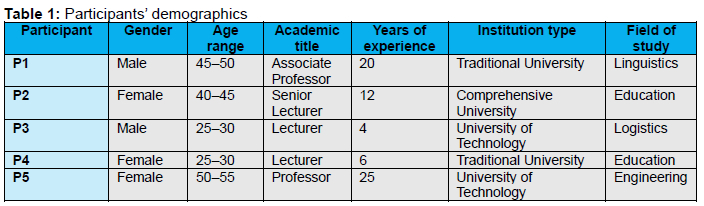
During an annual teaching and learning conference hosted by the researchers' university in November 2023, Cape Town, ten open-ended questionnaires were randomly distributed to academics in attendance by the researchers. The sample included academics from various South African universities who held various positions, who were in attendance. In addition to demographic information, the questionnaire covered key areas of questions:
What specific toxic behaviours have you experienced from your leader(s)/ line managers(s)?
How has toxic leadership affected your professional and personal lives?
What coping strategies have you employed to respond to toxic leadership?
Seven of the ten distributed questionnaires were returned, with two incomplete, leaving five fully completed questionnaires, which conveniently formed the article's sample. Although the sample size is small, qualitative research often benefits from such focused, in-depth data, as smaller samples can yield richer, more detailed insights into complex phenomena such as toxic leadership. As Nendauni, Sadiki and Baloyi (2021) suggest, smaller participant groups can lead to more nuanced findings, reducing the margin of error and enhancing the authenticity and validity of the results by allowing for a deeper exploration of each participant's experiences.
The gathered data were systematically organised and analysed using thematic analysis, a widely accepted method for identifying and interpreting patterns within qualitative data (Braun and Clarke 2006). The application of thematic analysis enabled the identification of patterns that reflected shared experiences of toxic leadership, which enabled the researchers to contextualise the findings within the broader framework of leadership studies.
The data analysis process employed a structured approach to ensure the reliability and validity of the findings. Initially, the researchers immersed themselves in the data by reading and re-reading the questionnaires to thoroughly understand each participant's narrative, identifying recurring patterns and familiarising themselves with the content. Open coding was then used to label segments of data with descriptive codes capturing key elements related to toxic leadership behaviours, their impacts on personal and professional lives, and the coping strategies employed by academics.
After initial coding, similar codes were grouped into broader themes, such as "micromanagement", "emotional exhaustion", and "resilience strategies". To validate these themes, the researchers used triangulation, cross-referencing with existing literature on toxic leadership to ensure alignment with established concepts. They also sought feedback from an independent critical reader to mitigate potential bias and ensure interpretations were grounded in the data. The process concluded with refining themes to ensure each was distinct, supported by multiple data points, and accurately represented participants' experiences. This systematic approach to thematic analysis enhanced the article's credibility and rigour. Table 1 below displays participants' demographics.
Ethical considerations were meticulously adhered to throughout the research. Informed consent was obtained from all participants, ensuring they understood the research's purpose and their voluntary involvement. Confidentiality was upheld by anonymising responses, with participants labelled P1 to P5. Transparency was reinforced by allowing participants to withdraw from the research at any time without repercussions. The researchers, having experienced toxic leadership themselves, were motivated to conduct this research but endeavoured to maintain objectivity and avoid personal biases. To ensure impartiality, they sought feedback from a critical reader, which helped eliminate any potential biases in the article.
The rigorous ethical considerations and strategies to ensure objectivity further enhance the credibility and trustworthiness of the findings, which are presented in the ensuing section.
FINDINGS AND DISCUSSION
In this section, the findings of the article are presented in alignment with the research objectives of the article and emerging themes from the data. The analysis reveals that toxic leadership in South African universities is characterised by self-serving, manipulative behaviours that undermine subordinates and degrade both professional environments and organisational performance. These findings resonate with extensive scholarship on toxic and destructive leadership, which demonstrates how such leadership undermines individual well-being, erodes trust, and compromises institutional functioning across professional and educational contexts (Kellerman 2004; Lipman-Blumen 2005; Tepper 2000; Tepper 2007).
In this article, the findings are therefore categorised under three main themes as guided by the research objectives of the article: (1) specific toxic behaviours experienced by academics from their leaders, (2) the impact of toxic leadership on academics' professional and personal lives, and (3) strategies employed by academics to cope with and respond to toxic leadership.
Specific toxic behaviours experienced by academics from their leaders
Participants' responses reveal a spectrum of toxic behaviours, including undermining autonomy, inconsistent policies, and poor communication. This corresponds with a study conducted in the United States by Okpala (2023), which reports that toxic leaders engage in destructive actions such as attributing errors and faults to academics to obscure their own leadership incompetence. For instance, P2 and P3 uttered:
"She is overly critical without offering constructive feedback, and she frequently engages in power plays and intimidation to assert dominance. I also think her lack of transparency and inconsistency with policies are also a giant red flag" [P2].
"Ever since I joined this department, I have never seen her acknowledging her mistakes, she is always right and she blame others for failures, and she has created a culture of fear and secrecy. We kind of work in silos, with little support for one another" [P3].
These findings are consistent with the Toxic Triangle Theory (Padilla et al. 2007), which posits that toxic leadership arises from the interaction among three critical elements: destructive leaders, susceptible followers, and conducive environments. In the cases of P2 and P3, their leaders have created a conducive environment for toxicity, thereby rendering P2 and P3 susceptible followers. These findings are also consistent with the findings of Lipman-Blumen (2005) and Pelletier (2010), who characterise toxic leaders as engaging in behaviours that severely compromise employees' well-being. Lipman-Blumen (2005) describes toxic leaders as creating a work environment marked by the erosion of trust, the instillation of fear, and the manipulation of power dynamics. These actions collectively contribute to a hostile and unsupportive workplace, severely affecting employees' mental and emotional health. Similarly, Pelletier (2010) highlights that toxic leaders can undermine organisational morale by fostering an atmosphere of distrust and intimidation, further exacerbating stress and dissatisfaction among staff.
Further, P1's experience of a hostile environment caused by gossip and favouritism illustrates how toxic leaders undermine collegiality, aligning with Goleman, Boyatzis, and MCKee (2002) in their discussion of the emotional toll of poor leadership on organisational culture. They argue that detrimental leadership practices erode the emotional fabric of the workplace, leading to a culture of negativity and reduced employee engagement. P1 stated:
"My HoD constantly undermines my autonomy, he does not respect me, and he takes credit for others' work, and he engage in gossip or favouritism, and this create a hostile environment. He even makes erratic decision-making and poor communication, and it adds to the dysfunction" [P1].
Similarly, P4 uttered:
"My HoD has been in the institution for years and she runs the department as if she is running her household, no matter how learned we are, to her we are children who must be micromanaged. She has proven to be very toxic and manipulative, and if you are not her favourite, she will try to block your academic growth. She wants to be part of every project even though she is not contributing anything, but her name must be there so that she can claim victory" [P4].
P4's description of micromanagement and the utilisation of positional power to obstruct academic growth mirrors the findings of Tepper (2000; 2007). Tepper's research underlines the harmful effects of abusive supervision, particularly in knowledge-intensive environments such as academia. Tepper identifies that such toxic leadership practices not only stifle individual academic development but also foster a detrimental work culture. The behaviour described by P4 where a leader's need for control and personal validation overrides the professional and developmental needs of their subordinates reflects the destructive consequences of abusive supervision documented by Tepper (2007). This alignment with Tepper's findings highlights how toxic leadership can impair academic progress and create a counterproductive environment in which academics potential is not fully realised. P4's narrative aligns with the Toxic Triangle theory (Padilla et al. 2017), which posits that the personalised need for power exacerbates toxic tendencies, as leaders prioritise their authority and self-promotion over ethical considerations, often using coercion and control to suppress dissent. From a different vein, P5 experienced toxicity after completing her PhD as she stated:
"After working together for years, he became toxic when I completed my PhD before him, he started treating me bad and telling people that I just have a PhD, but I do not know what I am doing. He has been demonstrating a lack of respect for my' opinions and he often dismiss or belittle my contributions" [P5].
P5's narrative of a leader becoming toxic post-PhD completion demonstrates the role envy and professional jealousy play in academic spaces. This aligns with the Toxic Triangle theory (Padilla et al. 2007), which posits that hierarchical and competitive nature of workplaces often fosters environments where toxic leaders can be jealous of their followers. This is supported by Mehta and Maheshwari (2014), who argue that toxic leadership in academia often emerges when power is threatened, such as when subordinates achieve notable academic success. Such reactions can manifest in various forms of toxic behaviour from leaders, including undermining the achievements of their subordinates, engaging in punitive measures, or fostering a competitive rather than collaborative atmosphere. The envy and professional jealousy described in P5's case thus align with Mehta and Maheshwari's argument, highlighting how individual accomplishments, particularly those that challenge existing power structures, can exacerbate toxic dynamics within academic settings.
The impact of toxic leadership on academics' professional and personal lives
When asked about the impact of toxic leadership on their professional and personal lives, academics' responses vividly illustrate the detrimental effects of toxic leadership on academics' well-being, echoing empirical research. For instance, P1 and P2 stated:
"The negative environment significantly affected my work performance and personal well-being. I faced heightened levels of stress, which led to a decline in my overall health and made it difficult to enjoy my work. My personal relationships also suffered due to my preoccupation with work issues" [P1].
"It resulted in a hostile work environment that hindered collaboration and innovation. Personally, I experienced increased stress levels and feelings of isolation. It also strained my family life as I brought work-related stress home" [P2].
P1's account of increased stress and its detrimental effects on personal health is consistent with Schilling's (2009) research, which explores the health-related consequences of working under toxic leadership. Schilling's article highlights that toxic leaders can significantly impair employees' well-being, contributing to a range of health issues due to sustained stress and emotional strain. Similarly, P2's depiction of a hostile work environment resulting in isolation and strained family relationships aligns with the findings of Padilla et al (2007). Their research emphasises that toxic leaders undermine social support systems and aggravate work-life conflict. Padilla et al. (2007) further argue that toxic leadership not only deteriorates workplace relationships but also extends its negative impact beyond the professional sphere, affecting personal and familial interactions. This correspondence between P2's experiences and the findings of Padilla et al. (2007) accentuate the pervasive influence of toxic leadership on both professional environments and personal lives of academics. Similarly, P4 stated:
"The toxic environment led to burnout and a significant decrease in job satisfaction... I became increasingly withdrawn and less engaged with colleagues and students. I ended up working in my own silo" [P4].
The recurring theme of stress and burnout highlighted by P4 is corroborated by existing literature. Research such as that of Okpala (2023) indicates a strong association between toxic leadership and heightened stress levels and emotional exhaustion, particularly within high-pressure sectors such as education. To add, Krasikova, Green and LeBreton (2013) demonstrate that toxic leadership practices contribute significantly to these adverse outcomes. Their article reveals that leaders who exhibit toxic behaviours such as micromanagement, inconsistency, and lack of support are likely to exacerbate stress and burnout among their subordinates. In the demanding environment of academia, where professional and emotional challenges are already prevalent, the negative impact of toxic leadership can be particularly pronounced. This alignment with Krasikova et al. (2013)'s findings underlines the critical need to address toxic leadership as a factor contributing to stress and burnout in higher education. Further findings show lack of interest in the job, for instance, P3 expressed his loss of interested in his work due to stress, as he articulated:
"The constant uncertainty and fear affected my overall morale. It led to decreased productivity and feelings of helplessness. On a personal level, it contributed to sleep disturbances and a general sense of dissatisfaction with my career" [P3].
P3's description of decreased morale and productivity aligns with Ashforth's (1997) concept of "petty tyranny", which posits that toxic leaders diminish employees' motivation and job satisfaction. Ashforth (ibid) argues that such leaders employ minor yet persistent forms of mistreatment and control that erode the work environment and lead to decreased overall engagement. Additionally, the sleep disturbances and feelings of helplessness described by P3 echo Kellerman's (2004) findings that toxic leadership can lead to psychological distress, further highlighting the pervasive nature of this issue in academic settings. P3's alignment with both Ashforth's and Kellerman's research highlights the extensive and damaging effects of toxic leadership within academic environments, illustrating its potential to compromise both emotional well-being and professional performance. This is supported by Beeslaar (2020), who argues that when individuals are compelled to conform to standards that do not reflect local realities, it leads to stress, anxiety, and major depression, often manifesting as physical burnout and chronic illness, which can result in frequent sick leave. Drawing from the Toxic Triangle theory (Padilla et al. 2017), this destructive outlook manifests in leaders' actions, often resulting in harmful policies and practices within their organisations.
Strategies employed by academics to cope with and respond to toxic leadership
Participants have employed a range of coping strategies to manage the adverse effects of toxic leadership, including meticulous documentation, establishing clear boundaries, and seeking new employment opportunities. These approaches are consistent with strategies identified by Hutchinson et al (2006), who argue that formal documentation is a crucial method for mitigating the effects of toxic leadership. This is evident from P1's account, who stated:
"I have been documenting all her toxic incidents to protect myself and to build a case against her, I am also exploring other job opportunities as a long-term solution" [P1].
P1's strategy of documenting incidents serves not only as a protective measure but also as a means of accumulating evidence that can be used to address grievances formally or to support a case for reassignment. This method aligns with Hutchinson et al. (2007), who found that a detailed record of problematic interactions is important to counteract the impact of toxic leadership.
Additionally, P4's decision to leave a toxic environment aligns with Keashly and Neuman's (2010) assertion that employees often resort to transferring or exiting toxic environments as a last resort to safeguard their mental health. This approach not only underscores the pursuit of a healthier work environment but also demonstrates an initiative-taking stance towards improving personal well-being. P4 uttered:
"I chose my mental health and applied other positions internally, this is my new position, previously I was in the faculty of... before joining the centre. Since I moved, I now have peace" [P4].
Other participants highlighted different strategies, for instance P3 chose to set boundaries between her personal and professional life, as stated:
"One thing that helps me is that I have always set clear boundaries between work and personal life. Me and my husband have agreed that no matter what happens at work, we should not bring work problems at home because it affects everyone at home. I try to stay focused on my core responsibilities and engaged in self-care activities" [P3].
P3's approach of setting boundaries between work and home life speaks to Lazarus and Folkman's (1984) Stress and Coping theory, which suggests that individuals facing toxic environments often employ problem-focused strategies such as setting limits on how much they allow work-related stress to encroach on personal time. According to this theory, individuals encountering stressful and toxic environments often use problem-focused strategies to mitigate the impact of stress on their overall well-being. By setting firm boundaries, P3 actively prevents work-related issues from intruding into personal time, which protect family dynamics and personal well-being. P5 appeared to have experienced a lot of toxicity throughout her academic career, she stated:
"I made a concerted effort to focus on aspects of my work that I could control, and I focused on building a positive relationship with new academic joining the faculty. I am no longer young, and I have experienced a lot of toxicity in my academic career, some of the things I do not take them seriously to avoid erupting my sugar diabetes. Academia is a toxic environment you just must stick to your lane and focus on your work" [P5].
P5's recognition of toxic academic environments and choosing to focus on aspects of their work within their control reflects the findings of Niessen, Sonnentag and Sach (2012), who emphasised the importance of fostering positive interpersonal relationships and resilience-building in dealing with toxic leadership. By choosing to cultivate relationships with newer members of the academic staff, P5 not only creates a more supportive work environment but also fortifies her own well-being through these meaningful connections.
Fritz et al. (2011) further suggest that resilience-building and focusing on controllable elements of one's professional life can protect against the pervasive negativity of toxic workplaces. P5's ability to "stick to her lane" and avoid unnecessary stress reflects a form of emotional regulation, which, as Fritz et al. (2011) argue, is crucial for sustaining well-being in hostile work environments.
In their book Leadership in Higher Education: Practices that Make a Difference, Kouzes and Posner (2019) describe how individuals within college and university campuses inspire others to strive for shared aspirations and achieve extraordinary outcomes. They argue that leadership involves the behaviours that transform values into actions, visions into realities, obstacles into innovations, divisions into solidarity, and risks into rewards. According to Kouzes and Posner (2019), effective leadership practices create an environment where people collaborate to turn challenging opportunities into remarkable successes. Regrettably, Baloyi (2020) argues that toxic leaders often refuse to participate in training aimed at improving their leadership style to better meet the needs of the organisation and its stakeholders. Baloyi (2020) highlights that one reason toxic leaders avoid leadership training is their lack of awareness regarding their own toxic behaviour.
The findings of this article converge with existing literature on toxic leadership, particularly regarding the harmful behaviours exhibited by leaders and the significant impact on professional and personal well-being. Furthermore, the coping strategies employed by the participants mirror scholarly recommendations for mitigating the adverse effects of toxic leadership in academic settings. This article contributes to ongoing discussions about leadership in higher education, suggesting that systemic changes are needed to address and prevent toxic leadership.
Few studies have been conducted across Africa, and aligning and comparing this article's findings may reveal additional layers of complexity in the dynamics of toxic leadership in higher education.
In Nigeria, for example, toxic leadership has been linked to issues of corruption, favouritism, and political interference, where leaders may prioritise personal or political gain over the interests of the academic community (Nwogu 2023). These behaviours contribute to a climate of fear and mistrust, discouraging academic freedom and innovation, which aligns with findings in South African universities where leaders may similarly exercise control to maintain their power, often at the expense of academic integrity (Matsiliza et al. 2022). Similarly, in Kenya, studies point to a lack of mentorship and support for junior academics, with toxic leaders frequently using intimidation to suppress dissent and limit career progression, further entrenching institutional inequalities (Wanasika et al. 2011). These commonalities highlight how toxic leadership in African higher education institutions is often intertwined with broader socio-political challenges, including historical legacies of colonialism, political instability, and entrenched power structures (Herbst, and Roux 2023).
However, despite these shared experiences, there are also differences in how toxic leadership is addressed. Some universities in Uganda, for instance, have implemented more robust governance structures that promote accountability and transparency, helping to mitigate the worst effects of toxic leadership by empowering academics through collective decision-making processes (Kyambade et al. 2024). These approaches could serve as models for South African institutions, which continue to grapple with leadership challenges that undermine academic performance and well-being. By examining these varied contexts, it becomes clear that addressing toxic leadership in African higher education requires not only institutional reform but also a rethinking of leadership philosophies, with an emphasis on fostering ethical, inclusive, and supportive leadership models that are responsive to the diverse needs of academic communities across the continent (Herbst and Roux 2023).
RECOMMENDATIONSThe recommendations arising from this article underscore the need for systemic and sustainable changes in higher education institutions to combat toxic leadership and foster healthier academic environments. First, leadership development programmes focusing on emotional intelligence, ethical leadership, and conflict resolution should not only be implemented but also embedded within the existing professional development frameworks of universities. These programmes can be incorporated into mandatory leadership curricula, with ongoing refresher courses tied to performance evaluations. Institutions could collaborate with external leadership development consultants and leverage existing structures, such as human resource departments or staff development units, to sustain these programmes.
In addition, structural reforms should be introduced to enhance accountability, including the development of comprehensive policies that address leadership conduct. For example, universities can establish leadership charters that outline clear behavioural expectations, aligned with institutional values, and embed these within existing codes of conduct and governance documents. Grievance redressal mechanisms should be institutionalised in a manner that ensures their integration into the fabric of university policies. This could involve formalising independent ombudsperson offices within university governance structures, staffed with professionals trained in conflict resolution and mediation, who operate separately from university management to maintain impartiality. Additionally, institutions should adopt a "zero-tolerance" policy on toxic leadership, ensuring that clear repercussions for violations are incorporated into existing disciplinary frameworks.
To enhance the professional development of academic leaders and reduce toxic behaviours, institutions should incorporate leadership development into tenure and promotion processes. By linking training to career advancement, leadership development can be viewed as an ongoing component of academic leadership. Regular 360-degree evaluations, with anonymous feedback from peers, subordinates, and external stakeholders, should be conducted to assess leadership effectiveness and enable early intervention.
In line with Mahlangu's (2020) call for institutional culture change, universities should prioritise transparency, inclusivity, and respect by reviewing and updating their policies. Regular policy audits, facilitated by external evaluators, can enhance accountability and responsiveness to leadership toxicity. Additionally, creating internal mobility programmes can support academics seeking to transition from toxic environments, enabling smoother career changes and reducing stagnation.
Following Baloyi's (2020) argument that toxic leaders may be unaware of their behaviours, leadership training should target both emerging and existing leaders requiring intervention. Tailored training programmes should focus on development, enabling leaders to reflect on their styles and implement changes. These sessions could be integrated into university leadership retreats, strategic planning sessions, or annual summits to expose leaders to new management strategies.
For long-term sustainability, institutions should establish a dedicated task force on leadership and institutional culture to oversee the implementation of these recommendations and monitor progress. Further, future research should investigate the causes and long-term effects of toxic leadership in academia, focusing on its intersections with gender, race, and institutional type. Such studies could help tailor leadership development initiatives to the diverse needs of academic environments. By incorporating these recommendations into existing structures and policies, universities can foster a more supportive and productive academic community.
LIMITATIONS OF THE ARTICLEThis pioneering article on toxicity in South African higher education has several limitations for future research. The article relies on data from only five academics, which may not adequately represent the diverse experiences across universities. This limits the generalisability of the findings; a larger sample would have provided a broader range of perspectives. Also, the use of open-ended questionnaires may have restricted the depth of participants' experiences, therefore, semi-structured interviews or focus groups could have yielded more comprehensive insights. Additionally, the article did not examine how demographic factors such as gender, race, or academic rank intersect with toxic leadership, an analysis that would enrich understanding of its impact.
While this article offers a snapshot of toxic leadership, it does not examine its long-term effects or how academics' coping strategies evolve over time. Longitudinal studies are recommended to investigate the sustained influence of toxic environments on career progression and mental health. Lastly, the reliance on international studies due to the limited research on toxicity in the South African context may not fully capture local realities. Although recent South African studies were incorporated, the existing literature remains insufficient for a thorough understanding of the issue.
CONCLUSION
This article examines the lived experiences of academics under toxic leadership in South African higher education institutions, focusing on specific toxic behaviours, their impact on academics' professional and personal lives, and the coping strategies employed. The findings reveal that toxic leadership manifests through destructive behaviours such as micromanagement, favouritism, erratic decision-making, and professional jealousy, significantly affecting academics' well-being and resulting in stress, burnout, decreased job satisfaction, and impaired collaboration. The article also highlights academics' resilience and agency in navigating these environments, showcasing strategies such as documenting incidents, seeking mentorship, setting personal boundaries, and leaving toxic settings. However, the persistence of such leadership practices necessitates systemic interventions within higher education institutions to foster healthier, more inclusive environments conducive to academic and professional growth.
Overall, the findings contribute to the growing body of research on toxic leadership in South Africa, emphasising the challenges faced by academics and the need for greater awareness and action to mitigate the detrimental effects of such practices. By highlighting both toxic behaviours and coping mechanisms, this article lays the groundwork for future research and institutional reforms aimed at improving academic leadership practices.
REFERENCES
LITERATURE REVIEW
- Ashforth, B. 1997. "Petty tyranny in organisations: A preliminary examination of antecedents and consequences". Canadian Journal of Administrative Sciences, 14: 126- 140.
-
Baloyi, G. T. 2020. "Toxicity of leadership and its impact on employees: Exploring the dynamics of leadership in an academic setting". HTS Teologiese Studies/Theological Studies 76(2), a5949. https://doi.org/10.4102/hts.v76i2.5949.
» https://doi.org/10.4102/hts.v76i2.5949 -
Balwant, P. T. 2016. Transformational instructor-leadership in higher education teaching: A meta-analytic review and research agenda. Journal of leadership studies, 9(4): 20-42. https://doi.org/10.1002/jls.21423
» https://doi.org/10.1002/jls.21423 - Başkan, B. 2020. "Toxic leadership in education". International Journal of Educational Administration, Management, and Leadership, 1(2): 97-104.
- Bennis, W. 2003. On Becoming a Leader. Basic Books.
- Council on Higher Education. 2016. South African Higher Education Reviewed: Two Decades of Democracy. Pretoria: Council on Higher Education.
-
Beeslaar, M. 2020. "Overcoming toxic culture at tertiary institutions and the servitude required to combat it". Posted on June 4, 2020. Accessed on 06 March 2024 from https://sayasblog.com/2020/06/04/overcoming-toxic-culture-at-tertiary-institutions/
» https://sayasblog.com/2020/06/04/overcoming-toxic-culture-at-tertiary-institutions/ - Braun, V, and C. Victoria. 2006. "Using Thematic Analysis in Psychology". Qualitative Research in Psychology 3(2): 77-101.
- Caldwell, C., and C. Okpala. 2022. "Leading with passion - What it means, why it matters". Journal of Values-Based Leadership, 15(2): 6.
- Conger, Jay A. 1990. "The Dark Side of Leadership". Organisational Dynamics 19(2): 44-55.
- Council on Higher Education. 2016. "South African higher education reviewed: Two decades of democracy", Council on Higher Education, Pretoria.
- Creswell, J. W. 2014. Research Design: Qualitative, Quantitative, and Mixed Methods Approaches. 4th ed. Los Angeles: Sage Publications.
- De Wet, J., and J. Goussard. 2020. Managing Academia: A Perspective on South African Higher Education. African Sun Media.
-
Dlamini, N. G., and N. D. Dlamini. 2024. "Understanding the well-being challenges confronting academic staff in South African universities: A narrative review". Discover Education, 3 (9):1-22. https://doi.org/10.1007/s44217-024-00089-8
» https://doi.org/10.1007/s44217-024-00089-8 -
Eddy, P.L., and K. Van der Linden. 2006. "Emerging Definitions of Leadership in Higher Education: New Visions of Leadership or Same Old 'Hero' Leader?" Community College Review 34(1): 5-26. https://doi.org/10.1177/0091552106289703
» https://doi.org/10.1177/0091552106289703 - Goldman, A. 2009. Transforming Toxic Leaders: The Practical Guide for Successful Leaders. Stanford, CA: Stanford Business Books.
- Goleman, D., R. Boyatzis, and A. McKee. 2002. "Primal leadership: Realising the power of emotional intelligence". Bantam Books: New York.
- Goodchild, L. F. 2014. Toxic Leadership in Higher Education. San Francisco: Jossey-Bass.
- Herbst, T. H., and T. Roux. 2023. "Toxic leadership: A slow poison killing women leaders in higher education in South Africa?". Higher Education Policy, 36(1): 164-189.
- Hogan, Robert, and B. Kaiser Robert. 2005. "What We Know About Leadership". Review of General Psychology 9(2): 169-180.
- Hogan, R, R. Randall, and F. Dan. 1990. "The Dark Side of Charisma". In Measures of Leadership, edited by Kenneth E. Clark and Miriam B. Clark, 341-354. West Orange, NJ: Leadership Library of America.
-
Hutchinson, M, Margaret H. Vickers, J. Debra, and W. Lesley. 2006. "Workplace Bullying in Nursing: Towards a More Critical Organisational Perspective". Nursing Inquiry 13(2): 118-126. https://doi.org/10.1111/j.1440-1800.2006.00314.x.
» https://doi.org/10.1111/j.1440-1800.2006.00314.x - Kyambade, M., J. Mugambwa, R. Namuddu, A. Namatovu, and G. Kwemarira. 2024. "Staff Commitment in Ugandan Public Universities: Does Servant Leadership Matter?". SEISENSE Business Review, 4(1), pp. 29-43.
-
Keashly, L. and J. H. Neuman. 2010. "Faculty experiences with bullying in higher education", Administrative Theory & Praxis, vol. 32, no. 1, pp. 48-70. Available at: https://doi.org/10.2753/ATP1084-1806320103.
» https://doi.org/10.2753/ATP1084-1806320103 - Kellerman, B. 2004. Bad Leadership: What It Is, How It Happens, Why It Matters. Boston: Harvard Business School Press.
- Lipman-Blumen, J. 2005.The Allure of Toxic Leaders: Why Followers Rarely Escape Their Clutches. Ivey Business Journal, 69(3): 1-8.
- Khasawneh, S., J. Al Adwan, A. Othman, and O. Bani-Hassan. 2024. "Toxic leadership in higher education: A typology of behaviours", Research in Post-Compulsory Education, vol. 29, no. 3, pp. 363-380.
- Kouzes, J. and B. Posner. 2019. Leadership in Higher Education: Practices That Make A Difference. United States: Berrett-Koehler Publishers.
- Knoll, M., and R. Dick, 2013. "Do I hear the whistle...? A first attempt to measure four forms of employee silence and their correlates". Journal of Business Ethics, 113(2), 349-362.
-
Krasikova, Dina, V., Steven G. Green, and James, M. LeBreton. 2013. "Destructive Leadership: A Theoretical Review, Integration, and Future Research Agenda". Journal of Management 39(5): 1308-1338. https://doi.org/10.1177/0149206312471388.
» https://doi.org/10.1177/0149206312471388 - Lazarus, R.S., and F. Susan. 1984. Stress, Appraisal, and Coping. New York: Springer.
- Lipman-Blumen, B. 2005. "Toxic leadership: When grand illusions masquerade as noble vision". Leader to Leader, 36: 29- 36.
-
Mahlangu, V. P. 2020. "Understanding Toxic Leadership in Higher Education Workplaces through Betrayal Trauma Theory". Bulgarian Comparative Education Society, 18: 115-121. https://doi.org/10.1007/978-3-030-44217-0_52#DOI
» https://doi.org/10.1007/978-3-030-44217-0_52#DOI -
Maistry, S. M., and L, Le Grange. 2023. "South African Higher Education as Mutating Plantation: Critical Reflections on Navigating a Racialized Space." Educational Studies 59 (4): 420-39. doi:10.1080/00131946.2023.2248328.
» https://doi.org/10.1080/00131946.2023.2248328 - Maslach, C, B. Wilmar B. Schaufeli, and Michael P. Leiter. 2001. "Job Burnout". Annual Review of Psychology 52(1): 397-422.
- Matsiliza, N. S., L. C. Ndzoyiya, B. Tatira, N. R. Jere, K. Aruleba, T. L. Jere, and S. Balkaran. 2022. Higher education for public good: Perspectives in the new academic landscape in South Africa. Cape Town, AOSIS Publishing.
- McCaffery, P. 2019. The Higher Education Manager's Handbook: Effective Leadership and Management in Universities and Colleges. Routledge.
- Mehta, S., and G. C. Maheshwari. 2014. "Toxic Leadership: Tracing the Continuum of Charisma and Narcissism". South Asian Journal of Management 21(4): 95-110.
-
Nendauni, L., M. Sadiki, and M. Baloyi. 2021. "Name-Calling as a Communicative Tool in South African Political Discourse". Communicatio. 47(4): 21-47. https://doi.org/10.1080/02500167.2021.2009531
» https://doi.org/10.1080/02500167.2021.2009531 -
Niessen, C., S. Sonnentag, and F. Sach. 2012. "Thriving at work-A diary study". Journal of Organisational Behaviour, 33: 468-487. https://doi.org/10.1002/job.763
» https://doi.org/10.1002/job.763 - Nwogu, C. F. 2023. Development and Accountability of Nigeria's Anticorruption Initiatives: Governance and Democracy in Nigeria. University of La Verne.
-
Okpala, C. O. 2023. "Exploring Subordinates' Perceptions and Experiences with Abusive Leaders in Higher Education: A Qualitative Study". J Leadersh Stud, 16:35-40. https://doi.org/10.1002/jls.21833
» https://doi.org/10.1002/jls.21833 -
Olabiyi, O. J., M. Du Plessis and C. J. Van Vuuren. 2024. "Unveiling the toxic leadership culture in South African universities: authoritarian behaviour, cronyism and self-serving practices". Front. Educ. 9:1446935. doi: 10.3389/feduc.2024.1446935
» https://doi.org/10.3389/feduc.2024.1446935 - Padilla, A., R. Hogan, and R. B. Karser. 2007. "The toxic triangle: Distributive leaders, susceptible followers and conducive environment". Leadership Quarterly, 18:176- 194.
-
Pelletier, K. 2012. "Perceptions and reactions to toxicity: Do leader-follower relationship and identification with victim matter?". Leadership Quarterly, 25: 412- 424. https://doi.org/10.1016/j.leaqua.2011.09.011
» https://doi.org/10.1016/j.leaqua.2011.09.011 - Reed, G. E., and D. Olsen. 2010. "Toxic leadership: Part deux". Military Review, 90(3): 58-64.
-
Schilling, Jutta. 2009. "From Ineffective to Destructive Patterns of Leadership: A Theoretical Analysis of the Costs and Benefits of Intra-Group Conflicts". International Journal of Conflict Management 20(4): 390-406. https://doi.org/10.1108/10444060910991091.
» https://doi.org/10.1108/10444060910991091 - Schmidt, A. A. 2008. Development and Validation of the Toxic Leadership Scale. PhD diss., University of Maryland.
- Soudien, C. 2010. Transformation in Higher Education: A 20-year Study on South Africa's Policy. HSRC Press.
-
Sparks, K., B. Faragher, and C. L. Cooper. 2001. "Well-being and occupational health in the 21st century workplace". Journal of occupational and organizational psychology, 74(4): 489-509. https://doi.org/10.1348/096317901167497
» https://doi.org/10.1348/096317901167497 -
Tepper, B. J. 2000. "Consequences of abusive supervision". Academy of Management Journal, 43(2):178- 190. https://doi.org/10.5465/1556375
» https://doi.org/10.5465/1556375 -
Tepper, B. J. 2007. Abusive supervision in work organizations: Review, synthesis, and research agenda. Journal of Management, 33(3): 261-289. https://doi.org/10.1177/0149206307300812
» https://doi.org/10.1177/0149206307300812 -
Thompson, D. 2024. University elders sound the alarm about the leadership. Https://www.universityworldnews.com/post.php?story=20240612052458408. University world news. Accessed 13/09/2024.
» Https://www.universityworldnews.com/post.php?story=20240612052458408 - Tourish, D. 2013. The dark side of transformational leadership: A critical perspective. Routledge.
-
Wanasika, I., J. P. Howell, R. Littrell, and P. Dorfman. 2011. "Managerial leadership and culture in sub-Saharan Africa". Journal of World Business, 46: 234-241. https://doi.org/10.1016/j.jwb.2010.11.004
» https://doi.org/10.1016/j.jwb.2010.11.004 -
Xia, Y., L. Zhang, and M. Li. 2019. "Abusive Leadership and Helping Behaviour: Capability or Mood, which Matters?" Current Psychology, 38(1): 50-58. https://doi.org/10.1007/s12144-017-9583-y
» https://doi.org/10.1007/s12144-017-9583-y