Assessing institutional readiness for implementing the National Language Policy Framework for public higher education institutions in South Africa
Abstract
This article investigates the institutional readiness of South African public higher education institutions for the implementation of multilingual language policies, specifically focusing on the recently promulgated National Language Policy Framework for Public Higher Education Institutions (NLPFPHE). Drawing on applied linguistics, Weiner's (2009) theory of organisational readiness for change, and policy implementation studies, the authors explore how various institutional factors shape the capacity to implement language policies effectively. Using a mixed-methods approach, data from the national language audit (Van Dyk, Wilken, Ravyse, Du Plessis, Khumalo and Steyn, 2023) to assess current preparedness is analysed. The findings highlight key areas where institutions demonstrate readiness, such as staff engagement with policy, but also expose critical gaps in resources and student awareness. Moreover, the authors advocate for applying organisational readiness theory as a framework for guiding language policy implementation without specific models from the Department of Higher Education and Training (DHET). By outlining challenges and opportunities in the current landscape, this article offers practical insights for institutions that foster linguistic inclusivity and excellence. It aims to empower stakeholders with a structured approach to assess readiness, address gaps, and enhance the implementation of multilingual language policies.
National Language Policy Framework for Public Higher Education Institutions; Department of Higher Education and Training; language policy; theory of organisational readiness for change; South Africa
INTRODUCTION
Language policies and frameworks guiding such policies serve as crucial tools for fostering linguistic diversity, promoting social inclusion and cohesion (Cele, 2021), and ensuring equitable access to opportunities within institutions as part of South Africa's "transition to a constitutional democracy" (Nudelman 2015, 4). Crafting a comprehensive, informed, adequate, and appropriate language policy for a university is a complex endeavour that requires meticulous planning, stakeholder engagement, and a deep understanding of the linguistic landscape within an institution, as demonstrated in existing research in a South African context by, for example, Cele (2021); Mthombeni and Ogunnubi (2020); Madiba (2013); Van der Walt (2004); and Foley (2004). However, the mere existence of a language policy is not sufficient; its successful implementation hinges on the readiness of the institution to embrace and operationalise its principles, i.e., make the jump from policy to practice as expressed by, among other researchers, Zikode (2017); Drummond (2016); and Maseko (2014).
Similar challenges exist in other multilingual contexts. For instance, in the USA, Ruiz (1984) introduces three fundamental orientations regarding language planning: Language-as-problem, language-as-right, and language-as-resource. In essence, these orientations come from a minority language perspective, where language diversity is seen as a social problem, which requires a technical approach (Gorter and Cenoz, 2016). Moreover, the legal rights of minority language speakers entail planning to, for example, receive education in the home language, with language-as-resource being a possible solution for bilingual education in the USA. However, linguistic contexts vary, and Canada's approach to bilingual education is uniquely shaped by its sociopolitical context, where the designation of both English and French as official languages has fostered the development of educational programmes like French immersion (Daigenas, 2013). These programmes strategically employ French as the primary medium of instruction for at least half of the academic curriculum in elementary and secondary schools, specifically targeting English-speaking students. With its complex interplay of Dutch Flemish, French, and German (Mettewie and Van Mensel, 2020), Belgium offers a model for managing linguistic diversity in a geographically compact area where regional autonomy influences language policy within higher education institutions. Even more comparable to South Africa is India's multilingual landscape, characterised by a multitude of recognised languages and varying degrees of institutional support, which presents a case where language policy aims to balance national unity with regional linguistic identities (McKibben-Greene, 2020). Understanding these models may offer insights into how South African institutions can navigate resource allocation and policy adaption in light of establishing institutional readiness.
Using data from the recently completed national language resources audit at South African public universities (see Van Dyk et al., 2023), this article considers the intricate process of assessing institutional readiness for implementing language policy frameworks. Drawing upon insights from applied linguistics, Weiner's (2009) theory of organisational readiness for change, and policy implementation studies, the multifaceted dimensions that influence an institution's capacity to enact its language policies effectively are explored. From administrative structures and resource allocation to pedagogical practices and cultural norms, every facet of institutional functioning shapes its readiness to navigate the complexities of language policy implementation. These facts are investigated using the organisational readiness theory in the absence of other models from the Department of Higher Education and Training (DHET) and to evaluate the preparedness of South African institutions to implement multilingual policies, thereby providing insights to shape future language planning strategies. By illuminating challenges, opportunities, and strategies inherent in this process, the authors seek to contribute to the discussion on implementing the National Language Policy Framework for Public Higher Education Institutions (NLPFPHE). The findings aim to empower stakeholders at higher education institutions to assess their readiness accurately, identify areas for improvement, and embark on a journey toward fostering linguistic inclusivity and excellence. To this end, it is essential to recognise that language policies (such as the NLPFPHE) are not static documents but dynamic instruments that evolve in response to changing societal needs, educational paradigms, and linguistic ideologies. Therefore, the insights offered in this article are intended to inform ongoing dialogue, reflection, and action towards creating inclusive and language-rich environments where every individual can thrive and contribute to the collective advancement of knowledge and understanding.
READINESS IN THEORYThis section details theoretical frameworks applicable to evaluating institutional readiness in terms of language policy implementation. The authors argue that this is the baseline for informed decision-making and reflective practitioners who must approach the process of implementing the NLPFPHE responsibly. The intricate terrain of institutional readiness is navigated, shedding light on key concepts, methodologies, and best practices that can guide stakeholders in their quest to implement language policy frameworks like the NLPFPHE effectively. From assessing organisational culture to fostering linguistic competencies, each aspect addressed in this text is integral to nurturing language-inclusive institutions that uphold the principles of equity, diversity, and excellence.
Language planning and management
Language planning and management refers to the deliberate and systematic efforts to regulate, shape, and optimise language use within a particular community or organisation, in this case, the higher education sector. It involves developing, implementing, and evaluating policies, strategies, and practices aimed at promoting linguistic diversity, enhancing a sense of inclusion, advancing multilingualism, and fostering language sustainability. Language planning and management aims to address language-related challenges, meet the linguistic needs of individuals and communities, and create inclusive and language-rich environments conducive to social, cultural, and economic development.
Language planning and management is an integral component of applied linguistics, as it involves applying linguistic theories, principles, and methodologies to address language related issues in real-world contexts. Applied linguists engaged in language planning and management draw upon various linguistic theories, sociolinguistic frameworks, and methodological approaches. Such scholars typically collaborate with policymakers at universities, lecturers, other language experts, and community stakeholders to analyse language needs, assess language resource allocation and development, and design interventions that address specific linguistic challenges. Language planning and management also intersect with other areas of applied linguistics, such as language policy formulation, curriculum design, language assessment, and language education. While language planning deals with the "systematic linguistic change in some community of speakers" (Kaplan, 2013, 2) with language policy formulation as the conduit (Mwaniki 2004, 177), language management deals with the implementation of the policy/plan, specifically, "about language use, including decisions about which language to use for teaching, research, and publishing activities" (Toprak-Yildiz 2022, 198). Understanding that implementation depends on institutional readiness is an essential factor to consider. While language policy development is not without its shortcomings and remains ongoing as seen in existing literature spanning over two decades (Bamgbose, 1996; Kamwangamalu, 2001; Alexander, 2004; Beukes, 2009; Stroud and Kerfoot, 2013; Du Plessis, 2017; Cele, 2021; van der Merwe, 2022), if institutions have no guidance in determining their readiness for implementation, the evaluation of policy may be skewed since it will not have been implemented as planned. Even though the importance of Language Planning Agencies cannot be overlooked (Du Plessis, 2020), the question remains: How do we determine institutional readiness? This article applies Weiner's (2009) theory of organisational readiness for change to data from the recently completed national language resources audit at South African public universities (Van Dyk et al., 2023) to determine how ready South African institutions are in terms of multilingual policy implementation. The contribution of this article is thus two-fold: a) the proposal for adopting the theory of organisational readiness in the absence of any other models that the DHE should have offered, and b) assess the preparedness of South African institutions for implementing multilingual policies, which should then inform future strategies for language planning.
Investigating institutional readiness - A theory of organisational readiness for change
This article uses Weiner's (2009) theory of organisational readiness for change based on the overarching aim it seeks to achieve - effective implementation of change on an organisational level (as opposed to individual readiness). Since the successful implementation of language policies at South African higher education institutions is dependent on organisational readiness, Weiner's (2009) theory is applicable. Although the organisational theory was originally modelled to improve healthcare delivery on an organisational scale, it remains suited to language policy implementation, which is also dependent on South African higher education institutions as organisations' buy-in. Moreover, Weiner (2009) explains that many models of change are not based on scientific evidence (Holt, 2006; Weiner, 2009); his organisational readiness for change theory is based on extensive empirical study.
Determining organisational readiness is multi-faceted on multiple levels and is reliant on stakeholders' commitment to change (Weiner 2009, 68). Beyond this required shared psychological state, it is important to acknowledge that implementing a language policy framework within an institution is a multifaceted endeavour that requires careful consideration of various aspects of institutional readiness. Motivating these aspects is crucial to ensure the successful implementation and sustained effectiveness of the NLPFPHE. The readiness for change theory is reliant on stakeholders' shared resolve, i.e., change commitment and belief in the achievement of the change, i.e., change efficacy (Weiner, 2009). Stakeholder change commitment and change efficacy are the two overarching criteria applied in this article to evaluate institutional readiness for change via successful language policy implementation. Consequently, considering that one purpose of NLPFPHE is to "provide guidelines for the development, implementation, monitoring and evaluation of institutional language policies" (Department of Higher Education and Training, 2020:10), it is important to determine what measures of readiness should be considered (since the DHE has not offered a framework) so as to arrive at more comprehensive insight into the current situation of the South African higher education context. These conclusions offer recommendations as a contribution of this publication for suggested implementation.
The elements to determine intuitional readiness in this article aim to address both stakeholders change commitment and change efficacy. Weiner's (2009) theory is used to evaluate the stakeholder engagement aspect of determining readiness by exploring stakeholders' change commitment as part of change valence, drawn on from motivation theory (Vroom, 1964; Fishbein and Azjen, 1975; Meyer and Herscovitch, 2001) as well as stakeholders' change efficacy based on social cognitive theory (Gist and Mitchell, 1992). Involving stakeholders, including academic structures like faculty boards, senate and even council, the Department of Higher Education and Training, staff, students, parents and the community at large, in evaluating institutional readiness for the implementation process fosters a sense of ownership and inclusivity. When stakeholders are engaged and committed to change, their diverse perspectives and experiences can enrich policy endeavours and increase its relevance and effectiveness. Effective stakeholder engagement ensures that the language policies and implementation plans reflect the needs and values of the entire institutional community and its readiness for change. It also promotes transparency, trust, and collaboration, laying the foundation for sustainable policy implementation and positive outcomes. The audit data provides attitudinal insights from stakeholders, which will be utilised to examine instances of change commitment and change efficacy. As part of evaluating stakeholder change commitment and change efficacy, institutional contextual factors need to be considered to better inform the discussion related to the findings.
Institutional contextual factors that are important to explore in determining higher education institutional readiness that the authors deem essential, based on the literature review, for consideration include, firstly, leadership commitment (Nordin, 2010). Leadership commitment sets the tone for institutional readiness for policy implementation by signalling its importance and priority within the institution. When leaders actively champion the language policy framework, it fosters a culture of accountability and dedication among staff, students, and other stakeholders. For this reason, entities responsible for language planning and management must be positioned at as high a level as possible, with certain executive authority (not to prescribe or manage, but to lead, guide and support). The impact of strong leadership commitment will result in resources being allocated, well-trained staff, and structures instituted to support implementation processes. It also inspires confidence and buy-in from all institution levels, enhancing the likelihood of successful policy enactment.
Secondly, institutional resource allocation and availability are important considerations (Lehman, Greener and Simpson, 2002). Adequate allocation of financial, human, and technological resources is essential to support institutional readiness for implementing a language policy framework. Investing in infrastructure, professional development, curriculum materials, and support services demonstrates the institution's commitment to fostering linguistic diversity and inclusion. Insufficient resources can impede policy implementation and undermine its effectiveness. By prioritising resource allocation, institutions can overcome barriers, address challenges, and sustain momentum toward achieving the goals outlined, e.g., the NLPFPHE and institutional language planning and management endeavours.
Thirdly, capacity building is an important factor in organisational effectiveness (Claussen, 2011) and, in turn, is instrumental in determining readiness - investing in capacity development, i.e. building a knowledgeable and expert staff and student body, is essential for understanding, supporting, and fostering institutional readiness for implementing the NLPFPHE. Providing training, professional development opportunities, and ongoing support empowers individuals and groups to navigate the complexities of language policy implementation effectively. Note that this need not be institutionally internal only; all involved will have the advantage of collaborative efforts between universities. Investing in capacity building means that a well-trained and informed workforce is better equipped to enact the policy framework in their daily practices and interactions. Capacity building also cultivates a continuous learning and improvement culture, ensuring that the institution remains responsive to evolving linguistic needs and aspirations.
Fourthly, Eresia-Eke and Boadu (2019:534) explain that "overall, a readiness assessment seeks to establish if the prerequisites for a good M&E [monitoring and evaluation] system are in place within the organisation". Establishing mechanisms for monitoring and reporting on the implementation of the NLPFPHE allows institutions to assess readiness progress, identify areas for improvement, and make informed decisions for future endeavours. Regular data collection, resulting in comprehensive feedback, enables stakeholders to track outcomes, measure impact, and adjust strategies as needed. Monitoring and regular reporting foster accountability, transparency, and evidence-based decision-making. By systematically assessing the effectiveness of policy implementation, institutions can refine practices, allocate resources strategically, and demonstrate their commitment to achieving the intended outcomes of the NLPFPHE, as well as institution-specific language policies and plans.
METHOD AND DATA
This study reflects the mixed-methods approach and primary data source used in the national language resource audit for assessing institutional readiness to implement multilingual language policies (Van Dyk et al. 2023)1.
Quantitative data was collected on the availability and use of language resources across institutions, including infrastructure, staffing, and materials for supporting multilingualism. This data set was analysed to identify trends in resource allocation and assess institutional capacities to meet the demands of the National Language Policy Framework for Public Higher Education Institutions (NLPFPHE). In addition to the quantitative data, qualitative insights were gathered through surveys and interviews with key stakeholders, including academic staff, administrative personnel, and students. These interviews explored perceptions of language policy readiness, challenges to implementation, and attitudes towards language policy implementation. The quantitative data was analysed using descriptive statistics to highlight patterns in resource distribution and institutional preparedness. The qualitative data underwent thematic analysis, allowing for the identification of recurring themes related to organisational readiness, leadership commitment, and resource-related challenges. This mixed-methods approach enabled the triangulation of findings, providing both breadth and depth in understanding the factors influencing the successful adoption of multilingual policies. It also illuminated the policy-practice gap that Hornberger (2020) identified, which remains central to this study's recommendations for future language planning and change management strategies.
RESULTS
Situational factors regarding stakeholder engagement and commitment are important components for consideration when evaluating institutional readiness based on Weiner's (2009) theory of organisational readiness. Stakeholder change commitment refers to "organisational members' shared resolve to implement a change" (Weiner, 2009, 67), while stakeholder change efficacy refers to the "shared belief in their [stakeholders'] collective capability to do so [implement change]" (Weiner, 2009, 67). Based on the interpretations of the quantitative and qualitative results on the two elements as mentioned above, institutional readiness is determined, "When organisational readiness for change is high, organisational members are more likely to initiate change, exert greater effort, exhibit greater persistence, and display more cooperative behaviour. The result is more effective implementation" (Weiner 2009, 67). In order to evaluate both stakeholders change commitment and change efficacy as measures of institutional readiness, the contextual factors as proposed in section 2.2 are explored. As part of stakeholder change commitment, this article explores leadership commitment (Nordin, 2010) and the monitoring and evaluation (Eresia-Eke and Boadu, 2019) contextual factors. As part of stakeholder change efficacy (that is, the belief that language policy can be successfully implemented), this article explores the contextual factors of resource availability (Lehman et al., 2002) and capacity building (Claussen, 2011).
Stakeholder change commitment
Leadership commitment
Many institutions have strong commitment from management to support languages, as is evident from established language policies and administrative support for initiatives that promote multilingualism. Students have a diverse understanding of language policies; mostly, there is cognisance that it is a set of rules, regulations, and decisions that govern language use in an institution (van Dyk et al., 2023, 34). Their responses in the questionnaire suggest varying degrees of awareness, with some students articulating a clearer understanding while others demonstrate limited knowledge of language policies:
"Language policy is the policy/detailed approach of how languages should be treated in the space of a specific society how and where all the languages can be used, in this case the university" (Student participant 108272340);
"A language policy is a policy that embracing other languages and helping to develop a better understanding of all the languages that are well spoken" (Student participant 108272302);
"I'm not aware of what a language policy is" (Student participant 108272253).
Moreover, 54.23 per cent know that their institution has a language policy, while 42.99 per cent do not know (van Dyk et al. 2023, 34): "No I never came across that information" (Student participant 108272290). This speaks to a lack of communication from management, other stakeholders, and the student body. Student responses in the questionnaire thus highlight a need for greater awareness of language policy, including some of the following points. First is the nature and role of policies; second, where they are accessible, as 19.43 per cent of students believe they are only available in internal documents, followed by 18.57 per cent who do not know where to find them, and 11.52 per cent who believe the policy is only available on request (van Dyk et al. 2023, 34). Put differently, no fewer than 49.52 per cent of students - barely less than half - have no idea where policy documents may be obtainable, at best, or believe there is some measure of gatekeeping involved in access to the documents, at worst. Third, students often did not know what their institutions' language policies say (van Dyk et al. 2023:35). Students do tend to hope for policies that foster inclusion, linguistic diversity, and education in students' preferred languages (van Dyk et al. 2023, 34).
Most staff members (57.28%) indicated that their institutions have language implementation plans (van Dyk et al. 2023). A small percentage (7.97%) said their institutions did not have such plans, but 34.74 per cent indicated they did not know if these plans existed (ibid.). Similarly, to the language policy custodians, the DVC: Academic/Teaching and Learning (56.37%) was offered as the office or entity that is the institution's owner or custodian of the language plans (ibid). However, the Language Directorate (13.60%), the Language Centre (11.90%) and the Faculty/College (8.78%) were also given as options (ibid.). The institution's website (41.20%) was once again listed as the most probable place for staff to view the language plan, followed by internal documents (31.84%) (van Dyk et al., 2023, 32). For students, the website (42.43%) and internal documents (22.72%) were also the items listed the most; while for the public, staff members also listed the website (52.81%), but 23.51 per cent did not know if it is visible to the public and 18.54 per cent said it was available on request (ibid.).
The majority of staff members (62.39%) did not know if their institutions have a language ombud function, with only 11.02 per cent saying they do and 26.59 per cent saying they do not (van Dyk et al., 2023:33). According to them, the language ombud function is situated in the Language Directorate (49.17%), followed by the Language Centre/Unit (23.33%) and the Faculty/College (12.50%) (ibid.). 56.88 per cent of staff said that staff, students and the public know about the language ombud and its functions, with 25.69 per cent saying they do not, and 17.43 per cent of staff indicating they do not know (ibid.). The institutions' websites are again listed as the place where staff (56.82%), students (54.55%) and the public (69.12%) can view information on the language ombud and its responsibilities (ibid.). Students said the office or entity that is responsible for the institution's language policy is mostly the DVC: Academic/Teaching and Learning, with the Language Directorate, Language Centre and Faculty/College also taking up this responsibility, depending on the institution. 18.25 per cent of respondents did not know which entity is the owner or custodian. Overall, an institution's website was offered as the place where staff members (49.60%), students (51.29%) and the public (56.74%) can view the language policies (van Dyk et al., 2023:30f).
Monitoring and evaluation
Regarding institutions' language policy and plans being monitored, 44.93 per cent of staff confirmed that they are being monitored, however, 45.04 per cent were unsure (van Dyk et al. 2023, 37). Only 10.03 per cent said the policy and plans were not monitored (ibid.). For most institutions (46.38%), this is a continuous process; however, 24.43 per cent of staff said they do not know how often this is done (ibid.). Depending on the institution, the Language Directorate (26.90%), the language centre/unit (25.73%), and the faculty/college (20.47%) are responsible for monitoring the implementation of an institution's language policy and plans (ibid.). Staff particularly highlighted the need for 'clear and practical' language implementation plans (van Dyk et al., 2023:38). Priority areas identified in this regard were teaching and learning (29.0%), implementation plans (24.3%), language services (22.5%), policy (13.4%), student life (9.4%), and "other" at 1.4% (ibid.).
Stakeholder change efficacy
Resource availability
From staff responses, it would seem various strengths are to be observed on the landscape of language support and promotion of multilingualism in HEIs. Staff participant 107796830 highlights:
"UCT's Communication & Marketing Department encourages staff, students, alumni and other stakeholders to express themselves in their mother tongues whenever they are interviewed on camera for news clips and mini-documentaries. Subtitles are then used to help those who may not understand the language. The department also encourages the use of sign language, which is also visible in a number of publications. This, I believe, is just one of the things done to advance multilingualism at [institution name removed]. We also believe when people express themselves in their mother tongues they are more genuine and more expressive. But this also showcases the beauty of the melting pot of languages and cultures that UCT has."
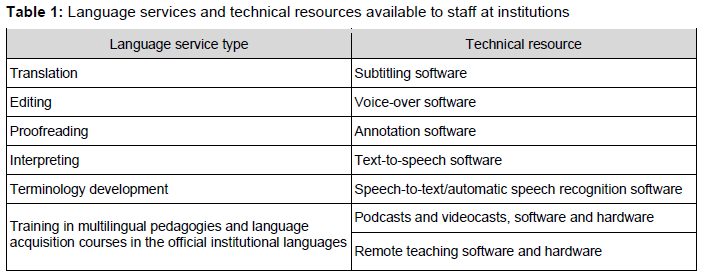
Moreover, universities offer an admirable range of language services, which are detailed in Table 1 (see van Dyk et al., 2023: 43-44, 46). Students can sometimes use all the language services listed except terminology development and training in multilingual pedagogies. Regrettably, at many institutions, these services are only available to staff or - more narrowly - management (van Dyk et al., 2023: 43f, 46, 53). Nonetheless, efforts to engage in inclusive communication are evident, with various languages being used in official announcements at institutions and additional recognition and support for indigenous languages, which is encouraging. This is demonstrated in their integration into curricula and through the provision of services in these languages (e.g., van Dyk et al., 2023, 65). Within the academic infrastructure, several departments and initiatives focus on promoting multilingualism by offering resources, support, and programmes for learning and developing languages.
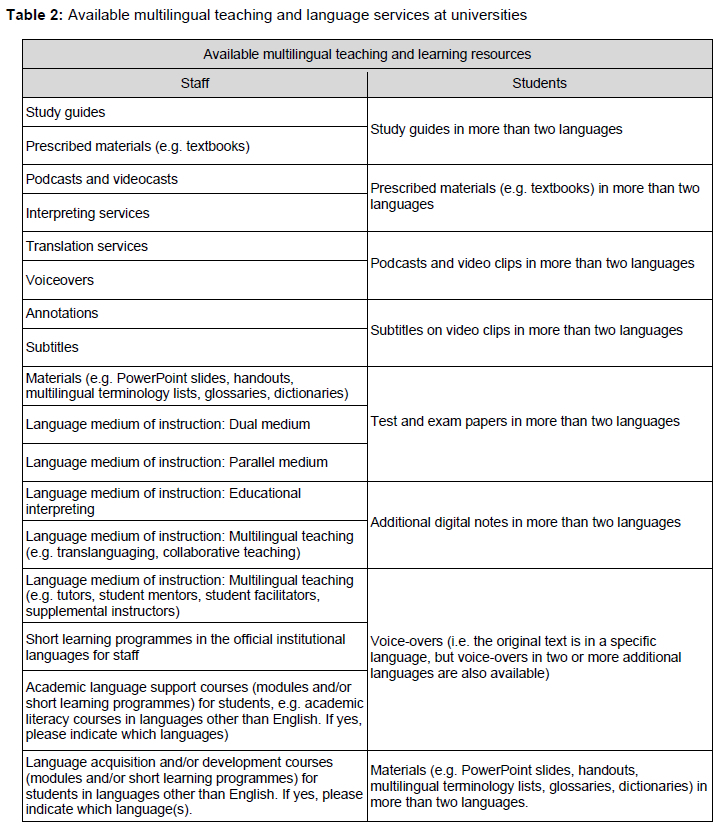
Table 2 (see van Dyk et al. 2023, 54-55) indicates the multilingual teaching and learning resources available at universities for both staff and students. The lists are not exhaustive, as some staff and students marked "other" when they completed the questionnaire. Some of them also did not know what resources they could use. Survey responses underscore many commendable practices and initiatives universities are implementing to support linguistic diversity and multilingualism. Nonetheless, many students remain unaware of what is available (van Dyk et al. 2023, 45). Thus, despite good progress made, there remains room for improvement in providing language support and promoting multilingualism. Among some of the areas for improvement identified by students are expanding language acquisition course offerings, such as "Lunch hour classes to learn the two indigenous languages in the language policy. Have more events that promote multilinguism. Introduce one of the two indigenous languages as Compulsory subject for students who may not be efficient in one or both indigenous languages (Student participant 101875211); provision of course material in more languages, "The university can start by hiring personnel that are trained in multilingualism, utilise textbooks written in other languages other than English, libraries can also have multilingual resources" (Student participant 100361386); greater development of skills in multilingualism among staff: "They can try hiring those lectures that knows more than two language so that when he/she speaks he/she can use those different languages in order to accommodate those students who have difficulties when it comes to English (Student participant 102717368); and more multilingual communication, e.g., through signage and instruction: "Have signs all over the place with common different language words to get people to learn the basics" (Student participant 101875197) (van Dyk et al. 2023, 44, 62).
The accommodation of students with varying linguistic backgrounds emerged as an important concern (van Dyk et al. 2023, 77) - and that this should be achieved by prioritising English in formal contexts, which is then supplemented by additional measures such as readily accessible translation services and short learning programmes for basic proficiency in languages. In addition, students emphasised their desire for the creation of an inclusive environment where they can be comfortable expressing themselves in their preferred language(s) (van Dyk et al. 2023, 45). This, however, should not come at the expense of others' ability to participate. Practical solutions which were offered include the employment of interpreters, multilingual resources, interactive events, and the like (ibid.). These should aim particularly at effective communication across sub-divisions within institutions.
Capacity building
Students expressed the desire to improve general language skills (95.7% total; van Dyk et al. 2023, 58) but especially indicated the desire to communicate in the language in which they are most comfortable. Moreover, they expressed the desire to include other languages alongside English and possibly use them in class discussions (van Dyk et al. 2023, 59). As identified by students, the greatest need for improved language skills lies in English, South African Sign Language, isiZulu, isiXhosa, Sesotho, and Afrikaans (in descending order; ibid.). Their suggestions included offering language modules and providing better access to translated materials - particularly materials that could supplement instruction in English (ibid.).
Student suggestions for greater multilingualism and linguistic integration include efforts to promote cultural integration through focused efforts at promoting multilingualism. Staff echo this sentiment, saying that there is limited support for official languages other than Afrikaans and English, and students believe insufficient resources have been provided for this purpose (van Dyk et al. 2023, 65). Disparity also exists among faculties and departments in that some have successfully promoted multilingualism. Staff suggest this may be remedied through greater alignment of support mechanisms across institutions (e.g. van Dyk et al., 2023: 52).
Efforts are further hampered by obstacles in implementation, which staff suggest originate from ineffectual structures and lacking staffing in the language support initiatives, for example, expressed by Staff participant 107643942: "At present difficult to provide interpretation to all three languages for bigger module groups due to lack of venues. An incongruence between the Faculty T&L plans and the bureaucratic expectations and deadlines for setting, moderating, translating and submitting formative and summative assessments". Moreover, certain disciplines - especially those within the "hard" sciences - have insufficient language support, which reinforces the argument for greater alignment of language support across institutions (van Dyk et al. 2023, 56). Staff seem to agree and suggested that short learning programmes in languages relevant to their universities be offered so they can better communicate with students in their preferred languages (van Dyk et al. 2023, 51). Staff indicated that at present, there are short learning programmes in the official institutional languages available to staff (5.75%), for students (5.79%), and more generally (4.02%; van Dyk et al. 2023, 54). Overall, "Functional multilingualism should remain the focus", especially since there is the risk of misdirecting resources (van Dyk et al. 2023:51.).
It is encouraging that staff offered a variety of strategies to achieve functional multilingualism (van Dyk et al. 2023, 71); this speaks to active engagement with issues which relate to this goal; it also suggests that they are willing to contribute expertise toward practicable solutions to affect the goals of their respective institutions' language policies. Overall, it speaks to general staff buy-in. A multipronged approach is necessary to achieve this goal. Thoroughgoing and continuous policy development and review are necessary to monitor whether policies are implemented and whether they are fit-for-purpose. Special attention is necessary to determine whether adequate levels of support are available. To develop language support infrastructure, targeted investment in language service departments, translation services, and staff training are necessary. It is unclear whether the budget for this is available at present. The importance of funding was stressed by staff across all universities. Staff argue that the erasure of historical and current inequality should be facilitated through prioritisation of funding and other resources for under-developed languages. This should be done especially to promote parity among languages. In pursuance of this goal, staff repeatedly emphasised the need for funding which appropriately addresses the needs outlined in language policies.
Finally, staff strongly support using cutting-edge technology, particularly those augmenting translation and interpreting (van Dyk et al. 2023: 42, 46), which they believe should improve inclusivity and access. Similarly, it became clear in the course of the LRA that there is a need for the "creation and maintenance of a single resource repository (technological, human, physical, etc.) available to all universities", mainly to avoid unnecessary reduplication of efforts, and to ensure that capacity is built collaboratively, across institutions (van Dyk et al. 2023, 83).
DISCUSSION
Stakeholder change commitment
Leadership commitment
As part of leadership commitment (Nordin, 2010), institutions need leadership that ardently promotes the implementation of change. The data presented highlights several important aspects of leadership committed to implementing and managing multilingual language policies and their accountability. In line with earlier postulation, a significant majority of responses indicate awareness of the language policy by staff, however, based on student responses in the qualitative data, it is apparent that awareness for this specific stakeholder group needs improvement (Garcia, 2008; Gorter and Cenoz, 2017). The discrepancy between staff awareness and the lack of student awareness indicates that leadership commitment is most effective for staff members, whether intentional or not. Therefore, it may be important that change management should consider a more concerted effort in directing language policy awareness in more actively engaging with students towards perhaps a co-construction of how language policies are implemented (Dagenais et al., 2008; Hardman and Hardman, 2017; Makoni et al., 2022; le Roux and Makoe, 2023).
Accountability is another important aspect of leadership commitment. As derived from the data, it seems that institutions are doing well in this regard where the entities responsible for language planning and management are positioned at higher levels (e.g., the DVC 56.37%). In addition to the DVC, participants also noted that their language directorate, language centre, and/or respective faculties/colleges collectively make up 34.26 per cent of the custodians of the institution's language plan. In considering that accountability at the highest possible levels fosters a culture of confidence in leadership commitment to change, it may be advisable for institutions to show that language policy implementation and management has change management investment at the highest levels (Kingsley, 2010; Burton, 2013; van de Walt, 2016).
Monitoring and evaluation
In line with change commitment, monitoring and evaluation of language policy implementation and management (Eresia-Eke and Boadu, 2019) is a sub-component important in terms of measuring the success in terms of assessing progress, identifying areas for improvement so that informed decisions for future improvements are made. As discussed in the data, a roughly even division is apparent in terms of whether language policy plans are being monitored. This is a significant finding that speaks directly to the need for change commitment by management to be more apparent, with a possible solution being a stronger focus on change management in this regard (Doppelt, 2017). Furthermore, as part of monitoring language policy implementation, staff identified priority areas that would aid in giving effect to the language policy framework. Most significant for change commitment in terms of monitoring and evaluation is the staff's clear call for the actual implementation of plans (ranking as the second-highest suggestion at 24.3 per cent, next to the need for teaching and learning resources at 29%). The fact that staff highlight the need for policy implementation means that there is a policy-practice gap, as highlighted by Hornberger (2020), which should be managed more closely through change management.
Stakeholder change efficacy
Resource availability
Resource availability (Lehman et al., 2002) is an important consideration as part of stakeholders' belief that, in this context, the language policy framework can be successfully implemented. As highlighted in the results section, observations are made regarding the disparity between resource-rich and resource-poor(er) aspects of a) language services and b) teaching and learning resources. Resource availability is an important factor for stakeholder's belief that they are well-equipped to implement change (Borg, Scott-Young and Turner, 2019). Regarding language services, the diversity in student opinions concerning language services available at the respective institutions specifically pertains to the need for availability, improvement and increased awareness - indicating a strong desire for more language support services. The need for language services was noted as being of great importance for non English speaking students to garner inclusivity and understanding (Hibbert, 2023). To improve language services as part of change efficacy, funding is important for change management considerations and planning. From a staff perspective, it seems that awareness of available technical resources is lacking - which may have a two-pronged effect where students would also then not enjoy the benefits of language resources and services (which may explain why students have highlighted the need for language services in the first place) but it may also negatively influence staff's perception of change efficacy in that if they do not have the tools to implement the language policy framework, the projection of successful implementation may suffer. Whether there is a lack of resources for staff or a lack of awareness of available resources, it is an important consideration that should inform change management in achieving institutional readiness.
Capacity building
As previously expressed, investing in capacity development - that is, building the capacity of staff and students to improve readiness in implementing the language policy framework, is. Indicative in the results is the want of students to improve their language skills, specifically in English, which may indicate that either they are content with English as the language of learning and teaching (LoLT), or it may indicate that since they know that English remains the main LoLT, they need to be more proficient in it. Either way, the desire to build their capacity is there. For other South African languages, the desire to build their capacity shows that there should be more flexibility and accommodation concerning language use in the classroom. Flexible language use in the classroom can, however, only be accommodated in so far as the lecturer may be able to accommodate other languages; hence, the need for staff's capacity building in learning another official language of the institution at least conversational level (Madiba, 2013; Maseko, 2014; Llurda, Cots and Armengol, 2014; Gambushe, 2015), possibly through Structured Language Programs (SLPs). Structured Language Programs could be managed either internally or externally. These suggestions for capacity building in becoming more multilingual are rooted in the notion of higher education institutions moving towards functional multilingualism (Coetzee van Rooy, 2010; Ndebele and Ndimane-Hlongwa, 2019; Heugh, Stroud and Hickey, 2020) and have become an important consideration for change management in improving stakeholder change efficacy. Furthermore, the data shows the need for the development of robust support to both students and staff by integrating and utilising multilingual resources effectively. However, it is important to emphasise that this approach should not merely be superficial; instead, it requires a departure from the status quo of solely using English, supplemented by meaningful multilingual elements. It is imperative to build students' capacity through academic language development courses tailored to the main medium(s) of instruction, often referred to as academic literacy courses. Developing discipline-specific terminology is critical, necessitating oversight by a central authority, whether within or outside the institution - another consideration for change management towards establishing institutional readiness.
In comparison to the US, some universities in the South also struggle with seeing multilingualism as a resource rather than a challenge, i.e., language diversity as a challenge (language-as-a-problem) rather than an asset (language-as-resource) (Ruiz, 1984), particularly in resource-scarce environments. While South Africa's policy aims to support multiple languages, it lacks Canada's centralised funding and enforcement mechanisms as part of their federally supported bilingual programmes. Belgium showcases regional autonomy within their linguistically diverse context, and although South Africa seems to adopt this approach loosely, it is not explicitly regionally autonomous. Considering South Africa's history of segregation, regional autonomy may not be favourable because, like India, South Africa must balance national unity with local linguistic realities. The key challenge is ensuring that all official languages receive equal institutional support - but in order to receive that support, the fundamental issue remains institutional readiness for change.
To conclude the discussion, one is reminded of Weiner's fundamental view on organisational readiness for change, "When organisational readiness for change is high, organisational members are more likely to initiate change, exert greater effort, exhibit greater persistence, and display more cooperative behaviour. The result is more effective implementation" (Weiner, 2009, 67). The data shows areas where more attention should be paid in leadership commitment, monitoring and evaluation, resource availability, and capacity building. The interdependence between stakeholders change commitment and stakeholder change efficacy is evident in their cyclical relationship. If stakeholder efficacy is lacking, it will impact their (stakeholder change) commitment to implementing changes. This, in turn, influences stakeholders' confidence in their ability to execute language policy-i.e., change efficacy successfully. So, the recommendation is that institutions should do more to show stakeholders that policy implementation is possible through providing leadership commitment, resource availability, capacity building and then monitoring and evaluation. As a collective, change management directly addresses change commitment, which is an important consideration that will positively influence change efficacy, resulting in improved institutional readiness.
CONCLUSION AND THE ROAD AHEAD
This article articulates that language policy implementation must be visibly supported at the highest levels to cultivate a culture of accountability and confidence in institutional leadership. This commitment to change management is particularly vital given the staff's strong call for enacting policy plans-second only to the need for adequate teaching and learning resources. Funding remains a crucial factor in realising these objectives. Whether due to a lack of resources or inadequate awareness of existing resources, it is clear that financial investment must be prioritised within change management planning to ensure institutional readiness. While change management is essential, it is merely one aspect of a broader, ongoing effort needed for successful multilingual policy implementation. Institutions must adopt a multifaceted approach to sustain progress on this journey, with change management as a key but not singular focus.
GENERAL NOTEGrammarly has been used to edit and rephrase for conciseness and clarity - it has been appropriately cited in the reference list.
REFERENCES
- Alexander, Neville. 2004. "The Politics of Language Planning in Post-Apartheid South Africa." Language Problems & Language Planning 28 (2).
- Bamgbose, Ayo. 1996. "Post-Imperial English in Nigeria 1940-1990." Contributions to the Sociology of Language 72: 357-372.
- Beukes, Anne-Marie. 2009. "Language Policy Incongruity and African Languages in Postapartheid South Africa." Language Matters 40 (1): 35-55.
- Borg, Jessica, Christina M. Scott-Young, and Michelle Turner. 2019. "Smarter Education: Leveraging Stakeholder Inputs to Develop Work-Ready Curricula." In Smart Education and E-Learning 2019, 51-61. Singapore: Springer.
- Burton, Lisa Ann. 2013. Mother Tongue-Based Multilingual Education in the Philippines: Studying Top-Down Policy Implementation from the Bottom Up. PhD diss., University of Minnesota.
- Cele, N. 2021. "Understanding Language Policy as a Tool for Access and Social Inclusion in South African Higher Education: A Critical Policy Analysis Perspective." South African Journal of Higher Education 35 (6): 25-46.
- Claussen, C. 2011. Capacity Building for Organisational Effectiveness. Calgary: United Way of Calgary and Area.
- Coetzee-Van Rooy, Susan. 2010. "Complex Systems, Multilingualism and Academic Success in South African Higher Education." Southern African Linguistics and Applied Language Studies 28 (4): 309-321.
- Dagenais, Diane, Nathalie Walsh, Françoise Armand, and Erica Maraillet. 2008. "Collaboration and Co-Construction of Knowledge during Language Awareness Activities in Canadian Elementary School." Language Awareness 17 (2): 139-155.
- Doppelt, Bob. 2017. Leading Change toward Sustainability: A Change-Management Guide for Business, Government and Civil Society. Routledge.
- Drummond, Andrew. 2016. "An Analysis of Language Policy versus Practice in Two South African Universities." Southern African Linguistics and Applied Language Studies 34 (1): 71-79.
- Du Plessis, Theodorus. 2017. "Language Policy Evaluation and Review at the University of the Free State." Language Matters 48 (3): 4-24.
- Du Plessis, Theodorus. 2020. "The Role of Language Planning Agencies in Higher Education in South Africa-Comparing Two Cases." Sociolinguistica 34 (1): 173-193.
- Eresia-Eke, Chukuakadibia E., and E. S. Boadu. 2019. "Monitoring and Evaluation Preparedness of Public Sector Institutions in South Africa.
- "
- Fishbein, Martin, and Icek Ajzen. 1977. Belief, Attitude, Intention, and Behavior: An Introduction to Theory and Research.
- Foley, Andrew. 2004. "Language Policy in Higher Education in South Africa: Implications and Complications." South African Journal of Higher Education 18 (1): 57-71.
- Gambushe, Wanga. 2015. Implementation of Multilingualism in South African Higher Education: Exploring the Use of isiXhosa in Teaching and Learning at Rhodes University. PhD diss., Rhodes University.
- García, Ofelia. 2008. "Multilingual Language Awareness and Teacher Education." In Encyclopedia of Language and Education, 385-400.
- Gist, Marilyn E., and Terence R. Mitchell. 1992. "Self-Efficacy: A Theoretical Analysis of Its Determinants and Malleability." Academy of Management Review 17 (2): 183-211.
- Gorter, Durk, and Jasone Cenoz. 2017. "Language Education Policy and Multilingual Assessment." Language and Education 31 (3): 231-248.
-
Grammarly. 2024. "Grammarly." September 23, 2024. https://www.grammarly.com/.
» https://www.grammarly.com/ - Hardman, Jan, and Frank Hardman. 2017. "Guided Co-Construction of Classroom Talk." In Encyclopaedia of Language and Education, 199-210.
- Heugh, Kathleen, Christopher Stroud, and R. Hickey. 2020. "Multilingualism in South African Education: A Southern Perspective." In English in Multilingual South Africa, 216-238.
- Hibbert, Liesel, ed. 2023. English as a Language of Learning, Teaching and Inclusivity: Examining South Africa's Higher Education Crisis. Taylor & Francis.
- Holt, Daniel T., Achilles A. Armenakis, Stanley G. Harris, and Hubert S. Feild. 2007. "Toward a Comprehensive Definition of Readiness for Change." Research in Organizational Change and Development: 289-336.
- Kamwangamalu, Nkonko M. 2001. "The Language Planning Situation in South Africa." Current Issues in Language Planning 2 (4): 361-445.
-
Kaplan, Robert. 2013. "Language Planning." Applied Research on English Language 2 (1): 1-12. https://doi.org/10.22108/are.2013.15459.
» https://doi.org/10.22108/are.2013.15459 - Lehman, Wayne E. K., Jack M. Greener, and D. Dwayne Simpson. 2002. "Assessing Organisational Readiness for Change." Journal of Substance Abuse Treatment 22 (4): 197-209.
- le Roux, Kate, and Pinky Makoe. 2023. "Opening (Up) Spaces for Multilingual Learning and Teaching Practices in South African Higher Education." In The Routledge Handbook of Multilingualism.
- Llurda, Enric, Josep M. Cots, and Lurdes Armengol. 2014. "Views on Multilingualism and Internationalisation in Higher Education." Journal of Multilingual and Multicultural Development 35 (4): 376-391.
- Madiba, Mbulungeni. 2013. "Multilingual Education in South African Universities: Policies, Pedagogy and Practicality." Linguistics and Education 24 (4): 385-395.
- Makoni, Sinfree, Cristine G. Severo, Ashraf Abdelhay, and Anna Kaiper-Marquez, eds. 2022. The Languaging of Higher Education in the Global South. Routledge.
- Maseko, Pamela. 2014. "Multilingualism at Work in South African Higher Education: From Policy to Practice." In Multilingual Universities in South Africa, 28-45.
- McKibben-Greene, Maddox G. 2020. "Managing Multilingualism in India and South Africa: A Comparison." Senior thesis, University of South Carolina.
-
Mettewie, Laurence, and Luk Van Mensel. 2020. "Understanding Foreign Language Education and Bilingual Education in Belgium." International Journal of Bilingual Education and Bilingualism: 1-19. https://doi.org/10.1080/13670050.2020.1768211.
» https://doi.org/10.1080/13670050.2020.1768211 - Meyer, John P., and Lynne Herscovitch. 2001. "Commitment in the Workplace: Toward a General Model." Human Resource Management Review 11 (3): 299-326.
- Mthombeni, Zama M., and Olusola Ogunnubi. 2020. "An Appraisal of Bilingual Language Policy Implementation in South African Higher Education." South African Journal of African Languages 40 (2): 186-197.
- Mwaniki, Modest Munene. 2004. Language Planning in South Africa: Toward a Language Management Approach. PhD diss., University of the Free State.
- Ndebele, Hloniphani, and Nobuhle Ndimane-Hlongwa. 2019. "Impediments in Promoting the Functional Status of African Languages in Higher Education." Southern African Linguistics and Applied Language Studies 37 (2): 91-104.
- Nordin, Norshidah. 2012. "The Influence of Leadership Behavior and Organisational Commitment on Organisational Readiness for Change." Asia Pacific Education Review 13: 239-249.
- Nudelman, Craig. 2015. Language in South Africa's Higher Education Transformation.
- Ruiz, Richard. 1984. "Orientations in Language Planning." NABE Journal 8 (2): 15-34.
- Stroud, Christopher, and Caroline Kerfoot. 2013. "Towards Rethinking Multilingualism and Language Policy for Academic Literacies." Linguistics and Education 24 (4): 396-405.
- Toprak-Yildiz, Tugba Elif. 2022. "Developing a Cognitive Model of L2 Reading Comprehension." Studies in Educational Evaluation 75: 101200.
- Van der Merwe, Chanel. 2022. "Re-Considering Orientations in South African Language Policies." Bandung 9 (1-2): 279-299.
- Van der Walt, Christa. 2004. "The Challenge of Multilingualism." South African Journal of Higher Education 18 (1): 140-152.
- Van Dyk, Tobie. J., Wilken, Ilana, Ravyse, Natasha, Du Plessis, Deon, Khumalo, Langa, and Steyn, Juan. 2023. USAf National Language Resources Audit 2023. Potchefstroom: SADiLaR.
- Vroom, Victor Harold. 1964. Work and Motivation.
- Weiner, Bryan J. 2009. "A Theory of Organisational Readiness for Change." Implementation Science 4: 1-9.
- Zikode, Noluthando Purity. 2017. An Evaluation of the Implementation of the Language Policy for Higher Education. Master's thesis, University of Pretoria