Hidden discourses and implications of "at-risk" and "underprepared" labels in a South African university: seeking humane alternatives
Abstract
This article explores the hidden discourses and far-reaching implications associated with labelling students as "at-risk" and "underprepared" in a South African university. By unpacking the criteria, exploring the consequences, and scrutinising systemic biases, we provide a comprehensive understanding of the multifaceted dynamics surrounding these two labels. We adopted theory triangulation with Labelling theory as the central theoretical framework operationalised through Mill's Millian theory of names, Frege's Sense-based theory of names, and Russell's Descriptive theory of names. We employed qualitative methods, encompassing questionnaires and literature reviews, and thematic analysis was utilised for data analysis. Findings reveal that "at-risk" and "underprepared" labels are used loosely without due consideration of the variety of contextual, socio-economic, and educational backgrounds of the students. Through this article, we advocate for dialogue among university teachers to support all students and propose new terms to describe students who require extra support. For instance, we suggest names such as "Students in Transition" (SIT) or "Students on a Developmental Pathway" (SDP). In its entirety, this article highlights the need for more inclusive and culturally sensitive naming in higher education as more humane alternatives.
Labelling; hidden discourse; at-risk; underprepared; human labels; implications
INTRODUCTION
Students entering higher education are frequently viewed as lacking key academic skills, requiring additional support to complete their qualifications. They are often labelled "at-risk" or "underprepared", reflecting their vulnerable position in academia (Mulvey 2009). Maloney (2003) argues these labels portray students as unwilling or unable to handle academic demands, implying they are undeserving of higher education's benefits. Despite various alternatives, "at risk" and "underprepared" labels remain dominant in both the global North and South.
Mulvey (2009) argues that labelling in education involves assigning specific classifications to students based on certain characteristics or behaviours. This process can shape perceptions, expectations, and treatment (Nendauni, Sadiki and Baloyi 2021), potentially influencing educational opportunities and outcomes. In higher education, the widespread use of labels such as "at-risk" and "underprepared" often affects institutional perceptions and influences students' academic trajectories.
These labels, primarily applied to first-year students, are Eurocentric constructs that identify potential challenges. However, they carry hidden discourses that warrant closer scrutiny. As researchers in onomastics (linguistic study of names), we argue that such labels are based on ambiguous criteria, raising concerns about their fairness. As education evolves, it is crucial to critically assess these terms, especially as African universities adopt an Ubuntu-centred approach that prioritises care, unity, and inclusivity. This is mainly because socio-economic status, cultural background, and educational history, often overlooked in broad labels, may perpetuate systemic biases. This article aims to critically examine the subjective nature of these labels, contributing to discussions on equitable education rooted in Ubuntu.
Labelling students as "at-risk" or "underprepared" can significantly impact their self-perception, academic confidence, and motivation. The subjective nature of these labels calls for reform as higher education seeks greater inclusivity. By exposing systemic biases inherent in such labelling, we aim to inform policy changes that promote fairer educational practices and better support for diverse student populations. On this basis, this article is grounded in the ethics of care, inclusivity, and Ubuntu, advocating for an educational environment where all students, regardless of label, have equal opportunities for success. Ubuntu, rooted in interconnectedness, reminds us of that individual successes or struggles affect the broader educational community.
This needs to be understood in the context that South African universities are undergoing decolonisation to improve access and learning methods, but their assessment models remain Eurocentric, often ill-suited to the African context. Rather than asserting that students are "at-risk" or "underprepared", we should question whether African universities are prepared for the students they admit. We have argued that assessment should be contextualised, avoiding neoliberal frameworks that prioritise Western values (Ravhuhali and Nendauni 2020). This shift would render universities more relevant to African students' lives.
Historian and political theorist Achille Mbembe, cited in Badat (2023), highlights that many African universities remain "westernised", operating under a Eurocentric academic model that disregards other epistemic traditions. To address these issues, we explore the following questions:
What hidden discourses underlie the labels "at-risk" and "underprepared" within a South African university context?
What criteria, explicit and implicit, contribute to these labels at a South African university?
What consequences do students labelled "at-risk" or "underprepared" experience?
These questions guide the subsequent literature review and form the core of the article.
The literature review in this article forms a foundation for understanding the historical context, labelling criteria, and consequences associated with the "at-risk" and "underprepared" labels within the higher education.
Etymology and historical context
The historical evolution of the "at-risk" and "underprepared" labels in higher education reflects broader shifts in educational paradigms and societal attitudes. Initially emerging as responses to identify students who are not academically ready, and who may need additional support, these labels have a complex history. In America and other western countries, academic readiness is frequently measured by a combination of several factors such as Scholastic Assessment Test (SAT) or American College Test (ACT) scores, demographic statuses, and cultural norms (Choy 2002; Kuh et al. 2008; Raju and Schumacker 2015; Yeh 2002). Early efforts often revolved around assessing basic academic skills. However, as education theories evolved, so did the criteria for identifying students that are labelled as "at-risk" or "underprepared". Understanding this historical trajectory is crucial for contextualising the current use of these labels and recognising how they may carry remnants of past educational ideologies.
The labels "at-risk" and "underprepared" originated in the global North. In the 1700s, Harvard admitted students needing help with Latin and Greek, focusing on language proficiency and character (Mulvey 2009). By the mid-1800s, more students arrived underprepared, raising concerns about declining standards. For instance, in 1841, Brown University's president criticised students' poor English grammar, and condemned colleges for teaching content suited to lower education levels (Wechsler, Harold, and Diner 2021). This trend persisted as universities became more accessible, increasing the need for remediation (Stephens 2001).
In South Africa, similar challenges exist with accommodating diverse students and addressing varying academic preparedness levels. Maxwell (1979) observes that academically weak students have always existed, though in greater numbers due to increased enrolment. To add, Stephens (2001) argues there was never a "golden age" when all students were fully prepared for university, reflecting the disconnect between basic and higher education curricula.
Recent research suggests students today may be even less prepared than before (Mulvey 2009). However, contemporary scholarship questions whether historical criteria for "at-risk" and "underprepared" labels adequately capture today's diverse student challenges (Duarte, Ramos-Pires, and Gonçalves 2014). Understanding the historical context of these labels reveals how they have been shaped by changing educational philosophies and societal perspectives.
The subjectivity of labelling students as "at-risk" and "underprepared"
The literature on the subjectivity of "at-risk" and "underprepared" labels reveals significant variability and ambiguity in assessments. These labels often depend on a mix of quantitative metrics, such as test scores and GPAs, and qualitative assessments, like teacher recommendations (Choy 2002; Yeh 2002; Kuh et al. 2008; Raju and Schumacker 2015). Further, Duarte et al. (2014) demonstrate that solely using academic data is insufficient for identifying at-risk students. Adelman (2006) and Valencia (2010) argue that these labels reflect deficiencies attributed to cultural and socioeconomic factors beyond students' control, highlighting the subjective nature of these criteria.
Their research suggests biases in applying these labels, particularly affecting students from marginalised backgrounds, including minority racial and ethnic groups (Duarte et al. 2014). These criteria often overlook variations in learning styles, cultural backgrounds, and life experiences, leading to potential misclassification (Ravhuhali and Nendauni 2020). Addressing these critiques foster a more nuanced understanding of the challenges in the subjectivity of labelling criteria.
Consequences of labelling students as "at-risk" and "underprepared"
Literature on the consequences of labelling students as at-risk and underprepared underlines the far-reaching impact these classifications can have on students' academic experiences and self-perception (Dumais and Ward 2010; Kosher, Montserrat, Attar-Schwartz, Casas, and Zeira 2018). These studies consistently report that students labelled as such may face stigmatisation and stereotyping, both from lecturers and peers. This stigmatisation can manifest as lowered expectations, reduced opportunities, and a detrimental effect on students' sense of belonging within the academic community.
Accordingly, we argue that these labels can become self-fulfilling prophecies, influencing students' academic performance and future trajectories. Students internalise the negative categorisations, potentially leading to decreased motivation and a diminished belief in their ability to succeed. Additionally, the consequences of labelling extend beyond the individual to influence educational outcomes, exacerbating existing disparities in achievement and perpetuating inequality.
Having reviewed the relevant literature pertaining to the labels "at-risk" and "underprepared", it is important to note that limited studies indicate how higher education professionals and faculty members describe and utilise these labels when referring to students identified as such by their institutions. Overall, the literature reviewed provides a foundation for understanding the historical context, the subjectivity of criteria, and the consequences associated with the labels "at-risk" and "underprepared". The synthesis of existing research situates this article within the broader scholarly discourse, highlighting gaps in understanding and paving the way for an in-depth exploration of these critical issues in the subsequent sections of the article. In the subsequent section, we present the theoretical framework of the article.
THEORETICAL FRAMEWORKIn this article, we adopted a rigorous approach termed "theory triangulation", aimed at harmonising labelling dimensions. Angen (2000) posits that theory triangulation involves employing multiple theoretical perspectives to examine and interpret same data set. Against this backdrop, we adopt Labelling Theory (Goffman 1963), which suggests that social groups and institutions establish regulations regarding negative attributes of certain individuals, leading to their stigmatisation. Becker (1963) further expands on this by exploring the role of "othering" in the creation of deviance.
We adopt the Labelling theory (Goffman 1963) at a macro level, making it a central framework because it provides a powerful lens through which to examine the language and hidden discourse surrounding the labelling of students in South African higher education institutions. Moreover, this theory enables a deeper understanding of the power dynamics, hidden meanings, and social implications embedded in the language used in official documents, policies, and communication-related to these labels.
Despite its relevance in understanding hidden discourse associated with labelling, the Labelling theory (Goffman 1963) does not contain microlinguistic labelling elements that regulate meaning in context, it is, therefore, vital to incorporate other theoretical tools which can account for such microlinguistic labelling elements. In this regard, we adopt three naming theoretical tools, which in the context of this article are operationalised under the Labelling theory that include three prominent naming theories: Mill's Millian theory of names (1882), Frege's Sense-based theory of names (1952), and Russell's Descriptive theory (1905). The integration of these three theoretical tools provides a comprehensive and multidimensional approach to understanding the hidden discourses and implications of the labelling process.
By triangulating insights from Mill (1882), Frege (1952), and Russell (1905), we unravel the complex web of criteria, sense-based perceptions, and descriptive elements that contribute to the "at-risk" and "underprepared" labels. This theoretical tool also guides our analysis towards a more nuanced interpretation of the criteria, shedding light on the underlying biases and assumptions that may influence the assignment of these labels.
Firstly, Mill's Millian theory proposes that the meaning of a name lies in the individual or object it refers to. In the context of this article, Mill's perspective prompts an investigation into the specific characteristics or circumstances that contribute to students being labelled as "at-risk" or "underprepared". By adopting Mill's lens, our analysis discerns the individual traits and circumstances that academics and universities consider in their categorisations, emphasising a focus on the actual attributes of students rather than generalised assumptions. Despite its focus on characteristics and circumstances leading to naming, Mill's theory does not account for perpetual and sense aspects. Therefore, to account for this, we adopt Frege's Sense-based theory (1952).
The Sense-based theory contends that the meaning of a name is derived from the sense or description associated with it. In applying Frege's theory to this article, we direct the attention towards the criteria used to define students as underprepared or at-risk, emphasising the importance of understanding nuanced descriptions and perceptual aspects that shape these categorisations. Frege's theory deepens the analysis in this article by focusing on the senses attributed to students, revealing the complex layers of subjectivity in the labelling process.
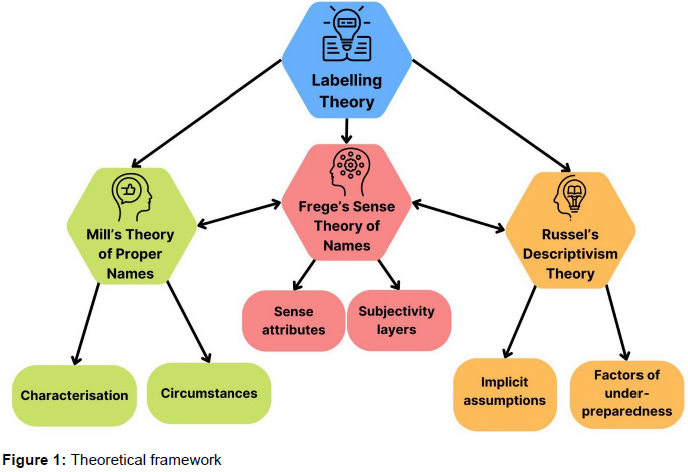
Lastly, we integrate Russell's Descriptive theory which asserts that a name is essentially a disguised description, encapsulating various attributes of the named entity (student). We use this theory to determine how students are characterised and identified, uncovering the factors contributing to their perceived lack of preparedness. This means that by applying Russell's theory, we reveal the descriptive elements used in the labelling process, exposing implicit assumptions and perceptions that may influence academics within a South African university to label these students. Figure 1 below illustrates the theoretical framework in brief.
The use of Millian theory, Sense-based theory, and Descriptive theory, operationalised under Labelling theory, provides a strong theoretical foundation for analysing the hidden discourses and implications of the "at-risk" and "underprepared" labels in a South African university. This framework examines how these labels position students within the university hierarchy, the entities or individuals with the authority to assign them, and the impact of this power dynamic on students' experiences. Labelling theory also highlights how language is used to legitimise certain perspectives while marginalising labelled students.
METHODOLOGY
This article adopts a qualitative research approach, incorporating various elements of this methodology. The population of the article consisted of fifty (50) newly appointed university teachers (UTs) who were part of the three (3) induction sessions held in the academic year 2023 in one South African university. An open-ended questionnaire was designed to allow participants to share their perspectives regarding the use of these "at-risk" and "underprepared" labels. A convenience sampling procedure was utilised and only fifteen (15) out of the total population of fifty (50) managed to complete the questionnaire, thus making 15 the sample of the article.
Data collected was anonymised to protect participants and their identities. Our approach to data collection and analysis was informed by the Labelling theory (Goffman 1963) and our belief that knowledge is a construction of the views, differences, and similarities of a common experience (Alexander and Dochy 1995). Our approach was also shaped by our positionality as Academic Development Practitioners who work in academia as full-time staff. Though qualitative data analysis is an iterative and non-linear process, thematic data analysis was adopted which involved familiarising us with data and coding to allow for themes and patterns to emerge throughout the data analysis process. Various patterns and connections were checked throughout the process of data analysis while direct or verbatim quotes were used as examples to support the key findings of the article.
FINDINGS AND DISCUSSION
Our thematic analysis draws on the work of Braun and Clarke (2006) as we extensively explore the hidden discourses and implications associated with labelling students as "at-risk" and "underprepared" in a South African university. Throughout our analysis, we discovered that these classifications are applied based on diverse criteria across departments within the university. Accordingly, our findings are organised into the following themes: the hidden discourses inherent in the "at-risk" and "underprepared" labels; the factors and standards influencing the labelling of students; the perceived consequences faced by students labelled as "at-risk" and "underprepared"; and finally, strategies for supporting academically struggling students, along with alternative labels.
Theme 1: Hidden discourses embroiled in the "at-risk" and "underprepared" labels
The labels "at-risk" and "underprepared" reflect broader societal narratives and power dynamics that affect how certain student groups are perceived and treated. This article examined not only the labels' surface meanings but also the ideologies and systems sustaining them. We found that these labels often obscure deeper issues and structural inequalities. Theory triangulation enhanced our analysis by revealing the labelling process and its implications.
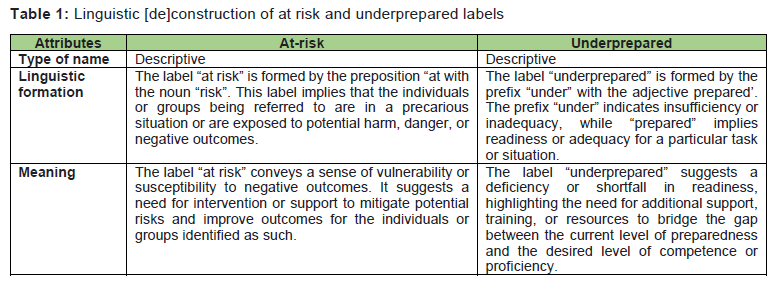
According to Russell's Descriptivism theory (1905), these labels serve both descriptive and evaluative functions, identifying specific attributes and assessing risks or deficiencies. While they can aid in targeting interventions, they may also perpetuate stigma. The table below deconstructs these underlying discourses from a linguistic perspective.
Table 1 shows that the labels "at-risk" and "underprepared" signify students' perceived vulnerability and lack of readiness for university education. Participants shared their views on these labels, revealing diverse and often hidden discourses. These include students who are overconfident, frequently absent, have disabilities, lack full competencies, or struggle with test failures. University teachers [UTs] noted that "at-risk" and "underprepared" students often have poor attendance. Presented below are their utterances:
"Those who are overconfident about content knowledge to the extent that they do not bother attending their classes" [UT1]
"Those students who do not attend classes always, students who are physically and mentally disabled "[UT2].
UT4 presented an alternative viewpoint, asserting that "at-risk" and "underprepared" students comprise those who enter the academic domain without possessing complete competencies. Furthermore, some of these students progress to level 3 of their studies despite encountering failures or carrying over modules from the first level. This implies that such students are classified as decontextualised, lacking the essential knowledge required for academic success. UT4 articulated the following perspective:
"The students who came in without full competencies, students who failed tests and two, students who are allowed to move to their 3rd year level with first-level modules. Students with serious academic and psycho-social problems [UT4].
UT5 offers a distinct viewpoint on "at-risk" students, suggesting that as students enter higher education spaces, they are introduced to unfamiliar disciplines. These students are inadequately prepared for the rigors of higher education studies. UT5 articulates:
"I do not believe that there are at-risk students. Students entering higher education do so as entering a new discipline which I think they are not familiar with and massification has made it difficult to be attended to or given the required attention which would ordinarily prepare them for higher education study" [UT5].
These findings reflect Mill's Millian theory of proper names (1882) regarding the traits and circumstances that lead to students being labelled as "at-risk" or "underprepared". These labels emphasise students' attributes and behaviours rather than generalised assumptions. Strauss (2019) notes that these labels are employed to identify students at higher risk of academic failure or dropout, a practice prevalent in various institutions. Nendauni et al. (2021) observe that this norm in higher education often labels students as "at-risk" based on perceived decontextualisation. Similarly, the Parliamentary Monitoring Group (2011) reports that some institutions utilise these labels for monitoring and counselling purposes.
Lewin and Mawoyo (2014) describe "underprepared" students as those struggling with autonomous learning and language proficiency, raising questions about their readiness for higher education and the responsibility of institutions to address these issues. Understanding these labels requires a critical examination of the socio-cultural contexts that influence their application. Thus, we further explored the appropriateness and relevance of these labels with university teachers.
Findings show that some UTs support the use of the "at-risk" and "underprepared" labels, while others indicate that it stigmatises students and carries negative connotations which are educationally meaningless. This aligns with Frege's Sense-based theory, which provides a lens to understand the senses attributed to students, revealing the complex layers of subjectivity in the labelling process which is shown by responses hereunder and the difficulties in using such labels openly.
"I don't support it because it stigmatises students" [UT14].
"No, they carry negative connotations and are educationally meaningless "[UT8].
"No, we need to understand them as students requiring support could do better in their studies, I think that is more positive than such labels or names "[UT5].
UT1 noted that the use of "at-risk" and "underprepared" labels are not right as "they are more militaristic" and they give the impression that education is some kind of combat or fight wherein you could be asked if you are at risk of not coming back alive or you are underprepared for the fight.
"The word at risk, if heard by the student, might make them feel discouraged, but support ensures them that someone is there for them to help them succeed" [UT1].
Notwithstanding the above, both UT12 and UT13 indicated that they support the use of the "at-risk" and "underprepared" labels as there are students who need serious support and that labelling such students must be made. UT12 and UT14 states:
"Yes, these are students who need very serious support from professional people who will talk to them in a better way, so they can be named at-risk" [UT12].
"Yes, they should be labelled because it helps them to be identified. Labelling has to be made" [UT13].
Though UT12 supports the use of "at-risk" and "underprepared" labels, we must deal with issues that may enable students to fail and drop out. In support, UT13 echoes the same sentiment and indicated that it would be helpful if efforts are made to identify students with academic challenges earlier. These findings are in line with Strauss (2019) who indicates that it can be challenging to know exactly what is meant when the label "at-risk" is used in educational settings without further clarification, examples, or criteria. This is because the labels can refer to a variety of factors or characteristics, and conditions, which if they are used without definition, could become practically meaningless, hence we saw it deemed in this article to deconstruct the underlying discourse of the two labels under investigation.
Strauss (2019) further critiques the frequent use of the term "at-risk" for large student groups, highlighting its stigmatising effects. Nendauni et al. (2021) note that negative labels are often based on perceived behaviour at specific times, reducing individuals to stereotypes and disregarding their humanity. The Community Journal (2023) and Gordon (2022) warn that such labels convey rejection and inadequacy, while Khetoa and Mokala (2022) argue that they can be a form of emotional abuse.
This highlights the need to avoid labels such as "at-risk" and "underprepared" for students, and instead, apply them to describe conditions or situations. Recognising and normalising students' diverse experiences can reduce "stereotype threat" and prevent marginalisation. The next theme examines the factors and standards influencing the labelling of students as at-risk and underprepared.
Theme 2: Factors and standards influencing labelling of students
Theme 2 revealed that the "at-risk" and "underprepared" labels carry specific connotations shaped by perceptions and institutional structures. UT1 questioned the use of "underprepared" label, linking it to Kripke's (1980) Theory of Causal History, which connects naming practices to historical contexts. This theory suggests that HEIs created these labels based on historically perceived factors affecting disadvantaged groups, leading to widespread acceptance and burdening of students with these labels. UT1's concerns highlight how these labels are entrenched and perpetuated in higher education.
"There is no such thing as underprepared, when we say students are underprepared, we compare them in relation to what? High schools do not offer Philosophy as a field of study when a student enter higher education without the required tools to think like a philosopher does it mean that the student is under prepared even though she/he never learnt philosophy in high school?" [UT1].
From this quote, UT1 questions the validity of labelling students as underprepared, asserting that this term lacks clear criteria. UT1 challenges the notion of underpreparedness by asking what students are being compared to when labelled as such. The argument implies that determining a students' preparedness should consider the specific requirements and expectations of the educational context they are entering. In this regard, UT1 raises questions about the meaningfulness and fairness of labelling students as underprepared without considering the diverse backgrounds and educational experiences they bring.
Contrastingly, UT8 offered a distinct viewpoint regarding "underprepared" students, asserting that they originate from schools characterised by academic literacy poverty. According to this socio-economic perspective, these students may rely on being excessively assisted and could face challenges in working autonomously. He states:
"These are students who come from academic literacy poverty-stricken schools. These students are only functional when they are "spoon-fed'' and cannot function independently" [UT8].
Contrary to UT8, UT7 believes that "at-risk" and "underprepared" students are those who consistently fail to attend classes. This characterisation highlights a reference to students' behaviour. He states:
"These are students not always honouring their classes, arriving late in class, and not preparing for any task" [UT7].
While certain participants maintain the perspective that there are underprepared students, UT12 highlight that,
"The term is sometimes problematic! but I think underprepared students are those students who may easily fail, repeat, or drop out. If we identify them upon entry and provide support, the term underprepared fades away" [UT12].
To add, UT5 expressed a caution regarding the application of the term "underprepared" while acknowledging that UTs or academics should be cognisant of the frequent adjustments made to matric results, potentially affecting students' qualifications. Furthermore, UT5 emphasised the predominant challenge in South Africa, highlighting the use of English language as the primary medium of instruction across all higher learning institutions. UT5 expressed the following insight:
"English language is a challenge and for the longest time, SA has been the last of more than 40 or 60 countries when testing for reading and writing competencies. Many students come in with adequate competencies. Imagine someone doing sciences and has never been in a laboratory "[UT5].
When the labels "at-risk" and "underprepared" are employed, they typically encompass a range of circumstances that students may encounter, posing potential threats to their ability to complete their education. These circumstances and factors include homelessness, incarceration, adolescent pregnancy, severe health issues, domestic violence, transiency (as observed in migrant-worker families), or other challenging situations. Additionally, the labels may extend to encompass learning disabilities, low test scores, disciplinary issues, grade retentions, or other learning-related factors that could adversely impact academic performance and achievement.
There is a widely accepted notion that high school or secondary school students achieving their matric or Grade 12 certificate in South Africa often lack the essential study skills and strategies necessary for success in higher education studies upon admission to university (DoE 2006; Council on Higher Education 2013; Mayet 2016). This assumption presents a challenge, as it implies the existence of specific study skills and strategies exclusively tailored for success in HEIs. Conspicuously, there is a lack of consideration for how these students have successfully navigated their matric studies, and literature addressing such skills and strategies remains silent on identifying them.
Drawing on these findings, we contend that labels such as "at-risk" and "underprepared" in higher education institutions are embedded in Pierre Bourdieu's concept of "habitus" (1977), which reflects internalised norms and perceptions within the field. Gillespie et al. (2020) explains that HEIs, through habitus, adopt and reinforce prevailing social and cultural norms, contributing to the perpetuation of these ideologies. This is related to "Doxa", the ingrained, unexamined beliefs and values that guide behaviour within a field (Gillespie et al. 2020). Drawing from Frege's Sense based theory of Names (1952), we argue that these habitus and doxa influence the labelling of students as "at-risk" and "underprepared", reinforcing and institutionalising these labels through policies and guidelines that often overlook students' complex experiences.
Next, we address Theme 3, focusing on the perceived consequences for students labelled as "at-risk" and "underprepared".
Theme 3: Perceived consequences experienced by students who carry the "at risk" and "underprepared" labels
Russell's Descriptive Theory (1905) asserts that a name or a label is essentially a disguised description, encapsulating various attributes of the named entity (student). When queried about their sentiments regarding identifying students as "at-risk" and "underprepared", UTs expressed a collective sense of unease. While UT6 suggested that such labels could serve as a motivational catalyst, propelling individuals to exert additional effort to disprove skeptical perceptions, the responses from other UTs conveyed a prevailing sentiment of dehumanisation.
UT1 and UT2 conveyed feelings of profound discouragement and emotional distress, whereas UT11 expressed offense at the prospect of being labelled as such. UT15 articulated a sense of unwelcome exclusion, asserting, "I would feel unwanted as the label underprepared gives me a sense that I do not belong". Additionally, UT8 emphasised the emotional toll, asserting that being designated as unprepared implies vulnerability to failure in academic modules.
In brief, UTs' comments collectively highlight the negative repercussions of being identified as "at-risk" and "underprepared" students, illuminating emotional and psychological consequences that extend beyond the academic context. These are some of the responses echoed:
"It would be very discouraging as it would be putting a label on my being as a student" [UT1].
"Hurt, because to me it means there is a high chance for me to fail "[UT2].
"It would be offensive as it puts some stigma on my personality" [UT11].
"Hurt, because it means I am unprepared and vulnerable for the module and the chances of failing are high" [UT8].
UT10, UT4, and UT7 do not feel enthusiastic and happy with the terms, and would, therefore, prefer labels that have positive references and provide recommendations for improvement. Here are some of the UTs' comments:
"Not very enthusiastic about it. I prefer a term that makes a positive reference" [UT10].
"Not happy. That will make me have more doubts about my capabilities. Maybe recommendations on things to improve on would be better" [UT4].
"Our systems are failing some students! I will not be happy. But it is what it is and if help is provided, I will be happy" [UT7].
In the absence of social context, labels such as "at-risk" and "underprepared" carry neither inherent positivity nor negativity. Nevertheless, owing to the socially constructed nature of language, these labels always hold significance, even if consensus on their meaning is lacking among users (Dix, Lail, Birnbaum, and Paris 2020). Moreover, labels employed to characterise individuals or groups can lead to disparate treatment compared to those who are not assigned the labels (Drotos and Cilesiz 2016). When contextualised within the sphere of higher education, the "at-risk" and "underprepared" labels suggests that a student or group of students deviates from a normative profile (Dix et al. 2020). It is important to highlight that the impact of these labels on students varies from minimal to potentially developmentally inhibiting (Soria and Stubblefield 2015).
Theme 4: Strategies for supporting academically struggling students and alternative names
When UTs were asked to suggest how they would like students who are labelled "at-risk" and "underprepared" to be understood and called, they indicated that such students need to be understood as new students entering a whole new environment. UTs also added that such students should be cared for and treated with love. Some descriptive names suggested by UTs included "students in a new environment", and "students with a myriad of academic and psycho-social challenges".
For us as researchers, "students in a new environment" carries positive connotations, as it frames students' experiences as a natural and expected part of adapting to new surroundings. This suggests that their challenges are temporary and related to the process of adjustment to a new academic or social context. On the other hand, "Students with a myriad of academic and psycho-social challenges" can have a more negative connotation. While it accurately reflects the complex realities some students face, it may inadvertently highlight the difficulties over the students' potential for success. The term "myriad" suggests a multitude of issues, which could be overwhelming or imply that the students are burdened by extensive challenges, possibly reinforcing a deficit view rather than one of resilience and capacity for growth.
Further, UT8 suggested that universities should send staff members to secondary schools to regularly talk to all the students about what they should expect in university environments. Some of the responses are captured as follows:
"Thus, higher education must make its provision to prepare students to succeed within the different qualifications" [UT8].
"They are in a new environment that they are unfamiliar with, and they are transitioning from having decisions made for them to making their own decisions, such as learning how to balance their schoolwork and personal life; as such, support on how they can easily navigate this transition is critical" [UT2].
"Students with a myriad of academic, and psycho-social challenges. Students should be treated with love and care and supported as necessary" [UT4].
UTs highlighted a variety of ways through which students who are struggling academically should be assisted. These include academic discourses that are more into their discipline, pairing them with classmates and provision of workshops tailored towards preparing them to work independently. Few responses are captured thus:
"Student profiling, and support of all kinds. Train student mentors, tutors, peer counsellors, SI leaders, and peer educators who will assist all students. Diagnose before prescribing!" [UT9].
"Most definitely, discipline academic discourses are unique therefore there must be proper initiation into them" [UT1].
"By holding workshops that prepare them to work more independently and demonstrate how technology can be used to enhance their learning experience" [UT6].
In support of UTs' suggestions, Winton (2023) highlights the need for additional support for students labelled as at-risk, including tutorials, extended deadlines, and both social and emotional assistance. Ensuring secure, encouraging learning environments, access to resources, and schedule flexibility is crucial for these students to balance personal and academic responsibilities. We argue that the "at-risk" and "underprepared" labels should be reconsidered, as they undermine students' dignity and well-being. Instead, universities should focus on identifying and addressing the various factors affecting academic performance, as Strauss (2019) suggests, providing targeted support to help students overcome these challenges.
SYNTHESIS OF THE FINDINGSIn an era permeated with buzzwords such as "decolonisation" and "decoloniality" within academic spheres, our findings reveal that South Africa continues to adhere to Eurocentric policies in higher education, sidelining Afrocentric methodologies that could nurture holistic student development. The labelling of students as "at-risk" and "underprepared" carries Eurocentric undertones, contributing to stigmatisation, reinforcing negative expectations, and perpetuating systemic biases, particularly disadvantaging students from under-resourced educational backgrounds.
Similar challenges are faced across other African countries due to shared colonial legacies. In Kenya, universities rely on Western assessment models that inadequately address socio-economic disparities, leading to the unjust labelling of students as "at-risk" (Mukhwana et al. 2016). In Nigeria, students from under-resourced secondary schools struggle with the transition to higher education and are frequently labelled "underprepared" (Solomon 2022). Ghana also faces similar issues, where students from rural areas are often labelled "underprepared" due to inadequate academic support structures (Bawakyillenuo et al. 2013).
To address these issues, African universities should adopt Afrocentric approaches such as Ubuntu, reframing how they view and support students. Countries such as Uganda are already experimenting with holistic support systems that focus on students' socio-economic contexts rather than their academic deficits (Moja, Schreiber, and Luescher-Mamashela 2014). By sharing best practices, institutions can reduce the harmful effects of labelling students as "at-risk" or "underprepared".
INSTITUTIONAL FRAMEWORK FOR MORE HUMANE ALTERNATIVES TO STUDENT LABELLINGAddressing the complexities of student labelling requires a shift beyond categorisation, recognising the diversity of student experiences, and understanding readiness in a holistic and multifaceted manner. Institutions should move away from deficit-based labels like "at-risk" and, instead focusing on terms that emphasise student potential. Reframing these labels to be more inclusive and empowering can shift the focus from limitations to capabilities.
The early identification of students requiring academic support is essential for targeted interventions and the effective allocation of resources. Employing diverse assessments to accurately profile students will ensure that support is tailored to their specific needs, mitigating the risk of dropout. Based on this article's findings, we advocate for the re-classification of students labelled as "at-risk" or "underprepared" as "Students on a Developmental Pathway" (SDP) or "Students in Transition" (SIT). These terms carry positive connotations, focusing on growth, progress, and the learning journey rather than shortcomings. The term "SDP" implies a purposeful, evolving journey towards continuous improvement and success, emphasising the process of education as dynamic and developmental. Likewise, "SIT" acknowledges that these students are in a phase of change or adaptation, which is a natural part of their academic journey, avoiding stigmatisation by framing their experiences as part of a broader process of growth. Both terms encourage a view of students as evolving individuals who, with the right support, are progressing towards their academic goals.
We also submit that higher education institutions should adopt humanising pedagogies, underpinned by the ethics of care and the African philosophy of Ubuntu, to respond to the needs of students requiring additional support, regardless of their socio-economic backgrounds. The first step in this transformation is engaging structures responsible for learning and teaching in universities to discuss the relevance of current labels and policies concerning student support. These platforms provide opportunities to propose alternative terms like SIT and SDP as humane options, thus enhancing inclusive student practices.
Practically, to integrate the terms "SIT" and "SDP" into institutional policies and practices, universities could revise their student support policies to formally adopt these terms, ensuring that students classified as SIT or SDP receive tailored interventions, such as personalised academic support plans or specialised workshops. Early identification mechanisms, such as diagnostic assessments during admissions, would allow institutions to profile students and provide targeted support. Identified students could benefit from customised support, including peer mentoring, academic counselling, and continuous progress monitoring. Multidisciplinary support teams, comprised of academic advisors, counsellors, and mentors, could be established to assist these students effectively. Additionally, shifting the institutional culture towards a growth-oriented perspective is vital, as faculty and staff should be trained to use these new terms in their interactions with students, fostering a more inclusive and supportive environment. Finally, monitoring systems should be put in place to track the progress of SIT and SDP students, with regular reporting to academic deans and student affairs offices, ensuring transparency and accountability in supporting these students.
CONCLUSION
In conclusion, we assert that if the labels "at-risk" and "underprepared" are to continue being used in higher education, we should critically examine the inclusivity of our higher education institutions and spaces, and how this aligns with the overarching purpose of higher education and the roles of university teachers. We need to begin asking ourselves uncomfortable questions, such as: How prepared should students be upon entering higher education institutions, and what exactly do we mean by "underprepared"? Who holds responsibility for preparing these students, and in what manner should this be undertaken? Furthermore, we should question whether institutions in South Africa are adequately positioned to support these students. Additionally, if we indeed have "at-risk" students within our institutions, is it not time to also scrutinise the notion of "at-risk" and "underprepared" lecturers, and more critically, to address modules with higher failure rates? We hope that this article will initiate dialogue and inspire further research into these pressing questions.
REFERENCES
LITERATURE REVIEW
- Adelman, C. 2006. "The Toolbox Revisited: Paths to Degree Completion from High School Through College". U.S. Department of Education.
-
Alexander, Patricia A., and Filip J. R. C. Dochy. 1995. "Conceptions of Knowledge and Beliefs: A Comparison across Varying Cultural and Educational Communities". American Educational Research Journal 32 (2): 413-442. https://doi.org/10.3102/00028312032002413
» https://doi.org/10.3102/00028312032002413 - Angen, M. J. 2000. "Evaluating Interpretive Inquiry: Reviewing the Validity Debate and Opening the Dialogue". Qualitative Health Research, 10 (3): 378-395.
- Badat, S. 2023. "Re-envisioning Universities in Africa as African Universities". Creating the New African University, 12-39.
- Bawakyillenuo, S., I. O. Akoto, C. Ahiadeke, E. B. D. Aryeetey, and E. K. Agbe. 2013. "Tertiary education and industrial development in Ghana". Policy Brief, 33012: 1-13.
- Becker, H. S. 1963. "Outsiders". Studies in the Sociology of Deviance, 1.
- Bourdieu, P. 1977. "Outline of a Theory of Practice". Cambridge: Cambridge University Press.
-
Braun, V., and Clarke, V.2006. "Using thematic analysis in psychology". Qualitative Research in Psychology, 3(2): 77-101.https://doi.org/10.1191/1478088706qp063oa
» https://doi.org/10.1191/1478088706qp063oa - Choy, S. P. 2002. Access and Persistence: Findings from 10 Years of Longitudinal Research on Students. American Council on Education.
- Council on Higher Education (CHE). 2013. "Report of the Task Team on Undergraduate Curriculum Reform in South Africa". Discussion Document. Pretoria: CHE.
- Dix, N., Lail, A., Birnbaum, M., and Paris, J. 2020. "Exploring the 'At-Risk' Student Label through the Perspectives of Higher Education Professionals". The Qualitative Report 25 (11): 3830-3846.
- DoE (Department of Education). 2006. "Funding for Foundational Provision in Formally Approved Programmes: 2007/08 to 2009/10". Pretoria: Department of Education.
-
Drotos, S. M., and Cilesiz, S. 2016. "Shoes, Dues, and Other Barriers to College Attainment: Perspectives of Students Attending High-Poverty, Urban High Schools." Education and Urban Society 48 (3): 221-244. https://doi.org/10.1177/0013124514533793
» https://doi.org/10.1177/0013124514533793 -
Duarte, R., Ramos-Pires, A., and Gonçalves, H. 2014. "Identifying at-risk students in higher education". Total Quality Management and Business Excellence, 25(7-8): 944-952. https://doi.org/10.1080/14783363.2014.906110
» https://doi.org/10.1080/14783363.2014.906110 -
Dumais, Susan A., and A. Ward. 2010. "Cultural Capital and First-Generation College Success". Poetics 38 (3): 245-265. https://doi.org/10.1016/j.poetic.2009.11.011
» https://doi.org/10.1016/j.poetic.2009.11.011 - Frege, G. 1952. "On Sense and Reference." In Translations from the Philosophical Writings of Gottlob Frege, edited by P. T. Geach and Max Black, 56-78. Oxford: Blackwell.
- Gillespie, R. G., G. M. Bennett, L. De Meester, J. L. Feder, R. C. Fleischer, L. J. Harmon, and G. O. Wogan. 2020. "Comparing adaptive radiations across space, time, and taxa". Journal of Heredity, 111(1): 1-20.
- Goffman, E. 1963. Stigma: Notes on the Management of Spoiled Identity. Englewood Cliffs, NJ: Prentice-Hall.
-
Gordon, S. 2022. "Consequences of Name-Calling". Verywell Family. Available from: https://www.verywellfamily.com/consequences-of-name-calling-460613. Accessed 23 May 2024.
» https://www.verywellfamily.com/consequences-of-name-calling-460613 -
Kosher, Hanan, Carme Montserrat, Shalhevet Attar-Schwartz, Ferran Casas, and Asher Zeira. 2018. "Out-of-Home Care for Children at Risk in Israel and in Spain: Current Lessons and Future Challenges". Psychosocial Intervention 27: 12-21. https://doi.org/10.5093/pi2018a4
» https://doi.org/10.5093/pi2018a4 - Khetoa, S. G., and N. T. Mokala. 2022. "The functional value of unconventional names in contemporary society: Social safety and security through Basotho nicknames". Nomina Africana: Journal of African Onomastics, 36(1): 59-70.
- Kripke, S. 1980. Naming and Necessity. Boston: Basil Blackwell.
- Kuh, G. D., J. L. Kinzie, J. A. Buckley, B. K. Bridges, and J. C. Hayek. 2006. What matters to student success: A review of the literature (Vol. 8). Washington, DC: National Postsecondary Education Cooperative.
- Lewin, T., and M. Mawoyo. 2014. "Student access and success: Issues and interventions in South African universities". Report published by Inyathelo: The South African Institute for Advancement, with the support of The Kresge Foundation.
- Maloney, W. H. 2003. "Connecting the texts of their lives to academic literacy: Creating success for at-risk first-year college students". Journal of Adolescent and Adult Literacy, 46(8): 664-673.
-
Mayet, Rashida. 2016. "Supporting At-Risk Learners at a Comprehensive University in South Africa". Journal of Student Affairs in Africa, 4 (2): 1-12. https://doi.org/10.14426/jsaa.v4i2.1527.
» https://doi.org/10.14426/jsaa.v4i2.1527 - Maxwell, N. 1979. "Educational Reform: A Shift Toward Inclusivity". Journal of Progressive Education, 22(3): 45-59.
- Mill, J. S.1882. A System of Logic, Ratiocinative and Inductive: Being a Connected View of the Principles of Evidence and the Methods of Scientific Investigation. 8th ed. New York: Harper and Brothers.
-
Moja, T., B. Schreiber, and T. Luescher-Mamashela. 2014. "Contextualising student affairs in Africa: The past, present and future". Journal of Student Affairs in Africa, 2 (1): 1-8. https://doi.org/10.14426/jsaa.v2i1.46
» https://doi.org/10.14426/jsaa.v2i1.46 - Mukhwana, E., S. Oure, J. Too, and D. K. Some. 2016." State of postgraduate research training in Kenya. Commission for university education" (p. 3). Discussion Paper 02. Nairobi, Kenya.
- Mulvey, Mary E. 2009. "Characteristics of Under-Prepared Students: Who Are 'The Under-Prepared'?" Research and Teaching in Developmental Education, 25 (2): 29-58.
-
Nendauni, L., M. Sadiki, and M. Baloyi. 2021. "Name-Calling as a Communicative Tool in South African Political Discourse". Communicatio, 47(4): 21-47. https://doi.org/10.1080/02500167.2021.2009531
» https://doi.org/10.1080/02500167.2021.2009531 - Olbrecht, A. M., S. D. Romano, and R. E. Schumacker. 2016. "Assessing Academic Readiness: A Qualitative Study". Journal of Educational Psychology, 108(1): 112-129.
-
Parliamentary Monitoring Group. 2011. "Access to Higher Education: Challenges: Higher Education SA Briefing". Higher Education, Science and Innovation, 07 February 2011. https://pmg.org.za/committee-meeting/12495/. Accessed 30 May 2024.
» https://pmg.org.za/committee-meeting/12495/ - Raju, D., and R. Schumacker. 2015. "Exploring student characteristics of retention that lead to graduation in higher education using data mining models". Journal of College Student Retention: Research, Theory and Practice, 16(4): 563-591.
- Ravhuhali, F., and L. Nendauni. 2020. "Fathoming prevailing assessment discourses through a social realist lense in a small comprehensive university". Gender and Behaviour 18 (2): 15293-15306.
-
Russell, B. 1905. "On Denoting". Mind 14 (56): 479-493. http://www.jstor.org/stable/2248381
» http://www.jstor.org/stable/2248381 - Stephens, J. 2001. "Academic Preparedness in Higher Education: Theoretical Considerations". Journal of Educational Reform, 43(2): 21-39.
- Solomon, A. A. 2022. "Estimating the Costs of Managing at Risk and High-Risk Populations Among High School Students in Osun State, Nigeria". US-China Education Review, 12(5), 172-181.
-
Soria, K. M., and R. Stubblefield. 2015. "Knowing Me, Knowing You: Building Strengths Awareness, Belonging, and Persistence in Higher Education". Journal of College Student Retention: Research, Theory and Practice 17 (3): 351-372. https://doi.org/10.1177/1521025115575914
» https://doi.org/10.1177/1521025115575914 - Strauss, V. 2019. "Why we should stop labeling students as "at risk" and the best alternative". The Washington Post.
-
The Community Journal. 2023. "From the Journal: The Dehumanizing Power of Name-Calling". The Community Journal. Available at: https://community-journal.com/2023/11/from-the-journal-the-dehumanizing-power-of-name-calling/. Accessed 24 May 2024.
» https://community-journal.com/2023/11/from-the-journal-the-dehumanizing-power-of-name-calling/ - Valencia, R. 2010. Dismantling Contemporary Deficit Thinking: Educational Thought and Practice. New York: Routledge.
- Wechsler, Harold S., and S., J. Diner. 2021. Unwelcome Guests a History of Access to American Higher Education. Johns Hopkins University Press
-
Winton, Sean. 2023. At-Risk Students: Success and Interventions. Available at: https://www.cui.edu/academicprograms/education/servant-leadership-institute/perfecting-the-practice/blog/post/at-risk-students-success-and-interventions. Accessed 06 February 2024.
» https://www.cui.edu/academicprograms/education/servant-leadership-institute/perfecting-the-practice/blog/post/at-risk-students-success-and-interventions