Teacher and learner preparedness in integrating ICTS in the teaching of FET-phase Geography during Covid-19
Abstract
This article examines teacher and learner preparedness in the integration of ICTs (information and communication technologies), in the teaching and learning of Geography in the Further Education and Training (FET) phase, in the South African context, during the Covid-19 pandemic. The article is underpinned by the Will Skill Tool Model of ICT integration, which proved to be a key tool in measuring readiness for ICT integration during the pandemic. The qualitative research approach was used to gain an in-depth understanding of learners' and teachers' views on whether they were ready to integrate ICTs in the teaching of FET-phase Geography during this period. Case study design was employed to determine the contexts of the participants' perceptions. The researchers employed purposive sampling, interviews, and document reviews to collect data. The study results revealed the participants' under-preparedness to implement ICTs and identified a lack of support from educational authorities in providing teachers with the necessary skills and infrastructure to level the playing field for integrating ICTs in Geography classrooms. To empower participants to participate in the global village, officials need to fact-track ICT-integration policy development, implementation, and monitoring, and to improve and provide adequate ICT infrastructure in schools, irrespective of their location.
academic performance scores; GIS; ICT infrastructure; ICT integration; video-flipped learning
INTRODUCTION
As Bagoly-Simo, Hartmann and Reineke (2020) point out, the outbreak of the Covid-19 pandemic necessitated the trimming of the South African Geography curriculum, as learners were required to attend schooling on a rotational basis. Some schools were required to stop presenting Geography completely, and to focus solely on STEM subjects (Bagoly-Simo et al., 2020). Bharati (2023), Firomumwe and Gamira (2021), and Bharati (2023), and Mkhongi and Musakwa (2020) assert that Geography can be taught using digital devices, as it is a subject that analyses spatial variations in terms of the human and physical phenomena on Earth. Tools such as Quantum Geographic and Information Systems (Q-GIS), YouTube, Facebook, Twitter, WhatsApp, Google Earth (GE) and the internet, can be used for teaching purposes (Tarisayi, 2022). In an increasingly technologized world, calls to integrate information and communication technologies (ICTs) in the teaching of all subjects - Geography included - have become a global phenomenon (Conference of Commonwealth of Education Ministries [CCEM], 2015). Integrating ICT skills in Geography teaching and learning helps to equip learners with valuable 21st-century skills (Bharati, 2023).
As Kadhim (2020) points out, the adoption and implementation of ICTs in the teaching of Geography has been shown to improve learners' performance. Many African countries have begun using various platforms to this end, and South Africa is no exception. The process is not, however, without its challenges. White Paper 7 (Republic of South Africa [RSA], 2004), which deals with e-education, envisages linking teachers and learners electronically to enhance teaching and learning, but that vision has been slow to materialise. As Palmentieri (2022) points out, it is mainly due to the Covid-19 outbreak that schools started familiarizing themselves with distance and smart learning - a process made possible by diffusing ICTs into the learning space. Bharati (2023) confirms that ICT integration in the teaching of Geography increased during the years of the pandemic, as teachers and learners were left with no option but to find innovative ways of ensuring that teaching and learning continued during that difficult period.
To address the preparedness of Geography teachers and their learners in respect of ICT adoption, the remainder of this article is structured as follows: the literature review is followed by the theoretical framework, research methodology, a discussion of the findings and the themes that emerged from the study, the implications of the study beyond the Covid-19 pandemic, a conclusion and recommendations for ICT strategies which institutions of higher learning might adopt.
Digital Proficiency During the Covid-19 Pandemic
The study by Mhishi, Chimbwanda and Gwizangwe (2023) indicates that the closure of schools in Zimbabwe due to the outbreak of Covid-19 placed unprecedented demands on Geography teachers and learners alike. As was the case around the world, immediate efforts were focused on ensuring that teaching and learning activities could continue uninterrupted. Many teachers resorted to methods commonly found in distance education contexts, by making use of blended learning, in which ICTs played the predominant role. (Mhishi et al., 2023), confirm that the internet, which is host to untold numbers of online platforms, was used to effect continuous learning on a previously unimaginable scale. According to Chirwa and Mubita (2021), fortunately most Geography teachers were early adopters, using their own ICT tools such as data projectors, laptops, smartphones, and digital cameras to write and project notes for their learners, due to a shortage of electronic devices in under-resourced schools.
The pandemic also challenged South African Geography teachers to become more innovative, and to craft new ways of accessing their learners, and remaining relevant to their learning. This they ensured by improving their digital proficiency and using e-learning to provide teaching services to learners via mobile devices such as tablets and smart phones. Vojteková et al (2021) concur that Covid-19 hastened the imperative not only to adopt but also to phase in ICTs in the teaching and learning space of Geography. An example is the phasing-in of the free JitsyMeet application (app), which grants teachers and learners access to free lessons via video conferencing, screen sharing, and chats (Vojteková et al., 2021).
With the introduction of ICTs in the educational space, teachers became facilitators, and learning became learner-centred, with learners having to conduct their own research (Vojteková et al., 2021). Learners became knowledge generators, accessing and consulting multiple data sources, as opposed to being passive recipients of information disseminated by their teacher as the only source of knowledge (Gonda and Tarazi, 2021).
ICT Integration during Covid-19 as a Way of Bridging the Rural-Urban Digital Divide
In the view of Mhishi et al. (2023), the advent of the pandemic presented a challenge for every school, requiring it to adopt online teaching irrespective of its geographic location: this, regardless of whether the school was rural or urban, and whether the teaching personnel possessed the requisite skills to render online teaching services. Rural teachers were largely challenged by related initiatives, while their urban counterparts appeared to thrive under those circumstances (Mhishi et al., 2023). Clearly, there were imbalances in terms of teachers' readiness to integrate ICTs in their teaching, and that was also the case for Geography as a subject. This upheaval happened at a time when policies to integrate ICTs had not yet been fully implemented, as was evident from Geography teachers continued use of mostly traditional methods of teaching, which did not accommodate the full integration of diverse technologies in their lessons (Mkhize, 2020).
As Gonda and Tarazi (2021) corroborate, the pandemic brought instability to Geography classrooms, as face-to-face teaching was disrupted. The distance teaching which became the order of the day suddenly centred around videos, which were regarded as reliable tools for assisting learners to access the materials covered by GIS modules (Gonda and Tarazi, 2021). This is an indication of how ill-prepared teachers were, in respect of the digital competencies required by the Professional Development Framework for Digital Learning (PDFDL) (Department of Basic Education [DBE], 2018). Even now, a significant number of Geography teachers in this country are not ICT compliant, thus phasing-in efforts continue to prove challenging in the post-pandemic era.
Amid the pandemic, Felix (2021) warned against the uneven integration of technology in the teaching of Geography in particular, would widen the digital divide between schools that used ICTs, and those which did not. He also warned that the uptake of such technologies, if used unwisely, would fail to improve learners' academic performance scores (APSs) - this, because many school management teams (SMTs) were not clear on ICT policies, for instance on how Wi-fi can be used to develop digitally aided Geography lessons (Felix, 2021). Gonda and Tarazi (2021) refute the notion that the pandemic brought about a paradigm shift in terms of teaching pedagogies, arguing that teachers were exposed to myriad sources of information, and were even able to network locally and globally, thereby closing the rural-urban divide. In the view of Vojteková et al. (2021), the outbreak of the pandemic bypassed the need to install or upgrade physical infrastructure, thereby largely overcoming barriers such as schools being under-resourced, while compelling teachers and learners to use the digital devices available to them, to access online lessons. This perspective does not, however, hold true for all nations across the world.
Felix (2021) posits that ICTs have become an integral part of teaching and learning in the 21st century, irrespective of the level at which education takes place. This is evident in modern-day learners' heavy reliance on technology, also when doing Geography homework or research-based assignments in this subject. White Paper 7 (RSA, 2004) speaks to the issue of phasing in ICTs in education in both primary and secondary schools. As digital natives (Prensky, 2001), today's learners tend to be technophiles, while older generations tend to be more technophobic, yet the suggestion is that educational stakeholders must use the learner's skillset to their advantage, by integrating ICTs into all facets of teaching, across subjects, including the teaching of Geography. In that way, they will ensure that learners take an interest in learning and are able to study on their own, at their own pace. This will happen irrespective of their geographical location and time constraints - and even where they might struggle with personal barriers to learning.
For many, the pandemic did not level the playing field in terms of which category of learners were ready for online learning. This means it became a matter of survival, with all learners being expected to rise to the occasion, irrespective of their learning capabilities and their levels of digital proficiency. The same can be said of teachers' readiness, yet as Mzuza and van der Westhuizen (2019) report, even though GIS has been part of the South African Geography curriculum for some time, ill-equipped teachers still find it difficult or intimidating to use related technology in the classroom. Fleishmann and van der Westhuizen (2019, confirm that mapping solutions ought to have moved from manual to ICT utilisations. For their part, learners should be required to complete Geography mapwork tasks which they submit via digital platforms, yet most devices currently lack Geography-based content. Similarly, Gonda and Tarazi (2021) note, such shortcomings were exacerbated by the advent of the pandemic, which forced rapid changes onto the educational space, in addition to driving the move from traditional, face-to-face teaching to online learning.
ICT Integration Promoted Inquiry-based Self-education during the Pandemic
Tatipamul (2018) asserts that learners who are exposed to ICTs in the context of Geography learning endeavours, tend to work better and have access to more exciting content than their counterparts. As Gonda and Tarazi (2021) opine, the sudden change in modes of learning placed the emphasis on inquiry-based science education (IBSE), which focuses on the self-education of learners within authentic contexts. IBSE compels the teacher to act as a mentor and facilitator in developing learners' critical thinking - something which has proven to yield positive results.
In integrating IBSE into the learning experience, as the role of the teacher has changed, so has that of the learners: from being passive observers and recipients or consumers of information, they have become active designers and generators of knowledge. Experience has shown that learners are likely to participate in a learning experience only actively if they are equipped with the knowledge, learning materials and opportunity to discover and explore, rather than being spoon-fed information or learning by rote.
According to Bagoly-Simo et al. (2020), Covid-19 presented an opportunity to novice teachers to do introspection by observing what their more senior colleagues taught. This, by comparing their teaching material with the alternatives presented in the digital classroom, for instance as videos or live-streamed lessons. This proved to be invaluable for younger and less experienced teachers who needed more guidance and reassurance in respect of the changes they were forced to make to their lesson planning and presentation.
The Use of Video-Flipped Learning to Present Geography Lessons
Wu, Chai and Wang (2022) recommend that teachers should stay in touch with their learners, irrespective of the latter's geographical location, thanks to internet connectivity. Where learners have internet access, they can prepare for video-flipped learning (VFL) by downloading YouTube videos (Zboun , Ghammaz & Zboun, 2018), blogs, PowerPoint presentations, podcasts, or Facebook on their mobile phones. Those learners can also watch their teachers' pre-prepared online presentations from the comfort of their own homes. If they access the suggested materials beforehand, during lessons they can respond to their teacher's questions and receive feedback from them or later participate in discussions on online platforms. In this way, each learner can learn at his/her own pace, watch a video as second time or re-read a blog entry for greater clarity, and realise his/her potential in terms of his/her personal strengths and/or weaknesses.
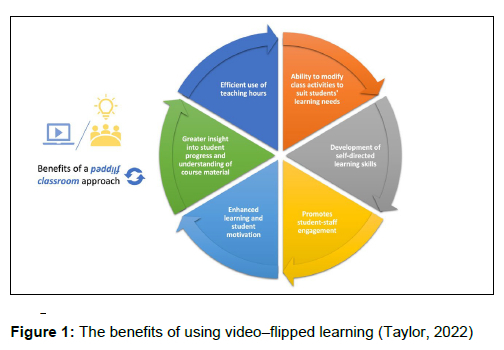
Where learners have access to smart phones, a database can be created of parents/guardians whose children take Geography as a subject, while Geography teachers can use the database to send and share subject-related tasks or activities with their learners. This proposal is, however, nothing but a pipe dream in the absence of digitally proficient teachers who are willing to go the extra mile and customise their teaching material to meet the GIS implementation process. Integrating various technologies in the teaching of Geography would assist parents in monitoring what their children are doing on their digital devices and allow them to keep abreast of their children's scholastic progress. Teachers might, for instance, allow learners to operate computers independently, working on materials suited to their specific learning needs, thus permitting them to take full control of their own learning, and preventing them from wasting time (see Figure 1).
The above diagram highlights the benefits of ICTs in inculcating the values of self-directed learning in learners. This notion aligns well with the study by Mhishi et al. (2023), which found that technologically advantaged schools had a good chance of successfully integrating user-friendly curriculum-oriented GIS software, more so than their disadvantaged counterparts -evidence that the urban-rural divide has not been bridged in all respects.
Currently, Gauteng province can rate schools on their state of readiness regarding ICT integration in the teaching of Geography, whereas the other provinces do not yet have that capability (Gauteng Department of Education [GDE], 2011). It is imperative that all provinces work from the same point of departure, in ensuring (equitable) education for all. In 2018, Ncube already noted that, with proper capacity development, teachers could and would move from using printed textbooks to fully integrating ICTs in their Geography teaching, thereby ensuring that a paperless classroom would become a reality in South African schools.
The Inequalities between Core and Peripheral Areas
Treier et al. (2008, as cited by Mkhize, 2020) argue that ICT integration in the teaching of Geography - especially GIS map skills - will only be fully achieved when subject teachers and their learners are given leeway to generate and produce GIS materials that predominantly emphasise local content. Many Geography learners struggle to understand GIS content that is foreign to their own unique context and surroundings. It is for this reason that Geography teachers need to continue capacitating their learners with ICT skills, even post-Covid, to prolong learning beyond the classroom setting.
For Mkhize (2020) and Taylor (2022), taking time to prepare digital material and adapt it to the needs of learners is key to achieving self-paced and individual learning. This, because Geography is allocated only four hours a week in the school timetable, leaving subject teachers with limited contact time to invite and/or infuse ideas obtained from their learners, to facilitate the teaching of GIS-related concepts. This paradigm shift benefits better-resourced urban schools, where there is updated ICT infrastructure, and most learners are computer literate or own mobile devices (Wang, 2013). In those contexts, integrating different ICTs is less of a challenge than in under-resourced rural milieus. Fleischmann and van der Westhuizen (2019) and Mwunda (2014) posit that the way individuals accept technological innovations varies (possibly due to age), while not everyone adopts innovations at the same time. The Diffusion of Innovation (DoI) theory (propounded by Everett Rogers in 2003) (Mwunda, 2014), acknowledges that some individuals accept technological innovations from the start (the so-called innovators) while others are early adopters, but there are also the early majority and late majority adopters, and, lastly, the laggards.
As Fleischmann and van der Westhuizen (2019) and Mwunda (2014) explain, in any organisation, the attitudes of the leaders play a vital role in subordinates accepting and subsequently championing any changes wrought by ICT adoption - in schools, this also applies to those who teach Geography. The GDE (2021), in conjunction with Sci-Bono, has prepared ICT content which enables teachers to become part of the technology-integration process, also in the teaching of Geography. Other provinces have started using educational centres located across multiple districts to expose teachers to subject-related content via video conferences, to encourage and capacitate them to use technology in their classrooms.
Notably, several of these centres have since closed, forcing teachers to leave their learners unattended, while they attend workshops at far-flung educational centres. Participants in those workshops merely tend to be recipients of information, rather than being upskilled to actively participate in the video conferences. Hennessy et al. (2010) advise that, to phase in ICT in teaching and learning, the focus must be on mobile devices and interactive boards, since installing infrastructure in every classroom will prove to be a costly exercise for the DBE. Where the lack of funding is an issue, the process of integrating diverse technologies in the teaching of FET-phase Geography might be delayed or even completely stalled. After Covid-19 compelled teachers to modify their pedagogies, it is imperative now to determine whether, when put to the test, any approaches proved effective in the teaching of Geography.
The next section addresses the theoretical framework that underpinned this study.
THEORETICAL FRAMEWORKAgyei and Voogt (2011) point out that, in developed countries ICTs are not such a burning issue, while developing countries continue to battle with access. While accessibility is indeed problematic, the same can be said of many users' attitudes and skill levels. For that reason, Agyei and Voogt (2011) posit that teacher training institutions need to present a module on ICT integration in the curriculum if they are to fully prepare and capacitate educators for the job market. Sasota et al. (2021) acknowledge that the adoption and implementation of technologies in the classroom can be influenced by both internal (user reluctance, lack of training, financial constraints) and external factors (shortage of computers, outdated programmes).
The Will Skill Tool (WST) model, first developed and tested in 1999 by Knezek and Christensen (2003), proved to be reliable tool for measuring ICT integration amongst teachers in Texas and Mexico City, when it was termed the Will, Skill, Tool model of Technology Integration (WSTTI). Texas teachers seemed to be more competent than their Mexico City counterparts, as the findings revealed (Knezek and Christensen, 2003). Further, students' academic performance was found to be directly influenced by ICT uptake in the classroom, which largely depended on a teacher's attitude (will), abilities (skill), and access to technology (tool), with the 'TI" part of the model pertaining to each teacher's competency (Velazquez, 2006). The WST model was later expanded to include the pedagogical component - a development that represented a step up from the original, which only addressed technology use and adoption (Knezek and Christensen, 2016). Notably, the earlier version did not highly rate a willingness to change, or technical support, as important variables - something which Velazquez (2006) identified as crucial.
McCombs and Marzano (cited in Velazquez, 2006) and Sasota et al. (2021) argue that "will" can be described as innate and self-generated motivation, while "skill" is an acquired competency, obtained through training to hone an ability. Importantly, both the "will" and the "skill" must be present and aligned in the individual who is aspiring to use ICTs to become a better teacher. This implies that "will" is never incidental, but must arise intrinsically from within, rather than being prompted or enforced by external factors. The "will" (a positive attitude), "skill" (competency in technology) and "tool" (availability of ICTs) are basic requirements for anyone seeking to integrate ICTs in the teaching and learning processes (Agyei and Voogt, 2011; Knezek and Christensen, 2008, 2016). The next section looks at the research methodology which the researchers used to collect data.
Research Methodology
The researchers situated the study on which the current article is based within the interpretivist paradigm, in the belief that reality is better understood at the level and within the context of the study participants (McMillan and Schumacher, 2010). Aliyu et al. (2014) argue that reality can also be understood at the researchers' level of thinking, which means that what they perceive to be real, can be interpreted and understood at the level of their perceptions. Constructivists believe in subjective analysis, and in seeking to comprehend reality (McMillan and Schumacher, 2010). Chilisa and Kawulich (2012) concur with Aliyu et al. (2014), asserting that the interpretivist paradigm is strongly related to researchers' understanding of reality, based on their own perceptions. Interpretivists thus believe there should be a stronger relationship between the researchers and the researched, with both parties advancing the study of a particular reality or context (McMillan and Schumacher, 2010). For Greener (2008), constructivists focus on subjectivity, hence participants' ideas and thoughts must be deemed valid: it is through the eyes of their study participants that constructivists "see" reality. Multiple views and various perceptions are accepted, whereas positivists believe there is only one truth or one reality, and they categorize issues as either "right" or "wrong".
Saunders et al. (2003) posit that, even though participants may be exposed to the same event or context, their interpretations thereof may vary significantly, depending on the meaning they attribute to an incident. From there, their experiences will inform them of the actions they take, based on their unique context. For researchers, it is thus vital to understand that the actions of participants are subjective in nature, since they are influenced by the meanings which they, as individuals, attach to the milieu and conditions in which they find themselves at that point in time.
Research Approach
According to McMillan and Schumacher (2010), the qualitative research method enables researchers to gain an in-depth understanding of the phenomenon under study - in this case, whether participants perceived that teachers and learners were sufficiently prepared for integrating ICTs in FET-phase Geography lessons during the pandemic. Since qualitative research accommodates and reflects the voices of the participants in respect of how they perceive reality, this study employed that approach to garner the study participants' views and experiences, in context, on the topic under investigation.
Research Design
McMillan and Schumacher (2010) state that the research design entails the researchers' plans for collecting data, while a case study enables them to assess a system or an organisation. As Saunders et al. (2003) and McMillan and Schumacher (2010) indicate, a case study enables researchers to gain a deeper understanding of the context in which an academic investigation takes place. It can prove to be valuable for addressing questions about how and why something happens. Each organisation (in this case, each school) is unique, given its context, which is the main reason why the case study was chosen as the most suitable tool for collecting data.
Data-collection Instruments
The researchers employed interviews and (not reported on here) observation and document analysis as data-collection instruments. This enabled them to solicit information from the participants on how, when and to what effect ICT integration occurred in the teaching of FET-phase Geography. Using interviews as a data-collection tool was preferred as it promoted the close interaction between the researchers and the participants, so that the latter could generate knowledge in their own context. In addition to an interview schedule, probing was used to assist in covering any grey areas that arose during the interview process. Furthermore, pertinent documents were reviewed such as ICT policies in schools and minutes of the meetings by various stakeholders as a means of verifying and confirming the statements made during the interview phase. Next, the researchers discuss the findings of the study, conducted in four secondary schools in KwaZulu-Natal, where ten learners and thirteen teachers were purposely sampled for the study.
DISCUSSION OF FINDINGS
In seeking to examine the participants' preparedness in respect of integrating ICTs in the teaching of FET-phase Geography in selected South African schools, the discussions and results of this study are presented under the following themes:
o Covid-19 made ICT integration compulsory,
o The pandemic initiated a "new normal" in the educational space, and
o Covid-19 initiated a move towards learner-centred approaches.
Covid-19 made ICT integration compulsory
Some schools used a rotational model of attendance during lockdown, with learners - including those taking Geography as a subject - attending for a few days and then staying home to allow other groups of learners to attend, in keeping with the government's protocols on social distancing. Even pre-Covid, Johnson et al. (2016) found that schools offering Geography were faced with numerous challenges, such as failure on the part of learners to access different devices, and the absence of ICT-related education and training from school timetables. Government's aim is for all learners in South Africa to be part of the Fourth Industrial Revolution (4IR), via the implementation of the "one teacher, one laptop" (https://www.iol.co.za/news/south-africa/one-teacher-one-laptop-445881) drive under former President Jacob Zuma, or "one learner, one tablet" initiative (https://www.cbn.co.za/featured/government-is-giving-every-south-african-learner-a-tablet-heres-who-is-getting-theirs-first), spearheaded by President Cyril Ramaphosa. If put into effect before the advent of the pandemic, these policies would have ensured that teachers and learners alike had various technologies at their disposal, to enrich the teaching of Geography (and other subjects) across all grades.
Bengel and Peter (2021), for instance, posit that ICT allows users to put global positioning systems (GPS) (navigators) to use when conducting spatial analyses, while remote sensing (RS) can be used to capture data by means of satellites, from distant places, without any physical contact. The use of GIS in Geography map skills is expected to take over the use of paper maps, as is the case in the applied sciences (Mkhongi and Musakwa, 2020; Bengel & Peter, 2021). That emphasizes the need for Geography as a subject discipline to move with the times. One Geography learner participant in the current study concurred with this view, stating:
"Using gadgets to search, collect, and analyse Geography data helps me to realise my potential, as I learn to identify my weaknesses and strengths. This helps me to ask for help in real time. Unlike when I am being taught by the teacher, a lot of problems are solved on my behalf, and I will be convinced that I have understood the concepts taught in class, only to discover that I battle when I am alone at home, in the absence of the teacher. This indicates to me that I become passive when things are done on my behalf, as I am not directly involved. The use of gadgets [...] improve[s] [my] level of concentration and focus, as I know that every mistake I make, will be mine."
This learner participant highlighted the ability of the current cohort of learners to use technological devices with relative ease. The comment also emphasised the role of the teacher as mediator of information. This further affirms that the state ensures ICT integration by allowing all learners equal access to technological infrastructure. This notion is in line with the Will Skill Tool model (Knezek and Christensen, 2003), which indicates that a teacher who is willing to adopt ICTs will, without hesitation, do so on condition that s/he is equipped with the requisite integration skills.
Seedat (2019) and Tatipamul (2018) opine that integrating various technologies in the teaching of Geography, by using tools such as Google Maps, exposes users to real-time information in the form of street maps. This enables all parties to participate in online dialogue which transcends the boundaries of time and space. Notably, Bengel and Peter (2021) and Seedat (2019) argue that spatial analysis in Geography can be done accurately, using GPS, thereby allowing learners to interact with their electronic devices and to take charge of their own learning, without relying on the teacher-centred approach to explore the world on their behalf. This will serve to limit the current over-reliance on compulsory extra classes, to close learning gaps where certain concepts were not fully understood in the previous grades or earlier phases.
e-Learning (electronic learning) enables learners to complete work independently, from the comfort of their own homes. This notion aligns well with the ICT integration practices which have been adopted by provinces such as Gauteng and the Eastern Cape (Mathevula and Uwizeyimana, 2014). If learners from rural areas, who have no internet connectivity or data bundles, had digital material uploaded onto their devices, it would have ensured that they were almost on par with learners from urban areas (see also Wang, 2013), when it comes to integrating technology across lessons. That would have enabled them to continue their studies despite the disruptions wrought by the pandemic.
The Pandemic Initiated a "New Normal" in the Educational Space
Arguably, every learner can learn, if given sufficient and relevant support. This finding was echoed by one of the learner participants:
"During the online classes, our teachers exposed us to colourful and meaningful Geography content in terms of YouTube Geography videos and images that helped us to easily master the content that was presented to us. In addition to that, such content was always available on our gadgets, and we were able to repeatedly play them, to consolidate the content that was taught in class before the hard lockdown. "
This participant appreciated the value of ICTs in not only improving access to the learning material but affording repeated access - something which facilitated the teaching and learning processes. This aligns well with the WST model (Knezek and Christensen, 2003), in that the choice of tools teachers use, have a decisive role to play in the educational context.
Covid-19 Initiated a Move Towards Learner-Centred Approaches
The findings revealed that the pandemic was a blessing in disguise, in that it paved the way for facilitating learner-centred pedagogies. As another Geography learner participant indicated:
"For me, studying is very difficult. I had to ask my siblings to read the geography notes for me, and I would record them and save them on my digital gadget, which I [...] always carry [...] with me as my "walking companion". Each time I play the geography recorded notes, I no longer feel guilty for not having attended the study [session], as I would have played the [notes] on various occasions."
This comment acknowledges the value which ICT tools and platforms hold for Geography learners: as this participant indicated, s/he was able to learn at his/her own pace, and on his/her own terms. Videos and animations, for instance, are appealing to visual learners, and make it easier for them to focus on their schoolwork. Learners who valued auditory learning were able to repeatedly listen to a recording. Muyengabe et al (2017) note that using a range of technologies to teach Geography exposes learners to basic skills, such as the drawing of diagrams. This enables them to consolidate the content which the teacher taught in class. Or, for video flipped learning (VFL), to gain an understanding of the content before it is consolidated in class.
For Karatza (2019), every classroom setting is made up of learners who are different in terms of their capabilities and must be treated and taught according to their unique strengths. For that reason, ICT integration in the subject of Geography can prove to be handy in creating a conducive learning atmosphere in the classroom, as learners grow used to operating their own devices during the learning process. For instance, teachers cannot expect learners who have never practised calculations on calculators during their lessons, to excel in the examinations if they then must borrow calculators with which they are not familiar. Teachers need time to allow their learners to practise navigating different devices before they can even think of exposing them to formal assessments. Clearly, Geography learners must be given adequate exposure to a range of devices during their lessons, because if only teachers operate those, it means such instruction is not truly learner centred (Chirwa and Mubita, 2021). The WST model (Knezek and Christensen, 2003, 2016) clearly indicates that it is impossible to adopt and implement ICTs in Geography classrooms until teachers are willing to acquire the associated skills and, in turn, to share those skills during their lesson presentation.
LESSONS LEARNT FROM THE OUTBREAK OF COVID-19 PANDEMIC
Though the outbreak of Covid -19 pandemic on one hand brought numerous adversities, it also brought several innovations in the educational space as highlighted in the paragraphs below.
The Covid-19 Outbreak Initiated Independent Learning
Taylor (2022) asserts that student participants in that study preferred the VFL approach, as an effective means of learning, as they were able to play and restart videos until they understood what was being presented. VFL, unlike face-to-face teaching, which is time-based and fails to increase student-teacher engagement or the use of multimedia resources. During the pandemic, digitised lecture material was deemed particularly beneficial for students facing barriers to learning, in that it allowed them to review the content at their own pace. This aligns with the understanding shared by a teacher participant in the study reported on here:
"ICT integration enables me to assess the level of understanding of my learners. I can see whether they are struggling or mastering the content that is taught to them. I could see the excitement when they achieve a certain goal, and the frustration when something does not go their way. Fortunately, learners can even continue with their studies after the lesson has ended, since they always have digital gadgets in their possession, and they learn to use them productively, as opposed to surfing the internet and visit[ing] sites that are not beneficial to them as learners. Google Earth exposes them to 3D images that make map skills [...] exciting."
As this statement reveals, the teacher participant believed digital devices and online platforms enabled learners to be in full control of their own learning, since the tools they used were both handy and interesting to use. Seedat (2019) posits that ICTs allow learners to concentrate on their own learning by focusing on the topics that interest them, thereby making the classroom set-up conducive to learning and teaching. Constance and Musakwa (2018) emphasise the benefits of implementing technologies in Geography lessons, noting that learning could conceivably take place at different times and in various settings, even in the absence of the geography teacher, thereby transcending the four walls of the classroom.
Learners' diverse interests will be accommodated, and their APSs are likely to improve, as Constance and Musakwa (2018) note if Geography teachers set projects and assignments which require learners to use technology in a responsible and self-enriching manner. Clearly, the Covid-19 outbreak brought hidden benefits, which saw learners and teachers alike being compelled to improve their ICT and innovation skills.
Knezek and Christensen's (2003, 2016) WST model indicates that teachers with the skills to adopt and employ ICTs successfully, will find it interesting to integrate those tools in their teaching practice. This will have a ripple effect on learners who are capacitated during practical sessions on their devices, as they search for solutions during problem-based learning tasks. This finding is confirmed by Tarisayi (2022), who opines that ICTs are key for motivating learners, as those tools connect with several of a learner's senses within a short space of time - sight, hearing, and touch. Where the senses are focused in a structured manner, learners will be able to ignore most distractions and be more committed to learning.
As the teacher participants in this study indicated, learners who are heavily involved in their own learning can produce their own projects. They are unlikely to forget the work they produced, while the same cannot be said if content must be learnt from handouts which their teachers distribute to them.
IMPLICATIONS OF ICT INTEGRATION FOR HIGHER EDUCATION INSTITUTIONS POST-COVID-19
Clearly, for tertiary institutions to continue claiming their space and remain relevant now and in the future, there is an urgent need for them to alter their teaching modalities. This even calls for the adoption of blended or hybrid teaching approaches. In the opinion of France et al. (2021), ICTs present opportunities for universities to enroll students who can access their lessons either online or via face-to-face teaching modes. Lecturers thus must learn new pedagogies, while at the same time unlearning those strategies that are rapidly becoming obsolete. This, as they prepare to welcome student cohorts who have already mastered much of the available digital technologies and tools, are used to working online, and have access to a variety of platforms.
The next section concludes the study and makes recommendations for stakeholders to improve ICT integration among teachers and learners.
CONCLUSION
Many views emanated from the study on which this article is based, giving insight into the state of readiness of teachers and learners in respect of the integration of ICTs in the teaching of FET-phase Geography. As the comments indicated, most participants were aware of the benefits of adopting technological tools and using different communication platforms to disseminate educational materials. They were willing to learn new and innovative ways of teaching and learning Geography under the challenging conditions imposed by the Covid 19 pandemic. The levelling of the playing fields in well-resourced schools facilitated the integration of ICTs in lessons, while the lack of resources in disadvantaged rural schools made it challenging for teachers and learners alike to integrate such technologies. Making ICT integration compulsory in schools will help to facilitate its implementation, and government will be obliged to fund related infrastructure (laptops, devices, connectivity), thereby levelling the playing fields in terms of access and affordability.
Stakeholders who participated in this study suggested solutions to ensure that every Geography teacher and learner has equal access to digital devices, to facilitate the adoption of ICTs and their integration in FET-phase Geography across all schools. These suggestions (uploading materials on learners' devices for them to watch even when offline, preparing learners for online assessment by familiarising them with a range of devices and platforms) offer invaluable insights and pointers which may be useful to curriculum planners and policy developers not only in Geography, but also other subjects.
REFERENCES
LITERATURE REVIEW
- Agyei, D. D. and J. M. Voogt. (2011). Exploring the potential of the Will, Skill, Tool model in Ghana: Predicting prospective and practicing teachers' use of technology. Computers & Education, 56(1), 91-100.
- Aliyu, A. A., M. U. Bello, R. Kasim and A. B. Martin. (2014). Positivist and non-positivist paradigm in Social Science research: Conflicting paradigms or perfect partners? Journal of Management and Sustainability, 4(3), 1-18.
- Bagoly-Simó, P. J. Hartmann, and V. Reinke. (2020). School Geography under Covid-19: Geographical knowledge in German formal education. Tijdschrift voor Economische en Sociale Geografie, 111(3), 224-238.
-
Bengel, P. T. and C. Peter. (2021). Attitudes of pre-service teachers of Geography on modern technology. Education, Science, 11(708). https://doi.org/10.3390/edusc,11110708
» https://doi.org/10.3390/edusc,11110708 - Bharati, B. (2023). Exploring Bhutanese Geography teachers' perception on the use of information and communications technology in teaching before, during and beyond pandemic. Asian Journal of Education and Social Studies, 46(2),1-13.
-
Chilisa, B and B. Kawulich. (2012). Selecting a research approach: Paradigm, methodology and methods [Book chapter]. https://www.researchgate.net/pubhcation/257944787
» https://www.researchgate.net/pubhcation/257944787 - Chirwa, C. and K. Mubita. (2021). Preparedness of teachers and learners in the integration of information communication technologies in the teaching and learning of Geography in selected schools of Petauke District of Eastern Province in Zambia. International Journal of Research and Innovation in Social Science (IJRISS), 5(3), 456-463.
-
Conference of Commonwealth Education Ministries. (2015). Nassau Declaration. 19th conference held in Nassau, July 29. https://www.adeanet.org/en/knowledge-and-resources/19th-conference-commonwealth-education-ministers-nassau-declaration
» https://www.adeanet.org/en/knowledge-and-resources/19th-conference-commonwealth-education-ministers-nassau-declaration -
Constance, S. M. and C. Musakwa. (2018). Integration of ICTs into the teaching and learning of secondary school Geography: The Seychelles experience. Journal of Geography Education in Africa (JOGEA), 1, 15-26. https://doi.org/10.46622/jogea,vli:2535
» https://doi.org/10.46622/jogea,vli:2535 -
Department of Basic Education (DBE) (2018). Professional development framework for digital learning. https://www.education.gov.za/Portals/0/Documents/Publications/Digital%20Leaming%20Framework.pdf?ver+2018-07-09-101748-95
» https://www.education.gov.za/Portals/0/Documents/Publications/Digital%20Leaming%20Framework.pdf?ver+2018-07-09-101748-95 - Felix, A. A. (2021). Integrating Geography teaching and learning using information and communication technology [Unpublished DPhil thesis]. University of the Free State, South Africa.
- Firomumwe, T. and D. Gamira. (2021). Evaluating technology acceptance in teaching of advanced level Geography in Zimbabwean secondary schools. Pakistan Journal of Distance & Online Learning, 2(1), 1-14.
-
Fleischmann, E. M. L. and C. van der Westhuizen. (2019). The availability of a bimodal application of an interactive-GIS-tutor within low-resourced South African schools. Journal of Geography Education Africa (JOGEA), 2, 61-70. https://doi.org/10.4662/jogeo.vzil.2485
» https://doi.org/10.4662/jogeo.vzil.2485 -
France, D., J. Park, K. Welsh and B. Whalley. (2021). Towards flexible personalized learning and the future educational system in the Fourth Industrial Revolution in the wake of Covid-19. Higher Education Pedagogies, 6(1), 75-99. https://doi.org/10.1080/23752696.2021.1883458
» https://doi.org/10.1080/23752696.2021.1883458 -
Gauteng Department of Education (GDE) (2011). Senior Certificate examination results, 2011. https://www.gov.za/events/senior-certificate-examination-results-2011
» https://www.gov.za/events/senior-certificate-examination-results-2011 -
Gauteng Department of Education (2021). National Senior Certificate results. https://www.education.gov.za/2021NSCResults.aspx
» https://www.education.gov.za/2021NSCResults.aspx -
Gonda, X. and F.I. Tarazi. (2021). Wellbeing, resilience and post-traumatic growth in the era of the Covid-19 pandemic. https://www.researchgate.net/publication/354333030_Well-Being_Resilience_and_Post-traumatic_growth_in_the_Era_of_Covid-19_Pandemic
» https://www.researchgate.net/publication/354333030_Well-Being_Resilience_and_Post-traumatic_growth_in_the_Era_of_Covid-19_Pandemic - Greener, S. (2008). Business research methods. Sue Greener and Ventus.
- Hennessy, S., D. Harrison and L. Wamakote. (2010). Teacher factors influencing classroom use of ICT in sub-Saharan Africa. Itupale Online Journal of African Studies, 2(1), 39-54.
-
Johnson, A. M., M.E. Jacovina, D.E. Russell and C.M. Soto. (2016). Challenges and solutions when using technology in the classroom. In S. A. Crossley and D. S. McNamara (Eds), Adaptive education technologies for literacy instruction. Routledge. https://files.eric.ed.gov/fulltext/ED577147.pdf
» https://files.eric.ed.gov/fulltext/ED577147.pdf - Kadhim, A. L. (2020). Effective use of ICT for learning and teaching Geography. Aalborg Academy Journal of Human and Social Sciences, 1(1), 15-42.
- Karatza, Z. (2019). Information and communication technology (ICT) as a tool of differentiated instruction: An informative intervention and a comparative study on educators' views and extent of ICT use. International Journal of Information and Education Technology, 9(1), 8-15.
-
Knezek, G. And R. Christensen. (2003). Testing a Will, Skill, Tool Model of Technology Integration. ResearchGate. https://www.researchgate.net/publication/234572159_Testing_a_Will_Skill_Tool_Model_of_Technology_Integration
» https://www.researchgate.net/publication/234572159_Testing_a_Will_Skill_Tool_Model_of_Technology_Integration - Knezek, G. and R. Christensen. (2008). The importance of computer attitudes and competencies in primary and secondary schools. In J. Voogt and G. Knezek (Eds), International handbook of information technology in primary and secondary education (pp. 321-328). Springer.
-
Knezek, G. And R. Christensen. (2016). Expanding the Will Skill Tool model of technology integration: Adding pedagogy as a new model construct. Journal of Computing in Higher Education, 28, 307325. https://link.springer.com/article/10.1007/s12528-016-9120-2
» https://link.springer.com/article/10.1007/s12528-016-9120-2 - Mathevula, M. D. and D.E. Uwizeyimana. (2014). The challenges facing the integration of ICT in teaching and learning activities in South African rural secondary schools. Mediterranean Journal of Social Sciences (MCSER), 5(20), 1087-1097.
- McMillan, J. M. and S. Schumacher. (2010). Research in education (7th ed.). Pearson.
-
Mhishi, M., V. M. Chimbwanda and I. Gwizangwe, I. (2023). Embracing the new normal: Geography teachers' preparedness and the use of e-learning methodologies. Pedagogical Research, 8(1), em0147. https://doi.org/10.29333/pr/12665
» https://doi.org/10.29333/pr/12665 - Mkhize, T. F. (2020). Geography teachers' perceptions of implementing paper-based geographic information systems in a rural learning ecology [Unpublished Master's dissertation]. University of KwaZulu-Natal, South Africa.
-
Mkhongi, A. and W. Musakwa. (2020). Perspectives of GIS education in high schools: An education of uMgungundlovu District, KwaZulu-Natal, South Africa. Educ. Sci., 10, 131. https://doi.org/10.3390/educscil0050131
» https://doi.org/10.3390/educscil0050131 - Muyengabe, S., Y. Zhao, H. Haiyan and S. Hitimana. (2017). Primary teachers' perceptions of integration for enhancing teaching and learning through the implementation of the 'One Laptop Per Child' program in primary schools of Rwanda. Eurasia Journal of Mathematics Science and Technology Education, 13(11), 7193-7204.
- Mwunda, N. M. (2014). A framework for integration of ICTs in teaching and learning process in secondary schools in Machakos sub-country [Unpublished Master's dissertation]. University of Nairobi School of Computing and Informatics, Kenya.
-
Mzuza, M. K. and C. P. van der Westhuizen. (2019). Review on the state of GIS application in secondary schools in the southern African region. South African Geographic Journal, 101(10), 1-17. https://doi.org/10.1080/03736245.2019.1579110
» https://doi.org/10.1080/03736245.2019.1579110 - Ncube, N. (2018). ICT integration in the teaching of FET Geography in Johannesburg East [Unpublished Master's dissertation]. University of the Witwatersrand, Johannesburg, South Africa.
- Palmentieri, S. (2022). E-learning in Geography: New perspectives in post-pandemic. AIMS Geosciences, 8(1), 52-67.
-
Prensky, M. (2001). Digital natives, digital immigrants. https://marcprensky.com/writing/Prensky%20-%20Digital%20Natives%20Digital%20Immigrants%20-%20Part1.pdf
» https://marcprensky.com/writing/Prensky%20-%20Digital%20Natives%20Digital%20Immigrants%20-%20Part1.pdf -
Republic of South Africa (RSA) (2004). White Paper on e-Education: Transforming learning and teaching through information and communication technologies. Government Printers. https://www.gov.za/documents/white-paper-e--education-transforming-learning-and-teaching-through-information-and-technology
» https://www.gov.za/documents/white-paper-e--education-transforming-learning-and-teaching-through-information-and-technology -
Sasota, R. S., R. Cristobal, I. S. Sario, J. T. Biyo and T. C Magadia. (2021). Will Skill Tool (WST) model of technology integration in teaching Mathematics in the Philippines. Journal of Computers in Education. https://doi.org/10.1007/s40692-021-00185-w
» https://doi.org/10.1007/s40692-021-00185-w - Saunders, M., P. Lewis and A. Thornhill. (2003). Research methods (3rd ed.). Prentice Hall.
-
Seedat, T. (2019). Digital trends in mapping: Perspectives of FET Geography educators regarding the use of ICTs in the teaching of mapwork [Unpublished Master's dissertation]. University of Johannesburg, South Africa. http://hdl.handle.net/102000/0002
» http://hdl.handle.net/102000/0002 -
Tarisayi, K. S. (2022). Using TikTok, memes and YouTube in a Geography classroom. Journal of Geography Education in South Africa (JoGEA), 5, 125-146, https://doi.org/10.46622/jogea.v5il.3977
» https://doi.org/10.46622/jogea.v5il.3977 - Tatipamul, R. V. (2018). Role of ICT in teaching, learning and research, with special reference to Geography. Neo Geographia, 7(2), 48-51.
- Taylor, K. J. (2022). A hidden benefit in the Covid-19 pandemic: Rethinking physical Geography pedagogy in higher education using a flipped classroom approach. Irish Journal of Technology-Enhanced Learning, 7(1), 1-26.
-
Velazques, C. M. (2006). Cross-cultural validation of the Will Skill Tool Model of Technology Integration [Unpublished doctoral thesis in Educational Computing]. University of Texas. https://digital.library.unt.edu/ark:/67531/metadc5256/m2/1/high_res_d/dissertation.pdf
» https://digital.library.unt.edu/ark:/67531/metadc5256/m2/1/high_res_d/dissertation.pdf -
Vojteková, J., A. Tirpáková, D. Gonda, M. Zoncová and M. Vojtek. (2021). GIS distance learning during the Covid-19 pandemic (students' perception). Sustainability, 13, 4484. https://doi.org/10.3390/su13084484
» https://doi.org/10.3390/su13084484 - Wang, P. (2013). Examining the digital divide between rural and urban schools: Technology availability, teachers' integration level and students' perception. Journal of Curriculum and Teaching, 2(2), 127-137.
-
Wu, T., C. Chai and L. Wang. (2022). Exploring secondary teachers' TPACK for video flipped learning: The role of pedagogical beliefs. Education and Information Technologies. https://doi.org/10.1007/s10639-022-10977-x
» https://doi.org/10.1007/s10639-022-10977-x - Zboun, M. A., S. A. D. Ghammaz and M. A Zboun. (2018). The impact of the use of YouTube and Facebook on students' academic achievement in Geography course at University of Jordan for Bachelor's degree. Modern Applied Science, 12(3).