There's no going back: the impact of Covid-19 on what matters to students, now and in the future
Abstract
This article examines the key success factors (KSFs) influencing prospective students' selection of private higher education institutions (PHEIs) in South Africa, highlighting significant shifts in priorities pre- and post-COVID-19. This study examined the importance of factors assigned by students enrolled at PHEIs, assigned to 18 measures that influenced their choice of Higher Education Institution (HEI) after COVID-19. Before the pandemic, students selecting PHEIs primarily valued the quality of teaching, employment prospects, campus safety, academic facilities, international links, language policies, institutional reputation, and flexible study modes. However, post-pandemic priorities for students have shifted markedly. The findings of this study indicate that campus safety remains paramount. Additionally, the significance of access to technological infrastructure, such as reliable internet and digital devices, has markedly increased. This highlights the essential need for robust digital resources to support remote learning effectively. Financial assistance and the capability to engage in blended and online learning have emerged as crucial, alongside enduring priorities such as employment prospects and teaching quality. This study was conducted at a large PHEI in South Africa. With over 28,000 students, the Independent Institute of Education (IIE) Rosebank College offers a valuable case study with a large sample pool. Based on the results of this study, recommendations are made that enhancing campus safety and security measures, investing in advanced information technology (IT) infrastructure, and expanding financial assistance programmes are vital steps for HEIs to remain attractive to students. Furthermore, improving blended learning capability, strengthening industry links for better employment outcomes, and maintaining high teaching standards through continuous faculty development are crucial. Promoting international opportunities and ensuring that digital learning tools are accessible and engaging will further align the institution's offerings with post-pandemic student expectations. The recommendations focus on HEIs' adaptations that will not only meet students' current needs but also position the PHEI sector as resilient, reliable and forward-thinking in the increasingly competitive landscape of higher education.
technology; student satisfaction; post-COVID; Private Higher Education; employment prospects; quality teaching; flexible learning; campus safety and security; technological infrastructure; key success factors; influence; choice; decision-making
INTRODUCTION
The COVID-19 pandemic has fundamentally altered students' priorities in selecting private higher education institutions (PHEIs) in South Africa. This study examines the key success factors (KSFs) that influence these choices, highlighting significant shifts in priorities before and after the pandemic. Pre-COVID-19, students primarily valued quality teaching, employment prospects, campus safety, academic facilities, international links, language policies, institutional reputation, and flexible study modes. Post-pandemic, while campus safety remains paramount, there is a marked increase in the importance of access to technological infrastructure and financial assistance. The study, conducted at the IIE Rosebank College and drawing on a large sample size, provides recommendations for enhancing campus safety, investing in IT infrastructure, expanding financial assistance programmes, and improving blended learning capabilities. These adaptations are crucial for PHEIs to align with post-pandemic student expectations and remain competitive in the evolving landscape of higher education.
LITERATURE REVIEW: THE FACTORS THAT INFLUENCE STUDENTS' CHOICES OF HIGHER EDUCATION INSTITUTIONS
Various factors influence the choices students make when selecting a higher education institution, including personal, familial, cultural, financial as well as reputational factors (Acevedo-Gil, 2017; Joseph, Spake and Albrecht, 2017; Mendoza-Villafaina and Lopez-Mosquera, 2024; Perna and Thomas, 2006). While many factors beyond and within the reach of the university are identified, as discussed in Perna and Thomas's comprehensive model (2006), student satisfaction is increasingly important in students' choices of higher education institutions (Than and Khaing, 2020).
Student satisfaction surveys are common globally and often reflect on the world rankings (Wong and Chapman, 2023). The QS World University Rankings: Student Experience Survey (QS, 2024) evaluates factors such as teaching quality, learning environment, student support, resources, career prospects, and social facilities, and the study concludes that students typically stress the significance of high-quality teaching, supportive learning environments, excellent career services, and vibrant campus life on a global scale. These factors significantly influence students' choice of institution (Wong and Chapman, 2023).
The Times Higher Education Student Experience Survey (THE, 2024) encompasses the quality of staff/lecturers, helpfulness of staff, social life, community atmosphere, accommodation, facilities, industry connections, and support services. According to this study (THE, 2024), students value effective teaching, comprehensive support services, good facilities, and a strong sense of community and social opportunities.
Various other surveys examining the factors influencing students' choices of HEIs focus on academic teaching and learning quality, administrative processes, quality of campus life, access to financial aid, and career services and employment prospects (PR, 2024). Their (PR, 2024) list of key areas influencing student choices includes quality of teaching, campus facilities, extracurricular activities, and career development support.
The English Higher Education Survey (UPP, 2022) and the National Student Survey (NSS, 2024) offer detailed insights into what students deem vital in their university experience in the UK and what factors influenced their choices of HEIs. Conducted annually, the NSS gathers feedback from final-year undergraduate students across the UK, covering several key aspects of student life. Students consistently prioritise the quality of teaching as the key factor shaping their experience and determining their choice of institution. They value clear explanations from teaching staff, engaging teaching and learning methods, and enthusiastic lecturers about their subjects. The ability of teaching staff to make subjects interesting and intellectually stimulating is crucial for student satisfaction (NSS, 2024; UPP, 2022). The Quality Indicators for Learning and Teaching (QILT, 2024) survey in Australia reveals a similar trend: students value their learning experience as a key determinant of their choice of institutions and their on-campus experience and satisfaction.
The work of Wiese et al. (2009) led to the development of 15 measures of student satisfaction that are also used to identify factors influencing institutional choice. Wiese et al. (2009) investigated the factors that influenced students' choice of HEI and concluded that "quality of teaching and employment prospects ranked the highest as choice factors" (p. 39), which concurs with various other studies (PR, 2024; QILT, 2024; Read, 2023).
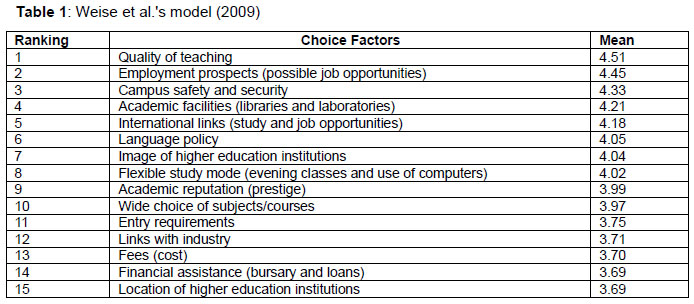
The Top 15 choice factors that South African first-year students considered in selecting a HEI were identified by Wiese et al. (2009) as the benchmark for pre-COVID-19 conditions. These include (1) Quality of teaching, (2) Employment prospects, (3) Campus safety and security, (4) Academic facilities, (5) International links, (6) Language policy, (7) Image of higher education institutions, (8) Flexible study mode, (9) Academic reputation, (10) Wide choice of subjects, (11) Entry requirements, (12) Links with industry, (13) Fees, (14) Financial assistance, and (15) Location of higher education institutions. They were based on insights from established surveys such as the Admitted Student Questionnaire (ASQ, 2024), which is administered annually to identify initial choice factors (Wiese et al., 2009). They reviewed multiple international studies, including those by Hoyt and Brown (2003), which provided a comprehensive list of essential factors in HE selection, such as academic reputation, quality of instruction, and employment opportunities (Wiese et al., 2009).
Wiese et al. (2009) review various influencing factors from a marketing perspective and assert that academic factors and employment prospects remain the leading factors for choosing an HEI. According to Wiese et al. (2009), students appreciate the opportunity to delve deeply into ideas, integrate information from different sources, and apply their knowledge in practical contexts. Opportunities for independent research and critical thinking are highly valued, too (Fullan and Langworthy, 2014; Strydom, Kuh and Loots, 2017; Wiese et al., 2009). Students stress the importance of clear evaluation criteria, fair assessment processes, and timely, constructive feedback. Understanding how to improve based on feedback is essential for academic development and has emerged as an important factor for students (Chowdhury, 2019; Fullan and Langworthy, 2014; Strydom et al., 2017; Wiese et al., 2009).
Academic support services are also crucial influencing factors (Wiese et al., 2009). Students need to feel they can access assistance, when necessary, whether through contact with teaching staff, academic advisors, or other support services. Adequate guidance and resources are key elements of a positive university experience (Wiese et al., 2009). Course organisation and management are rated highly. Students expect well-organised courses that run smoothly. Effective communication about any course or teaching schedule changes is crucial to avoid disruption, again listed as a factor influencing students' choices (Wiese et al., 2009). Learning resources, including library facilities, access to online resources, and IT infrastructure, are vital for student satisfaction. Reliable access to necessary materials and tools is essential for academic work, as is a sense of belonging to a learning community (Anderman, 2003). Students value working with peers and feeling part of a community of staff and students (Anderman, 2003). This sense of belonging enhances their overall university experience and supports personal and academic growth ((Anderman, 2003.; Wiese et al., 2009).
The role of the student voice also appeared to be significant. Students want their opinions heard and valued (Seale et al., 2014). They appreciate opportunities to provide feedback on their courses and see tangible changes resulting from their input (Seale et al., 2014).
In South Africa, the South African Survey of Student Engagement (SASSE) evaluates academic challenges, learning with peers, experiences with staff, campus environment, student support services, and developmental opportunities as factors that promote student engagement and enhance student satisfaction. Essential factors for student satisfaction include engagement in academically challenging work, supportive learning environments, effective student support services, and quality interactions with faculty (Finn, 2022; Strydom et al., 2017). The Council on Higher Education Surveys (CHE, 2023) look at the quality of teaching and learning, student support, infrastructure, graduate employability, and overall student satisfaction, emphasising teaching quality, availability of support services, infrastructure quality, and career readiness. University-specific surveys, such as those conducted by the University of Cape Town (UCT, 2022, 2024) and Stellenbosch University (CHE, 2024), cover areas like academic support, teaching quality, facilities, campus life, learning resources, campus services, and student welfare.
Common themes across the results of these surveys include the quality of teaching, high-quality instruction, and knowledgeable, engaging faculty, which are consistently rated as top priorities. Access to learning resources, such as libraries, online resources, and modern facilities, is crucial for student satisfaction. The availability of student support services, including academic advising, counselling, and career services, is highly valued. The quality and accessibility of campus facilities, including classrooms, labs, and recreational facilities, are essential. Significant factors include opportunities for social interaction, extracurricular activities, and a sense of community. Strong career services, industry connections, and job placement support are critical for students. Safe and secure campus environments are essential for student well-being (UCT, 2024; UFS, 2022; US, 2024; CHE, 2021).
The literature around the factors that influence students' choices for HEIs post-COVID-19 hasn't been conducted, and this study begins to fill the gap in our knowledge on how, if at all, COVID-19 has shifted the factors in any way. This study elucidates the significant transformation in student choices due to COVID-19 isolation and begins to outline the future shape of higher education in South Africa.
PURPOSE OF THE RESEARCHDespite the studies discussed in the literature review, more is needed to gain a deeper understanding of the impact of COVID-19 on KFSs that South African students consider when selecting a PHEI. The pandemic impacted how students live, learn, and interact. Their consumer behaviour has changed, influencing what they consider critical choice factors when selecting a PHEI.
This study reviewed the KSFs that influence students' decisions when selecting a PHEI in South Africa pre- and post-COVID-19, and will consequently aid PHEI leaders in utilising existing resources and capabilities more effectively, or in developing new ones, to enhance their strategies to meet student-specific needs. By making data-driven, informed decisions, PHEIs can remain competitive and thrive in the evolving HE landscape. The objectives of this study were two-fold: (1) To determine whether KSFs in South Africa have changed post-COVID-19, and (2) To determine whether IIE Rosebank College must amend its business strategy.
METHODOLOGY
This study explored factors influencing students' choices of a HEI in South Africa. A mixed research method was employed to identify the factors and rank their importance (Creswell, 2013). IIE Rosebank College, a South African PHEI, was used as the setting for this research.
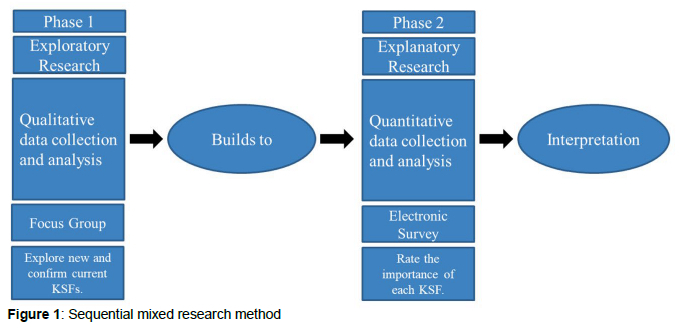
An exploratory sequential mixed research methodology (Creswell, 2013) was used to identify and confirm the KSFs influencing prospective students' selection of a PHEI in South Africa and to establish their importance, particularly post-COVID-19.
The methodology included two phases:
Qualitative Phase: This initial phase involved conducting a semi-structured focus group with seven participants. Purposive sampling was used to select the participants. This phase aimed to explore and confirm the 18 KSFs identified from the literature review. Employing Wiese et al. (2009) 15 KSFs as a benchmark for pre-COVID-19 determinants, the focus group confirmed three additional factors as pertinent in the post-COVID-19 context: 1) Access to technological infrastructure, 2) Online learning capabilities, and 3) Blended learning capabilities. The qualitative insights gained from the thematic analysis of the transcribed focus group helped refine and inform the questionnaire design used in the subsequent quantitative phase (Creswell, 2013).
Quantitative Phase: Following the qualitative phase, an online survey was designed and distributed to 8,784 first-year students. The survey asked participants to rank each of the 18 KSFs on a five-point Likert scale to establish their importance in decision-making. With a response rate of 16.72 per cent, the survey received 1,469 responses, providing a 99 per cent confidence level (and a margin of error of 3) for the results (Creswell, 2013).
Participants
More than 90 % of the respondents were between the ages of 18 and 24 years (91.8%), some were aged 25 to 34 (6.9%), and very few were over the age of 35 (0.7%). There were fewer male respondents (29.5%) than female respondents (69%) , with some not specifying their gender (0.5%). Respondents were predominantly Black (93.9%), followed by Coloured1 (3.7%), Indian/Asian (1%), and White (0.1%).
Data collection
The pre-COVID-19 survey was taken directly from Wiese et al.'s 15-factor scale, which served as the baseline against which the authors measured changes in the post-COVID-19 survey. The electronic survey was sent via SMS to 8,784 first-year students and received 1,469 responses. Anonymity and confidentiality were ensured in the introduction, and participants gave their consent by electing to participate in the survey.
Ethics
The authors adhered to all the required ethical procedures. They applied for ethical clearance from the conferring institution (University of Reading) and the participating institution (IIE Rosebank College, The Independent Institute of Education). Both institutions approved it, and ethics clearance was obtained.
Survey
The survey had 18 questions, with 15 focusing on pre-COVID-19 using Wiese et al.'s scale (2009) and three focusing on post-COVID-19, which the authors designed. Additionally, demographic information was collected to examine any variations in perceptions based on different participant characteristics. The survey took about 10 minutes to complete, and the responses were Likert-scale ratings ranging from "Not at all important" to "Extremely important."
Limitations
The qualitative sample that helped shape the factors was small, comprising seven all-female participants. While this is a small group, it only served as the first stage of our research and was used to gather feedback on our survey tool and explore some areas that benefited from qualitative exploration (Goodman, 2011). Another limitation is that the pre-COVID-19 survey was taken from Wiese et al.'s 2009 study, and it can be argued that students' needs have changed over time.
RESULTS
This research study aims to better understand the KSFs that influence prospective students' selection of a PHEI in South Africa in the post-COVID-19 era. To determine whether any of the KSFs for the industry have undergone notable changes, this study compared KSFs in the pre-COVID-19 period with those in the post-COVID-19 period.
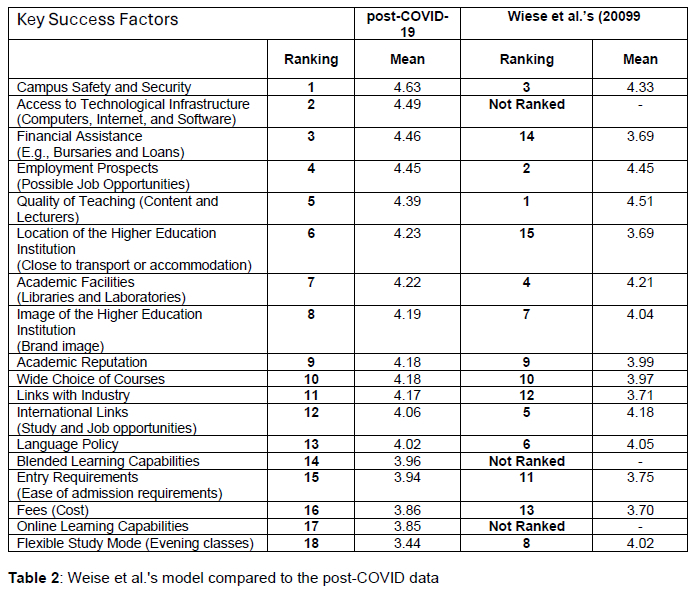
The pre-COVID-19 results, based on Wiese et al.'s work (2009), are presented in Table 1, followed by Table 2, comparing the post-COVID-19 results from this study to Wiese et al.'s work (2009). The Ranking Column indicates the highest to lowest ranked factor, and the Mean Column indicates the actual value of the ranking, with five being the highest and one being the lowest.
Pre-COVID-19 factors
For Weise et al's study, 1241 higher education students participated across six public universities (2009, 47) and conveyed their ranking of issues. As presented in Table 1, the most critical factors pre-COVID-19 were the quality of teaching, employment prospects, campus safety, academic facilities, international links, language policies, institutional reputation, and flexible study modes (Weise, 2009, 53). Post-COVID-19, there has been a marked shift in ranking and importance, as seen in Table 2.
Post-COVID-19
Post-COVID-19, the importance of these factors shifted, with increased emphasis on campus safety, access to technological infrastructure, financial assistance, and blended and online learning capabilities, as seen in Table 2. The quality of teaching and employment prospects remained significant but only changed slightly in rank.
The five most important post-COVID-19 factors were campus safety and security, access to technological infrastructure, financial assistance, employment prospects, and quality of teaching. The heightened concern for campus safety and security indicates that students now prioritise personal well-being and a secure environment, likely influenced by the uncertainties and health risks experienced during the pandemic. The increased emphasis on access to technological infrastructure underscores a strong dependence on digital learning, with students expecting institutions to provide robust online platforms and reliable technology for remote education. The prominence of financial assistance as a key factor reflects the growing financial strain on students and their families, highlighting a rising demand for affordability and institutional support in managing educational costs. The focus on employment prospects demonstrates that students are now more concerned with the economic returns of their education, seeking institutions that offer pathways to secure job opportunities in an uncertain labour market. These shifts suggest that institutions capable of effectively addressing these priorities will likely be more attractive to future students.
DISCUSSION OF RESULTS
COVID-19 has impacted the HE Sector fundamentally (Aristovnik et al., 2020; DAAD, 2020; Marinoni, van't Land and Jensen, 2020), and so have the student choices of an HEI. Based on the findings of this study, with data derived from the IIE Rosebank College, but with implications for the broader higher education sector, the universities should enhance a safe and secure environment, improving access to IT infrastructure, enhancing research capabilities, administrative efficiency, and institutional reputation, reducing financial barriers, and providing networking and employment opportunities.
The generalisability of these findings to public universities, where the majority of students are funded by the National Student Financial Aid Scheme (NSFAS), hinges on several factors outlined in the article, such as sample demographics, funding structures, and institutional contexts. Should the article predominantly analyse data from privately funded students or those attending private institutions, its direct applicability to public universities-where NSFAS is pivotal-might be limited.
The unique financial landscape of public universities, with NSFAS funding being a substantial element, suggests that the dynamics surrounding financial aid, resource access, and student support services could differ significantly. Public universities might place greater emphasis on affordability, support services aligned with NSFAS policies, and addressing the challenges associated with large, heterogeneous student populations.
Several KSFs changed in importance from their pre-COVID-19 ranking.
Campus Safety and Security ranked third pre-COVID-19 with a mean of 4.33 and is now the most crucial factor with a mean of 4.63. This is supported by Bezuidenhout (2012, iv). This might also be due to high overall crime or the South African HE sector having experienced significant institutional unrest before COVID-19 (Ngcuka, 2024).
Access to Technological Infrastructure, which was not included as a KSF in the pre-COVID-19 study, is now considered the second most crucial factor, with a mean of 4.49. The COVID-19 pandemic significantly shifted teaching and learning engagements into the online and virtual space. While some teaching and learning have returned to the in-person modality, most courses and programmes rely on virtual and online learning enhancement, thus making the Technological Infrastructure an essential part of teaching and learning.
Presently ranked third with a mean of 4.46, Financial Assistance grew in importance post-Covid-19 from 14th position with a mean of 3.69, pre-Covid-19.
With an unchanged mean of 4.45, Employment Prospects declined from second place, pre-Covid-19, to fourth, post-Covid-19.
Quality of Teaching dropped from first place to fifth place.
The location of the Higher Education Institution increased substantially from 15th place to sixth.
Academic Facilities changed its ranking from four to seven.
The Image of Higher Education Institutions shifted from seventh to eighth.
Academic Reputation (9th) and,
Wide Range of Courses (10th) was the only factor that did not change their rank.
Links with Industry moved one position higher from 12 to 11.
International Links dropped substantially from 5 to 12.
Language Policy declined significantly from 6 to 13
Blended Learning Capabilities are one of the new factors that secured the 14th position.
In 15th place, Entry Requirements decreased in the rankings from 11.
Fees and Flexible Study Mode declined from 13th to 16th and 8th to 18th, respectively, with Online Learning Capabilities taking up their new position at 17 (2023, p 50).
The missing piece
One aspect of this study that significantly informs the outcomes is the impact of COVID-19 on students and staff during the pandemic. While certain elements, such as the de-stigmatisation of mental illness (Bantjes, 2020) and the worsening conditions for women staff working from home (Ronnie, 2021), are touched upon in academic studies, there remains a notable gap in understanding the collective psyche shifts of the general population during this period across various countries. The primary reason for this is that each individual's experience of COVID-19 is unique and cannot be generalised (Sahoo, Mehra and Suri, 2020; Schweda et al, 2021). Therefore, the subsequent discussion consists of a series of assumptive generalisations based on the most probable outcomes.
The abrupt isolation from peers, disruption of daily routines, and uncertainty regarding the future contributed to heightened levels of stress, anxiety, and depression among students (Lee, Jeong and Kim, 2021; Woon et al., 2021). Isolation from peers and diminished social interaction engendered feelings of loneliness and a sense of disconnection from the academic community. The absence of in-person support from friends, teachers, and mentors exacerbated these emotions, complicating students' ability to manage academic and personal challenges. The sudden transition to online learning introduced additional stressors, especially among the poor, as many students struggled to adapt to new technologies and manage their time effectively without the structure provided by traditional classroom settings.
Uncertainty about academic progress and future career prospects further compounded the psychological burden. Concerns regarding the quality of online education, potential delays in graduation, and impacts on job opportunities generated pervasive anxiety. Financial strain due to the economic repercussions of the pandemic intensified these worries, with some students facing difficulties in affording tuition and other educational expenses. This is particularly true among PHEIs (it moved from 14th position to 3).
The constant exposure to negative news and an overall atmosphere of fear and uncertainty during the pandemic also contributed to mental health issues. Many students experienced elevated levels of stress and anxiety concerning their health and that of their loved ones. This ongoing stress impaired their ability to concentrate, stay motivated, and perform academically (Bantjes and Stein, 2022). Coping mechanisms were similarly disrupted, as activities previously relied upon for stress relief-such as sports, social gatherings, and extracurricular activities-were no longer available. This loss of normalcy and inability to engage in familiar routines and hobbies further impacted their mental well-being.
Recognising the profound psychological impact of lockdown on students, most educational institutions prioritised mental health support. Providing accessible mental health services, including counselling and virtual support groups, to assist students in navigating their emotional challenges. Additionally, fostering a sense of community through virtual events and maintaining open lines of communication with students alleviated feelings of isolation and promoted a more supportive academic environment.
Examples of university adaptations included most universities implementing a comprehensive online learning platform and providing training for faculty to transition to remote teaching effectively. Stellenbosch University expanded mental health services and introduced virtual wellness programmes to support student well-being. The pandemic has highlighted the importance of student well-being, and universities will continue developing comprehensive support systems that address physical and mental health. Enhanced mental health services, including virtual counselling and wellness programmes, will likely become a standard offering.
The adaptations universities have made in response to the COVID-19 pandemic are likely to have several long-term impacts on the future of higher education. One significant impact is the increased acceptance and integration of online and hybrid learning models. These models' flexibility can make higher education more accessible to diverse students, including those with work or family commitments that prevent them from attending traditional in-person classes. The use of digital resources and learning platforms is expected to continue growing. Universities will likely invest more in developing sophisticated online learning environments, which can enhance the quality of education by providing students with access to a wealth of digital materials, interactive tools, and virtual laboratories. This shift could also encourage more personalised learning experiences, as technology allows for adaptive learning paths tailored to individual student needs and progress.
The importance of community and social engagement in a hybrid environment will also be a lasting consideration. Universities will continue exploring innovative ways to build and maintain a sense of community among students, whether on campus or studying remotely (Beauchamp, Schwartz and Pisacreta, 2020). This may include virtual and in-person events, clubs, and activities that foster connection and engagement.
Administrative flexibility is another area where lasting changes are likely. Universities have had to become more adaptable in their policies and procedures, such as offering extended deadlines and more lenient grading options. This flexibility can help accommodate the diverse circumstances of students and ensure that HE remains inclusive and supportive. In terms of crisis management and resilience, universities will be better prepared for future disruptions. The development of comprehensive crisis management plans and the ability to quickly move to online learning have become essential skills for institutions. This preparedness will help universities maintain continuity in education during future crises and begin their formation in the #FeesMustFall period.
Overall, the long-term impacts of these adaptations will likely lead to a more flexible, inclusive, and resilient HE system. By embracing technology, enhancing support services, and remaining adaptable, universities can provide a better learning experience that meets the evolving needs of students in a rapidly changing world.
The more significant change is the emergence of a student-centred university. The expansion of career services and the emphasis on employability will persist. Universities will continue to develop robust career support systems, including virtual job fairs, online workshops, and remote internship opportunities. This focus on employability will help students navigate the changing job market and prepare them for future career challenges.
Is satisfaction enough?
This study's primary objective is to compare students' priorities before COVID-19 and how these priorities have shifted in the post-COVID environment. Additionally, it seeks to determine whether student satisfaction surveys are adequate for developing a student-centric university or if they merely provide a limited understanding of the institution's strategic needs.
While student satisfaction surveys constitute a valuable instrument for determining a university's strategic direction, they should not be the sole determinant in decision-making. These surveys offer direct insights from students regarding their experiences, preferences, and areas of concern, thereby highlighting immediate needs and potential areas for improvement. Understanding what satisfies students can assist universities in developing better engagement strategies, improving retention rates, and enhancing overall student satisfaction. Regular collection and analysis of student feedback can drive continuous improvements in teaching methods, facilities, support services, and campus life. However, such surveys are one-dimensional and position the student as a customer rather than a co-creator of the course content and an active participant in interactions with the lecturer. One is a marketing/strategic measure, and the other measures student growth. These surveys can be subjective and may not always accurately reflect education quality or strategic initiatives' effectiveness. Surveys often focus more on immediate concerns rather than long-term strategic goals and might fail to capture broader trends or external factors impacting higher education.
To ensure a comprehensive strategic direction, universities should supplement student satisfaction surveys with other methodologies. Analysing broader market trends and industry demands can help universities align their programmes with future job market requirements by understanding emerging fields, technological advancements, and economic shifts. Engaging with various stakeholders such as faculty, alumni, employers, and industry partners provides a well-rounded perspective on strategic direction and offers insights into curriculum relevance, employability, and industry partnerships. Utilising institutional data such as enrolment trends, participation and graduation rates, employment outcomes, and academic performance can provide a data-driven basis for strategic planning (Kurni, Mohammed, and Srinivasa, 2023). Learning analytics can identify patterns and areas for targeted interventions. Comparing the university's performance and strategic initiatives with peer institutions can help identify best practices and areas for differentiation, while benchmarking against national and international standards can provide a broader context for strategic decisions. Strategic planning should align with the university's long-term vision, mission, and core values to ensure that short-term actions contribute to overarching goals and institutional identity.
Student support services have been improved with the introduction of virtual academic advising and tutoring services to help students with their coursework and academic planning. More personalised support services have been provided, including one-on-one mentorship programmes and personalised learning plans. Financial aid packages and emergency funding options have been enhanced to assist students facing financial difficulties due to the pandemic.
THE CHANGING SHAPE OF HIGHER EDUCATIONThe study served as a strategic instrument to enhance campus conditions, uniquely distinguishing the IIE Rosebank College. However, its close association with the impact of COVID-19 permits insightful observations regarding the future shaping of the entire sector by the pandemic. As Tesar (2020) considered whether it would be possible to return to conditions pre-COVID-19, we argue that there is no going back. The pandemic has demonstrated that universities need to be prepared for sudden disruptions, as well as public and private HEIs. Institutions will develop comprehensive crisis management plans to ensure educational continuity during future crises. This preparedness includes the capability to transition to online learning if required swiftly. Moreover, the Department of Higher Education and Training, when drafting policy for the public higher education sector to assist in navigating crises, might want to include the private sector in its ambit, as the private HEIs, indeed, are the preferred choice for some students, as this study highlights.
The pandemic underscored technology's pivotal role in education. Consequently, universities will likely continue substantial investments in technological infrastructure to support online and hybrid learning. This encompasses ensuring reliable internet access, advanced learning management systems, and adequate training for students and faculty to utilise these technologies effectively. Hybrid models, which amalgamate in-person and online learning, will become increasingly prevalent. These models offer the flexibility of online learning while preserving the benefits of face-to-face interactions. The success of mixed and online teaching modalities indicates that universities will persist in providing flexible learning options. This adaptability can accommodate diverse student needs, including those balancing work or family commitments or those who prefer self-paced learning environments.
The study reveals that student satisfaction is intricately linked to teaching modalities and educational quality. Universities will prioritise enhancing the overall student experience by refining teaching methods, providing timely and constructive feedback, and ensuring well-organised and engaging courses. Using data analytics to monitor and improve teaching practices will become more widespread. Universities will leverage large-scale data from student satisfaction surveys and other metrics to inform decisions and continuously improve educational quality.
The pandemic highlighted the significance of mental health. Universities are likely to expand their mental health services, offering more robust support systems, including virtual counselling, wellness programmes, and community-building activities to help students manage stress and maintain well-being.
Given the strong correlation between student satisfaction and employment prospects, universities will enhance their career services. This includes providing more internship opportunities, job placement programmes, career counselling, and fostering stronger industry connections to improve employability outcomes for graduates. There will be a shift towards more student-centred approaches in education. Universities will seek regular student feedback and involve them in decision-making processes to ensure their needs and preferences are met. This participatory approach can enhance student engagement and satisfaction.
Ensuring educational quality, irrespective of the teaching modality, will remain a paramount priority. Universities will implement rigorous quality assurance measures to maintain high online and in-person education standards. To ensure the effectiveness of new teaching modalities, universities will provide continuous professional development for educators. This includes training in online teaching techniques, the use of digital tools, and methods to engage students in virtual environments.
The future of universities will be characterised by a more flexible, technology-driven, and student-centred approach. These changes aim to enhance the educational experience, support student success, and ensure institutions can adapt effectively to future challenges.
CONCLUSIONS
This study has comprehensively analysed the KSFs influencing prospective students' selection of PHEIs in South Africa post-COVID-19. The exploratory sequential mixed method approach, incorporating both qualitative and quantitative phases, identified 18 critical KSFs, demonstrating their heightened importance in the current socioeconomic environment.
The findings reveal significant shifts in the ranking and composition of these factors compared to the pre-COVID-19 period, emphasising the impact of the pandemic on students' priorities. Particularly notable is the increased emphasis on online and blended Learning Capabilities, which remain crucial, highlighting the need for technological integration in education.
The KSFs identified provide valuable insights into how IIE Rosebank College can strategically enhance its offerings and better align with student expectations. By addressing these factors, IIE Rosebank College can strengthen its competitive edge and ensure it meets the evolving demands of its student body. This approach will support the institution's goal of providing high-quality, affordable education and secure its reputation and growth in the post-pandemic educational landscape.
The study cautions against using student satisfaction surveys as the only measure of critical success factors. It recommends that institutions incorporate other methodologies, including market trends and industry demands, to inform their strategies. Notwithstanding the importance of the KSFs, the study also emphasised the need to understand the impact of the pandemic on students' mental health and institutional strategies to enhance student wellbeing.
The shifting priorities in South African higher education, as identified in the post-COVID-19 study, mirror broader trends likely pertinent across Africa. The pandemic has accelerated the need for systemic transformation in education, emphasising campus safety and security, access to technological infrastructure, financial assistance, employment prospects, and quality of teaching. These considerations are crucial for shaping continental education strategies, particularly those outlined in the African Union's Agenda 2063, which envisions inclusive and high-quality education as a driver of sustainable development across Africa.
These post-COVID-19 trends in South African higher education offer valuable insights for shaping continental education strategies. By prioritising these shifts in higher education institutions across the continent, they can better meet their students' needs while contributing to the broader development goals of Agenda 2063. These trends underscore the importance of creating resilient, inclusive, and future-oriented educational systems that empower African students to thrive in a rapidly changing global landscape.
REFERENCES
-
Admitted Student Questionnaire. 2024. https://asq.org/ Accessed on 9/07/2024.
» https://asq.org/ -
Aristovnik, A., D. Keržič, D. Ravšelj, N. Tomaževič, and L. Umek. 2020. "Impacts of the COVID-19 Pandemic on Life of Higher Education Students: A Global Perspective". Sustainability, 12, 8438. https://doi.org/10.3390/su12208438
» https://doi.org/10.3390/su12208438 -
Acevedo-Gil, N. 2017. "College-conocimiento: toward an interdisciplinary college choice framework for Latinx students". Race Ethnicity and Education, 20(6), 829-850. https://doi.org/10.1080/13613324.2017.1343294
» https://doi.org/10.1080/13613324.2017.1343294 -
Anderman, L. H. 2003. "Academic and Social Perceptions as Predictors of Change in Middle School Students' Sense of School Belonging." The Journal of Experimental Education 72: 5-22. doi:10.1080/00220970309600877.
» https://doi.org/10.1080/00220970309600877 -
Bantjes, J., and D. Stein. 2022. South African National Student Mental Health Survey. Funded by the South African Medical Research Council. Presentation to HELM. https://www.youtube.com/watch?v=FKzG73bzyso&list=PLsIrFDLgDxmE5pp6kkyLGOWr2bvEDJ83W&index=12. Accessed on 19/06/2024.
» https://www.youtube.com/watch?v=FKzG73bzyso&list=PLsIrFDLgDxmE5pp6kkyLGOWr2bvEDJ83W&index=12 -
Beauchamp, J., E. Schwartz, and E. D. Pisacreta. 2020. Seven Practices for Building Community and Student Belonging Virtually. https://doi.org/10.18665/sr.313740
» https://doi.org/10.18665/sr.313740 - Bezuidenhout, G. 2012. Factors that influence students' choice of private higher education institutions. Submitted in partial fulfilment of M Tech, Tshwane University of Technology.
-
CHE. Council on Higher Education. (2023). https://www.che.ac.za/publications/reports/council-higher-education-che-20222023-annual-report
» https://www.che.ac.za/publications/reports/council-higher-education-che-20222023-annual-report -
CHE. Council on Higher Education. (2024). SU Audit Report. https://www.che.ac.za/publications/reports/executive-summary-2023-institutional-audit-report-su. Accessed on 30/7/2024.
» https://www.che.ac.za/publications/reports/executive-summary-2023-institutional-audit-report-su - Chowdhury, F. 2019. "Application of Rubrics in the Classroom: A Vital Tool for Improvement in Assessment, Feedback and Learning". International Education Studies, 12(1).
-
Council on Higher Education. 2021. Problematising student feedback in quality management in higher education. https://www.che.ac.za/file/6482/download?token=CIP2gBzg. Accessed on 12/07/2024.
» https://www.che.ac.za/file/6482/download?token=CIP2gBzg - Creswell, J. 2013. Research design: Qualitative, quantitative, and mixed methods approaches. Sage.
-
DAAD. 2020. German Academic Exchange Services. COVID-19 Impact on International Higher Education: Studies & Forecasts. https://www.daad.de/en/information-services-for-higher-education-institutions/centre-of-competence/covid-19-impact-on-international-higher-education-studies-and-forecasts/
» https://www.daad.de/en/information-services-for-higher-education-institutions/centre-of-competence/covid-19-impact-on-international-higher-education-studies-and-forecasts/ - Finn, S. C. 2022. Dimensions of student engagement in a blended learning environment at a Private Higher Education institution. MA, University of Johannesburg.
- Fullan, M and M. Langworth. 2014. A rich seam: How new pedagogies find deep learning. Technical Report. Pearson.
-
Goodman, L. A. 2011. "Comment: On Respondent-Driven Sampling and Snowball Sampling in Hard-to-Reach Populations and Snowball Sampling Not in Hard-to-Reach Populations". Sociological Methodology, 41(1), 347-353. https://doi.org/10.1111/j.1467-9531.2011.01242.x
» https://doi.org/10.1111/j.1467-9531.2011.01242.x - Hoyt, J. F. and A. B. Brown. 2003. "Identifying college choice factors to market your institution successfully". College and University, 78(4), 3-5.
-
Joseph, M., D. F. Spake, C. M. Albrecht. 2017." Branding Universities: An Updated View of Factors Underlying College Choice". In Campbell, C.L. (eds) The Customer is NOT Always Right? Marketing Orientations in a Dynamic Business World. Developments in Marketing Science: Proceedings of the Academy of Marketing Science. Springer, Cham. https://doi.org/10.1007/978-3-319-50008-9_101
» https://doi.org/10.1007/978-3-319-50008-9_101 -
Kurni, M., M. S. Mohammed, K. G. Srinivasa. 2023. Predictive Analytics in Education. In A Beginner's Guide to Introduce Artificial Intelligence in Teaching and Learning. Springer, Cham. https://doi.org/10.1007/978-3-031-32653-0_4
» https://doi.org/10.1007/978-3-031-32653-0_4 -
Lee, J., H. J. Jeong, and S. Kim. 2021. "Stress, Anxiety, and Depression Among Undergraduate Students during the COVID-19 Pandemic and their Use of Mental Health Services". Innov High Educ, 46, 519-538. https://doi.org/10.1007/s10755-021-09552-y
» https://doi.org/10.1007/s10755-021-09552-y -
Marinoni, G., H. van't Land, T. Jensen. 2020. "The Impact of Covid-19 on Higher Education around the World". International Association of Universities Global Survey. International Association of Universities Publishers. https://www.iau-aiu.net/IMG/pdf/iau_covid19_and_he_survey_report_final_may_2020.pdf.
» https://www.iau-aiu.net/IMG/pdf/iau_covid19_and_he_survey_report_final_may_2020.pdf -
Mendoza-Villafaina, J. and N. López-Mosquera. 2024." Educational experience, university satisfaction and institutional reputation: Implications for university sustainability." Education, 22(3). https://doi.org/10.1016/j.ijme.2024.101013
» https://doi.org/10.1016/j.ijme.2024.101013 -
National Student Survey. 2024. FAQs. https://www.thestudentsurvey.com/faqs/. Accessed on 10/06/2024.
» https://www.thestudentsurvey.com/faqs/ -
Ngcuka, O. 2024. "A student caught in the crossfire is one of three dead in the Braamfontein shooting". Daily Maverick. https://www.dailymaverick.co.za/article/2024-03-01-student-caught-in-crossfire-is-one-of-three-dead-in-braamfontein-shooting/. Accessed 20/06/2024.
» https://www.dailymaverick.co.za/article/2024-03-01-student-caught-in-crossfire-is-one-of-three-dead-in-braamfontein-shooting/ -
NSS. National Student Survey. 2024. https://www.thestudentsurvey.com/
» https://www.thestudentsurvey.com/ -
Perna, L. and S. Thomas. 2006. A Framework for Reducing the College Success Gap and Promoting Success for All Commissioned Report for the National Symposium on Postsecondary Student Success: Spearheading a Dialog on Student Success. NPEC publishers. https://nces.ed.gov/npec/pdf/perna_thomas_report.pdf
» https://nces.ed.gov/npec/pdf/perna_thomas_report.pdf -
QILT 2024. Quality Indicators for Learning and Teaching, Australia. https://www.qilt.edu.au/ Accessed on 15/07/2024.
» https://www.qilt.edu.au/ - QS World University Rankings: Student Experience Survey. 2024.
- Read, J. 2023. Key Success Factors that Influence Prospective Students' Selection of a Private Higher Education Institution in South Africa post-Covid-19. In partial fulfilment of an MBA, Henley Business School, University of Reading.
-
Ronnie, L. 2021. Insights from the Covid-19 academic research study. Presentation made to Women in Leadership, HELM. https://www.youtube.com/watch?v=DuXm1Vp9kkc&list=PLsIrFDLgDxmE5pp6kkyLGOWr2bvEDJ83W&index=16. Accessed on 19/06/2024.
» https://www.youtube.com/watch?v=DuXm1Vp9kkc&list=PLsIrFDLgDxmE5pp6kkyLGOWr2bvEDJ83W&index=16 -
Sahoo, S., A. Mehra, V. Suri. 2020. "Lived Experiences of COVID-19 Intensive Care Unit Survivors". Indian Journal of Psychological Medicine. 42(4), 387-390. doi:10.1177/0253717620933414
» https://doi.org/10.1177/0253717620933414 -
Schreiber, B., T. Luescher, B. Perozzi, L. Bardill Moscaritolo. 2021. ,,Student Affairs and Services during Covid-19 in Africa: Mitigating the Pandemic's Impact on Student Success". Journal of Student Affairs in Africa, 9(1), 1-22. https://upjournals.up.ac.za/index.php/jsaa/article/view/1425
» https://upjournals.up.ac.za/index.php/jsaa/article/view/1425 - Schweda, A., B. Weismüller, A. Bäuerle, N. Dörrie, V. Musche, M. Fink, H. Kohler, M. Teufel, E. Skoda. 2021. ,,Phenotyping mental health: Age, community size, and depression differently modulate COVID-19-related fear and generalized anxiety". Comprehensive Psychiatry, Volume 104, 152-218.
-
Seale, J., S. Gibson, J. Haynes, and A. Potter. 2014." Power and resistance: Reflections on the rhetoric and reality of using participatory methods to promote student voice and engagement in higher education". Journal of Further and Higher Education, 39(4), 534-552. https://doi.org/10.1080/0309877X.2014.938264
» https://doi.org/10.1080/0309877X.2014.938264 -
Strydom, F., G. Kuh, S. Loots. (Eds.). 2017. Engaging students: Using evidence to promote student success. South Africa, Bloemfontein, SunPress. https://doi.org/10.18820/9781928424093
» https://doi.org/10.18820/9781928424093 -
Tesar, M. 2020. "Towards a Post-Covid-19 'New Normality?': Physical and Social Distancing, the Move to Online and Higher Education". Policy Futures in Education, 18(5), 556-559. https://doi.org/10.1177/1478210320935671.
» https://doi.org/10.1177/1478210320935671 - Than, Wai and Ni Khaing. 2020." A Meta-Analysis On Factors Influencing Student Satisfaction." Higher Education, 18. 393-404.
-
THE. Times Higher Education. 2024. Introducing student experience tracker surveys. https://www.timeshighereducation.com/hub/consultancy/p/introducing-student-experience-tracker-surveys . Accessed 20/06/2024.
» https://www.timeshighereducation.com/hub/consultancy/p/introducing-student-experience-tracker-surveys -
The Princeton Review. (PR) 2024. The Best 389 Colleges: 2024 Edition. https://www.princetonreview.com/college-rankings/best-colleges. Accessed 01/07/2024.
» https://www.princetonreview.com/college-rankings/best-colleges -
UCT. University of Cape Town. 2022. https://www.news.uct.ac.za/article/-2022-10-24-uct-gsbs-executive-mba-ranked-among-top-20-in-the-world-for-student-satisfaction. Accessed on 30/07/2024.
» https://www.news.uct.ac.za/article/-2022-10-24-uct-gsbs-executive-mba-ranked-among-top-20-in-the-world-for-student-satisfaction -
University of Cape Town (UCT.). 2024. Careers Service. https://careers.uct.ac.za/ Accessed 21/06/2024.
» https://careers.uct.ac.za/ -
University of Stellenbosch (US). 2024. Student Tracking and Development. https://www.sun.ac.za/english/InformationGovernance/services/student-tracking. Accessed 15/07/2024.
» https://www.sun.ac.za/english/InformationGovernance/services/student-tracking -
UPP. 2022. Public Attitudes to Higher Education Survey, 2022. https://www.hepi.ac.uk/wp-content/uploads/2023/02/Public-Attitudes-to-Higher-Education-Survey-2022.pdf
» https://www.hepi.ac.uk/wp-content/uploads/2023/02/Public-Attitudes-to-Higher-Education-Survey-2022.pdf -
Wiese, M., C. van Heerden, Y. Jordaan, E. North. 2009. A marketing perspective on choice factors considered by South African first-year students in selecting a higher education institution. https://ro.uow.edu.au/cgi/viewcontent.cgi?article=3037&context=commpapers
» https://ro.uow.edu.au/cgi/viewcontent.cgi?article=3037&context=commpapers -
Wong, W.H. and E. Chapman. 2023. "Student satisfaction and interaction in higher education." Higher Education, 85, 957-978. https://doi.org/10.1007/s10734-022-00874-0
» https://doi.org/10.1007/s10734-022-00874-0 -
Woon S, M. Abdullah., H. Sidi, N. Mansor, N. Jaafar. 2021. "Depression, anxiety, and the COVID-19 pandemic: Severity of symptoms and associated factors among university students after the end of the movement lockdown". PLoS ONE, 16(5). e0252481. https://doi.org/10.1371/journal.pone.0252481
» https://doi.org/10.1371/journal.pone.0252481