Students' perceptions and attitudes toward factors contributing to the high failure rate of first-year accounting students at a South African university
Abstract
The study explored what students perceived to be the contributing factors to the high failure rate in first-year Accounting. The study followed a quantitative research approach and method informed by a non-experimental survey design. A total number of 82 first-year Accounting students were purposively selected. The survey questionnaire that consisted of closed-ended questions was administered to the respondents. The quantitative data was analysed through SPSS to generate descriptive statistics and provide information about the internal consistency (called the Cronbach Alpha) of the questionnaire Likert scale items used to establish what factors contribute to the high failure rate among undergraduate first-year Accounting students. The findings revealed that many students were of the view that the instructional techniques used by lecturers did not demonstrate a practical application of Accounting to the students' lives. Furthermore, the students indicated that Accounting lecturers' language proficiency did impact their (i.e. the students') achievement, as poor linguistic competency can result in a communication barrier and ultimately be a factor that influences the high failure rate in first-year Accounting students. An alarm-raising finding was that students indicated that although they enjoyed Accounting and gained personal satisfaction from doing it, they believed that they lacked motivation, which is a crucial influential contributor to high failure rate in the first-year Accounting students.
Accounting student; perception; attitude; achievements; high failure rate
INTRODUCTION AND BACKGROUND
The study is located within the subject of Accounting and aimed to contribute to the pressing debate about the deteriorating achievement of first-year Accounting students at tertiary institutions. Accounting is a subject that has received increased criticism because of the poor achievement1 of learners in this subject. This problem resulted in several national and international research projects on the subject (Du Plessis, Muller and Prinsloo 2007; 2005). Several studies have been carried out to identify factors leading to poor student achievement at tertiary institutions (Matarirano et al. 2019; Papageorgiou and Carpenter 2019; Papageorgiou 2017; Fakoye 2014; Du Plessis et al. 2007; 2005; Potter and Johnston 2006; Koch and Kriel 2005; Stout and Da Crema 2004). Subsequently, there is convincing evidence to suggest that a range of factors can influence student achievement in Higher Education (HE). According to Du Plessis et al. (2007; 2005), some factors operate at the level of the individual student achievement (motivation, ability and other personal characteristics and circumstances). Others operate at the institutional level (quality of advice, guidance, and general quality of provision), and yet others operate at the supra-institutional level (finance and other socio-economic factors). This study is based on the institutional and individual student achievement levels.
The literature review has indicated that a study that identifies factors that lead to student achievement is important for various reasons. One reason for identifying these factors according to Du Plessis et al. (2007; 2005) is that policies and procedures can be put in place based on these factors to help manage a student's progress. Du Plessis et al. (2007; 2005) further state that determining such factors can assist Higher Education Institutions (HEIs) in fulfilling their obligation to provide support, guidance, and intervention for their perspective and existing students. This view is endorsed by Papageorgiou and Carpenter (2019), who argue that factors that affect students' academic achievement are crucial to students, lecturers, universities, and curriculum designers. For instance, factors that have been investigated in some studies include the impact of lecture attendance on performance, school-learning examination (matriculation) results, particularly achievement in mathematics, gender, age, student learning styles, goal commitment, academic motivation, limited comprehension of English as Second Language (L2), student writing, student communication skills, and academic counselling skills (Potter and Johnston 2006; Koch and Kriel 2005; Stout and Da Crema 2004; Lane and Porch, 2002).
According to Du Plessis et al. (2007), various measures can be used to indicate student achievement and the results are mixed concerning the indicators of this performance. Based on the nature of these results, it is important to note that each university is unique in terms of many factors such as the size, background of students, programmes, and courses offered. Moreover, Woodley (2004) in Du Plessis et al. (2007) raises the concern that retention and throughput in distance education are essentially very different compared to that in residential HEIs. Distance-teaching institutions are furthermore faced with the absence of a classroom environment, a facility that many learners, fresh from high school, still have a need for (Van der Poll and Van der Poll 2007).
The aim of a study conducted by Du Plessis et al. (2005) was to identify the potential attributes and characteristics of successful first-year Accounting students and to distinguish those characteristics that are typical of those of students who do not pass. The study was conducted at a South African-based university and the results of the study indicated whether lecturers' teaching approaches, and the students' Accounting achievements, were predictors of the success rate in first-year Accounting.
Proficiency in the language in which the studies are offered is also one of the factors that determine students' success in first-year Accounting. When studying a subject, which is content-related, in a different language than their mother tongue students are faced with the problem of content literacy (Van der Poll and Van der Poll 2007). In their study, Van der Poll and Van der Poll (2007) concluded that proper comprehension of a language is a non-negotiable prerequisite for the understanding of a content subject presented in that language. Koch and Kriel (2005) conducted another study in a South African context on language as a contributory factor to academic failure amongst first-year Accounting students at Nelson Mandela University. The results of the investigation indicated that students' problems were in most cases related to conceptualisation.
In Accounting, students acquire skills such as becoming fluent communicators; critical, logical, and analytical thinkers; ethical behaviour, good judgement, thoroughness, orderliness, accuracy, and neatness (DBE 2011, 8-9). It is the authors' belief that Accounting is the universal language of commerce. Therefore, at the university level, the analysis of financial information and pecuniary matters are the basis for economic decision-making and businesses. Maintaining accurate financial records and acting upon them is crucial to the economy's health. As such, the economy needs people who are equipped with these much-needed skills. Nevertheless, it seems as if students' experiences with Accounting are impacted by various contextual factors, including inappropriately qualified lecturers, a curriculum that leaves too little time for accounting, and little or no support from Accounting lecturers. Consequently, a lack of basic Accounting knowledge and skills are likely to cause a negative perception among Accounting students.
In an article released in the Business Day dated 13 August 2009, it was stated explicitly that South African universities need to address proficiency gaps. The article revealed how ill-prepared university students are to cope with their studies and just how immense the challenges are that South Africa's universities face if they are to produce quality graduates.
In this regard, the institution where this study was conducted is no exception. The researchers were concerned about the high failure rate in first-year Accounting and decided to embark on this study to investigate the reasons for the poor performance. The study focused on what the students perceived as the causes of the high failure rate in first-year Accounting at a university in South Africa. Conboy and Fonseca (2009) argue that one simple technique for improving academic success is listening to the students. Students as the primary consumers of the education process are uniquely positioned to understand the nature of school problems better and their perceptions can be useful in formulating solutions (Conboy and Fonseca 2009) and they are key players in the process of attrition (Johnston 1997). Limited attention has been given to the role of students' perceptions in the field of Accounting (Ferreira and Santos 2008). To the best knowledge of the researchers, few extensive studies have been conducted in South Africa focusing on students' perceptions of the high failure rate of first-year Accounting students. For example, Matarirano et al. (2019) focused on the factors affecting academic achievement of first-year Accountancy students at Walter Sisulu University. The results of their study indicated that students' matriculation scores in Accounting played an important role in students' academic achievement in Accounting at university level. Hence, the need for studies that explore students' perceptions of factors that cause a high failure rate in undergraduate first-year Accounting at universities. Therefore, this study seeks to find possible answers to the following research questions:
• What are students' perceptions of the lecturer-related factors that contribute to a high failure rate among first-year Accounting students?
• What are students' attitudes toward Accounting?
• What are the students' perceptions of achieving Accounting students?
Factors that contribute to the high failure rate among first-year Accounting students
In principle, Accounting is a challenging subject in business programs, which according to Velasco (2019) is associated with a high failure rate caused by numerous factors. Accounting is, despite its analytical nature, mathematical as well. To formulate the necessary calculations, an analysis is required and many students are perceived to have difficulty with the Mathematical portions of Accounting. As per illustration, an examination of the academic achievement of Iranian university students was conducted by Garkaz, Banimah, and Esmaeili (2011). Students with Mathematics diplomas performed better compared to those students with a non-Mathematics diploma, as one of the influences. In other words, prior knowledge in Accounting is a crucial factor. In Jordan, Shaban (2015) found that grades in Mathematics subjects correlate with Accounting students' performance. It thus appears that Accounting students' academic achievement is significantly influenced by grades in Mathematics subjects.
Furthermore, Papageorgiou (2017) researched the achievement of Accounting students in a South African university over a five-year period to determine the impact of pre-university knowledge. This study reported that students with Accounting experience in Grade 12 performed better academically at tertiary level, because according to Arquero et al. (2009), high school Accounting prepared students for their first Accounting class. This sentiment is supported by Alanzi (2015), who argues that students with previous Accounting knowledge perform better and have a better sense of self-confidence.
Andrade (2006) refers to language proficiency as another factor that contributes to the high failure rate in undergraduate Accounting students. For example, a study conducted by Almajed and Hamdan (2015) found that Accounting students understand better in their native language than in English. For his reason, to have an average to poor English proficiency, yet use it as a medium of instruction, raise challenges like among others, inadequate lexical knowledge (Al-Sohbani and Muthanna 2013), difficulty with spelling (Bowen 2011) and insufficient background knowledge (Elttayef and Hussein 2017). Subsequently, it appears that English language proficiency is highly correlated with academic performance. Contrastingly, not being able to perform well in Accounting, may likely result from students' fear of the subject, exacerbated by the fear of failure. To put it differently, a subject failure rate should indicate an underlying concern for both the lecturer and the student.
Since Accounting topics are sequential, computational, budgetary and procedural, students need to regularly attend classes and be content orientated to achieve accounting success (Velasco 2019). This is aligned with a study by Duve (2016) who found attendance and preparedness to be positively related to performance. Concerning lecturers' training to offer accounting, an accounting education evaluation was conducted on 1010 students by Tek§en, Tekin, and Gençtürk (2010) at Mehmet Akif Ersoy University vocational schools of higher education. Based on the results of this study, most students believe that the quality of Accounting lecturers is the most important factor affecting quality accounting education.
Furthermore, Jameel and Hamdan (2015) asserted that Accounting students from a university in Ahlia consider the role lecturers play in motivating students as a teaching strategy of how lecturers make time to assist those students who experience Accounting challenges. In other words, do lecturers make the effort to take time to introduce students to Accounting strategies that will improve their Accounting abilities, and subsequently enable them to perceive Accounting as an interesting and enjoyable subject? In addition, the researchers Ozpeynirci et al. (2013) include ineffective teaching, a lack of understanding of course contents and poor learning techniques, as factors that contribute to the high failure of Accounting students. To this end, the researchers of this article construe that it is important for Accounting lecturers to use an Accounting teaching approach that corresponds with the learning style of students that promote interaction and Accounting comprehension. In echo of this statement, Ismael (2009) contend that the Accounting teaching and learning approach is significantly correlated with academic performance. Although one would argue that Accounting learners need to be intelligent and work hard to achieve success, Yu (2011) on the other hand points out that factors such as attendance and study time are not necessarily a guarantee of achieving success in Accounting. In fact, teaching competence (in Accounting), according to Haslam et al. (2014), is the most important high failure rate decreasing factor for the Accounting student.
In conjunction to perception, attitude plays a vital role in determining an individual's reaction to a particular entity, and although it is complex indicating positive, negative, or neutral (Islam, Khan, and Ali 2015). Attitude is a way of looking at things (Muellerleile 2005). In other words, attitude is an abstract construct that signifies an individual's liking or dislikes for something. Therefore, measuring students' attitude towards a particular subject serves as good diagnosis. It allows lecturers to design appropriate content and apply relevant teaching strategies and materials.
The results of a study conducted by Chawla, Jain, and Mahajan (2013) found that students' attitude toward their teacher of Accountancy and the methodology of the subject teacher was positive, whereas their thinking of Accounting as a subject was negative. Consequently, Islam et al. (2015) point out that students develop a positive attitude toward a subject in a learning climate that display higher student involvement, teacher-student relationship and creative teaching methodology. These researchers (Islam et al. 2015) allude that to obtain maximum learning, Accounting should be offered in an environment where students feel motivated in the classroom. Subsequently, it appears that when attitude has a positive impact, it eventually produces fruitful results such as successful Accounting results. For this reason, this article focused on students' perceptions of lecturer-related factors that cause first-year Accounting students' high failure rate. The study further sought to know the first-year students' attitudes towards Accounting and in conjunction with factors that influence the achievement of undergraduate first-year Accounting students at a university in South Africa.
METHODOLOGY
Research design
The study followed a quantitative research approach. The non-experimental survey design was adopted for the study in which questionnaires were used to collect the desired data. Therefore, since the study was used to sought to obtain data about 1) Students perceptions about the Lecturer-related factors that contribute to the first-year accounting students' high failure rate;
2) Students perceptions about the factors that influence their attitudes toward Accounting; and
3) Factors that contribute to students' perceptions of achieving in Accounting; the survey questionnaire was designed and used for the data collection process. The questionnaires consisted of closed-ended questions that solicited quantitative data from respondents. Since the focus was on the perceptions of the students, the idea was to use closed-ended questions to gain a statistical understanding of the contribution of factors that appeared to affect students' high failure rate in first-year Accounting.
Respondents
The questionnaire respondents came from a South-African-based university that offers B.Ed. qualification. The study was based on the 2019 intake of students who enrolled for Bachelor of Education and specialised in Economics Management Sciences (EMS). Eighty-two (82) students were involved in the study. These students were first-year students and were doing both content and methodology of teaching Accounting as a subject at the high school level. The sample consisted of purposively selected 31 male and 51 female students.
Instrumentation and data analysis
A questionnaire designed by the authors was administered to B.Ed. Accounting first-year students. The questionnaire was divided into two sections consisting of closed questions required students to share their insight on the factors affecting the high failure rate in first-year Accounting. Section A which consisted of closed questions 1-13 focused the students' perceptions of lecturer-related factors that cause a high failure rate among first-year Accounting students. Section B (closed questions 14-27) of the questionnaire established which factors influence students' achievement Accounting. The five point intensity Likert scale consisted of the following options: a) Strongly agree; b) Agree; c) Not sure; d) Disagree and e) Strongly Disagree. The Statistical Package for the Social Science (SPSS) program was used to simplify the data analysis process through the use of descriptive analysis, frequencies and percentages.
Findings and discussions
A total of 82 students participated in the study, with almost double the number of female students, that is 62, 2 per cent making a contribution, compared to the 37.8 per cent of male students who participated in the study.
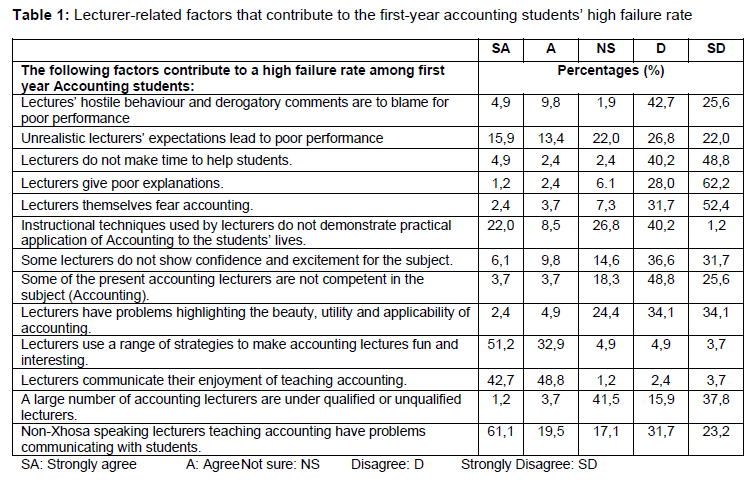
Table 1 provides information about the lecturer-related factors that contribute to a high failure rate among first-year Accounting students. Of the sample group N=82 (100%), almost half of the students, that is 42,7 per cent, disagreed that lecturers' hostile behaviour and derogatory comments are to be blamed for the Accounting students' poor performance, in addition to the 25,6 per cent of students who perceived that they strongly disagreed with this statement. Similarly, a number of students, 26,8 per cent and 22,0 per cent respectively, disagreed and strongly disagreed that lecturers' unrealistic expectations contribute to their poor performance. In extension to these results, 89 per cent (40,2% disagreed and 48,8% strongly disagreed) of the students contradicted the statement "Lecturers do not make time to help students". These results communicate that in the context of this study, based on the students' perceptions, lecturers do make time to help students with their accounting and thus this factor does not contribute to the high failure rate of the first-year accounting students. Subsequently these results refute the finding that the primary problem faced by accounting teachers in Brazil is a lack of time, (Araujo et al. 2015), which needs to be dedicated to assisting their Accounting students.
Ng et al. (2017, 58) promote the use of technology in education, specifically Accounting education, as affordable, practical, and reducing traditional learning barriers. For this reason, 22,0 per cent of students strongly agree that lecturers use instructional techniques that do not demonstrate practical application of Accounting to the students' lives, compared to the just below double this percentage (40,2%) of students who disagree with this statement. Thus, it seems as if students' perceptions concerning this statement is conflicted. Regardless of this conflicting concern, it appeared that most learners are of the view that lecturer-related factors are not the cause of a high failure rate among first year students. This statement is supported by 90,0 per cent students (40,2% disagreed + 48,8% strongly disagreed) who indirectly indicated that lecturers do make time to help students; 62,2 per cent of students who strongly disagreed with the statement that lecturers give poor explanations and half of the students (that is 52,4%) who strongly disagreed with the perception that lecturers themselves fear Accounting. In other words, most students perceive that lecturer-related factors do not significantly contribute to the high failure rate for first-year accounting students. For this reason, 48,8 per cent of students disagree, supported by 25,6 per cent of students who strongly disagree with the statement that "Some of the present Accounting lecturers are not competent in accounting". These results align with Ramsarghey (2020, 232) who points out that in a South African context, Accounting academics are technically competent in their discipline. However, "most newly appointed lecturers lack pedagogical skills" (Ramsarghey 2020, 232). This result is disturbing and questions whether the 7,4 per cent of students (3,7% strongly agreed +3,7% agreed) who were of the view that Accounting lecturers are not competent, could possibly be referring to the lecturers who are new to the academic field. Yet, it is teaching competence (in Accounting), according to Haslam et al. (2014) that is the most important high failure rate decreasing factor for the accounting student. To address this concern, the researchers concur with Marques (2013, 48) who recommends that "All staff teaching in higher education institutions ... should have received certified pedagogical training".
Due to the access to electronic devices, lecturers need constant to adapt and stay up-to-date with both technology and updates related to the subject of accounting. Lecturers should incorporate the use of smartboards, blackboards, webinars, social media applications, and on-trend software programmes related to the accounting industry which will offer accounting instruction in a fun and interesting way (Ramsarghey 2020, 237). For this reason, half of the students, that is 51,2 per cent statistically agreed that lecturers use a range of strategies to make accounting lecturers fun and interesting, which is supported by 91,5 per cent of students (42,7% who strongly agreed and 48,8% who agreed) that indicated that lecturers communicate their enjoyment of teaching accounting. Lecturers' various interactions with students are bound to produce emotions in the work environment. These encounters could according to Ramsarghey (2020, 241) invoke either positive or negative emotions in the lecturer that could, in turn, have an impact on the teaching that follows. This means the emotions experienced and shared by the lecturer during the teaching process can either positively or negatively influence the high failure rate in accounting students. Reaffirming this information is the 36,6 per cent of students who disagree and the 31,7 per cent of students who strongly disagree that lecturers do not show confidence and excitement for the subject. Based on these results, the researchers thus construe that in the context of this study, lecturers do show confidence and share their excitement for the subject during Accounting lessons.
However, although 37,8 per cent stated that strongly disagreed that lecturers are underqualified or unqualified, the fact that more students, that is 41,5 per cent of students said that they are not sure about the qualification of the lecturers is cause for concern. In light of Ramsarghey's (2020, 232) contention that qualifications provide pedagogical skills and effective teaching, it follows that 41,5 per cent of students who are unsure about the qualifications of their lecturers infer that their lecturers are ineffective Accounting lecturers. Furthermore, According to Ozpeynirci et al. (2013) lecturers' ineffective teaching as a lack of understanding of course content and the use of poor teaching and learning techniques, contributes to high accounting student failure.
Concerning lecturers' linguistic proficiency during accounting teaching, 19,5 per cent of students agree that non-Xhosa speaking lecturers teaching accounting have problems communicating with students. Andrade (2006) refers to language proficiency as another factor contributing to undergraduate accounting failure rates. Almajed and Hamdan (2015) found that accounting students understand better in their native languages than in English. It extremely difficult for students to develop content literacy when studying a subject in another language than their mother tongue (Van der Poll and Van der Poll 2007). It is therefore not surprising that almost a quarter of the students, 16 from 82 accounting students perceive and agree that there is a communication barrier between students and non-Xhosa speaking lecturers.
The reliability of the questionnaire instrument refers to the internal stability and consistency of the instrument developed and is represented by the Alpha Cronbach measurement (Creswell 2010). The closer Cronbach's alpha coefficient is to 1.0, the greater the internal consistency of the items in the scale. Hulin, Netemeyer, and Cudeck, (2001) provide the following general rule of thumb: 0.6-0.7 indicates an acceptable level of reliability, and 0.8 or greater a very good level. However, values higher than 0.95 are not necessarily good, since they might be an indication of redundancy. Differently put, a questionnaire's internal consistency refers to how well it measures what it is intended to measure. The result of a questionnaire with a higher internal consistency value (a higher Cronbach Alpha), is more likely to be reliable.
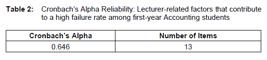
Based on the 13 lecturer-related factors that influence the high failure rate in first-year Accounting students, a Cronbach's alpha measurement of 0.646 was recorded, which indicates an "acceptable" level of the internal consistency of the questionnaire. This translates that the results produced by this section of the questionnaire are valid and reliable.
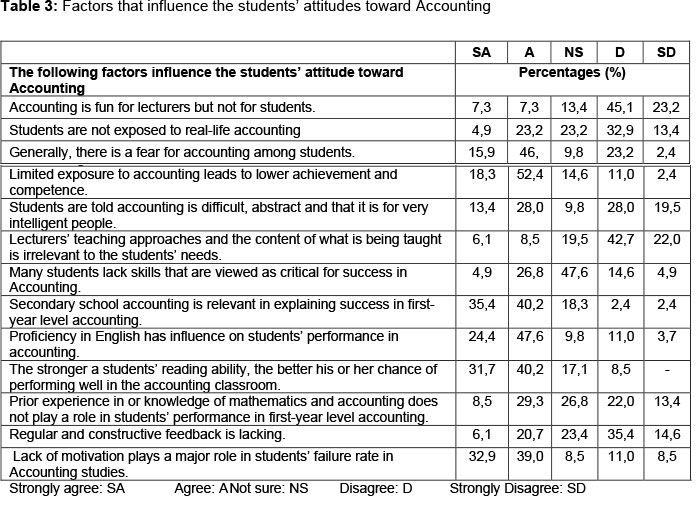
Apart from lecturer-related factors that contribute to the high failure rate among first-year Accounting students, the information provided in the questionnaire, also established which factors impact that influence the students attitudes towards Accounting. Table 3 below reveals how the students responded regarding their attitudes towards Accounting.
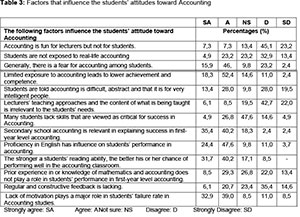
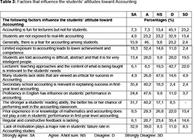
First-year students choose Accounting for getting a good job after completing graduation, unfortunately, many students drop out after getting admission to Accounting subject (Islam et al. 2015). In other words, fewer students graduate from this course compared to those who were admitted for Accounting. This assertion is supported by the 46.3 per cent of students who agreed that there is a fear of Accounting among students, which is reinforced by 15,9 per cent of students that strongly agreed that students fear accounting. These statistics thus show that more students perceive that there is a fear of accounting among students, compared to the 23,2 per cent (disagreed) plus 2,4 per cent (strongly disagreed) who disputed this opinion. Furthermore, a meager 7.3 per cent of students strongly agreed and agreed that "accounting is fun for lecturers but not for students". In other words, most students (45,1% and 23,2% respectively) disagreed and strongly disagreed, and thus indirectly perceived that Accounting is also fun for students, yet most of them fear this subject.
The results for the item Limited exposure to Accounting leads to lower achievement and competence indicated that this statement is supported by 18,3 per cent of students that strongly agreed and 52,4 per cent that agreed. For this reason, the researchers construe that limited exposure plays a significant role in the high failure rate in first-year Accounting. The results revealed an almost equal score. 13,4 per cent (strongly agreed) and 28,0 per cent (agreed) of students supported this perception with 28,0 per cent of students who disagreed and 19,5 per cent who strongly agreed that: Students are told Accounting is difficult, abstract and that it is for very intelligent people. However, the results clearly reflected that students perceived Secondary school Accounting is relevant in explaining success in first-year level accounting. Subsequently, 35,4 per cent of students strongly agreed and 40,2 per cent agreed with this statement. Contrastingly a measly 2,4 per cent of students respectively disagreed and strongly disagreed with the perception that secondary school Accounting is relevant in explaining success in first-year level Accounting.
Considering the item: Lecturers' teaching approaches and the content of what is being taught is irrelevant to the students' needs, only 6,1 per cent of students strongly agreed with this perception; and 8,5 per cent of students agreed. Conversely, 42,7 per cent agreed and 22,0 per cent strongly agreed in support of this statement. Differently put, the results indicate that most of the students perceive the lecturers' teaching approaches and the content of what is being taught as relevant to the students' needs. As a result, 35, 4 per cent (disagreed) and 14,6 per cent (agreed) that regular and constructive feedback (from lecturers) is lacking.
Additionally, 26,8 per cent of students agreeably perceive that many students lack skills that are viewed as critical for success in Accounting as opposed to the 14,6 per cent who disagree with this notion. However, 71,9 per cent of students, i.e. 32.9, strongly agreed and 39,0 agreed that the lack of motivation plays a major role in students' failure rate in Accounting studies. In other words, although students are not clear about whether students lack skills that are viewed as critical for success in Accounting, it is apparent that the majority of the student (71,9%) perceive that motivation or lack thereof is essential in the success or failure in First-year accounting. Concerning the students' perceptions of successful accounting students, Almajed and Hamdan (2015) found that Accounting students understand better in their native languages than English. Aligned with this statement, an accumulative 72,0 per cent of students, that is 24,4 per cent strongly agreed, and 47,6 per cent agreed with their perception that proficiency in English has an influence on students' performance in Accounting.
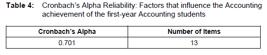
In addition, based on the 13 factors that influence the students' attitudes toward Accounting, a Cronbach's alpha is 0.701 was generated, which indicates an "acceptable", level of internal consistency, declaring the questionnaire results as credible.
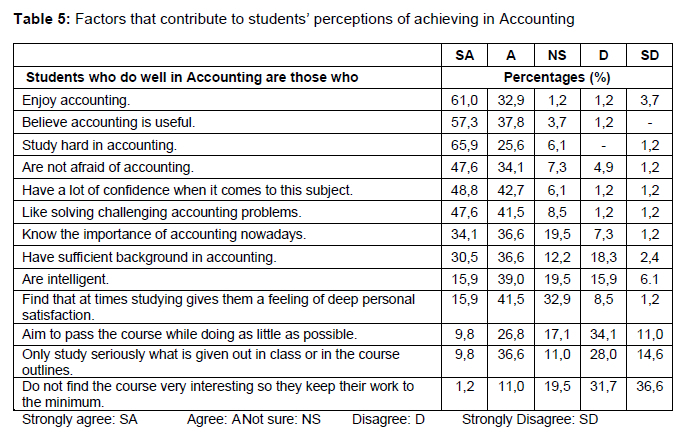
Apart from lecturer-related factors that contribute to the high failure rate among first-year Accounting students and students' attitudes, the information provided in the questionnaire, also established which factors impact on the Accounting achievement of the students, and subsequently contribute to the high failure rate in first-year Accounting. Table 5 reveals how the students responded.
Table 5 reflects on the information that sought to understand what students perceived to be factors that impact on their Accounting achievement and influence the high failure rate in the first-year Accounting students.
Based on the statement, students who do well in Accounting are those who enjoy counting, 61,0 per cent of students strongly agreed with this statement, aligned with the 32,9 per cent of students who agreed. Although majority of students (i.e., 93.9%) agreed that enjoyment impact on their Accounting achievement, an accumulative number of 91,5 per cent of students (i.e., 65.9% who strongly agreed + 37.8% who agreed) shared the perception that they need to study hard in accounting. On the other hand, 57,3 per cent strongly agreed; that is just more than half of the students that believe that accounting is useful, which translates into a perceptual factor that impacts on their Accounting achievement.
Previous Accounting knowledge motivates the accounting students to perform better and reflect an improved self-confidence (Alanzi 2015). This statement is support by the 48,8 per cent (strongly agreed) and 42,7 per cent (agreed) of students who respectively perceive that students' confidence is a factor that impact on their achievement in Accounting, which shares a parallel relationship with students' perceptions about not being afraid of the subject. For example, 47,6 per cent of students strongly agreed that they are not afraid of Accounting, which is echoed by 34,1 per cent of students who agreed with this sentiment. Furthermore, 36.6 per cent of students agreed that to know the importance of accounting nowadays also serves as a factor that impacts on the Accounting achievement. This is in direct contrast with 7,3 per cent of learners who disagreed with the relevance of accounting knowledge in today' time.
Arguably, an equal number of students, 15,9 per cent indicated that they strongly agree that intelligence is a factor in Accounting achievement, compared to those students (15,9%) who disagree with this perception. Likewise, 15,9 per cent of the students strongly agree, and 41,5 per cent agree, that is more than half of the students (57,4%) that indicated that they perceive that experiencing a feeling of deep personal satisfaction also constitutes as a factor that impact on the Accounting achievement of students. This information agrees with research by Lubbe (2014) who argues that rather than merely teaching superficial information, teaching, that is accounting teaching in the context of this study, should be thought provoking and cultivate insight into the subject content. In a deep learning approach, students retain the structure of the task and attempt to connect new knowledge to existing knowledge. This information indirectly validates the 36.6 per cent of students who agreed that to know the importance of accounting nowadays also serves as a factor that impacts on the Accounting achievement. Moreover, it may be possible that students that demonstrate accounting insight may be better prepared to make informed personal decisions. Due to studying in a way that generates a sense of personal satisfaction in them, 57,3 per cent (15,9% + 41,5%) of the students strongly agree and agree they do well in accounting, which contributes to positive accounting achievement.
Echoing in support of the positive trajectory as per students' perceptions about their accounting achievement is the evidence of 93,0 per cent (61,0% + 32,9%) of students who strongly agree to agree and stated that they enjoy the subject. Subsequently, the researchers infer that when students are emotionally satisfied with their achievement in accounting, it with reduce the intensity of subject fear in them, which translates why only meagre total of only 4,9 per cent (that is 4 from a total of 82 students) disagreed with the statement "Are not afraid of accounting". To put it differently, since most of the student find that at times studying give them a feeling of deep personal satisfaction, the parallel outcome reflects that most students perceive that themselves not to be afraid of the subject.
Of the sample group N = 82 (100%), 26,8 per cent (i.e., 22 from 82) of student showed that they agreeably perceive that they aim to pass the course while doing as little as possible. Per contra, more students (i.e. 34,1% who disagreed and 11,0% who strongly disagreed) refuted this claim. Consequently, this result disputes the finding produced by research conducted by Ramsarghey (2020, 231) who perceive that one of the factors that contributes to the high accounting failure rate is basic content insight, which in turn result in students "studying to pass and not necessarily studying to understand". Differently stated, accounting students simply demonstrate basic accounting knowledge with the aim to pass the course, which identifies as a factor contributing to poor student achievement in accounting at tertiary institutions (Matarirano et al. 2019; Papageorgiou and Carpenter 2019).
Since students simply study to obtain basic accounting knowledge, it serves as a rationale why more students (36.6%) agree in contradiction with the 28,0 per cent of students who disagree that they only study seriously what was given out in class to do well in accounting. Regardless of the accumulative number of 91,5 per cent of students (i.e. 65.9%) (strongly agreed) + 25,6 per cent (agreed) who shared the perception that they need to study hard to do well in Accounting, few students, only 11,0 per cent (9 from 82 students) agree that they do not find the course very interesting, so they keep work at a minimum. To put it differently; 31,7 per cent and 36,6 per cent of students disagree and strongly disagree that keeping work to a minimum is a factor that assist them to do well in accounting.
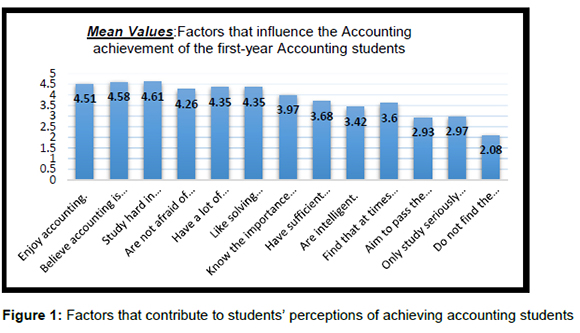
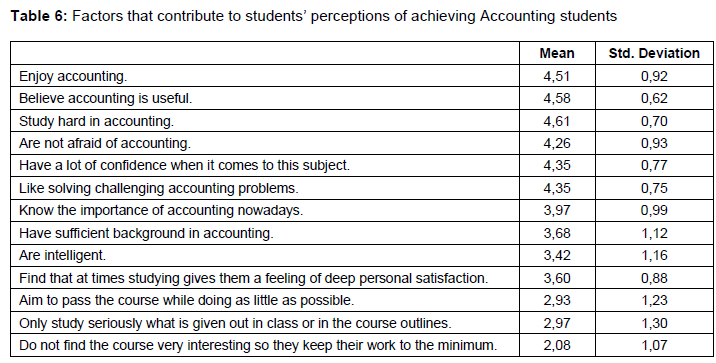
The data recorded in Table 6 show that, based on the questionnaire analysis, most students are of the perception that to "Study hard in accounting" is the factor that contributes most to the Accounting achievement of the first-year Accounting students with an average score of 4.61 (SD = 0.70). This factor is followed by students who "Believe accounting is useful" and those students who "enjoy accounting" which respectively recorded average scores of 4.58 (SD = 0.062) and 4.51 (SD = 0.92). However, students rated not being afraid in Accounting (M = 4,26; SD = 0.93) as a factor that influences student accounting achievements more than knowing the importance of Accounting in today's time, which score an average value of 3.97.
One would think that students would perceive intelligence as an essential contributing factor in Accounting achievement, yet they only scored it an average of 3,42 (SD = 1,16); followed by feeling of deep personal satisfaction which was scored an average value of 3,60 (SD = 0.88).
The three factors which students perceived influence their achievement in Accounting in the least, in descending sequential order, are 1) study seriously what is given out in class (M = 2, 97; SD = 1,93); 2) Aim to pass the course while doing as little as possible (M = 2,93; SD = 1,30); and 3) Do not find the course very interesting so they keep their work to the minimum, which produced a minimum score of 2.08 and a Standard deviation of 1,07.
The interpretation of the students' perceptions of the factors that influence accounting achievements mean scores is further aided by the visual ranking representation in Figure 1.
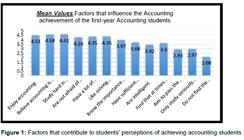
Considering the students' perceptions of factors that influence Accounting achievements as reflected by the questionnaire survey, it seems that most students perceive that "Studying hard" with a mean score of 4,61 as the most important factor that influences Accounting achievement, compared to "Do not find the course very interesting so they keep their work to the minimum"; which most students perceive as the factor that makes the least impact on their achievement in accounting.
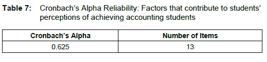
In addition, based on the 13 factors that influence the Accounting achievement of the first-year Accounting students, a Cronbach's alpha is 0.625 was generated, which indicates an "acceptable", level of internal consistency, declaring the questionnaire results as credible.
CONCLUSION
The study sought to explore what students perceived to be the contributing factors to the high failure rate in first-year Accounting. As already mentioned above, first-year Accounting students identified various factors as contributing to the high failure rate in first-year Accounting. This study found that based on the students perceptions, lecturer-related factors do not significantly contribute to the high failure rate for first year Accounting students. For example, the findings revealed that students perceive lecturers' hostile behaviour and derogatory comments not to have an impact on their poor accounting achievement, because on the other hand, lecturers do make time to help students with Accounting which positively influence their achievement.
However, the results indicated that many students were of the view that the instructional techniques used by lecturers do not demonstrate practical application of accounting to the students' lives. This finding also aligned with more than a quarter of the research participants who agreed that they are not exposed to real-life Accounting. Also, students shared their perception that Accounting lecturers' language proficiency does impact their achievement, as poor linguistic competency can result in a communication barrier and ultimately be a factor that influences the high failure rate in first-year Accounting students.
Students demonstrated a positive attitude regarding Accounting lecturers and the methodology used by them (i.e., the lecturers) the in the classes. However, many students indicated that they perceived that there is a fear of Accounting amongst students, which might be exacerbated by limited exposure to Accounting. Most students agreed that the absence of motivation contributes to students' Accounting failure rate, hampering accounting achievement and competence.
A disturbing factor was that the majority of students indicated that although they enjoy Accounting and agreed that they experience a deep personal satisfaction from doing it, they believe that they lack motivation, which is a crucial influential contributor of the high failure rate in first-year Accounting students. The researchers found these findings concerning and are of the view that Accounting education fails because students lack motivation and are not exposed to in-sync Accounting industry realities, which in later years, can lead to them failing to meet industry Accounting industry demands.
The perceptions about the factors that contribute towards the high failure rate in Accounting at tertiary education entry level produced mixed results. Subsequently, Gallagher (2001) cites students' familiarity with subjects, lecturers' expectations, changes in career aspirations, as factors that can cause a high failure rate in undergraduate first-year accounting students.
NOTE1 . A student's achievement is based on their performance, and it can be measures measured in various ways such as the successful demonstration of a pre-specified competence; the award of a pass mark or the gaining of a satisfactory grade for work accomplished (Oxford Dictionary of Education 2015, 8).
REFERENCES
LITERATURE REVIEW
- Alanzi, K. A. 2015. "Determinants of Students' Performance in Cost Accounting - Further Evidencefrom Kuwait." World Journal of Management 6(1): 136-152.
- Almajed, A. K. and A. Hamdan. 2015. "English Language and Accounting Education." European Journal of Accounting Auditing and Finance Research 3(6): 12-25.
- Al-Sohbani, V. A. and A. Muthanna. 2013. "Challenges of Arabic-English Translation: The Need for Re-Systematic Curriculum and Methodology Reforms in Yemen." Academic Research International 4(4).
-
Andrade, M. S. 2006. "International students in English-speaking universities: Adjustment factors." Journal of Research in International Education 5: 131. https://doi.org/0.1177/1475240906065589.
» https://doi.org/0.1177/1475240906065589 -
Araujo, T. S., F. D. C Lima, A. C. L. De Oliveira, and G. J. Miranda. 2015. "Perceived Problems of Being an Accounting Teacher." R. Cont. Fin.-USP, São Paulo 26(67): 93-105. https://doi.org/10.1590/1808-057x201512230.
» https://doi.org/10.1590/1808-057x201512230 -
Arquero, J. L., M. Byrne, B. Flood, and J. M. Gonzalez. 2009. "Motives, Expectations, Preparedness and Academic Performance: A Study of Students of Accounting at a Spanish University." Revista de Contabilidad - Spanish Accounting Review 12(2): 279-300. https://doi.org/10.1016/S1138-4891(09)70009-3.
» https://doi.org/10.1016/S1138-4891(09)70009-3 - Bowen, H. 2011. Spelling it out! Accounting for Spelling Difficulties for Arab Learners of English.
- Chawla, C., V. Jain, and T. Mahajan. 2013. "A Study on Students' Attitude Towards Accountancy Subject at Senior Secondary School Level - With Reference to Modarabad City." International Journal of Management 4: 177-184.
- Conboy, J. E. and J. M. B. Fonseca. 2009. "Student-generated Recommendations for Enhancing Success in Secondary Science and Mathematics." Eurasia Journal of Mathematics, Science and Technology Education 5(1): 3-14.
- Creswell, J. W. 2010. Educational research - planning, conducting, and evaluating quantitative and qualitative research. 4th Edition. Pearson Merril Prentice Hall, New Jersey.
- DBE see Department of Basic Education.
- Department of Basic Education. 2011. Curriculum and Assessment Policy Statement. Accounting. Further Education and Training Phase, Grades 10-12. Pretoria: Government Printers.
- Du Plessis, A., H. Muller and P. Prinsloo. 2007. "Validating the profile of a successful first-year accounting student." The South African Journal of Higher Education 19(4): 684-698.
- Du Plessis, A., H. Muller, and P. Prinsloo. 2005. "Determining the profile of the successful first-year accounting student." Meditari Accountancy Research 1(15): 19-23.
- Duve, M. 2016. "Non-accounting students' academic performance and introductory financial accounting course: A case of Great Zimbabwe University." Journal of Business Administration and Education 8(2): 36-62.
- Elttayef, A. I. and N. O. Hussein. 2017. "Arab Learners' Problems in Learning English Language: A Teacher Perspective." Journal of Literature, Languages and Linguistics 40.
- Fakoya, M. B. 2014. "Failure modes and effects analysis of repeating accounting students." Journal of Social Science 41(1): 37-43.
- Ferreira, A. and A. Santos. 2008. "Do students' perceptions matter? A study of the effect of student's perceptions on academic performance." Accounting and Finance 48: 209-231.
-
Gallagher, T. 2001. "Equal opportunities commission conference on boys and girls in the 21st Century: Gender Differences in learning." http://www.Eoc.org.hk/eoc/graphicfolder/newsletter/content.aspx?itemid=4948. (Accessed 2 February 2012).
» http://www.Eoc.org.hk/eoc/graphicfolder/newsletter/content.aspx?itemid=4948 -
Garkaz, M., B. Banimahd, and H. Esmaeili. 2011. "Factors Affecting Accounting Students' Performance: The Case of Students at the Islamic Azad University." Procedia - Social and Behavioral Sciences 29: 122-128. https://doi.Org/10.1016/j.sbspro.2011.11.216.
» https://doi.Org/10.1016/j.sbspro.2011.11.216 -
Haslam, C., C. Riley, G. Theodosopoulos, and N. Tsitsianis. 2014. "Teaching Accounting and Finance to non-specialists: Revealing the students' perspective on the learning experience." British Accounting and Finance Association Annual Conference (BAFA 2014), London. http://bura.brunel.ac.uk/handle/2438/10370.
» http://bura.brunel.ac.uk/handle/2438/10370 - Islam, N., A. G. Khan, and R. Ali. 2015. "Measuring Students' Attitude about Accounting At College Level: A Case Study Of Tangail District." Journal of Science and Technology 5(1): 37-44.
-
Ismail, S. 2009. "Accounting Student's Learning Approaches and Impact on Academic Performance." Jurnal Akuntansi dan Keuangan Indonesia 6(2). http://dx.doi.org/10.21002/jaki.2009.07.
» http://dx.doi.org/10.21002/jaki.2009.07 - Jameel, S. H. and A. Hamdan. 2015. "Effects of student's attendance on accounting student's performance." International Journal of Business and Management Review 3(5): 79.
- Johnston, V. 1997. "Why do first-year students fail to progress to their second year? An academic staff perspective." Paper presented at the British Educational Research Association Annual Conference, September 11-14 1997.
- Koch, E. and M. Kriel. 2005. "An argument for integrating language or language-related skills in theaccounting curriculum." South African Journal of Higher Education 19(3): 218-229.
- Lane, A. and M. Porch. 2002. "Computer aided learning and its impact on the achievement of non- specialist accounting undergraduates." Accounting Education 11(3): 17-34.
- Marques, J. C. 2013. "Pedagogic qualification of higher education teaching staff - the third wave." International Journal of Engineering Pedagogy 3(4): 47-49.
- Matarirano, O., M. Panicker, C. Atoliyah, and Z. Mangisa. 2019. "Factors impacting academic achievement of first-year accounting students at Walter Sisulu University." Africa Education Review 17(1): 83-99.
-
Muellerleile. 2005. "Attitude vs Aptitude." http://dx.doi.org/10.1037/0033-2909.132.5.778. (Accessed 17 October 2013).
» http://dx.doi.org/10.1037/0033-2909.132.5.778 - Ng, S. F., N. S. I. C. Hassan, N. H. M. Nor, and N. A. A. Malek. 2017. "The relationship between smartphone use and academic performance: A case of students in a Malaysian tertiary institution." Malaysian Online Journal of Educational Technology 5(4): 58-70.
- Oxford Dictionary of Education. 2015. Oxford: University Press.
-
Ozpeynirci, R., M. Yücenur, H. Duman, and I. Apak. 2013. "The Underlying Reasons of Students' Success or Failure in Accounting Lessons, A Suggested Model: The Case of KMU-ASU." Procedia - Social and Behavioral Sciences 103: 1181-1188. https://doi.org/10.1016/j.sbspro.2013.10.445.
» https://doi.org/10.1016/j.sbspro.2013.10.445 - Papageorgiou, E. 2017. "Accounting students' profile versus academic performance: A five-year analysis." South African Journal of Higher Education 31(3): 209-229.
- Papageorgiou, E. and R. Carpenter. 2019. "Prior accounting knowledge of first-year students at two South African universities: Contributing factor to academic achievement or not?" South African Journal of Higher Education 33(6): 249-264.
- Potter, B. N. and C. G. Johnson. 2006. "The effect of interactive online learning systems on student learning outcomes in accounting." Journal of Accounting Education 24: 16-34.
-
Ramsarghey, K. 2020. "What Educator Capabilities Are Necessary for Reflective Learning In Accounting Students?" South African Journal of Higher Education 34(2): 230-247. https://Dx.Doi.Org/10.20853/34-2-3336.
» https://Dx.Doi.Org/10.20853/34-2-3336 -
Shaban, O. 2015. "The Relationship Between Mathematics Grades and the Academic Performance of The Accounting Students' Department (A case Study on Accounting Department Students at Al-Zaytoonah University of Jordan)." The European Proceedings of Social & Behavioural Sciences. http://dx.doi.org/10.15405/epsbs.2015.05.6.
» http://dx.doi.org/10.15405/epsbs.2015.05.6 -
Stout, D. E. and J. J. Da Crema. 2004. "A writing intervention for the Accounting Classroom Dealing with the problem of faulty modifiers." http://www.ysu.edu/catalyst/PastEvents/PastEvents/stoutdacremapaper-october2004.htm.
» http://www.ysu.edu/catalyst/PastEvents/PastEvents/stoutdacremapaper-october2004.htm - Tekşen, Ö., M. Tekin, and M. Gençtürk. 2010. "Muhasebe Eğitiminin Değerlendirilmesi: Mehmet Akif Ersoy Üniversitesi'ne Bağlı Meslek Yüksekokulları Öğrencileri Üzerine Bir Araştırma." Mufad Journal 46: 100‒112.
- Van der Poll, H. M. and J. A. Van der Poll. 2007. "Towards an analysis of poor learner achievement in a theoretical computer literacy course." Proceeding of the 2007 Information Science and IT Education Joint Conference Volume 7.
-
Velasco, R. M. 2019. "Factors Associated with Failure in Accounting: A case study of the Omani Students." International Journal of Higher Education 8(6). https://doi.org/10.5430/ijhe.v8n6p157.
» https://doi.org/10.5430/ijhe.v8n6p157 - Woodley, A. 2004. "Conceptualizing student dropout in part-time distance education: Pathologizing the normal?" Open Learning 19(1): 47-63.
- Yu, D. D. 2011. "How Much Do Study Habits, Skills, and Attitudes Affect Student Performance in Introductory College Accounting Courses?" New Horizons in Education 59(3).