Investigating students' self-perceived affective learning during classroom interaction involvement at a South African university
Abstract
Despite the importance of affective learning as a gateway to learning, it has been neglected in university curricula in many parts of the world. Subsequently, in formal classroom teaching, the bulk of the teachers' efforts typically go into the cognitive aspects of the teaching and learning and most of the classroom time is earmarked for cognitive outcomes. However, research has shown that the affective domain develops well-rounded students with broad abilities and consequently many scholars advocate for the incorporation of the affective domain in university curricula. Therefore, the aim of this article was to establish and understand the self-perceived affective learning of the university students in order to match their emotions to the process of teaching and learning. The study was quantitative in nature and a survey design was followed. The Attribution theory was used to anchor the study. A randomly selected sample of 127 first-year students registered for Linguistics was used to collect data. A questionnaire was used to collect data and the Statistical Package for the Social Sciences (SPSS) was used to analyse data. With regards to students' self-perceived perceptiveness during classroom interaction involvement, the findings revealed that the majority of students were very perceptive to the meaning of others' behaviour in relation to themselves and the situation. Concerning the students' self-perceived attentiveness during classroom interaction involvement, the majority of students reported that they were very observant of others' reactions while speaking during classroom conversation. Finally, regarding students' self-perceived responsiveness during classroom interaction involvement, the students indicated that they felt confident during their conversation in class, and were sure of what to say and do.
affective learning; classroom interactive involvement; students' self-perceived perceptiveness; students' self-perceived attentiveness; students' self-perceived responsiveness
INTRODUCTION
Bloom identified three important domains, namely cognitive (knowledge-based), affective (emotion-based) and psychomotor (action-based) for understanding educational goals which can be evaluated in student performance (Armstrong 2010). Previous studies reveal that cognitive and psychomotor domains became prominent assessment tools used for the assessment of learning (Brouse 2021; Dorji-Yangzon 2021; Shakeel 2019; Aydin et al. 2009; Pierre and Oughton 2007). This view is supported by Agih (2017) who observed that the affective domain has been relegated to the background in classroom instruction at the expense of the other domains. Supporting this view, Shakeel (2019) states that in formal classroom teaching, the bulk of the teachers' efforts typically go into the cognitive aspects of the teaching and learning and most of the classroom time is meant for cognitive outcomes.
Neglecting the affective domain is not only limited to South Africa it occurs in a number of other countries. For instance, during a study conducted by Nande, Aboho and Maduewesi (2019) in Nigeria, they mentioned the neglect of the affective domain within the syllabus and classroom practice as "a neglected area of learning objectives". Similarly, Dorji-Yangzom (2021) refers to the neglect of the affective domain within the university curriculum as "the unchartered area of teaching and learning in tertiary education". Pierre and Oughton (2007) moreover describe the neglect of the affective domain as "the undiscovered country". The present study sought to close this gap by opening a debate on the importance and inclusion of the affective domain within the university curriculum; the importance of teaching within the affective domain cannot be over-emphasised.
Agih (2017) argues that there is a need to shift from the age old cognitive dominance in learning, to the affective domain. In addition, Shakeel (2019) declares that the affective domain develops well-rounded students with broad abilities. It follows that the affective status of students should concern all lecturers. Focusing teaching on the affective domain at university is supported by Patson (2020) who points out that many of the goals of higher education are affective in nature. Patson describes developing critical thinking skills and ethical reasoning and action as two of the desired outcomes of higher education. Uribe (2011) is of the view that affective teaching requires the lecturer respecting students. Specifically, Uribe believes that lecturers respect students once they listen attentively to them, sincerely invite opinions and truly value their previous knowledge. The authors of the study are of the view that focusing teaching on affective domain might play a crucial role in solving the challenges facing higher education in South Africa and improving quality and pass rates. This view is inspired by international studies conducted on the role of affective domain in improving teaching and learning. For instance, Shakeel (2019) is of the opinion that tapping into the affective domain has significant value in realising the potential to incease student learning. Similarly, Pierre and Oughton (2007) as well as Nande, Aboho and Maduesi (2019) suggest that the affective domain is the gateway to learning. The researchers agree that lecturers should teach from the affective domain which influences values, beliefs and attitudes.
Van Valkenburg and Holden (2004) define the affective domain as the internal part of a student that reflects the student's behaviours, conditions, principles and standards, more commonly referred to as the student's attitude, creativity, self-development and motivation. It therefore follows that students' emotions should be considered during classroom instruction. Stearns (2018) elaborates on this when he makes reference to emotional intelligence. He defines emotional intelligence as a person's ability to understand and articulate their own, and others' feelings. This definition becomes important for the present study as the study focuses on the students' emotions about the classroom activities and about other students. Salovey, Mayer and Caruso (2002) similarly define emotional intelligence as the capacity to understand and explain emotions on the one hand, and emotions reinforcing thought on the other hand.
The authors of the article believe that understanding students' emotions means understanding students' circumstances, mood or relationship with others. We move from the premise that this domain of learning is considered too infrequently in South African higher education classrooms, yet the ground is fertile for its implementation. This claim is supported by the view advanced by Bharuthram (2018). Bharuthram declares that in South Africa, students enter higher education with a variety of life experiences and therefore experience academia very differently from each other. We believe that lecturers who teach from the affective domain should capitalise on the students' different emotions. By doing so, they wil cater for students with different emotions and also to respect individual emotions. This view is supported by London School of Management Education (2019), who state that it is imperative to understand that there are different categories of students who have varying needs and as such different methods must be adopted within the planning and delivery of lessons to make sure that such needs are addressed. Thus, instructors should purposefully target the affective domain so as to challenge and modify students' value systems.
Investigating students' self-perceived affective learning should be seen against the background of the broader debate on student retention and atttrition in South Africa. Baijnath (2018) opines that while South Africa has made great strides towards achieving universal access to basic education, this has not translated into improved educational outcomes in higher education. Some of the challenges facing higher education in South Africa manifested during the demonstration by university students in 2015 and 2016. Nyamupangedengu (2017) argues that while the most pertinent issue that sparked the protests was steep fee hikes which were negatively impacting equitable access to higher education, the protests furthermore presented other issues impacting students' success. These included a lack of transformation pertaining to university curricula, which does not sufficiently cater for students from varying backgrounds. Baijnath (2018) views this as the failure of institutions and individuals to tailor the standard teaching and learning process to the realities of the great majority of the current student body.
Despite the importance of the affective domain being a gateway to learning, few studies that sought to investigate university students' self-perceived affective learning have been conducted in South Africa. The literature shows that having this information is vital since it plays a crucial role in helping lecturers find methods and activities that engage students, alert lecturers how students feel about their work and their peers, and therefore the process of learning. This information is hopefully going to help lecturers design appropriate courses and design relevant course material that matches the students' characteristics with regards to the affective domain.
Among the few studies that were conducted in South Africa is a study conducted by Bharuthram (2018). The aim of the study was to explore first-year university students' emotional experiences with the ultimate aim of improving teaching and learning. The results of the study indicated that students used mostly negative descriptions to express their emotions. These included feelings of self-doubt, alienation, loss of identity and not belonging to the university and their disciplinary community. The authors of the article believe that these descriptions serve as an eye-opener about the roots of the learning challenges experienced by some students within the South African universities, particularly in their first year. In this case, Baijnath (2018) views the challenge as the failure by institutions and individuals to tailor the standard teaching and learning process to the realities of the great majority of the current student body.
The incorporation of the affective domain into the fabric of teaching and learning should happen within the course outlines and lesson plans, with affective outcomes that indicate how these are going to be taught and evaluated. Also important is how lecturers address the affective domain in their teaching strategies. Pierre and Oughton (2007) emphasise that affective educational outcomes that specialise in individual dispositions, willingness, preferences and delight must be acknowledged and integrated into curricula throughout institutions of higher learning. Thus, the present study sought to investigate the university students' self-perceived affective learning in order to assist with designing syllabi, classroom material, classroom activities, and instruction strategies that match the students' emotions. Specifically, the present study focuses on perceptiveness, attentiveness and responsiveness, the components of affective domain. Given that so few studies have been conducted in South Africa on the incorporation of affective domain in teaching and learning, it is hoped that this research will help to ensure continued debate on students' perceptiveness, attentiveness and responsiveness. It is furthermore hoped that the research will ultimately create awareness about the importance and inclusion of affective domain in teaching and learning in higher education curriculum, not only among South African universities but in the rest of Africa, and other continents. The study therefore sought to address the following research questions:
• How do the students perceive their own perceptiveness during classroom interaction involvement.
• What are the students' perceptions of their attentiveness during interaction involvement in their classrooms?
• What are the students' perceptions of their responsiveness during interaction classroom involvement?
Classroom Interaction involvement
Cegala et al. (1982, 229) explain interaction involvement as the extent to which students participate with each other in classroom conversations. These researchers opine that students who are highly involved in communication, such as during classroom conversations, integrate their feelings, thoughts and experiences in their conversations with others. For this reason, people who demonstrate emotional alertness during interaction involvement are perceived as competent interpersonal communicators. On the other hand, those who participate less are psychologically removed from the ongoing interaction and appear somewhat absent in the discussion (Cegala et al. 1982). Cegala et al. add that people who demonstrate a lower intensity of emotional interaction involvement are not taken seriously even when they decide to participate in a conversation, as their communication may be regarded as unclear and inconsistent. They may furthermore be considered incompetent in their communication with others.
Frymier (2005) conducted a study about classroom interaction involvement with college students. She found that students who are highly involved in classroom interaction tend to be confident in what to say and how to say it; they pay attention to their instructors and can observe how their instructor responds to them during classroom interaction involvement. Frymier (2005) and Cegala et al. (1982) assert that students who are actively involved in classroom interaction perform better academically, although their involvement at times can be obstructed by their emotions.
Affective learning: An emotionally perceptive learning perspective
Affective learning refers to the emotions affecting students' learning experience while they are learning (Lifen 2016). Miller (2005, 15) asserts that affective learning is "concerned with how students feel while they are learning, as well as with how learning experiences are internalised so they can guide the learner's attitudes, opinions, and behaviour in the future". Boyd, Dooley and Odom (2006, 25) support this by suggesting that students reflect on their thoughts and emotions during classroom interaction, which helps them to create meaning from the information gained as well as their own experiences. The importance of students' emotionally perceptive learning experiences is emphasised by research conducted by the Institute of HeartMath that indicated that students' emotions, that is, how students feel during classroom interaction involvement, affect their achievement scores in tests (McCraty 2005). Yet, as Lifen, (2016) reports, affective learning development is neglected in the classrooms.
The crucial role that affective learning plays in the classroom, is summarised by Stevick's (1980, 4) comment that classroom-learning success "depends less on materials, techniques and linguistic analyses and more on what goes on inside and between the people in the classroom." "Affect" is about the inside and the between. The "inside" refers to personality traits such as self-concept and self-esteem, anxiety, inhibition, attitudes, motivation, and learner styles. "Between" refers to the relational learning processes that occur in the classroom, among students, and among instructors and students. To further expand on the conceptualisation of affective learning, Brown et al. (2001, 241) explain that affective learning, as a construct, consists of "affective characteristics such as motivation, initiative, compassion, service, accountability, empathy, honesty, advocacy, commitment, optimism, respect and self-confidence lead to behaviours that typically produce professional excellence."
For this reason, Llewellyn and Cahoon (1990) point out that when elements of affective learning are incorporated during classroom interaction, it presents students with a platform for autonomous and ideological learning. Affective learning promotes instruction and learning in a more inclusive and holistic manner. Different sources corroborate that affective learning encompasses students' emotions such as among others perceptions, empathy, belief, attentiveness, responses, attitudes, interests, and motivations. Cegala et al. (1982) concur and describe the extent to which individuals are engaging in a conversation and sharing thoughts, experiences and feelings as interaction involvement.
To achieve the aim of this study and provide a framework to investigate, understand and address the research questions, the researchers furthermore present Cegala et al. (1982), who explains that affective learning consists of three dimensions, perceptiveness, attentiveness and responsiveness. According to Spitzberg and Cupach (1989), these three interaction involvement dimensions can be investigated in an individual or collective context. In this study, these dimensions were 8investigated collaboratively within the context of affective learning.
Perceptiveness implies that student learning relates to their lived experiences (Lifen 2016). According to Myers and Bryant (2002), perceptiveness is associated with positive, affective responses toward the instructor or fellow students, increased motivation to study, and satisfaction with the classroom communication. Vierimaa (2013) concurs and reasons that empathy, which in the context of this study relates to affective classroom interactive involvement, means that an individual is observant and considers classmates' feelings during learning. In other words, increased affective perceptiveness in the classroom can lead to increased emotional learning awareness and, subsequently, more effective learning. Lifen (2016) mentions that perceptive instruction and learning are related to the students' real lives and enables them to expand their own learning experiences in the classroom. Perceptiveness in the affective-learning context encourages students to be active participants in their own learning by identifying with their values and morals as perceived through the lesson content, as well as acknowledging their own and classmates' contribution in the learning process (Lifen 2016). Perceptive learning, therefore, does not only represent knowledge acquisition, but also the spectre of the affect aspect within the classroom interaction involvement.
Attentiveness, the second factor in the triparty perceptiveness-attentiveness-responsiveness learning collaboration, refers to students' attentional focus that forms the first step towards effective learning. Students' ability to show a high level of attention competency signals their interaction involvement in the process of learning (Goldberg et al. 2019). Effective learning, therefore, depends on paying attention. Subsequently, it appears that attentiveness within the instruction-learning context refers to information that students absorb and retain to expand on their knowledge schemata. This is supported by Seufert and Brünken, (2006), who assert that attention determines the success of knowledge schemata construction. Although information processing occurs in an abstract manner, some concrete attentiveness processing can be observed. This may include visually orientating towards a particular stimulus perceived to contribute to increased knowledge expansion (Posner 1988).
Consequently, it can be construed that attentiveness constitutes a crucial factor within the affective learning construct. Furthermore, affective engagement, namely, interaction involvement in the classroom, which includes affective reactions such as excitement, boredom, curiosity, and anger (Fredricks, Blumenfeld, and Paris 2004) that signify the students' level of attentiveness. In other words, it seems that attentiveness (or lack thereof) can be used as a tool to evaluate the students' interest or disinterest during affective interaction involvement in the classroom.
Based on the above information, it seems that in order for a high level of affective learning to occur, students need to demonstrate a responsive-perceptive-attentiveness learning balance during classroom interaction involvement. While the presence of affective learning can stimulate valuable holistic learning in the classroom, its absence can prevent learning from occurring altogether. In the context of the study and with reference to Krashen's (1985) affective filter hypothesis, learning through the negative aspects, or negative affective reactions, should be avoided in the classroom because it can impede learning. In contrast, learning through positive aspects, or positive affective learning reactions, should be incorporated in the classroom because it can facilitate learning. In addition, students need to connect with their own as well as their classmates' emotions during classroom interaction to increase productive affective learning. To this end, this study also sought to explore and evaluate students' self-perceived affective learning during interaction involvement.
According to McCroskey and Richmond (1996, 93), responsiveness is "the ability to communicate sensitively, being a receptive and approachable listener, putting interlocutors at ease when communicating, as well as to acknowledge the needs and desires of others". Cegala et al. (1982) associates responsiveness with the ability to focus on knowing what to say and knowing how to respond. Similarly, Sherman (2004, 118) explains that responsiveness during classroom interaction engagement, refers to the "how to respond" rather than "the what to respond to".
The notion of responsiveness in affective learning during classroom interaction involvement furthermore refers to the conception of caring (Noddings 1984) and the use of tone and tact (Van Manen 2002). The right guidance and empathy can foster affective learning that may motivate students to "live full lives in a multitude of ways that sustain their capacity to become proficient, avid readers; capable, meticulous mathematicians, keen observers of scientific phenomena and well-informed citizens" (Sherman 2004, 117). In turn, McCroskey and Richmond (1996) describe responsiveness as being sensitive, being a good listener, and making others comfortable. Frymier (2005) concurs and states that "responsiveness" implies being helpful, sympathetic, friendly, and gentle. Sherman (2004) agrees with the pertinence of the responsiveness construct of affective learning. He mentions that affective learning represents the enactment of responsiveness during classroom interaction involvement, which emerges from personal dispositions that enable students to grasp the instructor or their peers' disposition.
The literature on instructional communication reveals that a substantial body of research has focused on examining effective teacher communication, but ignored both effective and affective student communication (Hurst, Wallace, and Nixon 2015; Craig and Savage 2015; Shah and Inamullah 2012; Frymier, 2005). To put it differently, there is a lack of information on students' attribution in the classroom, that is how students perceive, respond and behave during interaction involvement during instruction in the classroom. In South African, Segabutla (2015) conducted a study at a higher education institution (HEI) where she investigated lecturers' and students' perceptions of lecturers' instructional communication as influenced by their instructional competence, with specific reference to lecturer immediacy, clarity and credibility. Segabutla (2015, v) concludes that, "Although the lecturers were perceived to be verbally and nonverbally immediate, they were also perceived to be unclear in their presentation, although credible in the eyes of their students". Other studies, such as those of Frymier (2005), Hurst et al. (2013), Craig and Savage (2015), and Shah and Inamullah (2012), focused on the instructor as the initiator and controller of classroom communication, yet neglected students' affective learning. For this reason, this study focused on students' perceptions of their affective classroom interaction involvement based on perceptiveness, attentiveness and responsiveness.
THEORETICAL FRAMEWORK OF THE STUDYThis study was conducted within the framework of the Attribution theory. The Attribution theory explains (1) How people respond to the causes of events or behaviour; and (2) How do they perceive the impact of such attribution on their future behaviour (Weiner 2010). In other words, within the context of this study, the Attribution theory was used to focus on how students' perceptions of their behaviour are associated with their subsequent communication in a given course (Frisby and Martin 2010; Johnson and Beela 2015; Sollitto, Johnson and Myers, 2013). Fiske and Taylor (1991) point out that the attribution theory deals with how the perceiver uses information socially to arrive at causal explanations for events. Fosterling (2001, 109) argues that the attribution theory proposes that the attributions people assign to events and behaviour, can be classified as internal, or external. He explains that in an internal or dispositional attribution, people infer that an event or a person's behaviour is due to personal factors such as traits, abilities, or feelings. On the other hand, he argues that when external or situational factors are involved, the tendency is to describe a person's situational factors or qualities.
Gronhaug and Falkenberg (1994) contend that attribution theories stem from a person's work or personal perceptions, which refers to the conditions associated with their attempts to find structure in their own behaviour and the behaviour of others. To put it differently, Gronhaug and Falkenberg (1994) thus indirectly allude that the attribution theory refers to an understanding of students' feelings during learning, such as their perceptiveness, responsiveness and attentiveness, which are associated with lecturers' diagnosis of the students' interests and motivation to learn.
METHODOLOGY
This study adopted a quantitative approach with a questionnaire survey design. Maree (2016, 307) explains that "a quantitative researcher relies on numerical data to test the relationships between variables". According to Check and Schutt, (2012, 160), "Survey research is defined as the collection of information from a sample of individuals through their responses to questions" In the current study, a questionnaire survey was used to conduct a statistical analysis, which is a quantitative approach, to investigate and understand the students' self-perceived affective learning that occurs in the classroom. Another reason for using a survey questionnaire was to generalise the findings to a larger population.
RESPONDENTSThe sample respondents of the study comprised 127 first-year students registered for Linguistics at a university in Gauteng. These respondents completed the questionnaire between August and September 2019. The sample comprised 78 male (31.5%) and 170 female (68.5%) students, providing a research sample of 127 students. Students were chosen at random; each respondent had an equal chance of getting chosen (Creswell 2014, 10). Consequently, random sampling proved relevant for the study as it was an unbiased way of collecting the responses from a large group of students, and created a balanced subset with the potential of representing the larger group in its entirety.
DATA COLLECTION AND INSTRUMENTATIONData collection was carried out by the IIS questionnaire that was administered to determine the self-perceptions, attentiveness and responsiveness of the respondents during interaction involvement in the classroom. The researchers decided to use the IIS questionnaire survey to collect data since it is perceived to be a reliable instrument and has been used extensively with credible results. Cegala (1981) originally developed the IIS, and in later years, Frymier (2005) modified it. The survey questionnaire consisted of two sections where Section A explored the demographic variables of the students, while section B incorporated 18 items that measured affective learning. The eighteen items on the questionnaire were structured in alignment with the literature review of this study and to simplify the data analysis procedures.
In addition, it reiterated Cegala et al.'s (1982) assertion that affective learning consists of three dimensions, namely (1) responsiveness, (2) perceptiveness as well as (3) attentiveness. The IIS consists of eighteen self-perceived closed statements with a six-point intensity scale ranging from rating 1, "not at all like me" to rating 6, "very much like me". The use of the IIS instrument comprised four items to determine students' perceptiveness; six items to determine attentiveness, and eight items to determine responsiveness. To simplify the questionnaire vocabulary, the researchers used the word "conversation" to refer to the interaction involvement that occurs in the classroom. The researchers viewed the ISS questionnaire instrument as the most suitable instrument for obtaining data about the students' self-perceived affective learning behaviour during interaction involvement in the classroom. To assist the researchers to understand the students' self-perceived and self-rated affective learning, closed questions were employed.
DATA ANALYSISNext, we elaborate on the data analysis process relevant to this study. Data analysis refers to analysing the information gathered during the study and assessing the relevant information that can be helpful for better decision-making (White 2005, 168). The data gathered were analysed using the Statistical Package for the Social Sciences (SPSS) method, which is well-known computer software used for analysing research as it embraces a meaningful explanation of the variables and it uses graphs to present the results (Arkkelin 2014, 2). Furthermore, a flexible package allows various types of analysis and illustrates the application of different statistical analysis techniques using statistical packages.
PRESENTATION OF THE FINDINGS AND DISCUSSION
The findings are presented and discussed according to the following headings:
Students self-perceived perceptiveness
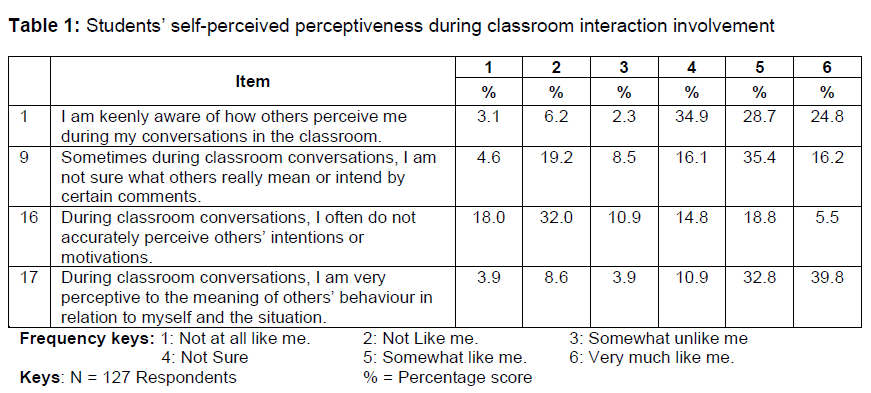
The first research question focused on the students' perceptions of their own perceptiveness during classroom interaction involvement. Specifically, it focused on how individual students observed how classmates felt during learning. The premise on which this study was based was that a perceptive learning process not only represents knowledge acquisition but also the "affect" aspect within the classroom interaction involvement. Students' self-perceived perceptiveness is summarised in Table 1 below.
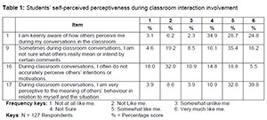
Table 1 reflects that 53,5 per cent of students indicated that they were somewhat to very much aware of how others perceived them during interaction involvement. Of the sample group of N =127 (100%) of students, a mere 2.3 per cent replied that it was somewhat unlike them to be cognisant of how other people perceived them during the interaction involvement, and similarly, only 3.1 per cent of students mentioned that it was not at all like them to take note of how others perceived them during classroom interactions. It thus appears that about half of the students demonstrated perceptiveness about what others thought about them during the interaction involvement in the classroom. However, 34.9 per cent declared that they were not sure of how others perceived them during classroom interaction involvement. In other words, more than half of the students indicated that they were perceptive about how the other participants in the classroom viewed them.
Although 35,4 per cent of students indicated that it was somewhat like them to be unsure of what others meant or intended by making certain comments during a conversation or interaction involvement, more than a quarter of the participating students responded they were uncertain of what their fellow classmates were saying during the interaction involvement. A similar number, namely, 32.0 per cent, communicated that it was not like them to perceive others' intentions or motivation during a conversation often inaccurately. In other words, students perceived themselves to have insight into what the other person was communicating, which could contribute indirectly to effective affective learning. In addition, 4.6 per cent of the respondents thought that it was not like them at all to be unsure of what others meant or intended by making comments during a conversation. This corresponds indirectly with the low percentage of 5,5 per cent of the students that showed that it was very much like them to perceive others' intentions or motivations inaccurately often. In other words, few students can attach meaning to behaviour, which led the researchers to deduce that only a small number of students were perceptive about the emotions associated with a particular behaviour. Therefore, the majority of the students were unable to demonstrate perceptiveness about other people's behaviour. As a result, it appears that most students did not acquire affective learning during interaction involvement.
To further elaborate on the perceptiveness of students in the classroom, 39.8 per cent of students stated that it was very much like them to be very perceptive regarding the meaning of others' behaviour in relation to themselves and the situation during the interaction involvement. In contrast, 3.9 per cent declared that it was not like them at all and somewhat unlike them to be very perceptive of the meaning of others' behaviour in relation to themselves and the situation. It thus appears that students are more perceptive about the meaning of the learning behaviour of their fellow students compared to their own learning development, which could possibly hamper effective learning within an affective learning framework. On the other hand, it could also mean that students demonstrate more empathy during interaction involvement, as they are more aware of the meaning of their learning behaviour
Students self-perceived attentiveness
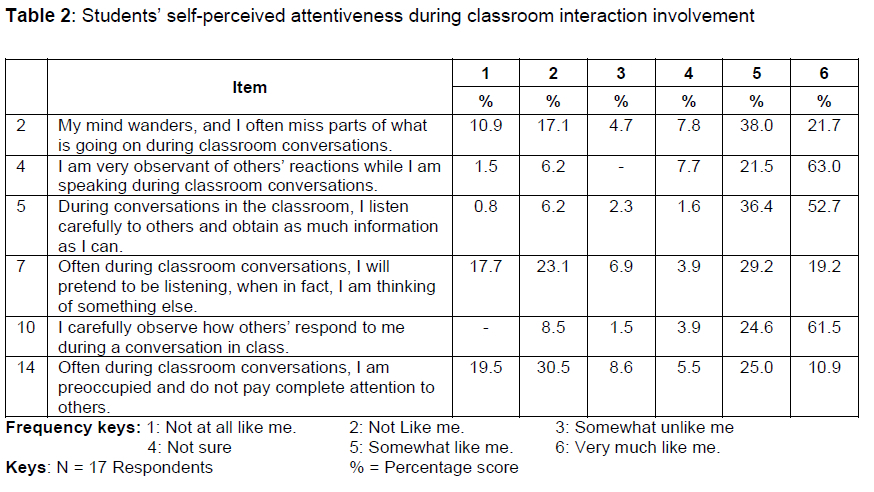
The second research question focused on students' perceptions of their attentiveness during interaction involvement in their classrooms. The researchers viewed this research question as important since students' ability to show a high level of attention competency signals their interaction involvement in the process of learning, which is likely to result in academic success. It is also important to note that students cannot manage effective learning if they are not attentive. Students' self-perceived attentiveness is summarised in Table 2.
Table 2 displays that only 4.7 per cent of the cohort of students indicated that it was somewhat unlike them for their minds to wander, resulting in them often missing part of what was going on during a conversation. This statistic is contradicted by the 38,0 per cent that were of the view that it is somewhat like them, with 21.7 per cent indicating that it was very much like them for their minds to wander and miss parts of the conversation. Accumulatively, these statistics indicate that more than half of the students did not focus during interaction involvement. Seufert and Brünken (2006) assert that attention determines the success of knowledge schemata construction, which is essential for academic achievement. In other words, more than half of the students had a poor attentiveness ability, which could lead to them experiencing educational difficulties. Differently put, more half than half of the students demonstrate low levels of attention competency during learning. These statistics paralleled the 63,0 per cent of the students who indicated that it was very much like them to be observant of others' reactions while they were speaking. Vierimaa (2013) reasons that when a student is observant and regards other classroom participants' feelings during the learning process, the students demonstrate empathy, which relates to affective classroom action involvement in this study. Moreover, most students (63,0%) seem to have empathy, which can result in an increased level of emotional learning awareness, which promotes increased affective perceptiveness in the classroom, in turn, and, subsequently, effective learning. Thus. It appears that the students were more attentive to the reaction of their fellow classroom participants, but not as attentive to process information with the purpose to expand on their knowledge schemata.
In contrast, only 1,5 per cent indicated that it was not like them at all to be observant of others' reactions while they were speaking. An insignificant 0.8 per cent of the students declared that it was not like them at all to listen carefully to others and obtain as much information as possible during classroom interaction involvement. In contrast, 52.7 per cent responded that it was very much like them to be attentive and obtain information. It appeared that affective learning based on attentiveness did occur in the classrooms. This seems to be corroborated by more than half of the respondents (63,0%) who indicated that it was very much like them to be very observant of others' reactions while they spoke. In addition, more than half of the respondents (52,7%), revealed that it was very much like them to listen carefully to others and obtain as much information as they could.
A total of 48,4 per cent (29,2% and 19,2% respectively) of the students indicated that it was often somewhat like them and very much like them to pretend to be listening, when they were thinking of something else during a conversation. The fact that a relatively large number of students pretended to be attentive in class, could point towards deceptive learning development, contributing to the misconceived self-perception about the learning progress. Interestingly, 17.7 per cent of the students shared that it was not at all like them to pretend to listen often in a conversation, when in fact, they were thinking of something else. Pedagogically, these results imply that fewer than a quarter of the students actually absorbed and retained knowledge. On the other hand, the majority of the students, 86,1 per cent, communicated that it was somewhat like them (24,5%) and very much like them (61,5%) to observe carefully how their classmates responded to them during the classroom interaction. This means that the majority of the students were attentive concerning how others responded to them during classroom interaction involvement. Despite this, a quarter of the students (25%), stated that they were preoccupied and did not pay complete attention to others during conversations.
Students self-perceived responsiveness
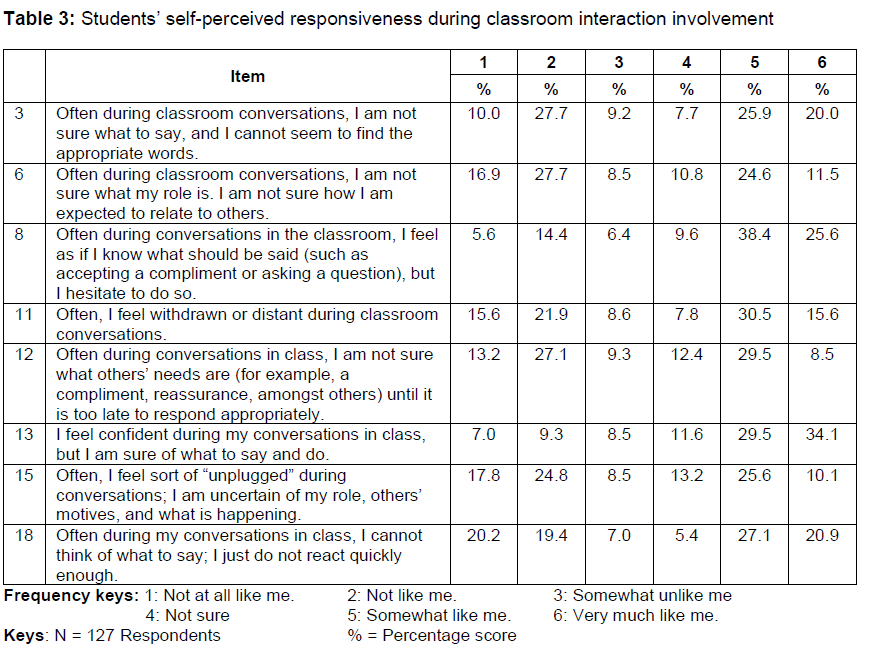
The third research question focused on the students' perceptions of their responsiveness during classroom interaction involvement. The researchers felt it necessary to explore whether the students were able to communicate sensitively, receptively, and in an approachable fashion, putting their classmates at ease when communicating, as well as acknowledging their classmates' needs and desires during classroom engagement. Students' self-perceived responsiveness is summarised in Table 3.
Table 3 reflects students' responsiveness during classroom interaction involvement, and whether students know what to say and how to respond during classroom conversations, or classroom interaction involvement. It was interesting to note that 25.9 per cent and 20.0 per cent, respectively, indicated that it was somewhat like them and very much like them to be X students affirmed that they were uncertain of how to act responsively during classroom interaction involvement. In turn, 27.7 per cent were of the view that it was unlike them to be unsure often about what to say in a conversation, similar to the 27.7 per cent of the students that said it was not like them not to be sure of their role or how they were expected to relate to other during classroom interaction. This means that only 16.9 per cent of students were confident about their responsiveness during a learning event. An almost equal number of students, namely, 24.6 per cent, indicated that it was somewhat like them to be unsure often of what their role was or how they were expected to relate to others during classroom interactive involvement. Therefore, it is unclear whether the students knew what to say during classroom conversations or not; students seemed uncertain about their responses, and it is not clear whether affective responsiveness occurs during classroom interaction involvement.
Furthermore, most students (38.4% and 25.6, respectively) communicated that it is somewhat like them and very much like them to often say anything during a conversation. They felt like they knew what should be said, but hesitated to say anything. Indirectly, this finding communicates that students were not confidently responsive during the interaction involvement because if they were, they might have been more inclined to respond. McCraty (2005) asserts that students' emotional states during classroom interaction involvement affects whether they achieve their educational goals in the classroom. Boyd et al. (2006, 25) concur that students' emotional state, and the extent to which they are emotionally involved in classroom interaction, can nurture the construct of meaning from information and experiences that support this information. Based on the findings of this study, 64 per cent of the students (38.4% and 25.6%, respectively) were hesitant to participate during classroom interaction involvements, which may imply that students failed to achieve their educational goals also because they were affectively disconnected from the learning process, and that was why they were hesitant about responding during classroom interaction involvement.
While some 15.6 per cent of the students responded that it was not at all like them to feel withdrawn or distant during a conversation, the same percentage of students felt it was very much like them. However, 30.5 per cent of the students affirmed that they felt somewhat withdrawn and distant during conversations in the classroom. This means that more than a quarter of students were emotionally absent from interactive involvement in the classroom. It appears that those students who participated less were psychologically removed from the ongoing interaction and appeared to be lost in the discussion. In other words, the results of this study revealed that a number of students felt emotionally detached from the classroom even if they were present, and therefore failed to demonstrate responsiveness during learning. This finding is in line with that of Cegala et al. (1982).
In terms of responsiveness during classroom interaction involvement, only 8.5 per cent of the students indicated that it was very much like them not to be sure what their classmates' needs were during a conversation until it was too late to respond appropriately. However, in response to the same statement, 13.2 per cent said it was not at all like them to be unsure of what classmates' needs were during a conversation. The findings furthermore confirmed that a small number, namely, 8.5 per cent, of the students perceived themselves to be empathic, or able to understand their classmate's point of view during classroom conversations. This indicates indirectly that most students did not experience affective learning in the classroom.
In addition, 29.5 per cent of the students revealed that it was somewhat like them not to be sure what their classmates' needs were in a conversation until it was too late to respond appropriately. This statistic is contradicted by the same statistical value, with 29,5 per cent of the students revealing that it was somewhat like them to be sure of what to say and do during interaction involvement in the classroom. Only 7.0 per cent and 9.3 per cent respectively revealed that it was not at all like them and not like them to feel confident during conversations, while most of the learners (63.6%) felt somewhat to very much confident about what to say and do during classroom interactive involvement. This implies that the majority of the students who were highly involved in classroom interaction tended to be confident in what to say and how to say it (Frymier, 2005).
These results thus indicate that majority of the students perceived that they demonstrated affective responsiveness during classroom conversations. Only ten students, namely, 1 per cent of the total number of students (N =127), confirmed that it was very much like them to feel somewhat unplugged often, during classroom interaction involvement. However, double the number of students, that is 20.2 per cent, stated that it was not at all like them to be unable to think of what to say or not react quickly enough during a conversation. Almost the same number of students, 20.9 per cent, indicated that it was very much like them to be unable to think of what to say or just not respond quickly enough during interaction involvement.
More than half of the students indicated that they were aware of how classmates felt about them during a conversation. In other words, how the instructor or their classmates viewed them during a conversation, or interaction involvement, could encourage or discourage their learning process. Furthermore, not only did the majority of students indicate that their minds often wandered during classroom conversation, but half of the students shared that during classroom interaction involvement, they just pretended to be listening to others whilst their thoughts actually wandered. Concerning the responsiveness within the learning process, almost half of the students indicated that they could not think of what to say, and were therefore slow to react quickly, which may be the reason why just less than half of the students noted that they felt withdrawn and distant during classroom conversations. Considering the above findings, it seems as if there was an absence of affective learning stimulation in a holistic context in the classroom.
CONCLUSION
This study set out to investigate and understand students' self-perceived affective learning during classroom interaction involvement. The primary findings in response to the research questions indicated that students were perceptive of how classmates viewed them during classroom interaction involvement, but showed little concern for their own affective learning development process. In addition, students lacked attentiveness during classroom interaction, because their minds were prone to wandering, or they just pretended to be listening to others, whilst they focussed on something else. Furthermore, although students perceived themselves to be responsive classroom participants, the fact that they frequently hesitated to respond, were unsure of what to say, and felt withdrawn during classroom conversations, indicate a need for more responsiveness during classroom interaction.
Although the results indicated that the participating students perceived that they demonstrated perceptiveness, there appeared to be a lack of both attentiveness and responsiveness during classroom conversations. In other words, there is a need for more affective learning development during classroom interaction involvement.
Since affective instruction-learning significantly contributes to learning development in a holistic context, the importance of affective learning during classroom interaction involvement cannot be over-emphasised. There is no doubt that affective factors are relevant to promote holistic learning development, and students' affective learning development should be stimulated during classroom interaction involvement. Yet, despite affective learning factors being necessary for a holistic classroom experience, little research has been done in this area. The findings of this study can assist students in becoming more perceptive regarding their own affective learning and possibly encourage them to express their independent learning during classroom interaction involvement.
IMPLICATIONS REGARDING INSTRUCTIONThis study's premise is that students' perceptions comprise their thoughts, beliefs, and feelings about persons, situations, and events. Therefore, lecturers' understanding and awareness of these traits are important for supporting, developing, and finding effective ways to improve students' social and emotional learning. We also acknowledge that perceptions of self and others play a fundamental role in the effectiveness of classroom interactions. Based on students' self-reports, there are several practical implications regarding this study that are important for the promotion of affective instruction-learning development in the classroom. The self-reports suggest that students have a low self-perceived perception of their own classroom interaction. Accordingly, the authors of this article believe that lecturers are in a favourable position to help students improve their affective abilities so that students can exhibit greater interest during classroom interaction involvement. Specifically, lecturers should find effective ways of improving students' emotional learning.
This belief is informed by the view that students who perceive high-quality classroom interactions are more engaged in their school work. Therefore, lecturers should ensure that their students are engaged during the classroom interactions to optimise each student's learning and development. The findings also indicate that students frequently hesitate to respond, are sometimes unsure of what to say, and feel withdrawn during classroom interaction involvement. The authors of this article believe that education is one of the processes shaping the moral imagination, character, skills, and intellect of students, giving them the resources to prepare to fully participate as conscientious agents for the greater good of society. It is against this view that lecturers should assist students in knowing what to say and how to respond during classroom interactions. If these students are not aware of their own affective learning and are unresponsive in the classroom, they are unlikely to develop and expand their own affective learning experiences in a holistic manner. When students have lecturers who care and encourage their development, it is believed that students are more likely to be engaged during classroom interactions.
Furthermore, we strongly believe that teachers should administer self-reports to students to assess how they use the responsive-perceptive-attentiveness during classroom interactions. The profiling of the students' responsive-perception-attentiveness is likely to assist lecturers in understanding their students' social approach and behaviour during classroom interaction. Having this information is likely to assist lecturers with adjusting their instruction approaches accordingly. In addition, the lecturers' affective instruction-learning programme can be adapted or redesigned to support the students' holistic development better within the cognitive, behavioural and affective learning domains. The inclusion of an affective instruction-based strategy could perhaps elicit greater interaction responsive behaviour from students during classroom interaction involvement. Therefore, it is important for instructors to redesign their affective instruction strategy programme and to be aware of their students' affective learning behaviours to plan and provide instruction that accommodates different affective learning components, for the students to have a holistic classroom interaction involvement experience.
REFERENCES
LITERATURE REVIEW
- Agih, A. A. 2017. "Integrating elements of the affective domain in teaching, assessment and grading of students' performance for affective learning." Journal of Emerging Trends in Educational Research and Policy Studies 8(4): 232-236.
- Arkkelin, D. 2014. Using SPSS to understand research and data analysis. Psychology Curricular Material. Valparais, Indiana. Valparaiso University Press.
-
Armstrong, P. 2010. "Bloom's taxonomy. Vanderbilt University Center for Teaching." https://cft.vanderbit.edu/guides-sub-pages/blooms-taxonomy/. (Accessed 12 February 2022).
» https://cft.vanderbit.edu/guides-sub-pages/blooms-taxonomy/ - Aydin, B., F. Bayram, B. Canidor, and G. Cetin. 2009. "Views of English language teachers on the affective domain of language teaching in Turkey." Anadolu University Journal of Social Sciences 9(1): 263-280.
- Baijnath, N. 2018. "Learning for development in the context of South Africa: Considerations for open education resources in improving higher education outcomes." Journal of Learning for Development 5(2): 87-100.
- Bharuthram, S. 2018. "Attending to the affective: Exploring first year students' emotional experiences at university." South African Journal of Higher Education 32(2): 27-42.
-
Boyd, B. L., K. E. Dooley, and S. Odom. 2006. "Measuring learning in the affective domain using reflective writing about a virtual international agriculture experience." Journal of Agricultural Education 24(3) September. DOI 10.5032/jae.2006.03024.
» https://doi.org/10.5032/jae.2006.03024 -
Brouse, K. 2021. "Understanding the affective domain of learning." https:///www.graduateprogram.org/2021/05/understanding-the-affective-domain-of. (Accessed 11 February 2022).
» https:///www.graduateprogram.org/2021/05/understanding-the-affective-domain-of - Brown, D. L., M. J. Ferril, A. B. Hinton, and A. Shek. 2001. "Self-directed professional development: The pursuit of affective learning." American Journal of Pharmaceutical Education 65: 240-246.
- Cegala, D. J. 1981. "Interaction Involvement: A cognitive dimension of communicative competence." Communication Education 30(2) April: 109-21.
-
Cegala, D. J., G. T. Savage, C. C. Brunner, and A. B. Conrad. 1982. "An elaboration of the meaning of interaction involvement: Towards the development of a theoretical concept." Communication Monographs 49(4): 229-248. DOI: 10.1080/03637758209376087.
» https://doi.org/10.1080/03637758209376087 - Check, J. and R. K. Schutt. 2012. "Survey research." In Research Methods in Education, ed. J. Check and R. K. Schutt, 159-185. Thousand Oaks, CA: Sage Publications.
- Craig, D. J. and S. J. Savage. 2015. "Does instructor appearance affect student learning of principles of economics?" Australian Journal of Economics Education 12(2): 30-49.
- Creswell, J. W. 2014. Research Design: Qualitative, Quantitative, and Mixed Methods Approaches. 4th Edition. Thousand Oaks, California: Sage Publications.
- Dorji-Yangzom, P. 2021. "Affective domain: The unchartered area of teaching and learning in tertiary education." Asian Research Journal of Arts & Social Sciences 13(11): 51-65.
- Fiske, S. T. and S. E. Taylor. 1991. Social Cognition. New York: McGraw Hill.
- Fosterling, F. 2001. An Introduction to Theories, Research and Applications. Munich, Germany: Psychology Press.
-
Fredricks, J. A., P. C. Blumenfeld, and A. Paris. 2004. "School engagement: Potential of the concept: State of the evidence." Review of Educational Research 74: 59-109. doi: 10.3102/00346543074001059.
» https://doi.org/10.3102/00346543074001059 - Frisby, B. N. and M. M. Martin. 2010. "Instructor student and student-student rapport in the classroom." Communication Education 59(2): 146-164.
- Frymier, A. B. 2005. "Students' classroom communication effectiveness." Communication Quarterly 53: 197-212.
-
Goldberg, P., R. Gollner, P. Gerjets, and U. Trautwein. 2019. "Alternative or not? Toward a machine learning approach to assessing students' visible engagement in classroom institution." Educational Psychology Review. https://doi.org/10.1007/s10648-019-095114-z. (Accessed 1 June 2020).
» https://doi.org/10.1007/s10648-019-095114-z - Gronhaug, K. and J. S. Falkenberg. 1994. "Success attributions within and across organisations." Journal of European Industrial Training 18: 22-30.
- Hurst, Beth, Randall Wallace, and Sarah Nixon. 2015. "The impact of social interaction on student learning." Reading Horizons: A Journal of Literacy and Language Arts (Online) 52(4): 375-398.
- Johnson M. and N. Beela. 2015. "The role of teachers in motivating students to learn." B.U. Journal of Graduate Studies in Education 9(1): 46-49.
- Krashen, S. 1985. The Input Hypothesis Issues and implications. New York Longman.
-
Lifen, H. E. 2016. "On perceptive teaching in Chinese middle school English teaching." SHS Web of Conferences 25, 01006 ICITCE 2015. DOI:10.1051/shsconf/20162501006.
» https://doi.org/10.1051/shsconf/20162501006 - Llewellyn, A. and D. Cahoon. 1990. "Teaching for affective learning." Educational Leadership 22(7): 469-472.
-
London School of Management Education. 2019. "The three domains of learning-cognitive, affective and psychomotor (CAPS) - Its application in teaching and learning." https://Isme.ac.uk/blog/the-three-3-domains-of-learning. (Accessed 13 August 2021).
» https://Isme.ac.uk/blog/the-three-3-domains-of-learning - Maree, K. 2016. First steps in research. Pretoria: Van Schaik Publishers
- McCraty, R. 2005. "Enhancing emotional, social, and academic learning with heart rhythm coherence feedback." Biofeedback and Self-Regulation 33(4): 130-134.
- McCroskey, J. C. and V. P. Richmond. 1996. Fundamentals of Human Communication: An Interpersonal Perspective. Prospect Heights, IL: Waveland Press.
-
Miller, M. 2005. "Learning and teaching in the affective domain." In Emerging Perspectives on Teaching And Technology, ed. M. Orey. http://www.coe.uga.edu/affective.html. (Accessed 17 September 2020).
» http://www.coe.uga.edu/affective.html - Myers, S. A. and L. E. Bryant. 2002. "Perceived understanding, interaction involvement, and collegestudent outcomes." Communication Research Reports 19(2): 146-155.
-
Nande, B. K., D. A. Aboho, and B. U. Maduewesi. 2019. "Affective domain: Neglected area of learning objectives in Nigeria's primary and secondary schools. World Education Forum." www.globalacademicgroup.com. (Accessed 11 February 2022).
» www.globalacademicgroup.com - Noddings, N. 1984. Caring, a Feminine Approach to Ethics and Moral Education. Los Angeles: University of California Press.
- Nyamupangedengu, E. 2017. "Investigating factors that impact the success of students in a higher education classroom: A case study." Journal of Education 68: 113-130.
-
Patson, N. 2020. "Getting students to discuss by channeling the affective domain." https://www.facultyfocus.com/tag/affect-domain/. (Accessed 12 February 2022).
» https://www.facultyfocus.com/tag/affect-domain/ - Pierre, E. and J. Oughton. 2007. "The affective domain: Undiscovered country." College Quarterly10(4): 1-7.
-
Posner, M. I. 1988. "Structures and function of selective attention." In Clinical Neuropsychology and Brain Function: Research, Measurement, and Practice, ed. T. Boll and B. K. Bryant, 173-202. American Psychological Association. https://doi.org/10.1037/10063-005. (Accessed 27 January 2021).
» https://doi.org/10.1037/10063-005 - Salovey, P., J. D. Mayer, and D. Caruso. 2002. "The positive psychology of emotional intelligence." In Handbook of positive psychology, ed. C. R. Snyder and S. J. Lopez, 159-171. Oxford University Press.
- Segabutla, M. H. 2015. "Exploring perceptions of lecturers' instructional communication as a reflection of instructional competence." Doctoral dissertation. University of Pretoria.
-
Seufert, T. and R. Brünken. 2006. "Cognitive Load and the Format of Instructional Aids for Coherence Formation." Applied Cognitive Psychology 20(3): 321-331. https://doi.org/10.1002/acp.1248. (Accessed 01 August 2021).
» https://doi.org/10.1002/acp.1248 - Shah, J. and H. M. Inamullah. 2012. "Overcrowded classrooms: A serious problem for teachers." The Journal of Educational Strategies 5(1): 772-789.
-
Shakeel, S. 2019. "The influence of affective domain on the learning of students at primary level." https://ssrm.com/abstract=3756396. (Accessed 12 February 2022).
» https://ssrm.com/abstract=3756396 - Sherman, S. 2004. "Responsiveness in teaching: Responsibility in its most particular sense." The Educational Forum 68(2): 115-125.
- Sollitto, M., Z. D. Johnson, and S. A. Myers. 2013. "Students' perceptions of college classroom connectedness, assimilation and peer relationships." Communication Education 62(3): 318-331.
- Spitzberg, B. H. and W. R. Cupach. 1989. Handbook of Interpersonal Competence Research. New York Springer-Verlag.
-
Stearns, C. 2018. "Emotional intelligence activities for college students." https://study.com/academy/lesson/emotional-intelligence-activities-for-college-students. (Accessed 11 February 2022).
» https://study.com/academy/lesson/emotional-intelligence-activities-for-college-students - Stevick, E. W. 1980. Teaching Languages a Way and Ways. Rowley, MA Newbury House.
-
Uribe, J. 2011. "Discovering the fascinating world of affective language learning with young children." https://draft.blogger.com/dyn-css/authorization.css?
» https://draft.blogger.com/dyn-css/authorization.css? - Van Manen, M. 2002. The Tone of Teaching: The Language of Pedagogy. 2nd Edition. London, Ontario, Canada: Althouse Press.
- Van Valkenburg, J. and L. K. Holden. 2004. "Teaching methods in the affective domain." Radiologic Technology 75(5): 1-8.
- Vierimaa, J. 2013. Emotional Intelligence and Project Teachership: An Explorative Study. Göteborg, Sweden: Chalmers University of Technology.
- Weiner, Bernard. 2010. Attribution Theory. Springer. 10.1002/9780470479216.corpsy0098.
- White, 2005. Research: A practical guide. Pretoria: Ithuthuko Investments.