Social change and transformation as a developmental agenda in the South African higher education
Abstract
The National Development Plan (NDP) advocates for the elimination of poverty, and the reduction of inequality by 2030. These goals can only be achieved if we harness the energies of the people, build an inclusive economy, develop skills, improve the capacity of the state and promote leadership and partnerships across society. This is to be achieved through transforming society more equitably and at the same time making the country more competitive in the global economic system. The article seeks to explore how institutions of higher learning can be transformed through the production of future professors with a developmental agenda. Therefore, the NDP advocates continuous professional development, lifelong learning and knowledge production, and innovation as a focus for building the capacity of individuals and society. The article employed the modernisation theory as a vehicle to drive social change and transformation in higher education. The article employed a systematic review of the literature on transformation and social change in higher education as advocated in the NDP. The findings of the article show that universal human development can be achieved by respecting human rights, promoting equality and empowering people to exercise the opportunities and choices they value in higher education. The article recommends that a structured interaction between lecturers and students within the context of transformative change and social justice should be prioritised in higher education. This can only be achieved through preparing the future professor with a developmental agenda to assist in shaping higher education by designing a curriculum that responds to the needs of the current cohort of students.
developmental agenda; future professoriate; modernisation theory; social change; transformation
INTRODUCTION
Society in general has huge expectations of the role that Institutions of Higher Learning should play by actively engaging with them and at the same time taking responsibility by transferring their expertise to the immediate local context in order to promote sustainable development and social innovation (Jordaan and Mennega 2021). In this way, Institutions of Higher Learning assist communities by directing their knowledge, expertise, and the work of their academics and students on the critical challenges and opportunities that communities face (Schlossberg et al. 2018). Whittle and Rampton argue that higher education institutions face the challenge of promoting effective management of their efforts to solve societal problems, as identified by the United Nations in the 2030 Sustainable Development Goals (SDGs), in an increasingly competitive and complex global environment. The environment in which universities operate is dynamic and encompasses numerous aspects that should be carefully considered in their diversity (Whittle and Rampton 2020).
Academic freedom encompasses the ability to conduct research and publish relevant results, the freedom to instruct and discuss, and the freedom to criticise higher education institutions without being exposed to censorship (Timbermont 2023). Tenure is an institutional framework that defines the professoriate and serves as a concrete expression of this freedom in the United States and other nations with comparable higher education systems (Finkelstein and Kelchen 2020). Xavier (2023) claims that certain professions in society lack characteristics such as employment stability, freedom of speech, and significant participation in collegial leadership. The author also points out that the tenure system helps colleges recruit and retain outstanding individuals from the business community, which benefits companies and advances the field of human resource management.
To produce graduates of high calibre, higher education institutions must embrace technology as a transformative tool. The idea of multimodal teaching has altered the landscape of higher education by emphasizing community well-being and appropriate engagement methods (Philippe et al. 2020). Therefore, universities have made an enormous contribution in giving support to policymakers, frontline workers, and civic society organisations in addressing societal challenges and support during the crisis (Jarvis 2023). The health and wellbeing of faculty and staff in the higher education sector was another important consideration during the changeover. Avenues had exhausted its support capacity and, in most cases, technology was found to play a critical role in helping students complete their academic programs (Alakavuklar and Alamgir 2018). Therefore, transformation in institutions of higher education should not be seen as an act that does not require planning and proper implementation. At the same time bearing in mind the stakeholders i.e. students and staff should always be put at the centre since they are part of the whole agenda. Scholars such as (Alakavuklar and Alamgir 2018) in their seminal work argue that these stakeholders become change agents in challenging situations rather than adapting. The aim at the end is to create a sustainable social transformation through mobilising knowledge, capacity, resources as well as social agreements in a variety of social structures. According to Haugh and Talwar (2016) the concept of social change is complex, and it is known to be founded on the elimination of restrictions that impedes the progress of any organisation. Further to this, Sutter, Bruton, and Chen (2019) attest to the fact that social change and how societal reforms unfold as a value-driven process bring forth ethical principles that should guide the change. This means that there are ethical questions that need to be answered during the process of change which should not be taken for granted.
According to Reinecke and Ansari (2015), most organisations do struggle to cope with societal change because of ethical complexity. Organisations attempting to bring about social change are therefore constantly faced with the challenge of managing the ethical complexity that arises from the lack of predetermined principles that govern conduct (Bhatt 2022). However, scholars such as Alakavuklar and Alamgir (2018) propose that institutions should priorities addressing social problems which results in being confronted with social order. Otherwise, they would expose themselves to a social order that reinforces the normative ethics of conformity and re-establishes mechanisms of oppression. The article focusses on the modernisation theoretical framework and its relevance to the social impact and transformation in higher education. It further addresses challenges faced by higher education institutions in preparing the future professoriate which can make an impact in the sector.
THEORETICAL FRAMEWORK: MODERNISATION THEORY
According to (Ntini 2016), the development of modernisation theory can be traced back to the 1950s, when it emerged as an intellectual reaction to the events of the Second World War. Scholars such as Ntini (2016) argue that the theory focussed primarily on the changes that were taking place in the Third World at the time. The aim was to understand these transformations as a process of modernisation. It also assumes that modernisation is a transformation process in which societies evolve from a traditional to a modern state.
In a seminal work conducted by Rulashe and Nkonki (2017) modernisation is defined as an act of becoming modern to meet modern needs. The scholars believe that it involves catching up with, reaching, and/or behaviour, structure, system, and ideas. The forms of change include formation, development, transition, and interaction. The contents of change, in modernisation are characterised by evolution, selection, diffusion, and withdrawal (He 2012).
There have been various interpretations of the history of the theory by other scholars such as Alexander, (1994, 168), Harrison, (1988, 30), and Huntington, (1971, 288-90) in Knobl (2002, 160-161) assumed modernisation theory as:
• "Modernization, which began in Europe during the Industrial Revolution in the mid-18th century (or earlier), is an all-encompassing and irreversible phenomenon that has influenced societies worldwide since the end of the Second World War;
• The historical progression of modernisation from traditional to modem societies implies that tradition and modernity are diametrically opposed.
• In conventional societies and nations commonly referred to as the 'Third World', personal attitudes, values and role structures have a major influence. These factors are often described with terms such as 'particularism', 'ascription' and 'functional diffuseness' These characteristics are a huge obstacle to economic and political progress;
• In contemporary societies of Euro-American civilisation, secular, individualistic and scientific values prevail, together with the corresponding role clusters;
• Modernisation is an inherent process that takes place within societies and should be studied as interrelated entities, preferably through the lens of structural-functionalism. The evolution of societies towards modernity is expected to be relatively consistent and sequential in different contexts" (Alakavuklar and Alamgir 2018).
It should be noted that the modernisation theory aims at identifying variables that contribute to progress and development and further explains the process of evolution. The theory not only emphasises the process of change but also explains the response to the change identified. The internal dynamics, social and cultural structure as well as adapting to new technologies (Rulashe and Nkonki 2017). This implies that institutions in the process of change have a lot to consider as it impacts the direction the institution intends to take. It further impacts on the achievement of the goals and objectives of the institution. The existence of new technologies to improve teaching and learning in institutions requires a lot of planning internally. The process is ongoing and requires proper investment in the resources that the institution has at its disposal.
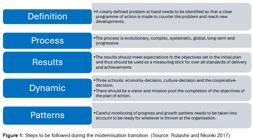
The above steps indicate the need to clearly define the programme of action in the institution during the process of transformation. At the same time, it indicates ways of dealing with problems that should arise in the process as there are new developments taking place. In the process, it should be noted that evolution is complex, systematic, global, long-term, and progressive. This means results cannot be achieved in the short term however it is a long-term commitment. This should be realised by all stakeholders involved in the progress of development. The stages further indicate that the achievement of the results should be in line with the stated objectives and there should be a yardstick used to measure the process made. Lastly, careful monitoring of progress and growth patterns needs to be ready for whatever is thrown at the organisation.
RESEARCH METHODOLOGYThe NDP's recommendations for transformation and social change in higher education were implemented in the essay through a methodical study of the literature. The article used a systematic review to interpret data from published studies on higher education transition. After the chosen issue was examined, explained, and interpretations of the concepts under investigation were critically evaluated, an evidence-based conclusion was reached. Secondary sources helped with data collection and analysis regarding how producing future academics with a developmental agenda might improve higher education institutions.
TRANSFORMATION IN HIGHER EDUCATIONHigher Education Institutions around the World have gone through enormous challenges both in external global needs as well as knowledge and structure required for their development and transformation (Dullaart et al. 2023). Countries have experienced different pandemics, massification, online learning and teaching, poorly maintained infrastructure, and loss of key competencies, these are some issues that drive change in this era (Moksel 2022). According to Akour and Alenezi (2022) attending higher education institutions was an opportunity that was set aside for a certain group of society. Today, it has become a prerequisite for success, and family responsibility, and has assisted in addressing the world's pressing challenges that affect members of the society. The South African Department of Higher Education do admit the role it has to play in transforming universities since it has to redress past inequalities and ensure that a new social order in the education system is achieved (Department of Education 1997). As a means of addressing the challenges of a new democratic, non-racial and gender-free society, the imperative to reform higher education should ensure that its structure is both historical and contemporary. While traditional education remains relevant, it is increasingly important to ensure lifelong, skills-based education that is accessible to individuals at all stages of their lives (Akour and Alenezi 2022). At the same time, the advancement of technology and how conventional methods have been used to restrict access to education (Ntini 2016). Hence, the need to ensure lifelong learning on how the curriculum is taught in institutions of higher learning is important since reference is always drawn at any stage of life. The Council for Higher Education attest that teaching is more than a craft however it is also a profession. It should be knowledge or theory based because of the existence of an extensive body of knowledge on learning in Higher Education more specifically on the teaching of disciplines (Department of Higher Education 2021).
In a study conducted by Alenezi (2021) the involvement of all stakeholders in the transformation process tends to provide positive benefits as it improves learning and teaching. To achieve this, universities need to have a better understanding of the gaps in terms of skills needed in the future. This enables universities to ensure that students receive an appropriate education and are equipped with the essential knowledge they need to be successful in the years to come. This critical knowledge is important to institutions of higher as since it touches on the curriculum offered and understanding of the dynamics in the workplace. It should be noted that technological advancement is key in the transformation process however this does underestimate the role that still needs to be played by stakeholders in the process. Students, employers, and university professors should be prepared to abrase the change brought by uncertainties and vulnerabilities brought by the advancement of technology. At the same time, no one can predict the future, and forthcoming events can never be predicted (Ntini 2016).
Scholars such as Goulart, Liboni, and Cezarino (2021) argue that institutions of higher learning should be prepared to train their employees to meet the educational demands brought by the advancement of technology. What this means is that a budget should be set aside to train human resources, this cannot be a once-off engagement however it is ongoing. Hence Cederquist, Fishman, and Teasley (2022) suggest that access to the curriculum on online learning is critical for the development of skills to employee's institution of higher learning. Further to that module reviews on student experience on the applicability of the technology, development of their digital abilities the graduation process, and certification are critical. Scholars such as Rulashe and Nkonki (2017) further advocate that the skills which are required by employers from employees, module/exit outcomes of programs, alumni profiles; and the benefits of professional student growth should assist in determining the kind of graduates and employees the institution intends to produce. In addition, scholars such as Shriberg and Harris (2012) attest to the fact that HEIs have a responsibility to provide students with a new learning experience for future growth and sustainability. For this to be achieved, scholars such as Zhu and Caliskan (2022) emphasise the role to be played by HEIs in society. The scholars further suggest that it is an ongoing process that requires institutional change at the same time this is threatened by the reforms which are brought by the change. Again, these must continue contributing to the democratic processes adopted in the country which supports how decisions should be taken which affects stakeholders at the same time while maintaining confidence in the society. According to Bidandi, Anthony, and Mukong (2022) some university in South Africa from their inception have been able to collaborate with various stakeholders for purposes of advancement, development and sustainability. Hence, the need for university to prioritise stakeholder engagement is critical for future development.
FUTURE PROFESSORIATE IN HIGHER EDUCATION AS A CATALYSTIn a study conducted by Hermanowicz (2018) institutions of higher learning and their dependence on the production of professoriate have experienced a lot of changes caused by globalisation and the exposure of countries to different economies. The scholar further argues that there have been changes in science, technology, and scholarship as the globalisation becomes key in institutions of higher learning. The dissemination of knowledge, research, scientists and students thus transcends national borders and is becoming increasingly mobile. The current state of affairs, then, is that university academic rankings have gone global, demonstrating the kind of consensus that supports an increasingly institutionalised global enterprise (Akour and Alenezi 2022).
Scholars such as Bitzer (2008) view the status of a professor in the reviewed literature as having significant systematic and institutional differences amongst countries. A study conducted in North America focused on the preparation of doctoral students for a profession and concluded that in most cases, the structures, activities, and requirements of doctoral programs are not conducive to academic preparation eventually leading to the scholarly duties and responsibilities of a professor (Department of Education 1997). Thus, Austin and McDaniels (2006) indicate that the preparation of graduates in the end produces graduates who are talented and have the required knowledge to compete in the global world. However, the key mandate is to ensure that the future generation is prepared to compete in the ever-changing world. How these students are socialised contributes to how academics in the faculties understand the tasks assigned to them and can assume their professional roles.
For example, the Syracuse University, Department of Anthropology's Future Professoriate Program has two fundamental goals:
• "To adequately equip graduate students for the pedagogical responsibilities they will face as future faculty members, and
• To promote a change in faculty culture by recognising the importance of teaching as an element of postgraduate education." (Rhoades 2022).
The programme achieves the above objectives through teaching-work sessions, faculty members acting as teaching mentors and the selection of FPP participants. The participants are drawn from different departments to participate in the University-wide Future Professoriate Program (Rhoades 2022).
The Future Professors Programme (FPP) is a flagship initiative of the South African Department of Higher Education and Training and is a significant program. It is a national, collaborative project designed to contribute to the development of a future South African professoriate by promoting the attributes of academic standing and leadership in university scholarship (Department of Higher Education 2020). The programs are hosted by the University of Stellenbosch and the University of Johannesburg, respectively. The FPP hosted by the University of Johannesburg (Cohort 2) focuses on:
• "Preparing participants for professoriate positions, and professional duties.
• through the development of the scholarship of learning and teaching, the scholarship of research, and public scholarship at the level of professional conduct." (University of Johannesburg Future Professor Programme n.d.).
The FPP2 is aimed at involving innovative approaches to the growing professoriate in the country through the implementation of a coherent, structured, and effectively supported program. The aim is to fulfil the need for a significant number of academic leaders and outstanding personalities in the higher education sector in South Africa (Cederquist et al. 2022). Participants are drawn from the 26 universities in the country to participate in the program from various disciples.
Scholars such as Ferris and Sweeney (2019) put the role to be played by faculties in promoting the principle of shared governance in the administration of institutions. The scholar advocates that academic institutions have the authority to promote a pragmatic and straightforward understanding of the principles proposed by administrators. At the same time, it ensures that there are creative ways to continue to teach modules with fully engaged faculties, encourage and support research, to embrace academic freedoms and the ideas that it nurtures (Shriberg and Harris 2012). Therefore, faculties have a responsibility to hire academics who have the potential to grow at the same time ensure that they are given ongoing support to ensure academic excellence. According to Virginia Tech Graduate School (2022) the implementation of a program to support academics is aimed at creating new models and new methods of training for the future professoriate. It is not about settling the status quo and witnessing the decline in sustainability however it is about ensuring that support is given to those joining faculties and the academic leaders for tomorrow.
According to Kezar (2018) areas of broad agreement within faculties as they develop indicate the need for new faculty models that are mindful of broader and institutional missions and values adopted in institutions. These should recognise the need to re-professionalise faculties, emphasizing values that are in line with those adopted by the institution, at the same time responding to the everchanging external forces. This can only be recognised once gaps are identified in the reviewing process of faculty operations and establishing new mandates for each department to be achieved in the coming years. The author Bidandi et al. (2022) developed the following consensus model for a scholarly educator who is on a professoriate journey whilst at the same time fulfilling the mandate of the institution as adopted in the vision and mission.
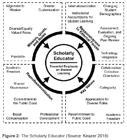
The above model is divided into four themes i.e. mission, goals and roles responsiveness to key values, external forces, and re-professionalisation. The themes indicate the journey that one transverse which emphasises student learning. The concerns affecting the professoriate in higher education have been described in various forms (The Presidency 2012). Notwithstanding the cultural differences between national systems and between wealthy, middle-income and developing countries, the author maintains that the opportunities and challenges for the professoriate are limited. These are influenced by how institutions are structured and the type of exposure the professor is exposed to.
A DEVELOPMENTAL AGENDA FOR TRANSFORMING HIGHER EDUCATIONAccording to the NDP's Vision 2030, all women and men should have access to quality technical, vocational and tertiary education, including higher education (Goal 4.3), at reasonable prices by 2030 (The Presidency 2012). Further to this, the NDP advocates for the elimination of poverty and reduction of inequality (Ncanywa 2019). Scholars such as Tamrat (2022) and Fia, Ghasemzadeh, and Paletta (2023) provide additional evidence that SDG 4 relates to the quality of education and that its targets relate to higher education. Sections 4.3 and 4.4 of this goal state: "By 2030, all men and women should have equal access to quality technical, vocational and tertiary education, including higher education, at an affordable price". It also states that by 2030, all students should have the necessary knowledge and skills to work towards sustainable development. This is to be achieved through sustainable lifelong learning and education that emphasises sustainable development, human rights, gender equality, the promotion of a culture of peace and non-violence, global citizenship and the appreciation of cultural diversity and its role in promoting sustainable development (Tamrat 2022). According to Shava et al. (2023) it should be widely acknowledged that high-quality education is one of the most effective and reliable means of promoting sustainable development. This idea may be utilized in both formal and informal educational settings and has the potential to benefit the broader public in several ways. The only important mechanism for bringing about change in the direction of sustainable development is education.
Sustainable development is defined as "development that meets the needs of the present generation while preserving the ability of future generations to meet their own needs" (Assembly, UN General 1987). Higher education understands sustainable development as a sustainability strategy that it implements, either independently or in collaboration with other stakeholders, to address the pressing sustainability challenges that arise in the pursuit of the SDGs (Franco et al. 2019). Using knowledge, skills, and values to address the sustainability agenda considers universities' roles as facilitators of the development, dissemination, and advancing the principles of sustainability in society as well as their ability to influence and shape society's future via their core missions of research and teaching (Rhoades 2022).
According to Ruiz-Mallén and Heras (2020), institutions of higher learning have been formally engaged in matters of sustainability since the Rio Summit in 1992 when Agenda 21 was put into effect in its previously published Chapters 35 and 36 (Ruiz-Mallén and Heras 2020). The Summit's Agenda was to ensure that universities understand the importance of achieving the SDG on quality education. Scholars, including Franco et al. (2019) have urged universities to: (i) strengthen scientific skills and capacity to conduct long-term assessments; (ii) align education with the goal of promoting sustainable development; (iv) educate the public about the interdependence of human activities and the environment; and (v) provide training to cultivate human resources and facilitate the transition to a more sustainable global society. To promote sustainability, universities integrate sustainability concerns into campus operations, research, curricula, and outreach initiatives. To promote sustainability, universities are integrating sustainability concerns into campus operations, curricula, research and outreach initiatives, among other measures. According to the findings of a study by Leal Filho et al. (2019) on universities on five continents regarding the integration of the 2030 Agenda SGDs into sustainability education, lectures are the most widely used method of incorporating these topics. In contrast, the Department of Higher Education (2020) claims that there is no consensus framework among academic institutions for the implementation of the 2030 Agenda strategies. The existing literature does not explicitly position any particular measure within a framework that encompasses multiple levels and measures. The lack of structure in this approach presents a challenge in effectively applying the findings to practical actions that can advance the HEI's goals. Knowledge appears to be fragmented, making it more difficult to identify and replicate good practise.
Building human resources and capacity is essential in the creation of a single, successful coordinated system. According to the DHET Department of Education (1997), increasing and developing capacity in all areas - academic, governance, and infrastructure, for example -ensures that the enlarged and redesigned higher education system will operate effectively.
FINDINGS AND DISCUSSIONS
The findings of the article suggest that universal human development can be realized through the promotion of equality, the protection of human rights and the facilitation of the exercise of opportunities and choices important to individuals in the field of higher education.
Achievement of universal goal for human development
The above literature indicates the fragmentation that exists among institutions of higher learning. In as much as there is a national department of higher education and training however the implementation of the mandate differs from one institution to another. Future higher education's goals should include both producing professors and extending history, with a constant focus on teaching, research, and community involvement. The shared responsibility regarding the governance of institutions must be clearly defined and the implementation should be shared with all stakeholders such as students, staff, alumni, public and private sector, nongovernmental organisations. The academic freedom within universities should be restructured as a reflection of increasing pressure in the higher education sector. There should be a way of conducting monitoring and evaluation within the sector, the scorecards must be developed and addressed if institutions are to be sustainable. Scholars such as Hermanowicz (2018) attests to the fact that there are changes that have been witnessed in science, technology, and scholarship as the globalisation has become key in institutions of higher learning. Hence, the production of knowledge by researchers, and students provides a space for becoming increasingly mobile and extending to transcend national boundaries. The body of knowledge produced in universities should address societal issues that require interdisciplinarity in the approach to solving the problems identified. Innovative and integrated approaches should be adopted which assist in producing the next generation of global leaders in higher education (Chang and Caliskan 2022; Department of Education 1997; Department of Higher Education 2021).
Transformation in the higher education sector
The rankings of higher education institutions nationally and globally are an indication of a slow process of transformation. Studies conducted in the past indicate that changes in science, technology, and research have contributed to the changes in the global world (Brankovic, Hamann, and Ringel 2023). This means that the production of knowledge, by researchers has improved since it transcends outside national boundaries (Hermanowicz 2018). Institutions of higher learning have a responsibility to adopt new strategies to produce the next generation of leaders who have a responsibility to bring change to the world. This can only be accomplished by implementing the pertinent curricula created to generate scholars with worldwide significance.
The SDGs emphasise the provision of education to students. The kind of education to be provided should be of high quality since the aim at the end is to ensure sustainability. This cannot only be achieved by universities through the curriculum they offer however informal education can also play an important role (University of Johannesburg Future Professor Programme n.d.). Transformation can only be achieved if all stakeholders are involved in the transformation process and the benefits should improve learning and teaching (He 2012). The ranking of universities results in the ranking of students based on the universities attended because of the availability of resources. Hence, Department of Higher Education should ensure that class distinction even in the sector is addressed since it leads to the different skills possessed by students after graduation. The downside of this is that even the teaching and the research produced in institutions ranked to be the highest are well received by the other scholars in the field without interrogating their authenticity them. Hence, the universal treatment of universities is key so that the country can be able to achieve the national agenda. Skills needed in the future cannot only come from universities with high rankings, the production of new knowledge is a responsibility of all academics irrespective of affiliation (He 2012).
Capacitation of academics in higher education
Academics in higher education should recognise the need to upskill because of the changing times and the exposure to changing technologies (Padmaja and Mukul 2021). The SDGs advocate that by 2030, all learners must have the knowledge and skills needed to drive sustainable development. This includes promoting sustainable, continuous learning and education for sustainable development (Bitzer 2008). Acquiring the knowledge and skills includes the element of lifelong learning aimed at promoting sustainable development. It is imperative for administrators to allocate resources towards employee training in order to equip them to fulfil the expectations of the global workforce. The educational demands can only be met if academics are continually trained on how to embrace technology in teaching and learning (Knobl 2002). Once again, the involvement of stakeholders in the crafting of the mission and goals of the institution is critical for development to take place in institutions of higher learning.
The scholarly educator as advocated by Dullaart et al. (2023) should be committed to lifelong learning, re-professionalisation which involves professional development, and be committed to internationalisation at the same time be able to embrace technology. It should be noted that technology can never replace the educator however upskilling the educator is important to make an impact in the changing world. Academics should allow themselves to be learners to produce students who can compete in the global world. Prioritising lifelong learning should be key in higher education and academics should be prepared to go through this journey. Embracing technology in institutions of higher education as a form of transformation is key to producing quality graduates. The exposure to technology has introduced the concept of multimodal teaching and has changed the landscape in higher education and placed more emphasis on the community's well-being and how engagements should take place. Universities in their journey towards excellence have a responsibility to address internal dynamics, and social and cultural structures whilst adapting to the advancement of technology (Reinecke and Ansari 2015).
CONCLUSION
The role that higher education can play in the future is important for the future of the professoriate. Universities in their journey of producing new knowledge should be thoughtful, and purposeful and ensure that relations are sustainable with communities. The sharing of knowledge among academics should be one element that opens a space to learn from one another. Social change has its advantages however the response to the change is critical. This is what universities should aim for to ensure sustainability in learning and teaching, and research while at the same time promoting academic freedom. The article recommends that a structured interaction between lecturers and students within the context of transformative change and social justice should be prioritised in higher education. This can only be achieved through preparing the future professor with a developmental agenda to assist in shaping higher education by designing a curriculum that responds to the needs of the current cohort of students. The developmental agenda can only be achieved if all parties involved in the process fully understand their role of making a positive contribution to the country. Programs aimed at preparing Future Professors should be extended to all academics to promote academic excellence and leadership in the higher education sector.
REFERENCES
- Akour, Mohammad and Mamdouh Alenezi. 2022. "Higher education future in the era of digital transformation." Education Sciences 12(11): 784.
- Alakavuklar, Ozan Nadir and Fahreen Alamgir. 2018. "Ethics of resistance in organisations: A conceptual proposal." Journal of Business Ethics 149: 31-43.
- Alenezi, Mamdouh. 2021. "Deep dive into digital transformation in higher education institutions." Education Sciences 11(12): 770.
- Assembly, UN General. 1987. "Report of the world commission on environment and development: Our common future." United Nations.
- Austin, Ann E. and Melissa McDaniels. 2006. "Preparing the professoriate of the future: Graduate student socialization for faculty roles." In Higher education: Handbook of theory and research, edited by J. C. Smart, 397-456. Springer, Dordrecht.
- Bhatt, Babita. 2022. "Ethical complexity of social change: Negotiated actions of a social enterprise." Journal of Business Ethics 177(4): 743-762.
- Bidandi, Fred, Ambe Nofor Anthony, and Claudia Mukong. 2022. "Collaboration and partnerships between South African higher education institutions and stakeholders: Case study of a postapartheid University." Discover Education 1(1): 2.
- Bitzer, E. M. 2008. "The professoriate in South Africa: Potentially risking status inflation." South African Journal of Higher Education 22(2): 265-281.
- Brankovic, Jelena, Julian Hamann, and Leopold Ringel. 2023. "The institutionalization of rankings in higher education: Continuities, interdependencies, engagement." Higher Education 86(4): 719731.
- Cederquist, Steven, Barry Fishman, and Stephanie D Teasley. 2022. "What's Missing From the College Transcript?: How Employers Make Sense of Student Skills." In Handbook of research on credential innovations for inclusive pathways to professions, 234-253. IGI Global.
- Department of Education. 1997. Education White Paper 3: A programme for the Transformation of Higher Education. Pretoria: Government Printers.
-
Department of Higher Education. 2020. Future Professor Programme Cohort 1. Pretoria: Government Printers. www.dhet.gov.za.
» www.dhet.gov.za - Department of Higher Education. 2021. Introduction to the HEQC 's Improving Teaching and Learning Resource. Pretoria: Government Printers.
- Dullaart, Gerda, Ydalene Coetsee, Jean L. Farmer, Jennifer Feldman, Jerome Joorst, Ruenda Loots, Marianne McKay, and Simbongile Ntwasa. 2023. "Challenges of transforming curricula: Reflections by an interdisciplinary Community of Practice." Transformation in Higher Education 8: 11.
- Ferris, Rick and Robert J. Sweeney. 2019. "Future of the Professoriate." Voices of Reform: Educational Research to Inform and Reform 2(1): 8-23.
- Fia, Magali, Khatereh Ghasemzadeh, and Angelo Paletta. 2023. "How higher education institutions walk their talk on the 2030 agenda: A systematic literature review." Higher Education Policy 36(3): 599-632.
- Finkelstein, Martin and Robert Kelchen. 2020. "Higher Education Systems and Institutions, United States of America." In The International Encyclopedia of Higher Education Systems and Institutions, 1597-1609. Springer.
- Franco, Isabel, Osamu Saito, Philip Vaughter, Josh Whereat, Norichika Kanie, and Kazuhiko Takemoto. 2019. "Higher education for sustainable development: Actioning the global goals in policy, curriculum and practice." Sustainability Science 14(6): 1621-1642.
- Goulart, Alessandro R., Lara B. Liboni, and Luciana O. Cezarino. 2021. "Qualification as a societal challenge and the role of higher education from a system approach." Higher Education, Skills and Work-Based Learning 11(5): 1002-1019.
- Haugh, Helen M. and Alka Talwar. 2016. "Linking social entrepreneurship and social change: The mediating role of empowerment." Journal of Business Ethics 133: 643-658.
- He, Chuanqi. 2012. Modernization science: The principles and methods of national advancement. Springer Science & Business Media.
-
Hermanowicz, Joseph C. 2018. "Chapter 6: The professoriate in international perspective." In Higher Education: Handbook of Theory and Research, edited by M. Paulsen, 239-293. Springer. https://doi.org/10.1007/978-3-319-72490-4_6.
» https://doi.org/10.1007/978-3-319-72490-4_6 - Jarvis, Sue. 2023. "How Should Universities Understand Their Social Impact?" In Reframing the Civic University: An Agenda for Impact, 41-61. Springer.
- Jordaan, Martina and Nita Mennega. 2021. "A community-university partnership: Responding to COVID-19 in South Africa via the University of Pretoria's Community Engagement Initiative." Alliance for African Partnership Perspectives 1(1): 117-123.
- Kezar, Adrianna. 2018. "A new vision for the professoriate." Change: The magazine of higher learning 50(3-4): 84-87.
- Knobl, Wolfgang. 2002. "Modernisation Theory, Modernisation and African Modernities. An Outsider's View." African Modernities: 158-178.
- Leal Filho, Walter, Chris Shiel, Arminda Paço, Mark Mifsud, Lucas Veiga Ávila, Luciana Londero Brandli, Petra Molthan-Hill, Paul Pace, Ulisses M Azeiteiro, and Valeria Ruiz Vargas. 2019. "Sustainable Development Goals and sustainability teaching at universities: Falling behind or getting ahead of the pack?" Journal of Cleaner Production 232: 285-294.
-
Moksel, Chafic. 2022. "A two-level transformative decade for higher education." https://eua.eu/resources/expert-voices/264:atwo-level-transformative-decade-for-higher-education.
» https://eua.eu/resources/expert-voices/264:atwo-level-transformative-decade-for-higher-education - Ncanywa, Thobeka. 2019. "Entrepreneurship and development agenda: A case of higher education in South Africa." Journal of Entrepreneurship Education 22(1): 1-11.
- Ntini, Edmore. 2016. "Today's World: Can Modernisation Theory Still Explain It Convincingly?" Journal of Sociology and Social Anthropology 7(1): 56-67.
- Padmaja, V. and Kumar Mukul. 2021. "Upskilling and reskilling in the digital age: The way forward for higher educational institutions." In Transforming Higher Education Through Digitalization, 253275. CRC Press.
- Philippe, Stephanie, Alexis D. Souchet, Petros Lameras, Panagiotis Petridis, Julien Caporal, Gildas Coldeboeuf, and Hadrien Duzan. 2020. "Multimodal teaching, learning and training in virtual reality: A review and case study." Virtual Reality & Intelligent Hardware 2(5): 421-442.
- Reinecke, Juliane and Shaz Ansari. 2015. "What is a 'fair' price? Ethics as sensemaking." Organization Science 26(3): 867-888.
- Rhoades, J. L. 2022. Future Professoriate Programme (FPP). Syracuse University. Future Professoriate Program (ANT) - Maxwell School - Answers (syr.edu).
- Ruiz-Mallén, Isabel and María Heras. 2020. "What sustainability? higher education institutions' pathways to reach the agenda 2030 goals." Sustainability 12(4): 1290.
- Rulashe, Tando and Vuyisile Nkonki. 2017. "E-Learning and LMS Adoption Through the Modernisation Theory Lens in a Historically Disadvantaged Institution of Higher Learning." In International Conference on e-Learning Proceedings, 179-187.
-
Schlossberg, Marc, Nico Larco, Carissa S Slotterback, Charles Connerly, and Mike Greco. 2018. "Educational partnerships for innovation in communities (EPIC): Harnessing university resources to create change." In Urban planning education: Beginnings, global movement and future prospects, edited by A. Frank and C. Silver, 251-268. The Urban Book Series. Springer, Cham. https://doi.org/10.1007/978-3-319-55967-4_17.
» https://doi.org/10.1007/978-3-319-55967-4_17 - Shava, George N., Nhlanhla Mkwelie, Mlisa Jasper Ndlovu, and Eldon Zulu. 2023. "Higher Education Institutions' Sustainable Development towards Agenda 2030: A Global Goals in Policy and Curriculum." International Journal of Research and Innovation in Social Science 7(4): 13201336.
- Shriberg, Michael and Kathryn Harris. 2012. "Building sustainability change management and leadership skills in students: Lessons learned from 'Sustainability and the Campus' at the University of Michigan." Journal of Environmental Studies and Sciences 2: 154-164.
- Sutter, Christopher, Garry D. Bruton, and Juanyi Chen. 2019. "Entrepreneurship as a solution to extreme poverty: A review and future research directions." Journal of Business Venturing 34(1): 197-214.
- Tamrat, Wondwosen. 2022. "Addressing the higher education for sustainable development agenda at the College of Open and Distance Learning, St. Mary's University, Ethiopia: Opportunities and challenges." International Journal of Sustainability in Higher Education 23(1): 177-195.
-
The Presidency. 2012. National Development Plan Vision 2030. Pretoria: Government Printers. www.gov.za.
» www.gov.za - Timbermont, Evelien. 2023. "Academic Freedom as a Fundamental Feature of Academia: A European Union Perspective." Higher Education Policy 36(2): 394-410.
-
University of Johannesburg. Future Professor Programme. n.d. The Future Professors Programme. fpp2.co.za.
» fpp2.co.za -
Virginia Tech Graduate School. 2022. "Transformative Graduate School Initiative." Transformative Graduate Education Initiative | Graduate School | Virginia Tech (vt.edu).
» vt.edu - Whittle, M. and J. Rampton. 2020. "Towards a 2030 vision on the future of universities in Europe." Policy report. Centre for Strategy & evaluation services (CSES).
- Xavier, Wlamir Gonçalves. 2023. The Future of the Professoriate. SciELO Brasil.
- Zhu, Chang and Aysun Caliskan. 2022. "Transformation in Higher Education Institutions in cross-cultural contexts during uncertain times." Research in Educational Administration and Leadership 7(3).