Clinical supervision experiences of nursing students: the good, the bad, and the ugly of nursing professionalism
Abstract
BACKGROUND: Clinical supervision is essential to nursing students' transformation into skilled professional nurses in the healthcare field. Effective communication, emotional intelliaence, cultural sensitivity, collaboration, and conflict resolution are some of the skills that professionals need to demonstrate as part of professionalism. The key environment for student nurses' growth and development into competent professionals is the clinical learning environment, where they receive their training and gain practical experience AIM: This study aims to explore nursing students' clinical supervision experiences SETTING: At a nursing school in South Africa METHODS: Employing a qualitative descriptive design and obtaining ethical clearance, the study utilised focus group interviews guided by a semi-structured interview guide. A purposive sampling strategy was employed, resulting in 36 participants, with nine students per focus group, representing various educational levels over four years. Content analysis was applied for data interpretation RESULTS: The exploration of nursing students' clinical supervision experiences revealed a central theme of professionalism. The study identified good aspects, including the demonstration of knowledge and positive reinforcement; bad aspects such as poor time management; and ugly aspects like unskilled and incompetent supervisors and abusive behaviour CONCLUSION: Professionalism is a fundamental aspect of nursing education, significantly influencing student nurses' training, particularly in the clinical learning environment. As students observe and emulate professional behaviours, the role of professionalism becomes crucial during expert guidance and professional assessments, facilitating their journey towards competency and proficiency CONTRIBUTION: This study enhances our understanding of how professionalism impacts student nurses' development and learning outcomes in both clinical and theoretical teaching components. It contributes valuable insights to the evidence base of nursing education in practice
clinical learning environment; clinical supervision; clinical supervisor; student nurses; professionalism
INTRODUCTION
In the dynamic realm of healthcare, clinical supervision serves as a pivotal element in assisting student nurses to amalgamate theory and practice, ultimately cultivating their proficiency as professional nurses (Jayasekara et al. 2018). Although professionalism is a multifaceted concept, attempts to define it have often resulted in ambiguity (Bimray and Jooste 2023). Within the nursing domain, professionalism encompasses attributes such as knowledge, skill, ethics, behaviour, and motivation (Fitzgerald 2020). These traits include effective communication, emotional intelligence, cultural sensitivity, collaboration, and conflict resolution techniques (Gordon et al. 2021). While this study focuses on clinical supervision within the clinical environment, it's crucial to acknowledge that the development of these professional qualities for nursing students transpires across both clinical and theoretical learning environments. The clinical learning environment, as described by Flott and Linden (2016), is fundamental for nursing students to acquire valuable experiences on their journey towards becoming proficient professional nurses. These environments encompass skills laboratories, hospitals, and clinics where students receive hands-on training in patient care (Motsaanaka, Makhene, and Ally 2020). Here, various factors influence learning experiences and determine the achievement of learning outcomes (Flott and Linden 2016). Among these factors, the teaching and learning process, predominantly led by practicing nurses mandated by regulatory councils like the Nursing and Midwifery Council, plays a critical role in shaping the clinical learning experiences of nursing students and facilitating their development towards becoming competent professional nurses (Pramila-Savukoski et al. 2020). While clinical supervisors globally face challenging responsibilities, their primary duty remains guiding and supporting nursing students (Manninen et al. 2015). In South Africa specifically, clinical supervisors are instrumental in training nursing students within the clinical learning environment to ensure competence (Donough 2014). As mentors, facilitators, and assessors, clinical supervisors play a vital role in evaluating students' achievement of learning outcomes and competence in various skills (Donough 2023; Voges and Frantz 2019).
Despite numerous studies on clinical supervision, nursing students continue to face various challenges, particularly related to professionalism (Raso et al. 2019; Vabo, Slettebø, and Fossum 2022). Raso et al (2019) found that these challenges significantly influence students' professional development and that any unprofessional behaviour by clinical supervisors has the potential to compromise the benefits gained from clinical placement. It is crucial to acknowledge that nursing students may encounter emotionally challenging situations, including unprofessional behaviour among healthcare professionals (Weurlander et al. 2018).
Background
This study explores into the clinical supervision experiences of nursing students, where clinical supervisors, employed professional nurses at the nursing school under study, facilitate clinical supervision. However, it is worth noting that in certain countries or settings, clinical supervision may be the responsibility of practicing nurses, who may or may not be employed by the nursing school (Donough 2014; Cant, Ryan, and Cooper 2021). Clinical supervision encompasses both good, bad and ugly aspects. The good aspects of clinical supervision emphasise the advantages of supervising nursing students. Good clinical supervision entails behaving professionally, demonstrating knowledge, using efficient mentoring strategies, and fostering a professional clinical learning environment (Jayasekara, 2018). The good aspect emphasises effective methods and procedures that promote the growth and development of knowledgeable and caring professionals (Corey et al. 2020).
Conversely, the bad aspects of clinical supervision are the difficulties that could surface throughout the clinical supervision process that may question professionalism (Fadana and Vember 2021). This may entail difficulties like poor communication between clinical supervisors and students, and disagreements in the clinical learning environment (Corey et al. 2020). Bad aspects of clinical supervision need to be identified for it to be improved to prevent potential problems.
Furthermore, more serious issues may fall under the "ugly" category, including incidents of unprofessional behaviour, ethical dilemmas, or incompetence (Corey et al. 2020; Shdaifat, Al Amer, and Jamama 2020). These ugly aspects have the potential to not only impact individuals negatively but also compromise the integrity of the nursing profession, underscoring the importance of professionalism in the clinical learning environment (Lindblad 2021). Overall, professionalism in clinical supervision encompasses various attitudes, behaviours, and standards that not only shape student nurses' development but also impact patient care quality and safety. Recognising that professionalism is a collective responsibility, shared between the regulatory body and Higher Education, it emphasises the importance of a collaborative effort. Nurses, as a whole, share the responsibility of upholding a collective professional identity.
Aim and Rationale
This study aims to explore nursing students' clinical supervision experiences, particularly focusing on the role of clinical supervisors in shaping students' professional identity, as highlighted by Vabo, Slettebø, and Fossum (2022). The researcher's motivation stemmed from firsthand experiences as a lecturer at the nursing school under study, where frequent reports from dissatisfied students regarding their clinical supervision experiences were received. Prompted by these recent reports of dissatisfied students, the researcher explored this ongoing and vital aspect in the field of contemporary nursing and midwifery education, as it remains relevant.
METHODS
To explore nursing students' clinical supervision experiences, a descriptive design incorporating a qualitative approach with focus group interviews was adopted.
Research setting
The research took place at a nursing school in South Africa. In this setting, the clinical supervisors provide clinical teaching and guidance to students at the nursing school's skills laboratories and clinical learning environments (hospitals and clinics) for the clinical component. The theoretical component of the nursing programme is taught in classroom settings by nurse lecturers. The interviews were held at a private venue within the nursing school, chosen by the participants for convenience, comfort and privacy. The nursing school offers a four-year undergraduate degree nursing programme aligned with the South African Nursing Council's regulations. At the nursing school included in this study, the nursing school employs the clinical supervisors to facilitate clinical supervision to the nursing students who must complete their practical in a clinical learning environment.
Population and Sampling
The total population consisted of 1001 undergraduate nursing students at the time of the study, with each academic year level (1st year, 2nd year, 3rd year, and 4th year level) forming a focus group, resulting in 36 participants across the four-year levels. Each focus group comprised nine students from different NQF year levels (NQF 5, 6, 7, 8) to facilitate focused discussions and comparisons of clinical supervision experiences among individuals with similar academic backgrounds and clinical exposure. A purposive sampling approach was employed to select participants enrolled in the four-year undergraduate programme, and deemed to have relevant knowledge of the topic under investigation. Specifically, the group interviews comprised nine students from each academic year: first year, second year, third year, and fourth year. This approach aligns with Creswell and Creswell's (2017) recommendation to conduct focus group interviews with minimum six to eight participants per group. Purposive sampling allowed for the inclusion of participants who could provide rich and in-depth insights into the topic, aligning with the study's aim to explore nursing students' clinical supervision experiences across different stages of their education.
Ethical considerations
Ethical clearance was obtained from the Health Research Ethical Committee (Stellenbosch University S12/05/132), and permission was granted by the nursing school's department head. The protection of human rights was maintained throughout the study by adhering to ethical principles such as confidentiality, anonymity, privacy, and the right to self-determination. Informed consent was obtained from participants for interviews and recording, with confidentiality upheld through the use of numerical identifiers to protect identities during data collection and analysis, ensuring anonymity. Recorded interviews and transcripts were securely stored and accessible only to the researcher, safeguarding participants' personal information. Participants were instructed on confidentiality protocols and advised against discussing specific details outside the interview setting to protect their privacy and anonymity. The interview setting was chosen based on participants' preference for a private venue at the nursing school, ensuring comfort and privacy. Additionally, therapeutic counselling was available at no cost to participants who might experience emotional distress during data collection, provided by the nursing school involved in the study.
Data collection
Following ethical approval to conduct the study, the researcher obtained a list of names, year levels, and contact details of undergraduate nursing students from the clinical coordinator responsible for planning and organising clinical placements at the nursing school. Students meeting the inclusion criteria were contacted and invited to participate voluntarily in the study. This process ensured that participants were selected based on the inclusion criteria and that their participation was entirely voluntary.
Focus group interviews were conducted using a semi-structured interview guide. The central question that was posed to the students was: "Tell me about your experiences with clinical supervision". Pilot interviews were conducted to ensure the guide's accuracy and clarity (Creswell and Creswell 2017). Once the instrument was deemed suitable, arrangements were made to conduct the focus group interviews at a time, day, and location convenient for the participants. The participants agreed to a comfortable private venue at the nursing school, and refreshments were provided. The interviews were conducted in English, which is the language of instruction at the nursing school. The researcher who was affiliated with the nursing school, employed two field workers to perform the interviews to prevent bias. These field workers were unaffiliated with the nursing school, and were experienced with performing interviews. This allowed the participants to speak freely without being intimidated by the researcher who was known to them. While the exact number of focus group interviews was not predetermined, the process began with one focus group interview, and by the fourth interview, no new data surfaced. According to Braun and Clarke (2021), data collection continued until saturation, or until no new information emerged. If saturation had not been reached, additional focus group interviews would have continued.
Data analysis
The interview recordings were transcribed verbatim with the assistance of a professional transcriber, and the field notes were used to understand the sequence of participant involvement in each focus group interview. The analysis of the data followed a structured method to guarantee that the findings gathered from the interview recordings and transcripts were adequately considered. Due to the researcher's employment at the nursing school at the time of the study, conscious efforts were made to bracket by putting aside personal convictions and avoid passing judgment. In qualitative research, bracketing is a typical strategy that emphasizes the significance of objectivity and neutrality throughout the analysis of data (Creswell, 2017). The themes were coded through a systematic process following the five-step content analysis as proposed by Erlingsson and Brysiewicz (2017) which offered an established basis for examining the recurring patterns and themes in the data. The interviews were read and re-read, including listening to the recordings repeatedly in the initial step. This method was necessary to fully comprehend the data and become familiar with the content. The researcher was able to immerse in the content. After becoming familiar with the data, the researcher started searching for themes by identifying patterns of similarities and differences within the data. The data was meticulously coded when the initial themes were discovered. This involved dividing the interview transcripts into meaningful parts, each of which corresponded to a theme or sub-theme. Coding made the data more manageable for analysis by organising it. The researcher began an elaboration process using the data that had been classified into a theme or sub-theme. This step enabled a more thorough examination of the themes and their core ideas. It entailed considering how the theme and sub-themes linked to the more general study concerns. After reviewing the themes that had been coded, the researcher assessed whether they accurately summarised the study's findings. This necessitated assessing the theme and sub-themes in light of the aim of the study and determining whether they adequately captured the data. It was essential to ensure that the theme and sub-themes correctly reflected the participants' experiences and points of view.
Trustworthiness
Trustworthiness was upheld as per Lincoln and Guba (1988) framework namely, credibility, transferability, dependability, and confirmability, to ensure the rigor and reliability of the study's findings. The reliability of the findings in this study was essential to producing quality research findings. As a result, these strategies for reliability were employed by ensuring consistency, transparency, and rigor in the research process, ultimately enhancing the trustworthiness and validity of the study's findings. Credibility was ensured through member checking, reflecting participants' views in the themes and subthemes. Participants were informed about the availability of transcripts, themes, and subthemes for verification. The participants who availed themselves reviewed hard copies of the transcripts and themes, verifying the data and interpretations, and expressed satisfaction with the findings. Transferability was ensured by giving a detailed description of the research setting, population, context, methods and findings. This gave readers context to compare the study's findings to their situations. Dependability was ensured by constantly examining the research process and keeping an audit trail. Confirmability was ensured by presenting the findings with verbatim quotations that reflected the views of the participants. Providing direct quotations adds to the authenticity of the findings.
RESULTS
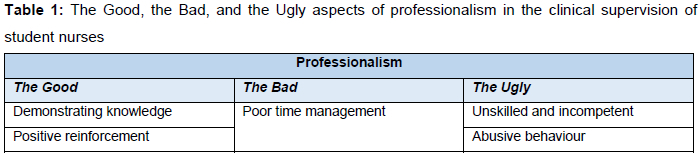
The study aimed to explore nursing students' clinical supervision experiences. Focus group interviews revealed professionalism as a major theme within the clinical learning environment, categorized into "The Good," "The Bad," and "The Ugly" aspects (Table 1). Subthemes included demonstrating knowledge, positive reinforcement (good); poor time management (bad); unskilled and incompetent supervisors, abusive behaviour (ugly).
Professionalism
The theme of professionalism emerged based on the participants' expression of their experiences with clinical supervision in the clinical learning environment. This theme demonstrates the Good, the Bad, and the Ugly aspects of professionalism in clinical supervision. The subthemes include the Good: Demonstrating Knowledge and Positive Reinforcement; the Bad: Poor Time Management; and the Ugly: Unskilled and Incompetent Supervisors and Abusive Behaviour.
The Good - demonstrating knowledge
The participants reported that they had very good clinical supervisors that are knowledgeable about their work and in training the student nurses on the procedures.
"We have very good supervisors, they're well prepared, they know their work." [Focus group, group 2, participant 1]
"These people [clinical supervisors] they know what they're doing, they know exactly what they want from you and they know exactly how to teach you these procedures." [Focus group, group 4, participant 2]
The Good - positive reinforcement
Some participants reported that the clinical supervisors would positively reinforce them thus aiding them in developing to their full potential.
"So sometimes when we think that they are nasty with you and they are pushing you or just focusing on you and why are they always asking me certain stuff, I think it's because they want to develop us in a, like to our full potential as a professional as well." [Focus group, group 4, participant 9]
"On that note like the supervisor would tell you like he will or she will fail you, I always experience that but in a positive way, sometimes he will tell you like 'I'm going to fail you because of you need you to know your work, I need you to go and do the homework so that when you come back you are competent.'" [Focus group, group 2, participant 7]
Students who have difficulty in becoming competent in a procedure are identified by the supervisors, who then prompt them to improve. The comment below confirms that the clinical supervisors identify students who require more assistance and positive reinforcement to succeed.
"I personally am a repeater students... my supervisor that I had she frequently came to follow up ... I feel that we have more than enough opportunities to practice what we have to do in the hospitals." [Focus group, group 2, participant 2]
The Bad - poor time management
Some participants indicated they would encounter delays while waiting for the clinical supervisor to arrive for a scheduled booked procedure. As a result, they were hesitant to leave the clinical learning environment that they were assigned for fear of being scorned by the nursing sister (professional nurse) in charge of that shift.
"You wait an hour to an hour and a half for your supervisor to come, then you have your supervisor you're busy for two hours and you come back to the ward and immediately the sister that's in charge she thinks that you're walking around." [Focus group, group 2, participant 3]
The Ugly - unskilled and incompetent
Participants reported that certain clinical supervisors were not able to teach or demonstrate a specific clinical procedure.
"When we ask the supervisors to demonstrate how to perform, how to demonstrate like mechanisms of labour. To be honest I actually realized that, okay I didn't ask all of them but the ones that we asked, they don't know how to demonstrate it." [Focus group, group 3, participant 3]
"Then I got her for the reev [re-evaluation] so I asked her what happened? Where did I went wrong? And she looked and said no you didn't mention about the Trendelenberg position. So, I asked her what is this position, to my surprise she didn't even know what was the Trendelenberg position." [Focus group, group 3, participant 1]
The Ugly - abusive behaviour
The participants reported that they had clinical supervisors who were shouting at them and displaying intimidating behaviour.
"I had a problem with my supervisor who always shouting us". [Focus group, group 1, participant 6]
"Then she's like started to shout at me". [Focus group, group 4, participant 7]
"That specific supervisor and a lot of people know who I'm talking about, she is very rude, she is intimidating". [Focus group, group 2, participant 1]
DISCUSSION
The study explored nursing students' clinical supervision experiences, highlighting professionalism's pivotal role within the clinical learning environment. This important and recurring aspect of contemporary nursing was carefully explored, highlighting its ongoing significance and the impetus given by recent reports of dissatisfied students.
Clinical supervisors play a crucial role in assisting nursing students in developing their professional identities by providing a professional supportive clinical learning environment, modelling professionalism and knowledge, and applying effective mentoring strategies (Raso et al. 2019; Vabo et al. 2022; Jayasekara et al. 2018; Weurlander et al. 2018). The theme, professionalism, demonstrates the Good, the Bad, and the Ugly aspects of professionalism in clinical supervision. Professionalism plays a significant part in how we shape students, and how students develop with professional guidance. The subthemes encompass the good aspects, such as demonstrating knowledge and positive reinforcement; the bad aspects namely poor time management; and the ugly aspects, such as unskilled and incompetent supervisors, and abusive behaviour.
Demonstrating knowledge as a professional nurse and clinical supervisor serves as a role model for students (Gibbs and Kulig 2017). This demonstration not only guides students in achieving high standards in their work but also influences their behaviour. The results of this study demonstrated the perceived idea that some participants gathered about the supervisors being role models based on the professional behaviour that they demonstrated. This is deemed as a "Good" aspect of professionalism. Role modelling professional behaviour is one of the soft skills that positively guides the student's behaviour in the workplace. Hsieh, Kuo, and Wang (2019) argued that professionalism in healthcare should be seen as observable behaviours rather than abstract traits. Their study indicated that clinical supervisors effectively conveyed their knowledge, attitude, and expectations to students by demonstrating professionalism. Students acknowledged the competence and thoroughness displayed by clinical supervisors, contributing to the good experiences with clinical supervision.
Exploring how the clinical nurse supervisor demonstrates professionalism through attitude and conduct, gives a broader overview of how well the attribute of professionalism can facilitate student learning and convey a good image of clinical supervision as a profession.
Another "Good" aspect of professionalism emerged when some participants reported that clinical supervisors provided positive reinforcement, thus aiding them in developing their full potential. The clinical supervisors interact closely with students, so after becoming familiar with them, they can identify which students need more reinforcement to succeed. Mahasneh et al. (2020) explain that clinical supervisors are experts at recognising students who are having trouble mastering particular procedures. The capacity to identify students who require more assistance is an important part of the clinical supervisors' job. It seems that the clinical supervisors often have to take a stern approach to force some students to do their homework (self-directed learning) and to practice more to do well. This encouraging approach acts as an impetus for participants' professional growth, enabling them to realise their full potential. Positive reinforcement in this sense refers to the process of prompting and motivating students' desired behaviours and efforts (Hsieh et al. 2019). Hsieh et al (2019) state that positive reinforcement allows for positive behaviour and enhances overall performance. The key to improving overall performance is using positive reinforcement. It is important to acknowledge that this sternness is not intended to undermine or demoralise the student. Instead, it is used as a catalyst to encourage students to take their commitments seriously. In essence, the clinical supervisors are raising the bar to motivate students to succeed. Effective use of positive reinforcement by clinical supervisors promotes a positive clinical learning environment (Tigerschiöld et al. 2021). Students have a sense of motivation, appreciation, and value, which can improve performance and make learning more effective. The results indicated that clinical supervisors identified students who needed additional support, including repeater students who had previously failed and required positive reinforcement to succeed. This demonstrates the clinical supervisors' capability in identifying struggling students.
The clinical supervisor would spend more time with the struggling students and encourage them to perform better. This encouragement may come in the form of encouraging criticism, advice, and positive reinforcement. The objective is to encourage and guide these students toward taking the essential actions to improve their competency (Pramila-Savukoski et al. 2020). The clinical supervisor therefore maintained quality through reassessment and hence exhibited professionalism.
Hunter and Cook (2018) assert that time management is a crucial skill for professionals to develop in order to efficiently complete their daily tasks. The results of the study highlight participants' concerns about possible time management issues related to clinical supervisors, identified as a potential challenge within professionalism. Students observed factors contributing to time management challenges, such as clinical supervisors arriving late for appointments or being overbooked, impacting their ability to maintain schedules. Broetje, Jenny, and Bauer (2020) explain that the nursing profession is characterised by exceptionally high work demands, which could further impact time management practices among clinical supervisors. Morsy and Ebraheem (2020) recommended organising seminars and workshops to provide support in managing job-related stressors, including workload and time management. Interestingly, the discussion raises questions about whether the earlier subtheme on positive reinforcement, which highlighted the need for clinical supervisors to dedicate more time to struggling and poorly performing students, could influence clinical supervisors' time management. The matter of time management should be brought to the attention of management, as it falls under their responsibility to review staffing and assess each employee's performance to identify those in need of additional training. Griffiths et al. (2020) emphasise the importance of considering workload, which includes staffing management and completing tasks within a specified timeframe. Formal incentives, job satisfaction, fair working conditions, and career progression are among the other elements that might inspire personal development and, in turn, increase work performance and time management (Broetje et al. 2020).
Furthermore, the participants identified shortcomings in the student-clinical supervisor relationship, particularly regarding inadequate communication and consideration. This becomes particularly apparent when the clinical supervisor arrives late for scheduled appointments without prior communication with the students. The lack of effective communication between clinical supervisors and student nurses is a problem (Fadana and Vember 2021). These flaws could harm not only the students and the clinical supervisor's reputations but also that of the nursing school and HEI where the students are enrolled, which leads to bad experiences with clinical supervision. It is interesting to point out that the participant's anxiety about leaving their workstations for a long period demonstrates their sense of accountability for doing their assigned task which is to provide patient care. This demonstrates that the participants are aware of their responsibilities and, in a way, exhibit their professional attitude towards their absence from their patients.
In this study, students reported that certain clinical supervisors were not able to teach or demonstrate a specific clinical procedure, constituting an "Ugly" aspect of professionalism. To meet their clinical learning outcomes, the students must be assessed and be found competent in several procedures. After demonstrating the procedure to the students, the clinical supervisors need to assess the student's level of competence. The results of the study raised concerns about the competency of clinical supervisors. It also raises concerns regarding the standard of clinical supervision that students get, as well as whether the institution should create standards that stipulate a particular level or amount of practical exposure, or increase the years of experience required for the clinical supervisor before employing them. A qualitative study conducted by Karami, Farokhzadian, and Foroughameri (2017) explored the nurses' professional competency and found that professional competence is a multifaceted issue that is connected to the nursing education system. Reduced levels of clinical competency of the clinical supervisor may result in further consequences as they have to impart their skills to student nurses. According to Karami et al (2017), experience, personality traits, and theoretical knowledge were among the most significant elements influencing nurses' clinical competency.
Another "Ugly" aspect of professionalism emerged when some participants reported that they had clinical supervisors who were shouting at them and displaying intimidating behaviour. The results indicated that the participants had bad encounters with their clinical supervisors. The clinical supervisors' overbearing communication methods, such as yelling and intimidating body language, are the root of these encounters. The verbal abuse and threatening behaviour that the participants reported and experienced from their clinical supervisors can be damaging to their learning and general well-being. Such actions can contribute to the fostering of a resentful and unpleasant clinical learning environment, which is not ideal for the development of confident and competent healthcare professionals. According to a study by Shdaifat et al (2020), verbal abuse against student nurses is a significant issue that they frequently report and experience in clinical learning environments. Minton and Birks (2019), whose research focussed on New Zealand student nurses in clinical placement, found that bullying in nursing is not a recent phenomenon and that student nurses are not spared from its effects. The sad reality is that these abusive behaviours contribute to nurses feeling stressed and depressed. This ugly aspect of professionalism demands both attention and drastic correction. If this ugly behaviour does not change and immediate interventions are not implemented, we sadly risk the leaving or resigning of potential great nurse professionals from the healthcare field.
CONCLUSION
The study aimed to explore the clinical supervision experiences of nursing students. The aspects of professionalism were a major theme that emerged from the data regarding the clinical supervisors in the clinical learning environments. Clinical supervisors contribute in a multitude of ways to student nurses' professional development. They are skilful in identifying students who are having difficulty learning, encourage them to do better and stress the value of self-directed learning and practice by using a combination of positive reinforcement and a strict approach when appropriate. Ultimately, this strategy helps students become more competent and progress toward becoming productive professionals in their chosen fields. The results highlighted the fundamental principles of professionalism in clinical supervision, looking at the good characteristics that encourage learning (clinical supervisors demonstrating knowledge and positive reinforcement), the bad aspects that impede growth (clinical supervisors having poor time management), and the ugly aspects that call for attention and correction (clinical supervisors not able to teach or demonstrate a specific clinical skill, and using abusive behaviour). Through this viewpoint, more information was gained on professionalism in clinical supervision as a guiding concept, and how it affected student nurses' experiences. The research ultimately provided insights into the positive and negative aspects of clinical supervision and paved the way for a more efficient and morally sound training approach for nursing professionals.
STRENGTH AND LIMITATIONThe strength of this study included having diverse viewpoints through focus group interviews, and fostering openness, particularly in sensitive discussions where individual students might have hesitated to speak about their clinical supervisor. The group dynamics, with students of varied backgrounds in the same educational level, created a supportive environment, encouraging even the most reserved students to contribute. Additionally, the engagement of independent field workers unaffiliated with the nursing school to conduct interviews strengthened data collection. This approach ensured participants felt at ease expressing themselves without concerns about the researcher, known to them. The study was conducted in a specific nursing school in South Africa, which may limit the generalisability of the findings to other contexts or institutions. Another limitation of this study was that it focused solely on undergraduate nursing students, without exploring the personal experiences of clinical supervisors. Future research should consider investigating the perspectives and experiences of clinical supervisors, which could provide valuable insights for enhancing clinical supervision practices.
FUNDINGNo external funding.
CONFLICTS OF INTERESTNone
DATA AVAILABILITY
Data sharing does not apply to this manuscript, as no new data was created for this manuscript.
ETHICAL STATEMENTEthics approval was received from the Health Research Ethical Committee at Stellenbosch University (Ethics reference no.: S12/05/132).
CREDIT AUTHORSHIP CONTRIBUTION STATEMENTAs an independent scholarly effort, G. Donough is the sole author of this article.
ACKNOWLEDGEMENTS
This article is based on research originally conducted as part of Gabieba Donough's Master's thesis titled "Perceptions and experiences of undergraduate nursing students of clinical supervision" which was supervised by Marianna Van der Heever and Ethelwynn Stellenberg. As an independent scholarly effort, this article has since been revised and adapted for journal publication.
REFERENCES
- Bimray, Portia, and Karien Jooste. 2023. "Climbing the Ladder in Crafting A Professionalism Framework for Nursing Students in South Africa." Babali Nursing Research 4 (3): 440-459.
-
Braun, Virginia, and Victoria Clarke. 2021. "To saturate or not to saturate? Questioning data saturation as a useful concept for thematic analysis and sample-size rationales." Qualitative research in sport, exercise and health 13 (2): 201-216. https://doi.org/10.1080/2159676x.2019.1704846.
» https://doi.org/10.1080/2159676x.2019.1704846 - Broetje, Sylvia, Gregor J Jenny, and Georg F Bauer. 2020. "The key job demands and resources of nursing staff: An integrative review of reviews." Frontiers in Psychology 11: 84.
-
Cant, Robyn, Colleen Ryan, and Simon Cooper. 2021. "Nursing students' evaluation of clinical practice placements using the Clinical Learning Environment, Supervision and Nurse Teacher scale-A systematic review." Nurse Education Today 104: 104983. https://doi.org/10.1016/j.nedt.2021.104983.
» https://doi.org/10.1016/j.nedt.2021.104983 - Corey, Gerald, Robert H Haynes, Patrice Moulton, and Michelle Muratori. 2020. Clinical supervision in the helping professions: A practical guide. John Wiley & Sons.
- Creswell, J.W., and J.D. Creswell. 2017. Research Design: Qualitative, Quantitative, and Mixed Methods Approaches. SAGE Publications.
-
Donough, Gabieba. 2014. "Perceptions and experiences of undergraduate nursing students of clinical supervision (Master of Nursing Science dissertation, Faculty of Health Sciences at Stellenbosch University: Stellenbosch).". http://hdl.handle.net/10019.1/86575.
» http://hdl.handle.net/10019.1/86575 -
__________. 2023. "Nursing students' experiences of clinical assessment at a university in South Africa." Health SA Gesondheid 28 (1). https://doi.org/10.4102/hsag.v28i0.2161.
» https://doi.org/10.4102/hsag.v28i0.2161 -
Erlingsson, Christen, and Petra Brysiewicz. 2017. "A hands-on guide to doing content analysis." African Journal of Emergency Medicine 7 (3): 93-99. https://doi.org/10.1016/j.afjem.2017.08.0012211-419X/Ó2017.
» https://doi.org/10.1016/j.afjem.2017.08.0012211-419X/Ó2017 -
Fadana, Fundiswa P, and Hilda F Vember. 2021. "Experiences of undergraduate nursing students during clinical practice at health facilities in Western Cape, South Africa." curationis 44 (1): 110. https://doi.org/10.4102/curationis.v44i1.2127
» https://doi.org/10.4102/curationis.v44i1.2127 - Fitzgerald, Anita. 2020. "Professional identity: A concept analysis." Nursing forum.
-
Flott, E. A., and L. Linden. 2016. "The clinical learning environment in nursing education: a concept analysis." J AdvNurs 72 (3): 501-13. https://doi.org/10.1111/jan.12861. https://www.ncbi.nlm.nih.gov/pubmed/26648579.
» https://doi.org/10.1111/jan.12861. https://www.ncbi.nlm.nih.gov/pubmed/26648579 - Gibbs, Sheena Simpkins, and Judith C Kulig. 2017. ""We definitely are role models": exploring how clinical instructors' influence nursing students' attitudes towards older adults." Nurse Education in Practice 26: 74-81.
-
Gordon, Stuart, Dianne Gardner, Jenny Weston, Charlotte Bolwell, Jackie Benschop, and Tim Parkinson. 2021. "Fostering the development of professionalism in veterinary students: challenges and implications for veterinary professionalism curricula." Education Sciences 11 (11): 720. https://doi.org/10.3390/educsci11110720.
» https://doi.org/10.3390/educsci11110720 - Griffiths, Peter, Christina Saville, Jane Ball, Jeremy Jones, Natalie Pattison, Thomas Monks, and Safer Nursing Care Study Group. 2020. "Nursing workload, nurse staffing methodologies and tools: A systematic scoping review and discussion." International journal of nursing studies 103: 103487.
-
Hsieh, Jyh-Gang, Li-Chuan Kuo, and Ying-Wei Wang. 2019. "Learning medical professionalism-the application of appreciative inquiry and social media." Medical education online 24 (1): 1586507. https://doi.org/10.1080/10872981.2019.1586507.
» https://doi.org/10.1080/10872981.2019.1586507 - Hunter, Kiri, and Catherine Cook. 2018. "Role-modelling and the hidden curriculum: New graduate nurses' professional socialisation." Journal of clinical nursing 27 (15-16): 3157-3170.
-
Jayasekara, R., C. Smith, C. Hall, E. Rankin, M. Smith, V. Visvanathan, and T. R. Friebe. 2018. "The effectiveness of clinical education models for undergraduate nursing programs: A systematic review." Nurse Educ Pract 29: 116-126. https://doi.org/10.1016/j.nepr.2017.12.006. https://www.ncbi.nlm.nih.gov/pubmed/29272736.
» https://doi.org/10.1016/j.nepr.2017.12.006. https://www.ncbi.nlm.nih.gov/pubmed/29272736 -
Karami, Abbas, Jamileh Farokhzadian, and Golnaz Foroughameri. 2017. "Nurses' professional competency and organizational commitment: Is it important for human resource management?" PloS one 12 (11): e0187863. https://joumals.plos.org/plosone/article?id=10.1371/joumal.pone.0187863.
» https://joumals.plos.org/plosone/article?id=10.1371/joumal.pone.0187863 - Lincoln, Yvonna S., and Egon G. Guba. 1988. "Criteria for Assessing Naturalistic Inquiries as Reports." American Educational Research Association, New Orleans, LA.
- Lindblad, Tracie L. 2021. "Ethical considerations in clinical supervision: Components of effective clinical supervision across an interprofessional team." Behavior Analysis in Practice 14 (2): 478490.
- Mahasneh, Deema, Noordeen Shoqirat, Lourance Al Hadid, Mahmoud A Alja'afreh, and Ghada Mohammad Abu Shosha. 2020. "Nursing students' experience of clinical supervision and contributing factors in Jordan." Nurse Education Today 92: 104515.
-
Manninen, Katri, Elisabet Welin Henriksson, Max Scheja, and Charlotte Silén. 2015. "Supervisors' pedagogical role at a clinical education ward-an ethnographic study." BMC nursing 14: 1-8. https://doi.org/https://doi.org/10.1186/s12912-015-0106-6.
» https://doi.org/https://doi.org/10.1186/s12912-015-0106-6 -
Minton, Claire, and Melanie Birks. 2019. ""You can't escape it": bullying experiences of New Zealand nursing students on clinical placement." Nurse education today 77: 12-17. https://doi.org/10.1016/j.nedt.2019.03.002.
» https://doi.org/10.1016/j.nedt.2019.03.002 - Morsy, Mahdia ME, and Shaimaa MA Ebraheem. 2020. "Work-related stressors, coping strategies: its relation to job performance and perceived organizational support among critical care nurses." Evidence-Based Nursing Research 2 (3).
- Motsaanaka, Mpho N, Agnes Makhene, and Hafisa Ally. 2020. "Student nurses' experiences regarding their clinical learning opportunities in a public academic hospital in Gauteng province, South Africa." Health SA Gesondheid 25 (1).
- Pramila-Savukoski, Sari, Jonna Juntunen, Anna-Maria Tuomikoski, Maria Kääriäinen, Marco Tomietto, Boris Miha Kaučič, Bojana Filej, Olga Riklikiene, Maria Flores Vizcaya-Moreno, and Rosa M Perez-Cañaveras. 2020. "Mentors' self-assessed competence in mentoring nursing students in clinical practice: A systematic review of quantitative studies." Journal of Clinical Nursing 29 (5-6): 684-705.
- Raso, Annalisa, Lea Ligozzi, Lorenza Garrino, and Valerio Dimonte. 2019. "Nursing profession and nurses' contribution to nursing education as seen through students' eyes: A qualitative study." Nursing forum.
- Shdaifat, Emad A, Mohammed M Al Amer, and Aysar A Jamama. 2020. "Verbal abuse and psychological disorders among nursing student interns in KSA." Journal of Taibah University Medical Sciences 15 (1): 66.
- Tigerschiöld, Stephanie, Bijan Darvish, Ann-Charlotte Falk, and Jonas Nordquist. 2021. "The Perception of Feedback and Strengthening the Feedback Process. A Qualitative Thematic Analysis Among Residents and Supervisors in Anaesthesia and Intensive Care.
- "
-
Vabo, Grete, Åshild Slettebø, and Mariann Fossum. 2022. "Nursing students' professional identity development: an integrative review." Nordic Journal of Nursing Research 42 (2): 62-75. https://doi.org/https://doi.org/10.1177/20571585211029.
» https://doi.org/https://doi.org/10.1177/20571585211029 -
Voges, Taryn-Lee, and Josè M Frantz. 2019. "Clarifying the role of clinical supervisors according to physiotherapists at a higher education institution." South African Journal of Physiotherapy 75 (1): 1-6. https://joumals.co.za/doi/epdf/10.4102/sajp.v75i1.523.
» https://joumals.co.za/doi/epdf/10.4102/sajp.v75i1.523