Ubuntu as a framework for quality in doctoral programmes
Abstract
The systemic pressure within South African higher education to accelerate doctoral production risks favouring throughput over substance. This strain remains unaddressed by standard quality assurance (QA) frameworks, which tend to promote a rushed approach, narrowly focusing on quantifiable outcomes such as short completion times and independent research, while neglecting the psychosocial and holistic aspects of students' lives. This paper argues that current QA standards largely adopt a Western-based "I think, therefore I am" orientation, placing a disproportionate emphasis on cognitive mastery, while downplaying the need to foster the holistic development of researchers whose knowledge and impact are deeply rooted in their social context. The study proposes that, to counter this, QA frameworks must integrate an Ubuntu-based "I am because you are" orientation if they are to recognise the critical influence of students' social roles, responsibilities, and relationships as essential levers, and to infuse the transformation envisaged in the democratic dispensation into doctoral QA. Drawing on in-depth interviews with 19 past and present doctoral students who are parents and mostly employed, the study undertakes a discourse analysis to examine how their social roles and responsibilities shape their experience of quality learning, highlighting the essential dimensions of community engagement and situated knowledge that are currently neglected by existing QA models. The findings reveal a systemic quality trap arising from a mismatch between rigid institutional metrics and students' lived realities, based on four themes: conflicting paradigms that penalise relational responsibilities; institutional cultural myopia regarding necessary support structures such as childcare; a cumulative burden resulting from intersecting identities; and a constriction of student agency.
Ubuntu; doctoral students; quality assurance; parents; doctoral education
INTRODUCTION AND BACKGROUND
The transformation of South African higher education following the democratic transition in 1994 represents one of the most ambitious attempts to align educational quality assurance (QA) with democratic values and social transformation goals (Symes 2006). Now three decades in the making, this relationship between QA and democratisation extends beyond technical considerations of educational standards to encompass fundamental questions about the role of higher education in building a democratic society (Gouws and Waghid 2006). Central to this transformation has been a concerted effort to dismantle the exclusionary legacies of the past and build an equitable, inclusive system. During the apartheid regime, higher education was a fragmented and deeply segregated system designed to serve the political and social architecture of racial oppression (Bunting 2006). While institutions designated for the white minority often enjoyed significant state funding and academic autonomy, those established for Black, Coloured, and Indian populations were systematically under-resourced, politically controlled, and academically marginalised. In this context, quality assurance was an instrument of racial stratification. Before the democratic era, quality assurance was essentially an internal matter for institutions. Universities and technikons had their own internal mechanisms, but there was no national, coordinated system. The Committee of Technikon Principals established the Certification of Council of Technikons Education (SERTEC), and universities had the Quality Promotion Unit (QPU). These bodies laid the groundwork for future frameworks but operated in a fragmented, pre-democratic context. Thus, the very notion of quality was implicitly tied to the standards and norms of elite, white institutions, reinforcing a discriminatory status quo and ensuring that academic excellence remained the exclusive domain of a privileged few. This created a dual-track system in which quality was defined by a specific, exclusionary model of scholarship, and the academic reputations of historically Black institutions were often undermined.
Now, in the democratic dispensation, the government has faced the challenge of simultaneously establishing robust quality standards and dismantling these historical inequities. It has always been clear that the two objectives were inextricably linked (Symes 2006). Over the past three decades, the state has had to develop frameworks that not only define and measure educational quality but also serve as policy levers to redress past injustices and promote democratic participation in a once-exclusive domain (Gouws and Waghid 2006). Reviews of the South African government's post-apartheid efforts to align QA with transformation have yielded notable successes and persistent shortcomings. A key success has been the institutionalisation of equity as a core principle of quality. By establishing a unified national system and creating bodies such as the Council on Higher Education (CHE) and the Higher Education Quality Committee (HEQC), the state has broadened access and participation in higher education, explicitly linking QA to democratic values (Gouws and Waghid 2006). This framework has served as a powerful policy tool for addressing the fragmentation of the past and ensuring that quality is no longer a clandestine concept tied to racial privilege. However, a significant shortcoming is the frameworks' struggle to move beyond bureaucratic uniformity. Despite the stated aims of transformation, the implementation of QA has often devolved into a checklist mentality, in which institutions focus on meeting quantifiable accreditation targets rather than fostering a genuinely inclusive and responsive culture (Makola, Ramchander and Naidoo 2025). This top-down, one-size-fits-all approach can inadvertently overlook a diverse student body's specific, lived experiences, creating a gap between the policy's transformative intent and its on-the-ground impact.
As articulated in documents like the Framework for Programme Accreditation (Council on Higher Education 2004), and the Framework for Institutional Audits (Council on Higher Education 2021), the CHE's approach to QA has historically been rooted in a model that privileges institutional-level inputs and academic outputs. These frameworks focus on aspects such as curriculum design, faculty qualifications, research productivity, and student completion rates. The implicit assumption is that a universal level of quality can be assured across the system by standardising and monitoring these elements. While effective in establishing a baseline of academic credibility, this approach tends to treat quality as a fixed, measurable commodity rather than a dynamic, socially constructed concept. For instance, while intended to promote accountability, the CHE's emphasis on programmatic review and institutional audits can inadvertently streamline and homogenise the student experience (Mbati and Juta 2024). The focus remains on formal processes and quantifiable metrics, often overlooking students' lived experiences as they navigate the system. Scholars have noted that because these QA benchmarks default to the resource structures and linear academic traditions characteristic of historically white institutions (HWIs), they create a systemic bias against historically disadvantaged institutions (HDIs) and non-traditional students (Bunting 2006). Consequently, by framing quality through an assimilationist lens that demands compliance with Eurocentric, individualistic norms rather than structural redress, the framework inadvertently stymies the radical, socially just transformation central to South Africa's democratic project (Badat 2010; Saidi and Mbhele 2023).
The central problem confronting South African postgraduate QA is this structural mismatch between institutional performance metrics and the demographic reality of the contemporary student body. While post-apartheid higher education has successfully democratised student access, national regulatory mechanisms remain tethered to a Western-based, individualistic archetype of the unencumbered scholar. As argued above, existing QA frameworks inadvertently penalise and marginalise doctoral students who concurrently manage professional careers and family responsibilities by defining educational quality strictly through quantifiable outputs.
To address this systemic gap, this study is guided by two primary research objectives:
To critically deconstruct how current doctoral quality assurance standards operate as mechanisms of exclusion by analysing the lived experiences of employed doctoral student-parents.
To propose a relationally embedded, Ubuntu-informed conceptual framework for higher education QA that values interconnectedness, compassion, and community-situated knowledge.
This study aims to challenge this status quo by drawing on the lived experiences of doctoral student parents, a group that exemplifies the complexities of the contemporary student body. Their reflections expose that no singular, ideal student identity exists and, therefore, no single metric can capture their journey. Using a relationally embedded lens and discourse analysis, the paper demonstrates how identities related to race, gender, and parental status intersect to create unique challenges largely unacknowledged by current QA frameworks. The study argues for integrating an Ubuntu-based 'I am because you are' philosophy as a foundational principle for quality assurance in South African doctoral studies. I elaborate on what this entails in the theoretical framework section of this paper.
The transformative imperative: Linking QA frameworks and PhD studies
For South Africa's higher education system to realise the transformative mandate of the democratic era, examining the quality of PhD education is an important entry point for institutional critique, as doctoral degrees are the highest institutional output. The standards used to measure their success fundamentally dictate the type of knowledge and researchers they produce, and whether the quality is genuinely transformative. The existing literature on PhD education highlights a significant gap between a doctoral student's traditional, idealised identity and the reality of the contemporary student body. The conventional archetype, often a young, male, white, and unencumbered individual, is a full-time, self-funded researcher with no family or employment obligations, able to dedicate themselves entirely to their studies (Thouaille 2017). The "storybook image of the scientist" is a pervasive stereotype that attributes higher levels of objectivity, rationality, and intelligence to scientists, often aligning with the image of a young, white male. This stereotype is held by the general public and scientists themselves, who often perceive PhD students as embodying these traits more than early-career scientists (Veldkamp, et al. 2017).
This archetype, though largely outdated, continues to influence institutional policies and expectations, creating a system that disadvantages a growing number of students. Even in contexts like South Africa, where a significant number of students are women, professionals, and parents, Nkoala (2024) argues that this has shifted from primarily white males with ideal work setups to a diverse cohort of parents and professionals, making traditional institutional support systems and policies increasingly obsolete and inequitable. Scholars show that this is rooted in academic institutions' inherent resistance to change and in long-standing traditions and structures that perpetuate the "unencumbered scholar" archetype (Blockett et al 2016; Salter 2019). For example, many programs still operate with funding and timeline expectations that are only feasible for students who can dedicate themselves entirely to their studies (Leitch, et al. 2022). Furthermore, policies on study leave, part-time enrollment, and parental support have been slow to adapt to the needs of working parents or students with caregiving responsibilities (Wladkowski and Mirick 2020). Another aspect that scholars find to be an entrenchment of this archetype is the socialisation process. New PhD students are socialised into a professional culture that upholds the traditional archetype (Salter 2019; Blockett et al 2016). This socialisation operates through both informal and formal academic practices. Informally, it occurs via casual department conversations, mentorship dynamics, and peer networks that celebrate overwork and continuous campus presence as markers of dedication. Formally, the culture is reinforced through structural silences such as the absence of institutional spaces for children or family discussions and a lack of visible, successful role models who balance caregiving with high-level research.
Competing paradigms of quality in doctoral education
Traditional QA metrics are another evident site of tension. The metrics, such as a short time-to-completion, a high publication count, or the expectation of full-time, on-campus presence, reflect the ideal of a young, unencumbered student while failing to account for the realities of students who are also professionals, parents, or caregivers (Héctor, Guzmán and Fosado 2023). When QA frameworks push these narrow metrics, they can inadvertently compromise the quality of the student experience. Students who cannot meet these unrealistic expectations, not because of a lack of academic ability but because of their life circumstances, as Nkoala (2024) argued, may face delayed graduation, increased mental health challenges, or a higher risk of attrition. This outcome contradicts the very purpose of QA, which is to ensure a high-quality educational environment and successful outcomes (Saidi and Mbhele 2023). This, in turn, creates a quality trap in which institutions appear to meet standards on paper but, in reality, fail to support the majority of their students. The scholarship on QA in South African higher education does not sufficiently address this knowledge gap regarding the quality trap in QA frameworks for postgraduate studies, thereby foregrounding an analysis of how institutional practices and policies perpetuate reliance on the unencumbered scholar archetype. Therefore, there is a need to explore how a relationally embedded QA framework might assist in diagnosing and addressing systemic inequities to promote a more just and inclusive academic environment and to genuinely enhance the quality of doctoral education and research for all students.
The struggle to reconcile national doctoral targets with the lived experiences of parenting students underscores a deeper issue: the highly contested nature of quality in higher education (Filippakou and Tapper 2008). Indeed, the notion of quality in higher education is highly contested, and, due to its intangible nature, it is difficult for higher education institutions to develop a uniform definition that applies to all faculties and professional support units within their institutional quality assurance frameworks. This challenge is particularly pronounced when considering quality in postgraduate studies, mainly NQF 9 and 10 research programs. Various instruments can be used in undergraduate studies as process measures, including student evaluations, curriculum reviews, and program reviews (Asuquo and Onyinye 2022; Er et al 2020). However, it remains challenging to determine the effectiveness of such instruments in positioning students' agency within the academic project at the postgraduate level, particularly at the PhD level (Houston and Rees 1999).
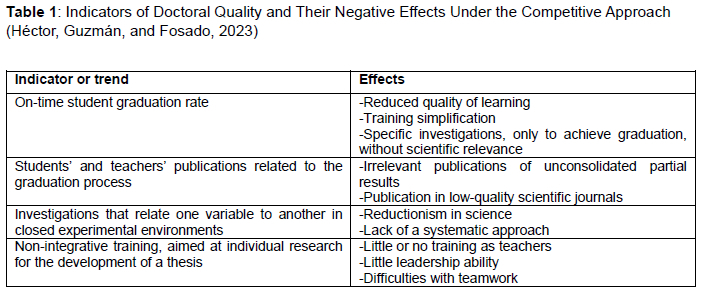
Héctor, Guzmán, and Fosado (2023, 230, 231) suggest two overarching paradigms for quality management in postgraduate studies: the competitive approach, which is "based on compliance with academic, scientific and administrative standards, and the positioning of universities in world lists of best institutions" based on graduation and retention rates, and the humanist-social approach, which prioritises institutions' commitment to the social impact of knowledge and education, ethical values promoting collective well-being, equitable access and support for students, social justice, and sustainable development (see Table 1).The former emphasises quantifiable metrics and external recognition, often neglecting the nuanced aspects of the research process and the individual experiences of postgraduate students. The humanist-social approach, meanwhile, emphasises intangible aspects such as mentorship, intellectual growth, and social impact, which are inherently difficult to quantify and measure, making it challenging to demonstrate the effectiveness of quality assurance mechanisms based on this approach and leading to a lack of concrete evidence of impact. This study is aligned with the humanist-social approach because the competitive approach's rigid focus on numerical efficiency inevitably masks the structural inequities of the post-apartheid university, reducing complex human experiences to bureaucratic throughput.
This inherent difficulty in applying conventional quality metrics to doctoral education directly impacts the pursuit of national targets. If one looks at the push by South African universities and the higher education sector as a whole to increase the number of doctoral graduates expeditiously in the quest of ensuring that South Africa can claim its space in the knowledge economy, one can deduce that our approach falls into the latter paradigm, with a push that prioritises quantity over quality, leading to a rushed approach in doctoral supervision that risks neglecting critical dimensions of the doctoral journey. The paradigm essentially adopts the competitive approach, rooted in René Descartes' Western-based philosophical orientation of "I think, therefore I am", which upholds individual thinking as ultimate, overlooking the psychosocial aspects of students' lives, which are deeply tied to their identities and essential for a quality learning experience. This oversight becomes particularly evident when considering the broader landscape of doctoral education in South Africa, which, despite considerable growth and progress toward national targets, continues to grapple with high attrition rates and ongoing systemic issues (Leitch et al 2022; Makola et al 2025), especially concerning the underexplored challenges faced by student-parents. To address this issue, this paper proposes postgraduate quality indicators grounded in an Ubuntu orientation. Such an orientation advocates for interdependence, collaboration, and a strong community context, reflecting the imperative of "the insertion of postgraduates in society for the solution of local and global problems" (Héctor, Guzmán and Fosado 2023, 236).
CONCEPTUAL FRAMEWORKThe first written references to the notion of Ubuntu date back to 1846, but it was not until 1993 to 1995 that Ubuntu was associated with the saying umuntu ngumuntu ngabantu, an association that scholars have accepted (Maris 2020, 318). Louw (2001, 15) notes, "The maxim ubuntu ngumumntu ngabantu articulates a basic respect and compassion for others. As such, it is both a factual description and a rule of conduct or social ethic. It not only describes human beings as 'being-with-others', but also prescribes how we should relate to others, i.e. what 'being-with-others' should be all about. Meanwhile, Eliastam (2015, 2) argues,
"The principles of ubuntu resonate with universal values of human worth and dignity. Archbishop Emeritus Desmond Tutu explains that the meaning of ubuntu is that 'a person is a person through other people. It is not "I think, therefore I am". It says rather: "I am human because I belong". I participate; I share. The concept highlights the interconnectedness of human society, with the implication that people should treat others as part of the extended human family."
Scholars emphasise the social and compassionate aspects of Ubuntu. Makhudu (1993) sees Ubuntu as the manifestation of warmth, empathy, understanding, open communication, interaction, participation, sharing, reciprocation, harmony, cooperation, congruence, and a shared worldview. Broodryk (2006) further conceives of Ubuntu as a comprehensive ancient African worldview grounded in humanness, caring, sharing, respect, compassion, and related values, aiming for a happy, high-quality human community life in a spirit of family. Various interpretations of Ubuntu highlight its essence as a state of being. Mkhize (2008, 35) describes it as "the process of becoming an ethical human being." Chikanda (1990) specifically views Ubuntu as African humanism, characterised by sensitivity to others' needs, charity, sympathy, care, respect, consideration, and kindness. Letseka (2000) synthesises these views, contending that Ubuntu has normative implications, encapsulating moral norms and values such as altruism, kindness, generosity, compassion, benevolence, courtesy, respect, and concern for others.
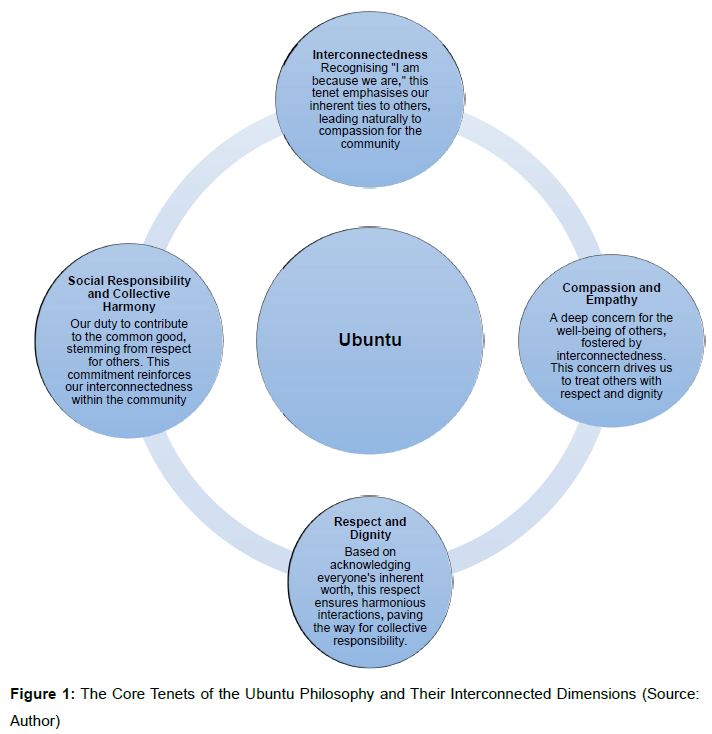
Thus, there is no denying its existence, even though, according to Maris (2020), Ubuntu's essence is so difficult to define. I posit that this is similar to defining the notion of quality - we know it when we see it, but cannot put definitive parameters on it due to the inherent epistemological challenges of articulating a concept grounded in tacit relational knowledge. Nevertheless, distilling the above, Ubuntu can be centred on four tenets. The first is interconnectedness (I am because we are), which signifies that individual existence and identity are inherently tied to, and affirmed by, one's relationships with others and the community (Letseka 2000). The second is compassion and empathy that shows a deep concern for the well-being of others, characterised by sympathy, care, sensitivity, kindness, generosity, and benevolence, calling for treating others with warmth, understanding, and actively striving to alleviate their suffering and promote their flourishing (Letseka 2000; Broodryk 2006; Makhudu 1993). The third is respect and dignity, based on recognising the inherent worth and dignity of every individual, regardless of their status, which translates into courteous conduct, consideration for others' rights, and a commitment not to undermine another's humanity (Broodryk 2006). The final one is social responsibility and collective harmony, based on the view that individuals are responsible for contributing to the collective good, including sharing, cooperation, participation, and striving for consensus and harmony within the community (Makhudu 1993). Figure 1 shows the relationship between these tenets.
In the context of quality in postgraduate studies, the tenets of Ubuntu offer a framework that extends beyond traditional academic metrics. Beginning with interconnectedness, the "I am because we are" orientation emphasises the primacy of reciprocal relationships among students, supervisors, and the broader academic community, in which a student's personal well-being and social context are recognised as integral to their scholarly journey. Next is compassion and empathy, which foreground postgraduate studies characterised by genuine care and sensitivity from supervisors and ethical research practices from students. Thirdly, we consider the importance of the values of respect and dignity, which centre on the humans involved and their value. Finally, social responsibility and collective harmony mean that research endeavours embody a worldview of interconnectedness in their conceptualisations of time, space, and shared resources. These tenets are not exhaustive, but they provide a careful and nuanced consideration of the philosophical debates about what Ubuntu is. They form the basis of this paper's proposal for quality indicators that facilitate the implementation of the humanist-social approach outlined by Héctor, Guzmán and Fosado (2023).
METHODOLOGY
Data collection
The study employs a qualitative approach (Hesse-Biber 2010), rooted in the view that meaning is socially constructed and best understood through individuals' lived experiences. The research design is a multi-phase, sequential qualitative inquiry (Chandanabhumma et al 2024). The study began with an online survey completed by 44 respondents. Participants were selected using a non-probability purposive sampling strategy, supplemented by snowball sampling to reach this specific, often hard-to-access demographic. To ensure data relevance, the inclusion criteria required participants to be either doctoral candidates or graduates, to hold primary parental responsibilities, and to be employed (full-time or part-time). The survey invitation was distributed digitally, allowing for a diverse cross-institutional reach. An overview of this group's demographics is presented in Table 2 below. A detailed discussion of the findings from this survey was presented in a previously published paper and will thus not be the focus of this one (Nkoala, 2024). To gain deeper insights into the survey responses, respondents were asked to indicate their availability for in-depth interviews. The insights discussed in this paper are based on interviews with 19 respondents. These interviews were conducted over Zoom.
Data analysis
The interview data were analysed using Critical Discourse Analysis (CDA). CDA, as theorised by Norman Fairclough (2023), is a research method that analyses the relationship between language, power, and ideology. It goes beyond merely what is said to examine how and why it is said, revealing how dominant narratives and social structures are reproduced through discourse. For instance, when a doctoral student's discourse centres on the perceived institutional pressure to complete their degree within a normative timeframe, CDA reveals a deeper ideological conflict. Using linguistic markers or expressions of guilt to attend to familial responsibilities directly reflects a power relationship in which the student's lived experience conflicts with a dominant discourse.
The study's use of CDA is crucial for unpacking the quality trap, as it enables analysis of how discourses of time, success, and academic identity reveal the limitations of QA frameworks built on an outdated, idealised archetype. In this study, the quality trap has been operationalised by examining how participants described their lived experiences in relation to institutional expectations, their coping strategies and challenges, and their navigation of multiple roles. The institutional discourse of academic success often valorises metrics such as a high volume of publications in high-impact journals that are more attainable for the unencumbered scholar (Allen 2020). When a student's personal definition of success, rooted in their ability to balance multiple demanding roles, is devalued by this dominant discourse, it exposes a power dynamic where the institution's definition of quality invalidates the achievements and lived realities of a diverse student body.
FINDINGS AND DISCUSSION
The analysis of the interview data identified four core thematic areas that structure the discussion around the limitations of the current QA model, confirming the central argument that the one-size-fits-all model perpetuates a quality trap. These themes emerged from the participants' accounts of navigating academia alongside parenthood, beginning with the Conflicting Paradigms theme, which speaks to the tension between the QA framework's competitive, individualistic approach and the humanist-social realities of parental obligations and time poverty, which together express the Ubuntu relational self. This conflict is enabled by Cultural Myopia, which refers to the institutional blind spot regarding the need for essential support structures, such as flexible policies and childcare. For the students, this institutional failure results in a Cumulative Burden, which is the compounding effect of multiple, communal intersecting identities, including race, gender and parenting, that transforms academic stress into overwhelming unseen labour and mental health strain. Finally, these systemic pressures lead to the Constriction of Agency, which refers to institutional processes that reduce the student's autonomy, force a denial of their relational self, and turn the negotiation of multiple life roles into an academic impediment for which the student is held accountable. Each of these is now discussed in turn below.
Conflicting paradigms
The lived experience of the idealised student, unencumbered by external responsibilities, aligns perfectly with institutional expectations of a linear, uninterrupted academic journey. This congruence means the QA framework's metrics appear fair and logical. In contrast, the lived realities of the relationally embedded student, who often juggles professional careers, childcare, and personal responsibilities, directly conflict with these institutional norms. This mismatch exposes a quality trap in that while appearing valid for the small group of students they were designed for, the QA metrics are ill-equipped to measure the quality of the experience for the majority (Saidi and Mbhele 2023). The parents' experiences reveal this seemingly fair framework to be an apparatus of exclusion, as their non-academic responsibilities inherently disrupt the linear path and disqualify them from meeting these rigid institutional ideals, confirming that the traditional archetype continues to influence institutional expectations (Thouaille 2017).
The analysis reveals that for many participants, the system's rigid expectations actively conflict with core communal values, highlighting a deep ideological divide between the academic project and students' social reality - a tension previously noted in the scholarship on QA frameworks (Filippakou and Tapper 2008). Participant 5, a black woman, explicitly states this conflict, declaring that "the parental obligations come first. And then the PhD next, because you know, my child has only one parent, me," thereby prioritising a relational, Ubuntu-based outlook on her life over the competitive, output-driven demands of the university (Héctor, Guzmán, and Fosado 2023). This choice inevitably slows her time-to-completion. This prioritisation, which the QA framework views as a personal impediment, is, in fact, an affirmation of a relational worldview that the institution fails to value, thereby contradicting the democratic imperative to align education with broader social values (Waghid 2003). The consequence of this conflict is often immense personal strain, exemplified by Participant 19's experience, as a white woman, that her "mental health did take a knock" due to the effort required to meet the system's deadlines, while being the primary caregiver.
Cultural myopia
The second theme observed relates to the cultural myopia where, in higher education, QA is evident in the institutional blind spot toward the unique, often compounded, needs of relationally-embedded students, which converts essential support mechanisms into active, systemic barriers, a significant shortcoming that the literature identifies as a struggle to move beyond bureaucratic uniformity (Makola et al 2025). For the idealised student, for instance, the absence of campus childcare or flexible scheduling is irrelevant, as the system implicitly assumes they have the financial and social capital to manage these external logistics. Still, for a student like Participant 7, a black woman, the non-existence of these resources is a structural barrier that is not registered. In her interview, she states, "I don't think they are aware. Because there hasn't been a time when we were asked whether we are parents."
This complete lack of inquiry or institutional awareness demonstrates a myopia in which the institution's standard operating procedures are based on a narrow cultural norm, failing to see, let alone address, the needs of its diverse population. This institutional failure to recognise the student's holistic, communal identity is a fundamental denial of the Ubuntu ethic, which posits that a person is a person through other people. This structural bias suggests that three decades into democracy, transformation in South African higher education has remained largely assimilative rather than genuinely structural (Badat 2010; Mbati and Juta 2024). It reveals that while national policies have successfully altered the demographic profile of student access, institutions have left the underlying, Western-centric definition of academic excellence untouched (Saidi and Mbhele 2023).
The institution's refusal to adjust to the realities of its students is further exposed in the participants' discourses on personal space and time, which the institution's policies assume are readily available to students. Participant 2, a black man, admitted that because of having young children at home, he must spend "a lot of my weekends in the office... just to be in a quiet space" to focus on his work. This underscores that he must personally engineer the "unencumbered" time that the institution assumes is simply a given for all its students. Moreover, the failure of work environments to support Black professional women like Participant 13, where her PhD "was secondary" and done only "after hours or during university holidays", further complicates this challenge.
Cumulative burden
The concept of the cumulative burden is used in this paper to differentiate the academic challenges of the idealised student from the compounded, intersecting struggles faced by the non-traditional scholar, revealing the vast amount of unseen labour that the current QA framework remains blind to. The challenges faced by the idealised student are primarily academic, and their coping strategies focus on scholarly tasks (Salter 2019). For the relationally embedded student, however, challenges are compounded by their multiple, intersecting identities (Allen 2020). Their strategies are not just about managing academic stress but about navigating the dual demands of scholarship and life. An Ubuntu-based approach to this point reveals that a single black mother, like Participant 5, for example, faces challenges compounded by racial bias, gendered expectations, and the profound societal expectation to uphold her communal role, all of which require unique and often exhausting coping strategies. For the idealised student, challenges are typically confined to the academic sphere. In contrast, for the relationally embedded student, their coping strategies must concurrently address the compounded pressures arising from the intersection of race, gender, and parental status (Wijeyesinghe and Jones 2014), as well as the imperative of personhood as defined by the community.
In her interview, Participant 19 described having to "drop certain balls" ranging from rushing into lectures to "not being able to cook a healthy meal" for her family. This illustrates this compounding effect, where the academic pressure directly compromises her ability to fulfil her roles as a parent and maintain her health, showing that her failure is a measure of the system's burden, not her academic capacity, thereby creating a quality trap where institutions appear to be meeting standards but fail to support students (Nkoala 2024).
Participants also noted that, while their supervisors knew they were parents, their supervisors did their best to act as though the two roles were separate. Participant 13 stated: "They were aware of that, but I never burdened them about that if something needed to be done, I would not say just because I have kids, I cannot achieve this particular goal. I just basically did not bring the kids into the PhD - I separated the two". This speaks to a feeling that they needed to deny their reality as a Black female professional parent, whose time is already fragmented by the societal expectations of personhood that marginalise both her racial and gendered identities in the professional and academic sphere. Her necessity to complete her PhD because she "understood what having a PhD meant for my career in academia" transforms her doctoral journey from a pursuit of knowledge into a high-stakes, necessary burden to secure professional and familial stability, compounding the emotional weight of the process and illustrating how the socialisation process upholds the traditional archetype (Salter, 2019; Blockett et al, 2016).
The idealised student's experience, often serving as the singular, uncompounded benchmark, stands in sharp contrast to the lived reality of the Black female parent, whose journey is shaped by the simultaneous pressures of gender-based assumptions about caregiving, racial bias in academic spaces, and the economic necessity to maintain a professional career alongside her studies (Wladkowski and Mirick 2020). In his interview, Participant 18, a white man, spoke about his experience, noting: "I realise that I speak as a male - as a white male. And so I've been able to take time off when our children were born without any kind of academic repercussions, whatever. There was actually funding available for me. That experience would be different if I was a mother. There's no question about that. But it certainly has been very challenging to balance the responsibilities of being a parent." The simple acknowledgement, "That experience would be different if I were a mother," while insightful, only captures the gender component; the challenges faced by a Black mother would be further amplified by the historical and systemic inequities inherent in South Africa's transforming higher education sector, where race and class intersect to affect access to resources and the quality of supervision (Snyder 2014).
This compounded reality means that the institutional metrics of quality inadvertently assess the student's ability to compartmentalise and overcome relationally embedded discrimination, rather than their academic prowess alone, revealing the implicit assumption that quality is tied to the standards of elite, white institutions, a legacy of the pre-democratic era. For example, a student's need for "a safe space" to write, as described by Participant 2, is partly a challenge for parents. The challenges faced by Participant 13, a black woman, with her unsympathetic supervisor are not just about a lack of empathy but the manifestation of a power dynamic where the supervisor, operating from a position of authority often aligned with the idealised archetype, dismisses her Black, female, professional parent realities as irrelevant, thereby denying her personhood as a relational self at once, further entrenching the "storybook image of the scientist" (Veldkamp et al 2017).
The quality trap is acute in this context, as a QA framework built on a one-size-fits-all approach is structurally incapable of accounting for or addressing these compounded, relationally-embedded challenges, thereby perpetuating a system that effectively punishes students for their very identities. The QA framework provides no mechanism for diagnosing or intervening in specific forms of discrimination because it fails to disaggregate data and audit for differential experiences arising from the relational complexity of the Ubuntu self (Makola et al 2025). The proposed solution must therefore incorporate an audit tool that specifically measures the provision of targeted support, prioritising communal and relational well-being over individual output alone. An example of this could be mentorship that accounts for identity and maternity/paternity leave policies. These would go a long way towards ensuring that institutional quality is genuinely defined by its capacity to serve all students, regardless of the complexity of their intersecting roles, aligning with the call for QA to serve as a policy lever for redressing injustices (Gouws and Waghid 2006).
Constriction of agency
When we bring the three notions discussed above, namely the conflicting paradigms which equates institutional quality with the linear, uninterrupted progress of the unencumbered scholar, the cultural myopia that structurally omits and fails to audit for essential support mechanisms like childcare and flexible policies and the cumulative burden which quantifies the immense, exhausting strain of managing multiple, non-negotiable life roles simultaneously, the result is a self-reinforcing quality trap that constricts parenting doctoral students' agency. This perpetual duality of demands severely restricts their autonomy over their time, resources, and mental focus, transforming the pursuit of a PhD into a constant balancing act where, as Participant 19 notes, one is always "holding a lot of glass balls in the air," a task that is unsustainable in the long term, and which contradicts the expectation of an unencumbered student.
The Constriction of Agency is exacerbated by institutional and supervisory practices. As evidenced by the Participant's supervisor, who insisted, "it was not their problem, you signed up for the programme," this discourse fundamentally externalises the problem, shifting the responsibility for systemic friction entirely onto the student and diminishing their agency to navigate their academic journey at a sustainable pace (Symes 2006). By holding the student, rather than the system, accountable for academic friction, the QA framework perpetuates a system not designed to accommodate students' realities, thereby constraining their agency. To break this trap, QA must recognise the negotiation of multiple roles as a valid component of the student experience, advocating for a shift towards a model that emphasises intangible aspects (Héctor, Guzmán, and Fosado 2023) and actively empowering the relationally embedded student to define a successful, yet sustainable, academic journey.
CONCLUSION
This paper has argued that the prevailing blanket QA model is severely limited because its metrics are built on the outdated and privileged unencumbered scholar archetype, thereby creating a quality trap in which a minority of students meet institutional standards, while the majority of diverse students are systematically undersupported.
The need to align QA with the democratic project demands structural policy changes at the national level. The primary recommendation is to incorporate a relationally embedded audit tool into national QA frameworks, such as those governed by the CHE, which must move beyond a mere checklist mentality to audit the existence, accessibility, and efficacy of specific support structures. This includes mandating flexible doctoral timelines and funding to accommodate part-time or parental leave status, thereby acknowledging the Cumulative Burden on student parents. Furthermore, the CHE should require evidence of comprehensive, compulsory, and relationally embedded supervision training for all academic staff, ensuring that supervisors understand the systemic biases associated with race, gender, and parental status, and are equipped to adopt a humanistic and social approach to mentorship.
An important next step is to develop and pilot an Ubuntu-Informed Quality Assurance Index (UIQAI), a quantifiable tool that the CHE could use to measure institutional support for students across various intersecting identities, including disability, socioeconomic status, and geographical location, thereby operationalising the humanist-social approach. Future studies should also conduct longitudinal research to track the academic progress, mental health outcomes, and attrition rates of relationally embedded student cohorts relative to those of unencumbered students, providing concrete data on the differential impact of the quality trap.
REFERENCES
LITERATURE REVIEW
-
Allen, Kristen. 2020. "'When Does Hot Become Cold?': Why We Should Be Disrupting Narrow and Exclusive Discourses of Success in Higher Education." Critical Explorations of Equity in Higher Education 7 (1): 8-21. https://novaojs.newcastle.edu.au/ceehe/index.php/iswp/article/download/143/143.
» https://novaojs.newcastle.edu.au/ceehe/index.php/iswp/article/download/143/143 -
Asuquo, Michael Ekpenyong, and Chuktu Onyinye. 2022. "Internal School Quality Assurance Practices and Undergraduate Students' Attitude towards Academic Activities: A Case of Public Universities in Cross River State, Nigeria." International Education Studies 15 (4): 108-116. https://doi.org/10.5539/ies.v15n4p108.
» https://doi.org/10.5539/ies.v15n4p108 -
Badat, Saleem. 2010. The Challenges of Transformation in Higher Education and Training Institutions in South Africa. Development Bank of Southern Africa. https://www.dhet.gov.za/summit/Docs/2010Docs/The%20Challenges%20of%20Transformation%20in%20Higher%20Eduaction%20and%20Training%20Institutions%20in%20South%20Africa.pdf.
» https://www.dhet.gov.za/summit/Docs/2010Docs/The%20Challenges%20of%20Transformation%20in%20Higher%20Eduaction%20and%20Training%20Institutions%20in%20South%20Africa.pdf - Blockett, Reginald A., Pamela P. Felder, Walter Parrish, and Joan Collier. 2016. "Pathways to the Professoriate: Exploring Black Doctoral Student Socialization and the Pipeline to the Academic Profession." Western Journal of Black Studies 40 (2): 95-110.
- Broodryk, Johann. 2006. Ubuntu: Life-Coping Skills from Africa. Johannesburg: Knowledge Resources Publishing.
- Bunting, Ian. 2006. "The Higher Education Landscape under Apartheid." In Transformation in Higher Education: Global Pressures and Local Realities, edited by Nico Cloete, Peter Maassen, Richard Fehnel, Teboho Moja, Trish Gibbon, and Helene Perold, 35-52. Dordrecht: Springer Netherlands.
-
Chandanabhumma, P. Paul, Sriram Swaminathan, Lourdes M. Cabrera, Hechuan Hou, Guangyu Yang, K. Dennie Kim, Allison M. Janda et al 2024. "Enhancing Qualitative and Quantitative Data Linkages in Complex Mixed Methods Designs: Illustrations from a Multi-Phase HEA." Journal of Mixed Methods Research 18 (3): 235-246. https://doi.org/10.1177/15586898241257549.
» https://doi.org/10.1177/15586898241257549 -
Council on Higher Education. 2004. "Framework for Programme Accreditation." https://www.che.ac.za/publications/frameworks/framework-programme-accreditation
» https://www.che.ac.za/publications/frameworks/framework-programme-accreditation -
Council on Higher Education. 2021. "Framework for Institutional Audits." https://www.che.ac.za/publications/frameworks/framework-programme-accreditation
» https://www.che.ac.za/publications/frameworks/framework-programme-accreditation -
Department of Education. 1997. "A Programme for the Transformation of Higher Education: Education White Paper 3." Government Gazette 386 (18207), August. https://www.gov.za/sites/default/files/gcis_document/201409/18207gen11960.pdf.
» https://www.gov.za/sites/default/files/gcis_document/201409/18207gen11960.pdf -
Department of Education. 2001. "National Plan for Higher Education." February. https://www.justice.gov.za/commissions/feeshet/docs/2001-NationalPlanForHigherEducation.pdf.
» https://www.justice.gov.za/commissions/feeshet/docs/2001-NationalPlanForHigherEducation.pdf -
Er, Hui Meng, Vishna Devi Nadarajah, Sook Han Ng, and Ann Nee Wong. 2020. "Quality Assurance in Education: Perception of Undergraduate Health Professions Students in a Malaysian University." Korean Journal of Medical Education 32 (3): 185-195. https://pmc.ncbi.nlm.nih.gov/articles/PMC7481045/pdf/kjme-2020-166.pdf.
» https://pmc.ncbi.nlm.nih.gov/articles/PMC7481045/pdf/kjme-2020-166.pdf - Fairclough, Norman. 2023. "Critical Discourse Analysis." In The Routledge Handbook of Discourse Analysis, edited by James Paul Gee and Michael Handford, 11-22. New York: Routledge.
-
Filippakou, Ourania, and Ted Tapper. 2008. "Quality Assurance and Quality Enhancement in Higher Education: Contested Territories?" Higher Education Quarterly 62 (1-2): 84-100. https://doi.org/10.1111/j.1468-2273.2008.00379.x.
» https://doi.org/10.1111/j.1468-2273.2008.00379.x -
Gouws, Amanda, and Yusef Waghid. 2006. "Higher Education Quality Assurance in South Africa: Accreditation in Perspective." South African Journal of Higher Education 20 (6): 751-761. https://doi.org/10.10520/EJC37304.
» https://doi.org/10.10520/EJC37304 -
Héctor, Eduardo Fidel, Antonio Clarencio Guzmán, and Osvaldo Alberto Fosado. 2023. "The Competitive Approach vs. the Humanist-Social Approach in Quality Management of Postgraduate Studies." Revista Chakiñan de Ciencias Sociales y Humanidades 21: 229-241. http://scielo.senescyt.gob.ec/pdf/rchakin/n21/2550-6722-rchakin-21-00229.pdf.
» http://scielo.senescyt.gob.ec/pdf/rchakin/n21/2550-6722-rchakin-21-00229.pdf -
Hesse-Biber, Sharlene. 2010. "Qualitative Approaches to Mixed Methods Practice." Qualitative Inquiry 16 (6): 455-468. https://doi.org/10.1177/1077800410364611.
» https://doi.org/10.1177/1077800410364611 -
Houston, Don, and Malcolm Rees. 1999. "Developing a Quality Management System for a Postgraduate Education Programme: A Case Study." Journal of Higher Education Policy and Management 21 (2): 227-238. https://doi.org/10.1080/1360080990210209.
» https://doi.org/10.1080/1360080990210209 -
Leitch, Andrew, Stephanie Burton, Isaac Ntshoe, Andrew Kaniki, and Rockey Ralebipi-Simela. 2022. National Review of South African Doctoral Qualifications. Council on Higher Education. https://www.che.ac.za/sites/default/files/inline-files/CHE%20Doctoral%20Degrees%20National%20Reporte.pdf.
» https://www.che.ac.za/sites/default/files/inline-files/CHE%20Doctoral%20Degrees%20National%20Reporte.pdf - Letseka, Moeketsi. 2000. "African Philosophy and Educational Discourse." In African Voices in Education, edited by Philip Higgs, Zola Vakalisa, Tyobeka Mda, and N'Dri Assie-Lumumba, 179-193. Cape Town: Juta.
-
Louw, Dirk J. 2001. "Ubuntu and the Challenges of Multiculturalism in Post-Apartheid South Africa." Quest: An African Journal of Philosophy 1-2: 15-36. https://www.quest-journal.net/Quest_2001_PDF/louw.pdf.
» https://www.quest-journal.net/Quest_2001_PDF/louw.pdf - Makhudu, Nono. 1993. "Cultivating a Climate of Co-Operation through Ubuntu." Enterprise Magazine 48: 40-42.
- Makola, Andrew Madoda, Manduth Ramchander, and Trevor R. Naidoo. 2025. "Development of Quality Management Systems for Support Services in the South African Public Higher Education Institutions." South African Journal of Higher Education 39 (2): 131-150.
-
Maris, Cees W. 2020. "Philosophical Racism and Ubuntu: In Dialogue with Mogobe Ramose." South African Journal of Philosophy 39 (3): 308-326. https://doi.org/10.1080/02580136.2020.1809124.
» https://doi.org/10.1080/02580136.2020.1809124 - Mbati, Mello David, and Lusanda Beauty Juta. 2024. "The Role of Governance Structures in Monitoring and Evaluation of Higher Education Institutions' Performance in South Africa." In Higher Education Governance and Management in Africa: Continental, Regional, and National Perspectives, edited by Lazarus Nabaho and Wilberforce Turyasingura, 177-195. Dordrecht: Springer Nature.
- Mkhize, Nhlanhla. 2008. "Ubuntu and Harmony: An African Approach to Morality and Ethics." In Persons in Community: African Ethics in a Global Culture, edited by Ronald Nicolson, 35-44. Durban: UKZN Press.
-
Nkoala, Sisanda. 2024. "Balanced-Integration: A Dimension of Supervision to Support Students Navigating Parenthood in Pursuit of a PhD." South African Journal of Higher Education 38 (1): 189-216. https://doi.org/10.20853/38-1-6270.
» https://doi.org/10.20853/38-1-6270 -
Parliament of the Republic of South Africa. 1997. "Higher Education Act 101 of 1997." Government Gazette. November 26. https://www.gov.za/documents/higher-education-act.
» https://www.gov.za/documents/higher-education-act -
Saidi, Amani T., and Sindisiwe P. Mbhele. 2023. "Broadening the Scope of the Discourse on Africanisation of Higher Education to Encompass Quality Assurance and Promotion." In Chronicles on African Philosophy of Higher Education: A Colloquy among Friends, edited by Yusef Waghid, 135-159. Brill. https://doi.org/10.1163/9789004543805_010.
» https://doi.org/10.1163/9789004543805_010 -
Salter, Daniel W. 2019. "An Archetypal Analysis of Doctoral Education as a Heroic Journey." International Journal of Doctoral Studies 14: 525-542. https://doi.org/10.28945/4408.
» https://doi.org/10.28945/4408 -
Snyder, Cyndy R. 2014. "A Woman's Place: Women of Colour Navigating Doctoral Education in South Africa." International Journal of Multicultural Education 16 (2): 15-35. https://ijme-journal.org/ijme/index.php/ijme/article/download/904/980.
» https://ijme-journal.org/ijme/index.php/ijme/article/download/904/980 -
Symes, Ashley. 2006. "Democratisation and Quality Assurance in South African Higher Education." South African Journal of Higher Education 20 (6): 762-772. https://doi.org/10.10520/EJC37303.
» https://doi.org/10.10520/EJC37303 -
Thouaille, Marie-Alix. 2017. "The Ideal PhD Researcher Has No Baggage." Impact of Social Sciences Blog. https://eprints.lse.ac.uk/85018/.
» https://eprints.lse.ac.uk/85018/ -
Veldkamp, Coosje LS, Chris HJ Hartgerink, Marcel ALM Van Assen, and Jelte M. Wicherts. 2017. "Who Believes in the Storybook Image of the Scientist?" Accountability in Research 24 (3): 127-151. https://doi.org/10.1080/08989621.2016.1268922.
» https://doi.org/10.1080/08989621.2016.1268922 -
Waghid, Yusef. 2003. "Democracy, Higher Education Transformation and Citizenship in South Africa: Perspectives on Higher Education." South African Journal of Higher Education 17 (1): 91-97. https://doi.org/10.10520/EJC36964.
» https://doi.org/10.10520/EJC36964 -
Wladkowski, Stephanie P., and Rebecca G. Mirick. 2020. "Supports and Recommendations for Pregnant and Newly Parenting Doctoral Students in Health Professions." Journal of Social Work Education 56 (2): 312-326. https://doi.org/10.1080/10437797.2019.1656580.
» https://doi.org/10.1080/10437797.2019.1656580