The ignored middle: transition from first to second year financial accounting
Abstract
In higher education, the transition from first year to second year is marked by unique challenges, often underestimated by both students and educators. While extensive research has explored the transition from school to university, limited attention has been directed towards the transition between the first and second years of higher education. This article aims to explore the impact of a specific first-year Financial Accounting module on student success in a second-year Financial Accounting module at a South African university. By examining the factors that facilitate or hinder this transition, the study sought to bridge the gap between student expectations and the realities of their academic journey. The study investigated whether, according to the perceptions of students, a specific first-year Financial Accounting module supports or fails to support student success in a specific second-year Financial Accounting module at one South African university. In addition, the study set out to determine what students perceived to be the major influences on their success or failure in Financial Accounting at second-year level. The research aimed to give a descriptive analysis of the perceptions of students, which were empirically investigated by means of a questionnaire, containing both open and closed questions. The results revealed that, according to the perceptions of the respondents, the first-year module prepared them adequately to complete the second-year module successfully. However, the respondents indicated that the way in which the first-year module is presented creates incorrect expectations of the second-year module. Suggestions to ease the transition between the two years of studies included better communication in the first-year module regarding future expectations, as well as introducing second-year topics in the first year already. While the results of this study mainly reflected students' own perceptions, the research question identified is not necessarily restricted to a specific discipline. The findings could be generalisable beyond this context to other disciplines and other higher education institutions.
Accounting education; transition to second year; student perceptions; first-year student success; financial accounting
INTRODUCTION
"Middle child", "Murky middle", "Wise fools" are but some of the nicknames for second-year university students. The first year is for settling in, with a lot of emphasis placed on the support for first-years, and the final year is packed for preparedness for a post graduate curriculum or employment (Milsom and Yorke 2015). However, the second year in a typical three-year undergraduate curriculum can be compared to a middle child.
Student life is one dimension of the family life cycle, which includes the developing of every member of the family going through different stages of his or her specific life cycle. Experiences and events have an impact on an individual's life, and human individuals utilise previous experiences to create categories for understanding new events (Neugarten 1976). The transition from school to university and leaving home in exchange for "student life" is one of the most important events in an individual's life cycle (Fulmer, Medalie and Lord 1982).
Students entering higher education have various expectations, which can be seen as anticipations of future events (Kuh 1999). Students' prior experiences of education and academic self-concept are among the factors that can play a role in the shaping of their expectations (Bennett, Kottasz and Nocciolino 2007), which in turn can have an effect on their learning method, their success and gratification within their higher education journey. This phenomenon is applicable when entering higher education but also when a student transitions from one year to the next.
Many students find the transition from the first to the second year of study significantly harder and more challenging than they expected, due to a false sense of security. This transition is often neglected by students as well as lecturers, despite the fact that it is such an important part of a student's academic life cycle (Conana, Marshall and Solomons 2019).
First-year students and their transition from school to university is a field that has been and continues to be studied in great depth, with ample resources being expended on this group of students (Bowles, Fisher, McPhail, Rosentreich and Dobson 2014; Kuh et al 2011; Strydom and Mentz 2010). Many first-year students encounter difficulties due to a lack of understanding what higher education entails and requires (Gamache 2002). First-year students enter with a level of knowledge from their previous school learning experiences (Gamache 2002), while second-year students enter with experiences gained in their first year. Second-year students and their experiences, however, garner significantly less research and resources. This could give rise to students being well-supported in one year (due to the emphasis on overall wellness of first-years), and then being left in the lurch in the year thereafter (Gahagan and Hunter 2008). Various factors play a role in the drop-out rate among students in higher education, which include a lack of preparedness, poor motivation, the misalignment of expectations, and the actual reality of what is expected from them (Boyle, Carter and Clark 2002; Baxter and Hatt 2000).
To date, limited research has been published on the connection between the approaches to learning of first-year students and their successive studies, as well as their competence to advance to their second year of studies (Duff 2004). It seems, though, as if a focus on the development and support of second-year students is emerging (Black 2014). The aim of this article is to reveal whether a specific first-year Financial Accounting module supports or fails to support student success in a specific second-year Financial Accounting module at one South African university.
It is imperative to determine the factors that hinder or help students in their transition from first year to second year. Firstly, through utilising this knowledge, the potential difference between students' expectations (from the university, the module and the lecturer) and the actual reality can be reduced. Also, the difference between students' expectations and what is expected of them can be addressed. The ideal would be for students to feel that they have gained a good university experience, which would include clear expectations from both parties, namely students and lecturers (Hassel and Ridout 2018). Secondly, the results of the current study would enable lecturers to recognise the factors that hinder or help students with the transition, and to use this information to ease the transition from first year to second year.
The life cycle
Levinson et al (1978) demonstrate that adult development can be divided into four major stages: childhood-adolescence (the first 20 years); early adulthood (between ages 20 and 40); middle adulthood (between ages 40 and 60) and late adulthood. A university student would be in the transition phase and in a category that can be defined as "late adolescence-young adulthood". The transition between secondary school and higher education can be stressful for students. It might be difficult for them to adapt to the method of learning and to adjust to the broader environment in which they will function (Gallon 1990). Overall, higher education is a particularly important and life-changing time for most students (Hassel and Ridout 2018).
"Transition" refers to movement and in this context can link to a student's journey as well as his or her experiences, since the relationship with the university is not only with the institution itself, but involves the entire university life experience (University of Sheffield 2009). The challenges related to the transition from school to university can be attributed to various factors, which include financial factors, cultural factors and academic factors, such as the vast difference in educational environments between school and university (Tinto 1993; Kantanis 2000; Nel et al 2009). For South African students, another contributing factor in the transition from school to university is the inequalities in the schooling system which has an impact on the students' preparedness and consequently how they handle the transition from school to university (Nel et al 2009). This is illuminated in the study by Mavunga (2014) which reports that the basic education system of South Africa has multifaceted problems, and its consequences roll over to higher education. The study revealed that first-year students struggle with modules like Financial Accounting, due to the underdevelopment of numeracy skills in the schooling system.
Adjustments to second year
A study by Cameron and Rideout (2022) showed that first-year students were not prepared for the challenges that higher education brought to the table, and even at the end of the first year, students still tried to figure out how to be effective learners in a university setup. It was also noted by the respondents in the study that the transition from first to second year is notable, yet not adequately recognised.
The second year can be compared to a mid-life crisis. While there is a lot of academic and personal pressure on students, institutional support services decrease during this stage (Black 2014). Although it has been acknowledged that students experience specific challenges beyond the first year of study, and that these challenges may have an impact on persistence in university study and completion rates, the issue has not been awarded the same level of rigorous research as the first-year student experience.
In a study by Donnison and Masters (2010), students provided feedback regarding the significance of the transition from first to second year, revealing that they experienced numerous anxieties. Second-years feel challenged, especially by the academic demands of the programme. The pace of lectures presented are faster than in their first year, which they find difficult to manage (Sekhukune 2008). In addition, they are faced with an intense workload (Sterling 2018). This is often referred to as the "sophomore slump", which means students do not feel connected, they are academically challenged, and lack motivation (Gahagan and Hunter 2006). A contributing factor to the sophomore slump is that students are not prepared for the workload of the second year (Milsom and Yorke 2015).
It has been established that students perform better and at a higher level if they adopt a "deep approach" to learning (Byrne, Flood and Willis 2002). Duff (1999) indicates that first-and second-year students tend to adopt a "surface approach" to learning, while mature students (aged 21 years and older and thus your typical third-year or postgraduate student) show a more appropriate approach to learning, i.e. deep learning. A study by Vermunt and Van Rijswijk (1988) also found that students with prior existences of higher education experience (e.g. an already completed first year of studies) were less likely to learn with a surface approach as opposed to students without previous higher education exposure. This demonstrates that students' second year of studies is an important year to master the skill of adopting a deep approach to learning which, ultimately, will have a positive influence on their success. Accounting is considered to be one of the more intense programmes to study as it entails a lot of different modules, the coursework is overwhelming, and it requires a lot of studying and preparation (Calma 2020). In addition to the academic challenges (i.e. the workload and the difficulty of the work), second-year students struggle with financial burdens and their future after university life (Gahagan and Hunter 2006). Evidently, university is much more than an academic experience; it also involves psychosocial development (Black 2014). Correspondingly, Willcoxson, Cotter and Joy (2011) found that second-year students need support in terms of both their learning and their well-being (however, not half as much as the support required by first-year students).
Yet, while acknowledging the various challenges faced by second-year students, Willcoxson, Cotter and Joy (2011) found that second-year students have learnt how to balance the various demands of a student. These students present a more internal focus (e.g. self-confidence) rather than believing that the university and the teachers are responsible for ensuring learning. Moreover, a study by Ramsay, Barker and Jones (1999) illuminated that despite all the challenges that students face, they also experience a lot of positive occurrences, for example tutoring classes, group work and peer support.
Preparedness
The importance of prior education experiences and the learning context is a topic that has been studied extensively over a long period. One of the more famous models of student learning processes was designed by Biggs (1985). Cook and Leckey (1999) highlight that the methods and practices learned at school will provide for a certain set of study skills and method of learning that might not be effective for higher education where a more independent form of learning might be expected. Some students view university as a continuation of secondary school, and therefore expect that, for example, similar teaching styles would be used, detailed material would be given, and small groups of students would be allocated per lecture (Lowe and Cook 2003). Evidently, students' expectations can be very different from the reality, as well as from the expectations of lecturers. This is illustrated by, for instance, the expectation of lecturers that students take responsibility for their own studies (Crabtree, Roberts and Tyler 2007), while some students tend to believe that lecturers have the greater responsibility for students' learning (Killen 1994). A mismatch between a lecturer's teaching style and a student's learning style could also lead to negative consequences (Visser, Mcchilery and Vreken 2006). In the same manner that first-year students rely on their school knowledge, learning methods and experiences, the methods and practices learned during their first year might or might not help and support students in their second year of study. In a study by Byrne and Flood (2005), 25 per cent of the respondents (first-year Accounting students) indicated that they were not sure about their ability to succeed. Adelman (2006) found that for about 20 per cent of second-year students, the transition from first year to second year includes the recapturing of what they lost in their first year. Notably, a study by Tinto (1993) underscores that the experiences gained from first year play a significant role towards students' mindsets and performance in the following years. If differences exist between students' expectations and the reality (for example what they expected from the second year of study vs the reality), then it might be difficult to transition from one year to the next. Students' preparedness and their prior learning experiences affect their self-confidence which, in turn, will influence their motivation and commitment in higher education (Anderman and Midgley 1998). In the study by Byrne and Flood (2005), first-year Accounting students were asked how prepared they were for higher education. Most respondents were confident and felt prepared for many factors; however, surprisingly, they did not feel that their prior studies provided them with confidence for some of the factors. In contrast to this, it is the expectation that second-year students feel that they were provided with enough confidence in their first year to face all factors in their second year. However, in a working paper by Calma (2020), it was found that second-year Accounting students performed poorly in their three main modules, including Financial Accounting, which indicates that they are not properly prepared for their second year.
Preparedness (or underpreparedness) for second year does not only refer to academic preparedness but could also involve institutional factors (e.g. the offering of support to second-year students like tutorial classes), financial factors (e.g. concerns regarding accommodation, student fees and meals), and internal factors (e.g. poor time management and a lack of self-discipline) (Mavunga 2014). Calma (2020) links to this by pointing out that due to the intense workload of accounting students, it is important that they are prepared to pursue the programme in higher education.
Students might be underprepared for their second year. While the middle years of a programme (for example the second year of a three-year curriculum) are full of challenges and transitions, second-year students often experience a lack of the support strategies they received in their first year of study (Birbeck, McKellar and Kenyon 2021). Black (2014) emphasises that since second-year students are faced with so many challenges and are seeking to become independent adults, they need support. If support programmes were offered to second-years as well, it would make a huge difference in their learning experiences and their success (Gahagan and Hunter 2006). This is underscored by Milsom and Yorke (2015) who inform that students who reflected on their second year indicated that they would have wanted more academic support. Lecturers with good teaching styles could be beneficial to develop students' ability to distinguish the need for different learning styles, for example surface approach vs deep approach (Cadiz Dyball et al 2010), as accounting specifically requires a mixture of these two learning approaches. Lecturers play an important role in the attitude towards the subject. Calma (2020) found that teachers with a negative attitude towards the subject Financial Accounting negatively influenced their students' performance. It also emerged that teaching style influenced the students' understanding of the subject. Visser et al. (2006) propose that different teaching and assessment approaches by lecturers could be beneficial for students with different learnings styles.
Examples of support for second-year students include strategies such as the traditional orientation programme, websites for second-years, personnel who act as advisors, workshops to develop specific academic skills as well as specific life skills, counselling workshops, pairing second-year students with final-year students, peer to peer mentoring, and mentoring programmes (Donnison and Masters 2010; Gahagan and Hunter 2006; Sterling 2018). Furthermore, Willcoxson, Cotter and Joy (2011) demonstrate that the presentation of an expectation-building strategy for students will narrow the link between the intention of second-year students to leave university and the excessive workload. The ideal would be to develop an overall transition support programme for students throughout their time at university (Loughlin et al 2013).
Gahagan and Hunter (2006) suggest the following support for second-year students:
• Pay attention to second-year students by understanding their experiences and evaluate their support.
• Create second-year appropriate services, programmes and curricula.
• Design first-year experience offerings that can be extended to the second year.
• Create institutional traditions for sophomores to make them feel included.
The second year is a crucial year at university as it is a vital phase of making decisions regarding academic and career development, hence the importance of support during this time (Schreiner and Pattengale 2000). It was found that learning-related support plays a role in the retention, the satisfaction and the success of second-year students (Willcoxson, Cotter and Joy 2011).
The current study focused on whether, according to the perceptions of students, a specific first-year Financial Accounting module supports or fails to support student success in a specific second-year Financial Accounting module at one South African university. In addition, the study investigated what students perceived to be the major influences on their success or failure in Financial Accounting at second-year level.
While the cited literature informed this study and influenced the initial preparation of the questionnaires employed, the focus was on the students' own perceptions. Students' perceptions are important as their lived experience is influenced by it. It is thus imperative that lecturers take cognizance of these perceptions, and where possible, address these issues.
METHOD
Background
An exploratory interpretive approach was adopted in this study. A survey questionnaire was utilised to investigate student perceptions on whether the current first-year Financial Accounting module supports or fails to support student success in the current second-year Financial Accounting module at a particular South African university.
The first-year Financial Accounting module, with approximately 1 300 registered students annually, is a compulsory first-year subject for all Bachelor of Commerce (BCom) students at this particular university. Of these 1 300 students, approximately 40 per cent to 50 per cent have no background in Accounting as it was not one of their secondary school subjects. Students have the opportunity to follow a BCom degree without having studied accounting as a subject at secondary school as a prerequisite. The second-year Financial Accounting module, with approximately 500 registered students annually, is a compulsory module for some BCom students, while for other students the module can be taken as an elective or extra module.
Students are often considered as "customers" and, as such, the essence of higher education institutions, hence the value and significance of obtaining insights into their views and perceptions (Bunce 2017). If the views and perceptions of students are better assessed and comprehended, it might contribute to overall satisfaction in a higher education institution (Nell and Cant 2014). The results obtained in the current study provided valuable empirical insight into the attitudes and perceptions of students regarding factors in the first-year Financial Accounting module that support or fail to support their success in the second-year Financial Accounting module. This insight may facilitate a more learner-centred ethos through the development of student support systems and teaching practices based on an empirically founded notion of student needs (Steenkamp, Baard and Frick 2009).
Research aim
The study aimed to answer the following research question: Does the current first-year Financial Accounting module support or fail to support student success in the current second-year Financial Accounting module? The objectives of the study were to determine the ways in which the first-year Financial Accounting module prepared students to be successful in the second-year Financial Accounting module, or where it fell short in this regard. In addition, it sought to establish how the first-year Financial Accounting lecturers helped promote or hindered the success of students in the second-year Financial Accounting module.
Student survey
The objective of the research was to provide a descriptive analysis of the perspectives of second-year Financial Accounting students at a South African university (Henning, Van Rensburg and Smit 2004) using a survey questionnaire. A published study by Steenkamp, Baard and Frick (2009) employed a questionnaire which formed the basis for the questionnaire used in this study. The questionnaire was adapted for the specific circumstances and objectives of the study. The questionnaire contained both open and closed questions and was electronically distributed via e-mail to a second-year Financial Accounting cohort of students and was repeated in the following year with the second-year Financial Accounting cohort of students of that academic year. The questionnaire was distributed at the same time in both academic years, close to the end of the second semester of studies. The respondents had two weeks to voluntarily complete the online questionnaire anonymously. The research design and methodology were developed with the intention of ensuring the study's replicability, thereby enhancing its reliability. Prior to distributing the questionnaire, the necessary ethical clearance and institutional permission for the study were obtained.
The questionnaire consisted of two parts. The first section of the questionnaire contained closed questions and students were asked to respond to statements by means of a five-point Likert scale (1 = disagree strongly; 2 = disagree; 3 = neutral; 4 = agree; 5 = agree strongly). Students' perceptions of the module content, degree of difficulty, assessments, pace of class presentations and the performance of lecturers in the first-year Financial Accounting module were investigated in this section. The section also included questions on whether the first-year module prepared students for the second-year module and whether the first-year module led students to overestimate or underestimate the second-year module.
The second section of the questionnaire contained open questions on, inter alia, the ways in which the first-year Financial Accounting module and lecturers of the module helped prepare students to be successful or hindered their success in the second-year Financial Accounting module.
A total of 1 077 second-year Financial Accounting students (total for both academic years) were included in the survey. A response rate of 20.61 per cent (222 respondents) was obtained. Gay (1987) recommends a minimum sample size of 10 per cent of the total target population for a descriptive study. The results can therefore be generalised to the target population for students registered for the second-year Financial Accounting module at the particular South African university, but not beyond this parameter.
Analysis
Basic descriptive statistics were used to process and analyse the 222 closed-ended Likert-scale responses. Basic content analysis was used to scrutinise students' responses to the open questions. Quotes in the results section of this article represent typical responses - all selected to inform the quantitative study results. A limitation to the study is that it predominantly focused on students' own perceptions. Their perceptions might, however, not reflect reality.
RESULTS
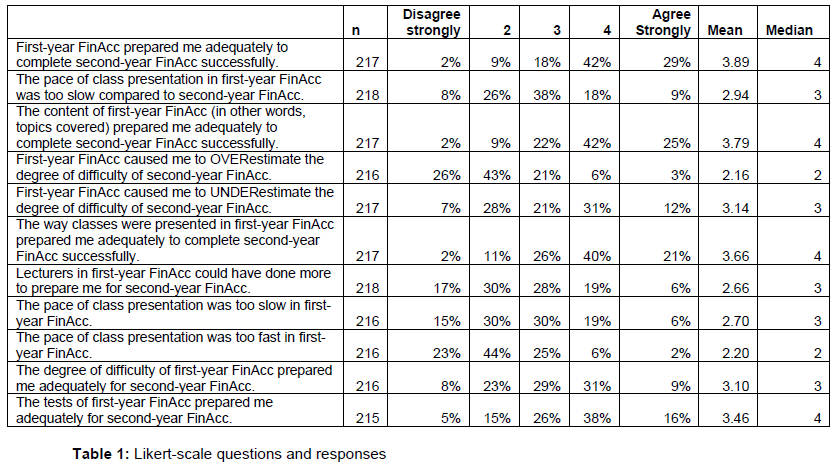
The questionnaire contained a number of 5-point Likert scale questions to gauge students' perceptions. The calculated mean and median are summarised in Table 1.
General perceptions
In response to a general question, 71 per cent of the respondents were of the opinion that the first-year module prepared them adequately to complete the second-year module successfully. The majority (67 per cent) also felt that the topics covered in the module prepared them adequately for the second year. Taking into account the various challenges second-year students are required to manage, these results could reveal that they know how to deal with these challenges and can even experience the transition from first year to second year as positive, as was found by Willcoxson, Cotter and Joy (2011) and Ramsay, Barker and Jones (1999). In an open-ended question, "In what ways did the work covered in first-year FinAcc prepare you for second-year FinAcc?", 77 per cent of the respondents said that the work covered had provided a good foundation, and had taught them the basics and principles of the discipline. A further 19 per cent went on to say that good learning methods and habits learned in the first year stood them in good stead in the second year. These results correspond to Tinto's (1993) findings that the foundations and experiences from the first year play a meaningful role towards the performance and preparedness of the following year. The following quotes represent typical responses:
"The work in first-year FinAcc is a good introduction of accounting and allows continuity into second-year FinAcc for understanding concepts in greater detail and applying techniques to more difficult problems."
"Work in first-year FinAcc significantly prepared me for second-year FinAcc. It improved some of my accounting skills."
Adjustments between first and second year
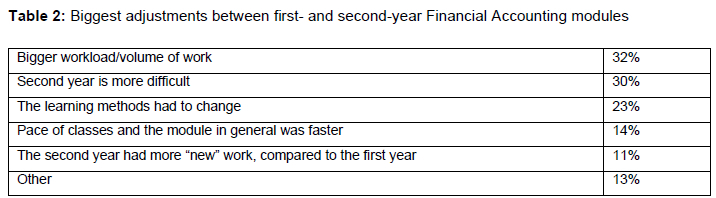
In an open-ended question, students were asked what the biggest adjustment was between the first- and second-year Financial Accounting modules. The results are summarised in Table 2.
The responses are in line with expectations and the reality of life at university, which include more and harder work in the second year and a faster pace, all necessitating a change in students' approach to and method of learning. These results are also in agreement with prior research by, for example, Sterling (2018) and Milsom and Yorke (2015), who also found that the intense workload is a major factor in adjusting from the first year to the second year. These themes appear in the responses to other questions as well. The following sample of quotes represent the more typical responses:
"I found that continuous practice is required for second-year FinAcc, whereas with first-year FinAcc not much needed to be done to be successful in the module at the end of the year. The adjustment from first-year FinAcc to second-year FinAcc was therefore difficult."
"First-year FinAcc was a lot of revision so it was easy to stay up to date without really trying. Second-year FinAcc is all new work so it takes a lot more hard work and attention."
Classes
Classes in the first year Financial Accounting module are initially presented at a slightly slower pace compared to second- and third-year Financial Accounting modules. For many students this is their first introduction to the subject area, and sufficient time is spent on embedding an understanding of the base principles of the discipline. In the second year of Financial Accounting, all students are expected to be at the same level and the pace is picked up considerably. Students were asked whether the pace of classes was too slow in the first year, compared to the second year. A third (34 per cent) disagreed, i.e. they felt that the pace was not too slow, 38 per cent were neutral, and 28 per cent agreed. Later in the survey, when students were asked whether the pace was too slow (in general, instead of as preparation for second year), 25 per cent agreed that it was too slow. However, in a separate question, only 8 per cent felt it was too fast. From the results of these different questions it can be concluded that, for the majority of students, the pace of classes in the first year is acceptable and serves as adequate preparation for the second year.
Respondents believed that the way in which classes were presented in the first year prepared them adequately for the second year, with 61 per cent of the respondents agreeing.
Tests
The first-year and second-year modules are assessed in a similar fashion with written three-hour tests. In a Likert-scale question, 54 per cent of the respondents agreed with the statement "The tests for first-year FinAcc prepared me adequately for second-year FinAcc", with 20 per cent disagreeing. In a related question, 40 per cent felt that the degree of difficulty for the first-year module prepared them adequately for the second-year module, with 31 per cent disagreeing.
In an open-ended question, students were asked which of the skills they learned in the first-year module assisted them to be successful in the second year. More than half (53 per cent) in some way indicated that exam technique, study methods and a general approach to questions learned in their first year aided them in their second year. This response could indicate that the lecturers of this course adopted various approaches to tests in order to accommodate students with various learnings styles (Visser et al. 2006).
Effect on expectations
As discussed previously, the first-year Financial Accounting module is an introductory module to Financial Accounting and is presented at a slightly slower pace compared to second- and third-year Financial Accounting modules. The reason for the introductory module to Financial Accounting is that some first-year students would have had exposure to accounting at secondary school level, while for other first-year students the Financial Accounting module would have been their first introduction to this learning area. For this reason, it is possible that the first-year module might create incorrect expectations of the discipline and future Financial Accounting modules for both the students who had previous exposure to accounting at secondary school level and for those who did not. Specifically, this might lead them to either over- or underestimate the degree of difficulty of the second-year Financial Accounting module.
Two Likert-questions indicate that these fears are warranted. More than two thirds (69 per cent) felt that they did not overestimate the difficulty of the second-year Financial Accounting module; however, 44 per cent believed that the first-year Financial Accounting module caused them to underestimate the second-year Financial Accounting module. This could possibly lull students into a false sense of security at the start of their second year, with negative consequences later in their second year.
This is borne out in the responses to an open-ended question where respondents were asked to indicate how the first-year Financial Accounting module hindered their success in the second-year Financial Accounting module. Of the respondents who listed factors that hindered them, 50 per cent indicated that the first-year of Financial Accounting was easy, and caused them to underestimate the second-year of Financial Accounting. The samples of quotes below reflect some of these views:
"Because first-year FinAcc was so easy, I underestimated the difficulty of second-year FinAcc and went into it with a "too chilled" mindset."
"First-year FinAcc was very similar to accounting in high school. There was not much new work. There is therefore a lot more new work in second-year FinAcc for me. It may have made me underestimate second-year FinAcc somewhat. However, I adjusted fine and am doing well in second-year FinAcc."
"The pace was pretty slow in first-year FinAcc (keep in mind I did do accounting in school). So it made me lazy for Finacc which affected my marks for second-year FinAcc as I realized I had to start putting in more hours."
"Make the student understand that in order to cope with second-year FinAcc, first-year Fin Acc is more important than expected as it is often underestimated or its necessity for second-year FinAcc is underestimated."
Lecturers
While ample support is provided by the university, faculty and lecturers, it remains the responsibility of the student to access the support and, in the final instance, to pass the module (Crabtree et al. 2007). The researchers were therefore interested to know whether students believed that lecturers could have done more to prepare them for the second-year Financial Accounting module. Only 25 per cent felt that lecturers could have done more to help them prepare for second-year Financial Accounting, while 47 per cent said they could not have done anything more.
When students were asked in an open-ended question how first-year Financial Accounting lecturers hindered their success in their second-year Financial Accounting studies, 73 per cent indicated that lecturers did not hinder their success in any way. Of the remainder, 14 per cent had a variety of comments related to lecturing style, disinterest, lack of motivation received from the lecturer, or other related matters. The only noticeable trend in the answers to this question was that 6 per cent of respondents felt that the pace of the lecturer in first-year Financial Accounting was too slow compared to second-year Financial Accounting. This corresponds to the study by Sekhukune (2008) where students in accounting found it difficult to cope with the pace of lectures in their second year.
Students were also afforded the opportunity to indicate how lecturers helped students to be successful in their second-year Financial Accounting. As could be expected, the answers to this question varied widely in detail, but were for the most part complimentary (65 per cent of the respondents) regarding specific lecturers, generally good lecturing styles, preparedness, and helpfulness. As one student responded:
"My lecturer in first-year FinAcc was extremely helpful and made sure I understood the concepts (she was thorough and explained things really well) which helped me to have a more solid foundation of knowledge in second-year FinAcc. I didn't have to revisit work to understand things again."
One noticeable theme that emerged in this regard was that lecturers' enthusiasm, passion and personal interest aided students' preparation for the second-year Financial Accounting module, as was indicated in some way by 25 per cent of respondents. Two typical comments from respondents illustrate this:
"My lecturer in first-year FinAcc was fantastic, passionate and really understanding and helpful. He listened to the class and would not move on if the class was confused. He really managed to portray his love for accounting and used different ways to help us understand the sections instead of just using normal slides and questions."
"Their enthusiasm for the subject really helps. People tend to relay information better when they are passionate about it. When lecturers were really enjoying the topic, it creates a better environment not only to encourage learning (because the lecturer gives detailed explanations) but it also creates an environment which is more comfortable for asking questions and actively participating."
Given that students' self-confidence influences their motivation and commitment in higher education (Anderman and Midgley 1998), lecturers' attitude can play a vital role in students' future success. In a separate question, students were asked whether the first-year Financial Accounting module had changed their interest in accounting in general. A quarter (27 per cent) stated that the first-year Financial Accounting module had increased their interest significantly, with 35 per cent indicating that it had increased it a bit. Evidently, lecturers can play a role in promoting students' motivation and commitment. In line with Calma's (2020) finding regarding the detrimental effect of negative lecturers, positive lecturers seem to have a positive effect on future performance, at least in the perceptions of students.
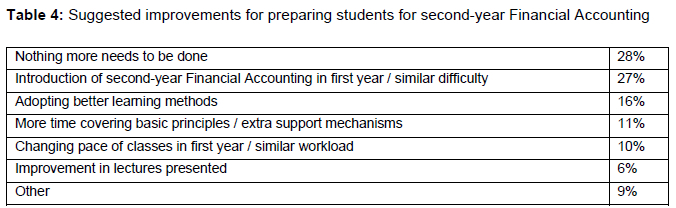
SUGGESTED IMPROVEMENTSThe respondents were asked what could have been done in the first-year Financial Accounting module to prepare them better for the second-year Financial Accounting module. The results are summarised in Table 4.
Just more than a quarter (27 per cent) of the respondents expressed the wish that the difficulty level of the first-year Financial Accounting module be more similar to the second-year Financial Accounting module. Additionally, they suggested that some of the content of the second-year Financial Accounting module is introduced in the first-year Financial Accounting module to ease the transition between first and second year of Financial Accounting studies. Examples of students' responses are:
"A slight introduction to the concepts which were going to be dealt with in second-year FinAcc. A gradual increasing pace in first-year FinAcc would have assisted as well, I [sic] think."
"The difficulty level of work completed in first-year FinAcc could've been a bit closer to second-year FinAcc's difficulty level, then the jump wouldn't have been so dramatic."
These findings agree with those by Willcoxson, Cotter and Joy (2011) regarding managing student expectations.
Some of the respondents (16 per cent) indicated that they should have employed better learning methods in the first year of Financial Accounting to better prepare themselves for second-year Financial Accounting. They mentioned, for instance, working more on their own, coming to class prepared, attending classes, and working through more exercises. As one student responded:
"I think that first-year FinAcc was taught well especially because I didn't have accounting in high school it helped me to prepare for second-year FinAcc. Again I just need to do a lot of extra studying because the concepts in second-year FinAcc aren't repeated once they're taught and I just had to adjust to that lack of repetition."
Whereas Willcoxson, Cotter and Joy (2011) and Gahagan and Hunter (2006) found that students require more support, only 11 per cent of respondents in the current study believed more time should be spent on covering the basic principles and adding further support mechanisms in the first year. As such, the majority of respondents did not identify lack of support as a main concern in preparing them for second-year Financial Accounting.
Of the respondents, 10 per cent had comments on changing the pace of classes; however, the responses were fairly evenly split between both classes being faster and slower. A small percentage (6 per cent) had other suggestions regarding the presentation of the work and classes.
CONCLUSIONS AND IMPLICATIONS
Macaskill (2018) proposes the possibility that first year transition strategies provide too much support, and consequently, after a positive first year, the reduced transitional support in the second year leaves students feeling abandoned by the institution. D'Arcangelo (2013) suggests that the issues of retention in first year are moved to the second year, and that in line with transitional support in the first year, the second year should also have targeted transition support. This raises concerns that university implementation of first year transition pedagogies may have been too narrowly focused. The transition from first year to second year at university is an important one, as students need to navigate their way through new challenges that await them. Hence, they expect the same level of support that they might have received in their first year. However, higher education institutions normally direct their attention to the new first-years, and this is where second-year students might feel left out (Schreiner 2018). Sophomores can be compared to a sibling stuck between the older child and the baby seeking attention. Notably, Sterling (2018) highlights the importance of continuing the provision of specific support to maximise all students' learning and development. Therefore, sophomores should not be viewed as the "forgotten class". On the contrary, it is vital to understand that they are going through a period of transition.
Byrne and Flood (2005) emphasise that for a student to succeed, he or she has to know what is expected from him or her and to be prepared accordingly, since students' motives, preparedness and expectations impact their learning, and ultimately their success. In line with this, Gahagan and Hunter (2006) opine that support should be extended to second-year students and their needs should be considered more seriously in order to assist them better. However, there is much that we don't know about second-years, their experiences and their challenges. Therefore, much more research needs to be done in this regard (Heier 2012).
The current study aimed to determine the views of second-year Financial Accounting students at one university in South Africa on whether the current first-year Financial Accounting module and lecturers support or fail to support student success in the current second-year Financial Accounting module. At large, the results showed that the respondents were mostly of the opinion that the first-year Financial Accounting module provided a good basis and prepared them well for the second-year module. The increased workload and difficulty level of the second year were highlighted as the biggest adjustments from first to second year. Students were, however, generally satisfied that the tests and pace of classes in the first year served as good preparation for the second-year module.
What emerged as an area that warrants improvement in the transition from first to second year is better communication regarding the differences students can expect. Students' expectations of what they could anticipate in their second year were based on their experiences in and perceptions of the first-year module. Consequently, they often underestimated the second-year accounting module. Students therefore suggested that a variety of methods be employed to manage their expectations, e.g. introducing topics in the first year already and discussions on study techniques and the importance of time management.
To address the suggested improvement in communication, it might be considered to disseminate the results of this study among first-year students at the beginning of the academic year. This could potentially enhance their motivation to approach the subject with greater seriousness and encourage regular class attendance. Rather than being mere instructions from a lecturer, these findings reflect the perspectives of their peers and might therefore be more impactful. The approach aims to foster a more engaging and relatable learning environment. Furthermore, lecturers can attempt to contextualise the contents of the first-year module within the scope of the topics and workload of future years. Providing a better understanding of where the work fits in and demonstrating how it serves as a basis for future years of studies may motivate and inform students better.
The study supports the extant literature, but also expands on the literature and adds value by giving a voice to students' experiences. These perceptions and experiences can sensitise lecturers in how they present classes, but also in how curricula are developed. The fact that the study focused mainly on students' own perceptions could be seen as a limitation to the study. However, the research question identified is not necessarily restricted to a specific discipline, in this case accounting; it could be generalisable beyond this context to other disciplines and other higher education institutions.
An area for future research, which is currently being undertaken, is the extent to which there is a correlation between students' academic performance in the first-year module and the second-year module.
REFERENCES
LITERATURE REVIEW
- Adelman, C. 2006. The toolbox revisited: Paths to degree completion from high school through college. US Department of Education.
- Anderman, L.H. and C. Midgley. 1998. Motivation and Middle School Students. ERIC Digest.
- Baxter, A. and S. Hatt. 2000. "Everything Must Go!"Clearing and first-year performance. Journal of Further and Higher Education, 24(1): 5-14.
- Bennett, R., R. Kottasz and J. Nocciolino. 2007. Catching the early walker: An examination of potential antecedents of rapid student exit from business-related undergraduate degree programmes in a post-1992 university. Journal of Further and Higher Education, 31(2): 109-132.
- Biggs, J.B. 1985. The role of metalearning in study processes. British journal of educational psychology, 55(3): 185-212.
- Birbeck, D., L. McKellar and K. Kenyon. 2021. Moving beyond first year: An exploration of staff and student experience. Student Success, 12(1): 82-92.
- Black, E.L. 2014. Engaging beyond the first college year: Exploring the needs of second-year students. Communications in Information Literacy, 8(2): 6.
- Bowles, A., R. Fisher, R. McPhail, D. Rosenstreich and A. Dobson. 2014. Staying the distance: Students' perceptions of enablers of transition to higher education. Higher Education Research & Development, 33(2): 212-225.
- Boyle, R., J. Carter and M. Clark. 2002. What makes them succeed? Entry, progression and graduation in computer science. Journal of Further and Higher Education, 26(1): 3-18.
- Bunce, L. 2017. The student-as-consumer approach in higher education and its effects on academic performance. Studies in Higher Education, 42(11): 1958-1978.
- Byrne, M. and B. Flood. 2005. A study of accounting students' motives, expectations and preparedness for higher education. Journal offurther and Higher Education, 29(2): 111-124.
- Byrne, M., B. Flood and P. Willis. 2002. The relationship between learning approaches and learning outcomes: a study of Irish accounting students. Accounting education, 11(1): 27-42.
- Cadiz Dyball, M., A. Reid, P. Ross and H. Schoch. 2010. Compulsory group work-accounting students' conceptions and suggestions. Asian Review of Accounting, 18(2): 92-105.
-
Calma, R.R. 2020. Academic Preparedness of the Second Year Students in Accountancy Program. Available: chrome-extension://efaidnbmnnnibpcajpcglclefindmka)/https://fms-kursk.ru/wpcontent/uploads/2020/07/AcademicPreparednessoftheSecondYearStudentsinAccountancyProgram.pdf (Accessed 21 January 2023).
» chrome-extension://efaidnbmnnnibpcajpcglclefindmka)/https://fms-kursk.ru/wpcontent/uploads/2020/07/AcademicPreparednessoftheSecondYearStudentsinAccountancyProgram.pdf - Cameron, R.B. and C.A. Rideout. 2022. "It's been a challenge finding new ways to learn": first-year students' perceptions of adapting to learning in a university environment. Studies in Higher Education, 47(3): 668-682.
- Conana, H., D. Marshall and D. Solomons. 2019. Supporting student learning in foundation programmes and beyond: Using Legitimation Code Theory as a theoretical lens to think about transition. Reconfiguring Foundational Pedagogies through Theoretical Frameworks, 26(2): 183-212.
- Cook, A. and J. Leckey. 1999. Do expectations meet reality? A survey of changes in first-year student opinion. Journal of further and higher education, 23(2): 157-171.
- Crabtree, H., C. Roberts and C. Tyler. 2007. Understanding the problems of transition into higher education. In 4th Education in a Changing Environment Conference: 12-14.
- D'Arcangelo, M.T. 2013. Understanding student development tasks related to sophomores and their academic success. State University of New York at Buffalo.
- Donnison, S. and J. Masters. 2010. Supporting transition into higher education through social affordances: The Pod experience. In Proceedings of the 13th Pacific Rim First Year in Higher Education Conference: 1-10. Queensland University of Technology.
- Duff, A. 1999. Access policy and approaches to learning. Accounting Education, 8(2): 99-110.
- Duff, A. 2004. Understanding academic performance and progression of first-year accounting and business economics undergraduates: the role of approaches to learning and prior academic achievement. Accounting Education, 13(4): 409-430.
- Fulmer, R.H., J. Medalie and D.A. Lord. 1982. Life cycles in transition: A family systems perspective on counselling the college student. Journal of Adolescence, 5(3): 195-217.
- Gahagan, J. and M.S. Hunter. 2006. The second-year experience: Turning attention to the academy's middle children. About Campus, 11(3): 17-22.
- Gahagan, J. and M.S. Hunter. 2008. Engaging sophomores: Attending to the needs of second-year students. College and University, 83(3): 45.
- Gallon, D. 1990. A report of the Commission on Urban Junior Colleges of the American Association of Community and Junior Colleges (AAJAC) (Washington DC, National Centre for Higher Education).
- Gamache, P. 2002. University students as creators of personal knowledge: An alternative epistemological view. Teaching in higher education, 7(3): 277-294.
- Gay, L.R. 1987. Educational research. Competencies for analysis and application. Third Edition. Colombus: Merrill Publishing Company.
- Hassel, S. and N. Ridout. 2018. An investigation of first-year students' and lecturers' expectations of university education. Frontiers in psychology, 8: 2218.
- Heier, M. 2012. Understanding the Sophomore Year Experience. Washington, University of Washington.
- Henning, E., W. Van Rensburg and B. Smit. 2004. Finding your way in qualitative research. First Edition. Pretoria: Van Schaik Publishers.
- Kantanis, T. 2000. The role of social transition in students': adjustment to the first-year of university. Journal of Institutional Research, 9(1): 100-110.
- Killen, R. 1994. Differences between students' and lecturers' perceptions of factors influencing students' academic success at university. Higher Education Research and Development, 13(2): 199-211.
- Kuh, G. 1999. Setting the bar high to promote student learning. In G. Blimling, and E. Whitt (Eds.), Good practice in student affairs: Principles that foster student learning. San Francisco: Jossey-Bass. 67-89.
- Kuh, G.D., J. Kinzie, J.H. Schuh and E.J. Whitt. 2011. Student success in college: Creating conditions that matter. John Wiley & Sons.
- Levinson, D.J., C.N. Darrow, E.B. Klein, M.H. Levinson and B. McKee. 1978. The Seasons of a Man's Life. New York: Alfred A. Knopf.
- Loughlin, W., S.J. Gregory, G. Harrison and J. Lodge. 2013. Beyond the first year experience in science: Identifying the need for a supportive learning and teaching environment for second year science students. International Journal of Innovation in Science and Mathematics Education, 21(4).
- Lowe, H. and A. Cook. 2003. Mind the gap: are students prepared for higher education? Journal of further and higher education, 27(1): 53-76.
- Macaskill, A. 2018. Undergraduate mental health issues: The challenge of the second year of study. Journal of Mental Health, 27(3): 214-221.
- Mavunga, G. 2014. The Contribution of Under-Preparedness to Low First Year Success Rates as Perceived by Lecturers and second Year Students and at a Comprehensive South African University. Mediterranean Journal of Social Sciences, 5(20): 1748.
- Milsom, C. and M. Yorke. 2015. Defining the second year. In C. Milsom, M. Stewart, M. Yorke and E. Zaitseva (Eds.), Stepping up to the second year at university: academic, psychological and social dimensions. 14-23. Abingdon: Routledge.
- Nel, C., C. Troskie-de Bruin and E. Bitzer. 2009. Students' transition from school to university: Possibilities for a pre-university intervention. South African Journal of Higher Education, 23(5): 974-991.
- Nell, C.E. and M.C. Cant. 2014. Determining student perceptions regarding the most important service features and overall satisfaction with the service quality of a higher education institution. Management: Journal of Contemporary Management Issues, 19(2): 63-87.
- Neugarten, B.L. 1976. Adaptation and the life cycle. The counseling psychologist, 6(1): 16-20.
- Ramsay, S., M. Barker and E. Jones. 1999. Academic Adjustment and Learning Processes: a comparison of international and local students in first-year university. Higher Education Research & Development, 18(1): 129-144.
- Sekhukhune, M.E. 2008. An empirical investigation into the key factors causing second-year accounting students to drop out at Tshwane University of Technology Soshanguve Campus between 2004 to 2006 (Doctoral dissertation, North-West University).
- Schreiner, L.A. 2018. Thriving in the second year of college: Pathways to success. New Directions for Higher Education, 2018(183): 9-21.
- Schreiner, L. and J. Pattengale (Eds.). 2000. Visible solutions, for invisible students: helping sophomores succeed. Monograph Series No. 31. National Resource Centre for the First Year Experience and Students in Transition, University of South Carolina.
- Steenkamp, L.P., R.S. Baard and B.L. Frick. 2009. Factors influencing success in first-year accounting at a South African university: A comparison between lecturers' assumptions and students' perceptions. SA Journal of Accounting Research, 23(1): 113-140.
- Sterling, A.J. 2018. Student experiences in the second year: Advancing strategies for success beyond the first year of college. Strategic Enrollment Management Quarterly, 5(4): 136-149.
- Strydom, J.F. and M. Mentz. 2010. Focusing the student experience on success through student engagement. Pretoria: Council on Higher Education.
- Tinto, V. 1993. Building community. Liberal education, 79(4): 16-21.
- University of Sheffield. 2009. Student Transitions Support. Definition and Development. Final Report. Sheffield: University of Sheffield.
- Vermunt, J.D. and F.A. Van Rijswijk. 1988. Analysis and development of students' skill in selfregulated learning. Higher education, 17(6): 647-682.
- Visser, S., S. McChlery and N. Vreken. 2006. Teaching styles versus learning styles in the accounting sciences in the United Kingdom and South Africa: a comparative analysis. Meditari accountancy research, 14(2): 97-112.
- Willcoxson, L., J. Cotter and S. Joy. 2011. Beyond the first-year experience: The impact on attrition of student experiences throughout undergraduate degree studies in six diverse universities. Studies in Higher Education, 36(3): 331-352.