The relationship between cognitive load and self-regulated learning strategies amongst postgraduate accounting students at a South African university
Abstract
Studies propose the integration of two prominent learning theories:Cognitive Load Theory (CLT) and Self-Regulated Learning (SRL). The purpose of this study is to provide empirical evidence relating to this field of interest, by investigating the relationship between cognitive load and SRL strategies amongst postgraduate accounting students. Each of 262 participants completed one of three tasks of varying levels of difficulty, followed by a questionnaire that subjectively assessed each participants' cognitive load and self-regulation. The data was statistically analysed. The results indicate a statistically significant positive relationship between cognitive load and perceived task difficulty, in line with existing literature. In addition, a statistically significant negative relationship was observed between cognitive load and one of three self-regulation constructs. A high level of self-regulation in the form of learning strategies was therefore associated with low cognitive load, and vice versa. This study thus provides unique evidence of the benefit of learning strategies for managing cognitive load amongst accounting postgraduate students. It furthermore provides recommendations for instrument design measuring both SRL and cognitive load.
Cognitive load; self-regulated learning; accounting; postgraduate
INTRODUCTION
Accounting professional bodies increasingly emphasise the need for individuals to be lifelong learners (American Institute of Certified Public Accountants, 2019; South African Institute of Chartered Accountants 2020). Further, global higher education institutions are experiencing increasing diversification and massification of students, thus compelling students to become more responsible for their own learning (Stegmann and Malan 2016). A lifelong learner is a self-regulating learner with a clearly defined goal, who determines what should be mastered, controls their environment, implements a learning plan, seeks assistance, monitors progress and evaluates that progress towards the predetermined goal (Smith 2001). A recent South African study identified a positive relationship between accounting students' ability to control their beliefs about their learning (i.e. self-regulation) and academic performance (Papageorgiou 2022); thereby affirming the link between self-regulation and academic success.
To support the development of students' lifelong learning skills, de Bruin and van Merriënboer (2017) recommend the integration of two research paradigms: Cognitive Load Theory (CLT), which focuses on instructional design for learning in complex, information-heavy circumstances, and Self-Regulated Learning (SRL), which addresses aspects of the learning process that learner's control and monitor. Integration of these paradigms is only feasible if there are sufficient commonalities between the individual paradigms and they can benefit from each other's strengths. Previous studies (notably de Bruin and van Merriënboer (2017); Seufert (2018) and Sweller and Paas (2017)) provide early analyses into the commonalities and differences between the paradigms and conclude that the integration is not only feasible, but also necessary. Further, de Bruin and van Merriënboer (2017), Seufert (2018) and Wang and Lajoie (2023) propose theoretical frameworks for the integration. However, a lack of empirical validation of the relationship between Cognitive Load (CL) and SRL currently exists in the literature.
The purpose of this study is to investigate the relationship between CL and SRL amongst postgraduate accounting students. Hughes, Costley, and Lange (2018) identify a negative relationship between certain components of CL and self-regulatory effort. Seufert (2018) proposes an interactive relationship between CL and self-regulation during task completion (learning), which gives rise to a parabolic function. In this function, as task difficulty increases, the increasing cognitive load initially induces self-regulation to a certain point, after which the self-regulation becomes a burdensome cognitive load to the learning process. Other scholars have proposed additional considerations of relevance to the relationship between SRL and CL, such as self-control acting as a bridge (Eitel, Endres, and Renkl 2020), and the role of unconscious self-regulation (Wirth et al 2020). Although a framework for the integration of CLT and SRL is, therefore, still an ongoing area of research, this study aims to contribute empirical evidence to these theoretical developments.
This study statistically models theorised relationships between task difficulty, CL and self-regulation using a variety of statistical techniques, including structural equation modelling (SEM). SEM comprises of confirmatory factor analysis and regression analysis. The study does so via a measurement instrument designed for this study, incorporating both SRL and CLT concepts. The findings of this study contribute to research on the relationship between CL and SRL, specifically within an accounting context at a South African university. This contribution also includes recommendations for instrument design.
CLT and SRL are two eminent fields within educational research, that have largely been independently researched, developed and applied. Both theories have provided useful insights into learning; however, these insights have been less robust due to their independent development (Moos 2013). In response to the growing complexity and volume of information in the learning environment, emerging research (e.g. Boekaerts 2017; de Bruin and van Merriënboer 2017; de Bruin et al 2020; Seufert 2018; Seufert 2020; Sweller and Paas 2017) has begun exploring the possibility of integrating CLT and SRL. Integration of these theories may provide further knowledge of learning efficiency and the development of lifelong learning skills, which has benefits for the academic environment and workplace. A high-level overview of these two fields follows.
Cognitive Load Theory
CLT is an instructional design theory underpinned by our understanding of the human cognitive architecture (Sweller, van Merriënboer, and Paas 1998; Sweller 2019; Sweller, van Merriënboer, and Paas 2019). The primary aim of CLT is to increase the learning efficiency of complex tasks (Mostyn 2012). Efficiency refers to the effort a learner exerts in comprehending and remembering content. CLT states that the amount and complexity of information required to be held in working memory for any learning objective significantly affects the efficiency of learning (Sweller et al 2019). The objective of CLT is, therefore, to address learning efficiency by identifying how CLs result in learning constraints and how to optimise the amount and type of CL in order to improve learning efficiency (Mostyn 2012; Sweller et al 2019).
The classical formulation of the human cognitive architecture comprises of limited working memory capacity, schemas and unlimited long-term memory (Roodenrys et al 2012; Sweller et al 2019). The amount and duration of information that can be held in working memory is limited (Miller 1956; Cowan 2001). Schemas are organised knowledge structures (Plass and Kalyuga 2019) that are developed incrementally in chunks in working memory and transferred to long-term memory, with repetition (Mostyn 2012). Schemas in long-term memory are retrieved by working memory to solve problems (Sweller et al 2019). Experts typically have large amounts of complex schemas in long-term memory, distinguishing them from novices with fewer and simpler schemas (Sithole and Abeysekera 2017). CLT has advanced towards developing techniques to manage working-memory load to facilitate the changes in long-term memory related to schema construction and automation (Paas, Renkl, and Sweller 2004).
According to CLT, there are three categories of CLs: intrinsic, extraneous and germane CL (Sweller et al 2019). Intrinsic CL is the cognitive effort exerted due to the inherent complexity of the material to be learned and is assumed to be fixed (Sweller et al 2019). The level of intrinsic load is created by the number of elements interacting in a complex task and can be altered by changing what is taught (Sweller et al 2019). The intrinsic load is related to a learner's schema development, as intrinsic load eventually transforms into schemas through the comprehension and synthesis of information (Mostyn 2012).
Extraneous CL is the unnecessary cognitive effort expensed due to inefficient instructional designs (Sweller et al 2019). Similar to intrinsic load, extraneous load is also determined by the number of interacting elements, but is more specifically related to the instructional design of the learning material, instead of its inherent complexity (Sweller et al 2019). Extraneous load can be reduced by tailoring instructional methods to learners' levels of expertise (Blayney, Kalyuga, and Sweller 2010).
Germane CL is the necessary cognitive effort that working memory uses to foster schema development (Park et al 2019). Germane load is based on instructional materials that facilitate effective and efficient learning (Park et al 2019). According to Mostyn (2012), germane load is essential to learning as it is related to comprehension, practice, repetition and development of metacognition. The three types of CL described above work in conjunction with each other and should be considered collectively by instructors when designing materials to ensure that learners' constrained cognitive processing capacity is used efficiently during learning (Sithole and Abeysekera 2017).
The measurement of CL is highly subjective (Sweller et al 2019). Sweller et al (2011) distinguish between measures such as: indirect (e.g., task performance), secondary (e.g., using secondary tasks to measure CL in primary tasks) and physiological (e.g., eye tracking). Indirect measures also include subjective self-reporting scales, such as questionnaires where participants specify the perceived CL experienced from completing a task. The classical, and most popular method of measurement in CLT research is the Paas (1992) scale (Schmeck et al 2015; Seufert 2018). The Paas (1992) scale is a subjective rating scale that is either a 5-, 7- or 9-point Likert scale that requires learners to rate their mental effort. It captures the overall CL and thus cannot distinguish between different types of loads (Sweller et al 2019), which is a noted shortcoming (Schmeck et al 2015; Seufert 2018).
Critics caution against overreliance on mental rating scales, as learners tend to adjust ratings according to situational factors and subjective internal standards (Schmeck et al 2015; van Gog and Paas 2008). However, studies have shown that the Paas (1992) scale is sensitive enough to detect minor changes in task complexity, easier to use and as equally reliable as objective techniques such as physiological measurements (Szulewski et al 2017; Paas et al 1994; Van Gerven et al 2004).
Self-regulated Learning
SRL is the process in which students metacognitively, motivationally and behaviourally participate in their own learning to attain their goals (Zimmerman 1986; Zimmerman and Schunk 2011). SRL research has found that self-regulatory processes are a vital explanation of achievement disparities amongst students (Zimmerman and Martinez-Pons 1986). SRL is also an effective means to improve achievements of students who differ vastly in proficiency (Schunk 1981, 1984).
Self-regulating learners specify learning goals, employ effective learning strategies, monitor and assess their progress, create productive learning environments, and maintain a sense of self-efficacy for learning (Zimmerman 1986; Zimmerman and Schunk 2011). When learning goals are set, learners create feedback loops that allow them to follow their learning effectiveness and adjust their functioning. Feedback from the self-regulatory cycle allows learners to seek support when required, to adjust strategies, and to persist, reach and set goals (Zimmerman and Schunk 2011). Research increasingly promotes SRL, and studies have argued that SRL behaviours are teachable (Dignath and Büttner 2008).
Many SRL models exist (Boekaerts 2011; Efklides 2011; Pintrich 2000; Zimmerman 2000; Winne and Hadwin 1998) that cover unique domains (Sitzmann and Ely 2011). Pintrich's (2000) model on motivation and its measurement instruments are widely utilised (Honicke and Broadbent 2016; Roth, Ogrin, and Schmitz 2016). Schunk (2005) suggests that this model is suitable for studying SRL in educational settings.
Pintrich's model gave rise to a significant contribution to SRL research: The Motivated Strategies for Learning Questionnaire (MSLQ) (Pintrich et al 1993). The MSLQ is the most utilised SRL measurement instrument (Honicke and Broadbent 2016; Roth et al 2016). An additional model developed by Efklides and Vlachopoulos's (2012) is known as the Metacognitive Knowledge in Mathematics Questionnaire (MKMQ). The MKMQ has also been used in subsequent research (e.g., Tian, Fang, and Li (2018)). The MKMQ and the MSLQ are, therefore, well-established methods for the purpose of measuring SRL.
The relationship between CLT and SRL
Numerous models exist within the individual lines of research, but there is not yet consensus on a specific, empirically validated conceptual framework that should be used to depict the integration of CLT and SRL. Possible frameworks include Koriat's (1997) Cue-Utilization Theory and Seufert's (2018) Conceptual Model. The Cue-Utilization Theory has been well-utilised in medical education research (de Bruin et al 2017) and provides a practical SRL perspective to the integration of learning theories. Seufert's (2018) Conceptual Model is more generalised, as it models the underlying theoretical relationships between CLT and SRL - which the Cue-Utilization Theory does not address explicitly.
Seufert's (2018) Conceptual Model is premised on the core constructs of CLT and SRL, with a clear emphasis on the different kinds of CLs that self-regulation creates during different phases of learning. This is consistent with CLT literature where self-regulation is seen as an additional CL imposed on a learner's memory capacity (de Bruin and van Merriënboer 2017; Seufert 2018; van Gog, Kester, and Paas 2011). Therefore, the possibility of integration has increasingly been approached from a CLT perspective rather than from a SRL perspective.
Seufert's (2018) analysis of the interplay between CLT and SRL shows that self-regulation during learning is a cognitively demanding process. The learning task imposes either an intrinsic or extraneous load, which reduces the mental capacity available for a learner to self-regulate. The collective effect of the imposed load and availability of sufficient mental resources determines the level of self-regulation. If a task is easy, minimal mental resources are required to complete the task. Therefore, CL is low and there is no need for learners to self-regulate. Thus, self-regulation is low. However, when tasks are difficult and CL is high, a learner may not have residual cognitive capacity to self-regulate. The optimal point of learning is when the task difficulty, CL and mental resources are balanced, enabling optimal management of the task and self-regulation. This is seen when the task is of medium difficulty. At this optimal point, the CL is sufficient to trigger self-regulation, but not too high to inhibit self-regulation. This relationship suggests that CL could trigger self-regulation (germane CL), but self-regulation could also impose CL (extraneous CL) (Seufert 2018).
This relationship is supported by studies such as Costley and Lange (2017); Hughes et al (2018); Lange and Costley (2018, 2019); Lange, Costley, and Han (2017) and van Gog et al (2011). These studies show that there is a positive relationship between self-regulation and germane load; and that extraneous load is negatively related to self-regulation and germane load, which suggests that the conceptual relationships modelled by Seufert (2018) hold. The aim of this study is to further investigate the nature of the relationship between SRL and CL, within a unique context, being South African postgraduate accounting students. Recent studies on either CLT or SRL involving accounting students include Bentley and Becker (2026); Papageorgiou (2022); King et al (2021); Lima Filho (2020) and Miller (2020). However, no studies have yet been conducted on the interaction between CL and SRL amongst postgraduate accounting students; thereby affirming the need for the present study.
METHODOLOGY
This study aims to answer the following research question: "What is the relationship between CL and SRL strategies amongst postgraduate accounting students at a South African university?"
Research design
This study adopts an approach similar to that of Efklides and Vlachopoulos (2012); Hughes et al (2018); Jackson (2018); Lange et al (2017); Lange and Costley (2018); Sithole and Abeysekera (2017) and Tian et al (2018). In these studies, a predetermined task is designed and administered, followed by a questionnaire based on existing questionnaires; namely, the MKMQ (Efklides and Vlachopoulos 2012), MSLQ (Pintrich et al 1991) and Paas (1992) scales. The tasks were administered before the questionnaire, thereby requiring learners to retrospectively provide subjective judgement of the level of effort exerted in completing the task and the amount of self-regulation that was invested in both completing the task and learning the content.
The data was collected from postgraduate accounting students. Similar to Costley and Lange (2017) and Hughes et al (2018), the participants were randomly assigned one of three versions of the task: easy, medium and difficult, in order to investigate the relationship between CL and self-regulation for different levels of task difficulty. Once the data was collected, cleaned, captured and reviewed; descriptive statistics, correlation analyses and analysis of variance tests (ANOVA) were conducted. Thereafter, exploratory and confirmatory factor analyses were conducted to identify and confirm the constructs of interest relating to CL and self-regulation. This aligns with the approach of Efklides and Vlachopoulos (2012); Jackson (2018) and Smith and Chen (2017). Finally, various models using structural equation modelling (SEM) (Kline 2015) were conducted.
Task description
The task took the form of a financial accounting question. The task tested principles in IAS21: The Effects of Changes in Foreign Exchange Rates and IFRS 3 and IFRS 10 on group accounting in the International Financial Reporting Standards (IFRS Foundation 2020). The three versions of the task (i.e., easy, medium, difficult) differed according to the complexity of the scenario presented and, therefore, the number of interacting elements that needed to be considered to correctly answer the task. The different versions were, therefore, designed to result in different levels of CL for participants.
Questionnaire
A questionnaire was designed consisting of questions retrieved from Paas (1992) on CL, and Efklides and Vlachopoulos (2012) and Pintrich et al (1991) on self-regulation. The selected questions, therefore, originate from both CLT and SRL research fields. The CLT questions arose from the Paas (1992) scale, and measure the mental effort invested in completing the abovementioned tasks, difficulty in understanding the content and the difficulty of the content itself. The questions were received directly from the original author and were retained in their original five-point scale to maintain their reliability (Lange et al 2017). The SRL questions assess metacognitive and cognitive awareness of self, task, strategies and resource management, and were retrieved from Efklides and Vlachopoulos' (2012) MKMQ and Pintrich et al's. (1991) MSLQ for college students. The questions were adapted to refer to the financial accounting context of the task. The original Likert scales were retained. Questions that address both easy (low demand) and more difficult (high demand) aspects of the task were selected, to ensure that the questionnaire covered the full range of task difficulties.
The MSLQ questions on learning strategies were selected based on the characteristics of the participants in the study. As part of the postgraduate programme requirements, participants had been required to prepare weekly reflections covering aspects of metacognitive awareness and learning strategies. Given the self-regulatory learning environment that the participants were exposed to, the MSLQ questions on learning strategies were deemed appropriate for the purpose of this study. MSLQ questions can be used individually or jointly according to the researchers' needs (Pintrich et al 1991).
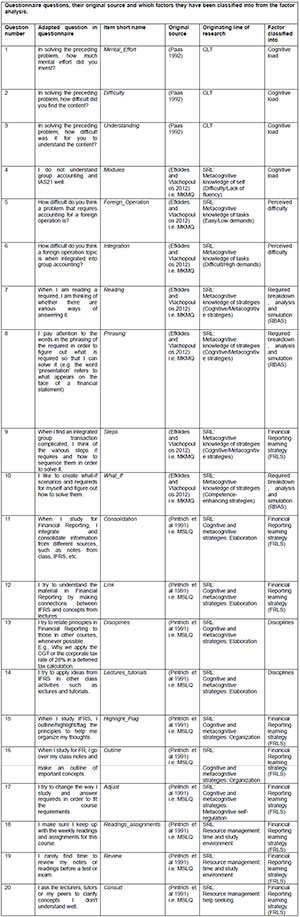
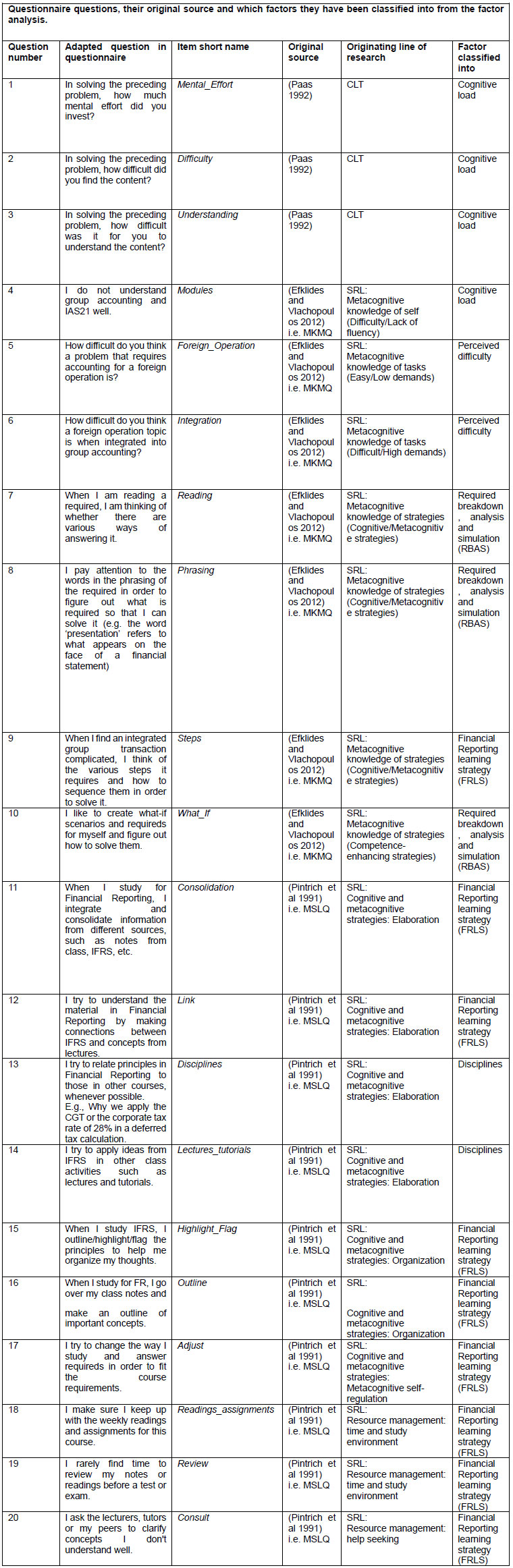
The selection of questions aimed to assess as many self-regulation subscales as possible, whilst simultaneously avoiding imposing unnecessary CL upon participants completing the questionnaire. Given expectations of the time it would take participants to complete both the task and questionnaire, the questionnaire was limited to twenty questions. The twenty questions comprised: three from the Paas (1992) scale; seven from Efklides and Vlachopoulos' (2012) MKMQ and ten from Pintrich et al's (1991) MSLQ. These questions, their abbreviation, original source and line of research, and their associated factor (based on the factor analysis conducted) are included in Appendix A.
Participants
Participants were students registered for a Postgraduate Diploma in Accounting at a South African university in 2019. The class consisted of 452 students, including the principal researcher and a pilot study participant. The population size was, therefore, 450.
Students were provided with a cover letter and consent form. Their participation in the study was completely voluntary and anonymous. A total of 266 participants participated in the study. Four participants did not consent to having their data used and were removed from the dataset. Therefore, the sample size was 262 participants, and the effective participation rate was 58.22 per cent for this study. Within the accounting education field, Hill (2016) achieved a response rate of 50 per cent and Hutchins and Roberts (2019) achieved a 17 per cent response rate. The response rate achieved for this study (58.22%) is, therefore, considered high.
Similar to Costley and Lange (2017) and Hughes et al (2018), the easy, medium and difficult versions of the task were distributed to students in a random manner that aimed to achieve relatively even participation across the three task versions. The nature of the version completed by each student was not disclosed to the students. Ultimately, 102 students completed the easy version, 38 students completed the medium version, and 122 students completed the difficult version. Although an unequal participation rate across task versions was achieved, the absolute number of participants per task version was deemed sufficient for the purpose of conducting further analyses.
Once the data was collected, the questionnaire responses were captured on an Excel spreadsheet for further statistical analyses and modelling. To ensure the integrity of the data capturing process, an independent third party reviewed the dataset captured by the researcher. An exploratory data analysis was also conducted to identify missing data and validate the accuracy of the captured data. Where questions were phrased or loaded negatively, the Likert scales were reversed. For this reason, question 19 was reversed.
Ethical clearance was obtained before conducting pilot tests and the study. The tasks and questionnaire were piloted in phases by four pilot participants to assess the design, language and proposed changes. Feedback from the initial pilot tests was used to improve the tasks and questionnaire for subsequent phases of testing.
Statistical analyses
Stata v16.1 was used to perform statistical analyses. The following steps were conducted, and are described below:
Determine the suitability of the dataset for factor analysis.
Perform Exploratory Factor Analysis (EFA) on the data.
Perform descriptive statistics.
Perform an analysis of variances (ANOVA) on the constructs identified from the EFA;
Perform a Confirmatory Factor Analysis (CFA); and
Use regression analysis to model the relationships in the structural model.
The Kaiser-Meyer-Olkin Measure of Sampling Adequacy was performed to confirm that the data was suitable for factor analyses. An Exploratory Factor Analysis (EFA) was conducted to reveal the latent variables from the observed variables. This study applied the principle-component analysis extraction method with orthogonal varimax rotation to the twenty items from the questionnaire. Kaiser's criterion was applied, whereby factors with Eigenvalues above 1 were retained for further analysis in this study (Williams, Onsman, and Brown 2012). The factors identified from the EFA based on all twenty questions were CL, Perceived difficulty (PD), Financial Reporting Learning Strategies (FRLS), Required Breakdown Analysis and Simulation (RBAS) and Disciplines1. The results and analysis section describes these constructs in more detail.
Cronbach's alpha was used to determine the reliability of the questionnaire and its individual items. The validity of the items and constructs was determined via correlation tests (Pearson's correlation and polychoric correlation) and CFA. Thereafter, an ANOVA was performed to test for differences in the means between task versions for the identified constructs. A pairwise comparison, using Tukey's multiple comparison test, between task versions was also conducted. Finally, the Kruskal-Wallis (non-parametric counterpart of the one-way ANOVA (Field 2013)) equality of population rank test was conducted to corroborate the results from the parametric ANOVA tests.
CFA was conducted to confirm the constructs of interest identified in the EFA. This is identical to the approach taken in Efklides and Vlachopoulos (2012); Jackson (2018) and Smith and Chen (2017) within SRL research. The CFA tests the validity of the questionnaire and the constructs identified in the EFA, according to goodness-of-fit indices. In this study, the maximum likelihood estimation was used in the CFA.
Lastly, regression analysis was used to model the relationships in the structural model. Relationships between constructs were hypothesised based upon literature. The confirmed factors were fitted to the hypothesised model. CL was utilised as the dependent variable, as the participants' perceived difficulty and extent of self-regulation contributes to the reported CL upon completion of the learning task. Therefore, CL is determined as a function of PD and the self-regulatory effort exerted via learning strategies employed, represented by RBAS, FRLS and Disciplines. Based upon literature previously discussed, the regression analysis considered both a linear relationship between CL and SRL, and a parabolic relationship, which was achieved by squaring the SRL constructs i.e.:
CL = β0 + β1SelfRegulation + β2SelfRegulation2
The homoscedasticity assumption was tested using the Breusch-Pagan test. Finally, Tukey's Ladder of Powers test was also conducted to determine whether it was necessary for the dependent variable to be transformed.
RESULTS AND ANALYSIS
Exploratory Factor Analysis (EFA)
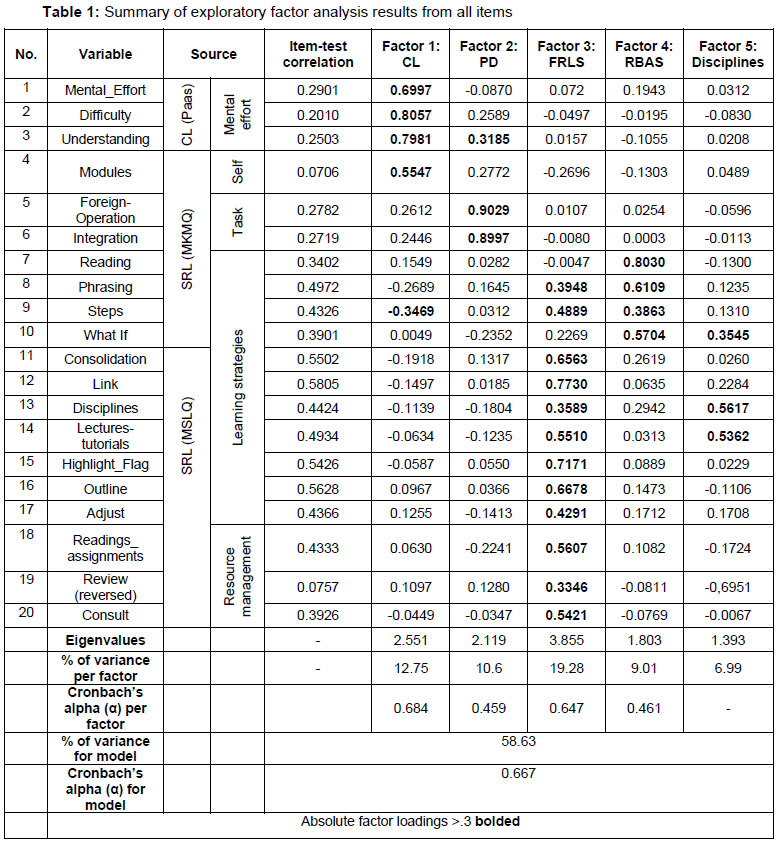
The results for the EFA appear in Table 1 below.
The EFA identified five factors, each with Eigenvalues exceeding 1. Table 1 indicates that CL items (Mental_effort; Difficulty and Understanding) tended to cluster together in one factor (CL), as expected; and SRL items relating to task-related metacognition (Foreign_Operation and Integration) tended to cluster together in the PD factor, as expected from SRL literature. Finally, SRL items relating to metacognitive learning strategies, tended to cluster across three different self-regulation factors: named FRLS, RBAS and Disciplines. The only exception to this is Modules, which originates from the MKMQ questionnaire dealing with metacognitive knowledge of the self, but loaded highest into the CL factor. The inclusion of Modules in the CL construct does, however, appear theoretically justified, as a learner's intrinsic understanding of a particular learning module would act as a cue that informs their subjective CL rating (e.g. see Sweller 2018; Sweller and Paas 2017).
Regarding the self-regulation learning strategy items (items numbered seven to twenty), the majority loaded into Factor 3, which was, therefore, named Financial Reporting Learning Strategies (FRLS). However, Reading, What-if, Phrasing and to a lesser extent, Steps, all loaded together in Factor 4. This factor was named Required Breakdown Analysis and Simulation (RBAS), as it appeared to relate to the ability to analyse and adapt instructions. Finally, Factor 5 was named Disciplines, comprising loadings for Lectures_tutorials, Disciplines and, to a lesser extent, What_If. This factor appears to relate to the ability to transfer and apply knowledge across different accounting disciplines (taxation, auditing etc.); therefore, it was named Disciplines.
The item-test correlations were all highly satisfactory, exceeding the .3 cut-off when rounded up, except for Review (reversed); Difficulty and Modules. This suggests these items should be removed from the questionnaire, and appears to support Sweller and Paas's (2017) argument that the instruments used for CLT and SRL are different in methodological design, as each of these items originates from a different line of research.
The Cronbach's alpha value for the individual constructs did not meet the .7 threshold for reliability. However, the values for CL and FRLS were decimally close to the threshold. Cronbach's alpha could not be determined for Disciplines, as insufficient items loaded into this construct. For the five-factor model above, Cronbach's alpha was .667 which is also decimally close to the .7 threshold for reliability. In addition, the factors explained 58.63 per cent of the variance in the data, which is considered satisfactory in social science research (Hair et al 2013). Thus, it was determined that CFA could be conducted on the constructs identified in the EFA.
Correlation analysis
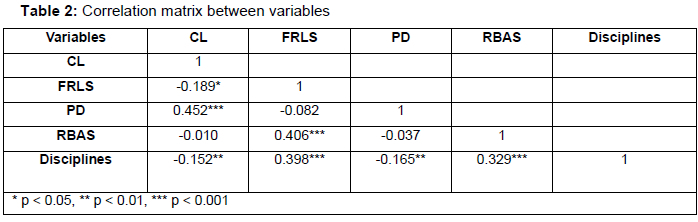
Correlation analysis was conducted to descriptively determine the relationships between the constructs identified in the EFA. Table 2 below presents the correlation matrix.
All correlations were below .8, suggesting multicollinearity is not a concern (Field 2013; Zulu and Haupt 2018). A significant positive correlation between CL and PD was observed. This supports literature which has consistently found that CL ratings tend to increase with the increase in perceived difficulty (Sweller 2019; van Gog et al 2011). The significant and negative correlation between CL and the self-regulatory learning strategy constructs (FRLS and Disciplines) is also supported by literature, as self-regulation tends to decrease the overall CL reported (Hughes et al 2018; Lange and Costley 2018, 2019; Lange et al 2017; van Gog et al 2011). A similar negative and significant correlation is observed between PD and Disciplines. This suggests that as more self-regulatory effort is invested into practising transfer of knowledge across different courses, the task is perceived as less difficult. The positive and significant correlation between the self-regulatory constructs supports the literature that learners who are active self-regulators use an assortment of learning strategies in order to improve their learning (e.g. Schunk 1981, 1984; Zimmerman and Martinez-Pons 1986; Zimmerman and Schunk 2011).
Contrary to expectations, no significant negative correlation was observed between RBAS and CL, nor RBAS and PD. Thus, the data does not appear to support the theorised negative relationship between self-regulatory effort invested in analysing task instructions, and CL nor PD.
Analysis of Variance (ANOVA)
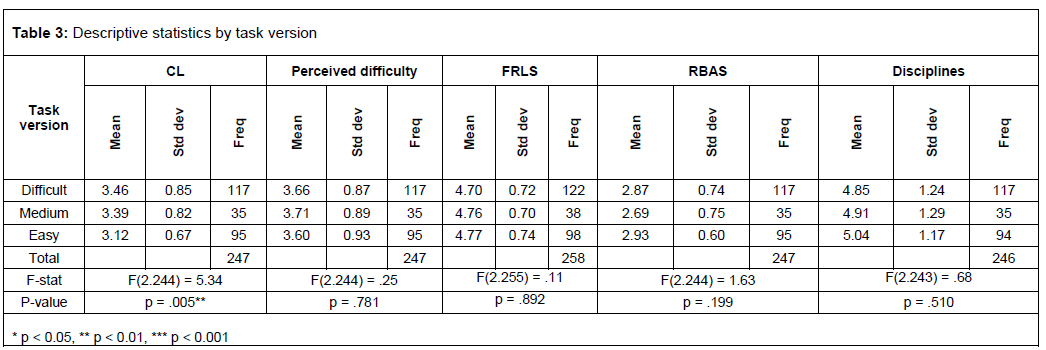
The ANOVA tests were conducted to determine if there were any differences in the self-assessed ratings relating to the constructs (CL, PD, FRLS, RBAS and Disciplines) for the three different task versions completed. Table 3 below summarises the means and standard deviations for each task version. Note that differences in frequency are due to questionnaires that were partially completed.
Regarding CL, statistically significant differences were found between the easy and difficult task versions. This suggests that the different task versions were sufficiently different in levels of difficulty, as intended.
Regarding RBAS, Disciplines and FRLS, no significant differences were apparent at a task version level. This suggests that on average, the ability to analyse and adapt to instructions, integrate knowledge across disciplines and employ learning strategies, is relatively homogenous across participants. This could be as a result of participants being postgraduate students who have been exposed to longer periods of self-regulatory skill development as a class.
However, for the three different task versions, the highest mean for the self-regulation constructs (FRLS, RBAS and Disciplines) is associated with easy tasks, while the lowest mean for FRLS and Disciplines is associated with the difficult task. This suggests that participants who completed the easy version were able to self-regulate more and with higher consistency. The opposite occurred with the difficult version: participants experienced a higher CL and lower self-regulation. These findings appear to support the negative relationship hypothesised between SRL and CL.
The lack of significant differences in PD across task versions was unexpected. Sweller and Paas (2017) state that the perceived task difficulty acts as a cue that informs the CL. Since CL differed across easy and difficult tasks, the lack of significant differences for PD across task versions was surprising. A plausible reason could be participants' inability to accurately self-assess task difficulty, due to self-assessment biases or a lack of knowledge of what constitutes an easy, medium or difficult task (van Gog et al 2011).
Confirmatory Factor Analysis (CFA)
To assess the appropriateness of using SEM (which includes CFA and regression analysis), key assumptions underpinning the SEM model were tested. The normality assumption for all the models was satisfied to an acceptable degree; and the assumptions of homoscedasticity of the residuals and absence of multicollinearity were not seriously violated. In addition, influential data points were excluded, and the results did not change significantly. Finally, all constructs contained at least three observed variables; with the exception of Disciplines. This resulted in some restrictions to the statistical tests that could be performed, such as goodness-of-fit tests for the items. Overall, whilst some assumptions underlying SEM were slightly violated, most were upheld, resulting in the SEM proceeding.
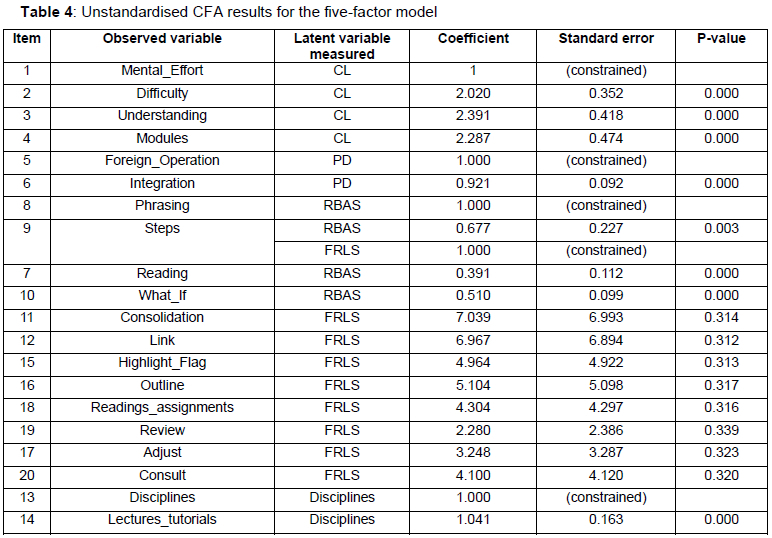
Table 4 below contains the CFA output relating to the five-factor model.
The CFA revealed that the observed variables Difficulty, Understanding and Modules contributed significantly to manifesting the CL construct (p<.001) together with Mental_Effort. Similarly, Integration was significant in indicating the PD construct (p<.001) together with Foreign_Operation. The observed variables Phrasing, Steps, Reading and What_If were all significant in indicating the RBAS construct (p< .01). However, Steps was less significant in indicating RBAS at the 0.1 per cent level of significance (p-value = .003). Finally, the Disciplines construct was measured significantly by the Disciplines observed variable as well as Lectures_tutorials. All the unstandardised factor loadings exceeded the .5 cut-off for convergent validity (Civelek 2018), except for Reading. Apart from this, convergent validity was observed for the targeted latent constructs CL, PD, RBAS and Disciplines. The above suggests that the questions included in the questionnaire were effective in measuring these latent constructs hypothesised.
Contrary to the above, the FRLS construct was not well manifested by any of the observed variables included (Consolidation, Link, Highlight_Flag, Outline, Readings_assignments, Review, Adjust, Consult) (p-value >.05). This suggests that the questions included in the questionnaire to measure self-regulatory behaviour relating to the use of financial reporting learning strategies were possibly redundant. This highlights a weakness in the instrument designed.
Assessing model fit
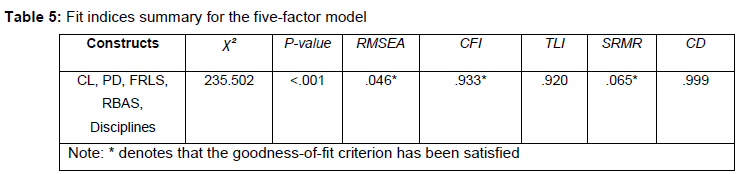
The model fit was determined by examining the chi-square value, the Random Measures of Sampling Error Approximation (RMSEA), Comparative Fit Index (CFI), Tucker-Lewis Index (TLI), Standardised Root Mean Square Residual (SRMR) and Coefficient of Determination (CD). Table 5 below summarises the overall goodness-of-fit indices for the five-factor model.
The model satisfied three of the six goodness-of-fit tests, indicating a moderately satisfactory fit. Therefore, although the CFA revealed that several FRLS variables were not significant in the model and should be removed from the questionnaire, the goodness-of-fit indices were still satisfied in many cases. In addition, the model had an exceptionally high coefficient of determination (CD = .999), implying that the variation in the data is explained well by the model.
A possible reason for why the model did not satisfy all goodness-of-fit criteria, may be due to the large proportion of questionnaire items (10 out of 20 questions) originating from the MSLQ. The MSLQ items were not significantly adapted for the purpose of this study. Therefore, the generalised nature of the scales and the large proportion thereof in the questionnaire may have resulted in a lower goodness-of-fit for the model. Zulu and Haupt (2018) also use CFA to validate factors relating to CL and self-regulated learning and found that not all fit indices were satisfied. This does not necessarily indicate the data has an implausible fit to the model (Zulu and Haupt 2018). Instead, it may indicate a marginally acceptable model structure in the underlying data. Based on the arguments presented above, it was concluded that the CFA results for the model are satisfactory, and that regression analysis would be applied to the identified factors.
Regression analysis
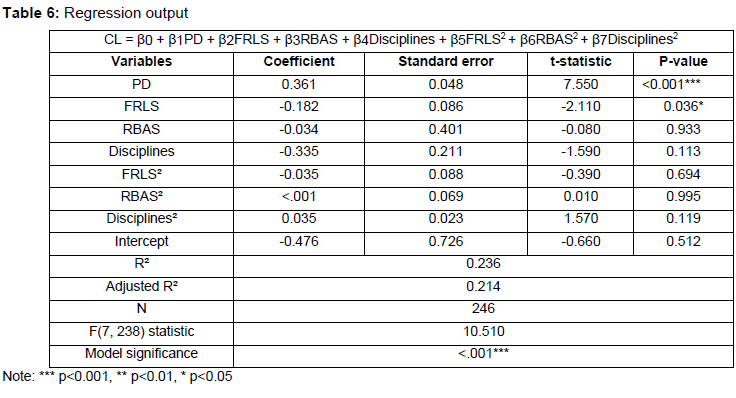
The regression analysis examined the relationship between CL and PD; the self-regulatory factors (FRLS, RBAS, Disciplines); and the squares of the respective self-regulatory factors. The squares of the self-regulatory factors were utilised in line with Seufert's (2018) proposal that a parabolic function exists between CL and SRL. Table 6 below summarises the regression output.
The assumption of constant variance was not seriously violated for this model (χ2(1)=2.27; p=.132). The model revealed that perceived task difficulty is positively and significantly predictive of CL at the 0.1 per cent level of significance (β.=.361, p< .001). FRLS (β= -.182; p= .036) is also significantly negatively predictive of CL. Further, the model is significant (F(7, 238) =10.510; p< .001) and the R2 of the model amounts to 23.60 per cent, which implies that 23.6 per cent of the variance in CL is explained by the independent variables. Although this proportion is low, it is only slightly lower than that reported by Papageorgiou (2022), which deals with a similar context i.e. the SRL levels of South African accounting students.
RBAS and Disciplines were not found to be significantly associated with CL. In addition, the results of the regression analysis do not support the parabolic relationship between SRL and CL, as none of the squared variable were significantly associated with CL.
However, the model supports a significantly positive relationship between task difficulty and CL, as modelled in Seufert's (2018) Conceptual Model and in line with prior literature (Blayney 2013; Sithole and Abeysekera 2017; Seufert 2018; Sweller 2019; Sweller et al 2019). The model further indicates that FRLS is significantly and negatively related to CL, as implied by the results of the correlation analysis and ANOVA discussed earlier, and in line with other studies (Hughes et al 2018; Lange and Costley 2018, 2019; Lange et al 2017; van Gog et al 2011).
The results of the regression analysis therefore provide mixed results on the nature of the relationship between SRL and CL amongst postgraduate accounting students at a South African university. Some insights apparent from these results are discussed below.
CONCLUSION
The purpose of this study was to investigate the relationship between CL and SRL strategies amongst postgraduate accounting students, at a South African university. The desire to better understand whether or not the cognitive burden experienced by students during learning can be better managed via strategies that help students to self-regulate during learning, provided the rationale for this study. This study is the first to explore the relationship between these two important educational concepts within a South African context amongst postgraduate accounting students. The results of this study, therefore, provide evidence as to whether the relationship between CL and SRL identified by existing studies in other countries, and other tertiary education departments, also apply to the South African postgraduate accounting environment. Given the ongoing debate regarding the merging of SRL and CL theory, the present study's unique context contributes further evidence of how these concepts inter-relate.
The study did so by designing and administering three financial accounting tasks that varied according to level of difficulty, and a questionnaire to measure students CL and SRL levels. Postgraduate accounting students completed one of the three versions of the task, followed by the questionnaire.
The correlation and regression analyses support a positive relationship between perceived task difficulty and CL, in line with prior literature (Blayney 2013; Sithole and Abeysekera 2017; Seufert 2018; Sweller 2019; Sweller et al 2019). In other words, as students perceived the task to be more difficult, their CL increased. This finding suggests that the tasks were appropriately designed for this study. The ANOVA further supports this, which identified significant differences in CL between those who received the easy and difficulty task versions. Further analysis on the relationship between CL and SRL was therefore considered appropriate.
The ANOVA indicated that when the task version was easy and CL was low, there was a corresponding higher mean for the SRL factors i.e., FRLS, RBAS and Disciplines. Similarly, for the difficult task with higher CL, the mean for the SRL factors was lower. The correlational analysis partially supports this observation, whereby a significant negative relationship between CL and two SRL factors - FRLS and Disciplines - was identified. This suggests that a negative relationship exists between CL and SRL.
Regression analysis, however, provided mixed results for the relationship between CL and SRL. The regression model indicated that CL was not significantly related to most of the self-regulatory factors (RBAS, Disciplines and their respective squares). Only FRLS was found to be significantly and negatively related to CL. This provides some evidence that self-regulation during learning contributes towards explaining a learner's reported CL i.e., that those students who adopt a high level of SRL strategies report a lower CL, and vice versa. However, the usefulness of this finding is limited, given the CFA's revelations that FRLS was not well manifested by any of the observed variables. In summary, the results of this study provide mixed support for the relationship between CL and SRL.
Although concerns exist relating to the validity of the FRLS construct, the significant negative relationship observed between FRLS and CL provides some evidence of the importance of helping accounting students develop self-regulated learning strategies in order to better manage their CL. Examples of such strategies could include helping students to: identify the different steps to complete a task; integrate new content with existing knowledge; highlight, outline and flag relevant information; read consistently and stay up-to-date; and seek help when necessary. Designing low extraneous load learning materials with step-by-step self-regulatory guidance for learners to work through, may be one means of practically achieving this.
Furthermore, aiding students' SRL strategy development may lead to these strategies becoming automatic or "unconscious". Wirth et al (2020) argue that students can regulate their learning without consciously having to think about employing certain strategies, and that doing so does not impose germane CL. Although the present study does not distinguish between different types of CL, nor between conscious and unconscious learning strategies, the findings of the present study support the importance of SRL skills training in constraining overall CL, in line with recent studies (Wang and Lajoie 2023; Wirth et al 2020).
The findings of this study have relevance for accounting educators pondering how to help students self-regulate during learning, whilst concurrently managing their CL. As Sweller et al (2011, v) states: "Without knowledge of human cognitive processes, instructional design is blind." A primary contribution of this study is therefore its provision of "sight" to educators, to aid the development of appropriate instructional guidance that enhances students' learning strategies, whilst remaining cognisant of the likely effect of these strategies on students' CL.
LIMITATIONS AND AREAS FOR FUTURE RESEARCHA limitation of this study is the moderate acceptability of the research instrument applied. Further, the questionnaire items were based on measurement models that do not distinguish between the different types of CLs (intrinsic, extraneous or germane) imposed during task completion. In addition, the items selected for use in the questionnaire were based on the researchers' perceptions of the most relevant scale items, given the context in which the study took place. Furthermore, the findings highlighted specific items, such as Review, be removed from the questionnaire, as it was not significant in explaining the specified latent constructs. The use of different questions may therefore yield different results in constructs and model fit.
This study utilised a specific cohort of postgraduate students from a South African university. To increase the generalisability of the findings, a larger sample is recommended. This study did not explicitly control for variables such as gender, race and performance, which may impact the explanatory power of the statistical results obtained. Future research to explore how these personal factors contribute towards individual's CL and self-regulation during learning would enhance the results of this study.
Furthermore, this study analysed the relationships between the latent constructs CL, PD and self-regulation from a CLT perspective, by using CL as the dependent variable. This is consistent with CLT research which finds that self-regulatory effort in addition to the completion of the learning task both contribute towards a higher CL (van Gog et al 2011). However, Seufert (2018) argues that CL also induces self-regulation to a certain extent. Future research on the relationships between the latent constructs CL, PD and self-regulation using self-regulation as the dependent variable, is recommended.
Disclosure of thesis-based content
This article includes content that overlaps with research originally conducted as part of one of the author's Master's thesis.
REFERENCES
LITERATURE REVIEW
-
American Institute of Certified Public Accountants. 2019. "CGMA Competency Framework: 2019 Update." https://www.cgma.org/content/dam/cgma/resources/tools/downloadabledocuments/cgma-competency-framework-2019-edition.pdf.
» https://www.cgma.org/content/dam/cgma/resources/tools/downloadabledocuments/cgma-competency-framework-2019-edition.pdf -
Bentley, Ashley and Becker, Lana (2026). "Exploring a conceptual link between self-regulated learning and cognitive load theory: a study of task difficulty and self-monitoring in an introductory accounting course." Accounting Education, advance online publication. https://doi.org/https://doi.org/10.1080/09639284.2026.2685595.
» https://doi.org/https://doi.org/10.1080/09639284.2026.2685595 - Blayney, Peter. 2013. "Application of Cognitive Load Theory to the Design of Learning Tasks and Instruction in Accounting." PhD diss., University of New South Wales.
- Blayney, Peter, Slava Kalyuga, and John Sweller. 2010. "Interactions Between the Isolated-Interactive Elements Effect and Levels of Learner Expertise: Experimental Evidence from an Accountancy Class." Instructional Science 38 (3): 277-287.
- Boekaerts, Monique. 2011. "Emotions, Emotion Regulation, and Self-Regulation of Learning." In Handbook of Self-Regulation of Learning and Performance, edited by Barry Zimmerman and Dale Schunk, 409-425. New York: Routledge.
- Boekaerts, Monique. 2017. "Cognitive Load and Self-Regulation: Attempts to Build a Bridge." Learning and Instruction 51: 90-97.
-
Civelek, Mehmet E. 2018. Essentials of Structural Equation Modeling. Lincoln: Zea E-Books. https://digitalcommons.unl.edu/zeabook/64.
» https://digitalcommons.unl.edu/zeabook/64 - Costley, Jamie, and Christopher Lange. 2017. "The Effects of Lecture Diversity on Germane Load." International Review of Research in Open and Distance Learning 18 (2): 27-46.
- Cowan, Nelson. 2001. "The Magical Number 4 in Short-Term Memory: A Reconsideration of Mental Storage Capacity." Behavioral and Brain Sciences 24 (4): 87-185.
- De Bruin, Anique, John Dunlosky, and Raquel Cavalcanti. 2017. "Monitoring and Regulation of Learning in Medical Education: The Need for Predictive Cues." Medical Education 51 (6): 575-584.
- De Bruin, Anique, Johannes Roelle, Shana K. Carpenter, and Marleen Baars. 2020. "Synthesizing Cognitive Load and Self-Regulation Theory: A Theoretical Framework and Research Agenda." Educational Psychology Review 32: 903-915.
- De Bruin, Anique, Ruud M. Rikers, and Henk G. Schmidt. 2007. "Improving Metacomprehension Accuracy and Self-Regulation in Cognitive Skill Acquisition: The Effect of Learner Expertise." European Journal of Cognitive Psychology 19 (4): 671-688.
- De Bruin, Anique, and Jeroen van Merriënboer. 2017. "Bridging Cognitive Load and Self-Regulated Learning Research." Learning and Instruction 51: 1-9.
- Dignath, Charlotte, and Gerhard Büttner. 2008. "Components of Fostering Self-Regulated Learning Among Students." Metacognition and Learning 3 (3): 231-264.
- Efklides, Anastasia. 2011. "Interactions of Metacognition with Motivation and Affect in Self-Regulated Learning: The MASRL Model." Educational Psychologist 46 (1): 6-25.
- Efklides, Anastasia, and Spyridon Vlachopoulos. 2012. "Measurement of Metacognitive Knowledge." European Journal of Psychological Assessment 28 (3): 227-239.
-
Eitel, Alexander, Tim Endres, and Alexander Renkl. 2020. "Self-Management as a Bridge Between Cognitive Load and Self-Regulated Learning." Educational Psychology Review 32 (4): 1073-1087. https://doi.org/10.1007/s10648-020-09559-5.
» https://doi.org/10.1007/s10648-020-09559-5 - Field, Andy. 2013. Discovering Statistics Using IBM SPSS Statistics. 4th ed. London: Sage.
- Hair, Joseph F., William C. Black, Barry J. Babin, and Rolph E. Anderson. 2013. Multivariate Data Analysis. Upper Saddle River, NJ: Pearson.
- Hill, Thomas. 2016. "Do Accounting Students Believe in Self-Assessment?" Accounting Education 25 (4): 291-305.
- Honicke, Toni, and Jaclyn Broadbent. 2016. "The Influence of Academic Self-Efficacy on Academic Performance." Educational Research Review 17: 63-84.
- Hughes, Christopher, Jamie Costley, and Christopher Lange. 2018. "The Effects of Self-Regulated Learning and Cognitive Load on Video Lectures." Interactive Technology and Smart Education 15 (3): 220-237.
- Hutchins, Robert, and David Roberts. 2019. "Factors that Determine the Decision to Major in Accounting." The Accounting Educators' Journal 28: 159-167.
- IFRS Foundation. 2020. IFRS Standards. London: IFRS Foundation.
- Jackson, Charles. 2018. "Validating and Adapting the MSLQ for STEM Courses." AERA Open 4 (4): 1-16.
- King, Ryan, Peter Blayney, and John Sweller. 2021. "How Language Background Impacts Learners Studying IFRS." Accounting Education 30 (5): 439-450.
- Kline, Rex B. 2015. Principles and Practice of Structural Equation Modeling. 4th ed. New York: Guilford Press.
- Koriat, Asher. 1997. "Monitoring One's Own Knowledge During Study." Journal of Experimental Psychology: General 126 (4): 349-370.
- Lange, Christopher, and Jamie Costley. 2018. "The Moderating Effects of Intrinsic Load." Journal of Computer Assisted Learning 34 (6): 652-660.
- Lange, Christopher, and Jamie Costley. 2019. "The Negative Impact of Media Diversity." Issues in Educational Research 29 (1): 158-179.
- Lange, Christopher, Jamie Costley, and Seung Han. 2017. "The Effects of Extraneous Load." International Review of Research in Open and Distance Learning 18 (5): 64-83.
- Lima Filho, Raimundo N., G. A. F. L. Sampaio, and Adriano L. Bruni. 2020. "Self-Regulated Learning in Accounting." Brazilian Business Review 12 (1): 36-54.
- Miller, George A. 1956. "The Magical Number Seven Plus or Minus Two." Psychological Review 63 (2): 81-97.
- Miller, Thomas. 2020. "Curriculum Reduction, Cognitive Load and Understanding." Meditari Accountancy Research 28 (1): 1-25.
- Moos, Daniel. 2013. "Examining Hypermedia Learning." Journal of Educational Multimedia and Hypermedia 22 (1): 39-61.
- Mostyn, Greg. 2012. "Cognitive Load Theory in Accounting." Issues in Accounting Education 27 (1): 227-245.
- Paas, Fred. 1992. "Training Strategies for Attaining Transfer." Journal of Educational Psychology 84 (4): 429-434.
- Paas, Fred, Alexander Renkl, and John Sweller. 2004. "Cognitive Load Theory." Instructional Science 32 (1): 1-8.
-
Papageorgiou, Elmarie. 2022. "Self-Regulated Learning Strategies and Academic Performance." South African Journal of Higher Education 36 (1): 251-278. https://doi.org/10.20853/36-3-4546.
» https://doi.org/10.20853/36-3-4546 - Park, Bo, Andrea Korbach, Paul Ginns, and Roland Brünken. 2019. "Embodied Cognition?" In Advances in Cognitive Load Theory, edited by S. Tindall-Ford, S. Agostinho, and J. Sweller, 142-154. London: Routledge.
- Pintrich, Paul R. 2000. "The Role of Goal Orientation in Self-Regulated Learning." In Handbook of Self-Regulation, edited by Monique Boekaerts, Paul Pintrich, and Moshe Zeidner, 451-502. Academic Press.
- Pintrich, Paul R., David Smith, Teresa Garcia, and Wilbert McKeachie. 1991. A Manual for the Use of the Motivated Strategies for Learning Questionnaire (MSLQ). Ann Arbor: University of Michigan.
- Pintrich, Paul R., David Smith, Teresa Garcia, and Wilbert McKeachie. 1993. "Reliability and Predictive Validity of the MSLQ." Educational and Psychological Measurement 53 (3): 801-813.
- Plass, Jan L., and Slava Kalyuga. 2019. "Four Ways of Considering Emotion in Cognitive Load Theory." Educational Psychology Review 31 (2): 339-359.
- Roodenrys, Kirsten, Shirley Agostinho, Susan Roodenrys, and Paul Chandler. 2012. "Managing One's Own Cognitive Load." Applied Cognitive Psychology 26 (6): 878-886.
- Roth, Anne, Simon Ogrin, and Bernhard Schmitz. 2016. "Assessing Self-Regulated Learning in Higher Education." Educational Assessment, Evaluation and Accountability 28 (3): 225-250.
- Schmeck, Annett, Melanie Opfermann, Tamara van Gog, Fred Paas, and Detlev Leutner. 2015. "Measuring Cognitive Load." Instructional Science 43 (1): 93-114.
- Schunk, Dale H. 1981. "Modeling and Attributional Effects." Journal of Educational Psychology 73 (1): 93-105.
- Schunk, Dale H. 1984. "Sequential Attributional Feedback." Journal of Educational Psychology 76 (6): 1159-1169.
- Schunk, Dale H. 2005. "Self-Regulated Learning." Educational Psychologist 40 (2): 85-94.
- Seufert, Tina. 2018. "The Interplay Between Self-Regulation and Cognitive Load." Educational Research Review 24: 116-129.
- Seufert, Tina. 2020. "Building Bridges Between Self-Regulation and Cognitive Load." Educational Psychology Review 32: 1151-1162.
- Sithole, Sithembiso, and Indra Abeysekera. 2017. Accounting Education: A Cognitive Load Theory Perspective. New York: Routledge.
- Sitzmann, Traci, and K. Ely. 2011. "A Meta-Analysis of Self-Regulated Learning." Psychological Bulletin 137 (3): 421-442.
- Smith, Patricia. 2001. "Understanding Self-Regulated Learning." Issues in Accounting Education 16 (4): 1-38.
- Smith, Stephanie, and Ching-Hsueh Chen. 2017. "Modified MSLQ." Issues in Information Systems 18 (3): 129-140.
-
South African Institute of Chartered Accountants (SAICA). 2020. "SAICA Competency Framework-CA2025." https://ca2025.co.za.
» https://ca2025.co.za - Stegmann, Nico, and Marietjie Malan. 2016. "Accounting Students' Experience of Feedback." Journal of Economic and Financial Sciences 9 (3): 769-788.
- Sweller, John. 2018. "Measuring Cognitive Load." Perspectives on Medical Education 7 (1): 1-2.
- Sweller, John. 2019. "Cognitive Load Theory." In Advances in Cognitive Load Theory, edited by S. Tindall-Ford, S. Agostinho, and J. Sweller, 1-12. New York: Routledge.
- Sweller, John, Paul Ayres, and Slava Kalyuga. 2011. Cognitive Load Theory. New York: Springer.
- Sweller, John, and Fred Paas. 2017. "Should Self-Regulated Learning Be Integrated?" Learning and Instruction 51: 85-89.
- Sweller, John, Jeroen van Merriënboer, and Fred Paas. 1998. "Cognitive Architecture and Instructional Design." Educational Psychology Review 10 (3): 251-296.
- Sweller, John, Jeroen van Merriënboer, and Fred Paas. 2019. "Cognitive Architecture and Instructional Design: 20 Years Later." Educational Psychology Review 31 (1): 261-292.
- Szulewski, Adam, Andreas Gegenfurtner, David Howes, Marco Sivilotti, and Jeroen van Merriënboer. 2017. "Measuring Physician Cognitive Load." Advances in Health Sciences Education 22 (4): 951-968.
- Tian, Ying, Ying Fang, and Jie Li. 2018. "The Effect of Metacognitive Knowledge." Frontiers in Psychology 9: 1-11.
- Van Gerven, Pascal, Fred Paas, Jeroen van Merriënboer, and Henk Schmidt. 2004. "Memory Load and the Cognitive Pupillary Response." Psychophysiology 41 (2): 167-174.
- Van Gog, Tamara, Liesbeth Kester, and Fred Paas. 2011. "Effects of Concurrent Monitoring." Applied Cognitive Psychology 25 (4): 584-587.
- van Gog, Tamara, and Fred Paas. 2008. "Instructional Efficiency." Educational Psychologist 43 (1): 16-26.
-
Wang, Ting, and Susanne Lajoie. 2023. "How Does Cognitive Load Interact with Self-Regulated Learning?" Educational Psychology Review 35 (3): 1-28. https://doi.org/10.1007/s10648-023-09794-6.
» https://doi.org/10.1007/s10648-023-09794-6 - Williams, Brett, Andrys Onsman, and Ted Brown. 2012. "Exploratory Factor Analysis." Australasian Journal of Paramedicine 8 (3): 1-14.
- Wirth, Joachim, Frederik Stebner, Moritz Trypke, Christina Schuster, and Detlev Leutner. 2020. "An Interactive Layers Model." Educational Psychology Review 32 (4): 1127-1149.
- Winne, Philip H. 2011. "A Cognitive and Metacognitive Analysis." In Handbook of Self-Regulation of Learning and Performance, edited by D. Schunk and B. Zimmerman, 15-32. New York: Routledge.
- Winne, Philip H., and Allyson F. Hadwin. 1998. "Studying as Self-Regulated Learning." In Metacognition in Educational Theory and Practice, edited by D. Hacker, J. Dunlosky, and A. Graesser, 277-304. New York: Routledge.
- Zimmerman, Barry J. 1986. "Becoming a Self-Regulated Learner." Contemporary Educational Psychology 11 (4): 307-313.
- Zimmerman, Barry J. 2000. "Attaining Self-Regulation." In Handbook of Self-Regulation, edited by M. Boekaerts, P. Pintrich, and M. Zeidner, 13-39. Academic Press.
- Zimmerman, Barry J., and Manuel Martinez-Pons. 1986. "Development of a Structured Interview." American Educational Research Journal 23 (4): 614-628.
- Zimmerman, Barry J., and Dale H. Schunk. 2011. Handbook of Self-Regulation of Learning and Performance. New York: Routledge.
- Zulu, Edwin, and Theo Haupt. 2018. "Structural Equation Modelling of Cognitive Loading." Paper presented at the 14th International CDIO Conference, Kanazawa Institute of Technology, Japan, June 28-July 2.