Who owns the story? Perspectives on AI-generated children's literature in preservice-teacher higher education
Abstract
Artificial Intelligence (AI) technologies are beginning to play a transformative role in the creation of children's literature, which presents both opportunities and challenges. In this qualitative exploratory study, 250 preservice teachers conducted a research investigation into the creation of stories for preschool children using large language models such as ChatGPT and other AI illustration tools. Situated within a social constructivist research paradigm, enriched by the theoretical premises of the human-machine teaming (HMT) and Technological Pedagogical Content Knowledge (TPACK) framework, the study seeks to understand preservice teachers' experiences and ethical reflections on using generative AI in children's literature creation, while critically examining broader implications for children's literature authorship, copyright, and cultural representation. Thematic analysis of preservice teachers' reflective journals and five keyinformant interviews with experts in copyright and publishing highlight the possibilities and dangers of AI-generated children's literature. The study presents an HMT-TPACK framework as a conceptual map for analysing preservice teachers' experiences and ethical reflections and presents thematic findings that show how AI-generated story making is enabled and constrained by operational and governance competence, and the capacity to justify authorship through demonstrable human contribution. The findings highlight the need for a reconceptualisation of authorship, concluding that ownership in AI-generated children's literature cannot be treated as a simple identity claim; rather, it becomes an educational practice grounded in teacher knowledge, ethical legal reasoning, and accountable human design. Recommendations for the use of AI in children's literature include explicit preservice teacher training on HMT principles concurrent with disciplinary and Pedagogical Content knowledge (PCK).
artificial intelligence; authorship; children's literature; copyright; ethical considerations; higher education; preservice teacher training
INTRODUCTION
Children's literature is a high-stakes educational genre in early childhood which mediates language development, identity formation, socio-emotional learning and holistic development. In South Africa, these stakes are intensified by contextual factors such as multilingualism and multiculturalism, uneven access to quality books across indigenous languages, and the continuing demand for culturally relevant early-grade reading resources. At the same time, generative AI tools are increasingly available to preservice teachers and may appear to offer a rapid route to producing stories and illustrations across languages. Yet speed and scale do not automatically translate into educational value, and the introduction of AI into children's literature production raises conundrums for higher education regarding how to prepare preservice teachers to make pedagogically sound decisions and remain accountable authors when using AI in the process.
This article, therefore, addresses the higher education problem by examining how preservice teachers experience the use of generative AI for creating children's stories and how they reason about authorship, originality, ownership, and classroom suitability. The central claim is not that AI can or cannot be used in children's literature, but that the educational legitimacy of AI-generated story making hinges on what preservice teachers know and can do. Teacher education, therefore, becomes the decisive site where AI-generated production is either transformed into developmentally appropriate, culturally responsive literature for early years learning or collapses into uncritical automation that undermines quality, ethics, and trust.
Limited research exists on how South African preservice teachers enact authorship and accountability when AI is positioned as a co-producing partner, and on the kinds of teacher knowledge systems that enable them to translate AI output into pedagogically sound children's literature that can be used responsibly in early childhood classrooms. Existing debates frequently focus either on technological affordances or on legal and ethical concerns in isolation. This separation is analytically limiting for higher education because preservice teachers encounter these issues simultaneously when creating children's literature. This study is therefore both conceptual and empirical. By integrating Human Machine Teaming (HMT) (see Seeber et al 2020; O'Neill et al 2022) principles and the Technological Pedagogical and Content Knowledge (TPACK) model (see Mishra and Koehler 2006; Koehler and Mishra 2009), this study delves deeper into the social mechanics involved in role allocation, trust calibration, and accountability within human AI collaboration, while also considering the knowledge integration required to evaluate and revise AI output against children's literature criteria and early childhood pedagogical standards. Finding the harmonious blend of AI and human creativity is vital in shaping the future landscape of children's literature.
This study's research questions attempt to unpack the "possibilities and challenges of using generative AI to create children's literature in South Africa." Furthermore, the study explores "how the use of generative AI by preservice teachers affects the meaning of authorship in children's literature".
By focusing on preservice teachers' perspectives rather than on technological performance alone, the article contributes evidence for higher education policy and curriculum design, particularly in relation to human accountability, governance competency, and intellectual property literacy as integral components of responsible AI integration in teacher education.
EXPANSION AND REVOLUTION OF CHILDREN'S LITERATURE
The modern genre of children's literature is often traced to 18th century England and the Western Hemisphere, where commercial publishing increasingly produced texts for children (Grenby 2014). In the beginning of the 18th century, very little children's literature existed, and what did was mostly pious or instructional (such as spelling, school, and conduct books). Fables, fairy tales, romances, short pamphlet tales, and ballads, known as chapbooks, existed, but these were intended for both children and adults. By the end of the 18th century, children's literature was a flourishing, separate and secure part of the publishing industry in England. John Newbery, often referred to as 'father of children's literature' in the Western hemisphere, produced the first children's periodical called The Lilliputian Magazine (1751-52), a collection of stories, verse, riddles and editorials. Newbery also produced what some consider the first children's novel, The History of Little Goody Two-Shoes (1765) (Grenby 2014). The reasons for the sudden rise of children's literature in the 18th century are mostly unknown (Grenby 2014).
In South Africa, children's literature has been produced since the beginning of the 19th century, however, indigenous oral literature goes back much further (Jenkins 2008). Children's literature in South Africa has undergone significant changes over the past three centuries, reflecting the country's unique and complex history, culture, and different communities (Jenkins 1993; van Vuuren 1994). It's important to recognise that the history of South African children's literature is complex and multifaceted, reflecting its colonial past and the country's diverse linguistic and cultural landscape. In the 19th and early 20th century, children's literature comprised collections of indigenous oral folklore compiled by white missionaries and scholars. The collections did not explicitly identify as "children's literature," but authors soon began shaping them into stories specifically for children, thereby initiating a major genre of South African children's literature (Jenkins, 2008). During the 20th century, an upsurge in the publication of children's books was noticed (Jenkins 1993). Adey et al (1986) notes that after 1976, local publishers began to encourage indigenous children's literature, leading to a trend of producing various types of texts for children. In 1987, the first national symposium on children's literature took place with the theme "Towards Understanding: Children's Literature for Southern Afried". The aim of the symposium was to stimulate an increase in interest in the field of children's literature (van Vuuren 1994).
Since 1994, political changes in the country and the establishment of the new Constitution greatly influenced the development of indigenous African-language children's literature (Jenkins 2008). Jenkins (1993) argues that, by the end of the 20th century, children's literature had two roles to fulfil:(1) uniting a fractured country and reflecting the societal realities of South Africa, and (2) translating folktales. By the beginning of the 21st century, a strong publishing industry was in place (Jenkins 2008), with more stories and books also originating in the indigenous South African languages. Maskew Miller Longman and Via Afrika were the first publishing houses to publish children's fiction and non-fiction in indigenous languages (Dada 1993, cited in van Vuuren 1994).
More recently, in 2015, the Department of Basic Education (DBE) launched the national Read to Lead Campaign, which encouraged the development of more Children's literature in all 11 official languages to improve the reading abilities of all South African children (Department of Basic Education 2021). Since then, various Non-Governmental Organisations (NGO) such as Molteno (i.e. Vula Bula), National Education Collaboration Trust (NECT), South African Institute for Distance Education (SAIDE) (i.e. African Storybook Project), the Zenex Foundation (i.e. Ulwazi Lwethu reading series), READ Education trust, IBBY South Africa and Room-to-Read, as well as national reading campaigns such as Nalibali, Funda Wande, Bala Wande, Book Dash and The Right to Read campaign, have greatly contributed to the field of children's literature.
When comparing the children's literature of the 18th century with that published today, it is evident that 21st-century children's literature is marked by an intention to entertain rather than to educate or instruct. As in the 18th century, many 21st-century stories still have a moral tone, a criterion for good children's literature. Other criteria used include stories that fulfil a child's emotional needs at various stages, with a clear, simple plot, an understandable time sequence, and a happy ending (van Vuuren 1994). Furthermore, children's literature is expected to be culturally sensitive, relevant and relatable (Sharp and Johnson, 2016 and West, 2024) by reflecting and being representative of the diverse cultures and beliefs that make up South African society and, lastly, to be free of harmful stereotyping or biases (Sharp and Johnson 2016; Van Vuuren 1994).
As much as children's literature has evolved over three centuries, it has reached a new apex in the 21st century with the introduction of generative AI. Technological advances, such as generative AI, have made the creation of children's literature significantly easier and more accessible to the public through openly licensed digital storybooks distributed via web-based services and mobile apps (Amory 2018).
Against this background, contemporary South African children's literature carries two intersecting responsibilities that directly inform this study's focus on preservice teachers. First, it must meet pedagogical and developmental criteria for early childhood audiences, including language that is readable and age-appropriate, a clear sequence, and narratives that support emotional and moral development without harmful stereotyping (van Vuuren 1994; Sharp and Johnson 2016; West 2024). Second, it must be culturally sensitive and locally resonant across communities and languages, which requires intentional choices about setting, character, values, and linguistic register rather than generic templates (Jenkins 1993; Sharp and Johnson, 2016). These responsibilities help explain why teacher education is a decisive site of intervention. Teachers are not only users of children's texts but are increasingly becoming curators and creators of classroom materials, especially where suitable texts are unevenly available across languages.
GENERATIVE AI FOR CREATIVE PURPOSESGenerative AI uses large language models and text-to-image systems to produce story drafts and illustrations from prompts. In teacher education, the critical feature is not how algorithms learn, but how their rapid, high-variability outputs reshape authorship work. A single prompt can yield multiple plots, language levels, and visual options within seconds (Wright 2023; Saveri 2023). This speed can support ideation and multilingual drafting, yet it also intensifies governance demands. Because the model can mimic patterns from training data and generate plausible but misaligned content, preservice teachers must "govern", in other words, decide what to delegate, what to verify, and what to rewrite, while ensuring developmental appropriateness, cultural fit, and legal-ethical compliance (Thorne 2020).
THE MEANING OF AUTHORSHIPThe growing use of generative AI to produce story text and illustrations intensifies longstanding questions about authorship, ownership, and copyright. In this study, authorship is treated as more than a naming convention because the research problem, "Who owns the story?", turns on how preservice teachers understand authorship, responsibility, and originality when a machine can generate plausible narrative and visual expression at speed. A minimal dictionary definition frames an author as "the writer of a literary work" (Merriam Webster Dictionary 2023), yet this is oversimplified for AI-generated creation. For example, authorship can be a person, a function or a figure (Foucault 1979) and has a social function that ties texts to accountability, interpretation, and authority within a community of readers (Foucault 1979). Craig and Kerr describe authorship as a social, dialogic practice through which selfhood and social relations are constituted, rather than merely a technical act of producing words on a page (Craig and Kerr 2020). This matters in children's literature because the audience is developmentally and culturally situated, and the work is judged against criteria of educational suitability, representation, and potential harm. Accordingly, the study conceptualises authorship as a governed process of design and responsibility rather than a single moment of generation.
Even where AI contributes draft text, plot moves, or visual options, authorship remains anchored in human governance, i.e., decisions about selection, arrangement, revision, and pedagogical adaptation. This aligns with an ontological approach that asks not only what an author does, but what an author must be in relation to governance, ethical and legal boundaries, including accountability for meaning, consequence, and harm (Craig and Kerr 2020). In teacher education terms, the (preservice) teacher is positioned as the final responsible agent who must justify why a story is appropriate for early childhood audiences, how it supports learning intentions, and whether it fairly represents children and communities. This shift foregrounds authorship as professional responsibility, a framing that becomes crucial once AI introduces the possibility of fast production without necessarily producing defensible educational texts.
ETHICAL AND LEGAL ISSUES IN USING AI FOR CREATIVE PURPOSESGenerative AI has accelerated ethical legal debates about intellectual property (IP), particularly copyright, originality, and infringement risk (Burgan 2023; Brittain 2023). While the public debate often conflates plagiarism and copyright infringement, they are analytically distinct. Plagiarism is a breach of academic integrity and attribution norms, whereas copyright infringement refers to illegally involving unauthorised use of protected expression. Both, however, become governance problems that should be considered by preservice teachers who intend to publish, share, or assess AI-generated stories in higher education and early childhood settings.
In South Africa and in many jurisdictions, copyright protection generally arises automatically when a work meets statutory requirements, rather than through registration, with limited exceptions such as cinematograph films (Blignaut 2022; Griffiths 2023). A core threshold is originality, but originality is not primarily a measure of artistic quality. It is tied to the authorial process, meaning that the law protects expression that results from sufficient human skill, effort, and labour, even if the work is simple (Craig and Kerr 2020; Griffiths 2023). This principle becomes complex under AI generation because a user may obtain expressive outputs with minimal human effort, while the system's output may also risk substantial similarity to protected works in its training corpora or in the broader cultural archive. Litigation internationally has drawn attention to these risks, including claims that AI developers trained models on copyrighted works without permission and those outputs can replicate protected expression or style in ways that undermine creators' interests (Brittain 2023; Dudley-Nicholson 2023; Johnston 2023). The practical consequence for education is that authorship claims and dissemination decisions become inseparable from controls over infringement risk, particularly when preservice teachers are encouraged to distribute storybooks online or use them in assessed tasks. Furthermore, copyright ownership can be shaped by joint authorship, employment, or commissioned work, and these issues become salient when preservice teachers produce materials within institutional courses or in collaboration with peers (RSA 1992).
A further complication is the requirement for human authorship in influential jurisdictions. In the United States, the Copyright Office has repeatedly reaffirmed that AI-generated authorship is generally not registrable (U.S. Copyright Office 2023; Brittain 2025). Authors and artists are protesting what they view as technology's disregard for copyright law. Several pending lawsuits (specifically in the US) have also been filed against generative AI companies such as OpenAI, Meta, GitHub, Midjourney, and Stable Diffusion for using copyrighted works to train generative AI without permission (Brittain, 2023). For example, in the US, authors have filed a lawsuit against OpenAI for unlawfully using their books to train ChatGPT (Creamer 2023). Another example in the US is of authors who discovered that pirated versions of their books were used to train Meta AI (Johnston 2023). In Australia, it is estimated that over 18,000 pirated works have been used to train AI (Dudley-Nicholson 2023). In South Africa, acclaimed authors' work has also been used to train various AI programmes (Nair, 2023).
Saveri (2023), an attorney representing multiple clients in copyright infringement lawsuits against generative AI Companies such as OpenAI and Meta, argues that it is common for technology to replace humans, but that with AI-generated works, humans have not been replaced, their "contributions are simply hidden, and they are left uncompensated". Similarly, Wright (2023) quotes Saveri and Butterick (n.d.) in a briefing, "generative AI is just human intelligence, repackaged and divorced from its creators". To further complicate matters, various generative AI programmes such as OpenAI declare in their terms that they will continue using the content that was generated and therefore warn that the AI programme may generate similar or even the same work output for another user (Moyo 2023), which raises questions regarding originality, a core requirement for copyright protection.
Therefore, a threshold question arises: what kind of human contribution is sufficient when AI systems intermediate idea generation, drafting, style, and even the final form? The emerging direction is evidentiary. Human authorship must be demonstrated through identifiable governance processes (i.e., creative control), such as selection, arrangement, substantial rewriting, and transformative revision, alongside transparent disclosure of AI-generated components (U.S. Copyright Office 2023; U.S. Copyright Office 2025). This evidentiary turn aligns closely with the study's conceptual framing, because it ties authorship to accountable process rather than to output alone.
Furthermore, South African law introduces a distinct level of complexity. The Copyright Amendment Act distinguishes traditional authorial works from works described as "computer-generated", yet the statutory language does not clearly define "computer-generated" in ways that map cleanly onto contemporary generative AI systems (RSA 1992; Griffiths 2023). Commentators often point to the provision that treats the "author" as the person who undertook the arrangements necessary for the creation of the work, suggesting that an AI user could, in principle, be treated as an author in some circumstances (Griffiths 2023; Moyo 2023). However, this position is not straightforward. The key statutory problem is that "arrangements" and "sufficient effort" are under-specified in the context of AI-generated creation, making it risky to infer copyrightability solely from a prompt. Copyright analysis remains process-focused, and the central issue becomes whether the (preservice) teacher's contribution constitutes sufficient human effort and perceptible creative control over the final expression, beyond what the system generated (Samuelson 1986; Craig and Kerr 2020; Griffiths 2023).
Therefore, even when a work may be protectable, the risk of infringement remains. Authorship should therefore be viewed as governance work, the role of the author must be demonstrable, not merely asserted.A defensible approach to authorship in AI-generatedchildren's literature requires explicit risk controls. These include avoiding prompts that request imitation of identifiable books, characters, or proprietary styles; checking outputs for similarity where feasible; maintaining audit trails of prompts and revision history; and documenting the human editorial and pedagogical transformations that produced the final text (Wright 2023; U.S. Copyright Office 2025).
In summary, generative AI has exposed a structural mismatch between copyright's normative foundation, which rewards human authorship and an original authorial process, and contemporary production systems that can synthesise expressive outputs at scale. The most defensible position for teacher education is neither technological rejection nor uncritical adoption. It is a governance-oriented approach in which authorship becomes an evidence-based practice. Preservice teachers must demonstrate sufficient human effort through documented creative control and be prepared to manage infringement risk when AI mediates the production of texts intended for children. In South Africa, the urgency of this issue is amplified by ongoing debates about copyright modernisation and the adequacy of current statutory language for emerging technologies (Government of South Africa 2024; Moyo 2023). The study, therefore, positions authorship not as a metaphysical label to be assigned to humans or machines, but as a professional responsibility that must be taught, assessed, and evidenced in teacher education.
CONCEPTUAL FRAMEWORKThe study is framed by two complementary lenses that clarify how preservice teachers collaborate with generative AI to produce children's literature and, second, the knowledge required to do so responsibly in early childhood education. HMT is used as the analytic lens for the collaborative, social mechanisms and dynamics of AI-generated production. Rather than treating AI as a neutral tool, HMT conceptualises preservice teachers and AI systems as a team whose effectiveness depends on social mechanics such as interdependence, communication, role clarity, calibrated trust, and human accountability (Seeber et al 2020; O'Neill et al 2022).
In this study, teaming is enacted across a workflow of conceptualisation, drafting, revision, and illustration, with the additional demand that the final artefact must be pedagogically usable. HMT therefore guides analysis toward how participants allocate tasks, verify and override outputs, and justify responsibility when machine contributions are substantial. The preservice teacher remains the responsible agent for educational purposes, age appropriateness, representation, and harm prevention, even when the machine appears to "do" much of the writing or illustrating. Accountability is therefore essential to the study's title question, "Who owns the story?" In practice, ownership and authorship claims become credible only when human originality is demonstrable through processes such as substantive rewriting, creative selection and arrangement, and critical editing, rather than through unmodified AI output. Where human contribution is minimal, claims about copyright and ownership are correspondingly fragile. Moreover, irrespective of who is treated as the author, preservice teachers must manage infringement risk by for example, avoiding prompts that seek replication of protected characters or recognisable expressive elements, checking outputs for close similarity, and using licensed or public domain materials with clear attribution and traceable process documentation. TPACK provides the second lens and functions as the knowledge architecture that explains what preservice teachers must know to enact HMT responsibly. Building on Shulman's pedagogical content knowledge, TPACK conceptualises teacher expertise as an integrative capacity emerging at the intersection of content, pedagogy, and technology (Shulman 1986; Mishra and Koehler 2006; Koehler and Mishra 2009). For AI-generated children's literature, technological knowledge cannot be reduced to operational skills such as prompt writing or tool selection. It must also include governance competency (i.e. distinguish between plagiarism and copyright infringement and adopt risk-minimisation practices), the capacity to evaluate and revise AI outputs against disciplinary criteria for high-quality children's literature and against early childhood pedagogical goals. In this study, governance competency refers to preservice teachers' ability to mobilise disciplinary and pedagogical knowledge to curate plot coherence, language level, character and setting appropriateness, and text image alignment, and to refine outputs iteratively so that the final story can support early years teaching practices such as shared reading, dialogic reading, vocabulary work, and comprehension scaffolding (Hoffman et al 2015).TPACK also foregrounds ethical legal competency as part of what preservice teachers need to know when AI participates in text making. This is where the question of ownership becomes operational rather than rhetorical.
In summary, HMT provides the interactional lens for analysing how teaming happens, while TPACK specifies the integrated knowledge systems that make that teaming pedagogically sound, ethically defensible, and legally cautious.
RESEARCH METHODSIn this exploratory qualitative study, using social constructivism as a paradigm, first-year Early Childhood Education preservice teachers at a university in South Africa explored the use of generative AI to create children's literature relevant for preschool learners. The AI tools used included ChatGPT, Gemini and Microsoft co-pilot as well as AI illustration creation tools such as DALL-E and Gencraft.
Over an 8-week period, 250 first-year preservice teachers enrolled for an early literacy module participated in an interactive series of children's literature workshops, during which the linguistic and educational quality of children's literature, the writing process, and the use of AI were addressed. The last workshop focused specifically on prompt literacy, how to communicate with and engage AI to make the necessary changes. During the 8-weeks the preservice teachers were asked to keep a reflective journal on their perceptions of and experiences with AI, their understanding of authorship, and the possibilities and dangers of AI-generated children's literature. They also had to write and design their own digital books and reflect on how AI was involved in the authoring of their own stories. At the end of the 8-weeks, preservice teachers were invited to participate in the study by anonymously submitting their reflective journals as well as the digital story they created. Out of 250 preservice teachers, 201 chose to participate.
The data collected was analysed to explore the possibilities and challenges of using AI as well as the quality and relevance of the stories created and finally teachers' perceptions on authorship. , Owing to the large data set, generative AI (ChatGPT) was initially used as an analytical support tool to develop a deductive coding framework aligned with the study's conceptual framework (HMT-TPACK) and social constructivist paradigm. A priori coding domains were established to reflect theoretically salient constructs (e.g., role allocation, verification practices, trust calibration, accountability, technological-pedagogical reasoning, and copyright/IP literacy), which were then critically reviewed and adapted and then applied during the next phase of data analysis which included thematic analysis using ATLAS.ti 25 to support the systematic identification and refinement of codes, categories, and higher-order themes across the dataset. The analytic process followed an iterative sequence of familiarisation, initial code generation, and progressive abstraction, with ongoing comparison within and across participants' reflective journals. The themes were developed and revised through multiple cycles, supported by memo-writing and analytic annotations to document emerging interpretations. This process enabled the movement from descriptive coding (capturing salient content) to more interpretive coding (capturing underlying meanings, tensions, and ethical reasoning), culminating in thematic representations that addressed the study's conceptual framing and research questions. Furthermore, the AI-generated coding framework was triangulated against manual coding in ATLAS.ti 25. Together, the inductive-deductive strategy strengthened methodological rigour by allowing themes to emerge from participants' accounts while also ensuring systematic engagement with theoretically pre-specified constructs central to the study.
ETHICAL CONSIDERATIONSEthical clearance for this study was obtained from the relevant University's institutional Research Ethics Committee prior to data collection (Ethics number EDU185/23). All participants provided voluntary informed consent. Participants were informed of the study purpose, procedures, potential risks and benefits, their right to withdraw at any time without penalty, and the measures taken to protect confidentiality and anonymity. Data were de-identified at the point of transcription and analysis, stored securely with access restricted to the research team, and reported in aggregate, with anonymised quotations, to prevent identification. The study complied with institutional ethics requirements and applicable national guidelines for research involving human participants.
FINDINGS AND DISCUSSION
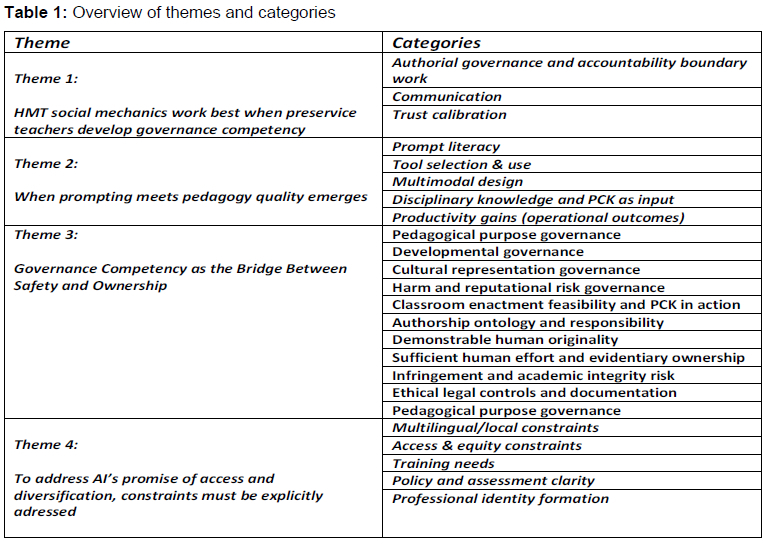
During the final round of data analysis, four themes emerged. See Table 1 for an overview of the four themes and their associated categories.
Theme 1: Human Machine Teaming social mechanics work best when preservice teachers develop governance competency
Theme 1 argues that HMT social mechanics work best when preservice teachers develop governance competency, which secures role clarity, calibrated trust, and human accountability. Theme 1 consists of three categories: authorial governance and accountability boundary work, communication and trust calibration. The first category, authorial governance and accountability boundary work, aligns with codes such as interdependence, role clarity, task distribution, and human accountability, as well as the more granular codes such as AI used as support rather than replacement, human AI shared task framing, delegation across workflow including idea, draft, and revise, AI as assistant tool, AI as co-writer, human as editor curator and human as final author arbiter. Empirically, these codes converge on a single governance pattern in which preservice teachers attempt to use AI as a generative partner without surrendering the authorial and ethical responsibilities that define legitimate educational authorship.
Participants repeatedly positioned AI as a scaffold for ideation and structure rather than a substitute for authorial agency, for example "to give me an idea of the story I wrote and to also help guide me as to how the structure of my story should be written," and "it generated a story which gave me an idea on how to write my story," and "acted as a creative springboard." These statements indicate deliberate delegation of early-stage generativity and role boundaries as ways that stabilise the authorship in question. For example, participant stated that "ChatGPT (SIC) is not an author. It is an AI generator that can be used to answer question, give ideas," and "ChatGPT cannot be classified as an author it can be classified as a contributor to the final written work," and the conditional position "could be considered an author, but I think there definitely needs to be human interception to make the story more appropriate... then edit it." Here, the human is positioned as the editor, curator, and final arbiter of author intent and appropriateness. Crucially, this boundary work is reinforced through accountability claims that render responsibility non-delegable, including "its one's responsibility to double check if everything is correct," and "cannot take responsibility for the things it comprises," which frames authorship as responsibility rather than mere production. Accountability is further intensified through institutional risk narratives, where AI use "usually counts against them as plagiarism because it is not their original work," and "plagiarism is an undeniably huge crime that could affect my academic career," showing that governance competency includes managing academic integrity constraints alongside pedagogical ones. This category captures how successful HMT depends on maintaining authorial governance and accountability boundaries that allow AI support without collapsing responsibility, originality, and ownership into uncritical automation.
Furthermore, communication, aligned with codes such as iterative "back and forth" prompting, clarification prompts, conversational refinement, and negotiating contradictions or ambiguity in outputs. Communication operated as the primary social mechanism through which governance competency was enacted. The majority of the participants did not treat the AI output as a final product but as a provisional draft that must be steered through successive instructions, illustrated by the claim that they used the output "as an idea and changed numerous aspects of the story to make it my own," and by a fuller account of iterative control, for example, one participant wrote:
"I started by providing ChatGPT with an introductory prompt that presented the story's setting, characters, and overarching theme. I then continued asking questions and offering prompts to guide the plot.. I would check the generated text as the story developed and make any changes or requests for further details to make sure the narrative made sense and remained cohesive."
The communicative burden was explicitly recognised as a competence demand, since "the only challenge was that you had to be super specific with your prompt," which positions prompt specificity as a condition for coordinated teaming rather than a stylistic preference.
Additionally, trust calibration, aligned with codes such as conditional trust, scepticism about accuracy, acceptance without checking, and reliance on AI authority. Trust was argued into being through verification and experience rather than assumed, as shown in "not everything you get or receive is accurate," and "sometimes it can give you responses that are not related to the topic that you want," and "may not understand what exactly you want," and "I was always sceptical (SIC)... It took me a few attempts, however, to get exactly what I wanted," which collectively treat trust as a calibrated judgement contingent on relevance, coherence, and iterative improvement.
However, in stark contrast, the anecdotal analysis of the students' finished stories and attribution statements revealed a counter pattern that sharpens the theme of authorial governance and accountability boundary work, as a gap was identified between their beliefs and intentions and their actual behaviour when using AI. On the surface, when analysing only their reflections, most students positioned AI as only a support mechanism or assistant and asserted that AI cannot be an author. However, the anecdotal analysis indicated that many had reproduced AI-generated text with little visible iteration, refinement, or substantive rewriting. This gap between what preservice teachers' intentions and beliefs and their actual behaviour and actions displays an implicit slip from HMT collaboration into delegation, where AI output is treated as authoritative by default. Furthermore, despite students' stated view that AI cannot act as an author, many still credited AI in ways that dilute or contradict human authorship claims. For example, 64 students listed AI as a co-author, 32 listed AI as the main author, and 76 made no reference to AI use, even though their reflections acknowledged using AI. This inconsistency signals that those preservice teachers are still negotiating what authorship means in AI-generated contexts and lack stable norms for disclosure, credit, and ownership.
Conceptually, this undermines the boundary work that Theme 1 argues is required for effective social mechanics, because role clarity and accountability depend on coherent and transparent positioning of the human as the final author and responsible agent. This counter-pattern directly instantiates acceptance without checking or reliance on AI authority, and it demonstrates that governance competency cannot be assumed from exposure alone. Even after eight weeks of training on the pedagogy and authorship of children's literature and explicit training in AI use and prompt writing, many stories still showed weak PCK in interrogating developmental suitability, narrative, and illustration coherence.
Generic and westernised story context also signals weak prompt literacy, a significant aspect of governance competency that prevented preservice teachers' stories from meeting early childhood standards. Theme 1's findings, therefore, show that HMT social mechanics only function when preservice teachers can operationalise their claimed boundaries through skilled governance practices. Those practices include iterating on prompts, revising drafts substantially, checking developmental appropriateness, which requires PCK, and aligning narrative choices with educational purposes. Without them, the human remains nominally accountable but practically displaced, and "ownership" becomes ambiguous because the human contribution is not clearly demonstrable. Theme 1 therefore, operates as a diagnostic claim that distinguishes accountable HMT from superficial delegation and clarifies why the study's central question, who owns the story, is inseparable from the capacity to govern role clarity, trust calibration, and accountability in early childhood educational practice.
Theme 2: When prompting meets pedagogy quality emerges
Theme 2 emerged as an integrated competence claim about how AI becomes usable in practice, as the perceived possibilities of generative AI in children's literature creation are not inherent in the tools themselves but are enabled through preservice teachers' operational competency, which functions as the practical interface between human intention and machine output. This theme was formed from five categories, each with its own associated codes identified during the initial analysis. The first category, Prompt literacy, aligned with codes such as specific instruction-giving, constraint-setting in relation to age, theme, length, and language level, prompt-refinement strategy, and asking for alternatives. Participants described operational success as hinging on translating pedagogical intentions into precise instructions, for example "I asked chatgpt to write a children's story, specifying the audience's age, the setting, the number of characters in the story and the length and moral of the story," while positioning the output as provisional rather than final, "I used this as an idea and changed numerous aspects of the story to make it my own." The data also show that prompt literacy includes metacognitive correction, not simply request-making: "I should have been more specific and explained what I wanted in more detail, instead of taking the first thing it gave me." Prompting was framed as sustained steering: "I started by providing ChatGPT with an introductory prompt that presented the story's setting, characters, and overarching theme," and then "continued to ask questions and offer prompts to direct the plot's direction," indicating that operational competency is enacted through iterative control that keeps human agency active rather than passive.
Furthermore, tool selection and use, aligned with codes such as choosing ChatGPT versus other tools, switching tools, limitations of free versions and paywalls, and managing attempt limits. Here, operational competency surfaced as situated decision-making under constraint. Participants' reflections show that what could be produced was partly determined by platform affordances and access limitations, for instance, "you only have a limited attempts to generate illustrations, especially when you have the unpaid version, so you have to wait up to five hours to unlock more free attempts." The third category, Multimodal design, aligned with codes such as generating and iterating illustrations, aligning image requests to story, handling visual inconsistency, and picture book planning. Participants described multimodal productivity and friction simultaneously. On the enabling side, one participant foregrounded speed and controllability, "I really enjoyed seeing how quickly ChatGPT generated the illustrations," adding that it made the process "much quicker and more creative because you can specify what you'd like to be generated," including style choices such as "I used the Cartoon theme." On the constraining side, multimodal work introduced continuity problems central to picture book coherence: "The illustrations don't come out the same every time, which causes the characters to not look the same at all, which is not ideal, especially for a children's book." Another participant similarly framed multimodal alignment as an active burden of planning and verification, "I also had to make sure that the illustrations matched what was being said in each part of the story," and "I had to make sure that the characters looked similar." These extracts show that multimodal design competence is not decorative. It is part of operational control that sustains narrative cohesion across modes and absorbs quality assurance work that the tools do not reliably perform.
Additionally, disciplinary knowledge and PCK as input incorporate the quality and risk claims that had previously been separated, because participants treated children's literature quality as an achieved outcome of knowledge integration rather than a by-product of tool use. This aligns with Moyo (2023) that careful curation and vigilance are important to ensure the publication of culturally sensitive, high-quality children's literature. Within this category, participants invoked criteria from children's literature as non-negotiable constraints on machine-generated content. One participant made this explicit as a checklist, "making sure that the theme is relevant," "the grammar and language is suitable for the specific age group," and that illustrations "should not contain images of violence." Another participant stated the underlying literary metalanguage as part of author competence, "Under literature we have theme, plot, dialogue, and style," and emphasised that authors must "check and edit their work," while also avoiding content "that could traumatise the child." The data further show that when disciplinary and PCK inputs are weak, the machine's lexical defaults violate early childhood readability expectations, "AI gave me bombastic words that was not easy for understandable as I wanted easy words as I was writing story book for grade R." Conversely, when governance is enacted, preservice teachers treated AI as a structural scaffold that still required human redesign, "I made use of ChatGPT to ensure that I have the correct structure of the book and a logical sequence of events however I only used it to get a basic story outline that I altered afterwards," and "I put specific, written directions and guidelines into ChatGPT to create my baseline story. This helped to narrow down my story's narrative and give me a good story to work on."
Participants also flagged the risk of formulaic repetition that undermines quality without governance: "ChatGPT can only generate so many different types of stories before they start repeating in some way... the children's literature is going to become boring and repetitive." This aligns with Saveri (2023), Wright (2023) that "generative AI is just human intelligence, repackaged and divorced from its creators".
Language simplification emerged as a core PCK and accountability problem. For example, one participant wrote: "These AI use strong vocabulary and for me I was doing a story for children hence I needed simple, easy to read and understand vocabulary for the children but chatgbt used advanced vocabulary that in the end I had to edit some of the words out. replace with simpler and easy to understand words," anchored in the developmental criterion of selecting language "that a child of a specific age range would be able to understand or even be able to read."
Character development was similarly governed through intentional design, "the author should choose the character that the children will remember," while recognising model limits, for example: "maintaining consistent characterisation throughout the story can be difficult, as the model may not remember specific traits or behaviours assigned to characters earlier in the narrative," and "capturing and conveying subtle emotional in characters may be difficult."
Moral and social learning aims were built into the governance of plot and character, "I asked ChatGPT to create a story for me that will have a moral and that will help children develop social skills." Setting generation functioned as a contextual constraint supplied by the human author, "I gave ChatGPT an idea of the story that I wanted, how many characters, the antagonist, and the place where I wanted the story to take place," and "I specified the age group that I wanted my criteria to meet. The places that I wanted my story to take place in, and the kinds of animals that I wanted," while also acknowledging contextual misalignment risk, "ChatGPT might not fully understand the context of the user's story, leading to responses that may not align with what the user wants." Finally, linguistic and educational quality was articulated both as an obligation and as demonstrable transformation, children's literature "must be made of diction that is easy to understand... and... needs to give the children the opportunity to gain experience something good from it," and "ChatGPT provided me with the correct length and moral filled story that I wanted to have and then I changed it to become my own, personally invented story," alongside a richer quality repertoire, "the author has to ensure that the book has a specific moral, theme or lesson. repetition, rhymes, literary devices. new vocabulary... vivid and not too-distracting illustrations." Where this integration was weak, participants predicted classroom failure and narrowed engagement, "using AI lacks the human creativity necessary for children literature, the story it generated for me was terribly boring and the children would have lost focus within the first 5 minutes," and even professional deskilling, "this will cause authors and educators to become lazy and they will not expand their knowledge or improve their ability to educate."
Lastly, productivity gains aligned with codes such as time-saving and efficiency, faster drafting, overcoming writer's block, and generating many options quickly. Participants consistently described AI as a cognitive accelerator, "Using it in this way, saves a lot of time spent on brainstorming," and "it has speed, or it can be fast and efficient way to get ideas," and "It helped me too overcome write's and keep creative process flowing," and "I benefited by being saved time and energy since ChatGPT wrote for me." However, across the theme, productivity is not neutral. It creates an optimisation pressure that can privilege completion over critique unless operational competence is embedded within governance routines and pedagogical evaluation, captured in the corrective insight that one should not take "the first thing it gave me." Theme 2, therefore, consolidates the central implication for teacher education. AI expands production, but only integrated operational competency, plus disciplinary and PCK governance, determines whether what is produced is children's literature that is teachable, developmentally plausible, culturally sensitive, and educationally purposeful.
Theme 3: Governance competency as the bridge between safety and ownership
Governance competency, as the bridge between safety and ownership, emerged as a unifying theme that links early childhood risk management to authorship claims through an explicit ethical and legal competency lens. Participants repeatedly positioned AI as productive but epistemically and ethically volatile, because "avoiding possible errors buried in the AI's training data" sits alongside the need for "suitable material" and a "constant tone." Within this logic, governance competency serves as the bridging mechanism precisely because it integrates operational control with ethical and legal judgment. It is the capacity to (a) define educational purpose and developmental fit, (b) anticipate harm, bias, and misinformation, and crucially (c) manage copyright infringement risk while evidencing sufficient human effort to justify authorship. Participants framed this as accountability under conditions of uncertainty, noting "a chance of unwanted disadvantages, inappropriate content, or the maintenance of misconceptions," therefore "human authors must exercise care and accountability," because "human creators ultimately have the responsibility for the content's effect on younger learners."
The same governance logic converts "safety" work into "ownership" work by defining boundaries around authorship, originality, and non-delegable responsibility. Participants consistently asserted that "ChatGPT is not an author," but grounded ownership in demonstrable human contribution that signals sufficient human effort, "it gives us the clue and the summary," "therefore I had to extend the story using my own knowledge and abilities," and "I added pictures... to fit for children and added a proper ending." In parallel, safety criteria were treated as authorial duties rather than optional refinements, including ensuring "the grammar and language is suitable for the specific age group," and that illustrations "should not contain images of violence in any way, shape or form." These pedagogical safeguards intersect directly with ethical legal competency, because they require verifying what is appropriate to teach and what is permissible to use. Participants fused this with the ownership claim that AI "cannot take responsibility for the things it composes," and "nor can it claim originality because everything ChatGPT knows is from other sources," a reasoning that implicitly foregrounds infringement anxieties and the need to avoid passing off derivative output as original human work.
The dataset also shows what happens when governance competency is absent or overridden by convenience. One student admitted, "I chose to be one of the lazy students... taking the first thing it gave me," and described the negative consequences afterwards. This directly illustrates how insufficient human effort collapses both pedagogical safety and defensible ownership, because the process cannot evidence critical human judgement, revision, or due diligence. That vulnerability is experienced institutionally as pressure to uphold academic integrity and to avoid plagiarism: "plagiarism is an undeniably huge crime that could affect my academic career." Finally, governance competency is enacted in classroom feasibility decisions that join pedagogical safety to professional accountability, for example, "I would not have been the true author," and concerns that digital delivery was "stressful," while "children liked the actual hardcover books a lot more interactive than the digital books." Taken together, the theme argues that in HMT, ownership becomes credible only when it is earned through TPACK-anchored governance that integrates operational, pedagogical, and ethical legal competencies, reduces copyright infringement risk, and makes sufficient human effort visible and auditable.
Theme 4: To address AI's promise of access and diversification, constraints must be explicitly addressed
Theme 4 emerged as a structural constraint claim. It argues that AI's promise of widening access and diversifying children's literature is real, but it is routinely bottlenecked by language and contextual fragility, uneven tool access, and institutional ambiguity, which together make explicit higher education teaching of HMT principles and IP literacy non-optional rather than supplementary. First, multilingual and local context constraints showed that diversification is not achieved by merely switching the output language. Students explicitly noted that "ChatGPT's language construction is not always accurate and correct, especially when generating stories in Afrikaans," and that generative AI "sometimes struggles to grasp the deeper meaning and context of stories," requiring active correction work because "there were a few language errors that I had to correct." This limitation extends beyond grammar into cultural and contextual modelling. One participant explained that AI may not "always know the context in which it should be," and that even asking it to "write in a South African context" still yields only "a narrow understanding of what that may be," with the further risk that "AI can unknowingly create biased texts in terms of culture or gender roles." In other words, the "access and diversification" promise is conditional on human contextual governance, because the tool's defaults can reproduce shallow contextuality and stereotype drift rather than culturally responsive localisation.
Second, access and equity constraints were not abstract. They were experienced as workflow interruptions and classroom barriers to feasibility that directly shape who can iterate, verify, and refine. On the production side, the participants described free tier constraints where "you only have a limited attempts to generate illustrations, especially when you have the unpaid version, so you have to wait up to five hours to unlock more free attempts," and another bluntly stated "ChatGPT is not good because I was never free when using it." These accounts matter because they show that "operational possibility" is stratified by paywalls, device availability, and classroom infrastructure, which in turn stratifies the capacity to enact the iterative checking that HMT requires.
Third, the data demonstrate why teacher education must explicitly teach HMT routines and IP literacy, as students encounter policy ambiguity and integrity risks in the operational environment. One participant described being "not comfortable using ChatGPT," feeling "like I was cheating," and emphasised that "in the JGL module I think the lines got blurred," leading to "contradicting instructions" because AI applications were allowed. This same participant directly requested structured institutional support, arguing that "if a tutor was made available or if we had a Q and A online session... it may have helped," and recommending the semester be used to show "the intended use of ChatGPT" and "elaborate to the AI about what kind of story" is being requested might lead to plagiarism and unethical profession," so that storybooks can be completed "ethically." Another participant similarly notes that AI use can create "issues of plagiarism." Finally, a tension between convenience and pedagogical authorship exists, with concerns that AI "limits human creativity and imagination," that "we rely on technology and don't think for ourselves," and that it is "making younger generations lazy," thereby threatening the teacher author identity that must remain accountable for children's texts.
CONCLUSION
This study shows that generative AI can expand the production of multilingual children's literature in South Africa, but only when preservice teachers treat AI as a teammate that must be actively governed rather than a shortcut to finished texts. HMT clarifies that effective AI-generated production depends on social mechanics such as interdependence, communication, role clarity, calibrated trust, and human accountability. In parallel, TPACK explains why success is not merely technical and why disciplinary knowledge and PCK are integrative, with governance competence and ethical legal competence as essential extensions for AI-generated children's literature.
Across the four themes, it is clear that preservice teachers iterated prompts, constrained outputs to early childhood criteria, aligned text image coherence, and retained final responsibility. AI enabled faster drafting, multimodal experimentation, and scaffolding of structure. Where preservice teachers defaulted to uncritical acceptance, AI amplified generic plots, developmental misfit, and integrity risk, producing work that was efficient but not educationally defensible. Therefore, to answer the research question, the possibilities lie in accelerated ideation, drafting, and illustration workflows that can support literacy goals and widen access to locally relevant story material, which matters in a system still prioritising reading promotion initiative. At the same time, the challenges are structural. Students reported uneven platform access, paywalls, and tool constraints that shape iteration cycles and quality assurance. Linguistically, multilingual production is constrained by errors, translation limits, and contextual shallowness that can undermine cultural credibility. Pedagogically, children's literature carries developmental and well-being stakes, so the cost of errors is higher than in general text generation. The findings also indicate that authorship is enacted as accountable design work rather than claimed as a label. This aligns with the article's argument that governance competence requires evaluating and revising AI outputs against disciplinary criteria for children's literature and early years pedagogical goals, while embedding ethical legal judgement about intellectual property and classroom suitability.
The last research question asked how generative AI affects the meaning of authorship in children's literature. The findings indicate that the ontology of authorship will need to be reconceptualised (Craig and Kerr, 2020). The study suggests a shift from authorship as origin to authorship as sufficient human effort, evidenced through selection, arrangement, editing, and substantive rewriting, supported by audit trails and disclosure practices. In jurisdictions where human authorship remains a requirement, wholly AI-generated outputs are generally treated as ineligible for protection, and the central question becomes what kind and how much human contribution is sufficient, thus aligning with Wright's (2023) position that some uses of generative AI will be deemed to constitute copyright infringement while others will not.
For teacher education, the implication is to explicitly teach HMT principles and IP and prompt literacy alongside disciplinary knowledge and PCK, to develop governance competency so that access and productivity gains do not collapse into unsafe texts or unstable ownership claims.
REFERENCES
- Adey, D., R. Beeton, M. Chapman, and E. Pereira. 1986. Companion to South African Literature. Cape Town: Donker.
- Amory, A. 2018. "Activity Theory and Interactive Design for the African Storybook Initiative." Journal of Educational Multimedia and Hypermedia 27 (3): 293-308.
-
Blignaut, H. 2022. "Copyright in South Africa: FAQs." Lexology. Accessed February 6, 2026. https://www.lexology.com/commentary/intellectual-property/south-africa/spoor-fisher/copyright-in-south-africa-faqs.
» https://www.lexology.com/commentary/intellectual-property/south-africa/spoor-fisher/copyright-in-south-africa-faqs -
Brittain, Blake. 2023. "AI-Generated Art Cannot Receive Copyrights, US Court Says." Reuters, August 21. https://www.reuters.com/legal/ai-generated-art-cannot-receive-copyrights-us-court-says-2023-08-21/.
» https://www.reuters.com/legal/ai-generated-art-cannot-receive-copyrights-us-court-says-2023-08-21/ -
Brittain, Blake. 2025. "US Appeals Court Rejects Copyrights for AI-Generated Art Lacking 'Human' Creator." Reuters, March 18. https://www.reuters.com/world/us/us-appeals-court-rejects-copyrights-ai-generated-art-lacking-human-creator-2025-03-18.
» https://www.reuters.com/world/us/us-appeals-court-rejects-copyrights-ai-generated-art-lacking-human-creator-2025-03-18 -
Burgan, C. 2023. "AI and Copyright: Can the Hill Stop Gen AI from Stealing Your Work?" MeriTalk. Accessed February 6, 2026. https://www.meritalk.com/articles/ai-and-copyright-can-the-hill-stop-gen-ai-from-stealing-your-work/.
» https://www.meritalk.com/articles/ai-and-copyright-can-the-hill-stop-gen-ai-from-stealing-your-work/ - Craig, C., and I. Kerr. 2020. "The Death of the AI Author." Ottawa Law Review 52 (1): 31-86.
-
Creamer, E. 2023. "Authors File a Lawsuit against OpenAI for Unlawfully 'Ingesting' Their Books." The Guardian, July 5. https://www.theguardian.com/books/2023/jul/05/authors-file-lawsuit-against-openai-for-unlawfully-ingesting-their-books.
» https://www.theguardian.com/books/2023/jul/05/authors-file-lawsuit-against-openai-for-unlawfully-ingesting-their-books - Department of Basic Education. 2021. "Read to Lead." Accessed February 6, 2026. https://www.education.gov.za/Programmes/Read2Lead.aspx.
-
Dudley-Nicholson, J. 2023. "Why Stolen Australian Books Are Being Used to Train AI." The Senior. Accessed February 6, 2026. https://www.thesenior.com.au/story/8377940/why-stolen-australian-books-are-being-used-to-train-ai/.
» https://www.thesenior.com.au/story/8377940/why-stolen-australian-books-are-being-used-to-train-ai/ - Foucault, Michel. 1979. "What Is an Author?" In Textual Strategies: Perspectives in Post-Structuralist Criticism, edited by Josué V. Harari, 141-60. Ithaca, NY: Cornell University Press.
-
Government of South Africa. 2024. "President Cyril Ramaphosa Refers the Copyright Amendment Bill and the Performers' Protection Amendment Bill to the Constitutional Court." October 15. https://www.gov.za/news/media-statements/president-cyril-ramaphosa-refers-copyright-amendment-bill-and-performers%E2%80%99.
» https://www.gov.za/news/media-statements/president-cyril-ramaphosa-refers-copyright-amendment-bill-and-performers%E2%80%99 -
Grenby, M. O. 2014. "The Origins of Children's Literature." The British Library. Accessed February 6, 2026. https://www.bl.uk/romantics-and-victorians/articles/the-origins-of-childrens-literature.
» https://www.bl.uk/romantics-and-victorians/articles/the-origins-of-childrens-literature -
Griffiths, W. 2023. "Artificial Intelligence and IP - Who Owns the Copyright." Mondaq. Accessed February 6, 2026. https://www.mondaq.com/southafrica/copyright/1290132/artificial-intelligence-and-ip--who-owns-the-copyright.
» https://www.mondaq.com/southafrica/copyright/1290132/artificial-intelligence-and-ip--who-owns-the-copyright -
Hoffman, Jessica L., William H. Teale, and Junko Yokota. 2015. "The Book Matters! Choosing Complex Narrative Texts to Support Literary Discussion." Young Children 70 (4): 8-15. Accessed February 6, 2026. https://www.naeyc.org/resources/pubs/yc/sep2015/book-matters.
» https://www.naeyc.org/resources/pubs/yc/sep2015/book-matters - Jenkins, E. 1993. Children of the Sun: Selected Writers and Themes in South African Children's Literature. Johannesburg: Ravan Press.
-
Jenkins, E. 2008. "Research into the Multilingual Children's Literature of South Africa." Children's Literature Association Quarterly 33 (4): 428-40. https://doi.org/10.1353/chq.0.1877.
» https://doi.org/10.1353/chq.0.1877 -
Johnston, R. 2023. "Authors Discover Pirated Versions of Their Books Used to Train Meta AI." Bleeding Cool. Accessed February 6, 2026. https://bleedingcool.com/comics/authors-discover-pirated-versions-of-their-books-used-to-train-meta-ai/.
» https://bleedingcool.com/comics/authors-discover-pirated-versions-of-their-books-used-to-train-meta-ai/ -
Koehler, M. J., and P. Mishra. 2009. "What Is Technological Pedagogical Content Knowledge (TPACK)?" Contemporary Issues in Technology and Teacher Education 9 (1): 60-70. https://citejournal.org/volume-9/issue-1-09/general/what-is-technological-pedagogical-content-knowledge/.
» https://citejournal.org/volume-9/issue-1-09/general/what-is-technological-pedagogical-content-knowledge/ -
Merriam-Webster. 2023. "Author." Merriam-Webster.com Dictionary. Accessed February 6, 2026. https://www.merriam-webster.com/dictionary/author.
» https://www.merriam-webster.com/dictionary/author -
Mishra, P., and M. J. Koehler. 2006. "Technological Pedagogical Content Knowledge: A Framework for Teacher Knowledge." Teachers College Record 108 (6): 1017-54. https://doi.org/10.1467-9620.2006.00684.x.
» https://doi.org/10.1467-9620.2006.00684.x -
Moyo, A. 2023. "AI Tools like ChatGPT Raise Copyright Issues in SA." ITWeb. Accessed February 6, 2026. https://www.itweb.co.za/content/lwrKxq3Yn5r7mg1o.
» https://www.itweb.co.za/content/lwrKxq3Yn5r7mg1o -
O'Neill, T., N. McNeese, A. Barron, and B. Schelble. 2022. "Human-Autonomy Teaming: A Review and Analysis of the Empirical Literature." Human Factors: The Journal of the Human Factors and Ergonomics Society 64 (5): 904-38. https://doi.org/10.1177/0018720820960865.
» https://doi.org/10.1177/0018720820960865 - Republic of South Africa. 1992. Copyright Amendment Act 125 of1992. Pretoria: Government Printers.
- Samuelson, P. 1986. "Allocating Ownership Rights in Computer-Generated Works." University of Pittsburgh Law Review 47 (4): 1185-1228.
-
Saveri, J. 2023. "Generative AI Litigation." Saveri Law Firm. Accessed February 6, 2026. https://www.saverilawfirm.com/generative-ai-litigation.
» https://www.saverilawfirm.com/generative-ai-litigation -
Saveri, J., & Butterick, M. (n.d.). LLM litigation. https://llmlitigation.com/
» https://llmlitigation.com/ -
Seeber, I., E. Bittner, R. O. Briggs, T. de Vreede, G. J. de Vreede, A. Elkins, R. Maier, A. B. Merz, S. Oeste-Reiß, N. Randrup, G. Schwabe, and M. Söllner. 2020. "Machines as Teammates: A Research Agenda on AI in Team Collaboration." Information and Management 57 (2): 103174. https://doi.org/10.1016/jim.2019.103174.
» https://doi.org/10.1016/jim.2019.103174 -
Sharp, L. A., and R. D. Johnson. 2016. "Overcoming Cultural Inequalities with Diverse Children's Literature: Recommendations That Support Culturally Responsive Teaching with Multicultural Literature." English in Texas 46 (1): 23-29. https://files.eric.ed.gov/fulltext/EJ1262893.pdf.
» https://files.eric.ed.gov/fulltext/EJ1262893.pdf -
Shulman, L. S. 1986. "Those Who Understand: Knowledge Growth in Teaching." Educational Researcher 15 (2): 4-14. https://doi.org/10.3102/0013189X015002004.
» https://doi.org/10.3102/0013189X015002004 -
South African Government. n.d. "Register Copyright." Accessed February 6, 2026. https://www.gov.za/services/intellectual-property/register-copyright.
» https://www.gov.za/services/intellectual-property/register-copyright -
Thorne, S. 2020. "Hey Siri, Tell Me a Story: Digital Storytelling and AI Authorship." The International Journal of Research into New Media Technologies 26 (4): 808-23. https://doi.org/10.1177/1354856520913866.
» https://doi.org/10.1177/1354856520913866 -
U.S. Copyright Office. 2023. Copyright Registration Guidance: Works Containing Material Generated by Artificial Intelligence. March 16. https://www.copyright.gov/ai/ai_policy_guidance.pdf.
» https://www.copyright.gov/ai/ai_policy_guidance.pdf -
U.S. Copyright Office. 2025. Copyright and Artificial Intelligence, Part 2: Copyrightability. January 17. https://www.copyright.gov/ai/Copyright-and-Artificial-Intelligence-Part-2-Copyrightability-Report.pdf.
» https://www.copyright.gov/ai/Copyright-and-Artificial-Intelligence-Part-2-Copyrightability-Report.pdf -
van Vuuren, K. 1994. "A Study of Indigenous Children's Literature in South Africa." MA diss., University of Cape Town. https://open.uct.ac.za/bitstream/item/24174/thesis_hum_1995_van_vuuren_kathrine.pdf7sequence=1.
» https://open.uct.ac.za/bitstream/item/24174/thesis_hum_1995_van_vuuren_kathrine.pdf7sequence=1 - West, J. 2024. Literacy Practice Guide: Teaching Emergent Literacy. Pretoria: University of Pretoria.
-
Wright, W. 2023. "What You Need to Know about the Copyright Issues Surrounding Generative AI." The Drum, August 1. https://www.thedrum.com/news/2023/08/01/what-you-need-know-about-the-copyright-issues-surrounding-generative-a.
» https://www.thedrum.com/news/2023/08/01/what-you-need-know-about-the-copyright-issues-surrounding-generative-a