Emotional and user-experience factors influencing student performance: A case study of first-year online computer programming assignments
Abstract
This study investigates the interplay between achievement emotions, user experience, and academic performance of online university assignments. Drawing on Pekrun's Control-Value Theory (CVT), User Experience Theory (UXT), Self-Determination Theory (SDT), Cognitive Load Theory (CLT), and Expectancy-Value Theory (EVT), the research explores how these factors impact first-year students' engagement and performance in a computer programming module. The sample comprised 350 responses across three assignments, with 30 responses for Assignment 1, 292 for Assignment 2, and 27 for Assignment 3. Achievement emotions were assessed using the Achievement Emotions Questionnaire (AEQ) across eight scales: enjoyment, hope, pride, anger, anxiety, shame, hopelessness, and boredom. The User Experience Questionnaire (UX) evaluated user experience across four scales: ease of use, interest, alignment, and appeal. Additionally, academic performance was measured as a percentage. Descriptive statistics revealed the prevalence of both positive and negative emotions, as well as varied user experiences. Correlation analysis indicated significant relationships between positive emotions (enjoyment, hope, pride) and higher academic performance, while negative emotions (anger, anxiety, hopelessness) were negatively correlated with performance. Positive user experiences (ease of use, interest, alignment, appeal) were also positively correlated with academic success. Reliability analysis examined the extent to which achievement emotions and user experiences significantly predict academic performance. Recommendations for educators are to create assignments that minimise cognitive load, maximise positive user experiences, and support students' intrinsic motivations.
Achievement Emotions Theory (AET); Assessment Emotions Questionnaire (AEQ); User Experience (UX) Theory; Control-Value Theory (CVT); Self-Determination Theory (SDT); Cognitive Load Theory (CLT); Expectancy-Value Theory (EVT)
INTRODUCTION
Academic achievement and student engagement are critical points in higher education (Lin et al. 2023). Understanding the factors influencing these areas can provide valuable insights into creating a more effective and supportive learning environment (Sointu et al. 2023). Among these factors, achievement emotions and user experience play significant roles. As defined by Control-Value Theory (CVT), achievement emotions are directly related to achievement activities and outcomes, such as studying for an exam or completing an assignment (Pekrun and Goetz 2023). These emotions, which can be positive (e.g., enjoyment, hope, pride) and negative (e.g., anger, anxiety, hopelessness), influence students' motivation, cognitive resources, and academic performance. Parallel to this, the user experience (UX) of academic tasks, which encompasses ease of use, interest, alignment, and appeal (Jahnke 2023), has gained attention as a determinant of student engagement and satisfaction (Fayez, Ozfidan, and Ismail 2023). The study that informed this article examined these dynamics within the framework of the first-year computer programming module at an open and distance learning tertiary institute, focusing on three assignments. Computer science was chosen because it is the cornerstone of most modern technology. It fosters logical thinking, problem-solving, and creativity and is a field where creativity and technical skill can lead to developing new software, creating better algorithms, or improving cybersecurity. This subject provides numerous career opportunities, but students often need help to learn the logic of computer programming, resulting in failing university courses (Bosse and Gerosa 2017). The challenge is compounded in an online learning environment. Previous studies have examined the interplay between achievement emotions and academic performance (Pekrun et al. 2017), user experience and academic performance (Paramitha, Dantes, and Indrawan 2018), and the relationship between achievement emotions and user experience (Schrader and Grassinger 2021) in both face-to-face and online contexts. However, studies have yet to consider all three factors simultaneously in an online environment, particularly in computer science. This gap underscores the need for research that simultaneously explores achievement emotions, user experience, and academic performance to provide recommendations for improving student outcomes in online computer science courses.
Achievement Emotions in Education
Achievement emotions, as conceptualised by CVT, are directly linked to academic activities and outcomes, and significantly influence students' motivation, learning strategies, and performance (Feraco et al. 2023). These emotions, classified into positive (e.g., enjoyment, hope, pride) and negative (e.g., anger, anxiety, hopelessness) have distinct impacts on students' academic experiences (Pekrun et al. 2002, 2011). Positive emotions are associated with higher motivation, better cognitive engagement, and improved academic performance, while negative emotions can lead to disengagement, decreased motivation, and lower academic outcomes (Cassady and Johnson 2002; Zeidner 1988).
User Experience in Education
UX theory, rooted in human-computer interaction and design principles, is defined as a holistic concept beyond usability, including emotional and psychological responses elicited during interactions (Hassenzahl and Tractinsky 2006) and emphasises creating engaging, efficient, and satisfying interactions (Norman 1988; Hsu 2024). Well-designed interfaces and materials reduce cognitive load, foster deep learning, and sustain engagement, promoting better academic outcomes (Hartson and Pyla 2012; Linnenbrink-Garcia et al. 2010; Schraw and Lehman 2001).
The Interplay Between Achievement Emotions and User Experience
The interaction between achievement emotions and user experience in educational settings is crucial for enhancing student engagement and academic performance (Nasruddin et al. 2024). Educational tasks designed with a positive user experience can enhance positive achievement emotions, thereby improving academic performance (Moos and Azevedo 2009; Pekrun and Stephens 2010; Sahraie et al. 2024).
Cognitive Load Theory and Assignment Design
CLT posits that educational tasks should minimise unnecessary cognitive demands to facilitate better learning outcomes (Sweller 1988). Structured and easy-to-navigate assignments help students focus on the intrinsic aspects of the task, enhancing cognitive engagement and reducing negative emotions (Sweller, Ayres, and Kalyuga 2011).
Self-Determination Theory and Educational Motivation
SDT emphasises the importance of autonomy, competence, and relatedness in fostering intrinsic motivation and well-being (Deci and Ryan 1985). Assignments that support these psychological needs are more likely to elicit positive emotions and enhance academic performance (Deci et al. 1991; Ryan and Deci 2000).
Expectancy-Value Theory and Academic Engagement
First proposed by Atkinson et al. (1960) and further developed by Eccles and Wigfield (2002), EVT posits that students' engagement and performance are influenced by their expectations of success and the value they place on academic tasks (Eccles and Wigfield 2002). Assignments perceived as achievable and valuable foster positive emotions and enhance academic engagement (Wigfield and Eccles 2000; Eccles and Roeser 2011).
Conceptual Framework
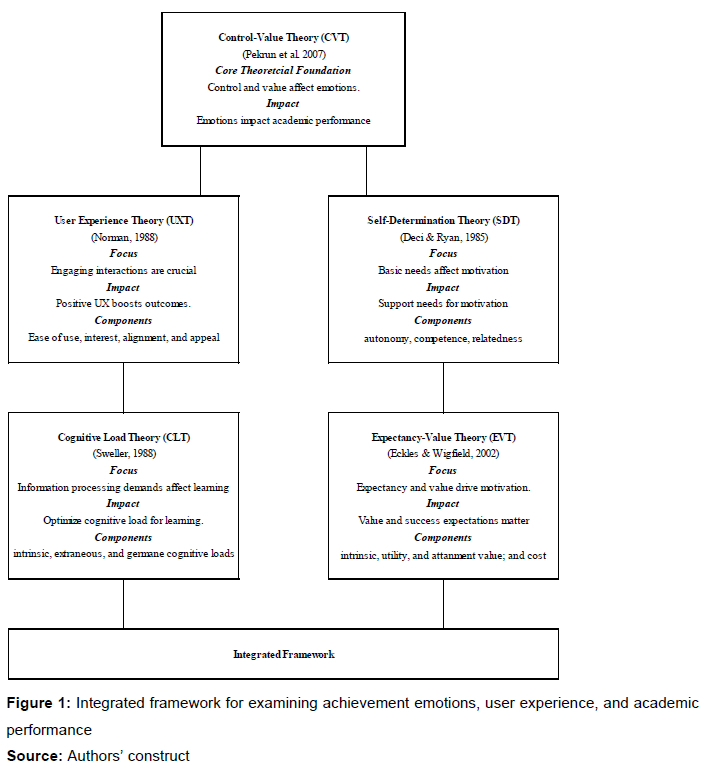
The theory framing the present study is a combination of the CVT, UXT, SDT, CLT, and EVT. Figure 1 illustrates the integrated framework for analysing achievement emotions, user experience, and academic performance in assessments. This integrated framework provides a comprehensive understanding of how various factors, including achievement emotions, user experience, and motivational elements, impact student performance. This holistic approach highlights the importance of considering emotional and motivational dimensions in educational practices to foster a more effective and engaging learning environment.
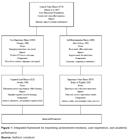
AET and SDT offer insights into the emotional and motivational aspects of learning. UXT and CLT emphasise the importance of assignment design and its impact on learning efficiency and satisfaction. Finally, EVT bridges the gap between motivation, emotion, and perceived task value, offering a holistic view of the factors influencing student engagement and performance.
METHODOLOGY
The research design outlines a comprehensive approach to understanding the interplay between achievement emotions, user experience, and academic performance.
Research Objectives
The study aimed to assess the prevalence of different achievement emotions experienced by students during online assignment preparation and completion; evaluate the user experience of assignments in terms of ease of use, interest, alignment, and appeal; analyse the impact of achievement emotions and user experience on students' academic performance; and provide insights into how assignment design can be improved to foster positive emotions and user experiences, thereby enhancing academic outcomes.
Research Questions
The following five research questions underpinned the study:
RQ1. What are the common achievement emotions experienced by students during online assignment preparation and completion?
RQ2. How do students perceive the user experience of online assignments in terms of ease of use, interest, alignment, and appeal?
RQ3. What is the relationship between achievement emotions and academic performance in online assignments?
RQ4. How does the user experience of online assignments impact students' academic performance?
RQ5. How can online assignment design be improved to enhance positive achievement emotions and user experiences?
Sample and Setting
The study was conducted at an open and distance learning tertiary institute, involving students enrolled in a first-year computer programming module. Participants were undergraduate students who voluntarily participated in the study by completing the questionnaires and submitted responses to three online assignments. The first and third assignments were multiple-choice-based, while the second assignment required written programming coding. The sample comprised 350 responses, with 30 responses for Assignment 1, 292 responses for Assignment 2, and 27 responses for Assignment 3.
Data Collection
Data were collected using two primary instruments: the AEQ and the UX Questionnaire (UXQ). The AEQ assessed students' emotions related to assignment preparation and completion across eight scales: enjoyment, hope, pride, anger, anxiety, shame, hopelessness, and boredom. The UXQ measured user experience across four scales: ease of use, interest, alignment, and appeal. Additionally, a score scale (as a percentage) was used to evaluate academic performance. Responses were collected for each of the three online assignments in the first-year computer programming module.
Instruments
The AEQ utilised a 5-point Likert scale ranging from 1 (strongly disagree) to 5 (strongly agree) to measure students' emotions. The UXQ used 7-point semantic differential scales to assess:
Ease of use: technical-non-technical, complex-simple, impractical-practical, complicated-straightforward, unexpected-expected, confusing-clearly structured, undoable-doable.
Interest: isolating-connective, unprofessional-professional, unsuitable-suitable, inferior-superior, alienating-integrating, separates me-brings me closer, unpresentable-presentable.
Alignment: conventional-inventive, unimaginative-creative, limiting-unrestricted, conservative-innovative, dull-captivating, undemanding-challenging, familiar-unfamiliar.
Appeal: unlikeable-enjoyable, unappealing-appealing, disagreeable-likeable, rejecting-inviting, bad-good, repelling-engaging, discouraging-motivating.
Data Analysis
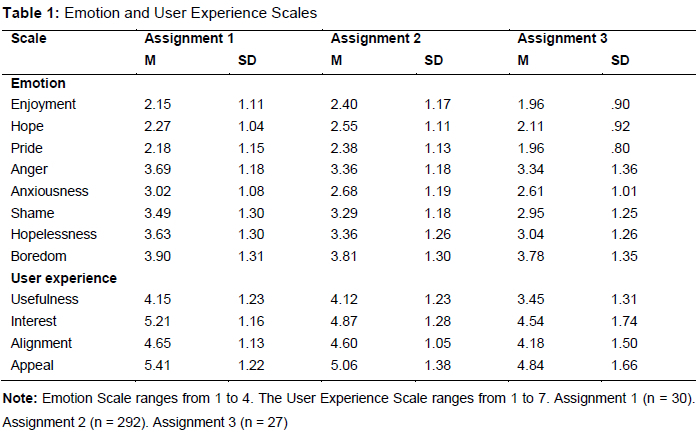
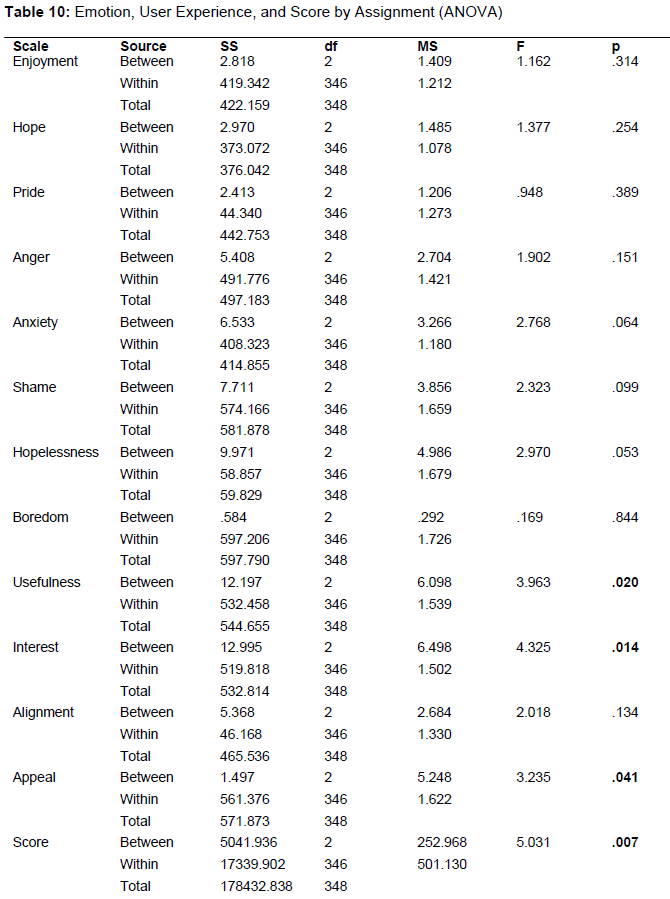
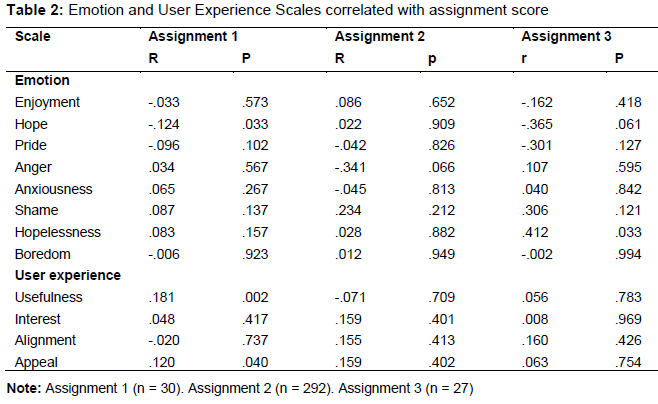
The data analysis involved several steps. First, descriptive statistics (table 1) were calculated to determine the mean and standard deviation for each emotion and user experience scale, summarising the central tendencies and variabilities. Next, correlation analysis (tables 2 and 3) used Pearson correlation coefficients to explore the relationships between emotions, user experience scales, and academic performance. Reliability analysis (table 3) assessed the internal consistency of the scales using Cronbach's alpha. Multiple regression analyses (tables 7-9) were then conducted to determine the predictive power of emotions and user experiences on academic performance, with separate regression models created for each assignment. Finally, ANOVA (table 10) was used to analyse the differences in emotions and user experiences across different assignments.
Ethical Considerations
Ethical approval (reference number 2022/CSET/SOS/091 AMENDED) was obtained from the relevant institutional ethics review board. Participants were informed about the purpose of the study, their rights, and the confidentiality of their responses. Consent was obtained. Data were anonymised to protect participants' identities, and the results were reported in aggregate form. Participation was voluntary, and students could withdraw from the study at any time without penalty.
Limitations
The limitations of the study include sample size variation, self-report bias, and a cross-sectional design. Uneven sample sizes across assignments may affect the generalisability of the findings. Participants' perceptions and social desirability may have influenced responses. The study's cross-sectional nature limits the ability to infer causality between variables.
RESULTS
Table 1 presents the means and standard deviations for each scale to provide an overview of the general sentiment and experience of students. Higher mean values in scales like enjoyment, hope, and pride suggest positive emotional experiences, whereas higher values in anger, anxiety, shame, hopelessness, and boredom suggest negative emotions. For user experience, higher means in scales like ease of use, interest, alignment, and appeal indicate positive experiences. This initial analysis can help identify overall trends and areas that might need improvement.
The correlation matrix data in table 2 reveal how different emotions and user experience scales interact with each other. Positive correlations (e.g., between enjoyment and ease of use) suggest that positive emotions often accompany positive user experiences. Negative correlations (e.g., between anxiety and ease of use) indicate that negative emotions are more likely when user experiences are poor. Identifying these correlations helps understand the interplay between different factors affecting student experiences and performance. The data in table 2 highlight the relationships among the emotional and user experience variables. Strong positive correlations between enjoyment, hope, and pride (r > .7) suggest that these positive emotions often co-occur. Conversely, negative emotions like anger, anxiety, and hopelessness exhibit strong negative correlations with positive emotions (r < -.5), indicating that these are typically experienced inversely.
Table 3 presents Cronbach's alpha values by assessing the internal consistency of the scales used. High reliability (values above .7) means that the items within each scale consistently measure the same underlying concept (Revicki 2023). For example, if the enjoyment scale has a high Cronbach's alpha, it suggests that the various items measuring enjoyment are consistent and reliable indicators of this emotion.
Multiple regression analyses were conducted to examine the extent to which achievement emotions predicted students' assignment scores. Separate models were created for each of the three assignments. The results for Assignment 1 are presented in Tables 4-6.
Similarly, the regression analysis for Assignment 2 suggests that the model's explanatory power is much lower, with an R2 of .041 and an adjusted R2 of .014, indicating that only 4.1 per cent of the variance in scores is explained by the model. The model is not statistically significant (p = .148). Among the predictors, hope approaches significance (p = .072) with a negative coefficient of -4.576, suggesting a potential negative impact on scores, though it does not reach the threshold for statistical significance. Overall, none of the predictors significantly affect the scores in Assignment 2.
The regression model for Assignment 3 explains a substantial portion of the variance in scores, with an R2 of .758 and an adjusted R2 of .386. The model is statistically significant (p = .024), indicating a reliable prediction of scores based on the included predictors. Enjoyment negatively affects assignment scores, with a coefficient of -6.373 (p = .018), meaning that higher enjoyment is paradoxically associated with lower scores. In contrast, hope has a positive impact on scores, with a coefficient of 8.786 (p = .013), as does shame, with a coefficient of 21.149 (p = .024).
The regression analysis across the three assignments shows varied impacts of emotional predictors on student scores. For Assignment 1, anger negatively and shame positively influence scores, though the overall model is not significant. Assignment 2's model is not significant, with no predictors showing a significant effect. In contrast, Assignment 3's model is significant, with enjoyment negatively and both hope and shame positively affecting scores.
These findings highlight the complex and assignment-specific nature of the relationship between emotions and academic performance in the computer programming module. Table 7 shows that the model explains 25.3 per cent of the variance in scores (R2 = .253), though the adjusted R2 (-.086) suggests overfitting. Table 4 reveals that none of the emotional variables significantly predict scores, as all p-values exceed .05.
Like the emotion model, tables 7-9 show how well user experience scales predict assignment scores. Higher R2 values indicate better predictive power of the user experience scales. The ANOVA and regression coefficients data provide insights into which aspects of user experience significantly affect scores. For example, if ease of use has a significant positive coefficient, it suggests that assignments perceived as easier to use are associated with higher scores. The regression analysis for Assignment 1 (table 7) indicates that the model has an R-value of .253, suggesting a weak correlation between user experience factors (appeal, usefulness, alignment, interest) and the scores. The R2 value is .064, meaning that only 6.4 per cent of the variance in scores can be explained by these predictors. The adjusted R2 is negative (-.086), indicating a poor model fit, which is further supported by the standard error of the estimate (31.17816). The ANOVA of Assignments 2 and 3 for the regression model, calculated an F value of .427 with a p-value of .788, which is not statistically significant.
This indicates that the regression model does not significantly predict the dependent variable (score). The regression coefficients in table 9 reveal that none of the predictors (usefulness, interest, alignment, appeal) significantly contribute to the model. The p-values for all predictors are greater than .05, with the smallest p-value being .342 for usefulness.
The model summary for Assignment 2 calculated an R-value of .208, indicating a weak correlation. The R2 value is .043, suggesting that only 4.3 per cent of the variance in scores can be explained by the predictors. The adjusted R2 is .030, which shows a slight improvement but still indicates a weak model fit. The ANOVA for Assignment 2 was calculated with an F value of 3.259 and a p-value of .0120. This p-value is statistically significant, indicating that the regression model has some predictive power for Assignment 2 scores. The regression coefficients of Assignment 2 indicate that usefulness is a significant predictor (p = .022) with a positive beta value (.144), meaning that an increase in perceived usefulness is associated with higher scores. The other predictors (interest, alignment, appeal) do not significantly contribute to the model, with p-values of .431, .369, and .088, respectively.
The regression model summary for Assignment 3 calculated an R-value of .221, indicating a weak correlation. The R2 value is .049, suggesting that 4.9 per cent of the variance in scores can be explained by the predictors. The adjusted R2 is negative (-.124), indicating a poor model fit. The ANOVA of Assignment 3 results with an F value of .282 and a p-value of .887, indicating that the regression model does not significantly predict the scores for Assignment 3. The regression coefficients reveal that none of the predictors (usefulness, interest, alignment, appeal) significantly contribute to the model for Assignment 3. All p-values are greater than .05, with the smallest p-value being .411 for alignment.
The regression analyses for the three assignments reveal varying levels of predictive power for user experience factors on assignment scores. In Assignment 1, the model does not significantly predict scores, with no predictors showing significant contributions. Assignment 2 shows some predictive power, with usefulness being a significant positive predictor, although the overall model fit remains weak. Assignment 3, like Assignment 1, shows no significant predictive power for the user experience factors.
These findings suggest that while user experience factors like usefulness may influence assignment scores to some extent (as seen in Assignment 2), the overall impact across different assignments is inconsistent. The inconsistency implies that other factors not captured in the user experience scales might be more critical in determining academic performance on assignments. Further research could explore additional variables or alternative models to understand assignment performance determinants better. A one-way analysis of variance (ANOVA) was conducted to determine whether achievement emotions, user-experience ratings, and assignment scores differed significantly across the three assignments. The results are presented in Table 10.
DISCUSSION
The present study's findings support that positive emotions like enjoyment and pride correlate with higher academic performance, reflecting core principles from the CVT of achievement emotions (Pekrun et al. 2007). This trend suggests that when students feel in control of their learning activities and value them, their motivation and cognitive resources are enhanced, leading to better academic outcomes (Pekrun and Stephens 2010). Conversely, negative emotions, such as anger, anxiety, shame, hopelessness, and boredom, can significantly impact student performance and overall well-being, indicating the need for improved assignment design and student support to mitigate stress and enhance the learning experience (Cassady and Johnson 2002; Zeidner 1988). The correlation analysis (table 2) provides further insights into the relationships between emotions, user experience scales, and student performance across assignments. Positive correlations, such as those between enjoyment and ease of use, underscore the importance of creating user-friendly assignments to foster positive emotional experiences, an essential aspect of UXT (Hartson and Pyla 2012). Conversely, negative correlations, such as those between anxiety and ease of use, suggest that poor user experience can lead to increased negative emotions. Addressing assignment complexity and clarity issues can help reduce anxiety and other negative emotions, ultimately improving student satisfaction and performance (Linnenbrink-Garcia et al. 2010; Moos and Azevedo 2009).
The reliability analysis in table 3 confirms that the scales used in the study are consistent and reliable, with high Cronbach's alpha values for most scales. This reliability ensures the validity of the findings and supports making reliable inferences about the data (Revicki 2023). The assignment-specific correlation analysis reveals that different assignments evoke different emotional and experiential responses. For instance, if anxiety is highly correlated with scores in Assignment 2 but not in Assignment 1, it suggests that Assignment 2 is perceived as more challenging or stressful. This variability highlights the need for tailored support and interventions for specific assignments to help students manage stress and improve performance. Understanding these assignment-specific dynamics can help educators design more effective and supportive learning experiences, aligning with the principles of SDT, which emphasises supporting autonomy, competence, and relatedness to foster higher intrinsic motivation (Deci and Ryan 1985; Ryan and Deci 2000).
Regression analysis (tables 4-6) examines the extent to which emotions predicted assignment scores. Although the overall models for Assignment 1 did not reach significance, some individual coefficients suggested associations worth further investigation. Similarly, the user experience regression models (tables 7-9), explored whether ratings of usefulness, interest, alignment, and appeal predicted scores. Ensuring assignments are easy to use, interesting, and engaging can significantly boost student performance and engagement, reflecting UXT and EVT principles (Hassenzahl and Tractinsky 2006; Fayez et al. 2023).
The ANOVA results (table 10) show significant differences in emotions and user experiences across assignments. These differences suggest that students' emotional and experiential responses vary depending on the assignment, which can inform improvements in assignment design. By understanding how different assignments impact students' emotions and experiences, educators can design assignments that consistently foster positive experiences and emotions, minimising extraneous cognitive load and maximising germane cognitive load, as suggested by CLT (Sweller 1988; Sweller et al. 2011). The detailed analysis reveals a complex interplay between emotions, user experiences, and performance across different assignments (Cassady and Johnson 2002; Linnenbrink-Garcia et al. 2010; Pekrun et al. 2002, 2007, 2011; Pekrun and Stephens 2010; Zeidner 1988). Positive emotions and user experiences generally enhance performance, while negative emotions can hinder it (Wigfield and Eccles 2000; Eccles and Roeser 2011). These insights highlight the importance of designing user-friendly, engaging assignments aligned with students' interests to foster positive emotions and experiences. By addressing these factors, educators can improve student performance, satisfaction, and overall well-being. This comprehensive approach can lead to a more supportive and effective learning environment.
Understanding and leveraging these insights can help educators create a learning environment that enhances academic performance and supports students' mental health and emotional balance. The findings provide a comprehensive understanding of the typical achievement emotions experienced by students during assignment preparation and completion, and how these emotions, alongside user experiences, influence academic performance. Descriptive statistics revealed that students commonly experience a range of positive and negative emotions while engaging with their assignments.
In terms of user experience, students' perceptions varied across the four measured scales: ease of use, interest, alignment, and appeal. Generally, assignments perceived as easy to use, interesting, well-aligned with students' identities, and appealing, received higher ratings. Ease of use was particularly crucial, with students favouring clear, straightforward, and well-structured assignments. Interest was measured by how engaging and professionally presented the assignments were, with higher interest levels linked to more connective and interactive assignments. Alignment referred to how well the assignments resonated with students' identities and preferences, with creative and innovative assignments being highly rated. Appeal measured the assignments' overall attractiveness and motivating potential, with enjoyable and engaging assignments favoured (Fayez et al. 2023; Nasruddin et al. 2024).
The integrated conceptual framework combining CVT, UXT, SDT, CLT, and EVT provides a comprehensive understanding of the complex interplay between achievement emotions, user experiences, and academic performance. The findings underscore the significance of fostering positive emotions and creating engaging, user-friendly assignments to enhance student satisfaction and performance. Educators can design more effective and supportive learning environments by addressing factors that support students' autonomy, competence, and relatedness, as well as by minimising extraneous cognitive load while maximising germane cognitive load. These insights offer valuable guidance for improving assignment design and student support, ultimately contributing to better academic outcomes and enhanced overall well-being for students (Pekrun and Goetz 2023; Ryan and Deci 2000).
RECOMMENDATIONS AND IMPLICATIONS OF THE STUDYBased on the present study's findings, several recommendations emerge to improve assignment design and enhance positive achievement emotions and user experiences, especially in learning programming. Firstly, educators should focus on creating assignments that are clear and well-structured to reduce cognitive load and enhance ease of use. Incorporating elements that stimulate interest and engagement, such as interactive and collaborative tasks, can make assignments more appealing and motivating. Aligning assignments with students' interests and preferences by integrating creative and innovative elements can further enhance alignment and interest. Finally, designing assignments that are enjoyable and engaging can foster positive emotions and improve academic performance. By addressing these aspects, educators can create a supportive and effective learning environment that promotes positive achievement emotions and enhances user experiences, ultimately leading to improved academic outcomes.
The findings of this study have significant implications for educational practice and assignment design. The data indicate that positive emotions, such as enjoyment, hope, and pride, as well as positive user experiences, like ease of use, interest, alignment, and appeal, are crucial for enhancing student performance and satisfaction. Conversely, negative emotions, such as anxiety, anger, and hopelessness, can detrimentally affect students' academic outcomes and overall well-being. These insights underscore the importance of designing assignments that are user-friendly, engaging, and aligned with students' interests and identities. By focusing on creating assignments that minimise confusion, complexity, and negative emotional responses, educators can foster a more positive learning environment. This approach not only improves academic performance but also supports students' emotional and psychological health, leading to a more holistic and effective educational experience. Implementing these findings can help educators develop strategies to support and motivate students, thereby enhancing both their academic success and overall satisfaction with their learning experiences.
CONCLUSION
The present study highlights the crucial impact of achievement emotions and user experience on academic performance, assessed over three online assignments (MCQ and written). Positive emotions, such as enjoyment, hope, and pride, along with favourable user experiences characterised by use, interest, alignment, and appeal, tended to be associated with higher academic performance, although the relationships were generally modest. Conversely, negative emotions, such as anxiety, anger, and hopelessness, and negative user experiences marked by complexity, disinterest, misalignment, and un-appeal, adversely affect students' academic outcomes. These findings underscore the importance of thoughtful assignment design in higher education to foster a supportive learning environment, improving academic outcomes and emotional well-being. The study suggests minimising cognitive load, enhancing user experience, and aligning assignments with students' intrinsic motivations to boost engagement and performance. These insights contribute to the research on the interplay between achievement emotions, user experience, and academic performance, offering practical strategies to enhance student engagement, satisfaction, and success in a more holistic educational experience.
REFERENCES
LITERATURE REVIEW
-
Atkinson, John W., Jarvis R. Bastian, Robert W. Earl, and George H. Litwin. 1960. "The Achievement Motive, Goal Setting, and Probability Preferences." Journal of Abnormal and Social Psychology 60 (1): 27-36. https://doi.org/10.1037/h0047990.
» https://doi.org/10.1037/h0047990 -
Bosse, Yorah, and Marco Aurélio Gerosa. 2017. "Why Is Programming so Difficult to Learn?" ACM SIGSOFT Software Engineering Notes 41 (6): 1-6. https://doi.org/10.1145/3011286.3011301.
» https://doi.org/10.1145/3011286.3011301 -
Cassady, Jerrell C., and Ronald E. Johnson. 2002. "Cognitive Test Anxiety and Academic Performance." Contemporary Educational Psychology 27 (2): 270-95. https://doi.org/10.1006/ceps.2001.1094.
» https://doi.org/10.1006/ceps.2001.1094 -
Deci, Edward L., and Richard M. Ryan. 1985. "The General Causality Orientations Scale: Self-Determination in Personality." Journal of Research in Personality 19 (2): 109-34. https://doi.org/10.1016/0092-6566(85)90023-6.
» https://doi.org/10.1016/0092-6566(85)90023-6 -
Deci, Edward L., Robert J. Vallerand, Luc G. Pelletier, and Richard M. Ryan. 1991. "Motivation and Education: The Self-Determination Perspective." Educational Psychologist 26 (3-4): 325-46. https://doi.org/10.1080/00461520.1991.9653137.
» https://doi.org/10.1080/00461520.1991.9653137 -
Eccles, Jacquelynne S., and Robert W. Roeser. 2011. "Schools as Developmental Contexts during Adolescence." Journal of Research on Adolescence 21 (1): 225-41. https://doi.org/10.1111/j.1532-7795.2010.00725.x.
» https://doi.org/10.1111/j.1532-7795.2010.00725.x -
Eccles, Jacquelynne S., and Allan Wigfield. 2002. "Motivational Beliefs, Values, and Goals." Annual Review of Psychology 53 (1): 109-32. https://doi.org/10.1146/annurev.psych.53.100901.135153.
» https://doi.org/10.1146/annurev.psych.53.100901.135153 -
Fayez, Orchida, Burhan Ozfidan, and Hala Ismail. 2023. "The Praxis of User Experience (UX) in the Design of Undergraduate Online Classes: Framing the Perceptions of Engineering and Social Sciences Students." Sustainability 15 (4): 1-11. https://doi.org/10.3390/su15043300.
» https://doi.org/10.3390/su15043300 -
Feraco, Tommaso, Nicole Casali, Elena Ganzit, and Chiara Meneghetti. 2023. "Adaptability and Emotional, Behavioural and Cognitive Aspects of Self-Regulated Learning: Direct and Indirect Relations with Academic Achievement and Life Satisfaction." British Journal of Educational Psychology 93 (1): 353-67. https://doi.org/10.1111/bjep.12560.
» https://doi.org/10.1111/bjep.12560 - Hartson, Rex, and Pardha S. Pyla. 2012. The UX Book: Process and Guidelines for Ensuring a Quality User Experience. Waltham, MA: Morgan Kaufmann.
-
Hassenzahl, Marc, and Noam Tractinsky. 2006. "User Experience: A Research Agenda." Behaviour and Information Technology 25 (2): 91-97. https://doi.org/10.1080/01449290500330331.
» https://doi.org/10.1080/01449290500330331 -
Hsu, Chia-Lin. 2024. "Does a Gamified Website Matter? An Extended UTAUT Model with Regulatory Fit, User Experience, Engagement, and Attitudes." Entertainment Computing 50 (May). https://doi.org/10.1016/j.entcom.2024.100658.
» https://doi.org/10.1016/j.entcom.2024.100658 -
Jahnke, Isa. 2023. "Quality of Digital Learning Experiences: Effective, Efficient, and Appealing Designs?" International Journal of Information and Learning Technology 40 (1): 17-30. https://doi.org/10.1108/IJILT-05-2022-0105.
» https://doi.org/10.1108/IJILT-05-2022-0105 -
Lin, Weiyi, Syed Imran Zaman, Sobia Jamil, and Sharfuddin Ahmed Khan. 2023. "Students Engagement in Distant Learning: How Much Influence Do the Critical Factors Have for Success in Academic Performance?" Psychology in the Schools 60 (7): 2373-94. https://doi.org/10.1002/pits.22858.
» https://doi.org/10.1002/pits.22858 -
Linnenbrink-Garcia, Lisa, Amanda M. Durik, AnneMarie M. Conley, Kenneth E. Barron, John M. Tauer, Stuart A. Karabenick, and Judith M. Harackiewicz. 2010. "Measuring Situational Interest in Academic Domains." Educational and Psychological Measurement 70 (4): 647-71. https://doi.org/10.1177/0013164409355699.
» https://doi.org/10.1177/0013164409355699 -
Moos, Daniel C., and Roger Azevedo. 2009. "Learning with Computer-Based Learning Environments: A Literature Review of Computer Self-Efficacy." Review of Educational Research 79 (2): 576-600. https://doi.org/10.3102/0034654308326083.
» https://doi.org/10.3102/0034654308326083 -
Nasruddin, Z. A., A. W. Z. Abidin, N. H. M. Ariffin, M. K. A. Hassan, and R. Mokhtar. 2024. "Exploring User Experience and Emotion during Open Distance Learning among University Students." In European Proceedings of Social and Behavioural Sciences, edited by A. K. Othman et al., 227-37. European Publisher. https://doi.org/10.15405/epsbs.2024.05.19.
» https://doi.org/10.15405/epsbs.2024.05.19 - Norman, Donald A. 1988. The Psychology of Everyday Things. New York: Basic Books.
-
Paramitha, A. A. Istri Ita, Gede Rasben Dantes, and Gede Indrawan. 2018. "The Evaluation of Web-Based Academic Progress Information System Using Heuristic Evaluation and User Experience Questionnaire (UEQ)." In 2018 Third International Conference on Informatics and Computing (ICIC), 1-6. IEEE. https://doi.org/10.1109/IAC.2018.8780430.
» https://doi.org/10.1109/IAC.2018.8780430 -
Pekrun, Reinhard, Anne C. Frenzel, Thomas Goetz, and Raymond P. Perry. 2007. "The Control-Value Theory of Achievement Emotions." In Emotion in Education, edited by Paul A. Schutz and Reinhard Pekrun, 13-36. Elsevier. https://doi.org/10.1016/B978-012372545-5/50003-4.
» https://doi.org/10.1016/B978-012372545-5/50003-4 -
Pekrun, Reinhard, and Thomas Goetz. 2023. "How Universal Are Academic Emotions?" In Motivation and Emotion in Learning and Teaching across Educational Contexts, edited by Gerda Hagenauer, Rebecca Lazarides, and Hanna Järvenoja, 85-99. London: Routledge. https://doi.org/10.4324/9781003303473-7.
» https://doi.org/10.4324/9781003303473-7 -
Pekrun, Reinhard, Thomas Goetz, Wolfram Titz, and Raymond P. Perry. 2002. "Academic Emotions in Students' Self-Regulated Learning and Achievement: A Program of Qualitative and Quantitative Research." Educational Psychologist 37 (2): 91-105. https://doi.org/10.1207/S15326985EP3702_4.
» https://doi.org/10.1207/S15326985EP3702_4 -
Pekrun, Reinhard, Thomas Goetz, Anne C. Frenzel, Petra Barchfeld, and Raymond P. Perry. 2011. "Measuring Emotions in Students' Learning and Performance: The Achievement Emotions Questionnaire (AEQ)." Contemporary Educational Psychology 36 (1): 36-48. https://doi.org/10.1016/j.cedpsych.2010.10.002.
» https://doi.org/10.1016/j.cedpsych.2010.10.002 -
Pekrun, Reinhard, Stephanie Lichtenfeld, Herbert W. Marsh, Kou Murayama, and Thomas Goetz. 2017. "Achievement Emotions and Academic Performance: Longitudinal Models of Reciprocal Effects." Child Development 88 (5): 1653-70. https://doi.org/10.1111/cdev.12704.
» https://doi.org/10.1111/cdev.12704 -
Pekrun, Reinhard, and Elizabeth J. Stephens. 2010. "Achievement Emotions: A Control-Value Approach." Social and Personality Psychology Compass 4 (4): 238-55. https://doi.org/10.1111/j.1751-9004.2010.00259.x.
» https://doi.org/10.1111/j.1751-9004.2010.00259.x -
Revicki, Dennis. 2023. "Internal Consistency Reliability." In Encyclopedia of Quality of Life and Well-Being Research, 3579-80. Cham: Springer. https://doi.org/10.1007/978-3-031-17299-1_1494.
» https://doi.org/10.1007/978-3-031-17299-1_1494 -
Ryan, Richard M., and Edward L. Deci. 2000. "Self-Determination Theory and the Facilitation of Intrinsic Motivation, Social Development, and Well-Being." American Psychologist 55 (1): 68-78. https://doi.org/10.1037/0003-066X.55.1.68.
» https://doi.org/10.1037/0003-066X.55.1.68 -
Sahraie, Faranak, Ahmad Rezvanfar, Seyed Hamid Movahedmohammadi, Martin Ebner, Amir Alambeigi, and Mohammadreza Farrokhnia. 2024. "Analysis of Learners' Emotions in e-Learning Environments Based on Cognitive Sciences." International Journal of Interactive Mobile Technologies 18 (7): 34-52. https://doi.org/10.3991/ijim.v18i07.48471.
» https://doi.org/10.3991/ijim.v18i07.48471 -
Schrader, Claudia, and Robert Grassinger. 2021. "Tell Me That I Can Do It Better: The Effect of Attributional Feedback from a Learning Technology on Achievement Emotions and Performance." Computers and Education 161. https://doi.org/10.1016/j.compedu.2020.104028.
» https://doi.org/10.1016/j.compedu.2020.104028 -
Schraw, Gregory, and Stephen Lehman. 2001. "Situational Interest: A Review of the Literature and Directions for Future Research." Educational Psychology Review 13: 23-52. https://doi.org/10.1023/A:1009004801455.
» https://doi.org/10.1023/A:1009004801455 -
Sointu, Erkko, Mareena Hyypiä, Matthew C. Lambert, Laura Hirsto, Markku Saarelainen, and Teemu Valtonen. 2023. "Preliminary Evidence of Key Factors in Successful Flipping." Higher Education 85 (3): 503-20. https://doi.org/10.1007/s10734-022-00848-2.
» https://doi.org/10.1007/s10734-022-00848-2 -
Sweller, John. 1988. "Cognitive Load during Problem Solving: Effects on Learning." Cognitive Science 12 (2): 257-85. https://doi.org/10.1016/0364-0213(88)90023-7.
» https://doi.org/10.1016/0364-0213(88)90023-7 -
Sweller, John, Paul Ayres, and Slava Kalyuga. 2011. "Intrinsic and Extraneous Cognitive Load." In Cognitive Load Theory, 57-69. New York: Springer. https://doi.org/10.1007/978-1-4419-8126-4_5.
» https://doi.org/10.1007/978-1-4419-8126-4_5 -
Wigfield, Allan, and Jacquelynne S. Eccles. 2000. "Expectancy-Value Theory of Achievement Motivation." Contemporary Educational Psychology 25 (1): 68-81. https://doi.org/10.1006/ceps.1999.1015.
» https://doi.org/10.1006/ceps.1999.1015 - Zeidner, Moshe. 1988. "The Origins and Development of Test Anxiety." In Test Anxiety: Perspectives on Individual Differences, edited by Cecil R. Reynolds and Robert T. Brown, 145-70. Boston: Kluwer Academic.