Re-imagining academic induction through Ubuntu and transformative learning: A critical realist study of agency, epistemic justice and contextual responsiveness in a rural South African university
Abstract
Academic induction is a universal feature of higher education, but its enactment in rural and historically marginalised South African universities bears little resemblance to dominant international models. These institutions face compounding pressures: geographic isolation, infrastructure deficits, student poverty, digital exclusion, and complex community expectations that profoundly shape early-career academics' (ECAs) experiences of professional learning. This study re-imagines academic induction at a historically disadvantaged institution (HDI) by bringing Ubuntu philosophy, Transformative Learning Theory (TLT), and Critical Realism (CR) into explicit theoretical conversation. Through a Critical Realist ethnographic case study conducted at a rural university over a twenty-month period, the research explores the generative mechanisms that enable or constrain meaningful induction. A morphogenetic analytical framework surfaced the dynamic interplay between structural realities, cultural logics, and agential possibilities. Findings reveal that: rurality operates as both structural constraint and generative force; Ubuntu provides a relational ethical grammar for professional support and epistemic recognition; and transformative learning emerges through disorienting encounters, peer dialogue, and critical reflection. The article proposes the Contextually Responsive Induction Model (CRIM), integrating Ubuntu's relational ethic, TLT's reflective praxis, and CR's explanatory depth, and argues that induction in South Africa must move beyond generic templates toward approaches that foreground people, place, and possibility.
Academic induction; Ubuntu; transformative learning; critical realism; rural universities; epistemic justice; historically disadvantaged institutions; global south; decoloniality; rural higher education; academic development; contextual responsiveness
INTRODUCTION
Inequalities in post-apartheid rural universities are one of the dominant challenges of rural universities, where from 1948 to 1994, under the apartheid regime, rural universities were institutions marginalized to serve the interests of the black population (Damoah, Khalo and Omodan (2023). Since the end of apartheid in 1994, South African universities have been engaged in ongoing institutional transformation aimed at addressing historical inequalities in access, curriculum, and knowledge production (Badat 2010; Soudien 2010; Heleta 2016). Within this contested landscape, academic induction has become a site of increasing policy and scholarly attention. International scholarship identifies induction as a critical mechanism through which new academics develop teaching identities, engage with scholarly communities, and negotiate institutional cultures (Knight, Tait, and Yorke 2006). The dominant literature, however, originates overwhelmingly from well-resourced Global North universities that presuppose stable infrastructure, manageable teaching loads, and functional digital connectivity. These assumptions do not hold at many South African HDIs, particularly those in rural provinces.
In Limpopo, as elsewhere in rural South Africa, ECAs enter institutions which carry the historical scars of apartheid-era spatial engineering, resource deprivation, and epistemic marginalisation (Badat 2010; Bozalek and Boughey 2012). Load-shedding disrupts teaching, students cannot afford textbooks, research expectations coexist with severely under-resourced libraries, and the question of whose knowledge counts remains urgently unresolved. In such contexts, induction has frequently become what Mezirow (2003) might call a series of meaning schemes absorbed uncritically, with programmes serving institutional compliance more than genuine professional transformation. Recent scholarship has begun to challenge this mismatch (Ngubane and Makua 2021; Fataar 2025; Woldegiorgis 2025), but theoretically grounded and empirically derived induction frameworks for HDI contexts remain largely absent from the literature.
The emergence of diverse identities in post-colonial and post-apartheid South Africa is rooted in the intersection of historical inequalities, cultural and linguistic plurality, and ongoing struggles for recognition and belonging. While the democratic transition of 1994 sought to establish an inclusive national identity, colonialism and apartheid left enduring racialised, socioeconomic and epistemic hierarchies that continue to shape how individuals understand themselves and are positioned within institutions. At the same time, the post-apartheid period has enabled stronger expressions of African, cultural, linguistic, gendered and other intersecting identities, alongside renewed claims for the recognition of indigenous knowledges and historically marginalised voices. Recognising this complexity is particularly important for academic induction, as new academics enter institutions with diverse histories, identities and epistemic resources. It is of paramount importance to explore in an in-depth manner issue of identity and belonging. (Gumbo, Knaus, and Gasa 2024; Muraina, Toshe-Mlambo and Cingo, 2024).
This article addresses that gap. It reports on a Critical Realist ethnographic case study at a rural HDI in Limpopo, examining how induction is experienced, enacted, and potentially re-imagined. The question focuses not only on how and in what conditions can ubuntu and transformative learning contribute to re-envisioning academic induction for enhanced agency, epistemic justice and contextualised responsiveness but also how attention is paid to the historical and socio-cultural conditions of a rural South African University within a critical realist perspective. In this regard, the induction is not viewed as an orientation and adjustment process but as a potentially transformative space in which knowledge, identity, belonging and institutional structures and systems intersect. The rural setting is not incidental; it is constitutive of the inquiry. The study draws on three theoretical traditions: Ubuntu philosophy as a relational ontology and ethic of mutual recognition (Letseka 2012; Mathebula and Martinez-Vargas 2023); TLT as a framework for deep shifts in meaning-making and professional identity (Mezirow 2000; Hoggan 2016; McClain 2024); and CR as a meta-theoretical lens for identifying the generative structural, cultural, and agential mechanisms shaping induction experiences (Archer 1995; Bhaskar 2013; Clegg 2005). Together, these constitute the Transformative Ubuntu Realist (TUR) framework. The article makes three original contributions: it proposes the TUR framework as a novel theoretical synthesis for postcolonial professional development research; it reconceptualises rurality as a generative structural force, not merely a deficit; and it proposes the CRIM as a principle-based framework for redesigning induction at HDIs.
THE RURAL UNIVERSITY AS A SOCIAL SPACE: HISTORICITY, POWER, AND POSSIBILITY
Rurality is frequently mobilised in higher education discourse as shorthand for remoteness, scarcity, and lack. Policy texts and institutional narratives frame rural universities through deficit lenses, emphasising what they do not have when measured against urban, research-intensive counterparts. Such framings naturalise inequality and obscure historically produced conditions. Recent scholarship therefore calls for a critical engagement with rurality as socially constructed, relational, and deeply entangled with power (Balfour and Dlamini 2020; Timmis, Carvalho, and Williamson 2021).
In South Africa, rural universities cannot be understood outside apartheid's spatial and political engineering, which deliberately located historically Black institutions in underdeveloped rural homelands. As Badat (2010) observed, these institutions were designed to be peripheral, under-resourced, and narrowly instrumental, producing a long tail of infrastructural deficits and symbolic marginalisation that persisted into the democratic era. Rurality is thus not merely geographical but structural, operating through material conditions, institutional cultures, and epistemic hierarchies. The DHET's (2018) Framework for Enhancing Academics as University Teachers acknowledges differentiated institutional contexts, but national policy has struggled to translate this acknowledgement into meaningfully contextualised support for rural HDIs. The CHE (2016) review of two decades of democracy confirmed that material inequalities between institutions remained stark.
Conceptualising rural universities as social spaces reveals how global knowledge regimes, national policy imperatives, and local community realities converge and sometimes collide (Boughey and McKenna 2021). Decolonial scholars argue that the persistent framing of Global South institutions as deficient reproduces epistemic hierarchies that position Northern knowledge systems as universal standards (Mignolo and Walsh 2018; Santos 2014; Connell 2007). While rural universities face significant material constraints, they generate distinctive forms of sociality, solidarity, and contextual knowledge. These assets are frequently rendered invisible within mainstream discourses privileging individual productivity and mobility. Academic induction, when informed by uncritical notions of rural deficit, risks reproducing these silences rather than engaging the full complexity of rural academic life. On the contrary, induction that begins by taking rurality seriously as a historical condition, a structural reality, and a resource can become a site of genuine professional becoming.
THEORETICAL FRAMEWORK: THE TRANSFORMATIVE UBUNTU REALIST (TUR) FRAMEWORK
This study draws on three traditions that address distinct but interconnected dimensions of induction. CR provides the ontological depth to explain why things happen as they do; TLT provides adult learning theory to understand how individuals and groups change through experience; Ubuntu specifies what kinds of professional community ought to be built and on what terms. Their explicit combination addresses a persistent gap, considering that existing Ubuntu scholarship tends to under-theorise structural mechanisms (Ngubane and Makua 2021; Radebe 2021), existing TLT applications in South African contexts remain largely individualist (Newman 2012), and existing Critical Realist higher education research rarely engages Ubuntu as an operative cultural mechanism (Abbott et al. 2024).
Ubuntu as relational ontology and professional ethic
Ubuntu, derived from the Nguni aphorism umuntu ngumuntu ngabantu (a person is a person through other persons) is engaged here not as an essentialist cultural artefact but as a living relational ethic, a grammar of care, reciprocity, and collective becoming that shapes how people relate in specific institutional contexts (Murove 2014; Msila 2015; Waghid 2019). In the context of academic induction, Ubuntu offers a counter-narrative to the individualist and meritocratic assumptions embedded in many professional development frameworks. It positions senior academics not merely as gatekeepers of disciplinary norms but as community elders with obligations of care towards those who are new Mathebula and Martinez-Vargas (2023) find that Ubuntu as a valued capability is architectonic for other freedoms in South African higher education. This relational belonging constitutes the conditions under which professional development becomes possible. Ubuntu makes visible the moral dimensions of institutional life and when in play, questions of who belongs, whose voice is heard, and how knowledge is validated, rendering it inherently in harmony with epistemic justice (Fricker 2007; Matolino and Kwindingwi 2013; Waghid 2018; Waghid 2020; Ngubane and Makua 2021; Maditsi, Rasehlomi, and Seemise, 2024).
Transformative learning theory
Mezirow's TLT proposes that adult learning at its deepest level involves a fundamental shift in one's frame of reference and an embodiment of change (Mezirow, 2000). Hoggan extends TLT to consider the embodied, affective, and socially situated dimensions of transformation, emphasising that it is always embedded in relationships, power dynamics, and material conditions. This extension is particularly significant in rural South African contexts, where disorienting dilemmas are profound and intuitively material. A limitation of canonical TLT is its individualist bias (Newman 2012; Hoggan 2016). Ubuntu provides a corrective, with transformation in this context being understood as inherently communal. One becomes a different kind of academic through sustained dialogue with others, not in isolation (Anderson et al. 2025; Fataar 2025; Maditsi et al. 2024). The synthesis of Ubuntu and TLT creates a more sociologically grounded and culturally resonant theory of professional transformation.
Critical realism and the morphogenetic approach
CR distinguishes between three ontological domains: the empirical (what is observed), the actual (what happens regardless of observation), and the real (underlying generative mechanisms). This stratified ontology rejects the false choice between macro-structural determinism and micro-agential voluntarism (Archer 1995; Bhaskar 1989). Archer's (2000) Morphogenetic Approach distinguishes three analytical phases: Structural and Cultural Conditioning (T1), where existing structures and cultural systems pre-shape agential action; Socio-Cultural Interaction (T2-T3), where agents navigate these conditions; and Structural and Cultural Elaboration (T4), where agential action reproduces or transforms existing structures over time. Applied to academic induction, this approach identifies which features of rural institutional life enable or constrain meaningful induction, and how individual and collective agency mediates these constraints to produce new professional possibilities.
METHODOLOGY
Research design and site
This study employed a Critical Realist ethnographic case study design. Case study methodology allows for in-depth examination of a complex social phenomenon within its real-world context (Yin 2014). Ethnographic methods reflect the study's commitment to understanding induction as lived, not merely as represented in policy documents through emphasising the dialogical relationship between researcher and participants (Quarta, 2024). The critical realist framing directed analytical attention to the underlying mechanisms producing observable events (Danermark et al 2002). The research site was a rural university in Limpopo established during the apartheid era to serve a predominantly Black student population. It operates under persistent under-resourcing, geographic isolation, limited digital infrastructure, and intense community expectations. Ethics clearance was obtained from the institutional research ethics committee. All participants provided written informed consent and are identified by coded references throughout.
Participants and data generation
Participants were selected through purposive sampling (Creswell 2014), achieving diversity in discipline, career stage, gender, and geographic origin. ECAs, defined as those in their first three years of full-time appointment, participated alongside experienced colleagues. Fieldwork spanned twenty months. Data sources included open-ended questionnaires and conversations during engagements with participants, field notes from formal induction sessions, groupwork activities and community-of-practice gatherings, and a reflexive journal. Questionnaires were conducted in English.
Analysis and trustworthiness
Data analysis followed retrodictive logic characteristic of Critical Realist inquiry that moves from observable patterns to hypotheses about underlying mechanisms through analytical abduction (Sayer 2000; Stutchbury 2022). Analysis proceeded through three coding levels adapted from Paapa and Puma (2025) namely open coding (descriptive labels for raw data units), axial coding (relational categories), and selective coding. These themes were then subjected to morphogenetic analysis (Archer 1995), interrogating each for its structural, cultural, and agential dimensions. Member-checking through two focus group sessions enhanced credibility. As a researcher holding a part-time teaching role at the institution during early fieldwork, reflexivity was paramount. The reflexive journal served as an ongoing exercise in tracking researcher positioning and interpretive assumptions, supported by thick description and peer debriefing with two senior scholars.
FINDINGS AND DISCUSSION
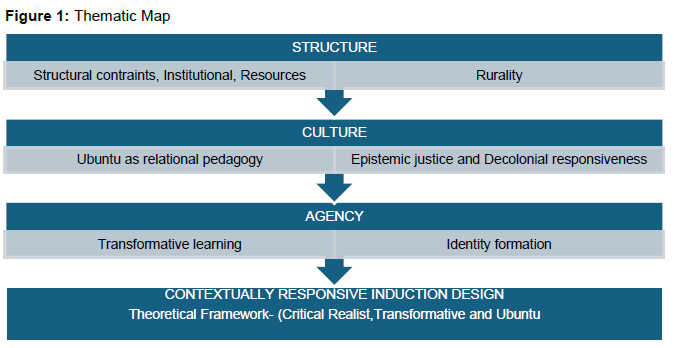
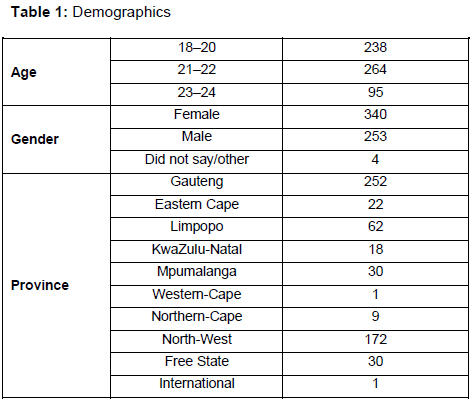
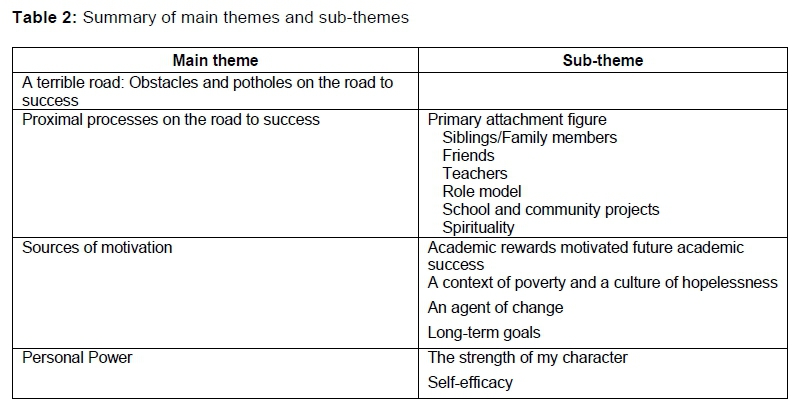
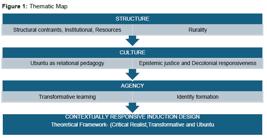
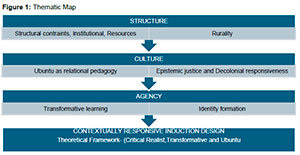
Six themes emerged from the morphogenetic analysis. They move from structural conditions to cultural mechanisms, from individual learning to collective possibility, and culminate in participants' visions for responsive induction. Ubuntu mediates structural constraints, transformative learning emerges through Ubuntu-shaped relationships, while epistemic justice runs through all six themes. Where the three theories in the TUR framework speak directly to one another, this is signalled explicitly. Below are Figure 1-the thematic map, Table 1 that presents the qualitative coding framework underpinning the themes, and Table 2 which presents the full morphogenetic matrix.
Ubuntu as relational pedagogy: Care, collegiality, and cultural mechanisms
The most pervasive theme across all data sources was the relational ethic of Ubuntu as a lived cultural mechanism. Participants described it through concrete practices such as spontaneous mentoring, shared materials, and communal presence in personal crisis. One participant recalled:
"When I was struggling with the research ethics submission, a senior colleague sat with me for two hours. She said, "we do this together here." (Doc 4, Agriculture)
This moment illustrates what CR identifies as a generative cultural mechanism: a set of orienting values and relational practices that shape how experienced colleagues understand obligations to one another. Ubuntu functioned not as a rhetorical ideal but as a living institutional resource, enabling agential flourishing precisely where structural support failed. Another participant stated simply: "Yes, on a daily basis they kept reminding us of Ubuntu" (Doc 3, Post-Induction Reflection). The communal character of this support drew on an explicit cultural grounding: "There's a Sotho proverb: Motho ke motho ka batho babang. I believe wholeheartedly in this. It goes hand-in-hand with the work we did as a group" (Doc 3, Post-Induction Reflection).
This relational ethic reframes what counts as professional support. Where Anglo-American induction models emphasise transmission of institutional procedures and performance expectations. Waghid et al. (2023) , conceptualise Ubuntu in terms of collaborative engagement and co-belonging, arguing that Ubuntu needs to permeate university management and pedagogical practices if higher education so as to become genuinely transformative. From a TLT perspective, these relational spaces were also spaces of transformative dialogue through which perspective shifts were negotiated collectively. From a CR perspective, Ubuntu constituted a generative cultural mechanism enabling agential flourishing despite constraining structures. The three theories converge, with Ubuntu creating the relational conditions under which transformative learning becomes communal, and within which structural constraints are navigated collectively.
Transformative learning and identity formation: disorientation, dialogue, and becoming
The second theme documented disorienting dilemmas, perspective shifts, and identity expansions that induction and early teaching triggered. One participant noted: "I'm still negotiating my identity between being a researcher and becoming a competent teacher" (Doc 3, P1). This negotiation is not merely psychological; it is ontological. The process of working through disorientation was rarely solitary. When a participant from agriculture encountered a farmer explaining an irrigation cycle in language that perfectly mapped onto hydrological models without having read the relevant literature, the encounter produced an epistemic shift. Indigenous knowledge systems are able to solve problems the textbooks claimed were unsolved (Doc 4, Agriculture). This disorienting dilemma catalysed a transformation in how indigenous knowledge was valued in that participant's own teaching (Mezirow 2009).
Identity formation followed a communal arc. Participants progressively reconstructed their identities as educators, community partners, and knowledge mediators: "I used to see myself as a subject specialist. Now I have a broader understanding not just a teacher but a facilitator of learning and a contributor" (Doc 3, Post-Induction Reflection). Growing confidence- what CR frames as the activation of personal emergent properties (Archer 2000) was a product of supported, relational induction: "I feel more confident as a Junior Lecturer, support from peers goes a long way. Entering the academic space is not easy, therefore looking for support from peers and mentors goes a long way" (Doc 3, Post-Induction Reflection). There is identity integration, a provocation of reflection and agential activation. Transformative learning here is a socially situated process, not a solo cognitive event and precisely what the TUR framework's synthesis of Ubuntu and TLT predicts. In higher education, these identities are therefore not fixed categories but are continually negotiated through lived experiences, institutional cultures, language, knowledge systems and relationships of power. An Ubuntu-informed and transformative approach create spaces in which these differences are acknowledged, dialogue is encouraged, and agency and epistemic justice are strengthened (Mezirow, 2009; Davids, 2024; Gumbo et al, 2024; Honneth , 2022; Muraina et al. 2024 ).
Structural constraints and institutional culture: The weight of the system
The third theme surfaces administrative, bureaucratic, and cultural barriers constraining early-career academic flourishing. Administrative overload was pervasive: "There's always a lot of administration to do, you teach, coordinate, book test venues, collect and mark scripts. It takes up a lot of time" (Doc 2, Participant Z). Research time eroded systematically: "I almost don't have time to do research at all because the work is too much" (Doc 2, Participant H). Bureaucratic dysfunction compounded these pressures. For example, one participant prepared two NRF applications only to discover that neither had been submitted by the responsible administrator (Doc 2, Participant M). Procurement delays of up to two months for research materials were reported as routine (Doc 2, Participant Mn). These findings are consistent with Awung et al. (2024), who identify environmental and infrastructural obstacles as primary contributors to early-career academic difficulty at institutions serving historically marginalised communities.
Management support came across as frequently absent. One participant observed: "There is little to no support from administrators and management" (Doc 3, Management and Law participant). Another noted that "the institution expects us to carry on tasks while not appointing staff, nor verifying if staff has the knowledge of what is expected" (Doc 3, Post-Induction Reflection). In morphogenetic terms, these conditions constitute Structural Conditioning at T1 (Archer 1995): they narrow the range of possibilities available to ECAs before induction even begins. Formal induction programmes that ignore these realities transmit meaning schemes uncritically, normalising the unacceptable rather than equipping ECAs to analyse and respond to it. The DHET's (2018) Framework for Enhancing Academics as University Teachers calls for contextually sensitive professional development; implementation at HDIs requires explicit engagement with the structural conditions this theme reveals.
Rurality as obstacle, resource, and structural force
The fourth theme analyses the dual nature of the rural setting. Several participants reframed rurality actively. One stated: "Rurality is not an obstacle. Only the individual's mindset and background can become obstacles" (Doc 3, Post-Induction Reflection). Another confirmed that the rural context positively shapes academic identity (Doc 3, Likert data). However, this reframing did not deny material realities. As one participant captured:
"It is both an obstacle and a resource. Limited access to internet restricts formal induction; strong community ties encourage innovation." (Doc 3, Post-Induction Reflection)
Infrastructure barriers were documented concretely: "Network issues would interrupt classes and booking venues for contact lessons required timely booking which was not an option in emergency" (Doc 3, Health Sciences participant). Student under-preparedness rooted in rural schooling legacies shaped teaching demands (Doc 3, P2; P5). However, rurality also generated distinctive professional resources. Participants described mission-driven purposefulness:
"Working in a rural university allows me to contribute to empowering students many of whom come from communities where livestock and agriculture play a critical role" (Doc 3, Science and Agriculture participant). In morphogenetic terms, rurality functions as both a conditioning structure that narrows certain agential possibilities and a generative cultural context that expands others.
Epistemic justice and decolonial responsiveness: Silencing, voice, and recognition
It is argued that many concepts presented as universal in the social sciences were developed from Western historical experiences and consequently marginalise alternative conceptual traditions from the Global South (Pernau, 2025; Gumbo et al 2024).
The fifth theme examines the tension between dominant Western academic norms and the indigenous and community knowledge participants carried. One participant in the Humanities reflected: "Indigenous knowledge and local cultural perspectives are sometimes limited in their acknowledgement; greater efforts are still needed" (Doc 3, Humanities participant). This resonates with Flicker's (2007) concept of hermeneutical injustice. Conversely, Ubuntu-informed induction spaces created pathways for recognition. One participant described community-embedded pedagogy: "When I teach, our students are the community. Whatever is happening around them, we can teach about things in ways they see themselves through what we teach" (Doc 2, Participant M). Another integrated indigenous agricultural knowledge as decolonial practice (Doc 3, Science and Agriculture participant).
The Likert data confirmed that lived experience is taken seriously in this institutional context: "Yes, they are taken seriously. Academia is about being a lifelong learner. I learned a lot from my colleagues, lived experience came into play" (Doc 3, Post-Induction Reflection). From a CR perspective, epistemic justice functions as both a persistent structural challenge and an achievable cultural possibility - its realisation depends on deliberate institutional choices. From a TLT perspective, the perspective transformations documented here involve revisions in the fundamental frame of reference through which knowledge, community, and academic purpose are understood. It is the contrapuntal epistemic transformation Fataar (2025) calls for. Ubuntu provides the relational infrastructure through which this dialogue becomes institutionally possible. The TUR framework makes visible that structural conditions (T1), relational cultural mechanisms (Ubuntu), and agential reflection (TLT) must work in concert for epistemic justice to move from aspiration to practice.
Contextually responsive induction design: Participants' visions
The sixth theme synthesises participants' visions for what meaningful induction should look and feel like, grounded in the gap between what they experienced and what they needed:
"A good induction is not a briefing. It is a becoming. It takes time, honesty, and genuine trust between the institution and its new academics." (Doc 4, Agriculture Survey)
"Good induction looks and feels like a village gathering, knowledge flows in all directions. Everyone leaves having both given and received." (Doc 4, Health Sciences Survey)
Participants called for embodied, face-to-face formats: "It should be physical, not online. Meeting face-to-face helps because words are not attached to facial expression and body language" (Doc 3, Post-Induction Reflection). They envisioned extended, iterative models: "I would design induction as a four-month slow immersion: monthly reflection circles, mentorship pairings, visits to local schools and libraries" (Doc 4, Humanities Q10). Timing mattered: "The induction follow-up should come at the end of July so that people have had enough time to engage in teaching and learning practices and give meaningful feedback" (Doc 2, Participant Ml). Equity in scope was raised: "The homework was more academically focused. How do you cater for people in administrative support and other non-academic roles?" (Doc 2, Participant M2). These visions confirm that effective induction at a rural HDI requires a fundamentally different design logic, one that begins with context, centres relationship, and creates space for genuine professional becoming.
THE CONTEXTUALLY RESPONSIVE INDUCTION MODEL (CRIM)
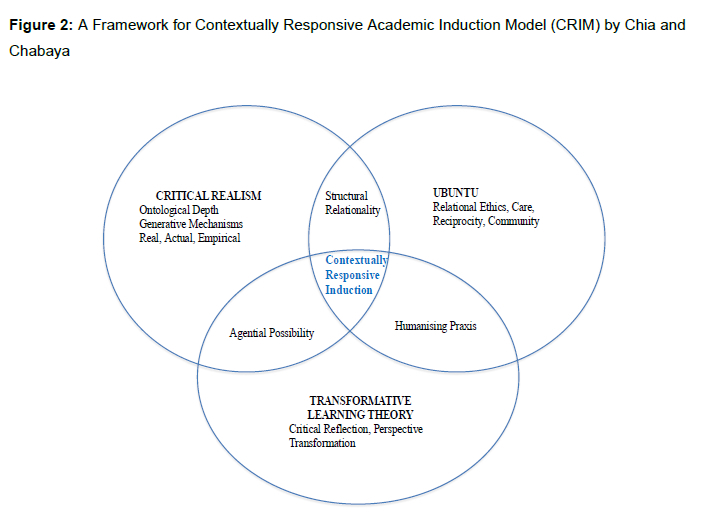
Drawing from the theoretical framework and empirical findings, this article proposes the CRIM as a contribution to both scholarship and practice. The CRIM is not a linear programme design but a dynamic, principle-based framework articulating the conditions, processes, and outcomes of meaningful induction in contexts marked by historical disadvantage, geographic marginalisation, and epistemic diversity. It positions itself explicitly against dominant models, Anglo-American socialisation frameworks (Austin 2002; Trowler and Knight 2000) and the generic South African academic development programmes that presuppose institutional conditions that do not exist at rural HDIs.
The CRIM rests on four interconnected principles. First, Structural Reflexivity: effective induction must begin with an honest, institutionally supported engagement with the structural conditions shaping early-career academic work. Induction should not open with compliance requirements but with structured opportunities for ECAs to name, analyse, and collectively respond to infrastructure deficits, geographic isolation, student poverty, and workload inequities. CR insists that structural conditions are real and causally efficacious, and that denying them in induction processes is both intellectually dishonest and professionally harmful (Archer 1995; Bhaskar 1989; Bhaskar 2013). The DHET's (2018) Framework for Enhancing Academics as University Teachers provides a national policy anchor for this principle; the CRIM operationalises that call for the rural HDI specifically.
Second, Relational Embeddedness: the CRIM foregrounds the Ubuntu principle that induction is fundamentally a process of communal belonging-making. Practically, this means investing in communities of practice that cross disciplinary and hierarchical boundaries, formalising the moral obligation of compassion, assisting and interconnectedness as an institutional value, and designing academic relationships that honour the knowledge and experience ECAs bring (Heleta and Dilraj 2024; Tummons, 2024). Informal mentoring networks constitute the institution's most effective induction infrastructure; the CRIM calls for resourcing them rather than allowing formal bureaucratic processes to crowd them out.
Third, Transformative Praxis: the CRIM insists that meaningful induction creates conditions for perspective transformation, not merely information transfer. This requires structured opportunities for critical reflection, collaborative dialogue, and examination of assumptions about knowledge, teaching, and the relationship between the university and its communities. In short, McClain, (2024) extends developments in transformative learning, including its traditional theoretical foundations, practices for fostering transformation, critiques, theoretical integration and recent scholarship. The community-of-practice gatherings described by participants as regular meetings characterised by intellectual dialogue and embodied relational engagement offer a practical institutional model.
Fourth, Epistemic Justice as Institutional Commitment: the CRIM proposes that induction at HDIs should explicitly commit to epistemic justice as a structural feature of institutional life, not a rhetorical aspiration. Practically, this means revising promotion criteria to recognise community-based and indigenous knowledge research, providing language support for academics conducting scholarship in African languages, creating forums in which contextual knowledge is treated as a scholarly resource, and ensuring that induction affirms the diverse knowledge traditions ECAs bring (Fricker 2007; Santos 2014; Fataar 2025). The CHE's (2016) review identifies recognition of diverse knowledge forms as a persistent transformation imperative; the CRIM translates this into concrete induction design. The CRIM resists universal prescription. Its strength lies in adaptability and attentiveness to place, history, and people, in alignment with decolonial calls for context-sensitive professional learning in the Global South (Mignolo and Walsh 2018).
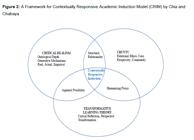
The model integrates: Ontology in the form of Ubuntu that is Relational, Epistemology- Plural and justice-oriented, the Method being Reflexive and dialogical while the Analytical Lens used is Critical realism -the interplay of structure-culture-agency. The framework positions induction as a developmental ecosystem rather than a procedural event.
CONCLUSION: IMPLICATIONS, LIMITATIONS, AND FUTURE DIRECTIONS
This article has argued for a re-imagining of academic induction in rural South African universities as a contextually embedded, ethically grounded, and analytically robust praxis. The findings demonstrate that while rural HDIs are shaped by enduring structural constraints, they also generate distinctive relational and cultural resources. Ubuntu emerges not as a rhetorical ideal but as a lived ethic that enables care, reciprocity, and epistemic recognition. Transformative learning, understood communally and contextually rather than individually and rationally, offers pathways for deep professional development in contexts marked by inequality and deep history. CR provides the explanatory depth to account for how these mechanisms interact over time.
For academic developers and institutional leaders, the implications are direct. Induction should be redesigned to begin with Structural Reflexivity rather than compliance requirements, creating space for ECAs to name and analyse their working conditions. This shift aligns with the DHET's (2018) vision of academic development as contextually responsive and humanising, and with the SSAUF's (DHET 2015) commitment to growing and diversifying the academic profession. Institutions should recognise, resource, and protect the informal mentoring networks and communities of practice that participants identified as their most meaningful professional support. These are structures that emerge often despite, not because of, formal induction design. National policy frameworks should provide differentiated, contextually sensitive guidance for induction at rural HDIs. The CRIM offers an empirically grounded starting point for this work.
More broadly, academic development in South Africa must position itself critically against models derived from well-resourced metropolitan institutions. Continuing to apply these models without critical adaptation reproduces the epistemic hierarchies that decolonial scholarship has called upon higher education to dismantle. The TUR framework and the CRIM proposed here are offered not as prescriptions but as invitations. It is theoretically grounded, with empirically informed tools for institutions seeking to design induction processes that are humanising, intellectually serious, and genuinely responsive to the contexts in which they operate.
The study has several limitations. As a single case study, its findings offer transferable rather than generalisable insights (Lincoln and Guba 1985). The twenty-month fieldwork period is substantial, but transformative processes may unfold over years. Future research should consider longitudinal designs tracking ECAs across their first five years of appointment, comparative studies across HDIs in different provinces, and studies focusing on the specific induction experiences of women academics, academics with disabilities, and first-generation academics. The recent emergence of GenAI-enabled learning in South African higher education should be approached with particular caution in rural HDI contexts, where connectivity deficits mean that digital solutions may deepen rather than redress existing inequalities (Hayes et al 2025).
The question of how a university welcomes its newest members is never merely administrative. It is a question about what kind of institution the university aspires to be, whose knowledge it values, and what version of human flourishing it is willing to support. In the rural South African context, answering that question honestly and with the courage to act on is an act of institutional transformation that ripples outward into the communities these universities exist to serve.
NOTES• The research was conducted at a single rural university. Ethics clearance was obtained from the institutional research ethics committee. All participants provided written informed consent. Participant anonymity is maintained through coded references (P1-P10 for questionnaire participants; Doc 2 workshop speaker codes; Doc 4 faculty codes).
• The DHET's Staffing South Africa's Universities Framework (2015) and Framework for Enhancing Academics as University Teachers (2018) are the primary national policy documents governing academic staff development. The CHE's (2016) review of two decades of democracy provides the broader context for understanding institutional differentiation in South African higher education.
• The term historically disadvantaged institution (HDI) is used in accordance with its established usage in South African higher education policy and scholarship, referring to institutions designated for Black students under apartheid that continue to experience differentiated resource and structural conditions.
• We did not use GenAI in working on this manuscript to develop ideas or write. We relied mainly on what we learnt and experienced as we work daily, attend/facilitate workshops and participate in projects such as the NATHEP project. The ideas and theories stem from our experiences while the data- responses were from the new staff induction sessions in our university. We only used GenAI when we were responding to suggestions from one of the reviewers who noticed that some of the references we used were too old. In this case, it helped us to locate newer references on some of the themes in the manuscript which we used to correct the comment.
REFERENCES
-
Abbott, Pamela, Rachel Shanks, Isabel Stanley, and Lucia D'Ambruoso. 2024. "A Protocol for a Critical Realist Systematic Synthesis of Interventions to Promote Pupils' Wellbeing by Improving the School Climate in Low- and Middle-Income Countries." PLOS ONE 19 (5): e0286489. https://doi.org/10.1371/journal.pone.0286489.
» https://doi.org/10.1371/journal.pone.0286489 -
Anderson, Peter, Zane M. Diamond, Thu Pham, Angela B. Pena, Carla Tapia, Levon Blue, Melanie Saward, Angelina Hurley, Kate Pecar, Amanda Kelly, Owen Forbes, Veronica Goerke, Jeane Diamond, Abby Cathcart, Chizu Sato, Koji Maeda, Russell Fox, and Wren D. W. Howe. 2025. "Indigenous Rights-Based Approaches to Decolonising Research Methodologies in Settler Colonial Contexts." Frontiers in Research Metrics and Analytics 10. https://doi.org/10.3389/frma.2025.1553208.
» https://doi.org/10.3389/frma.2025.1553208 - Archer, Margaret Scotford. 1995. Realist Social Theory: The Morphogenetic Approach. Cambridge: Cambridge University Press.
- Archer, Margaret Scotford. 2000. Being Human: The Problem of Agency. Cambridge: Cambridge University Press.
- Austin, Ann E. 2002. "Preparing the Next Generation of Faculty: Graduate School as Socialization to the Academic Career." The Journal of Higher Education 73 (1): 94-122.
-
Awung, Felix, Alan Felix, Wiets Botes, Raymond Fru, Tiani Wepener, and Richard Moloele. 2024. "Induction-Phase Challenges Faced by South African Higher Education Students: A Case Study of Sol Plaatje University." African Journal of Inter/ Multidisciplinary Studies 6 (1): 1-12. https://doi.org/10.3389/frma.2025.1553208.
» https://doi.org/10.3389/frma.2025.1553208 - Badat, Saleem. 2010. The Forgotten People: Political Banishment under Apartheid. Leiden: Brill.
- Balfour, Robert J., and Siyabonga Dlamini. 2020. "Rurality, Social Justice and Higher Education Transformation." Perspectives in Education 38 (2): 1-13.
- Bhaskar, Roy. 1989. The Possibility of Naturalism: A Philosophical Critique of the Contemporary Human Sciences. 2nd ed. Brighton: Harvester.
- Bhaskar, Roy. 2013. A Realist Theory of Science. Routledge.
- Boughey, Chrissie, and Sioux McKenna. 2021. Understanding Higher Education: Alternative Perspectives. Cape Town: African Minds.
- Bozalek, Vivienne, and Chrissie Boughey. 2012. "(Mis)framing Higher Education in South Africa." Social Policy and Administration 46 (6): 688-703.
- Council on Higher Education (CHE). 2016. South African Higher Education Reviewed: Two Decades of Democracy. Pretoria: CHE.
- Creswell, John W. 2014. Research Design: Qualitative, Quantitative and Mixed Methods Approaches. 4th ed. Thousand Oaks, CA: Sage.
- Damoah, Benjamin, Xolani Khalo, and Bunmi Omodan. 2023. "Disparities in Rural Universities Transformation: A Review from a South African Perspective." Prizren Social Science Journal 7 (3): 1-10.
- Danermark, Berth, Mats Ekström, Liselotte Jakobsen, and Jan Karlsson. 2002. Explaining Society: Critical Realism in the Social Sciences. London: Routledge.
-
Davids, Nuraan. 2024. "Decolonization in South African Universities: Storytelling as Subversion and Reclamation." Journal of Philosophy of Education 58 (2-3): 189-208. https://doi.org/10.1093/jopedu/qhae029.
» https://doi.org/10.1093/jopedu/qhae029 - Department of Higher Education and Training (DHET). 2015. Staffing South Africa's Universities Framework. Pretoria: DHET.
- Department of Higher Education and Training (DHET). 2018. Framework for Enhancing Academics as University Teachers. Pretoria: DHET.
- Fataar, Aslam. 2025. "Contrapuntal Curriculum and Epistemic Transformation in South African Universities." Transformation in Higher Education 10: 1-10.
- Freire, Paulo. 1970. Pedagogy of the Oppressed. New York: Herder and Herder.
- Fricker, Miranda. 2007. Epistemic Injustice: Power and the Ethics of Knowing. Oxford: Oxford University Press.
-
Gumbo, Mishack Thiza, Christopher B. Knaus, and Velisiwe G. Gasa. 2024. "Decolonising the African Doctorate: Transforming the Foundations of Knowledge." Higher Education 88 (4): 1611-1627. https://doi.org/10.1007/s10734-024-01185-2.
» https://doi.org/10.1007/s10734-024-01185-2 - Hayes, Sarah, Sarah Earle, Shane Dukhan, Kriben Padayachee, Lara Dison, and Mili Milaras. 2025. "Perspectives from South Africa on GenAI in Higher Education: A Postdigital Dialogue with the Global Context." Postdigital Science and Education 7: 1375-1413.
- Heleta, Savo. 2016. "Decolonisation of Higher Education: Dismantling Epistemic Violence and Eurocentrism in South Africa." Transformation in Higher Education 1 (1): 1-8.
-
Heleta, Savo, and Ilse Dilraj. 2024. "Decolonisation Is Not Even a Footnote: On the Dominant Ideologies and Smokescreens in South African Higher Education." Transformation in Higher Education 9: 416. https://doi.org/10.4102/the.v9i0.416.
» https://doi.org/10.4102/the.v9i0.416 - Hoggan, Chad D. 2016. "Transformative Learning as a Metatheory: Definition, Criteria, and Typology." Adult Education Quarterly 66 (1): 57-75.
- Honneth, Axel. 2022. "The Recognition Paradigm between Universalism and Historicism." In Recognition and the Human Life-Form. Taylor & Francis.
- Knight, Peter, Jo Tait, and Mantz Yorke. 2006. "The Professional Learning of Teachers in Higher Education." Studies in Higher Education 31 (3): 319-339.
- Letseka, Moeketsi. 2012. "In Defence of Ubuntu." Studies in Philosophy and Education 31 (1): 47-60.
- Lincoln, Yvonna S. "i Egon G. Guba." Naturalistic inquiry (1985).
- Maditsi, Malehu E., Makwena M. Rasehlomi, and Tshilidzi H. Seemise. 2024. "A Quest for Decolonization: Incorporating Indigenous Pedagogies to Foster Teaching and Learning at Higher Education Institutions in South Africa." Journal of Mother-Tongue Biblical Hermeneutics and Theology 6 (5): 79-93.
- Mathebula, Manthiba, and Carmen Martinez-Vargas. 2023. "Ubuntu as a Valued Capability for University Students in South Africa." Journal of Student Affairs in Africa 11 (2): 17-33.
- Matolino, Bernard, and Wenceslaus Kwindingwi. 2013. "The End of Ubuntu." South African Journal of Philosophy 32 (2): 197-205.
-
McClain, L. Adam. 2024. "New Developments in Transformative Learning." New Directions for Adult and Continuing Education 2024 (184): 20-29. https://doi.org/10.1002/ace.20540.
» https://doi.org/10.1002/ace.20540 -
Mezirow, Jack. 2003. "Transformative Learning as Discourse." Journal of Transformative Education 1 (1): 58-63. https://doi.org/10.1177/1541344603252172.
» https://doi.org/10.1177/1541344603252172 - Mezirow, Jack. 2009. "Transformative Learning Theory." In Transformative Learning in Practice: Insights from Community, Workplace, and Higher Education, edited by J. Mezirow and E. W. Taylor, 18-31. San Francisco, CA: Jossey-Bass.
- Mignolo, Walter D., and Catherine E. Walsh. 2018. On Decoloniality: Concepts, Analytics, Praxis. Durham, NC: Duke University Press.
- Msila, Vusi. 2015. Ubuntu: Shaping the Current Workplace with (African) Wisdom. Randburg: Knowres Publishing.
-
Muraina, Luqman, Yonela Toshe-Mlambo, and Siviwe Cingo. 2024. "South African Higher Education: Transformation or/and Decolonisation?" Scholarship of Teaching and Learning in the South (SOTL) in the South 8 (1): 183-205. https://doi.org/10.36615/sotls.v8i1.321.
» https://doi.org/10.36615/sotls.v8i1.321 - Murove, Munyaradzi Felix. 2014. "Ubuntu." Diogenes 59 (3-4): 36-47.
- Newman, Michael. 2012. "Calling Transformative Learning into Question: Some Mutinous Thoughts." Adult Education Quarterly 62 (1): 36-55.
- Ngubane, Nompendulo I., and Makabongwe Makua. 2021. "Intersection of Ubuntu Pedagogy and Social Justice: Transforming South African Higher Education." Transformation in Higher Education 6: 1-8.
-
Paapa, Christopher, and Oscar Ouma Kambona. 2025. "A Critical Review of Grounded Theory and Thematic Analysis in Qualitative Research: A Way Forward for Qualitative Researchers." International Journal of Science and Research Archive 16 (3): 302-313. https://doi.org/10.30574/ijsra.2025.16.3.2549.
» https://doi.org/10.30574/ijsra.2025.16.3.2549 -
Pernau, Margrit. 2025. "Decolonizing Theory and Concepts: Perspectives from the Global South." History and Theory 64 (2): 265-280. https://doi.org/10.1111/hith.12384.
» https://doi.org/10.1111/hith.12384 -
Quarta, Serena. 2024. "The Role of Emotions in Ethnographic Research: Comparing Subjectivities."Social Sciences 13 (8): 398. https://doi.org/10.3390/socsci13080398.
» https://doi.org/10.3390/socsci13080398 - Radebe, Nokukhanya. 2021. "Ubuntu as Grounding Principle in Pursuit of Academic Freedom, Institutional Autonomy and Public Accountability for African Universities." Unpublished article, UNISA.
- Santos, Boaventura de Sousa. 2014. Epistemologies of the South: Justice against Epistemicide. Boulder, CO: Paradigm Publishers.
- Sayer, Andrew. 2000. Realism and Social Science. London: Sage.
- Soudien, Crain. 2010. "Transformation in South African Education." Journal of Educational Change 11 (4): 333-352.
-
Stutchbury, Kristina. 2022. "Critical Realism: An Explanatory Framework for Small-Scale Qualitative Studies or an 'Unhelpful Edifice'?" International Journal of Research & Method in Education 45 (2): 113-128. https://doi.org/10.1080/1743727X.2021.1966623.
» https://doi.org/10.1080/1743727X.2021.1966623 -
Susen, Simon. 2024. "The Interpretation of Cultures: Geertz Is Still in Town." https://doi.org/10.6092/issn.1971-8853/18664.
» https://doi.org/10.6092/issn.1971-8853/18664 - Timmis, Sue, Lucila Carvalho, and Ben Williamson. 2021. "Rethinking Rural Higher Education: Space, Place and Professional Learning." Teaching in Higher Education 26 (7-8): 996-1012.
- Trowler, Paul, and Peter Knight. 2000. "Coming to Know in Higher Education: Theorising Faculty Entry to New Work Contexts." Higher Education Research & Development 19 (1): 27-42.
- Tummons, Jonathan. 2024. Communities of Practice in Higher Education: Learning, Teaching, and Research. Taylor & Francis.
- Waghid, Yusef. 2018b. "On the Educational Potential of Ubuntu." In Re-Visioning Education in Africa: Ubuntu-Inspired Education for Humanity, edited by E. J. Takyi-Amoako and N. T. Assié- Lumumba, 565-? Palgrave Macmillan.
- Waghid, Yusef. 2019. Towards a Philosophy of Caring in Higher Education: Pedagogy and Nuances of Care. Palgrave Macmillan.
-
Waghid, Yusef. 2020. "Towards an Ubuntu Philosophy of Higher Education in Africa." Studies in Philosophy and Education 39 (3): 299-308. https://doi.org/10.1007/s11217-020-09709-w.
» https://doi.org/10.1007/s11217-020-09709-w - Waghid, Yusef, Judith Terblanche, Lester B. Shawa, Joseph P. Hungwe, Faiq Waghid, and Zayd Waghid. 2023. Towards an Ubuntu University. Springer Nature.
- Woldegiorgis, Emnet Tadesse. 2025. "Navigating the Decolonial Frontier: Leadership Perspectives on Epistemic Justice in South African Higher Education." International Journal of Educational Research 134: 1-12.
- Yin, Robert K. 2014. Case Study Research: Design and Methods. 5th ed. Thousand Oaks, CA: Sage.