The lived experiences of academics in transitioning to remote online teaching and learning: a south african university case study
Abstract
For traditional contact universities, the transition to remote online education brought a sense of panic and uncertainty concerning how Teaching and Learning (T) would be implemented and its implications for the quality of their qualifications. Despite opposition to full remote teaching and assessment and the ensuing challenges, academics and management at a university in South Africa developed coping mechanisms to navigate the transition. This article adopts a qualitative research approach to understand academics' lived experiences in an abrupt transition to remote online teaching and learning. It adopted an interpretive paradigm that allows the expression of lived experiences. To that end, six Focus Group (FG) interviews were conducted via the Zoom platform in compliance with the COVID-19 restrictions. The study was undertaken during the Covid-19 pandemic. Some of the key findings are that certain of the students reported not having access/limited access to data and laptops, poor networks, and living spaces that were not conducive to learning. Poor internet connectivity meant some students missed valuable lecture periods, as they could not access online learning resources, and sometimes missed assessments. Some staff found the transition overwhelming and described it as a "bomb" as this came with additional administrative responsibilities.
Academics' experiences; Remote Online Teaching and Learning; Academics lived experience; Transition to remote education
INTRODUCTION
The 21st century has witnessed a significant transformation in education because of the rise of Information Technologies (IT). Higher education has particularly embraced the internet for teaching, leading to a surge in online courses and the adoption of tools like eLearning, Blackboard, and Google Classroom (Kennedy 2018, 8). This digital shift has revolutionised education, offering students a new mode of learning where teaching, learning, and assessments occur entirely online. This growth is attributed to technological advancements, societal changes, and economic factors (Moore 2002, 6-7).
The impact of the COVID-19 pandemic has been unprecedented, disrupting educational systems across more than 190 countries (Almahasees, Mohsen, and Amin 2021, 638470). Traditional classrooms led to virtual teaching and learning, catching many institutions unprepared. The sudden transition prompted researchers to explore the effects of online versus traditional education. The United States Distance Learning Association (USDLA) discovered no statistically significant difference in learning outcomes between virtual and traditional education (Kennedy 2018, 8).
Discussions around remote learning have led to varying perspectives. Carr emphasises the need for systematic evaluations comparing online and in-person education (Carr, 2020, 40). Hsu and Hargrave (2000, 303) categorise researchers into two groups: one argues that online education broadens access and learning experiences, while the other contends that current online programmes prioritise teaching over learning (Aithal and Aithal 2016, 225-35; Kay 2006, 383-408). Challenges in remote learning include assessment integrity as control shifts to students, making it difficult to prevent cheating (Munoz and Mackay, cited in Rapanta et al. 2020, 923-45). Online education leverages digital tools to create a learner-centred, interactive, and flexible learning environment accessible anytime, anywhere (Aithal and Aithal 2016, 225). With the ubiquity of personal computers and the demands of modern life, remote learning has become a popular alternative to traditional classrooms (Rapanta et al. 2020, 923-45). However, ensuring fair assessments remain a concern.
Remote learning encompasses situations where teachers and students are geographically apart for most of the class time, such as virtual classes (Alghizzawi et al. 2019, 13-26). It entails teaching and learning mediated by the internet (Rapanta et al. 2020, 923-45). Face-to-face teaching involves in-person presentation of course material and the fostering of social interaction. This traditional method promotes knowledge retention and enables meaningful student engagement (Muruthy and Yamin 2017, 86-98).
The 21st century has witnessed a paradigm shift in education due to the integration of Information Technologies. Online learning has become a prominent form of education, facilitated by digital tools and accessible from anywhere. The COVID-19 pandemic accelerated this transition, revealing both the benefits and challenges of remote learning. Researchers debate its effectiveness and compare it to traditional face-to-face education. Despite differences in perspectives, remote learning offers flexibility and broadened access to education, while traditional teaching nurtures social interaction and engagement. The evolution of education in the digital era continues to shape how students learn, and educators teach.
The Evolution of Remote Learning
According to Muruthy and Yamin (2017, 86-98), the oldest kind of remote education through mail was an advertisement in a Swedish newspaper in 1833 offering the chance to learn and study "composition through the medium of the post". Soon after, newspaper articles and advertising were widely used for distance learning and communication. Using the English penny post service, Isaac Pitman started teaching shorthand around 1840 (Rahrouh, Taleb, and Mohamed 2018, 162-81). After Pittman's first accomplishment with the Phonographic Correspondence Society, more systematic corresponding research was created.
In the 1980s, the next step in establishing remote learning was the introduction of interactive television (ITV) courses, which mimicked the face-to-face contact between a teacher and a class of learners. In the 1980s and 1990s, researchers first compared ITV courses to their in-person equivalents. While preliminary research found no significant difference in student achievement between the two settings, students overwhelmingly preferred classroom instructions, citing a lack of interactivity and a lack of familiarity with the medium as reasons for their preferences (Salloum and Al-Emran 2018, 371-90).
The Learning Atmosphere
Face-to-face delivery has always followed a strict and structured curriculum with a strict timetable. This allows group dynamics in class to play out, encouraging students to air their voices and actively participate in their education. Unlike a planned classroom session, online learning may occur on the go. Students can do it anytime and at their own speed. In their study in Jordan, Almahasees et al. (2021, 638470), found that academic staff preferred traditional face-to-face teaching to online teaching because face-to-face instruction allows engagement between students and the instructor and provides opportunities to discuss and explain matters. Traditional training setups are beneficial but costly (Datnow 2020, 431-41). Compared to online training, the cost of online courses is often lower. Unlike face-to-face training, this is because there is no need to pay for transportation and a dedicated instructional space. Online educational courses have substantially fewer running costs.
The advent of eLearning technology in higher education has yielded many benefits. For instance, it can be customised to cater to each student's needs. In the digital era, knowledge delivery is enhanced by putting the demands of individual students ahead of those of educational institutions or teachers (Datnow 2020, 431-41). Remote learning facilitates quick and easy completion of goals. Equitable access to information is one way in which the remote learning environment improves educational learning for people of all ages, backgrounds, and geographic locations. Almahasees et al. (2021), found that online learning presents the following benefits: it allows self-learning, is convenient, has low costs, and is flexible - they however concluded, that it cannot replace face-to-face learning. For that reason, they suggested the use of blended learning. Adedoyin and Soykan (2023, 863-75) maintain that online learning presents problems such as its incompatibility with subjects that entail laboratory work such as engineering, medical sciences, and sports sciences; outdated technology; digital inequalities especially affecting instructors and some students who are not tech-savvy; resource inequalities among students, for example, access to data and electronic gadgets; and cheating. For Almendingen et al. (2021), the most pressing challenges faced by students in online learning were staying at home without access to a home office, the absence of physical social interaction, insufficient data bandwidth, and demotivation.
Because of the remote educational atmosphere, teachers are relegated to the role of guides and advisers rather than the exclusive source of information (Harrison and McTavish 2018, 163-88). Many other major advantages include remote learning being user-friendly, efficient in terms of time management, and convenient in managing courses, instructors, and classrooms as well as generating reports. Users may set reminders for delivery dates, assignment due dates, and examination dates. At the advent of COVID-19, both students and academic staff were of the view that online learning was hard to adapt to; it is difficult for students with disabilities, it lacks interaction, and is encumbered by technical and data issues (Almahasees et al., 2021).
Almahasees et al. (2021) opine that remote teaching should entail doing more tasks on the part of the student to compensate for the opportunities lost because of a lack of direct contact with instructors. Oliveira et al. (2021, 1357-76) note that virtual classes brought new possibilities such as the participation of international guests from remote institutions, and they suggest that institutions of learning must create communities of practice for engagement or social connection. Their study also revealed challenges related to negative personal experiences related to workloads, motivation, mental health, and difficulties in controlling student cheating.
Obstacles to Remote or Distance Learning
Despite the many benefits of online learning, students and instructors face several obstacles in practice. According to Irfan and Sastra's (2020, 58-70) research, remote learning leads to poor student participation because of students' isolation. In the absence of direct interaction with instructors, remote learning has the inherent risk of being less efficient than face-to-face teaching. One of the drawbacks of online learning is that it may be difficult to keep students motivated. Students who lacked ambition and independence performed worse than their peers (Yilmaz 2017, 39-51). Students experiencing problems with self-control often submit rushed or poor work because they do not set aside enough time to complete their tasks. Feedback and feedforward are crucial in helping students assess their level of knowledge, which is also crucial for their performance (Kirmizi 2015, 133-42). The importance is in assessing pupils' degree of comprehension rather than the final answer. Students are more likely to avoid plagiarism when working on group assignments (Ozerbas and Erdogan 2016, 203-12). A person's attitudes highly affect moral behaviour. It has been shown that one's mentality may positively or negatively affect one's actions (Bashitialshaaer, Mohammed, and Lassoued 2021, 99). This finding is in line with the dynamics of how students interact with remote or online education.
METHODOLOGY
This article adopts a qualitative research methodology to understand academics' lived experiences in an abrupt transition to remote online teaching and learning. It is located within an interpretive paradigm as it aims to produce rich data from the views and experiences of academics at a university in South Africa. It further adopts a case study approach, which is considered suitable for understanding issues or phenomena in a real-world situation in specific contexts (Kekeya 2021, 28-37; Harrison et al. 2017) such as the institution in this study. While the case study approach is critiqued for its lack of generalisation and or transfer to other contexts due to its specificity, it is considered helpful in answering "why" and "how" questions (Chowdhury Ahmmed and Hossain 2020, 271-90) which is what this research is about.
A thematic analysis that is commonly used in examining narratives (Jordan et al. 2021; Castleberry and Nolen 2018, 807-15) was employed in this research. This method involves probing for themes by carefully going through the data repeatedly to identify patterns with similar meanings to elicit a rich interpretation (Clarke and Braun 2017, 297). Thematic analysis is a flexible approach that can identify patterns across participants' lived experiences and perceptions (Clarke and Braun 2017, 297), thus making it ideal for understanding academics' lived experiences of the transition to remote teaching and learning.
The qualitative case study approach allows nonprobability sampling "to collect specific cases, events or actions that can clarify or deepen the researchers' understanding about the phenomenon under study" (Ishak and Abu Bakar 2014, 29). Drawing from the work of other scholars, Kekeya (2021) surmises that case-based qualitative education research would not typically involve large groups due to resource constraints. Instead, sampling is often done purposively to target specific participants with the requisite experience, expertise, and knowledge to meet the research objectives. Therefore, a purposive sampling technique was employed to identify academics with crucial teaching and learning and managerial portfolios for interviews. Data was thus derived from a thematic analysis of six FG interviews. The interviews were conducted via the Zoom platform in compliance with the COVID-19 restrictions. Four of the six interviews involved staff in the four colleges of the University: The College of Agriculture, Engineering, and Science (CAES-FG), the College of Humanities (CHUM-FG), the College of Law and Management Studies (CLMS-FG), and the College of Health Sciences (CHS-FG). A Pilot FG (Pilot-FG) was implemented before the main study, while another was held with Deans (FG-Deans) from across the university. The audio recordings of the interviews were transcribed and imported into NVivo, for thematic analysis. The transcript was later emailed to participants for members checking in order to enhance the credibility of the interpretations offered.
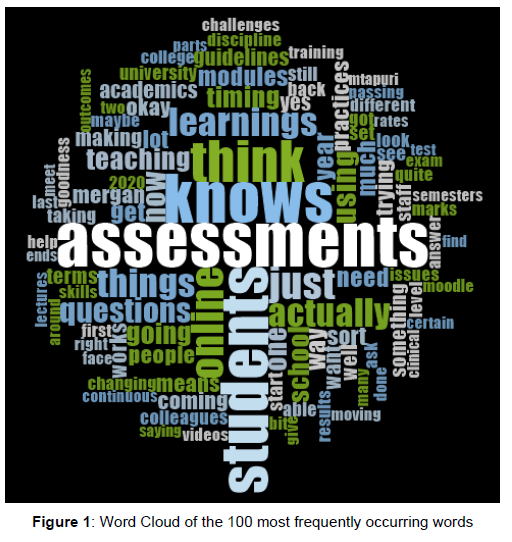
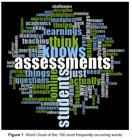
DATA PRESENTATIONAs part of a broad university-wide mixed-method project aimed at understanding the diverse assessment practices used by academics as they transitioned to remote learning environments, this article presents qualitative findings from FG interviews with key academics in the institution. The analysis began with a preliminary exploration of the data using a word cloud (Figure 1) to visualise the 100 most frequently occurring words (set to stemmed words1) across the transcripts. Assessment was the most frequently occurring word followed by students, knows and thinks. The word cloud also reflects several other words pertinent to this study. The word cloud gave the researchers initial insights into the data collected for the study.
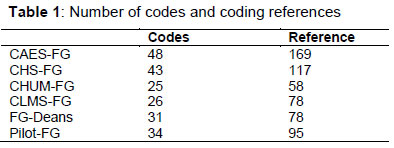
All transcripts of the FGs were read and coded iteratively into eight broad themes (See Table 1) and sub-themes, respectively. Table 1 shows the number of codes that each transcript was coded into and the number of times the transcripts were coded into the codes. As shown in Table 1, the CAES-FG transcript was coded into the most number of sub-codes (n=48) and coded the most times (n=169), while the CHUM-FG was coded into the least number of subcodes (n=25) and coded the least number of times (n=58).
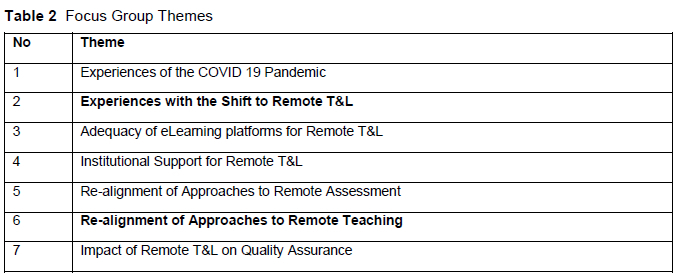
This article focuses on two themes due to the data's enormity and word count limitations (See Table 2). These themes are presented below.
Only codes or chunks of text that were relevant to address the research question were selected during the initial stages of data reduction. Codes were then refined - this involved amalgamation and abandonment of some themes - after identifying similarities and differences in the selected texts under the various themes. This process was undertaken by two researchers whose results led to the formulation of the final themes as shown in Table 2 below. This process was followed as part of the validation process.
Experiences with the Shift to Remote T&L
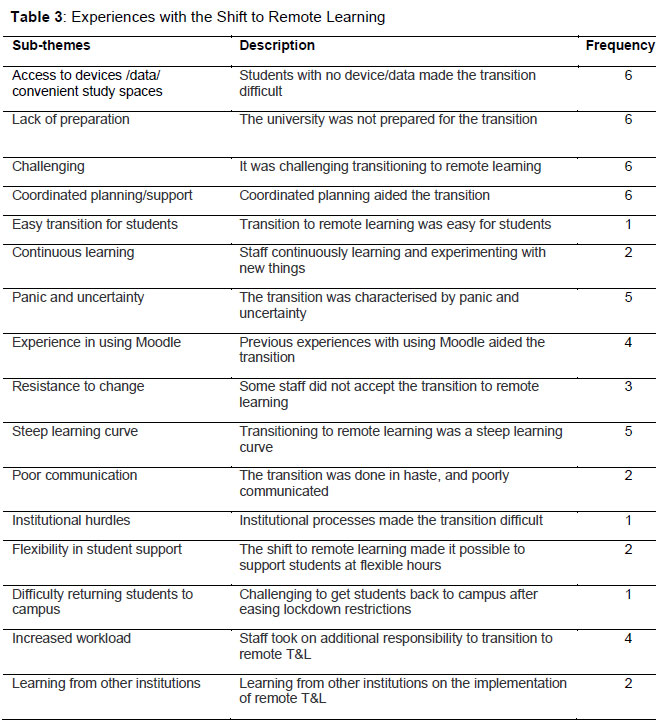
Sixteen sub-themes concerning participants' experiences with the shift to remote T&L were identified, as shown in Table 3. These sub-themes are presented under four broad categories, including theme six - re-alignment of Approaches to Remote teaching.
Challenges of Transitioning to Remote Teaching and Learning
For many participants, the transition to remote T&L was challenging. A consistent issue that emerged in all six interviews was students with no access/limited access to data and laptops, poor networks, and living spaces that are not conducive for learning. A participant shared the challenge of a student who noted: "my home environment is not conducive to writing my assessments at this time because it's too noisy; I need time at night. The townships are a bit quieter, and the kids have gone to bed, etc". (CLMS-FG). Another participant stated: "some students have to look for a hotspot either next to the taxi rank or find a space where they can be able to receive the signal". (CHS-FG). This was reported as inconvenient for learning because of the noise at taxi ranks and the security risks associated with using a laptop at a taxi rank. Poor internet connectivity meant that some students missed valuable lecture periods, they could not access online learning resources, and sometimes missed assessments. Without undermining students' genuine connectivity challenges, a participant in the pilot study FG stated that some used this as a pretext to miss lectures/assessments.
Another challenging factor reported by several participants across all six FGs was the fact that some staff/students were unfamiliar with the basic requirements of remote T&L. Some staff found the transition overwhelming because they: "didn't really know how you could use these resources or these platforms (such as Teams, Zoom, Kaltura, Google Form, etc.) to actually convey material or assess students". (CLMS-FG). According to the interviewees, most staff discovered these multiple eLearning platforms only after management announced the transition to full remote T&L. This made the transition to remote T&L a steep learning curve (CHUM-FG).
Most participants reported that the transition to remote T&L increased the workload for some staff. A participant who recently took up a leadership role noted that the experience of supporting the transition to remote T&L "is a full-time job " in addition to the primary teaching job (CAES-FG). This, according to the participants, reduced their engagement in research activities. The demands to rapidly shift to remote T&L meant that staff would take on additional administrative responsibilities however they could not take leave (CLMS-FG). Another participant in the same FG reported seeing a physiotherapist because of back pain from the stress of marking students' assignments on the computer. This resonates with the experiences of other participants who described the experience of transitioning to remote T&L as a 'bomb ' because of the constant high pace of demands (Pilot-FG).
For some participants, the shift to remote T&L implied the design and implementation of different modes of assessment. Setting assessments on the online platform was reported by a participant as one of the most challenging aspects of the transition (Pilot-FG). One participant noted that "someone who's the examiners in medicine or in paediatrics, they had to create an exam every six weeks, and you all know that creating a new exam every six weeks is quite impossible". (CHS-FG). Corroborating this point, another participant reported the challenges of " having to communicate with so many students online. So, coordinating or administering a module now became like a big issue". (CHUM-FG). A participant in the Pilot FG, for instance, reported that setting "up to three tests and exams per subject" in the online environment "was just draining; it was terrible". (Pilot-FG). In disciplines such as psychology, students had to have a set minimum number of hours of practical experience before progressing. They had to get special permission to complete the needed practical hours (CHUM-FG). Otherwise, it "could have been very bad for the students because you know they can't go on to their second year unless they get these hours". (CHUM-FG).
The transition to remote T&L brought about a sense of panic and uncertainty concerning how the transition would be implemented and the implications of full virtual T&L for the quality of qualifications offered by the university. One of the Deans who participated in the Deans' FG reported panicking about the implications of the transition to remote T&L for the quality and integrity of the programmes offered by the university. According to the participant, nobody knew how students would respond to the transition (i.e., whether they would accept it). (FG-Deans, CLMS-FG).
A participant in the Deans' FG reported strong resistance to the transition to remote T&L. The participant noted that the resistance was from staff and those in the College leadership who did not want to implement online assessments. The leadership level's resistance also influenced other academics to resist online assessment. Being a contact institution, it seemed inappropriate to transition fully to remote T&L, and some staff found it unacceptable to change their approach to T&L, which they had implemented over many years. A participant in the Deans' interview noted that this resistance only ended after the Department of Higher Education and Training issued a directive authorising the transition to remote T&L as an interim response measure to the COVID-19 restrictions. Despite these challenges and hurdles, academics and management developed coping mechanisms to navigate the transition.
Navigating the Transition to Remote Teaching and Learning
A coordinated approach to the transition was reported across all six interviews. According to a participant in the Pilot FG, coordination was important to ensure consistency in the transition to remote T&L (Pilot-FG). Teaching and assessment resources, tips, and tricks were shared with colleagues using various platforms, including WhatsApp groups. A participant in the CAES-FG reported how a staff who used Moodle before the transition to remote T&L "put together a manual, sort of explaining how to set up these quizzes using wild cards and where you can vary the calculation questions and the answers and so on, without you having to set new mathematical questions every time".
Several participants reported that those experienced in various virtual learning platforms would organise workshops to share their experiences with colleagues. According to a participant in the Deans' FG, "the good thing was that there were people who have done this in science and humanities and sort of had some, you know, the assessment guidelines that was able to give us some ideas of how to do things". (FG-Deans). Similarly, a participant in the CHUM-FG reported that people were always available to assist others. The participant cited examples of older colleagues who had difficulty recording their lectures, being assisted by those with experience. The participant reported that this eased the transition process for some colleagues (CHUM-FG). A participant who had engaged online before COVID concurred, stating, "there was much of a transition that happened. But I know for other colleagues, it was difficult to manage the technicalities of assessing online". (Pilot-FG).
For some staff, the transition to full virtual T&L implied they had to relearn doing things. Most staff who had used Moodle before the transition to full remote T&L used it mainly as a platform for sharing learning resources (e.g., PowerPoint lecture notes and literature) with students. They were unaware of its multiple advanced functionalities for interactive T&L and assessment. In that regard, one of the Deans reported that the College focused on building the capacity of staff to implement remote T&L in recognition that this was something they had not done previously (Deans-FG).
Forming a community of practice was reported as another form of a coordinated approach to remote T&L. In the CHS, the College instituted "an information feedback meeting". According to the participant, "a crisis kind of a meeting to discuss, you know, what are we going to do, and we kind of work on a week-by-week basis, from between March and you know October last year we had those meetings every week on a Monday". (CHS-FG). However, the preceding statement contrasted with another discipline where a participant noted "consensus about how to do it [remote T&L] ". (Pilot-FG).
Getting through institutional hurdles had implications for transitioning to remote T&L. Several participants reported revising their module template and passing it through the university's system for approval. A participant noted that this was being done when the semester was already at the tail end, and the delays in getting the approval were not helpful. A participant in the Pilot FG further noted that "the guidelines came too late". (Pilot-FG). It was more like an exercise in compliance rather than using the process to enhance the quality of the transition (CHS-FG). The participant noted that "somehow, there needs to be more alignment between what needs to happen and having some sort of a flexible plan to allow for that to happen". (CHS-FG). For many academics, a key aspect of navigating the transition to remote teaching was the re-alignment of their teaching approaches; one of the seven themes that emerged from the interviews.
Re-alignment of Approaches to Remote Teaching
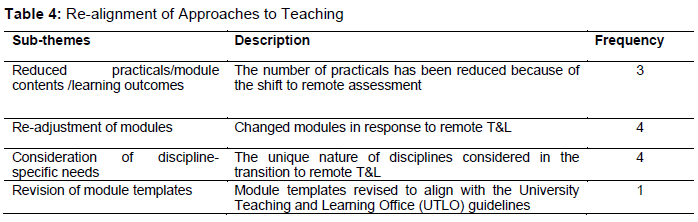
Participants in the FGs reported changing their teaching approaches in response to the transition to virtual T&L (see Table 4).
For those in health sciences, remote learning and the associated impact of the pandemic meant that students "are not exposed to as many of the patients that would have had a variety of diseases, because you know, obviously, it impacted on the people coming into the hospital". (CHS). To address this, the participant noted that staff are reverting "back to the same number of clinical teachings". in the actual theatre as opposed to using all the simulated environments". In the School of Religion, instead of going into the city for observational learning, students were asked to do this wherever they were located and to write a piece to reflect their experience. In another instance, an honours programme that requires students to do a mini ethnographic study was changed to auto-ethnography (CHUM-FG). In CHUM, the module template was revised to accommodate shortened learning time and the change to remote T&L. A similar change was reported by a participant in the Deans' interview who noted that difficulties resulting from the shutting down of hospitals led to them reducing hospital inservice from 12 to 8 weeks (CHS-FG).
Staff explored innovative ways to get students to implement the theory they learned through remote learning. A participant in the CHS-FG reported that students were asked to record themselves implementing things like bathing a baby at home and uploading the video on Moodle. This was to check if they followed the steps taught in the remote learning classes. Another practical way for students, was giving medication and health education to their family members. This was particularly useful for first-year students who needed clinical exposure during vacation but which was impossible for them to attain because of COVID-19 restrictions. However, limited data "was also a challenge, because you have to do it to within a certain megabyte otherwise it doesn't go through". (CHS-FG). All the changes happened against the backdrop of ongoing discussions/negotiations on the extent of changes that could be implemented and the need to ensure that changes to modules respond to discipline-specific needs. Nonetheless, a CHS participant stated that the discipline module templates were revised to align them with the guidelines stipulated by the UTLO and later audited informally during the year.
Some Positive Outcomes
A participant in the Deans' interview reported that a benefit of remote T&L is that it is less prone to being disrupted by strike actions. The participant cited the example of a scheduled assessment that went on despite a strike action on the university's campus (Deans-FG). In addition, the transition was also considered beneficial because students could access recorded lectures and watch the session as many times as they liked (Pilot-FG). A participant also celebrated the fact that assessments were mainly multiple-choice (MCQ-type) questions that Moodle automatically grades because "marking can be quite draining". (CHS-FG). However, one participant reported disappointment in the shift to MCQ-type assessments, which was a "huge disappointment " because "it's like open book now. I mean, those are the things you can't control". (Pilot-FG). Academics found it demotivating that "students cheat and [are] so dishonest in their approach to the assessment" after all the effort that academics put into preparing their module contents. Some participants reported a decline in lecture attendance as an unintended consequence of the transition to remote T&L. Some students felt they gained nothing from the lecture as lecturers merely read the slides (Pilot-FG). Some participants acknowledged the university community's attempt at managing the crisis, stating that the first year provided a valuable learning experience upon which teaching, learning, and assessment practices in 2021 can be built (CHS-FG). One participant said, "I think this year has allowed us to be a lot more intentional about what we're doing and why ". (Pilot-FG).
DISCUSSION
The COVID-19 pandemic disrupted all spheres of life as we know it, and tertiary education was not spared. We describe a case study from a low-resource, publicly funded South African university, and the transition process to remote teaching, learning, and assessments. Unlike Almahasees, et al. (2021), most academics had not embraced the available technology before the pandemic. The lack of computer equipment and data for students, coupled with the cut in governmental funding in 2020, created problems in expeditiously rolling out IT equipment for students (van Schalkwyk 2020, 44-58). The load-shedding crisis in South Africa and unreliable coverage by the mobile cellular phone data providers created further havoc among learners, some of whom resorted to creative measures to access data. The failure to use the existing technology to enhance T&L is not uncommon (Shava 2022, 78-91), but the COVID-19 pandemic created a disorienting dilemma that required a major transformation in T&L (Hebers 2009, 5-34). The ease at which students adapted to the online learning platform and the unease of many teachers to do the same, may speak to the generational gap between a 21st century learner and a 20th century teacher (Lisenbee 2016, 100-25). Underpinning this was the unfamiliar territory many learners and teachers found themselves in when adapting the home environment to be a T&L space. The lack of control over one's teaching space, the conflicting commitment of family and work, the lack of focus on the task at hand, and the suspicion that students were not concentrating on the teaching created doubts about the efficacy of this mode of T&L (Efriana 2021, 38-47). Embracing the new technology created problems for those who had not used remote T&L before; they sought to gain competency and skill in IT and online teaching, which was understandably time-consuming.
The initial chaos resulting from the disruption of T&L and the subsequent scrambling to save the academic year resulted in schools and colleges adapting new practices (van Schalkwyk 2020, 44-58). Staff quickly realised they were all facing similar plights, so communities of practice developed (Bolisani et al 2020, 72-80). Community of practices are environments where academics collaborate and share teaching practices, methods, and strategies to overcome challenges posed for example, by the COVID-19 pandemic. They support each other, share experiences on overcoming specific problems, and work towards a common goal. The learning community allows faculty to reinvent themselves as educators by "experimenting, reflecting, discussing, assessing" and getting feedback to evolve in a changing work environment (Bolisani et al 2020, 72-80). "Champions" or positive deviants emerged to empower others in the community (Wolfer and Wilson 2019, 151-63). The positive deviants are individuals within a community who have enhanced problem-solving and change management skills, which others struggle to learn despite facing the same challenges. It obviates the need to seek outside expertise and skills to solve problems in the community. These champions may conjure up a new way of dealing with problems and share these solutions with the community, thereby elevating the shared understanding and practices for the common good of the organisation (Wolfer and Wilson 2019, 151-63). This was evident through champions creating resource material for other colleagues to use. Users navigating the learning management platforms, and getting to grips with the various available online resources, would have been much more challenging if not for the communities of practice and the champions.
Innovations in T&L developed as academics adapted to the new normal and started experimenting. However, some just transitioned from delivering didactic content in the classroom to delivering the same on a virtual platform. Attendance at these virtual classes was understandably low as learners realised the limited educational value of this didactic content. Some academics saw this as an opportunity to address students' individual needs, while others saw this as a hindrance affecting their personal time. The early adopters of remote T&L found the transition less stressful as they had started finding IT solutions to presenting to large classrooms before the pandemic (Shava 2022, 78-91).
The lack of guidance from senior leadership was worrying as academics dealt with issues iteratively in their communities of practice. The amendments of the module templates seem to have followed the adaptation of the practice. This is not unusual in transformative learning spaces (Herbers and Nelson 2009, 5-34). Guidance, when it came was late, by which time most academics had already adapted their teaching and assessment practices. Many professional disciplines were hamstrung because of the lack of exposure to professional practice and technical skills acquisition. The statutory bodies fortunately decreased the requisite workplace hours, which allayed the fears of teachers and learners. Self-directed learning was used as a strategy for some professional practice students to deal with limitations in the workplace environment. However, this required motivated learners with good personal and learning behaviour skillsets (Singaram, Naidoo, and Singh 2022,1-10).
The new normal had some positive spin-offs, with remote online T&L being less disrupted by student strikes, thus promoting access to all and improving the chances of student success (Czerniewicz et al. 2020, 946-67). Academics were encouraged to use multiple-choice questions (MCQs), and for some, this proved very challenging. Developing large volumes of MCQs for each test was fraught with difficulties as academics could not rely on using the same questions. They feared that students had banked the questions and shared these with others (Majola and Mudau 2022, 275-83). Concerns were raised about whether the assessment was a true reflection of learning as academics viewed online assessments with scepticism. The university did not use any proctoring software, so online assessments were considered "open book" examinations. However, some innovated their assessment practices and focused on higher-order thinking in the assessment process (Abosalem 2016,1 -11).
The lived experiences of academics at this South African university provide a case study of transformative learning. Academics fostered critical thought of their own and others' assumptions, recognised their frames of reference, and participated effectively in the discourse. Discourse in learning is a social process central to making meaning. Effective discourse allows individuals to advance their beliefs, challenge, defend, explain, assess evidence, judge arguments and become critically reflective. Central to this process is good communication skills. New information is incorporated into an existing frame of reference. Critical reflection transforms one's frame of reference to fully understand the experience. This process fosters autonomous thinking and acknowledges that the experience is designed to develop critical reflectivity (Mezirow 1997, 5-12) which is important for teaching and learning.
CONCLUSION
It can be concluded that academics were able to reflect on their praxis to navigate new possibilities in changed circumstances. This study is significant in that it unpacks the positive and negative aspects of the transition to online remote T&L by providing insights into what is possible in such a context and environment. We learn from this study that adjustments and realignment of approaches to remote T&L are important to obviate the disadvantages of remote T&L. The study enables us to understand that the assemblages of communities of practice are crucial in furthering the practice of teaching and learning in collaborative environments for the benefit of the students and staff and for purposes of the cross-pollination of good practices and lessons learned. The study also highlights that academic staff need institutional support to be able to discharge their duties effectively. As such, the study offers the following recommendations.
To ensure long-term sustainability and adaptability in teaching practices, universities can integrate several insights from the research into their existing structures. First, fostering Communities of Practice (CoP) is essential for collaborative growth among academics. Universities should establish formal CoP networks that allow interdisciplinary and subject-specific groups to meet regularly, share strategies, and address teaching challenges. These communities should have institutional support to ensure their longevity. Positive deviants or "champions" within these groups can lead peer learning sessions and share innovative approaches, promoting a culture of collaboration across departments.
Additionally, universities need to institutionalize support for remote teaching tools and training. This includes investing in centralized IT training programs to help staff develop both basic and advanced digital skills. Continuous opportunities for faculty to upgrade their digital competencies should be provided, with a focus on innovative pedagogy for online environments. Furthermore, ensuring all students and faculty have adequate access to digital tools and internet connectivity is crucial. Universities must address issues such as load-shedding and unreliable internet by providing offline resources or flexible teaching options.
Leadership strategies must also adapt to provide timely guidance during transitions in teaching and learning (T&L). Senior leadership should be proactive in offering clear, early directives on remote teaching to prevent staff from dealing with challenges in isolation.
Establishing clear communication channels between faculty and leadership can facilitate smoother transitions and prevent delays in decision-making.
Innovating assessment practices is another critical area for improvement. Universities should encourage assessments that promote higher-order thinking, such as project-based learning and problem-solving tasks. These methods assess students' deeper understanding rather than rote memorization. For online assessments, investing in proctoring technologies or designing open-book exams that challenge students to apply knowledge critically can enhance assessment integrity.
Flexibility in teaching and learning models should also be prioritized. Hybrid teaching models that blend face-to-face and online learning can provide greater flexibility and accessibility for students, particularly during disruptions. Supporting self-directed learning by integrating it into the curriculum will empower students to become more independent learners, especially in professional disciplines requiring practical exposure.
To support faculty development, universities should incorporate critical reflection into regular professional development programs. Reflective practice sessions where faculty can assess and refine their teaching methods will foster continuous improvement. Additionally, facilitating discourse around teaching practices through debates, discussions, or seminars will allow educators to share experiences and collaboratively explore solutions to common challenges.
Finally, universities must institutionalize support for student success in online T&L. This includes offering digital literacy training, access to mental health services, and academic support to help students adapt to remote learning environments. Monitoring student engagement in online classes and addressing barriers to learning through personalized outreach or technology support will also be essential. By implementing these recommendations, universities can build resilient and adaptable teaching and learning environments that prepare both staff and students for future challenges.
Implications and Limitations of the Study
Some students reported having no access or limited access to data and laptops. Their living spaces were not conducive for learning which meant that some students missed valuable lecture periods. They could not access online learning resources, and sometimes missed assessments, which is detrimental to their own learning with adverse implications for practice. Transitioning was adjudged to be "overwhelming" by some staff, as it increased their workload.
Consequently, staff were hamstrung to engage in research activities, which is detrimental to their careers since research is vital for staff for promotion and professional growth.
One of the limitations of this study is that the study was undertaken in one institution of higher learning in South Africa using a qualitative approach. This implies that the findings of this study are context-specific and cannot be generalised to other institutions in the country. Similarly, evidence gathered using Focus Group Discussions (FGDs) cannot be generalised to a broader population because of the smallness of the sample. Furthermore, the dominance of some participants in FGDs yields biased findings. To ameliorate the adverse effects associated with FGDs, experienced researchers facilitated these discussions.
REFERENCES
LITERATURE REVIEW
-
Abosalem, Yousef. "Assessment Techniques and Students' Higher-Order Thinking Skills." International Journal of Secondary Education 4, no. 1 (2016): 1-11. DOI:10.11648/j.ijsedu.20160401.11
» https://doi.org/10.11648/j.ijsedu.20160401.11 -
Adedoyin, Olasile Babatunde, and Emrah Soykan. "Covid-19 Pandemic and Online Learning: The Challenges and Opportunities." Interactive Learning Environments 31, no. 2 (2023): 863-875. https://doi.org/10.1080/10494820.2020.1813180
» https://doi.org/10.1080/10494820.2020.1813180 - Aithal, Perdoor Sreeramana, and Shubhrajyotsna Aithal. "Impact of Online Education on Higher Education System." International Journal of Engineering Research and Modern Education (IJERME) 1, no. 1 (2016): 225-235.
- Alghizzawi, Mahmoud, Mohammed Habes, Said A. Salloum, M. A. Ghani, C. Mhamdi, and Khaled Shaalan. "The Effect of Social Media Usage on Students' eLearning Acceptance in Higher Education: A Case Study from the United Arab Emirates." Int. J. Inf. Technol. Lang. Stud 3, no. 3 (2019): 13-26.
-
Almahasees, Zakaryia, Khaled Mohsen, and Mohammad Omar Amin. "Faculty's and Students Perceptions of Online Learning during COVID-19." In Frontiers in Education, vol. 6, p.638470. Frontiers Media SA, 2021.https://doi.org/10.3389/feduc.2021.638470
» https://doi.org/10.3389/feduc.2021.638470 - Almendingen, Kari, Marianne Sandsmark Morseth, Eli Gjølstad, Asgeir Brevik, and Christine Tørris. "Student's Experiences with Online Teaching Following COVID-19 Lockdown: A Mixed Methods Explorative Study." PloS One 16, no. 8 (2021): e0250378.
- Bashitialshaaer, Raed, Mohammed Alhendawi, and Zohra Lassoued. "Obstacle Comparisons to Achieving Distance Learning and Applying Electronic Exams During COVID-19 Pandemic." Symmetry 13, no. 1 (2021): 99.
- Bolisani, Ettore, Monica Fedeli, Valentina De Marchi, and Laura Bierema. "Together We Win: Communities of Practice to face the COVID Crisis in Higher Education." In Proceedings of the 17th International Conference on Intellectual Capital, Knowledge Management & Organisational Learning ICICKM, 2020, 72-80.
- Clarke, Victoria, and Virginia Braun. "Thematic analysis." The journal of positive psychology 12, no. 3 (2017): 297-298.
- Carr, Ronnie. "Face-to-face Tutorials in a Distance Learning System: Meeting Student Needs." Open Learning 15, no. 1 (2020): 35-46.
- Castleberry, Ashley, and Amanda Nolen. "Thematic Analysis of Qualitative Research Data: Is it as Easy as it Sounds?" Currents in Pharmacy Teaching and Learning 10, no. 6 (2018): 807-815.
- Chowdhury, Mohammad Shahjahan, Faisal Ahmmed, and Ismail Hossain. "Methodological Dilemma in Microfinance Research: Applicability of a Qualitative Case Study Design." The Qualitative Report 25, no. 2 (2020): 271-290.
- Czerniewicz, Laura, Najma Agherdien, Johan Badenhorst, Dina Belluigi, Tracey Chambers, Muntuwenkosi Chili, Magriet De Villiers et al. "A Wake-Up Call: Equity, Inequality and Covid-19 Emergency Remote Teaching and Learning." Postdigital Science and Education 2, no. 3 (2020): 946-967.
- Datnow, Amanda. "The Role of Teachers in Educational Reform: A 20-year Perspective." Journal of Educational Change 21, no. 3 (2020): 431-441.
- Efriana, Leli. "Problems of Online Learning During Covid-19 Pandemic in EFL Classroom and the Solution." JELITA 2, no. 1 (2021): 38-47.
- Harrison, Eugene, and Marianne McTavish. "i'Babies: Infants' and Toddlers' Emergent Language and Literacy in a Digital Culture of iDevices." Journal of Early Childhood Literacy 18, no. 2 (2018): 163-188.
- Harrison, Helena, Melanie Birks, Richard Franklin, and Jane Mills. "Case Study Research: Foundations and Methodological Orientations." In Forum Qualitative Sozialforschung/Forum: Qualitative Social Research, vol. 18, no. 1. 2017.
- Herbers, M. Sharon, and Barbara Mullins Nelson. "Using the Disorienting Dilemma to Promote Transformative Learning." Journal on Excellence in College Teaching 20, no. 1 (2009): 5-34.
- Hsu, Ying-Shao, and Constance P. Hargrave. "Survey of Instructional Technology Courses for Preservice Teachers." Journal of Technology and Teacher Education 8, no. 4 (2000): 303-314.
-
Irfan, Fauzi, and Iman Hermawan Sastra Khusuma. "Teachers' Elementary School in Online Learning of COVID-19 Pandemic Conditions." Jurnal Iqra, no. 5(1) (2020): 58-70. DOI:10.25217/ji.v5i1.914
» https://doi.org/10.25217/ji.v5i1.914 - Ishak, Noriah Mohd, and Abu Yazid Abu Bakar. "Developing Sampling Frame for Case Study: Challenges and Conditions." World Journal of Education 4, no. 3 (2014): 29-35.
- Jordan, Jaime, Wendy C. Coates, Michael Gottlieb, William E. Soares III, Kaushal H. Shah, and Jeffrey N. Love. "The Impact of a Medical Education Research Faculty Development Program on Career Development, Through the Lens of Social Cognitive Career Theory." AEM Education and Training 5, no. 3 (2021): e10565.
- Kay, Robin H. "Evaluating Strategies Used to Incorporate Technology into Preservice Education: A Review of the Literature." Journal of Research on Technology in Education 38, no. 4 (2006): 383408.
- Kekeya, Joseph. "Qualitative Case Study Research Design: The Commonalities and Differences Between Collective, Intrinsic and Instrumental Case Studies." Contemporary PNG Studies, no. 36 (2021): 28-37.
- Kennedy, Kathryn. "Intellectual Property in the Digital Age". Technology and Learning, no. 2 (2018): 8.
- Kirmizi, Özkan. "The Influence of Learner Readiness on Student Satisfaction and Academic Achievement in an Online Program at Higher Education." Turkish Online Journal of Educational Technology-TOJET 14, no. 1 (2015): 133-142.
- Lisenbee, Peggy. "Generation Gap Between Students' Needs and Teachers' Use of Technology in Classrooms." Journal of Literacy and Technology, no. 17 (2016): 100-125.
- Majola, Moffat Xolani, and Patience Kelebogile Mudau. "Lecturers' Experiences of Administering Online Examinations at a South African Open Distance E-Learning University During the COVID-19 Pandemic." International Journal of Educational Methodology 8, no. 2 (2022): 275283.
- Mezirow, Jack. "Transformative Learning: Theory to Practice." New Directions for Adult and Continuing Education, no. 74 (1997): 5-12.
- Moore, Kathryn. "Professional Development Through Distance Learning." Scholastic Early Childhood Today 16, no. 6 (2002): 6-7.
- Muruthy, Aggilanda Easwary, and Fadhilah Mat Yamin. "The Perception and Effectiveness of Learning Management System (LMS) Usage among the Higher Education students." Journal of Technology and Operations Management 12, no. 1 (2017): 86-98.
- Oliveira, Gabriella, Jorge Grenha Teixeira, Ana Torres, and Carla Morais. "An Exploratory Study on the Emergency Remote Education Experience of Higher Education Students and Teachers During the COVID-19 Pandemic." British Journal of Educational Technology 52, no. 4 (2021): 13571376.
- Ozerbas, Mehmet Arif, and Bilge Has Erdogan. "The Effect of the Digital Classroom on Academic Success and Online Technologies Self-Efficacy." Journal of Educational Technology & Society 19, no. 4 (2016): 203-212.
- Rahrouh, Maha, Nasser Taleb, and Elfadil A. Mohamed. "Evaluating the Usefulness of E-Learning Management System Delivery in Higher Education." International Journal of Economics and Business Research 16, no. 2 (2018): 162-181.
- Rapanta, Chrysi, Luca Botturi, Peter Goodyear, Lourdes Guardia, and Marguerite Koole. "Online University Teaching During and After the Covid-19 crisis: Refocusing Teacher Presence and Learning Activity." Postdigital Science and Education, no. 2 (2020): 923-945.
- Salloum, Said A., and Mostafa Al-Emran. "Factors Affecting the Adoption of E-Payment Systems by University Students: Extending the TAM with Trust." International Journal of Electronic Business 14, no. 4 (2018): 371-390.
- Shava, Elvin. "Reinforcing the Role of ICT in Enhancing Teaching and Learning Post-COVID-19 in Tertiary Institutions in South Africa." Journal of Culture and Values in Education 5, no. 1 (2022): 78-91.
- Singaram, Veena S., Kimesh L. Naidoo, and Shenuka Singh. "Self-Directed Learning During the COVID-19 Pandemic: Perspectives of South African Final-Year Health Professions Students." Advances in Medical Education and Practice (2022): 1-10.
- van Schalkwyk, Francois. "Reflections on the Public University Sector and the Covid-19 Pandemic in South Africa." Studies in Higher Education 46, no. 1 (2021): 44-58.
-
Wolfer, Terry A., and Betty L. Wilson. "Seeking Champions for Change: A Positive Deviance Approach for Social Work." Families in Society 100, no. 2 (2019): 151-163. doi:10.1177/1044389418811600
» https://doi.org/10.1177/1044389418811600 - Yilmaz, Ramazan. "Problems Experienced in Evaluating Success and Performance in Distance Education: A Case Study." Turkish Online Journal of Distance Education 18, no. 1 (2017): 3951.