The dimension of ethics in training student volunteers: A case study of a community engagement partnership between a university of technology and a child and youth care centre in Durban
Abstract
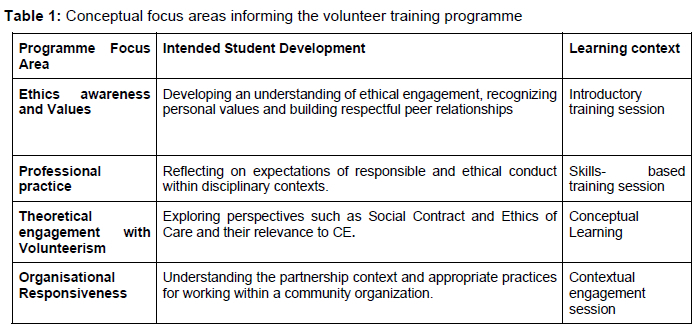
This article examines the importance of training students in ethical practices prior to their interaction with community partners in community engagement. Ethics is commonly understood as the justification of what is right or wrong, or moral principles that guide a person's behaviour. Ethical dimensions that should govern community engagement activities include establishing mutual respect and relationships of trust at community-level and establishing participatory processes both to inform study design and to address concerns related to risks of participation. The aim of this article is to provide a framework on how to prepare student volunteers on ethics and ethical practices, so that they possess the requisite knowledge on community engagement ethics, and also act ethically in their volunteer activities. This study argues that training student volunteers prior to their involvement with community partners can achieve ethical practices. Based on research conducted in 2019 between a Child and Youth Care Centre and a University of Technology in Durban, the study focused on collaboratively developing a training programme for placement of the student volunteers in the Centre. The training programme consisted of four dimensions, one of which focused on ethics. This qualitative study, based on exploratory and developmental designs, was participatory in nature. The study was guided by Social Contract and Ethics of Care theories, which focus on ethical behaviour and ensuring that this behaviour is upheld. The planning and implementation phase of the study highlighted the importance of the principles of ethical behaviour during volunteer training and interaction. The evaluation phase included the extent to which students understood ethics and ethical behaviour in volunteerism. The findings revealed that students gained some knowledge and skills on how to behave ethically. However, the identified challenges indicated that in-depth training in ethics and ethical behaviours for specific organisational needs have to be included in the preparation of student volunteers for community engagement to ensure that ethics are upheld, and that no harm is caused to the participants. The study offers a scalable, participatory model for ethics training in community engagement providing a practical tool for Universities of Technology and higher education institutions aiming to institutionalize socially responsive, ethical engagement practices.
community engagement; student volunteerism; volunteer training programme; ethics; ethical practices; Social Contract and Ethics of Care theory