The dimension of ethics in training student volunteers: A case study of a community engagement partnership between a university of technology and a child and youth care centre in Durban
Abstract
This article examines the importance of training students in ethical practices prior to their interaction with community partners in community engagement. Ethics is commonly understood as the justification of what is right or wrong, or moral principles that guide a person's behaviour. Ethical dimensions that should govern community engagement activities include establishing mutual respect and relationships of trust at community-level and establishing participatory processes both to inform study design and to address concerns related to risks of participation. The aim of this article is to provide a framework on how to prepare student volunteers on ethics and ethical practices, so that they possess the requisite knowledge on community engagement ethics, and also act ethically in their volunteer activities. This study argues that training student volunteers prior to their involvement with community partners can achieve ethical practices. Based on research conducted in 2019 between a Child and Youth Care Centre and a University of Technology in Durban, the study focused on collaboratively developing a training programme for placement of the student volunteers in the Centre. The training programme consisted of four dimensions, one of which focused on ethics. This qualitative study, based on exploratory and developmental designs, was participatory in nature. The study was guided by Social Contract and Ethics of Care theories, which focus on ethical behaviour and ensuring that this behaviour is upheld. The planning and implementation phase of the study highlighted the importance of the principles of ethical behaviour during volunteer training and interaction. The evaluation phase included the extent to which students understood ethics and ethical behaviour in volunteerism. The findings revealed that students gained some knowledge and skills on how to behave ethically. However, the identified challenges indicated that in-depth training in ethics and ethical behaviours for specific organisational needs have to be included in the preparation of student volunteers for community engagement to ensure that ethics are upheld, and that no harm is caused to the participants. The study offers a scalable, participatory model for ethics training in community engagement providing a practical tool for Universities of Technology and higher education institutions aiming to institutionalize socially responsive, ethical engagement practices.
community engagement; student volunteerism; volunteer training programme; ethics; ethical practices; Social Contract and Ethics of Care theory
INTRODUCTION
As a core function of higher education, community engagement (CE) promotes the developmental and transformational role of universities through a range of engagement practices, such as service learning, outreach, volunteerism, community-embedded research, field education, and internships (Seemiller 2013, 2; Hall 2010, 7). Student volunteerism is an integral part of community engagement processes that cultivate social responsibility and critical forms of citizenship among students (Grobbelaar 2017, 4; Maistry 2012, 142). Social responsibility is one of the core goals for all higher education institutions (HEIs) in South Africa. Historically, the main purpose of Universities of Technology (UoTs) was the preparation of students for the workplace. Currently, UoTs are challenged to inculcate social and civic responsibilities in students through their interactions with local communities. In the South African higher education context, CE has increasingly been recognized as an important way through which universities contribute to social transformation and respond to the needs of local communities (Republic of South Africa [RSA], Department of Education [DoE] 1997). Universities of Technology in particular are required to rethink both their approaches to CE and how students are prepared to participate in these contexts (Grobbelaar 2017, 113), to promote the developmental role of UoTs. Community University Partnerships (CUPs) therefore play an important role in creating environments that support meaningful and developmental learning experiences for both students and community partners (RSA, DoE 1997). Padayachee, Lortan and Maistry (2021) advocate CUPs that promote social responsibility based on a non-dualistic, holistic model, better suited to meaningful community engagement and participation and created from the ground up.
Literature further suggests that student participation in community settings should be guided by principles of mutual respect, shared learning and ethical responsibility, rather than approaches that position communities as passive recipients of assistances (Peterson 2009, 548-549). From such perspectives, students are viewed not only as participants but also as both agents and beneficiaries of CE processes, emphasizing the need for appropriate preparation and training prior to their involvement in CE activities (Maistry and Thakrar 2012, 59). Therefore, training is important in enabling students to develop the knowledge, skills and ethical awareness required to engage effectively in different forms of CE, including service-learning, volunteerism and community-based participatory research (Schuurman 2013 cited in Doorsamy 2019, 42; Harris, 2009 cited in Volunteer Now 2012, 9).
The importance of such preparation becomes even more evident when students work with vulnerable communities, where context sensitivity, cultural competence and appropriate professional conduct are essential (Doorsamy 2019, 41). Thus, training can be understood as a learning process that supports students' personal development while also strengthening their capacity to contribute meaningfully to CE initiatives (Groble 2014, 10). Despite consensus on the importance of student volunteer training, relevant and up-to-date literature for Global South contexts remains limited (Doorsamy 2019, 25).
The aim of this article is to provide a framework on how to prepare student volunteers in ethics and ethical practice so that they possess the requisite knowledge on CE ethics and act ethically in their volunteer activities. Based on research conducted in 2019 between a Child and Youth Care Centre (CYCC) and a University of Technology in Durban, the study focused on collaboratively developing a training programme for placement of the student volunteers in the Centre. The study argued that training volunteers prior to their involvement with community partners can achieve ethical community engagement practices. The training programme consisted of four dimensions, one of which focused on ethics. Students from diverse disciplines who were interested in serving as volunteers with children in a CYCC were selected for this qualitative study, which was participatory in nature and based on exploratory and developmental designs. The study investigated the kind of preparation/training required for student volunteers of a UoT. One of the objectives of the overall study was the development of a framework for the training of students as volunteers, with the emphasis on ethics and ethical practice which is the aim of this article. This article first discusses student volunteerism as a form of community engagement and the importance of preparation/training students prior to their placement in a community organisation, with an emphasis on ethics and ethical behaviour. The theoretical framework that guided the study is discussed. Details of the methodology and the research process are presented. Finally, the findings of the study are discussed. The article highlights and promotes the importance of training student volunteers of HEIs generally in CE volunteerism and particularly in ethical practice.
STUDENT VOLUNTEERISM AS A FORM OF COMMUNITY ENGAGEMENTCommunity Engagement in HEIs in South Africa is intended to support the social and economic well-being of communities and promote civic responsibilities in graduates (RSA, DoE 1997, 10) through its nexus between teaching and research, despite barriers due to its relatively recent introduction to the higher education arena. In South African HEIs, CE creates spaces for shared benefit by contributing to institutional growth, supporting student development, addressing community concerns, and encouraging social responsive citizenship. Community engagement has the potential to contribute to social justice, equity, and transformation (Petersen and Osman 2013, 4-5) through its various forms such as service learning, volunteerism, and engaged research. Equally important, these partnerships, grounded in CUP principles already discussed, ensure mutual benefit and ethical collaboration (Jacob, et al. 2015, 4). Ethical considerations and practices are essential in ensuring that CE activities are conducted responsibly, respectfully, and with the best interests of all stakeholders (Scheepers, Christopher and Harrison 2023, 2).
As discussed earlier, ethics and ethical practice in CE requires moral awareness, respect for autonomy, and prioritizing community well-being (Varkey 2021, 17 and Scheepers et al. 2023, 10-15). Ethical practices should be guided by the various forms of policies that are available globally, nationally, regionally, and institutionally, highlighting, the importance of recognizing existing gaps within HEIs policies and taking steps to enhance frameworks that guide ethical practices in CE (Scheepers et al. 2023, 14).
The following are important principles for CE in the planning and implementation of projects: early engagement, community practices that emphasize shared decision-making, open communication, responsiveness to community needs, mutual respect and inclusive participation (Resnik 2018, 139). Timeliness refers to the allocation of appropriate time to start, conduct and finish the project. Care should also be taken to include time for the community organisations to gain clear understanding of the CE process. Consent is critical from all stakeholders involved to ensure that all participate in joint decision making. Information sharing refers to the researcher sharing details of the project to all stakeholders to ensure transparency and equality, and the community and/or stakeholders sharing their needs, issues, and solutions with the researcher/stakeholders. The engagement should be based on transparency, openness, common goals, and decision-making. Responsiveness, mutual understanding, and respect are vital for all participants to work as a team, within a partnership which entails a clear purpose. Inclusiveness means that all stakeholders should be included in CE activities, due to the knowledge they may bring to the project. Communities are experts on their own lives and other stakeholders may have valuable insights that could form grounds for a multidisciplinary team. These principles aim to ensure meaningful community engagement, ethical conduct, and equitable participation in studies and projects.
Scheepers et al. (2023, 9) write that "all CE practitioners must be regarded as ethical leaders who consider ethical values when involved in CE projects. Individual ethical behaviour should additionally reflect the values and ethics of the organization they represent". By upholding ethical standards universities can build trust, foster meaningful relationships, and create positive social impact in the communities they engage with, and this is specifically significant for the South African context. The challenges and ethical dilemmas inherent in community engagement and community-based research require ongoing reflection, dialogue, and a commitment to promoting social justice and equity.
As a form of CE, volunteerism offers students opportunities for social change through CUPs. It benefits students in terms of self-esteem, employability, and overall well-being (Sahri et al. 2013). Volunteering has been part of indigenous communities in South Africa for centuries, emphasizing community service and mutuality, and the practice of volunteerism aligns with the values of Ubuntu (Seabe 2014). Volunteerism is deeply embedded in human nature and arises from ancient traditions of sharing and reciprocal exchanges. It is an expression of social responsibility and can empower individuals with skills and knowledge for creating change. Motives for volunteering include helping others, personal gain, social engagement, career development, and ethical values. Understanding motives can encourage student participation and foster self-awareness and self-development (Harris and Roose 2014, 795).
Overall, volunteerism in South African HEIs is important for social and civic transformation. It should be recognized and integrated into the curriculum, taking into consideration students' motives, and the principles of CE, ethical practices, CUP principles and social justice. Universities benefit from volunteerism through improved public profiles, community relationships, and student retention. Students benefit from volunteerism through skills acquisition, employability, personal development, social networks, and academic improvement. Finally, communities gain diverse benefits from collaborating with student volunteers and HEIs (Joseph 2016, 3).
Training can take various forms, but the key is to ensure that learning takes place. The training of volunteers is essential to equip them with the required information, skills, and attitudes to effectively engage with communities and contribute to positive outcomes without causing harm; thus, acting in an ethical manner (Maistry and Thakrar 2012). Volunteer training follows a systematic process consisting of stages that include identifying training requirements, preparing and delivering the programme, and reflecting on its outcomes. The identification phase involves understanding the volunteers and determining the gap between their existing knowledge and the knowledge needed for volunteering. Planning includes considering the programme's aims, methods, facilitators, logistics, and specific requirements for each volunteer task. Implementation involves delivering the training programme, ensuring appropriate learning environments, and using interactive sessions to encourage lifelong learning. Evaluation assesses whether the aims were met, the effectiveness of the methods used, and provides recommendations for improvement (Volunteer Now 2012, 12).
Students at UoTs may require additional support and preparation for CE due to their primary focus on industry relationships and work-integrated learning (Council on Higher Education [CHE] 2011, 6). While CE does not directly prepare students for employment, it provides relationship experiences that can be beneficial in work situations. Guidance and preparation of students for CE, including volunteerism, may not be a priority at UoTs and may be non-existent in many cases. As part of the transformation agenda, UoTs are therefore encouraged to engage more intentionally with community service initiative, contextual social and economic challenges and partner-based learning approaches alongside their traditional role of workplace preparation (Grobbelaar 2017 cited in Doorsamy 2019, 12). The study and this article attempt to address the gap existing in UoTs in relation to the training of students volunteers in ethical community engagement.
THEORETICAL FRAMEWORKThe following theories which guided the study was informed by three interconnected perspectives, namely the Curriculum of Engagement, Social Contract Theory, and Ethics of Care Theory. Instead of being treated as separate frameworks, these perspectives were drawn together to shape the development of the CUP, the design of the volunteer training programme and the implementation of the volunteer task.
In particular, Barnett and Coate's (2005) conceptualization of a Curriculum of Engagement provided an important point of department through their three functions: knowing, acting, and being which are integral to CE. The curriculum helped students recognize how theoretical knowledge (knowing) translates into practical application (acting) and impacts their self-awareness and self-development (being) (cited in Doorsamy 2019, 55). In collaboration with the CYCC staff, students integrated discipline-specific knowledge to design and execute the volunteer task which was a holiday programme tailored to the children's needs. Reflective practice was emphasized, fostering deeper self-awareness among students, which is crucial for effective volunteerism.
As students were expected to engage in a CYCC setting that supports children experiencing vulnerabilities, it became important for them to develop an understanding of appropriate and ethical ways of interacting in order to safeguard both the children and themselves (Doorsamy 2019). The Social Contract Theory provided a foundational framework for the partnership between the UoT and the CYCC, stressing the importance of reciprocal agreements rooted in ethical behaviour and mutual respect. The agreement ensured equitable participation, valuing contributions from all parties equally and promoting ethical interactions, thus preventing exploitation and harm.
The Ethics of Care Theory, advocated by Noddings (1984), complemented these frameworks by emphasizing empathy, responsibility and care in community interactions. The Ethics of Care theory governed and guided how students engaged within the CYCC setting and interacted with the children throughout the holiday programme.
The Ethics of Care Theory was considered appropriate for this study as it supported the idea of social and civic responsibility that can be inculcated through volunteerism. Central to this theory was the nurturing of a caring environment, important for student volunteers working with vulnerable populations, such as the children at the CYCC. This theory encourages students to engage with sensitivity, ensuring their interactions were morally grounded and beneficial.
Supporting student volunteers to engage with empathy and sensitivity towards those they work with during volunteering is a significant component of building CUP relationships between universities and communities. The Ethics of Care perspective prepared the student volunteers to work in an appropriate, sensitive, and caring manner at the CYCC. A caring environment stimulates growth and development demonstrating care in a morally acceptable way helps sustain a cooperative engagement between the community partner and UoT academic staff and students. It also guards against any harm that may be done, albeit unwittingly.
While each perspective offered a distinct contribution, bringing them together provided a useful framework for guiding the planning, delivery and reflection on the volunteer training programme.
THE STUDYGoal and Research Question
This study sought to work collaboratively with participants to design, implement and reflect on a volunteer training programme aimed at preparing UoT students to engage in a CUP within a CYCC context. This particular phase of the research focused on ethics training as one of four interconnected dimensions that shaped the overall framework. In this regard, the study explored what forms of preparation and support are required for UoT students to participate meaningfully in engaged partnership-based volunteer initiatives.
Research Design and Methodology
The design of the study was exploratory and developmental, the methodology qualitative, and the study was participatory in nature. The study followed the phases of developmental research, including context analysis, study design, prototype development and evaluation, and ongoing revision and re-evaluation (Smith et al. 2014, 584). The concept of instructional technology, which involves designing, developing, utilizing, managing, and evaluating learning processes and resources, was integrated into the study. The study combined instructional technology principles with participatory action research (PAR) to develop a volunteer training programme for students in a CYCC setting. The training process aligned with instructional technology steps, guiding the learning of student volunteers (Lam et al. 2018, 369).
Sampling Process and Sample
The study sample was comprised of CYCC staff, UoT academics, and students from various disciplines. Purposive sampling was used for the CYCC, while snowball sampling was used for the UoT sample of academics and students. The participant group included academic staff, ten students representing three departments and four staff members from the CYCC, resulting in a total of sixteen participants. During the volunteer task, which was conducted in October 2017, only seven of the student participants remained involved across all phases of the study. The students were between the ages of 19 and 22, while the CYCC staff brought relevant professional experience to the partnership context. The participating UoT academic staff were early-career women lecturers with an interest in CE within their respective departments (Doorsamy 2019, 67).
The Research Process
The steps of participatory action research (PAR) by Maree (2007) and Collins (1999) were adapted to align with the aims of the study (Maree 2007, 127-131 and Collins 1999, 42-43). The research phases were informed by the "systematic training cycle" proposed by Volunteer Now, which consisted of i) identifying the training needs ii) planning for the training iii) implementation and iv) evaluation (Volunteer Now 2012, 9). This study combined the second and third of three phases: orientation, planning and implementation, and evaluation.
Phase One: centered on introducing participants to the process and establishing a collaborative partnership between the CYCC and UoT representatives. Proper orientation for volunteers is crucial for ethical practices, risk management, and ensuring their understanding of responsibilities and rights within the organization. Lortan and Maistry (2019) posit that orientation of CUPs is not a singular event, but a process in which relevant partners are oriented prior to training and throughout the implementation of CUPs. The orientation process included a needs analysis and legal/ ethical clearance, including SAPS checks (form 30), consent and introductory meetings.
Focus group interviews were conducted with CYCC staff, UoT academic staff, and student volunteers to explore their understanding of concepts relevant to "the study, such as community engagement, volunteerism, and community university partnerships. The focus group discussions explored participants' understanding of CE and volunteerism, their previous involvement in engagement activities and their perspectives on CUPs. Attention was also given to the values underpinning effective collaboration, as well as the relevance of theoretical perspectives such as Social Contract theory and Ethics of Care in informing the volunteer training programme (Doorsamy 2019, 227). Data collection involved collaboration between the researcher and the sample groups, and the data was analyzed through workshops with the participants to inform the planning of Phase Two.
The second phase of the study centered on collaboratively planning and facilitating the volunteer training programme. A series of planning meetings created spaces for the participants to reflect on insights generated during Phase One and to shape the content and direction of the training. Through this joint process, the researcher and participants drew on the identified concepts and theoretical perspective to develop the programme. Key learning areas were subsequently defined, including ethics and values, professional conduct, theoretical understandings of volunteerism and organizational expectations within the partnership context.
Consent forms and confidentiality agreements were signed to ensure roles and confidentiality were understood and respected. The researcher implemented the training programme, and a meeting was held to collaboratively design and facilitate a holiday activity schedule for the children at the CYCC. The volunteer task, including the holiday programme, was implemented during the year end school holidays in 2017.
The final phase, was Phase Three which focused on the evaluation of the CUP and the volunteer training initiative. Following the completion of the programme, individual interviews were conducted to explore how students' understanding and experiences had developed through their participation in the volunteer task (Doorsamy 2019, 74). The evaluation phase sough to understand how students' conceptual insights had developed through their participation, while also reflecting on the effectiveness of the volunteer training programme and identifying ways to strengthen both the initiative and the partnership process. Individual interview were conducted with the seven students who remained involved during Phase Two in order to gather their feedback and experiences. The individual interviews explored students' reflections on their experiences of the volunteer training programme, including the extent to which it supported their participation in the volunteer task and shaped their understanding of CE and volunteerism. Discussions also considered students' perspective on CUPs, the values required to sustain collaborative relationships and the strengths and challenges encountered during the engagement process. In addition, attention was given to how the training contributed to students' personal development and self-awareness, as well as their suggestions for the strengthening of future student volunteer preparation initiatives (Doorsamy 2019, 77)
Insights from the evaluation informed the collaborative refinement of a final volunteer training programme developed by the researcher together with the participation of the student for use in preparing future student volunteers for their role in CE and volunteerism.
FINDINGS OF THE STUDY
Phase One: Orientation
The orientation phase aimed to establish the CUP by assessing participants' understanding of key concepts and determining specific training needs. Participants initially exhibited limited theoretical knowledge about Social Contract and Ethics of Care theories but demonstrated practical insights through personal experiences and intuitive practice of care and informal ethical agreements.
The participants made several recommendations for the volunteer training programme. The main themes were background information, ethics, engagement with children, and information pertinent to their roles. Although students expressed a desire for more details about the children's background, it was not possible to provide such information due to confidentiality and children's rights regulations. Instead, CYCC staff shared broad contextual insights about the circumstances of the children requiring care, while avoiding the disclosure of individual details. The study supported the idea that while specific information cannot be disclosed, general information about the circumstances leading to children being sent to the CYCC can be discussed and analyzed. The orientation informed the direction taken in the subsequent phase of the study. It became clear that students required preparation across several practical areas related to working with children, including managing behaviour, communicating effectively and responding sensitively within the CYCC context. Such preparation was intended to support students in carrying out their roles confidently while aligning their engagement with organizational expectations and partnership values.
Ethics was mentioned as a crucial component of the training programme (Commonwealth of Australia 2006, 12). Students used words such as: "...it (ethics) is like my moral code and my moral standings in life. How I understand certain situations. Ethics of Care is when we care and nurture those ethics in order to be more humane...". The CYCC staff stated: "it is ethics that underpin care, for example, equality irrespective of the child's race, age or gender".
Ethical elements were further mentioned by the CYCC staff under aspects to be included in the training programme. These focused on boundary creation, confidentiality, and behaviour management techniques. Creating clear boundaries and differentiating between appropriate and inappropriate conduct in a CYCC setting and with students is necessary (Graham et al. 2013, 13-15). Clearly defining the rules, regulations, and responsibilities for volunteers is essential for their confidence, retention, and adherence to ethical practices.
Similarly, it was also recommended that aspects of maintaining confidentiality and engaging thoughtfully and with care were essential when working with developmentally vulnerable children such as those in a CYCC context (Molepo 2014, 226). The CYCC staff highlighted the need for the volunteers to create boundaries: "they (students) should understand that boundaries are important in this environment (CYCC)". This study highlights the importance of confidentiality and suggests reiterating it throughout the training (Thumbadoo 2013, 77). The CYCC staff reiterated the importance of working with children "at risk" stating that "confidentiality is top priority for us and the children in our care, all students should also sign our confidentiality form and respect our children's privacy".
Finally, the CYCC staff highlighted that students should be prepared in behaviour management as an important aspect of volunteer training, especially when working with children considered to be "at risk" who may present behavioural challenges (Molepo 2014, 121-122). Training in behaviour management is necessary for student volunteers to appropriately handle behavioural issues during their volunteer task and to approach them with sensitivity (Modlin 2013, 5). This study supported the inclusion of behaviour management training for student volunteers, as it ensured the smooth running of the holiday programme. These insights set the stage for broader themes that emerged across the different phases of the research.
Across all the different phases, volunteers consistently emphasized ethics as central to their preparation and performance. From orientation to evaluation, key themes such as boundaries, confidentiality and sensitivity to vulnerable children remained prominent. These findings confirm the training impact on students' ethical development and underscore the value of embedding ethical awareness throughout the CE preparation.
Phase Two: Planning and Implementation
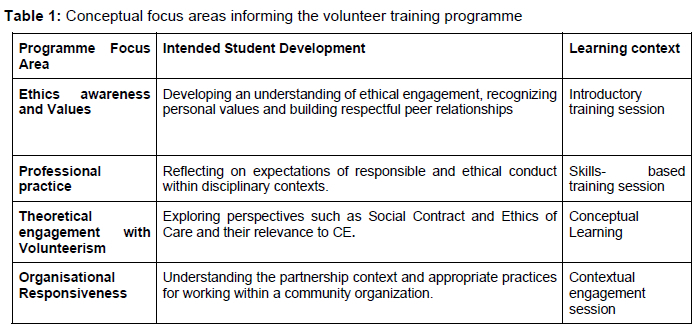
Leading on from orientation, Phase Two took into consideration the current knowledge and skills of the participants and analyzed the gaps in their understanding and skills. This phase involved collaboratively developing and delivering the training programme, titled "Kuqala Ngawe" which translates to "it begins with you", tailored specifically for students' roles in the CYCC. Pedagogical design is understood as "connecting theory and practice; cultivating the course learning with the community; designing learning activities that stimulate critical thinking and creativity; that require continuous collaboration in small teams... integrating self and peer-assessment; and presenting clear criteria for assessing learning outcomes" (Avdiel, Blau, Shamir-Inbal 2018, 169). The pedagogical approach underpinning the training programme was informed by the three theoretical perspectives discussed earlier. In practice, the programme was structured around four interconnected focus areas namely, ethical awareness and values, expectations of professional conduct, conceptual understandings of volunteerism and engagement with organizational contexts (Doorsamy 2019, 114).
The training programme spanned three weeks, with two-hour interactive sessions each week designed around students' academic schedules. The programme employed diverse individual and group activities, emphasizing creative and critical thinking, self-reflection and an awareness of personal values, which significantly influenced their performance during volunteer activities.
Training in ethics involved clearly defining terms such as ethics, morality, values, beliefs, being and partnerships, emphasizing personal reflection and team rapport. Group discussion identified essential ethical considerations for volunteers, particularly those engaging with children. Students actively participated in role-plays to explore personal values, relationship-building activities and examining positive and negative CUPs, reinforcing respect and understanding across diverse interactions.
The professional conduct component encouraged students to consider the expectations associated with ethical and responsible practice within their respective disciplines. Objectives included defining professional conduct, identifying commonalities across fields and understanding specific volunteer requirements. Students actively engaged in discussions about general and field-specific professional conduct, thus establishing clear ethical and professional expectations for the volunteer tasks. The study advocated for including community input in these discussions, emphasizing a collaborative approach to professional ethics.
The theoretical perspectives such as Social Contract and Ethics of Care were engaged within a reflective and applied manner, with students linking the theoretical concepts directly to their volunteer roles. This created the opportunity for students to connect theory to practical application, enriching their ethical understanding and preparedness. Students collaboratively created a visual summary of the Ethics of Care, which was prominently displayed at the CYCC to reinforce ethical commitments during their volunteer tasks.
Lastly, the organisational conduct dimension explored aspects of partnership, and the uniqueness of the organisation or community with which the students would be working. Activities included discussions on why children reside in the CYCC and critical analysis of case studies emphasizing ethical, sensitive interactions. This dimension emphasized the importance of contextual knowledge and appropriate behaviour, aligning with the literature advocating context-specific volunteer training (Commonwealth of Australian 2006: 9).
The training programme was structured around four interconnected areas of development. These included strengthening students' ethical awareness and understanding of personal values, supporting reflection on professional conduct within disciplinary contexts, introducing key theoretical perspectives relevant to volunteer engagement and preparing students for working within organizational partnership environments.
Collectively, these dimensions ensured that students developed a comprehensive ethical awareness, professional readiness, theoretical understanding, and contextual sensitivity necessary for responsible and impactful volunteering.
Phase Three: Evaluation
Evaluation results echoed the themes mentioned in Phase One, reinforcing the importance of comprehensive, context specific ethics training.
Insights generated during Phase Three informed the refinement of the volunteer training framework and highlighted key areas requiring attention in preparing students for engagement contexts. Rather than being presented as a fixed model, the framework should be understood as evolving and responsive to emerging needs and contextual realities. While the training programme was initially structured around four core dimensions, subsequent reflections suggested the value of a broader set of focus areas. This included recruitment and orientation processes, opportunities for self-development, engagement with the philosophy of Ubuntu, conceptual understandings of CE, volunteerism, ethical awareness and values, expectations of professional conduct and responsiveness to organizational contexts.
Within this broader framework, the ethics and values dimension which forms the primary focus of this article, emphasizes the importance of creating space for students to reflect on both their own values and those of others in socially and culturally diverse environments. This involves encouraging critical engagement with the ethical considerations associated with working in community contexts, as well as with theoretical perspectives that inform volunteer practices. Participatory learning activities, such as role-plays and other creative approaches can support students in exploring principles of commitment, equality and compassion thereby, strengthening their ability to translate these values into meaningful and responsible engagement practices.
CONCLUSION
As HEIs continue to expand their involvement in CE initiatives, including volunteer-based activities, greater attention is being given to how students are prepared to engage ethically within partnership contexts. In the South African higher education landscape, institutions are also expected to contribute to the development of graduates who demonstrate social responsibility and active citizenship (RSA DoE, 1997). Findings from this study suggest that participation in structured volunteer training can play a meaningful role in strengthening students' conceptual understandings, ethical awareness and engagement practices. Through involvement in the programme, students appeared to develop greater clarity regarding their roles within CUPs and their responsibilities as volunteers.
The study further demonstrates the value of participatory ethics training programmes for student volunteers. By equipping students with ethical, professional and contextual competencies, HEIs can better fulfil their civic missions and support community partners. The adapted training framework offers a replicable model for other institutions, especially UoTs, seeking to institutionalize ethical practice in CE. Embedding such training institutionally can help transform CE from an extracurricular activity into a core pedagogical practice for social change.
REFERENCES
- Avdiel, Orit, Ina Blau, and Tamar Shamir-Inbal. 2018. "How Pedagogical Design of Technology-Enhanced Academic Course Promotes Listening to Student Voice and Reflecting on Students' Perceived Learning." International Association for Development of the Information Society.
- Barnett, Ronald, and Kelly Coate. 2005. Engaging the Curriculum in Higher Education. Maidenhead: Society for Research into Higher Education and Open University Press.
- Collins, Kathleen Jane. 1999. Participatory Research: A Primer. South Africa: Prentice Hall.
-
Commonwealth of Australia. 2016. "A Toolkit for Training Volunteers (Part B): For Trainers, Managers of Volunteers and Volunteer-Involving Organisations." Accessed May 15, 2019. https://www.volunteeringaustralia.org/wp-content/files_mf/1377052757VaGuidetotrainingvolunteerspartB.pdf.
» https://www.volunteeringaustralia.org/wp-content/files_mf/1377052757VaGuidetotrainingvolunteerspartB.pdf - Council on Higher Education. 2011. Work-Integrated Learning: Good Practice Guide. Pretoria: Council on Higher Education.
- Doorsamy, Kristena. 2019. "Community Engagement and Volunteerism: Preparing DUT Students as Volunteers for a Child and Youth Care Centre in Durban." Master's thesis, Durban University of Technology.
- Graham, Lauren, Leila Patel, Marianne Ulriksen, Jacqueline Moodley, and Eddy Mavungu. 2013. "Volunteering in Africa: An Overview of Volunteer Effort in Africa and Its Potential to Contribute to Development.
- "
- Grobbelaar, Helena Hendrina. 2017. "Development of a Community Engagement Capacity-Building Programme within a Social Justice Framework for Consumer Science Food and Nutrition Students at the Durban University of Technology." PhD diss., Durban University of Technology.
-
Groble, Patricia. 2014. "Risk Management or Risky Management? Preparing Non-Profit Leaders for Risk and Liability." Accessed January 14, 2016. http://engagedscholarship.csuohio.edu/cgi/viewcontent.cgi?article=2249&context=urban_facpub.
» http://engagedscholarship.csuohio.edu/cgi/viewcontent.cgi?article=2249&context=urban_facpub - Hall, Martin. 2010. "Community Engagement in South African Higher Education." In Kagisano No. 6: Community Engagement in South African Higher Education, 1-52. Pretoria: Jacana Media.
- Harris, Anita, and Joshua Roose. 2014. "DIY Citizenship amongst Young Muslims: Experiences of the 'Ordinary'." Journal of Youth Studies 17 (6): 794-813.
- Jacob, W. James, Stewart E. Sutin, John C. Weidman, and John L. Yeager, eds. 2015. Community Engagement in Higher Education: Policy Reforms and Practice. Springer.
- Joseph, Bianca Monique. 2016. "Recruitment and Retention of University Student Volunteers for South African Community Projects." PhD diss., Stellenbosch University.
- Lortan, Darren, and Margie Maistry. 2019. "Keeping Community-Based Participatory Research Practitioners Relevant and Effective through Orientation." In Teacher Education at the Edge: Expanding Access and Exploring Frontiers, edited by Tonya Huber and James G. O'Meara, 3-31. Information Age Publishing.
- Maistry, Margie. 2012. "Community Engagement, Service Learning and Student Social Responsibility: Implications for Social Work Education at South African Universities: A Case Study of the University of Fort Hare." Social Work/Maatskaplike Werk 48 (2).
- Maistry, Margie, and Jayshree Thakrar. 2012. "Educating Students for Effective Community Engagement: Student Perspectives on Curriculum Imperatives for Universities in South Africa." South African Review of Sociology 43 (2): 58-75.
- Maree, Kobus. 2007. First Steps in Research. Pretoria: Van Schaik.
- Modlin, Heather. 2015. "Meaning Making: Another Perspective." Relational Child and Youth Care Practice 26 (3): 5-13.
- Molepo, Lesiba Phineas. 2014. "Challenges and Coping Strategies of Child and Youth Care Workers in the South African Context." PhD diss., University of Pretoria.
- Noddings, Nel. 1984. "Caring: A Feminine Approach to Ethics." In Moral Education.
- Padayachee, Kanyakumarie, Lortan, Darren, and Maistry Savathrie. 2021. Rethinking Higher Education for Social Responsibility in South Africa: Considering Synergies between Gandhian Principles and Ubuntu. In Socially Responsible Higher Education: International Perspectives on Knowledge Democracy. Editors: Budd Hall and Rajesh Tandon. 31-41. Brill Sense. Leiden. Boston.
- Petersen, Nadine, and Rubby Osman. 2013. "An Introduction to Service Learning in South Africa." In Service Learning in South Africa, 2-32 Peterson, Tessa Hicks. 2009. "Engaged Scholarship: Reflections and Research on the Pedagogy of Social Change." Teaching in Higher Education 14 (5): 541-552.
- Republic of South Africa, Department of Education. 1997. Education White Paper 3: A Programme for Higher Education Transformation. Government Gazette Vol. 18207, August 15. Pretoria: Government Printers.
- Resnik, David B. 2018. "Ethics of Community Engagement in Field Trials of Genetically Modified Mosquitoes." Developing World Bioethics 18 (2): 135-43.
- Sahri, Mardhiyyah, Khairudin Murad, Asmidar Alias, and Mohd Dasuqkhi Mohd Sirajuddin. 2013. "Empowering Youth Volunteerism: The Importance and Global Motivating Factors." Journal of Educational and Social Research 3 (7): 502.
- Schuurman, Alvina. 2013. "Volunteer Experiences in a Non-Profit Organisation." PhD diss., Stellenbosch University.
- Seabe, Dineo Shirley. 2014. Understanding Volunteerism in South Africa: A Mixed Methods Approach. PhD diss., Stellenbosch University.
- Scheepers, Jacqueline, Lloyd Christopher, and Stephen Harrison. 2023. "Ethical Imperatives in Community Engagement." African Journal of Higher Education Community Engagement 1 (1): 1-19.
- Seemiller, Corey. 2013. Best Practices for Community Engagement Programmes. Learn Forward Engagement Series. Texas: OrgSync.
- Smith, Karen M., Danielle N. Naumann, Laura McDiarmid Antony, Mary Ann McColl, and Alice Aiken. 2014. "Using Developmental Research to Design Innovative Knowledge Translation Technology for Spinal Cord Injury in Primary Care: Actionable Nuggets™ on SkillScribe™." Journal of Spinal Cord Medicine 37 (5): 582-88.
- Thumbadoo, Zenuella Sugantha. 2013. "Ways in Which Child and Youth Care Workers Support Child-Headed Households in Communities." PhD diss., University of South Africa.
- Varkey, Basil. 2021. "Principles of Clinical Ethics and Their Application to Practice." Medical Principles and Practice 30 (1): 17-28.
-
Volunteer Now. 2012. "As Good As They Give: Providing Volunteers with the Management They Deserve." Workbook Four: Managing Volunteer Training. http://www.volunteernow.co.uk/fs/doc/publications/workbook-4-managing-volunteer-training-2013.pdf.
» http://www.volunteernow.co.uk/fs/doc/publications/workbook-4-managing-volunteer-training-2013.pdf