Funding the future: Financial aid's role in postgraduate choices and success
Abstract
BACKGROUND: Ensuring a pipe-line of students from undergraduate into postgraduate phase of higher education is of critical importance to most countries' post-school strategies and economic growth. While there are some insights in the international literature on the role of funding in respect of postgraduate access and success, there are limited studies in the South African context. This study examined the impact of prospective financial aid receipt on students registered at a selected South African university METHOD 1: The study first analysed the financial aid receipt status and academic performance of postgraduate students on a selected sample of Commerce students of a South African university in 2019 (the last 'normal' year before COVID-19 took place). The data indicates that 46 per cent of these students received financial aid. The recipients were predominantly African female full-time students FINDINGS 1: The empirical findings indicated that financial aid receipt was associated with a significant shorter studies completion time at Postgraduate Diploma (PGDip) level, followed by Honours level METHOD 2: The study proceeded to use primary data collected from the 2023 final-year undergraduate students, as well as those in Year 1 (Honours and PGDip), and Year 2 (Masters) students of the same university on their intention to pursue the next level of postgraduate studies in 2024. A total of 159 responses were received and the results showed that 88 per cent of final-year undergraduate students; 64 per cent of first-year postgraduate students; and 45 per cent of Masters students had an intention to proceed into further postgraduate studies FINDINGS 2: The primary reason for not intending to pursue further studies (Masters and Doctorate) was the need to become economically active through work opportunities to provide financial support to their families. In respect of final-year undergraduate students there were two factors that would influence their decision to apply for postgraduate studies, namely meeting minimum entry requirements and receipt of financial aid SIGNIFICANCE OF RESEARCH: This research is important as it provides valuable insights on the key factors that drive the students' decision to pursue further postgraduate studies and the role of financial aid to improve students' academic success at postgraduate level
Financial aid; Higher Education; Postgraduate; Academic performance
INTRODUCTION
South Africa has been labelled among one of the most unequal societies worldwide and has endeared persistently high levels of poverty, inequality and unemployment even during post-apartheid. There is ample evidence that human capital development, such as through university training, is one of the ways to improve the socio-economic status of the population. Statistics South Africa (StatsSA)'s Quarterly Labour Force Survey bears testimony to this given that the unemployment rate among persons with a first degree is 17.4 per cent and those with a postgraduate (PG) degree is even lower at 7.7 per cent (StatsSA, 2024).
Several studies demonstrate that university education is central to a country's economic health (Casey, 2009; Chang, Chen and Xiong, 2018). While a first degree is able to provide some degree of human resource input to the economy, the benefits are limited. Successfully thriving economies depend on PG completions to enhance research productivity which, in turn, has been linked to a country's intellectual and economic wealth (Jaffe et al., 2020). There is also evidence that enhanced research and innovation capability positively impact competitiveness of the country (Lo and Tian, 2020). Therefore, ensuring a pipe-line of students from undergraduate (UG) into the PG phase of higher education is of critical importance in most countries' post-school education strategy.
Therefore, from a perspective of higher education planning, strategies to ensure both access to PG programmes, and thereafter the successful throughput from such programs is important. In South Africa, two key strategic policies underpin the University sector's planning for access and success. The National Development Plan (NDP) (NPC, 2014) is a high-level cross cutting strategic plan of government which provided a long-term compass for all areas of economic and social development. The NDP affirms that that "higher education is the major driver of the information/knowledge system, linking it with economic development" (NPC, 2014: 262) and sets out a clear target in respect of PG output that set the country on a course to "produce more than 100 doctoral graduates per million per year by 2030" (NPC, 2014: 278). Following on the NDP, the White Paper for Post School Education and Training (DHET, 2013) sets a specific objective of expanded access to Higher Education, calling for "participation rates in universities ... to increase from the current 17.3 per cent to 25 per cent ... in 2030" (DHET, 2013: xiv). The White Paper goes on to stress the needs for expanding opportunities for PG studies (DHET, 2013: 2).
In the context of a country with high levels of unemployment and poverty, it may be argued that PG education is a luxury to some, especially those coming from lower-income classes since study fees represent a high proportion of household income. Moreover, UG degree holders often are compelled to work in the labour market immediately after graduation to support their families financially. Thus, the value proposition of PG studies does not appear to be promising to a student whose families' economic plight is more paramount in light of the rising costs of living coupled with low levels of financial support for PG students. The net result is a detrimental impact on PG enrolments which in turn detracts from the policy objectives as ensconced in both the NDP and White Paper on post-school education.
In light of the foregoing, to ensure that the goals envisaged in policy are achieved, it is important to understand issues in relation to access and success of students in PG studies. The decision to pursue PG studies is often influenced by a myriad of factors, with financial considerations playing a pivotal role. Funding opportunities, including scholarships, grants and fellowships, are frequently the determining factor for many students in their decision to undertake further studies. However, the availability of funding raises critical questions about its impact on students' commitment to their studies and quality of their academic performance.
Current research reveals some insights into UG students decisions to pursue PG studies. Fomunyam (2020), for example found that available funding positively influences enrolment, but at the same time insufficient funding pools led to decreased enrolment due to high tuition costs. Research in the USA found that receiving grant aid during UG studies increased the chances of pursuing advanced degrees; though on the other hand, larger student loans reduced the likelihood of continuing to PG studies (Witteveen, 2023).
From a perspective of the impact of funding on PG success research internationally does provide some insights. Research undertaken in Brazil found that students with scholarships performed better and graduated more quickly than those without scholarships (Lepine, 2019). In Qatar, students who receive financial aid, particularly merit-based aid, tended to perform better academically than those who do not receive aid (Al-Kubaisi, 2022). In Norway, Sten-Gahmberg (2020) found that a student aid reform program had mixed results on timely graduation, while research conducted in Italy found that students who received less financial aid graduated faster than those who received more aid (Rattini, 2023).
While there are some insights in the international literature on the role of funding in respect of PG access and success, there are limited studies in the South African context. This is an especially important issue to understand since the South African government has developed an extensive financial support program for UG programmes in the form of the National Student Financial Aid Scheme (NSFAS). However, support from government for PG programmes is limited and more evidence is required to inform policy in respect of PG funding provisioning.
Given the foregoing, this study's research objective is to examine the impact of prospective financial aid receipt on students registered within Economic and Management Sciences programs at a selected South African university. The investigation had a two-pronged approach. The study firstly investigated whether the receipt of financial aid in 2019 had a positive impact on the academic performance of the cohort of students, based on their progress four year later in 2023. Secondly, the study investigated the 2023 cohort of final-year UG students; students in Year 1 of PG study (NQF Level 8) and students at Masters level (NQF Level 9), in respect of their intention to proceed into the next NQF level of PG study.
The specific research objectives, using a selected cohort at a South African University, were as follows:
Identify the key factors (e.g. personal, institutional and supervisory factors) that determine students' decision to apply for PG studies.
Analyse the PG students' financial aid receipt status at the outset of their UG studies.
Derive descriptive results on the type (e.g. university's internal financial aid, bursaries from the government and external donors) and amount of financial aid available to bursary recipients in the selected cohort.
Investigate if financial aid recipients enjoyed a significant advantage in their academic success compared with the non-recipients (e.g. higher completion rate, shorter number of years to complete studies).
According to the human capital theory (Becker, 1962), education is an investment in human capital. Hence, incremental earnings as well as both direct (e.g. study fees, expenditure on textbooks and stationery, campus accommodation) and indirect (foregone earnings) costs are taken into consideration. Upon discounting the above earnings and costs variables into present value terms, if the net present value (NPV) is positive, a person would decide to pursue further education instead of immediately working in the labour market after completing the current qualification. Financial aid helps reduce the direct cost and subsequently increase the net present value, thereby boosting the likelihood of the person investing in his/her future by studying further. Subsequently, the attainment of a higher qualification improves the person's productivity, earnings and upward economic mobility potential.
Educational attainment acts as a signal to employers about a job applicant's capabilities as suggested by the signalling theory (Spence, 1973). For those individuals with high potential to pursue further education but with inferior financial resources, the receipt of financial aid is an important means to allow them access further education and afford the costs, and subsequently signal their abilities in the job market upon the attainment of higher educational qualification. Financial aid also plays a role to reduce social inequalities by helping students from under-privileged backgrounds overcome the cost barriers (Blackmur, 2023). Therefore, the receipt of financial aid helps promote social justice by encouraging students from historically disadvantaged backgrounds to pursue higher education.
Lastly, according to the self-determination theory, both intrinsic and extrinsic motivation play a key role to drive people to behave in certain ways; intrinsic motivation stand for internal drives such as our core values and interests, whereas extrinsic motivation is driven by external sources such as positive grades, awards, respect and admiration of others (Deci and Ryan, 1985). Applying this theory to education, some people opt to study further as they gain more values from pursuing PG studies (i.e. intrinsic motivation), want to receive good grades and meet the expectations of their families (i.e. extrinsic motivation).
Studies on students' intention or decision to pursue university studies
Several international studies have investigated factors influencing high school students' intention or decision to pursue tertiary education. In Britain, a survey of high school students found that the thought of owing a lot of money made it difficult for their families to consider higher education, while over 75 per cent of participants said they would need a part-time job to help pay off the higher education costs (Knowles, 2000). Callender and Jackson (2008) found that students with low socio-economic status indicated they planned to apply to universities nearer their homes or live at homes with their parents if they were accepted. Callender and Wilkinson (2013) found that most students did not think their university enrolment decision was affected by bursaries, although those who were cost-conscious and expected to receive higher-amount bursaries were relatively more likely to think bursaries were influential and important.
Steiner and Wrohlich (2008) conducted various simulations to estimate the elasticity of enrolment into higher education with respect to the amount of means-tested student aid provided by the German Federal Government; the elasticity estimates were very small (about 0.1), and hence the authors concluded that neither the current student aid reform nor more substantial increases in the amount of student aid alone would achieve the goal of increasing PG enrolment rates. Next, Liu (2010) examined the motives, expectations and preparedness of a group of UK students to pursue PG studies in marketing. The most significant reasons for pursuing PG studies were as follows: intrinsic goals, career-related aspirations, strong learning support and good resources, as well as getting practical experience.
Studies on the impact of financial aid on academic performance
Few local studies examined the impact of financial aid receipt on UG's academic performance. First, Mngomezulu, Dhunpath and Munro (2017) looked at the academic experience of a group of 12 South African UG students with the aid of focus group discussions. Some students who received bursaries indicated that sometimes they were expected to redirect part of the funding to their families to improve living conditions, while others reported that due to financial illiteracy, they mishandled the bursary money and subsequently it led to poorer academic performance. That is, receipt of financial assistance had an unintended consequence of increasing students' risk of academic exclusion.
Naidoo and McKay (2018) investigated the relationship between student bursary funding and academic performance of more than 8 000 students coming from the 2011 cohort year. These students were tracked over three years (2011-2013), and the findings showed that there was no significant relationship between students being awarded a bursary and their successful graduation (throughput). Also, there was insignificant relationship between the amount of bursary awarded and students' academic performance. Sokhweba (2022) examined the impact of NSFAS on 501 UG students' access to finance at a Western Cape university. While the findings suggested a positive effect of NSFAS on students' access to finance for tertiary education, there were challenges that hampered students' smooth access to funds, such as not being notified of the NSFAS application outcome, not being taken through the follow-up due process after approval. The study also found statistically insignificant correlation between receipt of NSFAS and academic performance of the students.
Research on the administrative load, bottleneck and delays with regards to NSFAS is scant. However, a study commissioned by NSFAS notes the administrative difficulties that students might experience when applying for funding. Mafilika et al (2024: 16) indicated that "students may encounter administrative hurdles and additional expenditures when getting or updating documentation from DHA... These problems may disproportionately affect disadvantaged groups, such as students from low-income or rural locations..." Given the lower support already provided by NSFAS to postgraduate students, it is likely these administrative loads might further discourage students from pursuing PG studies.
Next, Wildschut, Megbowon and Miselo (2020) examined the academic performance of 30 000 UG students in 2018 at two universities. After controlling for differences in other characteristics, the analysis found that a positive (albeit weak) correlation existed between being NSFAS-funded and average academic performance. Pillay, Bhorat and Asmal (2021) examined how the financial aid scheme affected student performance as measured by both the subject pass rate and likelihood of passing all subjects in 2000-2012 across 17 South African universities. The empirical findings revealed that during the 12-year period under study, NSFAS successfully increased the number of recipients and targeted historically disadvantaged individuals and women. In addition, the NSFAS students passed 83 per cent of their subjects at the historically black institutions, compared to 79 per cent at the historically white institutions. Furthermore, the authors found a positive relationship between award size and student academic performance.
Frans and Rabie (2022) used both qualitative (by means of interviews and questionnaires) and quantitative (enrolment and throughput statistics) data to evaluate the Thuthuka Bursary Fund program at Stellenbosch University's accounting students. The study found that funding not only allowed student access to the university, but played a positive role to improve the students' pass rates and throughput rates. To conclude, the relationship between student academic performance and financial aid receipt is unclear given the local studies reviewed.
With regard to international studies, Ostberg (1982) investigated the relationship between various methods of financing college costs (e.g. loans and work, scholarships and grants, parental support) and academic achievement. The author found that students who earned and borrowed 25 per cent or less of their total educational costs and received no other financial aid obtained higher GPAs than the class mean. In addition, students whose college costs were at least 75 per cent paid by financial assistance achieved less well than their average classmates. The findings also showed that students with lower ability and achievement levels at the time of admission, those from poorer socio-economic backgrounds and members of ethnic minorities were associated with weaker academic performance. Those achievement differences, however, were not related to financial aid differences but rather reflected other background variables.
Coonrod (2008) investigated the relationship between the amount of financial aid on students' Grade Point Average (GPA), with a specific focus on the amount of grants from all sources and the amount of loans not taken out by parents. The econometric analysis indicated that there was a significantly positive relationship between the grant variable and GPA, while the negative relationship between the loan variable and GPA was insignificant. In fact, the latter finding is contrary to the expected positive correlation direction. Moving on to the 2009 Stater study, the author investigated the impact of financial aid on students' GPAs at three public universities. The study found that both need-based aid (i.e. grants or loans) and merit-based aid (i.e. scholarships) had significantly positive effects throughout the students' college years after controlling for differences in other characteristics, but the effect of the latter aid was larger as indicated by the much larger coefficient in the regressions. This finding could be attributed to the fact that merit-based aid had certain academic-related requirements (e.g. strong school academic performance, or high GPA in the initial years of university studies).
Contrary to the above three reviewed studies, Nichols (1980), Jones and Moss (1994) as well as Carlson (2006) found that students who received financial aid did not necessarily enjoy significantly better performance compared with non-recipients, after controlling for differences in other characteristics. First, Nichols (1980) examined a sample of 200 USA students to derive the relationship between socio-economic status, financial aid receipt, gender and academic achievement. The empirical analysis found an insignificant relationship between the financial aid variables (e.g. grant, loan and work-study variables) and students' GPA.
Jones and Moses (1994) estimated the influence of financial aid on the academic performance of students at a medical school, by distinguishing three financial aid groups: no aid; non-need aid; and need-based aid. The findings showed that the students from the non-need aid group enjoyed the highest mean GPA (3.65) and graduation rate (89%), while the other two groups fared almost the same, with a mean GPA of 3.48-3.49 and graduation rate of 85 per cent. Hence, receipt of need-based aid did not lead to a significantly better GPA or graduation rate. Lastly, Carlson (2006) compared the academic performance of two groups: need-based aid recipients and non-need-based aid recipients. It was found that the former group had a slightly higher mean GPA (3.08 versus 3.04), but such difference in the mean GPA was statistically insignificant.
Some international studies focused on throughput, completion and graduation rates of UG students. First, Dynarski (2003) found that the eligibility for student benefits increased the probability of completing at least one year of college by 14.5 percentage points, even though the result was statistically insignificant. Next, Singell (2004) examined the impact of financial aid on re-enrolment and retention at a large public university. The author found that students who completed the Free Application for Federal Student Aid (FAFSA) form during their first year of college were 17.6 per cent more likely to re-enrol, which was nearly six times its effect on the initial enrolment decision. Moreover, a US$1 000 increase in grants or scholarships was predicted to increase the probability of re-enrolment by 1.3 per cent and 4.3 per cent, respectively.
Alon (2007) investigated the effectiveness in promoting the persistence of USA black and Hispanic students to complete their college education. The empirical findings indicated that, although need-based aid eligibility was negatively related to graduation likelihood, aid amounts had a positive influence on graduation, conditional on eligibility for aid. Among types of aid, grants and scholarships had the most positive impact on graduation. Furthermore, financial aid amounts helped equalize initial racial and ethnic differences in graduation likelihood. Next, Glocker (2011) used panel data to examine the impact of student aid receipt on duration of study in Germany, and found that student aid recipients finished their studies faster than comparable students who were supported by the same amount of parental or private financial support (11.07 versus 11.51 semesters). Also, a higher financial aid amount was associated with an increased probability of finishing the UG studies successfully.
Berlanga, Figuera and Perez-Escoda (2016) investigated the academic performance of 642 UG studies from the 2010/2011 cohort at a Spanish university. Bursary holders had a slightly higher exam sitting rate (87.6%) compared with non-bursary holders (85.3%) but had a lower exam pass rate (68.3% versus 72.4%). The latter finding might be attributed to the greater pressure on bursary holders to pass to maintain the bursary. In addition, bursary holders who persisted enjoyed a much higher exam sitting rate (96.5%) and exam pass rate (76.4%) compared with the bursary holders who dropped out (49.6% and 25.8%, respectively).
Lastly, Moores and Burgess (2023) investigated the impact of financial aid on students' retention at a UK university, with specific focus on 6 800 first-year students who first enrolled at the university in 2013/14-2015/16. The authors found that the receipt of scholarships improved student retention, but primarily for those coming from low- and intermediate-income households. In particular, there was a significant association between scholarships and withdrawal, as students without scholarship were 75 per cent more likely to leave the university before their second year (8.4%) compared to those with scholarships (4.8%).
Only two international studies focused on PG academic performance. First, De Zoysa (2008) examined the PG students' performance at a Sri Lanka university and found that the majority of the PG research students did not belong to high-income groups, and hence grants and loans should be provided, and it would be helpful if the university could introduce a special interest-free loan scheme to support the students. Hadi and Muhammad (2019) examined the impact of three groups of factors (personal, institutional and supervisory) on PG research students' performance. The empirical findings showed that personal factors (e.g. competence, motivation) had the most crucial influence on student academic performance, followed by institutional factors (e.g. university's reputation, affordability of fees, level of financial support, diversity of programs, availability of facilities, availability of qualified staff) and supervisory factors (e.g. supervisors' research experience and mentoring skills).
Other studies
Epple, Romano and Sieg (2003) investigated peer effects, financial aid and selection of students into colleges and universities. Tobit regressions were run to find out factors influencing the financial aid amounts. Students with higher GPAs, coming from low-income groups, and Black or Asian ethnic groups were associated with the receipt of significantly higher amounts of financial aid.
Soria, Weiner and Liu (2014) examined the impact of various factors on UG students' financing decisions, such as working, suffering more debt on the credit card account, and applying for an increase in the student loan amount. Focusing on the results of the logit regressions on the likelihood of asking for an increase in the student loan amount, female students coming from low-income families and working-class social class category were significantly more likely to apply for an increase in the student loan amount.
Mabeba and Mamokhere (2021) examined the impact of financial aid services to 101 first-year students from various faculties at a university with the aid of a primary survey that adopted the 5-point Likert scale. The findings showed that 86 per cent of survey participants indicated the bursary covered tuition fees, accommodation, meals and book allowance. Moreover, 65 per cent and 28 per cent of the participants respectively strongly agreed and agreed that the bursaries had a positive impact on their future. Lastly, 86 per cent strongly agreed that the bursaries could help them secure jobs in future upon their completion of studies.
Another local study is that of Mokgotho (2022), who examined the effectiveness of NSFAS from the perspective of skills development amongst UG students at the University of Limpopo, with the aid of semi-structured interviews. A total of nine students (all of which were NSFAS beneficiaries) and six NSFAS administrators working at the university took part. The findings showed that students felt their financial security improved upon the receipt of NSFAS funding, and the funding contributed to soft-skills development (e.g. time management, self-confidence and personal growth). However, there was less evidence that receipt of NSFAS funding contributed to the students' hard-skills development.
Lastly, Ismail, Abiddin and Hassan (2011) is a highly qualitative study that discussed a wide range of issues, such as PG research needs, responsibility of supervisors and effective supervision. It is linked somewhat to the earlier discussed Hadi and Muhammad (2019) study which mentioned that supervisory factors also played a role in determining PG students' academic performance. To conclude, there is clearly a lack of local empirical studies relating to financial aid receipt, intention to pursue PG studies as well as PG academic performance. Thus, our study aims to fill these two existing research gaps in the South African Higher Education literature.
DATA AND METHODSThe University of the Western Cape (UWC), which serves as the site of the study, is one of the 12 universities in South Africa being classified as a traditional university that offers UG and PG programmes. The university' vision is to be a leading research-led university, most notably for the nexus between its UG and PG degree programmes and its research endeavour. There are seven faculties in total, and at the Faculty of Economic and Management Sciences (EMS), numerous UG programmes are offered, such as BAdmin, BCom General, BCom Accounting and BCom Financial Accounting. At PG level, PGDip, Honours, Masters coursework, Masters full thesis and Doctorate dissertation programs are offered.
Four sources of data are used for the empirical analysis:
Primary data: A survey to all 2023 final-year EMS UG, Honours and Masters students to find out which factors (e.g. personal, institutional and supervisory factors) play a significant role to influence their decision to apply for Honours or PGDip, Masters and Doctorate studies in 2024, respectively.
Secondary data on the 2019 EMS new PG students (e.g. gender, race, age) obtained from the university' Student Administration System Integration (SASI) portal.
Secondary data on the 2019-2022 academic performance of EMS students who started their PG studies in 2019.
Secondary data on financial aid characteristics of the 2019 EMS new PG students (e.g. funder and amount). The data was also obtained on SASI.
With regard to (1), the three groups of factors are explained in greater detail, namely personal factors (e.g. personal interest, motivation and expectations), institutional factors (available research facilities and resources, reputation of the institution, and curriculum of PG programme) and supervisory factors (expertise and level of support of prospective supervisors). Since data on (2), (3) and (4) is only available internally to UWC staff and primary data collection would take place with the use of a survey we applied for ethics clearance and it was approved in March 2023.
The primary data is analysed to investigate whether the possibility of receiving financial aid is the most important factor in determining EMS students' intention to apply for PG studies in the 2024 academic year, or whether other factors also play a role (e.g. availability of qualified staff, university's reputation, student's motivation and intrinsic fulfilment).
Regarding the secondary data, newly registered PG EMS students from the 2019 cohort are chosen for this study, as it was the last "normal" year before COVID-19 and campus lockdown happened. A total of 623 new PG students enrolled at the EMS Faculty - 186, 275, 133 and 29 registered for the PGDip, Honours, Masters and Doctorate programs in 2019, respectively. We examine their financial aid receipt characteristics before we investigate the following:
PGDip and Honours: Whether the financial aid recipients were more likely to finish their studies in one year, at the end of 2019 (and graduated in April 2020), compared with non-recipients.
Masters: Whether the financial aid recipients were more likely to finish their studies within two to three academic years, compared with non-recipients.
Doctorate: Whether the financial aid recipients were more likely to finish their studies at the end of 2022 (fourth year of enrolment), compared with non-recipients.
In all three groups of the above-mentioned PG students, we also conduct a thorough descriptive statistical analysis to find out the sources of funders (e.g. NRF, public sector or private sector institutions, and even UWC internal bursaries and scholarships) and aid amounts. More specifically, seven groups of financial aid are distinguished: (1): UWC internal financial aid (e.g. merit award, PG bursary, sports bursary); (2): NRF bursary; (3): Finance and Accounting Services Sector Education and Training Authority (FASSET) bursary; (4): Thuthuka bursary; (5): Other skills- or sector-specific bursaries, excluding FASSET and Thuthuka bursaries (FASSET and Thuthuka are distinguished as standalone categories due to the relatively higher number of students receiving these two types of bursaries); (6): Bursaries or scholarships from the municipality, public sector or private sector donors; (7): Other.
The education production function approach, first introduced by Siegfried and Fels (1979), is the theoretical framework employed in this study for the empirical data analysis. A production function measures outcomes based on the respective inputs. Outcomes vary from measurement of learning, student attitudes, impact of understanding on behaviour and distribution of benefits. Learning inputs are divided into various categories: student input, faculty input, college environment and student effort.
We adapt these categories as follows in this study: the outcome variable is the 2019 cohort of PG students' academic performance (PERFORMANCE) (e.g. whether they completed the studies and graduated, overall average mark). We also control for numerous important groups of inputs as explanatory variables; first, person-level characteristics (P), such as age, gender and ethnicity of students. Secondly, school-level characteristics (S) are included, namely Matric (Grade 12) entry points and subjects (e.g. whether the students enrolled in English home language, Mathematics instead of Mathematical Literacy, etc. For a detailed explanation of the entry points, refer to UWC (2023: 42)). Next, university-level characteristics (U) represent the next group of characteristics, ranging from programme name and programme duration to the students' UG final-year overall average mark. Lastly, the earlier-mentioned financial aid characteristics are the last group of explanatory variables (AID). In equation terms, the econometric model can be expressed as: PERFORMANCE = f(P, S, U, AID).
EMPIRICAL FINDINGSThere are 995 eligible final-year UG students and 105 of them took part in the survey (response rate was 11%). If we only include the 603 students who graduated in April 2024, the adjusted response rate was 17 per cent. For the 490 Honours and PGDip students who enrolled in programs with a research component (and eligible for Masters studies the following year), we had a 9 per cent response rate (44 took part). For eligible Masters students (students in their second year of enrolment), we had a response rate of 24 out of 277, or 9 per cent.
Findings of the student survey
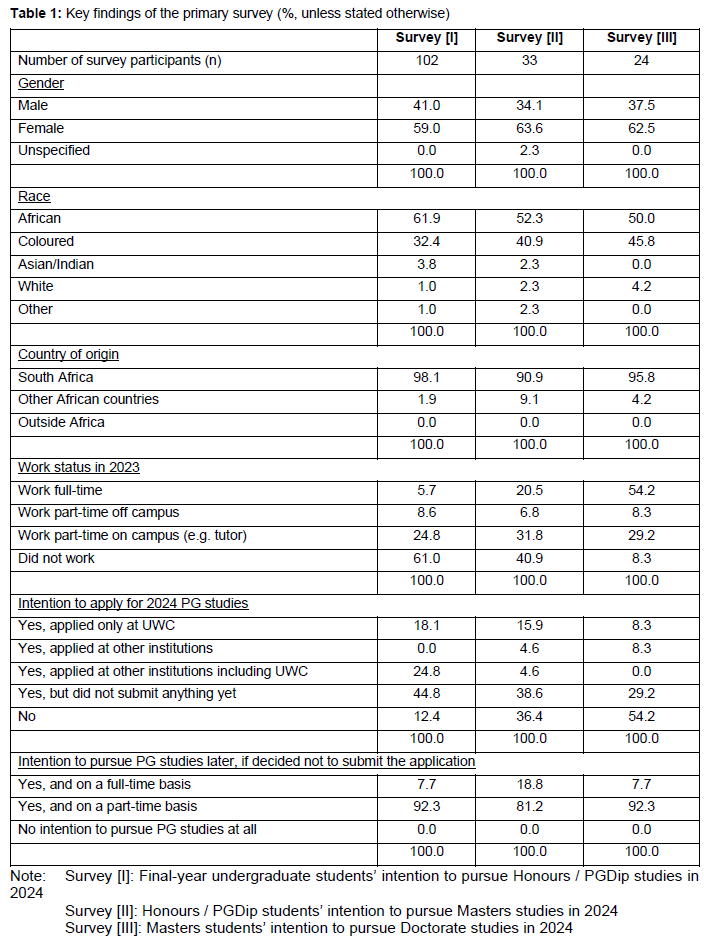
Table 1 shows that across all three levels, more females responded than males, and Africans dominated. Further, more than 90 per cent of respondents were South Africans. With regard to employment status, most final-year UG students did not work (61%), but the picture changed with Masters students. At this level of study, 54 per cent of survey participants had full-time jobs.
Only 12.4 per cent of final-year UG students indicated that they had no intention to apply for Honours or PGDip studies the following year, and an even higher percentage of 36.4 per cent of current Honours and PGDip students indicated no intention to continue with Masters studies. The highest percentage of students with no intention to pursue further studies were found amongst the Masters students, as 54.2 per cent said they have no intention to enrol PhD studies. The vast majority of students who did not want to continue with studies said if even they would continue with their studies, they would only do so on a part-time basis.
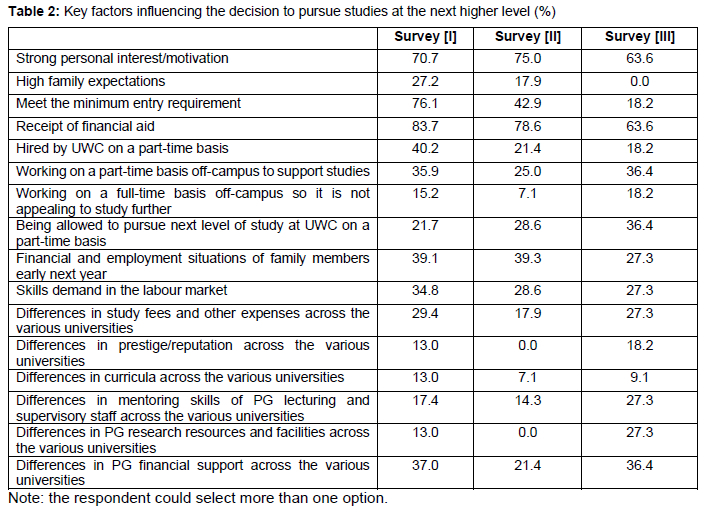
Table 2 presents results on students who indicated their intention to apply for a degree program in the following year. The top two reasons for their decision to want to continue are firstly, strong personal interest or motivation to further their studies and secondly, receipt of financial support. The top reasons listed aligns somewhat to the findings of Liu (2010) where the most significant reasons for pursuing PG studies were aspects such as intrinsic goals and access to good resources and support. For the final-year UG students, a third (although seemingly obvious) reason was that they met the minimum entry requirements for further studies (76.1%).
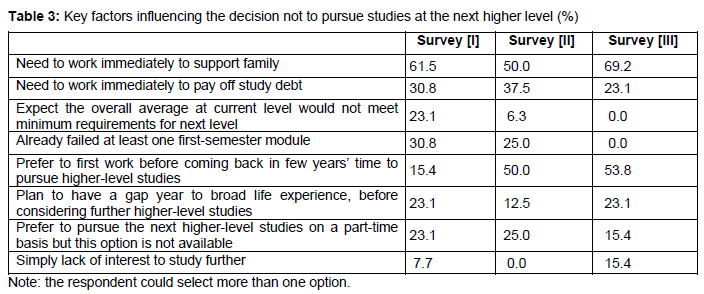
In Table 3, we interrogate students who indicated they had no intention of continuing with their studies. The top reason, as expected, given the economic conditions in South Africa, is that students need to find employment and stable incomes to support their families. The same reason was given by prospective Masters and PhD students as the main reason that they are unable to continue with further studies.
Another popular reason that appears in the latter two groups was the preference to experience other work environments (either public or private employment) before returning to their studies at a later date. This echoes the economic and financial conditions of many South Africans who prefer a stable income with a graduate degree over further PG studies. There may also be a need for universities to engage with the private and public sectors to develop areas where work in these sectors might be converted to a degree.
Findings on the financial aid receipt status of the 2019 postgraduate students
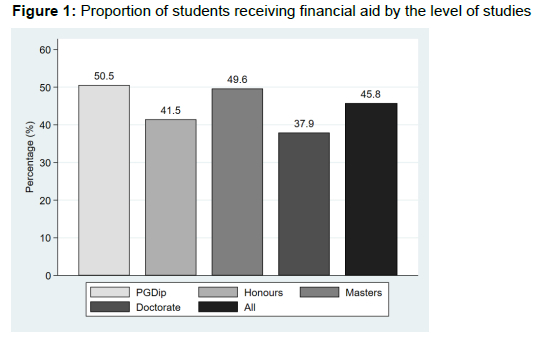
Figure 1 shows the proportion of students receiving financial aid by the level of study. Across all 2019 new PG EMS students, 45.8 per cent received some form of financial aid. This statistic is much lower than the near universal UG student financial support in the form of NSFAS aid. This is again an indication that the wider economic conditions, and the need to find employment is a bigger concern for students than the need for further education. In addition, out of all four PG levels, the proportion of students receiving financial aid was the highest at PGDip level (50.5%) but the lowest at PhD level (37.9%).
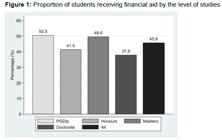
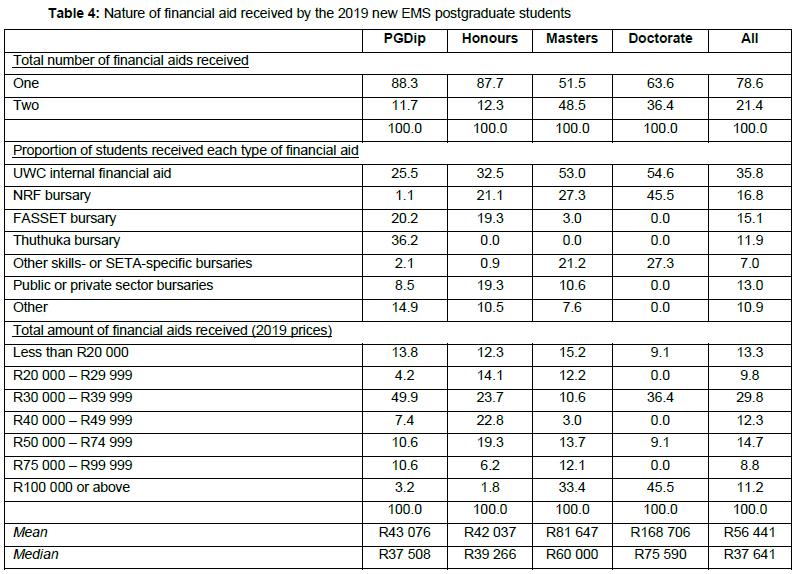
Table 4 investigates the nature of financial aid received. Almost half (48.5%) of Masters students received financial aid from more than one source. This could be attributed to the duration and costs associated with Masters studies. It may also be that funding sources changed during the first year of the studies. Another reason may be that students are more successful in finding more sources once the first source was secured.
The most prominent source of funding for the PGDip programmes is the NRF's Thuthuka bursary. This programme specifically supports students who pursue studies in Accounting. The Honours programme students are mostly supported by internal financial aid which indicates that for these programmes, it is difficult to find external sources of aid like NRF funding. Similarly, Masters students are also mostly supported by internal financial aid. This is further supported by most PhD studies being supported by the NRF and internal funding sources.
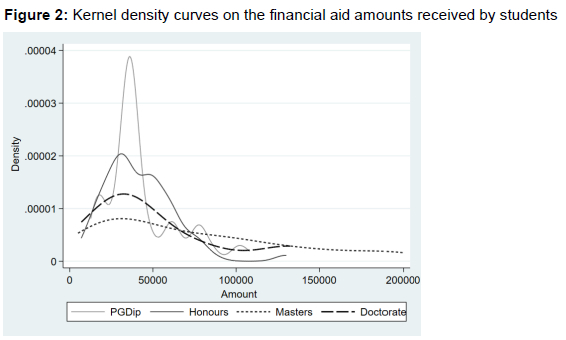
The mean amount of financial aid received was slightly over R40 000 for PGDip and Honours students, while the mean increased to R81 000 at Masters level and R168 000 at PhD level. These results are not surprising given the longer periods of funding, higher levels of education and the earlier finding that Masters and PhD students received funding/aid from more than one source. What should be noted is the bimodal nature of the PhD funding distributions; while the median amount received is high, some students received much less (about R35 000) whereas others received much more (R120 000 and above), as shown in Figure 2.
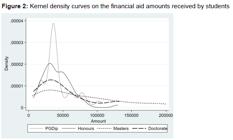
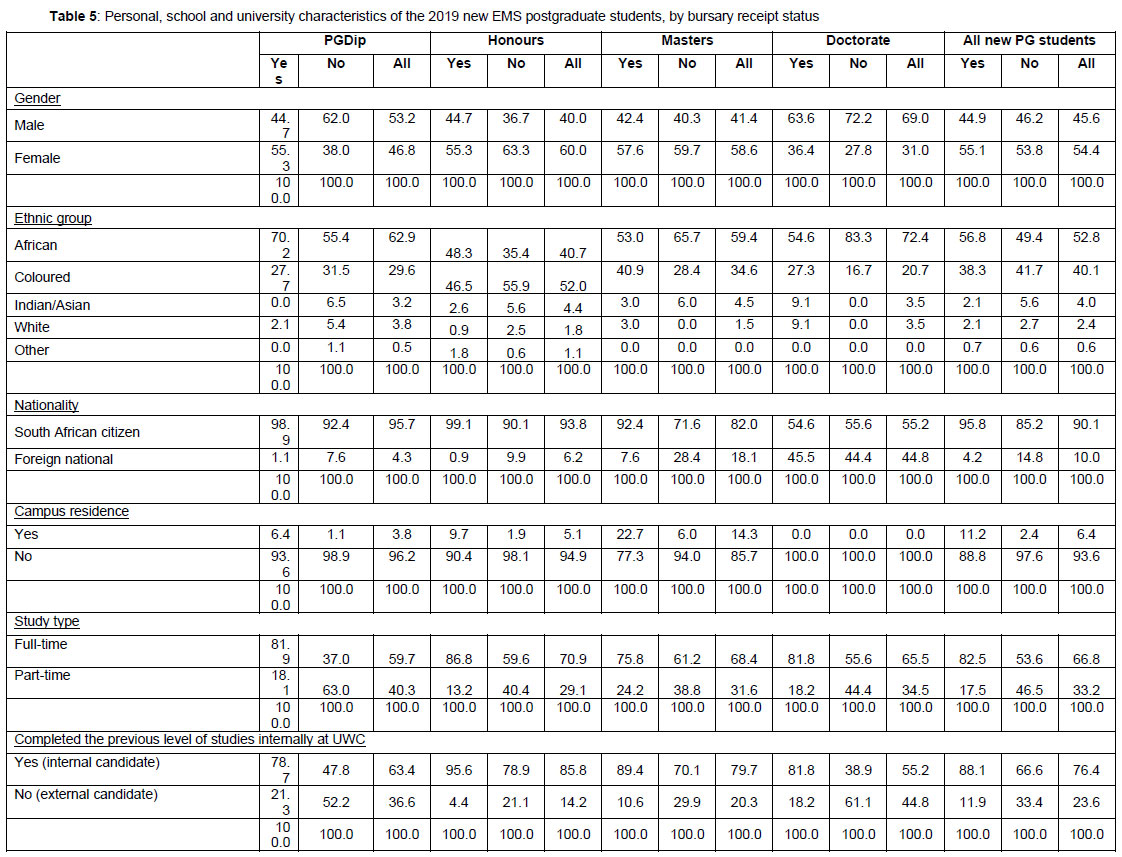
Table 5 shows that for all levels except PhD, more females than males received financial aid, and the majority of recipients were Africans for all levels. These findings are in line with the social justice theory that the previously disadvantaged population groups represented the majority of financial aid recipients to help them overcome the cost barriers to pursue PG studies. Regarding the PhD programmes, a higher share of foreign students are observed, but they still represented less than half of financial aid recipients. This, however, might be explained by the lower likelihood of local students continuing with studies until PhD level.
There are no key results with regard to campus housing, but more than 80 per cent of students who receive financial aid were full-time students. This finding may be explained by requirements of funding that want students to focus on studies and are precluded from working as well. This supports the fact that students need to support families, however, it also raises the question whether there is scope for financial support that allow students to spend part-time on their studies and part of their time in employment. Finally, most candidates who received financial aid were internal students who completed their previous level of studies at UWC.
To put these results in an international perspective, we compare the funding model in South Africa to Brazil, China, India, Germany and the United States of America (USA). While Germany and the USA benefit from "advanced economy" status and could therefore afford different funding structures, Brazil, China, and India are developing countries just like South Africa. In Brazil, the government introduced a new funding program like NSFAS called Fundo de Financiamento ao Estudante do Ensino Superior (FIES). It aimed to provide students from poor households access to higher education. However, Kussuda (2016) found that similar to South African students, Brazilian students who received aid from FIES would leave higher education as soon as possible to find employment.
In China, state funding has played a significant role in giving students access to higher education. Liu (2019) noted that the uptake of loans from the state remains low amongst poorer students and parents prefer to rely on family income to pay for the education of their children. In India too, government loans are the most popular form of support for students in engineering (Tilak, 2019), but students from lower socio-economic status tend not to take up these loans as they are risk-averse and unsure about the returns (Chandrasekhar, Rani and Sahoo, 2019).
In the USA, there are various funding opportunities for students, like Pell Grants and Loans, Student Parent loans and Stafford loans. The Stafford loans are closest to the funding provided in developing countries, with states providing guarantees for these loans. The aim in the USA is also to reach students from lower socio-economic status (Hu, 2019). However, evidence exists that student debt has a negative impact on income inequality in the US and higher student costs (Apergis, 2022). In Germany, higher education funding has changed significantly over the past two decades, with more Federal funding becoming available, particularly for quality research, women and internationalisation. Teichler (2016) suggested that student funding in Germany has largely been successful in achieving its targets in contrast to the other countries mentioned here. Apart from Germany, these comparisons suggest that the South African struggle with funding higher education is not a unique situation.
Findings on the academic performance of the 2019 postgraduate students
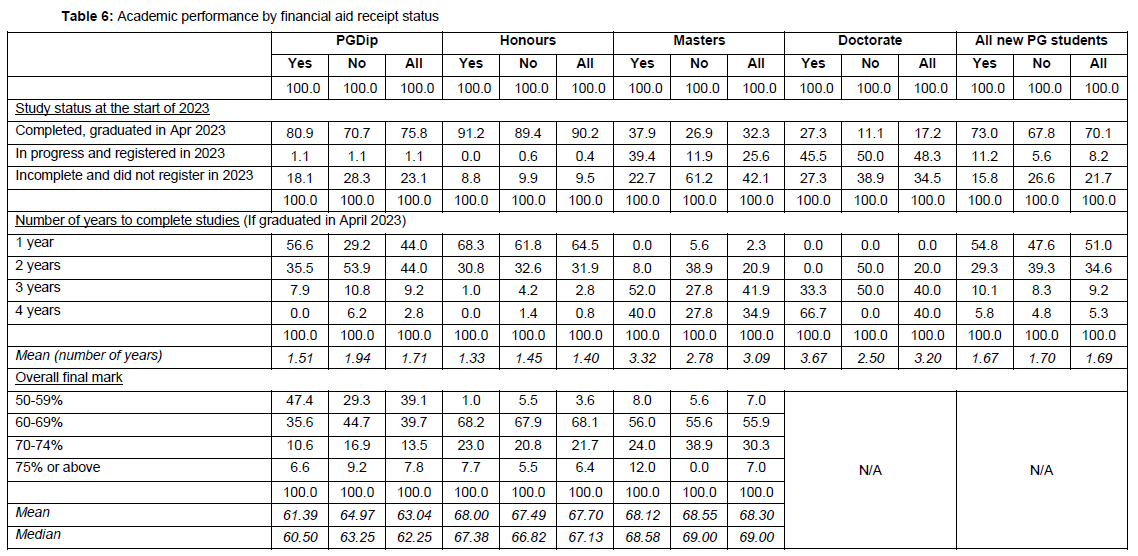
Table 6 presents the data on academic performance by financial receipt status. A notable outcome is the proportion of students who did not complete but re-registered as returning students in 2023 by financial aid status. Except for the Honours programme where there was not much difference between financial aid receipt (8.8% versus 9.9%) and an incomplete study status, all other levels present a stark difference in completion, in particular Masters. The study reviewed by Singell (2004) similarly showed the effectiveness of financial aid and its impact on the likelihood of re-enrolment decisions. The proportion of PGDip students who received financial aid and dropped out was 18.1 per cent, compared to 28.3 per cent of PGDip students who did not receive any financial aid and dropped out. It is a difference of more than 10 percentage points. However, this is lower than the difference noted for Masters and Doctorate studies.
At Masters and Doctorate levels, financial aid recipients were associated with a greater likelihood of completing their studies at the end of 2022 or before, compared with non-recipients (Masters: 37.9 per cent versus 26.9 per cent; Doctorate: 27.3 per cent versus 11.1 per cent). Alon (2007) likewise showed that grants and scholarships had a positive impact on graduation. At Masters level, the share of aid-receiving students who dropped out was 22.7 per cent, whereas an alarming 61.2 per cent of those who did not receive any aid dropped out. For Doctorate students, 27.3 per cent of aid-recipients dropped out whereas the corresponding dropout rate was 38.9 per cent for those who did not receive any financial support (i.e. a difference of 11.6 percentage points).
A different picture emerges if we only consider students who successfully graduated in or before April 2023. At the PGDip level, a much higher proportion of financial aid recipients finished their studies in one academic year (56.6%) compared with non-recipients (only 29.2%). On average it took 1.51 years for PGDip level financial aid recipients to complete their studies, compared with 1.94 years amongst the non-recipients (i.e. the difference of 0.43 years is more or less equivalent to one semester's duration). A similar finding is observed in Honours students; a higher proportion of these students who received financial aid completed their studies in one year (68.3%) compared with non-recipients (61.8%). These findings also align with other empirical studies reviewed earlier: aid recipients pass rates and completion of studies improved (Berlanga et al., 2016; Pillay et al., 2021; Frans and Rabie, 2022).
Nonetheless, there is no strong indication that financial aid recipients took significantly shorter time to complete Masters and Doctorate studies. The results must be interpreted with some caution though given the much smaller number of students at these levels (the number of students completed is even lower). Lastly, there appears to be no indication financial aid recipients obtained significantly higher overall average marks compared with non-recipients.
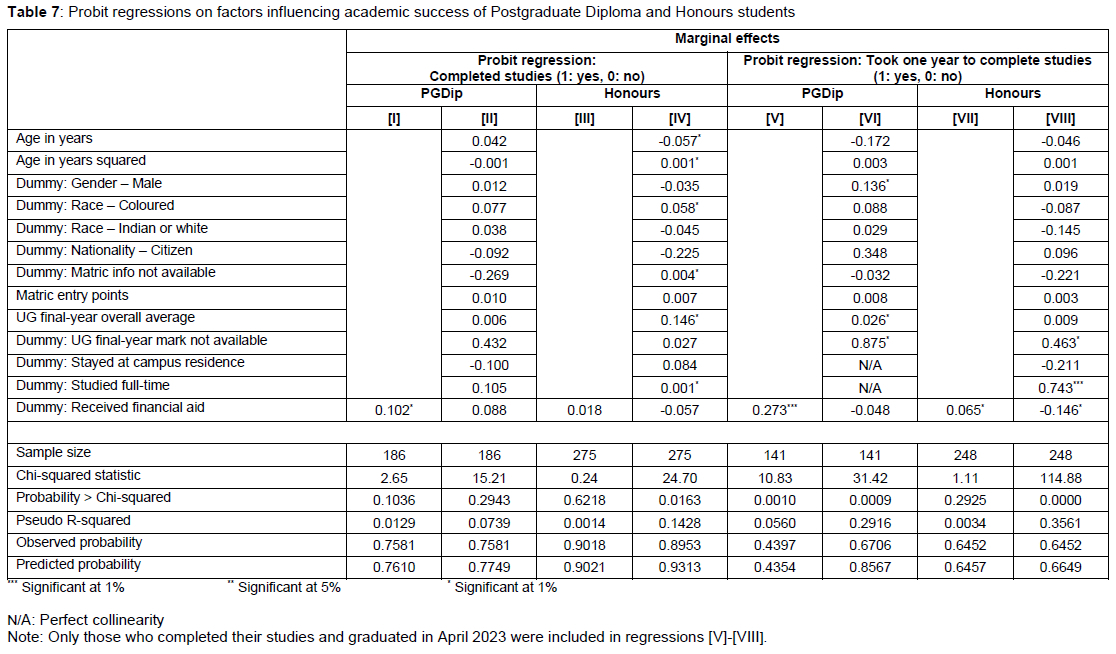
To determine the factors influencing the academic success of PGDip and Honours students, probit regressions were run and the results are presented in Table 7. Firstly, in the regressions [I], [III], [V] and [VII] the financial aid receipt dummy variable is included as the only explanatory variable. Regressions [I], [V] and [VII] demonstrate that receiving financial aid had a significant and positive impact on the likelihood of completing the studies and taking one year to complete the studies. The results are in line with contributions by Wildschut et al. (2020), Ostberg (1982), Coonrod (2008), Stater (2009) regarding the relationship between receipt of financial aid and students' academic performance.
In regressions [II], [IV], [VI] and [VIII], differences in other characteristics were controlled for. After controlling for these other characteristics in regression [II], the financial aid receipt dummy variable remained positive but the impact on the probability of completing PGDip studies became insignificant. This finding is in line with studies reviewed earlier (Naidoo and McKay, 2018; Nichols, 1980; Jones and Moses, 1984; Carlson, 2006).
For regression [IV], the financial aid receipt variable presented with a negative sign, which is contrary to what is expected and insignificant in its impact on the probability of completing Honours studies. The following explanatory variables that were significant at the 10% level include: age and age squared (where a convex relationship between age and probability of completing studies presents itself); Coloured dummy (positive); dummy variable that controls for Matric information not available in some students; UG overall average mark (positive) and the studying full-time dummy (positive). Wildschut et al. (2020) similarly found that being full-time had a positive and significant effect on academic performance.
The remaining probit regressions [VI] and [VIII] pertain to time taken to complete PGDip and Honours studies. Having controlled for differences in other characteristics, financial aid receipt dummy had a negative sign and once again an insignificant impact on the probability of completing the PGDip studies in one year. The explanatory variables that were significant at the 10 per cent level included the male dummy (positive marginal effects). Likewise, the dummy variable controlling for the UG overall average where not available in some students was positive. These are students who completed their UG studies at institutions other than UWC.
The final regression [VIII] again displayed a negative sign for the financial aid receipt dummy, when controlling for differences in other characteristics. While the result was significant in impact on the probability of completing Honours studies in one year, the level of significance was quite weak statistically at 9 per cent. Other significant explanatory variables include the dummy variable that controls for UG overall average not available in some students, as mentioned above these are students who completed the UG studies elsewhere, and the studying full-time dummy was significant and positive.
Overall, the explanatory variables that proved to be relatively more influential are firstly the UG overall average mark; secondly studying the PGDip/Honours full-time and lastly having received financial aid. These variables were significant in numerous regressions above.
CONCLUSION AND RECOMMENDATIONS
This study underscores the significant role of financial aid in influencing university students' decisions to pursue PG studies and their subsequent academic success. The findings reveal that financial aid acts as a critical enabler for students to continue their education beyond the UG level, particularly in an environment characterized by economic challenges, such as that of South Africa. Key determinants for pursuing PG studies include strong personal motivation, high family expectations, meeting academic entry requirements, and financial aid availability. Conversely, the primary barrier for students opting out of further studies is the pressing need to secure stable employment to support their families financially. This therefore affirms that household financial security associated with entering the world of work, trumps students' decisions to undertake PG studies.
The study also demonstrates that receipt of financial aid is associated with a higher probability of students completing their PG studies as well as shorter completion time, most notably at PGDip level (aid recipients completed their studies half a year shorter than non-recipients).
The multivariate econometric analysis shows that personal characteristics (e.g. age, gender and ethnic group) and UG academic performance remain significant explanatory variables which accounted for students' PG academic success. Based on these findings, we conclude that a complex dynamic amongst both academic and non-academic factors exist, which are relevant in affecting students' decision to pursue PG studies and their academic success. Among these, receipt of financial aid is the key.
The study therefore emphasizes the importance of financial aid, not only in supporting access to PG education, but also enhancing academic success. Policymakers and higher education institutions must consider expanding financial aid beyond UG programmes as a strategic investment in educational equity and academic excellence. There is a clear value proposition to this, given that the extant literature makes a link between PG output and economic progression. As such a greater investment into PG funding, at a level similar to that of the NSFAS in South Africa, is clearly a strategy worth pursuing to alleviate poverty and inequality.
REFERENCES
ACKNOWLEDGMENT
The authors would like acknowledge the data assistance provided by Niyaaz Davids
LITERATURE REVIEW
-
Al-Kubaisi, Huda. 2022. "Upgrading: An analysis of financial aids and academic performance at Qatar University." TEM Journal 11(2): 639-650. https://doi.org/10.18421/TEM112-18
» https://doi.org/10.18421/TEM112-18 -
Alon, Sigal. 2007. "The influence of financial aid in levelling group differences in graduating from elite institutions." Economics of Education Review 26(2007): 296-311. http://dx.doi.org/10.1016/j.econedurev.2006.01.003
» http://dx.doi.org/10.1016/j.econedurev.2006.01.003 -
Apergis, Nicholas. 2022. "College student loan debt and income inequality in the US: national and regional evidence." Journal of Economic Studies 50(6): 1210-1225. https://doi.org/10.1108/JES-05-2022-0287
» https://doi.org/10.1108/JES-05-2022-0287 - Becker, Gary. 1962. "Investment in human capital: a theoretical analysis." Journal of Political Economy 70(5): 9-49.
- Berlanga, Vanesa., Pilar Figuera, and Nuria Perez-Escoda. 2016. "Academic performance and persistence of study bursary holders." Revista de Cercetare si Interventie Sociala 54(1): 23-35.
-
Blackmur, Douglas. 2023. "A social justice policy framework for funding the acquisition of higher education qualifications in South Africa." South African Journal of Higher Education 37(6): 41-55. https://dx.doi.org/10.20853/37-6-6112
» https://dx.doi.org/10.20853/37-6-6112 -
Callender, Claire, and Jonathan Jackson. 2008. "Does the fear of debt constrain choice of university and subject of study?" Studies in Higher Education 33(4): 405-429. https://doi.org/10.1080/03075070802211802
» https://doi.org/10.1080/03075070802211802 -
Callender, Claire, and David Wilkinson. 2013. "Student perceptions of the impact of bursaries and institutional aid on their higher education choices and the implications for the national scholarship programme in England." Journal of Social Policy 42(2): 281-308. https://doi.org/10.1017/S0047279412000992
» https://doi.org/10.1017/S0047279412000992 - Carlson, Corey. 2006. "Academic performance of students who receive need-based financial aid." OTS Master's Level Projects and Papers. 108. Norfolk: Old Dominion University.
-
Casey, Bernard. 2009. "The economic contribution of PhDs." Journal of Higher Education Policy and Management 31(3): 219-227. https://doi.org/10.1080/13600800902974294
» https://doi.org/10.1080/13600800902974294 - Chandrasekhar, Sethumadhavan, Geetha Rani, and Soham Sohoo,. 2019. "Household expenditure on Higher Education: What do we know and what do recent data have to say?" Economic & Political Weekly 54(20): 52-60.
- Chang, Victor, Yian Chen, and Chang Xiong. 2018. "Dynamic interaction between higher education and economic progress: a comparative analysis of BRICS countries." Information Discovery and Delivery 46(4): 225-238.
- Coonrod, Lane. 2008. "The effects of financial aid amounts on academic performance" The Park Place Economist 16(1): 24-35.
-
De Zoysa, Srini. 2008. "Factors affecting the completion of postgraduate degrees using distance mode." Unpublished study. [Online.] Available: https://wikieducator.org/images/a/a0/PID_383.pdf (Accessed: 27 September 2022).
» https://wikieducator.org/images/a/a0/PID_383.pdf - Deci, Edward, and Richard Ryan. 1985. "Intrinsic motivation and self-determination in human behaviour." New York: Plenum.
- Department: Higher Education and Training (DHET). 2013. "White Paper for Post-School Education and Training." Pretoria: Department: Higher Education and Training.
- Dynarski, Susan. 2003. "Does aid matter? Measuring the effect of student aid on college attendance and completion." American Economic Review 93(1): 279-288.
- Epple, Dennis, Richard Romano, and Holger Sieg. 2003. "Peer effects, financial aid, and selection of students into colleges and universities: An empirical analysis" Journal of Applied Econometrics 18(5): 501-525.
- Fomunyam, Kehdinga George. 2020. "The implications of funding on enrolment rates of international postgraduate students: The case of engineering students." International Journal of Engineering Research and Technology 13(7): 1567-1574.
- Frans, Ilse, and Babette Rabie. 2022. "An evaluation of the Thuthuka Bursary Fund Programme at Stellenbosch University." Administratio Publica 30(2): 148-167.
-
Glocker, Daniela. 2011. "The effect of student aid on the duration of study." Economics of Education Review 30: 177-190. https://doi.org/10.1016/j.econedurev.2010.08.005
» https://doi.org/10.1016/j.econedurev.2010.08.005 -
Hadi, Noor, and Barudin Muhammad. 2019. "Factors influencing postgraduate students' performance: A high order top down structural equation modelling approach." Educational Sciences: Theory and Practice 19(2): 58-73. http://dx.doi.org/10.12738/estp.2019.2.004
» http://dx.doi.org/10.12738/estp.2019.2.004 -
Hu, Xiaoqi. 2019. "Comparison of Higher Education funding systems between China and the United States." Open Journal of Social Sciences 7(1): 150-159. https://doi.org/10.4236/jss.2019.74013
» https://doi.org/10.4236/jss.2019.74013 - Ismail, Affero, Norhasni Zainal Abiddin, and Aminuddin Hassan. 2011. "Improving the development of postgraduates' research and supervision." International Education Studies 4(1): 78-89.
-
Jaffe, Klaus, Enrique Ter Horst, Laura Gunn, Juan Diego Zambrano, German Molina. 2020. "A network analysis of research productivity by country, discipline, and wealth." Plos One 15(5): e0232458. https://doi.org/10.1371/journal.pone.0232458
» https://doi.org/10.1371/journal.pone.0232458 - Jones, Bonnie, and Polly Moss. 1994. "The influence of financial aid on academic performance and persistence in medical school." Journal of Student Financial Aid 24(3): 5-11.
-
Koen, Charlton, Mlungisi Cele, and Arial Libhaber. 2006. "Student activism and student exclusions in South Africa." International Journal of Educational Development 26: 404-414. https://doi.org/10.1016/j.ijedudev.2005.09.009
» https://doi.org/10.1016/j.ijedudev.2005.09.009 - Knowles, John. 2000. "Access for few? Student funding and its impact on aspirations to enter higher education." Widening Participation and Lifelong Learning 2(1): 14-23.
- Kussuda, Cintia. 2016. "The struggles of financial aid for Higher Education in Brazil." eJournal of Education Policy.
-
Lepine, Andrea. 2019. "Financial aid and student performance in college: Evidence from Brazil." Brazilian Review of Econometrics 38(2): 221-245. https://doi.org/10.12660/bre.v38n22018.75505
» https://doi.org/10.12660/bre.v38n22018.75505 -
Liu, Jie. 2010. "The changing body of students: A study of the motives, expectations and preparedness of postgraduate marketing students." Marketing Intelligence and Planning 28(7): 812-830. https://doi.org/10.1108/02634501011086436
» https://doi.org/10.1108/02634501011086436 -
Liu, Jingjing. 2019. "A Quantitative Study on Student Financial Aid of a Local Undergraduate College in China." World Journal of Education 9(6): 7-14. https://doi.org/10.5430/wje.v9n6p7
» https://doi.org/10.5430/wje.v9n6p7 -
Lo, Man Fung, and Feng Tian. 2020. "Enhancing competitive advantage in Hong Kong higher education: Linking knowledge sharing, absorptive capacity and innovation capability." Higher Education Quarterly 74(4): 426-441. https://doi.org/10.1111/hequ.12244
» https://doi.org/10.1111/hequ.12244 - Mabeba, Selaelo, and John Mamokhere, J. 2021. "The impact of financial aid services in the institutions of higher learning in South Africa." African Perspectives of Research in Teaching and Learning 5(1): 178-193.
- Mafilika, V., B. D. Nkgabe, A. Miselo, T. Klaas, and R. Maluleka. 2024. "The determination of household income for unverified parental relationships for students applying for the National Student Financial Aid Scheme (NSFAS) Funding". National Student Financial Aid Scheme (NSFAS) Research Report May 2024. Cape Town: NSFAS.
- Mngomezulu, Samukelisiwe, Rubby Dhunpath, and Nicholas Munro. 2017. "Does financial assistance undermine academic success? Experiences of 'at risk' students in a South African university." Journal of Education 68(1): 131-148.
- Mokgotho, Manoko. 2022. "The effectiveness of National Student Financial Aid Scheme towards student skills development at the University of Limpopo, South Africa." Unpublished Masters mini-thesis. Polokwane: University of Limpopo.
-
Moores, Elisabeth, and Adrian Burgess. 2023. "Financial support differentially aids retention of students from households with lower incomes: a UK case study." Studies in Higher Education 48(1): 220-231. https://doi.org/10.1080/03075079.2022.2125950
» https://doi.org/10.1080/03075079.2022.2125950 -
Naidoo. Anban, and Tracey McKay. 2018. "Student funding and student success: A case study of a South African university." South African Journal of Higher Education 32(5): 158-172. http://dx.doi.org/10.20853/32-5-2565
» http://dx.doi.org/10.20853/32-5-2565 - National Planning Commission (NPC). 2014. "Our future - make it work. National Development Plan 2030." Pretoria: Department: The Presidency.
- Nichols, Edward. 1980. "Financial aid awards: Predictors of Grade-Point Averages." Journal of Student Financial Aid 10(3): 33-43.
- Ostberg, Kenneth. 1982. "An examination of the relationship between various methods of financing college costs and academic achievement." Journal of Student Financial Aid 12(3): 7-15.
- Pillay, Neryvia, Haroon Bhorat, and Zaakhir Asmal. 2021. "Higher education outcomes in South Africa: The role of the National Student Financial Aid Scheme." In Pearson Jr, W. and Reddy, V. (Eds.), Social justice and education in the 21st century: Research from South Africa and the United States. Cham: Springer: 171-194.
-
Rattini, Veronica. 2023. "The effects of financial aid on graduation and labor market outcomes: New evidence from matched education-labor data." Economics of Education Review 96: 102444. https://doi.org/10.1016/j.econedurev.2023.102444
» https://doi.org/10.1016/j.econedurev.2023.102444 - Siegfried, John, and Rendigs Fels. 1979. "Research on teaching college economics: A survey." Journal of Economic Literature 17(3): 923-969.
-
Singell, Larry. 2004. "Come and stay a while: Does financial aid effect enrollment and retention at a large public university?" Economics of Education Review 23(5): 459-471. https://doi.org/10.1016/j.econedurev.2003.10.006
» https://doi.org/10.1016/j.econedurev.2003.10.006 - Sokhweba, Xolela. 2022. "The impact of National Student Financial Aid Scheme on students' access to tertiary education in a selected university in the Western Cape." Unpublished Masters thesis. Cape Town: Cape Peninsula University of Technology.
-
Soria, Krista, Brad Weiner, and Elissa Lu. 2014. "Financial decisions among undergraduate students from low-income and working-class social class backgrounds." Journal of Student Financial Aid 44(1): 1-23. https://doi.org/10.55504/0884-9153.1037
» https://doi.org/10.55504/0884-9153.1037 - Spence, Michael. 1973. "Job market signalling." Quarterly Journal of Economics 87(3): 355-374.
-
Stater, Mark. 2009. "The impact of financial aid on college GPA at three flagship public institutions." American Educational Research Journal 46(3): 782-815. https://doi.org/10.3102/0002831208329903
» https://doi.org/10.3102/0002831208329903 - Statistics South Africa (StatsSA). 2024. "2024 Quarterly Labour Force Survey: First Quarter. Statistical Report." Pretoria: Statistics South Africa.
-
Steiner, Viktor, and Katharina Wrohlich. 2012. "Financial student aid and enrollment in higher education: New evidence from Germany." Scandinavian Journal of Economics 114(1): 124-147. https://doi.irg/10.1111/j.1467-9442.2011.01669.x
» https://doi.irg/10.1111/j.1467-9442.2011.01669.x - Sten-Gahmberg, Susanna. 2020. "Student heterogeneity and financial incentives in graduate education: evidence from a student aid reform." Education Finance and Policy 15(3): 543-580.
-
Teichler, Ulrich. 2018. "Recent changes of financing higher education in Germany and their intended and unintended consequences." International Journal of Educational Development 58: 37-46. https://doi.org/10.1016/j.ijedudev.2016.10.008
» https://doi.org/10.1016/j.ijedudev.2016.10.008 -
Tilak, Jandhyala B.G. 2020. "How do students fund their higher education in India? A study of loan financing in engineering education." Journal of Higher Education Policy and Leadership Studies 1(1): 4-24. http://dx.doi.org/10.29252/johepal.1.1.4
» http://dx.doi.org/10.29252/johepal.1.1.4 - University of the Western Cape. 2023. "UWC 2023 General Calendar." Bellville: University of the Western Cape.
-
Wildschut, Angelique, Ebenezer Megbowon, and Amanda Miselo. 2020. "Impact of funding on academic performance: An exploration of two South African universities." Journal of Education 81(2): 29-49. http://dx.doi.org/10.17159/2520-9868/i81a02
» http://dx.doi.org/10.17159/2520-9868/i81a02 -
Witteveen, Dirk. 2023. "The effects of undergraduate financing on advanced degree attainment." Social Forces 101(3): 1258-1287. https://doi.org/10.1093/sf/soac044
» https://doi.org/10.1093/sf/soac044