Do academics find it easy to use e-learning tools?
Abstract
To improve the level of instruction and learning, e-learning has the potential to increase knowledge and skills. According to research, most e-learning systems demonstrate a poor understanding of pedagogy and fundamental flaws in their methods of delivering information. This research seeks to identify a pedagogical viewpoint when designing e-learning solutions. In a higher education environment, technology can encourage active participation in the learning process, which is often challenging to manage in traditional lecturing. Technology allows students to pace their learning by providing unlimited access to content. This study explores academics' perceptions, viewpoints and readiness for the acquisition, adoption and implementation of e-learning to support teaching and learning at Orbit TVET College. The primary goals of the study were to examine the e-learning strategies employed, the interventions implemented for effective teaching and learning as well as the various forms of e-learning the College may employ. The study adopted a qualitative approach, using semi-structured interviews to investigate the e-learning methods employed at the College. This included identifying the effectiveness of the methods used, the challenges that the academics are facing and also the support they get from the management of the college. The purposive sampling method was used to develop a sample of the research under discussion. This method selected sample members based on their knowledge and expertise regarding a research subject. The sample frame for this research included 12 respondents from Orbit TVET College in the North West Province, concentrating only on the following groups, three groups consisted of four lecturers in the three campuses of Orbit TVET College, in Brits (64 lecturers), Mankwe (77 lecturers) and Rustenburg (91 lecturers). The interviews were the principal instruments for data collection. The qualitative data gathered were transcribed using Atlas.ti and analysed using thematic analysis. The findings revealed that the academics at Orbit TVET College know about e-learning and the training conducted but e-learning is not effectively used. The system is there but not effective. In order to successfully educate and learn, the academics at Orbit TVET College need to use a variety of instructional e-learning techniques, which is the focus of this study. The study recommend that it should be mandatory that academics use the system and further training be provided to all the lecturers working at Orbit TVET.
e-learning tools; TVET Colleges; e-learning technigues; technology; pedagogy
INTRODUCTION AND/OR BACKGROUND
E-learning helps to make information accessible to learners. E-learning open new doors for government institutions such as health, as well as for business. Yusuf, and Nisreen (2013:173-180) states that there has been an educational change towards e-learning, which has enabled the use of information and communication technology and the inclusion of the internet in teaching and learning. However, it must be used effectively to realise the full benefits of technology in improving education.
Education stakeholders, such as academics in training and vocational education and training (TVET) institutions, need to play a part in using technology to enhance the learning experience that TVET Colleges offers. The Data and Information Unit at Orbit TVET College works towards improving the Business Management System (BMS) from version 3 to integrator 4.1 Mboweni (2018). With this upgrade of the BMS, the College has taken a step towards a more web-based system that promotes easier accessibility for users at any given time and allows the College to participate in the Fourth Industrial Revolution (4IR) practices.
Technology has the potential to be a powerful ally in education. It can improve communication and relationships between students and educators; can also change their approach to instructing students (Van Der Walt, Lizanne, 2022), contribute to the effective management and deployment of e-learning platforms and practices and consequently, to the improvement of strategies for decision-making about the use of technologies in the future.
PURPOSE OF THE STUDYThis study explores academics' perceptions, viewpoints and readiness for the acquisition, adoption and implementation of e-learning to support teaching and learning at Orbit TVET College.
Following on this introduction, the article will present the review of the literature, followed by the theoretical framework upon which the research question hinges. This will be followed by the research methods that were used to collect and analyse the data. Then a presentation of the results is followed by a discussion of the results and how they link to the literature. Finally, we shall present a conclusion drawn from the results and areas for further research.
CONTEXT OF THE STUDYAbout Orbit TVET College
Orbit TVET College is in the North West Province and specialises in skills development. The College consists of a head office in Rustenburg, which handles all administration for the three campuses located in Brits, Rustenburg and Mankwe. Each Orbit campus has adapted well to the communities in which it is situated and provides a unique experience for every student. The College is one of the colleges currently introducing digital methodology into its programme delivery (Viljoen 2020:1). This study assesses the perception of academic staff on the three campuses regarding the use of e-learning. Colleges cannot function without the technological innovations that will influence their ability to deliver educational content to more applicants. Despite the benefits of using the internet and technological advances, most TVET College staff do not apply technology effectively in their instructional delivery. Some still use face-to-face methods, without combining them with e-learning to discuss assignments and communicate with their students.
E-learning and its efficacy
E-learning plays an important role in the higher education sector. Research on e-learning covers various fields, such as education, information technology and online learning. According to Guar (2015:30), there are different aspects of e-learning in research. It combines technology and specially designed learning materials. In simple terms, online education is called e-learning. According to Algahtani, Abdullah (2011:36), considerable debate has been had about a comprehensive definition of e-learning. Existing definitions reflect the researcher's specialisation and are not generally applicable. However, according to Arkorful, and Abaidoo (2015:29-42):
"e-learning refers to using ICT to enhance and support learning in tertiary education. This covers a wide range of systems, from students using e-mail and accessing course work online while following a course on campus to programs entirely online."
One of the benefits of e-learning is its capacity to help to manage the current explosion of knowledge and to meet the growing demand for education (Faleh and Aborumman, 2011:57). E-learning is learning by means of electronic technologies and accessing an educational curriculum outside of a traditional classroom. It refers mainly to a course or a program delivered entirely online. E-learning is mostly interactive learning online, in which the students can communicate with one another and ask the lecturer questions. E-learning also takes place when pre-recordings of topics are made by lecturers, with the assistance of diagrammatic presentations; when students watch films, like features and documentaries on curriculum topics, accessing activities graded at different levels, e.g. in mathematics or online debates. E-learning has been proven to be an efficient way of studying (elearninggvc.gov).
Learners can access the information from anywhere, at any time and according to the learner's convenience. This is one of the aspects of e-learning that classroom learning cannot compete with. In sum, research suggests that the potential benefits of e-learning are greater than those of traditional learning as long as e-learning is used and applied appropriately. TVET colleges need to keep up with the changes in communication and information technology (ICT), especially during possible future pandemics. It is essential for them to adapt their platforms of e-learning in order to improve teaching and learning and also to uplift the level of access and success for students. E-learning can be extremely beneficial to employees who are studying. There are many practical difficulties in implementing e-learning programs in TVET Colleges, mainly due to a lack of resources (Muhmud and Gope, 2009:155-159)).
The technological dimension of the e-learning framework examines infrastructure issues in e-learning environments (Rhema and Miliszewska, 2010:423-437), including infrastructure planning, hardware and software (Khan et al, 2003: 118-121). Another factor related to technology is software and interface design, which refers to the overall look and feel of e-learning programs. Therefore, educational software should be easy to use and LMSs should support the selected learning models and pedagogies. Sife, Lwoga and Sanga (2007: 57-67) state that adequate technical support is an important part of implementing and integrating ICT and e-learning in an education system.
E-learning plays an important role in the higher education sector. Research on e-learning covers various fields, such as education, ICT and online learning. According to Guar (2015:30), there are different aspects of e-learning in research. It combines technology and specially designed learning materials. In simple terms, online education is called e-learning. One of the benefits of e-learning is its capacity to help to manage the current explosion of knowledge and to meet the growing demand for education (Faleh and Aborumman, 2011:57).
GROWTH OF E-LEARNING
According to Nagar, Sushma, Rathiesh and Sekar (2015: 1362-1368), e-learning or electronic learning rapidly changes the educational scenario. ICT has opened up new possibilities for experiments in teaching and learning methods, making education more interesting. The newness and the growing availability of computers have allowed educators to design more carefully how to teach (Livingstone, 2012:9-14) argue that educators should not simply recreate the traditional classroom but take advantage of what new communication and ICT offers. Wang and Woo (2011: 1 -26) claim that a Facebook group had the potential to be used as a Learning Management System (LMSs).
Methods of e-learning
According to Algahtani (2011:51), e-learning can be divided into computer-based and internet-based learning. Computer-based learning involves using the range of hardware and software generally available for ICT use and each component can be employed in one of two ways: "computer-assisted learning" and "computer-managed instruction".
Problems of e-learning
Researchers such as Leary, Mark and Tate (2007: 251-255) reveal that the challenge of e-learning is the time required to develop and maintain an e-learning course. A study conducted by Nasser, Maha and Romanowski ((2011:39-62)) notes that students complained about their lack of ICT knowledge and that lecturers provided little support in that area. The problem is that lecturers also lack time to teach students computer skills, so they face challenges. Asiri, Mohammed, Mahmud, et al (2012: 525-534) reveal that staff members' acceptance of technology undoubtedly also plays a key role in the optimal operation of Learning LMS in higher education.
The technological dimension of the e-learning framework examines infrastructure issues in e-learning environments (Rhema and Miliszewska, 2010: 423-437), including infrastructure planning, hardware and software (Khan, 2003 et al:118-121). Another factor related to technology is software and interface design, which refers to the overall look and feel of e-learning programs. Therefore, educational software should be easy to use and LMS should support the selected learning models and pedagogies. Sife, Lwoga and Sanga (2007: 57-67) state that adequate technical support is an important part of implementing and integrating ICT and e-learning in an education system.
THEORETICAL FRAMEWORKAccording to many scholars, existing theories of learning can be integrated, altered and directly applied to online learning (Pange, Apostolia and Jenny Pange 2011:933). Given that academics do not coexist in the same physical setting, this research aimed to assess academics' perceptions of using e-learning for successful teaching by examining the following perceived ease of use (PEOU). Percieved ease of use (PEOU) refers to the degree to which a person believes that using a particular system would be free of effort (Sternad, Simona and Bobek, 2014: 389-415).
The study explores academics' perceptions, viewpoints and readiness for the acquisition, adoption and implementation of e-learning to support teaching and learning at Orbit TVET College. This was done under the following objectives:
• To explore the academic perceptions of using e-learning for successful teaching and learning at Orbit TVET College.
• To investigate the e-learning methods used by the academics at Orbit TVET College.
• To identify interventions and strategies that the College had in place to support e-learning.
RESEARCH METHODSResearch approach
This study adopted a qualitative research approach in order to explore academics' perceptions, viewpoints and readiness for the acquisition, adoption and implementation of e-learning to support teaching and learning at Orbit TVET College.
Research design
Using technology to conduct interviews, a qualitative design was applied for data collection.
Data collection instruments and procedures
The instrument that was used to collect data was the interview guide. Data were collected through online interviews using an interview guide to allow the respondents to respond in a chosen format (Salmons, 2012:109). The interviews were conducted using the Microsoft Team's application, with recording and transcription enabled so that the researcher could also assess nonverbal cues. All the sessions were recorded to facilitate the data analysis process.
Sampling
The purposive sampling method was used to develop a sample of the research under discussion. This method selected sample members based on their knowledge and expertise regarding a research subject. The sample frame for this research included 12 respondents from Orbit TVET College in the North West Province, concentrating only on the following groups: three groups consisted of four lecturers in the three campuses of Orbit TVET College in Brits (64 lecturers in total), Mankwe (77 lecturers in total) and Rustenburg (91 lecturers in total).
Data were collected through online interviews using an interview guide to allow the respondents to respond in whatever format they chose (Salmons, 2012:109). The data collected was based on interviews with 12 respondents (4 lecturers on each campus) Brits, Mankwe and Rustenburg. The respondents were lecturers teaching NCV Life Skills, NCV Business Studies and Report 191 at Orbit TVET College in the North West.
Data analysis
The method chosen for this study is a qualitative approach and thematic analysis was the type of analysis conducted. The thematic analysis produces and presents data effectively to detect and identify elements and variables that influence any issue from the interviews. (Clarke, Victoria, Braun and Hayfield, 2015:222-248). The researcher used ATLAS.ti Software for this research as there was a large amount of interview data to manage. The document to be analysed was saved in a text format. According to Friese (2019:5), ATLAS.ti can handle text files only, and the file must be saved in a required format.
FINDINGS
-
Definition of e-learning
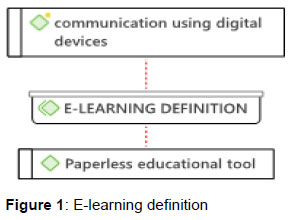
Eleven (11) academics explained e-learning as information delivery and training through a digital resource conducted electronically via Microsoft Teams or Zoom. Only one lecturer explained it differently as a paperless educational tool. Some of their responses are shown below:
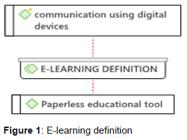
Based on the interviews, almost all the participants understood e-learning as a communication using digital devices. One of the participants explained it saying:
"I understand that e-learning is a paperless educational tool which enables teaching and learning to take place using various ways of connectivity. For instance, Internet connections and it is one way, which is limitless. You can have a class with any student around the world, it is not limited like the physical facilities."
Almost all of the participants refers to e-learning as using any type of digital gadget, including computers and cell phones. Others said it is learning through various software tools and a lesson that is delivered electronically using Microsoft Teams or Zoom. It is a method of learning in which one or more electronic devices are used to improve teaching and learning. It is the process of facilitating learning through computers. By using a computer system, a search engine, the internet and videos, e-learning is the type of communication-based education. One participants also stated that:
"In e-learning, or electronic learning, we instruct pupils facelessly and virtually, without actually seeing them in person. The students are learning from home and away from the campus thanks to electronic teaching and learning."
PERCEPTIONS OF THE EFFECTIVENESS OF E-LEARNING
The academics at Orbit TVET College agreed about the effectiveness of e-learning. They believed that students' lack of resources and poor connectivity were issues.
One participant expressed the view that:
I think it is effective even though to a certain degree because there are number of things that are still outstanding that needed to be incorporated to have a holistic e-learning platform that will ensure that we, as an institution we are aligned with the 4th Industrial Revolution and completely, where we can having both a physical contact and online contact at the same time. I think it still needs improvement. There are certain things, especially the lecturer rooms they need to be equipped with a technological tool that will allow that.
Academics emphasized a lack of engagement. One of the participant said:
"I believe it's very effective and efficient in the sense that they are able to utilize it on a daily basis, they are able to buy data for WhatsApp because it's not that expensive. Yeah, so it is effective, the WhatsApp group. We are communicating with our students on a daily basis, it is very effective."
They added that they did not think online education was efficient. The need for training was also mentioned as a requirement for success. They asserted that it was discussed and that academic subjects were taught, but the majority insisted they were not utilizing it to instruct students. Another participant expressed the view that:
"It is effective in the way. We had challenges with our students who do not have the resources, some students were complaining about the network, data and some would say they do not have laptops because some other information you cannot use your phone. But I think the methods that we are using they are very much effective because like I said earlier we can be able to reach out to our students through all those methods. They we cannot, we cannot reach them throughout their emails and then the WhatsApp and then the portal as well. You are able to make announcements on the portal whereby students they can access the information quite well."
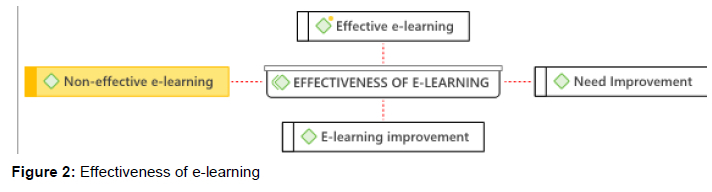
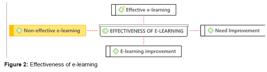
The researcher identified the theme effectiveness of e-learning and four sub-themes in the effectiveness of e-learning as illustrated in Figure 2. The sub-themes identified were effectiveness of e-learning, non-effective of e-learning, e-learning improvement and e-learning need improvement. Seven academics out of 12 said that e-learning is effective, three said it needed improvement and two said it is not effective, which shows that most academics were positive about the effectiveness of e-learning.
GROWTH OF E-LEARNING
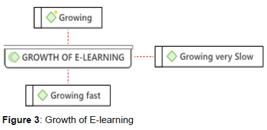
Six academics said that e-learning is not growing at Orbit:
Other participants expressed the view that:
"At orbit it is growing, but the pace is a bit slow because we are forever taken for training and there is no follow up to make it a point that we are practicing that which we have been taught. But I think going forward the management must look into making it a mandatory for both learners and educators to use the program. I can say is growing fast. What I can say is that the limitation of the resources is holding our hands to move on and depending on number of student that we have, we don't afford to use it actually, at the moment we don't have equipped digital learning classroom, we have minimum resources."
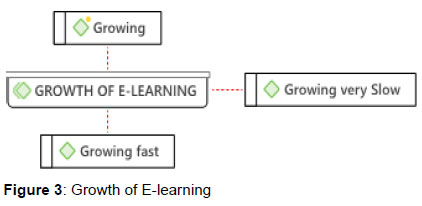
According to the respondents' responses to the research mentioned in the above Figure 3, the theme growth of e-learning was formulated followed by three sub-themes:
Based on the themes and sub-themes identified, the respondents expressed that:
P1: "They've started utilizing it, but it's just moving very slowly in the sense that we don't use it very often".
P2:"I've come to the conclusion that e-learning is not advancing as swiftly as I had anticipated when compared to the private sector since I've noticed that it is doing so much more quickly in the private education sector than it is in public institutions."
P3: "We are aware of the available money and the potential connection to financial constraints."
METHODS OF E-LEARNING
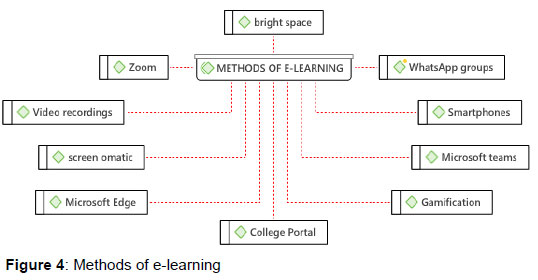
The academics referred to using the College portal, Microsoft Teams, Zoom and WhatsApp to teach students online. They also recorded videos and sent them to the students via WhatsApp. The lecturers successfully used the College portal and Microsoft Teams, while the NCV Business Studies and NCV Life Skills used WhatsApp to teach online.
These are some of the answers from the participants about the methods of e-learning the academics are using:
P1: "Google Classroom is what we use. "
P2: "Students are utilizing their smartphones and phones to access question papers."
P3: "Our WhatsApp groups that we have established are used by the lecturers to connect with the students."
P4:"I once went to a session on digital learning where we learnt about it and receivedtraining on various strategies for making sure that students can continue to complete their coursework on online platforms. "
P5:"The one I chose was Microsoft Edge, where you can create quizzes and then multiple-choice questions that students can answer and then receive feedback. "
P6:"This allows you to check how students performed on each activity and prepare quizzes and multiple-choice questions. "
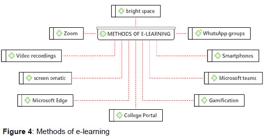
Based on the responses from the participants, it is clear that e-learning at Orbit TVET College was introduced and training was conducted for all lecturers. All the lecturers received laptops and routers with loaded data. Vocational programme managers were selected as champions for e-learning at Orbit and supported the lecturers but it was noted that e-learning was introduced full-time for only one programme, the Report 191 lecturers. The Report 191 lecturers indicated that they used Microsoft Teams and the College portal to teach their students online and found it very effective. NCV Business Studies lecturers and NCV Life Skills lecturers stated that they were communicating with their students via WhatsApp only, rather than any other e-learning tool.
E-learning problems
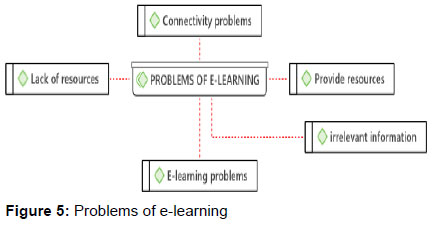
The following Figure 5, indicate the sub-themes identified on the problems of e-learning. The participants opined that many challenges in the college are caused by the lack of resources, accessibility, commitment and dedication.
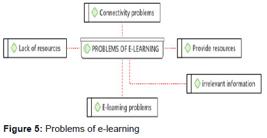
The lecturers indicated that the ICT resources at their college were generally insufficient, especially for students, since the classrooms lacked resources. Another problem was resistance to change. Most of the academics interviewed were comfortable with the traditional, face-to-face teaching mode. Other problems that the academics experienced were connectivity and technical issues. Sometimes lecturers could connect with only a few students as some had connectivity problems due to faulty networks and load-shedding. Most of the lecturers are not committed or dedicated to teaching using e-learning. Nine of the 12 lecturers mentioned these challenges as a major hindrance to the successful use of e-learning at Orbit TVET College.
One of the participants said:
"Since most of our students use Facebook to socialize, I think we can use it in addition to cell phones and computers if we have messengers now. In fact, most of our students use Facebook. So, yeah, I think we can also contact with them using Facebook Messenger because they have a Facebook account. Microsoft Edge since it's a part of the academic system. While we wait for possibly fully equipped lecturer's rooms with technological apparatus that will make teaching and learning accessible and then also enable us to reach out to them, they don't need to pay any additional money in order for lecturers to continue using that."
The following participants expressed that many challenges in the college are caused by the lack of resources, accessibility, commitment and dedication.
P1: "We have got the problem of resources that like I have indicated earlier on, we have got the resources problem, the other challenge is dedication and commitment of using the little that we have for sharing information with our students."
P2: "are resistant to change. I believe if we can have a mandate to say now we use this, everybody it is mandatory to do that, I think is where we can go in the same line."
P3:"I think the accessibility I should say that because many people are not really accessing it much. So if people are more accessible and they are using it then it could work out that's the problem."
P4: "The problems that we always have is Internet connectivity and loadshedding. That's one of the main major difficulties that we are encountering."
P5: "Our students are having technical issues; some do not have laptops. Some do not have enough data and that is making learning delivery to be difficult from our side Some of the students are not committed, not dedicated, and are not making efforts. We have student from rural areas who suffer from network problems so it becomes a problem to deliver a lesson to such an environment."
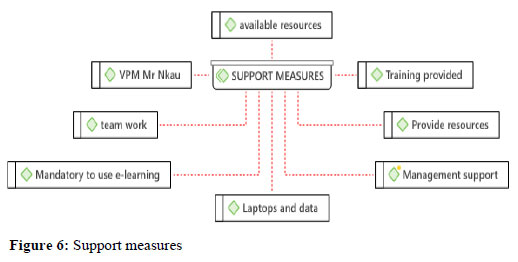
The respondents suggested that the management provide resources for both lecturers and students. Although they have data and computers, these are not useful if the students lacked the necessary resources. They also recommended that the management hold more training sessions. They believed that the academic staff should attend seminars so that everyone could learn about the tools available and how to use them to help students engage in e-learning successfully.
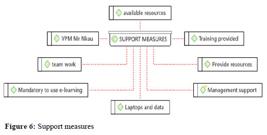
The following are some of the responses about the support the academics are receiving from the management. They said:
P1: "They've sent us to training so that we may become familiar with e-learning. In order to help us understand how e-learning functions, they provided us with a guide that explains how to create your own online test questions. They also provided us with computers and data so that we could access the web portal they had built."
P2: "Although it is a fine strategy to employ, it loses relevance when it comes to the needs of the students because we are dealing with children who are digitally inclined and who want to receive information at the tip of their fingers without having to exert themselves. Therefore, it will interest and tempt them if you include such information in your learning outcomes or learning objectives when you are teaching and learning. They will be more engaged and inspired to participate in this method of instruction."
P3: "It is completely ineffective, in my opinion, because we have studentswho don'ttakethingsseriously, thus we must add full e-learning training for our clients in order for them to understand it. Unfortunately, their lack of resources makes it harder for them to learn by learning because they do not have enough. You understand that the entire effort, the entire practice exercise, would be futile during the pandemic when we were forced to try and interact with our pupils in a group of 30 students if only two of them didn't have WhatsApp and didn't have data. Resources are a major issue. To be effective, it is crucial to have understanding of electronic devices and e-learning."
P4: "I believe that for progress to occur, all parties must be actively participating. There must be some sort of strategic implementation strategy, which would then include all the required procedures and let each stakeholder know what part they should play. When and how will the project be allowed to entirely deviate from the plan? I believe that by doing so, we will be able to assess our progress in this area. Additionally, I believe that this type of project needs a champion who will ensure that at the very least, everyone is on board and making good progress in their comprehension of and ability to execute the project."
DISCUSSION
Research objective (i): To explore academics' perceptions of using e-learning for successful teaching and learning at Orbit TVET College.
Concerning this objective, most respondents took the idea to indicate that e-learning has been demonstrated to be an effective method of instruction and that this is one area in which classroom learning cannot compete with e-learning.
Arkorful and Abaidoo (2015:29-42) provide the following general description:
"E-learning refers to using ICT to enhance and support learning in tertiary education. This covers a wide range of systems, from students using e-mail and accessing coursework online while following a course on campus to programs offered entirely online."
This objective aimed to establish how well the academics at Orbit TVET College know about e-learning. During the interview, out of the 12 participants, only one explained it differently. Most of them said it is online communication, providing teaching and learning through digital devices and lessons conducted electronically via Microsoft Teams or Zoom," and one student said: "to teach students faceless without physically seeing each other".
Out of the 12 lecturers interviewed at Orbit TVET college, nine perceived e-learning to be effective but it is essential for college management to equip academics with resources and have classes that are digitally equipped. According to the findings on the growth of e-learning at Orbit TVET College, six lecturers said it was growing fast; two lecturers said it was growing slowly and four said it needed improvement. Although the training was conducted for all lecturers, only a few were using e-learning because the classes were not digitally equipped with the internet or WiFi. There was a lack of resources for students: those who did not have data or laptops could not access e-learning adequately.
The partial failure of an information system occurs when the system is implemented, but the major goals are not attained (Almaiah, Al-Khasawneh and Althunibat, 2020:5261). These studies have shown that many users cannot use LMSs effectively due to lacking support services. A study conducted by (Jere, J.N., 2020) based on a survey of 358 respondents from 25 African countries, found that 74 per cent indicated that a lack of training and technical support hindered them from fully using LMSs features. As a result, they could not use the LMSs at all or could only use a relatively small number of them. The institutions involved should equip their academics with the technical and pedagogical skills to use e-learning to achieve quality results.
Research objective (ii): To investigate the e-learning methods used by the academics at Orbit TVET College.
Based on the responses, it is possible to conclude that Report 191 lecturers are the only ones at Orbit TVET College who use e-learning techniques for teaching and learning, while NCV lecturers only use WhatsApp to get in touch with their students and sometimes do not. Most respondents claimed that despite being taken for training, they are not utilising the newly introduced e-learning method.
According to Algahtani (2011:51), e-learning can be divided into computer-based and internet-based learning. Computer-based learning involves using the range of hardware and software generally available for ICT use and each component can be employed in one of two ways: "computer-assisted learning" and "computer-managed instruction".
Ferriman (2013) mentions some emerging methods related to e-learning:
•
Gamification - This is arguably one of the most exciting developments. Games can now easily be integrated into many e-learning courses and learning management systems.•
Mobile technology - devices such as tablets and smartphones allow learning on the move. By 2016, the largest growth in mobile sales by a significant margin was in notebooks and tablets.•
Massive open online courses (MOOCs) - Possibly the most controversial trend, MOOCs are causing a stir but the application of the model is still not quite certain. However, the possibilities of MOOCs are very exciting.These methods can improve e-learning and help all lecturers at TVET colleges, whether they specialise in teaching computer science, theory or engineering. The lecturers were trained but it appears they were trained in using only one method that is not effective for all of them because only a few lecturers are currently employing it.
Research objective (iii): To identify interventions and strategies that the College had in place to support e-learning
Most of the lecturers recommended that it be mandatory for all lecturers to teach using e-learning. They also maintained that the lecturers should be given one group each to teach online and that they should offer them more training. Lecturers should also work in groups to share skills and the management should follow up to check that they are all using e-learning. They should also be well-equipped with resources such as smart boards and digitally-equipped classrooms.
The management of the College should also implement strategic planning. They should train staff and students more and ensure that all lecturers are teaching online. Most higher education institutions recognise that technology needs to be matched to pedagogical intentions, while teaching and learning strategies must be flexible and responsive to the changing needs, priorities and emerging technologies. There are many practical difficulties in implementing e-learning programs in TVET Colleges, mainly due to a lack of resources (Mahmud, and Gope, 2009:155159).
Researchers such as Lock and Redmond (2021:100773) agree that it is especially important to engage pre-service teachers in developing their capacity to use emerging technologies, developing teaching approaches that support interactive, engaging and collaborative learning. They also state that this could be facilitated by using digital technology in a classroom or in a blended format of online and offline activities.
STUDY LIMITATIONSThe study was limited to a single North West province college and the results thereof may not necessarily be generalisable hence it is recommended that similar studies be undertaken in other colleges.
CONCLUSION
To sum up the findings of this research, it seems clear that the main drawbacks to the successful implementation of e-learning are twofold; namely, although the staff generally favour computer-assisted learning and recognise its importance in the modern age, the colleges are not equipped with sufficient resources for the staff or the students to engage with it successfully. To become fully computer literate, students must continually use computers for research and communication. This cannot happen when they have limited access to computers. It also implies that students with computers had an enormous advantage over those with limited finances. There is also a lack of computer skills among the lecturers and this should be remedied urgently or the colleges will fall further behind in equipping students for the future. Some means should be found to induce lecturers to include an e-learning component in all their courses. The lack of connectivity due to load-shedding is also a severe handicap. Alternatives are being sought nationally and the college might need to address this problem as an individual entity, as many other institutions are doing.
REFERENCES
LITERATURE REVIEW
- Abdullah, Fazil, Ward, Rupert and Ahmed, Ejaz (2016). Investigating the influence of the most commonly used external variables of TAM on students' Perceived Ease of Use (PEOU) and Perceived Usefulness (PU) of e-portfolios. Computers in Human Behavior, 63. pp. 75-90. ISSN 0747-5632.
- Algahtani, Abdullah. "Evaluating the effectiveness of the e-learning experience in some universities in Saudi Arabia from male students' perceptions." PhD diss., Durham University, 2011.
- Arkorful, Valentina and Nelly Abaidoo. "The role of e-learning, advantages and disadvantages of its adoption in higher education." International journal of instructional technology and distance learning 12, no. 1 (2015): 29-42.
- Clarke, Victoria, Virginia Braun and Nikki Hayfield. "Thematic analysis." Qualitative psychology: A practical guide to research methods 3 (2015): 222-248.
- Faleh, A. Alhawary and H. Aborumman As' ad. "Measuring the effect of academic satisfaction on multidimensional commitment: A case study of applied science private university in Jordan." International Business Research 4, no. 2 (2011): 153.
- Ferriman, Nicholas. "The impact of blended e-learning on undergraduate academic essay writing in English (L2)." Computers & Education 60, no. 1 (2013): 243-253.
- Friese, Susanne. Qualitative data analysis with ATLAS. ti. Sage, 2019.
- Khan, Khalid S., Regina Kunz, Jos Kleijnen and Gerd Antes. "Five steps to conducting a systematic review." Journal of the royal society of medicine 96, no. 3 (2003): 118-121.
- Leary, Mark R. and Eleanor B. Tate. "The multi-faceted nature of mindfulness." Psychological Inquiry 18, no. 4 (2007): 251-255.
- Livingstone, Sonia. "Critical reflections on the benefits of ICT in education." Oxford review of education 38, no. 1 (2012): 9-24.
- Lock, Jennifer and Petrea Redmond. "Embedded experts in online collaborative learning: A case study." The Internet and Higher Education 48 (2021): 100773.
- Mahmud, Khaled and Khonika Gope. "Challenges of implementing e-learning for higher education in least developed countries: a case study on Bangladesh." In 2009 international conference on information and multimedia technology, pp. 155-159. IEEE, 2009.
- Mboweni, Vongani Sharon. "Measuring the effectiveness of Management Information Systems used for decision making in Mpumalanga TVET Colleges." PhD diss., North-West University, 2018.
- Nasser, Ramzi, Maha Cherif and Michael Romanowski. "Factors that impact student usage of the learning management system in Qatari schools." International Review of Research in Open and Distributed Learning 12, no. 6 (2011): 39-62.
- Pange, Apostolia and Jenny Pange. "Is e-learning based on learning theories? A literature review." International Journal of Educational and Pedagogical Sciences 5, no. 8 (2011): 932-936.
- Rhema, Amal and Iwona Miliszewska. "Towards e-learning in higher education in Libya." Issues in informing Science and information technology 7, no. 1 (2010): 423-437.
- Salmons, Janet. Qualitative online interviews: Strategies, design, and skills. Sage Publications, 2014.
- Sife, Alfred, Edda Lwoga and Camilius Sanga. "New technologies for teaching and learning: Challenges for higher learning institutions in developing countries." International journal of education and development using ICT 3, no. 2 (2007): 57-67.
- Sternad, Simona and Samo Bobek. "Comparative analysis of acceptance factors for SAP and Microsoft Dynamics NAV ERP solutions in their maturity use phase: enterprise 2.0 issues." In Handbook of research on enterprise 2.0: technological, social, and organizational dimensions, pp. 389-415. IGI Global, 2014.
- Tarhini, Ali, Kate Hone and Xiaohui Liu. "Measuring the moderating effect of gender and age on e-learning acceptance in England: A structural equation modeling approach for an extended technology acceptance model." Journal of Educational Computing Research 51, no. 2 (2014): 163-184.
- Van der Walt, Lizanne. "The value of an e-learning bundle in the acquisifion of a clinical skill: exploring the perceptions of third-year medical students at Stellenbosch University, South Africa." PhD diss., Stellenbosch: Stellenbosch University, 2022.
- Wang, Xiaolu and Wing Thye Woo. "The size and distribution of hidden household income in China." Asian Economic Papers 10, no. 1 (2011): 1-26.
- Yusuf, Nadia, and Nisreen Al-Banawi. "The Impact of Changing Technology: The Case of E-Learning." Contemporary Issues in Education Research 6, no. 2 (2013): 173-180.