Distributed leadership: a model for student leadership engagement
Abstract
Developing student leadership has never been more demanded of higher education institutions than within a 21st century VUCA (volatile, uncertain, complex and ambiguous) world. Globally, there is an increasing preference for organisations to become more devolved and operate more collaboratively (Hayward 2015). Rapid socio-economic changes and enhanced access to higher education, have seen 21st century institutions around the world facing major challenges to their governance systems, curriculum, external relations, research and financing (Jones and Harvey 2017; Black 2015; Jones 2014; Shin and Harman 2009). South African higher education institutions have not escaped these global challenges but the issues have been further exacerbated by the legacy of apartheid and demands for political redress, transformation and equal access (Habib 2016; South African Civil Society Information Services 2013). Such issues are unique to the South African higher education landscape and are demonstrated in the frustrations of the country's youth, which are regularly being played out on our streets and university campuses. This study sought student leaders' opinion on their role in participative institutional governance using distributed leadership as the underpinning model.
distributed leadership; higher education; student representatives
INTRODUCTION
During the period 2015-2016, South Africa observed the dramatic re-entry of student activism within the higher education terrain, colloquially known as the #FeesMustFall campaign (Badat 2015; Habib 2016). It was a reaction to what students saw as the tardiness and "foot dragging" pace of higher education transformation (Suransky and Van der Merwe 2016) which found South African universities still struggling to deal with the legacy of apartheid. Despite national government initiatives to resolve these issues, at the operational level, university management still appeared to be struggling to deal with these chronic issues of funding and accommodation.
This was evidenced by violent student skirmishes on KwaZulu-Natal campuses as recently as July 2019 (Duma 2019). This led to questioning of the 2015-2016 protests as an "organic crisis" within South African higher education which would require serious review and reformulation of higher education by key national stakeholders (Badat 2015).
CONTEXT OF THE STUDYThis study is located within and specific to student leaders at a South African institution of higher education, so it is important to understand the background and context within which it is placed. In the last two decades, South African higher education has had to make substantive changes in its relationship with the state and society to align itself within the democratic legislative framework (Department of Education 1997). Post 1994, it had the urgent task to change its shape and form and re-create an equal, integrated, national system of education which then resulted in the nature and context of higher education leadership changing. In tandem with these internal demands, there was also the challenges that all higher education institutions internationally were confronted with, particularly global competitiveness and massification (Mekoa 2018).
The substantive intention of the South African Constitution was to demand that all public organisations address the scourge of apartheid (Habib 2016; Badat 2015; 2009) and this was supported by a vast array of founding documents, policies and legislation to deliberately bring about the transformation of a fractured, unequal society into a democratic nation. The White Paper on Higher Education (Department of Education 1997), one of the transformative legislations, also introduced a new governance framework based on the credo of co-operative governance. Co-operative governance being premised on the fact that no single stakeholder, management, staff (academic or administrative) nor student can be vested with sole responsibility for the university's agenda (Kulati and Mojo 2002). Thus, these post-apartheid legislations were seen as being a particularly significant change to higher education governance.
Despite the structural changes that have occurred in the governance of institutions since the implementation of this raft of legislations (Badat 2015; Department of Education 1997) it was apparent that increased empirical research still needed to be conducted especially as many of those who are stakeholders in this process are unclear about their role in these governance structures (Kulati 2000). Meanwhile, Smit (2006) argues that this is, in part, due to stakeholders not having been given time to understand and operationalise the concepts inherent in the policies guiding higher education.
Within higher education institutions themselves, there can be discerned fault lines in relation to the increasing complexity of stakeholder constituencies and the need to work collaboratively, often in partnerships (Jones and Harvey 2017). South African higher education is a highly legislated system, with clear parameters around leadership and governance, yet there appears an absence of discourse around matters such as participatory leadership. The situation is exacerbated by these stakeholders having competing and conflicting demands, thereby hindering decision making. Business as usual in terms of university leadership is no longer working if our institutions are to become responsive not only to our national needs but to also compete globally (Habib 2016). This is not a new argument as the discourse around university governance issues has been on the higher education agenda, almost since the dawn of the country's democracy, when it was identified that South African higher education was facing a crisis of leadership and management (Kulati 2000).
Leadership theories
Literature supports the notion that leadership is a critical agenda for higher education change, in general (Hempsall 2014; Harper 2015; Wright 2008; Bryman 2007) and specifically within South Africa (Council on Higher Education 2016; Smit 2006; Kulati 2003). However, events such as #FeesMustFall campaign, the strident student discourse and the rising clamour for transformation, questions if real change has actually taken place. South African higher education institutions have become a "system under fire" (Jones 2009, 3) often criticised for a lack of leadership and inability to deal with the current stressors facing them.
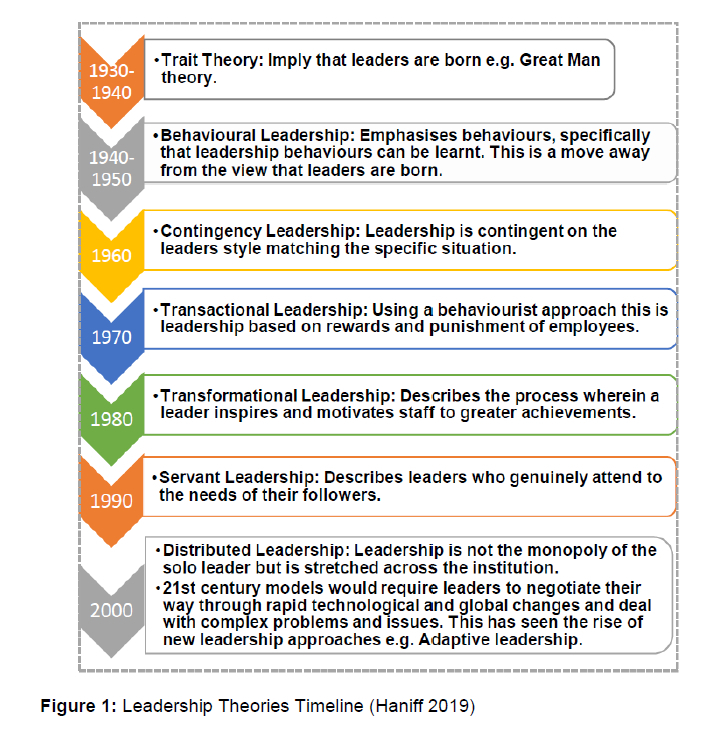
In order to better understand distributed leadership, the theoretical approach of this study, a timeline of prominent leadership theories depicts how leadership models have evolved over the last century leading up to and influencing the development of distributed leadership and is presented below.
From the timeline we note that leadership models such as transactional, transformational and servant leadership styles have demonstrated a focal change away from the concept of "hero" leader to relational styles of leadership (Skalicky et al. 2020). However, it was only at the cusp of this millennium that distributed leadership gained in popularity with leadership practitioners and leaders (Crawford 2012; Bolden 2011; Gronn 2000), and emerged in response to a leader-centric approach which was no longer fit for purpose. Distributed leadership is a shared process, with a de-emphasis on the heroic leader and is a response to the dynamic, non-defined and complex nature of 21st century leadership with all its diversities. The emergence of a distributed leadership perspective acknowledges that there are multiple leaders in any institution (Spillane, Halverson, and Diamond 2004) and recognises leadership potential and capacity as being fluid, not fixed. Further it supports the notion that leadership can be developed and extended (Harris 2008).
DISTRIBUTED LEADERSHIP: RESEARCH MODEL
This study was underpinned by academic literature indicating that there is a paucity of empirical research around leadership in higher education (Floyd and Preston 2018; Lumby 2012; Bryman 2007). The literature also confirms that the higher educational environment globally has become a terrain of shifting sands and increased complexity, so developing good leaders across all levels of university management has become a pressing issue (Floyd 2016; Bryman 2007).
The aim of this research was then to investigate student leadership, from the perspective of a distributed leadership stance, in that it is not only about what people do, but also why and how this is done. A distributed form of leadership is viewed as a postmodern approach, in which leadership is practiced as an interaction between leaders and followers, is an interdependency among leaders and does not reside within one titular head. There is a growing trend to view leadership practice as essentially relational and collective in nature. In other words, the focus has shifted from being inherently about the quality or characteristics of the individual leader to a shared group process (Friedrich, Griffith, and Mumford 2016; Bolden and Petrov 2014; Uhl-Bien, Marion, and McKelvey 2007).
Distributed leadership remains the preferred approach in a variety of different sectors, is seen as being popular and in vogue (Floyd and Preston 2018; Jones and Harvey 2017; Diamond and Spillane 2016; Harris 2005) and considered to be the leadership idea of the moment in which:
"... decisions are made by those best equipped to make them, fully empowered to do so through the deliberate delegation of authority and supported with information, tools and training to ensure they can make effective decisions in the best interests of the organisation." (Hayward 2015, 10).
Distributed leadership is identified as the leadership theory that coalesces best with the higher education sector (Harper 2015; Bolden 2011; 2010) and considered the preferred leadership model for 21st century educational institutions (Bush 2013). Within South Africa, distributed leadership is also seen as the favoured leadership approach by national policy makers (Williams 2011) as it appears to be most closely associated with the democratic ethos of this country. It has been described as being the model most likely "to mobilize the space opened up by democracy to achieve educational liberation" from "the intellectual prison that was Bantu education" (Pandor 2006, quoted in Williams 2011, 196).
If we accept the notion that there is no singular or unidirectional leadership focus for higher education institutions and that one form of leadership is not a replacement for another, then distributed leadership is seen as an approach complementary to the traditional forms of leadership (Bolden and Petrov 2014; Bolden 2010; Harris 2007).
Student leaders' representation in decision making at institutions of higher learning is close to universal (Luescher-Mamashela 2013; Mbambo 2013) and has its genesis in the democratisation movement of the 1960's and 1970's. University democratisation with respect to students and governance issues was as explained by Luescher-Mamashela (2013)
"A reconstitution of internal decision making in universities with reference to democratic principles, inter alia, by making decision making processes in universities more representative of internal constituencies such as students." (Luescher-Mamashela 2013, 1443).
Post 1994, in South Africa, the democratic model of cooperative governance placed students as integral stakeholders within participatory governance and at the core of institutional democratisation within higher education as provided for in The White Paper on Higher Education (Department of Education 1997). Thus, students constitute a critical group as participative, collaborative stakeholders in institutional leadership (Mekoa 2018; Moloi, Makgoba, and Miru 2107).
Distributed leadership has, however, also earned its fair share of contention and debate (Harris 2016). There has been the submission that the absence of a clear definition (Harris and DeFlaminis 2016) is a serious constraint. There is also the argument put forward by Bennet, Wise, Woods, and Harvey (2003, 6) that distributed leadership research, in the main, has been "suggestive rather than conclusive", which according to Tian, Risku, and Collin (2016) still remains relevant today, although Harris and DeFlaminis (2016) takes issue with this conclusion. In its practice, there is the danger of distributed leadership becoming a double-edged sword in that whilst credence is given to the concepts of engagement and collegiality, it could be used by those in power to obscure their own agendas (Bolden et al. 2009).
Despite this contra view, distributed leadership remains the preferred approach and leadership idea of the moment, particularly within educational environments (Jones et al. 2017; Harris and DeFlaminis 2016) where the emphasis is on inclusivity and collegiality (Harris and DeFlaminis 2016). It has at its core, the humanistic development of students and also serves to counter centralised organisational management (Harper 2015). Also supporting the distributed model, particularly in knowledge work (which is a core tenet of university work), is the reliance on team-based activities, which require a diverse group from a variety of disciplines to contribute to new knowledge (Youngs 2017; Bryman and Lilley 2009; Harris 2008).
However, despite this growing interest in distributed leadership for higher education institutions, there exists limited research into its value and practice for these organisations (Floyd and Fung 2017; Grant 2017; Ritchie and Woods 2007; Woods et al. 2004). Even amongst recognised researchers (Jones 2014; Hempsall 2014; Bryman 2007) who are expected to have a broad ontological view, there is the tendency to view university leadership at the individual level and to research the role of formal leaders. This then implies that the issues of different types of leadership namely vertical, horizontal, distributed or blended leadership, at organisational or institutional level, still needs to be addressed through research (Middlehurst, Goreham, and Woodfield 2009).
Thus, the authors aver, distributed leadership should be put to an empirical and theoretical test if it is to be seen as an alternative model for a South African higher education institution. Additionally, unless theories can be applied to real life situations, they really have very little relevant value and remain in the realm of academia.
RESEARCH OBJECTIVESThe aim of the study was to explore the impact of student-stakeholder representation in shared, participative institutional leadership at a South African higher education institution. If South African university management is to remain legally compliant and relevant, it needs to ensure that its leadership model embraces its multiple stakeholders in a shared, participative manner. The aims of this study were as follows:
• To understand student perspective of leadership and its practice at a University of Technology.
• To determine the impact and role of student leadership in co-operative management and governance (distributed leadership) and understand if this is supported by the university's governance structures.
METHODOLOGY
This study used a case study approach as it contributed to deep learning about student leadership at this particular institution (Starke 1995, in Woods et al. 2016). The site was selected as it is one the researcher is familiar with, thereby enhancing the opportunity and scope to collect rich data from participants who were acquainted with her. It allowed for the researcher to acquire answers to "how" and "why" type questions whilst also allowing for many facets of a phenomenon to be revealed and understood (Baxter and Jack 2008). Permission to conduct the study as well as ethics clearance was obtained from the institution.
RESEARCH FRAMEWORKThis study used a two-phase approach to the collection of data viz the rich picture technique of Soft Systems Methodology with qualitative individual and focus group interviews.
Soft systems methodology
Any research activity needs to take cognisance of the complexities of our 21st century world and utilise robust research methods in order to be relevant. Leadership, until early this 21st century, tended to focus on leader centric research, with an emphasis on survey based quantitative methods (Harper 2015) providing a narrow, often singular perspective, which now appears to be outdated offerings when faced with present day demands. This emphasis on linear causal relationships is what vexes many organisations as most issues are an interconnected web of circular relationships (Anderson and Johnson 1997) which require a wider perspective for effective problem solving.
The Soft Systems Methodology (SSM) falls within the genre of systems thinking, defined as the "science which provides a deep understanding of systems and by which consistent inferences about their behaviour can be made" (Richmond 1987, referenced in Rezk and Gamal 2019, 438). This then provided the researcher with a deeper perspective to understand and assess the dynamic complexity (Rezk and Gamal 2019) of the case study under review.
The popularity of systems thinking is because it offers a different conceptual framework, or alternate new way of thinking about and conceptualising the world around us, whether or not our interests are of a global or local nature (Cabrera, Colosi, and Lobdell 2008). Essentially, systems thinking contends that in order to fully understand a phenomenon it cannot be broken up into its elemental parts and then reconstituted, but that we instead apply a universal vision to understand its functioning (Mele, Pels, and Polese 2010).
SSM rich pictures
Lewis (1992) opines that the architects of SSM regarded the creation of rich pictures as a useful technique and effective alternative to a textual description. This study only used the rich picture technique of the SSM, a pictorial representation of the problematical situation, identifying the different stakeholders and their concerns, including some of the structure underlying the issues raised (Checkland and Winter 2006; Lewis 1992). It was selected as a research tool, as it allowed for student stakeholder world-views to be expressed, galvanised them to think deeply about the problem and understand it well enough to pictorially represent it and is best suited to situations which are complex and problematic (Checkland and Poulter 2010; Checkland and Winter 2006).
Using specifically the SSM rich pictures, encouraged student leaders to view the problem situation from different perspectives, thereby developing a varied set of pictures or images of the institution. This research paradigm contributed to a holistic appreciation of the problem situation and assisted with the research enquiry. The SSM rich pictures assisted in offering expression to the problem or situation and provided the foundational questions for the qualitative semi-structured interviews.
The value of visual (or rich picture) communication provides a medium through which it is possible to gain an understanding of the different perspectives, particularly issues or viewpoints, held on a particular "messy" or wicked problem. This was seen as a non-linear, innovative and creative way to express their views on leadership (Woods and Roberts 2016).
Qualitative interviews
Using qualitative methodology to support the systems thinking process was based on the understanding that this form of research is "a systemic and reflective process for development of knowledge that can somehow be contested and shared, implying ambitions of transferability beyond the research setting" (Malterud 2001, 483). Qualitative research is people-oriented and concerned with the dynamic of social phenomena and its relevance as a scientific method of research is fast increasing (Attride-Stirling 2001). Using qualitative methods to determine leadership practice was supported by the increased interest in and use of qualitative research in leadership studies (Lumby 2019; Jones et al. 2017; Cannatelli et al. 2017). When examining such contextually rich topics as leadership the cornerstone methodology should be qualitative research as it captures the richness of the participants' personal opinions and perceptions as well as the nuances accompanying these changes. This is as opposed to quantitative methods which measure only "static moments in time" (Conger 1998, 110).
Using the flexibility of a qualitative research approach combined with systems thinking, provided the researcher with a rich vein of different data sources from which to do this analysis. Qualitative data was gathered through fieldwork that included a SSM rich picture workshop with staff and students, and continued with in-depth semi-structured interviews with SRC leaders. The structure of the SSM workshops, student focus groups and individual interviews were fairly broad and non-directive as the aim was to understand the institution from a constructionist, interpretivist stance.
Study sample
Participants were contacted by email initially requesting them to participate in the study. This was accompanied with informatory communication providing them with a brief outline of the study and informed consent form. A follow up a few days later where any queries or apprehensions was then discussed with them. The interviews were conducted at a time and place based on their availability and accommodated their academic timetables.
To address the purpose of this study a total of 16 student leaders participated. A total of 6 student leaders engaged in Phase One and 10 in Phase Two. There is an understanding in the literature that qualitative sample sizes are often smaller than those used in quantitative studies (Dworkin 2012; Bryman 2012) as qualitative studies are often more concerned with gathering in-depth knowledge of a phenomenon (Dworkin 2012).
DATA COLLECTIONThis was obtained in two phases:
Phase One
Employed the rich picture technique of Soft Systems Methodology to understand student leadership, its practice as well as student leader perspective on institutional variables that impeded their practice. A total of 6 students in leadership positions engaged in this activity.
The students were divided into three groups and informed that whatever went into the picture was entirely up to them and that all contributions were to be considered. As this technique is action research which sought to provide a holistic, contextual overview of the problem situation (Kotiadis and Robinson 2008; Bronte-Stewart 1999) each of the pictures were then presented by a group spokesman and explanations and additional inputs provided by team members, where necessary. Each group then identified the themes that they believed their picture represented which was supplemented by suggestions from the other group participants and then either adopted or discarded.
In the pictures created, some responses formed a natural cluster, and so formed a theme. Each thematic title was then written up on chart paper and all the workshop participants were invited to vote for their themes. This "finding out" process of the rich picture workshop led to the emergence of four (4) generalised themes in order of participant rating. Using this approach was also a means of ensuring that stakeholders looked at the complex problem holistically, thereby allowing for connections and relationships to be identified and expressed. In this exercise an inductive approach was employed meaning that themes and patterns emerged out of the data rather than being imposed prior to data collection and analysis (Bowen 2005). These themes are presented under results and discussion.
The exercise of using graphic representations also found much favour amongst the participants as it was seen as a fun, entertaining exercise engendering much conversation as to what should, or not, be included in the rich pictures. It is also being suggested that this could be useful as an introductory, ice breaker strategy in general focus group activities.
Phase Two
It involved a total of 10 (ten) student leaders, and included 4 (four) individual interviews and one focus group of six student leaders. The one-on-one interviews lasted approximately 45-60 minutes whilst the focus group took approximately 1.5 hours. The emphasis in Phase Two was to collect in-depth information on issues raised during Phase One. The data obtained from the rich picture exploratory exercise then informed the qualitative questions used in this formal interview process. In this exercise, purposive sampling was directly informed by theoretical saturation, which was reached when the last few interviews provided limited or no insights.
DATA ANALYSISPhase one or Rich picture exercise provided baseline data which then informed the qualitative interview and focus group query. Data analysis of Phase Two then relied on recordings of engagements between the researcher and student leaders via individual interviews or focus group and were analysed and explored for common themes.
When analyzing the collected data, this researcher used the six-phase thematic analysis of Braun and Clarke (2013; 2006) long seen as being a widely used yet unacknowledged analytical method. However, there is evidence that the tool has been gaining increasing popularity as a foundational, basic method which allows the researcher to reflect and unravel the surface of participants' "reality" (Braun and Clarke 2006). Data obtained from audio transcriptions, written notes as well as related documents were then coded, analysed and organised into themes through the identification of patterns across the datasets (Braun and Clarke 2006, 2014). Both individual and focus group interviews were transcribed and then coded after reviewing line, paragraph and sentence portions of the transcribed data.
Other data collection methods included archival data, namely, policy documents as well as information that was already in the institutional domain such as internal memos. There was no incongruity to using a qualitative paradigm to inform the systems approaches of SSM as they all adhere to an interpretive paradigm (Schwaninger 2004; Golafshani 2003) meaning that they melded together through the data analysis process.
Trustworthiness
In this study, trustworthiness was attained through using multiple methods and multiple sources of data to establish the credibility of the findings, that is, triangulation, member checking and negative case analysis. When it was confirmed that there were no negative cases or contrary evidence, the analysis was considered complete. Member checking, the process of confirming facts and observations with the research participants was also conducted to strengthen the trustworthiness of the study. Triangulation, a corroborative technique ensured research validity by using multiple sources of data collection including respondent interviews (primary data gathering method), observation (both interviews and focus groups) and document reviews (Creswell and Miller 2000).
It must be expected that, in general, an in-depth qualitative study will generate vast quantities of data. For research rigour during data analysis the researcher ensured a thorough familiarity with and knowledge of the material being studied. The researcher was familiar with data content and what it meant, and was able to distinguish in the material collected what was relevant to answering the research question. Research rigour was also maintained by ensuring that themes emerging from the data were reconfirmed in a process of constant checking and rechecking.
RESULTS AND DISCUSSION
Rich picture themes
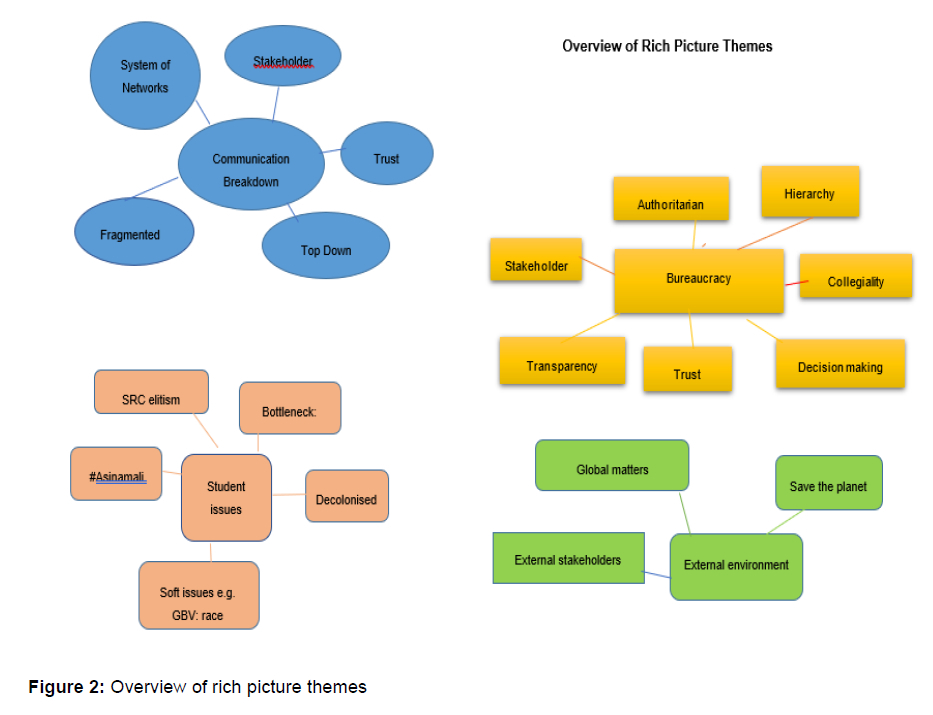
Under the primary theme of Communication there was unanimous agreement amongst student leaders. They described institutional communication lines as being flawed and fragmented. The bureaucratic hierarchy of the institution was considered the predominant contributor to impaired internal communication.
There was also a general recognition that trust amongst the stakeholders was affected, often leading to the withholding of information as "power". Students in particular indicated that when they felt stymied and frustrated at their lack of "voice", then they resorted to strike action. They emphasised though that this was a last resort action.
The institution was described as being an interrelated system of networks and if the information and communication pipelines between them were obstructed or impeded then this negatively impacted not only the operations but the collegial relationships amongst the stakeholders.
Aligned to communication but highlighted as a separate theme was the general opinion expressed by the student leaders that the institution was adopting a less consultative approach. This was seen as a management ploy to keep institutional control and restrict stakeholder input into decision making. Soft interpersonal issues such as trust and transparency were also impacted by bureaucracy resulting in strained relationships.
Student specific issues were, in the main, related to student funding and protest action encapsulated in the #FeesmustFall. Students were wanting institutions to not only support them in their demands, but also in their transformational demands e.g., curriculum decolonisation.
There was also comment on the external environment where there was recognition of rapid societal and global changes which require immediate responses and which they believe is something which institutional management needs to prioritise.
The primary themes identified above, whilst issues in their own right have an interdependency and correlation with other themes. Communication informed the hierarchy/ bureaucracy issues which were infused within the student specific matters. Such interactions between the themes implies then that this rich picture or "finding out" exercise provided a holistic overview of the institutional leadership rather than an insular viewpoint.
The rich picture exercise assisted in identifying the primary issues, highlighted where to look for these problematical situations, as well as provided an understanding about climate and leadership culture as viewed by student leaders.
Qualitative interviews/focus group
The interview and focus group data were analysed against the primary themes identified in the Rich Picture exercise. The analysis showed that in general there was a fair amount of concordant opinion and consensus around the primary themes by all student leaders.
Primary concerns raised were around processes and soft issues of leadership at the university. Following on from the rich picture exercise, in the one-on-one interviews and focus group student leaders continued to express their frustrations with communication channels, hierarchy and the internal environment. In particular, students felt side-lined and excluded from university management.
A particular critique was that bureaucracy, a slow-moving behemoth, hinders decision making and consequently leads to management by crisis, as it is particularly slow to react to issues arising spontaneously. This often triggers student unrest as they believe that management is only reactive and responsive to student mass action, a last resort tactic by students to be heard.
There was unanimous agreement by student leaders in identifying silo operations at the institution. It was submitted by respondents that managerialism and bureaucracy breeds rigidity and silo operations and that lacking a person-centred leadership approach stifles the opportunity to harness collegial knowledge and experience. Such a leadership approach could prove to be a stumbling block to distributed leadership as rigid operational boundaries and non-collaboration between significant university stakeholders could result in departments being in competition with one another. This impacts on collaborative, co-operative working relationships.
"... I see that there are different departments in the hierarchy but there are no pipes connecting those departments." (SL1: Focus Group).
Respondents expressed frustration with the institutional practice of top down communication in which the upper echelons of institutional management appeared to be unaware of the situation on the ground. The interrelatedness of trust and communication issues in stakeholder responses were succinctly encapsulated in a student leader's comments below.
"Which is another thing that I have learnt that if you communicate especially to institutional management or anyone in the institutional space you must be able to do it via email so there is proof as well." (SL2: Focus Group).
This extract captures the breakdown of trust with stakeholders having to resort to maintaining a paper trail to ensure evidential proof. The student leaders' relationship with their Executive Management was also portrayed as very protocol driven which they argued hampered and stifled student leadership operations.
Student leaders, generally, saw transparency as leading to increased responsibility and accountability, but also to a more collegial relationship with the student body. However, in their view, institutional managers lack transparency in their dealing with students.
"But the problem is that they don't trust us as student leadership. Trusting issues that is the problem." (SL1: Focus Group).
Thus, a lack of trust and inclusivity has led to a strained relationship between student leaders and management. Whilst they see themselves as significant university stakeholders, they state that they are still excluded from important communiques. Student leaders express the view that increased transparency will not only expose flaws and defects in management leadership, but will also lead to intensified calls for more institutional accountability.
University bureaucracy is also described as being contradictory. This is demonstrated in the Student Representative Council (SRC) being represented at some boards and committees of university management but excluded from others. It is described by them as being a "power" ploy used by management to keep power tilted in managements favour. As they explain it, the University management uses divide and rule tactics to control and manipulate student leadership. This not only handicaps the effectiveness of the SRC in helping the student body but such tactics can also lead to infighting amongst the student leadership resulting in action paralysis and ineffectual leadership.
There was generalised consensual agreement and support for the distributed leadership model. It was described as people oriented, promoting trust and genuine engagement with the general sentiments captured in the following quote.
"... that is a brilliant model. That is what we looking for ... it is what our institution needs. Not only our institution, outside our institution, this is what leadership is (SL1).
Student leaders supported and saw relevance for distributed leadership practice especially as, in their opinion, any 21st century institution that is solely dependent upon its senior managers to cope with critical and complex issues is at serious risk of failure (Heifetz, Grashow, and Linsky 2009). Underpinning their endorsement of the model however, was the caveat that this form of leadership practice could work if only the institution recognised the leadership potential within all categories of stakeholders. Distributed leadership was viewed as a "game changer" for student leaders especially as this approach placed them as equal partners with other university stakeholders.
There were, however, some cynical viewpoints expressed, implying that the upper echelons of management would merely pay lip service through protocol to the concept of distributed leadership, all the whilst continuing along the traditional style of bureaucratic leadership. In fact, student leaders believe that using a distributed leadership model would create tensions and divisions as upper management would be unwilling to share power in a distributed leadership model.
"Management equally will always want to be seen as the controllers and the powerness and the decision makers of the system (SL3).
They opine that leadership, currently, is practiced in siloes and being constantly hindered by roadblocks and speedbumps leading to a paralysis in institutional leadership. Using a distributed approach, because of its team-based nature would inculcate a sense of collegiality and cooperativeness across all stakeholder groups which already existed within academia. Another positive outcome is that this would remove the present silo operations and thinking, whilst encouraging a more cohesive leadership approach.
In fact, it is the idea of the engagement of people, across the institution, collectively building institutional capital which resonated with all those who interviewed for this study. In this study, distributed leadership as a form of institutional practice found strong support from its student leaders and supported by studies such as Vuori (2019). This contrasts with the assertions of Gosling, Bolden, and Petrov (2009) that distributed leadership within higher education settings was essentially just rhetoric.
Implementing a leadership model that takes cognisance of the demands of its student leaders, but more importantly, that aligns itself to open engagements not only within the institution itself but also to the environment, is relevant for any 21st century higher education institution. The student protests of 2016-2017 in particular, show this new dynamic at play within South African higher educations. At its very essence this requires a mind-set change from student leaders for power to be more widely distributed and inclusive, and stakeholder engagements to occur with more transparency and open communication lines. It is also incumbent upon those in authority to not only provide the mechanisms and structures for this distributive leadership to practice and thrive, but to support these initiatives by practicing it themselves.
There is seen to be a need for leadership to be responsibly distributed, substituting traditional formal hierarchical authority "with organizational bandwidth which draws on collective intelligence" (Heifetz et al. 2009, 6).
CONCLUSION
Distributed leadership within higher education has been identified as not only an under-researched area (Grant 2017; Williams 2011; Bolden 2010) but a more demanding terrain for empirical study compared to research focussing on leadership solo (Harris 2007). Distributed leadership should be studied within the specific social context of that organisation (Day, Gronn, and Salas 2006) which is why this research was conducted within a "realistic organisational setting" (Van Ameijde et al. 2009) of a higher education institution. The social context of any institution is "intense, dynamic and multifaceted" (Day et al. 2006, 213) thereby contributing rich, possibly untapped data which was true of the findings of this study.
Student leaders are a potent and powerful stakeholder group, which institutional management would do well to recognise and incorporate fully into a participative distributed leadership, especially as many go onto the national stage and become future political leaders .There is a political case for including students within formalised decision-making structures otherwise there is always the potential for them to be disruptive (Luescher-Mamashela and Mugume 2014; Luescher 2008) and cause institutional mayhem. Within these parameters, however, is the query as to whether a disjuncture exists between the ethos of participatory governance encapsulated in national policies with the actual practice of students as stakeholders in institutional co-operative leadership (Moloi et al. 2017; Mbambo 2013).
However, whilst the concept of distributed leadership has found resonance within higher education, there is caution expressed as to whether the term "performs a rhetorical function that may well outstrip its ability to hold up under scrutiny as a true descriptor of leadership practice within the sector" (Gosling et al. 2009, 303). In addition, whilst the academic literature proliferates with studies on school leadership, within higher education such a body of work is rather sparse (Lumby 2012). These are all considerations which would need to be tested in future studies.
REFERENCES
LITERATURE REVIEW
- Anderson, Virginia and Lauren Johnson. 1997. Systems thinking basics. Cambridge, MA: Pegasus Communications.
- Attride-Stirling, Jennifer. 2001. "Thematic networks: An analytic tool for qualitative research." Qualitative Research 1: 385-405.
- Badat, Saleem. 2009. "Theorising institutional change: Post-1994 South African higher education." Studies in Higher Education 34(4): 455-467.
- Badat, Saleem. 2015. "Institutional combinations and the creation of a new higher education institutional landscape in post-1994 South Africa." In Mergers and alliances in higher education, 175-201. Springer, Cham.
- Baxter, Pamela and Susan Jack. 2008. "Qualitative case study methodology: Study design and implementation for novice researchers." The Qualitative Report 13(4): 544-559.
-
Bennett, Nigel, Christine Wise, Philip A. Woods, and Janet Harvey. A. 2003. "Distributed leadership." Nottingham National College for School Leadership. http://oro.open.ac.uk/8534/. (Accessed 12 April 2018).
» http://oro.open.ac.uk/8534/ - Black, Simon A. 2015. "Qualities of effective leadership in higher education." Open Journal of Leadership 4(02): 54.
- Bolden, Richard and Georgy Petrov. 2014. "Hybrid configurations of leadership in higher education employer engagement." Journal of Higher Education Policy and Management 36(4): 408-417.
- Bolden, Richard, Georgy Petrov, Jonathan Gosling, and Alan Bryman. 2009. "Leadership in higher education: Facts, fictions and futures - Introduction to the special issue." Leadership 5(3): 291-298.
- Bolden, Richard. 2010. "Leadership, management and organisational development." In Handbook of Leadership and Management Development, ed. J. Gold, R. Thorpe, and A. Mumford, 117-132. Aldershot: Gower.
- Bolden, Richard. 2011. "Distributed leadership in organizations: A review of theory and research." International Journal of Management Reviews 13(3): 251-269.
- Bowen, Glen. 2005. "Preparing a qualitative research-based dissertation: Lessons learned." The Qualitative Report 10(2): 208-222.
- Braun, Virgina and Victoria Clarke. 2013. "Teaching thematic analysis: Overcoming challenges and developing strategies for effective learning." The Psychologist 26(2): 120-123.
- Braun, Virgina and Victoria Clarke. 2014. "What can 'thematic analysis' offer health and wellbeing researchers?" International Journal of Qualitative Studies on Health and Well-Being 9(1): 26152.
- Braun, Virginia and Victoria Clarke. 2006. "Using thematic analysis in psychology." Qualitative Research in Psychology 3(2): 77-101.
- Bronte-Stewart, Malcolm. 1999. "Regarding rich pictures as tools for communication in information systems development." Computing and Information Systems 6: 83-102.
- Bryman, Alan and Simon Lilley. 2009. "Leadership researchers on leadership in higher education." Leadership 5(3): 331-346.
- Bryman, Alan. 2007. "Effective leadership in higher education: A literature review." Studies in Higher Education 32(6): 693-710.
- Bryman, Alan. 2012. Social research methods. 4th Edition. Oxford: Oxford University Press.
- Bush, Tony. 2013. "Distributed leadership: The model of choice in the 21st century." Educational Management Administration & Leadership 41(5): 543-544.
- Cabrera, Derek, Laura Colosi, and Claire Lobdell. 2008. "Systems thinking." Evaluation and Program Planning 31: 299-310.
- Cannatelli, Benedetto, Brett R. Smith, Alessandro Giudici, Jessica Jones, and Michael Conger. 2017. "An expanded model of distributed leadership in organizational knowledge creation." Long Range Planning 50: 582-602.
- Checkland, Peter and John Poulter. 2010. "Soft Systems Methodology." In Systems approaches to managing change: A practical guide, ed. M. Reynolds and S. Holwell, 191-242. London: The Open University.
-
Checkland, Peter and Mark Winter. 2006. "Process and content: Two ways of using SSM." Journal of the Operational Research Society 57: 1435-1441. www.palgrave-journals.com/jorsn. (Accessed 19 July 2017).
» www.palgrave-journals.com/jorsn - Conger, Jay A. 1998. "Qualitative research as the cornerstone methodology for understanding leadership." Leadership Quarterly 9(1): 107-121 .
- Council on Higher Education. 2016. South African higher education reviewed. Two decades of democracy. Pretoria: Council on Higher Education.
- Crawford, Megan. 2012. "Solo and distributed leadership: Definitions and dilemmas." Educational Management Administration and Leadership 40(5): 610-620.
- Creswell, John W. and Dana Miller. 2000. "Determining validity in qualitative inquiry." Theory into Practice 39(3): 124-130.
- Day, David V., Peter Gronn, and Eduardo Salas. 2006. "Leadership in team-based organizations: On the threshold of a new era." The Leadership Quarterly 17(3): 211-216.
- Department of Education. 1997. Draft White Paper on Higher Education. No. 17944. Government Printer Pretoria.
- Diamond, John B. and James P. Spillane. 2016. "School leadership and management from a distributed perspective: A 2016 retrospective and prospective."Management in Education 30(4): 147-154.
-
Duma, Nkosikhona. 2019. "DUT, UKZN students protest over NSFAS and accommodation". EWN22 July 2019. https://ewn.co.za/2019/07/.../dut-ukzn-students-protest-over-nsfas-and-accomodation.
» https://ewn.co.za/2019/07/.../dut-ukzn-students-protest-over-nsfas-and-accomodation - Dworkin, Shari. 2012. "Sample size policy for qualitative studies using in-depth interviews." Archives of Sexual Behavior 41: 1319-1320.
- Floyd, Alan and Diane Preston. 2018. "The role of the associate dean in UK universities: Distributed leadership in action?" Higher Education 75(5): 925-943.
- Floyd, Alan and Dilly Fung. 2017. "Focusing the kaleidoscope: Exploring distributed leadership in an English university." Studies in Higher Education 42(8): 1488-1503.
- Floyd, Alan. 2016. "Supporting academic middle managers in higher education: Do we care?" Higher Education Policy 29(2): 167-183.
- Friedrich, Tamara L., Jennifer A. Griffith, and Michael D. Mumford. 2016. "Collective leadership behaviors: Evaluating the leader, team network, and problem situation characteristics that influence their use." The Leadership Quarterly 27(2): 312-333.
- Golafshani, Nahid. 2003. "Understanding reliability and validity in qualitative research." The Qualitative Research 8(4): 597-606.
- Gosling, Jonathan, Richard Bolden, and Georgy Petrov. 2009. "Distributed leadership in higher education: What does it accomplish?" Leadership 5(3): 299-310.
- Grant, Carolyn. 2017. "Distributed leadership in South Africa: Yet another passing fad or a robust theoretical tool for investigating school leadership practice?" School Leadership & Management 37(5): 457-475.
- Gronn, Peter. 2000. "Distributed properties. A new architecture for leadership". Educational Management and Administration 28(3): 317-337.
- Habib, Adam. 2016. "Transcending the past and reimagining the future ofthe South African university." Journal of Southern African Studies 42(1): 35-48.
- Haniff, Naseem. 2019. "Distributed Leadership at a South African University of Technology." D.Phil. dissertation, Durban University of Technology.
- Harper, Malcolm Roy. 2015. "How professional service managers in higher education understand leadership." PhD dissertation, Manchester Metropolitan University.
- Harris, Alma and John DeFlaminis. 2016. "Distributed leadership in practice: Evidence, misconceptions and possibilities."Management in Education 30(4): 141-146.
- Harris, Alma. 2005. Crossing boundaries and breaking barriers. International Networking for Educational Transformation Dexter Graphics. London.
- Harris, Alma. 2007. "Distributed leadership: Conceptual confusion and empirical reticence." International Journal of Leadership in Education 10(3): 315-325.
- Harris, Alma. 2008. "Distributed leadership: According to the evidence." Journal of Educational Administration 46: 172-188.
- Hayward, Simon J. 2015. Success factors in the transition towards distributed leadership in large organisations. The University of Manchester. United Kingdom.
- Heifetz, Ronald, Alexander Grashow, and Marty Linsky. 2009. "Leadership in a (permanent) crisis." Harvard Business Review 87(7/8): 62-69.
- Hempsall, Kay. 2014. "Developing leadership in higher education: Perspectives from the USA, the UK and Australia." Journal of Higher Education Policy and Management 36(4): 383-394.
- Jones, Sandra and Marina Harvey. 2017. "A distributed leadership change process model for higher education." Journal of Higher Education Policy and Management 39(2): 126-139.
- Jones, Sandra, Marina Harvey, Jillian Hamilton, John Bevacqua, Kathy Egea, and Jo McKenzie. 2017. "Demonstrating the impact of a distributed leadership approach in higher education." Journal of Higher Education Policy and Management 39(2): 197-211.
- Jones, Sandra. 2014. "Distributed leadership: A critical analysis." Leadership 10(2): 129-141.
- Jones, Stuart D. 2009. "A study of the relationship between leadership practices and organizational effectiveness in student affairs." PhD dissertation, Northcentral University.
- Kotiadis, Kathy and Stewart Robinson. 2008. "Conceptual modelling: Knowledge acquisition and model abstraction." In Proceedings of the 40th Conference on Winter Simulation, ed. S. J. Mason, R. R. Hill, L. Monch, O. Rose, T. Jefferson, and J. W. Fowler. Florida, 7-10 December 2008.
- Kulati, T. and T. Moja. 2002. "Leadership." In Transformation in higher education. Global pressures and local realities in South Africa, ed. N. Cloete, R. Fehnel, P. Maassen, T. Moja, H. Perrold, and T. Gibbon, 230-260. Lansdowne, Compress.
- Kulati, Tembile. 2000. "Governance, leadership and institutional change in South African higher education: Grappling with instability." Tertiary Education and Management 6(3): 177-192.
- Kulati, Tembile. 2003. "From protest to challenge: Leadership and higher education change in South Africa." Tertiary Education & Management 9(1): 13-27.
- Lewis, P. J. 1992. "Rich picture building in the soft systems methodology." European Journal of Information Systems 1(5): 351-360.
- Luescher, Thierry M. 2008."Student governance in transition: University democratisation and managerialism. A governance approach to the study of student politics and the case of the University of Cape Town." Doctoral thesis, University of Cape Town.
- Luescher-Mamashela, Thierry M. 2013. "Student representation in university decision making: Good reasons, a new lens?" Studies in Higher Education 38(10): 1442-1456.
- Luescher-Mamashela, Thierry M. and Taabo Mugume. 2014. "Student representation and multiparty politics in African higher education." Studies in Higher Education 39(3): 500-515.
- Lumby, Jacky. 2012. What do we know about leadership in higher education? Leadership Foundation for Higher Education.
- Lumby, Jacky. 2019. "Distributed leadership and bureaucracy." Educational Management Administration and Leadership 47: 5-19.
- Malterud, Kirsti. 2001. "Qualitative research: Standards, challenges, and guidelines." The Lancet 358(9280): 483-488.
- ,
- Mbambo, Sithabile. 2013. "Student participation in institutional governance in South African universities: A case of The University of Cape Town." Master's thesis, University of Cape Town.
- Mekoa, Itumeleng. 2018. "Challenges facing Higher Education in South Africa: A change from apartheid education to democratic education." African Renaissance 15(2): 227-246.
- Mele, Cristina, Jacqueline Pels, and Franscesco Polese, 2010. "A brief review of systems theories and their managerial applications." Service Science 2(1-2): 126-135.
- Middlehurst, Robin, Helen Goreham, and Steve Woodfield. 2009. "Why research leadership in higher education? Exploring contributions from the UK's leadership foundation for higher education." Leadership 5(3): 311-329.
- Moloi, Kholeka, Malegapuru W. Makgoba, and Collins Ogutu Miruka. 2017. (De)constructing the #FeesMustFall campaign in South African higher education. Contemporary Education Dialogue 14(2): 211-223.
- Rezk, Sahar Saeed and Shahinaz Gamal. 2019. "The viable system model and its applications in higher education: An overview." Kybernetes 48(3): 438-450.
- Ritchie, Ron and Philip A. Woods. 2007. "Degrees of distribution: Towards an understanding of variations in the nature of distributed leadership in schools." School Leadership and Management 27(4): 363-381.
- Schwaninger, Markus. 2004. "Methodologies in conflict: Achieving synergies between systems dynamics and organizational cybernetic." Systems Research and Behavioural Science 21(4): 411-431.
- Shin, Jung Cheol and Grant Harman. 2009. "New challenges for higher education: Global and Asia-Pacific perspectives." Asia Pacific Education Review 10(1): 1-13.
- Skalicky, Jane, Kristin Warr Pedersen, Jacques van der Meer, Sally Fuglsang, Phillip Dawson, and Sarah Stewart. 2020. "A framework for developing and supporting student leadership in higher education." Studies in Higher Education 45(1): 100-116.
- Smit, Patricia Elizabeth. 2006. "Leadership in South African higher education: A multifaceted conceptualisation." PhD dissertation, Institute of Education, University of London.
-
South African Civil Society Information Services. 2013. "Adam Habib On Higher Education's Role in South Africa's Racial and Economic Transformation." (Interview). https://sacsis.org.za/site/article/1762.
» https://sacsis.org.za/site/article/1762 - Spillane, James P., Richard Halverson, and John B. Diamond. 2004. "Towards a theory of leadership practice: A distributed perspective." Journal of Curriculum Studies 36(1): 3-34.
- Suransky, Caroline and J. C. van der Merwe. 2016. "Transcending apartheid in higher education: Transforming an institutional culture." Race Ethnicity and Education 19(3): 577-597.
- Tian, Meng, Mika Risku, and Kaija Collin. 2016. "A meta-analysis of distributed leadership from 2002 to 2013: Theory development, empirical evidence and future research focus." Educational Management Administration & Leadership 44(1): 146-164.
- Uhl-Bien, Mary, Russ Marion, and Bill McKelvey. 2007. "Complexity leadership theory: Shifting leadership from the industrial age to the knowledge era." The Leadership Quarterly 18(4): 298318.
- Van Ameijde, Jitse D. J., Patrick C. Nelson, Jon Billsberry, and Nathalie Van Meurs. 2009. "Improving leadership in higher education institutions: A distributed perspective." Higher Education 58(6): 763-779.
- Vuori, Johanna. 2019. "Distributed leadership in the construction of a new higher education campus and community." Educational Management Administration & Leadership 47(2): 224-240.
- Williams, Clarence G. 2011. "Distributed leadership in South African schools: Possibilities and constraints." South African Journal of Education 31(2).
- Woods, Philip A. and Amanda Roberts. 2016. "Distributed leadership and social justice: Images and meanings from across the school landscape." International Journal of Leadership in Education 19(2): 138-156.
- Woods, Philip A., Nigel Bennett, Janet A. Harvey, and Christine Wise. 2004. "Variabilities and dualities in distributed leadership: Findings from a systematic literature review." Educational Management Administration & Leadership 32(4): 439-457.
-
Wright, Lisa L. 2008. "Merits and limitations distributed leadership: Experiences and understandings of school principals." Canadian Journal of Educational Administration and Policy 69: 2-33. https://eric.ed.gov/?id=EJ806988.
» https://eric.ed.gov/?id=EJ806988 - Youngs, Howard. 2017. "A critical exploration of collaborative and distributed leadership in higher education: Developing an alternative ontology through leadership-as-practice." Journal of Higher Education Policy and Management 39(2): 140-154.