Facilitating the development of clinical reasoning skills amongst undergraduate student nurses through action research
Abstract
Student-centered teaching and learning practices encourage critical thinking and clinical reasoning skills in nursing education, but these practices are challenging for nurse educators. This study followed an action research approach, which involved collective, self-reflective inquiry by the participating nurse educators to identify educational practices that will foster the development of clinical reasoning skills among undergraduate student nurses. This paper describes the action research applied, outlining the implementation and outcomes which led to a co-constructed action plan. Four challenges: teaching, learning, and assessment; the clinical learning environment; continuous professional development and support; as well as the selection of nurse educators and students was addressed. This reflective process contributed to nurse educators evaluating their own pedagogy and adapting their teaching and learning practices to foster clinical reasoning skills among nursing students.
Action research; clinical reasoning; critical thinking; student-centered teaching and learning; nursing education; student nurse
INTRODUCTION
Student-centered teaching and learning encourages the development of critical thinking and clinical reasoning skills. Teaching student nurses to think critically and reason clinically is a challenge in nursing education, and some nurse educators struggle to facilitate student-centered teaching and learning (Makhene 2022, 1).
Botma et al (2014, 16) identified a need for nurse educators to change their attitudes. Franklin, Iwu and Dubihlela (2022, 36) further revealed that several students viewed educators' educational approach as conventional, repetitive, uninspiring, lacking intellectual expertise, and not particularly challenging. Educators were seen as information carriers, rather than facilitators, as their teaching focused on quantity rather than quality. According to Engel-Gilbert (2021, 2), a primary aim of healthcare education is to develop sound critical thinking and clinical reasoning skills among students.
Teaching and learning practices that foster critical thinking and clinical reasoning are complex and include several components. Franklin et al (2022, 36) further suggest that effective teaching and learning has a large impact on the development of reasoning skills; however, these skills are rarely supported by current teaching and learning practices (Vreugdenhil et al 2021, 1; Brown Tyo and McCurry 2019, 12). Similarly, Misganaw et al (2022, 71) state that clinical reasoning is a core competency that must be taught to student nurses to improve patient outcomes.
BACKGROUND
Nurse educators face several challenges in the classroom. Aside from an excessive amount of theoretical material, nurse educators have to present content that is not connected to actual clinical practice (Rischer 2013, para. 5). Classroom theory is often fragmented and teacher-based learning does not readily engage students with clinical realities. Allen (2013, 3) further suggests that teacher-based learning emphasizes ever-increasing volumes of content rather than on the application of the learned material in clinical practice. Nurse educators should involve students in hands-on learning opportunities where they are expected to apply theory to practice and think critically about clinical scenarios for the patient's benefit (Epp et al 2021, 804). Hands-on learning opportunities may better facilitate the development of critical thinking and clinical reasoning skills among student nurses. Therefore, nurse educators need to balance teacher-based learning with hands-on opportunities.
Students in South Africa experience various educational difficulties. According to Lack and Bruce (2014, 157), many student nurses come from underprivileged homes. Their cultural background and home language is often different from educational language, which hampers their reading and writing abilities and their ability to manage scientific language. Students need much academic support; thus, educators should employ innovative and creative teaching and learning practices to meet the needs of students (Lack and Bruce 2014, 157). These student experiences and other challenges are mirrored among many African countries such as Botswana, Zambia and Ghana. The authors (Sabone, Tshiamo and Rapinyana, 2018, 88) reflect on the challenges facing nursing education in Botswana. Among these are staff shortages and increasing diversity of nursing students. The findings from a study conducted in Zambia revealed that the lack of ICT infrastructure, trained educators and connectivity challenges hindered the implementation of more creative student-centred approaches such as e-learning (Mphande et al 2024, 672). Kolbugri et al (2024, 26) conducted a comprehensive SWOT analysis of studies related to nursing education reforms in Nigeria and other African countries in order to reform nursing education in Ghana. The authors identified significant challenges, such as inadequate clinical training facilities, shortage of qualified educators, and the threat of brain drain. These authors provide a regional perspective on this phenomenon. African countries can therefore benefit from the results described in this article.
Nurse educators are responsible for embracing teaching and learning practices that prepare student nurses for clinical practice and developing the competencies required of registered nurses (Epp et al 2021, 809). Critical thinking and clinical reasoning skills must be developed to equip students with problem-solving skills to examine events and plan patient care (Franklin et al 2022, 36). Nursing education is evolving from the traditional teacher-centered approach to a more student-centered, problem-based approach. This change implies that different teaching and learning practices should be used to enhance active student involvement and facilitate learning (Misganaw et al 2022, 72).
Nursing students are adult students enrolled at nursing education institutions. It is therefore expected that when facilitating nursing students, nurse educators must utilise adult learning principles in order to promote the development of clinical reasoning skills. The theoretical framework within this study was based on andragogy. Malcolm Knowles (1984) cited by Crookes, Crookes and Walsh (2013, 239) is seen as the father of andragogy and defines andragogy as "the art and science of helping adults learn". This theory is based on six assumptions. These assumptions postulate that adults learn best when they are more motivated to learn, when the learning will help them to perform tasks. When content is presented using real-life situations adult students tend to learn better. This study highlighted the importance of utilising adult learning principles as well as student-centred teaching and learning practices, as illustrated by the co-constructed action plan (Van Wyngaarden 2017).
The need for nursing education to transition from a traditional teacher-centred approach to a more student-centred approach may be hindered by various challenges. The findings from Phase 1 of this study revealed several challenges which contributed to nurse educators not utilising student-centred educational practices. These challenges were classified under the following four main themes, educational practices, clinical learning environment, military environment, and various role players within the teaching and learning environment, these findings were reported in a previously published article (Van Wyngaarden 2019).
At the nursing education institution (NEI), where this study was conducted, nurse educators have been tasked with creating student-centered teaching and learning practices that will promote the development of clinical reasoning skills. Failing to use student-centered teaching and learning may result in students not acquiring critical thinking and clinical reasoning skills (Chilemba and Bruce 2015, e59; Shellenbarger and Robb 2015, 79). To facilitate the transition from teacher to student-centered teaching, we had to consider how to improve existing teaching and learning practices used in this NEI using an action research approach.
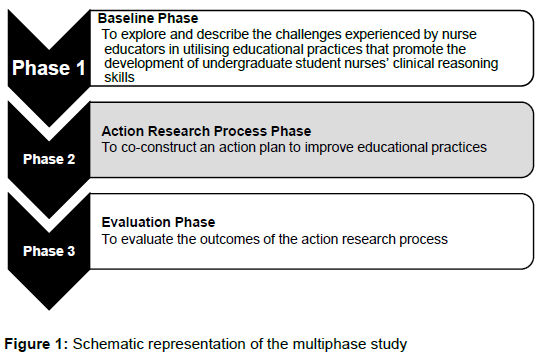
To improve teaching practices and foster the development of critical thinking and clinical reasoning skills, a multiphase study was carried out at the NEI. Phase 1 explored and described the challenges that nurse educators faced when facilitating clinical reasoning skills. Using four action research cycles, a core group of nurse educators created an action plan during Phase 2 to address the challenges that were identified during Phase 1. The World Café data gathering technique was used in Phase 3 to evaluate the results of the action research process. A schematic illustration of the multiphase study is shown in Figure 1.
The findings of Phase 1, the baseline phase, were reported in a previously published article (Van Wyngaarden 2019). Here, we describe the action research process (Phase 2), which consisted of four cycles. Phase 3 findings were published in a former article (Van Wyngaarden 2018). The results of this multiphase study may considerably advance our understanding of educational practices to advance critical thinking and clinical reasoning. The jointly developed action plan may help nurse educators in similar situations to overcome challenges similar to those identified in this study.
METHODOLOGY
Design
Action research was used to answer the research question: "How can action research be used to enable nurse educators to transition to student-centered teaching and learning?" The study was approved by the Research Ethics Committee of the Faculty of Health Sciences of the University of Pretoria (protocol number: 84/2015), and the principal of the NEI permitted us to conduct the research.
Action research
Research is a form of disciplined inquiry leading to the generation of knowledge (Koshy 2010, 1); however, the knowledge gained by action research has a direct and continuous impact on modifying and enhancing practice (Given 2008, 4). Action research ultimately aims to improve practice and is conducted by professionals and practitioners. This flexible research methodology is uniquely suited to researching and supporting change (Given 2008, 4). Action research involves researching the present to shape the future, and it generates "robust, actionable knowledge, in an evolving process that is undertaken in a spirit of collaboration and coinquiry, whereby research is constructed with people, rather than on or for them" (Coghlan 2019:87).
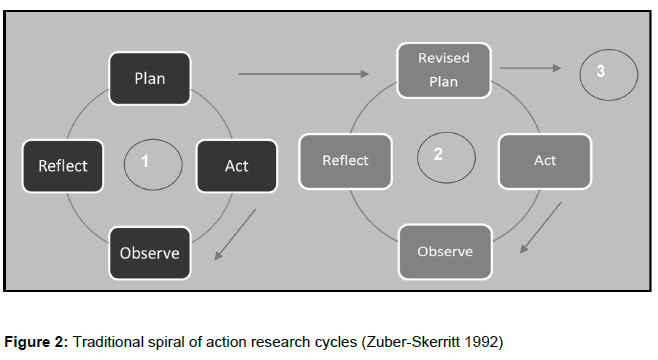
The action research approach selected for this study was the traditional spiral of action research cycles, as explained by Zuber-Skerritt (1992) and illustrated in Figure 2.
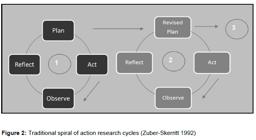
The action research process comprises four stages, namely, plan, act, observe, and reflect, resulting in revised plan, followed by plan, act, observe, and reflect (Zuber-Skerritt 1992, 11). "Plan" involves problem analysis and strategic planning; "action" refers to putting the plan into action; "observation" includes an evaluation and self-evaluation of the action; and, finally, "reflection" refers to reflecting on the evaluation and the whole action research process. By including nurse educators as co-researchers, the creation of knowledge was combined with professional development.
The action research process
Gaining access
Since the first author (Van Wyngaarden) was the quality assurance manager at the NEI at the time of the study, acquiring access was not a problem. Having an insider as the action researcher increases the likelihood of success and buy-in (Williamson, Bellman, and Webster 2012, 68). The action research study was formally introduced at an information session that was open to all academic staff members. Nurse educators were asked to complete a check sheet at the launch to express their interest in participating in the study.
Composition of the action research group
The nurse educators who expressed interest were then invited to participate in the study. With a sample size of 11, the action research group (ARG) was formed, with members from the NEI management, nurse educators, and the researcher.
Planning of the action research process
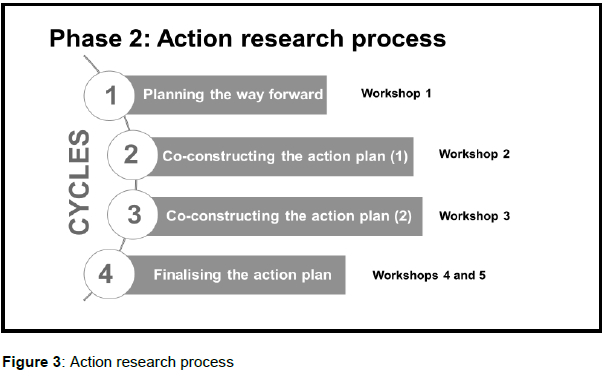
The ARG planned the course of action collaboratively. The ARG agreed on the number of workshops, the timing, and the dates of the upcoming meetings for monitoring and feedback purposes. Over a six-month period, a total of five 8-h workshops were organized and conducted. The ARG scheduled the workshops and the monitoring and feedback meetings during this first workshop (Cycle 1: Planning the way forward). Another goal of this workshop was to agree on the most important challenges. Over the course of two months, two workshops (Cycle 2 and Cycle 3: Co-constructing the Action Plan) were held with the aim of developing activities to address these challenges. The fourth and fifth workshops (Cycle 4: Finalizing the action plan) were conducted to finalize and approve the final draft action plan. Figure 3 shows a schematic of the action research process and the action research cycles.
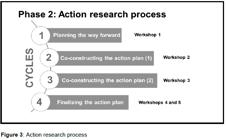
Although the action research process aimed to jointly create an action plan to address the challenges facing nurse educators, some of the suggested activities were also put into practice. Professional development sessions, the creation of guidelines, and brainstorming sessions with all academic staff were among these spin-off activities.
Action research cycles
Each of the four cycles followed the steps of plan, act, observe, and reflect, but the steps did not always occur sequentially. At times we planned, reflected on that plan, would act by adding our activities to the plan, sit back and observe, and would revise again after some deliberation, but each workshop and meeting followed a different sequence (Van Wyngaarden 2017). McNiff (2013, 67) reports that action research is a systematic, but flexible, process with several steps, but she does not believe that these steps must be consecutive or that the process must be logical. The action research process of the present study proved to be a typical example of that described by Jean McNiff (2013, 67). Each of the four cycles is briefly discussed.
Cycle 1: Planning the way forward
Cycle 1 describes the launch of the action research process and how the ARG planned the way forward. Because the challenges were numerous and complex, the ARG decided to identify challenges that could be tackled and which ones were in our power to change. Following a consensus workshop, four strategies were identified to address and co-construct an action plan. The following strategies were identified (Van Wyngaarden 2017):
Teaching, learning and assessment practices
Clinical learning environment
Continuous professional development (CPD) and support
Selection of nurse educators and students
The primary outcome of this cycle was the introduction of the CPD points in accordance with the South African Nursing Council (SANC) criteria to the academic staff during a planned quality assurance workshop. The academic staff's learning demands were also analyzed to tailor future professional development sessions to their requirements (Van Wyngaarden 2017).
Cycle 2: Co-constructing the action plan
During this cycle, two results were attained: learning needs analysis and the identification of activities for the four strategies. Three of the identified learning needs were agreed upon for professional development. The NEI's professional development coordinator received the remaining subjects, who will use them for future scheduled professional development programs. The following three topics were identified by the ARG to include in professional development sessions (Van Wyngaarden 2017):
facilitation of learning, assessment, evaluation and feedback
research and knowledge creation
Emotional intelligence
The spin-off from this cycle was the article written and published in the NEIs magazine, 'The Lamp', to inform academic staff on the progress made by the ARG (Van Wyngaarden 2017).
Cycle 3: Co-constructing the action plan
Cycle 3 saw the action plan evolve; certain activities were added while others were revised to better suit each strategy. The formal introduction of the CPD implementation guidelines took place during a subsequent planned quality assurance workshop.
Professional development sessions on clinical reasoning and student-centered teaching and learning practices, such as the use of video clips, real-life case studies, and unfolding case studies, were provided to all the academic staff as a spin-off from this cycle. The next theoretical block presented nurse educators with the challenge of using at least one of these teaching and learning practices while gradually increasing their usage of student-centered practices. Additionally, during academic meetings, all nurse educators were urged to present initiatives, accomplishments, and best practices (Van Wyngaarden 2017).
Cycle 4: Finalizing the action plan
The action plan was finalized and approved by the ARG. The final action plan was the main outcome of the action research process.
The spin-offs for this cycle included two professional development sessions. A demonstration and training session on the ward round was presented to a representative group of nurse educators and students. The utilization of ward rounds as a teaching and learning strategy to advance clinical reasoning was demonstrated to nurse educators. All academic staff members participated in the second session, which focused on professional development in inquiry-based teaching and appreciative feedback (Van Wyngaarden 2017).
RESULTS AND DISCUSSION
The action research process resulted in a co-constructed action plan (Van Wyngaarden 2017) that addressed nurse educator challenges. The action plan addressed four main challenges experienced by nurse educators outlining strategies for improving their teaching and learning practices. The process resulted in various professional development sessions on student-centered teaching and learning practices. The activities were co-constructed by the ARG to address the four main challenges (Van Wyngaarden 2017).
Strategy 1: Teaching, learning and assessment strategies
To improve teaching, learning and assessment practices at the NEI, the ARG focused on the following subheadings: facilitating student-centered teaching and learning practices, incorporating innovative assessment and feedback practices and inspiring reflective conversations. Improvement activities were formulated for each of the aforementioned subheadings.
Strategy 2: Clinical learning environment
The ARG identified the establishment of an effective clinical department, enhancing clinical accompaniment, facilitating student-centered teaching, learning and assessment practices, providing an efficient simulation laboratory and improving collaboration with clinical facilities as the core components to improve the clinical learning environment.
Strategy 3: Continuous professional development and support
The continuous professional development and support of nurse educators was identified as an important challenge that must be addressed by identifying the learning needs of nurse educators, by creating and fostering a learning culture, by improving computer literacy, and by initiating and maintaining a research culture.
Strategy 4: Selection of nurse educators and students
The NEI must recruit and select quality nurse educators who are passionate about nursing and education; furthermore, the NEI must promote the professional socialization of nurse educators and implement strategies to retain nurse educators, and attention must be given to the recruitment and selection of suitable candidates for nurse training.
Participants described how participating in the action research project allowed them to reflect on and self-evaluate their own pedagogical practices, which inspired them to use more student-centered teaching and learning practices. Participants gave positive feedback on the professionalism of the action research study and stated that their critical thinking skills were stimulated. Participants suggested that the action research process enhanced their problem-solving abilities and their teaching practices. Participants further stated that the action research process study shifted their perspective from being teachers to being facilitators. Moreover, participants claimed that critical thinking was promoted, which encouraged theory and practice correlation. They believed that the action research study had helped them progress and improve (Van Wyngaarden 2017).
LESSONS LEARNT AND RECOMMENDATIONSThis action research followed the participatory worldview, which shares commonality with patient-centered and collaborative care. The ARG comprised a representative group of nurse educators but would have benefitted from the participation of all academic personnel. This was not feasible due to their professional duties. Therefore, all academic staff were invited to the professional development sessions and quality assurance workshops where guidelines were developed. A potential bias could be the researcher's dual role as an insider and the researcher. The researcher kept a reflective journal to overcome potential bias. Input from each participant was requested after each action research cycle. To ensure that the co-constructed action plan was the outcome of the ARG participants, the researcher circulated the co-constructed action plan amongst all participants for comments and input (Van Wyngaarden 2017).
The action plan is expected to be implemented as a quality improvement initiative and therefore be integrated into existing nursing education frameworks. An example of how this may be accomplished is to share the co-constructed action plan during the quality assurance workshops, to identify responsible members per strategy. Follow up workshops could be held whereby feedback on the progress of implementation will be provided. The development of standard working procedures or guidelines will have to be instituted including the training of all academic staff. Personnel development sessions may be scheduled to provide training on the identified student-centred teaching and learning practices such as blended learning, case-based learning and so forth. Finally, the implementation of the action plan must be monitored and evaluated through conducting various audits and quality control checks (Van Wyngaarden 2017).
This study had several limitations. The participants' did not have an opportunity to critically reflect on the action research process, which would have been beneficial to the project's progress and evaluation. We did not require that the ARG members keep journal entries or have them keep a reflective journal. Such data would have added to our discussions. We could not explore long-term objectives as the research was conducted over a two-year period. Only NEI management and nurse educators were included in the study. By adding more diverse perspectives to the action plan and gaining support from stakeholders and higher authorities, the opinions of other role players, such as professional nurses, students, representatives from the affiliated university, and representatives from the Nursing Directorate, would have undoubtedly contributed to the success of the study (Van Wyngaarden 2017).
CONCLUSION
In conclusion, because student nurses are enrolled in nursing programs that demand theoretical and practical components, their skills go far beyond those of rote learning and the memorization of facts. Nursing students should be lifelong learners with the ability to synthesize data, use knowledge, and reason clinically. They should also engage in reflective practice, self-critique, and self-direction. To help students strengthen their clinical reasoning skills, nurse educators must use student-centered teaching and learning practices. We were able to collaborate with nurse educators to enhance their educational practices and solve their challenges through action research.
ACKNOWLEDGEMENTS
The National Research Foundation provided part-time doctoral scholarship funding for this work. Dr. Cheryl Tosh (University of Pretoria) for editing support.
REFERENCES
-
Allen, P. 2013. "Preparing Nurses for Tomorrow's Healthcare System." Accessed April 22, 2024. https://www.myamericannurse.com/preparing-nurses-for-tomorrows-healthcare-system.
» https://www.myamericannurse.com/preparing-nurses-for-tomorrows-healthcare-system - Botma, Y., P. Brysiewicz, J. Chipps, S. Mthembu, and M. Phillips. 2014. Creating Stimulating Learning Opportunities. Cape Town: Pearson.
-
Brown Tyo, M., and M. K. McCurry. 2019. "An Integrative Review of Clinical Reasoning Teaching Strategies and Outcome Evaluation in Nursing Education." Nursing Education Perspectives 40 (1): 11-17. https://doi.org/10.1097/01.NEP.0000000000000375.
» https://doi.org/10.1097/01.NEP.0000000000000375 -
Chilemba, E. B., and J. C. Bruce. 2015. "Teaching Styles in Malawian BSN Programmes: A Survey of Nurse Educator Preferences." Nurse Education Today 35 (2): e55-e60. https://doi.org/10.1016/j.nedt.2014.12.015.
» https://doi.org/10.1016/j.nedt.2014.12.015 - Coghlan, D. 2019. "Demystifying Action Research." In Action Learning and Action Research: Genres and Approaches, edited by O. Zuber-Skerritt and L. Wood. Bingley: Emerald Publishing Limited. Accessed July 14, 2023. ProQuest Ebook Central.
- Crookes, K., Crookes, P.A. & Walsh, K. 2013. Meaningful and engaging teaching techniques for student nurses: a literature review. Nurse Education in Practice, 13, 239-243.
- Engel-Gilbert, I. 2021. Enhancing the Development of Clinical Reasoning in Health Professional Students: A Scoping Review. Dissertation. Cape Town: University of the Western Cape.
-
Epp, S., M. Reekie, J. Denison, N. de Bosch Kemper, M. Willson, and P. Marck. 2021. "Radical Transformation: Embracing Constructivism and Pedagogy for an Innovative Nursing Curriculum." Journal of Professional Nursing 37 (5): 804-809. https://doi.org/10.1016/j.profnurs.2021.06.007.
» https://doi.org/10.1016/j.profnurs.2021.06.007 - Franklin, E. I., C. G. Iwu, and J. Dubihlela. 2022. "Students' Views Regarding Barriers to Learning Critical Thinking." International Journal of Research in Business and Social Science 11 (4): 355-364.
- Given, L. M. 2008. The SAGE Encyclopedia of Qualitative Research Methods. Vols. 1-2. London: SAGE.
-
Kolbugri, P., B. Boateng, E. Kansangabata, and K. O. Danso. 2024. "Challenges and Opportunities in Implementing Nationwide Nursing Education Reforms: Lessons from Nigeria's Experience." Ghana Journal of Nursing and Midwifery (GJNMID) 1 (3): 26-52. https://doi.org/10.69600/gjnmid.2024.v01.i03.26-52.
» https://doi.org/10.69600/gjnmid.2024.v01.i03.26-52 - Koshy, V. 2010. Action Research for Improving Educational Practice. 2nd ed. London: Sage.
- Lack, L., and J. C. Bruce. 2014. "How Student Nurses Perform in Problem-Based Learning Tutorials: A South African Perspective." Journal of Nursing Education and Practice 4 (7): 156-164.
-
Makhene, A. 2022. "Use of Foundational Knowledge as a Basis to Facilitate Critical Thinking: Nurse Educators' Perceptions." Nursing Research and Practice 2022: 3736322. https://doi.org/10.1155/2022/3736322.
» https://doi.org/10.1155/2022/3736322 - McNiff, J. 2013. Action Research: Principles and Practice. 3rd ed. London: Routledge.
-
Misganaw, E., T. Yigzaw, R. Tezera, A. Gelitew, and S. Gedamu. 2022. "The Promise of the New Educational Strategy for Curriculum Development (SPICES) Model on the Development of Students' Clinical Reasoning Ability: A Comparative Cross-Sectional Study." Advances in Medical Education and Practice 13: 71-79. https://doi.org/10.2147/AMEP.S344933.
» https://doi.org/10.2147/AMEP.S344933 - Mphande, F., K. Kalimaposo, C. Phiri, P. Tembo, and M. Mwale. 2024. "Experiences of Teachers and Pupils on E-Learning Preparedness in Selected Urban Schools of Lusaka District, Zambia: An Interpretive Phenomenological Study." International Journal of Advanced Multidisciplinary Research and Studies 4 (4): 672-685.
-
Rischer, K. 2013. Transforming Nursing Education: How to Prepare Your Students to Think Like a Nurse So They Don't Harm Their Patients in Clinical Practice. Accessed August 24, 2022. http://www.keithrn.com.
» http://www.keithrn.com - Sabone, M., W. Tshiamo, and O. Rapinyana. 2018. "Reflections on Nursing Education Issues in Botswana." Mosenodi Journal 21 (2): 89-102.
-
Shellenbarger, T., and M. Robb. 2015. "Technology-Based Strategies for Promoting Clinical Reasoning Skills in Nursing Education." Nurse Educator 40 (2): 79-82. https://doi.org/10.1097/NNE.0000000000000111.
» https://doi.org/10.1097/NNE.0000000000000111 - Van Wyngaarden, A. 2017. Educational practices for promoting student nurses' clinical reasoning skills [dissertation]. South Africa: University of Pretoria.
-
Van Wyngaarden, A., R. Leech, and I. M. Coetzee. 2018. "Assessing the Value of Action Research: Using a World Café to Explore the Professional Journey of Nurse Educators." South African Journal of Higher Education 32, no. 6: 519-31. https://doi.org/10.20853/32-6-2974.
» https://doi.org/10.20853/32-6-2974 -
Van Wyngaarden, A., R. Leech, and I. M. Coetzee. 2019. "Challenges Nurse Educators Experience with the Development of Student Nurses' Clinical Reasoning Skills." Nurse Education in Practice 40: 102623. https://doi.org/10.1016/j.nepr.2019.102623.
» https://doi.org/10.1016/j.nepr.2019.102623 -
Vreugdenhil, J., S. Somra, H. Ket, E. J. F. M. Custers, M. E. Reinders, J. Dobber, and R. A. Kusurkar. 2021. "Reasoning Like a Doctor or Like a Nurse? An Integrative Review Protocol." BMJ Open 11 (9): e049862. https://doi.org/10.1136/bmjopen-2021-049862.
» https://doi.org/10.1136/bmjopen-2021-049862 - Williamson, G. R., L. Bellman, and J. Webster. 2012. Action Research in Nursing and Healthcare. London: SAGE.
- Zuber-Skerritt, O. 1992. Action Research in Higher Education: Examples and Reflections. London: Kogan Page Limited.