Barriers preventing best practice of work integrated learning in south african colleges
Abstract
Globally, work integrated learning (WIL) is viewed as a pedagogy and cornerstone of the higher education curriculum. However, the South African Technical and Vocational Education and Training (TVET) colleges produce unemployable graduates, although they include WIL in institutional strategic directions. This article presents the barriers of the TVET sector to best practice in five stages of WIL: 1) preparation of students for workplace learning. 2) placement of students, 3) monitoring of students' workplace learning, 4) assessment of students' workplace learning, and 5) building and maintenance of WIL partnerships. Qualitative research approaches were used to collect data during group meetings and workshops, using reflections and discussions with the college staff. The findings reveal that the implementation of best WIL practices in South Africa is significantly hindered by challenges related to institutional leadership, funding, and policy coherence. The article suggests an integrated WIL implementation framework for TVET colleges, employers, and educators.
Barriers; best practice; work integrated learning; South African colleges
INTRODUCTION
Globally, work integrated learning (WIL) is regarded as a pedagogy and cornerstone of the higher education curriculum (Zegwaard & Pretti, 2023), as it integrates work experiences into an academic curriculum and enhances students' employability, which includes self-employment. In alignment with global trends, the South African Department of Higher Education and Training (DHET) published the White Paper on Post School Education and Training (PSET), in 2014, which highlights the importance of linking education and the workplace. The white paper recommends that "workplace learning must be seen as an integral part of qualification and program design" (DHET, 2014, p. 64), and that "a key role of the skills system is to support efforts to implement workplace learning that complements formal education and training" (DHET, 2014, p. 58).
Although South African Technical and Vocational Education and Training (TVET) colleges include WIL in institutional strategic directions and receive financial support that enables them to use WIL as a teaching and learning approach, their graduates continue to be disadvantaged in the labor market (Husain et al., 2020). Several studies indicate that learners exiting TVET colleges are not finding work easily as they are often described by employers as lacking the skills needed (Rosen, Visher, and Beal, 2018, Husain et al., 2020; Chauke, 2023).
The production of unemployable graduates is in contradiction with the vision of the White Paper for PSET (DHET 2014) and the National Skills Development Plan 2030 (DHET, 2019) which expect the TVET colleges to produce competent and skilled learners that are employable and capable of creating jobs. It is also contrary to the investment that has been made by the DHET to fund and support the TVET sector. This article attributes the failure of the TVET colleges to deliver on their expected mandate (DHET, 2014) to the barriers or challenges that prevent the colleges to conduct the five stages of WIL effectively and efficiently. These five WIL stages are: 1) preparation of students for workplace learning. 2) placement of students, 3) monitoring of students' workplace learning, 4) assessment of students' workplace learning, and 5) building and maintenance of WIL partnerships. The rationale for this research is that a deeper understanding of the barriers in five WIL stages would guide the development of a national WIL implementation framework to address underlying factors that include the roles of institutional leadership, funding, and policy coherence.
The study was set against the general literature on the barriers to best practice in five areas of WIL and on the importance of institutional leadership, funding, and policy coherence. Literature on the typologies, key elements and definition of WIL was also reviewed to guide the study.
An analysis of documented definitions reveals that studies define WIL as an international educational approach that blends formal academic studies with practical, work-related experiences to enhance students' professional or career development by integrating theoretical knowledge with real-world practice (Zegwaard and Pretti, 2023). Several studies identify the following key aspects of WIL: Curricular integration that involves planning and purposeful integration of academic learning and workplace practice or experiences (Smith, 2012; Winchester-Seeto and Piggot, 2020; Ferns, et al., 2024); authentic learning that provides students with real-world learning experiences that are relevant to their field of study (Cooper, Orrell and Bowden, 2010; Coll and Zegwaard, 2011; Kaider, Hains-Wesson, and Young, 2017); collaborative partnerships between educational institutions, host organizations, and student (Coll and Zegwaard, 2011; Groenewald et al., 2011; Winchester-Seeto et al., 2016); and development of employability skills which include technical and soft skills, such as communication, teamwork and problem solving , which are highly valued in the workplace (Coll et al., 2011; Martin et al., 2012; Abdullah, Muhammad and Nasir, 2021; Billette, 2022;)
The studies further indicate that WIL has diverse approaches or can take various forms because variations in defining elements underpin terms used to describe models of WIL. These terms include work placements, industry projects internships, co-ops, apprenticeships, service-learning, and non-placement models such as simulated work environments. Although some studies (Groenewald et al., 2011; Rowe and Zegwaard, 2017; McRae and Johnston, 2016; Kaider, et al, 2017) propose a shared understanding of the meaning of each term, the terms are used inconsistently in practice, (Zegwaard et al., 2023).
For the preparation of students before their workplace learning, studies highlight the challenge of limited preparation that is offered and designed in an unstructured and inconsistent manner by education institutions (Kosman, et al., 2023). In response to this challenge, studies emphasise quality preparation of students (OECD, 2018; Ipinge, Batholmeus and Pop, 2020; Winchester-Seeto and Piggot 2020; Chad 2020; Kosman et al., 2023). These studies recommend the use of simulations and point out that good WIL preparation could address the concerns raised by the world of work on the lack of readiness skills amongst students placed in organizations.
In relation to WIL placements, the documented challenges include limited human and financial resources, workload, time constraints, and limited placement opportunities for students (Jackson, 2017; Rook 2017; Mokibelo and Seru 2020; Vu, Ferns and Ananthram et al., 2021).
Explaining monitoring of workplace learning, Billette (2022) emphasises the complex and challenging nature of monitoring WIL and explains that monitoring involves a variety of attributes, such as "expert attributes" that go beyond routine workplace activities as well as "conceptual, procedural, and dispositional attributes" for routine work activities. Other identified challenges are 1) monitoring the advancement of workers towards expertise and their ability to transfer vocational knowledge to new situations, and 2) combining theory and practice which requires monitoring tools to cover a range of topics that include curriculum design (Billette 2022; Simper, Gouthier and Scott, 2018). In support of monitoring-related challenges, Grollmann, et al., (2021) indicates that workplace supervisors may not have the expertise to integrate curriculum-related outcomes with workplace practice.
Studies on WIL assessment reveal that assessing WIL is complex as it involves parties and settings, external to the university and that it is problematic because of difficulties in aligning learning activities during placements with what is or can be assessed by an educational institution (Jackson 2017; Aijawi et al, 2020; Scholtz 2020; Boud et al., 2023). These authors highlight the complexity of coordinating educational activities with external partners, especially when one party drives assessment. They also attribute assessment challenges to the difficulties of "mainstreaming WIL or embedding WIL in pedagogy and courses" (Rook, 2017, 201).
For building and maintaining WIL partnerships, studies highlight challenges that include competing demands of stakeholders and managing expectations or understanding stakeholder roles when implementing WIL (Rook 2017). Other challenges are time constraints, limited resources, and capacity (Adam, Gagnier and Jones-Manson, 2022). These challenges result in poor engagement or disinterest in the work of internal partnerships (Scher, McCowan, and Castaldo-Walsh, 2018). In the case of external partnerships, literature notes communication both in terms of frequency and language used (McGill et al. 2021; Penuel et. al, 2015) as challenges.
The roles of institutional leadership, funding, and policy coherence are viewed as barriers to best WIL practices by several studies. These studies maintain that the persistent barriers hindering optimal WIL practices can be mitigated through dedicated funding, robust institutional leadership, and coherent policy frameworks (Dean and Campbell, 2020; Jackson, 2025). In South Africa the need for policy-level commitment and financial investment to sustain high placement rates and equitable outcomes is highlighted (Universities South Africa, 2025). The findings from studies that draw on policy implementation theory (Young and Lewis, 2015; Diem, Young and Sampson, 2019) highlight that policy success depends not only on formal adoption but also on the capacity, agency, and will of those tasked with implementation, and that policy texts are not passively implemented but are interpreted and translated in local contexts. Recent models that embrace critical policy perspectives which foreground power dynamics, discourse, and context are recommended, instead of early models that treat policy as a linear, technocratic process, which flows from problem identification through implementation to evaluation. Ghimire and Edwards (2024) highlight the rise of AI in education as a stimulus for developing flexible, ethically grounded policy frameworks and suggest policies that balance access and autonomy.
Compared with other African TVET systems, South Africa's WIL implementation faces the same barriers which include limited employer placements, weak supervision/monitoring, and uneven assessment (ETDP SETA, 2024), but these barriers are compounded by complex coordination with SETAs and colleges that often blurs accountability. In Kenya, studies report chronic shortages of suitable industry attachment slots, limited lecturer visits to workplaces, and logistical barriers for students (transport, accommodation), which reduce the quality and duration of placements (Mwaura et al., 2022). Ghana faces similar industry-linkage gaps but is further hampered by acute resource constraints inside colleges, which include obsolete or insufficient equipment and limited internships, so students often complete programs with minimal practical exposure (Baraka Policy Institute [BPI], 2022). Although Nigeria's Student Industrial Work Experience Scheme (SIWES) institutionalizes WIL nationally, students still encounter placement difficulties, limited supervision, employer indifference, and questions about program duration and relevance. This signals that policy presence alone does not guarantee coherent or high-quality implementation (Abusomwan, 2024). Taken together, South Africa's challenge is chiefly one of multi-actor coordination and consistent execution across WIL processes; Kenya and Ghana grapple more with basic access to placements and training resources; and Nigeria illustrates how a national WIL policy can exist alongside on-the-ground bottlenecks in placement quality and oversight, pointing to a continental pattern where employer engagement, robust supervision, and resource adequacy remain the binding constraints.
With its focus on work placements, this paper supports the existing literature by adopting the international definition of WIL and using the key elements as yardstick for WIL best practice to identify the barriers to best WIL practices. The article supports studies that attribute the implementation challenges of WIL to systemic issues related to institutional leadership, funding, and policy coherence, all of which can be critically examined through the lens of educational policy theory. The article confirms studies (Jackson, 2013; Rook, 2017; Mokibelo and Seru, 2020) that highlight the complex nature of WIL which traverses work and university spaces as a challenge.
THEORETICAL RAMEWORKThe Experiential Learning Theory (ELT) was used as the pedagogical foundation of the practice of WIL to understand barriers to best practices because it emphasizes the importance of involvement, experience, and engagement in the learning process. ELT suggests that learning is most effective when actively engaged through doing, rather than passively hearing, or seeing information. The involvement through doing is viewed as leading to proper understanding. This theory defines learning as "the process whereby knowledge is created through the transformation of experience" (Kolb, 1984, p. 41). The term 'Experiential learning' emphasizes the central role that experience plays in the learning process. Kolb's (1984) concept of experiential learning explores the four-stage cyclical pattern of all learning from experience through reflection to conceptualization and action (Kolb 1984). Although learners can enter at any stage of the cyclical pattern, the sequence must be followed.
Stage 1 is a concrete experience in which learners directly engage with an experience. This study selected the college staff who had experience in facilitating WIL for college students that do workplace learning for eighteen (18) months to satisfy the requirements of a National Accredited Technical Education Diploma (NATED) program.
Stage 2 is reflective observation, which allows the learners to observe and reflect on the experience from different perspectives. Dewey (1933, p. 9) explains that "reflection entails considering past or present experiences, learning from the outcomes observed and planning how to better approach similar situations in the future". In this study, the college WIL staff were asked to reflect on how they prepared, placed, monitored, and assessed students' workplace learning and identify barriers to their best practice of the mentioned areas of WIL.
Stage 3 is abstract conceptualization. The students learn from their experience during this phase. This study attempted to discover what the college staff learned from the reflections of their facilitation and supervision processes of students' workplace learning. They were requested to share the lessons learned.
Stage 4 is active experimentation. During the active experimentation phase, the learners can test the knowledge gained by applying knowledge to new situations. The college staff and workplace mentors shared how they would use the lessons learned from the reflections on their practice of WIL in NATED programs when they deal with students who have registered for occupational programs.
The selection of ELT was appropriate for this study because the cycle and principles were used as a guide to select the participants and formulate research questions. It was also used to encourage the college staff to reflect on their experiences to improve the practice of the five areas of WIL. Despite the shortcomings and suggested improvements of Kolb's (1984) ELT, as pointed out by Bergsteiner, Avery and Neuman (2010), Yardley, Teunissen and Dornan (2012), Morris (2019), and Kong (2021), the ELT guided the research process of the study successfully and allowed the researchers to follow its stages and sequence.
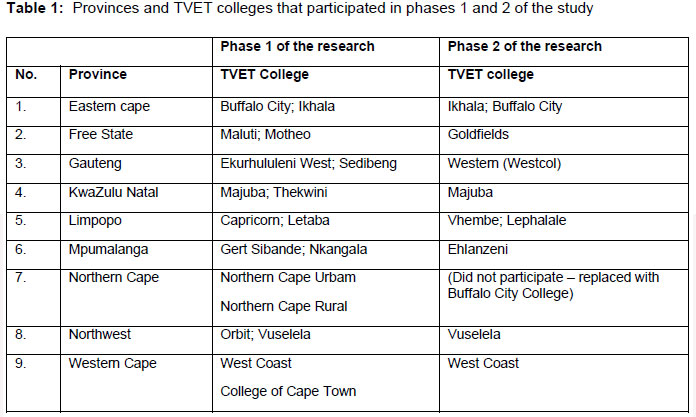
CONTEXT OF THE STUDYThis research was conducted with TVET college staff that are involved in the facilitation and management of students' workplace learning in National Accredited Technical Education Diploma (NATED) programs. The colleges that were involved are in nine (9) South African provinces. During the first phase of the research two (2) colleges were selected in each province and eighteen (18) colleges participated. The second phase involved ten (10) colleges in 8 South African provinces. The purpose of the first phase of the research was to gather data on barriers to best practice of WIL and validate the collected data, during the second phase, with ten TVET colleges that were selected by the DHET and the ETDP SETA to serve as Centers of Excellence in terms of promoting best practices in WIL and the Fourth Industrial Revolution (4IR). It was planned that the validation process of the barriers in research findings of the first phase would be used as an entry point to get confirmation, buy in, support and consensus from the ten TVET colleges to be involved in participatory action research together with college students' workplaces, to address the barriers to best practice of WIL. The provinces and TVET colleges that participated in phases 1 and 2 of the study are reflected in Table 1 which is attached as Appendix 1.
ETHICAL CONSIDERATIONSPermission to conduct research was sought from the DHET and TVET colleges. The DHET expressed an interest in and support for the research in the ethics approval letter. In addition, most of the TVET College Councils granted permission to conduct the study. The South African College Principals' Organization (SACPO) wrote a letter for the Research Chair to get buy-in and support in the TVET sector.
METHODOLOGY
The study is situated in the interpretive research paradigm that focuses on understanding social phenomena through the subjective experiences and interpretations of individuals within their social context. This approach is grounded in the belief that social reality is not objective but is shaped by human experiences and social interactions. The primary goal is to understand the lived experiences and perspectives of individuals, rather than to test hypotheses or examine causal relationships. In contrast to positivist research, which aims to establish objective truths and causal relationships, interpretive research seeks to uncover the subjective meanings and understandings that shape social reality. It emphasizes qualitative methods and seeks to uncover the meanings and understandings people ascribe to their lives and behaviours. This study used qualitative research approaches to explore concepts related to WIL and understand the opinions or experiences (Merriam and Tisdell, 2016) of TVETcollege staff.
Research was conducted in two (2) phases. The first phase involved data gathering on barriers to best practice of WIL. Eighteen (18) focus group interviews were conducted with college WIL staff in nine (9) South African provinces. Studies note that focus groups offer several benefits in research, including the ability to gather in-depth qualitative data efficiently, explore nuanced perspectives, and uncover insights that might not be revealed through individual interviews (Nyumba, et al., 2018, Taherdoost, 2021). In this study, focus groups were used to facilitate discussions and to capture diverse perspectives on WIL staff experiences. They encouraged participants to share their experiences and opinions about barriers to their best WIL practice in a more open and comfortable setting. They also allowed for rich discussion and probing which resulted in group consensus around the barriers that were identified.
Group dynamics were again used when the identified barriers during phase 1 were validated with ten selected TVET colleges in phase 2 of the research. Two meetings and one workshop were used to discuss and validate the presented research findings that were derived from phase 1. The use of group meetings is supported by Goodall and Barnards (2015), who indicate that group meetings between co-researchers who have been brought together for a common purpose serve to generate in-depth data on a topic. The meetings, in this study, allowed the college project leaders from ten TVET colleges to express their opinions in relation to the barriers to best WIL practice, and to discuss possible solutions.
The use of eighteen (18) focus groups in phase 1, and workshops with ten project leaders in phase 2, was appropriate for the study as the purpose was not to generalize the findings, but to use the findings to plan for interventions that would improve the practice of the five identified areas of WIL. Purposive sampling was used to select participants with knowledge and experience in the practice of WIL. The use of purposive sampling allowed the researcher to "decide what needs to be known and sets out to find people who can and are willing to provide the information by knowledge and experience" (Etikan, Musa, and Alkassim, 2016, p.2)
DATA ANALYSISData relating to WIL practice were analyzed qualitatively. The data was coded and transformed into a set of meaningful, cohesive categories. Emerging themes were aligned to the practice of five (5) areas of WIL. The process of summarizing and representing data was done to provide a systematic account of the recorded information and to enable researchers to classify, organize and interpret data. Thematic analysis was used as it is considered a popular method for analyzing qualitative data (Strauss and Corbin 1990; Bowen, Rose and Pilkington 2017; Lerigo-Sampson, 2022). Emerging themes that were identified are presented in the section below.
PRESENTATION AND DISCUSSION OF THE FINDINGS
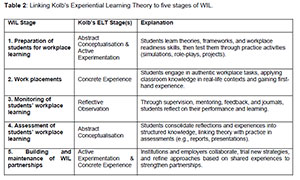
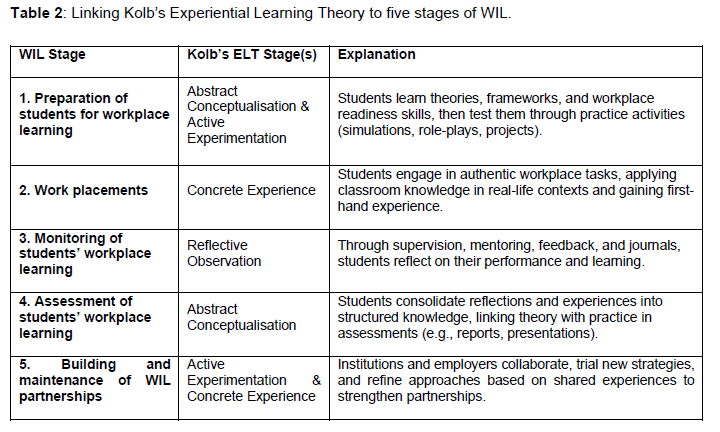
This section discusses the research findings and links the barriers to best practice of five WIL stages to Kolb's (1984) Experiential Learning Theory. Table 2, which provides a summary of the linkages between the ELT and five WIL stages, is attached as an Appendix.
Theme 1: Barriers to good preparation of students for workplace learning
The reflections of the college staff in phase 1 of the research revealed inadequate preparation that involved students in one-day-long orientation or induction.
"Only one session is provided to prepare students who are leaving the college to do workplace learning" (Statement from group 3).
"No task books are available for NATED programmes" (Statement from group 5).
"The placement unit is responsible for preparing WIL students" (Statement from group 6).
The group discussions revealed that there are no structured and time-tabled work readiness programs and that short orientations are done only when students are about to exit the college. It was also mentioned that there are no standardised procedures for preparing students for the workplace.
These barriers prevent students from engaging in Kolb's (1984) abstract conceptualisation and active experimentation as they are not provided with opportunities to learn theories, frameworks, and workplace readiness skills, and test them through practice activities such as simulations, role-plays, and projects.
The challenge of limited preparation, offered and designed in an unstructured and inconsistent manner, confirms the findings by Kosman, et al., (2023) who noted the same practice in other education institutions. This challenge also confirms the concerns on the lack of readiness skills amongst placed students.
This research supports studies that advocate for the quality preparation for WIL (Bates and Bates, 2013; Dwesini, 2014; Grace and O'Neil, 2014; Rayner and Papakonstantinou, 2015) as it reveals the barriers to draw the attention of stakeholders to address them. The research highlights that the practice of preparing students in TVET colleges is in contradiction with the definition of WIL because the preparation phase does not use WIL as an educational approach that involves planning and purposeful integration of academic learning and workplace practice or experiences, as pointed out in the literature (Smith, 2012; Winchester-Seeto and Piggott, 2016; Ferns, et al., 2024). The research also reveals lack of shared responsibility because WIL is regarded as the responsibility of the administrative staff of the placement unit or Student Support Services, as they report to the Deputy Principal: Registration Services or Deputy Principal: Innovation and Development who is responsible for partnerships. The Deputy Principal: Academic Services and the academic staff of the college are not involved in WIL. The result of this structural barrier is that WIL is conducted as an administrative only function for student placement, and not an academic requirement for curriculum embedding. In addition, preparation is not done collaboratively as workplace mentors are not involved.
Theme 2: Barriers to effective placement of students in workplaces
The college staff reported lack of human and financial resources for work placements.
"I am the only placement officer now, and I am responsible for placing students that are in five campuses of this college" (Statement from group 11).
The colleges place a limited number of students. Most students find placement opportunities on their own and sometimes find themselves in inappropriate workplaces. Limited placement opportunities were also reported.
"Our college is in a small rural town that lacks workplaces, especially for Tourism students" (Statement from group 7).
The implications for unplaced students and students that are in inappropriate workplaces is that they are not involved in Kolb's (1984) stage of concrete experience as they do not engage in authentic workplace tasks, and apply classroom knowledge in real-life contexts, to gain firsthand experience.
The limited placement opportunities for students are documented in several studies (Mokibelo and Seru 2020; Rook, 2017; Vu et al., 2021). This study supports the studies that indicate that not all students are placed in appropriate workplaces and highlights the need to explore innovative ways to deliver WIL and skills development that meets the evolving needs of employers today. Such ways of bridging the gap between the world of work and education institutions might include the integration of WIL with technology, consideration of other modalities of WIL, and the use of simulated work environments.
Theme 3: Barriers to effective monitoring of students' workplace learning.
Some of the college staff confirmed that student visits posed a challenge when they stated that:
"Students in NATED programmes are monitored by their workplaces, we sometimes visit students in NCV programmes who are placed for short periods when we do our five-day industry exposure" (Statement from group 17).
"Lecturers are reluctant to monitor students during their "five-day industry exposure in June /July holidays because they are not given additional remuneration for using their vacation." (Statement from group 13).
"There are no monitoring guidelines for WIL, and one or two placement officers cannot be expected to place many students and monitor their workplace learning" (Statement from group 1).
The statements of the college staff indicated that workplace learning is not regarded as an extension of learning from college to the world of work. Consequently, college students who go out for workplace learning are not visited and monitored by the colleges as they are not registered students. They are regarded as employees of the workplace. The perception that workplace learning is employment rather than learning results in monitoring being left in the hands of workplaces who are not well-informed about the learning outcomes of college academic programs. Other mentioned challenges were limited human resources, time constraints, and absence of standardised monitoring guidelines and tools.
The reported barriers prevent students from engaging in Kolb's (1984) stage of reflective observation as students are not given opportunities to learn through supervision, mentoring, feedback, and journals. Such lack of opportunities prevents students from reflecting on meaningful learning experiences or performance, learning from the outcomes observed, and planning how to better approach similar situations in the future.
There are differences in the findings of this study and other studies. While other studies highlight the challenges of monitoring practices and processes (Rook, 2017; Grollmann, et al., 2021; Billette 2022)., the findings of this study reveal challenges that result in and from non-monitoring of students' workplace learning. Non-monitoring of students is not documented as studies recommend collaborative, regular review, and periodic monitoring of workplace learning by all relevant stakeholders, especially in the light of a rapidly changing workplace (Grollman et al., 2021; Zegwaard and Pretti, 2023). Supporting these studies, this study advocates for effective monitoring of students' workplace learning.
Theme 4: Barriers to effective assessment of students' workplace learning.
The following reflections of the college staff indicated that some of the students were not assessed properly.
"For NATED courses, there are no set criteria and assessment tools because the students have completed N4 - N6. Once they have finished their course work, they complete a form and bring it back to the administration and the examination officer who sends it to the Head Office of the DHET in Pretoria, and they get their Diploma". (Statements from 11 groups)
"A current weakness in the system is that students are not getting evaluated on their internships, they do not return to the college after having completed the internship". (Statement from groups 12 and 14).
"It is the responsibility of the Student Support Services only to assess how the placement is progressing by just doing site visits". (Statement from groups 4 and 13).
The statements of the college staff revealed that the main barrier to best assessment practices is non-alignment of curriculum outcomes to the expectations of the workplace which results in a mismatch between what the TVET Colleges offer to students and what is expected from students in the world of work. This situation results in uncoordinated and disintegrated assessment which makes it difficult to understand and decide what to assess and how to assess workplace learning, hence there are no standardised assessment guidelines and tools.
The barriers highlight non-involvement of students in Kolb's (1984) stage of abstract conceptualisation as it is impossible for them to consolidate reflections and experiences into structured knowledge, and link theory with practice in assessments in the form of reports and presentations.
A study by Jackson (2017) attributes the challenges relating to workplace performance to the complex nature of WIL, and notes that WIL is not simply a process of students engaging in work experience with the hope that it will result in employability. Instead, it is an educational process, service, and experience, with foundational pedagogy and theory (Knight and Yorke, 2008) and can be aligned with the processes and outcomes of experiential learning (Kolb, 1984).
The findings on assessment practices are not in line with the South African HEQSF (2012, p. 49) which states that "workplace-based learning must be properly structured, properly supervised and assessed." The findings also contradict studies that suggest that students must be provided with employer feedback (Al-Bashir, Kabir and Rahman, 2016) and opportunities to reflect on their workplace learning experience during assessments in their classroom setting (CHE 2011; Cooper et al., 2010; Mesuwini, et.al, 2023). In support of these studies, this study encourages the use of reflection on workplace experience and inclusion of employer feedback in assessment tasks.
Theme 5: Barriers to the formation of strong WIL partnerships
The findings revealed that the lack of close working relationships between the college and workplaces in terms of preparing, placing, monitoring, and assessing students, is an overarching barrier. The reported barriers include structural barriers that need the attention of the DHET as they are beyond the control of the colleges, a lack of regular communication, information sharing or engagement, and reluctance to sign Memoranda of Understanding (MoUs) by external stakeholders.
"An MOU is an indicator for partnerships, but industry partners are reluctant to sign MOUs. Due to limited communication with and advocacy to our partners, there is not enough time to explain to them the importance of signing MOUs and that, signing doesn't mean that they will share their profits with us and/or will have negative legal implications" (Statements from a group of college project leaders).
The lack of close working relationships prevents the TVET colleges and student employers to engage in Kolb's (1984) stages of active experimentation and concrete experience, as they are deprived of meaningful opportunities to collaborate, pilot, and evaluate new strategies, and refine approaches based on shared experiences. This is a limitation that does not only constrain WIL partnerships and innovation, but also perpetuates reliance on outdated WIL practices.
The findings contradict the recommendations of establishing strong WIL partnerships as suggested by several studies (DHET, 2014; UNESCO 2016; OECD, 2018; Green, et al, 2023). This study supports the research that advocates for the removal of the barriers by all relevant stakeholders (Rook 2017; Scher et al, 2018; McGill et al. 2021; Adam, Gagnier, and Jones-Manson, 2022) through forming strong WIL partnerships.
EDUCATIONAL IMPLICATIONS FOR WIL STUDENTS IN SOUTH AFRICAN TVET COLLEGESWhen the five stages of work-integrated learning (preparation, work placements, monitoring, assessment, and building and maintenance of partnerships) are inadequately implemented in South African TVET colleges, students' learning and professional development are significantly compromised. Poor preparation limits students' readiness for the workplace, reducing their ability to connect theoretical knowledge with practical expectations (Winchester-Seeto and Piggot 2020; Chad 2020; Kosman et al., 2023). Inadequate work placements restrict exposure to authentic industry environments, undermining skill acquisition and reinforcing inequities in access to experiential learning (Jackson, 2017; Mokibelo and Seru 2020; Vu et al., 2021). Weak monitoring systems reduce opportunities for formative feedback, leaving students without guidance to improve workplace performance ((Billette 2022; Simper et al, 2018; Grollmann, et al., 2021). Insufficient assessment practices compromise the recognition of workplace competencies and impede employability (Aijawi et al, 2020; Scholtz 2020; Boud et al., 2023). Finally, ineffective partnership building and maintenance with industry limit placement availability and diminish employer confidence in TVET graduates (Jackson, 2017; Scher, McCowan, and Castaldo-Walsh, 2018; Vu et al., 2021). Collectively, these deficiencies perpetuate the theory-practice gap, reduce student motivation and confidence, and weaken the capacity of TVET colleges to produce work-ready graduates.
RECOMMENDATIONSTo guide national WIL implementation at South African TVET colleges, the country needs a framework that addresses multiple levels, which are policy alignment, institutional readiness, industry engagement, student learning, and monitoring/evaluation. The framework must integrate theory, practice, and policy, and ensure that WIL is structured, scalable, and contextually relevant for South African TVET colleges.
Proposed Framework for Work Integrated Learning
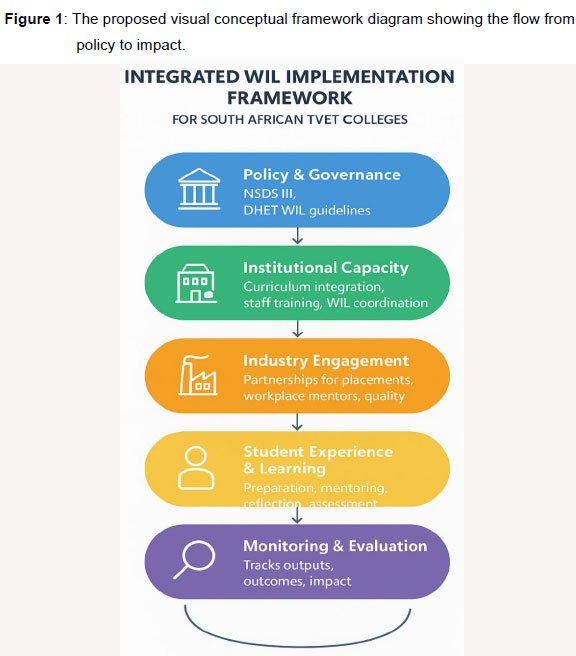
The proposed framework is conceptualized as a layered, stacked model that delineates the progression from national policy to student impact, while incorporating a continuous feedback loop for system-wide improvement.
Policy and Governance (National Level)
At the apex of the framework lies the Policy and Governance layer, situated at the national level. This layer is informed by key policy instruments such as the National Skills Development Strategy III (NSDS III) and the Department of Higher Education and Training (DHET) Work-Integrated Learning (WIL) Guidelines. Its primary role is to establish national standards, provide funding allocations, and enforce regulatory compliance, thereby shaping the enabling environment for effective WIL implementation across the system. For this component, the focus must be on national coordination, funding, and compliance, with explicit theoretical and policy alignment to the NSDS III and the DHET WIL guidelines.
Institutional Capacity (TVET College Level)
The second layer of the framework is Institutional Capacity, located at the Technical and Vocational Education and Training (TVET) college level. This layer emphasizes the integration of WIL within curricula, the professional development of academic staff, and the establishment of WIL coordination units. Functionally, it represents the input layer within the logic model, comprising the resources, systems, and institutional structures required to facilitate effective WIL implementation. The focus here must be on strengthening staff capabilities, embedding WIL into curricula, and developing robust monitoring systems, while conceptually linking these dimensions to the input and activity components of the Logic Model.
Industry Engagement (Employers and Stakeholders)
The third layer is Industry Engagement, which foregrounds the role of employers and external stakeholders. This layer involves the creation of partnerships that provide student placements, the training of workplace mentors, and mechanisms for quality assurance. Anchored in Kolb's Experiential Learning Theory (ELT), this layer primarily enables Concrete Experience, which is central to applied learning and the development of work-ready graduates. The industry engagement component must therefore focus on building sustainable partnerships, ensuring the quality of placements, and aligning workplace exposure with skills requirements, underpinned by Kolb's experiential learning principles.
Student Experience and Learning
The fourth layer, Student Experience and Learning, constitutes the core of the WIL process. It encompasses student preparation, mentoring, reflective practice, and assessment, all of which are integral to deep learning. This layer is conceptually linked to the full cycle of Kolb's ELT as well as Lundy's model of participation, thereby ensuring that students' voices are authentically represented in program design and evaluation. In this way, it positions students not merely as beneficiaries, but as active participants in shaping their learning journeys. The primary focus of this layer must therefore be on preparation, reflection, and assessment, with explicit theoretical grounding in Kolb's experiential cycle and Lundy's participation model.
Monitoring and Evaluation (Feedback Loop)
The final layer is Monitoring and Evaluation, which functions as both the bottom layer and a feedback loop. This layer systematically tracks outputs (e.g., student placements and partnerships), outcomes (e.g., skills acquisition and employability), and broader impacts (e.g., workforce development and national capacity building). By feeding evidence of progress and challenges back into the policy and institutional layers, this layer ensures continuous improvement, accountability, and sustainability of the WIL system. The focus of this component must be on assessing outcomes, measuring long-term impact, and institutionalizing feedback mechanisms that reinforce the Logic Model's outputs and outcomes, thereby supporting continuous improvement.
The visual conceptual framework diagram showing the flow from policy to impact (Figure 1), is attached as Appendix 2. The arrows show top-down implementation and bottom-up feedback. The colours are blue for policy with an icon of the government building, green for institution with an icon of the college, orange for industry with an icon of the factory or office, yellow for student with an icon of the student and purple for evaluation with an icon of the magnifying glass.
CONCLUSION
The fragmented implementation of WIL in South African TVET colleges underscores systemic weaknesses that directly affect student outcomes. Across the five stages of WIL, students experience constrained opportunities to develop workplace readiness, demonstrate competencies, and gain exposure to authentic industry contexts By systematically addressing deficiencies in preparation, placement quality, monitoring, assessment, and partnership development, TVET colleges can enhance the integration of theory and practice, improve graduate employability, and fulfil their mandate to equip students with both technical competence and workplace adaptability. The proposed layered and integrated framework for WIL offers a coherent national model for strengthening WIL within the TVET system, ensuring alignment between policy intent, institutional practice, industry needs, and student outcomes.
REFERENCES
LITERATURE REVIEW
-
Abusomwan, V. I. 2024. "Assessment of Students Industrial Work Experience Scheme (SIWES) for practical skills acquisition among Home Economics students in tertiary institutions in Lagos Mainland Local Government Area." International Journal of Entrepreneurship, Technology, and Innovation, 1(2), 226-239. DOI: 10.1108/HESWBL-10-2023-0294
» https://doi.org/10.1108/HESWBL-10-2023-0294 - Adam, T., K.M. Gagnier, K. and S. Jones-Manson. 2022. Approaches to Build and Maintain High-Quality, Effective Partnerships. Cross-project summary produced by AnLar and the Office of Elementary and Secondary Education. Education, Innovation, and Research Program (EIR).
- Al-Bashir, M., R. Kabir, and I. Rahman. 2016. "The value and effectiveness of feedback in improving students' learning and professionalizing teaching in higher education". Journal of Education and Practice 7(16), 18-41. ISSN-2222-1735
-
Baraka Policy Institute. 2021. A BPI research report: The quest for creative employabilityskills: An inquiry into the state of technical/vocational education and training in Ghana. Accra.efaidnbmnnnibpcajpcglclefindmkaj/https://barakapolicy.org/wp-content/uploads/2024/03/TVET_Research_Report_1-1-compressed.pdf
» Accra.efaidnbmnnnibpcajpcglclefindmkaj/https://barakapolicy.org/wp-content/uploads/2024/03/TVET_Research_Report_1-1-compressed.pdf -
Bates, A., and L. Bates. 2013. "Work-integrated learning courses: An essential component for preparing students to work in statutory child protection". Asia-Pacific Journal of Cooperative Education, 14(1), 45-58. http://hdl.handle.net/10072/60097
» http://hdl.handle.net/10072/60097 -
Bergsteiner, H., G. C. Avery, and R. Neumann, 2010. "Kolb's experiential learning model: Critique from a modelling perspective". Studies in Continuing Education, 32(1), 29-46. https://doi.org/10.1080/01580370903534355.
» https://doi.org/10.1080/01580370903534355 -
Billette S. 202. "Learning in the workplace: Strategies for effective practice." Routledge, New York. https://doi.org/10.4324/9781003116318
» https://doi.org/10.4324/9781003116318 -
Boud, D., C. Costley, S. Cranfield, J. Desai, E. Nikolou-Walker, P. Nottingham, D. Wilson. 2023: "The pivotal role of student assessment in work-integrated learning." Higher Education Research & Development 42 (6), 1323-1337. https://doi.org/10.1080/07294360.2022.2152981
» https://doi.org/10.1080/07294360.2022.2152981 -
Bowen, P. W., R. Rose, and A. Pilkington. 2017 "Mixed methods theory and practice. Sequential, explanatory approach". International Journal of Quantitative and Qualitative Research Methods. 5(2), pp. 10-27. https://eajoumals.org/ijqqrm/vol-5-issue-2-may-2017/mixed-methods-theory-practice-sequential-explanatory-approach/
» https://eajoumals.org/ijqqrm/vol-5-issue-2-may-2017/mixed-methods-theory-practice-sequential-explanatory-approach/ - Cates, C., and P. Jones. 1999. Learning outcomes: The educational value of cooperative education. Columbia, MD: Cooperative Education Association.
-
Chad, P. 2020." Equitable work-integrated learning: Using practical simulations in university marketing subjects". Australasian Marketing Journal, 28(2), 119-127. https://doi.org/10.1016/j.ausmj.2020.01.004
» https://doi.org/10.1016/j.ausmj.2020.01.004 -
Chauke T A. 2023. "Determinants of Youth Unemployment among TVET College Graduates in the Vhembe District." Journal of Culture and Values in Education 6(3):125-143. DOI: 10.46303/jcve.2023.24
» https://doi.org/10.46303/jcve.2023.24 -
Coll, R., R. Eames, L. Paku, M. Lay, D. Hodges, R. Bhat, S. Ram, D. Ayling, J. Fleming, L. Perkins, C. Wiersma, and A. Martin. 2011. "An exploration of the pedagogies employed to integrate knowledge in work-integrated learning". Journal of Co-operative Education & Internship, 43(1), 14-35 https://researchcommons.waikato.ac.nz/bitstream/handle/10289/5554/An%20Exploration.pdf?sequence=1
» https://researchcommons.waikato.ac.nz/bitstream/handle/10289/5554/An%20Exploration.pdf?sequence=1 - Coll, R. K., and K. E. Zegwaard. 2011. "The integration of knowledge in cooperative and work-integrated education programs". In R. K. Coll and K. E. Zegwaard (Eds.), International handbook for cooperative and work integrated education: International perspectives of theory, research, and practice (2nd ed., pp. 297-304). World Association for Cooperative Education.
-
Cooper, L., J. Orrell, and M. Bowden. 2010. "Work integrated learning: A guide to effective practice." Routledge. https://doi.org/10.4324/9780203854501.
» https://doi.org/10.4324/9780203854501 -
Council on Higher Education. 2011. "Work-integrated learning: Good Practice Guide". HE Monitor No. 12. https://www.che.ac.za/sites/default/files/publications/Higher_Education_Monitor_12.pdf
» https://www.che.ac.za/sites/default/files/publications/Higher_Education_Monitor_12.pdf - Dean, B. A., & Campbell, M. (2020). Reshaping work-integrated learning in a post-COVID-19 world of work. In K. E. Zegwaard & T. J. Pretti (Eds.), The Routledge international handbook of work-integrated learning (pp. 361-380). Routledge.
-
Department of Higher Education and Training. 2014. White paper for post school education and training. Pretoria. South African Government. https://www.gov.za>gcis_document>201409.pdf
» https://www.gov.za>gcis_document>201409.pdf -
Department of Higher Education and Training. 2019. National skills development promulgation. South African Government. http://www.dhet.gov.za.
» http://www.dhet.gov.za -
Dewey, J. 1933. How "We Think: A Restatement of the Relation of Reflective Thinking to the Educative Process". Boston, MA: D.C. Heath & Co Publishers. https://unesdoc.unesco.org/ark:/48223/pf0000193692
» https://unesdoc.unesco.org/ark:/48223/pf0000193692 -
Diem, S., M. D. Young, and C. Sampson. 2019. "Where critical policy meets the politics of Education: An introduction". Educational Policy 33 (1) https://doi.org/10.1177/0895904818807317
» https://doi.org/10.1177/0895904818807317 - Dwesini, F.N. 2015. "Assessing learners' preparedness for work-integrated learning (WIL) at Walter Sisulu University, South Africa". African Journal of Hospitality, Tourism and Leisure, 4(2), 112.
-
Education, Training and Development Practices Sector Education and Training Authority (ETDP SETA). 2024. Development and execution of college action plans to improve the practice of five areas of work-integrated learning: Final report. Johannesburg: ETDP SETA. etdpseta.org.za
» etdpseta.org.za -
Etikan, I., S. A. Musa, and R. S. Alkassim. 2016. "Comparison of convenience sampling and purposive sampling." American Journal of Theoretical and Applied Statistics, 5(1), 14. https://doi.org/10.11648/j.ajtas.20160501.11
» https://doi.org/10.11648/j.ajtas.20160501.11 -
Ferns, S.J., K. E. Zegwaard, T. Pretti. and A. D. Rowe. 2024: "Defining and designing work-integrated learning curriculum". Higher Education Research & Development, 44 (2), 371 - 385 DOI: 10.1080/07294360.2024.2399072
» https://doi.org/10.1080/07294360.2024.2399072 -
Ghimire, A., and J. Edwards. 2024, July. "From guidelines to governance: A study of ai policies in education". In International Conference on Artificial Intelligence in Education (pp. 299-307). Cham: Springer Nature Switzerland. https://doi.org/10.1007/978-3-031-64312-5_36
» https://doi.org/10.1007/978-3-031-64312-5_36 -
Goodall, C., and A. Barnard. 2015. December 11-14. "The challenge of participatory action research with children and young people" [Conference session]. Social Research Association Conference, Nottingham Trent University, England. https://www.researchgate.net/publication/287201728
» https://www.researchgate.net/publication/287201728 - Grace, S., and R. O'Neil. 2014. "Better prepared, better placement: An online resource for health students". Asia-Pacific Journal of Cooperative Education, 15(4), 291-304.
- Green, E., R. Barr, J. Lawrence, B. Smith, A. Carey, M Peelgrane, and Z. Crawford. 2023. "Building sustainable partnerships and managing expectations of work-integrated learning stakeholders". In The Routledge international handbook of work-integrated learning (pp. 395-412). Routledge.
-
Grollman, P., F. Hugo, S. Thomas, and W. Wittig. 2021. "Monitoring and evaluating work-based learning in vocational education and training": A handbook for policy makers and social partners. European Training Foundation. https://eric.ed.gov/?id=ED617526
» https://eric.ed.gov/?id=ED617526 - Groenewald, T., Drysdale, M. T. B., Chiupka, C., & Johnston, N. (2011). Towards a definition and models of practice for cooperative and work-integrated education. In R. K. Coll & K. E. Zegwaard (Eds.), International handbook for cooperative and work-integrated education (2nd ed., pp. 17-24). World Association for Cooperative Education.
-
Husain, S.H., A. I. Che-Ani, H. M. Affandi, N. M. Nasri, and N. A. Musid. 2020. "Mismatch in supply and demand of building surveying graduates' skills: A triangulation perspective." Journal of Technical Education and Training, 12(4), 70-80. DOI: 10.46303/jcve.2023.24
» https://doi.org/10.46303/jcve.2023.24 -
Iipinge, S., P. Batholmeus, and C. Pop. 2020. "Using simulations to improve skills needed for work-integrated learning before and during COVID-19 in Namibia". International Journal of Work Integrated Learning, Special issue 21(5), 531-543. https://eric.ed.gov/?id=EJ1271588
» https://eric.ed.gov/?id=EJ1271588 -
Jackson, D. 2013. "Business graduate employability-where are we going wrong?" Higher Education Research & Development, 32(5), 776-790. https://doi.org/10.1080/07294360.2012.709832
» https://doi.org/10.1080/07294360.2012.709832 -
Jackson, D. 2017. "Exploring the challenges experienced by international students during work-integrated learning in Australia". Asia Pacific Journal of Education, 37(3), 344-359. https://doi.org/10.1080/02188791.2017.1298515
» https://doi.org/10.1080/02188791.2017.1298515 -
Jackson, D. 2025). "University student anticipation and experience of challenges and supportduring compulsory Work Integrated Learning components'. The Australian Educational Researcher.DOI: https://doi.org/10.1007/s13384-025-00836-2
» https://doi.org/10.1007/s13384-025-00836-2 -
Kaider, F., R. Hains-Wesson, and K. Young. 2017. "Practical typology of authentic work-integrated learning". Asia-Pacific Journal of Cooperative Education 18 (2). 153 -165. https://eric.ed.gov/?id=EJ1151141
» https://eric.ed.gov/?id=EJ1151141 - Knight, P., and M. Yorke. 2008. "Assessment close up: The limits of exquisite descriptions of achievement". International Journal of Educational Research 47 (3): 175-183.
-
Kolb, D.A. 1984. Experiential learning: Experience as the source of learning and development. Prentice Hall. https://www.researchgate.net/publication/235701029
» https://www.researchgate.net/publication/235701029 - Kolb, D.A. 2015. Experiential Learning: Experience as the source of Learning and Deveopment, Second Edition. New Jersey: Pearson Education. ISBN: 978-0-13-389240-6.
-
Kong, Y. 2021. "The role of experiential learning on students' motivation and classroom engagement". Frontiers in Psychology, 12, Article 771272. https://doi.org/10.3389/fpsyg.2021.771272
» https://doi.org/10.3389/fpsyg.2021.771272 -
Kosman, B.A., D. C. De Jong, C. R. K. Knight-Agarwal, L. Chipchase, and N. Etxebarria, 2023 "Study abroad: Exploring the pre-departure preparation provided to students, staff, and host communities." International Journal of Work Integrated Learning 24(4), 477-489. https://eric.ed.gov/?id=EJ1408851
» https://eric.ed.gov/?id=EJ1408851 -
Lerigo-Sampson, M. 2022. "Qualitative data analysis." In Handbook of research methods for supply chain management, 187-201. Edward Elgar Publishing. https://doi.org/10.4337/9781788975865.00016
» https://doi.org/10.4337/9781788975865.00016 -
McGill, M. M., A. Peterfreund, S. Sexton, R. Zarch, and M. Kargarmoakhar. 2021. "Exploring research practice partnerships for use in K--12 computer science education." Association for Computing Machinery (ACM) Inroads, 12(3), 24-31. https://doi.org/10.1145/3477607
» https://doi.org/10.1145/3477607 -
Martin, A., M. Rees, M. Edwards, and L. Paku. 2012. "An organizational overview of pedagogical practice in work-integrated education". Asia-Pacific Journal of Cooperative Education 13, no. 1: 23-37. https://hdl.handle.net/10289/7296
» https://hdl.handle.net/10289/7296 -
McRae, N., and N. Johnston. 2016. "The development of a proposed global work-integrated learning framework" [special issue]. Asia-Pacific Journal of Cooperative Education, 17(4), 337348. https://eric.ed.gov/?id=EJ1131540
» https://eric.ed.gov/?id=EJ1131540 - Merriam, S. B., and E. J. Tisdell. 2016. Qualitative research: A guide to design and implementation (4th ed.). John Wiley & Sons.
-
Mesuwini, J., K. L. Thaba-Nkadimene, D. Mzindile, and S. Mokwena. 2023. "Work-integrated learning experiences of South African technical and vocational education and training lecturers." International Journal of Work-Integrated Learning, 24 (1), 83-97. https://eric.ed.gov/?id=EJ1379048
» https://eric.ed.gov/?id=EJ1379048 -
Mokibelo, E. and L. Seru. 2020. "Learning for Employment: Challenges Encountered by Students." Open Access Library Journal, 7, 1-16. doi: 10.4236/oalib.1106549
» https://doi.org/10.4236/oalib.1106549 -
Morris, T.H. 2019. "Experiential learning - A systematic review and revision of Kolb's model". Interactive Learning Environments, 28 (8), 1064-1077. https://doi.org/10.1080/10494820.2019.1570279
» https://doi.org/10.1080/10494820.2019.1570279 -
Mwaura, A. N., M. Mugwe, P. Adabu, and R. Thinguri. 2022. "Influence of Industrial Attachment Duration on Employability Skills: A Case of Technical, Vocational Educational and Training (TVET) Trainees in Nairobi County" (Online) Journal of Research Innovation and Implications in Education 6 (2) 281-292.efaidnbmnnnibpcajpcglclefindmkaj/https://jriiejoumal.com/wp-content/uploads/2022/06/JRIIE-6-2-030.pdf
» efaidnbmnnnibpcajpcglclefindmkaj/https://jriiejoumal.com/wp-content/uploads/2022/06/JRIIE-6-2-030.pdf -
Nyumba, T. O., Wilson, K., Derrick, C. J., & Mukherjee, N. (2018). The use of focus group discussion methodology: Insights from two decades of application in conservation. Methods in Ecology and Evolution, 9(1), 20-32. https://doi.org/10.1111/2041-210X.12860
» https://doi.org/10.1111/2041-210X.12860 -
OECD. (2018). OECD Science, technology, and innovation outlook 2018. OECD Publishing. https://oecd.org
» https://oecd.org -
Penuel, W. R., A. R. Allen, C. E. Coburn, and C. Farrell. 2015. "Conceptualizing research-practice partnerships as joint work at boundaries." Journal of Education for Students Placed at Risk (JESPAR), 20(1-2), 182-197. doi:10.1080/10824669.2014.988334
» https://doi.org/10.1080/10824669.2014.988334 -
Rayner, G., and T. Papakonstantinou. 2015. "Student perceptions of their workplace preparedness: Making work integrated learning more effective". Asia-Pacific Journal of Cooperative Education, 16(1), 13-24. https://eric.ed.gov/?id=EJ1113532
» https://eric.ed.gov/?id=EJ1113532 -
Rook L. 2017 "Challenges of implementing work-integrated learning in human resource management university courses." Asia-Pacific Journal of Cooperative Education 18 (3) 199-212. https://eric.ed.gov/?id=EJ1156043
» https://eric.ed.gov/?id=EJ1156043 -
Rosen, R., M. Visher, and K. Beal. 2018. "Career and technical education: current policy, prominent programs, and evidence." New York: MDRC. DOI: https://eric.ed.gov/?id=ED590008_(retrieved 26.03.2022).
» https://eric.ed.gov/?id=ED590008_ -
Rowe, A. D., and K. E. Zegwaard. 2017. "Developing graduate employability skills and attributes: Curriculum enhancement through work-integrated learning". Asia-pacific journal of cooperative education, 18(2), 87-99. https://www.researchgate.net/publication/327791143
» https://www.researchgate.net/publication/327791143 - Scher, L., R. McCowan, and C. Castaldo-Walsh. 2018. "Regional Educational Laboratory researcher practitioner partnerships: Documenting the research alliance experience." Washington, DC: U.S.
-
Department of Education, Institute of Education Sciences, National Center for Education Evaluation and Regional Assistance. https://eric.ed.gov/?id=ED581137
» https://eric.ed.gov/?id=ED581137 -
Scholtz, D. 2020. "Assessing workplace-based learning." International Journal of Work-Integrated Learning, 21(1), 25-35. https://www.ijwil.org
» https://www.ijwil.org -
Simper, N., L. Gouthier, and J. Scott. 2018. "Student Learning in the Workplace: The Learning Evaluation and Reflection Narrative (LEARN) framework". Journal of Workplace Learning, 30(8), 658-671. https://doi.org/10.1108/JWL-04-2018-0060
» https://doi.org/10.1108/JWL-04-2018-0060 -
Smith, C., 2012. "Evaluating the quality of work-integrated learning curricula: a comprehensive framework". Higher Education Research & Development 31 (2) 247-262. https://doi.org/10.1080/07294360.2011.558072
» https://doi.org/10.1080/07294360.2011.558072 - Strauss, A. L., and J. Corbin. 1990. Basics of Qualitative Research: Grounded Theory Procedures and Techniques. Thousand Oaks, CA: Sage.
-
Taherdoost, H. 2021." Data collection methods and tools for research; a step-by-step guide to choose data collection technique for academic and business research projects" International Journal of Academic Research in Management (IJARM), 10(1), 10-38. https://hal.science/Hal03741847/
» https://hal.science/Hal03741847/ - UNESCO. (2016). "Strategy for technical and vocational education and training" (TVET): (2016-2021).
- Universities South Africa. 2025, August 6. Bridging the gap between education and employability.
-
Vu, T., S. Ferns. and S. Ananthram. 2021. "Challenges to international students in work-integrated learning: a scoping review." Higher Education Research and Development 41 (7), 2473-248 https://doi.org/10.1080/07294360.2021.19963399.
» https://doi.org/10.1080/07294360.2021.19963399 - Winchester-Seeto T. and L. Piggott. 2020. "Workplace or workforce: What are we preparing students for?" Journal of University Teaching and Learning Practice 17(4), 1-6.
-
Yardley, S., P. W. Teunissen, and T. Dornan. 2012. "Experiential learning: Transforming theory into practice". Medical Teacher, 34 (2), 161-164. https://doi.org/10.3109/0142159X.2012.643264
» https://doi.org/10.3109/0142159X.2012.643264 -
Young, T., and W. D. Lewis. 2015. Educational Policy Implementation Revisited. Educational Policy, 29(4), 615-639. SAGE Journals https://doi.org/10.1177/0895904815568936
» https://doi.org/10.1177/0895904815568936 - Zegwaard, K. E. and T. J. Pretti. 2023. "Future directions for advancing work integrated learning pedagogy". In K.E. Zegwaard and T.J. Pretti (Eds.), The Routledge International Handbook of Work Integrated Learning (3rd ed.). Routledge.
APPENDICES