Lecturers' perspectives on teaching students with visual impairments: A case study of one TVET college in Kwazulu-Natal
Abstract
Inclusive education has become a critical aspect of the Higher Education system. This article explored ways to promote inclusivity and reduce exclusion in TVET colleges by addressing how lecturers view students with visual impairments. Drawing on the Learning Journey Theory (LJT) and Theory of Change (TOC), the researchers sought to re-conceptualise and understand lecturers' learning journeys to facilitate inclusivity. Qualitative data was gathered from six TVET lecturers and analysed using thematic narrative analysis. The training of TVET lecturers to support students with VI emerged as a major barrier hindering the lecturers' practice to enhance such students' academic performance. Additional challenges included a dearth of educational resources, funding, inappropriate training programs, a lack of professional growth, and clear guidelines for educating visually impaired students. The findings indicate that policies for visually impaired students should be supported by thorough, ongoing training for lecturers. Furthermore, it is essential to have backing from government bodies and educational institutions to provide vital learning materials, assistive technologies, and well-defined policy guidelines. Hiring knowledgeable and empathetic instructors towards visually impaired students is another indispensable component.
visual impairment; inclusion; learning journey; stigmatisation; diversity; pedagogies; narrative inquiry; professional development
INTRODUCTION
Visual impairment (VI) encompasses challenges arising from either partial or complete blindness, making it difficult for individuals to carry out daily activities such as driving, reading, socialising, and participating in sports. In addition, it can lead to vision problems that negatively affect a person's educational performance (David, Schroeder, and Fernandez 2019). As noted by Felix, Kumar, and Veeramuthu (2018), the visually impaired face a disadvantage because most tasks require visual information, making it harder for them to obtain important information about their environment. However, people with VIs are in a position to receive additional support thanks to recent advances in inclusive technology. A partially sighted person can learn largely through vision rather than touch or hearing since they have adequate functional visual efficiency; yet, VI children typically require a great deal of support at school. Those who require magnifying glasses but can see huge prints are regarded as partially sighted.
Significantly, traditional habits continue to cause problems for blind people (Santra and Deyasi 2022). For anyone with a VI, even a simple task such as going to the grocery store without a personal aide presents a challenge. At TVET colleges, a VI individual could require additional time to complete tasks that require vision or to acclimate to changes in lighting. The student may further need more time to complete tasks that involve vision. In this context, assistive technology (AT) refers to any apparatus or system used to maintain, improve, or expand a learner's functional abilities to maximise participation. AT can be purchased commercially, or be self-modified or customised (Alnahdi 2014, 18-23) VI students can benefit from AT by using it to complete difficult activities, become independent in their scholastic and professional pursuits, and engage in class discussions. Increasingly, students with VIs are using AT to suit their daily needs (Periša et al. 2022). Thus, AT could be used to inspire students, help instructors share knowledge, and deliver engaging lessons, facilitating the accomplishment of goals. Lecturers should also remind themselves that VI students benefit from using AT. Therefore, they should always have them at hand and be equipped to assist students in using AT.
To overcome certain barriers to education and completely engage in society, pupils and persons with VIs must be digitally literate (Arslantas and Gul 2022). Gaining information and skills in an increasingly dynamic professional and academic setting, as well as in school, has made becoming 'digitally literate' an essential objective. Thus, Landsberg, Kruger, and Swart (2013, 379) state that "they must learn to read and write Braille at the same time as the sighted learn to read and write". Braille is the fundamental and distinctive writing and reading medium for teaching blind and partially sighted students.
Thanks to the advent of computers, students can now fully engage in the educational process, which is essential for fostering inclusion. According to Landsberg et al. (2013, 379), visually impaired students can access the internet, create and read documents, and navigate screens with the help of software designed for screen access. This information is then transformed into audio output. Additionally, partially sighted students can use magnifying glasses when large-print books are not accessible. Instead of traditional textbooks with standard lines commonly found in universities, educators can also create parallel lines on blank type A4 paper using a dark pen or marker, making it easier for visually impaired students, especially those who struggle to write within the lines.
To leverage the advantages of assistive technologies (ATs), it is crucial for instructors who aim to support visually impaired (VI) students in mainstream education to obtain advanced special education degrees. Without the involvement of specialists in educational adaptations, visually-oriented learners may struggle to achieve optimal learning outcomes.
TEACHING AND LEARNING SUPPORT MATERIALSThe availability of teaching and learning support materials (TLSM) in inclusive classrooms enhances teaching techniques and facilitates thorough implementation. Employing effective computer technology in inclusive classrooms is essential for unlocking the full potential of visually impaired (VI) students. Moreover, employing innovative teaching strategies plays a key role in achieving success within these inclusive environments. As a result, providing assistive devices to VI students is vital for fostering an inclusive educational framework. Ndlovu (2020) asserts that assistive devices are designed to promote learning. Consequently, this study aimed to add to the ongoing discussion regarding the provision of assistive technology (AT) and support services for VI students in low-resource contexts, especially within the higher education institutions (HEI) sector in South Africa.
Technology has significantly contributed to the creation of assistive devices for students with disabilities (Beingolea et al. 2021). Specifically, many of these technologies are designed to assist students who are blind or visually impaired to connect with their surroundings in a more engaging way (obstacles, objects and navigation). According to Fraser (2021), an assistive device is any item, piece of equipment, or product system used to increase, maintain, or improve the functional skills of persons with disabilities, regardless of whether it is acquired commercially, adapted, or customised. Sadly, the devices' astronomical prices put them beyond the reach of VI students.
Assistive devices
AT can assist students with disabilities in various ways, serving as a valuable educational tool (Bouck, Park, and Stenzel, 2020). AT also helps students with visual impairments and their classmates without disabilities overcome barriers to learning and skill development (Atanga et al. 2020). This, however, necessitates lecturers to become well-trained and skilled in technology use. Not only are there are professionals in AT services who suggest particular technological tools to various educational program teams, but workshops or training sessions aimed at enhancing AT skills for educators can also be beneficial. Therefore, the process of creating an assistive device should not be daunting for students or teachers; instead, it should cater to the users' functional requirements without leading to social discomfort. For students with VIs, AT is essential for accessing information and participating in educational environments (Abualrejal, et al 2021, 873-883). Consequently, students encountering different challenges in technical and vocational education and training (TVET) can depend on assistive technology to help them achieve their academic goals.
Multi-sensory method, kinesthetic learning and tactile learning
VI students learn using various senses including taste, smell, touch, and hearing (apart from vision). In reviewing the literature on sensory learning, the sense of touch (tactile) has been identified as the most effective teaching strategy for children with visual impairments (VI). Baker (2020, 275) refers to this as kinesthetic learning, while Chun et al. (2019) call it tactile learning. Heller et al. (2019) describe it as a multisensory approach. These researchers agree that utilising the sense of touch to educate students with VI is the most effective method. This learning style fosters connections to concepts associated with touch, sensation, or bodily movement, allowing students to gather information about objects through their tactile experiences. For example, they can comprehend a map by highlighting the limits of the thread (Curwen, Ardell and MacGillivray, 2019). In addition, (Elli, Bedny, & Landau, 2021) explain that VI students should be capable of touching an object since this allows them to 'see' what their sighted classmates see.
Auditory learning method
Numerous researchers including (Rahayu, Suryani, and Zainiyati 2020) advocate for the auditory learning approach. This approach employs language to create mental images that interpret or lend meaning to spoken words (White et al. 2020). Essentially, spoken language generates 'visuals' that help express meaning. Khoza (2015, 122) suggests that lectures become more effective and rewarding when instructors create an environment that allows students to cultivate their understanding of the material being presented. For diverse people, meaning is always established differently, and in distinct ways (Titchkosky 2020). As a result, meaning is extremely context-dependent; for example, a message received creates a different picture in the mind of a VI student since we interpret things in our own way.
According to Judd (2020), the first step in effectively using the auditory learning method is for lecturers to evaluate the nature of a student's VIs during an informal, private talk with the student and parents. As a researcher, understanding the student's needs is crucial to provide effective support for their academic endeavours. Judd (2020) adds that lecturers who teach VI students should exercise extra care when presenting material to accommodate them. For VI students, it is vital to clarify terminology concretely, especially when it comes to graphs. Furthermore, Joseph et al. (2019) advocate for lecturers not to use ambiguous directional cues like 'this', 'that', 'here', or 'there' for VI students as such exclusionary language could make comprehending information more difficult.
Narration/storytelling teaching method
The storytelling (narrative) teaching strategy in its most basic form is a means by which a culture passes on to the next generation what they have found to be useful (Miller and Pennycuff, 2010). The curriculum can be thought of as a specific medium for delivering a tale about the world by using this strategy. When the narrator narrates the story with diverse gestures and variations in moods, volume, sound and narration as a tactic, it becomes more interesting to VI students. Therefore, the narrator (the lecturer) must be well-versed in various techniques of voice production to elicit VI students' responses. Since narratives involve a series of related events or experiences, whether non-fictional or fictional, a sequence of written or spoken words, a tale can be told using still photographs, moving visuals, or a combination of both. Educators' familiarity with schools and classrooms as individual settings embodies the concept of expertise in a manner that enables us to describe them as well-informed and knowledgeable individuals (Clandinin 2019). When employing a narrative approach in teaching, the curriculum can be viewed as a valuable resource for sharing stories about the world.
Demonstration method
According to McLain (2021, 3-26), demonstration is an essential teaching approach for practical subjects. It enhances students' understanding, observational abilities, and skills in imitation, while also fostering independence and the ability to adjust techniques. The demonstration method serves as a way to convey information in Knowledge-Based Management (KBM), presenting a clear visual guide on how to perform a task (Purwana 2021). Additionally, the demonstration method can be employed to improve student achievement by identifying problems, defining problems, planning, implementing actions, and assessing the results. Any planned performance of occupation skill, scientific theory, or experiment is considered a demonstration (Triayomi 2019). It is assumed that demonstrating an occupational skill is the most efficient method to teach it. The use of the demonstration method in mathematics could help students learn more effectively (Pulungan 2021). Pulungan (2021, 247) suggests that conducting research by using the demonstration method could encourage students to be more motivated to attain quality results. According to Nugraha (2021), this method also encourages students to be more active and creative in their English studies. This means that procedural text-writing competence has a substantial effect in the experimental class.
THEORETICAL FRAMEWORKTwo theories, the Learning Journey Theory (LJT) and Theory of Change (TOC) which underpinned this article, were re-conceptualised to understand lecturers' learning journeys. The relevance of LJT and TOC to this research was highlighted due to their focus on the processes of change over short, medium, and long-term periods to reach desired results. Additionally, the theories were found to work well together, thereby enhancing the ability to address the research questions effectively.
A theoretical framework, as described by Merriam (2009, 2) forms the underlying structure of any study and assists the researcher in justifying the reasons for undertaking the study. It also informs the research design in line with the research aim, objectives, and research questions which results in the selection of suitable research methods. A theoretical framework offers a lens through which a study may be planned and viewed. The purpose of underpinning a study with a theoretical framework is to anchor the organisation of the data to answer the research questions. Grant and Osanloo (2019) emphasise that a theoretical framework leans on a selected model that grounds the planning of a research topic. In this article, the framing of lecturers' learning journeys involves having competent teaching staff from both technological and pedagogical points of view to enhance VI students' learning experiences (Batanero et al. 2019). Within this context, the study aimed to understand how lecturers' learning journeys were influenced by teaching students with VI.
Swart and Pettipher (2019) maintain that a theory is a set of assumptions and concepts ordered to inform us about the world, ourselves, or any relevant aspect of reality. Therefore, an appropriate theoretical framework should be adopted to resolve the research problem in line with the aim of the study. TVET colleges, with all of their programs, are progressively admitting students with impairments, including those with vision impairment (Muzata et al. 2019), so differently-abled students should learn alongside their abled peers, as indicated in the inclusive education policy. To ensure the successful inclusion of students with VIs, TVET colleges should routinely train all instructors in inclusive pedagogies (content and technique) so that they can create activities that promote interactive learning for all students.
RESEARCH METHODS AND DESIGNTo understand the learning journeys of selected lecturers who educated students with vision impairment in a TVET college in KwaZulu-Natal, this article adopted a qualitative approach informed by an interpretive paradigm. A researcher's methodology refers to the precise procedures or approaches utilised to find, select, and analyse obtained material concerning the research issue. Buenaflor, Lukszo, and LaFave (2021) further state that the research methodology comprises processes that a researcher follows to conduct the investigation. This entails the techniques employed to select and analyse data that was required to address the aim, objectives, and research questions of the study. Generally, in qualitative research, specific individuals (a sample) are involved in data generation processes.
Theron (2015, 1-9) believes that the most comprehensive and effective way of questioning a social phenomenon is through the qualitative research approach. In contrast, a quantitative approach generates numerical data that enables the researcher to seek a relationship between variables, the qualitative approach elicits the views of study participants to understand a social phenomenon (Hayashi, Abib and Hoppen 2019). The research topic is thus viewed through the lens of various selected human participants who have knowledge and experience of the phenomenon under investigation. This article utilised qualitative research methods as the researcher aimed to understand how the selected participants interpreted the given phenomenon; namely, the learning journeys of lecturers who taught students with visual impairment. Merriam (2010, 48) defines qualitative research as "a multi-method approach that tries to explore phenomena in their natural surroundings and [that] attempts to make sense of events in terms of the meaning individuals attribute to them". This definition aligned with the article's objectives which were achieved using a qualitative research approach as it best unearthed the information that was required. According to Palmer, Larkin, De Visser, and Fadden (2010), qualitative researchers gather data using both spoken and written language, after which they analyse this information and group it into themes for manageable and coherent data organisation. To obtain the required information for analysis, narrative interviews, narrative focus-group discussions, and written narrative reflections were therefore deemed appropriate to generate the data. Moreover, the qualitative approach elicits subjective data that is generated by probing into participants' responses to obtain rich and deeper insights about the topic under investigation. Such data is usually generated at a safe venue where the participants do not feel intimidated (De Vos 2011, 65). Accordingly, the researcher visited the participants' homes and generated data by conducting one-on-one semi-structured interviews using pre-determined questions. The TVET college that was targeted had ten lecturers who all taught students with various visual impairments, but only six of these lecturers eventually agreed to participate in the study. The collected data was generated verbally and not numerically as the researcher aimed to comprehend the participants' experiences of teaching students with visual impairments through qualitative research processes.
Research approach
The study employed a qualitative research methodology. As noted by Ravindran (2019, 40), data analysis in qualitative research is an iterative and complicated process that focuses on eliciting tacit meanings associated with people's behaviours and reactions to a phenomenon. Moreover, qualitative techniques aim to clearly demonstrate its scientific nature in order to gain a thorough comprehension of the phenomenon under investigation while maintaining the depth of the researcher's subjectivity in a constantly changing and developing environment (Hayashi, Abib, and Hoppen 2019). According to Hayashi et al. (2019), in qualitative research, validity can manifest in various ways, such as rigour, trustworthiness, relevance, and quality, and it can be described using diverse terminology. Importantly, the participants selected for a study should have extensive insights into the phenomenon under investigation. Consequently, the researcher employed purposive sampling, which involved recruiting only those participants who are currently teaching students with visual impairments as TVET lecturers.
Research paradigm
The methodology of narrative inquiry focuses on creating stories that arise from personal experiences, forming the basis of this research project (Mashiloane 2019). This study was framed within the interpretive paradigm to understand the lived learning journeys of the participants. By incorporating a narrative case study as its methodological framework, the study deepened the comprehension of processes that clarify present-day realities in various professions and the wider society. The researcher generated data from one institution - a TVET college in KZN - where lecturers who teach students with VIs were selected as participants. Since education is one of the most important development tools (Overton et al. 2020), the research paradigm refers to how the researcher views the world and how these are extended to shape research. Reid et al. (2021) contend that a research paradigm or worldview is defined and distinguished according to ontologies (nature of reality), epistemologies (theories of knowledge and its validity), axiologies (nature of values), and methodologies. Reid et al. (2021) identify three types of paradigms: positivist, interpretive, and constructivist.
The interpretive paradigm aims to understand individuals lived experiences, allowing narratives to emerge from these experiences (Ntombela 2019). This approach relies on a relativist ontology, suggesting that a single event can be interpreted in various ways instead of being viewed as a singular, measurable fact (Alharahsheh and Pius 2020). Kankam (2019) states that the primary objective of the interpretive paradigm is to gain a deep understanding, which often requires researchers to spend significant time directly engaging and immersing themselves with participants to grasp how they experience daily life and what holds significance for them.
Research design
This study recorded TVET lecturers' verbatim responses through the narration of their stories. The aim was to gain insight into how their knowledge and skills were applied to teach in TVET colleges (Mashiloane 2019). As with all narratives of lived experiences, narrative inquiry restructures or restores the experiences as stories of lecturers which have numerous possible beginnings (Clandinin 2019). As a result, lecturers' learning journeys were a part of ongoing narratives of experience that are constantly revised and rewritten as individuals discover new ways of making sense of their roles as lecturers and meet new situations.
A study by Kistoro (2021) highlighted teachers' experiences in delivering character education to autistic children, paralleled by Lee's (2019, 399) narrative inquiry method that explored the potential for fostering creativity through personal and professional experiences. Both recommended a pen-and-paper interview to allow interviewees to discuss their professional experiences by beginning with their early years of teaching students with impairment. Narrative inquiry has been a common practice throughout history, as people have always shared stories about their lived experiences (Hlalele and Mashiya 2019). By involving six lecturers as co-inquirers, the researcher had the opportunity to document their stories, which encompassed both personal and professional contexts, as well as the knowledge, skills, and identities that influenced their experiences in teaching students with visual impairments.
Setting
The study was conducted at Impangele TVET College which is in the far north of KwaZulu-Natal. This college has nine campuses that are located within communities in both urban and rural settings. The focus was on one campus in a township situated 22 kilometres from Richards Bay. This campus is not far from a police station, a clinic, the local offices of the Department of Home Affairs, and several high schools. It will be referred to as the Mvumezi Campus hereafter. As Impangele TVET College is a public institution, it is under the governance of the Continuing Education and Training Act No. 16 of 2006 (RSA, 2006) which is monitored by the Department of Higher Education and Training (DHET). This campus is managed by a campus principal, three heads of departments, and four education specialists. The campus has security guards and controlled access and employs approximately 62 teaching staff, 20 support staff, and 20 maintenance staff. At the time of the study, the college had enrolled approximately 2 200 Black students, 36 of whom had different learning and visual impairment disabilities.
Sampling and selection of participants
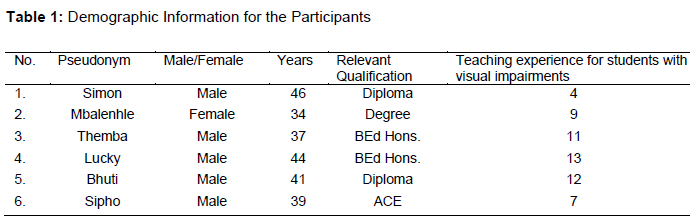
Purposive and convenience sampling techniques were employed for this article to select six suitable participants from one TVET college in KwaZulu-Natal (Eneizan et al 2020). The purposeful sampling of the lecturers had the potential to provide in-depth data on their learning journeys in teaching students with visual impairments. Through sharing their experiences, they enlightened other lecturers who might teach VI students in the future. Convenience sampling, according to Bertram and Christiansen (2014, 43), is using a sample that is "easy of reach by the researcher". The demographic information of the participants is presented in Table 1.
The sample lecturers were accessible because they taught at the college where the lecturer is employed near his residence. The purposive and convenience sample eventually consisted of six TVET college lecturers who were involved in teaching students with visual impairments (Ntombela 2019). The participants included both males and females and were selected based on their identification within the group of three lecturers from NC(V) and three lecturers from Report 191 (NATED).
Interviews were conducted within the participants' natural settings using narrative interviewing techniques. Although using convenient sampling has its weaknesses such as the withdrawal of participants (which was circumvented by including eight participants so that if someone withdrew from the study), the original number of participants were still accessible.
Data generation method
This study adopted three data generation methods: the narrative interview, a narrative group discussion, and written narrative reflections to explore the teaching approaches used by TVET college lecturers in teaching students with visual impairments. In this manner, the researcher was able to dissect interview textual data that reproduce, in a complete way, the interweaving of events and the sedimentation of experiences about the interviewees' life histories. Narrative interviews were conducted with participants to share their experiences including clarification of certain events, probing, and prompting for elaboration. Furthermore, a narrative interview is a verbal one-on-one or telephonic exchange in which an interviewer asks a set of open-ended questions but also allows for fresh viewpoints to develop from the conversation.
Participants were grouped to share their learning journeys of teaching students with visual impairment. The semi-structured interviews were followed by focus-group interviews where questions about their experiences were posed. Therefore, each participant was interviewed twice: during a semi-structured interview, as well as in a focus group. According to Goh (2019, 1731), the question as to why focus-group interviews should be used is that a focus-group discussion allows members to share knowledge and learn from each other's experiences - a process that simultaneously allowed me to gather deeper insights into their experiences.
Written narrative reflections were utilised for participants to reflect on their experiences teaching children with vision impairment, including the approach they used. Narrative inquiry emphasises the importance of a reflective research method that includes participants' recall of their lived experiences. Larsen, London, and Emke (2016) identify two forms of reflection: reflection-in-action and reflection-on-action. The study prioritised the reflection-on-action process where participants reflected on their previous experiences when teaching students with visual impairment. Utilising written narrative reflections encouraged participants to process their experiences to express how they apply preferred methods when teaching students with visual impairment.
Ethical considerations
To maintain the ethical standards of the research, several protocols were followed. Ethical clearance from the University of KwaZulu-Natal with the reference number HSSREC/00005356/2023 was granted by the Humanities and Social Science Ethics Committee. This approval enabled the researcher to obtain permission to carry out research at a TVET College in KwaZulu-Natal, and the necessary documentation was gathered, including the research proposal and the university's ethical clearance certificate. Participants were thoroughly informed about the study's objectives, methodology, and purpose, as well as their right to withdraw at any point before giving their consent to participate. Additionally, the confidentiality of the data collected was protected.
FINDINGS
The findings revealed that teaching visually impaired (VI) students at a college in the KwaZulu-Natal Province encountered various obstacles that greatly affected their educational experience in higher education. In narrative interviews, the instructors expressed that educating VI students was difficult owing to insufficient training in strategies for teaching them. They underscored the necessity of providing visually impaired students with essential tools and addressing their concerns in a timely manner.
The narrative interview data elicited from the participants further indicated that there were numerous challenges that they faced in teaching students with VI. The participants noted that, despite the challenges faced by VI students, a considerable portion of them enroll in inclusive schools as other schools do not accommodate them. This finding was confirmed by Bhuti's articulation:
"The buildings had no proper signage to help other students and inform them on how to assist or treat students who are visually impaired. Before the classrooms did not have ramps, even students themselves did not have supportive devices."
Further, the study also revealed that VI students took longer to understand concepts since they were VI. This was because the subjects or courses they offered were half vocational and half oral as supported by Simon:
"I have realised that they take longer to understand since they cannot see because the type of subjects or courses, we offer are half vocational and half oral. When it comes to where we should do the practical by using the charts and other vocational training aids in class or outside the class it becomes difficult for them to copy information since they cannot see."
This finding aligns with the observations made in the study by Baykaldı, Corlu, and Yabaş (2023). These regular educational environments frequently experienced teaching-learning challenges for both students with VI and their sighted peers.
The most significant hurdle identified was a lack of resources; they did not have enough resources to deal with teaching students with VI. This correlates with Read's (2023, 1-24) revelation that lecturers in mainstream classes do support the inclusion of VI students in their classrooms. Under the discussion on the lack of appropriate and adequate resources, some of the participants felt that VI students were probably not suited for certain programs, particularly those that require practical skills. In the following excerpts, the participants (lecturers) presented their challenges when teaching students with VI:
"In terms of the resources, we reported the matter to the specific office and they tried to get some assistive devices for them like laptops and recorders. But what I will do personally is to sit with them and talk to them about their needs." (Lucky)
"Infrastructure and buildings - specially built infrastructure to serve the purposes of students with visual impairment is one of the challenges. My class is upstairs so it is a challenge for students who are visually impaired to reach my classroom when using long steps. My class ends up being delayed because I will have to wait for them to be in the class and make sure they get their supportive devices. The installation of JAWS software will assist as the computer speaks and tells on the operation of the computer." (Themba)
The second challenge faced by the participants was the paucity of formal training to enable them to properly and adequately meet the educational needs of students with visual impairment. During the interview process, common problems were evident as supported by the following statements:
"I would not call it training; I would call it an orientation where they introduced and explained Inclusive Education. Something like induction." (Simon)
"I was not trained on how to teach and deal with students' visual impairments." (Sipho)
"I was so sympathetic and shocked at the time because it was my first time with the kind of students without training or resources to assist them." (Mbalenhle)
Importantly, training (in- and pre-service) is a vital requirement to promote lecturers' professional development to perform their duties and responsibilities successfully. Such training would enable them to facilitate the quality teaching-learning of students with visual impairment. Thus, it was important to first interrogate their (lecturers') teaching processes and quality regarding students with visual impairments. This need arose from the narrative focus-group interviews and narrative reflections in line with the research purpose of exploring lecturers' learning journeys in teaching students with visual impairment.
Although continuous support, ongoing training, resource provision, and better infrastructure can assist lecturers in implementing the inclusive education policy, lecturers' readiness and attitude remain critical in the learning journeys to teach students with visual impairment. Some participants did not understand the starting point since they were not trained to teach students with visual impairment, but they tried to be positive and proactive in serving such students as confirmed by Simon:
"I maintain a positive attitude whenever I teach them. I sympathise with them, but I treat them as ordinary students. What I do is allocate more time to teach them. My attitude towards them is to regard them as ordinary students."
However, the basics of teaching students with VI emerged as a major challenge, in addition to lecturers not being familiar with the different approaches to teaching such students. Mbalenhle confided:
"They need enough resources; they need assistive devices. They need more time and extra classes. When I started, they were still in N4 [entry level Report 191 N4 qualification], and I was teaching it for the first time. Since I knew nothing about it, I asked myself, how am I going to do that? I had no idea where to begin or how to approach them. They also need training on how to communicate and interact with others without isolating themselves."
Students with VI must be accommodated in the IE classroom. They can be provided with the same curriculum as their sighted peers by employing methodologies, learning styles, and assistive technologies. Another crucial characteristic of a lecturer is his/her teaching method to accommodate students with visual impairments. Thus, inclusivity in education refers to the recognition and encouragement of all students to share and learn in the same environment, regardless of their abilities (Dumitru 2023, 186). Bhuti, Lucky, Themba and Mbalenhle used voice recorders and read the instructions so the students could listen to it when not in class. In addition, Sipho used the following strategy:
"When I teach, I try to use the strategy of imaginary pictures. Some concepts or terminologies that require spelling and explanations that they know and understand. I try to contextualise what is in the textbook with them after pronunciation, because visually impaired students cannot see those terms."
The inadequate information that the participants provided regarding accommodating VI students during teaching and learning somewhat hampered this investigation, as the researcher wished to discover more about how to include VI students in the lesson. According to the generated data, participants applied several ways to engage students which included the use of the audiotape, verbal description of visual aids, raised lines, drawings, tactile models, braille lab signs, equipment labels, and auditory lab warning signs. Lecturers are bound by the constitution, which prohibits them from refusing to teach students with VI based on their right to learn. The TVET College therefore registered them.
DISCUSSION
This study revealed that all participants experienced many challenges when teaching students with visual impairments. Despite the difficulties VI students encounter, a significant number of them still attend general schools (Baykaldı et al. 2023). However, mainstream educational environments frequently present challenges for both VI students and their sighted peers, particularly during teaching and learning situations. The primary problem was a lack of resources, particularly when teaching pupils with visual impairments. Read (2023) opines that lecturers in normal classes opposed the inclusion of students with vision impairments in their classrooms. This mindset contradicts the philosophy of inclusive education.
To make teaching and learning effective, the required resources must be in place. Budiarti, et al. (2022) define resources as tools that help lecturers prepare and implement classes. According to Marjanovic-Shane, Kullenberg, and Gradovski (2023), resources are categorised into three types: hardware, software, and ideological ware. Teane and Gombwe (2022) assert that using cutting-edge technical resources in the classroom helps lecturers give creative courses that promote student development. Students with visual impairments, in particular, rely on technologies such as computers equipped with JAWS software for real-world learning.
Teaching aids or resources play a vital role in promoting VI students' all-round scholastic performance. Some participants believe that the college must conduct research to investigate how to accommodate lecturers' quest to discuss their views and experiences to find solutions to challenges they face daily. They should gather information, provide resources, and hire staff who are qualified to accommodate VI students. Most students with visual impairments are accommodated in the general science classroom, but few studies have been conducted to determine whether appropriate modifications are made in these classrooms to meet the special needs of these students (Taneja-Johansson, Singal, & Samson, 2023). This study's findings indicate that TVET colleges need up-to-date infrastructure and a revision of learning programs to support effective teaching and learning.
According to the study's findings, training should be instituted for lecturers. In all countries, lecturer training is the foundation of teaching and learning (Sánchez-García 2023). Participants emphasised the need to learn how to approach a specific topic in teaching students with visual impairment. In addition, the participants recognised the value of training; however, they did not receive any training in teaching kids with vision impairment. The relevant stakeholders in technical and vocational education and training (TVET) colleges must be willing to accept change in order to strengthen the educational system and achieve excellence in this ever-changing technological environment (Aina and Ogegbo 2022). This study exposed the fact that lecturers were not ready to facilitate students with visual impairment. Through relevant research, the TVET will unearth solutions to ensure that quality is achieved when facilitating VI students.
The lecturers involved in this research were not all professionally qualified, as they possessed general teaching qualifications. Lecturers must also engage with technology in the teaching and learning process to assist VI students with more practical experiences. These findings also corroborate Banegas, Corrales, and Poole (2020) revelation that mere teaching qualifications did not prove helpful during practical activities in inclusive education. Moreover, the results confirmed that lecturers were ignorant about braille, which is an essential support tool for teaching VI students.
This study discovered that ongoing assistance, training, resources, and infrastructure are crucial to assisting lecturers in implementing the inclusive education policy. Nevertheless, lecturers' readiness and negative attitudes impede educating students with visual impairment. Some volunteers were unsure where to start because they had not been trained to educate pupils with visual impairments. Various research on lecturers' attitudes toward students with visual impairments in standard classes revealed differing perspectives. According to studies conducted by Karakoç and Aslan (2022) and Odame, Opoku, Nketsia, and Nanor (2021), professors in mainstream colleges are dismissive of students with visual impairments because they are unprepared to welcome them into their courses. Others do not support inclusive education in general.
The findings of this study revealed instructors' lack of confidence and competence contributed to their negative attitudes. In other words, if professors were instructed on how to cope with students with varying learning skills, they would have more confidence and a better attitude. Some lecturers noted that such views stem mostly from the nervousness they face when dealing with VI students. Specifically, one participant expressed negativity towards students with visual impairment. She stated that poor assessment processes and unfamiliar content resulted in low self-confidence that led to giving up on teaching students with visual impairment.
IMPLICATIONS AND RECOMMENDATIONSBased on this study's findings, the following implications were highlighted:
Lecturers have not received training to instruct students with visual impairments, which they view as an additional challenge. Many believe it is not their duty, as their university training did not include teaching methods for visually impaired students; and
There is a shortage of qualified lecturers capable of teaching students with visual impairments. As a result of their inexperience, most lecturers do not pay attention to the seating arrangements for these students during lectures, and very few take into account the specific needs of students with visual impairments.
Based on the implications, the study has formulated the following recommendations:
Training in educating visually impaired students should be a prerequisite for lecturers. Both in-service training and official training in educating visually impaired students might achieve this; and
Hiring specialists with experience in training visually impaired students is necessary so they can support the instruction of these students at colleges.
CONCLUSIONS
This study aimed to explore lecturers' perspectives on teaching students with VIs at a TVET college in KwaZulu-Natal. The teachers' stories offered valuable perspectives for teacher training to effectively equip teachers of colour for successful, enduring, and transformative professional journeys. According to the research's findings, lecturers' experiences teaching students with VI should improve, particularly for those students from underprivileged backgrounds and those who have experienced marginalisation due to their impairment. This study is expected to significantly improve the education of visually impaired students at TVET colleges. If we do not achieve this, our country will be falling short in fulfilling inclusive education initiatives aimed at supporting individuals with disabilities within our educational framework.
REFERENCES
- Abualrejal, H. M. E., H. O. Shtawi, M. G. Hassan, A. Z. Alqudah, and A. A. Alamrani. 2021. "Assistive Technology and Its Impact on Educational Achievement for Visually Impaired Students at SKPK Princess Elizabeth." International Conference on Emerging Technologies and Intelligent Systems 322: 873-883.
- Aina, A. Y., and A. A. Ogegbo. 2022. "Investigating TVET College Educators' Experiences while Transitioning from the Traditional Classroom to the Virtual Classroom during the COVID-19 Pandemic." Perspectives in Education 40 (1): 129-142.
- Alharahsheh, H., and A. Pius. 2020. "A Review of Key Paradigms: Positivism vs Interpretivism." Global Academic Journal of Humanities and Social Sciences 2 (3): 39-43.
- Alnahdi, G. 2014. "Assistive Technology in Special Education and the Universal Learning Design." Turkish Online Journal of Educational Technology 13 (2): 18-23.
- Arslantas, T. K., and A. Gul. 2022. "Digital Literacy Skills of University Students with Visual Impairment: A Mixed-Methods Analysis." Education and Information Technologies 47 (6): 1-21.
- Atanga, C., B. A. Jones, L. E. Krueger, and S. Lu. 2020. "Teachers of Students with Learning Disabilities: Assistive Technology Knowledge, Perceptions, Interests, and Barriers." Journal of Special Education Technology 35 (4): 236-248.
- Baker, L. 2020. "Releasing Students from the Cognitive Straitjacket of Visual-Auditory Kinaesthetic Learning Styles." Impact 3 (10): 57-60.
- Banegas, D. L., K. Corrales, and P. Poole. 2020. "Can Engaging L2 Teachers as Material Designers Contribute to Their Professional Development? Findings from Colombia." System 91: 102265.
- Batanero, C., L. de-Marcos, J. Holvikivi, J. R. Hiler and S. Otón. 2019. "Effects of new supportive technologies for blind and deaf engineering students in online learning". IEEE Transactions on Education, 62(4), 270-277.
- Baykaldı, G., M. S. Corlu, and D. Yabaş. 2024. "An Investigation into High School Mathematics Teachers and Inclusive Education for Students with Visual Impairments." British Journal of Visual Impairment 42 (1): 124-134.
- Beingolea, J. R., M. A. Zea-Vargas, R. Huallpa, X. Vilca, R. Bolivar, and J. Rendulich. 2021. "Assistive Devices: Technology Development for the Visually Impaired." Designs 5 (4): 75.
- Bertram, C., and I. Christiansen. 2014. Understanding Research: An Introduction to Reading Research.
- Bouck, E. C., J. Park, and K. Stenzel. 2020. "Virtual Manipulatives as Assistive Technology to Support Students with Disabilities with Mathematics." Preventing School Failure: Alternative Education for Children and Youth 64: 281-289.
- Budiarti, E., J. Jamiatun, N. Udjir, R. Rohana, and T. Rahayu. 2022. "Improving Children's Pre Reading Ability through Smartphone Based Learning Video Media in RA Mutiara Ambon." Edumaspul Journal Pendidikan 6 (2): 3206-3210.
- Chun, S., W. Son, H. Kim, S. K. Lim, C. Pang, and C. Choi. 2019. "Self-Powered Pressure-and Vibration-Sensitive Tactile Sensors for Learning Technique-Based Neural Finger Skin." Nano Letters 19 (5): 3305-3312.
- Buenaflor, S. H., C. M. Lukszo and A. LaFave. 2021. "What makes transfer decisions unique: Reexamining the role of finances, geography, and academics in the choice process". Journal of Applied Research in the Community College, 28(1), 47-61.
- Clandinin, D. J. 2019. Teacher Education as Narrative Inquiry. New York, NY: Routledge.
- Curwen, M. S., A. Ardell, and L. MacGillivray. 2019. "Hopeful Discourse: Elementary Children's Activist Responses to Modern-Day Slavery Grounded in Systems Thinking." Literacy Research: Theory, Method, and Practice 68 (1): 139-161.
- David, E. R., T. M. Schroeder, and J. Fernandez. 2019. "Internalized racism: A systematic review of the psychological literature on racism's most insidious consequence". Journal of Social Issues, 75(4), 1057-1086.
- De Vos, M. 2011. Quantitative and qualitative aspects of education in South Africa: An analysis using the National Income Dynamic Study (No. 06/2011).
- Dumitru, C. 2023. "Supporting Students with Specific Learning Disorders Through Higher Education: Pedagogical Framework for Online Teaching." In Engaging Students with Disabilities in Remote Learning Environments, 186-206. Hershey, PA: IGI Global.
- Elli, G. V., M. Bedny and B. Landau. 2021. "How does a blind person see? Developmental change in applying visual verbs to agents with disabilities". Cognition, 212, 104683.
- Eneizan, B., A. Alsaad, A. H. N. Alkhawaldeh, and O. E. Rawash. 2020. "E-WOM, Trust, Usefulness, Ease of Use, and Online Shopping via Websites: The Moderating Role of Online Shopping Experience." Journal of Theoretical and Applied Information Technology 98 (13): 2554-2565.
- Felix, S. M., S. Kumar, and A. Veeramuthu. 2018. "A Smart Personal AI Assistant for Visually Impaired People." In Trends in Electronics and Informatics: 2nd International Conference (ICOEI), 1245-1250. Tirunelveli, India, May 11-12, 2018.
- Fraser, A. 2021. Safety Analysis of Battery-Powered Adaptive Ride-on Toys for Children with Disabilities. Florida, USA: University of North Florida.
- Goh, P. S. C. 2019. "Implementing Narrative-Pedagogical Approaches in a Teacher Education Classroom." The Qualitative Report 24 (7): 1731-1746.
- Grant, C., and A. F. Osanloo. 2016. "Understanding, Selecting, and Integrating a Theoretical Framework in Dissertation Research: Creating the Blueprint for Your 'House.'" Administrative Issues Journal 4: 12-26.
- Hayashi, P., G. Abib, and N. Hoppen. 2019. "Validity in Qualitative Research: A Processual Approach." The Qualitative Report 24 (1): 98-112.
- Heller, J., M. Chylinski, K. de Ruyter, D. Mahr, and D. I. Keeling. 2019. "Touching the Untouchable: Exploring Multi-Sensory Augmented Reality in the Context of Online Retailing." Journal of Retailing 95 (4): 219-234.
- Hlalele, D., and N. Mashiya. 2019. "Understanding Women Teacher Transnational Migration: A Narrative Inquiry from Southern Africa." SAGE Open 9 (3): 1-8.
- Joseph, R. M., D. P. Skwerer, B. Eggleston, S. R. Meyer, and H. Tager-Flusberg. 2019. "An Experimental Study of Word Learning in Minimally Verbal Children and Adolescents with Autism Spectrum Disorder." Autism & Developmental Language Impairments 4 (1): 1-13.
-
Judd, A. E. 2020. An Occupational Therapy Approach to Education for Foster Parents. Scholarship and Open Access Repository. https://doi.org/10.46409/sr.GUVH6953.
» https://doi.org/10.46409/sr.GUVH6953 - Kankam, P. K. 2019. "The Use of Paradigms in Information Research." Library & Information Science Research 41 (2): 85-92.
- Karakoç, T., and C. Aslan. 2022. "Teaching Experiences of Science Teachers Working in Schools for the Visually Impaired." International Journal of Progressive Education 18 (1): 128-146.
- Khoza, S. B. 2015. "Using a Curricular Spider Web to Explore a Research Facilitator's and Students' Experiences." South African Journal of Higher Education 29 (2): 122-143.
- Kistoro, C. A. 2021. "Teachers' Experiences in Character Education for Autistic Children." International Journal of Evaluation and Research in Education 10 (1): 65-77.
- Landsberg, E., D. Kruger, and A. Swart. 2013. Addressing Barriers to Learning: A South African Perspective. Pretoria: Van Schaik Publishers.
- Larsen, D. P., D. A. London, and A. R. Emke. 2016. "Using Reflection to Influence Practice: Student Perceptions of Daily Reflection in Clinical Education." Perspectives on Medical Education 5 (5): 285-291.
- Lee, J. C. K. 2019. "Teachers' Work, Change and Learning: Roles, Contexts, and Engagement." Journal Homepage 25 (4): 399-403.
- Marjanovic-Shane, A., T. Kullenberg, and M. Gradovski. 2023. "Scandinavian Experiments in Democratic Education." Dialogic Pedagogy 11 (2).
- Mashiloane, T. M. 2019. "Stories of Experience: Lecturers' Pathways of Learning to Teach in Technical and Vocational Education and Training (TVET) Colleges." Master's thesis, School of Education and Development, University of KwaZulu-Natal.
- McLain, M. 2021. "Developing Perspectives on 'the Demonstration' as a Signature Pedagogy in Design and Technology Education." International Journal of Technology and Design Education 31 (1): 3-26.
- Merriam, S. B. 2009. Qualitative Research: A Guide to Design and Implementation. Hoboken, NJ: Jossey-Bass.
- Miller, S. E., and L. Pennycuff. 2008. "The Power of Story: Using Storytelling to Improve Literacy Learning." Journal of Cross-Disciplinary Perspectives in Education 1.
- Muzata, K. K., M. Simalalo, S. Kasonde-Ng'andu, D. Mahlo, M. K. Banja, and T. Mtonga. 2019. "Perceptions of Students with Visual Impairment towards Their Inclusion in the Faculty of Education at the University of Zambia: A Phenomenological Study." Multidisciplinary Journal of Language and Social Sciences Education 2 (2): 170-210.
- Ndlovu, S. 2020. Provision of Assistive Technology for Students with Disabilities in South African Higher Education: A Decolonial Perspective. Pretoria: National Research Foundation of South Africa.
- Ntombela, G. N. N. 2019. "The Dynamics of Inclusive Education in Further Education and Training in South Africa: A Case Study of Two Technical and Vocational Education and Training Colleges in Pietermaritzburg." Doctoral thesis, University of KwaZulu-Natal.
- Nugraha, J. E. 2021. The Effectiveness of Using Demonstration Method in Teaching Writing Procedure Text: An Experimental Research at the Seventh Grade of MTs Al-Rahmah Islamic Boarding School. Walantaka-Serang: UIN SMH BANTEN.
- Odame, L., M. P. Opoku, W. Nketsia and B. Nanor. 2021. "University experiences of graduates with visual impairments in Ghana". International Journal of Disability, Development and Education, 68(3), 332-346.
- Overton, J., P. Stupples, W. E. Murray, A. Gamlen, and M. Palomino-Schalscha. 2020. "Learning Journeys: Five Paradigms of Education for Development." Asia Pacific Viewpoint 61 (2): 366-380.
- Palmer, M., Larkin, M., De Visser, R., & Fadden, G. (2010). Developing an interpretative phenomenological approach to focus group data. Qualitative research in psychology, 7(2), 99-121.
- Periša, M., D. Peraković, I. Cvitić, and M. Krstić. 2022. "Innovative Ecosystem for Informing Visual Impaired Person in Smart Shopping Environment: InnIoTShop." Wireless Networks 28 (1): 469-479.
- Pulungan, S. A. 2021. "Application of Demonstration Method to Improve Mathematics Learning Achievement of Class 1 Students DS 0511 Batang Tangle Jas to 2020/2021." Indonesian Journal of Basic Education 4 (2): 247-254.
- Purwana, R. 2021. "The Correlation of Students' Perceptions about Speaking Skills Demonstration Method with Learning Outcomes of English Subject in Binjai 'Ex School' Tutoring." International Journal of Cultural and Social Science 2 (2): 91-98.
- Rahayu, D. C., S. Suryani, and H. S. Zainiyati. 2020. "Identification of Vacuum Learning Styles (Visual, Auditory, Kinaesthetic) Primary School Students in Indonesia." International Journal of Education and Research 8 (9): 181-190.
- Ravindran, V. 2019. "Data Analysis in Qualitative Research." Indian Journal of Continuing Nursing Education 20 (1): 40.
- Reid, A. J., L. E. Eckert, J. F. Lane, N. Young, S. G. Hinch, C. T. Darimont, S. J. Cooke, N. C. Ban, and A. Marshall. 2021. "Two-Eyed Seeing: An Indigenous Framework to Transform Fisheries Research and Management." Fish and Fisheries 22 (2): 243-261.
- Read, L. A. 2023. Resources for Inclusivity in High School US History Classrooms. Thousand Oaks, CA: SAGE.
- Sánchez-García, D. 2023. "Potential Professional Growth of English-Medium Education Teachers in a Transnational Teacher Education Programme." International Journal of Instruction 16 (3): 1-24.
- Santra, S., and A. Deyasi. 2022. "Prototype Implementation of Innovative Braille Translator for the Visually Impaired with Hearing Deficiency." In Emerging Trends in IoT and Integration with Data Science, Cloud Computing, and Big Data Analytics, 272-290. Hershey, PA: IGI Global.
- Swart, E., and R. Pettipher. 2019. "A Framework for Understanding Inclusion." In Addressing Barriers to Learning, 3-27. Pretoria: Van Schaik Publishers.
- Taneja-Johansson, S., N. Singal, and M. Samson. 2023. "Education of Children with Disabilities in Rural Indian Government Schools: A Long Road to Inclusion." International Journal of Disability, Development and Education 70 (5): 735-750.
- Teane, F. M., and R. Gombwe. 2022. "Self-Efficacy as a Tool to Enhance Students' Classroom Participation: TVET/FET College Students' Views on the Causes of Student Passivity." Community College Journal of Research and Practice: 1-13.
- Theron, P. M. 2015. "Coding and Data Analysis during Qualitative Empirical Research in Practical Theology." In die Skriflig 49 (3): 1-9.
- Titchkosky, T. 2020. Reading and Writing Disability Differently. Toronto: University of Toronto Press.
- Triayomi, R. 2019. "The Effect of Interactive Demonstration Method on Heat Energy Learning." Journal of Physics: Conference Series 1282: 1-7.
- White, P., H. R. Marston, L. Shore, and R. Turner. 2020. "Learning from COVID-19: Design, Age-Friendly Technology, Hacking and Mental Models." Emerald Open Research 2 (21): 21.