Three key drivers in devising a responsive curriculum in South African higher education institutions
Abstract
South African higher educational institutions are constantly required to respond to a series of tensions and challenges within higher education curriculum reform. This implies the need for urgent attention to a truly responsive curriculum in South African higher education. This article reports on research involving a critical interpretative literature analysis. Three drivers are identified in devising a responsive curriculum in South African higher education, namely the need for decolonisation, accommodation of disruptive technologies, and features of graduateness in the 21st century. The discussion of each of these drivers is preceded by a brief conceptualisation of the notion responsive curriculum. The research conclusion indicates that it should be a strategic priority of each higher education institution in South Africa to acknowledge the three curriculum design drivers as mentioned above, and accordingly upskill and empower academics in the quest for conceptualising and developing a constructively aligned curriculum that is responsive to the ever-changing societal and global needs.
decolonisation; disruptive technologies; graduate attributes; responsive curriculum and teaching
INTRODUCTION
Curriculum relevance has always been the axis in any conceptualisation of the provision of education. In contrast to the other levels of education provision, curriculum relevance in higher education (HE) is directly linked to the needs of society and the workplace. Productivity and competitiveness depend on the ability to employ highly skilled and adaptive workers, who can manage and manipulate knowledge and information, and adjust to volatile and unpredictable global markets (Ogude, Nel and Oostenhuizen 2016). The 21st century workers (employed or self-employed) need to have well-developed problem-solving skills and be able to continually adjust their repertoire of knowledge, skills and technology to changing environments. In such a context, it is often argued that the role of HE shifts from an induction into the specialised knowledge of specific disciplines, to the development of broad, generic and transferable skills (Ogude et al. 2016). In essence, higher education institutions worldwide are being called upon to become more responsive to the needs of the 21st century workplace. As in other countries, South Africa attempts to meet pressing national needs in a global context, and this implies the urgent need for a responsive curriculum to address the tensions and challenges of the 21st century. This raises the question on the key stimuli (or drivers) in devising a responsive curriculum for the South African higher education.
This article reports on research in which a critical interpretative approach was followed, focusing on literature analysis. The research rendered rich data of a theoretical and conceptual nature. In presenting the data, attention is firstly drawn to how a responsive curriculum should be conceptualised. Subsequently, three drivers in devising a responsive curriculum in South African HE institutions are discussed, namely de-colonisation, disruptive technologies, and graduateness. Choosing these three drivers in this article are based on the following elements a) the ever-changing learning environment where adaptive learning has become the driving force for online educational systems which can support and address the challenges of personalised learning. Furthermore, the COVID-19 pandemic has fuelled a rise in the online education paradigm in recent times (b) with the increased need for technology skills by a number of jobs, universities will have produce students that require creativity, innovation and empathy. (c) South African HEI's is still struggling to decolonise the curriculum even after the #FeesMustFall (FMF) and is trying to navigate their way through the colonial legacy.
CONCEPTUALISING A RESPONSIVE CURRICULUMResponsiveness is the drive to survive (Ogude et al. 2016). International trends and the national policy increasingly emphasise the responsiveness of HE to the goals of economic and social development (Myklebust and Smidt 2021). At least in principle, policy documents such as the National Commission on Higher Education (NCHE) Report (1996), the Education White Paper 3 (DOE 1997) and the National Plan for Higher Education (NPHE) Report (DOE 2001) have taken a broad approach to the issue, avoiding a focus purely on economic competitiveness. Thus, the NCHE Report (1996, 79) refers to the challenges of redress and development, while the Education White Paper 3 (DOE 1997) appeals for the development of "enlightened, responsible and constructively critical citizens".
As Breier (2001, 6) observes, it is also significant that the NCHE cautioned that responsiveness should amount to more than a reaction to short-term or immediate problems. In its concluding statement on the development of a framework for the transformation of South African HE, the NCHE Report (1996, 80) states that responsiveness should also include an appreciation of the longer-term demands on HE that flow from a more universal, wider-ranging view of its nature and role in human affairs (cf. Ogude et al. 2016). This means the new HE framework should also provide enough room for the kind of freedom that will ensure autonomous academic inputs and discretion, so that those longer-term objectives of HE, which the market and the immediate social environment do not, and cannot, register, can be attended to (Ogude et al. 2016). However, the NCHE criterion of responsiveness to societal interests and needs opens the door for possible contradictions. South African HE institutions are expected to be vehicles of social redress by broadening access, improving success rates, and setting targets for improved racial and gender balances. At the same time, they are required to be increasingly market oriented by competing for students, producing employable graduates, establishing niches, and diversifying their funding base (Council on Higher Education (CHE 2002, 10). In response to these concerns, South African HEIs have been required to identify appropriate graduate attributes and implement these across programmes and link curriculum reform to the context of a changing world - national, regional and international (CHE 2013). Furthermore, within this broad framework, tensions and challenges such as disruptive technologies and graduateness should be addressed.
In this regard, Singh (2001, 8) notes that universities' traditional knowledge responsibilities are increasingly being relocated within the demands of economic productivity and its requirements for particular kinds of knowledge and skills. The discourse of accountability and responsiveness debates about the role and value of higher education is narrowly framed by the expected contribution of higher education to economic growth and competitiveness - in other words, market responsiveness. Singh (2001) argues for the reinsertion of the "public good" as a means of finding a way back to a more comprehensive conceptualisation of responsiveness. She defines the public good as "a set of social interests that are not reducible to the sum of interests of individuals or groups of individuals and that demarcate a common space in which the moral and political goals can be negotiated and collectively pursued" (Singh 2001, 9). A curriculum that will ensure that students are employable after completing a qualification or curriculum, which is locally relevant, and internationally recognised, or a curriculum that ensures that students are holistically developed, to function as independent and responsible individuals in society (Human 2017, 61). This notion of responsiveness proceeds from the position that the responsiveness of higher education to the general and specific needs of the economy is a subset of a more complex and multi-faceted notion of responsiveness (Dowling and Seepe 2003). Thus, it is asserted that, in a country like South Africa where higher education institutions have broader social responsibilities than their counterparts in more stable political and economic systems, it is vital that social responsiveness is not entirely sub-ordinated to economic responsiveness.
In the South African context, a broader view of higher education institutions' social responsiveness implies primarily attention to the notion of decolonisation.
CONCEPTUALISATION OF DECOLONISATIONCalls for the decolonisation of education first emerged on the African continent in the context of decolonising struggles against colonial rule during the 1950s and 1960s (Padayachee, Matimolane and Ganas 2018, 291). These were based on a negation of traditional colonial education whose organising principle centred on shaping the colonised into colonial subjects, and in the process, stripping them of their humanity and full potential (Fataar 2018, 4). The knowledge of colonised groups, such as non-Europeans and indigenous folk, was suppressed as the decolonial scholar Santos (2014) explained, their knowledge suffered a form of epistemicide which signifies their evisceration from the knowledge canon (c.f. Fataar 2018, 4). The topic of decolonisation as a concept and as a process remains a highly contested, complex and subjective socio-cultural phenomenon, although it has been widely interrogated in South African universities (both officially and unofficially, among staff and students (Padayachee et al. 2018, 291).
According to Padayachee et al. (2018, 219), the work of decolonisation theorists such as Fanon (2004), Spivak (1988) and Wa Thiong'o (1986) clearly illustrates that the decolonisation process is complex and multi-dimensional, replete with conflicts, contradictions and paradoxes. Mbembe (2016) focused on decolonisation in higher education in particular, drawing attention to the fact that the decolonisation process encompasses all aspects of being in the higher education space. These aspects include the predominantly colonial architecture of university campuses and the Eurocentric academic model that still exists, as well as the authoritative systems of control and management, both of students (through the standardised assessment processes) and, increasingly, of university lecturers. Mbembe (2016) also emphasises the injustice of the continued existence of syllabi created through epistemic violence and deliberately designed to meet the needs of the colonisers of South Africa and, later, of the apartheid system.
The dominance of the European culture, language and theories in higher education has also been highlighted as problematic by other authors. Fataar (2018) comments that the knowledge domain of the "colonial" university or school paid little to no attention to indigenous knowledge, the knowledge of the working poor, or the literacies of urban black female dwellers, for example. It favoured the Western canon, founded on a separation of the modern Western knowledge from its non-Western knowers, suggesting that modern knowledge would help instantiate modern subjects. Conversely, what is now needed for graduates to be locally and globally responsive (as required for a sustainable future) are university curricula that are epistemically diverse and locally and globally relevant (Padayachee et al. 2018).
In light of the above, a responsive curriculum can address issues of decoloniality in South African higher education if the following four criteria are recognised and adhered to (University of Pretoria 2016):
• Responsiveness to social context: a changing curriculum is one that registers and is attuned to local and global contexts, histories, realities, and issues. A changing curriculum gains concreteness, relevance, and purpose by being situated in a particular social, economic, environmental, intellectual, political, and legal context. Issues of development, social justice, and globalisation should be central to teaching and research, along with other topics.
• Epistemological diversity: curriculum redesign is a constant encouragement of epistemological diversity. Diversifying epistemology means placing marginalised groups, experiences, knowledge, and worldviews from Africa and the Global South at the centre of the curriculum. It means challenging the hegemony of Western ideas and paradigms and foregrounding local and indigenous concepts and narratives while acknowledging the global context.
• Renewing pedagogy and teaching practises: Transforming the curriculum requires continuous rethinking and reassessment of how we learn and teach. This includes responding to and learning new pedagogical methods and approaches within the disciplines.
• An institutional culture of openness and critical reflection: a changing curriculum demonstrates an understanding that a "hidden curriculum" can be found in the spaces, symbols, narratives, and embedded practises that make up the university and in the diversity - or lack thereof - of staff and students.
In addition to the abovementioned, Ammon (2019) stipulates that a responsive curriculum should recognise the following as helpful to decolonise the curriculum.
• Acknowledge the existence of entangled knowledge. As a relatively new way of thinking, this idea on decolonizing knowledge doesn't separate knowledge into neat binaries like "us" and "them", "the metropole" and "the South" etc. Instead, it views knowledge, in its likeness to human existences, as intertwined. The argument goes further that even scientific discovery owes its existence to "interwoven" knowledge from both the colonizer and the colonized (Ammon 2019).
• Avoid an additive-inclusive knowledge approach. Described by Jansen (2017a) as a "soft version", this concept of decolonization recognizes that current canons of knowledge are of value but requests that new knowledge should be recognized and added to established curricula. The critique of this approach is that adding content is necessary but insufficient to fully decolonize the curriculum. Although it would be just to add in what has been left out, such as adding a new course to a degree or a new book to the syllabus, there is a danger of ghettoizing the new content from the mainstream disciplines.
• Decolonisation as critical engagement with settled knowledge. This concept advocates the empowerment of students to engage with knowledge by critical questioning such as: "Where did this knowledge come from? In whose interest does this knowledge persist? What does it include and leave out?" (Jansen 2017a, p. 161). Here, the thought process goes that you cannot eliminate things about the past that you do not like. Instead, you can invite critical involvement with such curricula in a way that ultimately transform what they essentially mean. One looks at the same set of problems with new eyes by making use of new theories, methods and perspectives (Jansen 2017a).
Du Plessis (2021) on his part tries to explain what a responsive curriculum should consider when decolonising the curriculum. He considers the following as crucial:
• Include aspects of social leadership, social justice into the curriculum.
• Rethink the three board perspectives of the curriculum by answering if the curriculum is explicit (clear on what should be taught and learned) is the curriculum hidden (what students learn about the dominant culture of a university, and what values it reproduces) or is the curriculum null (is what universities leave out, namely, what is not taught and learned in a university (Mheta, Lungu and Govender 2018). The latter will allow university leaders to seize upon the potential that diversity offers, challenging dominant discourse and knowledge.
• Be clear on what the alternative ontological and epistemological methods of knowing are. Bring action and theory together (Du Plessis 2019).
Decolonising education calls for a Eurocentric consciousness to be disrupted and notions of meritocracy within education and society that have privileged some, to be challenged. It is apparent that a responsive curriculum is put under substantial pressure in the attempt to meet the challenge to decolonise the curriculum. In the 21st century, South African higher educational institutions have to reflect ardently on the abovementioned criteria as a base for contemplating a truly responsive curriculum for the benefit of the South African society. However, a second driver in doing this presents itself, as indicated in the following discussion of so-called "disruptive technologies".
CONCEPTUALISATION OF DISRUPTIVE TECHNOLOGIESThe concept disruption denotes a radical change in well-established practices and traditions, usually brought about by force, and mostly understood in the negative sense of causing disorder or even chaos. However, the latter needs not necessarily be the case.
Currently, higher education is fundamentally being affected, thus "disrupted", by various new practices and tools of the online dispensation. The rapid advancement of information and communication technologies has brought about various changes in education and the structure of colleges and universities. Colleges and universities are undergoing a kind of "disruptive innovation and catalytic change" (Christensen 2008, 43). Technology, being a form of social relationship, always evolves. No technology remains fixed. Technology starts, develops, persists, mutates, stagnates, and declines, just like living organisms (Yadav 2019). Disruptive technologies are those that disrupt established practices, often starting with a small number of users, but growing over time to the extent that they displace a previously dominant, incumbent technology (Flavin 2012). Conversely, sustaining technologies are technologies that enhance the performance of established technologies. Christensen (1997) outlines that all sustaining technologies have the following in common that they improve the performance of established products. Disruptive technologies bring to market very different values and practice propositions than had been available previously, with wide-ranging implications for devising a responsive curriculum.
Due to the changing landscape of higher education and specifically the diverse populations of students, as well as increasing interest in technology and enhancement of learning through technology, the demands are increasingly on the responsive curriculum to include innovative technologies, which will adapt to the learning of students. The demands of the disruptive technologies on the curriculum are to determine what type of technology allows teachers the opportunity to give students experience with real-world scenarios. Whether it is connecting with others across the globe, starting a business, digital collaboration or coding, technology can add a more interactive edge to any curriculum plan, and create more globally minded and socially aware citizens. The classroom becomes a place where students become learners and experimenters. Furthermore, the personalised approach to learning becomes a reality by incorporating disruptive technologies in the curriculum. These disruptive technologies includes online learning websites and learning management systems as part of e-learning environment (Dupouy 2021). However, although e-learning has been in greater demand since the COVID 19 pandemic, the technology enhanced classroom has also evolved from an e-learning environment to a smart learning environment regarded as a high-end form of e-learning (Deng et al, 2019). Smart learning is built with two types of technologies: smart devices technologies (such as the Internet of Things, wearable devices, and mobile learning) and intelligent technologies (such as learning analysis and cloud computing, augmented/virtual reality) (Deng et al. 2019). These two types of disruptive technologies enabled the smart learning environments to have features of tracking learning process, recognizing learning scenario, awareness of physical environment, connecting learning communities, adaptive function, and natural interaction, which bring learners more flexibility, effectiveness, adaptation, engagement, motivation, feedback, and optimisation of learning outcomes (Tarud 2021).
Furthermore, these disruptive technologies assist in imparting knowledge that is focused on learner accessibility, needs, infrastructure, and interaction, regardless of time or location. Block chain as a disruptive technology and its application in the storage of records, verification of learning identity, information security and content protection adds to the value of the curriculum and learning environment. Artificial intelligence and its ability to emulate the way people reason and make decisions and its special relevance in personalized learning, which recognizes that students have different preferences about how and what they want to learn, and this should be reflected in their opportunities to learn (Deng et al. 2019).
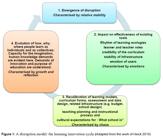
The disruption model (presented below) illustrates how effective and collaborative processes can positively steer the tension and challenges presented by disruptive technologies vis-à-vis a responsive curriculum.
The model displays four pertinent stages. Each stage is important in understanding how to elevate some of the tension and challenges brought about by innovative, disruptive technologies concerning the curriculum. Heick (2019) explains these stages as follows:
Stage 1: Emergence of disruption
This phase is characterised by relative stability, a fixed mindset of the majority and disruptive thinking of the few. It is the inattention, inaction, or misunderstanding of the disruption by the majority that can lead to a shift in power as the number of those reacting to the disruption with discomfort can grow. At this stage, there is very little change for most, and the ultimate success of any "innovation" is uncertain. As an analogy, consider mutations in the evolutionary process. The "success" of a mutation is not in its outward appearance, but in whether it leads to a biological advantage that can be passed on. This takes time to develop.
Stage 2: Impact
According to Heick (2019), the "impact" phase of the learning innovation cycle is a bit more chaotic, but still exciting. In this phase, disruption has created a mess - changing perspectives, benefits, applications, and resources. In this phase, the importance and relevance of the following are questioned:
• How effective are existing learning tools?
• How can student and teacher roles be explained?
• Is the existing curriculum still credible?
• Are the approaches and models of the curriculum still relevant?
• To what extent is the infrastructure stable and able to handle the disruption?
• How can the emotions of the users be described?
• What impact do they have on the pattern and rhythm of learning ecologies?
Heick (2019) characterises this phase as heightened emotions - excitement, exaggeration, anxiety, uncertainty, and binary thinking. This is caused by rapidly changing circumstances; the disruption is difficult to understand. Individuals are unsure of how, for example, iPads will change a classroom or adaptive learning apps should change a curriculum - or the idea of a curriculum as such. This uncertainty can be polarising, creating a sense of excitement and new possibilities for some, while others see cause for concern.
This phase may also be characterised by reduced efficiency and stability of contexts (e.g., assessments, data, and classrooms). The learning innovations that take hold are not simply "born" but evolve over time, as they are understood, reach tipping points, pivot themselves, or connect with other innovations to find new energy and applications (Heick 2019).
Stage 3: Recalibration
After the "emergence" and the "impact", a "recalibration" takes place for those left behind. The institutions that have invested in the possibilities of upheaval in the learning environment begin to pay off here, but this phase is less about the exact design and more about a broad shift. Although there are many possible indicators at this stage, progress and potential are the defining characteristics. It is significant that the weaknesses of the old thinking, tools, systems and approaches have been highlighted. In this part of the cycle, the innovations and their potential become more visible than before. To the extent that the circumstances around the innovation adapt to it and vice versa, any progress made can create credibility that encourages adding more resources (leading to even more progress and credibility). Upcoming recalibrations may include learning models, curriculum forms, assessments, teacher planning, and the process of instructional design.
Stage 4: Evolution
The last phase of learning innovation is characterised by intensive development. This occurs not only because existing technologies enable new discoveries, but also because of the growing mentality of people who, having seen what is now possible, cannot see their work environment any other way and insist on change. From the model above, this cycle is the largest, not only because this phase of the cycle takes so much time, but also because evolution is the most critical part for innovation to endure.
This phase could be seen as the reward for all the previous changes, revisions and fears. From these previous phases, a broader vision can evolve, ultimately leading to more innovation. Ongoing reflections on the following characterise the evolution phase: how, where, and why people learn; vision and self-criticism as an industry; imagination; demands on human knowledge; expectations for innovation; and finally, the purpose of education.
Heick's (2019) model of the learning innovation cycle provides an ideal framework to positively guide the tensions and challenges posed by disruptive technologies in favour of developing a responsive curriculum for South African higher education institutions.
The preceding discussions on the imperatives of decolonization and disruptive technologies in the development of a responsive curriculum lead to the ultimate question of the output of South African higher education institutions: What are the attributes of relevant higher education degrees in the South African context.
CONCEPTUALISATION OF GRADUATENESSOne of the fundamental pillars of a university is to teach people, as Boulton and Lucas (2011) note: "Universities create new opportunities; in teaching, they shape new people." However, these "new people" must be able to earn a living through their studies. The term graduateness refers to the "characteristics of graduates" that make them employable. However, the continuous withering of the South African economy and growing the unemployment crisis brings the mandate of the university to "shape new people" who are employable into question.
This inability of universities to produce employable graduates is seen as a critical problem (Myklebust and Smidt 2021) - producing employable graduates is now becoming a challenging task for the entire higher education system. Employer expectations continue to rise in line with global societal and environmental demands. Universities are educating students in both disciplinary and non-disciplinary knowledge so that graduates leave with the tools to address the problems of the world today (Boulton and Lucas 2011). Myklebust and Smidt (2021) emphasise that one of these "tools" is the willingness of graduates to engage in ongoing education and lifelong learning". This includes acquiring relevant knowledge for new types of jobs, for example, through digital training, and developing transferable skills such as critical thinking, creativity, or even self-management. Often, it is these skills that make people more versatile, resilient, adaptable and enable them to participate fully in the Fourth Industrial Revolution economy, whether working for a company or starting their own" (Myklebust and Smidt 2021, 2).
The desired characteristics of university graduates have been defined at various levels. Voogt and Roblin (2012) argue that the 21st-century competencies needed in the knowledge society can be viewed as the overarching rationale and goals for learning, that is, the intended curriculum. However, there may be a disconnect between the needs of the knowledge society expressed by proponents of 21st-century competencies and how these competencies are addressed in national and school curricula, i.e., the implemented curriculum (Miji and Ditsele 2018). The challenge in achieving university readiness, then, is simply to close the gap between the intended curriculum and the implemented curriculum.
There is an argument that a university graduate should not necessarily be job-ready, but must have the ability to think, to adapt, and to learn relatively quickly. Even with this expectation, it is critically important to understand the world of work and to have a relationship with the job market (Mail & Guardian 2020). In addition, the industry needs graduates to evolve with career opportunities, as many employers consider critical and strategic thinking skills as fundamental in middle-management roles. Collaboration, negotiation, emotional intelligence, cognitive flexibility, and resilience are important abilities in the workplace. Enterprising mindsets to support and sustain themselves, and contribute to the development of their communities (Mail and Guardian 2020). Employers seek candidates who have experience gained through internships or cooperative programmes (Hansen 2017). Workplace-focused skills in high demand are communication, teamwork, problem-solving, initiative and enterprise, planning and organising, self-management, time management, learning, and technology (Brown 2013). She adds leadership, strategy, management and collaboration to the list of important soft skills required by organisations (Bowley 2018). It is thus evident that the responsibility for the development of these skills must be reconsidered. Ultimately, the transfer of skills and knowledge in formal classrooms occurs to develop the graduate to provide for their livelihood, and perhaps, to achieve a level of independence as an individual in future (Mobarak 2019). The responsibility for the production and transfer of skills and knowledge is a process that involves many stakeholders. It is widely acknowledged that each stakeholder in this process has a level of accountability in the development of the graduate for the labor market. The convergence of stakeholder responsibility and accountability should lead to the development of a holistic graduate who is prepared to embrace their future with confidence (Mobarak 2019). Similarly, academics should be encouraged to find ways to present their subject content that considers graduate workplace-readiness. The graduate attributes embedded in teaching and learning have to contribute to converting theory into practice.
Embedding graduate attributes into curricula is strongly dependent on academic staff viewing their role in fostering such skills and dispositions in a positive light and delivering learning activities that are effective in the delivery of these attributes (cf. Chapple and Tolley Error! Hyperlink reference not valid.). There needs to be a move from teacher-focused to learner-focused activities (Barrie Error! Hyperlink reference not valid.), from passive to participatory pedagogies (Hill Error! Hyperlink reference not valid.), and both within and beyond the curriculum; an embracing of students as partners in their learning journey (Healey, Flint, and Harrington Error! Hyperlink reference not valid.). If academic staff are to engage proactively with the development of graduate attributes, they must view them as "translational" or "enabling" (using the conceptual basis of Barrie Error! Hyperlink reference not valid.), which are attributes that are necessary to apply disciplinary knowledge to unfamiliar contexts or essential to support the creation of new knowledge. To enhance the chances of success, implementing graduate attributes systemically across programmes and institutions should be given time (beyond two academic years) and should be embedded in course development and review processes, thereby encouraging reflexive practice and delivery of validated and responsive curricula (Bath et al. Error! Hyperlink reference not valid.).
Universities are increasingly marketing their "successful" students to the industry using graduate attributes as measures of that success (Daniels and Brooker Error! Hyperlink reference not valid.). Despite inconsistencies in the way that graduate attributes are perceived, taught and assessed, when their limitations are understood and accounted for, they have a valuable role to play in enhancing learning and linking this learning to the world of work and to immerse graduates into global communities (Barrie Error! Hyperlink reference not valid.). The awareness of workplace requirements can guide academics towards more appropriate teaching and learning strategies to adequately prepare graduates for the workplace (Mobarak 2019).
CONCLUSION
The need for decolonization, the emergence of disruptive technologies, and 21st century attributes were examined as three distinct drivers in the development of a responsive curriculum for South African higher education. It is evident that these three drivers are important factors in the conceptualization, development, and design of the curriculum at HEI. These drivers determine the core assumptions and outcomes of higher education and the development of competencies that had better equip individuals for the work environment and independence. By giving greater importance and attention to these factors in curriculum development, higher education institutions are responding to demands for accountability and standards in quality assurance processes.
In essence, the curriculum is the heart of higher education and as such, change must focus on what is taught and learned and the relevance of that teaching and learning to society (Andrade 2018, 14). Therefore, it should be a strategic priority of each higher education institution in South Africa to recognise the three drivers of curriculum design identified above and, accordingly, to train and empower academics in an effort to design and develop constructively aligned curriculum that is responsive to ever-changing societal and global needs.
The first step in empowering and training the academics would be to have conversations to the understanding of the academics about these three drivers and their impact on the curriculum. Academics should be sensitised that decolonising the curriculum might mean to make changes to the classroom, diversify materials and content. Teaching learning outcomes that address power and social justice and designing assessments, which allow diverse learners to demonstrate mastering in diverse ways and to link social issues to academic content. Lessons and curricula should include the digital pedagogies, to support the disruptive technologies included in the curriculum. Training to this effect can be done by the universities itself, using the instructional designers and curriculum development practitioners in their institutions. Institutional guiding documents on how to identify and incorporate these three drivers can be workshopped within HEI's. Policy and framework development should include academics on all the levels not only management. Development of professional development workshops and establishment of Community of Practice groups, to address and workshop these drivers will lead to the upskilling and training of academia.
RECOMMENTATIONS FOR FUTURE RESEARCHAlthough the literature reviewed highlighted the importance of three different drivers in developing a responsive curriculum for South African higher education, the involvement of these three drivers in the curriculum development and design was much less explicitly described. Furthermore, it is not clear what mechanisms are used in identifying these factors in higher education curricula. Therefore, the recommendation is that further research be conducted at institutions of higher education on the involvement of these drivers in curriculum design and development. In addition, research should also include measures that identify the application of these drivers in curricula and how it supports the learning activities.
REFERENCES
- Ammon, Linnea. 2019. Decolonising the University Curriculum in South Africa: A Case Study of the University of the Free State: Masters Dissertation: UFS.
-
Andrade, Maureen Snow. 2018. A responsive higher education curriculum: change and disruptive innovation a responsive higher education curriculum: change and disruptive innovation. DOI: http://dx.doi.org/10.5772/intechopen.80443.
» http://dx.doi.org/10.5772/intechopen.80443 - Barrie, Simon. 2006. Understanding what we mean by the generic attributes of graduates. Higher Education, 51: 215-241.
- Barrie, Simon. 2007. A conceptual framework for the teaching and learning of generic graduate attributes. Studies in Higher Education 32(4): 439-445.
- Bath, Debra, Smith, Calvin, Stein, Sarah and Swann, Richard. 2004. Beyond mapping and embedding graduate attributes: bringing together quality assurance and action learning to create a validated and living curriculum. Higher Education Research and Development 23, 313-328.
-
Boulton, Geoffrey and Lucas, Colin. 2011. What are universities for? Chinese Science Bulletin 56: 2506-2517. 10.1007/s11434-011-4608-7.
» https://doi.org/10.1007/s11434-011-4608-7 -
Bowley, Rachel. 2018. Most promising jobs and in-demand skills of 2018. https://blog.linkedin.com/2018/january/11/linkedin-data-reveals-the-most-promising-jobs-and-in-demand-skills-2018. (Accessed 5 May 2022).
» https://blog.linkedin.com/2018/january/11/linkedin-data-reveals-the-most-promising-jobs-and-in-demand-skills-2018 - Breier, Mignonne. 2001. Curriculum restructuring in higher education in post-apartheid South Africa. Bellville: Education Policy Unit, University of Western Cape.
-
Brown, J. 2013. Benefits of work experience: Career-Ready. https://career-ready.blogs.latrobe.edu.au/2013/08/09/benefits-of-work-experience/ (Accessed 5 May 2022).
» https://career-ready.blogs.latrobe.edu.au/2013/08/09/benefits-of-work-experience/ - Chapple, Mary and Tolley, Harry. 2000. Embedding key skills in a traditional university. In integrating key skills in higher education, edited by Stephen Fallows and Christine Steven, 67-76. London: Kogan Page.
- Christensen, Clayton M. 1997. The innovator's dilemma: When new technologies cause great firms to fail. Harvard Business School Press: Boston, MA.
- Christensen, Clayton, M. 2008. Disruptive innovation and catalytic change in higher education. Forum Futures 4346: 19.
-
Council on Higher Education (CHE). 2002. Proceedings of the colloquium on building relationships between higher education and the private and public sectors, 27-28 June 2002. http://www.che.ac.za/documents/d000037/Colloquium_Report.pdf.
» http://www.che.ac.za/documents/d000037/Colloquium_Report.pdf -
Council on Higher Education. 2013. A Framework for Qualification Standards in Higher Education. Pretoria: Council on Higher Education. http://www.che.ac.za/documents/d000248/.
» http://www.che.ac.za/documents/d000248/ - Daniels, Jeannie and Brooker, Jennifer. 2014. Student identity development in higher education: implications for graduate attributes and work-readiness. Educational Research, 56, 65-76.
- Department of Education (DOE). 1997. Education White Paper 3: a programme for the transformation of higher education. Government Gazette No. 18207, 15 August. Pretoria: Government Printers.
- Department of Education (DOE). 2001. National Plan for Higher Education. Pretoria: DoE.
- Department of Education (DOE). 2002. The restructuring of the higher education system in South Africa. Report of the National Working Group, 31 January.
- Dowling, Dolina and Seepe, Sipho. 2003. "Towards a responsive curriculum". In A tale of three countries: social sciences curriculum transformations in South Africa, edited by Naude, Piet and Cloete, Nico. Lansdowne, Cape Town: Juta.
-
Du Plessis, Pierre. 2021. Decolonisation of education in South Africa: Challenges to decolonise the university curriculum South African Journal of Higher Education https://dx.doi.org/10.20853/35-1-4426. 35(1) 2021 March: 54-69.
» https://dx.doi.org/10.20853/35-1-4426 -
Dupouy, Luis, Toro. 2021. New trends in online learning: the impact of disruptive technologies:https://blog.efmdglobal.org/2021/11/22/new-trends-in-online-learning-the-impact-of-disruptive-technologies2/. (Accessed 8 May 2022).
» https://blog.efmdglobal.org/2021/11/22/new-trends-in-online-learning-the-impact-of-disruptive-technologies2/ -
Deng, Yuli, Lu, Duo, Chung, Chun. Jen, Huang, Dijiang and Zeng, Z. 2019. Personalized Learning in a Virtual Hands-on Lab Platform for Computer Science Education. Proceedings - Frontiers in Education Conference, FIE, 2018-Octob. https://doi.org/10.1109/FIE.2018.8659291.
» https://doi.org/10.1109/FIE.2018.8659291 - Fanon, Frantz. 2004. "Algeria Unveiled". In P. Duara, Decolonization: Perspectives from Now and Then. London: Routledge, 2004.
- Fataar, Aslam. 2018. Decolonising education in South Africa: perspectives and debates. Educational Research for Social Change (ERSC) 7, Special Issue June 2018.
- Flavin, Michael. 2012 Research in learning technology supplement. ALT-C 2012 Conference Proceedings Disruptive technologies in higher education. King's Learning Institute, King's College, London: UK. Received 20 February 2012; final version received 20 June 2012).
-
Hansen, Katharine. 2017. College students: you simply must do an internship. https://www.livecareer.com/quintessential/internship-importance (Accessed 8 May 2022).
» https://www.livecareer.com/quintessential/internship-importance - Healey, Mick, Flint, Abbi, and Harrington, Kathy. 2014. Developing students as partners in learning and teaching in higher education. York: Higher Education Academy.
-
Heick, Terry. 2019. A disruption model: how innovation in education causes change. Updated on 11 November 2019. https://www.teachthought.com/the-future-of-learning/the-learning-innovation-cycle-how-disruption-creates-lasting-change. (Accessed November 2020).
» https://www.teachthought.com/the-future-of-learning/the-learning-innovation-cycle-how-disruption-creates-lasting-change - Hill, Jennifer. 2013. Celebrating the scholarship of teaching and learning. Planet, 27, 1-5.
- Human, Nadia Emelia. 2017. The role of a responsive curriculum in optimising learning in Higher education. Doctoral Thesis. Pretoria. UNISA.
- Jansen, Jonathan. 2017a. Introduction - Part II. Decolonising the curriculum given a dysfunctional school system? Journal of Education (University of KwaZulu-Natal). 68, 3-14.
- Mail & Guardian. 2020. Preparing graduates for the workplace. March.
- Mbembe, Achille Joseph. 2016. Decolonizing the university: New directions. Arts and Humanities in Higher Education 15(1): 29-45.
-
Mheta, Gift, Lungu, Bwalya and Govender, Thaiurie. 2018. Decolonisation of the curriculum: A case study of the Durban University of Technology in South Africa. South African Journal of Education. 38(4), Pretoria Nov. 2018 http://dx.doi.org/10.15700/saje.v38n4a1635.
» http://dx.doi.org/10.15700/saje.v38n4a1635 - Miji, Andile and Ditsele, Rampofeng. 2018. 21st century graduates' attributes: exploring perspectives in undergraduate curricula at a South African university of technology. Tshwane University of Technology, Pretoria, South Africa.
-
Mobarak, Kaashiefa. 2019. Reflections of employed graduates on the suitability of their skills and knowledge for workplace-readiness. South African Journal of Higher Education http://dx.doi.org/10.20853/33-4-3337. 33 (4) 2019: 186-202
» http://dx.doi.org/10.20853/33-4-3337 - Myklebust, Jan Petter and Smidt, Hanne. 2021. What is the role of universities in global upskilling? University World News. The Global Window on Higher Education. (Accessed 29 January 2021).
- National Commission on Higher Education (NCHE). 1996. National Commission on Higher Education Report: a framework for transformation. Pretoria: Government Printer
-
Ogude, Nthabiseng, Nel, Heather and Oosthuizen, Martin. 2016. The challenge of curriculum responsiveness in South African higher education. https://www.academia.edu/28280625. (Accessed November 2020).
» https://www.academia.edu/28280625 - Padayachee, Kershree, Matimolane, Mapula and Ganas, Rieta. 2018 Addressing curriculum decolonisation and education for sustainable development through epistemically diverse curricula. South African Journal of Higher Education 32(6): 288-304.
- Santos, Boaventura de Sousa. 2014. Epistemologies of the South: Justice against Epistemicide. Routledge, Taylor Francis group. London
- Singh, Mala. 2001. Re-inserting the 'public good' into higher education. Kagisano - CHE Higher Education Discussion Series, 1.
- Spivak, Gayatri Chakravorty. 1988. Can the subaltern speak? In Marxism and the interpretation of culture, ed. C. Nelson and L. Grossberg, 271-313. Urbana and Chicago. University of Illinois.
-
Tarud, Jonathan. 2019. Disruptive Technology Examples at Use Every Day, Koombea: https://www.koombea.com/blog/disruptive-technology-examples/ (Accessed 8 May 2022)
» https://www.koombea.com/blog/disruptive-technology-examples/ - University of Pretoria (UP). 2016. Draft framework document. Reimagining curricula for a just university in a vibrant democracy. Work stream on curriculum transformation at the University of Pretoria, Pretoria, South Africa.
-
Voogt, Joke and Roblin, Natalie Pareja. 2012. A comparative analysis of international frameworks for 21st century competences: implications for national curriculum policies. Journal of Curriculum Studies, 44(3): 299-321. DOI: 10.1080/00220272.2012.668938.
» https://doi.org/10.1080/00220272.2012.668938 - Wa Thiong'o, Ngugi. 1993. Moving the centre: The struggle for cultural freedoms. James Currey.
- Yadav, Kusum. 2019. Disruptive innovative technologies in higher education. International Journal of Advanced Education and Research. 4(1); January 2019, 49-54.