Non-degreed youth's employability, careeradaptability, and psychological capital at an educational institution
Abstract
Technological developments and the Fourth Industrial Revolution (4IR) make employability more important than employment. The youth are forced to adopt a protean career and constantly adjust their skills, knowledge and behaviour to maintain their employability and skills relevance. Psychosocial career resources assist them in coping with career challenges and setbacks through career adaptability and remaining employable. The study investigated the relationship between employability, career adaptability, and psychological capital amongst non-degreed youth at an educational institution. To cope with contemporary work environment demands, the youth must be equipped with the competencies and know-how to flex their careers appropriately. At the time of the study, no research had examined the relationship between employability, career adaptability and psychological capital. The study used a cross-sectional, quantitative, non-experimental research approach to explore the interrelatedness of the variables. The results demonstrated a strong, positive and significant relationship between employability and career adaptability; employability and psychological capital; and career adaptability and psychological capital. The relationship between employability and career adaptability was more conspicuous than the relationship between employability and psychological capital. Cultivating employability attributes, career adaptability, and psychological support may strengthen the youths' self-perceived employability and improve how they adjust their careers according to work environment demands. The study explains how employability, career adaptability, and psychological capital relate. Its findings can be used to advance youth employability.
career adaptability; employability; psychological capital; psychosocial career resources; Fourth Industrial Revolution
INTRODUCTION
Paid employment is central to society, affecting our lifestyles and self-concepts. When forms of employment change in society, so must people's self-concepts and methods of career interventions (Savickas 2013, 649). The Fourth Industrial Revolution (4IR) and STARA (Smart Technology, Artificial Intelligence, Robotics, and Algorithms) are driving forces shaping the future of work (Oosthuizen 2022, 1). In this rapidly changing landscape, individuals, particularly the youth, need to continuously enhance their skills, knowledge, and behaviours to stay employable (Maree 2017b, 370). Adopting an adaptability mindset and leveraging psychosocial career resources can enhance youth employability in the 4IR era (Coetzee 2019, 218; Hartung and Cadaret 2017, 16; Luthans 2011, 219).
Today, employability, rather than mere employment, is crucial (Maree 2017b, 351). Embracing a protean career mindset enables individuals to thrive and succeed (Hartung and Cadaret 2017, 15; Maree 2017a, 4). By acquiring employability skills that add to organisational success (Botha 2021, 2), employees make themselves attractive to employers (Rothwell and Arnold 2005, 37). It is worth noting that students primarily attend educational institutions to improve their employment prospects, not to specialise in a specific field or subject (Botha 2021, 2; Cox and King 2006, 263; Xia et al. 2020, 3). A protean career requires workers to shape their careers by adapting to their work environment and its demands (Schreuder and Coetzee 2016, 8). This adaption implies overhauling or redesigning themselves to maintain employability and prevent skills and knowledge obsolescence and irrelevance (Clarke and Patrickson 2007, 125; Schreuder and Coetzee 2016, 57). Career adaptability is a critical skill and a survival mechanism to find or create employment opportunities. Career resilience is also necessary to cope with career-linked changes and difficulties (Maree 2017b, 351).
Against the backdrop of the 4IR's disruptive nature, the search for employment induces stress and pressure among students and workers. These stressors arise from workplace changes, depression, and anxiety (Broad and Luthans 2020, 547). Equipping individuals with cognitive and emotional tools to strengthen their psychosocial resources can help them cope with challenges and setbacks, enabling appropriate adaptive responses.
PURPOSE OF THE STUDYThis study explores the relationship between employability, career adaptability, and psychological capital among non-degreed youth at an educational institution. These constructs are vital for effective career management in today's work environment (Coetzee, Ferriera, and Potgieter 2015, 2). Notably, limited research exists on the association between these three constructs using the specific measurement instruments employed in this study. Furthermore, these three variables have not been extensively tested among South African youth. Therefore, this study contributes to the theoretical, empirical, and practical knowledge base. The study validates existing and new theoretical models of employability, career adaptability, and psychological capital among South African youth and provides empirical evidence supporting the associations between these variables and their underlying factors.
The findings may offer educators, counsellors, career counsellors, psychologists, and employers' strategies to help youth and entry-level workers enhance their employability and psychosocial career capacities in a dynamic work environment. The study utilises correlation analysis to examine whether significant relationships exist between employability, career adaptability and psychological capital; and to understand the contribution of each variable and its subfactors to this relationship.
Self-perceived employability
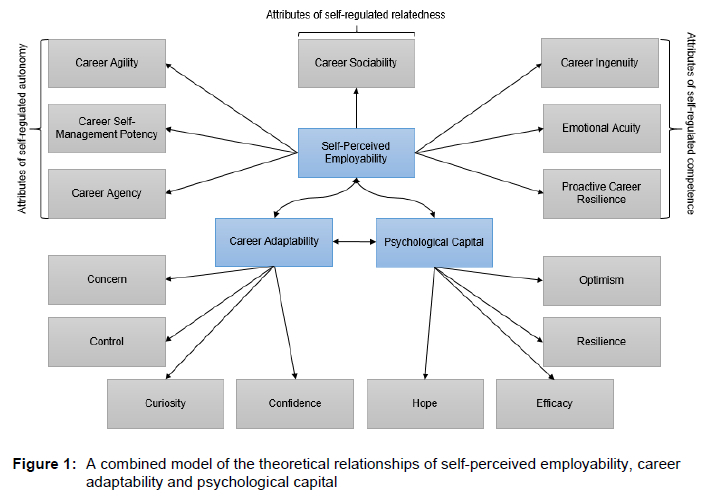
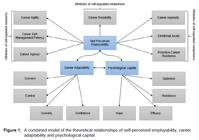
Self-perceived employability is a multifaceted (Rothwell, Jewel, and Hardie 2009, 153) and psychosocial construct (Coetzee and Engelbrecht 2019, 3) that has been studied and defined from numerous viewpoints (Coetzee 2019, 219). Employability represents the career-related qualities that aid a person's adaptive cognition, behaviour, and affect (Coetzee and Engelbrecht 2019, 3). It is a collective of attributes essential for creating, securing and maintaining employment opportunities, even when facing joblessness or dealing with the consequences of the 4IR (Bezuidenhout 2011, 45, 63; Coetzee 2019, 221; Nimmi and Donald 2023, 276). Self-perceived employment is a perception of one's capacities to gain and sustain a satisfying job and to have the know-how, understanding, competencies, experience, and personal qualities to progress independently within the labour market (Oosthuizen, Mayer, and Zwane 2021, 2). This study treats self-perceived employability from an individual and contextual perspective and includes three areas of psychological needs, namely autonomy, self-regulated competence, and relatedness (Coetzee 2019, 221), consisting out of seven psychological attributes of self-regulated employability (Coetzee 2019, 222).
Autonomy refers to a person's wish to self-manage their experiences and behaviour and to participate in endeavours consistent with their character (Deci and Ryan 2000, 231). Personal agency is demonstrated through autonomous career management, goal setting, and achievement, facilitating a better fit between the individual and their environment (Coetzee and Engelbrecht 2019, 8). Career agility attributes indicate the acceptance of accountability for one's choices. It also points to a person's predisposition to be more involved, leading to future and self-started activities to adapt to changing circumstances through improving knowledge and skills (Coetzee 2019, 223). Career self-management potency attributes involve an intrinsic autonomous motivation and capacity to support employability through continuous learning and development opportunities, career planning, and management efforts to pursue career goals (Coetzee 2019, 223; Potgieter and Coetzee 2013, 3). Career agency attributes relate to the person's estimation of his or her ability to set challenging targets, function and make decisions independently of others, cope with challenges, and thrive through the enjoyment of the discovery of original solutions (Bezuidenhout, Rudolph, and Furtak 2019, 111; Coetzee 2019, 223).
Self-regulated competence refers to an inclination to impact the environment and achieve valued outcomes from it (Deci and Ryan 2000, 231). Therefore, a person feels competent and confident about their actions and behaviour, which supports achieving their career outcomes such as employability and achieving proficiency over circumstances that affect their career success and employability (Coetzee and Engelbrecht 2019, 16). Cultural ingenuity attributes involve a capacity to understand, confidently initiate and behave, and positively interact with various groups of people in a multicultural environment (Coetzee 2019, 224; Potgieter and Coetzee 2013, 3). Emotional acuity concerns the flexible application of emotions and the ability of individuals to detect, recognise, and effectively manage the emotions and moods of others and themselves (Coetzee 2019, 224; Potgieter and Coetzee 2013, 3). Proactive career resilience attributes concern the temperament that enables: a person's degree of anticipation and adjustment to changeable circumstances, openness, self-assurance, and proficiency, irrespective of the person's career circumstances (Bezuidenhout et al. 2019, 111; Coetzee 2019, 224).
Relatedness involves belonging and connecting with others (Deci and Ryan 2000, 231). It reflects a need for relatedness by developing and maintaining satisfying social relationships that can be leveraged to advance one's career (Bezuidenhout 2011, 96; Coetzee and Engelbrecht 2019, 10). Previous research by Coetzee and Engelbrecht (2019, 14) has shown a negative association between low self-perceived employability and career adaptability. Individuals with low self-perceived employability tend to perceive job market changes as threats to their autonomy and consider the number of available coping resources to restore their sense of autonomy and employability. In addition, research findings indicate that self-directed independence and proficiency characteristics explain the strongest link between self-perceived employability and career adaptability (Coetzee and Engelbrecht 2019, 15).
Career adaptability
Career adaptability is a crucial psychosocial resource and skill associated with an individual's ability to create plans for obtaining or creating work opportunities. It has become an indispensable means of survival (Lin and Jiang 2023, 2; Maree 2017b, 351; Savickas and Porfeli 2012, 661; Tien and Wang 2017, 300). Career adaptability pertains to identifying and utilising one's psychosocial resources to adjust to career situations and accomplish career gratification and achievement. Because social structures are more ambiguous and less supportive, employment during the 4IR is fluid and demands greater self-knowledge, flexibility, and personal self-management (Rottinghaus, Falk, and Eshelman 2017, 86; Sou, Yuen, and Chen 2022, 4; Xia et al. 2020, 2-3).
Adaptability requires active cognitive assessment of how the external environment aligns with one's interests, talents, abilities, and employer demands. It involves tailoring oneself to ideal work contexts and actively and constructively participating in work roles (Coetzee and Engelbrecht 2019, 3; Rottinghaus et al. 2017, 88). Coetzee and Harry (2015, 86) found a positive association between career adaptability and employability competencies and skills. Another study by Coetzee, Ferreira and Shunmugum (2017, 9) demonstrated a link between career adaptability and psychological resources as critical psychosocial career capacities.
Career concern, -control, -curiosity, and -confidence and confidence constitute the resources of career adaptability. Career concern is an attitude to and competence in planning behaviours to cope with anticipated workplace changes. Career control reflects an individual's sense of responsibility for making career-related decisions. Career curiosity involves exploration and experimentation to acquire direct knowledge and skills. Finally, career confidence entails self-belief in problem-solving abilities related to one's career (Santilli et al. 2017, 64; Savickas 2012, 663; Xia et al. 2020, 2).
Psychological capital
Psychological capital is a higher-order collection of positive capacities (Calvo and Garcia 2020, 4; Görgens-Ekermans and Herbert 2013, 1) of a cognitive nature (Avey et al. 2010, 19). Luthans identified four constructs comprising psychological capital: hope, efficacy, resilience, and optimism (also referred to as HERO) (Görgens-Ekermans and Herbert 2013, 1). Luthans and Youssef-Morgan (2017, 340) define the psychological resources of psychological capital as follows:
"an individual's positive psychological state of development, characterised by (1) having confidence (self-efficacy) to take on and put in the necessary effort to succeed at challenging tasks; (2) making a positive attribution (optimism) about succeeding now and in the future; (3) persevering towards goals, and when necessary, redirecting paths to goals (hope) to succeed; and (4) when beset by problems and adversity, sustaining and bouncing back and even beyond (resiliency) to attain success."
Youth unemployment is a global phenomenon owing to the economic crisis; globalisation in various spheres of life; competition amongst businesses; technological evolution and use; and organisational changes. The 4IR demands adaptable and resilient workers that can work in various contexts whilst overcoming setbacks in their careers (Calvo and Garcia 2020, 1). Therefore, psychological capital can supply psychological resources to achieve this demand (Asbari et al. 2021, 69).
Research established that psychological capital is a "storehouse" of psychological resources (Asbari et al. 2021, 68). Psychological capital is a vital yet underutilised resource that strengthens individuals' positive psychological resources (Broad and Luthans 2020, 551). Research has demonstrated its significance for various work-related outcomes and its role as a personal resource influencing individuals' experiences and adaptation to work demands. Research also indicates that resilience helps workers deal with challenging situations through increased persistence. Zyberaj et al. (2022, 2) contend that because psychological capital boosts a worker's career adaptability, it is vital for proactive career behaviour. Career-adaptable workers have improved coping capacities for managing unpredictable adjustments necessitated by a changeable work environment.
Employment is crucial for psychological well-being (Coetzee and Engelbrecht 2019, 17). Given the connection between employment and psychological well-being, individuals rely on psychological capital and adaptability to enhance their employability skills and perceive themselves as employable (Calvo and Garcia 2020, 4; Coetzee and Engelbreacht 2019, 17). Psychological capital equips individuals with the psychological resources to navigate the challenges of a fluid work environment (Coetzee 2019, 223; Coetzee and Harry 2015, 81-82). Figure 1 illustrates the theoretical model representing the relationships between self-perceived employability, career adaptability, and psychological capital based on the literature review.
METHODOLOGY
Research approach
The study adopted a cross-sectional, quantitative, non-experimental research approach to explore the interrelatedness of the variables. Three core variables, employability, career adaptability and psychological capital, were identified and examined using Pearson's correlation (r) analysis. All assessments were conducted online through an encrypted assessment link, ensuring that the testing process was standardised and in line with the predetermined planned steps. The measuring instruments were standardised, and the sample was deemed representative and appropriate.
Research participants
A non-probability convenience sample of 263 non-degreed first- and second-year students from a public educational institution was employed. In line with general South African higher education institutional trends, the gender profile was skewed towards females, accounting for 80.2 per cent of the participants. The average age of the participants was 20, with the largest age group being 19 to 24 (37.3%), followed by 25 to 30 (28.2%) and older than 35 years (20.5%). The smallest age group was 31 to 35 years (19.8%). In terms of race, the majority of participants were African (73.8%), followed by whites (13.7%), Coloureds (6.8%), Indians (4.6%), and Other (1.1%). The "Other" category included racial groups not fitting into the four main categories.
Measuring instruments
An electronic encrypted version of the biographical questionnaire, the Employability Attributes Scale (EAS), the Career Adapt-Ability Scale (CAAS), and the Psychological Capital Questionnaire (PCQ) were utilised to gather data.
Biographical questionnaire: Demographic variables, such as gender, age, home language, and race, were collected from the study sample using a biographical questionnaire at the start of the online survey. The demographic options were in a multiple-choice format.
Employability Attributes Scale (EAS): The EAS is multifactorial and contains 51 items and seven subscales, namely career agility (13 items); career self-management potency (7 items); cultural ingenuity (7 items); emotional acuity (7 items); proactive career resilience (8 items); career agency (5 items); and career sociability (4 items). A seven-point Likert-type scale ranging from "definitely disagree" (1) to "strongly agree" (7) was employed. Previous studies report verified reliability and validity in a South African context. In a 2019 study, the EAS achieved an internal consistency of 0.97 (Coetzee 2019, 226). This study calculated a Cronbach's alpha coefficient of 0.96. Oosthuizen et al. (2021, 4) reported a Cronbach's alpha coefficient for the EAS and the sub-dimensions between an acceptable 0.78 and 0.90. This study achieved a similar range of between 0.78 and 0.91.
Career Adapt-Ability Scale (CAAS): The CAAS is a self-ranking measure and consists of 24 questions and four equally weighted subscales: concern, control, curiosity, and confidence. A five-point Likert-type scale was used, ranging from "not strong" (1) to "strongest" (5). A study by Coetzee et al. (2017, 6) found an internal consistency ranging between 0.83 (control) and 0.90 (confidence). The calculated internal consistency for this study was 0.95, and the reliability of the subscales was as follows: concern (0.83), control (0.86), curiosity (0.86), and confidence (0.92).
Psychological Capital Questionnaire (PCQ): The PCQ comprises four similarly loaded subscales: hope, optimism, self-efficacy, and resilience. Every subscale comprises six questions, and response options range from "strongly disagree" (1) to "strongly agree" (6). Görgens-Ekermans and Herbert (2013, 5) report that earlier studies established internal consistency scores of between 0.72 and 0.80 for hope, 0.69 and 0.79 for optimism, 0.75 and 0.85 for self-efficacy; and 0.66 and 0.72 for resilience. In their respective studies, Zyberaj et al. (2022, 8) and Daswati et al. (2022, 7) report an internal consistency of 0.88. The calculated Cronbach's alpha was 0.91 in this study. The internal consistency for the subscales was 0.87 (efficacy); 0.83 (hope); 0.75 after the removal of one item (resilience); and 0.75 after the removal of two items (optimism). Three reverse-scoring items affected the instrument's internal consistency.
Research procedure and ethical considerations
A non-probability convenience sampling technique was applied. The questionnaires were electronically distributed to participants with the aid of the educational institution's Information, Communication and Technology (ICT) department. The purpose, procedures and potential study benefits were explained, and participants were informed of their guaranteed rights to confidentiality, voluntary participation and withdrawal. Participants gave their consent before proceeding with the survey. All information was treated with complete confidentiality. The researchers and statistician signed confidentiality agreements and assured each other that the research would be conducted with integrity. Before the researcher and statistician did the statistical analysis, the ICT department extracted, anonymised, and adjusted data to the IBM Statistical Package for the Social Sciences (SPSS), version 28 format. The ICT department will keep the completed surveys on the educational institution's data server for five years.
The researchers received ethical clearance (2021_CEMS/IOP_030) from the educational institution's Research Ethics Review Committee (RERC) to perform the study. The institution's Research Permission Sub-Committee (RPSC) gave permission (2021 RPSC081) to use the ICT department to distribute the questionnaires to the participants electronically.
Validity and reliability
A systematic approach was adopted to ensure validity and reliability during the theoretical and empirical studies. Standardised measuring instruments proven reliable and valid in other research studies were used to collect response data, and relevant analysis techniques were used to interpret the data. Before any statistical work was done, the reliability coefficients of the measurements were calculated according to Cronbach's coefficient alpha to determine an approximation of the measurement scale items' consistency and the degree to which the results can be relied upon to come to accurate and valid conclusions.
Statistical analysis
The numerical data were processed using an independent statistician utilising SPSS version 28. Descriptive statistics such as mean, standard deviation, frequency, and range were calculated to investigate the demographic qualities and differences within the sample and provide depth to the inferential statistics. Confirmatory Factor Analysis (CFA) measured each measurement scale item's input and calculated the scale's reliability in assessing a concept (Hair et al. 2019, 660). The Pearson product-moment correlation coefficient (r) established and described the relationship strength between the study variables (Tredoux and Durrheim 2008, 183). The researchers followed the following practical significance for interpreting Pearson's correlations: r less than 0.1. for a small practical effect, r less than 0.30 for a moderate practical effect and r greater than 0.5 for a large practical effect (Cohen 1992, 156). This research study used a significance level of ρ < .05. The null hypothesis is rejected, and results are considered significant when a test of significance results in a p-value lower than the chosen level of significance (Babbie 2021, 46; Salkind 2012, 28-29).
RESULTS
Confirmatory Factor Analysis (CFA)
The CFA investigated the model's validity and established whether or not associations exist between the studied variables and their underlying items. Knowledge of the theory helped to assume the relationship pattern based on theoretical deduction and to test the model statistically. The first step was to ensure that the parameter estimates were statistically significant (p-value < 0.05), and then the degree of model fit was calculated. Goodness-of-fit indices were used to determine it. All CFA calculations indicated the factor structures' reasonable validity (Stindt 2022; Suhr 2006). For the PCQ, a significance level was achieved after item 13, "When I have a setback at work, I have trouble recovering from it, moving on" for resilience. Two items -item 20, "If something can go wrong for me work-wise, it will" and item 23, "In this job, things never work out the way I want them to" - were removed. The analysis utilised the remaining items as the resultant structure was conceptually meaningful and interpretable.
Descriptive analyses
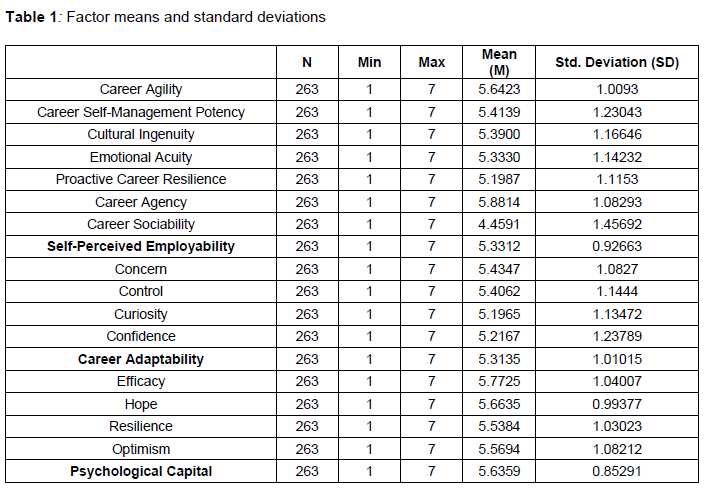
At measurement, the Likert scales of the EAS ranged between "Definitely disagree" (1) and "Strongly agree" (7); the CAAS between "Not strong" (1) and "Strongest" (5); and the PCQ from "Strongly disagree" (1) to "Strongly agree" (6). The measured scores were standardised to a score out of 7 to allow comparisons between the factors. Table 1 displays the valid responses; the lowest and highest-rated answers; the mean score; and the standard deviation for every sub-score. The standard deviation for career sociability was the highest (SD = 1.46) compared to other variables, such as self-perceived employability (SD = 0.93) and psychological capital (SD = 0.85), for which the standard deviation was the lowest.
From an investigation of the means, three notable thematic trends emerged. The first theme hinges on the sample group's confidence in their ability to set challenging targets, be independent decision-makers, and thrive through original problem-solving. As depicted in Table 1, the mean averages were the highest for career agency (M = 5.88) and efficacy (M = 5.77). The standard deviation was also fairly narrowly dispersed around the mean (SD = 1.08 and SD = 1.04, respectively), indicating that the answers tended to trend narrower towards the mean. The second theme indicated a high mean score for psychological capital's efficacy (M = 5.77), hope (M = 5.66), resilience (M = 5.54), and optimism (M = 5.57). The standard deviation for all four variables was also lower than others (SD = 1.04; 0.93; 1.03; 1.08, respectively). Thirdly, career sociability was a notable variable measuring the lowest mean average compared to the other measured variables (M = 4.46) and the most widely dispersed responses around the mean (SD = 1.46).
Correlation analyses
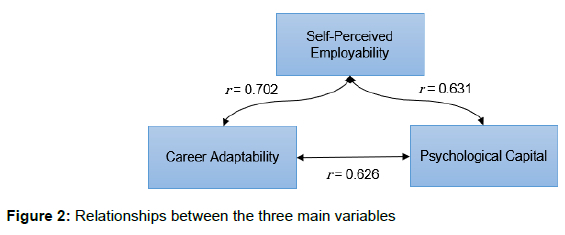
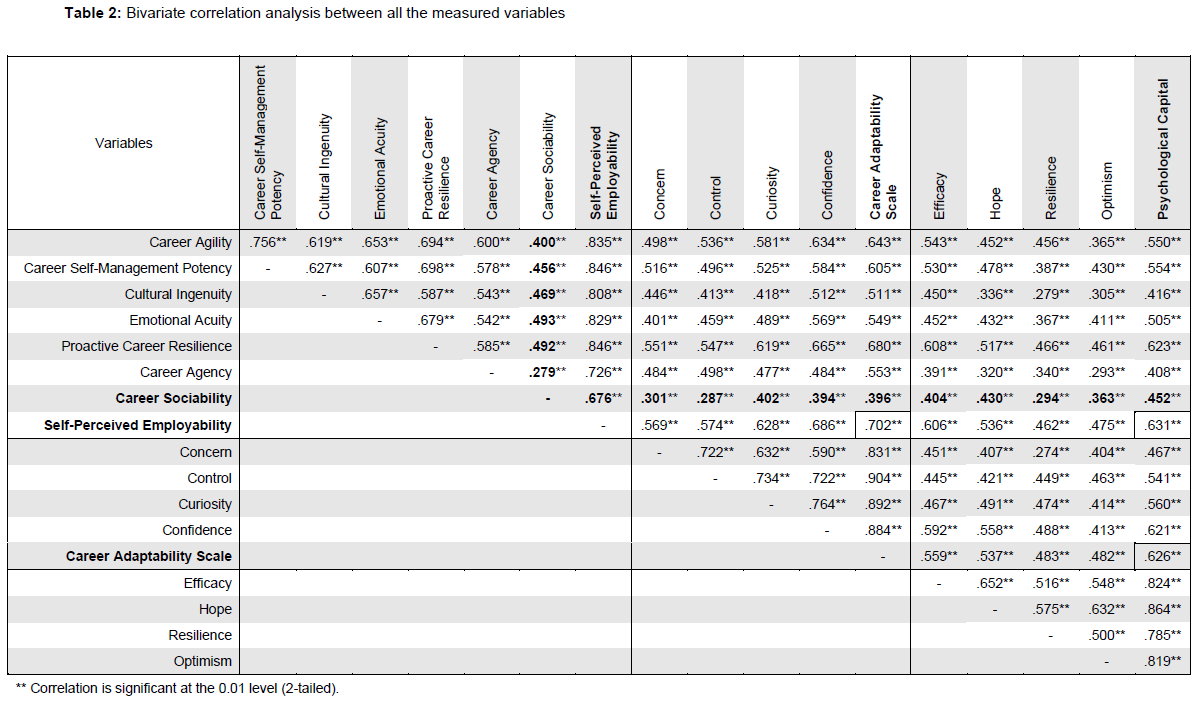
The Pearson product-moment correlation coefficient calculated the direction and magnitude of the relationships between the EAS and its seven variables, the CAAS and its four variables, and the PCQ and its four variables. The relationships between all variables were statistically significant at the ρ < 0.01 (1%) 2-tailed level. All statistically significant relationships were in a positive direction. The correlations range from r = 0.274 (small practical effect size) to r = 0.904 (large practical effect size). As shown in Figure 2, relationships between the three main variables were significant.
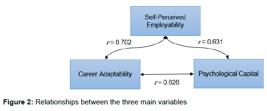
The statistical analysis in Table 2 indicated a strong positive correlation between employability and career adaptability (r= 0.702, p< 0.01), which explained 49.28 per cent of the variance. This finding agrees with that of Coetzee and Harry (2015, 86) and Coetzee and Engelbrecht (2019, 15), who came to a similar conclusion. The statistical analysis suggested a strong positive association between employability and psychological capital (r= 0.631 P<- 0.01), explaining 39.82 per cent of the variance. This specific correlation is weaker than the association between employability and career adaptability. This observation also agrees with Rawat and Sharma (2018, 49), who established an association between psychological capital and employability. Calvo and Garcia (2020, 13) demonstrate that psychological capital is required to develop employability skills such as self-management, teamwork, and self-knowledge. Ngoma and Ntale (2016, 135) submit that psychological capital, social capital and career identity help people to cope with employability challenges. The strong positive correlation between career adaptability and psychological capital (r = 0.626, ρ < 0.01) explains 39.18 per cent of the variance. This association is also the weakest of the three correlations among the three main variables. Mohammed, Nazri, and Omar (2019, 19) and Safavi and Bouzari (2019, 71) noticed an association between career adaptability and psychological capital. Savickas and Porfeli (2012, 663) also note theoretical associations between career adaptability and psychological capital in scientific-research literature.
DISCUSSION
Outline of the results
Employability and career adaptability. The study results indicate a strong positive correlation between the main variables of self-perceived employability and career adaptability. Bezuidenhout (2011, 63) and Coetzee (2019, 221) demonstrate that employability is a collection of attributes needed to heighten the possibility of creating, obtaining, and maintaining employment opportunities. Coetzee and Engelbrecht (2019, 3-4) also emphasise that these attributes support employability through adaptive cognition, behaviour, and affect. Career adaptability relates to a person's readiness to adjust to changes in the environment and to rely on adaptive competencies and motivation by depending on adaptability resources such as concern, control, curiosity, and confidence. Qualitative analysis of the definitions reveals overlapping themes of adaptation in cognition, behaviour, and affect to effectively adjust to changes and opportunities in one's employment situation. Similar to this study, Coetzee and Harry (2015, 86) also observe a positive relationship between career adaptability and employability, while Coetzee and Engelbrecht (2019, 14) note a negative association between low perceived employability and career adaptation. Qualitative analysis of the definitions reveals overlapping themes involving adaptation - how one thinks (cognition), acts (behaviour), and feels (affect) - to optimally adjust to changes and opportunities in one's employment situation. Similar to this study, Coetzee and Harry (2015, 86) also observe a positive relationship between career adaptability and employability, while Coetzee and Engelbrecht (2019, 14) note a negative association between low perceived employability and career adaptation.
Further investigation of the study results shows that career adaptability and confidence correlate strongly with career agility, career self-management potency, career ingenuity, emotional acuity, proactive career resilience, and career agency. Proactive career resilience, as a factor, correlates with all four factors of career adaptability. Proactive career resilience, as a factor, correlates with all four factors of career adaptability. According to Coetzee (2019, 224) and Coetzee and Harry (2015, 87), proactive career resilience points to the temperament that allows a supportive degree of expectancy and modification to changeable situations, flexibility, self-confidence, and competence, irrespective of a person's career conditions. Considering this explanation, the theme of career adaptability and confidence emerges strongly and explains the correlation between career adaptability and the confidence factor. Savickas and Porfeli (2012, 663) described that confidence involves a person's self-belief in finding solutions to career problems and overcoming obstacles, demonstrating resilience. Coetzee et al. (2015, 6) support this finding and highlight the positive links between career resilience and career adaptability.
The association between career adaptation confidence and career resilience proves that a belief in one's abilities to solve career challenges and remain hardy (regardless of setbacks) is essential in obtaining and maintaining employability flexibly. As Qenani, MacDougall and Sexton (2014, 202) suggested, career adaptation through employability attributes helps individuals regain their autonomy.
Employability and psychological capital. The main variables of self-perceived employability and psychological capital resulted in a strong positive significant correlation in this study. Employability encompasses attributes that enhance the creation, obtaining, and sustainability of employment opportunities. More importantly, in the light of psychological capital, these attributes support employability through adaptive cognition, behaviour, and affect (Bezuidenhout 2011, 78; Coetzee 2019, 224). Luthans and Youssef-Morgan (2017, 340) describe psychological capital as a constructive psychological condition of growth, which is considered as possessing self-confidence (self-efficacy) to carry out a challenging task and make an effort to be successful at it, react positively (optimism) about prospering now and in future; push forward or redirect paths, when required, towards goals to succeed (hope); and, when affected by setbacks, to bounce back and perform even better (resilience) to accomplish success. Psychological capital primarily relates to cognitive aspects, encompassing an individual's optimistic appraisal of circumstances and belief in their potential for success (Avey et al. 2010, 20; Görgens-Ekermans and Herbert 2013, 1). Given these explanations, there appears to be a link between the positive appraisal of how one assesses a career situation and how one cognitively, behaviourally, and emotionally adjusts through the support of one's employability attributes and psychosocial career capacities. In confirmation of the results of this study, Rawat and Sharma (2018, 41-42) draw attention to an association between the concepts of psychological capital and their definition of employability. Calvo and Garcia (2020, 10) submit that psychological capital is a precursor variable of employability skills and influences various employability skills such as teamwork, self-knowledge, and self-management.
A closer examination of the factor correlations reveals a positive association between psychological capital and career agility, career self-management potency, emotional acuity, and proactive career resilience. Psychological capital also positively correlates with self-efficacy, career agility, and career self-management potency. Proactive career resilience demonstrates the strongest association with psychological capital and, to a slightly lesser extent, with efficacy, which relates to confidence (Luthans and Youssef-Morgan 2017, 348). When inspected qualitatively, the theme of positive expectations emerges. A person can expect and adapt to a changeable career scene and can do so in a self-confident and competent manner. We can, therefore, identify a statistically supported link between psychological capital (albeit not as substantial as career adaptability) and efficacy with proactive career resilience.
Efficacy positively correlates with career agility and self-management potency, forming another prominent theme in this study. Career agility and career self-management potency also demonstrated a strong relationship between the employability factors, in other words, a substantial degree of relatedness. Efficacy is the belief in one's capacity to activate the needed motivating force, mental resources, and courses of action to perform a particular task successfully in a specific context (Avey, Luthans, and Jensen 2009, 680). Career agility involves that one takes responsibility for one's decisions and playing an active role in one's career, which will result in future and independent measures to adjust to changes in one's situation by improving one's knowledge and skills (Coetzee et al. 2015, 3; Potgieter and Coetzee 2013, 3). Career self-management potency implies an inherent independent motivation and capacity to support employability through ongoing learning opportunities, career planning, and management endeavours to pursue one's career goals (Coetzee et al. 2015, 7; Coetzee and Engelbrecht 2019, 9; Potgieter and Coetzee 2013, 3). These three factors converge on the concept of active, autonomous efficacy. They highlight the importance of self-motivation, proactive action, and assuming responsibility for one's career. The positive statistical relationship between these factors, particularly career agility and self-management potency, supports this notion.
Career adaptability and psychological capital. The main variables of career adaptability and psychological capital displayed a strong positive correlation in this study. This relationship is, however, the weakest of the three associations between the three main variables. Empirical studies by Savickas and Porfeli (2012, 663), Mohammed et al. (2019, 18), and Safavi and Bouzari (2019, 71) also support the association between career adaptability and psychological capital.
In this study's statistical analysis, the factor theme of career confidence demonstrates positive associations between hope and efficacy as career adaptability and psychological capital factors. Qualitative analysis of the definitions of career confidence and efficacy reveals overlapping themes, highlighting self-belief in one's motivation and cognitive abilities to solve career problems (Avey et al. 2009, 680; Savickas and Porfeli 2012, 663). As defined by Luthans (2011, 217) and Luthans and Youssef (2007, 330), hope signifies constructive motivation centred around effective goal-oriented strategies. Hope is driven by self-agency and entails being motivated to take action and believing in one's abilities to achieve career goals. These overlaps explain the positive association between hope and career efficacy, hope and career confidence, and career efficacy and career confidence. Literature and empirical evidence support the central thesis of a positive relationship between employability, career adaptability, and psychological capital amongst non-degreed youth at an educational institution. Figure 2 provides an overview of the relationships between the three main variables.
Practical implications
The results highlight the close correlation and interdependence between employability, career adaptability, and psychological capital among non-degreed youth at an educational institution. Taking a holistic approach is crucial based on the results.
First, career sociability, which relates to interpersonal connections and the need to create and maintain meaningful relationships, shows a weak to moderate relationship with career agency and emotional acuity. It appears that career sociability does not strongly correlate with other factors besides employability. This trend is consistent with previous research conducted by Coetzee (2019, 227). The researchers hypothesise that the rise of virtual, online and social media culture may contribute to a decrease in in-person connections which may affect the young worker's ability to seize opportunities that may arise via social connections. Educational practitioners, psychologists, and counsellors should focus on coaching and developing interpersonal and sociability skills suitable for the 4IR world.
Second, the themes of confidence and efficacy emerge repeatedly as significant factors. Self-belief in one's skills, abilities, and motivation plays a vital role in driving employability and career adaptability. Self-efficacy guides career competence and the successful execution of career tasks (Chen 2017, 339). Younger workers with limited life and occupational know-how may also require supportive involvement more than, for example, workers in their middle-to late-adulthood stages (Coetzee 2019, 230). Therefore, fostering confidence and self-efficacy through training interventions, counselling, and workshops is essential.
Third, proactive career resilience and psychological capital exhibit a weaker correlation, but qualitatively, they address the need for a temperament that allows individuals to adapt and bounce back from setbacks. It is recommended to actively focus on developing resilience, efficacy, agility, and adaptability among young workers through coaching sessions, workshops, and training programs (Oosthuizen 2022, 9). Psychologists, counsellors and career practitioners in the field will have to play an active role in developing young entry-level workers and assisting them in acquiring the necessary employability attributes and mindset to cope with the ever-changing nature of work.
Lastly, career agility and career agency highlight the importance of individual responsibility in making career decisions, planning, and continuous learning as part of their career management and continuous career adaptation. To foster adaptability and lifelong learning, educational institutions and career counsellors should adopt frameworks that empower young individuals to self-manage and sustain their employability. These frameworks should focus on developing skills, behaviours, and attitudes suitable for the 4IR and emphasise the importance of continuous learning and upskilling (Chen 2017, 337). In counselling, youth, especially those from more resource-scarce areas, should be made aware of how their skills, behaviour and attitudes will aid them in navigating their employability and how they can adapt to changes in their work situation, helping them to become more career resilient (Maree 2017b, 354).
Limitations and recommendations
This study utilised a cross-sectional design, limiting causal interpretations and hindering solid confidence in the analysis (Babbie 2021, 105-106; Salkind 2012, 253). To overcome this limitation, future research should employ longitudinal designs to investigate shifts in perceived employability, career adaptability, and psychological capital over time, considering the influence and causes of technological advancement. Additionally, replication studies with diverse demographics, cultural contexts, and occupational settings are necessary to ensure generalizability. The study's reliance on a convenience sample restricts the applicability of the findings to the broader population. Further research should involve different populations and contexts to enhance the external validity of the results. Finally, the study's timing during the COVID-19 lockdown may have influenced participants' responses, and future studies should account for this potential confounding factor.
To address the limitations mentioned above, it is recommended to conduct longitudinal studies exploring shifts in perceived employability, career adaptability, and psychological capital over time. These studies should investigate the influence of the 4IR and STARA on these variables and their role in workers' ability to remain employable and adapt to changing labour environments. Replication studies, especially in the rest of the African continent, are crucial to validate the findings in diverse populations, cultures, and occupational contexts, considering a broad range of demographic variables. Additionally, reviewing the education system to align it with the demands of the 4IR should be prioritised, emphasising lifelong learning, adaptability, and psychosocial resources. Industrial psychologists and career counsellors should play an active role in developing workers' psychosocial strengths, resilience, and efficacy through training interventions, counselling sessions, and talent management programs.
CONCLUSION
The findings highlight the importance of developing employability attributes, career adaptability factors, and psychological support factors, such as resilience and efficacy, among non-degreed youth at educational institutions. Strengthening self-perceived employability and the ability to adapt careers to a changing labour environment requires a holistic approach. As the 4IR and STARA reshape industries, workers must cultivate an adaptability mindset and continuously refine their skills, knowledge, and behaviours. The education system should focus on instilling an adaptability mindset, emphasising lifelong learning, protean careers, and essential cognitive and emotive competencies. Industrial psychologists, counsellors, and educational practitioners should nurture psychosocial skills, resilience, and efficacy in young individuals to help them navigate their careers successfully and remain employable in the face of evolving challenges.
REFERENCES
LITERATURE REVIEW
-
Asbari, M., A. B. Prasetya, P. B. Santoso, and A. Purwanto. 2021. "From creativity to innovation: The role of female employees' psychological capital." International Journal of Social and Management Studies 2(2): 66-77. https://doi.org/10.5555/ijosmas.v2i2.18.
» https://doi.org/10.5555/ijosmas.v2i2.18 -
Avey, J. B., F. Luthans, and S. M. Jensen. 2009. "Psychological capital: A positive resource for combating employee stress and turnover." Human Resource Management 48(5): 677-693. https://doi.org/10.1002/hrm.2029.
» https://doi.org/10.1002/hrm.2029 -
Avey, J. B., F. Luthans, R. M. Smith, and N. F. Palmer. 2010. "Impact of positive psychological capital on employee well-being over time." Journal of Occupational Health Psychology 15(1): 17-28. https://doi.org/10.1037/a0016998.
» https://doi.org/10.1037/a0016998 - Babbie, E. R. 2021. The practice of social research. 15th Edition. Cengage Learning.
- Bezuidenhout, M. L. 2011. "The development and evaluation of a measure of graduate employability in the context of the new world of work.". Unpublished master's dissertation, Department of Human Resource Management, University of Pretoria.
-
Bezuidenhout, M. L., E. C. Rudolph, and A. M. Furtak. 2019. "Self-perceived employability attributes of adult learners within an open distance learning environment." Journal of Contemporary Management 16: 106-139. https://doi.org/10.35683/jcm18025.0007.
» https://doi.org/10.35683/jcm18025.0007 -
Botha, D. 2021. "Self-perceived employability among undergraduate students at a South African university." SA Journal of Human Resource Management 19(0). https://doi.org/10.4102/sajhrm.v19i0.1685.
» https://doi.org/10.4102/sajhrm.v19i0.1685 -
Broad, J. D. and F. Luthans. 2020. "Positive resources for psychiatry in the fourth industrial revolution: Building patient and family-focused psychological capital (PsyCap)." International Review of Psychiatry 32: 542-554. https://doi.org/10.1080/09540261.2020.1796600.
» https://doi.org/10.1080/09540261.2020.1796600 -
Calvo, J. C. A. and G. M. Garcia. 2020. "The influence of psychological capital on graduates' perception of employability: The mediating role of employability skills." Higher Education Research and Development 40(4): 1-16. https://doi.org/10.1080/07294360.2020.1738350.
» https://doi.org/10.1080/07294360.2020.1738350 -
Chen, C. P. 2017. "Career Self-determination Theory." In Psychology of Career Adaptability, Employability and Resilience, edited by K. Maree, 329-347. Springer International Publishing. https://doi.org/10.1007/978-3-319-66954-0_20.
» https://doi.org/10.1007/978-3-319-66954-0_20 -
Clarke, M. and M. Patrickson. 2007. "The new covenant of employability." Employee Relations 30(2): 121-141. https://doi.org/10.1108/01425450810843320.
» https://doi.org/10.1108/01425450810843320 -
Coetzee, M. 2019. "A framework for assessing and developing self-regulatory positive psychological career attributes for sustained employability." In Positive psychological intervention design and protocols for multicultural contexts, edited by L. Van Zyl and S. Rothmann, 217-240. Springer. https://doi.org/10.1007/978-3-030-20020-6_10.
» https://doi.org/10.1007/978-3-030-20020-6_10 -
Coetzee, M. and L. Engelbrecht. 2019. "How employability attributes mediate the link between knowledge workers' career adaptation concerns and their self-perceived employability." Psychological Reports 0(0): 1-22. https://doi.org/10.1177/0033294119844981.
» https://doi.org/10.1177/0033294119844981 -
Coetzee, M. and N. Harry. 2015. "Gender and hardiness as predictors of career adaptability: An exploratory study among black call centre agents." South African Journal of Psychology 45(1): 81-92. https://doi.org/10.1177/0081246314546346.
» https://doi.org/10.1177/0081246314546346 -
Coetzee, M., N. Ferreira, and C. Shunmugum. 2017. "Psychological career resources, career adaptability and work engagement of generational cohorts in the media industry." SA Journal of Human Resource Management 15(0): 1-12. https://doi.org/10.4102/sajhrm.v15i0.868.
» https://doi.org/10.4102/sajhrm.v15i0.868 -
Coetzee, M., N. Ferreira, and I. L. Potgieter. 2015. "Assessing employability capacities and career adaptability in a sample of human resource professionals." SA Journal of Human Resource Management 13(1). https://doi.org/10.4102/sajhrm.v13i1.682.
» https://doi.org/10.4102/sajhrm.v13i1.682 - Cohen, J. 1992. "A power primer." Psychological Bulletin 112(1): 155-159.
-
Cox, S. and D. King. 2006. "Skill sets: An approach to embed employability in course design." Education + Training 48(4): 262-274. https://doi.org/10.1108/00400910610671933.
» https://doi.org/10.1108/00400910610671933 -
Daswati, D., H. Wiraman, S. Hattab, R. Salam, and A. S. Iskandar. 2022. "The effect of psychological capital on performance through the role of career engagement: Evidence from Indonesian public organisations." Cogent Social Sciences 8(1). https://doi.org/10.1080/23311886.2021.2012971.
» https://doi.org/10.1080/23311886.2021.2012971 -
Deci, E. L. and R. M. Ryan. 2000. "The 'What' and 'Why' of Goal Pursuits: Human Needs and the Self- Determination of Behaviour." Psychological Inquiry 11(4): 227-268. https://doi.org/10.1207/S15327965PLI1104_01.
» https://doi.org/10.1207/S15327965PLI1104_01 -
Görgens-Ekermans, G. and M. Herbert. 2013. "Psychological capital: Internal and external validity of the Psychological Capital Questionnaire (PCQ-24) on a South African sample." SA Journal of Industrial Psychology / SA Tydskrif vir Bedryfsielkunde 39(2). http://dx.doi.org/10.4102/sajip.v39i21131.
» http://dx.doi.org/10.4102/sajip.v39i21131 - Hair, J. F., W. C. Black, B. J. Babin and R. E. Anderson. 2019. Multivariate data analysis. 8th Edition. Cengage.
-
Hartung, P. J. and M. Cadaret. 2017. "Career Adaptability: Changing Self and Situation for Satisfaction and Success." In Psychology of Career Adaptability, Employability and Resilience, edited by K. Maree, 15-28. Springer International Publishing. https://doi.org/10.1007/978-3-319-66954-0_1.
» https://doi.org/10.1007/978-3-319-66954-0_1 - Lin, Z. and Y. Jiang. 2023. "Character strengths, meaning in life, personal goal, and career adaptability among impoverished college students: A chain-mediating model." Heliyon 9(2): e13232.
- Luthans, F. 2011. Organisational behaviour. An evidence-based approach. 12th Edition. McGraw-Hill.
-
Luthans, F. and C. M. Youssef. 2007. "Emerging Positive Organisational Behavior." Journal of Management 33(3): 321-349. https://doi.org/10.1177/0149206307300814.
» https://doi.org/10.1177/0149206307300814 -
Luthans, F. and C. M. Youssef-Morgan. 2017. "Psychological capital: An evidence-based positive approach." Annual review of organisational psychology and organisational behavior 4(1): 339-366. https://doi.org/10.1146/annurev-orgpsych-032516-113324.
» https://doi.org/10.1146/annurev-orgpsych-032516-113324 -
Maree, K. 2017a. "The Psychology of Career Adaptability, Career Resilience, and Employability: A Broad Overview." In Psychology of Career Adaptability, Employability and Resilience, edited by K. Maree, 3-11. Springer International Publishing. https://doi.org/10.1007/978-3-319-66954-0_21.
» https://doi.org/10.1007/978-3-319-66954-0_21 -
Maree, K. 2017b. "Utilising Career Adaptability and Career Resilience to Promote Employability and Decent Work and Alleviate Poverty." In Psychology of Career Adaptability, Employability and Resilience, edited by K. Maree, 349-373. Springer International Publishing. https://doi.org/10.1007/978-3-319-66954-0_21.
» https://doi.org/10.1007/978-3-319-66954-0_21 - Mohammed, M. M., M. Nazri, and S. Omar. 2019. "The Mediating Role of Career Adaptability on the Relationship Between Psychological Capital and Academics' Career Success." Arabian Journal of Business and Management Review (Oman Chapter) 8(4): 8-21.
-
Ngoma, M. and P. D. Ntale. 2016. "Psychological capital, career identity and graduate employability in Uganda: the mediating role of social capital." International Journal of Training and Development 20(2): 124-139. https://doi.org/10.1111/ijtd.12073.
» https://doi.org/10.1111/ijtd.12073 -
Nimmi, P. M. and W. E. Donald. 2023. "Modelling the interaction between serious leisure, self-perceived employability, stress, and workplace well-being: empirical insights from graduates in India." Personnel Review 52(1): 272-287. https://doi.org/10.1108/PR-04-2021-0305.
» https://doi.org/10.1108/PR-04-2021-0305 -
Oosthuizen, R. M. 2022. "The Fourth Industrial Revolution - Smart Technology, Artificial Intelligence, Robotics and Algorithms: Industrial Psychologists in Future Workplaces." Frontiers in Artificial Intelligence 5: 913168. https://doi.org/10.3389/frai.2022.913168.
» https://doi.org/10.3389/frai.2022.913168 -
Oosthuizen, R. M., C. Mayer, and N. J. Zwane. 2021. "Burnout, employee engagement and self-perceived employability in the South African public sector." SA Journal of Human Resource Management / SA Tydskrif vir Menslikehulpbronbestuur 19(0): 1-12. https://doi.org/10.4102/sajhrm.v19i0.1340.
» https://doi.org/10.4102/sajhrm.v19i0.1340 -
Potgieter, I. and M. Coetzee. 2013. "Employability attributes and personality preferences of postgraduate business management students." SA Journal of Industrial Psychology 39(1): 1-10. https://doi .org/10.4102/sajip.v39i1.1064.
» https://doi .org/10.4102/sajip.v39i1.1064 -
Qenani, E., N. MacDougall, and C. Sexton. 2014. "An empirical study of self-perceived employability: Improving the prospects for student employment success in an uncertain environment." Active Learning in Higher Education 15(3): 199-213. https://doi.org/10.1177/1469787414544875.
» https://doi.org/10.1177/1469787414544875 -
Rawat, R. and R. Sharma. 2018. "Is psychological capital related to employability skills of graduate students?" Journal of General Management Research 5(2): 39-54. https://pdfs.semanticscholar.org/a6bb/72fa204f58050942f7b83b818e5655db3173.pdf.
» https://pdfs.semanticscholar.org/a6bb/72fa204f58050942f7b83b818e5655db3173.pdf -
Rothwell, A. and J. Arnold. 2005. "Self-perceived employability: Development and validation of a scale." Personnel Review 36(1): 23-41. https://doi.org/10.1108/00483480710716704.
» https://doi.org/10.1108/00483480710716704 -
Rothwell, A., S. Jewel, and M. Hardie. 2009. "Self-perceived employability: Investigating the responses of postgraduate students." Journal of Vocational Behaviour 75: 152-161. https://doi.org/10.1016/jjvb.2009.05.002.
» https://doi.org/10.1016/jjvb.2009.05.002 -
Rottinghaus, P. J., N. A. Falk, and A. Eshelman. 2017. "Assessing Career Adaptability." In Psychology of Career Adaptability, Employability and Resilience, edited by K. Maree, 83-105. Springer International Publishing. https://doi.org/10.1007/978-3-319-66954-0_6.
» https://doi.org/10.1007/978-3-319-66954-0_6 -
Safavi, H. P. and M. Bouzari. 2019. "The association of psychological capital, career adaptability and career competency among hotel frontline employees." Tourism Management Perspectives 30: 65-74. https://doi.org/10.1016/j.tmp.2019.02.001.
» https://doi.org/10.1016/j.tmp.2019.02.001 - Salkind, N. J. 2012. Exploring research. 8th Edition. Pearson Education International.
-
Santilli, S., J. Marcionetti, S. Rochat, J. Rossier, and L. Nota. 2017. "Career adaptability, hope, optimism, and life satisfaction in Italian and Swiss adolescents." Journal of Career Development 44(1): 62-76. https://doi.org/10.1177/0894845316633793.
» https://doi.org/10.1177/0894845316633793 -
Savickas, M. L. 2013. "The 2012 Leona Tyler Award Address." The Counseling Psychologist 41(4): 648-662. https://doi.org/10.1177/0011000012468339.
» https://doi.org/10.1177/0011000012468339 -
Savickas, M. L. and E. J. Porfeli. 2012. "Career adapt-abilities scale: Construction, reliability, and measurement equivalence across 13 countries." Journal of Vocational Behavior 80(3): 661-673. https://doi.org/10.1016/j.jvb.2012.01.011.
» https://doi.org/10.1016/j.jvb.2012.01.011 - Schreuder, A. M. G. and M. Coetzee. 2016. Careers: An organisational perspective. 5th Edition. Juta.
- Sou, E. K., M. Yuen, and G. Chen. 2022. "Career adaptability as a mediator between social capital and career engagement." The Career Development Quarterly 70(1): 2-15.
- Stindt, C. 2022. Analysis Interpretation Document. Guide document for statistic interpretations. Eversci.
- Suhr, D. 2006. Exploratory or Confirmatory Factor Analysis? SAS Users Group International Conference. SAS Institute, Inc.
-
Tien, H. S. and Y. Wang. 2017. "Career Adaptability, Employability, and Career Resilience of Asian People." In Psychology of Career Adaptability, Employability and Resilience, edited K. Maree, 299-314. Springer International Publishing. https://doi.org/10.1007/978-3-319-66954-0_18.
» https://doi.org/10.1007/978-3-319-66954-0_18 - Tredoux, C. and K. Durheim. 2008. Numbers, hypotheses & conclusions: A programme in statistics for the social sciences. University of Cape Town Press.
-
Xia, T., H. Gu, Y. Huang, Q. Zhu, and Y. Cheng. 2020. "The relationship between career social support and employability of college students: A moderated mediation model." Frontiers in Psychology 11(28): 1-7. https://doi.org/10.3389/fpsyg.2020.00028.
» https://doi.org/10.3389/fpsyg.2020.00028 -
Zyberaj, J., S. Seibel, A. F. Schowalter, L. Pötz, S. Richter-Killenberg, and J. Volmer. 2022. "Developing Sustainable Careers during a Pandemic: The Role of Psychological Capital and Career Adaptability." Sustainability, 14: 3105. https://doi.org/10.3390/su14053105.
» https://doi.org/10.3390/su14053105