Impact of Leaf Removal on Berry Amino Acid Content of Sequentially Harvested Cabernet Sauvignon and Shiraz in Stellenbosch
Abstract
The amino acid composition at harvest is a key determinant of the final wine quality. The composition of the grape must at harvest is strongly influenced by the grape variety, environmental conditions and the viticultural practices. These compounds play a key role in fermentation dynamics and flavour development, being precursors of volatile compounds. This study aimed to investigate how leaf removal and harvest timing influence amino acid content and physicochemical parameters in Cabernet Sauvignon and Shiraz grapevines. The results show that the Shiraz grapes had higher concentrations of sugars, amino acids and anthocyanins compared to Cabernet Sauvignon, whereas leaf removal increased key amino acids such as glutamine, phenylalanine and glycine, improving the nitrogen content essential for alcoholic fermentation. The optimal harvest time for maximising amino acid content was found to be at E-L 38 + 18 days close to 25°Brix. Moreover, the content of proline, an amino acid with osmo-protective properties, was positively correlated with glucose, fructose and total sugar content, suggesting its role in mitigating stress and promoting sugar accumulation. This study shows the significance of canopy management and precise harvest timing for improving grape composition and optimising wine quality.
Arginine; defoliation; grape; osmoregulation; proline; optimal harvest
INTRODUCTION
Grape ripening includes different physical and biochemical modifications in the seeds, skin and pulp (Van Leeuwen et al., 2023). Optimal berry ripeness depends on the wine style goal defined by the winemakers (Gutiérrez-Gamboa et al., 2021). The sensory characteristics of the finished wine, and thus its quality, are strongly dependent on the perception of the primary and secondary metabolites, including the alcohol level (Blancquaert et al., 2019). Optimal grape maturity is determined mostly by sugar content, acidity, berry size, phenolic content and taste, which have a direct impact on the type of wine that the winemaker wants to achieve (Le Moigne et al., 2008).
Ripening tools have been developed to determine berry maturity objectively and accurately at harvest. Berry maturity indices include (i) total soluble solids (TSS), (ii) titratable acidity (TA), (iii) pH and (iv) combinations thereof (maturity indexes) (Boulton et al., 1999). Some authors identify three levels of grape maturity: (i) technological maturity, which corresponds to maximum sugar accumulation/ concentration and low acidity, (ii) phenolic maturity, defined as the level and concentrations of phenolics in the skins and seeds and (iii) aromatic maturity, associated with the decrease in vegetal notes and the evolution of wine volatile profile (Schneider et al., 2002; Blancquaert et al., 2019).
An in-depth knowledge of grape compositional factors, grape cultivar, climate, topography, seasonal weather conditions and vineyard management practices is required to reach the "optimal ripeness" decision to achieve a targeted wine style (Bindon et al., 2013). One of these management practices is leaf removal, which directly influences light exposure and berry temperature, thereby affecting the sink-to-source relationship (Song et al., 2018). By enhancing light penetration and improving air circulation around the clusters, leaf removal can optimise berry temperature conditions and increase the effectiveness of biostimulants and fungicide formulations, ultimately reducing the incidence of grapevine diseases (Ivanisevic et al., 2020). Timing of harvest maximise grape quality in terms of its amino acid composition under different viticultural practice however research on this topic has been minimal (Garde-Cerdán et al., 2018; Gutiérrez-Gamboa et al., 2020). Leaf removal alters the berry microclimate, resulting in significant changes in the concentration and composition of amino acids, with responses differing between cultivars and across harvest dates used by producers.
Berry nitrogen composition is a key factor of must composition (Gutiérrez-Gamboa et al., 2020). Must nitrogen composition is essential for yeast growth, since it affects the fermentation kinetics and flavour metabolism of wines (Verdenal et al., 2021). A low nitrogen content in the must usually leads to stuck or sluggish fermentations, affecting the operational logistic of the wine cellar (Bisson & Butzke, 2000). Some of the amino acids contained in the musts are precursors of the higher alcohols, esters, carbonyl compounds, volatile fatty acids and sulphur compounds in wines, which are formed from the enzymatic metabolism of yeast and bacteria through alcoholic and malolactic fermentation (Bell & Henschke, 2005). A strong relationship between the amino acid composition of the must and some volatile compounds in wines has been reported by several studies (Bisson & Butzke, 2000; Bell & Henscke, 2005; Garde-Cerdán et al., 2018; Verdenal et al., 2021). Leaf removal increases the composition of primary and secondary metabolites, as well as the air flow in the fruit zone; however, it can result in an increase in sun exposure, which can have a negative impact on fruit chemistry. This paper is the first to study the post-harvest amino acid profile and one of the first to characterise the amino acid composition of berries in vineyards from Stellenbosch.
MATERIALS AND METHODS
Study site and plant material
The study was conducted in Shiraz and Cabernet Sauvignon vineyards located in the Stellenbosch Wine of Origin district during the 2018/2019 season. The Shiraz clone SH21K vineyard was oriented northwest to southeast at planting, whereas the Cabernet Sauvignon clone CS 20 vineyard was oriented north to south. The vineyards were grafted on 101-14 Mgt (Vitis riparia χ V. rupestris). The vines were trained on a six-wire vertical trellis system, and the blocks were subjected to drip irrigation as required throughout the season.
Treatments and harvest
The treatments consisted of modifying the bunch microclimate, as follows - i) control: no lateral shoot or leaf removal was applied in the bunch zone and ii) leaf removal: defoliation of the leaves located on the eastern/morning side of the bunch zone (Supplementary Fig. 1). The treatment was performed when the grapevines reached the berry set stage, corresponding to growth stage E-L 27 according to the Eichhorn and Lorenz system (Lorenz et al., 1995). Leaves were removed on the eastern side of the canopy (morning sun) at the fruit zone level (approximately 35 cm to 40 cm above the cordon), as done previously by Coombe (1995). Each treatment consisted of five replicates, and each replicate comprised two panels (six vines between poles), accounting for a total of 120 vines (60 for the control and 60 for the treatment) in each of the vineyards.
Grapes were harvested sequentially on three different dates according to the Eichhorn and Lorenz system (Lorenz et al., 1995) (Supplementary Table S1): i) E-L 38: the berries were ripe for the commercial harvest; E-L 38 + 18 days: the berries were harvested 18 days after the commercial harvest; E-L 38 + 34 days: the berries were harvested 34 days after the commercial harvest. Four vines from each of the replicates were harvested on each harvest date. The harvesting was conducted between 06:00 and 10:00. Thirty berries from each of the treatment replicates (n = 5) were sampled on each of the harvest dates. Each berry was weighed individually (n = 150) using a Mettler Toledo AG204 Delta Range (Columbus, Ohio).
Technological parameters of grapes and wines
The determination of soluble solids (°Brix), pH and titratable acidity (g L-1 of tartaric acid) in the grapes and the alcohol level (% v/v) of the wines was performed according to OIV (2003) methods.
Organic acids and sugars determination
The major sugars (glucose and fructose) in the grapes and wines, and the organic acids (malic, tartaric acid, succinic and citric acid) in the grape juice were analysed using an HPLC method previously published by Eyéghé-Bickong et al. (2012) and expressed in g L-1.
Amino acid analysis
The amino acids in the grape juice were derivatised, separated and quantified on an HPLC equipped with a fluorescence detector, using a Poroshell HPH-C18 column (4.6 × 150 mm, 2.7 μm) and UHPLC Guard 3PK Poroshell HPH-C18 guard column (4.6 × 5 mm, 2.7 μm). The analytical method was adapted from those published in the report of Suklje et al. (2019).
Colour and phenolic measurements
Fifty berries from the Shiraz and Cabernet Sauvignon were sampled at each harvest date and frozen for further analysis. The grapes were thawed for 30 min and homogenised with an IKA Ultra Turrax T18 basic blender for 4 min. The colour density (CD), modified colour density (MCD), co-pigment content, SO2-resistant pigments, total red pigments (TRP) and total phenolics (TP) of the grape pulp were measured using Boulton indices by spectrophotometric analysis (Boulton, 2001). The tannin levels were determined by the methyl cellulose precipitation (MCP) method and the results were expressed in catechin equivalents (Sarneckis et al., 2006). All measurements were performed in triplicate (n = 3).
Small-scale winemaking
Standard winemaking procedures of the experimental cellar of the Department of Viticulture and Oenology, Stellenbosch University were followed. The grapes from each harvest date and replicate were vinified individually. The grapes were crushed and destemmed into 20 L plastic drums and 30 mg L-1 SO2 was added. Must samples for pH, titratable acidity and soluble solids were taken before the SO2 addition. The crushed grapes were inoculated with 30 g hL-1 Saccharomyces cerevisiae (Lalvin ICV D21®) for Shiraz and Cabernet Sauvignon. Thus, 30 g hL-1 Go Ferm Protect (Lallemand) was added to the rehydration water. Fermentation took place at 25°C in Shiraz and Cabernet Sauvignon, and punch-downs were done three times a day. The rate of fermentation was measured daily with a hydrometer. After this, 0.25 g L-1 Fermaid K (Lallemand) was added. The fermentation took about five days, after which the skins were pressed at 1 bar and moved to 20°C to ensure that the fermentation process was complete. Following the alcoholic fermentation, the wines were racked off the lees and 50 mg L-1 of SO2 was added. The wines underwent cold stabilisation for three weeks at -4 °C before adjusting the free SO2 to 40 mg L-1. The wines were then bottled in 750 mL dark green glass bottles, sealed with screw caps and stored at 15°C one day after bottling.
Statistical analysis
The variables were analysed considering a completely randomised design with factorial arrangement, accounting for two treatments (control and leaf removal), two varieties (Shiraz and Cabernet Sauvignon) and three harvest dates (E-L 38, E-L 38 + 18 days and E-L 38 + 34 days). The variables were subjected to an analysis of variance (ANOVA). The significance of the differences was determined by Duncan's test (p < 0.05). In addition, a multivariate analysis was performed by principal component analysis (PCA) to determine the relationships among the variables according to factors. Both analyses were performed using the InfoStat software (InfoStat, www. infostat.com.ar).
RESULTS
Grape physicochemical parameters
The grape physicochemical parameters of Cabernet Sauvignon and Shiraz grapevines subjected to leaf removal at three different dates for harvest are outlined in Table 1. The grape variety affected berry weight, soluble solids, pH, titratable acidity, malic acid, succinic acid, glucose, total sugars, anthocyanins and the colour density of grapes, whereas the treatment factor statistically affected titratable acidity, citric acid and succinic acid (Table 1). Shiraz grapes presented higher berry weight, soluble solids, pH, malic acid, succinic acid, glucose, total sugars, anthocyanins and colour density and lower titratable acidity than Cabernet Sauvignon (Table 1). Leaf removal increased citric acid and decreased the titratable acidity and succinic acid content in grapes compared to the control (Table 1; Fig. 1). The harvest date statistically affected berry weight, soluble solids, pH, titratable acidity, citric acid, succinic acid, glucose, anthocyanins, tannins, total phenol index (TPI) and colour density (Table 1). Grapes harvested at E-L 38 + 34 days showed the highest soluble solids, pH and succinic acid content, as well as the lowest berry weight, titratable acidity and glucose (Table 1). Grapes harvested at the E-L 38 date showed the highest levels of titratable acidity, citric acid, anthocyanins and colour density (Table 1; Fig. 1).
The variety and harvest interaction affected a higher number of physicochemical parameters in the grapes than the rest of the resultant interactions. The variety and treatment interaction affected berry weight and succinic acid content, whereas the variety and harvest date interaction affected berry weight, citric acid, tartaric acid, succinic acid, glucose, fructose, total sugars and anthocyanins. The treatment and harvest date interaction affected berry weight, citric acid, succinic acid, glucose, fructose and total sugars, whereas the variety, treatment and harvest date interaction affected citric acid, succinic acid and tannins.
Non-polar and neutral amino acids
Table 2 shows the content of non-polar and neutral amino acid in the grapes of Cabernet Sauvignon and Shiraz grapevines subjected to leaf removal at three different harvest dates. Grape variety affected the content of the studied non-polar and neutral amino acids in the grapes, whereas the treatment factor affected the glycine (Gly), isoleucine (Ile), methionine (Met), serine (Ser), glutamine (Gln), threonine (Thr), tyrosine (Tyr), alanine (Ala) and phenylalanine (Phe) content in the grapes (Table 2). Shiraz grapes presented a higher content of the studied non-polar and neutral amino acids than Cabernet Sauvignon grapes. Leaf removal increased the content of Gly, Ile, Met, Ser, Gln, Thr, Tyr, Ala and Phe in the grapes compared to the control (Table 2). As in the case of grape variety, harvest date affected the content of the studied non-polar and neutral amino acids in the grapes. Grapes harvested at E-L 38 + 18 days showed the highest content of Gly, valine (Val), leucine (Leu), asparagine (Asn), Ser, Gln, Tyr and Phe. Harvest at the E-L 38 stage resulted in grapes with the lowest content of Ile and Met, whereas harvest at E-L 38 + 34 days resulted in grapes with the lowest content of Ala.
The variety and treatment interaction statistically affected the content of the studied non-polar and neutral amino acids in the grapes except for Met, whereas the variety and harvest date interaction affected the grape content of Gly, Ile, Leu, Ser, Gln, Thr, Tyr, Ala and Phe. The treatment and harvest date interaction affected only the Asn, Gln, Thr and Ala content in grapes, whereas the interaction of variety x treatment harvest date factors affected the Gln, Thr and Ala content of the grapes.
Positively and negatively charged amino acids
Table 3 shows the content of positively and negatively charged amino acids in the grapes of Cabernet Sauvignon and Shiraz grapevines subjected to leaf removal at three different harvest dates. The grape variety affected the grape content of the positively and negatively charged amino acids that were studied, whereas the treatment factor affected the content of cysteine (Cys), serine (Ser), arginine (Arg), ornithine (Orn) and lysine (Lys) in the grapes. Shiraz grapes exhibited higher concentrations of both positively and negatively charged amino acids compared to Cabernet Sauvignon, except for proline (Pro), which was found at lower levels in Shiraz grapes. Leaf removal increased the content of Cys, Ser, Arg, Orn and Lys in the grapes. Harvest date affected the content of most of the positively and negatively charged amino acids in the grapes, except for cysteinylcysteine (Cys-2). Grapes harvested at E-L 38 + 34 days showed the lowest content of aspartic acid (Asp), glutamic acid (Glu), Ser and Arg, whereas the E-L 38 harvest date resulted in the lowest content of Cys, γ-aminobutyric acid (GABA), GABA-2, Lys, hydroxyproline (HoPro) and Pro. Grapes harvested at E-L 38 + 18 days showed the highest content of Glu, Ser, histidine (His), GABA, GABA-2, Orn, Lys and HoPro.
The variety and treatment interaction affected most of the charged amino acid in the grapes except for Glu, whereas the variety and harvest date factors affected most of the amino acids in the grapes, except for His and HoPro. The variety and harvest date interaction, including the interaction of the studied factors, affected the content of Asp, Glu, Cys, Arg, Orn and Lys.
Wine physicochemical parameters
Table 4 shows the content of physicochemical parameters of wines produced from the grapes of Cabernet Sauvignon and Shiraz grapevines subjected to leaf removal at three different harvest dates. The grape variety affected ethanol wine content, whereas the treatment did not affect any of the determined parameters. Shiraz wines presented a higher ethanol content than the Cabernet Sauvignon wines. The harvest date factor affected the studied wine physicochemical parameters. Wines derived from grapes harvested at the E-L 38 stage presented a lower glucose, fructose, glycerol and ethanol content than the wines produced from grapes harvested at the E-L 38 stage + 34 days.
The variety and treatment interaction affected the ethanol content of wines, whereas the variety and harvest date interaction affected the content of glycerol in the wines. The treatment and harvest date interaction did not affect the physicochemical parameters of wines, whereas the interaction of the studied factors affected the ethanol and glycerol content of the wines.
Matrix corrections and principal component analysis
The correlations among the physicochemical parameters and amino acids measured in the grapes of Cabernet Sauvignon and Shiraz grapevines subjected to leaf removal at three different harvest dates are outlined in Table 5. Berry weight was strongly correlated with pH (+0.87), total acidity (-0.70), colour density (-0.80) and most of the studied amino acids (> +0.91) except for Pro. Soluble solids (°Brix) was correlated with total acidity (-0.82) and total tannins (+0.92). pH was correlated with total acidity (-0.94), glucose (+0.78), total sugars (+0.73) and most of the amino acids except for Pro (> +0.91), whereas total acidity was correlated with most of the amino acids except for Pro (> -0.78). Citric acid was correlated with malic acid (-0.83), succinic acid (+0.83), glucose (-0.78), fructose (-0.85), total sugars (-0.81), anthocyanins (-0.99) and Pro (-0.91). Tartaric acid was correlated with malic acid (-0.70), total acids (+0.79) and the total phenolic index (TPI) (+0.85), whereas malic acid was correlated with succinic acid (+0.98), fructose (+0.99), total sugars (+0.99), anthocyanins (+0.86) and Pro (+0.94). Succinic acid was correlated with anthocyanins (-0.81) and colour density (-0.96). Glucose was correlated with fructose (+0.99), total sugars (+0.99), anthocyanins (+0.80), Glu (+0.74), Gly (+0.70), GABA (+0.77), Cys-2 (+0.75), Val (+0.71), GABA-2 (+0.75), HoPro (+0.81) and Pro (+0.95), whereas fructose was correlated with total sugars (+0.99), anthocyanins (+0.87) and Pro (+0.95). Total sugars were correlated with anthocyanins (+0.84), GABA-1 (+0.71), GABA-2 (+0.70), HoPro (+0.71) and Pro (+0.95). Anthocyanins were correlated with Pro (+0.95), whereas tannins were correlated with TPI (+0.88). Colour density was correlated with most of the amino acids (> -0.70) except for Glu, GABA, Cys-2, Val, GABA-2, Orn, HoPro, Pro and total amino acids.
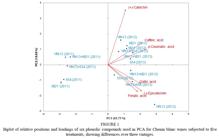
Principal component analysis of the physicochemical parameters and amino acids measured in the grapes of Cabernet Sauvignon and Shiraz grapevines subjected to leaf removal was done at three different harvest dates. The first principal component (PC1) accounted 53.1% of the variance, whereas the second principal component (PC1) achieved 18.5% of the variance, corresponding to a total variance of 71.6%. PC1 was strongly correlated with most of the amino acids (> 0.80), except for Asp, Ile and Pro, whereas PC2 was strongly correlated with anthocyanins, colour density and Pro (> 0.80). Shiraz grapes harvested at E-L 38 + 18 days and at E-L 38 + 34 days from the control and leaf removal treatment were positively correlated with most of the amino acids and negatively with tannins, tartaric acid, total phenolic index (TPI) and total amino acids, being located in an opposite direction to Cabernet Sauvignon grapes harvested at E-L 38 from the control and leaf removal treatment. Shiraz grapes harvested at E-L 38 from the control and leaf removal treatment were positively correlated with glucose, fructose, anthocyanins and colour density, and negatively correlated with Pro and succinic acid, being located in an opposite direction to Cabernet Sauvignon grapes harvested at E-L 38 +18 days and at E-L 38 + 24 days from the control and leaf removal treatment.
DISCUSSION
Shiraz exhibited higher berry weight, pH, soluble solids (SS), sugars, glucose, anthocyanins and colour density, while Cabernet Sauvignon had higher titratable acidity and tartaric acid (Table 1). Similarly, Sadras and Petrie (2011) showed that the rate of increase in total SS during ripening was more significant for Shiraz than for Cabernet Sauvignon. The onset of ripening for both varieties was positively correlated with temperature, but Shiraz exhibited a higher sensitivity to temperature changes compared to Cabernet Sauvignon; warmer conditions led to earlier ripening for Shiraz, while Cabernet Sauvignon showed a more stable onset (Sadras & Petrie, 2011 ). This suggests that Shiraz ripens faster, accumulating sugars more quickly compared to Cabernet Sauvignon, which has a slower rate of sugar accumulation. The differences in grape physicochemical parameters influenced the sensory characteristics of the wines, since Shiraz wines had a higher ethanol content than those from Cabernet Sauvignon, and, as expected, the harvest date also affected ethanol and glycerol concentrations. Grapes harvested at later phenological stages (E-L 38 + 34 days) produced wines with a higher ethanol content, which is consistent with the increase in soluble solids at this harvest point. Leaf removal increased citric acid content and decreased titratable acidity in the grapes, altering the overall profile of the resultant wines.
Some factor interactions, such as variety and harvest date and treatment and harvest date, considerably affected the content of the studied amino acids (Tables 2 and 3). This study shows that grapes harvested at E-L 38 + 34 days (~26.2°Brix) had a low content of several amino acids, whereas those harvested at E-L 38 + 18 days (~24.6°Brix) exhibited the highest amino acid levels. This finding suggests that this might be the optimal harvesting window for enhancing amino acid content, which is crucial for yeast fermentation and subsequent wine flavour (Gutiérrez-Gamboa et al., 2020). These findings are in accordance with Garde-Cerdán et al. (2018), who reported that the content of specific amino acids, such as phenylalanine, tryptophan, arginine, histidine, leucine, isoleucine, valine, methionine and proline, showed a maximum content at 25°Brix and decreased considerably towards 30°Brix. The findings suggest that the harvest timing, specifically when the grape reaches sugar maturity at 25°Brix, might coincided with the optimal nitrogenous maturity, which is crucial for balancing the fermentation needs for proline-accumulator varieties like Cabernet Sauvignon (Table 3) (Gutiérrez-Gamboa et al., 2020). Shiraz had generally higher amino acid concentrations than Cabernet Sauvignon, except that proline and leaf removal notably increased the levels of several amino acids. Proline is not metabolised by yeasts, and stuck and sluggish fermentations can occur when the content of yeast assimilable nitrogen is low, as in the case of Cabernet Sauvignon (Bell & Henscke, 2005).
Several amino acids in grapes were significantly affected by the interactions between the variety and treatment factors, especially in relation to neutral and non-polar amino acids, and leaf removal seemed to amplify varietal differences, with Shiraz responding more significantly than Cabernet Sauvignon (Tables 2 and 3). Shiraz presented higher water uptake and stomatal conductance, and it can reach an optimum technological maturity at low leaf-to-fruit ratios compared to Cabernet Sauvignon (Hochberg et al., 2013; Gutiérrez-Gamboa et al., 2019). This supports the suggestions that Shiraz is characterised by being a more vigorous and sensitive variety to changes in the canopy. In this regard, basal leaf removal applied 72 days after flowering in Sauvignon blanc grapevines promoted the synthesis of alanine, arginine, aspartic acid, proline and serine in grapes, and showed the highest content of total amino acids (Yue et al., 2019). This increase in the grape amino acid content of Shiraz subjected to leaf removal could be attributed to enhanced sunlight exposure and improved photosynthetic activity, which in turn enhance nitrogen assimilation and amino acid synthesis (Yue et al., 2019; Gutiérrez-Gamboa et al., 2020).
This study reports that the glucose, fructose and total sugar content in the grapes was strongly correlated with proline (Table 5). Proline has been identified as a key molecule with significant osmoprotective potential (Gutiérrez-Gamboa et al., 2020). The correlation of proline with glucose, fructose and total sugars in grapes provides insight into its possible role in protecting grapevines from environmental stress, particularly high temperatures and water scarcity, during berry development. Canoura et al. (2018) studied the effects of irrigation in Chardonnay and Shiraz varieties and reported that the proline concentration in water-stressed Shiraz vines was more than double that in the irrigated treatments. This contrasts with the Chardonnay grapes, where proline accumulation in the grapes of non-irrigated vines was like that of the three sets of irrigated vines, supporting the above-mentioned findings (Canoura et al., 2018). During periods of water stress or heat stress, grapevine cells may experience osmotic stress, leading to the activation of various stress-related metabolic pathways, such as proline synthesis, which is upregulated under these conditions (Haider et al., 2019; Wei et al., 2022). The increased proline concentrations can influence the cell's osmotic potential, promoting the retention of water in the tissues (Wei et al., 2022). This osmo-protective role of proline, particularly in water-deficit or high-temperature conditions, likely helps grapevines optimise sugar accumulation during berry ripening.
CONCLUSION
Leaf removal enhanced the levels of several key amino acids, thereby improving grape nitrogen content which is crucial for fermentation. In addition, the harvest date significantly influenced amino acid levels, with the optimal harvest occurring at E-L 38 + 18 days, providing the highest amino acid concentrations beneficial for fermentation. Proline, an amino acid with osmo-protective properties, was correlated with a higher sugar content, indicating its potential role in protecting grapevines under stress and aiding in sugar accumulation during ripening. Shiraz grapes had higher concentrations of sugars, amino acids and anthocyanins compared to Cabernet Sauvignon, confirming its faster ripening and greater sensitivity to environmental factors. The Shiraz wines had a higher ethanol content, consistent with the higher sugar concentrations found in the fruit. Overall, this study highlights the importance of canopy management and precise harvest timing to optimise grape composition, particularly amino acids, for improved fermentation efficiency and wine quality.
LITERATURE CITED
- Bell, S.-J. & Henschke, P.A., 2005. Implications of nitrogen nutrition for grapes, fermentation and wine. Aust. J. Grape Wine Res. 11, 242-295.
- Bindon, K., Varela, C., Kennedy, J., Holt, H. & Herderich, M., 2013. Relationships between harvest time and wine composition in Vitis vinifera L. cv. Cabernet Sauvignon 1. Grape and wine chemistry. Food Chem. 138(2-3), 1696-1705.
- Bisson, L.F. & Butzke, C.E., 2000. Diagnosis and rectification of stuck and sluggish fermentations. Am. J. Enol. Vitic., 51, 168-177.
- Blancquaert, E.H., Oberholster, A., Ricardo-da-Silva, J.M. & Deloire, A.J., 2019. Effect of light quality on fruit growth, composition and the sensory impact of the wines. S. Afr. Enol. Vitic. 40(2), 141-156.
- Boulton, R.B., 2001. The copigmentation of anthocyanins and its role in the color of red wine: A critical review. Am. J. Enol. Vitic. 52, 67-87.
- Boulton, R.B., Singleton, V.L., Bisson, L.F. & Kunkee, R.E., 1999. Principles and practices of winemaking. Springer, New York.
- Canoura, C., Kelly, M.T., & Ojeda, H., 2018. Effect of irrigation and timing and type of nitrogen application on the biochemical composition of Vitis vinifera L. cv. Chardonnay and Syrah grape berries. Food Chem. 241, 171-181.
- Coombe, B.G., 1995. Growth stages of the grapevine: Adoption of a system for identifying grapevine growth stages. Aust. J. Grape Wine Res. 1, 104-110.
- Eyéghé-Bickong, H.A., Alexandersson, E.O., Gouws, L.M., Young, P.R. & Vivier, M.A., 2012. Optimisation of an HPLC method for the simultaneous quantification of the major sugars and organic acids in grapevine berries. J. Chromatogr. B 885-886, 43-49.
- Garde-Cerdán, T., Gutiérrez-Gamboa, G., Fernández-Novales, J., Pérez-Álvarez, E.P. & Diago, M.P., 2018. Towards the definition of optimal grape harvest time in Grenache grapevines: Nitrogenous maturity. Sci. Hortic. 239, 9-16.
- Gutiérrez-Gamboa, G., Alañón-Sánchez, N., Mateluna-Cuadra, R. & Verdugo-Vásquez, N., 2020. An overview about the impacts of agricultural practices on grape nitrogen composition: Current research approaches. Food Res. Int. 136, 109477.
- Gutiérrez-Gamboa, G., Díaz-Galvéz, I., Verdugo-Vásquez, N. & Moreno-Simunovic, Y., 2019. Leaf-to-fruit ratios in Vitis vinifera L. cv. "Sauvignon Blanc", "Carmenère", "Cabernet Sauvignon", and "Syrah" growing in Maule Valley (Chile): Influence on yield and fruit composition. Agriculture 9(8), 176.
- Gutiérrez-Gamboa, G., Zheng, W. & Martínez de Toda, F., 2021. Current viticultural techniques to mitigate the effects of global warming on grape and wine quality: A comprehensive review. Food Res. Intl. 139, 109946.
- Haider, M.S., Jogaiah, S., Pervaiz, T., Yanxue, Z., Khan, N. & Fang, J., 2019. Physiological and transcriptional variations inducing complex adaptive mechanisms in grapevine by salt stress. Environ. Exp. Bot., 162, 455-467.
- Hochberg, U., Degu, A., Fait, A. & Rachmilevitch, S., 2013. Near isohydric grapevine cultivar displays higher photosynthetic efficiency and photorespiration rates under drought stress as compared with near anisohydric grapevine cultivar. Physiol. Plant 147(4), 443-452.
- Ivanisevic, D., Kalajdzic, M., Drenjancevic, M., Puskas, V. & Korac N., 2020. The impact of cluster thinning and leaf removal timing on the grape quality and concentration of monomeric anthocyanins in Cabernet-Sauvignon and Probus (Vitis vinifera L.) wines. OENO One 54, 63-74.
- Le Moigne, M., Maury, C., Bertrand, D. & Jourjon, F., 2008. Sensory and instrumental characterisation of Cabernet Franc grapes according to ripening stages and growing location. Food Qual. Prefer. 19(2), 220-231.
- Lorenz, D.H., Eichhorn, K.W., Bleiholder, H., Klose, R., Meier, U. & Weber, E., 1995. Growth stages of the grapevine: Phenological growth stages of the grapevine (Vitis vinifera L. ssp. vinifera) - codes and descriptions according to the extended BBCH scale. Aust. J. Grape Wine Res. 1, 100-103.
- OIV (Organisation Internationale de la Vigne et du Vin), 2003. Compendium of international methods of analysis of wines and musts. OIV, Paris.
- Sadras, V.O. & Petrie, P.R., 2011. Climate shifts in south-eastern Australia: Early maturity of Chardonnay, Shiraz and Cabernet Sauvignon is associated with early onset rather than faster ripening. Aust. J. Grape Wine Res., 17, 199-205.
- Sarneckis, C.J., Dambergs, R.G., Jones, P., Mercurio, M., Herderich, M.J. & Smith, P.A., 2006. Quantification of condensed tannins by precipitation with methyl cellulose: Development and validation of an optimised tool for grape and wine analysis. Aust. J. Grape Wine Res. 12, 39-49.
- Schneider, R., Razungles, A., Charrier, F. & Baumes, R., 2002. Effet du site, de la maturité et de l'éclairement des grappes sur la composition aromatique des baies de Vitis vinifera L. cv. Melon B. dans le vignoble du Muscadet. Bulletin de l'OIV, 270-282.
- Song, C., Wang, C., Xie, S. & Zhang, Z., 2018. Effects of leaf removal and cluster thinning on berry quality of Vitis vinifera cultivars in the region of Weibei Dryland in China. J. Integr. Agric. 17(7), 1620-1630.
- Suklje, K., Zhang, X., Antalick, G., Clark, A.C., Deloire, A.J. & Schmidtke, L.M., 2016. Berry shriveling significantly alters Shiraz (Vitis vinifera L.) grape and wine chemical composition. J. Agric. Food Chem. 64(4), 870-880.
- Van Leeuwen, C., Destrac-Irvine, A., Gowdy, M., Farris, L., Pieri, P., Marolleau, L. & Gambetta, G.A., 2023. An operational model for capturing grape ripening dynamics to support harvest decisions. OENO One 57(2), 505-522.
- Verdenal, T., Dienes-Nagy, Á., Spangenberg, J.E., Zufferey, V., Spring, J.L., Viret, O., Marin-Carbonne, J. & Van Leeuwen C., 2021. Understanding and managing nitrogen nutrition in grapevine: A review. OENO One 55, 1-43.
- Wei, T.L., Wang, Z.X., He, Y.F., Xue, S., Zhang, S.Q., Pei, M.S., Liu, H.N., Yu, Y.H. & Guo, D.L., 2022. Proline synthesis and catabolism-related genes synergistically regulate proline accumulation in response to abiotic stresses in grapevines. Sci. Hortic. 305, 111373.
- Yue, X., Ju., Y., Tang, Z., Zhao, Y., Jiao, X., Zhang, Z., 2019. Effects of the severity and timing of basal leaf removal on the amino acids profiles of Sauvignon blanc grapes and wines. J. Integr. Agric. 18(9), 2052-2062.

Date Accepted for Publication 14 July 2026