Effect of irrigation with diluted winery wastewater on phosphorus in four differently textured soils
Abstract
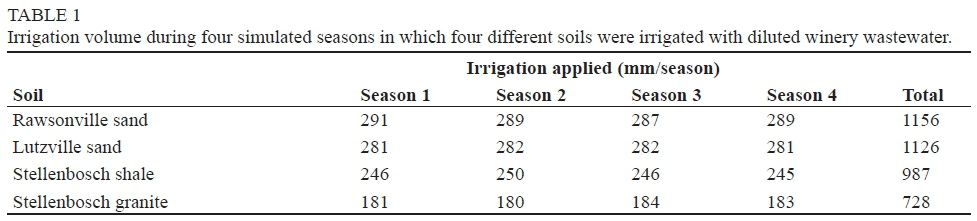
The wine industry needs solutions for wastewater treatment, as environmental legislation for its disposal is increasingly being enforced due to non-compliance. The feasibility of re-using diluted winery wastewater was assessed in a pot experiment under a rain shelter over four simulated irrigation seasons. Four soils varying in parent material and clay content, viz. aeolic sand from Lutzville containing 0.4% clay, alluvial sand from Rawsonville containing 3.3% clay, granite-derived soil from Stellenbosch containing 13% clay, and shale-derived soil from Stellenbosch containing 20% clay, were irrigated with wastewater diluted to 3 000 mg/L COD (chemical oxygen demand), whereas the control received municipal water. Irrigation with diluted winery wastewater increased the pH(KCl) in the shale- and granite-derived soils into the optimum range for P availability. Although pH in the aeolic sand was initially above the optimum range, relatively high Na+ levels also caused available P to increase as the pH(KCl) increased. The pH(KCl) in the alluvial sand increased beyond the optimum range, thereby causing a reduction in the available P. This indicates that irrigation with diluted winery wastewater may only enhance P absorption if the pH shift is towards the optimum. It must be noted that the results represent a worst-case scenario, i.e. in the absence of rainfall or crops.
Chemical oxygen demand; pot experiment; solubility; soil pH; water quality
 Thumbnail