Work pressure and client internal control: Auditor personality in fraud detection
Abstract
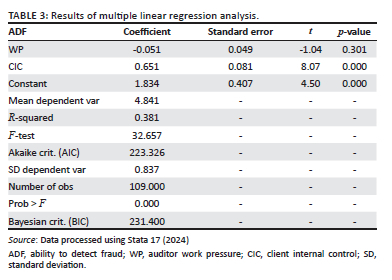
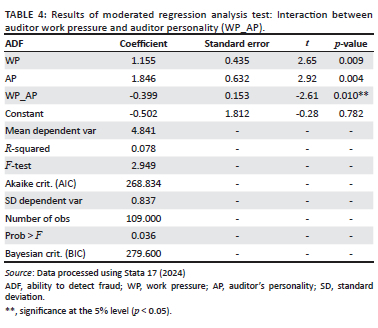
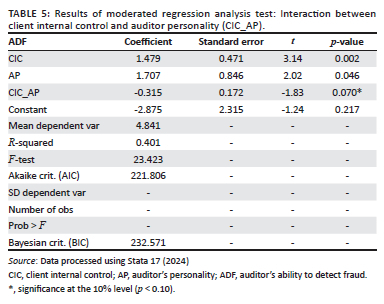
BACKGROUND: Fraud detection is a vital, yet complex task for auditors, shaped by environmental pressures, organisational systems, and individual traits. Based on Attribution Theory, auditors' fraud detection ability (ADF) depends on how they interpret situational cues such as work pressure and client internal controls (CIC). The Myers-Briggs Type Indicator (MBTI) adds a psychological dimension, suggesting that personality types respond differently to such cues-some thrive under pressure, others struggle. Despite their importance, these factors are rarely examined together AIM: This study investigates how auditor work pressure, CIC, and personality type interact to influence fraud detection effectiveness SETTING: The study involved 109 external auditors from public accounting firms in Indonesia, selected for its dynamic regulatory environment and high fraud risk across sectors METHOD: Data were collected through structured questionnaires and analysed using multiple linear regression and moderated regression analysis (MRA RESULT: Client internal controls significantly enhances auditors' ability to detect fraud, whereas work pressure alone shows no significant effect. Auditor personality moderates both relationships-reducing the negative influence of work pressure and slightly weakening CIC's positive impact CONCLUSION: Individual psychological traits play a critical role in audit performance. Aligning auditor personality with task environments can improve fraud detection outcomes CONTRIBUTION: This study enriches behavioural accounting research and provides practical insights for audit firm staffing, audit planning, and training programmes that integrate psychological and contextual considerations to enhance auditor effectiveness
fraud detection; auditor personality; MBTI; work pressure; internal control; behavioural accounting