Trends, Focus Areas and Research Gaps of Doctoral Degrees in Environmental Studies Departments at South African Universities: 1998-2017
Abstract
Doctoral research must be original, creative or innovative and must make a significant contribution at the frontiers of a discipline. This article documents the contribution of 19 years of PhD research at six comprehensive and eleven traditional South African universities and identifies research topics through using a systematic literature review method. Two hundred and fourteen (214) environmental studies were scanned, manually and digitally analysed using Leximancer© to identify each PhD's research theme. Results of what the PhDs focussed on were placed in a corresponding theme under each university. The combination of the number of completed PhDs per theme, the research focus areas and the SARChI research chairs of universities provide guidance to specific future research areas at the universities. Waste management, coastal/marine, mining-related environmental concerns, and protected areas are the broad themes with research potential. These gaps have been identified because few PhDs focused on these issues. The findings of the research highlight areas where environmental education can be a tool for improving and protecting the environment. In conclusion, we emphasise that this study will assist institutions of higher learning and their prospective students especially at PhD level with research focus areas that are yet to be further studied and that also require funding.
systematic review; PhD research ideas; environmental research focus
Introduction
The decision to achieve a PhD is a venture with many uncertainties. Students are confronted with questions about what their study should focus on or which university is the most suitable to complete the journey with. These decisions are coupled with the motivation of the PhD student as well as social and economic factors. South Africa's Higher Education Qualifications Framework also expects a PhD candidate to exhibit "expertise and critical knowledge in an area at the forefront of a field and the ability to conceptualise new research initiatives and create new knowledge or practice" (South African Qualifications Authority (SAQA), 2012, p. 12). The PhD must be seen by peers as novel, innovative and must make a signiñcant contribution to a specific research discipline (Van Schalkwyk et al., 2020). The Council of Higher Education (CHE) (2013) further states that a PhD must be "original and at the frontiers of a discipline or field".
The field that is relevant to this research is termed differently in the departments found at the various universities. To avoid the repetition of words and names, the term 'environmental studies' was chosen to be the collective overarching name and will include the departmental names of 'environmental management', 'environmental studies', and 'environmental science' used at the different South African universities represented in this study. A cross-sectional study spanning 19 years (1998 to 2017) was undertaken. The start date of the study is also the promulgation date of the National Environmental Management Act (NEMA) in South Africa. This study ties in with environmental education as both involving a process where students can explore environmental issues as well as participate in solving environmental problems to conserve and protect the environment.
The environmental agenda has begun to find a place within international and national legislation, development plans and frameworks (Department of Environmental Affairs and Tourism (DEAT), 2004). Environmental issues became important to students at universities because of international environmental commitments and awareness campaigns. Examples of these include the 1972 United Nations Stockholm Conference on the Human Environment; the publication of the Our Common Future in 1987; the Rio Earth Summit Conference on Environment and Development held in 1992 and the adoption of the United Nations Millennium Declaration in 2000, to name a few. South Africa responded to the international obligations by developing legislation and reports. The Constitution introduced environmental issues and initiated the first national environmental policy process that led to the National Environmental Management Act (NEMA) in 1998. From the NEMA, Specific Environmental Management Acts (SEMA) were promulgated and deal with the management of protected areas, air, waste, biodiversity and coastal management. The increased emphasis that was placed on the necessity to care for the environment and to raise awareness around environmental matters led to the commencement of environmental studies as a study field.
The inclusion of environmental studies in university curricula was promoted by scholars from various fields that included environmental issues in their own studies (Strydom & King, 2015). The field of environmental studies was integrated into the different geography departments at South African universities (Visser et al., 2016). The University of the Witwatersrand (Wits) was the first to attach the name 'Environmental Studies' to the Geography Department in the 1950s (Visser et al., 2016), 22 years prior to the 1972 Stockholm conference. One year after the Stockholm conference, a Chair of Environmental Studies was established at the University of Cape Town (UCT) and in 1985 the department changed its name to the Department of Environmental and Geographical
Sciences. The word 'environment' was included at the Geography Department of the University of KwaZulu-Natal (UKZN) in 1988 (Visser et al., 2016, p. 172). In 1989 the name 'environmental studies' was inserted at the geography department of the University of South Africa (Unisa). After the merger of Unisa and Technikon South Africa in 2004, Unisa established an independent environmental sciences department. In the 1990s the other comprehensive and traditional South African universities followed suit (Visser et al., 2016). With most universities providing opportunities to complete a PhD in environmental studies, a prospective PhD candidate can select not only the topic they want to study, but also where in terms of an institution and possible supervisor.
The environmental themes (mentioned further below) as identified by Van den Berg and Mearns (2023) will be used to compare and categorise the themes found in PhDs. In turn this could assist students to identify under-researched themes that are closely related to focus areas of environmental studies departments at South Arican universities. The results of this article may further assist PhD students who wish to fill gaps in the body of knowledge. Providing this guidance may function as a motivational factor to do a PhD as some information is provided to ease initial uncertainties.
Motivations of students to do a PhD in Environmental Studies
The reputation of a university, the relationship with a specific academic supervisor, funding, and the availability of better job opportunities are factors that are considered as motivations when students decide where to register for their doctorate degrees (Cloete et al., 2015; Wiegerová, 2016). A further consideration of the student is to interrogate the universities and to find out if they are specialising or focusing on a certain research area (Creswell, 2014; Mouton 2001; Wiegerová, 2016). Factors that motivate a student to complete a PhD can be related to family and their ambition (Wiegerová, 2016). The motivation of PhD students to study in the field of environmental studies relates to the research problem being of a high collective societal value.
The discipline of environmental studies is receiving heightened public support and funding agencies and research foundations are keen to invest in similar projects. The availability of funds or a set integrated research framework provided by funders can motivate PhD students to elect an environmentally related research focus area (Tress et al., 2009). As mentioned by Strydom and King (2015), students integrate environmental matters into numerous study subjects. This integrated research approach may be one of the factors that motivate students to complete a PhD in environmental studies. Certain students may be motivated by the potential to solve 'real-world' problems that are not specific to a discipline and by the applied nature of environmental studies. Others, by contributing to the development of science in environmental research, feel that the integrative nature of environmental studies may lead to the improvement of living conditions in communities (Tress et al., 2009). In addition to the above-mentioned academic departments, the focus areas of research chairs such as the South African Research Chairs Initiative (SARChI) may be considered when a decision is made.
SARChI research chairs at different universities
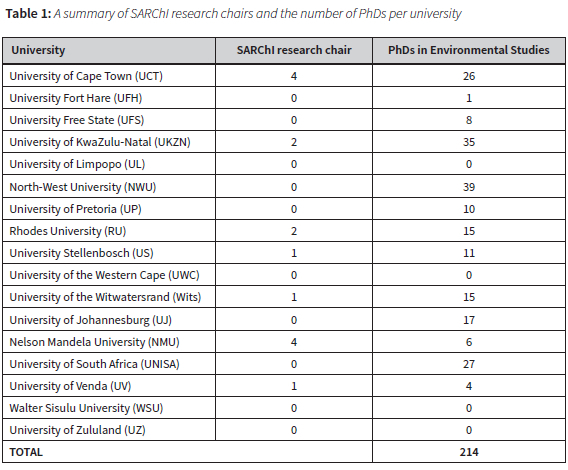
An initiative by the Department of Science and Technology, managed by the National Research Foundation (NRF) (2018) is the South African Research Chairs Initiative (SARChl). The aim of SARChl is to strengthen South Africa's ability to generate research and innovation of high quality and Chairs can be tied to universities (NRF, 2020). Seeing that this study has a time span from 1998-2017, the 2018 list was used for comparison purposes. The primary scientific field, Earth and Marine sciences, in the SARChl list, related to environmental studies, was used to identify the Chairs at the relevant universities (see Table 1).
UCT has four chairs linked to environmental studies. They are Marine Ecology and Fisheries, Environmental and Social Dimensions of the Bio-Economy, Climate Change, as well as Ocean Atmosphere Modelling. At UKZN their research focus area hosts two SARChl research chairs - Ecosystem Health and Biodiversity in KwaZulu-Natal (KZN) and in the Eastern Cape there is the Land Use Planning and Management Chair. One research chair could be found for the University of Limpopo (UL), namely Ecosystem Health: Monitoring
and Managing the Health Resilience of the Limpopo River Basin. Rhodes University (RU) has two SARChI research chairs which include Interdisciplinary Science in Land and Natural Resource Use for Sustainable Livelihoods and Marine Ecosystems and Resources. A research chair, Sociology of Land Environmental and Sustainable Development, can be found at the University of Stellenbosch (US).
On the SARChI list, the Global Change and Systems Analysis chair relates directly to environmental studies at Wits. The Nelson Mandela University (NMU) has four SARChI research chairs, Marine Spatial Planning, SA-UK Bilateral Chair in Food Security, Shallow Water Ecosystems, and the chair of Earth Systems Science. The University of Venda (UV) has a SARChI research chair with the name of Biodiversity Value and Change in the Vhembe Biosphere Reserve (NRF, 2018). The inclusion of these environmental studies-related research chairs is an important part of this study that assists in ascertaining the gaps, trends and future focus areas of PhDs at specific universities that are involved in environmental studies research.
Systematic literature review as research method
A PhD is an early indicator of the state of the body of knowledge in a specific research field. Knowledge and insights gained from completed PhDs also present a platform for future research, related to the vision of a specific study field (Xifra & Castillo, 2006). This is because scientific information is created and disseminated in PhD, studies demonstrating the importance of PhD theses as sources of information that could be significant in determining developments in any research discipline (Bozkurt et al., 2015). By way of example, studies by Caffarella (1999), Vierula et al. (2016) and Kazemia et al. (2018), were carried out to establish what PhD research focused on and this was either done through utilisation of content analysis or systematic literature review as the methodology of the study.
Caffarella (1999) explored the major research themes of doctoral degrees in educational technology, between 1977 and 1998, by using the content analysis research method. The study focused on the changes in major themes over time and the emerging trends in the related PhDs. These studies provide a better understanding of PhDs and how the nature of the research field is changing (Caffarella, 1999). In turn, Vierula et al. (2016) studied the PhD research focus of nursing education in Finland between 1979 and 2014. In their effort to describe the field of PhD nursing education, the study also revealed extensively over researched topics, those topics that were under researched and a calculation of the nursing education research outputs. It was discovered that in the field of nursing education itself, the research only covered 12,3% of all PhDs completed in relation to other areas such as nursing and caring sciences (Vierula et al., 2016).
A content analysis of articles published in the International Journal of Production of Research (IJPR) based on Reverse Logistics and Closed Loop Supply Chain Management from 2013 to July 2017 was undertaken by Kazemia et al. (2018). Firstly, the relevant articles were identified, collected, characterised, and classified into main and sub-categories. The attributes of all the articles could then be established to reveal research gaps for further, future research (Kazemia et al., 2018). The same method was used for this research as the focus of environmental studies PhDs was not clear. It is also not apparent if there were any research gaps that could provide ideas for future PhD research in the field of environmental studies.
Research method and data analysis
This study utilises a qualitative research design, which was implemented using systematic literature review methods. A census of all environmental studies PhDs produced from 1998 to 2017 in the various environmental studies academic departments was included in the sample to be analysed.
Institutional repositories of the universities (see Table 1) were explored to identify the PhDs. Lists of the various PhDs were sent for verification by the respective heads or chairs of the selected environmental studies departments at the universities. The institutional websites of the universities were scrutinised to acquire a better understanding and overview of each department's research focus area, research groups or centres and research chairs contributing to environmental studies research.
The inclusion criteria to select the dataset were PhDs that focussed on South Africa only, in environment-related research and completed by students at the eleven traditional and six comprehensive South African universities (within environmental sciences/study/ management departments and SARChI research chairs. A comprehensive university is a combination of universities of technology and traditional academic universities.
PhD studies focussing on South Africa but completed by other international universities were not included in this research. Two hundred and fourteen PhDs were identified, documented, and verified (see Table 1). PhDs were grouped by university, numbered, and reviewed manually by reading titles, abstracts, keywords, acronyms, first chapters and paragraph headings. This manual analysis offered a clear indication of the content, key concepts and resultant themes associated with each PhD. This was followed by using a digital analysis process through a text-mining software programme, Leximancer©, to analyse the full text of each thesis to validate and corroborate the manual search results.
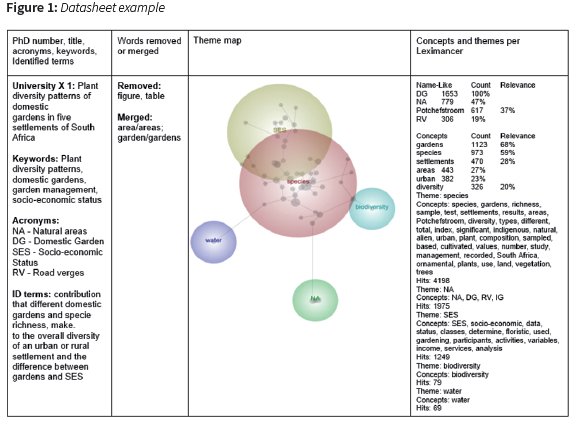
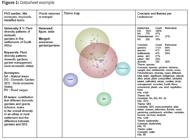
Leximancer© is a Computer Assisted Qualitative Data Analysis Software (CAQDAS) programme for text-mining the content of documents. This is an automated lexicographical tool that can visually display the textual content of documents (Freebody et al, 2018; Hyndman & Pill, 2018). The textual documents were processed by defining the contextual associations of words, through term occurrence information. The term occurrence information involves nouns and verbs, their co-occurrence, positions related to each other, and the frequencies of use found in the text. Leximancer© can reveal the frequency of words in a body of text, their connection with each other and their spatial proximity to each other. Thomas (2014) explained that the programme identifies the most repeated concepts and the relationship between the repeated concepts. The concepts are further clustered into higher-level themes. The themes are thus a collection of the concepts, located close to each other, but still have a connection to the original textual data (Leximancer, 2018). The themes are used to construct a concept map that indicates the extent of connectivity and degree of proximity between concepts in the analysed documents (Hyndman & Pill, 2018). Leximancer© provides a visual format of textual data (column 3 of Figure 1), by changing a textual document into concepts, themes, and a concept map (Freebody et al., 2018).
All 214 PhDs were individually imported into Leximancer©. The default concept analysis function was initially run to determine the automated concept list of Leximancer© and any obvious concepts that were related to each other - for instance, 'sea level' and 'rise', or 'climate' and 'change'. When the PhDs were uploaded into Leximancer© again, unnecessary words were removed or merged. The removal and merger did not affect the results of the generated concepts or themes.
The PhDs were additionally first studied, and a double manual verification was done before concepts were merged or removed from the original automated concept list generated by Leximancer©. This ensured that the name or word was not of any importance in the PhD research.
The removed or merged words did not represent a significant concept and had a high frequency in the document without being an identified theme, as cross-verified through the manual analysis of a PhD. Words such as 'figure', 'data', 'during', 'chapter', 'results', 'use', etc., were typical high frequency words in PhD theses and are called seed words. Plural seed words, synonyms and surnames of authors were also removed. Not all presumed related words were merged by default, for instance 'change' as a concept could be related to another concept, and no assumption could be made that it was always linked to 'climate change'. When both the singular and plural form of a word were identified as separate concepts, the words were merged. Words would also be merged, for example, when one word was typed in italics for example community; communities; communities.
It was essential to remove the seed words from the automated concept lists as it cluttered the concept map with redundant information. The inclusion of all the seed words would further reduce relevant themes to be less significant in the visual representation of the concept map. The main concepts relating to the seed words still appeared on the concept map, even after the seed words were merged or removed. Datasheets were then generated for each PhD produced at each university to capture the data as shown in Figure 1.
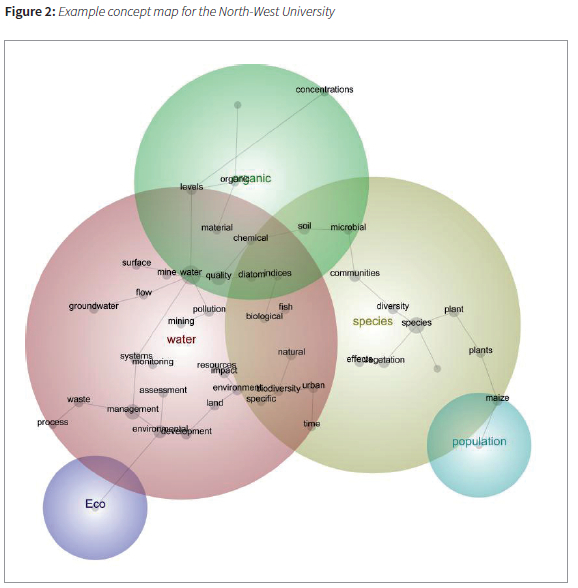
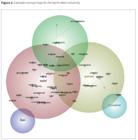
The datasheets contained an identifier number, the title of the PhD, keywords, acronyms, and terms classified from the manual analysis of the PhDs. The second and third columns indicate the start of the Leximancer© process. The second column contains the words that were removed or merged as explained above. The third column contains the thematic maps that were generated by Leximancer©. The last column includes the number of times the concept appeared in the document and the relevance of the concept to the document itself; these are also the concepts that made up the themes for the theme map. The spheres and warm colours (as per the colour wheel) on the theme map displayed the concepts that were found by Leximancer©. The biggest sphere and warmest colour, red, indicated main concepts and themes. A comparison was made between the theme map and concepts (column 3 and 4) identified by Leximancer© and the content identified by the manual examination of each PhD (column 1). This ensured the validity of both processes. This process identified the content and detail of each PhD. An identifier number was assigned to each PhD and a list was compiled with the main themes of each PhD per university. All the PhDs from each university were grouped together to derive concept maps per university. Figure 2 is an example of the concept map for the North-West University, which indicated that water was the main theme.
Themes that are regarded as strategically significant areas in environmental research from government documents have been identified by Van den Berg and Mearns (2023) and were also used in this research. The strategic government documents considered were the Specific Environmental Management Acts (SEMAs) of the NEMA; the Kok and Pietersen (1999) survey report on Environmental Management done in 1990; the three State of the Environment Reports; the National Development Plan - 2030 (National Planning Commission, 2012); African Union's Agenda 2063. The following eleven themes were identified:
■ protected areas
■ biodiversity, habitat, and resources
■ coastal/marine management
■ waste management
■ social-people of SA
■ water
■ greenhouse gas, low carbon- or green economy and renewable energy
■ climate change and natural disaster
■ mining
■ soil/agriculture
■ air quality
A PhD with its identifier number, completed at the corresponding university was then assigned to one or more of the above themes according to the data sheet and concept maps that were generated (Figures 1 and 2). It is important to note that a PhD could deal with two or more themes, and one PhD can therefore be in more than one theme.
Results and discussion
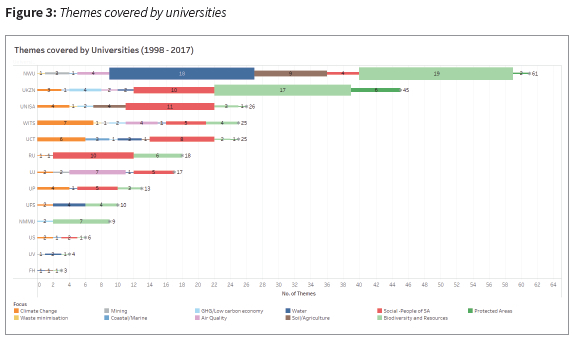
The data and results that emerged from the completed PhDs were then compared to themes identified in the strategic government documents, research focus areas and research chairs at universities to identify research themes. Research themes at the various universities are summarised in Figure 3.
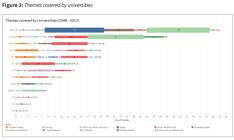
The Unit for Environmental Sciences and Management at NWU has research groups that deals with for example conservation and ecology as can be seen by the production of 19 PhDs in the Biodiversity, Habitat and Resources theme; and the water research group with 18 PhDs in the water theme. The Environmental Microbiology and Agricultural Biotechnology Research Group can be tied to nine PhDs in the soil/agriculture theme. In total the 39 PhDs produced at NWU are cumulatively represented in the 11 themes 61 times (one PhD may cover multiple themes) and indicates that the university is effectively using the research groups. NWU and UKZN were also the two universities with the most cumulatively represented research themes, 61 in total from NWU and 45 from UKZN. UKZN PhD research is within the biodiversity and resources, social-people of SA and protected areas themes. The research focus areas at UKZN are Water, Environment and Biodiversity that tied in with these PhD themes. Another research focus area is Energy and Technology for Sustainable Development where new technologies such as solar, wind and biofuels for the reduction of carbon dioxide and other greenhouse gases emitted from energy producing plants are developed. UKZN had the most PhDs that focussed on the greenhouse gas (GHG) theme. From the 45 PhDs completed, 36 of them are related to their research focus areas.
As with UKZN, the PhDs at Unisa mostly represented the social-people of SA, as well as the climate change and soil/agriculture themes. This connects with their research focus areas of climate change, environmental, geographic monitoring, and geomorphology research as well as human, socio-economic and behavioural research. Only three of the completed PhDs did not have a connection with these focus areas.
Almost half of the completed PhDs at Wits concentrated on the climate change and social-people of SA themes. There are two schools at Wits that offer PhDs in environmental studies: the School of Animal Plant and Environmental Sciences and the School of Geography, Archaeology and Environmental Studies. Both schools have climate change as a research focus area, which is also the theme of most PhDs at Wits compared to all the other universities. UCT had the second most PhDs within the climate change theme.
The Environmental and Geographical Science department at UCT has two formal research units that promote research on climate change. They are the 'Climate Systems Analysis Group' and the 'African Climate and Development Initiative'. Seven PhDs focused on climate change and greenhouse gas themes. The departmental aim is further to add knowledge, understanding and the management of interactions between humans and their environment, which is reflected in the social-people of SA theme (eight PhDs).
RU aspires to ensure that the link between human well-being, their livelihoods and vulnerability as well as ecosystem services are principal in all their work. The 10 PhDs in social-people of SA theme and the six in biodiversity and resources mirrored this aim. The research strengths of UJ are urban studies, housing, education, and energy issues. They offer a specific PhD on energy studies. The energy study issue mainly deals with power station emissions and infrastructure and air pollution and corresponds with a proportionally higher number of PhDs with an air quality theme. From the 17 cumulative themes identified, seven were concerned with air quality. No other university has a similarly high number in air quality and UJ leads in this theme as a research focus.
The Centre for Environmental Studies at UP strives for their research projects to have a prominent human and biodiversity component, which can be seen in the PhDs concerned with the biodiversity (three PhDs) and social-people of SA (five PhDs) themes. A long-term project in this department is the Mariepskop long-term observation site that monitors climate change, hence the link with the four PhDs centred on climate change. UFS has a Centre for Environmental Management with a strong focus on integrated water management and this coincides with the result that four PhDs are based on water, and four PhDs focus on biodiversity and resources. Two research institutes at NMU are the Centre for African Conservation Ecology and the Institute for Coastal and Marine Research. While seven PhDs have a biodiversity and resources focus no PhDs were completed on coastal/marine themes despite the research institute.
A School for Climate Studies is situated within US and two PhDs there were concerned with this theme. UV has earth systems and the environment as research niche areas, though these were too broad to link to the three completed PhDs here. At Fort Hare, no specific research niche area is specified and only one PhD dealing with environmental management and military activities was completed. No analysis or result lists were done for the University of Limpopo, University of the Western Cape, Walter Sisulu University, and the University of Zululand, as PhDs in environmental studies were not recorded or completed at these institutions.
The relation of the PhD themes to the research groups, units or focus areas at NWU, UKZN, Unisa, Wits, UCT, RU, UJ, UP and UFS indicates that the universities are effectively using their expertise and the set research groups or focus areas to guide a prospective PhD student in choosing a research topic. Certain universities have identified these themes as specific niche fields in their research agenda, but there is still much research that can be conducted in these identified research gaps.
Comparison of PhDs at universities with the NRF SARChI list
The 2018 NRF SARChI list was considered in the light of the results of the PhD focus areas to establish future alignment with the research chairs at the applicable universities and to reveal possible research ideas. Two of the four UCT chairs (climate change, marine ecology, and fisheries) were represented. RU had no PhD themes related to the Marine Ecosystems and Resources chair, but many that related to the Interdisciplinary Science in Land and Natural Resource Use for Sustainable Livelihoods chair. The two research chairs at the University of Kwa-Zulu Natal, Ecosystem Health and Biodiversity in KZN and the Eastern Cape and the Land Use Planning and Management Chairs, were well researched, as can be seen by the number of PhDs in the 'biodiversity, habitat and resources' theme as well as the 'protected area' theme. Global Change and Systems Analysis is a research chair at Wits and 13 of the 23 themes were reflected in the themes of their PhDs. Three of the six PhD themes at US was interrelated with their chair and at UV, only one theme. Even though NMU has four chairs, no themes in their PhDs were observed. A reason could be that master's degrees and academic journal articles are more evidently linked to the SARChI here.
Themes found in the PhDs that were closely aligned with the SARChI research chair of the institution were, for example, UCT, Wits and US. At RU and UKZN there was a remarkably close alignment with a chair, while the other chair did not have any themes that were evident from the PhD data set.
Potential niche research areas in environmental studies at South African universities
A prospective PhD student in environmental studies could be assisted by Figure 3 when deciding on a research theme and topic at a specific South African university. In addition to the specified niche areas, students are encouraged to look into environmental research conducted in departments other than those included for the purpose of this curriculum.
Waste as an over-arching theme is one of three areas that has been least researched and has immense potential as a niche research area for any university to claim; Unisa, NWU and Wits each have one PhD related to this theme. The second theme that shows great niche potential is that of coastal/marine management. With only six PhDs in total that focussed on this theme, there is a gap in environmental matters related to research on coastal and marine management and this presents an opportunity for any university. Considering that NMU has a registered research unit called the Institute for Coastal and Marine Research, the expectation is that PhD research could be forthcoming from this unit. However, it is possible that the research projects conducted within this unit are not necessarily concerned with producing PhDs.
The third theme with niche potential is mining with seven PhDs produced. From an environmental management perspective, it should be rather obvious that research on environmental matters in mining is always needed. Universities that have produced PhDs in the theme of mining, specifically sustainable mining and minerals are NWU, UJ, Wits and UV. The fourth theme showing a research gap is protected areas. The total PhDs contributing to this theme is 10 and UKZN leads research in the protected area theme. The fifth theme with substantial niche possibilities is greenhouse gas, low carbon- or green economy and renewable energy with a total of 11 PhDs contributing to this theme. This niche area is potentially open to any university with UKZN leading with four PhDs focussed on this theme and two each from Wits, NMU and Unisa.
Soil/agriculture and air as research themes have 16 and 17 PhDs respectively contributing to each of these themes with NWU probably establishing themselves as dominant in soil/ agriculture research (nine PhDs) and UJ leading air research (seven PhDs) followed by Wits and NWU with four PhDs each. Biodiversity is one theme that does not emerge as a research gap. The authors are not implying that research in this theme should be reduced. Considering the biodiversity in South Africa, research in this field remains important and an investigation into this theme on its own would be valuable to identify what research has been done on which forms of biodiversity and where gaps within this theme lie. As research themes at South African environmental studies departments become better known, students may be better informed of where they can obtain the necessary specific expertise to become recognised researchers in specific research fields. This is also an aspect that acts as motivation to do a PhD at a particular university (Mouton, 2001).
Specific research field choice of student and the research focus of a university
The discussion below is based on the correlation between SARChl chairs, the research groups of the environmental studies department, the number of themes found in the PhDs as well as the number of completed PhDs at a university.
If a student wants their research focus to be water, biodiversity, or soil, NWU could be a prospective choice. lf a protected area, biodiversity or social-people of SA themed PhD are considered, UKZN may be an option as it is aligned with their research focus area, their SARChl chair and the number of PhDs completed within these themes. UCT may be considered for the themes of social-people of SA and climate change as it is in line with their research units, the departmental aim and their SARChl chair. Another university that can be considered for climate change studies is Wits. Wits has the most PhDs completed in the climate change theme and this is promoted by their SARChl chair and the research focus area of both schools. The energy studies degree, offered by UJ, might be a good option for PhD students if they are interested in air quality studies. Unisa is focused on human, socioeconomic and behavioural research and could be considered for PhD studies with a focus on social-people of SA, as they have the most PhDs in this theme.
Conclusion
The results from the analysis of the 214 completed PhDs at different universities in South Africa successfully demonstrates the research patterns and trends in environmental studies research. More importantly, this study has revealed potential research gaps that exist in themes and provides PhD ideas at relevant and specific South African universities. As a result, potential niche areas within these strategic themes can be pursued by academic departments with an environmental focus as well as with the various SARChl chairs in mind.
While this research focussed on PhD research over a retrospective 19-year period (19982017), the patterns that have been established in this article could provide prospective students with an indication of the research gaps that require further investigation. The themes with the greatest niche potential are waste, coastal/marine management, mining, protected areas and greenhouse gas, low carbon- or green economy and renewable energy. Even well-researched themes that have been identified by universities and SARChl research chairs remain important themes to continuously research over time as the environment is dynamic and ever changing under human pressure and development.
Future studies should be undertaken to delve into the research methods used and trends within each of the themes, as research is needed to continuously discover changes in strategically relevant themes as human pressure on the environment continues to mount. Other research outputs such as Master's degrees and research published in national and international journals or at conferences can be investigated using the same methodology to get a bigger picture of all research patterns over and above PhD theses.
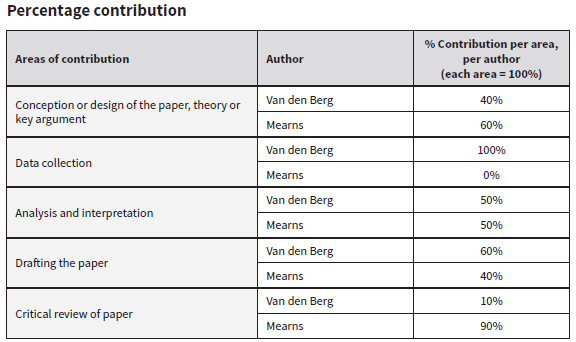
Notes on Contributors and their ContributionsLead author
Van den Berg, Unine
Unine van den Berg has a PhD and is currently a senior lecturer at the Department of Environmental Sciences, University of South Africa (Unisa). Her interests are systematic literature review in any environmentally management related subject.
Co-author
Mearns, Martie
Martie Mearns is Doctor of Literature and Philosophy in Information Science. As an associate professor in the Department of Information Science at the University of Pretoria, her scholarly interests are knowledge management and competitive intelligence.
References
Literature review
-
Bozkurt, A., Kumtepe, E.G., Kumtepe, A.T., Aydin, I.E., Bozkaya, M. & Aydin, G.H. (2015). Research trends in Turkish distance education: A content analysis of dissertations, 1986 - 2014. European Journal of Open, Distance and E-learning, 18(2), 1-21. https://doi.org/10.1515/eurodl-2015-0010
» https://doi.org/10.1515/eurodl-2015-0010 -
Caffarella, E.P. (1999). The major themes and trends in doctoral dissertation research in educational technology from 1977 through 1998. In Proceedings of Selected Research and Development papers presented at the National Convention of the Association for Educational Communications and Technology, Houston, Texas. https://eric.ed.gov/?id=ED436178
» https://eric.ed.gov/?id=ED436178 - Cloete, N., Mouton, J., & Sheppard, C. (2015). Doctoral education in South Africa. African Minds.
-
CHE (Council on Higher Education). (2013). The Higher Education Qualifications Sub-Framework. Pretoria: Council on Higher Education. https://nr-online-1.che.ac.za/html_documents/6.PUB_HEQSF.PDF
» https://nr-online-1.che.ac.za/html_documents/6.PUB_HEQSF.PDF - Creswell, J.W. (2014). Research design: Qualitative, quantitative and mixed method approaches (4th ed.). Sage.
-
DEAT (Department of Environmental Affairs and Tourism). (2004). Overview of Integrated Environmental Management, Integrated Environmental Management, Information Series 0. Pretoria: Department of Environmental Affairs and Tourism. https://www.dffe.gov.za/sites/default/files/docs/series0%20_overview.pdf
» https://www.dffe.gov.za/sites/default/files/docs/series0%20_overview.pdf - Freebody, M. Balfour, Finneran, M., & Anderson, M. (eds.). (2018). Applied Theatre: Understanding Change. Springer.
-
Hyndman, B. & Pill, S. (2018). What's in a concept? A Leximancer text mining analysis of physical literacy across the international literature. European Physical Educational Review, 24(3), 292-313. https://doi.org/10.1177%2F1356336X17690312
» https://doi.org/10.1177%2F1356336X17690312 -
Kazemia, N., Modak, N.M., & Govindan, K. (2018). A review of reverse logistics and closed loop supply chain management studies. International Journal of Production Research, 7(15-16), 4937-4960. https://doi.org/10.1080/00207543.2018.1471244
» https://doi.org/10.1080/00207543.2018.1471244 - Kok, P. & Pietersen, J. (1999). Environmental Management. The British Council: Human Sciences Research Council.
-
Leximancer. (2018). Leximancer User Guide. Release 4.5. https://doc.leximancer.com/doc/LeximancerManual.pdf
» https://doc.leximancer.com/doc/LeximancerManual.pdf - Mouton, J. (2001). How to succeed in your master's and doctoral studies: A South African guide and resources book. Van Schaik.
-
National Planning Commission. (2012). Our future - make it work. National Development Plan - 2030. https://www.gov.za/sites/default/nles/Executive%20Summary-NDP%202030%20-%20Our%20future%20-%20make%20it%20work.pdf
» https://www.gov.za/sites/default/nles/Executive%20Summary-NDP%202030%20-%20Our%20future%20-%20make%20it%20work.pdf -
NRF (National Research Foundation). (2018). 2018 List of Operating Research Chairs. https://www.nrf.ac.za/division/rcce/instruments/research-chairs
» https://www.nrf.ac.za/division/rcce/instruments/research-chairs -
NRF (National Research Foundation). (2020). South African Research Chairs Initiative. https://www.nrf.ac.za/division/rcce/instruments/research-chairs
» https://www.nrf.ac.za/division/rcce/instruments/research-chairs -
SAQA (South African Qualifications Authority). (2012). Level descriptors for the South African National Qualifications Framework. Waterkloof: SAQA, Strategic Support. https://www.saqa.org.za/docs/misc/2012/level_descriptors.pdf
» https://www.saqa.org.za/docs/misc/2012/level_descriptors.pdf - Strydom, H.A. & King, N.D. (2015). Environmental management in South Africa (2nd ed.). Juta.
-
Tress, B., Tress, G., & Fry, G. (2009). Integrative research on environmental and landscape change: PhD students' motivations and challenges. Journal of Environmental Management, 90(9), 2921-2929, https://doi.org/10.1016/j.jenvman.2008.03.015
» https://doi.org/10.1016/j.jenvman.2008.03.015 -
Thomas, D.A. (2014). Searching for significance in unstructured data: Text mining with Leximancer. European Physical Educational Review, 13(2), 235-256 https://www.doi.org/10.2304/eerj.2014.13.2.235
» https://www.doi.org/10.2304/eerj.2014.13.2.235 -
Van den Berg. U. & Mearns, M. (2023). A comparative knowledge map of priority environmental issues and doctoral research in South Africa. South African Geographical Journal, 105(4), 464-480. https://doi.org/10.1080/03736245.2023.2174174
» https://doi.org/10.1080/03736245.2023.2174174 -
Van Schalkwyk, S., Mouton, J., Redelinghuys, H., & McKenna, S. (2020). A systematic analysis of doctoral publication trends in South Africa. South African Journal of Science, 116(7/8), 1-9. https://doi.org/10.17159/sajs.2020/7926
» https://doi.org/10.17159/sajs.2020/7926 -
Vierula, J., Stolt, M., Salminen, L., Leino-Kilpi, H., & Tuomi, J. (2016). Nursing education research in Finland - A review of doctoral dissertations. Nurse Education Today, 37, 145-154. https://doi.org/10.1016/j.nedt.2015.10.014
» https://doi.org/10.1016/j.nedt.2015.10.014 - Visser, G. (2016). The production of student tourism research in South Africa: Past, present and future. Stellenbosch University.
- Visser, G., Donaldson, R., & Seethal, C. (2016). The origin and growth of geography as a discipline at South African universities. African Sun Media.
-
Wiegerová, A. (2016). A study of the motives of doctoral students. Procedia. Social and Behavioural Sciences, 217, 123-131. https://doi.org/10.1016/j.sbspro.2016.02.043
» https://doi.org/10.1016/j.sbspro.2016.02.043 -
Xifra, J. & Castillo, A. (2006). Forty years of doctoral public relations research in Spain: A quantitative study of dissertation contribution to theory development. Public Relations Review, 32, 302-308. https://doi.org/10.1016/j.pubrev.2006.05.004
» https://doi.org/10.1016/j.pubrev.2006.05.004