Weaving Science into Creative Writing: Integrating interdisciplinarity into young adult learning
Abstract
Science education and science communication, driven by their shared overarching objectives of awareness, engagement, and comprehension, have gained further potency through the integration of creative forms of expression. Creative methods of expression, particularly creative writing, can make science accessible, relatable, and engaging, which helps promote a scientifically enlightened society. The weaving of scientific concepts and creative writing is crucial in addressing global issues such as climate change. This study investigates the impact of a 12-week science-focused creative writing workshop held in Bangalore, India. The study pays attention to how participants creatively expressed their expanded understanding of the role of carbon and carbon dioxide emissions in influencing climate change. In this qualitative study, we utilised a multi-method approach, which allows for the use of open-ended surveys, assessment of the produced works, and self-assessment processes as ways of gaining insight into how the workshop has inspired participants to integrate science concepts into diverse creative writing genres. The findings demonstrate an integration of scientific literacy with imaginative expression, emphasising creative writing as an alternative way for learners to connect science to their life experiences.
science education; science communication; creative writing; carbon; interdisciplinary; climate change; carbon dioxide
Introduction
Science is relevant to daily life; for example, people create chemical reactions during cooking (Clegg & Kolodner, 2014) and apply physics and biology concepts, such as acceleration to drive vehicles and biomechanics during walking (Kanter & Honwad, 2011). However, due to the complexity of science concepts, there is evidence that people struggle to connect science to their everyday lives (Bell, 2009). A major reason for this is that science is taught in a way that is discipline-bound (Davidesco & Milne, 2019; You et al., 2021). For example, students might learn physics formulas but not understand how these formulas connect to their everyday movements. Students in an environmental sciences classroom might learn about the way the carbon cycle transforms carbon dioxide into oxygen, but those same students may not understand that carbon dioxide in the atmosphere is essential for sustaining life on Earth, as it plays a key role in processes like photosynthesis, even though it is a byproduct of respiration in humans and animals. Innovative pedagogy can bridge this mismatch between discipline-bound science learning and everyday life experiences, especially if it can help collapse disciplinary boundaries by using an interdisciplinary approach (Honwad et al., 2014; Santiani et al., 2023) and including learners' own experiences through sensitivity to experiences in informal learning environments (Bell, 2009).
In this study, we examined the way participants of a science-focused creative writing workshop connect science (particularly the topic of carbon) to their everyday lives. We observed that a workshop that combines the relevant scientific concepts with creative writing techniques, such as narrative, poetic form, description, storytelling, allusion, and descriptive language, provides students with the opportunity to express their scientific knowledge in novel ways. For example, participants showcased their connection to carbon by integrating concepts related to carbon into their narratives, poetry, and multi-modal artistic projects. The workshop used an interdisciplinary framework, thereby helping students to see how carbon is relevant to various disciplines, including the fossil fuel industry, art, philosophy, biology, chemistry, and climate science. The students' creative products presented in the findings section of this article demonstrate how experiences from the interdisciplinary approach informed their connections between the social sciences, creative writing, chemistry, and other science fields.
Creativity
We begin this section by defining creativity since it is a concept that informed the science-focused creative writing workshops and how we analysed participants' learning and writing progress throughout the study. This understanding of creativity then informs the discussion on creative writing as a mode for science engagement.
According to Ferguson (2023), creativity is not magic as it takes place through the utilisation of ordinary tools of thought to transform existing phenomena. Thus, novel creation happens by combining already existing things (or ideas) to make new things. Creativity, therefore, can consist of three steps: Copy, Transform, and Combine. We used Ferguson's three steps as the basis for how we think about creativity in analysing the outcomes of this workshop. We also drew from Brandt (2021), who posited that random combinations do not equate to creativity. Brandt (2021) concurs with Cropley's (2018) views that "ignorance, reflex ... simply letting yourself go" (p. 81) can result in novel creations, but this can lead to chaos rather than creativity. Thus, creativity in this study is seen as something driven by intention and which has the potential to be recognised as useful or valuable to others (Brandt, 2021; Runco & Jauger, 2012). In short, we define creativity as the intentional work to merge disparate component parts to form a new, coherent whole. More specifically, in our project, we define creativity as the intentional work to merge scientific concepts with creative writing forms and techniques to form a novel text that is comprehensible to others.
Creative writing as a mode for science engagement
Creative writing, as a form of artistic expression, blends imagination and written words; it encompasses diverse genres, such as poetry, fiction, plays, screenplays, storytelling, and creative non-fiction (Farrow, 2023). Creative writing is recognised as a valuable tool within scientific and technological communities for enhancing engagement with content (Krom & Williams, 2011) and for effectively communicating intricate ideas to the public (Januchowski-Hartley et al., 2018). It encourages integrative learning that spans across disciplines and has been acknowledged as a dynamic avenue for self-driven exploration (Watkins & Tehrani, 2020). By contextualising scientific concepts within stories, personal experiences, and societal issues, creative writing offers a unique platform to discuss the relevance and implications of science in our everyday lives.
Increasingly, creative writing is acknowledged for its significance in innovative educational approaches, serving as a means to foster creative thinking, enhance levels of engagement with subject matter (Krom & Williams, 2011), and effectively communicate complexity (Januchowski-Hartley et al., 2018). For example, Stanford's 'Artful Interpreter' course blends creative writing and science education, challenging students to craft engaging narratives that merge scientific concepts with human experiences (Stanford, 2022). Studies underscore the pivotal role of creative writing in engaging people with novel perspectives on issues concerning climate change and sustainability (Bentz et al., 2022), prompting a re-evaluation of past climate change responses (Logan & Grillo, 2023), and enhancing engagement and learning of conservation scientists (Januchowski-Hartley et al., 2018).
A creative science workshop
This study evaluates "Capturing Carbon: A Workshop on Science, Art, and Writing," held in 2022 in Bengaluru, India, as part of Science Gallery Bengaluru's exhibition on carbon. The workshop was designed for participants aged 15-28 years-old and invited them to explore the theme of carbon through creative expression. The evaluation focuses on the workshop's impact on participants, particularly how their knowledge of carbon was woven into creative writing. It also examines how individuals from diverse educational and cultural backgrounds engaged with the technoscientific concept, and how this diversity enriched their interpretations and the overall learning experience. To achieve this overarching objective, the study addresses three primary questions:
1. How does the workshop influence participants' knowledge and understanding of carbon?
2. How does the workshop contribute to the development of participants' skills to use creative writing to write about carbon?
3. How does the workshop foster interdisciplinary understanding and perspectives?
Science Education and Science Communication: Aligned objectives
One shared goal of science education and communication is to boost engagement with science (Baram-Tsabari & Osborne, 2015; McKinnon & Vos, 2015; Van der Sanden & De Vries, 2016), and both disciplines strive for effective audience engagement strategies (McKinnon & Vos, 2015). Studies suggest that an array of creative approaches, predominantly derived from the arts, have gained greater attention in the fields of science education and communication for enhanced awareness of and engagement with scientific topics (Fernández-Giménez et al., 2019; Furlan et al., 2007; Jacobson et al., 2016; Januchowski-Hartley et al., 2018; Tatalovic, 2009).
In response to this growing awareness, the adoption of innovative teaching approaches, such as artistic pedagogies and interdisciplinary projects, is on the rise. For example, Edmin (2012) has described a project in which students' work infuses science concepts into hiphop lyrics to showcase their science learning. More examples can be drawn from Osborn et al. (2023), who demonstrated how their students' use of creative writing techniques like poetic and descriptive writing heightened understanding of and engagement with the topic of entomology. Programmes that bring together scientific content and creative writing techniques heighten interest in science and encourage innovative expressions of science content.
Carbon as a focal point for connecting science to everyday life
Carbon, one of the most ecologically important elements for sustaining life (Sivrikaya, 2020), is linked to climate change, with carbon dioxide emissions being a primary driver (Ritchie et al., 2020). Carbon is constantly cycled through the environment, oceans, and living organisms. This also includes the absorption of carbon dioxide during photosynthesis, producing oxygen and organic compounds. This interconnection underscores that the achievement of Sustainable Development Goals (SDGs), especially goal 13, hinges on the imperative to reduce carbon emissions, given their various impacts on SDGs and the associated sub-goals (Yang et al., 2023). Therefore, it seems clear that if people gain an increased awareness and understanding of carbon, then they will also develop a greater understanding and interest in climate change topics.
But there is more to carbon than its role in environmental challenges. Sivrikaya (2020) has emphasised not only the potential environmental consequences but also the multifaceted benefits of carbon, highlighting the importance of teaching the carbon cycle with impactful educational materials. Carbon's importance extends to a wide range of technological applications, from pharmaceuticals to synthetic materials, due to its versatile bonding capabilities with both itself and nearly all other elements (Hirsch, 2010). Therefore, it is important that educational efforts aimed at empowering young individuals convey the broader societal and ecological significance of carbon, as this holistic perspective equips them to mitigate carbon's adverse impacts, such as climate change. Ongoing urgent appeals from scientists and sustainability experts underscore the crucial role of science education and communication in driving rapid societal transformation towards sustainability (Trott & Weinberg, 2020). Monroe et al. (2019) argued that these disciplines demand a dynamic approach, prioritising student-centred teaching and learning and incorporating "personally relevant", "meaningful", and "engaging" contexts. To empower young individuals in their "collective and socially transformative engagements with climate change," it is essential to focus on "interdisciplinary" and "creative" climate education and communication (Doyle, 2020).
The section below discusses the methodological approach that we employed in this study. It includes a background summary section before discussing the capturing carbon workshop that was facilitated as part of a Fulbright-Nehru Fellowship application.
Background and methodology
Science Gallery Bengaluru (SGB) is a unique institution that merges the concepts of an art gallery and a science museum. Broadly, SGB works to bring together science (human, natural, and social sciences) and art to facilitate public engagement with research. SGB is located in South India's bustling technology hub, Bengaluru, and has been dedicated to integrating science into culture since its inception in 2019. The institution collaborates with artists, scientists, and other educators and scholars to explore relevant scientific themes and build programmes and exhibitions that work to engage and challenge the public's conceptions of scientific ideas. In 2023, SGB focused on carbon for its exhibition season in collaboration with artists and scholars from around the world.
Capturing Carbon: A Workshop on Science, Art, Writing at SGB
Jay Barber (author 2), a professor at a research-focused American university, reached out to SGB to propose a creative writing workshop focused on carbon as part of a Fulbright-Nehru Fellowship application. This resulted in the establishment of a 12-week workshop for SGB's target demographic (15-28-year-olds). The structure of the workshop was built around a process-oriented format that emphasised pre-writing, drafting, and revising, as this process encourages writers to learn what they want to say and how they want to say it through an iterative process of writing and rewriting (Murray, 1972). In each workshop session, participants were given direct instruction on creative writing genres (poetry, fiction, narrative nonfiction) and then invited, through writing prompts, to incorporate their understanding of carbon into these specific genres. As the workshop progressed, participants were encouraged to choose one particular topic and one genre for their major writing project. Participants wrote multiple drafts of their projects, engaging in peersharing and peer review between each draft.
The workshop was designed with SGB's key tenets for learning programmes - it was non-evaluative, incorporated peer-to-peer learning, and emphasised experimentation and co-creation.
While some of the workshop sessions were held in a traditional classroom set-up, most took place in informal learning spaces. The participants were self-selected; they were not given any school credit for the class and were not assigned grades. They were also invited to share their own knowledge regularly, especially in the area of carbon, as some of them had strong science backgrounds. This format de-emphasised the authority of the workshop facilitator and enhanced peer-to-peer learning. This structure, participants' range of choices regarding genre and integration of science into their writing, and the absence of specific expectations for student output categorise this workshop as informal learning (Bell, 2009). Informal learning environments can foster a sense of learner curiosity and agency and "enable students to connect to their own interests" (Bell, 2009, p. 11). The approach is ideal for engaging learners from various backgrounds and educational levels, fostering a rich exchange of knowledge and perspectives.
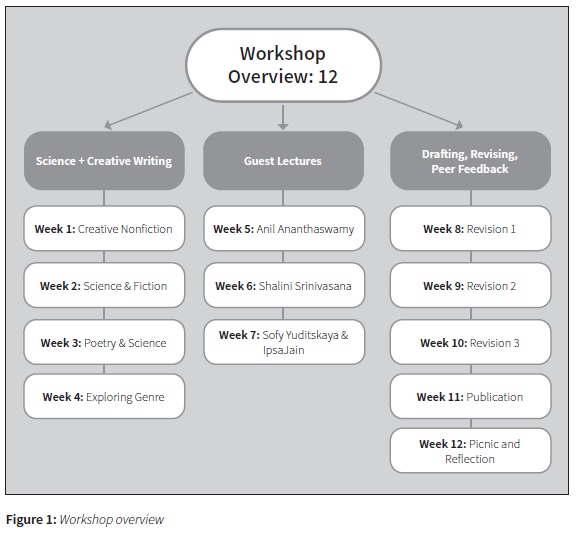
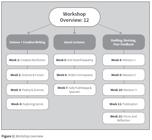
Participants were required to write about carbon, though how they chose to incorporate carbon in their writing was up to them. Participants were given out-of-class readings around carbon, and each workshop session included conversation and peer-to-peer learning about carbon. These conversations ranged from the chemical structure of carbon and its various allotropes to carbon's role as both giver and destroyer of life. Professional writers and artists were invited to the workshop on three occasions. These guests provided their own work as examples and discussed ways of weaving science concepts into creative writing. Figure 1 illustrates the three broad categories of the workshop sessions: instruction in science and creative writing, visits by guest lecturers, and practice in peer review and revision.
Participants and setting
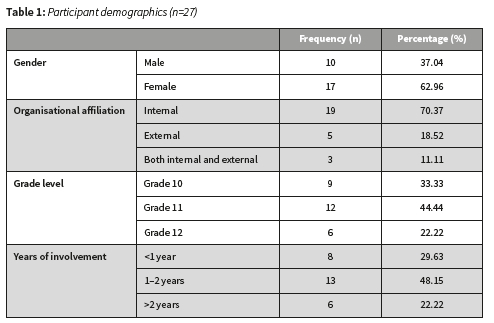
Participants were selected for the workshop through an application process. Accessibility was a key feature of the workshop; SGB welcomed anyone, through an open call, interested in exploring the concept of carbon through creative writing, regardless of their background in science or writing. Interested individuals applied for the workshop by submitting statements of interest detailing their background, previous writing experiences, and motivations for integrating science and creative writing, focusing on the theme of carbon. The final cohort was selected on the basis of evaluation criteria set by SGB, wherein the applicants' submissions were rated on their relevance to carbon-related themes and their demonstration of creative writing aptitude on a scale of 1 to 10. The selection process aimed to foster diversity in terms of backgrounds, interests, and perspectives, resulting in a final cohort of 21 individuals who encompassed various academic disciplines and interests (see Table 1). Sixteen participants of the 21 attended regularly and actively participated in the surveys. Participants granted informed consent through survey forms, indicating their comprehension and willingness to partake in the study. To protect their anonymity and confidentiality, each participant was assigned a unique identification number (e.g., P1, P2, P3) for all workshop-related records and assessments. All participants who contributed to the assignments and submitted impact evaluation forms were informed and signed a declaration stating that their responses would be part of a study conducted by SGB and could be used for ongoing and future research.
Workshop sessions are denoted as S1, S2, and so on to maintain a structured and consistent reference system. A final workshop marked the end of the process of drafting, revision, and peer feedback sessions, and was followed by a public reading event where participants shared their completed pieces at the Atta Galatta Bookstore in Bengaluru ("Voices of Carbon", n.d.).
Data collection and analysis
Qualitative surveys
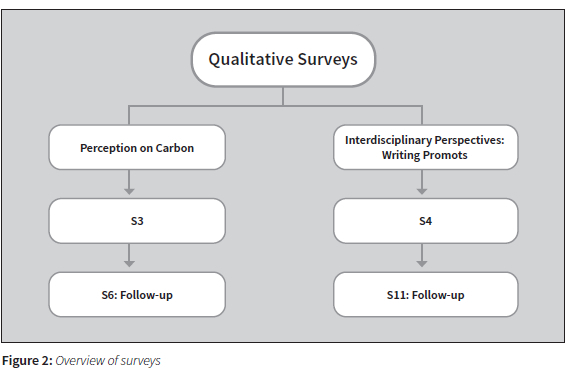
We conducted qualitative surveys throughout the workshop, as can be seen in Figure 2, to capture the evolving perspectives of participants. The surveys designed for this study consisted of open-ended questions and were administered during specific workshop sessions. The first survey was done during S3, focusing on participants' initial thoughts and associations regarding carbon and climate change. A follow-up survey took place during S6 to assess changes in participants' subjective responses and associations in light of workshop content and discussions.
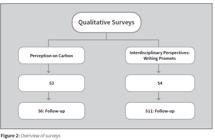
We also introduced interdisciplinary analysis prompts during critical sessions: S4, S7, and S11. These prompts encouraged participants to engage critically with interdisciplinary perspectives, shedding light on their evolving viewpoints and the workshop's effectiveness in fostering interdisciplinary thinking.
Assessment of generated works
The assessment of participants' creative works constituted a pivotal aspect of the study, and the workshop instructor's expertise and insights were instrumental in the process. We conducted a detailed analysis of both pre-workshop and post-workshop writing submissions to identify shifts in creative techniques, the incorporation of scientific concepts, and the weaving of science with creative writing techniques. This comprehensive examination sought to examine the application of elements, such as imagery, metaphor, storytelling, and descriptive language, and how participants used these techniques to communicate about carbon, which is a key element in learning about climate change.
Feedback and self-assessment
Feedback, a crucial component in an individual's learning journey (Tekian et al., 2017), plays a significant role in education (Hoon et al., 2015). Self-assessment enables the evaluation of one's own work with support in the form of rubrics, questionnaires, or checklists (Vasu et al., 2016), and its implementation in the writing classroom boosts students' writing performance (Nielsen, 2014; Ratminingsih et al., 2018). We provided participants with the opportunity to reflect on their experiences and offer qualitative feedback through a structured questionnaire. This feedback was instrumental in gathering insights into participants' goals, perceptions, learning outcomes, and suggestions for future improvements.
Results
Participant perspectives on 'carbon'
The qualitative surveys conducted during S3 and S6 consisted of a question - "What are the five words that come to your mind when you think of carbon?"- aimed at assessing the influence of workshop activities on participants' knowledge and understanding of 'carbon'. In total, 14 participants took part in both S3 and S6.
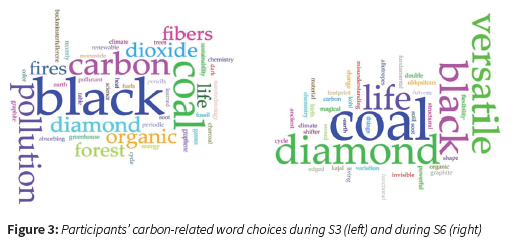
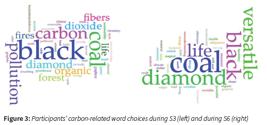
Participants' word associations with 'carbon' in S3 and S6 demonstrated a transformation in their understanding of the role of carbon in their daily lives and in shaping the environment. Seven of fourteen participants did not repeat a single word in S6, suggesting expanded vocabulary and perspective related to carbon, while four participants exhibited minimal overlap, two repeated two words, and one repeated three words, showcasing partial retention of initial associations in S6. Table 2 illustrates the transformation in participants' responses, particularly highlighting the number of repeated word associations in S6. This table shows how participants' word selection related to carbon evolved, demonstrating a significant shift from S3 to S6. The word clouds presented in Figure 3 visually capture this evolution, reflecting a broadening of perspectives as participants engaged more deeply with the topic throughout the workshop.
Writing samples
Based on the observed changes in the pre-workshop and post-workshop writings, findings and overall observations were made around the following criteria: variation in form and genre, engagement with science, and integrating science and artistic ideas.
Variation in form and genre
Participants ventured beyond their initial genre choices to embrace various forms and genres of creative writing in their post-workshop submissions, including essays, fiction, poetry, and even visual formats like videos and illustrations. They demonstrated flexibility and creative exploration, merging different literary forms and writing styles with technoscientific ideas to communicate in engaging ways. Some participants specifically noted that before the workshop, they had never considered merging certain writing forms with scientific concepts. Table 3 expands on these observations.
Engagement with science
The impact of the workshop on participants' engagement with science was clear. Five of the 13 participants (P4, P5, P10, P11, and P13) demonstrated a deeper engagement with scientific concepts related to carbon in their post-workshop writings compared to their initial submissions. These participants incorporated more scientific language and explored the structure and properties of carbon, including carbon bonding, carbon cycles, and carbon allotropes.
For instance, in a pre-workshop submission, P11 integrated scientific ideas into a poetic narrative, but the focus of the initial submission was more on conveying the interconnectedness of carbon with human experiences and natural processes. However, P11's post-workshop submission began with the formation of carbon in space and its arrival on Earth via a meteorite, introducing a cosmological perspective. The participant incorporated aspects of the carbon cycle, described the mining of graphite, the movement of carbon between states, chemical reactions forming bicarbonates, and the catenation and cleaving of carbon atoms. P11 noted increased understanding, stating, "I've gained an immense insight into [carbon's] application in industry, importance to the natural world, effects on the environment, iconography as a material, and general 'nature' as a substance."
In contrast to the pre-workshop submission, P5's post-workshop submission directly engaged with carbon. P5's post-workshop poem skilfully blended scientific concepts, describing the transformation of swampland into a coalfield. The participant emphasised ecological and geological processes while addressing the environmental impact of human activities, especially related to industrialisation and pollution.
The writing samples show that the workshop encouraged participants to understand and interpret science concepts in new ways. P11's writing touches on disciplines including astronomy, the coal industry, philosophy, chemistry, religion, and cosmetics. By incorporating scientific knowledge into their writing, participants displayed a blend of creative thinking and scientific inquiry. They copied, transformed, and combined (Kirby, 2023) scientific ideas, weaving them into their writing projects, ultimately showcasing a fusion of art and science. This suggests that as the participants broadened their understanding of carbon, they also connected carbon to their personal writing projects (and thus their everyday lives) in new ways.
Integrating science and artistic ideas
We found the participants' writing in this workshop most creative when we could see intentional ways they used science content to enhance their creative writing choices or used creative writing techniques to enhance their dissemination of science concepts. When participants used information that had come from their learning and study of carbon in their writing projects, we observed an intentional combination of artistic form and scientific concept. Some of the participants took accurate science content and worked it into a narrative or a poem, while others used broader scientific ideas as metaphors. For example, one participant used an angry mother character to symbolise the way the Earth produces more storms due to human-caused climate change. We noted these types of metaphors as a combination of science and creative technique.
Some participants skilfully merged scientific concepts with artistic ideas, creating a unique and interesting blend of disciplines. Of the 13 participants, several, including P1, P4, P5, P6, and P16, demonstrated an elevated fusion of science and creative forms of expression in post-workshop submissions when compared to their initial submissions.
P1's pre-workshop essay related topics in industry and culture to carbon. In a post-workshop video, this participant developed a story about time travel to highlight the applications of carbon in combating climate change and to inspire people to consider sustainable solutions. P5's pre-workshop submission depicted advanced technology through a conversational story. In a post-workshop poem, metaphors and poetic form were used to link carbon, nature, and fossil fuel extraction.
It was evident that post-workshop submissions differed from pre-workshop ones, with the weaving or fusion of science and creative writing becoming more pronounced (see Tables 4a and b). The participants integrated scientific knowledge with creative storytelling techniques, resulting in an impactful and engaging exploration of the topic.
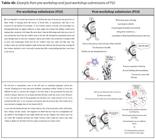
Overall, we observed that the workshop motivated participants to engage with the concept of carbon and explore various related aspects, including its connection to climate change. Our assessment, supported by the participants' self-assessment and feedback (see box below), indicates a blending of scientific understanding and creative writing. It also indicates that as the participants learned about carbon through diverse disciplinary lenses, they connected carbon in new ways to their writing projects.
Participant Self-assessment and Feedback
Enhanced conceptual frameworks and synthesis of scientific and creative perspectives:
"My current [post-workshop] piece certainly deals with a more specific aspect of carbon more carefully as compared to my submission sample, which felt a little more vague -I suppose this is important especially for scientific topics which need to be addressed with precision." - P3
"Earlier [before the workshop], I thought of Carbon in only a 'scientific sense' but now I see that Carbon has many roles in our day-to-day life as well. For example, the various pieces on Kajal that people wrote about." - P4
"I started out with a very generic understanding of carbon (CO2, coal, diamond, graphite, cremation, fuel) but over the course of the workshop, I've learnt to look at it in different ways, through our discussions, the work of others, and my own exploration. I've thought about (1) where did carbon actually come from? (2) how are our lives intertwined with carbon (how entrenched coal is in coal mining regions)..." - P5
"I'm looking at science very differently now. It's become clear to me that science is a very important tool that we must use to look at the world more clearly." - P9
"The workshop helped me in expanding my understanding about creative writing and how to introduce science through writing." "Creative writing will help us in building better ways to tell stories of science that masses can understand and keep them literate about what is happening in the field of science." - P10.
"Our initial few weeks exploring the genres of non-fiction, fiction and poetry in-depth helped me realise the versatility in which science can be incorporated into writing, from more academic essays, to supernatural science-fiction novels, to melodious poetry." - P11
"I learnt creative writing can be a great tool for spreading information and values of all sorts. The way we learn is through stories and creative writing is the strongest method to create stories." - P12
"I was able to read science more in the forms of metaphors to show what connects my world and the scientific." - P16
"Overall, I believe the participants' conceptual framework regarding carbon expanded." "The students who came in with a more science mindset tried out some literary and multimodal techniques with their writing. The students who came in already primed to use literary techniques, engaged with more scientific concepts in their writing (meaning "more" from their application submission to their writing sample in class)." - Workshop Instructor
Recognition for using creative writing techniques to foster engagement and evoke empathy:
"We can engage people through our writing." "I can attract attention of people towards climate change through creative writing.
This workshop definitely helped me in that process." - P1
"Creative writing has the potential to help us build a better future by inspiring empathy, promoting action, imagining new possibilities, and fostering critical thinking." - P2
"Creative writing can tap into not only what you know but also what you feel - which is essential in getting people to care." - P3
"Creative writing can play an important role in shaping peoples' perspectives about science and society. Messages layered within creative writing pieces can get people thinking. This is very crucial to see change in society." "Also, scientific messages can be layered in stories and poetry making people reading about it think." - P4
"The workshop has made me think about science education a little bit and the distinction between the sciences and the arts." - P9
"Creative writing will help us in building better ways to tell stories of science that masses can understand and keep them literate about what is happening in the field of science." - P10
"I think creative writing can serve as the catalyst to inspire change around the world, since words are the most effective tool to appeal to both the mind and the heart - to logic and emotion." "Creative writing, with proper engagement, can reach a wide audience, helping to not only raise general awareness levels among citizens of the world by disclosing important environmental and socio-economic issues, but also call upon world leaders to rectify said issues." - P11
Recognition for creative writing as an effective medium for science education and communication:
I didn't saw earlier poetry as a form for communicating science or never bothered to read one. But through the workshop when analysis was done on a particular poem on Gene mapping. That changed my perspective." - P1
"I had undermined creative writing as a choice for science communication. I now find it one of the best ways to do so." - P2
"I am more inclined to pursue Science Communication even if just as a hobby. The workshop has shown me how fun it can be." "[! would describe this workshop as a] creative writing and introspective workshop teaching how science communication can be done at the intersection of art, creativity and literature." - P4
"Creative writing is a great way to communicate what people think and how they see things, bringing lived experience into science. I saw this play out in the works that we shared with each other - each of us bringing a different aspect of creativity into telling a science story, based on our experiences and interests." - P5
"I subconsciously had been thinking creative writing for scientific communication can only take certain forms to be effective, like they cannot be personal or satirical or fantasy. But I have to come to realise that not only can it take those forms, it can be more effective than what I thought was conventional in certain contexts." - P8
"Creative writing helps in keeping the readers engaged with what the writer is wanting to tell. Disseminating science through creative writing would be the cool way to communicate and learn it." - P10
"I learnt that incorporating scientific concepts into a narrative framework is not merely an educational venture to inform the audience, but to INSPIRE readers to go out and explore concepts on their own by making science seem fun and approachable to people of all ages and knowledge-levels." - P11
"I got to learn about science poetry which was completely new for me. I got to read a few science articles some related to carbon which inspired me to pursue science writing in the future." "Expressing science in the form of stories and art is the easiest possible and accessible way to get people into science" - P13
Interdisciplinary understanding and perspectives
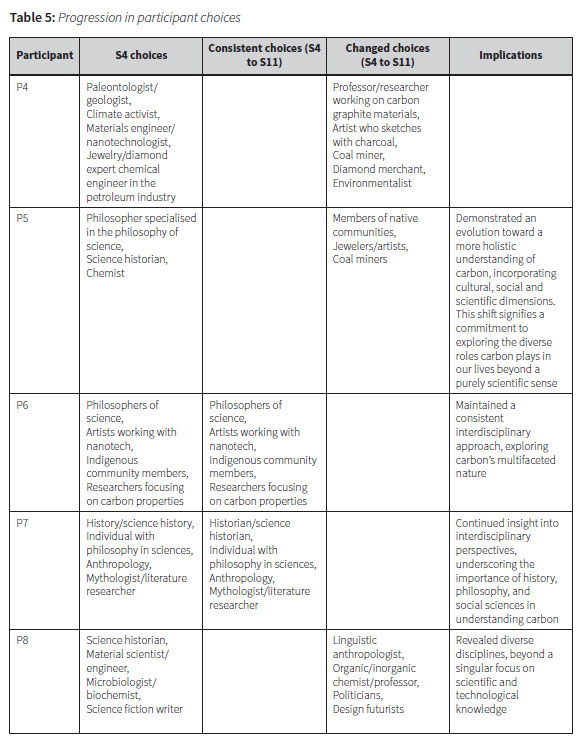
Participants' interdisciplinary thinking and understanding of carbon were analysed through their responses to a guided prompt introduced in S4 and repeated in S11. The data collected from the responses provided insights into the evolution of interdisciplinary perspectives over time. The question for S4 and S11 was as follows:
Imagine yourself as the author of The Multiple Signatures of Carbon (Loeve & Vincent, 2017). You might want to track down useful research sources for gathering relevant and reliable information to write this piece. In such a scenario, which five people would you reach out to for this information (they need not be specific people, but rather their background/training/ discipline)?
Among the 15 participants who completed the questionnaire, nine individuals, including P4, P5, and P8, demonstrated significant shifts in their preferences, with their choices evolving notably between S4 and S11. These individuals exhibited substantial changes in their interdisciplinary perspectives, as evidenced by their altered responses in S11. However, six of the 15 participants, despite the same timeframe between S4 and S11, displayed minimal or no changes in their choices. This group, including participants like P6 and P7, maintained a consistent but diverse set of preferences, reflecting a stable understanding of the interdisciplinary aspects of carbon from the outset. The responses of P4, P5, P6, P7, and P8 are provided as examples in Table 5.
One remarkable example worth noting is P3. In S11, this participant introduced a "grandmother" with knowledge of carbon traditions and a "grandfather" with experience in a carbon-dependent economy. These distinct choices emphasised the importance of cultural and historical perspectives in understanding carbon beyond scientific and technical aspects. The inclusion of individuals with first-hand experience and deep insights into traditional practices and the impact of carbon on different generations added a rich and diverse dimension to P3's interdisciplinary approach.
The analysis revealed that participants went beyond conventional choices and expanded their interdisciplinary perspectives by incorporating individuals with distinctive backgrounds, experiences, and expertise. Their choices indicate an openness to unconventional sources of knowledge and a recognition of the multifaceted nature of carbon-related issues.
Discussion
This study aimed to analyse the impact of a science-focused (specifically carbon) creative writing workshop on participants' interdisciplinary understanding of carbon and their connection of science to their everyday lives. We argue that initiatives such as this workshop, held in informal settings, offer a liberating space where participants can broaden their understanding of science by engaging in peer-to-peer learning and by connecting scientific content to their creative writing projects. By deviating from the structured nature of formal education, rigid curriculum constraints, and standardised assessments, the workshop facilitated an open and dynamic exchange of ideas where participants challenged disciplinary boundaries and explored alternative perspectives to both scientific knowledge and creative writing.
Brown (2015) and Osborn et al. (2023) have underscored the benefits of integrating creative writing in science education, fostering a more engaging and enjoyable learning environment. This study contends that such science-focused workshops, rooted in creative exploration, can enhance efforts in science education and communication. However, it is important to note that a limitation of the study is the absence of long-term impact measurement. Assessing the lasting effects of such workshops on participants' perceptions, continued engagement with science, and any sustained influence on their understanding of scientific concepts is crucial to comprehensively evaluating their efficacy.
To enhance future endeavours in this domain, we recommend incorporating long-term evaluation strategies to measure the sustained impact of such workshops. Additionally, expanding the scope of such initiatives to reach a wider demographic could further solidify the argument for the efficacy of creative writing workshops in science education and communication. We also suggest that our findings hold value for researchers and educators seeking to better understand interdisciplinary frameworks. We found that as the participants looked at carbon through different disciplinary lenses, they reported a heightened understanding of the importance of carbon. These various disciplinary frameworks also provided participants with new ways to connect carbon to their everyday lives and thus integrate carbon into their creative writing projects. These insights provide a valuable foundation for future research and the development of innovative approaches that promote effective science communication, science learning, and interdisciplinary engagement and learning.
Conclusion
In this study, we asked three questions: (1) How did a science-focused creative writing workshop influence participants' knowledge and understanding of carbon? (2) How did the workshop contribute to the development of participants' skills to use creative writing to write about carbon? (3) How did the workshop foster the participants' interdisciplinary understanding and perspectives? We found that the workshop influenced participants' knowledge and understanding of carbon by inviting them to explore concepts related to carbon through an interdisciplinary framework, which enabled participants to connect science to society. As participants communicated about carbon in creative writing projects, they went beyond memorisation or simple comprehension of scientific material and instead created novel texts that connected carbon to mythology, to personal family traditions, to cosmetics, to fossil fuel, to the changing environment, and to ontological explorations. We argue that science-focused creative writing workshops can be integral components of science engagement and communication endeavours, as the "Capturing Carbon Workshop on Science, Art, and Writing" showcased efficacy in making science relatable and relevant. Specifically, in the context of global challenges like climate change, where scientific literacy and youth engagement are pivotal, such workshops can empower individuals to grasp complex scientific ideas and intertwine them with their everyday experiences, thus fostering a deeper connection to these critical topics.
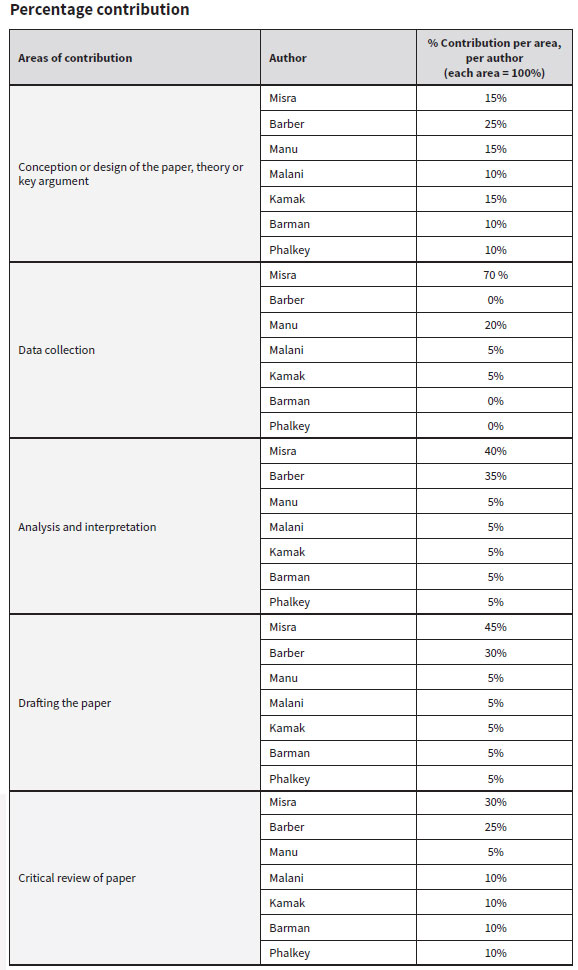
Notes on Contributors and their ContributionsLead author
Misra, Tanumita
Tanumita Misra is a science communicator interested in narrative and cross-disciplinary approaches to making science accessible and inclusive. She works with IIT Gandhinagar on research communication, science outreach, and public engagement initiatives.
Co-author
Barber, Jay
Jay Barber is a clinical associate professor at the University at Buffalo, where she teaches courses in writing and rhetoric. Her research examines science learning and creative writing as well as writing instruction strategies in the university classroom.
Co-author
Manu, Gayatri
Gayatri Manu is a writer, curator, and cultural practitioner with a background in reporting, exhibition-making, and public programming. As Programme Manager at Science Gallery Bengaluru, she designs and delivers interdisciplinary exhibitions and public programmes.
Co-author
Malani, Vasudha
Vasudha Malani is an interdisciplinary researcher and writer with a background in English Literature. She leads informal learning programmes for young adults at Science Gallery Bengaluru.
Co-author
Kamak, Madhushree
Madhushree Kamak is a cultural producer working at the interface of science, art and technology. She previously led Science Gallery Bengaluru's Exhibitions Team and now works independently with Tate, Wellcome Trust and others.
Co-author
Phalkey, Jahnavi
Jahnavi Phalkey is a historian of science and filmmaker. She is the founding director of Science Gallery Bengaluru.
Co-author
Barman, Paramananda
Paramananda Barman is a senior scientist at CSIR-National Institute of Science Communication and Policy Research and Associate Editor for the Indian Journal of Traditional Knowledge. His present areas of interest include popular science, social media communication, and traditional knowledge communication.
References
-
Baram-Tsabari, A. & Osborne, J. (2015). Bridging science education and science communication research. Journal of Research in Science Teaching, 52(2), 135-144. https://doi.org/10.1002/tea.21202
» https://doi.org/10.1002/tea.21202 -
Bentz, J., Do Carmo, L., Schafenacker, N., Schirok, J., & Corso, S. D. (2022). Creative, embodied practices, and the potentialities for sustainability transformations. Sustainability Science, 17(2), 687-699. https://doi.org/10.1007/s11625-021-01000-2
» https://doi.org/10.1007/s11625-021-01000-2 -
Brandt, A. (2021). Defining creativity: A view from the arts. Creativity Research Journal, 33(2), 81-95. https://doi.org/10.1080/10400419.2020.1855905
» https://doi.org/10.1080/10400419.2020.1855905 -
Bell, P. (2009). Learning science in informal environments: People, places, and pursuits. National Academies Press. https://nap.nationalacademies.org/read/12190
» https://nap.nationalacademies.org/read/12190 -
Brown, S.-A. (2015). Creative expression of science through poetry and other media can enrich medical and science education. Frontiers in Neurology, 6, 3. https://doi.org/10.3389/fneur.2015.00003
» https://doi.org/10.3389/fneur.2015.00003 -
Clegg, T. & Kolodner, J. (2014). Scientizing and cooking: Helping middle-school learners develop scientific dispositions. Science Education, 98(1), 36-63. https://doi.org/10.1002/sce.21083
» https://doi.org/10.1002/sce.21083 - Cropley, A. (2018). Bringing creativity down to earth: A long labor lost? In R. J. Sternberg & J. C. Kaufman (Eds.), The nature of human creativity (pp. 47-62). Cambridge University Press.
-
Davidesco, I. & Milne, C. (2019). Implementing cognitive science and discipline-based education research in the undergraduate science classroom. CBE Life Sciences Education, 18(3). https://doi.org/10.1187/cbe.18-12-0240
» https://doi.org/10.1187/cbe.18-12-0240 -
Doyle, J. (2020). Creative communication approaches to youth climate engagement: Using speculative fiction and participatory play to facilitate young people's multidimensional engagement with climate change. International Journal of Communication, 14, 2749-2772. https://ijoc.org/index.php/ijoc/article/view/14003/3093
» https://ijoc.org/index.php/ijoc/article/view/14003/3093 -
Edmin, C. & Lee, O. (2012). Hip-Hop, the "Obama Effect," and Urban Science Education. Teachers College Record: The Voice of Scholarship in Education, 114(2), 1-24. https://doi.org/10.1177/016146811211400205
» https://doi.org/10.1177/016146811211400205 -
Farrow, S. C. (2024, July 20). Importance of creative writing for understanding ourselves. https://www.scfarrow.com/creative-writing-in-todays-society
» https://www.scfarrow.com/creative-writing-in-todays-society -
Ferguson, K. (2023). Everything is a Remix. YouTube. https://www.youtube.com/watch?v=X9RYuvPCQUA
» https://www.youtube.com/watch?v=X9RYuvPCQUA -
Fernández-Giménez, M. E., Jennings, L. B., & Wilmer, H. (2019). Poetic inquiry as a research and engagement method in natural resource science. Society & Natural Resources, 32(10), 1080-1091. https://doi.org/10.1080/08941920.2018.1486493
» https://doi.org/10.1080/08941920.2018.1486493 -
Furlan, P. Y., Kitson, H., & Andes, C. (2007). Chemistry, poetry, and artistic illustration: An interdisciplinary approach to teaching and promoting chemistry. Journal of Chemical Education, 84(10), 1625. https://doi.org/10.1021/ed084p1625
» https://doi.org/10.1021/ed084p1625 -
Hirsch, A. (2010). The era of carbon allotropes. Nature Materials, 9(11), 868-871. https://doi.org/10.1038/nmat2885
» https://doi.org/10.1038/nmat2885 -
Hoon, A., Oliver, E., Szpakowska, K., & Newton, P. (2015). Use of the 'Stop, Start, Continue Method' is associated with the production of constructive qualitative feedback by students in higher education. Assessment & Evaluation in Higher Education, 40(5), 755-767. https://doi.org/10.1080/02602938.2014.956282
» https://doi.org/10.1080/02602938.2014.956282 - Honwad, S., Sypher, O. M., Hoadley, C., Lewis, A., Tamminga, K., Honey, R., & Edelson, D. C. (2014). Education for sustainability and resilience in a changing climate. International Society of the Learning Sciences.
-
Jacobson, S. K., Seavey, J. R., & Mueller, R. C. (2016). Integrated science and art education for creative climate change communication. Ecology and Society, 21(3). https://doi.org/10.5751/ES-08626-210330
» https://doi.org/10.5751/ES-08626-210330 -
Januchowski-Hartley, S. R., Sopinka, N., Merkle, B. G., Lux, C., Zivian, A., Goff, P., & Oester, S. (2018). Poetry as a creative practice to enhance engagement and learning in conservation science. BioScience, 68(11), 905-911. https://doi.org/10.1093/biosci/biy105
» https://doi.org/10.1093/biosci/biy105 -
Kanter, D. E., Honwad, S., Adams, J. D., & Fernandez, A. (2011). Guiding play for science learning in middle school. Children, Youth and Environments, 21(2), 360-382. https://doi.org/10.1353/cye.2011.0003
» https://doi.org/10.1353/cye.2011.0003 -
Krom, C. L. & Williams, S. V. (2011). Tell me a story: Using creative writing in introductory accounting courses to enhance and assess student learning. Journal of Accounting Education, 29(4), 234-249. https://doi.org/10.1016/j.jaccedu.2012.06.003
» https://doi.org/10.1016/j.jaccedu.2012.06.003 - Loeve, S. & Bensaude-Vincent, B. (2017). The multiple signatures of carbon. In B. Bensaude-Vincent, S. Loeve, A. Nordmann, & A. Schwarz (Eds.), Research objects in their technological setting (pp. 185-200). Routledge
-
Logan, A. L. & Grillo, K. M. (2023). How African pasts can inspire alternative responses to climate change: A creative writing experiment. African Archaeological Review, 40(3), 507-517. https://doi.org/10.1007/s10437-023-09543-8
» https://doi.org/10.1007/s10437-023-09543-8 -
McKinnon, M. & Vos, J. (2015). Engagement as a threshold concept for science education and science communication. International Journal of Science Education, 5(4), 297-318. https://doi.org/10.1080/21548455.2014.986770
» https://doi.org/10.1080/21548455.2014.986770 -
Monroe, M. C., Plate, R. R., Oxarart, A., Bowers, A., & Chaves, W. A. (2019). Identifying effective climate change education strategies: A systematic review of the research. Environmental Education Research, 25(6), 791-812. https://doi.org/10.1080/13504622.2017.1360842
» https://doi.org/10.1080/13504622.2017.1360842 - Murray, D. (1972). Teach writing as a process not a product. The Leaflet, New England Association of Teachers of English Fall, 11-14.
- Nielsen, K. (2014). Self-assessment methods in writing instruction: A conceptual framework, successful practices and essential strategies. Journal of Research in Reading, 37(1), 1-16.
- Osborn, L., Hoback, W., Parkison, A., & Golick, D. (2023). Science education through creative writing: A case study using entomology. NACTA Journal, 67(1).
-
Ratminingsih, N. M., Marhaeni, A. A., & Vigayanti, L. P. (2018). Self-assessment: The effect on students' independence and writing competence. International Journal of Instruction, 11(3), 277-290. https://doi.org/10.12973/iji.2018.11320a
» https://doi.org/10.12973/iji.2018.11320a -
Ritchie, H., Roser, M., & Rosado, P. (2020). CO2 and greenhouse gas emissions. Our World in Data. https://www.ourworldindata.org/co2
» https://www.ourworldindata.org/co2 -
Runco, M. A. & Jaeger, G. J. (2012). The standard definition of creativity. Creativity Research Journal, 24(1), 92-96. https://doi.org/10.1080/10400419.2012.650092
» https://doi.org/10.1080/10400419.2012.650092 -
Santiani, S., Ngabekti, S., Sudarmin, S., & Rusilowati, A. (2023). Development and validation model of peatland conservation through interdisciplinary science learning. Biosaintifika, 15(1), 134-142. https://doi.org/10.15294/biosaintifika.v15i1.43846
» https://doi.org/10.15294/biosaintifika.v15i1.43846 -
Sivrikaya, S. O. (2020). Carbon cycle learning of chemistry students: Modeling method. Journal of Education and Learning, 9(4), 80-85. https://doi.org/10.5539/jel.v9n4p80
» https://doi.org/10.5539/jel.v9n4p80 -
Stanford, S. (2022, May 23). Creative writing course explores overlap of science and art. Stanford Report. https://news.stanford.edu/report/2022/05/23/stanford-writing-course-explores-overlap-science-art/
» https://news.stanford.edu/report/2022/05/23/stanford-writing-course-explores-overlap-science-art/ -
Tatalovic, M. (2009). Science comics as tools for science education and communication: A brief, exploratory study. Journal of Science Communication, 8(04), A02. https://doi.org/10.22323/2.08040202
» https://doi.org/10.22323/2.08040202 -
Tekian, A., Watling, C. J., Roberts, T. E., Steinert, Y., & Norcini, J. (2017). Qualitative and quantitative feedback in the context of competency-based education. Medical Teacher, 39(12), 1245-1249. https://doi.org/10.1080/0142159X.2017.1372564
» https://doi.org/10.1080/0142159X.2017.1372564 -
Trott, C. D. & Weinberg, A. E. (2020). Science education for sustainability: Strengthening children's science engagement through climate change learning and action. Sustainability, 12(16), 6400. https://doi.org/10.3390/su12166400
» https://doi.org/10.3390/su12166400 -
Van der Sanden, M. C. & De Vries, M. J. (Eds.). (2016). Science and Technology Education and Communication. SensePublishers. https://doi.org/10.1007/978-94-6300-738-2
» https://doi.org/10.1007/978-94-6300-738-2 -
Vasu, K., Ling, C. H., & Nimehchisalem, V. (2016). Malaysian tertiary level ESL students' perceptions toward teacher feedback, peer feedback and self-assessment in their writing. International Journal of Applied Linguistics and English Literature, 5(5), 158-170. https://doi.org/10.7575/aiac.ijalel.v.5n.5p.158
» https://doi.org/10.7575/aiac.ijalel.v.5n.5p.158 -
Voices of Carbon (n.d.). Public reading by Science Gallery, Explocity Guide To Bangalore. https://bangalore.explocity.com/events-in-bangalore/atta-galatta-presents-voices-of-carbon-public-reading-by-science-gallery/
» https://bangalore.explocity.com/events-in-bangalore/atta-galatta-presents-voices-of-carbon-public-reading-by-science-gallery/ -
Watkins, A. & Tehrani, Z. (2020). Brave new worlds: Transcending the humanities/STEM divide through creative writing. https://digitalcommons.unl.edu/nchchip/325/
» https://digitalcommons.unl.edu/nchchip/325/ -
Yang, W., Feng, L., Wang, Z., & Fan, X. (2023). Carbon emissions and national sustainable development goals coupling coordination degree study from a global perspective: Characteristics, heterogeneity, and spatial effects. Sustainability, 15(11), 9070. https://doi.org/10.3390/su15119070
» https://doi.org/10.3390/su15119070 -
You, H. S., Marshall, J. A., & Delgado, C. (2021). Toward interdisciplinary learning: Development and validation of an assessment for interdisciplinary understanding of global carbon cycling. Research in Science Education, 51, 1197-1221. https://doi.org/10.1007/s11165-019-9836-x
» https://doi.org/10.1007/s11165-019-9836-x