Emergent Voices and Collective Actions of Environmental Rangers against Peatland Degradation Challenges
Abstract
Peatland degradation in South Sumatra, Indonesia, has become a critical environmental challenge driven by large-scale agricultural expansion, deforestation, and recurrent fires, resulting in substantial carbon emissions, biodiversity loss, and socio-economic impacts on local communities. This study explores the environmental awareness, motivations and collective actions of high school students actively engaged in student-led and community-based environmental organisations addressing peatland degradation challenges. Employing a qualitative approach, data were collected through in-depth interviews and focus group discussions with 27 students and analysed using thematic analysis. The findings reveal that student environmental rangers develop a multidimensional form of environmental awareness that integrates ecological literacy, emotional attachment to peatland landscapes, and moral responsibility, and this awareness functions as a catalyst for sustained collective action. This awareness is translated into concrete initiatives, including environmental education campaigns, peatland restoration activities, and policy-oriented advocacy. The study highlights the role of youth environmental organisations as critical spaces for nurturing agency, solidarity, and action-oriented environmental stewardship. Strengthening institutional support and cross-sector community partnerships is therefore essential to sustain and scale youth-led environmental action in peatland conservation contexts.
environmental activism; peatland conservation; student engagement; youth organisations; youth-led movements
Introduction
Indonesia is endowed with a vast array of diverse and ecologically rich ecosystems, many of which hold significant potential for supporting both biodiversity and climate resilience (Pelengkahu & Pratama, 2024; Syaban & Appiah-Opoku, 2023, 2024). Among these, peatland ecosystems stand out as one of the most critical due to their unique biophysical properties and ecological functions (Juutinen et al., 2020; Lee et al., 2021; Mozafari et al., 2023). Indonesia is home to approximately 25.67 million hectares of peatlands, making it one of the countries with the largest peatland areas globally (Zulkarnaini et al., 2025). These peatlands are vital carbon sinks, capable of storing between 57 to 60 billion metric tons of carbon, thereby playing a pivotal role in global climate regulation (Sirin, 2022). One of the provinces with the most extensive peatland coverage is South Sumatra, with a total area of approximately 2.1 million hectares (Irfan et al., 2024).
However, in recent decades, South Sumatra has witnessed severe peatland degradation, primarily driven by large-scale agricultural expansion, deforestation, and recurring fires (Nurhayati et al., 2021). According to the Ministry of Environment and Forestry (MoEF) of Indonesia, more than 1.4 million hectares of peatlands in South Sumatra are classified as degraded, with extensive areas located in districts such as Ogan Komering Ilir (OKI), Banyuasin and Musi Banyuasin. This degradation not only leads to significant carbon emissions but also exacerbates biodiversity loss and disrupts local water cycles (Irfan et al., 2024). Studies by Rodríguez Vásquez et al. (2021) indicate that peatland fires contribute to massive greenhouse gas emissions, with Indonesia's 2015 peat fires alone releasing 1.62 billion metric tons of CO2 into the atmosphere. Beyond environmental concerns, peatland degradation presents socio-economic challenges, particularly for rural communities that rely on these ecosystems for their livelihoods, agriculture, and water resources (Atkinson & Alibasic, 2023; Yunus et al., 2024). Given these alarming trends, urgent and innovative conservation strategies are needed to address this environmental crisis.
One of the emerging forces in peatland conservation is student-led environmental organisations, which are playing an increasingly prominent role in advocating for sustainable environmental policies and community-based restoration programmes. These organisations contribute to conservation efforts through activities such as public education, policy lobbying, and direct ecosystem restoration (Aboramadan & Karatepe, 2021). A previous study by Hilder and Collin (2022) showed that youth-led environmental activism plays a critical role in shaping sustainable policies, yet empirical studies on their specific contributions to peatland conservation remain scarce. In South Sumatra, several environmental organisations operate at various levels, including school-based groups such as the Environmental Ambassadors in each school, as well as regional and national networks such as Green Generation, Teens Go Green, and the Green Youth Movement. Several of these organisations have been actively involved in awareness campaigns, restoration projects and environmental advocacy focusing on peatland ecosystems. However, while their involvement in conservation efforts is evident, there remains a significant research gap in understanding the extent of their impact, motivations and the challenges they face in combating peatland degradation.
Previous studies have extensively examined students' perceptions and responses to environmental degradation. Research by Boca and Saraçli (2019) and Genovese (2022) found that students generally recognise the negative impacts of environmental destruction and express concerns about sustainability. Based on these findings, it is evident that students are aware of environmental issues, yet their specific understanding of peatland degradation remains underexplored. Research conducted by Girkin et al. (2023) highlighted the critical role of peatlands in carbon storage and climate regulation, emphasising the need for conservation efforts. Furthermore, studies by Zulkarnaini et al. (2020) demonstrated the importance of raising awareness about peatland conservation, particularly in regions prone to deforestation and land conversion. These findings suggest that while general environmental awareness exists, there is still a gap in research regarding students' perceptions of peatland degradation.
A significant gap therefore persists in understanding students' responses to peatland degradation, particularly in South Sumatra, a province with extensive peatland ecosystems. Moreover, no studies have specifically examined students' perceptions of the role of environmental organisations in promoting peatland conservation in this region. Given the escalating environmental challenges facing South Sumatra, further research is needed to explore how students perceive peatland degradation and how environmental organisations contribute to shaping their awareness, motivations and conservation-oriented actions.
Purpose of the research
The primary purpose of this study is to examine how high school students actively involved in environmental organisations understand, respond to, and take action on peatland degradation in South Sumatra, Indonesia. Specifically, the research seeks to explore the development of students' environmental awareness of peatland issues, the motivations that drive their sustained engagement in environmental activism, and the organisational strategies they employ to address peatland-related challenges. By focusing on students participating in both school-based environmental groups and external youth organisations, this study aims to clarify the role of youth activism in local peatland conservation efforts. The findings are intended to contribute to the growing scholarship on youth-led environmental activism in Indonesia and to provide evidence-based insights for educators, policymakers and community stakeholders seeking to strengthen youth participation in sustainable environmental management.
Methods
This study adopted a qualitative exploratory approach using a collective case study design to examine how high school students respond to peatland degradation in South Sumatra, Indonesia. The study focused on students' environmental awareness, motivations for activism, strategic actions and future aspirations as members of environmental organisations. A collective case study design was considered appropriate because it enables the exploration of diverse experiences and perspectives across multiple groups, both within and outside the school setting. Through this approach, the study aimed to develop a contextualised and in-depth understanding of youth-led environmental engagement in response to local ecological challenges.
Participants
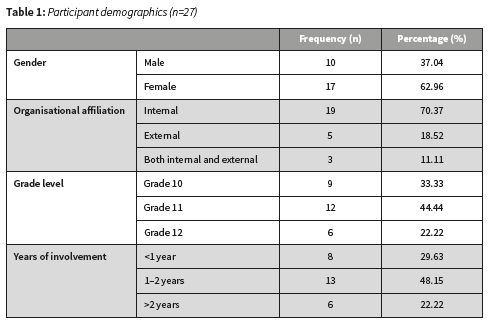
The participants comprised 27 students from State Senior High School 1 Palembang who were actively involved in environmental organisations. These included internal school-based groups, such as Duta Lingkungan SMA Negeri 1 Palembang (Environmental Ambassadors of State Senior High School 1 Palembang), as well as external youth environmental organisations, including Green Generation, Teens Go Green, and the Green Youth Movement. Participants were selected through purposive sampling to represent variation in organisational affiliation, duration of involvement, and intensity of environmental engagement. All participants had been involved in environmental activities or campaigns related to peatland issues for at least one semester prior to data collection. An overview of participants' demographic characteristics is provided in Table 1.
Ethical considerations were addressed throughout the research process. The study was conducted with formal permission from the school administration and participation was entirely voluntary. Prior to data collection, participants received a clear explanation of the study's aims, procedures, data collection methods, and data storage practices. Informed consent was obtained from all participants, with parental consent secured where required. To ensure anonymity and confidentiality, no personally identifiable information was collected and all participants were assigned pseudonym codes during analysis and reporting. Interview and focus group data were audio-recorded with participants' consent, transcribed verbatim, and securely stored on password-protected devices accessible only to the research team.
Data collection technique
Data were collected using two qualitative methods: semi-structured in-depth interviews and focus group discussions (FGDs). These methods were selected to capture both individual experiences and collective dynamics of student engagement in environmental activism related to peatland degradation. Semi-structured interviews were conducted with all 27 participants using an open-ended interview guide designed to explore environmental awareness, personal motivations, formative experiences, perceived challenges, and future aspirations. Each interview lasted approximately 30-50 minutes and was audio-recorded with participants' consent to ensure accuracy.
To complement the interview data, two FGDs were conducted with a total of 14 participants, organised into groups of six to eight students based on grade level and organisational involvement. The FGDs focused on shared values, organisational practices, collaboration strategies and participants' perceived roles in advancing environmental action. These discussions provided insight into how ideas were negotiated and reinforced within peer groups, capturing the collective dimension of youth environmental engagement. The integration of interviews and FGDs strengthened the depth and richness of the qualitative data.
Data analysis technique
Data analysis followed a thematic analysis approach based on the six-phase framework proposed by Braun and Clarke (2006). Analysis began with familiarisation through repeated reading of interview and FGD transcripts. Initial codes were then generated inductively, grounded in recurring ideas, expressions and emotionally salient responses articulated by participants. This inductive approach allowed themes to emerge from the data rather than being shaped by predetermined theoretical categories. The initial codes were subsequently reviewed and organised into broader thematic patterns that reflected key dimensions of students' environmental engagement. This iterative process resulted in the identification of three overarching themes: Warriors of the Peatlands, capturing students' ecological awareness and understanding of peatland degradation; From Passion to Action, reflecting the emotional and moral drivers of their activism; and Fighting for the Future, describing concrete actions, campaigns, and organisational strategies undertaken by the students.
To enhance the trustworthiness of the findings, investigator triangulation was employed through peer debriefing among the research team to minimise individual bias. In addition, member checking was conducted with selected participants to confirm the accuracy and resonance of the interpreted themes. These strategies contributed to a rigorous and credible qualitative analysis of youth environmental activism within a local ecological crisis context.
Results and discussion
Warriors of the Peatlands: Understanding student activists' environmental awareness
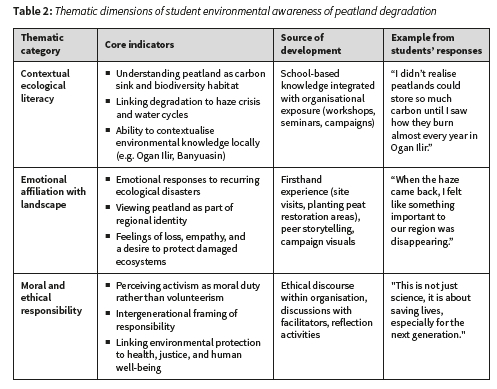
The initial thematic domain emerging from the analysis concerns the nature and multidimensional complexity of students' environmental awareness regarding peatland degradation. This awareness does not develop in isolation but is shaped through the intersection of formal education, participation in environmental organisations and direct ecological experiences. It involves not only cognitive understanding but also affective engagement, ethical reflection, and contextual interpretation of local environmental realities. In order to provide a clearer depiction of how this awareness is formed and articulated, a number of interconnected thematic categories were identified based on students' reflective responses. These categories are elaborated in Table 2, which outlines their defining indicators, formative sources and illustrative participant expressions.
Table 2 demonstrates that environmental awareness among student activists is deeply relational and integrative. It bridges scientific understanding with affective resonance and ethical reflection, forming a foundation for long-term commitment to environmental stewardship. Crucially, this awareness functions as a precursor to action, as it informs how students identify environmental problems, assign responsibility, and mobilise themselves and others toward meaningful change. Such insights affirm the necessity of educational and organisational ecosystems that not only transmit ecological facts but also cultivate empathy, critical thinking and ethical responsibility. For these students, peatland awareness is not an abstract concept, but it is lived, embodied and morally charged.
From Passion to Action: What drives student environmental rangers?
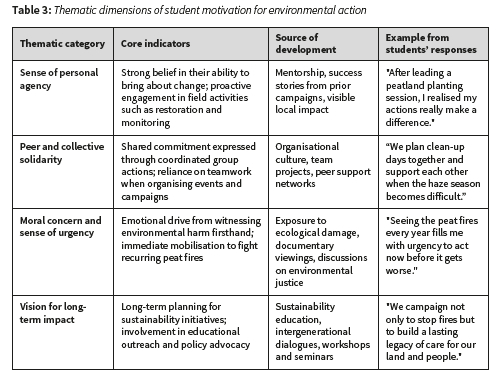
This section examines the motivations that move students from environmental awareness to active engagement in environmental protection. The findings indicate that student participation is driven by a combination of personal beliefs, social relationships and ethical concerns that encourage and sustain their involvement in environmental activities. To organise these findings, several thematic categories were identified based on students' narratives and reflections. These categories, together with their defining characteristics and formative sources, are presented in Table 3.
The motivational dimensions presented in Table 3 illustrate the interplay between emotional, social and cognitive factors that underpin student activism. A strong sense of personal agency enables students to engage in concrete actions such as peatland restoration and environmental monitoring. Collective solidarity within their organisations provides emotional support and reinforces sustained participation through shared goals. Moral concern, coupled with a sense of urgency, acts as a catalyst for action in response to recurring peatland fires. At the same time, a long-term vision encourages students to combine education and advocacy in pursuit of lasting environmental change. Together, these findings show that student environmental rangers are motivated not only by awareness, but by an integrated commitment that transforms concern into sustained environmental stewardship. This highlights the importance of supportive educational and organisational contexts that nurture both motivation and practical action.
Fighting for the Future: How student environmental organisations take action
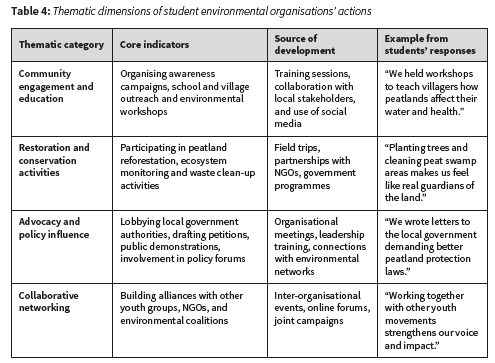
This section examines the strategies and activities used by student environmental organisations in responding to peatland degradation. The analysis highlights how these groups mobilise resources, coordinate actions, and engage with local communities. To present these practices clearly, several thematic categories were identified from the data, reflecting key forms of action and organisational dynamics. These categories, together with their core features and sources, are presented in Table 4.
The findings presented in Table 4 show that student environmental organisations adopt a multifaceted approach to addressing peatland degradation. Community engagement and education form the foundation of their efforts by promoting knowledge exchange and raising awareness among local communities. Restoration and conservation activities translate concern into concrete fieldwork, strengthening students' identities as active environmental stewards. Advocacy efforts extend their influence by engaging with local policies and governance related to peatland management. In addition, collaborative networking allows these organisations to expand their reach and share resources through strategic alliances. Together, these actions illustrate an integrated approach that combines grassroots participation, direct environmental intervention, and policy-oriented advocacy. This demonstrates the capacity of student-led organisations not only to respond to immediate ecological challenges, but also to contribute to longer-term environmental governance and sustainability.
Discussion and limitations
The findings of this study highlight the close relationship between environmental awareness, personal motivation and collective action among student members of environmental organisations responding to peatland degradation in South Sumatra. Student activists demonstrated a strong form of contextual ecological literacy, grounded in both cognitive understanding and emotional engagement. This finding aligns with previous studies by Wamsler (2020), Singer-Brodowski (2023) and Robina-Ramírez et al. (2020), which emphasise the importance of integrating emotional and moral dimensions into environmental education to support transformative learning.
The theme 'Warriors of the Peatlands' shows that student awareness is not merely theoretical, but rooted in lived ecological experiences, such as exposure to seasonal haze and direct involvement in peatland restoration activities. This supports the role of place-based education in shaping environmental awareness, as highlighted by Ardoin and Heimlich (2021), who argue that meaningful environmental learning occurs when young people can relate ecological issues to their local landscapes. In addition, students frequently framed environmental responsibility as an obligation to future generations, echoing the findings of Zhang et al. (2020), who noted that early participation in community environmental work strengthens long-term pro-environmental identity.
In the theme 'From Passion to Action', students' motivation to engage in activism was driven by a synthesis of personal concern, collective solidarity, and perceived urgency of ecological threats. These drivers mirror Guay's (2022) Self-Determination Theory, where autonomous motivation, especially when reinforced by purpose and relatedness, predicts sustained engagement. The shift from passive awareness to deliberate action resonates with the findings of Bennett et al. (2018) who found that environmental identity and emotional investment are critical predictors of youth environmental stewardship. Importantly, this study adds to such literature by highlighting how crisis-driven ecological threats like peatland fires act as catalysts for youth mobilisation.
The theme 'Fighting for the Future' highlights the broad range of strategies employed by student environmental organisations, including education, restoration activities, advocacy and coalition building. These findings are consistent with Hilder and Collin (2022) who emphasised that youth-led environmental movements are more effective when they operate across multiple levels, ranging from local awareness initiatives to engagement with institutional actors. The strong focus on policy engagement and inter-organisational collaboration in this study indicates that youth activism is increasingly moving beyond isolated protest actions towards more structured and sustained forms of civic participation. The development of collaborative environmental networks among youth groups suggests a shift from school-based initiatives towards more coordinated approaches to environmental governance. This pattern reflects a form of environmental citizenship in which young people address local environmental challenges while also engaging with global sustainability frameworks, including Sustainable Development Goal (SDG) 13 and SDG 15.
Moreover, the influence of student organisations in advocating for peatland preservation may signal a democratisation of environmental discourse in regions typically dominated by state and NGO narratives. As proposed by Trivelli and Morel (2021), youth participation in civic action not only amplifies young voices but also fosters inclusive environmental policymaking. This suggests that embedding environmental activism within educational structures and youth organisations could serve as a sustainable model for cultivating future environmental leaders.
Despite these contributions, several limitations of this study should be considered when interpreting the findings. The insights presented are based on a relatively small group of student participants drawn from a single senior high school in South Sumatra, Indonesia, which may limit the transferability of the results to broader educational or regional contexts. In addition, the qualitative data rely on self-reported experiences gathered through interviews and focus group discussions, which may be influenced by social desirability or selective recall. Furthermore, the focus on students who are already actively involved in environmental organisations means that the perspectives of less-engaged or non-affiliated youth are not represented. Future studies could address these limitations by involving multiple schools across different regions, incorporating comparative participant groups and adopting mixed-method approaches to strengthen the depth and generalisability of the findings.
Conclusion
This study provides a comprehensive account of how senior high school students involved in environmental organisations perceive, understand and act upon the challenges of peatland degradation in South Sumatra. The results demonstrate that students' environmental awareness is not limited to cognitive understanding but is shaped by emotional engagement and a strong moral orientation. Their awareness is developed through the intersection of formal education, organisational participation and firsthand experiences within their local ecological context. Motivated by a combination of personal concern, shared identity and ethical conviction, these students have transformed their environmental knowledge into concrete actions through campaigns, restoration efforts, advocacy work, and inter-organisational collaboration. Their activities illustrate the vital role that youth can play as frontline actors in addressing ecological crises.
Implications
The findings of this research carry important implications for environmental education and youth engagement programmes. Educational institutions should incorporate locally relevant environmental issues, such as peatland degradation, into the curriculum to foster contextual learning and strengthen student agency. Likewise, schools and civil society organisations need to provide structured platforms for student involvement in real-world environmental initiatives, enabling deeper moral reflection and long-term civic participation. These efforts may cultivate not only environmentally literate individuals but also active citizens who are committed to sustainable development at the community level.
Recommendations for future research
For future research, it is recommended to examine the long-term trajectories of student environmental activists and assess how early engagement shapes their civic behaviour, leadership roles or career orientation in environmental fields. Additionally, comparative studies across regions with different ecological challenges and sociocultural dynamics may uncover diverse pathways of youth-led environmental engagement. Employing methodologies such as longitudinal case studies or participatory action research could offer richer insights into the developmental and transformative aspects of student activism.
Notes on ContributorKurdiati, Lintang Auliya
Lintang Auliya Kurdiati holds a Master's degree in Natural Science Education from Universitas Negeri Yogyakarta, Indonesia. Her scholarly interests include environmental education, science education, and student responses to ecological issues.
References
-
Aboramadan, M. & Karatepe, O. M. (2021). Green human resource management, perceived green organizational support and their effects on hotel employees' behavioral outcomes. International Journal of Contemporary Hospitality Management, 33(10), 3199-3222. https://doi.org/10.1108/IJCHM-12-2020-1440
» https://doi.org/10.1108/IJCHM-12-2020-1440 -
Ardoin, N. M. & Heimlich, J. E. (2021). Environmental learning in everyday life: Foundations of meaning and a context for change. Environmental Education Research, 27(12), 1681-1699. https://doi.org/10.1080/13504622.2021.1992354
» https://doi.org/10.1080/13504622.2021.1992354 -
Atkinson, C. L. & Alibasic, H. (2023). Prospects for governance and climate change resilience in peatland management in Indonesia. Sustainability (Switzerland), 15(3). https://doi.org/10.3390/su15031839
» https://doi.org/10.3390/su15031839 -
Bennett, N. J., Whitty, T. S., Finkbeiner, E., Pittman, J., Bassett, H., Gelcich, S., & Allison, E. H. (2018). Environmental stewardship: A conceptual review and analytical framework. Environmental Management, 61(4), 597-614. https://doi.org/10.1007/s00267-017-0993-2
» https://doi.org/10.1007/s00267-017-0993-2 -
Boca, G. D. & Saraçli, S. (2019). Environmental education and student's perception, for sustainability. Sustainability (Switzerland), 11(6), 1-18. https://doi.org/10.3390/su11061553
» https://doi.org/10.3390/su11061553 -
Braun, V. & Clarke, V. (2006). Using thematic analysis in psychology. Qualitative Research in Psychology, 3(2), 77-101. https://doi.org/10.1191/1478088706qp063oa
» https://doi.org/10.1191/1478088706qp063oa -
Genovese, E. (2022). University student perception of sustainability and environmental issues. AIMS Geosciences, 8(4), 645-657. https://doi.org/10.3934/geosci.2022035
» https://doi.org/10.3934/geosci.2022035 -
Girkin, N. T., Burgess, P. J., Cole, L., Cooper, H. V., Honorio Coronado, E., Davidson, S. J., Hannam, J., Harris, J., Holman, I., McCloskey, C. S., McKeown, M. M., Milner, A. M., Page, S., Smith, J., & Young, D. (2023). The three-peat challenge: Business as usual, responsible agriculture, and conservation and restoration as management trajectories in global peatlands. Carbon Management, 14(1). https://doi.org/10.1080/17583004.2023.2275578
» https://doi.org/10.1080/17583004.2023.2275578 -
Guay, F. (2022). Applying self-determination theory to education: Regulations, types, psychological needs, and autonomy supporting behaviors. Canadian Journal of School Psychology, 37(1), 75-92. https://doi.org/10.1177/08295735211055355
» https://doi.org/10.1177/08295735211055355 -
Hilder, C. & Collin, P. (2022). The role of youth-led activist organisations for contemporary climate activism: The case of the Australian Youth Climate Coalition. Journal of Youth Studies, 25(6), 793-811. https://doi.org/10.1080/13676261.2022.2054691
» https://doi.org/10.1080/13676261.2022.2054691 -
Irfan, M., Koriyanti, E., Saleh, K., Hadi, Safrina, S., Awaludin, Sulaiman, A., Akhsan, H., Suhadi, Suwignyo, R. A., Choi, E., & Iskandar, I. (2024). Dynamics of peatland fires in South Sumatra in 2019: Role of groundwater levels. Land, 13(3). https://doi.org/10.3390/land13030373
» https://doi.org/10.3390/land13030373 -
Juutinen, A., Tolvanen, A., Saarimaa, M., Ojanen, P., Sarkkola, S., Ahtikoski, A., Haikarainen, S., Karhu, J., Haara, A., Nieminen, M., Penttilä, T., Nousiainen, H., Hotanen, J.-P., Minkkinen, K., Kurttila, M., Heikkinen, K., Sallantaus, T., Aapala, K., & Tuominen, S. (2020). Cost-effective land-use options of drained peatlands -integrated biophysical-economic modeling approach. Ecological Economics, 175, 106704. https://doi.org/10.1016/j.ecolecon.2020.106704
» https://doi.org/10.1016/j.ecolecon.2020.106704 -
Lee, S. C., Black, T. A., Nyberg, M., Merkens, M., Nesic, Z., Ng, D., & Knox, S. H. (2021). Biophysical impacts of historical disturbances, restoration strategies, and vegetation types in a peatland ecosystem. Journal of Geophysical Research: Biogeosciences, 126(10), 1-20. https://doi.org/10.1029/2021JG006532
» https://doi.org/10.1029/2021JG006532 -
Mozafari, B., Bruen, M., Donohue, S., Renou-Wilson, F., & O'Loughlin, F. (2023). Peatland dynamics: A review of process-based models and approaches. Science of the Total Environment, 877, 162890. https://doi.org/10.1016/j.scitotenv.2023.162890
» https://doi.org/10.1016/j.scitotenv.2023.162890 -
Nurhayati, A. D., Saharjo, B. H., Sundawati, L., Syartinilia, S., & Cochrane, M. A. (2021). Forest and peatland fire dynamics in South Sumatra Province. Forest and Society, 5(2), 591-603. https://doi.org/10.24259/fs.v5i2.14435
» https://doi.org/10.24259/fs.v5i2.14435 -
Pelengkahu, M. & Pratama, R. Y. (2024). Climate change law architecture towards golden Indonesia 2045: Lessons learned. The Indonesian Journal of Planning and Development, 9(2), 85-96. https://doi.org/10.14710/ijpd.9.2.85-96
» https://doi.org/10.14710/ijpd.9.2.85-96 -
Robina-Ramírez, R., Medina Merodio, J. A., & McCallum, S. (2020). What role do emotions play in transforming students' environmental behaviour at school? Journal of Cleaner Production, 258. https://doi.org/10.1016/j.jclepro.2020.120638
» https://doi.org/10.1016/j.jclepro.2020.120638 -
Rodríguez Vásquez, M. J., Benoist, A., Roda, J. M., & Fortin, M. (2021). Estimating greenhouse gas emissions from peat combustion in wildfires on Indonesian peatlands, and their uncertainty. Global Biogeochemical Cycles, 35(2), 1-17. https://doi.org/10.1029/2019GB006218
» https://doi.org/10.1029/2019GB006218 -
Singer-Brodowski, M. (2023). The potential of transformative learning for sustainability transitions: moving beyond formal learning environments. Environment, Development and Sustainability, 0123456789. https://doi.org/10.1007/s10668-022-02444-x
» https://doi.org/10.1007/s10668-022-02444-x -
Sirin, A. A. (2022). Mires and peatlands: Carbon, greenhouse gases, and climate change. Biology Bulletin Reviews, 12(S2), S123-S139. https://doi.org/10.1134/S2079086422080096
» https://doi.org/10.1134/S2079086422080096 -
Syaban, A. S. N. & Appiah-Opoku, S. (2023). Building Indonesia's new capital city: An in-depth analysis of prospects and challenges from current capital city of Jakarta to Kalimantan. Urban, Planning and Transport Research, 11(1). https://doi.org/10.1080/21650020.2023.2276415
» https://doi.org/10.1080/21650020.2023.2276415 -
Syaban, A. S. N. & Appiah-Opoku, S. (2024). Unveiling the complexities of land use transition in Indonesia's New Capital City IKN Nusantara: A multidimensional conflict analysis. Land, 13(5). https://doi.org/10.3390/land13050606
» https://doi.org/10.3390/land13050606 -
Trivelli, C. & Morel, J. (2021). Rural youth inclusion, empowerment, and participation. Journal of Development Studies, 57(4), 635-649. https://doi.org/10.1080/00220388.2020.1808194
» https://doi.org/10.1080/00220388.2020.1808194 -
Wamsler, C. (2020). Education for sustainability: Fostering a more conscious society and transformation towards sustainability. International Journal of Sustainability in Higher Education, 21(1), 112-130. https://doi.org/10.1108/IJSHE-04-2019-0152
» https://doi.org/10.1108/IJSHE-04-2019-0152 -
Yunus, M., Pagdee, A., & Baral, H. (2024). Economics of peatland ecosystem services: A study of use and non-use values and people interplays in Sumatra, Indonesia. Land, 13(6), 1-21. https://doi.org/10.3390/land13060866
» https://doi.org/10.3390/land13060866 -
Zhang, Y., Xiao, X., Cao, R., Zheng, C., Guo, Y., Gong, W., & Wei, Z. (2020). How important is community participation to eco-environmental conservation in protected areas? From the perspective of predicting locals' pro-environmental behaviours. Science of the Total Environment, 739, 139889. https://doi.org/10.1016/j.scitotenv.2020.139889
» https://doi.org/10.1016/j.scitotenv.2020.139889 -
Zulkarnaini, G. M., Lubis, E. E., Nasution, M. S., & Habibie, D. K. (2020). Peatland management based on Education for Sustainable Development (ESD). Journal of Physics: Conference Series, 1655(1), 012142. https://doi.org/10.1088/1742-6596/1655/1/012142
» https://doi.org/10.1088/1742-6596/1655/1/012142 -
Zulkarnaini, G. M., Suliansyah, I., Gusmini, G., & Yasin, S. (2025). Assessment of the tolerance of various indigenous rice varieties on West Sumatra Peatlands. Acta Universitatis Agriculturae et Silviculturae Mendelianae Brunensis, 73(2), 115-128. https://doi.org/10.11118/actaun.2025.009
» https://doi.org/10.11118/actaun.2025.009