Mapping Skills Ecosystems to Support the Development of Sustainable Local Food Economies: A conceptual tool
Abstract
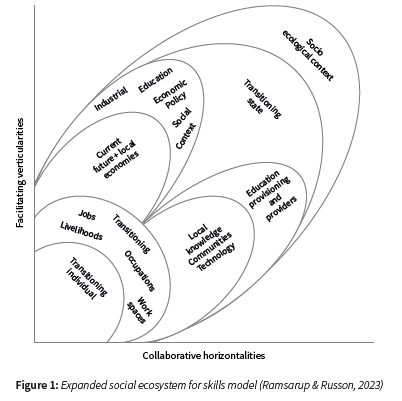
The transition towards sustainable, localised and just food economies requires fundamental structural changes within the skills development system. South Africa's current skills models remain siloed and inadequate for addressing the food system's complex social, technical and ecological dynamics. To address this gap, this article draws on the social skills ecosystems framework to develop an integrated mapping tool that examines skills as an enabler between verticalities (policies and hierarchical structures) and horizontalities (collaborative networks and local actor relationships) within local food economies. The tool was trialled across three South African case studies in the Eastern Cape, KwaZulu-Natal and Gauteng. Initial desktop-based mapping results reveal a systemic bias in regional education and training towards large-scale commercial agriculture, alongside a generic short-course culture lacking clear learning pathways. These models marginalise smallholder farmers and informal traders and provide limited support for sustainable practices such as urban farming and agroecology. Findings further highlight a policy-implementation gap, with municipalities often lacking the capacity to translate local strategies into action, resulting in reliance on under-supported non-state actors. We argue that transitioning to a just food system requires moving beyond linear, individualistic supply-and-demand approaches. The mapping tool offers a practical mechanism for grounded, place-based skills planning that strengthens collaboration between policy frameworks and local implementation to support sustainable living, working, and learning.
skills ecosystems; just transition; local food systems; skills planning
 Thumbnail
 Thumbnail