Tree Planting in Semi-Arid Urban Areas: Lessons from Somalia
Abstract
This article is based on 'Green Garowe', a tree planting action research project that was conducted in the drought-affected city of Garowe, Puntland state, Somalia. The project embraced a co-production approach that called for collaboration between the local government of Garowe, community members and Puntland State University researchers. A qualitative research approach was adopted with a tree-planting demonstration that enabled the research team to develop a holistic understanding of the enablers and constraints to tree planting in the city of Garowe. The findings revealed that tree planting in the city of Garowe was low due to social, ecological, climatic and economic conditions. The study also revealed that Garowe had a high tree deficit, necessitating the planting of 90 000 trees by the year 2030. Evidence from the tree planting demonstration revealed that trees can grow in semi-arid urban areas like Garowe with a success rate of over 90% only if they are taken care of and well protected. The study also revealed the significance of engaging local leaders in the fight against climate change through tree planting initiatives. The study further emphasises the importance of adequate public education and awareness campaigns on climate change, establishment of proper policies and legal frameworks on environmental conservation, better resource mobilisation strategies and relevant research on tree planting and care as key ingredients in promoting urban greening and combating climate change and its impacts as highlighted by SDG 13.
tree planting; tree protection; semi-arid urban areas; urban greening; coproduction; public environmental education
Introduction
Environmental degradation is the biggest threat facing humanity in both rural and urban settlements (Mohamud & Parvin, 2021). It threatens biodiversity, health of humans and wildlife (Jin et al., 2021). According to the United Nations Environmental Programme 36.3% of the Earth's surface has been degraded to become either semi-arid or arid (Chaudhry & Tewari, 2017). It was also revealed that between 2000 and 2005, over 36 million hectares (1%) of green cover were lost due to degradation (Food and Agriculture Organisation [FAO], 2022). Though Africa is considered to be home to 43 billion trees, the continent leads in losing green cover and it is estimated that the African continent loses 4 million hectares of trees per annum (FAO, 2021). Additionally, there is research evidence that demonstrates that between 2000 and 2005, the African continent lost 3.2% of its forested area (Hussein, 2017).
Statistical data from Somalia suggest that the country loses between 1.5% and 6% of its forestry each year due to deforestation (Hughes et al., 2020). By 2015, Somalia's forest cover had declined from 9 050 000 ha to 6 363 501 ha in 40 years (FAO, 2015). Further studies revealed that between 2001 and 2021, Somalia suffered a substantial loss of 429 000 hectares of forest cover, which resulted in severe droughts and floods, causing widespread human displacement (Dubow, 2022). Evidence shows that by 2022, over 3 million people were internally displaced and 43 000 had lost their lives as a result of hunger and starvation in Somalia (International Rescue Committee, 2023).
According to the United Nations Department of Economic and Social Affairs [UNDESA] (2019), by 2018, approximately 55% of the world's population resided in urban areas. This number is expected to increase to 70% by the year 2050 (Seto & Shepherd, 2009). Although Africa remains predominantly rural, with only 43% of its population residing in urban areas (UNDESA, 2019), Somalia's urban population is experiencing an unprecedented surge in growth. It is projected that by 2026, Somalia's urban population will surpass the rural population for the first time in history (Aubrey & Cardoso, 2019). Despite the increasing urban population, the urban spaces that host millions of residents still have limited green spaces to accommodate the growing numbers in both the developed and developing countries (Jim, 2012).
Large-scale tree planting may be a vital strategy to address the climate change crisis (Brancalion & Holl, 2020). It is recommended that urban areas with elevated temperatures should have at least 30% green coverage to promote urban cooling (Doick, 2022).
This recommendation is in line with Target 11.7 of Sustainable Development Goal 11 which states that "By 2030, [there should be] ^ universal access to safe, inclusive and accessible, green and public spaces, in particular for women and children, older persons and persons with disabilities" (United Nations [UN], 2023, p. 39). This is because urban forests and green spaces provide numerous benefits (Kondo et al., 2018). Urban forests are instrumental in controlling floods, subduing urban heat and controlling environmental degradation (Cuthbert et al., 2022; Jin et al., 2021). Furthermore, trees and green spaces in the urban areas contribute to air purification, in addition to providing shade and cooling to both people and animals (Hand & Doick, 2021). Additionally, street trees enhance the aesthetics and functionality of urban roads (Kilongosi et al., 2020). There is also considerable evidence to suggest that urban residents prefer trees planted in public places like parks and recreational areas (Ambrose-Oji et al., 2021).
According to Gwedla (2020), tree planting in urban areas is either facilitated or hindered by biophysical factors, social factors and resource factors. The biophysical factors include the climate of the area, the urban infrastructure design and development, soil type and water availability. These can contribute to the survival or death of the trees (Koeser et al., 2014). Furthermore, most parts of the cities like roadsides and parking lots are covered with concrete and steel. The concrete retains heat making it challenging for trees to grow (Scalenghe & Ajmone-Marsan, 2009).
Social factors highlight the cognitive, normative and institutional factors that hinder or promote tree planting in cities (Gwedla, 2020). Studies show that a background of planting trees contributes to the love for trees (Riedman et al., 2022). Some scholars suggest that urban residents dislike trees because they think that trees damage infrastructure, for example, cracking sidewalks (Camacho-Cervantes et al., 2014).
Resources need to be considered for tree planting in urban areas. Resources include knowledge on tree planting and benefits, finances to fund tree planting activities, technology and human resources to implement the tree planting activities (Gwedla, 2020). According to Ambrose-Oji et al. (2021), good planning in terms of fund mobilisation and allocating tree planting spaces contributes significantly to successful tree planting. The distribution of trees to urban residents is key in increasing tree cover in urban areas (Dawes et al., 2018).
This article presents the findings of a study that was conducted in a semi-arid urban area of Garowe, Puntland, Somalia with the input of community members during the design process of the study. The study elucidates the challenges faced by urban dwellers in semi-arid areas regarding tree planting and tree care. It also highlights the diverse interventions adopted by the community dwellers to preserve green spaces in these areas.
Methodology
The study was conducted in Garowe, the capital of Puntland, a federal member state of Somalia. The city is divided into nine administrative villages with an estimated population of 150 000 people and 23 110 households (UN Human Settlement Program, 2019). The city is located in the north-eastern region of Somalia with limited precipitation of only 90 mm per annum and an average daily temperature that ranges between 27 to 37 degrees Celsius (Somali Health and Demographic Survey [SHDS], 2020). Poverty is widespread in the city, with 87% of the population living on less than $1 per day. The residents have annual per capita income that ranges between $150-$200 (Garowe Local Government, 2019).
The study employed a qualitative action research approach to explore the participants' experiences with tree planting. Co-production, a collaborative approach involving researchers and individuals or groups with lived experience or expertise in the relevant study domain, was adopted to enhance knowledge on tree planting among city residents. Brainstorming was helpful during the design stage of the study. Community members and local village leaders provided suggestions for the topics they wanted the study to cover, which included the perception of city residents regarding tree care and planting, the challenges encountered during tree planting, and cost-effective methods for tree protection. The researchers also anticipated that tree planting demonstrations would create a ripple effect of tree planting throughout the city. In collaboration with local leaders from the nine villages, the research team planted 106 trees in the city to demonstrate to the village members better methods of tree planting and care. The trees were planted in households of selected residents who were given the responsibility for watering and caring for the planted trees. In addition, data was collected using other methods that included the following.
Focus group discussions
The researchers conducted three focus group discussions to collect opinions and perceptions of city residents on tree planting. The three groups comprised of 12 Green Garowe champions, 9 village local leaders (3 female and 6 male) and local experts on tree planting. The focus group discussion provided useful insights on challenges and perceptions associated with tree planting in the city. Additionally, the research team conducted panel discussions and brainstorming sessions on tree planting during the project's implementation. The primary objective of these discussions was to disseminate comprehensive information on tree planting and climate change to the general public.
Interviews
The research team conducted three interviews with the city mayor, the local councillor responsible for the municipality's environmental committee, and three tree nursery farmers. The city mayor unveiled the municipality's comprehensive plans for tree planting and green spaces and described various interventions implemented by the government and the private sector. The local councillor emphasised the municipality's collaborative efforts with private companies that provide water for watering urban trees. Nursery farmers detailed prevalent tree species commonly planted in Garowe, along with the associated costs and challenges encountered during tree planting and care.
ObservationThe research team conducted transect walks and city drives to gather information on the city's tree coverage, protection, and care practices. This data was supplemented by satellite images and drone videos. The information collected through these methods aided the research team in estimating the city's tree deficit and identifying care challenges.
Document review
The research team reviewed documents such as municipal reports and research articles on tree planting in urban areas especially on streets and tree planting in semi-arid areas for better understanding on tree planting.
The data collected by drone video shots and transect walks was quantitatively analysed by estimating the number of trees in the households and on the streets. Data collected using interviews and focus group discussions was analysed qualitatively to establish the common themes and patterns of the responses.
Results
Overview of tree coverage in Garowe city
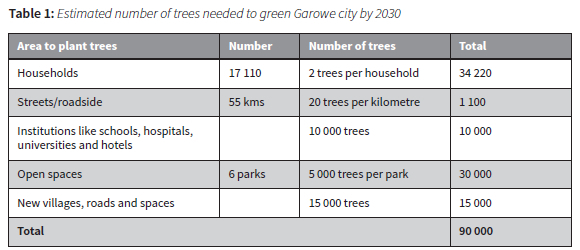
The study revealed that tree planting was limited, well below the recommended standards proposed by Doick (2022). The transect walks and aerial drone footage showed that only 15%-20% (4 500 - 6 000) of city households had planted a tree or two at the time of the study. In addition, though the city had 61kms of roads at the time of the study, only 5-10% (3-6 km) had trees on the sides of streets. It was estimated that Garowe city had a tree deficit of 90 000 trees as calculated in the table below.
The table above shows the estimated number of trees needed to green Garowe by 2030. The research team estimated that over 75% (17 110 households) did not have a tree planted in their compound or in front of their house. It was also-discovered that 55 of the 61 kilometres of roads in the city did not have trees. If 20 trees are planted within the spacing of 10 metres on each side of the road, this would equal 1 100 trees on the streets of Garowe.
Additionally, the study discovered that the city had limited green space for leisure and other social activities. Though the city mayor revealed a plan for six parks in the city, the study found that only two green parks are currently managed by local government with a total number of 150 trees. The other four parks are yet to be established. It was also discovered that the number of suppliers of tree seedlings was limited and their production capacity was constrained. The interview conducted with the local seedling providers revealed that the city had only five nursery farms capable of providing only 31 000 seedlings. Furthermore, the research team observed that the nursery farms lacked indigenous tree species, with a significant proportion of seedlings being exotic. One of the nursery farm owners, in an interview, stated that "Indigenous trees such as acacia are challenging to maintain and require a substantial amount of time for growth". The prevalent trees in the city include neem (Azadirachta indica) and dhamas (Conocarpus lancifolius).
Enablers of tree planting and survival
The presence of local influencers
Despite the lack of widespread adoption of tree planting among city residents, the study appreciated the ongoing efforts by the local clan leaders to influence their followers to plant and grow trees. The study found that through kinship and clanship ties popular in Somalia, people are mobilised to plant trees. During a focus group discussion, village leaders revealed that "The clan leaders, religious leaders and local leaders encourage residents to plant trees but that is all we can do". Another local leader claimed that "We would like to make it mandatory for marrying couples to plant trees before they are wedded in the mosque". These social campaigns have encouraged people to plant trees in their compounds or in front of their houses.
The social benefits of trees
Somalis are people who like socialising and dialogue, usually at local restaurants, tea points and under trees. The study found that trees were "socialising agents and drivers" that must be protected and preserved. The village local leaders revealed in a focus group discussion that "People use trees to discuss their issues and also resolve social problems; our clan leaders sit under trees to resolve disputes". These social benefits help people understand the importance of planting trees. During social activities, often under trees, education can take place with discussions on climate change and tree planting.
The support and role of government
The study learnt that government, particularly through the Ministry of Environment, Agriculture and Climate Change, played a pivotal role in promoting tree planting. The central government's main role included policy making, research and educational campaigns on the importance of trees and climate change education. It was noted that the ministry supplied tree seedlings and technical expertise to farmers. An interview conducted with one of the nursery tree farm owners in the city revealed that while government has played a significant role in supplying tree seedlings and designing policy interventions, these efforts are still insufficient: "Government has played a big role of supplying tree seedlings, but it is not enough, people have no money to buy the protective materials". This meant that though the government encouraged people to plant trees, these trees often did not survive as they needed to be protected from animals. The study revealed that the local government of Garowe implements a policy to incorporate roadside tree planting by contractors who win tenders for constructing city roads. An interview with the mayor indicated that all contractors involved in road projects were obligated to plant trees on newly constructed roads. The mayor stated, "We are developing innovative strategies to promote and enhance tree planting within the city. Currently, we are engaging in negotiations with road contractors to incorporate tree planting as one of the deliverables for road construction projects."
Collaboration with NGOs and the private sector
The study underscored the pivotal role of non-governmental organisations (NGOs) and the private sector in the promotion of tree planting initiatives. During an interview with the city mayor, he emphasised that "NGOs such as Care International have been actively engaged in tree planting as a proactive measure to combat climate change!" Furthermore, he disclosed that organisations like the National Energy Corporation of Somalia (NECSOM) and Nugaal Water Company (NUWACO) have made substantial contributions to tree planting and maintenance within the city: "NECSOM has planted over 180 trees along Israac road, which they diligently protect and maintain." NUWACO provides the municipality with 8 000 litres of water daily for the watering of trees in parks and along the streets. The municipality's responsibility is to provide the vehicle that transports this water.
Additionally, the research team observed that while some households have established irrigation systems for tree watering, the majority of city residents continue to use watering cans.
Availability of tree protection materials
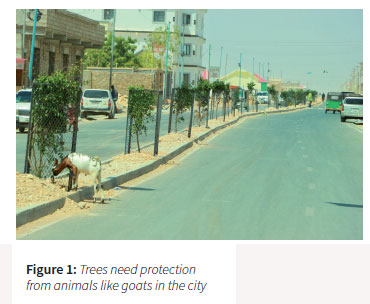
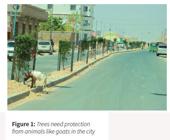
In the city of Garowe, tree protection is imperative. A study revealed that trees can only thrive with adequate protection. A tree planting demonstration successfully planted 106 trees in nine villages. After three months, 98 trees had survived (a remarkable 90% survival rate). This success can be attributed to the protection provided to these trees. Trees needed to be protected from urban livestock like goats and sheep, that loiter around the city and against accidents caused by humans. Through observation, the study found that approximately 95-98% of the trees planted in the city were protected (see Figure 1). The primary methods of protection included concrete blocks, galvanised wire mesh, perimeter walls, sisal bags, and plumbing pipes. The materials for protection were readily available in the city but were prohibitively expensive for the majority of the population. One Green Garowe champion shared in a focus group discussion that "To plant a tree in Garowe, one requires protective materials to safeguard the tree from goats, but these materials are very expensive."
Barriers to tree planting
Social barriers
Social barriers related to social aspects and normative culture are embedded in the day to day living of city residents. Some of these prevent people from enjoying the benefits that come with planting trees. Social factors included the nomadic culture of city residents and negative perceptions of trees.
Nomadic nature/culture of the city residents
The majority of the city's residents originate from nomadic communities. These nomadic communities have traditionally engaged in the practice of cutting trees to construct fences and shelters for their livestock. One of the village leaders provided an insight into this culture, stating, "The majority of Garowians are accustomed to felling trees to erect fences that effectively control the movement of animals and prevent escapes!' The city mayor intimated that "Somalis are born with an axe in their hands". This statement underscores the preference for tree cutting over tree planting within the community.
Negative perceptions of trees
The study revealed several prevalent misconceptions regarding trees and tree planting practices. It emerged that certain individuals held erroneous beliefs such as the notion that trees could generate electric shocks, contribute to increased electricity bills, serve as breeding grounds for mosquitoes, attract lightning strikes during rainy seasons, and provoke conflicts within neighbourhoods during periods of strong winds.
A village local leader highlighted the pervasive societal myth that asserts, "Trees planted in residential compounds consume electricity consequently raising electricity bills'. Furthermore, the study discovered many individuals expressed fear regarding the responsibilities associated with tree planting and care, as described by a Green Garowe Champion, "People dislike planting trees because they fear to take care of them". Another village leader related the challenges faced in caring for trees in Garowe, likening it to raising children. He asserted "I have faced many challenges, caring for trees in Garowe is like raising children."
These misconceptions have had a detrimental impact on tree planting initiatives. Numerous residents have even destroyed trees planted by the local government along the streets (in front of their residences) to relieve themselves of the responsibility of caring for them. The local councilor in charge of the environment disclosed that "With no genuine reason, residents pour Coca-Cola on young tree seedlings to kill trees planted at their compounds by the local governments'. One of the village local leaders revealed that "People do not take care of trees planted in front their compounds because they assume it is not their responsibility'. Another perception was that trees occupy valuable space that could be utilised for displaying merchandise or parking purposes.
Resource barriers
These are factors associated with financial and technical resources. They included the high cost of tree planting, the absence of technical capacity at the local government, and limited knowledge on suitable tree species.
High cost of tree planting
The study discovered that this was the primary obstacle to tree planting in Garowe, both at the individual and local governmental levels. A demonstration exercise conducted by the study revealed that the cost of planting a tree ranged from $80 to $100. This cost breakdown included the purchase of tree seedlings ($10-$15), preparation of the planting ground ($20-$30), acquisition of protective equipment ($30-$40), transportation of materials ($10-$15), and construction of a protective foundation ($10-$20). Data from the Garowe local government website indicated that 87% of the residents possessed a per capita income of $200, while 69% were unemployed. This economic situation posed a significant challenge for such households to afford the cost of planting a tree, which ranged from $80 to $100. Local village leaders expressed their concerns, stating that tree planting in their city was excessively expensive, and there was a lack of willingness from individuals to provide seedlings and protective materials. Furthermore, the local government did not have a dedicated budget allocated for tree planting.
The city mayor clarified that while there was a demand for trees and protective materials, the municipality lacked the capacity to provide them. The local councilor representing the environment committee at the municipality disclosed that the municipality had planned to collaborate with workshops that would offer protective materials at a reduced cost, thereby mitigating the financial burden of tree planting. He revealed that "The municipality was planning to collaborate with workshops (welders) that would offer protection materials at a subsidised cost".
Absence of technical capacity at the local government
Despite the presence of an environmental department within the municipality, the department was inadequately equipped to manage tree planting initiatives. The department lacked personnel with the requisite technical expertise in tree planting and relied on the guidance of experts from the Ministry of Environment. Furthermore, the department lacked the required equipment to facilitate tree planting activities. The city mayor disclosed that "There is a department for environmental conservation, but the department is not staffed, there are no equipment and personnel to facilitate the tree planting exercise, we only have one water truck that is at times not operational due to mechanical defaults".
Limited knowledge on suitable tree species
The study revealed that some city residents lacked knowledge on tree species suitable to plant, the amount of water needed by a tree, ground preparation for tree planting, the diseases that affected trees, and knowledge on effective tree protection and preservation methods. The lack of knowledge resulted in planting trees that were not suitable for certain areas. For example, Conocarpus lancifolius, locally known as dhamas, was the most planted tree species in the city. However, it had its challenges. In a focus group discussion with the village local leaders, they revealed that "Dhamas is not suitable for homes where we have berkads (water sources). Its roots grow towards the water source, causing damage to the building if it is planted near a toilet." In addition, some residents disliked trees because they shed leaves, making the compound untidy.
Biophysical barriers
These are factors associated with ecological and physical aspects that hinder tree planting. They include poor soil in the city, harsh climatic conditions, and urban livestock, pests and diseases.
Poor soil in the city
The study found that shallow, stony, and hard soils of Garowe were impermeable and not conducive to tree growth. Concrete city sidewalks were also a major hindrance. Through observation, it was discovered that most commercial buildings lacked space for trees because most of the ground is covered in concrete. One of the Green Garowe Champions noted that "It is very hard to grow trees because they hardly survive here; the soils have limited nutrients necessary for tree growth and survival". Being surrounded by concrete further hinders growth; one of the champions pointed out that "The roads are getting covered with concrete and tiles, leaving no space for trees". In addition, the study discovered that the city had narrow roads which could not accommodate the planting of trees, establishing sidewalks or water drainage channels. The village local leader commented that "Our people want to plant trees, but we have no open spaces".
Harsh climatic conditions
At the time of the study, Garowe experienced an average daily temperature that fluctuated between 25 and 40 degrees Celsius. The city also experiences one of the lowest annual precipitation rates of 90 mm, which presents a challenging environment for tree growth. The village leaders noted that "It is too hot here throughout the year, sometimes we go for a year without receiving rain". Furthermore, during the months of June and August, the city and the surrounding region are subjected to intense and rapid winds that reach speeds of approximately 40 kilometres per hour. The winds make it difficult for the young trees to grow as they are susceptible to breaking. The village leaders also noted that "Those with trees are always conflicting with their neighbours because the heavy winds make the trees lean or bend on their neighbours' house roofs, hence sparking conflicts. It is one reason why people cut trees during this season".
Urban livestock, pests and diseases
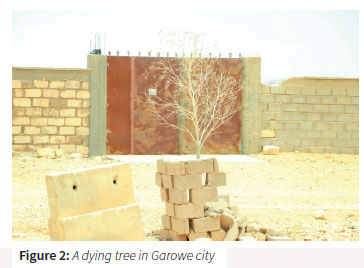
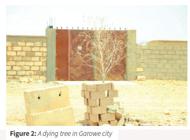
Given that the city is predominantly inhabited by individuals from nomadic communities, many residents traditionally prefer to live with livestock in their homes. Many families have goats and sheep which they leave to loiter in the city. Due to food scarcity, these animals resort to consuming dry paper and tree leaves. Tree protection is imperative, resulting in significant costs associated with tree planting initiatives. The city mayor revealed that "We have made attempts to remove animals from the city but people keep bringing them back". The excessive animal population in urban areas not only adversely impacts the growth of trees but also leads to traffic congestion, as individuals often have to wait for the animals to cross the roads. Additionally, it was revealed that numerous trees in the city had died due to either water scarcity or pest infestations and diseases (see Figure 2). The prevalent pest is the fall armyworm, which causes leaf damage, severely compromising trees' ability to thrive.
Discussion
This study investigated the enabling and hindering factors associated with tree planting in the city of Garowe. Though Doick (2022) recommended that urban areas should have a green coverage of 30%, the findings from Garowe reveal that the city is still far below this recommended standard. Only 15-20% of the households in the city had planted trees, and only 5-10% of Garowe streets have been planted with trees. The low coverage is attributed to various social, economic, administrative, and biophysical factors, as outlined in the results section above. These findings align with Gwedla's (2020) research, which suggests that social, biophysical, and resource factors significantly influence tree planting, growth, and survival. Monteiro and Doick (2021) concur with the study's findings. They identified that the growth and survival of trees were dependent on adequate water supply, soil quality, the absence of ground cover, effective landscaping, and the provision of suitable pits tailored to specific tree species. These factors necessitate substantial resources.
The research conducted in Garowe revealed that the existing tree nursery farms were insufficient to meet the city's demand for trees. The study identified a significant tree deficit of 90 000 trees, while the available nursery farms could only provide 31 000 tree seedlings. Furthermore, it was discovered that indigenous tree species, such as acacia, had been neglected. The acacia tree holds immense significance; even the city name 'Garowe' is derived from this tree. The study also found that the city's residents tended to prefer exotic tree breeds from Asia and other regions of Africa. This finding aligns with the findings of Oldfield et al. (2013), which revealed that in numerous urban areas, exotic tree species pose a significant threat to the survival of indigenous tree species. Consequently, it is imperative that proactive measures be implemented to safeguard the indigenous tree population through the deliberate establishment of forests that exclusively feature indigenous tree species. This proactive approach is crucial in preventing the extinction of these vital components of our ecosystems.
Despite the challenges hindering tree planting in the city of Garowe, the study discovered certain enabling factors, like the role of the ministry in distributing seedlings to the residents and the role of social influencers, like religious leaders and clan leaders, in mobilising the community. Tree distribution by the ministry is helpful according to the findings of Dawes et al. (2018) who claimed that free tree seedling distribution increases tree planting and coverage in urban areas. Riedman et al. (2022) noted the importance of role models who promote tree planting. In addition, the study highlights the importance of a good strategic plan for tree planting initiatives in urban areas. This idea is supported by Camacho-Cervantes et al. (2014) who highlighted the importance of proper planning in promoting the environmental quality of the city. These discoveries are instrumental in promoting tree planting and fighting against climate change. However, they have to be intentional and deliberate with proper courses of action. Engaging the community in tree planting and tree preservation campaigns is also important. However, this requires proper coordination, planning and organisation.
Conclusion
Although tree planting remains at a limited scale within the city of Garowe, there is sufficient evidence to suggest that trees can thrive within this urban environment. The study revealed that given the appropriate environment and resources, tree planting and green spaces can flourish even in semi-arid regions. Therefore, it is imperative that community education on climate change and its effects should be a primary priority for governments and research institutions to ensure the success of tree planting. Furthermore, it is important to identify sustainable funding strategies that be generated by the local community, the diaspora community, donors and the government. Additionally, for cities like Garowe, the availability of cost-effective tree protection materials and environmental regulations is essential in promoting tree planting and preserving the survival rates of trees. Lessons from Garowe show that despite inability of the Somali government and local government to spearhead tree planting campaigns, corporate private organisations and non-governmental organisations (NGOs) have been instrumental in filling this gap. Private organisations and NGOs have planted trees and conducted tree planting campaigns and public education. A tree planting demonstration part of this study revealed that many people did not have technical knowledge regarding planting and caring for trees. They lacked knowledge on the benefits and importance of trees, and the lack of green spaces hindered tree planting. This discovery shows the need for continuous public education on environmental protection and preservation. This can be conducted in local communities and in schools to empower the young generation. Current social media platforms like Tik Tok, You Tube, Facebook can help to engage the younger generation. Finally, it is recommended that specific days be appointed on the calendar for tree planting activities.
Notes on Contributors and their ContributionsLead author
Samanya, John
John Samanya is a seasoned social worker with over 15 years of experience in teaching, administration, project management, and research. His research interests encompass climate change, social protection, child protection, and community development.
Co-author
Abdikarim Adam Jama
Abdikarim Adam Jama is a civil engineer and researcher with expertise in water management, climate change resilience, and sustainable development. His research primarily focuses on climate change, water management, and irrigation systems.
Co-author
Ahmed Shire Ahmed
Ahmed Shire is an economist, academician, and researcher with extensive knowledge of local government finance management, public policy, and economic monitoring. He has also engaged in various consultancies with local and international organizations in Somalia.
Co-author
Abdulkadir Hamid Mohamed
Abdulkadir Hamid holds a master's in Public Economics and three bachelor's degrees in Public Administration, Law, and Education, with experience in consultancy and research in the field of taxation, financial management, and socio-economic development.
Co-author
Abdulkadir Ahmed Warsame
Abdulkadir A. Warsame is a professional with expertise in climate change, management, and academia. He holds a master's degree in Climate Change and Environmental Sustainability and a Master of Business Administration, with several publications.
References
-
Ambrose-Oji, B., Scott, E., Moffat, A., Doick, K., Paterson, A., & Bye, R. (2021). Public perceptions of urban trees: results of focus group discussions in England, Scotland and Wales. Technical report. https://www.researchgate.net/publication/356726737_Public_Perceptions_of_Urban_Trees_Results_of_Focus_Group_Discussions_in_England_Scotland_and_Wales
» https://www.researchgate.net/publication/356726737_Public_Perceptions_of_Urban_Trees_Results_of_Focus_Group_Discussions_in_England_Scotland_and_Wales -
Aubrey, D. & Cardoso, L. (2019). Towards sustainable urban development in Somalia and IDP durable solutions at scale. United Nations-Somalia, Integrated Office of the DSRGC/RC/ HC. https://www.globalprotectioncluster.org/wp-content/uploads/UN-Somali-DSI-Towards-Sustainable.pdf
» https://www.globalprotectioncluster.org/wp-content/uploads/UN-Somali-DSI-Towards-Sustainable.pdf -
Brancalion, P. H. & Holl, K. D. (2020). Guidance for successful tree planting initiatives. Journal of Applied Ecology, 57 (12), 2349-2361. https://doi.org/10.1111/1365-2664.13725
» https://doi.org/10.1111/1365-2664.13725 -
Camacho-Cervantes, M., Schondube, J. E., Castillo, A., & MacGregor-Fors, I. (2014). How do people perceive urban trees? Assessing likes and dislikes in relation to the trees of a city. Urban Ecosystems, 17(3), 761-773. https://doi.org/10.1007/s11252-014-0343-6
» https://doi.org/10.1007/s11252-014-0343-6 -
Chaudhry, P. & Tewari, V. P. (2017). Afforestation: An Effective Intervention for Sustainable Development of Fragile Desert Ecosystem. https://www.researchgate.net/publication/318119920_Afforestation_An_Effective_Intervention_for_Sustainable_Development_of_Fragile_Desert_Ecosystem
» https://www.researchgate.net/publication/318119920_Afforestation_An_Effective_Intervention_for_Sustainable_Development_of_Fragile_Desert_Ecosystem -
Cuthbert, M., O'Carroll, D., & Rau, G. (2022). This is how to reap the benefits of making our cities greener. World Economic Forum. https://www.weforum.org/agenda/2022/02/urban-greening-extreme-weather-climate-change-cities/
» https://www.weforum.org/agenda/2022/02/urban-greening-extreme-weather-climate-change-cities/ - Dawes, L. C., Adams, A. E., Escobedo, F. J., & Soto, J. R. (2018). Socioeconomic and ecological perceptions and barriers to urban tree distribution and reforestation programs. Urban Ecosystems, 21(4), 657-671.
-
Doick, K. J. (2022). Climate change and urban forests: Can urban forests help cities adapt to climate change? Climate change factsheet series. Forest Research. https://www.forestresearch.gov.uk/research/climate-change-and-urban-forests/
» https://www.forestresearch.gov.uk/research/climate-change-and-urban-forests/ -
Dubow, A. (2022). Somalia needs its trees to restore landscapes and livelihoods. World Bank blogs. https://blogs.worldbank.org/africacan/somalia-needs-its-trees-restore-landscapes-and-livelihoods
» https://blogs.worldbank.org/africacan/somalia-needs-its-trees-restore-landscapes-and-livelihoods -
FAO (Food & Agriculture Organisation). (2015). Global Forest Resources Assessment 2015. https://openknowledge.fao.org/server/api/core/bitstreams/5100a18e-1432-42b1-945e-398daac0176e/content
» https://openknowledge.fao.org/server/api/core/bitstreams/5100a18e-1432-42b1-945e-398daac0176e/content -
FAO (Food & Agriculture Organisation). (2021).Towards a continental leadership on environemental data. https://openknowledge.fao.org/server/api/core/bitstreams/cc6e646e-8007-4c5b-b3a4-18f78974b8ad/content
» https://openknowledge.fao.org/server/api/core/bitstreams/cc6e646e-8007-4c5b-b3a4-18f78974b8ad/content -
FAO (Food & Agriculture Organisation). (2022). Somali Water and Land Information Management. SWALIM. https://faoswalim.org/land/soils-somalia.
» https://faoswalim.org/land/soils-somalia -
Garowe Local Government. (2019). https://garowecity.pl.so/economy/
» https://garowecity.pl.so/economy/ -
Gwedla, N. (2020). Barriers to, and enablers of urban tree planting in low-cost housing areas: lessons from participatory learning process in South Africa. Rhodes University. https://commons.ru.ac.za/vital/access/services/Download/vital:41434/SOURCE1
» https://commons.ru.ac.za/vital/access/services/Download/vital:41434/SOURCE1 -
Hand, K. & Doick, K. (2021). Selecting urban trees for ecosystem service provision. Technical report. Forest Research. https://www.researchgate.net/publication/359789958_Selecting_urban_trees_for_ecosystem_service_provision
» https://www.researchgate.net/publication/359789958_Selecting_urban_trees_for_ecosystem_service_provision -
Hughes, K., Oduol, J., Kegode, H., Ouattara, I., Vagen, T., Winowiecki, L. A., Bourne, M., Neely, C., Ademonla, D. A., Carsan, S., Van Schoubroeck, F., & Chomba, S. (2020). Regreening Africa: Consolidated Baseline Survey Report. World Agroforestry. http://www.worldagroforestry.org/downloads/Publications/PDFS/RP20046.pdf
» http://www.worldagroforestry.org/downloads/Publications/PDFS/RP20046.pdf -
Hussein, S. M. (2017). Understanding the Drivers of Drought in Somalia : Environmental Degradation as a Drought Determinant. Somali Institute for Development & Research Analysis. http://www.sidrainstitute.org
» http://www.sidrainstitute.org -
International Rescue Committee. (2023). Crisis in Somalia: Catastrophic hunger amid drought and conflict. https://www.rescue.org/article/crisis-somalia-catastrophic-hunger-amid-drought-and-conflict
» https://www.rescue.org/article/crisis-somalia-catastrophic-hunger-amid-drought-and-conflict -
Jim, C. Y. (2012). Sustainable urban greening strategies for compact cities in developing and developed economies. Urban Ecosystems, 16(4), 741-761. https://doi.org/10.1007/s11252-012-0268-x
» https://doi.org/10.1007/s11252-012-0268-x -
Jin, J., Sheppard, S. R., Jia, B., & Wang, C. (2021). Planning to practice: Impacts of large-scale and rapid urban afforestation on greenspace patterns in the Beijing plain area. Forests, 12(3). https://doi.org/10.3390/f12030316
» https://doi.org/10.3390/f12030316 -
Kilongosi, C., Kadenyi, N., Bosma, L., Van Steenbergen, F., Kioko, T. M., Messo, J. R., Kidake, B. K., & Kigwa, B. K. (2020). Roadside tree planting manual. https://www.cifor-icraf.org/knowledge/publication/29655/
» https://www.cifor-icraf.org/knowledge/publication/29655/ -
Koeser, A. K., Gilman, E. F., Paz, M., & Harchick, C. (2014). Factors influencing urban tree planting program growth and survival in Florida, United States. Urban Forestry and Urban Greening, 13(4), 655-661. https://doi.org/10.1016/j.ufug.2014.06.005
» https://doi.org/10.1016/j.ufug.2014.06.005 -
Kondo, M. C., Fluehr, J. M., McKeon, T., & Branas, C. C. (2018). Urban green space and its impact on human health. International Journal of Environmental Research and Public Health, 15(3). https://doi.org/10.3390/ijerph15030445
» https://doi.org/10.3390/ijerph15030445 -
Mohamud, I. A. M. A. & Parvin. (2021). Environmental Awareness, Attitude and Participation Among Secondary School Students in Mogadishu-Somalia. Education, Sustainability & Society, 4(2), 50-53. https://doi.org/10.26480/ess.02.2021.50.53
» https://doi.org/10.26480/ess.02.2021.50.53 -
Monteiro, M. V. & Doick, K. J. (2021). Trees, green space and urban cooling. Forest Research https://www.forestresearch.gov.uk/publications/trees-greenspace-and-urban-cooling/
» https://www.forestresearch.gov.uk/publications/trees-greenspace-and-urban-cooling/ -
Oldfield, E. E., Warren, R. J., Felson, A. J., & Bradford, M. A. (2013). Challenges and future directions in urban afforestation. Journal of Applied Ecology, 50 (5), 1169-1177. https://doi.org/10.1111/1365-2664.12124
» https://doi.org/10.1111/1365-2664.12124 -
Riedman, E., Roman, L., Peasall. H., & Maslin, M. (2022). Why don't people plant trees? Uncovering barriers to participation in urban tree planting initiatives. Urban Forestry & Urban Greening, 73(3). https://doi.org/10.1016/j.ufug.2022.127597
» https://doi.org/10.1016/j.ufug.2022.127597 -
Scalenghe, R. & Ajmone-Marsan, F. (2009). The anthropogenic sealing of soils in urban areas. Landscape and Urban Planning, 90(1-2), 1-10. https://doi.org/10.1016/j.landurbplan.2008.10.011
» https://doi.org/10.1016/j.landurbplan.2008.10.011 -
Seto, K. C. & Shepherd, J. M. (2009). Global urban land-use trends and its impacts. Current Opinion in Environmental Sustainability,1(1). https://doi.org/10.1016/j.cosust.2009.07.012
» https://doi.org/10.1016/j.cosust.2009.07.012 -
Somali Health and Demographic Survey [SHDS]. (2020). Puntland Report 2020. https://nbs.gov.so/wp-content/uploads/2023/07/SHDS-Puntland-Report-2020.pdf
» https://nbs.gov.so/wp-content/uploads/2023/07/SHDS-Puntland-Report-2020.pdf -
UN (United Nations). (2023). Sustainable Development Goals Briefing Book 2023. https://unpartnerships.un.org/publications/2024/sdg-brienng-book-2023
» https://unpartnerships.un.org/publications/2024/sdg-brienng-book-2023 -
UNDESA (United Nations Department of Economic and Social Affairs). (2019). World Urbanisation Prospects: The 2018 Revision. https://population.un.org/wup/Publications/Files/WUP2018-Report.pdf
» https://population.un.org/wup/Publications/Files/WUP2018-Report.pdf -
United Nations Human Settlement Program. (2019). Garowe Urban Profile: Working paper and spatial analyses for urban planning consultations and strategic spatial planning. https://unhabitat.org/sites/default/files/documents/2019-07/garowe_city_pronle.pdf
» https://unhabitat.org/sites/default/files/documents/2019-07/garowe_city_pronle.pdf