On the Transformative Potential of Ecopedagogy in Environmental Education
Amidst mounting environmental crises, achieving sustainability emerges as a paramount imperative for both humanity and the planet. This article explores the crucial role of environmental education in fostering sustainable practices on Earth, with a specific focus on the transformative potential of ecopedagogy. It argues that existing educational systems significantly hinder sustainability efforts by perpetuating principles and values that endorse unsustainable lifestyles driven by neoliberalist ideology. Drawing on contemporary research and theoretical frameworks, the article investigates how ecopedagogy can cultivate ecological literacy and instil a transformative ethos among learners. It advocates for a comprehensive overhaul of environmental education by examining prevailing educational paradigms that reinforce unsustainable behaviours. Through critical analysis and dialectical inquiry, ecopedagogy offers a pathway to deeper comprehension of the intricate connections between social conflicts and environmental degradation, paving the way for innovative solutions. Ecopedagogy's approach involves critically analysing the nexus of social conflicts and environmental devastation, facilitating a nuanced understanding from which sustainable solutions can emerge. Furthermore, the article underscores the vital role of environmental education in various nations as a contributor to sustainability. Overall, it elucidates how ecopedagogy can catalyse transformative change toward a more sustainable future for all.
ecopedagogy; environmental education; sustainability; sustainable development goals
On the Transformative Potential of Ecopedagogy in Environmental Education
Jerry John IntsifulI; Emmanuel IntsifulII; Fred Kofi BoatengIII
IBeijing Normal University
IIOklahoma State University
IIIUniversity of Ghana
Amidst mounting environmental crises, achieving sustainability emerges as a paramount imperative for both humanity and the planet. This article explores the crucial role of environmental education in fostering sustainable practices on Earth, with a specific focus on the transformative potential of ecopedagogy. It argues that existing educational systems significantly hinder sustainability efforts by perpetuating principles and values that endorse unsustainable lifestyles driven by neoliberalist ideology. Drawing on contemporary research and theoretical frameworks, the article investigates how ecopedagogy can cultivate ecological literacy and instil a transformative ethos among learners. It advocates for a comprehensive overhaul of environmental education by examining prevailing educational paradigms that reinforce unsustainable behaviours. Through critical analysis and dialectical inquiry, ecopedagogy offers a pathway to deeper comprehension of the intricate connections between social conflicts and environmental degradation, paving the way for innovative solutions. Ecopedagogy's approach involves critically analysing the nexus of social conflicts and environmental devastation, facilitating a nuanced understanding from which sustainable solutions can emerge. Furthermore, the article underscores the vital role of environmental education in various nations as a contributor to sustainability. Overall, it elucidates how ecopedagogy can catalyse transformative change toward a more sustainable future for all.
Keywords: ecopedagogy, environmental education, sustainability, sustainable development goals
In the wake of escalating global dynamics propelled by capitalism, state interests, and the imperatives of globalisation, the imperative for higher standards of living has placed immense strain on the environment (Huang et al., 2019). Despite concerted global efforts, exemplified by initiatives such as the Sustainable Development Goals (SDGs), the anticipated outcomes in mitigating environmental degradation remain elusive (Leal Filho et al., 2020). This juxtaposition underscores a critical dilemma: our pursuit of enhanced living standards appears irreconcilable with the imperative of environmental stewardship.
This article endeavours to unpack this paradox by exploring the evolving landscape of environmental education in the context of the burgeoning solidarity economy - a socioeconomic paradigm emphasising collective welfare and sustainable practices (Libel & Kashwan, 2020). Central to this exploration is an inquiry into the potential of 'ecopedagogy', a progressive educational approach that scrutinises the intricate nexus between social conflicts and environmental degradation (Misiaszek, 2020).
Environmental education aims to cultivate citizens who understand the biophysical environment and its issues, enabling them to address the consequences of their actions (Gough & Gough, 2010). However, the solidarity economy's principles of inclusion and social emancipation, as highlighted by Gadotti (2008a), sometimes justify environmental harm as necessary for satisfaction and freedom. Consequently, current living standards heavily reliant on resource extraction lead to alarming depletion of natural resources (UNEP, 2023).
Sustainability, crucial for averting disaster, entails maintaining a balanced environment harmonising resource exploitation, investment, technology, and institutional change (Mohammadhadi & Somayeh, 2021). This concept aligns with sustainable development, meeting present needs without compromising future generations (Sakalasooriya, 2021). Despite this, prevailing environmental education models often fail to actively engage citizens (Febriasari & Supriatna, 2017), hindering global sustainability efforts. Ecopedagogy emerges as a solution, critically analysing the nexus between social conflicts and environmental devastation, fostering deeper understanding and potential solutions (Misiaszek, 2020). This approach addresses the subtle, yet damaging impact of environmental harm often overlooked in conventional education, bridging the gap between sustainability and education.
To address this, an all-encompassing approach is necessary, as the current educational system and environmental education models are not adequately solving the world's environmental problems. Changing the world and its systems is an incredibly challenging task that demands sacrifice, attention, and prioritisation. Thus, to accomplish this bold objective, one must appreciate, understand, and objectively perceive the world, which necessitates a collective effort (Morrow & Torres, 2019).
Ecopedagogy can help address the current limitations of environmental education models which has over the years failed to achieve the intended goal of sustainability (Göbel, 2022). As a critical educational pedagogy, it champions the promotion of critical thinking, educators as role models to learners, sustainable education needing action now, reconnecting with nature and the empowerment of the learner. When ecopedagogy is incorporated into existing environmental education models, its strengths complement the limitations of these models.
This article leverages contemporary research and theoretical frameworks to assess the effectiveness of ecopedagogy in promoting ecological literacy and fostering transformative attitudes among learners (Göbel, 2022; Morrow & Torres, 2019). It presents and critically evaluates the conceptual argument, leading to a nuanced discussion of its implications for policy, practice, and future research. By highlighting the synergies between Ecopedagogy and sustainability imperatives, this article advocates for a comprehensive redefinition of environmental education. This redefinition goes beyond traditional didactic approaches to embrace experiential learning, critical inquiry, and transformative praxis.
In essence, this article contends that the integration of ecopedagogy into mainstream educational frameworks represents a pivotal step towards nurturing ecologically literate citizens capable of effecting positive change in their communities and beyond. As humanity grapples with the existential challenges posed by environmental degradation, the imperative for a paradigm shift in environmental education has never been more pressing. Through collaborative action and a steadfast commitment to pedagogical innovation, we may yet forge a more sustainable and equitable future for generations to come.
The article begins by exploring the historical evolution of environmental education, noting humanity's growing awareness of its unsustainable relationship with the environment. It discusses the limitations of traditional environmental education models, particularly in terms of global reach and political approach. Highlighting the need for alternative approaches, the article introduces ecopedagogy, emphasising its core tenets such as critical thinking and global citizenship. It examines how ecopedagogy can address the shortcomings of traditional models and promote sustainability by empowering individuals and communities. Furthermore, it discusses ecopedagogy's role in addressing environmental violence and promoting social justice. It concludes by emphasising the importance of integrating ecopedagogy into educational curricula to advance global sustainability efforts, aligning with the United Nations Sustainable Development Goals for 2030.
Emergence of environmental education, limitations and alternative theoretical perspectives
Humans have polluted planet Earth in the past century more than all the periods before industrialization combined (Chu & Karr, 2017). Tracing the history of environmental education reveals how it has shaped the field and highlights the recent necessity to adopt ecopedagogy. When the 'Global North', who are massive extractors and consumers of natural resources, began to realise that their relationship with the environment was becoming problematic and unsustainable, they presented this relationship as some kind of educational assignment that needed urgent attention (Postma, 2006). Two main limitations hampered the effectiveness of an effective environmental education model: global reach and limited political approach.
Global reach
This educational agenda consequently led to the field taking on an international perspective as many scholars believed any environmental pedagogy needed to ensure that its audience acquire the requisite knowledge and skills on all issues concerning on the environment. As pointed out by J0rgensen and J0rgensen (2021), the ultimate aim of any environmental pedagogy is the creation of a population of citizens who are knowledgeable about the biosphere and the difficulties it faces, aware of how to contribute to those solutions, and eager to work toward those solutions.
Consequently, as the fields of environmental education and sustainability attracted increasing attention from the global community, various international organisations began to place environmental education on their topmost agenda. One notable international organisation was the United Nations, spearheaded by its agency, United Nations Education, Scientific and Cultural Organisation (UNESCO). UNESCO asserted that resources must be effectively exploited while ensuring its availability for future generations. From their perspective:
As education for sustainable development (ESD) evolved through diverse viewpoints, approaches, philosophies, and beliefs, UNESCO engaged with the field and emerged as a key advocate. UNESCO emphasized that ESD must focus on the creative and effective use of human potential and all forms of capital to ensure rapid and equitable economic growth with minimal environmental impact (UNESCO, 1992, p. 3)
This view of Education for Sustainable Development (ESD) by UNESCO was critiqued by some scholars as having components of neo-colonial tendencies and as "nothing more (or less) than a neo-colonial concept riding the waves of globalization" (Hesselink, et al., 2000, p.15) seeking to exploit rich resources of former colonies predominantly 'the Global South' by exploiting cheap labour and their political powers through the window of free-market economies. Savelyeva (2017) further asserted that, by the operational definition of ESD, many developing nations in the perceived bid of improving their socio-economic standards, eventually end up being exploited by giant transnational corporations (TNCs).
Limited political approach
With the growing threat of global warming, the strains of a voracious world economy, excessive consumption rates, industrialisation, and climate change, critical environmental problems have emerged that require immediate solutions (Walter, 2009). As discussions about such environmental crises become public discourse, some politicians adopt a limited approach to appear legitimate in the eyes of the public for political reasons (Hannigan, 2006).
In some developing countries, such as Ghana, despite previous calls to cease, when legal/illegal mining began taking a toll on the environment (water, land, biological health), the government implemented measures to curb the issue in a lackadaisical manner merely to gain public legitimacy, while politicians were approving licenses for the same mining companies (Owusu-Nimo et al., 2018). Environmental education has been a heavily contested field regarding what constitutes its pedagogy, on who and what to deliver, and at what time. In doing this some scholars proposed that "One strategy for addressing the multiplicity of theoretical and practical possibilities within environmental education consists of developing a map of this particular pedagogical "landscape" (Sauve, 2005, p. 12). This approach expands the concept of environmental education to many dimensions which will be useful when integrated into education curricula. The core tenets of ecopedagogy align perfectly with this 'landscape'.
Advantages of ecopedagogy
Critical thinking
Ecopedagogy critically helps us understand how and why environmental issues are both the causes and consequences of social conflicts; it focuses on ending or diminishing such social coercions (Misiaszek, 2020). Ecopedagogy has a repertoire of approaches it uses in ending environmental degradation and social conflicts which will subsequently ensure sustainability, embodying a critical and discussion approach (Kahn, 2009). This fosters personal and societal change by disparagingly questioning what is being taught and why (Misiaszek & Torres, 2019).
Dialectic approach
The democratic dispensation used in this dialectic approach to environmental teaching offers potential alternatives to current hegemonic environmental initiatives that will ultimately promote social cohesion (Gadotti & Torres, 2009). Globalisation in recent times, accompanied by its ever-powerful agents such as transnational cooperations (TNCs), mass media, politicians, and the so-called NGOs which are all oriented toward a neoliberalist ideology championing the slogan of free markets systems, has led to new heights in levels of environmental violence. It is not surprising in recent times that the people who have received education and know the most about the effects of environmental degradation are the ones that pollute the environment (Gadotti, 2008b).
This often leads to the exploitation of nature's ecosystem beyond its physical limits of growth or carrying capacity. In recent times, we can observe how influential technology and fashion corporations mostly found in the 'Global North' have the ability to generate addiction and foster consumer loyalty. However, these giant corporations often succeed in concealing the extensive environmental degradation and social conflicts associated with their pursuit of dominance and substantial profits. These conflicts include issues like low wages and employee health concerns (Davies et al., 2019).
The Industrial Revolution in giving humans more control and power over nature, has allowed us to shape the environment to our preferences rather than to be inhibited by it (Hannigan, 2006). However, this control of nature comes with dire consequences as nature prefers to be lived with not subdued against its laws:
Classical man framed a civilized context for human perspective, he was aware that he could defy fate-nature-environment, but only at his own risk, the contemporary man goes further; he attempts to create the world in his image, to build a man-made environment, and then discovers that he can do so only on the condition of constantly remaking himself to fit it. We now must face the fact that man himself is at stake. (Illich, 1983, p.2)
When humans thought that their violence committed against nature was one-way, little did they know that this violence would come back with disastrous consequences for them.
Global citizenship
To explore how ecopedagogy can ensure sustainability in the era of globalisation, with its ever-increasing influence, we need to acknowledge that while globalisation has undergone various transformations and has become irrevocable, its processes are adaptable (Bosio & Torres, 2019; Gadotti & Torres, 2009). Since nearly all environmental education models aim to have global impact and promote sustainable living, "what we need is a pedagogy that educates citizens to be global citizens and responsible stewards of the planet, ensuring sustainability, which is one of the central discourses of Ecopedagogy" (Misiaszek, 2017, p. 14). Educating individuals to become global citizens will empower people from diverse backgrounds to develop the essential skills necessary to actively engage with the world, promote social justice, and live sustainably with the environment (Misiaszek, 2017).
The primary objective of ecopedagogy in teaching global citizens and sustainable development is to delve into the fundamental aspects of education, assisting teachers and students in comprehending environmental issues from their own perspectives, which will then guide their environmental actions. This approach involves dialectical exchanges between teachers and students (Misiaszek, 2020). The dialectical method, also known as a dialectic approach, which entails discussions among individuals with differing viewpoints on a subject, seeks to establish truth through reasoned arguments.
Re-education
To ensure sustainability, individuals must undergo a process of re-education concerning education for sustainable development. This re-education should encompass two aspects: education about sustainability and education for sustainability, considering the theoretical perspective of ESD and exploring ways to make it more sustainable (Gadotti, 2008b). In doing so, we must influence people's attitudes, perspectives, beliefs, and ideological concepts to promote sustainable living with the environment. The aforementioned concepts form the foundational principles for ecopedagogy to foster sustainability. As we delve into more comprehensive and interconnected concepts, we need to consider how education, globalisation, global citizenship, economies, politics, social factors, and other elements influence sustainability.
Globalisation, sustainability and ecopedagogy
It is often difficult to discount how globalisation has impacted all facets of every nation's political, educational, economic, environmental, and social aspects. Many scholars have analysed globalisation from several perspectives. For example, Saul (2005) views globalisation as the emergence of an economic philosophy dominated by private interest in their quest for personal and corporate profits which has led to the alienation of rights and privileges of indigenes in a democratic nation.
Crossley and Watson (2003) also assert that agents of globalisation such as the TNCs and global financial institutions such as the International Monetary Fund (IMF) and the World Bank have managed to demarcate nations into various regional and global economies which have greater influences on these nations' decisions and implementation processes thereby rendering most nations incapable of taking their own decisions over their affairs.
The dynamics of globalisation continue to evolve, but it can be observed that "globalization can also be seen as a process that allows powerful world bodies, such as the World Bank, the World Trade Organisation, and UNESCO, to influence educational policy agendas on a global scale with lightning speed" (Jickling & Wals, 2008, p.4). This influence is evident when, for example, influential bodies like UNESCO reorient environmental education to Education for Sustainable Development (Hesselink et al., 2000; Intsiful & Beasy, 2023). The issue of sustainability and sustainable development has already gained traction in most nations; it is seen as a viable alternative to environmental education and is currently on many nations' top agendas (Jickling & Wals, 2008).
Education is one of the ultimate tools in achieving sustainability, as noted in Chapter 36 of the Earth Summit Report (UNESCO, 1992), which viewed the role of education in ensuring sustainability as critical:
Education is critical for promoting sustainable development and improving the capacity of the people to address environment and development issues, it is critical for achieving environmental and ethical awareness, values and attitudes, skills and behaviour consistent with sustainable development and for effective public participation in decision-making. (United Nations, 1992, p. 2)
However, education cannot be an effective tool without a suitable curriculum and pedagogy; "we thus need to reorient education starting with the principle of sustainability, that is, to redress education in its totality, which implies a revision of curricula and programs, educational systems, the role of the school and the teachers, and school organization" (Gadotti & Torres, 2009, p. 1264). This also suggests that if sustainability and sustainable development are to be achieved, ecopedagogy offers an appropriate pedagogical framework. It is evident that:
Ecopedagogy and education for sustainability are very linked, as Gro Harlem Brundtland said in the preface of the United Nations Report, Our Common Future, unless we can translate our words into a language that can reach the minds and hearts of people young and old, we shall not be able to undertake the extensive social changes needed to correct the course of development. This is one of the tasks of education for sustainability. (Gadotti, 2008a, p. 18)
Although there are various environmental education pedagogies and various ways that seek to provide alternatives to ensuring sustainability like using electric vehicles, using energy-saving appliances, using non-toxic and bio-degradable materials, and a host of others, most sustainable development initiatives irrefutably find themselves folded into the interests of global neoliberals in either their aggressive corporatist or profit-making interests (Kahn, 2009).
As an effective measure, the environmental pedagogy needed in ensuring sustainability involves critical reflection and engagement of citizens (teachers, students, and public) with the current economic, social, and political system, environmental ideals, knowledge in society, and the learner's lived experience (Bell, 2004). This pedagogy must not only be taught in the realm of theoretical basis; theoretical knowledge needs to be put into practice to aid people in solving environmental and other hegemonic actions in different situations (Misiaszek, 2020).
When issues of sustainability are discussed, "educating future generations in the ways of fostering positive change in respect to the environment seems increasingly important" (Kopnina, 2011, p.2). However in educating future generations and the public, what is being taught (the curriculum), how it is been taught (the pedagogy) and what is intended to be achieved is critical: "knowledge is not fixed, cut up in pieces and handed over, but rather co-created by transacting with prior tacit knowledge, the curriculum, and other learners" (Jickling & Wals, 2008, p. 7). This demonstrates a democratic and interactive approach between teachers and learners when discussing environmental issues.
The core function of an environmental pedagogy must empower educators, students, and the public to become critically aware of how they perceive the world to foster citizen engagement with social and environmental issues and participation in decision-making processes which is one of the ultimate goals of ecopedagogy.
Sustainability through ecopedagogy
Levels of environmental degradation continue to rise across the globe. Kolbert (2006) observed that it may seem impossible to imagine that a technologically advanced society could choose, in essence, to destroy itself, but that is what we are now in the process of doing. Based on modernisation across the globe, we cannot expect zero environmental violence because our new ways of living are reliant on extracting resources from the environment.
As Brown (2005) noted, 10% of the Earth's population use well over 90% of its resources, and the drive to consume is greater than the drive to sustain. Sustainability must begin right from the individual in every nation through to the global level,
Environmental issues are increasingly global in scope, with the ever-increasing impact of distant influences on local matters. Global Citizenship Education (GCE) and Ecopedagogy are seen as essential elements to understand and respect socio-environmental connections in different contexts. (Misiaszek, 2015, p. 280)
This critical aspect of ecopedagogy from this article's perspective will be essential if humans are to live sustainably on planet Earth. The issue of sustainability has been a global topical agenda for which most countries have set out various policies and strategies to ensure sustainability and sustainable development. UNESCO is one of the global proponents of sustainability:
Based on studies and research into education for sustainable development, efforts are now being made to produce educational materials for the necessary training in such pedagogy. To facilitate the emergence of an educational reform that would include sustainability as a guiding principle and an educational policy that would support a more qualified teaching and learning process. (Gadotti, 2008b, p. 22)
Critical questions arise from UNESCO's decade of education for Sustainability and Sustainable Development (2005-2015) which is still a global agenda in recent times. One of these questions is "whether the curriculum and pedagogy being implemented with a top-to-bottom approach agree with anti-globalization views or is rather synonymous with neoliberalism". Critical questions like this are what any environmental pedagogy must deal with in its initial approach, hence "sustainability education, therefore, has the rather grand task not only to turn unthinkable into mainstream views but also to jump the barrier between beliefs/awareness and living practice" (Jucker, 2004, p. 20). This espouses the difficult nature of ensuring sustainability in the ever-changing globalized world.
For sustainability to be achieved as Sterling (2001) noted, unless education becomes sustainability education, there is little chance that we can manage the transition to sustainability. This article's authors agree that ecopedagogy can contribute to global efforts for sustainability. The justification for this is that:
Ecopedagogy maintains a critical relationship to the ongoing UN-sponsored Decade of Education for Sustainable Development (2005-2015), ecopedagogy hopes to utilize education for sustainable development to make strategic interventions on behalf of the oppressed, but ecopedagogy also attempts to generate conscientisation upon the concept of sustainable development proper and thereby uncloak it of the sort of ambiguity... (Kahn, 2008, p. 8)
This approach of environmental pedagogy is much needed in the 'Global South' where excessive exploitation by globalisation agents such as TNCs are putting most countries on the verge of an environmental breakdown. In ensuring sustainability, educators, students, and citizens need to understand the impact of environmental violence and ways in which they can critically offer solutions for ending this violence.
When issues of environmental violence and exploitation are discussed, political entities in various nations cannot be left out. It is contingent on policy makers to make changes to the existing environmental education curricula that seek to educate people on environmental degradation but in reality, do not offer citizens the opportunity to express their opinions on how they can live sustainably. As Kahn (2008, p. 9) rightfully stated, ...as a form of critical theory of education, Ecopedagogy can work at a meta-level to offer dialectical critiques of environmental education and education for sustainable development as hegemonic forms of educational discourse that have been created by state agencies that seek to appear to be developing pedagogy relevant to alleviating our mounting global ecological crisis.
Over the years, various empirical research and observations from several countries have proven that education is one of the powerful tools that can bring drastic changes to society which can result in positive changes in people's behaviour, actions and thought processes (Chakraborty, 2018). This espouses the important role of political actors in various nations in our quest to promote sustainability.
Repertoire of ecopedagogy
As a form of critical theory of education, ecopedagogy emphasises that issues of social justice and democracy are not distinct from acts of teaching and learning. This implies that citizens must be made active participants and not mere informants in the whole education process concerning sustainability. According to Jucker (2004), the following essential components of ecopedagogy will strengthen the global efforts in the global quest for sustainability.
Critical thinking
This is an important meta-skill: "Students need to be able to think critically about the nature of knowledge, and about how knowledge is produced and validated" (Jones & Merritt, 1999, p. 350). The development of critical thinking skills is paramount in every educational pedagogy. This provides students and citizens from different backgrounds with the requisite knowledge and skills to adapt to any given situation efficiently. Educating individuals to become global citizens empowers people from diverse backgrounds to develop the essential skills necessary to actively engage with the world, promote social justice, and live sustainably with the environment.
Educators as role models and learners
If educators want to make progress in making societies more just and sustainable, no amount of information given to learners will ensure sustainability if the tutors do not change themselves and their lifestyles to be role models for the students and their communities alike (De Sousa Santos, 2018). This requires some re-education for educators to change from the dominant teacher-centred approach of curriculum delivery to a learner-centred approach so that students/learners can actively participate in the learning process.
Sustainable education needs action now
Knowledge gained through dialectic discourse needs to be put to action. As espoused by Misiaszek (2022), ecopedagogy can be used as a stand-alone teaching method or as a teaching aid in other environmental instructional techniques (e.g., environmental education (EE) and/or education for sustainable development (ESD)). Knowledge gained through the dialectic discourse may support learners to thoroughly understand the consequences of their actions and inactions that cause harm to the environment, and support decoding of the hidden agenda of various environmental policies and activities. This will contribute to a global effort towards sustainability.
Reconnecting with nature
If we want students and people to act sustainably, rather than turn them into highly informed beings, "we need to confront the fact that young people and adults are increasingly being isolated from direct contact with nature" (Plant & Devine, 1998, p. 17). Environmental and sustainability education will need to reconnect them with nature and the real world and develop their sense of belonging to a place and community (Misiaszek & Torres, 2019). This requires some level of re-education for people to know that everyone has a responsibility irrespective of their socio-economic background towards the environment to ensure its sustainability.
Empowerment of the learner
To empower learners, the teacher should act as "a catalyst for the discussion and re-evaluation of human values and practices, not simply to pass on extant "naturalized" knowledge" (Plant & Devine, 1998, p. 7). This means that the "ownership of the knowledge" should not be exclusive to the teacher. Indeed, students should be given the "opportunity to participate in the construction and transformation of study materials in ways that are meaningful in the particular socio-political contexts in which they live and work" (Plant, 1998, p. 110). As education is seen as one of the vital means of achieving sustainability that will aid citizens to live sustainably on the planet, the curriculum and pedagogy used in educating citizens need to allow for a democratic and engaging approach (Dialectic Approach) to equip citizens live sustainably (Misiaszek, 2022).
Conclusion
Environmental education and education for sustainability have been on the agenda of various scholars and international organisations for several decades. The careful analysis of the various thematic areas discussed in this article has provided a broader understanding of how the issues of environmental education and education for sustainability have emerged and their current state. Based on the in-depth analysis presented thus far, it is evident that much remains to be done by nations worldwide in our global pursuit of sustainability.
While efforts made over the years have laid a solid foundation for our future sustainability, incorporating ecopedagogy into the existing curricula of environmental education and education for sustainability by different nations can significantly contribute to the success of global efforts towards achieving the United Nations Sustainable Development Goals (SDG) by 2030.
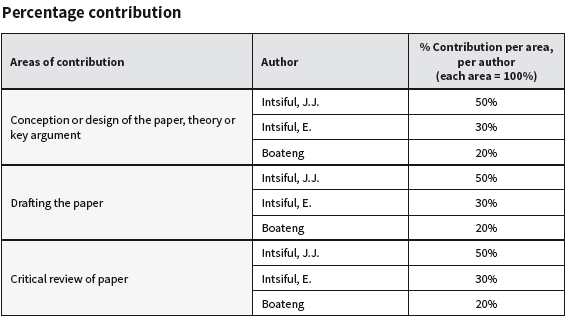
Notes on Contributors and their ContributionsLead author
Intsiful, Jerry John
Jerry John Intsiful has a Master's in Higher Education and Student Affairs. He is a university administrator whose scholarly interests include sustainability, critical studies, equity, and governance in higher education.
Co-author
Intsiful, Emmanuel
Emmanuel Intsiful works across different geographic contexts at the intersection of the humanities and social sciences on a wide range of educational issues. His interests are critical sociology of higher education, higher education policy, Foucauldian studies and issues related to sustainability.
Co-author
Boateng, Fred Kofi
Fred Kofi Boateng is a researcher in education studies in the Department of Educational Studies and Leadership at the University of Ghana. He has an interest in educational research especially in sustainability.
References
-
Brown, J. C. & Purcell, M. (2005). Against the local trap: Scale and the study of environment and development. Progress in Development Studies, 5(4), 279-297. https://doi.org/10.1191/1464993405ps122oa
» https://doi.org/10.1191/1464993405ps122oa -
Bosio, E., & Torres, C. A. (2019). Global citizenship education: An educational theory of the common good? A conversation with Carlos Alberto Torres. Policy Futures in Education, 17(6), 745-760. https://doi.org/10.1177/1478210319825517
» https://doi.org/10.1177/1478210319825517 -
Bell, D. R. (2004). Creating green citizens? Political liberalism and environmental education. Journal of Philosophy of Education, 38(1), 37-54. https://doi.org/10.1111/j.0309-8249.2004.00362.x
» https://doi.org/10.1111/j.0309-8249.2004.00362.x -
Chakraborty, B. (2018). Education as an instrument of social change and enhancing teaching-learning process with the help of technological development. Conference paper, Faculty of Engineering, Nilai University, Malaysia. https://www.researchgate.net/publication/325143953
» https://www.researchgate.net/publication/325143953 -
Chu, E. W., & Karr, J. R. (2017). Environmental impact: Concept, consequences, and measurement. Reference Module in Life Sciences. https://doi.org/10.1016/B978-0-12-809633-8.02380-3
» https://doi.org/10.1016/B978-0-12-809633-8.02380-3 - Crossley, M., & Watson, K. (2003). Comparative and international research in education: Globalisation, context and difference. Routledge.
-
Davies, P., Hernandez, M. P., & Wyatt, T. (2019) Economy versus environment: How corporate actors harm both. Critical Criminology, 27, 85-99. https://doi.org/10.1007/s10612-019-09433-z
» https://doi.org/10.1007/s10612-019-09433-z - De Sousa Santos, B. (2018). The end of the cognitive empire: The coming of age of epistemologies of the South. Duke University Press.
-
Febriasari, L. K., & Supriatna, N. (2017). Enhance environmental literacy through problem-based learning. Journal of Physics: Conference Series, 895, 012163. https://doi.org/10.1088/1742-6596/895/1/012163
» https://doi.org/10.1088/1742-6596/895/1/012163 -
Gadotti, M. (2008a). Education for sustainability: A critical contribution to the Decade of Education for Sustainable development. Green Theory and Praxis: The Journal of Ecopedagogy, 4(1), 15-64. https://doi.org/10.3903/gtp.2008.1.3
» https://doi.org/10.3903/gtp.2008.1.3 -
Gadotti, M. (2008b). What we need to learn to save the planet. Journal of Education for Sustainable Development, 2(1), 21-30. https://doi.org/10.3903/gtp.2008.1.3
» https://doi.org/10.3903/gtp.2008.1.3 -
Gadotti, M., & Torres, C. A. (2009). Paulo Freire: Education for development. Development and Change, 40(6), 1255-1267. https://doi.org/10.1111/j.1467-7660.2009.01606.x
» https://doi.org/10.1111/j.1467-7660.2009.01606.x -
Göbel, B. (2022). Environmental education and its challenges to foster attitudes. Biosphere Reserves Management, 1-9. https://doi.org/10.13140/RG.2.2.14295.14244
» https://doi.org/10.13140/RG.2.2.14295.14244 - Gough, N., & Gough, A. (2010). Environmental education. In C. Kridel (Ed.), Encyclopedia of curriculum studies (Vol. 1, pp. 339-343). Sage.
- Hannigan, J. A. (2006.). Environmental sociology as a field of inquiry. In J. A. Hannigan (Ed.), Environmental sociology (2nd ed., pp. 1-15). Routledge
- Hesselink, F., Van Kempen, P. P., & Wals, A. E. J. (Eds.). (2000). ESDebate: International debate on education for sustainable development. lUCN Commission on Education and Communication.
-
Huang, Y., Ge, Y., & Hu, W. (2019). Multiple dynamic mechanisms of globalization: Alternatives to capitalism. Sustainability, 11(19), 5344. http://dx.doi.org/10.3390/su11195344
» http://dx.doi.org/10.3390/su11195344 - Illich, I. (1983). Rebirth of Epimethean man: Deschooling society. Harper Colophon.
-
Intsiful, E., & Beasy, K. (2023). (Re)Conceptualizing the role and actions of higher education through excellence discourse: Perspectives of University Management and Academics. In K. Beasy, C. Smith, & J. Watson (Eds.), Education and the UN Sustainable Development Goals. Education for Sustainability, vol 7. Springer. https://doi.org/10.1007/978-981-99-3802-5_8
» https://doi.org/10.1007/978-981-99-3802-5_8 -
Jickling, B., & Wals, A. E. J. (2008). Globalization and environmental education: Looking beyond sustainable development. Journal of Curriculum Studies, 40(1), 1-21. https://doi.org/10.1080/00220270701684667
» https://doi.org/10.1080/00220270701684667 -
Jones, P. C., & Merritt, J. Q. (1999). Critical thinking and interdisciplinarity in environmental higher education: The case for epistemological and values awareness. Journal of Geography in Higher Education, 23(3), 349-357. https://doi.org/10.1080/03098269985290
» https://doi.org/10.1080/03098269985290 -
J0rgensen, F. A., & J0rgensen, D. (2021). Citizen science for environmental citizenship. Conservation Biology, 35(4), 1344-1347. https://doi.org/10.1111/cobi.13649
» https://doi.org/10.1111/cobi.13649 - Jucker, R. (2004). Have the cake and eat it: Ecojustice versus development? Is it possible to reconcile social and economic equity, ecological sustainability, and human development? Some implications for ecojustice education. Educational Studies, 36(1), 10-26.
- Kahn, R. (2008). From education for sustainable development to ecopedagogy: Sustaining capitalism or sustaining life. Green Theory & Praxis: The Journal of Ecopedagogy, 4(1), 1-14.
- Kahn, R. (2009). Producing crisis: Green consumerism as an ecopedagogical issue. In J. Sandlin & P. McLaren (Eds.), Critical Pedagogies of consumption: Living and learning beyond the shopocalypse (pp. 47-57). Routledge.
- Kolbert, E. (2006, November 20). The darkening sea. The New Yorker, 82(37), 68-69.
-
Kopnina, H. (2011). Revisiting Education for Sustainable Development (ESD): Examining anthropocentric bias through the transition of environmental education to ESD. Sustainable Development, 22(2) 73-83. https://doi.org/10.1002/sd.529
» https://doi.org/10.1002/sd.529 -
Leal Filho, W., Wolf, F., Lange Salvia, A., Beynaghi, A., Shulla, K., Kovaleva, M., & Vasconcelos, C. R. P. (2020). Heading towards an unsustainable world: Some of the implications of not achieving the SDGs. Discover Sustainability, 1(1),1-12. https://doi.org/10.1007/s43621-020-00002-x
» https://doi.org/10.1007/s43621-020-00002-x -
Libel, K., & Kashwan, P. (2020). Solidarity in times of crisis. Journal of Human Rights, 19(5), 537-546. https://doi.org/10.1080/14754835.2020.1830046
» https://doi.org/10.1080/14754835.2020.1830046 - Misiaszek, G. W. (2012). Transformative environmental education within social justice models: Lessons from comparing adult Ecopedagogy within North and South America. In D. N. Aspin, J. Chapman, K. Evans & R. Bagnall (Eds.), Second International Handbook of Lifelong Learning (pp. 423-440). Springer.
-
Misiaszek, G. W. (2015). Ecopedagogy and citizenship in the age of globalisation: Connections between environmental and global citizenship education to save the planet. European Journal of Education, 50(3), 280-292. https://doi.org/10.1111/ejed.12138
» https://doi.org/10.1111/ejed.12138 - Misiaszek, G. W. (2017). Ecopedagogy's essential role in teaching global citizenship and sustainable development. Global Commons Review: Magazine of the UNESCO Chair, 1(1), 56-60.
-
Misiaszek G. W. (2020). Countering post-truths through ecopedagogical literacies: Teaching to critically read 'development' and 'sustainable development'. Educational Philosophy and Theory, 52(7), 747-758. https://doi.org/10.1080/00131857.2019.1680362
» https://doi.org/10.1080/00131857.2019.1680362 -
Misiaszek G. W. (2022). An Ecopedagogical, ecolinguistical reading of the Sustainable Development Goals (SDGs): What we have learned from Paulo Freire. Educational Philosophy and Theory, 54(13), 2297-2311. https://doi.org/10.1080/00131857.2021.2011208
» https://doi.org/10.1080/00131857.2021.2011208 - Misiaszek, G. W., & Torres, C. A. (2019). Ecopedagogy: The missing chapter of Pedagogy of the Oppressed. In C. Torres (Ed.), Wiley Handbook of Paulo Freire (pp. 463-488). Wiley-Blackwell.
- Morrow, R. A. & Torres, C. A. (2019). Rereading Freire and Habermas: Philosophical anthropology and reframing critical pedagogy and educational research in the neoliberal Anthropocene. In C. Torres (Ed.), Wiley handbook of Paulo Freire (pp. 241-274). Wiley-Blackwell.
-
Mohammadhadi, H. & Somayeh J. K. (2021). Evolution of the concept of sustainability. From Brundtland Report to sustainable development goals. Sustainable Resource Management, 1-24. https://doi.org/10.1016/B978-0-12-824342-8.00018-3
» https://doi.org/10.1016/B978-0-12-824342-8.00018-3 -
Owusu-Nimo, F., Mantey, J., Nyarko, K. B., Appiah-Effah, E., & Aubynn, A. (2018). Spatial distribution patterns of illegal artisanal small scale gold mining (Galamsey) operations in Ghana: A focus on the Western Region. Heliyon, 4(2), e00534. https://doi.org/10.1016/j.heliyon.2018.e00534
» https://doi.org/10.1016/j.heliyon.2018.e00534 -
Plant, E. A. & Devine, P. G. (1998). Internal and external motivation to respond without prejudice. Journal of Personality and Social Psychology, 75(3), 811-832. https://doi.org/10.1037/0022-3514.75.3.811
» https://doi.org/10.1037/0022-3514.75.3.811 - Postma, D. W. (2006). Why care for nature? In search of an ethical framework for environmental responsibility and education. Springer.
-
Sakalasooriya, N. (2021). Conceptual analysis of sustainability and sustainable development. Open Journal of Social Sciences, 9, 396-414. https://doi.org/10.4236/jss.2021.9302
» https://doi.org/10.4236/jss.2021.9302 -
Saul, J. S. (2006). Africa: The struggle, intellectual and political, continues. Review of African Political Economy, 33(109), 561-576. https://doi.org/10.1080/03056240601001117
» https://doi.org/10.1080/03056240601001117 - Sauvé, L. (2005). Currents in environmental education: Mapping a complex and evolving. Canadian Journal of Environmental Education, 10(1), 11-37.
-
Savelyeva, T. (2017). Vernadsky meets Yulgok: A non-Western dialog on sustainability. Educational Philosophy and Theory, 49(5), 501-520. https://doi.org/10.1080/00131857.2016.1138851
» https://doi.org/10.1080/00131857.2016.1138851 - Sterling, S. (2001). Sustainable education, re-visioning learning and change. Schumacher Briefings. Green Books.
- United Nations. (1992). United Nations Conference on Environment and Development: Rio de Janeiro, Brazil, 3-14 June 1992: Agenda 21. United Nations Department of Public Information.
-
UNEP (United Nations Environment Programme). (2023, May 3). We're gobbling up the Earth's resources at an unsustainable rate. Retrieved March 2, 2024, from https://www.unep.org/news-and-stories/story/were-gobbling-earths-resources-unsustainable-rate
» https://www.unep.org/news-and-stories/story/were-gobbling-earths-resources-unsustainable-rate -
UNESCO (United Nations Educational, Scientific and Cultural Organisation). (1992). The first Earth Summit, a global commitment. The UNESCO Courier: A Window Open on the World, 44(11), 2-6. https://unesdoc.unesco.org/ark:/48223/pf0000090252
» https://unesdoc.unesco.org/ark:/48223/pf0000090252 - Walter, P. (2009). Philosophies of adult environmental education. Adult Education Quarterly, 60(1), 3-25.