Exploring Elements of Social Learning in Local Climate Action Strategies
Abstract
Climate change is a global issue that has local impacts. Southern African communities are arguably more vulnerable to the effects of climate change due to limited resources for adaptation and mitigation. This article reports on the results of a study that explores how local climate action strategies promote social learning among community members and the role that social learning plays in climate action. The article draws on social learning elements identified by Fisher et al. (2016) for analysing elements of social learning found in local climate actions. The study used a case study design with an interpretive qualitative approach, involving ten community farmers engaged in climate action initiatives. Using thematic analysis, I identified local climate action initiatives that include community-owned nutritional gardens, farmer field schools, a conservation agriculture (CA) project and collaborative farming extension initiatives. These all exhibited the following social learning elements: 1) participation and mobilisation, 2) knowledge co-production, 3) iterative reflection, and 4) norm and practice revisions. The study found that local climate action strategies and social learning elements help community members develop the skills and capacities for effective climate action and resilience. The article argues that local climate actions provide social learning spaces, allowing community members to share their experiences and learn from one another, resulting in increased adaptive capacity and resilience. The article points to implications for climate change education (CCE) in community settings that can enhance social learning and adaptive capacity, promoting sustainable practices.
climate change; climate action; local climate action; climate change education; social learning
Introduction
Climate change poses significant challenges for communities worldwide, particularly in vulnerable areas, such as Gwanda district, Zimbabwe where it is characterised by adverse climatic conditions such as rising temperatures, unpredictable rainfall patterns, and increased frequency of droughts and floods (Sibanda & Manik, 2022a). These climatic conditions have detrimental effects on agriculture, water resources, and ecosystems. In response to these problems, communities increasingly implement local climate action strategies. These strategies aim to mitigate the effects of climate change and serve as platforms for social learning, enabling community members to develop the knowledge, skills, and capacities necessary for effective adaptation. In this article, I explored how local climate action strategies promote social learning among community members and the role of social learning in climate action.
Social learning elements offer a theoretical lens that can aid understanding how local climate action strategies can promote social learning among community members. Some key elements of social learning include collaboration, knowledge co-production, iterative reflection, and the revision of institutions, norms, and practices (Fisher et al., 2016; Van Epp et al., 2016). This article focuses on these key elements of social learning, and explores them in the context of local climate action strategies.
Before discussing this in more depth, I clarify my understanding of climate change, climate action and climate change education.
Climate change
Climate change refers to the observed change in climate over long periods of time, either due to natural causes or as a result of human activity. The IPCC's sixth synthesis report indicates that human activities, principally through emissions of greenhouse gases, are leading to temperature rises that are already 1.1 degrees above the 1850-1900 pre-industrial baseline. This, in turn, is leading to widespread and rapid changes in the atmosphere, ocean, cryosphere and biosphere, affecting many weather and climate extremes in every region across the globe with widespread adverse impacts and related losses to nature and people (IPCC [Intergovernmental Panel on Climate Change], 2023). Climate change "increasingly threatens ecosystems, biodiversity, and the livelihoods, health and well-being of current and future generations" (IPCC, 2023, p. 24). While climate change is a normal element of the Earth's natural variability, resulting from interactions between the atmosphere, ocean, and land, as well as changes in the amount of solar energy reaching the Earth's surface, human-induced climate change is caused largely by the combustion of fossil fuels such as oil, coal and natural gas, which emit carbon dioxide into the atmosphere, trapping heat and resulting in a greenhouse effect (Hegerl et al, 2019; Trenberth, 2018). Other human processes also produce greenhouse gases (e.g. waste management, livestock production and other industrial processes).
Climate action is required to mitigate the adverse effects of human-induced climate change, and there is also a need to strengthen adaptation to the adverse effects of climate change. Thus various forms of climate action are needed.
Climate action
The term climate action encompasses the initiatives meant to address the adverse effects of climate change (Fuso Nerini et al., 2019). According to Sibanda and Manik (2022b, p. 3), "climate change action is a broad term that refers to human intervention to mitigate and adapt to climate change". Climate action is a key term used by the United Nations, in Sustainable Development Goal 13, where it refers to urgent action to combat climate change and its impacts. Climate action refers to the strategies that aim to reduce greenhouse gas emissions (also known as climate mitigation) and implementing measures to prepare for and cope with the effects of climate change now and in the future (climate adaptation). This article focuses on local climate action strategies in the study area.
Local climate action
Local climate action refers to initiatives and efforts undertaken at the local level to address climate change, with a focus on adaptation, mitigation, and community engagement (Froome & Bond, 2010). It involves creating awareness of local climate change adaptation to enhance resilience (Burnside-Lawry & Carvalho, 2016), linking adaptation and mitigation efforts with local ecological issues, and engaging community members and grassroots initiatives to facilitate effective action and build community resilience to climate change (Kumar et al., 2025).
Climate change education (CCE)
CCE is a sub-field of Education for Sustainable Development (ESD) that aims to help people or learners address and develop viable solutions to climate change. According to Park et al. (2020, p. 17), "climate change education (CCE) has emerged as a fundamental solution to cultivate awareness about responding to climate change". Similarly, Sibanda and Manik (2022b, p. 4) state that "CCE involves an array of processes to empower people with the knowledge of climate change and strategies for mitigating and adapting to the adverse impacts of climate change". The intention for CCE is to empower learners and community members with the skills, knowledge, and competencies to mitigate and adapt to climate change. In addition to addressing climate change adaptation and mitigation, CCE emphasises climate justice and, when applicable, indigenous knowledge (Sibanda, 2022; Trott et al., 2023; UNESCO, 2022). Thus, CCE can help people to acquire environmental awareness and gain knowledge and skills they need to cope with the effects of climate change, understand its causes and effects, and take the necessary steps to lead more sustainable lives (Tibola da Rocha et al., 2020). CCE can empower people to learn how climate change will affect them, how to protect themselves from negative consequences, and how to reduce their climate footprint (Teixeira & Crawford, 2022; Xu, 2022). As a result, CCE can help increase the resilience of communities against the adverse impacts of climate change.
Theoretical framing: Identifying elements of social learning to guide analysis
In this article, I draw on social learning theory, especially elements of social learning (Fisher et al., 2016) that are considered to be important for enabling climate action, particularly climate change adaptation (Peeling et al., 2015; Reed et al., 2010). While all learning is social, 'social learning' has developed as a popular concept in the social-ecological sciences to denote collaborative, process-oriented approaches to learning (Cundill & Rodela, 2012) that emphasise learning by doing and collaborative problem solving; it can be defined as a social change process in which people learn from one another (Ensor & Harvey, 2015; Van Epp & Garside, 2014; Wenger & Wenger-Trayner, 2020). According to Rodriguez and Vergara-Tenorio (2007), cited by Lotz-Sisitka et al. (2012, p. 22), social learning is "a process whereby local people are able to learn and transmit knowledge among themselves and to future generations". It involves a collaborative process characterised by dialogue, shared action, and reflection, which contributes to the creation of new knowledge and solutions, ultimately potentially also resulting in changes in understanding and practices (Kristjanson et al., 2014; Reed et al., 2010). Wals et al. (2009) included processes of reframing in their descriptions of social learning. In this article, I explore social learning elements to explore such learning in local climate action strategies.
The social learning elements I draw on in this article to guide interpretation of the learning associated with local led climate action strategies are comprised of four interconnected elements: 1) participation and mobilisation, 2) co-production of knowledge and development of capacities, 3) iterative reflection and action, and 4) revision of institutions, norms, and practices (Fisher et al., 2016; Van Epp et al., 2016). These are elaborated further below.
1.Participation and mobilisation: Social learning occurs through participation and mobilisation, often in Communities of Practice (CoP). According to Wenger et al. (2011, p. 9), CoP refers to a "learning partnership among people who find it useful to learn from and with each other about a particular domain. They use each other's experience of practice as a learning resource" (p. 9). People in a CoP share common problems or interests, regularly interacting to exchange ideas, tools, and solutions through social interaction (Wenger et al., 2011; Wenger & Wenger-Trayner, 2020). In the context of local climate action strategies, participation is key in areas like woodland management and indigenous knowledge systems on livelihoods, where local communities share knowledge about sustainable resource use and environmental conservation practices. These groups foster trust and transparency, enabling effective collaboration and decision-making (Peeling et al., 2015).
2.Knowledge co-production: Practical engagements and interactions that require knowledge exchange and the co-creation of new praxis, can contribute to knowledge co-production in social learning settings (Lotz-Sisitka et al., 2022). Interactions within CoPs can help to deepen a shared understanding of climate-related issues where different forms of knowledge can come together. This is consistent with Fisher et al. (2016), who found that CoP members contribute local knowledge and scientific competencies, making the co-learning and knowledge co-production process more robust. Knowledge co-production is an important process where community members can come together and share practical experiences and develop shared solutions to climate change, as is the case in local climate action strategies as will be explored further below.
3.Iterative reflection and action: These are fundamental to social learning because they include continuous learning, action, and reflection, allowing communities to adjust their strategies in response to the results of prior interactions (Fisher et al., 2016), reflecting Wals's (2007) notion of reframing. Reflexivity is an evaluative reflection process on what has been learned and how to act, which is potentially important for enabling local climate action strategies. For example, communities working on woodland management or renewable energy strategies can review their success, adapt, and implement effective strategies based on their learning.
4.Revising norms and practices: Social learning, particularly transformative social learning, encourages revising and reframing norms and practices that are unsustainable and/or oppressive (Wals, 2007; Lotz-Sisitka et al., 2017; Lotz-Sisitka, 2024) which may also be critical for climate change adaptation. In general, communities frequently face challenges in addressing the effects of climate change due to the resistance to change and fear of the unknown. However, climate action strategies associated with social learning can contribute to improved adaptive capacity due to participation and collaborative learning, which can empower communities to revise their norms and practices (Fisher et al., 2016; Lotz-Sisitka et al., 2017).
Through such processes, social learning has potential to foster adaptive capacity and resilience in communities, making it a valuable resource for both climate action and CCE interventions, as I explore further in this article. As such, the social learning elements highlighted above can be valuable for identifying how communities adapt to climate change through collaboration and knowledge sharing. In this article, I use the social learning elements analytically, exploring these in the context of local climate action strategies that provide opportunities for social learning while aiming to achieve climate resilience. Using the social learning elements outlined above, I explored if and how these elements of social learning were evident when community members implement local climate action strategies to address the effects of climate change, as discussed below in the findings section of the article.
Methodology
Given my interest in social learning, I used an interpretive qualitative research approach to explore social learning elements evident in local climate action strategies for climate change adaptation. An interpretive paradigm allowed me firstly to explore local climate action strategies for empowering climate change education in Southern Africa, and then to explore the social learning elements of these processes. Cohen et al. (2018, p. 1) reported that there should be "fitness of purpose," entailing "different research paradigms for different research purposes". An interpretive qualitative study fitted the purpose of this inquiry, as it allows for holistic understanding of rich, contextual, and generally unstructured, non-numeric data. In such a study design, the researcher typically converses with the research participants in a natural setting (Creswell & Poth, 2018). I employed a case study approach, focusing on local climate action strategies found in the Gwanda South district in Zimbabwe. Here I interviewed ten research participants from two wards (12 and 16). Then I held two focus group discussions with five groups from each ward to produce qualitatively rich data on the local climate action strategies and social learning interactions and processes.
According to Creswell and Poth (2018, p. 97), "case study research begins with identifying a specific case that will be described and analysed. Examples of a case study are an individual, a community, a decision process, or an event". The 10 participants involved in local climate actions in the two wards in the Gwanda district, Matabeleland South Province in Zimbabwe, comprised community members whose livelihoods depend on natural resources.
The communal lands in Wards 12 and 16 in Gwanda district are unfavourable for crop growing. However, people rely on agriculture, which is vulnerable to recurring drought cycles that result in low yields (Chitongo, 2019). The livelihoods of many African community members depend on local natural resources, including woodlands, land and water (Chitongo, 2019; Mugari et al., 2020; UNDP [United Nations Development Programme], 2018). Similarly, inhabitants in the Gwanda rural district rely on forests, land and water for agricultural purposes (Sibanda, 2022). Historically, rural districts in Zimbabwe were established as communal regions for Africans during the colonial period. The Gwanda rural area is one of the driest places in Sub-Saharan Africa, and it is facing the severe effects of climate change in the form of droughts, which hinder communities' efforts with food security and poverty reduction (Dube et al., 2018; Mugari et al., 2020; UNDP, 2018; World Bank, 2011). It is located in Natural Region V, which receives most of its annual rainfall between mid-October and March. The area has an average annual rainfall of less than 500 mm and high summer temperatures (Government of Zimbabwe, 2016). Climate change has contributed to the area having irregular rainfall, heat waves, extreme temperatures, a prolonged dry spell, a delayed rainy season, and below-average rainfall (Ndlovu et al., 2020).
To identify the case and case participants, I employed purposive sampling to select research participants and a rural district in a drought-prone region. According to Leedy and Ormond (2010), a purposive sampling technique ensures that participants with desired information about the topic are selected. The participants were farmers whose livelihoods depended on natural resources. Data generation tools included semi-structured interviews, focus group discussions and document analysis.
I addressed ethical considerations in this research to ensure that research participants' rights to dignity, privacy, confidentiality were respected, and to minimise harm. The ethical clearance of this study was granted by the Education Faculty Research Ethics Committee (EF-REC) from Rhodes University (ethics clearance no. 2025-8597-9973). Creswell and Poth (2018, p. 53), however, argued that researchers should have a plan to address any foreseeable ethical challenges because, in most cases, there is a "common misconception [that] these issues only surface during data collection". Thus, I undertook various measures to ensure that the rights of research participants were respected and that the research was ethically conducted.
Besides the institutional permission noted above, I sought permission from the responsible authorities in the case context to conduct the research before engaging the participants. I was granted permission from the Gwanda South rural district before generating data. For each of the 10 case study participants, I prepared a detailed informed consent form that elaborated on the purpose of my research, and I also discussed the informed consent forms with them (Creswell & Poth, 2018). I took care to translate these into Sesotho, the mother tongue of the farmers. Thus, all research participants were informed, consented to be part of my research, and signed the informed consent forms after I clarified the research process and all ethical considerations. In the informed consent letters, I clearly stated that participation in my research was voluntary and that they could freely withdraw at any time. I used pseudonyms to protect the identities of the research participants (Cohen et al., 2018; Leedy & Ormond, 2010). Thus, anonymity was employed for confidentiality and to minimise harm to participants.
To analyse the data, I firstly used thematic analysis to identify local climate action strategies in the Gwanda district context, and I then used the Social Learning Framework (SLF) comprising the four social learning elements noted above, to explore how local climate action strategies help community members develop knowledge, skills, and capacities through 1) participation and mobilisation; 2) co-production of knowledge and development of capacities; 3) iterative reflection and action; and 4) revision of norms, and practices (Fisher et al., 2016; Van Epp et al., 2016).
My research findings have limitations; financial resources constrained my research, so I chose a small and manageable sample size. However, I addressed this limitation by mining deeply and gathering data from a small sample, as supported by O'Leary (2014, p. 186): "The core principle of qualitative research is not representativeness but rich understanding that may come from the few rather than the many. Such studies are reliant on the ability of the researcher to argue the 'relativeness' of any sample (even a single case) to a broader context." Furthermore, the findings are specific to Gwanda district, and cannot be extrapolated to another district because this is a small-scale qualitative study. Thus, the outcomes are not representative of other rural communities, but are case bound.
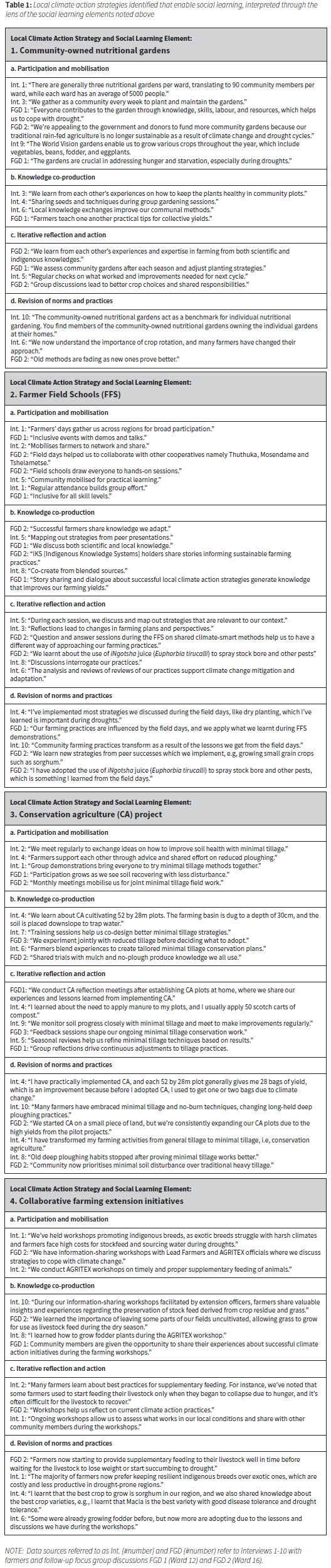
In the next section, I share the analysis and results of the study. I used inductive thematic analysis to analyse the data from my interviews and focus group discussions (FGDs). The first inductive analysis indicated that local climate action strategies such as cooperative gardening, integrating Indigenous knowledge systems into livelihoods, conservation farming programmes and community farming workshops enabled social learning (see Table 1 below). Further analysis showed that these reflected social learning elements including participation and mobilisation, knowledge co-production, iterative reflection, and revising norms and practices (see discussion of findings below).
Research findings: Local climate action strategies enabled by elements of social learning
The data in the case study was systematically analysed, and from this the following four local climate action strategies were identified that enabled the following aspects of social learning. The data is summarised in Table 1 below, after which it is discussed in further detail.
The data presented in Table 1 above is discussed in further detail in the following section.
Local climate action strategies identified that enable social learning
Using thematic analysis, I identified local climate action initiatives that include community-owned nutritional gardens, farmer field schools, conservation agriculture (CA) project and collaborative farming extension initiatives.
Community-owned nutritional gardens
Community-owned nutritional gardens serve as one of the significant climate action initiatives where knowledge of sustainable agricultural practices is shared. These gardens facilitate resource mobilisation and mutual learning on sustainable farming, promoting continuous food production and income generation in impoverished rural communities. Non-governmental organisations, such as World Vision, fund community gardens, which help farmers grow vegetables and fruits to supplement poor harvests in their fields. In these community gardens, people grow a variety of crops and plants, including vegetables, beans, fodder, and eggplants. Int. 1 reported that "there are generally three nutritional gardens per ward, translating to 90 community members per ward, while each ward has an average of 5000 people". Thus, my research findings highlighted that local climate action, such as community-owned nutritional gardens, provides opportunities for social learning and resilience to climate change during the climate crisis in this era of polycrisis.
The research findings revealed that community-owned nutritional gardens are one of the most effective local climate action strategies. FGD 2 noted: "We're appealing to the government and donors to fund more community gardens because our traditional rain-fed agriculture is no longer sustainable as a result of climate change and drought cycles." In addition, FGD 1 reported that "the gardens are crucial in addressing hunger and starvation, especially during droughts". Thus, my research findings highlight that community members now prefer nutritional gardens over traditional farming, which relies on rainfall and has been significantly affected by climate change. The community-owned nutritional gardens utilise irrigation, which ensures food security, as the region is experiencing poor farming conditions due to the adverse impacts of climate change on rain-fed agriculture.
The research findings highlight that community-owned nutritional gardens serve as a model for individual nutritional gardening, and most members have established their own gardens at home. This provides an opportunity to apply the knowledge gained from the cooperative to their own gardens. For instance, Int. 10 reported that: "The cooperative gardens act as a benchmark for individual nutritional gardening. You find members of the cooperative gardens owning the individual gardens at their homes." Thus, community-owned nutritional gardens facilitate the adoption of new norms and practices, as members apply the skills they have learned from the community-owned nutritional gardens to their own gardens.
Elements of social learning support and expand these local climate actions. The community-owned nutritional gardens enable the community members to participate in climate change mitigation action. The research participants reported that their participation in cooperative gardens enhanced awareness about sustainable farming practices. For instance, FGD 1 reported that "everyone contributes to the garden through knowledge, skills, labour, and resources, which helps us to cope with drought". The community gardens are a collaborative initiative that have helped to establish a community of practice, which has helped to develop trust among members (Wenger-Trayner & Wenger-Trayner, 2020). The research findings also revealed that community-owned nutritional gardens enhance the co-production of knowledge, an important aspect of social learning in the community. This is shown by the way that the community members share their experiences with sustainable farming, which leads to a better understanding of climate-smart agriculture. FGD 2 reported: "We learn from each other's experiences and expertise in farming from both scientific and indigenous knowledges", a process that expands their sustainable knowledge, promoting iterative reflection.
Community members continuously reflected on the impact of farming practices. During the semi-structured interviews, Int. 5 revealed that "after every season, we check what worked and what didn't, then adjust, and discuss what new crops to grow in the following season or in the future". This reflective practice enables members of the community gardens to adjust their strategies based on reflections and practical experiences. Thus, findings from both the semi-structured interviews and focus group discussions indicate that local climate action strategies in the study area encourage revising existing norms and practices related to farming based on the social learning processes that occur as people work on community projects.
Farmer field schools
Another important local climate action initiative that incorporates social learning elements is the farmer field schools (FFS). According to FAO (2025a), the FFS initiative originated in Asia in the late 1980s and has since spread to several countries worldwide. The approach is rooted in non-formal adult education, facilitating experiential learning and integrating scientific knowledge with local knowledge(s). Thus, FFS empowers individuals, households, and communities, enabling them to take charge of their own sustainable development. In my study area, the FFS initiative refers to selected days where agricultural extension officers select a farm to be visited by community members to learn some successful farming strategies. The research findings revealed that during FFS, farmers share their experience of working on their farms. This process of sharing information includes practical lessons facilitated by AGRITEX officers. The FFS also provides an opportunity for community members to share their sustainable IKS [Indigenous Knowledge Systems] practices. My research findings revealed that FFS embraces both scientific knowledge and IKS. For instance, Int. 5 reported that "during field schools, we learn both scientific and indigenous knowledge to address changes in climate in farming". Thus, leveraging both scientific and IKS in sustainable farming practices promotes social learning opportunities for community members to curb climate change. Community members integrate IKS and modern climate-smart strategies into climate action, demonstrating knowledge co-production. This collaborative approach strengthens the capacities of individuals and the CoP to address climate change.
From the perspective of social learning elements associated with this local climate action, the research findings revealed that integrating scientific knowledge and IKS practices plays a significant role in climate change action in the community. For example, FGD 2: "Successful farmers share knowledge we adapt." Similarly, FFS emphasises knowledge co-production, as community members discuss various strategies for addressing climate change and map out those perceived as relevant to their local context. This was also emphasised in FGD 1, which reported that "story sharing and dialogue about successful local climate action strategies generate knowledge that improves our farming yields".
The research findings highlighted the importance of iterative reflection as farmers developed effective strategies for local climate action, informed by the stories and dialogue shared during the sessions. For example, Int. 5 reported that: "during each session we discuss and map out strategies that are relevant to our context". This quote highlights the evidence of iterative reflection and revision of norms and practices regarding farmers as they integrate their practices and deliberate on the stories shared by successful farmers. Further elaborating this finding, Int. 5 reported that "during each session, we discuss and map out strategies that are relevant to our context." Similarly, Int. 3 noted that "reflections lead to changes in farming plans and perspectives". In addition, FGD 2 reported that "question and answer sessions during the FFS on shared climate-smart methods help us to have a different way of approaching our farming. Thus, the findings revealed that FFS shapes the way that communities embark on sustainable practices. Additionally, FFS has promoted the transformation of existing norms and practices. For instance, Int. 4 reported: "I've implemented most strategies we discussed during the field days, like dry planting, which I've learned is important during droughts." Similarly, FGD 1 reported: "Our farming practices are influenced by the field days because we apply what we learned during FFS demonstrations." In addition, FGD 2 reported: "We learn new strategies from peer successes, which we implement, e.g., growing small grain crops such as sorghum." Furthermore, FGD 2 noted: "I have adopted the use of iNgotsha juice (Euphorbia tirucalli) to spray stock bore and other pests, which is something I learned from the field days." These quotes highlight that FFS promotes social learning elements.
Conservation Agriculture (CA) project
The research findings highlighted another local climate action initiative in the district that teaches people about conservation farming techniques. According to the FAO (2025b), 'conservation agriculture' is a farming system that promotes minimal soil disturbance (minimal tillage), conserves a permanent soil cover and promotes plant species diversity. It promotes increased water and nutrient use efficiency, as well as improved and sustained crop production, particularly in areas prone to drought. Conservation agriculture techniques are taught as farming practices guided by AGRITEX and agricultural extension officers and through communal activities like letsema (voluntary cooperative work), where farmers assist each other and share skills directly, reinforcing social learning mechanisms.
With regard to the social learning elements related to the practice, Int. 4 stated: "We learn about CA cultivating 52 by 28m plots. The farming basin is dug to a depth of 30cm, and the soil is placed downslope to trap water." The programme provides social learning spaces where people learn as CoPs to gain the knowledge, skills, and competencies to cope with a particular phenomenon (Wenger & Wenger-Trayner, 2020).
The adoption of CA substantially improves farming yields. Participants stated that adopting CA has encouraged the use of manure instead of fertilisers since manure promotes water retention in the soil. For example, Int. 4 reported: "I learned about the need to apply manure to my plots, and I usually apply 50 scotch carts of compost." Adopting CA has furthermore resulted in collaborative learning regarding water and soil conservation techniques. Participants reported sharing their experiences about various CA practices. FGD 1 stated: "We conduct CA reflection meetings after establishing CA plots at home, where we share our experiences and lessons learned from implementing CA." Farmers share success stories and the impact of their CA. For example, Int. 4 stated: "I have practically implemented CA, and each 52 by 28m plot generally gives me 28 bags of yield, which is an improvement because before I adopted CA, I used to get one or two bags due to climate change." Thus, both knowledge co-production and iterative reflection were evident in this local action practice as community members had space to reflect on improving CA.
Additionally, this key local climate action initiative has influenced people to revise their existing norms and practices as they move from traditional land cultivation methods to CA. For instance, Int. 4 reported: "I have transformed my farming activities from general tillage to minimal tillage, i.e., conservation agriculture." In addition, FGD 2 stated: "We started CA on a small piece of land, but we're consistently expanding our CA plots due to the high yields from the pilot projects." This suggests that CA is transforming farmers' agricultural norms and practices, as they are motivated to adopt and scale up the practice due to its success.
Collaborative farming extension initiatives
The farmers learn about coping with climate change through agricultural support from public extension agents, lead farmers, and non-governmental organisations (NGOs). The recent integration of lead farmers with the government extension system is effective in capacitating farmers with local climate action initiatives. The research findings revealed that AGRITEX collaborates with lead farmers, who are experienced local farmers trained to share knowledge and new farming techniques with their communities. The lead farmers serve as a grassroots link in the extension system, facilitating the adoption of better practices through peer-to-peer learning.
Collaborative farming extension initiatives facilitate the mobilisation of farmers through workshops that address the effects of climate change. The practice promotes community involvement facilitated by AGRITEX and Lead Farmers initiative sessions on climate-resilient practices. For instance, Int. 1 stated: "We've held workshops promoting indigenous breeds, as exotic breeds struggle with harsh climates and farmers face high costs for stockfeed and sourcing water during droughts." Similarly, FGD 2 reported that "we have information-sharing workshops where we discuss strategies to cope with climate change". In addition, Int. 2 reported that "we conduct workshops on timely and proper supplementary feeding of animals". Thus, collaborative farming extension initiatives facilitate community participation in social learning that aims at addressing climate change.
In addition, collaborative farming extension initiatives foster collective knowledge creation by integrating farmer experiences with extension support, enabling tailored solutions for feed preservation and fodder growth in drought contexts. For example, Int. 10 reported: "During our information-sharing workshops, farmers share valuable insights and experiences regarding the preservation of stock feed derived from crop residue and grass." In addition, FGD 2 stated: "We learned the importance of leaving some parts of our fields uncultivated, allowing grass to grow for use as livestock feed during the dry season." Similarly, FGD 1 reported that "community members are given the opportunity to share their experiences about successful climate action initiatives during the farming workshops". Thus, research findings highlight that collaboration between government extension staff and lead farmers promotes social learning elements.
The collaborative farming extension initiatives provide opportunities for farmers to critically assess practices, leading to refined actions that improve livestock resilience against climate variability. For example, Int. 2 highlighted: "Many farmers learn about best practices for supplementary feeding. For instance, we've noted that some farmers used to start feeding their livestock only when they began to collapse due to hunger, and it's often difficult for the livestock to recover." Additionally, FGD 2 stated: "Workshops help us reflect on current climate action practices." Similarly, Int. 1 reported "ongoing workshops allow us to assess what works in our local conditions and share with other community members during the workshops." Thus, iterative reflection and action are evident in my research findings. Participants constantly reflect on their strategies and improve climate resilience based on previous experiences, which highlights iterative reflection (Lotz-Sisitka et al., 2022; Van Epp et al., 2016).
Furthermore, collaborative farming extension initiatives facilitate shifts from reactive to proactive climate-smart strategies. For example, FGD 2 reported that "farmers are now starting to provide supplementary feeding to their livestock well in time before waiting for the livestock to lose weight or start succumbing to drought". In addition, Int. 1 reported that "the majority of farmers now prefer keeping resilient indigenous breeds over exotic ones, which are costly and less productive in drought-prone regions". Similarly, Int. 4 reported: "I learnt that the best crop to grow is sorghum in our region, and we also shared knowledge about the best crop varieties, e.g., I learnt that Macia is the best variety with good disease tolerance and drought tolerance." Thus, my findings revealed that the workshops enhance positive change in practices towards sustainable farming. For example, Int. 6 reported: "Some were already growing fodder before, but now more are adopting due to the lessons and discussions we have during the workshops." Thus, the transformation of norms and practices was evident as community members reflected on the improvements in farming practices resulting from collaborative farming extension initiatives. The research findings revealed that collaborative farming extension initiatives foster social learning, as evidenced by the flow of information, and increased knowledge and awareness of climate action, resulting in individuals changing norms and practices to build climate resilience. (Van Epp et al., 2016; Kristjanson et al., 2014).
The findings indicate that local climate action strategies are characterised by social learning as they strengthen community resilience to climate change. Social learning was established when community members participated in various strategies such as community-owned nutritional gardens, farmer field schools, Conservation Agriculture (CA) project and collaborative farming extension initiatives. These initiatives promote community participation, fostering a social learning space where people exchange experiences and knowledge about sustainable practices (Wenger & Wenger-Trayner, 2020).
Discussion of findings: Social learning elements that can advance local climate actions
As shown above, the Gwanda District rural communities were involved in at least four local climate actions, all of which enabled social learning and which reflected elements of social learning, which as discussed above, and shown in Table 1, are 1) participation and mobilisation, 2) knowledge co-production, 3) iterative reflection and action, and 4) revising norm and practice revision (Fisher et al., 2016). This section considers the social learning elements found across the four local climate actions in the case study site, and how these are enhancing community resilience to climate change.
Participation and mobilisation
As shown across the four local climate actions above, participation and mobilisation were found to be present as an important element of social learning that facilitates community engagement, knowledge sharing, and collective action towards sustainable practices and climate resilience. In Wards 12 and 16, community involvement in the community-owned nutritional gardens, farmer field schools, Conservation Agriculture (CA) project, and collaborative farming extension initiatives enhanced participants' sense of ownership and responsibility, as shown by the data presented in Table 1. As shown above, participating in community projects helps to establish communities of practice that enhance social learning that is critical to climate action, as was reflected in the comments from the participants (Int. 1, 2, 4, and 9 as well as FGD 1 and 2). These findings underline the importance of collective activity in strengthening community relationships and trust. Participation in the local climate actions discussed above, provided the communities with a forum for discussion and shared experiences, which is critical for developing a social learning space (Lotz-Sisitka et al., 2016). As indicated above, the formation of communities of practice focussing on the climate actions was important for enabling community members to learn from each other (cf. Int. 2 reported about collaborative efforts amongst community members to address climate change and FGD 1 highlighted community's common goal towards climate action). This reflects the point made by Wenger et al. (2011) who argued that Communities of Practice (CoP) thrive on shared interests and issues (a shared domain), allowing members to learn from one another. The findings of the study therefore reveal that mobilisation and participation of community members in climate action projects, which also operate as communities of practice, can promote social learning and strengthen climate action.
Co-production of knowledge
As shown above, across all four local climate actions, co-production of knowledge is a necessary process that involves community members sharing their experiences and thoughts as they participate in local climate action strategies; at times this is complemented by inputs and knowledge from groups such as AGRITEX, Lead Farmers or NGOs. Also relevant to knowledge co-production as an enabling social learning element in local climate action, findings from the study highlighted that integrating IKS and modern techniques into sustainable livelihoods positively impacts climate action. For example, storytelling and dialogue about effective local climate action initiatives substantially contributes to climate smart agriculture as noted by FGD 1, Int. 1 and Int. 4, in the study (cf. also Das & Jan, 2025; Silo, 2017).
The findings shown above also revealed that IKS holders, government officials, and NGO officers all play an essential role in improving people's skills, knowledge, and capacities (cf. FGD 2, Int. 8 etc.). Also, the findings as presented in Table 1, regarding the collaborative farming extension initiatives (cf. Int. 1, FGD 2) show that an integrated and holistic approach to climate action allows community members to understand sustainable practices better.
As shown by Table 1, the collaborative knowledge creation approach enhances individual skills while increasing community resilience to the effects of climate change. Collaborative knowledge creation can be viewed as the process by which people create new knowledge through cooperation and co-creation, thereby developing a deeper understanding of the environment, gaining valuable insights, and acting collectively to drive change (Al-Omoush et al., 2020; Zhao et al., 2019). Fisher et al. (2016) argued that peer interactions within a CoP improve understanding by integrating local knowledge with scientific expertise. As shown in the four local climate actions in Gwanda district, this co-production of knowledge mainly takes place during workshops on local climate change strategies, as people share stories and dialogue about locally relevant climate action initiatives (cf. FGD 1, FGD 2, Int. 4). This social learning element strengthens the local capacity for sustainable resource management.
Iterative reflection and action
Iterative reflection is a significant social learning element of local climate action strategies, as revealed in the findings shared above that indicate how community members regularly reflect on their practices as they engage in climate action projects, allowing them to adjust their strategies. This was found in Wards 12 and 16, as shown above in Table 1. As shared by interviewees (Int. 1, 2, 6) and in focus group discussions 1 and 2, this reflective process is critical for ongoing improvement and climate change resilience. The iterative reflection encourages communities to adapt the community projects to their local context, as shown by Int. 8 and Int. 6, which highlight how discussions and reviews of practices support climate action, implying a reflective and analytical approach to addressing climate challenges.
The findings shared above show that participants develop critical thinking skills by evaluating their successes and challenges in the community of practices, as shown by FGD 2 that reported: "We learn new strategies from peer successes which we implement, e.g, growing small grain crops such as sorghum." Fisher et al. (2016) reported that such reflexivity is essential in social learning because it allows communities to adapt their strategies based on real-world experiences. As also reported by other authors such as McCune et al. (2017), Mukute et al. (2018), Mukute and Lotz-Sisitka (2012), Wals et al. (2010), iterative reflection fosters a social learning culture, and as shown in this study, it empowers community members to experiment with new practices while drawing lessons from their CoP reflections, for example when FGD 2 reported: "I have adopted the use of iNgotsha juice (Euphorbia tirucalli) to spray stock bore and other pests, which is something I learned from the field days."
Revision of norms and practices
As shown above, across all four local climate actions, the revision of norms and practices is a critical element of social learning aided by local climate action strategies. The findings from FGD 1 and FGD 2 revealed that farmers revise traditional methods in response to better yields associated with new practices. Furthermore, the findings, as evidenced by Int. 6, highlight that farmers now value crop rotation, and many farmers are gradually adopting the climate action initiative. In addition, dry planting (Int. 4) and small grains such as sorghum (FGD 2) are becoming more prevalent as a result of community-based learning and the agricultural support that farmers are receiving. As also reported by other authors, such as Lotz-Sisitka et al. (2017) and Mukute et al. (2012), community-based learning in southern Africa has led to the adoption of more sustainable practices.
Furthermore, the findings in Table 1 highlight that the Conservation Agriculture initiative has promoted revision of norms and practices as farmers transition from deep ploughing to minimal tillage, which supports good farming yields. For example, Int. 4 reported that they are consistently expanding CA plots due to the high yields being realised. As also reported by other authors, such as Mukute et al. (2018), Shah and Wu (2019) and Shrestha et al. (2020), CA is a significant farming method that promotes high yields and sustainable agriculture. Additionally, the findings in Table 1 suggest that changes in pastoral farming and livestock management are underway. For example, FGD 2 has adopted proactive supplementary feeding, as opposed to the traditional, reactive method of feeding livestock. Additionally, Int. 1 reported that the majority of farmers now prefer resilient indigenous breeds over exotic ones, due to success stories shared and climate action resolutions achieved through collaborative and community-based learning.
Conclusion: Implications for climate change education
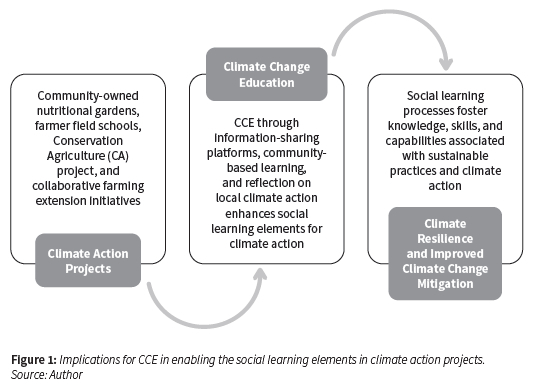
Based on the discussion of the research findings, I summarise the key findings below (see Figure 1) to demonstrate the implications for CCE in enabling the social learning elements in climate action projects. The four local climate action initiatives presented enhance social learning elements through information-sharing platforms, community-based learning, and reflection on local climate action strategies, in driving local climate action. These social learning elements, as presented above and in Table 1, foster the information, skills, and capabilities required for climate resilience and effective mitigation. Figure 1 presents implications for CCE in enabling the SL elements in climate action projects.
Figure 1 above shows that CCE enables the social learning elements in climate action projects. These elements include participation and mobilisation, knowledge co-production, iterative reflection, and revisions in norms and practices. Community members interact with one another by actively participating in local climate action and sharing knowledge and experiences that improve their awareness of sustainable practices (Ndlovu et al., 2020; Sibanda & Manik, 2022a). Knowledge co-production happens when individuals share their IKS-related views and experiences during gatherings facilitated by Agritex, lead farmers, and NGO officials, thus allowing the integration of local knowledge with scientific practices. This collaborative approach facilitates an understanding of climate-related issues and encourages the creation of viable solutions to these challenges. For example, when community members discuss and reflect on successful climate action initiatives, social learning is established, which strengthens climate action (Tibola da Rocha et al., 2020; Mugari et al., 2020; Sibanda, 2022).
Iterative reflection is another essential element of social learning in which community members regularly reflect on their climate action strategies. This enables them to refine or improve their strategies based on community-based learning. For example, communities that grow fodder plants review their planting strategies and outputs to improve their agricultural practices and to be more climate-smart. Local climate action initiatives help community members revise their norms and practices as they engage in their CoPs. In an advanced social learning phase, community norms and practices are revised to promote sustainable resource management (Mudombi et al., 2017; Mugari et al., 2020; Sibanda, 2022). Collaborative knowledge creation is crucial in social transformation, as it ensures that the community's collective wisdom is incorporated into climate action (Ndlovu et al., 2020; Sibanda & Manik, 2022a).
This section discusses the implications for CCE in enabling the social learning elements in climate action projects. Figure 1 highlights that the local climate action initiatives enhance the social learning elements that capacitate community members to address climate change holistically, resulting in increased adaptive capacity and resilience.
Recommendations
This qualitative study presents some examples of local climate action strategies that can be used when teaching about adapting to climate change at a local scale in Southern Africa, using Gwanda South district as a case study. I recommend that government and NGO officers facilitate social learning in climate action strategies through regular workshops, training sessions, and community meetings that foster dialogue among members (Harvey et al., 2012; Mar et al., 2023). These CCE strategies should be designed and supported to enable community members to regularly reflect on their climate strategies (Callaghan et al., 2020; Romsdahl, 2020). Therefore, government departments and NGOs should strive to integrate social learning into their climate change strategies. Sustainable practices should be encouraged by storytelling and dialogue that promote community-based learning. The findings have highlighted that the availability of climate action strategies that support social learning can help communities become more resilient (World Bank, 2022).
Finally, the agricultural support system should integrate local climate action strategies into climate change education frameworks that promote community-based learning, collaboration, and knowledge sharing in order to enhance adaptive capacity and climate resilience (Tibola da Rocha et al., 2020).
Notes on the ContributorSibanda, Arorisoe
Arorisoe Sibanda is a postdoctoral research fellow in the Environmental Education Research Centre at Rhodes University's Faculty of Education. Sibanda is the recipient of the NRF/ SARChI postdoctoral research grant nominated by Rhodes University. His areas of focus are community-based learning systems for subsistence farmers, education for sustainable development, teaching practices, professional learning communities in teacher education, and climate change education.
Acknowledgements
The author acknowledges and thanks the National Research Foundation (NRF) and the South African Research Chairs Initiative (SARChI) Chair in Global Change and Social Learning Systems for funding his postdoctoral research fellowship, which enabled the generation of this article. Profound gratitude goes to the research assistants (including Welcome Mdizo, Thembelihle Ndlovu, Thusanang E. Ndlovu, Proficient Jili), farmers, and local authorities and leadership for their cooperation during data generation for this article. Appreciation also goes to the SAJEE editors and reviewers for rigorous peer review.
References
-
Al-Omoush, K. S., Simón-Moya, V., & Sendra-García, J. (2020). The impact of social capital and collaborative knowledge creation on e-business proactiveness and organizational agility in responding to the COVID-19 crisis. Journal of Innovation & Knowledge, 5(4), 279-288. https://doi.org/10.1016/j.jik.2020.10.002
» https://doi.org/10.1016/j.jik.2020.10.002 -
Burnside-Lawry, J., & Carvalho, L. (2016). A stakeholder approach to building community resilience: Awareness to implementation. International Journal of Disaster Resilience in the Built Environment, 7(1), 4-25. https://doi.org/10.1108/IJDRBE-07-2013-0028
» https://doi.org/10.1108/IJDRBE-07-2013-0028 -
Callaghan, T. V., Kulikova, O., Rakhmanova, L., Topp-J0rgensen, E., Labba, N., Kuhmanen, L. A., ... & Johansson, M. (2020). Improving dialogue among researchers, local and indigenous peoples and decision-makers to address issues of climate change in the North. Ambio, 49(6), 1161-1178. https://doi.org/10.1007/s13280-019-01277-9
» https://doi.org/10.1007/s13280-019-01277-9 -
Chitongo, L. (2019). Rural livelihood resilience strategies in the face of harsh climatic conditions. The case of Ward 11 Gwanda, South, Zimbabwe. Cogent Social Sciences, 5(1), 1617090. https://doi.org/10.1080/23311886.2019.1617090
» https://doi.org/10.1080/23311886.2019.1617090 - Cohen, L., Manion, L., & Morrison, K. (2018). Research methods in education (8th Ed). Routledge.
- Creswell, J. W. & Poth, C. N. (2018). Qualitative inquiry and research design: Choosing among five approaches (4th ed.). Thousand Oaks.
-
Cundill, G. & Rodela, R. (2012). A review of assertions about the processes and outcomes of social learning in natural resource management. Journal of Environmental Management, 113, 7-14. https://doi.org/10.1016/j.jenvman.2012.08.021
» https://doi.org/10.1016/j.jenvman.2012.08.021 -
Das, B. & Jan, T. (2025). Bridging generations using climate change education in African early years to tertiary levels. In M.F. Mbah, P. Molthan-Hill & E. L. Molua (Eds.), Practices, perceptions and prospects for climate change education in Africa. Springer. https://doi.org/10.1007/978-3-031-84081-4_3
» https://doi.org/10.1007/978-3-031-84081-4_3 -
Dube, T., Mlilo, C., Moyo, P., Ncube, C., & Phiri, K. (2018). Will adaptation carry the future? Questioning the long-term capacity of smallholder farmers' adaptation strategies against climate change in Gwanda District, Zimbabwe. Journal of Human Ecology, 61, 20-30. https://api.semanticscholar.org/CorpusID:221857535
» https://api.semanticscholar.org/CorpusID:221857535 -
Ensor, J. & Harvey, B. (2015). Social learning and climate change adaptation: evidence for international development practice. WIREs Climate Change 6(5), 509-522. https://doi.org/10.1002/wcc.348
» https://doi.org/10.1002/wcc.348 -
FAO [Food & Agricultural Organisation]. (2025a). Global Farmer Field School Platform. https://www.fao.org/farmer-field-schools/overview/en/
» https://www.fao.org/farmer-field-schools/overview/en/ -
FAO Food & Agricultural Organisation. (2025b). Conservation Agriculture. https://www.fao.org/conservation-agriculture/en/
» https://www.fao.org/conservation-agriculture/en/ - Fisher, S., Garside, B., Van Epp, M., Dodman, D., D'errico, S., Anderson, S., & Carlile, L. (2016). Planning and implementing climate change responses in the context of uncertainty: exploring the importance of social learning and the processes of decision-making. IIED Working Paper.
-
Froome, C. & Bond, M. (2010). Localizing climate change: Stepping up local climate action. Management of Environmental Quality, 21(2), 214-225. https://doi.org/10.1108/14777831011025553
» https://doi.org/10.1108/14777831011025553 -
Fuso Nerini, F., Sovacool, B., Hughes, N., Cozzi, L., Cosgrave, E., Howells, M., ... & Milligan, B. (2019). Connecting climate action with other sustainable development goals. Nature Sustainability, 2(8), 674-680. https://doi.org/10.1038/s41893-019-0334-y
» https://doi.org/10.1038/s41893-019-0334-y - Government of Zimbabwe (2016). Zimbabwe's national climate change response strategy, Government of Zimbabwe. Harare.
-
Harvey, B., Ensor, J., Carlile, L., Garside, B., Patterson, Z., & Naess, L. O. (2012). Climate change communication and social learning-Review and strategy development for CCAFS. CCAFS Working Paper No. 22. CGIAR Research Program on Climate Change, Agriculture and Food Security (CCAFS), Copenhagen, Denmark. https://hdl.handle.net/10568/24456
» https://hdl.handle.net/10568/24456 -
Hegerl, G. C., Brönnimann, S., Cowan, T., Friedman, A. R., Hawkins, E., Iles, C., ... & Undorf, S. (2019). Causes of climate change over the historical record. Environmental Research Letters, 14(12), 123006. https://doi.org/10.1088/1748-9326/ab4557
» https://doi.org/10.1088/1748-9326/ab4557 -
IPCC [Intergovernmental Panel on Climate Change] (2023). Summary for Policymakers. In: Climate Change 2023: Synthesis Report. Contribution of Working Groups I, II and III to the Sixth Assessment Report of the Intergovernmental Panel on Climate Change [Core writing team: H. Lee and J. Romero (Eds.)]. IPCC, pp. 1-34. https://www.ipcc.ch/report/sixth-assessment-report-cycle/
» https://www.ipcc.ch/report/sixth-assessment-report-cycle/ -
Kristjanson, P., Harvey, B., Van Epp, M., & Thornton, P. K. (2014). Social learning and sustainable development. Nature Climate Change, 4, 5-7. https://doi.org/10.1038/nclimate2080
» https://doi.org/10.1038/nclimate2080 - Kumar, K. R., Sigdel, E. R., Ojha, S. K., & Bexci, M. S. (2025). Empowering communities with grassroots approaches to climate solutions. In Community resilience and climate change challenges: Pursuit of Sustainable Development Goals (SDGs) (pp. 203-226). IGI Global Scientific Publishing.
- Leedy, P. D. & Ormond, J. E. (2010). Practical research planning and design (9th Ed.). Pearson Education International.
-
Lotz-Sisitka, H. (2024). Towards a politics of transgression in environmental education research: meta-review of a T-Learning research 'archive'. Australian Journal of Environmental Education, 40(3), 549-573. https://doi.org/10.1017/aee.2024.62
» https://doi.org/10.1017/aee.2024.62 - Lotz-Sisitka, H., Mukute, M. & Belay, M. (2012). Educational perspectives on social learning theory: antecedents and starting points for research. (Re)Views on social learning literature: A monograph for social learning researchers in natural resources management and environmental education. Environmental Learning Research Centre, Rhodes University/EEASA/SADC REEP.
-
Lotz-Sisitka, H., Mukute, M., Chikunda, C., Baloi, A., & Pesanayi, T. (2017). Transgressing the norm: Transformative agency in community-based learning for sustainability in southern African contexts. International Review of Education, 63(6), 897-914. https://doi.org/10.1007/s11159-017-9689-3
» https://doi.org/10.1007/s11159-017-9689-3 - Lotz-Sisitka, H., Pesanayi, T., Weaver, K., Lupele, C., Sisitka, L., O'Donoghue, R., Denison, J., & Phillips, K. (2016). Water use and food security: knowledge dissemination and use in agricultural colleges and local learning networks for home food gardening and smallholder agriculture. WRC Report. No. 2277/1. Water Research Commission, Pretoria.
- Lotz-Sisitka, H., Sisitka, L., Metelerkamp, L., Chakona, G., Van Staden, W., Durr, S., Matiwane, M., Maqwelane, L., Conde-Aller, L., Shawarire, P., & Pesanayi, T. (2022). Amanzi for Food': A social learning network approach to agricultural water knowledge mediation, uptake and use in smallholder farming learning networks. Research and Development, WRC Report No. TT 868/21. Water Research Commission, Pretoria.
-
Mar, K. A., Schäpke, N., Fraude, C., Bruhn, T., Wamsler, C., Stasiak, D., ... & Lawrence, M. G. (2023). Learning and community building in support of collective action: Toward a new climate of communication at the COP. Wiley Interdisciplinary Reviews: Climate Change, 14(4), e832. https://doi.org/10.1002/wcc.832
» https://doi.org/10.1002/wcc.832 -
McCune, N., Rosset, P. M., Salazar, T. C., Morales, H., & Moreno, A. S. (2017). The Long Road: Farming and Agroecological Formation in Central America. Mind, Culture, and Activity, 24(3), 183-198. https://doi.org/10.1080/10749039.2017.1293690
» https://doi.org/10.1080/10749039.2017.1293690 -
Mudombi, S., Fabricius, C., Van Zyl-Bulitta, V., & Patt, A. (2017). The use of and obstacles to social learning in climate change adaptation strategies in South Africa. Jàmbá: Journal of Disaster Risk Studies, 9(1). https://doi.org/10.4102/jamba.v9i1.292
» https://doi.org/10.4102/jamba.v9i1.292 -
Mugari, E., Hillary, M., & Maitseo, B. (2020). Adapting to climate change in semi-arid rural areas: A case of the Limpopo basin part of Botswana. Sustainability, 12(20), 8292. https://doi.org//10.3390/su12208292
» https://doi.org//10.3390/su12208292 -
Mukute, M. & Lotz-Sisitka, H. (2012). Working with cultural historical activity theory and critical realism to investigate and expand farmer learning in southern Africa. Mind, Culture and Activity, 19(4), 342-367. https://doi.org/10.1080/10749039.2012.656173
» https://doi.org/10.1080/10749039.2012.656173 - Mukute, M., Marange, T., Masara, C., Lotz-Sisitka, H., & Pesanayi, T. (2012). Assessment of Southern African Community Development (SADC) capacity to implement international agreements on environment, sustainable development and education. Tunis Belvédère, Tunisia: Association for the Development of Education in Africa (ADEA).
-
Mukute, M., Mudokwani, K., McAllister, G., & Nyikahadzoi, K. (2018). Exploring the potential of developmental work research and change laboratory to support sustainability transformations: A case study of organic agriculture in Zimbabwe. Mind, Culture, and Activity, 25(3), 229-246. https://doi.org/10.1080/10749039.2018.1451542
» https://doi.org/10.1080/10749039.2018.1451542 -
Ndlovu, E., Prinsloo, B., & Le Roux, T. (2020). Impact of climate change and variability on traditional farming systems: Farmers' perceptions from south-west, semi-arid Zimbabwe. Jamba: Journal of Disaster Risk Studies, 12(1), 1-19. https://doi.org/10.4102/jamba.v12i1.742
» https://doi.org/10.4102/jamba.v12i1.742 - O'Leary, Z. (2014). The essential guide to doing your research project. Sage.
-
Park, N. E., Choe, S. U., & Kim, C. J. (2020). Analysis of climate change education (CCE) programs: Focusing on cultivating citizen activists to respond to climate change. Asia-Pacific Science Education, 6(1), 15-40. https://doi.org/10.1163/23641177-BJA00004
» https://doi.org/10.1163/23641177-BJA00004 -
Peeling, M., Sharpe, J., Pearson, L., Abeling, T., Swartling, A.G., Forrester, J., Deeming, H. (2015). Social learning and resilience building in the emBRACE Framework. University of York, Center Inf Studies, 5(3). https://eprints.whiterose.ac.uk/id/eprint/103021/
» https://eprints.whiterose.ac.uk/id/eprint/103021/ -
Reed, M., Evely, A. C., Cundill, G., Fazely, I. R. A., Glass, J., Laing, A., & Stringer, L. (2010). What is social learning? Ecology and Society 15(4). http://www.ecologyandsociety.org/vol15/iss4/resp1/
» http://www.ecologyandsociety.org/vol15/iss4/resp1/ -
Romsdahl, R. J. (2020). Deliberative framing: Opening up discussions for local-level public engagement on climate change. Climatic Change, 162(2), 145-163. https://doi.org/10.1007/s10584-020-02754-x
» https://doi.org/10.1007/s10584-020-02754-x -
Shah, F. & Wu, W. (2019). Soil and crop management strategies to ensure higher crop productivity within sustainable environments. Sustainability, 11(5), 1485. https://doi.org/10.3390/su11051485
» https://doi.org/10.3390/su11051485 -
Shrestha, J., Subedi, S., Timsina, K., Chaudhary, A., Kandel, M., & Tripathi, S. (2020). Conservation agriculture as an approach towards sustainable crop production: A review. Farming and Management, 5(1), 7-15. https://doi.org/10.31830/2456-8724.2020.002
» https://doi.org/10.31830/2456-8724.2020.002 -
Sibanda, A. & Manik, S. (2022a). Environmental Education (EE) effort in a rural drought-prone district in Zimbabwe: Micro innovations with growth potential. Journal of Geography Education in Africa, 5, 77-95. https://doi.org/10.46622/jogea.v5i1.4114
» https://doi.org/10.46622/jogea.v5i1.4114 -
Sibanda, A. & Manik, S. (2022b). Reflecting on climate change education (CCE) strategies for mitigation and adaptation in South Africa, Environmental Education Research, https://doi.org/10.1080/13504622.2022.2140781
» https://doi.org/10.1080/13504622.2022.2140781 - Sibanda, A. (2022). The role of environmental education in climate change mitigation and adaptation: The case of Gwanda Rural District, Zimbabwe. [Unpublished PhD thesis], University of KwaZulu Natal.
-
Silo, N. (2017). Integrating learners' voices into school environmental management practices through dialogue. In H. Lotz-Sisitka, O. Shumba, J. Lupele & D. Wilmot (Eds.), Schooling for sustainable development in Africa. Springer. https://doi.org/10.1007/978-3-319-45989-9_12
» https://doi.org/10.1007/978-3-319-45989-9_12 -
Teixeira, J. E. & Crawford, E. (2022). Climate change education and curriculum revision. World Bank. https://doi.org/10.1596/38146
» https://doi.org/10.1596/38146 -
Tibola da Rocha, V., Brandli, L. L., & Kalil, R. (2020). Climate change education in school: Knowledge, behavior and attitude. International Journal of Sustainability in Higher Education, 21(4), 649-670. https://doi.org/10.1108/IJSHE-11-2019-0341
» https://doi.org/10.1108/IJSHE-11-2019-0341 -
Trenberth, K. E. (2018). Climate change caused by human activities is happening and it already has major consequences. Journal of Energy & Natural Resources Law, 36(4), 463-481. https://doi.org/10.1080/02646811.2018.1450895
» https://doi.org/10.1080/02646811.2018.1450895 -
Trott, C. D., Lam, S., Roncker, J., Gray, E. S., Courtney, R. H., & Even, T. L. (2023). Justice in climate change education: A systematic review. Environmental Education Research, 29(11), 1535-1572. https://doi.org/10.1080/13504622.2023.2181265
» https://doi.org/10.1080/13504622.2023.2181265 -
UNDP [United Nations Development Programme]. (2018). Climate change adaptation in Africa. https://www.adaptation-undp.org/CCA-Africa
» https://www.adaptation-undp.org/ CCA-Africa -
UNESCO. (2022). Climate Change Communication and Education (CCE) country profiles. https://www.unesco.org/gem-report/en/cce2022
» https://www.unesco.org/gem-report/en/cce2022 -
Van Epp, M., Barihaihi, M., & Fisher, S. (2016). Exploring the role of social learning in addressing climate uncertainties in district planning in Uganda. Country Report, December 2016. IIED and ACCRA. https://www.iied.org/10173iied
» https://www.iied.org/10173iied -
Van Epp, M. & Garside, B. (2014). Monitoring and evaluating social learning: A framework for cross-initiative application. CCAFS Working Paper no. 98. CGIAr research Program on CCAFS, Copenhagen. https://hdl.handle.net/10568/53096
» https://hdl.handle.net/10568/53096 -
Wals, A. (2007). Think piece. Learning in a changing world and changing in a learning world: Reflexively fumbling towards sustainability. Southern African Journal of Environmental Education, 24, 35-45. https://doi.org/10.4314/sajee.v24i0.122738
» https://doi.org/10.4314/sajee.v24i0.122738 -
Wals, A. E., Van der Hoeven, E. M., & Blanken, H. (2009). The acoustics of social learning: Designing learning processes that contribute to a more sustainable world. Wageningen Academic Publishers. https://edepot.wur.nl/108487
» https://edepot.wur.nl/108487 -
Wenger, E. & Wenger-Trayner, B. (2020). Learning to make a difference: Value creation in social learning spaces. Cambridge University Press. https://doi.org/10.1017/9781108677431
» https://doi.org/10.1017/9781108677431 - Wenger, E., Trayner, B., & De Laat, M. (2011). Promoting and assessing value creation in communities and networks: A conceptual framework. Ruud de Moor Centrum.
-
World Bank (2011). Global facility for disaster reduction and recovery. climate risk and adaptation country profile: vulnerability, risk reduction, and adaptation to climate change Mozambique. http://sdwebx.worldbank.org/climateportalb/doc/GFDRRCountryProfiles/wb_gfdrr_climate_change_country_profile_for_MOZ.pdf
» http://sdwebx.worldbank.org/climateportalb/doc/GFDRRCountryProfiles/wb_gfdrr_climate_change_country_profile_for_MOZ.pdf -
World Bank (2022). Locally led climate action: Empowering communities on the frontlines. https://www.worldbank.org/en/events/2022/10/20/locally-led-climate-action-empowering-communities-on-the-frontlines
» https://www.worldbank.org/en/events/2022/10/20/locally-led-climate-action-empowering-communities-on-the-frontlines -
Xu, H. (2022, November 04). Climate Change Education (CCE). In Encyclopedia. https://encyclopedia.pub/entry/33084
» https://encyclopedia.pub/entry/33084 -
Zhao, L., Zhang, H., & Wu, W. (2019). Cooperative knowledge creation in an uncertain network environment based on a dynamic knowledge supernetwork. Scientometrics, 119, 657-685. https://doi.org/10.1007/s11192-019-03049-4
» https://doi.org/10.1007/s11192-019-03049-4