Using a Field Trip with Biology Students to Study Wetland Ecosystem Birds
Abstract
Wetlands ecosystems in Lesotho are significant for their rich biodiversity of birds and other species, yet citizens have limited knowledge about their value, and wetlands are faced with destructive anthropogenic pressures. This study investigated the effectiveness of using a field trip with Grade 11 biology students to study local wetland ecosystem birds. Three questions guided the study: "What is the Grade 11 biology students' knowledge of birds found in Pitseng wetland ecosystem?"; "How does Grade 11 students' knowledge of birds in Pitseng wetland develop with the use of the field trip approach over time?" and "What is the difference between male and female students' knowledge of wetland birds, if any?" Using ecological literacy as a theoretical framework, a case study design, in the form of an Action Research method, was employed to answer the research questions. Data was generated using an open-ended questionnaire and fieldwork observations. The participants were 34 biology students. The analysis of data was both qualitative and quantitative. The findings revealed that students' knowledge on wetland birds was low but increased with the use of field trip over time, regardless of gender. It is concluded and recommended that a field trip is an effective strategy for developing students' ecological literacy and should be used widely for further research of biological concepts.
birds; field trip; ecological literacy; wetland
Introduction
There are 364 species of birds recorded in Lesotho (Ambrose, 2020). This makes birds in this context, vertebrates with the most diverse species here (Ministry of Tourism, Environment and Culture, 2020). Lesotho is rich in wetlands and related biodiversity (Chatanga & Sieben, 2019) and the present study focused on Palustrine wetland in Pitseng which is situated within a rangeland that is facing threats such as overgrazing, burning of grass and pollution by fertilisers. Although birds are important organisms in wetlands (Sekercioglu et al., 2017), there is a limited research in Lesotho on field studies on wetland birds with secondary school students. Teachers lack time to make use of local environmental resources and fail to research and prepare for outdoor classrooms due to tightly controlled class schedules (Ruether, 2018). Udeani et al. (2016) emphasised that teachers must move away from lecture-based teaching to more participative approaches. Hence the aim of this study was to explore the use of a field trip with biology students, to study biodiversity of birds over time in a local wetland ecosystem.
The Lesotho General Certificate for Secondary Education (LGCSE) Grade 11 syllabus indicates that local natural resources should be incorporated in learners-centered teaching. Topic 5 states, "Describe Relationships of organisms with one another and with the environment," and further suggests that students should be able to "Discuss an ecosystem as a unit containing all organisms and their environment interacting together in a given area." The syllabus learning outcome (LO) also states that students should be able to "Discuss conservation of resources", and the assessment of this LO makes reference to students being able to "Describe the need for conservation of natural resources (limited to water) (Ministry of Education and Training, 2020). It is noteworthy, however, that the biology curricula in Lesotho does not specifically cover wetlands as unique ecosystems that should be conserved, despite their significance as water sources and as ecosystems rich in biodiversity. While biology topics and the learning outcomes do not specify birds either, the researchers considered students' knowledge of the species as an essential knowledge for comprehension of wetlands' ecological concepts and processes amongs learners. Thus the study did not set out to develop the syllabus LO amongst learners per se, but to use a field trip to develop knowledge that is aligned to the syllabus LO, based on a wetland ecosystem. The engagement of the learners in a field trip activity enables them develop competencies to explore, investigate, inquire and recognise, in terms of the Lesotho Basic Education Curriculum Policy (Ministry of Education and Training, 2021).
The government of Lesotho has taken various initiatives to conserve wetlands by accession to programmes such as Orange Senqu River Commission (ORASECOM, 2024) and ReNOKA (Ministry of Natural Resources, 2024) and the related recognition of World Wetland Day. These agreements and programmes create a framework for engagement of schools, through curriculum. Yet the involvement of both teachers and students is minimal. The LGCSE Biology examiner's report stated that the performance of Lesotho students on ecological concepts was extremely poor and recommended the use of learner-centred approaches for effective learning of the topic (Examinations Council of Lesotho (ECOL), 2018). This study set out to address this problem guided by the following three questions: "What is Grade 11 biology students' knowledge of birds found in Pitseng wetland ecosystem?"; "How does Grade 11 students' knowledge of birds in Pitseng wetland develop with the use of field trip approach over time?" and "What is the difference between male and female students' knowledge of wetland birds, if any?"
Animals such as birds surround our daily life and children have different opinions about ecological concepts (Ahi, 2016). Studies show that secondary students' factual knowledge regarding birds is limited, particularly their bird identification skills (Hummel et al., 2015; Lasuen et al., 2023; Oyebamiji & Odewumi, 2020). Similarly, in a study that involved 345 students from selected schools surrounding five ranges of the park, few of the students could correctly name 10-14 birds (Oyebamiji & Odewumi, 2020). The study concluded that students' ability to adequately identify common birds in their environment is low. Radler and Heil's (2021) findings showed that males could identify more bird species than females.
It can be argued that students' ability to recognise birds, develop students' positive view of birds and to enhance their ecological literacy may best be developed through a field trip teaching strategy (Rijal, et. al. 2018). Other studies have also attributed students' improved comprehension and achievement in biology to field trips (Larsen et al., 2017; Patric, 2010). Mmassy and Roskaft's (2013) findings showed that students had less ability to identify birds as compared to residents living adjacent to a park; the men and older people seemed to know birds better, as they could better recognise the photos of eight selected bird species. This was an unexpected finding as people with little or no education had greater ability of recognising birds than those who received secondary and/or higher education; this was mainly attributable to their interaction with the environment.
Similarly, Jiwa and Esa (2013) explored ecological literacy among secondary school students with an instrument that used several pictures about plants and animals found in the environment around them. The findings showed that students' ecological literacy was limited, due to their limited exposure to the environment. However, Hallman and Robinson (2015) found that the use of Twitter improved students' bird descriptions and identification. Students identified birds from instructor-provided lists or from field guides on their devices, and wrote short description of birds to identify the chosen species, and the descriptions were sent on Twitter. Results revealed that the vast majority of students actively improved their bird identification and description (Hallman & Robinson, 2015). Similarly, the use of E-Atlas Avifauna in some studies, resulted in improved students' ability to identify birds with ease, with the use of photos and pictures (Riley, 2020; Utani & Abbarwani, 2022).
Gender also plays a vital role in students' knowledge about birds. Hummel et al.'s (2015) study revealed that girls had a consistently higher interest in birds than boys in all countries which participated in their study, but there were no gender differences in the students' factual knowledge about birds. In addition, in a school-based outdoor learning experience which focused on a pond, both male and female students gained a broader understanding of ecological content and their knowledge of birds in their local ecosystem improved, as well as the development of a positive attitude towards wildlife (Bird et al., 2020; Ortiz et al., 2018). In a similar way, students in lower and higher grades participated in a study conducted to investigate specific birds such as a pigeon and an owl in their area. Instruments and interviews were used to collect data. Findings showed that students in lower grades had relatively limited information and less biological literacy than the ones in upper grades. Older students, both males and females, in secondary school had more specific knowledge of birds' characteristics (Bartoszeck et al., 2018; Dogru, 2022; Radler et al., 2021; Tunnicliffe, 2011). In contrast, the Radler and Heil (2021) study collected data via online questionnaires, containing demographic data, engagement in bird watching activity, and images of 28 bird species native to Germany. Participants were students, lecturers and administrative staff. Males identified more species of birds than females, but generally employees scored higher than students did and this implied that students' knowledge of birds was lower.
Bopardikar et al. (2023) indicated that a powerful way of engaging students in environmental education can be school-based citizen science whereby science curricula activities can be developed around community social scientific issues. Bopardikar et al.'s (2023) research presented a participant observation case study of a curriculum designer's thinking and processes in generating and integrating in-class curriculum with citizen science fieldwork. Data were collected using interviews, observations and document and the work was aimed at improving middle school students' knowledge of their environment. Findings revealed that the curriculum designer's work evolved through various measures, including appraisal by external advisers and inspiring examples, surveys of teachers' implementation and written pre-post assessment and evaluation of the curriculum. The key consideration for designing school-based citizen science emerged from learning environment around the fieldwork, as well as making scientist-designed fieldwork engaging to students. Specifically, the main findings were that students gained a broader understanding of their local ecosystems.
According to O'Neal (1995), through education, hopefully, wetlands could be saved, students' attitudes and knowledge developed, and this would ultimately save the global environment. In this study students took a field trip to a mangrove forest and freshwater marsh wetland to be taught about ecology and environmental awareness in general biology. They observed different plants and animals including birds and recorded their observations on data sheets and answered guiding questions, as in the current study. The students thought that field trips were the best laboratory experiences, and gained some understanding of the structure and function of the wetlands (O'Neal, 1995).
Theoretical framework
Ecological literacy (EL) is the theoretical framework underpinning this study. Orr (1990) was the first to introduce the term EL. EL involves a better understanding of the natural systems and assists learners to understand nature and their place in it (Boehnert, 2015). Furthermore, Jones (2014) emphasises that EL provides guidance in the teaching of how nature works in terms of biodiversity changes, interconnections and relationships of living things and non-living things.
Ecologically literate students have the knowledge and competencies necessary to address severe environmental problems (Boehnert, 2015). EL can be integrated into the science curriculum and be developed in the classroom by taking students to local natural ecosystems for identification of vertebrates (Hack, 2015). EL is correlated with gender among others, with males demonstrating higher levels of EL than females (Pitman et al., 2016). Overall EL is characterised by a number of key tenets, which include students' ability to describe biodiversity changes, identify organisms in an ecosystem, describe the natural systems better, describe and respond to severe environmental problems based on ecological knowledge, and to relate the relationships between humanity and nature as fundamental to the health and survival of many species. In this study, the focus was on one of these, namely identification of organisms in an ecosystem, in relation to changes in students' knowledge with the use of a field trip.
Methodology
Research design and methodology
This research employed action research (AR) to engage a class of students in recurring cycles of planning, action, monitoring and reflection phases (Cohen et al., 2017), with the aim to develop students' ecological literacy over time through a field trip. The action research involved both qualitative and quantitative data collection methods, and these were field notes, students' completed worksheet during the fieldtrip, and class reflection notes following the fieldtrip.
Population, sample and sampling method
The target population was Grade 11 biology students because they are engaged directly with LGCSE Biology (0180) curriculum topic 5 which refers to the 'Relationships of organisms with their environment, including biodiversity in ecosystems'. The sample of population comprised of 34 students in an intact class (24 females and 10 males) in Pitseng, a small town with a largely subsistence community located in the foothills. Purposive sampling was used to select the research school owing to its proximity to the wetland and it being the principal researcher's place of work, thus enabling planned action research implementation with ease. The wetland is situated about twenty minutes' walk from the school.
Data collection method
The study involved two AR cycles, with a three-week time lapse in between, and data was generated primarily through students' worksheets or questionnaires and the researcher's field notes. The instrument covered broad content on a wetlands ecosystem, including names of birds and was face-validated by two specialists in biology education.
The students were arranged to work in 17 gender-based pairs to enable conversation, to co-validate observations, during the field trip sessions: 12 pairs of girls, and 5 pairs of boys. Each pair was required to name the observed bird and to further describe its features and appearance; this was to validate the students' bird identification. The data were generated through the four phases of action research as follows.
Planning phase
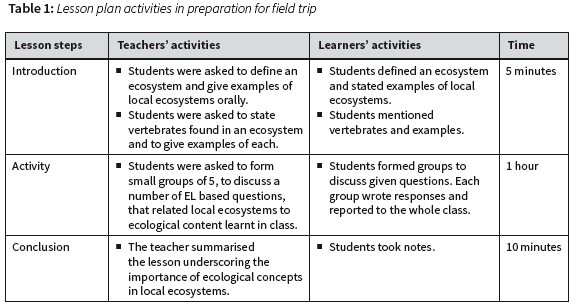
In addition to worksheet, a lesson plan (see Table 1 below) was developed, concerning Cycle 1, to engage learners to recall and relate ecological concepts and birds to an ecosystem and to build their understanding of the dependency that all living things have on their habitats.
The worksheet, which was to be filled in by students during their observation of wetland birds, was developed by the principal researcher together with the students; it listed birds that they thought were found in Pitseng wetland. The worksheet was intended to guide students on what to observe and focus on, during the field trip and to increase the learning effectiveness on targeted concepts (Myers & Jones, 2021), such as naming an identified bird and giving both a general and unique description.
Action phase
The action of two cycles was on different dates and times of the day, and Cycle 2 was conducted based on the weaknesses and strengths of Cycle 1, in order to improve the results. For instance, the visit in the first cycle was at noon but the time was changed to 8 a.m. in the second cycle. The first wetland visit took place on 16 February 2023 with the second cycle on 9 March 2023.
The students were required to use their senses of sight and hearing to observe and identify the birds from a distance and were told to avoid disturbing the birds. The learners made a tick against a bird observed on the worksheet, and were also allowed to record and describe any other bird which was not on the given list of birds, using either Sesotho or common English names. The researcher went around checking on the students. Mobile phones and cameras were allowed to photograph birds, for later verification. Captured photos in a research become observationally accurate and reliable sources of data (Cleland & MacLeod, 2021). The worksheets were retrieved directly from learners after completion of the two cycles by the researcher for data analysis. The principal researcher kept her own diary about the field trip.
Observation phase
Observation in action research involves analysis, synthesis and interpretation of collected data; key issues related to the problem are identified and this leads to reflection phase. In this study, observation in the two cycles involved presentation of learners' field trip findings, analyses of the students' worksheet data and the principal researcher's own diary to assess the impact of the field trip on the students' knowledge of wetlands birds in preparation for the next cycle.
Reflection phase
This phase involved students' discussion of questions that were prepared to guide a reflection on the field trip experience and findings. The students were asked to reflect on, among others, the most frequently identified and recorded birds; description of birds and how the next trip could be improved. These were first answered in pairs, and then discussed generally by the whole class. The reflection phase involves identifying an area of focus based on a problem. The information which is already known is used to learn more about the problem. Then actions are taken and a new area of focus is identified (Cohen et al., 2007).
All involved parties, in the study, were assured that the data and information collected would be kept confidential and would be used for the study only. They were further informed that the real names of participating school and respondents would not be used for confidentiality; instead pseudonyms would be used where appropriate. This was done in line with the principle of anonymity and confidentiality (Cohen et al., 2017).
Data analysis
The data were analysed both quantitatively and qualitatively and presented in the form of frequencies in tables and bar charts, based on the research questions, guided by the ecological literacy tenet on the ability to identify organisms in an ecosystem (Ary et al., 2009), as a framework of analysis of the students' developing knowledge. Thus trends and patterns were determined in relation to the students' knowledge changes over the two cycles of AR, and the data were disaggregated in terms of gender for comparison.
Findings
Students' prior knowledge of birds
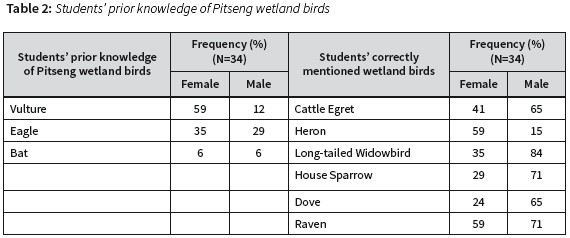
The students' knowledge in relation to Pitseng wetland, before the study intervention, shows that 18 (53%) of 34 participants had never been to the Pitseng wetland and did not mention any other wetland, and less than half of the students, 14 (41%), had been at least once to the wetland. Two students (6%) did not respond to the question. When asked to mention at least six birds found in the Pitseng wetland, out of 34 students, only 6 students (18%) were able to mention a maximum of three birds correctly - Cattle Egret, Heron and Long-tailed Widowbird, for example (see Table 2). Some students' included a vulture and an eagle on their lists, birds which do not typically inhabit the Pitseng wetland, and one mentioned a bat, which is a mammal. The birds' names were all mentioned in the student's first language, Sesotho.
The first cycle
Students' field knowledge of wetland birds
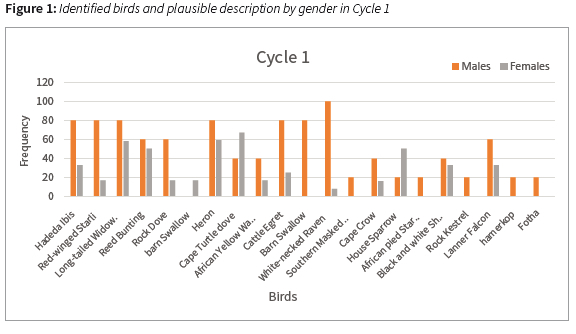
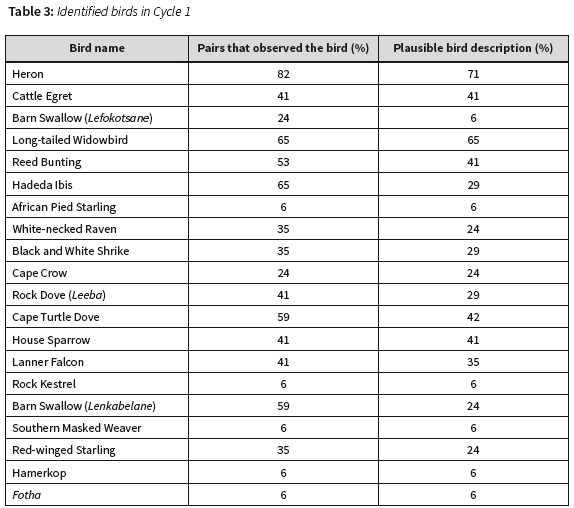
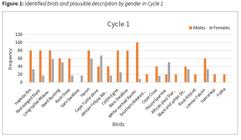
During the first cycle, students recorded 20 birds in Pitseng wetland (see Table 3 below). Of these birds, the most frequently mentioned included: Heron mentioned by 82% of students, with plausible description by 71%; Hadeda Ibis by 65%, with a plausible description by 29%; and Long-tailed Widowbird by 65% with a plausible description by 65%. An unknown bird name "Fotha" was mentioned by one pair of students (6%).
Gender-based field knowledge of wetland birds
A higher number of male pairs identified birds more accurately than females, as indicated by the comparatively high frequencies of plausible descriptions of birds that they observed. The examples of such birds included: Cattle Egret (80%), Long-tailed Widowbird (80%) and Hadeda Ibis (100%). Some male students also identified and gave more plausible descriptions of 4 (24%) birds which were not recorded by female pairs, and the birds were Hamerkop (6%), Rock Kestrel (6%), African Pied Starling (6%) and Southern Masked Weaver (6%).
Cycle 1 General Reflections
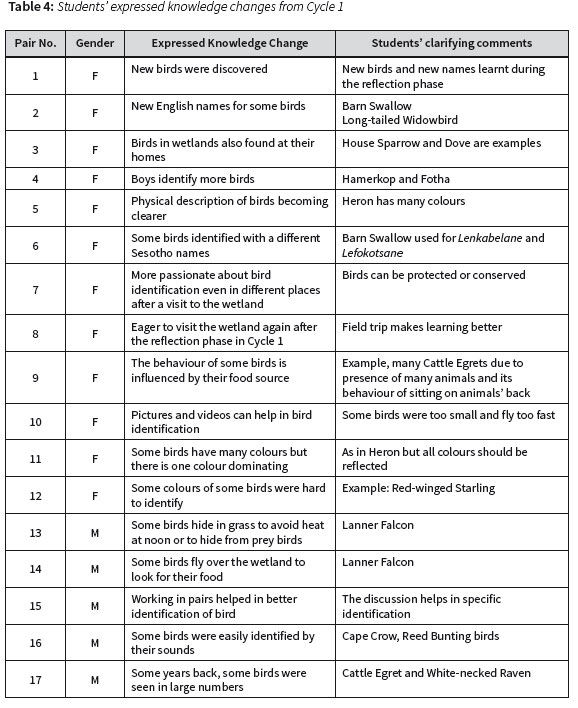
During the reflection phase, useful insights emerged from students' response to the question "How has your knowledge been changed by the birds you have learned from the wetland"; and the responses were as follows (Table 4):
It further became evident during the reflection phase that the students used different Sesotho names for the same birds and that they might not have made a distinction in their identification of different bird species of the same family. For instance, the students seemed to use the names Lenkabelane and Lefokotsane interchangeably for swallow species, whereas these can be different species for Greater striped swallow and Red breasted swallow or White throated swallow (Ambrose, 2020) respectively. The description of Fotha, mentioned by a pair of boys, (6%), seemed to fit the House sparrow, suggesting that the former is a rarely used name for a House sparrow.
The students also had insightful views on the field trip itself. They suggested that the next field trip to the wetland could be improved by visiting in the late afternoon, around 4 p.m. when more birds, which left the wetland during the day, are back. Some suggested that the visit should be early in the morning, around 8 a.m. when the birds were not hiding from the heat inside the long grass or reeds, and when many birds had not yet left the wetland.
The second cycle
Students' field knowledge of wetland birds
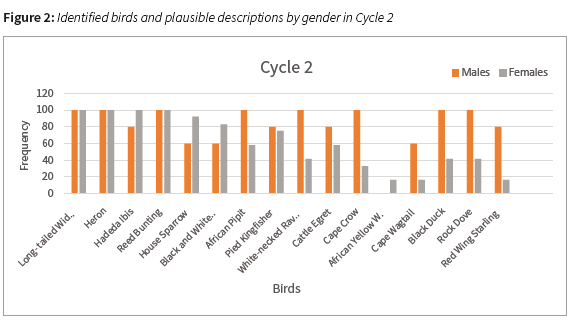
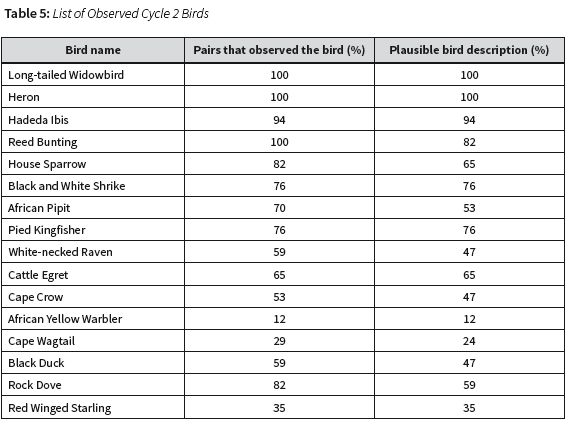
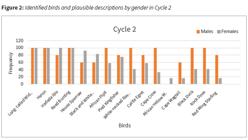
The total number of birds recorded, on the day and time of the field trip, was 16 (see Table 5); five birds less than the number of birds observed in Cycle 1, but the birds were identified by more students during the second cycle. The most frequently mentioned birds included: Heron by 100%, with a plausible description by 100%; Hadeda Ibis by 94%, with a plausible description by 94% and Long-tailed Widowbird by 100% with a plausible description by 100%.
Gender-based field knowledge of birds
Gender-based results revealed that the majority of both male and female pairs described more birds plausibly at higher percentages. Among the gender groups, 10 (59%) birds were more accurately described by at least 50% of the females, and 11(65%) birds were plausibly described by a minimum of 50% males.
Cycle 2 Reflections
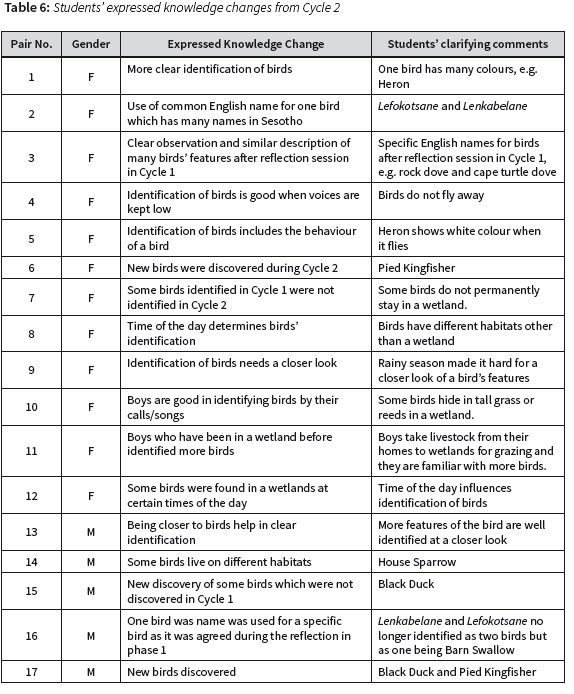
The reflection session revealed that the students' descriptions of their listed birds were clear enough in many cases. The reflection session also revealed that students' knowledge of wetlands birds improved. This became apparent when students answered the question "How has your knowledge changed after observing birds in the field trip?" Their responses are shown in the Table 6 below:
Additionally, 13 pairs (76%) of students emphasised that the problem encountered during the field trip was a lot of rain which limited free movement and a closer look at some wetland birds. Twelve pairs (71%) argued that the problem with Cycle 2 was that the trip occurred too early, and that some birds were still hiding in the tall grass. Three pairs (18%) of students suggested that in future, data collection should be in more than two cycles and more photos should be captured if possible for reference and more clarification during reflection phase.
Five new birds (31%) observed in Cycle 2 were as follows: Pied Kingfisher by 76%, with a plausible description by 76%; Black Duck by 59%, with a plausible description by 47%; Cape Wagtail by 29% and a plausible description by 24%. Birds identified in Cycle 1 but not in Cycle 2 were as follows: African Pied Starling, Barn Swallow, Lanner Falcon, Hamerkop, South Masked Weaver, Rock Kestrel and Fotha.
Discussion
According to Hack (2015), the ability to identify organisms in an ecosystem is an important aspect of ecological literacy. Prior to the field trip, only a few students (18%) could correctly mention three birds found in the wetland, such as a Cattle Egret, a Heron and a Long-tailed Widowbird. Some incorrectly thought that birds such as vultures existed in Pitseng wetland. Oyebamiji and Odewumi (2020) similarly found that only a few of the students who participated in their study could identify 10-14 birds found in a wetland. Researchers have attributed this to indoor learning of biology (Adawaih & Jiwa, 2014; Sarah, 2014; Hammarsten et al., 2019). In this study, the students' knowledge of wetlands birds improved with the Action Research intervention. In line with previous research (Radler & Heil, 2021), more male than female students accurately mentioned birds during the first cycle of AR. Cycle 2 findings reflected a more accurate identification of birds by both males and female students, which is attributable to the field trip (Rijal et al., 2018). The correlation of ecological literacy with gender has previously been observed by Pitman et al. (2018) and in this study, the initial outperformance of females by males in identifying birds could be associated with the local peri-urban cultural practices that connect male youth more with the environment such as livestock herding and wildlife hunting.
Given that the school curricula, on the other hand, are not explicit about local bird content, it can be argued that much of the students' demonstrated knowledge about birds is indigenous. Additionally, the students' bird descriptions made apparent some influence of the mother tongue, as well as the students' possible language limitations (both in English and Sesotho). For instance, their use of the word 'blue' in Cycle 1 could have been a literal English translation of a Sesotho word 'putsoa', which could mean either 'blue' and 'grey'; the use of implausible bird colours such as purple and silver points to the students' possible limited colour-related linguistic repertoire (Le Wei, 2022). Other limited bird descriptions seem to have been merely due to lack of the required detail, as students tended to describe the birds briefly in terms of their dominating colour, as noted in their description of the Whited-necked Raven as a black bird, without specifying its white patches, which made it indistinguishable from the Cape Crow. Similarly, the Heron was described simply as a grey bird; the white and black colours were left out. The students' poor bird descriptions in Cycle 1 could be attributed to their limited familiarity with birds.
In relation to bird naming, most of the names that the students used are widely known and locally used, and were in line with Ambrose's (2020) documented bird checklist. There were a few cases where different Sesotho names were used for the same birds, and where a distinction was not made between different bird species, of the same family. The students had the latitude to use either language to identify and describe the birds, and they preferred to use Sesotho. Sarah (2014) illustrates that the home environment can play a significant role in students' acquisition of knowledge of wetland birds.
It became apparent that the number of birds seen and recorded depended on the time of the day the fieldtrip was conducted, a finding that was inductively discovered by the students at the reflective stage of AR. Russel (2023) observes that the best birding hours range from early morning, from the hour before dawn to about 10 a.m. As indicated earlier, however, Cycle 2 of the AR yielded slightly fewer number of birds observed, in the present study.
Conclusion
The maximum number of wetland birds identified by students was 20 in Cycle 1, as compared to 362 birds that are found in Lesotho (Ambrose, 2020). Lesotho's wetlands and associated biodiversity, are faced with anthropogenic pressures such as livestock overgrazing, burning of grass and use of chemical fertilisers (Chatanga & Sieben, 2019). Teaching science in ways that promote students' knowledge of their biodiversity can help promote its conservation. This study affirms the value of using a fieldtrip in biology teaching, over time, to enhance the students' knowledge of birds, which constitute the most diverse vertebrate species in this context. This knowledge gain, in relation to identification of birds and their descriptions, constituted the development of students' important aspect of ecological literacy on wetland ecosystem, in a peri-urban environment, where a wetland is located close to a school. The use of a field trip in similar contexts can help advance students' knowledge of the wetland species. It is recommended that science teachers should try out action research-based (AR) field trips in their teaching of ecological topics at all grade levels, to enhance students' knowledge of their local environment, as a basis for its conservation. At least two action research cycles on a given environmental topic could be carried out, for effective learning, as demonstrated in the present study.
Notes on Contributors and their ContributionsLead author
Tenane, Makabelo
The late Makabelo Tenane was a science teacher and graduated with a Master's of Science Education at the National University of Lesotho. As part of her studies, the Erasmus+ student mobility programme greatly enhanced her conservation pedagogy and inspired her academic writing.
Co-author
Mokuku, Tsepo
Tsepo Mokuku is a professor of science and environmental education at the University of Lesotho. He has a particular interest in innovative outdoor learning in science education for effective biodiversity conservation.
References
Literature review
-
Adawiah, R. & Jiwa, M. (2014). Ecological literacy among secondary school students. 5th CoSMEd International Conference on Science and Mathematics Education, Malaysia. https://www.researchgate.net/publication/263011210
» https://www.researchgate.net/publication/263011210 - Ahi, B. (2016). Flying, feathery and beaked object: Children's mental models about birds. International Electronic Journal of Environmental Education, 6(1), 1-17.
-
Ambrose, D. (2020). Birds annotated species checklist. Lesotho Annotated Bibliography Section, 16(7A), 5. https://www.ajol.info/index.php/ostrich/article/view/203610
» https://www.ajol.info/index.php/ostrich/article/view/203610 - Ary, D., Jacobs, L. C., & Sorensen, C. (2009). Introduction to research in education. Cengage Learning.
- Bird, E. B., Harte, P., & Ballard, H. E. (2020). Birds near and far. Science and Children, 58(1), 48-54.
-
Bartoszeck, A. B., Vandrovieski, W., & Tratch, V. (2018). What do Brazilian school children know about birds in their country? European Journal of Educational Research, 7(3), 485-499. https://www.eu-jer.com>core
» https://www.eu-jer.com>core -
Boehnert, J. (2015). Ecological literacy in design education: A theoretical introduction https://doi.org/10.7577/FORMAKADEMISK.1405
» https://doi.org/10.7577/FORMAKADEMISK.1405 -
Borpardikar, A., Barnstain, D., & McKenny, S. (2023). Designers' considerations and process in developing school-based citizen-science curricula for environmental education. Journal of Biological Education, 57(3), 592-617. https://doi.org/10.1080/00219266.2021.1933134
» https://doi.org/10.1080/00219266.2021.1933134 -
Chatanga, P. & Sieben, E. J. J. (2019). Ecology of palustrine wetlands in Lesotho: Vegetation classification, description and environmental factors. Koedoe, 16(1), 1574. http://www.researchgate.net>336
» http://www.researchgate.net>336 - Cleland J. & MacLeod, A. (2021). The visual vernacular: Embracing photographs in a research. Perspective on Medical Education, 10, 230-237
- Cohen, K., Manion, L., & Morrison, K. (2017). Research methods in education. Taylor and Francis.
-
Dogru, M. S. (2022). Conceptual knowledge experiences and sources of information secondary school students have about owls. Science Education International, 33(1), 50-55. https://doi.org/10.33828/sei.v33.i1.5
» https://doi.org/10.33828/sei.v33.i1.5 -
Environmental Ministry National Gazette No 32474. (2009). Conservation on Biological Biodiversity Act. https://cer.org.za>2004/09
» https://cer.org.za>2004/09 -
Examinations Council of Lesotho. (2018). Biology (0180/2) Examiner's Report. Ministry of Education and Training. https://www.examxcouncil.org.ls
» https://www.examxcouncil.org.ls -
Hack, M. (2015, November 13). Teach ecological literacy in schools. https://chscommunicator.com/45579/opinion/2015/11/teach-ecological-literacy-in-schools/
» https://chscommunicator.com/45579/opinion/2015/11/teach-ecological-literacy-in-schools/ -
Hallman, T. & Robinson, W. D. (2015). Teaching bird identification and vocabulary with Twitter. The American Biology Teacher, 77(6), 458-462. https://researchgate.net>283
» https://researchgate.net>283 - Hammarsten, M., Askelund, P., Almers, E., Avery, H., & Samelsson, T. (2019). Developing ecological literacy in a forest garden: Children's perspectives. Journal of Adventure Education and Outdoor Learning, 19(3), 227-241.
-
Hummel, E., Ozel, M., Jerez, W. M. & Fancovicova, J. (2015). Interest in birds and its relationships with attitudes and myths. A cross-cultural study in countries with different level of economic development. Educational Science Theory & Practice, 15(1), 285-296. https://www.researchgate.net>272
» https://www.researchgate.net>272 -
Jiwa, M. & Esa, R. (2013, 11-14 November). Ecological literacy among secondary school students. Conference on science and mathematics education [Onlined Published Work]. CoSMEd 5th International Conference in Science and Mathematics Education, 2013, Penang, Malaysia. https://www.researchgate.net/publication/263011210
» https://www.researchgate.net/publication/263011210 -
Jones, P. (2014) Ecological literacy in social work ducation: Using a scenario-based approach to bring community spaces into the classroom. XI International Transformative Learning Conference, New York, https://researchonline.jcu.edu.au/35562/6/35562%20Jones%202014.pdf
» https://researchonline.jcu.edu.au/35562/6/35562%20Jones%202014.pdf - Larsen, C., Walsh, C., Almond, N., & Myers, C. (2017). The "real value" of field trip in the early weeks of higher education: The students' perspective. Educational Studies, 43(1,)110-121
- Lasuen, U. O., Pedrera, O., Telletxea, E., Barrutia, O., & Diez, J. R. (2023). Secondary students' knowledge of birds and attitudes towards conservation: Evaluation of an environmental education program. International Journal of Environmental Research and Public Health, 20(5769), 2-16.
-
Ministry of Education and Training. (2020). LGCSE Grade 10 and 11 Biology Syllabus. https://ncdclesotho.co.za/ou-syllabus.
» https://ncdclesotho.co.za/ou-syllabus - Ministry of Education and Training (2021). Lesotho Basic Education Curriculum Policy. Government of Lesotho.
- Ministry of Environment, Tourism and Culture. (2020). Lesotho's Sixth National Report to the United Nations Convention on Biological Diversity. Government of Lesotho.
-
Ministry of Natural Resources (ORASECOM). (2004). Strategic action programme for the Orange-Senqu River Basin. https://iwilearn.net>resolve
» https://iwilearn.net>resolve - Ministry of Natural Resources (Re NOKA). (2024). National programme for integrated catchment management in Lesotho: 2024/25 Operational Plan. Government of Lesotho.
-
Mmassy, E. C. & Roskaft, E. (2013). Knowledge of conservation interest among the people living close to protected areas in Serengeti, Northern Tanzania. International Journal of Biodiversity Science, Ecosystem Services & Management, 9(2), 114-122. https://www.examxcouncil.org.ls
» https://www.examxcouncil.org.ls - Myers, B. & Jones, L. (2021). Effective use of field trip in educational programming: A three stage approach. Data Information Systems, 352, 392-1761.
-
Orr, D. W. (1990). Environmental education and ecological literacy. Education Digest 55(9), 49-53. https://blogs.ubc.ca>2017/08
» https://blogs.ubc.ca>2017/08 - O'Neal, L. H. (1995). Using wetlands to teach ecology and environmental awareness in general biology. The American Biology Teacher, 57(3), 135-139.
-
ORASECOM. (2024). Integrated water resources management plan. https://orasecom.org/integrated-water-resources-management-plan-iwrm-plan/
» https://orasecom.org/integrated-water-resources-management-plan-iwrm-plan/ - Ortiz, J. L., Conkey, A. A. T., Brennan, L. A., Fedynich, L., & Green, M. (2018). Wild birds in the classroom: Evaluation of student affinities, perceptions, and attitudes in response to an experiential curriculum. International Journal of Environmental & Science Education, 13(10), 787-803.
-
Oyebamiji, A. O. & Odewumi, O. S. (2020). Knowledge of bird ecosystem services among secondary school students in communities around Old Oyo National Park, Nigeria. Ethiopian Journal of Environmental Studies & Management, 12(6), 739-751. https://ejesm.org>2020/12
» https://ejesm.org>2020/12 -
Patric, A. O. (2010). Effects of field studies on learning outcome in biology. Journal of Human Ecology, 31(3), 171-177. http://ejournal.upgrisba.ac.id>view
» http://ejournal.upgrisba.ac.id>view -
Pitman, S. D., Daniels, C. B., & Suttona, P. C. (2016). Ecological literacy and socio- demographics: Who are the most eco-literate in our community, and why? International Journal of Sustainable Development & World Ecology, 25(1), 9-22. https://doi.org/10.1080/13504509.2016.1263689
» https://doi.org/10.1080/13504509.2016.1263689 -
Randler, C. & Heil, F. (2021). Determinants of birds species literacy-activity interest and specialization are more important than socio- demographic variables. Animals, 11(6), 1595. https://www.mdpi.com>
» https://www.mdpi.com -
Rijal, M., Saefudin, S., & Amprasto, A. (2018). Field trip method as an effort to reveal students' environmental literacy on biodiversity issue and context. Journal of Physics Conference Series 1013(01). 8Journal of Physics Conference Series 1013(1):012020. https://doi.org/10.1088/1742-6596/1013/1/012020
» https://doi.org/10.1088/1742-6596/1013/1/012020 -
Riley, M. (2020). Engaging students with outdoor learning: Education during distance learning. https://classroomscience.org>fyi
» https://classroomscience.org>fyi -
Ruether, S. (2018). Barriers to use of environmentally-based education in outdoor classrooms. https://scholarworks.waldenu.edu>
» https://scholarworks.waldenu.edu -
Russel, S. (2023, February 15). What is the best time of day for birdwatching? https://environment.co/best-time-of-day-for-birdwatching/
» https://environment.co/best-time-of-day-for-birdwatching/ - Sarah, K. (2014). Influence of biology education on the use of wetlands resources by school leavers in Uganda: A case of Pece wetlands, Gulu District [Doctoral dissertation, Makerere University].
- Sekercioglu, C. H., Wenny D., & Whelan, J. H. (2017). Why birds matter: avian ecological functions and ecosystem services. Journal of Field Ornithology, 88(3), 318-320.
- Tunnicliffe, S. D. (2011). Visualisation of animals by children: How do they see birds? Center for Educational Policy Studies (CEPS) Journal, 1(4), 63-80.
- Udeani, U. N., Atagana, H. I., & Esiobu, G. O. (2016). Implementation of action research for the improvement of biology teaching and learning in senior secondary schools in Nigeria. Journal of Education and Practice, 7(7), 57-69.
- Utani, N. R. & Abbarwani, R. (2022). The development of E-Atlas Avifauna of Subaraya as an identification tool of birds and to train environmental care character for X Grade students. Journal of Biology , 11(1), 126-137.
- Wei, L. (2022). Translanguaging as a political stance: Implications for English language education. ELT Journal of Education, 76(2), 172-180.