Growing 'tools for conviviality': Exploring the transformative potential of urban gardening initiatives in Indian cities
Abstract
One of the major setbacks of humans dwelling in urbanised spaces is a huge disconnect between humans and the ecosystems that sustain them. To counter this challenge in specific ways, a growing awareness about industrial food production and consumption patterns, along with a need to create alternatives have given rise to a range of small-scale food growing initiatives in urban areas. In India, as urban spaces with uneven geographies and socio-economic realities are rapidly growing, we are faced with challenges food security and sovereignty. This article offers some preliminary insights into the varied motivations, constraints and possibilities that inspire urban gardening practices in Indian cities. Specifically, the article seeks to formalise some aspects of urban gardening in India via the following questions: 1) what kinds of practices and perspectives are embedded in urban gardening initiatives?, and 2) how can greater civic participation be nurtured through these practices and associated ideas? Based on a qualitative study involving practitioners, we argue that community gardening can be an important way to motivate people to re-establish connections with ecosystems. However, sustained transformations in urban spaces and food systems require supportive public policies, infrastructure and social acceptability. In conclusion, we emphasise the need to build on convivial structures such as community gardening initiatives as an educative social practice to traverse the journey from personal motivations to political commitments towards ecological flourishing.
urban gardening; conviviality; community practices; motivation
Introduction
By 2050, more than 70% of the global population is expected to live in cities, with the fastest expansion and growth of metropolises projected in the Global South (UNDESA, 2018). The unprecedented rate of urbanisation in the past century has significantly reoriented land use patterns, supply chains and energy demands. Following the conventional linear model of resource extraction and use, most cities are seen as 'one-way resource sinks' wherein natural resources and energy mined from far-off areas are used to sustain urban areas (Yang & Yang, 2022). The concentration of resources and people also make cities particularly vulnerable to increasingly common climate risks and associated socio-ecological issues of pollution, water and food insecurity, distress-induced urban migration and so on. Food systems offer a tangible manifestation of the imbalance created due to the industrial crop production techniques and supply chains that have made possible storage, transport and consumption of food over thousands of kilometres. Indeed, the disrupted supply chains during the COVID-19 pandemic, and the continuing inflation of food commodities, linked to fossil fuel prices, are a grim reminder of the unsustainable patterns governing the current food system. Yet, as Pollan (2013) has noted, "Eating and drinking especially implicate us in the natural world in ways that the industrial economy, with its long and illegible supply chain, would have us forget" (p. 408). Nevertheless, given the trend of urbanisation, it is clear that the design of cities, and how we live and learn in them will play a key role in facing the challenges of sustainability.
Despite the challenges, a growing school of thought and practice under civic environmentalism aims at generating positive ecological and social outcomes in human-dominated landscapes through participatory environmental restoration and management initiatives that also support community learning (Blok & Meilvang, 2015; James, 2014). Urban farming, broadly understood as the growing and processing of food-related crops and the rearing of livestock within or in the vicinity of urban areas has emerged as a common feature of many civic ecology initiatives (Mougeot, 2006, p. 4). The connection between environmental actions and farming activities is succinctly captured by Wendell Berry's statement, "Eating is an agricultural act" (1990, p. 216). Linking the act of consuming food to the conditions under which food is grown and brought to our plates requires a systemic way of thinking about the human-nature relationship. It also involves purposeful ways of involving people that are learning oriented.
Recognising, and nurturing, rich urban ecosystems amidst cities presents numerous opportunities as well as challenges. Many researchers now argue for developing skills of adaptation and resilience, given that climate change mitigation is no longer a practical aim (Bosello & Chen, 2011; Marsh et al., 2009). Thus, the nature of cities, and the nature in cities will matter (Nagendra, 2016). Studies on urban food systems, however, have a regional bias of countries from the Global North, with relatively less research focussed on cities of the Global South, despite their rapid expansion. According to Rao et al. (2022), "Wendelboe-Nelson et al. (2019) reviewed 241 studies of mental well-being and green spaces including gardens and urban farms, of which 208 were from North America, Europe, and Australia". These gaps indicate the need to understand context-specific opportunities and challenges offered by sustainable food system interventions in less researched, but rapidly transitioning urban areas.
Urban gardens as sites of socio-ecological resilience
The potential of local urban food systems in promoting socio-cultural and ecological sustainability is a growing field of research (Thorp & Townsend, 2001; Tidball & Krasny, 2011; Turner et al., 2011). Fantini (2023) argues that urban and peri-urban agriculture (UPA) in particular can address inter-related issues of ecological degradation, food insecurity and economic crises.
Furthermore, the physical activity of farming has a positive impact on the health of people involved, as they learn about and become aware of better diets in terms of fresh and local food. Several studies show that exposure to the natural environment helps in reducing stress (Bratman et al., 2021; Kuo, 2015). The experience of growing food also allows participants to understand seasonal cycles in nature and be more attentive to the changes in observed phenomena such as germination, flowering, fruiting, pest attacks and so on. Urban gardens can also serve as hotspots of biodiversity, and contribute to better air quality as well as micro-climate (Adams et al., 2020; Galluzzi et al., 2010; Wilby & Perry,
2006). The benefits of urban farming, from the nutrition and food security perspectives, have also been well studied, with visible effects manifested during the pandemic (Lal, 2020; Steenkamp et al., 2021).
The concept of urban farming in India is not new, as immigrants from rural areas have engaged in various forms of farming for local consumption or market produce. As Cook et al. (2015) commented,
Less traditional, but not necessarily less prevalent forms of urban agriculture include open-space production of high-value products on undeveloped land that is public or private land located along roads, railway lines, streams, and river valleys, and in industrial areas and around airports (Drechsel & Dongus, 2010; Simatele, Binns, & Simatele, 2012). Rather than speaking of 'urban agriculture' in general, more research is necessary to understand the particularities of each of these forms in specific contexts. (p. 267)
Community-based urban farming requires constant dialogue between participants to develop knowledge and skills involved in various tasks (Dutta & Chandrasekharan, 2018). The dialogue and sharing of tasks in turn strengthens feelings of community belonging, as people exchange ideas and thoughts on a variety of related topics (Okvat & Zautra, 2011), showing the community learning potential of such practices. Barthel et al. (2010) conducted a four-year study of allotment gardens in Stockholm to analyse the transmission of ecological practices amongst communities. They argued that community gardens act as sites of 'socio-ecological resilience', by helping sustain knowledge and skills needed to grow food in the area. The participatory culture in these initiatives, especially from the view of expanding notions of sustainability, is a less understood phenomenon (Poulsen et al., 2017).
'Conviviality' as a framework to explore urban garden interactions
The philosophical use of 'conviviality' as a term was most famously employed by Ivan lllich (1975, p. 24) to refer to "autonomous and creative intercourse among persons, and the intercourse of persons with their environment", with 'intercourse' referring to diverse interactions and engagements, including learning oriented interactions. Deeply critical of the industrial technology and underlying value processes of alienation it entails, lllich described convivial tools as ideas and actions that allow "each person who uses them the greatest opportunity to enrich the environment with the fruits of his or her vision" (p. 25).
Given that much of modern civilisation is a product of tool-making and associated technological processes that are co-shaped by socio-economic models and cultural practices (for instance, agroecology vs industrial farming, or, small-scale renewable energy vs fossil fuels) (Date et al., 2021), convivial processes require a critical analysis of the technology in question.
Adhering to convivial principles emphasises the connections and interdependencies sustaining life, and includes non-human agency and well-being as an integral part of human flourishing. As a physical practice, it refers to a deep and sensory engagement with the surrounding landscape (Hamilakis, 2017). Such interactions do not ignore the inevitable tensions, conflicts and trade-offs involved in relational sustenance; instead, recognising the interdependencies allow for a fuller understanding of relational well-being. Kavedzija (2021) argued that while traditional psychological studies of well-being analyse factors and outcomes from individual to community level in a series of cascading impacts, social and relational well-being could be better understood by moving away from the individual as a focal point. The process and presence of convivial structures and their associated community learning process might help in gaining newer insights. She wrote,
Conviviality, at its best, draws our attention to the fact that weHbeing is not only social but deeply relational. ... It matters how we think about our relationships with these other entities; not least, it matters for how we interact with them, as it frames our perceptions and expectations. These in turn can have a profound impact on our wellbeing. The way we conceive of these relationships affects others in turn, and their wellbeing and health, which in turn reflects on us. (p.21)
While many researchers have studied urban gardens as ways to engage with questions of food access, security and sustainability, understanding the potential of such spaces to nurture socio-political perspectives of shared well-being and learning merits further research. This project thus sought to explore the following lines of inquiry:
1. What are some salient features that incorporate aspects of interdependence in urban gardens practices?
2. How do such practices engender perspectives on conviviality amongst the practitioners?
Research context and approach
This project was motivated by the need to contribute to ongoing dialogues and policy discussions on urban gardening practices as sites of recreation, livelihood, well-being, pedagogy, learning and even resistance (Dutta, 2024) . We sought to foreground the voices of practitioners and understand the scope, motivations and challenges in sustaining food gardens across Indian cities. In the spirit of co-creating knowledge through the active participation of the people interviewed, we sought to emphasise particular histories, plurality of voices and geographical contexts. Our approach involved interviewing diverse practitioners. Over 30 individuals were initially identified from various online and social media groups. We considered dimensions such as the potential interviewees' background, experience in growing food, positionality and geographical context. We explicitly sought to maximise the diversity of our interviewee pool. Once we had selected someone as a potential interviewee, we reached out to them, explaining our project and why we wanted to talk to them specifically. If they agreed to an interview, we familiarised ourselves with the interviewee's background and developed questions specific to their interests to elicit detailed narratives. Narratives are coherent personal stories co-constructed by an interviewee and interviewer, in order to narrate the study of lived experiences or the study of descriptions of a series of events (Clandinin et al., 2007). Through co-constructing narratives, we wanted to understand personal accounts of their interaction with plants and how they approached various activities pertaining to urban farming in terms of motivation, inspiration and reflections. They also had the opportunity to collaboratively modify the questions in a back-and-forth conversation.
The interviews were used to characterise practices, knowledge networks and evolving personal values. Specifically, in terms of practices, the project explores the spectrum and diversity of activities, artefacts and spaces being used to grow food-related crops. We also conducted a preliminary mapping of the knowledge networks, communities and resource sites that function as enablers of ideas and practices pertaining to urban farming. The interviews also delved into personal journeys of the respondents to understand their initial motivation, evolving perspectives, learnings and personal visions for the future. Once the interview was completed, we transcribed it and converted it into a short narrative that would help the general public to connect with the viewpoints of each person interviewed. These narratives were also shared with the respondents to ensure their perspectives were accurately included.
As the project progressed, we found ourselves embracing the dynamic perspectives and identities contributing to the work of each respondent. The interviews themselves began to look like invitations for further dialogue and research, rather than a finished 'deliverable' subject to disinvested scrutiny. This incompleteness became a generative platform to imagine newer questions and perspectives rather than signalling a set directionality to the narratives.
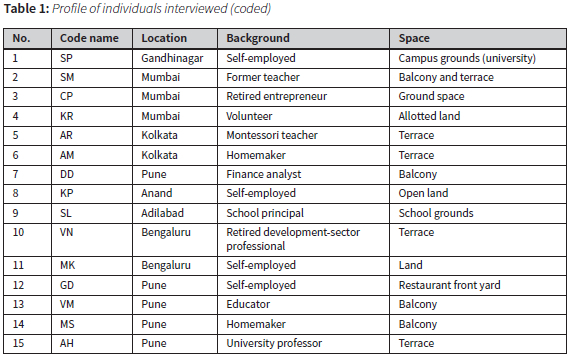
Based on mutual availability, we were able to interview 15 people from seven cities through the snowballing approach to draw attention to the diversity of practices and approaches governing urban farming practices (see Table 1). Ethical protocols of seeking consent and voluntary participation were followed as approved by the Indian Institute for Human Settlements (IIHS) Research Ethics Committee.
The transcribed interview data was thematically analysed to identify patterns, structures, and relations in the data. According to Boyatzis (1998), "Thematic analysis is a method for identifying, analysing, and reporting patterns (themes) within data. It minimally organises and describes your data set in (rich) detail. However, it also often goes further than this, and interprets various aspects of the research topic". This is an interpretative exercise. As Terry et al. (2017, p.7) pointed out, "If themes 'reside' anywhere, they reside in our heads from our thinking about our data and creating links as we understand them". Themes were inductively created from the data rather than following a theory-driven coding frame. Rich descriptions of data were connected back to the research questions, to provide an interpretation of specific points of interest such as motivation and expanding sphere of actions. Since many themes were closely associated to certain artifacts/ practices, interpretation involved going beyond the description of an occurrence, and relating it to underlying events (Lawler, 2002; Ospina & Dodge, 2005).
Findings
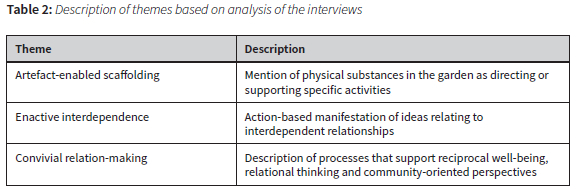
The interviews provided insights into ways in which participants began seeing their agency in gardening-related activities. A 'personal transformation' was generated by the perspectives embedded in the practice, and these views were affirmed through peer feedback (Hards, 2011). This led to the gardening practice being understood in relation to wider environmental issues, such as food miles, seed sovereignty, water usage and increasing local biodiversity. These views propose social interactions as enablers of the sense-making process, which simultaneously shape normative ideas regarding the world. In a similar vein, Ramstead et al. (2016) argued that social learning constitutes immersion in local contexts through what they describe as 'regimes of attention' that direct humans to engage with the environment in specific ways. Interconnected themes arose from participants' responses and narratives. Broadly classified as 'artefact-enabled scaffolding', 'enactive interdependence' and 'convivial relation-making' (see Table 2), these themes highlighted different ways in which the respondents connected with the physical space, perceived the immediate environment, and attended to the tasks associated with growing edibles.
Emergent ideas based on the themes are discussed as follows:
Artefact-enabled scaffolding
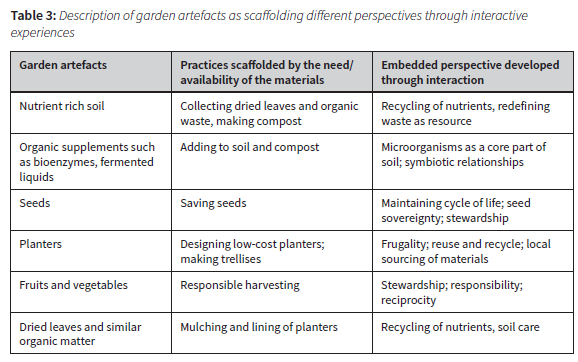
Respondents described how their interactions with different materials to make compost, collect biomass, grow seasonal edible plants or engage in plant care helped them expand their notions of sustainability, labour, care and community engagement as outlined in Table 3 below.
The artefact-enabled scaffolding process is further elaborated by VN who remarked,
I use whatever waste is generated in the house and sometimes make liquid ferments to use as a spray or add to the compost. I think whatever we are regularly using should be easily and locally available. I haven't found good quality cow dung, so I have developed my own recipes for nutrient mixes. Each plant responds differently, and I am always learning that way.
Visceral experiences of activities, supported by artefacts in the garden seem to engage a wider spectrum of senses and their combinations, which allows one to attend to previously ignored features of the environment. Bai (2015) argued, instead of appealing to vision-based discursive categorisation of the surroundings, a more sensuous perception arouses a participatory consciousness, and nurtures an emotional relationship. This also allows one to be especially sensitive to changes, which can act as feedback (such as the budding of a flower, or early signs of a pest affecting a plant) and thereby respond accordingly. Respondents commented on how they had begun paying more attention to the weather, even as artificially controlled environments have become the norm, as they could see it impacting plant growth and health. Such diverse and consequential acts of noticing were mediated through their connection with the plants and the immediate surroundings. A comment from SM illustrated this perspective:
When you are personally involved, you understand the importance of such an initiative. We are not only growing plants, but we are growing as human beings.
Enactive interdependence
Many respondents described related practices that could be understood as a broadening of sustainability perspective owing to recognising the interrelated connections constituting ecosystem well-being. For instance, CP explained,
My bathroom water is filtered and used in growing plants. What we are using is a natural water filter. On a small scale, we can take kitchen water and bath water; when we are using organic bath soaps, they act as natural pest controllers, so we don't have to use fresh water. The tap water after you wash rice and all is full of nutrients for the plants. That should not go wasted.
AR commented on the need to revitalise the soil based on her experience, and connected it to the rural-urban gap in food production.
I have grown spices like mustard for my annual consumption. Again, I will use it for mulching. We have to return to the soil whatever nature has given us, or else how will soil give us again? The food is getting transported from village to the city, so the soil of the village is becoming less fertile. So they are adding more and more fertilisers from the factories into the soil. Unless you grow your own food, you won't realise the value of food.
In many cases, participants found ways to express their sentiments through the garden itself. For instance, during the interview, SP plucked a cabbage head and showed the author the vigorous roots that supported the plant.
Taste and health are not separate. Eating these vegetables reminds me of my childhood when everything was grown organically. You don't get that taste from the market vegetables now. I want my children to experience and remember this taste.
Convivial relation-making
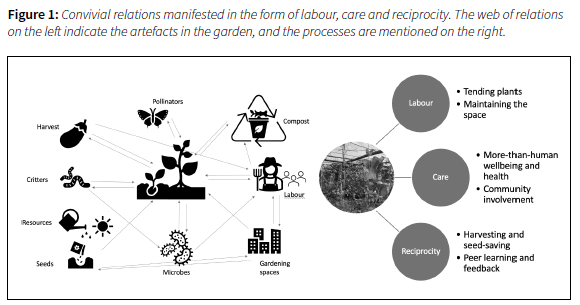
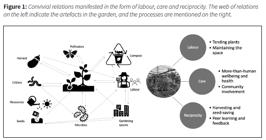
Participating in practices of growing edible plants provides volunteers with a visceral sense of ecological relationships manifested in the form of plant care, pest-predator interactions, seed saving, composting, mulching and so on. These actions create a 'coagulative' practice (Dutta & Chandrasekharan, 2018) - a set of actions that generate an understanding of the interdependence of elements in the environment, such as the symbiotic relationship of microbial systems and a garden, and the need for biodiversity for a healthy ecosystem. The term 'coagulative' captures the quality of the practice wherein seemingly different actions are integrated. This coagulation gradually leads to amorphous ideas becoming more substantive and actionable (see Figure 1). For instance, the need for nutrients led to the realisation of nurturing healthy soils and reimagining their connection with organic waste. Such close interactions led practitioners to deeply reflect on the methods of garbage disposal in their communities. Growing food thus creates various associations between elements that are systematically in an urban set-up, in terms of production, consumption and waste disposal. By paying close attention and unearthing such interdependencies, individuals began to participate in acts of care and are motivated to deepen their relationship with the 'cared-for' environment based on the response.
Most participants described feeling motivated through tangible positive feedback, in terms of harvest or encouragement from peers. The idea of being able to grow food in limited spaces, even in small quantities, seems to have helped participants actively seek groups and practices to help them sustain the effort. Further, the possibility of forming and strengthening social bonds through shared actions acted as a motivation to participate in similar activities. For instance, a respondent described how people organised themselves to collect dry biomass from various localities and kickstarted a civic movement to prevent dried leaves from going to the landfill. As evident in the narratives, the experience of togetherness attached to social interaction and affiliation not only motivates individuals to seek pleasure in social interactions, but also works to strengthen social bonds. These actions are mediated through the artefacts of practice, which act as tangible media for shared interactions and learning. SM, a former teacher, reflected on the need for tangible green spaces in school.
Every classroom should have a window. We are disconnecting children from nature with all the concrete buildings. Let them spend time outside and then ask questions... We need to create those kinds of schools where children will be close to the environment. What is education? Sharing experiences of people.
MK, who had taken to growing plants as a hobby, gradually moved from ornamentals to edible varieties, and realised that the latter actually required less maintenance. She commented,
It is actually easier to grow and maintain a native edible and medicinal garden than an ornamental garden as most of the latter are exotic varieties which need greater attention and care. With this transformation, my aesthetic sense too evolved, and I started appreciating the beauty of an edible garden.
Barriers and constraints
A recurrent tension articulated by many respondents was that of acceptance by neighbours, especially in shared spaces. While a few were able to garner support and appreciation from the immediate community, the aesthetics of growing food with frugal means could not be conveyed in many cases. Respondents also mentioned difficulty in saving seeds, as the fruits kept for harvest would get stolen or succumb to external elements. One of the respondents had to shut down her gardening activities a few months after the interview due to increasing protests by neighbours who felt that the garden was encroaching on public space. Lack of understanding, awareness and insufficient dialogue are some of the reasons that can escalate arguments. Another significant worry was the structural viability of spaces being used for gardening, especially balconies and rooftops. Fears of seepage or cracks also fuelled scepticism from neighbours in some cases. Distribution of reliable data and information about urban farming practices, supportive policies, infrastructure and social acceptability are needed to sustain such initiatives in the long run.
Discussion
Building a meaningful relationship with the environment requires immersive, sensorium-based experiences, which generate the rich, moral imagination necessary to think, learn and act in ecologically responsible ways. Given the atrophied and opaque nature of socio-ecological relationships in cities, facilitating such rich experiences and understanding the challenges in learning and acting upon them is a promising and urgent area of research.
Far from being barren, urban areas can be rich pockets of biodiversity, with native and non-native species assemblages (Faeth et al., 2011). Co-existence and mutual well-being of living systems in cities also encourage social bonding, co-learning, and stewardship as people from different walks of life participate in group activities (McMillen et al., 2016). Thus, to avoid the adverse environmental consequences of urbanisation, ecologically-rich spaces such as wetlands, forested areas, farm plots, and beaches need to be defined, preserved and made an important part of the lives of people. As Russ and Krasny (2017) commented,
The story of cities as ecological spaces needs to be told, both in cities and outside them: to adults and to the many young people who increasingly populate the world's growing cities. ... Such stories will have a critical impact on the willingness of the inhabitants of the cities of the future to protect and care for - and create - their urban environments. (p. 18)
In this project, we explored growing edible plants as a practice that allows one to embody the reciprocal relationships embedded in the health of the land, soil and living beings dependent on it. In particular, we sought to identify salient features that incorporate aspects of interdependence in urban gardening practices and found sustained interactions of sourcing seeds, making compost, designing planters, making natural fertilisers and pest repellents, and seed saving as significant pathways for practitioners to appreciate relational notions of well-being. In contrast, the highly commercialised options for gardening replete with automations and ready-to-use kits strip the relational meaning-making process, thereby turning plants into commodities to be bought and sold, reducing the convivial learning potential of such practices. The forms of gardening thus described by the respondents in the study form a critical commentary against the reductionist logic of capital intensive gardening practices (Naylor, 2012).
Practitioners shared how their sensorial engagement allowed them to attend and tend to the evolving conditions of the garden spaces as the soil would start harbouring earthworms and other creatures, the flowers would attract bees, butterflies, birds and other insects, the fruits would sometimes also invite the attention of monkeys and rodents, highlighting the complexity of shared co-existence. However, through such 'noticings' facilitated by the garden, participants felt more attuned and responsive to phenomena around them such as weather changes, seasonal variations, presence or absence of pollinators and so on. The health of the garden space became a proxy for the overall functioning of the local ecosystem, while their sense of personal well-being expanded to include such parameters.
Based on our findings we argue that community-gardening can be an important way to motivate people to re-establish connections with the ecosystem. As a tool for conviviality, urban gardening at personal and community level allows for social bonding, free sharing of knowledge and resources, is less resource-intensive owing to local scales of practice, and provides a learning oriented lens to develop a critical perspective towards technologies that operate in ignorance of, or against communal well-being. The barriers experienced only underscore the need of such initiatives to find infrastructural and policy support. Within the larger narrative of transitioning to sustainable food systems, such grassroots practices constitute significant ways to strengthen actions at a community level.
The initiatives described by most participants, especially when using their personal space, were limited to small, constructive tasks facing negligible systemic opposition (unlike in the case of protesting against building dams or clearing forest areas). Additionally, while a shift in perspective regarding recognising the interrelatedness and interdependence was observed, it was not clear if participants could place their practice in a larger context and compare with the trade-offs involved (such as the impact of agroecological practices on rural livelihoods, increase in public transport at the cost of clearing forest areas etc.). These are systemic issues with no straightforward answers, so it is likely that relevant knowledge of local civic and environmental issues (such as waste ending up in the nearest landfill, prevailing prices of food, government rules/schemes etc.) is required in addition to motivated action. Thus, it remains to be seen if personal, constructive actions can translate into large-scale social initiatives, especially in the face of resistance or inertia from the larger socio-economic system. That being said, the socio-political emphasis on care and reciprocal relationships manifested in convivial practices form a generative platform of transformative change at micro-level.
Such sites also offer rich avenues for informal learning, and offer guidance for formal educational institutions to incorporate similar spaces as part of the learning trajectory for students. Many respondents voiced their interest and concern regarding the younger generation's connection with land and identified their potential to share their time, expertise and learning to cultivate food gardens in collaboration with educational institutions. Participating in community-based farming activities can encourage thinking beyond disciplinary boundaries, and develop skills and convivial sensibilities to engage with local, action-oriented issues that could be connected with the curriculum. Strengthening community involvement also subverts the consumerist model of a school system (Kopnina, 2015), by sustaining context-specific and place-dependent interactions. Creating space for such engagements within the formal curriculum has immense potential to seed grassroots movements across different localities. As argued in this article, such forms of learning should incorporate a convivial orientation to relationality and understanding of gardening practices.
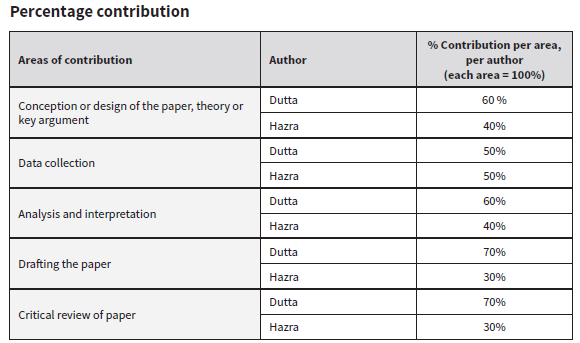
Notes on Contributors and their ContributionsLead author
Dutta, Deborah
Deborah Dutta is a postdoctoral associate at the Werklund School of Education, University of Calgary. She is an interdisciplinary academic interested in the interconnections between ecology, embodied knowledge and collective actions.
Co-author
Hazra, Amrita
Amrita Hazra (Ph.D. chemistry, Cornell University; Postdoc, microbiology, UC Berkeley) is an Associate Professor at the Indian Institute of Science Education and Research (IISER) in Pune, India. Her laboratory explores microbial vitamin production and sharing. She is deeply interested in nutrition and science outreach.
References
-
Adams, B., Li, E., Bahlai, C., Meineke, E., McGlynn, T., & Brown, B. (2020). Local-and landscape-scale variables shape insect diversity in an urban biodiversity hot spot. Ecological Applications, 30(4), e02089. https://doi.org/10.1002/eap.2089
» https://doi.org/10.1002/eap.2089 -
Bai, H. (2015). Peace with the earth: Animism and contemplative ways. Cultural Studies of Science Education, 10, 135-147. https://doi.org/10.1007/s11422-013-9501-z
» https://doi.org/10.1007/s11422-013-9501-z -
Barthel, S., Folke, C., & Colding, J. (2010). Social-ecological memory in urban gardens; Retaining the capacity for management of ecosystem services. Global Environmental Change, 20(2), 255-265. https://doi.org/10.1016/j.gloenvcha.2010.01.001
» https://doi.org/10.1016/j.gloenvcha.2010.01.001 - Berry, W. (1990). What are people for? North Point Press.
-
Blok, A., & Meilvang, M. L. (2015). Picturing urban green attachments: Civic activists moving between familiar and public engagements in the city. Sociology, 49(1), 19-37. https://doi.org/10.1177/0038038514532038
» https://doi.org/10.1177/0038038514532038 - Boyatzis, R. E. (1998). Transforming qualitative information: Thematic analysis and code development. Sage.
-
Bosello, F., & Chen, C. (2011). Adapting and mitigating to climate change: Balancing the choice under uncertainty. FEEM Working Paper No. 159.2010. http://dx.doi.org/10.2139/ssrn.1737614
» http://dx.doi.org/10.2139/ssrn.1737614 -
Bratman, G. N., Olvera-Alvarez, H. A., & Gross, J. J. (2021). The affective benefits of nature exposure. Social and Personality Psychology Compass, 15(8), e12630. https://doi.org/10.1111/spc3.12630
» https://doi.org/10.1111/spc3.12630 -
Clandinin, D. J., Pushor, D., & Orr, A. M. (2007). Navigating sites for narrative inquiry. Journal of Teacher Education, 58(1), 21-35. https://doi.org/10.1177/0022487106296218
» https://doi.org/10.1177/0022487106296218 -
Colding, J., & Barthel, S. (2013). The potential of 'Urban Green Commons' in the resilience building of cities. Ecological Economics, 86, 156-166. https://doi.org/10.1016/j.ecolecon.2012.10.016
» https://doi.org/10.1016/j.ecolecon.2012.10.016 -
Cook, J., Oviatt, K., Main, D. S., Kaur, H., & Brett, J. (2015). Re-conceptualizing urban agriculture: An exploration of farming along the banks of the Yamuna River in Delhi, India. Agriculture and Human Values, 32(2), 265-279. https://doi.org/10.1007/s10460-014-9545-z
» https://doi.org/10.1007/s10460-014-9545-z -
Date, G., Dutta, D., & Chandrasekharan, S. (2021). Solving for pattern: An ecological approach to reshape the human building instinct. Environmental Values, 30(1), 65-92. https://doi.org/10.3197/096327119X15579936382653
» https://doi.org/10.3197/096327119X15579936382653 - Dutta, D. (2024). Healing metabolic rifts through bridges of conviviality: An exploration of urban gardening practices in Indian cities. In R. Lindgren, T. Asino, E. Kyza, C. Looi, D. Keifert, & E. Suárez (Eds.), Proceedings of the 18th International Conference of the Learning Sciences 2024 (pp .1175-1178).
-
Dutta, D., & Chandrasekharan, S. (2018). Doing to being: Farming actions in a community coalesce into pro-environment motivations and values. Environmental Education Research, 24(8), 1192-1210. https://doi.org/10.1080/13504622.2017.1392485
» https://doi.org/10.1080/13504622.2017.1392485 -
Faeth, S. H., Bang, C., & Saari, S. (2011). Urban biodiversity: Patterns and mechanisms. Annals of the New York Academy of Sciences, 1223(1), 69-81. https://doi.org/10.1111/j.1749-6632.2010.05925.x
» https://doi.org/10.1111/j.1749-6632.2010.05925.x -
Fantini, A. (2023). Urban and peri-urban agriculture as a strategy for creating more sustainable and resilient urban food systems and facing socio-environmental emergencies. Agroecology and Sustainable Food Systems, 47(1), 47-71. https://doi.org/10.1080/21683565.2022.2127044
» https://doi.org/10.1080/21683565.2022.2127044 -
Galluzzi, G., Eyzaguirre, P., & Negri, V. (2010). Home gardens: Neglected hotspots of agro-biodiversity and cultural diversity. Biodiversity and Conservation, 19(13), 3635-3654. https://doi.org/10.1007/s10531-010-9919-5
» https://doi.org/10.1007/s10531-010-9919-5 -
Hamilakis, Y. (2017). Sensorial assemblages: Affect, memory and temporality in assemblage thinking. Cambridge Archaeological Journal, 27(1), 169-182. https://doi.org/10.1017/S0959774316000676
» https://doi.org/10.1017/S0959774316000676 -
Hards, S. (2011). Social practice and the evolution of personal environmental values. Environmental Values, 20(1), 23-42. https://doi.org/10.3197/096327111X12922350165996
» https://doi.org/10.3197/096327111X12922350165996 - Illich, I. (1975). Tools for conviviality. Harper & Row.
- James, P. (2014). Urban sustainability in theory and practice: Circles of sustainability. Routledge.
- Kavedžija, I. (2021). The process of wellbeing: Conviviality, care, creativity. Cambridge University Press.
-
Kopnina, H. (2015). Neoliberalism, pluralism and environmental education: The call for radical re-orientation. Environmental Development, 15, 120-130. https://doi.org/10.1016/j.envdev.2015.03.005
» https://doi.org/10.1016/j.envdev.2015.03.005 -
Kuo, M. (2015). How might contact with nature promote human health? Promising mechanisms and a possible central pathway. Frontiers in Psychology, 6, 1093. https://doi.org/10.3389/fpsyg.2015.01093
» https://doi.org/10.3389/fpsyg.2015.01093 - Krasny, M. E., & Tidball, K. G. (2015). Civic ecology: Adaptation and transformation from the ground up. MIT Press.
-
Lal, R. (2020). Home gardening and urban agriculture for advancing food and nutritional security in response to the COVID-19 pandemic. Food Security, 12(4), 871-876. https://doi.org/10.1007/s12571-020-01058-3
» https://doi.org/10.1007/s12571-020-01058-3 - Lawler, S. (2002). Narrative in social research. In T. May (Ed.), Qualitative Research in Action (pp. 242-258). Sage.
-
Marsh, K. L., Johnston, L., Richardson, M. J., & Schmidt, R. C. (2009). Toward a radically embodied, embedded social psychology. European Journal of Social Psychology, 39(7), 1217-1225. https://doi.org/10.1002/ejsp.666
» https://doi.org/10.1002/ejsp.666 -
McMillen, H., Campbell, L. K., Svendsen, E. S., & Reynolds, R. (2016). Recognizing stewardship practices as indicators of social resilience: In living memorials and in a community garden. Sustainability, 8(8), 775. https://doi.org/10.3390/su8080775
» https://doi.org/10.3390/su8080775 - Mougeot, L. J. A. (2006). Growing better cities: Urban agriculture for sustainable development. International Development Research Centre.
-
Nagendra, H. (2018). The global south is rich in sustainability lessons that students deserve to hear. Nature, 485-488. https://doi.org/10.1038/d41586-018-05210-0
» https://doi.org/10.1038/d41586-018-05210-0 -
Naylor, L. (2012). Hired gardens and the question of transgression: Lawns, food gardens and the business of 'alternative' food practice. Cultural Geographies, 19(4), 483-504. https://doi.org/10.1177/1474474012451543
» https://doi.org/10.1177/1474474012451543 -
Okvat, H. A., & Zautra, A. J. (2011). Community gardening: A parsimonious path to individual, community, and environmental resilience. American Journal of Community Psychology, 47(3), 374-387. https://doi.org/10.1007/s10464-010-9404-z
» https://doi.org/10.1007/s10464-010-9404-z -
Ospina, S.M., & Dodge, J. (2005). It's about time: Catching method up to meaning -The usefulness of narrative inquiry in public administration research. Public Administration Review, 65, 143-157. https://doi.org/10.1111/j.1540-6210.2005.00440.x
» https://doi.org/10.1111/j.1540-6210.2005.00440.x - Pollan, M. (2013). Food rules: An eater's manual. Penguin.
-
Poulsen, M. N., Neff, R. A., & Winch, P. J. (2017). The multifunctionality of urban farming: Perceived benefits for neighbourhood improvement. Local Environment, 22(11), 1411-1427. https://doi.org/10.1080/13549839.2017.1357686
» https://doi.org/10.1080/13549839.2017.1357686 -
Ramstead, M. J., Veissière, S. P., & Kirmayer, L. J. (2016). Cultural affordances: Scaffolding local worlds through shared intentionality and regimes of attention. Frontiers in Psychology, 7, 1090. https://doi.org/10.3389/fpsyg.2016.01090
» https://doi.org/10.3389/fpsyg.2016.01090 -
Rao, N., Patil, S., Singh, C., Roy, P., Pryor, C., Poonacha, P., & Genes, M. (2022). Cultivating sustainable and healthy cities: A systematic literature review of the outcomes of urban and peri-urban agriculture. Sustainable Cities and Society, 85, 104063. https://doi.org/10.1016/j.scs.2022.104063
» https://doi.org/10.1016/j.scs.2022.104063 - Russ, A., & Krasny, M. E. (Eds.). (2017). Urban environmental education review. Cornell University Press.
-
Steenkamp, J., Cilliers, E. J., Cilliers, S. S., & Lategan, L. (2021). Food for thought: Addressing urban food security risks through urban agriculture. Sustainability, 13(3), 1267. https://doi.org/10.3390/su13031267
» https://doi.org/10.3390/su13031267 -
Terry, G., Hayfield, N., Clarke, V., & Braun, V. (2017). Thematic analysis. The Sage handbook of qualitative research in psychology, 17-37. https://doi.org/10.4135/9781526405555.n2
» https://doi.org/10.4135/9781526405555.n2 -
Tidball, K. G., & Krasny, M. E. (2011). Urban environmental education from a social-ecological perspective: Conceptual framework for civic ecology education. Cities and the Environment (CATE), 3(1), 11. https://doi.org/10.15365/cate.31112010
» https://doi.org/10.15365/cate.31112010 - Thorp, L., & Townsend, C. (2001, December). Agricultural education in an elementary school: An ethnographic study of a school garden. In Proceedings of the 28th Annual National Agricultural Education Research Conference in New Orleans, LA, pp. 347-360.
-
Turner, B., Henryks, J., & Pearson, D. (2011). Community gardens: Sustainability, health and inclusion in the city. Local Environment, 16 (6), 489-492. https://doi.org/10.1080/13549839.2011.595901
» https://doi.org/10.1080/13549839.2011.595901 -
UNDESA (United Nations Department of Economic and Social Affairs). (2018). Population Division. https://population.un.org/wup/
» https://population.un.org/wup/ -
Wilby, R. L., & Perry, G. L. (2006). Climate change, biodiversity and the urban environment: A critical review based on London, UK. Progress in Physical Geography, 30(1), 73-98. https://doi.org/10.1191/0309133306pp470ra
» https://doi.org/10.1191/0309133306pp470ra -
Yang, N. N., & Yang, A. (2022). Urban bioeconomy: Uncovering its components, impacts and the urban bio-symbiosis. Cleaner Production Letters, 3, 100015. https://doi.org/10.1016/j.clpl.2022.100015
» https://doi.org/10.1016/j.clpl.2022.100015