Fostering Students' Engagement in Low-Carbon Education through an Electricity-Saving Project
Abstract
Emissions of carbon dioxide (CO2) result from burning fossil fuels. Industrial activities continue to produce CO2, which can increase by up to 64% annually. CO2 raises global temperatures; this has adverse effects on the climate, leading to climate change. In Indonesia, 56% of electricity is generated using coal-fired power plants, a process that significantly contributes to CO2 emissions through coal combustion. Consequently, optimising electricity usage is paramount to mitigating these emissions effectively. Reducing emissions is one way to address climate change. Therefore, this study aims to ascertain how university students implement and respond to project-based electricity saving. This case study involved 75 participants enrolled in the Statistics Department. The findings demonstrated that students could complete the one-month project electricity saving (kWh), resulting in reductions in emissions of CO2 (kg) and developing as sense of Quantitative Literacy (QL). The most popular ways to save electricity are to turn off lights and televisions, unplug phone chargers, use LED lighting, and control the use of electrical fans. From this study, it can be inferred that students were capable of finishing the project with a satisfactory rating of 4.5/5. The students in this study are expected to continue their energy-saving initiative upon the conclusion of this project. They are also encouraged to take part in more projects. Further research to determine how much longer-term energy saving can be performed by students is suggested.
low carbon; quantitative literacy; project-based; electricity saving; carbon engagement
Introduction
According to the International Panel on Climate Change (IPCC), human activities, such as industrialisation, have a considerable impact on climate change (Rhodes, 2019). Carbon dioxide gas emissions are produced when fossil fuels like coal are burned (Sasana & Putri, 2018). In Indonesia, coal accounts for 58% of electricity sources (Langer et al., 2021). Industrial CO2 emissions have increased by up to 64% yearly between 1990 and 2019 (https://news.un.org/en/story/2022/04/1115452). This has a negative impact because CO2 contributes to increasing the world temperature (Rhodes, 2019). A rise in global temperature brings climate change. If the global temperature rises by more than 1.5°C, it will have a severe impact on human health (Hoegh-Guldberg et al., 2019). The global temperature trend is predicted to continue (Rhodes, 2019). Increased dehydration, kidney failure, tropical infections, mental health issues, pregnancy problems, and allergies are all effects of rising global temperatures (Rocque et al., 2021). Rising global temperatures also decrease agricultural goods and soil quality, which diminishes supplies of adequate human nourishment (Watts et al., 2020). Reducing carbon emissions is one way to address this problem.
Through education, the next generation can be supported to deal with global warming. The current generation should be prepared immediately for adaptation and mitigation, especially by reducing carbon dioxide emissions (CO2). There have been various perspectives of growing concern on environmental sustainability. Due to this, the global community has adopted several ideas, such as education for sustainable development, low-carbon lifestyles, and pro-environmentalism (ESD) (Rahmawati et al., 2022). These concepts attempt to promote environmental protection or harmony between people and the environment (Sulphey, 2019).
Ecologically friendly behaviour has a significant impact on energy use and carbon emissions. Individual and societal orientations are the two main categories of energy consumption behaviour models (Chatterton, 2011). Energy saving and pollution reductions are incorporated into individual models, while social models include the provision of management systems, green technologies, and infrastructure. Everyone must receive education starting at a young age to reduce CO2 emissions.
One effective way to reduce CO2 emissions is to provide energy-saving education (Mizuta, 2003). Survey results revealed that climate change education could change individual behaviour and reduce individual carbon emissions by 2.86 tons of CO2 per year, an outcome not very different from the use of solar cells and electric vehicles (Cordero et al., 2020). Low-carbon activities reduce carbon emissions (Hudha & Permanasari, 2020).
Due to their strong connection to climate change, low-carbon activities must be explained. Education can promote climate change awareness (Keller et al., 2022). In Malaysia and China, education about reducing fossil fuel use has been carried out (Hudha & Permanasari, 2020). A low-carbon school community programme has also been implemented in Malaysia. Student literacy increased due to this programme, but there was no observable change in the performance of low-carbon activities (Mahat et al., 2020).
Knowledge is the first step toward a low-carbon mindset. However, junior high school students in Yogyakarta, Indonesia, still have low levels of climate change literacy (Sulistyawati et al., 2018). In Poland, it was discovered that "zero-emission" literacy in students between the ages of 15 and 19 and students between the ages of 20 and 24 was considered sufficient (Kaczmarczyk & Urych, 2022). This circumstance demonstrates that low-carbon education activities have yet to be carried out at their best. Therefore, education must be improved to hasten the development of low-carbon activities.
The habit of reducing CO2 emissions requires a foundation of rational awareness to consistently promote low-carbon behaviours. To effectively integrate low-carbon activities into daily life, it is essential to involve students in direct, hands-on activities (Nazarenko & Kolesnik, 2018; Rousell & Cutter-Mackenzie-Knowles, 2019). Such engagement enhances both carbon literacy (CL) and quantitative literacy (QL), thereby reinforcing their understanding and application of low-carbon practices (Dósa & Russ, 2020). Promoting active carbon engagement is a more efficacious strategy for reducing individual carbon footprints compared to merely enhancing carbon knowledge (Schleich et al., 2024).
Learning both at school and at home is part of this. Teachers especially play an important role in promoting low-carbon activities (Ferguson, 2022). Energy saving by students is one of the low-carbon actions that can be taken. To answer the question of how students save energy, it is necessary to conduct research. Therefore, this study aims to address this question and to establish whether students could reduce emissions using individual models through home-based energy conservation.
Both informal and formal instructions can help accustom students to low-carbon activities. Formal education per se takes place in a classroom. Project-based learning is one of the several potential learning strategies that might help students gain experience in resolving global warming issues (Genc, 2015). Project-based learning as a constructivist learning approach is recommended in environmental education (Arik & Yilmaz, 2020; Nazarenko & Kolesnik, 2018; Rousell & Cutter-Mackenzie-Knowles, 2019). It involves students in solving environmental problems directly. As stated by Kolb (1984), abstract concepts can be obtained flexibly in various ways, including through new experiences. He stated, "Learning is a process by which knowledge is created through the transformation of experience (p. 38). Experiential learning includes project-based learning or problem-based learning, community service learning or community-based learning, place-based learning, field trips or field experiences, and internships (Backman et al., 2019). Several prior investigations have been carried out using this learning model (Giang, 2021; Korkmaz & Kalayci, 2021; Nilsook et al., 2021; Paviotti & Cavicchi, 2022; Requies et al., 2018; Tierney et al., 2018). The results showed that project-based learning could enhance the significance of a learning resource (Giang, 2021; Korkmaz & Kalayci, 2021; Nilsook et al., 2021; Paviotti & Cavicchi, 2022; Requies et al., 2018; Tierney et al., 2018). Numerous prior studies have explored the implementation of project-based learning as an effective approach to enhancing climate change mitigation efforts among university students (Bramwell-Lalor et al., 2020; Nagarajan & Overton, 2019; Wróblewska & Okraszewska, 2020).
One effective strategy for mitigating climate change involves reducing CO2 emissions across various human activities. A significant approach to achieving this is conserving electrical energy, as substantial CO2 emissions often accompany electricity generation. A practical approach for students to contribute to reducing CO2 emissions is by conserving electricity in the environments where they engage in daily activities (Sumrall & Sumrall, 2021; TaeHoon et al., 2012; Zakaria et al., 2020). The majority of research has concentrated on the efforts of students residing in campus dormitories to conserve electrical energy (Bekker et al., 2010; Black et al., 2010; Bull et al., 2018; Cernicova-Buca et al., 2024; Emeakaroha et al., 2012; Toma et al., 2019). What measures are being undertaken by students to implement energy-saving practices at home? Furthermore, how are low-carbon activities accepted and integrated into their daily lives? This study addresses these questions to learn how students may implement energy-saving projects, save energy, and react to energy-saving projects at home.
Methods
Research design
A case study was used in this investigation (Crowe et al., 2011). This design aims to fully understand a phenomenon, in this case, electricity-saving. Participants included students enrolled in the Statistics Study Program at Universitas Muhammadiyah Semarang who took an introductory environmental science course.
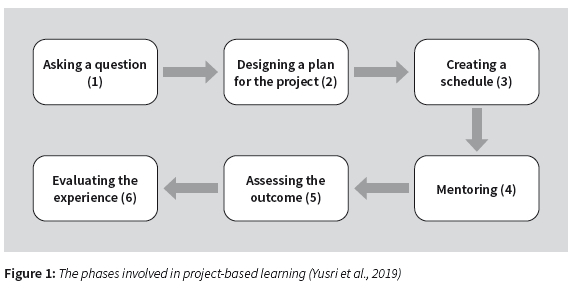
Students participated in project-based learning for a semester and finished an electrical energy-saving proj ect. The project involved the following stages: 1) asking students about the effects of global warming and ways to conserve energy. The students posed questions after reviewing four news articles related to electrical energy, highlighting that 61% of electricity generation in Indonesia is derived from coal-fired power plants. Previous discussions had centred on global warming and considered its primary contributors, including significant CO2 emissions from power plant operations (61% of electricity generation in Indonesia is derived from coal-fired power plants). Consequently, the students were prompted to reflect on 1) measures they had taken to conserve electricity to mitigate against CO2 emissions; 2) planning the project; 3) developing the project schedule; 4) project implementation; 5) assessing project implementation; and 6) evaluating project activities. These stages are illustrated in a flow diagram in Figure 1.
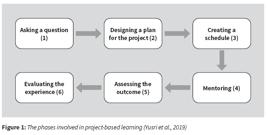
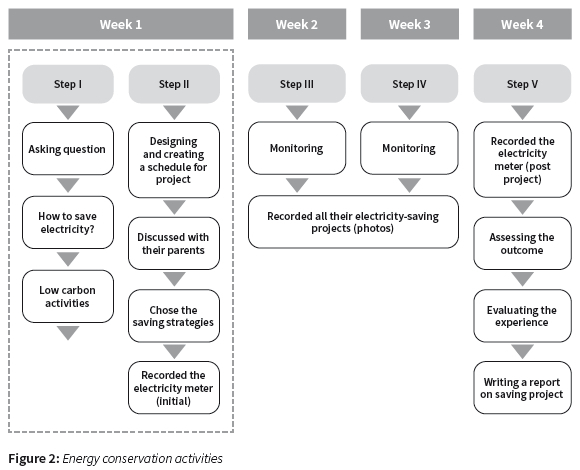
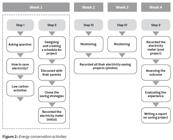
In addition, students took the following steps to complete the project: 1) students discussed the electricity-saving project with their parents; 2) they chose an energy-saving strategy from among those recommended by the lecturer; 3) they recorded their electricity consumption by taking a reading on their house electricity meter (in kWh) on the project's starting date; 4) they kept a record of all their electricity-saving efforts; and 5) they documented the final electricity meter readings at the conclusion of the one-month electricity-saving project. This data was subsequently compared to the recorded reading (kWh) for the previous month to determine the difference in electricity-saving. The quantified electricity saving was then converted into the corresponding reduction in CO2 emissions. Afterward, the students provided their responses to a questionnaire about their electricity-saving project implementation via a Google Forms link. Finally, they wrote a report on their energy saving initiative and uploaded it to Schoology. These stages are illustrated in Figure 2.
Participants
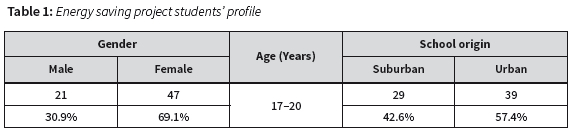
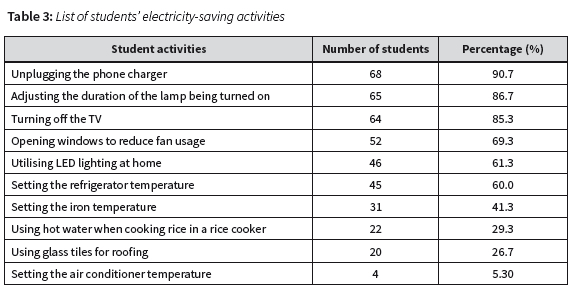
This study involved statistics students at Universitas Muhammadiyah Semarang who were enrolled in an introductory environmental science course, comprising 22 male and 53 female participants. The energy-saving project commenced in the ninth meeting of the course when students were given materials with instructions on the project. Prior to this meeting, students were required to independently research environmental issues; one that emerged was the issue of rising carbon dioxide (CO2) emissions from human activities in Indonesia. The students attending lectures are between 17 and 20 years of age. The demographic and academic profiles of the students are detailed in Table 1. The course was taken online by all students. Schoology, a learning management system, was used to facilitate learning in this course. Students were given some options for electricity-saving activities from which they could choose. These activities are detailed in Table 3.
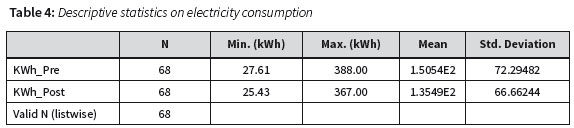
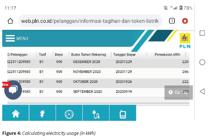
Every student participating in the electricity-saving initiative had to submit a project report. After the task was completed at home, the electricity-saving project report was then uploaded to Schoology. A total of 68 students turned in their project reports (21 male and 47 female). Among the 21 male students, four reported no electricity saving. This was due to several factors, including the students' economic expansion, holiday activities, extra activities (e.g., welding a house fence), and uncooperative family members. Among the 47 female students, eight were not successful in saving electricity because of a variety of reasons, e.g., family members moving in, some family members insisting against conserving electricity, increases in the usage of hand tools, and inefficient use of electricity. Electricity usage, measured in kilowatt-hours (kWh), was recorded at the beginning and end of the month. Subsequently, the data underwent statistical analysis. A detailed description of the measurement results is provided in Table 4.
Data collection
In this study, information was gathered through online observations of classes, student reactions, and reports on the energy-saving project. Class observations were conducted online during meetings using Zoom and WhatsApp groups because lectures were delivered online. Online classroom observations focused on student engagement, specifically in terms of student initiatives to ask questions related to the project. Observations of WhatsApp group interactions focused on the frequency of student inquiries regarding the project.
In addition, a questionnaire was administered to document students' responses to the energy-saving project and collect data related to energy-saving. The questionnaire used a 5-point Likert scale to collect data on the following items: 1) Were you satisfied with your implementation of the electricity-saving project? 2) What challenges did you face in implementing the electricity-saving programme? 3) How did your family members respond to the electricity-saving programme? 4) Who assisted you in your implementation of the electricity-saving project? 5)lf applicable, explain the role of this individual in supporting the electricity-saving project. 6) Do you believe that a project like this should be continued? and 7) What are your suggestions for improving the electricity-saving project? Students filled out the electricity-saving project questionnaire at home after completing the month-long project.
Students' electricity-saving project reports were also used to collect data. These reports covered the following data points: 1) personal information: name, age, gender, and school of origin; 2) household electricity profile: details of a students' residential electricity meter readings; 3) electricity-saving activities: comprehensive list of actions undertaken by students to conserve electricity; 4) electricity consumption data: measured in kilowatt-hours (kWh) at start and end of the project; 5) electricity saving data: the total amount of electricity conserved during the project, measured in kilowatt-hours (kWh); and 6) carbon emission reduction: the amount of CO2 emissions avoided through electricity-saving activities, calculated based on the standard specifying that every 1 kWh reduction corresponds to a reduction of 0.34 kg of CO2 emissions (Quaschning, 2022).
Data analysis
Data analysis was carried out in three stages: data reduction, data display, and conclusion drawing/verification (Rahmawati et al., 2022). Zoom and WhatsApp groups were used for classroom observations during online learning. Zoom observations of the classroom concentrated on student participation, particularly how actively they asked questions about the activity. Then, data from project reports and student replies were gathered for study. Student reaction data were analysed qualitatively to obtain an in-depth understanding of their responses. Meanwhile, project report data were analysed quantitatively to determine the extent of electricity savings. It was later confirmed that data were collected from 75 students. The collected data were further reduced according to how thoroughly the project report's components were written. The electricity-saving project report was refined based on the completeness of the data, specifically the initial and final electricity consumption recorded throughout the project duration. Students engage in project-based learning over one semester, undertaking an electrical energy-saving project. Reducing electricity consumption is a practical approach to lowering CO2 emissions in students' daily activities, contributing to climate change mitigation efforts. This study explores the implementation of energy-saving projects by students, the extent of energy conservation achieved, and their responses to the initiative within a household context.
Results and discussion
Results
Seventy-five Statistics students with characteristics presented in Table 1 participated in this energy-saving project. Some of the energy conservation activities are presented in Figure 2.
Electricity meter
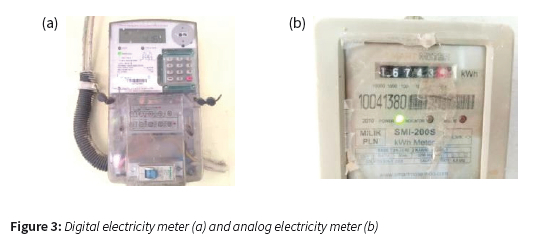
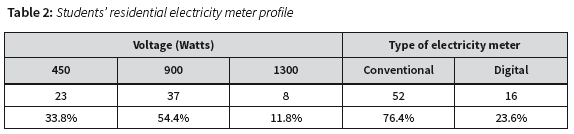
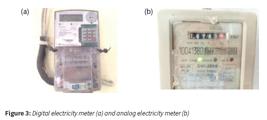
The electricity meter mounted on a wall of the students' house was used by the students to gauge their electricity usage. Every house signed up for a power subscription to Indonesia's State Utility Company (PLN) has this equipment installed either in digital or analog models (see Figure 3). Both types of electricity meters are still in use today. Digital electricity meters are typically utilised in newly constructed or newly built houses, while older power-subscribed buildings tend to employ analog electricity meters. Fifty-four percent of all houses of the students were subscribed to the 900 VA, 33.8% were subscribed to the 450 VA, and the rest were subscribed to the 1300 VA.
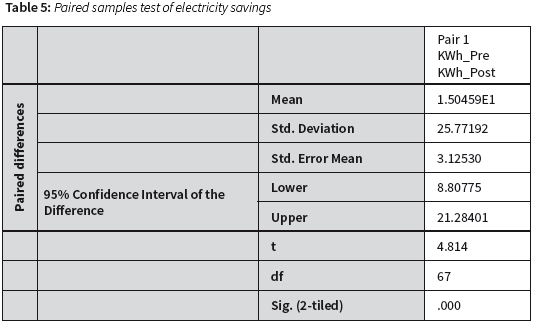
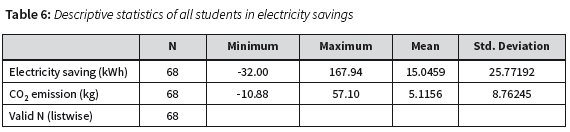
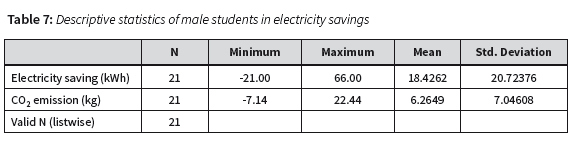
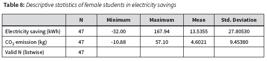
The electrical measurement data were subsequently subjected to statistical analysis using a paired t-test (see Table 5). The data satisfied the assumptions of homogeneity and normality, as indicated by a significance level greater than 0.05. Statistical analyses indicate a significant variation in electricity consumption between the beginning and the end of the month. A comprehensive overview of the overall electricity savings is provided in Table 6. Detailed breakdowns of electricity savings by gender are presented in Tables 7 and 8.
Discussion
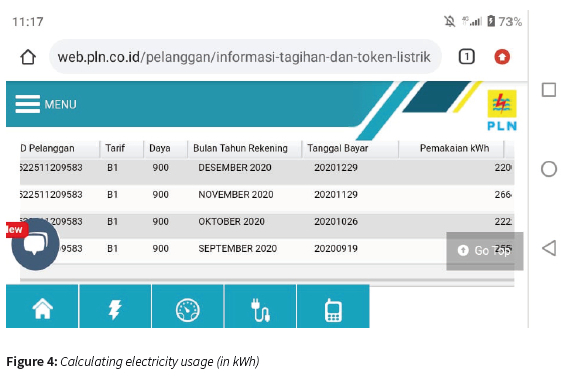
This study involved statistics students in an electricity-saving project the design of which was based on student feedback from a preliminary survey. They successfully conducted the electricity-saving project, as shown in Figure 4, because they were motivated and the goals were clear. As pointed out by Platis and Romanowicz (2020), when students are involved in the learning design, they tend to demonstrate preference for increased energy-efficiency. Backman et al. (2019) explained that project-based learning is a practical education method that can improve understanding, with greater understanding leading to students' greater motivation to engage in the project. However, only 56 of the 75 students who took part in the project - including 17 male and 39 female students - were able to reduce their electricity use. As shown in Table 3, the majority of students saved electricity through simple low-cost activities, such as unplugging the phone charger (90.7%), adjusting the duration of the light being turned on (86.7%), turning off the television (85.3%), opening windows to reduce fan use (69.3%), adjusting the refrigerator temperature (60%), adjusting the iron temperature (41%), and adjusting the air conditioner (AC) temperature (5.3%). Other activities such as installing glass roof tiles, cooking rice in a rice cooker with hot water, and upgrading lights to LEDs were costlier (Surahman et al., 2022).
Students and family members collaborated in this project. Students' responses revealed that it was their parents who were the most eager to save energy (95.6%). Students were encouraged to talk to their family members about the project before it commenced, encouraging and enabling everyone in the family, rather than only the students themselves, to be involved in the project. Some students encountered challenges such as unsupportive family members, increased electricity consumption due to family participation in festive events, and extra activities like fence-welding, leading to failure to save energy. Some students also reported early communication issues with family members. The project introduced a new habit to the family members, which was in some cases, initially challenging. Some family members needed to use electrical fans, some houses needed constant artificial lighting because of poor natural lighting, and some households' economic activities required a large amount of electricity consumption.
Most students who participated in the electricity-saving project were living in urban areas, where the average home size for male students was 118 m2 and the average home size for female students was 126 m2. The size of the dwelling had a significant impact on how much power was used. The larger the property size, the higher the power requirement for lighting and powering various equipment and applicances. The specifications of the power divider and electricity meter readings allowed us to determine whether a household was energy-efficient or not.
The students converted the difference in power use (kWh) between November and December into kg of CO2/kWh, and the study's underlying presumption was that coal is the fuel used to produce electrical energy in Indonesia. Based on the measurement results categorised by respondent gender, it was found that male students' households consumed an average of 141 kWh of electricity per month. Through energy-saving initiatives, they were able to reduce consumption by approximately 18.43 kWh per month, which is equivalent to a reduction of 6.265 kg of CO2 emissions per household per month or 75.18 kg of CO2 emissions per household annually. In comparison, female students' household used 154.6 kWh of electricity per month and could save 13.54 kWh or the CO2 equivalents of 4.60 kg of CO2 emissions/house/month or 55.22 kg CO2 emissions per household per year. On average, the students' monthly electricity use was 147.99 kWh, saving 15.98 kWh or the CO2 equivalent of 5.433 kg CO2 emissions per household /month or 65.20 kg CO2 emissions per household/year. According to Santosa and Susetyo (2019), a residential area's monthly household electricity consumption ranges from 250 to 450 kWh. In this study the average amount of electricity used was 648.31 kWh/month, lower than the average amount in Malaysia (Shofirun et al., 2021). Due to a change in dwelling classification, the electricity use throughout the electricity-saving project differed significantly from the usage reported in an earlier study. As depicted in the images in student reports, the student participants were from low-income residences.
Utilising specific home appliances efficiently is one way to conserve electrical energy (Vicca & Limmeechokchai, 2015). For example, one may turn off the lighting at night, use fans less by opening windows, switch to LED lighting, set the television on a timer, unplug the phone charger when the phone is fully charged, and boost the refrigerator temperature. He or she may also adjust the air conditioner temperature to 24-27°C, cook rice with hot water to reduce the amount of electricity used, and iron clothes occasionally to make the most of the iron heat. Efficient use of home appliances depends on the situation. However, some inefficient electrical devices are still in use daily. Using some glass tiles as part of the roofing allows sunlight to come into the house, which can be an alternative to the inefficient use of lights during the day. This is in line with Janda (2011) who states that energy efficiency can be attained by building an energy-efficient house. The above-mentioned, when practised at home to a greater extent, would have an impact nationally, given that home electricity consumption contributes to an increase in the national electricity demand (Kotsila & Polychronidou, 2021).
We discovered that Indonesia's peak demand may triple between 2010 and 2030 in a business-as-usual case to 77.3 GW, primarily driven by air conditioning, with essential contributions from lighting and refrigerators (McNeil et al., 2019). Students can utilise electricity following community demands while still maintaining their energy conservation efforts, which brings them a step closer to optimised energy use. A project such as the one in this study could considerably contribute to lowering carbon footprints as CO2 emissions are reduced. Small though it is, if every household in Indonesia engages in a project with energy-saving activities, carbon emissions can be significantly lowered. Therefore, the fact that students and their family members were participating in such a project in this study is encouraging; they could save 15.98 kWh or IDR 21,600 (IDR 1,352/KWh) in a month. The benefits of a project of this sort can be amplified by not only conducting environmental assessments but also by providing the community with financial assistance with regard to monthly electricity bills.
After taking part in this project, students gave the implementation of the project a score of 4.5 (on a scale of 5) and expressed satisfaction with the results. Additionally, all students agreed that they desired to carry out the electricity-saving initiative at home because it could reduce CO2 emissions, electrical energy use, and power costs. This project piqued their interest, and they subsequently encouraged their family members to behave appropriately and to restrain their electricity consumption. To the question "How did family members react to the project?", some students answered that their family members had been supportive of it. The following are some excerpts of the student responses:
"The project has been strongly supported by (my) family members because it can reduce (our) monthly expenses. (My) family members become more disciplined as a result of the endeavor."
"(My) family members have participated in and supported the energy-saving initiative."
"How the project enabled electricity expense reduction made my family happy. Although the project has ended, we wish to continue the energy-saving initiative. We want to also inspire others to conserve energy and protect the environment."
This energy-saving initiative helped the students' families reduce electricity expenses. This has been expressed by several students as follows:
"We are in favor of this project as it helped cut the monthly electricity bills."
"I was surprised at how it could drop from IDR 177,000 to IDR 144,000."
"(The project was) extremely beneficial because it could reduce the expenses from purchasing tokens."
"(My family is) positive (about the energy saving project) as the electricity bills can be reduced." "(I'm) very pleased that I can reduce my home electrical costs."
"(My family) accepts this programme because energy saving will result in lower monthly electricity costs."
Some unsuccessful students and family members were also motivated to save electricity. This is shown in the following statements:
"[My family is] very supportive as doing this electrical energy saving project could lower [our] household bills. Even though my family was only able to reduce [our energy consumption] by 1 kWh at the beginning of this project, hopefully, in the following one [we] will be able to reduce it more and lower the CO2 emissions."
"Initially, I did not like it, but over time, it grew on me because, even if [the change] was small, the electricity use could be more efficient."
The discipline of family members in utilising electrical appliances at home was also affected by this effort. The following is a student comment on this:
"Thankfully, [my] family members were lending a hand with this financial plan. They grew more conscious about their electricity use because of this project."
Family members learned the value of saving electricity due to this electricity-saving project. The community or family plays a significant role in establishing sustainable energy-saving practices to save energy (Jiang et al., 2018). This is as shown in the following student statements:
"(It was) very helpful. My family could focus more on how to use electricity thanks to this activity."
"I strongly support it, and I hope that I can get to apply for more energy-saving programs."
Some resources can help family members save money or utilise electricity more effectively. This is consistent with the behaviour change paradigm. One student successfully led and managed this activity at home. Students played the role of influencers in this project. The implementation of an energy reduction initiative is influenced by competent leadership (Xia et al., 2022). Literature also suggests focusing on the meaningfulness of information for students, applying active learning, and being constructive in nature to teach climate change mitigation (Arik & Yilmaz, 2020).
The implementation of energy-saving projects elucidates the rationale for enhancing low-carbon activities to mitigate climate change, aligning with the principles of quantitative literacy (QL). QL emphasises comprehending emissions through data analysis. For instance, streaming YouTube emits 2 grams of CO2 per second, resulting in 6 grams over a span of 3-4 minutes. Although these figures appear negligible, annual emissions can accumulate to 252,000 metric tons, equivalent to the emissions from 52,500 cars in one year. This illustrates the significant impact of seemingly minor activities when aggregated over time (Dósa & Russ, 2020).
Conclusion
This study demonstrates that students were able to conduct an energy-saving project effectively at home. The project successfully engaged both students and their family members, encouraging sustained energy conservation efforts as a significant step toward reducing CO2 emissions. Upon completion of the project, students rated the initiative's implementation at 4.5/5 and expressed their overall satisfaction with the outcomes. The student-led project which aimed at reducing household electricity consumption yielded positive results. However, several students encountered challenges that impeded their efforts. These challenges included a lack of support from family members, an influx in household electricity consumption, family participation in festivities, and extra activities such as the use of an electric welder for fence construction. Other difficulties faced during the project came from initial communication issues with family members, challenges in establishing new habits, the necessity of using electrical fans, and the substantial electricity requirements for economic activities. Further research is recommended to assess the sustainability and long-term effectiveness of these energy-saving behaviours among students.
Notes on Contributors and their ContributionsLead author
Yuliyanto, Eko
Eko Yuliyanto is presently undertaking doctoral studies in the Educational Technology programme at Universitas Negeri Surabaya, Indonesia. His research specialises in Low Carbon Education.
Co-author
Masitoh, Siti
Siti Masitoh is a professor of educational technology in the field of special education at Universitas Negeri Surabaya, Indonesia. Her research focuses on the development of learning technology for students with special needs.
Co-author
Sumarno, Alim
Alim Sumarno is a faculty member in the Educational Technology department at Universitas Negeri Surabaya, Indonesia. His research focuses on ICT-based educational technology.
Acknowledgements
The authors would like to thank the Ministry of Education, Culture, Research, and Technology of the Republic of Indonesia, Indonesian Endowment Fund for Education, and Centre for Higher Education Funding and Assessment for the grant that was given as an Indonesian Education Scholarship.
References
-
Arik, S., & Yilmaz, M. (2020). The effect of constructivist learning approach and active learning on environmental education: A meta-analysis study. International Electronic Journal of Environmental Education, 10(2), 44-84. https://dergipark.org.tr/en/pub/iejeegreen/issue/49969/605746
» https://dergipark.org.tr/en/pub/iejeegreen/issue/49969/605746 -
Backman, M., Pitt, H., Marsden, T., & Mehmood, A. (2019). Experiential approaches to sustainability education: Towards learning landscapes approaches. International Journal of Sustainability in Higher Education, 20(1), 139-156. https://doi.org/10.1108/IJSHE-06-2018-0109
» https://doi.org/10.1108/IJSHE-06-2018-0109 -
Bekker, M.J., Cumming, T.D., Osborne, N.K.P., Bruining, A.M., McClean, J.I., & Leland Jr., L.S. (2010). Encouraging electricity savings in a university residential hall through a combination of feedback, visual prompts, and incentives. Journal of Applied Behaviour Analysis, 43(2), 327-331. https://doi.org/10.1901/jaba.2010.43-327
» https://doi.org/10.1901/jaba.2010.43-327 -
Black, R., Davidson, P., & Retra, K. (2010). Intrinsic changes: Energy saving behaviour among resident university students. Australian Journal of Environmental Education, 26, 85-99. https://doi.org/10.1017/S0814062600000847
» https://doi.org/10.1017/S0814062600000847 -
Bramwell-Lalor, S., Kelly, K., Ferguson, T., Hordatt Gentles, C., & Roofe, C. (2020). Project-based learning for environmental sustainability action. Southern African Journal of Environmental Education, 36, 57-72. https://doi.org/10.4314/sajee.v36i1.10
» https://doi.org/10.4314/sajee.v36i1.10 -
Bull, R., Romanowicz, J., Jennings, N., Laskari, M., Stuart, G., & Everitt, D. (2018). Competing priorities: Lessons in engaging students to achieve energy savings in universities. International Journal of Sustainability in Higher Education, 19(7), 1220-1238. https://doi.org/10.1108/IJSHE-09-2017-0157
» https://doi.org/10.1108/IJSHE-09-2017-0157 -
Cernicova-Buca, M., Gherhes, V., Dragomir, G.-M., & Sirbu, R.-M. (2024). Electrically savvy or not? Tentative portrait of the Romanian student as a consumer of electric devices and utilities. Sustainability. https://doi.org/10.3390/su16031239
» https://doi.org/10.3390/su16031239 -
Chatterton, T. (2011). An introduction to thinking about 'energy behaviour': A multi model approach. https://uwe-repository.worktribe.com/output/957138
» https://uwe-repository.worktribe.com/output/957138 -
Cordero, E.C., Centeno, D., & Todd, A.M. (2020). The role of climate change education on individual life time carbon emissions. PLoS ONE, 15(2), 1-23. https://doi.org/10.1371/journal.pone.0206266
» https://doi.org/10.1371/journal.pone.0206266 -
Crowe, S., Cresswell, K., Robertson, A., Huby, G., Avery, A., & Sheikh, A. (2011). The case study approach. BMC Medical Research Methodology, 11(100), 1471-2288. https://doi.org/10.1186/1471-2288-11-100
» https://doi.org/10.1186/1471-2288-11-100 -
Dósa, K., & Russ, R.S. (2020). Making sense of carbon footprints: How carbon literacy and quantitative literacy affects information gathering and decision-making. Environmental Education Research, 26(3), 421-453. https://doi.org/10.1080/13504622.2019.1569205
» https://doi.org/10.1080/13504622.2019.1569205 -
Emeakaroha, A., Ang, C.S., & Yan, Y. (2012). Challenges in improving energy efficiency in a university campus through the application of persuasive technology and smart sensors. Challenges, 3, 290-318. https://doi.org/10.3390/challe3020290
» https://doi.org/10.3390/challe3020290 -
Ferguson, T. (2022). Envisioning low-carbon futures: Possibility and hope as part of climate change teacher education. Environmental Education Research, 28(8), 1191-1208. https://doi.org/10.1080/13504622.2022.2099532
» https://doi.org/10.1080/13504622.2022.2099532 -
Genc, M. (2015). The project-based learning approach in environmental education. International Research in Geographical and Environmental Education, 24(2), 105-117. https://doi.org/10.1080/10382046.2014.993169
» https://doi.org/10.1080/10382046.2014.993169 -
Giang, N. N. (2021). Project-based learning on the topic of aromatic wax production. Journal of Education and E-Learning Research, 8(4), 395-407. https://doi.org/10.20448/journal.509.2021.84.395.407
» https://doi.org/10.20448/journal.509.2021.84.395.407 -
Hoegh-Guldberg, O., Jacob, D., Taylor, M., Guillen Bolaños, T., Bindi, M., Brown, S., Camilloni, I.A., Diedhiou, A., Djalante, R., Ebi, K., Engelbrecht, F., Guiot, J., Hijioka, Y., Mehrotra, S., Hope, C.W., Payne, A.J, Pörtner, H.-O., Seneviratne, S.I., Thomas, A., Warren, R., & Zhou, G. (2019). The human imperative of stabilizing global climate change at 1.5°C. Science, 365(6459). https://doi.org/10.1126/science.aaw6974
» https://doi.org/10.1126/science.aaw6974 -
Hudha, M.N., & Permanasari, A. (2020). Low carbon education: A review and bibliometric analysis. European Journal of Educational Research, 9(1), 319-329. https://doi.org/https://doi.org/10.12973/eu-jer.9.1.319
» https://doi.org/https://doi.org/10.12973/eu-jer.9.1.319 -
Janda, K.B. (2011). Buildings don't use energy: People do. Architectural Science Review, 54(1), 15-22. https://doi.org/10.3763/asre.2009.0050
» https://doi.org/10.3763/asre.2009.0050 -
Jiang, P., Dong, H., Zhu, Y., Alimujiang, A., Zhang, Z., & Ma, W. (2018). Individual environmental behaviour: A key role in building low-carbon communities in China. Front. Energy, 12, 456-465. https://doi.org/10.1007/s11708-018-0566-y
» https://doi.org/10.1007/s11708-018-0566-y -
Kaczmarczyk, B., & Urych, I. (2022). Perception of the transition to a zero-emission economy in the opinion of Polish students. Energies, 15(1102), 1-18. https://doi.org/10.3390/en15031102
» https://doi.org/10.3390/en15031102 -
Keller, L., Riede, M., Link, S., & Hüfner, K. (2022). Can education save money, energy, and the climate? Assessing the potential impacts of climate change education on energy literacy and energy consumption in the light of the Efficiency Act. Energies, 15(1118), 1-18. https://doi.org/10.3390/en15031118
» https://doi.org/10.3390/en15031118 -
Kolb, D. A. (1984). Experiential learning: Experience as the source of learning and development (Vol. 1). Prentice-Hall. https://www.fullerton.edu/cice/_resources/pdfs/sl_documents/Experiential_Learning-Experience_As_The_Source_Of_Learning_and_Development.pdf
» https://www.fullerton.edu/cice/_resources/pdfs/sl_documents/Experiential_Learning-Experience_As_The_Source_Of_Learning_and_Development.pdf -
Korkmaz, G. & Kalayci, N. (2021). Problem and project-based learning as an educational philosophy: A novel conceptual model for higher education. African Educational Research Journal, 9(3), 774-789. https://doi.org/10.30918/AERJ.93.21.111
» https://doi.org/10.30918/AERJ.93.21.111 -
Kotsila, D. & Polychronidou, P. (2021). Determinants of household electricity consumption in Greece: A statistical analysis. Journal of Innovation and Entrepreneurship, 10(19), 1-21. https://doi.org/10.1186/s13731-021-00161-9
» https://doi.org/10.1186/s13731-021-00161-9 -
Langer, J., Quist, J., & Blok, K. (2021). Review of renewable energy potentials in Indonesia and their contribution to a 100% renewable electricity system. Energies, 14, 1-21. https://doi.org/https://doi.org/10.3390/en14217033
» https://doi.org/https://doi.org/10.3390/en14217033 -
Mahat, H., Hashim, M., Saleh, Y., Nayan, N., & Norkhaidi, S.B. (2020). Transformation of education for sustainable development through low carbon schools community program. Journal of Turkish Science Education, 17(3), 429-442. https://doi.org/10.36681/tused.2020.37
» https://doi.org/10.36681/tused.2020.37 -
McNeil, M.A., Karali, N., & Letschert, V. (2019). Energy for sustainable development: Forecasting Indonesia's electricity load through 2030 and peak demand reductions from appliance and lighting efficiency. Energy for Sustainable Development, 49, 65-77. https://doi.org/10.1016/j.esd.2019.01.001
» https://doi.org/10.1016/j.esd.2019.01.001 -
Mizuta, Y. (2003). A case study on energy saving and new energy services in Japan. Management of Environmental Quality, 14(2), 214-220. https://doi.org/10.1108/14777830310470431
» https://doi.org/10.1108/14777830310470431 -
Nagarajan, S. & Overton, T. (2019). Promoting systems thinking using project- and problem-based learning. Journal of Chemical Education, 96(12), 2901-2909. https://doi.org/10.1021/acs.jchemed.9b00358
» https://doi.org/10.1021/acs.jchemed.9b00358 -
Nazarenko, A. & Kolesnik, A. I. (2018). Raising environmental awareness of future teachers. International Journal of Instruction, 11(3), 63-76. https://doi.org/10.12973/iji.2018.1135a
» https://doi.org/10.12973/iji.2018.1135a -
Nilsook, P., Chatwattana, P., & Seechaliao, T. (2021). The project-based learning management process for vocational and technical education. Higher Education Studies, 11(2), 20-29. https://doi.org/10.5539/hes.v11n2p20
» https://doi.org/10.5539/hes.v11n2p20 -
Paviotti, G. & Cavicchi, A. (2022). Online project-based learning in the agri-food sector: A case study. Research on Education and Media, 14(1). https://doi.org/10.2478/rem-2022-0009
» https://doi.org/10.2478/rem-2022-0009 -
Platis, M.I. & Romanowicz, J. (2020). Integrating energy saving awareness into student engagement-based teaching and learning process. Sustainability, 12(22), 1-18. https://doi.org/10.3390/su12229626
» https://doi.org/10.3390/su12229626 -
Quaschning , V. (2022). Specific carbon dioxide emissions of various fuels. https://www.volker-quaschning.de/datserv/CO2-spez/index_e.php
» https://www.volker-quaschning.de/datserv/CO2-spez/index_e.php -
Rahmawati, Y., Taylor, E., Taylor, P.C., Ridwan, A., & Mardiah, A. (2022). Students' engagement in education as sustainability: Implementing an ethical dilemma -STEAM teaching model in chemistry learning. Sustainability, 14(3554), 1-15. https://doi.org/10.3390/su14063554
» https://doi.org/10.3390/su14063554 -
Requies, J.M., Agirre, I., Barrio, V.L., & Graells, M. (2018). Evolution of project-based learning in small groups in environmental engineering courses. Journal of Technology and Science Education, 8(1), 45-62. https://doi.org/10.3926/jotse.318
» https://doi.org/10.3926/jotse.318 -
Rhodes, C.J. (2019). Only 12 years left to readjust for the 1.5-degree climate change option - says 1nternational Panel on Climate Change report: Current commentary. Science Progress, 102(1), 73-87. https://doi.org/10.1177/0036850418823397
» https://doi.org/10.1177/0036850418823397 -
Rocque, R. J., Beaudoin, C., Ndjaboue, R., Cameron, L., Bergeron, L., Rheault, R., Fallon, C., Tricco, A., & Witteman, H. (2021). Health effects of climate change: An overview of systematic reviews. BJM Open, 11, 1-14. https://doi.org/10.1136/bmjopen-2020-046333
» https://doi.org/10.1136/bmjopen-2020-046333 -
Rousell, D. & Cutter-Mackenzie-Knowles, A. (2019). A systematic review of climate change education: Giving children and young people a 'voice' and a 'hand' in redressing climate change change. Children's Geographies, 18(2), 191-208. https://doi.org/10.1080/14733285.2019.1614532
» https://doi.org/10.1080/14733285.2019.1614532 -
Santosa, I. & Susetyo, B. (2019). The intensity of energy consumption by electrical household devices in the Pisma Asri Housing Complex, Indonesia. International Journal of Energy Economics and Policy, 9(3), 154-159. https://www.econjournals.com/index.php/ijeep/article/view/7543
» https://www.econjournals.com/index.php/ijeep/article/view/7543 -
Sasana, H. & Putri, A.E. (2018). The increase of energy consumption and carbon dioxide (CO2) emission in Indonesia. E3S Web of Conferences, 31(01008), 1-5. https://doi.org/10.1051/e3sconf/20183101008
» https://doi.org/10.1051/e3sconf/20183101008 -
Schleich, J., Dütschke, E., Kanberger, E., & Ziegler, A. (2024). On the relationship between individual carbon literacy and carbon footprint components. Ecological Economics, 218(108100). https://doi.org/10.1016/j.ecolecon.2023.108100
» https://doi.org/10.1016/j.ecolecon.2023.108100 -
Shofirun, S., Razman, M.R., Awang, A., Asyraf, M.R.M., Ishak, M.R., Ilyas, R.A., & Lawrence, R.J. (2021). Critical determinants of household electricity consumption in a rapidly growing city. Sustainability, 13(4441), 1-20. https://doi.org/10.3390/su13084441
» https://doi.org/10.3390/su13084441 -
Sulistyawati, S., Mulasari, S.A., & Sukesi, T.W. (2018). Assessment of knowledge regarding climate change and health among adolescents in Yogyakarta, Indonesia. Journal of Environmental and Public Health, 9716831. https://doi.org/10.1155/2018/9716831
» https://doi.org/10.1155/2018/9716831 -
Sulphey, M.M. (2019). The present and future of education for sustainable development: A fact sheet. International Journal of Environment, Workplace and Employment, 5(3), 220-234. https://doi.org/10.1504/IJEWE.2019.103393
» https://doi.org/10.1504/IJEWE.2019.103393 -
Sumrall, W.J. & Sumrall, K.M. (2021). Changing attitude into behaviour: How to reduce carbon dioxide emissions. Science Activities, 58(1), 23-33. https://doi.org/10.1080/00368121.2021.1885334
» https://doi.org/10.1080/00368121.2021.1885334 -
Surahman, U., Hartono, D., Setyowati, E., & Jurizat, A. (2022). Investigation on household energy consumption of urban residential buildings in major cities of Indonesia during COVID-19 pandemic. Energy and Buildings, 261, 111956. https://doi.org/10.1016/j.enbuild.2022.111956
» https://doi.org/10.1016/j.enbuild.2022.111956 -
TaeHoon, H., HyunJoong, K., & TaeHyun, K. (2012). Energy-saving techniques for reducing CO2 emissions in elementary schools. Journal of Management in Engineering, 28(1), 39-50. https://doi.org/10.1061/(ASCE)ME.1943-5479.0000073
» https://doi.org/10.1061/(ASCE)ME.1943-5479.0000073 -
Tierney, G., Goodell, A., Nolen, S.B., Lee, N., Whitfield, L., & Abbott, R.D. (2018). (Re)designing for engagement in a project-based AP environmental science course. Journal of Experimental Education, 88(1), 72-102. https://doi.org/10.1080/00220973.2018.1535479
» https://doi.org/10.1080/00220973.2018.1535479 -
Toma, A.R., Olteanu, M.V., Gheorghe, C.M., & Dumitrescu, A.-M. (2019). Electric energy consumption behaviour of university students. In 2019 11th International Symposium on Advanced Topics in Electrical Engineering (ATEE) (pp. 1-6). https://doi.org/10.1109/ATEE.2019.8724885
» https://doi.org/10.1109/ATEE.2019.8724885 -
Vicca, T. & Limmeechokchai, B. (2015). Energy efficiency improvement and CO2 mitigation in the residential sector: Comparison between Indonesia and Thailand. Energy Procedia, 79, 994-1000. https://doi.org/10.1016/j.egypro.2015.11.599
» https://doi.org/10.1016/j.egypro.2015.11.599 -
Watts, N., Amann, M., Arnell, N., & Ayeb-Karlsson, S. (2020). The 2020 report of The Lancet Countdown on health and climate change: Responding to converging crises. Lancet, 397(10269), 129-70. https://doi.org/10.1016/S0140-6736(20)32290-X
» https://doi.org/10.1016/S0140-6736(20)32290-X -
Wróblewska, D., & Okraszewska, R. (2020). Project-based learning as a method for interdisciplinary adaptation to climate change - Reda Valley Case Study. Sustainability, 12, 4360. https://doi.org/10.3390/su12114360
» https://doi.org/10.3390/su12114360 -
Xia, Y., Liu, Y., Han, C., Gao, Y., & Lan, Y. (2022). How does environmentally specific servant leadership fuel employees' low-carbon behaviour? The role of environmental self-accountability and power distance orientation. International journal of environmental research and public health, 19(5), 3025. https://doi.org/10.3390/ijerph19053025
» https://doi.org/10.3390/ijerph19053025 -
Yusri, R., Nurmi, N., & Delyana, H. (2019). Development of ICT integrated project based learning student worksheet. Journal of Physics: Conference Series, 1157(3). https://doi.org/10.1088/1742-6596/1157/3/032127
» https://doi.org/10.1088/1742-6596/1157/3/032127 -
Zakaria, R., Aly, S.H., Hustim, M., & Oja, A.D.M. (2020). A study of assessment and mapping of carbon footprints to campus activities in Hasanuddin University Faculty of Engineering. IOP Conference Series: Materials Science and Engineering, 875(1), 12023. https://doi.org/10.1088/1757-899X/875/1/012023
» https://doi.org/10.1088/1757-899X/875/1/012023