Natural sciences teachers' continuous professional development through a Community of Practice
Abstract
Years of research on teacher quality indicate that the quality and effectiveness of teachers have a significant influence on learner achievements. The quality of teachers and their teaching practice is widely debated where quality may depend on the teacher having acquired sound and relevant knowledge and skills to ensure effective teaching. The continuous professional development of teachers is a key element in ensuring the required quality in teaching to enhance learners' achievements. Utilising Wenger's construct of a Community of Practice (CoP) as theoretical framework, with the investigation reported on here, we aimed to understand how natural sciences teachers, from a specific rural school district in the Western Cape province, South Africa, experienced a CoP as a continuing professional teacher development (CPTD) strategy. This investigation was informed by a naturalistic case study method where open-ended questionnaires, semi-structured interviews and observations were utilised for data generation during CoP sessions. Thematic data-analysis revealed themes (words/phrases) for interpretation and discussion. Preliminary findings highlighted some emerging characteristics that influenced the effective operation of a CoP and suggested that participants acknowledged the importance of a CoP, indicating that their natural sciences knowledge and skills had notably increased. We argue that emerging CoP characteristics can assist in the advancement of motivation, effectiveness and professional development of natural sciences teachers in rural areas, affording quality teachers and teaching practices.
Community of Practice; continuing professional development; natural sciences teachers
Introduction
Authors such as Geldenhuys and Oosthuizen (2015) and Lumpe, Czerniak, Haney and Beltyukova (2012) have identified a significant correlation between teacher competence and learner performance. This finding has since been recognised and acknowledged by the South African Department of Basic Education (DBE) in their policy documents regarding the improvement of teacher capacity and practices (DBE, 2010a, 2010b). These policy documents clearly state that the improvement of teaching and learning requires a radical approach underpinned by quality and efficiency at school and district level (DBE, 2010b). Teacher professional development is a strategy that can enhance the development and sustainability of quality education (Admiraal, Kruiter, Lockhorst, Schenke, Sligte, Smit, Tigelaar & De Wit, 2016; Trygstad, Banilower, Smith & Nelson, 2014). It is, therefore, imperative that CPTD focuses on global educational reform initiatives, strategies and objectives such as the renewed focus on teacher professionalism and teacher competency under the umbrella of the National Policy Framework for Teacher Education and Development (Department of Education [DoE], 2006). The introduction of the Curriculum Assessment Policy Statement ([CAPS], DBE, 2010a) and the rollout of Professional Learning Communities (PLCs) (DBE, Republic of South Africa, 2015) are initiatives from the national government to address CPTD and enhancing the quality thereof. According to Heeralal (2014), factors [i.e. characteristics] such as teacher isolation, feelings of inferiority, inadequate confidence, and a lack of motivation to work with colleagues from their own or neighbouring schools, influence professional teacher development. Half of the school districts governed by the Western Cape Education Department (WCED) are classified as schools in rural environments. Rural schools are mostly confronted with challenges that include unqualified teachers, distant locations from main training centres, vast distances between schools, poor teacher motivation, teachers teaching multigrade classes, and a high teacher turn-over (Du Plessis & Subramanien, 2014). From our own experience, these challenges are even more worrying (e.g. in schools in the Vredendal area of the West Coast rural school district), about 300 km from Cape Town, where the current situation is not conducive to constructive teacher collaboration.
CPTD is currently trapped in a transmissionist approach (initiation of teachers by more experienced colleagues) (Sobkin & Adamchuk, 2015) and the call to implement its transformative models does not seem feasible in South Africa. Hence, we propose a move to a transitional model regarding a teacher CoP, which could be the first step in addressing the shortcomings in teacher professional development, particularly in rural school districts in the South African context. Teacher CoPs are well established in many developed countries, but this collaborative CPTD approach is, according to Maistry (2008), a relatively new phenomenon in South Africa. Although CoPs have significant potential for advancing CPTD (Maistry, 2008), it remains at a trial stage in South Africa with little research output (Jita & Mokhele, 2014). The investigation reported on here contributes to the current discourse on utilising teacher CoPs to facilitate the CPTD in South Africa, particularly in rural school district contexts.
The aim of this investigation was to identify specific CoP characteristics that could facilitate the professional development of natural sciences teachers in rural areas. Insights into such characteristics could contribute to various stakeholder initiatives to enhance CPTD in South Africa.
Literature Review
Continuing professional teacher development According to Maistry (2008), research related to CPTD and CoPs in the sciences is sparse and little is known about the practical aspects that affect the sustainability of teacher CoPs. Teacher CoPs are well researched in many developed countries, but in South Africa, this collaborative CPTD approach is a new phenomenon that needs to be explored to promote CPTD and CoPs regionally (Jita & Mokhele, 2014; Maistry, 2008).
The value proposition for teacher development is based on two fundamental points of departure. Firstly, teachers' personal career management, as in all careers, requires a continuous update of knowledge and skills, keeping pace with a fast-evolving world (Admiraal et al., 2016). All in-service training activities should contribute to professional development in the teaching profession (Forte & Flores, 2014). These activities are manifested in a variety of forms to update, develop and broaden the knowledge of the teachers, equipping them with new skills and a professional understanding of their profession (Lipowski, Jorde, Prenzel & Seidel, 2011; Patton, Parker & Tannehill, 2015). Secondly, global educational reforms are focused on teacher development as teachers are perceived as key to improving learner performance (King & Newman, 2001).
The term "CPTD" relates to two critical aspects of teacher development, namely "continuing" and "professional." Continuing declares that teacher development is not a one-off event but occurs throughout their careers (Forte & Flores, 2014) - a lifelong-learning journey (McMillan, McConnell & O'Sullivan, 2016). Continuing developmental activities should be focused and prolonged, instead of being short and infrequent, thus affording teachers the time to understand, develop, discuss and practice newly gained knowledge (Admiraal et al., 2016).
Professional refers to teachers' professional identity (Feldman, 2016; Hong, 2010). Teachers' professional identity, shaped by their attitudes, beliefs and values, forms a crucial aspect in their ability to effectively teach with confidence and staying motivated in retaining their profession (Dharsey, 2015; Robberts, 2017). Consequently, teachers' personalities and experiences are regarded as the essential sources of their work that influence work satisfaction, commitment, motivation, and self-efficacy (Körkkö, Kyrö-Ämmälä & Turunen, 2016:199).
We adapted Kennedy's nine continuing professional development (CPD) models (Kennedy, 2005). A CoP constitutes one of her suggested models and is closely related to that of Wenger (1998a), which we have adopted as a theoretical framework. Kennedy (2005) categorises the nine CPD models into three categories, namely transmissionist, transitional and transformative, with CoP falling within the transitional category (Kennedy, 2005:248). We concur that a CoP falls within a transitional category as teachers within a CoP take small steps towards professional development, bridging their traditional pedagogies while sharing and working in groups towards new and more effective ways of teaching and learning, but have not yet transformed to the new ways.
Community of Practice
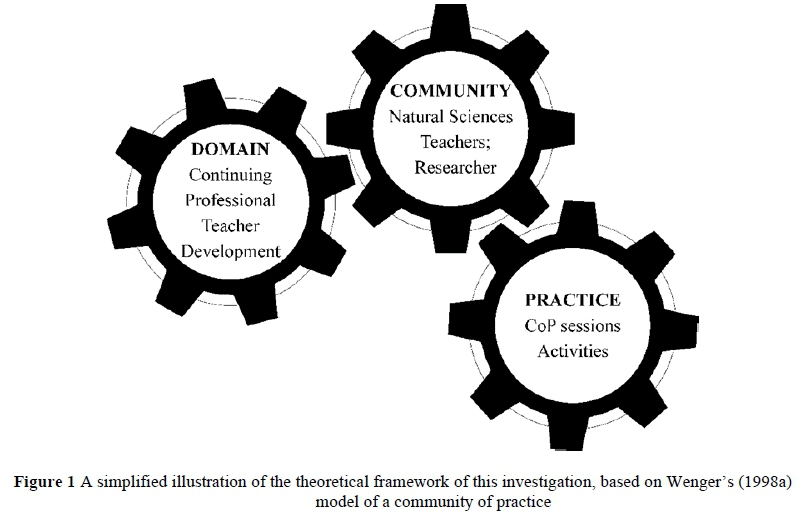
The populist term "CoP" is well known and finds purpose in diverse subject areas and disciplines, including educational research (Mays, 2002; Printy, 2008). Hoadley (2012) defines a CoP within an educational context as a platform where the sharing of practices among teachers can take place. Wenger (1998b) postulates that a CoP constitutes a combination of three crucial elements, namely domain, community and practice as portrayed in Figure 1. The three elements provide the formation, cohesion, and the goal of a CoP (Seaman, 2008).
The domain element constitutes "the area of knowledge that brings the community together, gives it its identity, and defines the key issues that members need to address" (Wenger, 1998a:2, 1998b:1). It outlines the identity of a CoP as the common area of shared inquiry and interest, which is not necessarily deemed as expertise outside of the CoP. In this investigation, the domain encapsulates the CPD of natural sciences teachers in the rural school district of Vredendal.
The community element of Wenger's model is described as a social construct where members of a specific domain engage and interact in shared activities, learning from one another and sharing information of common interest (Wenger, 1998b). It is "the group of people for whom the domain is relevant" (Wenger, 1998a:2). It refers to the membership within a CoP where members, with shared competence, collaborate with each other to accomplish collective and collaborative learning. Membership of a CoP is flexible, allowing members to leave this community, while new ones may also join, but the work of the community continues (Angelle, 2008:54). In this investigation, the natural sciences teachers and the researcher constituted the community.
The practice element of Wenger's model portrays shared practices, considering the members as practitioners that "develop [i.e. over time] a shared repertoire of resources" such as experiences, stories, tools, and ways of addressing recurring problems (Wenger, 1998b:2). It is also seen as the "body of knowledge and documents that members share and develop together" (Wenger, 1998a:2). In this investigation, the practice included different strategies used during the CoP sessions to explain and demonstrate specific natural sciences content, concepts, and contexts.
Collaborative approaches within a CoP towards CPTD are purposely designed to break down teacher isolation by providing opportunities for teachers to work together, exchange ideas, share resources and reflect on their classroom practices (Abdella, 2015; Kgabo, 2011). Characteristics of a CoP identified in the literature thus typically include collaboration, sharing, and professional identity. Thus, the move from isolation to collaboration leads to increased confidence and improved teaching (Patton & Parker, 2017).
The theoretical foundation of a CoP is primarily seated in the notion of situated learning (Williams, Ritter & Bullock, 2012), which conceptualises learning to occur socially through critical reflection with others who share the same experience, therefore, sharing their best classroom practices and allowing scope for individual teacher needs to be addressed (Levine & Marcus, 2010; Singh, 2011).
A CoP empowers teachers to take ownership of their professional development (DoE, 2006), implying that teachers should be allowed to have constructive input into the CoP, enforcing a high degree of teacher autonomy as endorsed in the National Policy Framework for Teacher Education and Development (NPFTED). Increased autonomy leads to positive changes in teaching practice, affording a notable change of CPTD programmes informing its usefulness and relevancy (Dharsey, 2015; Hargreaves, 2015).
A CoP presents a conducive and supportive platform where the required instructive, reflexive and collaborative competencies could be achieved (DoE, 2006), contributing to the development of a teacher's professional identity. Professional identity is an underlying construct of teacher professionalism formed by attitudes, beliefs, competences, and values (Dharsey, 2015; Körkkö et al., 2016; Mushayikwa, 2013; Robberts, 2017). On the other hand, self-determined teacher communities have limitations (De Clercq, 2013), and, therefore, research suggests that a CoP should include rotating leadership roles of the members, as leadership needs to balance CoP authority and sustainability (Avalos, 2011; Mak & Pun, 2015; Tan, 2014; Trust & Horrocks, 2017).
Trust, respect, and commitment to long-term professional relationships are essential elements that add to the effective implementation and operation of a CoP's social construct, setting the CoP apart from other community groups (Buysse, Sparkman & Wesley, 2003; Parker, Patton & Tannehill, 2012). Here learning takes place in the context of the learners' experience and their participation in the world (Wenger, McDermott & Snyder, 2002), focussing on knowledge in the hands of the (learner) practitioner (McKay, 2007).
It, therefore, became imperative to investigate the situation of CPTD in rural areas such as the Vredendal rural school district, to determine whether the identified characteristics were present, and whether other emerging characteristics could be identified.
Methodology
A constructivist ontology was employed from which rich data (Mertens, 2005) emerged within the context investigated. An interpretivist epistemology addressed the research aim, as it generated rich and in-depth data from participants, making sense of their world and their social interactions in a specific context. A qualitative research lens captured the essence of this investigation as it encapsulates the naturalistic character of the insider perspective.
A naturalistic case study method was adopted for this qualitative study. This type of method is appropriate as the in-depth descriptions of behaviour, group dynamics, interactions and events are ideal to understand the CoP in its natural settings. The strength of a case study method is the flexibility of using multiple sources and techniques in the data-generation process, allowing for thick descriptions of the phenomena under study (Yin, 2009).
In this multi-method qualitative case study, open-ended questionnaires, semi-structured interviews, observations, participant diaries, and my reflective journal (i.e. field notes) were used to generate in-depth data to address the aim of this investigation, which was to identify emerging CoP characteristics, according to teacher experiences, that would enhance CPTD of natural sciences teachers in a rural environment.
Sampling
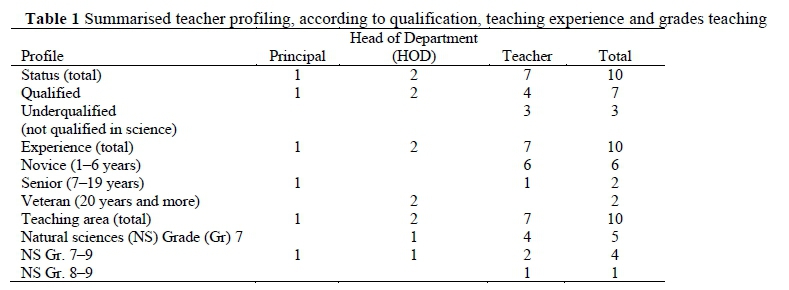
A purposive sampling method was employed in selecting participants as "it provides greater in-depth findings" (Anney, 2014:278). Information about the proposed investigation was emailed to the principals of 22 public primary and seven public secondary schools in the Vredendal district, inviting them to participate voluntarily in this investigation. All of the identified schools offered natural sciences as a subject in the Senior Phase (i.e., grade 7 to 9). Only 10 natural sciences teachers responded positively to participate in this investigation. The reasons for not participating was cited as the nature of the CoP sessions that were conducted at a central venue incurring additional commitments such as attendance, travel time, and travel expenses. The participating natural sciences teachers completed pre-intervention open-ended questionnaires on biographic information regarding post level, experience (i.e., years of teaching), school grades being taught, and official teacher qualifications, specifically science teaching qualifications. This information (see Table 1) provided me with an indication of the participants' profiles and status levels in the schools. The 10 participants constituted the CoP membership. They attended the CoP sessions, participated in the individual interviews, completed the postintervention open-ended questionnaire, and kept diaries with reflections on each CoP session.
The 10 selected natural sciences teacher participants represented public, rural district schools. The status (i.e. qualification) of the participants indicated that seven of the 10 participants were professionally qualified as natural sciences teachers, of which one was also a school principal. Three of the 10 participants were qualified teachers but not specifically for science teaching. The majority of the participants were novice teachers with relatively little teaching experience of between 1 and 5 years. The four remaining participants had teaching experience of 5 years and more. All teacher participants taught natural sciences in the Senior Phase.
Data Generation and Analysis Data generation methods included open-ended, pre-and a post-intervention questionnaires, semi-structured interviews, CoP session observations, participant diaries and my own reflective journal with field notes. The pre-intervention open-ended questionnaires gathered biographic information regarding the participants and their experience in teaching natural sciences. The post-intervention questionnaire aimed to determine the participants' opinions after their participation in the CoP intervention sessions had ended. The CoP intervention sessions took place in the form of 10 contact sessions over 6 months at pre-arranged venues, dates, and times. These sessions were directed by specific CAPS-related activities with regard to the knowledge strand, matter and materials, in the natural sciences General Education and Training (GET) curriculum for the Senior Phase.
I conducted individual semi-structured interviews with the participants to gain clarity on their various experiences in the context of professional teacher development supported by CoPs. Interviews were recorded electronically and field notes were taken. Information obtained through the pre-intervention open-ended questionnaires and semi-structured interviews was used to plan and structure the content of CoP contact sessions. Participants' diary entries and my reflective journal with field notes were used to capture the experiences and interactions of the participants during the CoP intervention sessions, culminating in rich data.
According to Braun and Clarke (2013), thematic data-analysis implies the assimilation, iterative coding and categorising of data. The thematic data-analysis approach was used in this investigation to analyse the data generated. The transcribed texts from the recorded individual interviews, the reflective dairy and journal entries, and information from the open-ended questionnaires were scrutinised for recurring words or themes. These emerging words or themes were clustered together into groups that allowed me to conceptualise the major categories of this investigation. These categories were used to address the aim of the investigation in understanding natural sciences teachers' experiences of a CoP as CPTD, as well as identifying the underlying characteristics that constitute an effective CoP. Purposive sampling, thick descriptions, and data triangulation, which refers to the use of multiple data sources such as questionnaires, interviews, observations, and dairy and journal entries, ensured the credibility and rigour of this investigation (Creswell, 2014; Guba & Lincoln, 1989).
Since this was a low-risk study involving only adult participants comprising of Senior Phase natural sciences teachers, ethical clearance was sought from the Institutional Ethics Community at the Stellenbosch University and consequently approved. Approval was also granted by the Director of Research Services, Western Cape Education Department, to conduct the investigation in the Vredendal school district.
Participation consent was obtained from participants who signed letters of consent of voluntary participation. I also contacted the participants telephonic to confirm participation and to ensure clarity of participation expectations within the project, acknowledging the protection of participants' rights and anonymity. Participation was voluntary and participants could withdraw from the investigation at any time without any consequence (Creswell, 2014).
To ensure anonymity, each participant was assigned a pseudonym. During the data-generation and analysis stages, all data were kept confidential (Kvale & Brinkmann, 2009), stored digitally on a password-protected computer that only I had access to. Hard copies containing confidential information were stored in a safe to which only I had access. I will store all information related to this investigation for at least 2 years after completion thereof.
Findings
Findings from this investigation give insight into characteristics that influence the effective operation of a CoP in a rural area leading to the advancement of CPD of natural sciences teachers. The participants were in overall agreement that the CoP sessions assisted in their improved understanding and teaching of natural sciences content linked to relevant real-life situations. Furthermore, CoP participation increased their practical skills to confidently conduct demonstrations and practical activities.
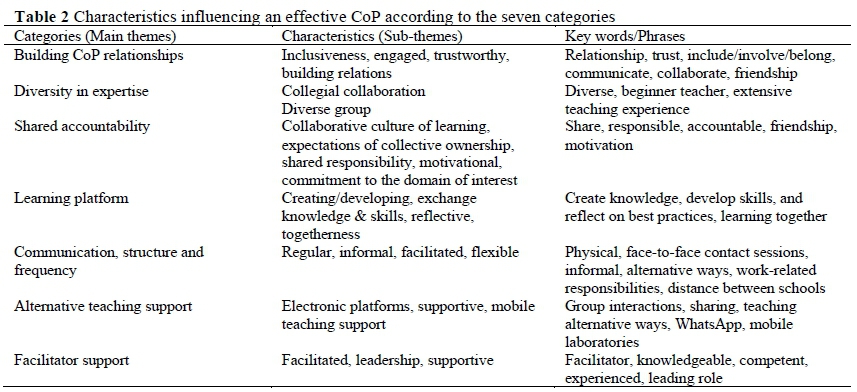
Teacher participants alluded to a variety of characteristics that influenced the effective operation and the sustainability of CoPs in the rural district. The various characteristics were categorised into seven categories namely: building strong and sustained relationships, diversity in expertise and experiences among the members, shared accountability, CoP as a learning platform, frequency, structure and communication within a CoP, alternative teaching support, and facilitator support (see Table 2). These findings are presented according to the identified categories and characteristics, supported by the participants' verbatim quotes.
Building CoP Relationships
The first and most important category for a CoP to operate effectively is the conducive relationships among the CoP members. One teacher participant stated that trustworthy relationships were essential to operate a teacher CoP effectively: "There needs to be trust among the teachers; otherwise the cooperation in the CoP will not be successful?" Another participant stressed the fact that "if we as teachers are included in the planning of the CoP activities, we will have a feeling of belonging and active involvement" indicating that inclusiveness and engagement were two characteristics that contributed to taking ownership of, and building strong relationships within a CoP community. According to one participant, the "vast distances and poor internet connection in rural areas are factors that influence communication" indicating that physical isolation in the rural communities contributed to teachers feeling excluded from collaborative practices. Being included in a CoP is of great importance and thus an imperative characteristic.
Generally, participants believed that the relaxed atmosphere of CoPs addressed the need for self-motivation and willingness to collaborate as "the atmosphere in the CoP-sessions was not stressful, and this helped me to participate more passionately, which enhanced more effective learning" , and that members participated more willingly due to "committed and motivated members [that] play a key role in teachers' participation in a CoP."
We are, therefore, of the opinion that relationships built on trust, underpinned by open, honest communication between participants form the basis on which the success of a CoP intervention resides. Participants indicated that teachers should be "included in the planning of the CoP activities" as they knew what their individual developmental needs were, and that it would make them feel more involved. This resonates well with Singh (2011) who is of the opinion that addressing individual needs contributes to their feeling of belonging, being engaged and trusted, and this involvement is conducive to building effective relationships in a CoP.
Diversity in Expertise
One participating teacher commented as follows: "I trust that working together in CoPs could work considerably well if the teachers are not at the same knowledge and competence level as this could help with exchanging knowledge and experience in a CoP", emphasising the importance of diversity in expertise in a CoP group. According to another participant "it [CoP] must be a diverse group so that the beginner teachers and those teachers like me who have extensive teaching experience can work together and learn from this collaboration", indicating that teachers with diverse experiences and ideas could pose a significant advantage to the effective operation of a CoP. Such cooperation is conducive to the development of novice (i.e., beginner) teachers, as well as the continuing development of seasoned teachers as this participant highlighted that they "learn from this collaboration."
Shared Accountability
As CoP sessions progressed, critical factors of success, such as collective ownership and accountability flowed from the shared member responsibilities. One participant mentioned that "if some teachers are not committed to completing the tasks allocated to them, there is no motivation for the rest to complete the tasks assigned to them in CoP meetings." This emphasised the importance of commitment in the CoP. Another participant felt strongly about member accountability by saying that "it is crucial that the participants are encouraged and kept accountable to participate in the activities in order to develop ownership for the CoP."
Another participant indicated that "it is important to create a culture of learning in which everyone shares the responsibilities towards the group members and not only for themselves." Wenger (1998b) implies that a commitment to the domain of interest [CoP], and as a result, a shared accountability, is essential to ensure success. We, therefore, argue that shared accountability contributes to the success of a CoP in creating environments of learning.
Learning Platform
The participants agreed that a CoP provided a learning platform that embraced trust, sharing, collaboration, ownership and accountability in a culture where teachers created knowledge, developed skills, and reflected on best practices. The value of such a learning platform was reflected in one of the participants' answers: "teachers' teaching practices could be enhanced through the participation in the CoP as a platform where the exchanging of knowledge and practices can occur. "
The CoP as a learning platform further equipped teachers in the teaching of natural sciences with specialised content knowledge and pedagogy to enable them to develop into competent natural sciences teachers. This finding was echoed by the following participant comment: "[t]his is especially the case for those teachers who are not confident in conducting experiments" , referring to teachers that did not hold a professional science teaching qualification, and "for me, in these CoP sessions, one can learn from the more experienced teachers. "
Communication, Structure and Frequency of CoP Sessions
Communication is of the utmost importance to ensure a successful CoP. One participant pleaded for better communication: "Regular communication is one of how you can enhance better collaboration between teachers, ensuring a stable and established basis at school." Informal, but regular communication among participants in a CoP is crucial as it affords the sharing of knowledge and teaching practices. Regular communication applies specifically to schools that are situated far from each other and where contact sessions are not always possible. According to Macià and García (2016), informal online communities and networks as a source of teacher professional development create alternative ways of communication in a more informal way. These would typically include electronic platforms such as chat groups for the development of a professional relationship that become possible once the participants had an opportunity to get to know each other. One participant stressed that, "a get-together session at the beginning of the year is essential because it will give teachers a chance to meet each other and to exchange contact information", which is crucial if communication is to continue seamlessly. Marcia and Garcia's idea of informal communication was echoed in a participant's response: "further communication can then occur through electronic platforms such as WhatsApp groups, e-mail or websites."
Physical, face-to-face contact sessions are powerful means to improve teachers' understanding of each other's circumstances. "I preferred these physical get-together sessions as it helped me to communicate better with my colleagues from other schools about subject-related issues" is one example of a participant voting for physical contact session such as CoPs.
Participants shared every-day challenges, feelings of incompetence, as well as best practices in an environment where members respected and trusted each other, which relates closely to Patton and Parker (2017) addressing the concept of helping teachers help themselves.
The frequency of CoP sessions plays a big role in the effective operation thereof. This is reflected in a participants' response to how often they need to attend CoP sessions: "I think it will be good if the CoP can happen once a month or it does not have to be once a month, maybe once a term, or maybe a day during a holiday. When and how often it happens, will depend on the teachers ' work-related responsibilities." In the same response it was emphasised that teachers' demanding work-related responsibilities needed to be accounted for when planning the frequency of CoP contact sessions. The number of contact sessions would, therefore, depend on the distance schools were situated from each other and the teachers' work programmes. Having said this, the planning of CoP sessions with regard to the time and way in which it is presented needs to be communicated regularly to assist participants to plan their attendance of CoP sessions.
Alternative Teaching Support Due to irregular communication and the vast distances between schools, group interactions seem key to assist teachers to support one another in sharing ideas on alternative teaching support strategies. One participant responded by saying that "group interactions help me to think of alternative ways to teach the content to make it more understandable for the learners" "I think if there is a mobile laboratory, which can alternate between schools, it can address the problem of inadequately equipped school laboratories" This indicates that participants utilised the CoP activities to think of alternative strategies to support their own teaching practice. Further teaching support "can then occur through electronic platforms such as WhatsApp groups, email or websites" as these "electronic platforms particularly help me to ask for assistance about questions of which I do not know the answers, as well as other work-related concerns. Through using these electronic platforms, we as teachers could support each other better?" These were valuable insights from participants in assisting them to think about alternative strategies with regard to teaching support.
Facilitator Support
Wenger's (1998a) original CoP design is partially structured and operates informally and autonomously without there being a leading agent or facilitator. However, in this investigation we found that an effective CoP was dependent on a knowledgeable and experienced facilitator taking charge of the operational aspects that included administration, planning, coordination, communication, and facilitation. This deduction was reiterated by one of the participants who observed that "the facilitator should play a leading role", be "effective [in] planning the activities for the CoP sessions as it plays a vital role in the successful implementation of a CoP"" We could, therefore, deduce that "the role of a facilitator is vital for the successful functioning of a CoP"" It is worth mentioning that the ideal facilitator could be an education practitioner, such as an ex-teacher, assigned to provide full-time support to teachers with activities in and out of school. The expertise of the facilitator, therefore, contributes widely to a well-structured, effectively operating CoP.
The findings from this investigation revealed seven categories comprising of various characteristics that contribute to the optimal operation of a CoP. Emerging characteristics within these categories included interactiveness, collaboration, diverse experiences, motivation, friendship, trust, accountability and ownership, and support among each other, but also support from the facilitator. The following comment indicates the success of the collaborative and interactive nature of the CoP sessions: "I have learned enormously through the CoP sessions, as it was very interactive, and the best for me was the communication among the teachers."
Discussion
The aim of this investigation was to identify, according to teachers' experiences, characteristics that may influence the effective operation of a CoP, and, therefore, enhance or contribute to the professional development of natural sciences teachers in a rural environment where a small number of teachers were underqualified, most teachers were qualified novice teachers, and only one was experienced in teaching grades 8 and 9. The seven categories identified underpin the variety of characteristics for CoPs to be functional. This variety of characteristics play a significant role in the effective operation of a CoP and, therefore, augmented the professional identity of teacher participants in the Vredendal rural school district.
Furthermore, structural elements of a CoP could play a significant role in promoting teacher collaboration as it breaks down teacher isolation -specifically in rural school environments. The participants suggested that a more informal CoP structure should be employed as a significant enabler to address their needs in enhancing professional development. Establishing effective CoP initiatives in this rural school district lead to developing professional relationships among the participants, which is key to the effective operation of a CoP. However, we recommend that the original construct of a CoP needs tailoring to operationalise it for the South African education system and context, both as a stand-alone or an integrated initiative with endorsed professional learning communities. In this context, a CoP needs an informal, but inclusive structure, preferably with an education specialist with experience of relationship dynamics and collaborative teacher development acting as a facilitator.
A CoP assists in building specific participant competencies as required by the authoritative norms set out in the NPFTED. Through interactive collaboration, participants improved their subject content knowledge, developed the ability to teach natural sciences theory relevant to real-life situations and raised their skills levels to conduct demonstrations and practical work more confidently. Opportunities for self-reflection appeared instrumental in entrenching the newly acquired teaching practices. These positive changes are considered the result of fostering teacher autonomy by including the participants in key aspects of the design and operation of the CoP. We agree with one of the teacher participants that the success of a CoP lies within "valuable experience as the co-operation between natural sciences teachers not only focus on one-directional communication, but time was allocated to discuss the problems that we are facing every day, which have an influence on the success of the work."
Conclusion
By embracing the identified characteristics that enable an optimal, functioning CoP, natural sciences teachers can effectively collaborate in their subject field, understanding and engaging with subject content within their various contexts, contributing to CPTD. Although the emerging findings are pertinent to teachers in a specific rural setting, we argue that similar characteristics of a functional CoP will apply just as well to other environments.
Authors' Contributions
CJP and MLB contributed to writing the manuscript. CJP provided data for Table 1 and 2 and designed Figure 1. CJP conducted the teacher interviews and conducted all statistical analyses. Both authors reviewed the final manuscript.
Notesi . This article is based on the doctoral thesis of Christa Joline Philander.
ii. Published under a Creative Commons Attribution Licence.
References
-
Abdella AS 2015. Lesson study as a support strategy for teacher development: A case study of middle school science teachers in Eritrea. PhD dissertation. Stellenbosch, South Africa: Stellenbosch University. Available at http://scholar.sun.ac.za/handle/10019.1/97776. Accessed 30 November 2021.
» http://scholar.sun.ac.za/handle/10019.1/97776 -
Admiraal W, Kruiter J, Lockhorst D, Schenke W, Sligte H, Smit B, Tigelaar D & De Wit W 2016. Affordances of teacher professional learning in secondary schools. Studies in Continuing Education, 38(3):281-298. https://doi.org/10.1080/0158037X.2015.1114469
» https://doi.org/10.1080/0158037X.2015.1114469 -
Angelle PS 2008. Communities of practice promote shared learning for organizational success. Middle School Journal, 39(5):52-58. https://doi.org/10.1080/00940771.2008.11461654
» https://doi.org/10.1080/00940771.2008.11461654 -
Anney VN 2014. Ensuring the quality of the findings of qualitative research: Looking at trustworthiness criteria. Journal of Emerging Trends in Educational Research and Policy Studies, 5(2):272-281. Available at http://196.44.162.10:8080/xmlui/handle/123456789/256. Accessed 30 November 2021.
» http://196.44.162.10:8080/xmlui/handle/123456789/256 -
Avalos B 2011. Teacher professional development in Teaching and Teacher Education over ten years. Teaching and Teacher Education, 27(1):10-20. https://doi.org/10.1016/j.tate.2010.08.007
» https://doi.org/10.1016/j.tate.2010.08.007 - Braun V & Clarke V 2013. Successful qualitative research: A practical guide for beginners. Thousand Oaks, CA: Sage.
-
Buysse V, Sparkman KL & Wesley PW 2003. Communities of practice: Connecting what we know with what we do. Exceptional Children, 69(3):263-277. https://doi.org/10.1177/001440290306900301
» https://doi.org/10.1177/001440290306900301 - Creswell JW 2014. Research design: Qualitative, quantitative, and mixed methods approaches (4th ed). London, England: Sage.
- De Clercq F 2013. Professionalism in South African education: The challenges of developing teacher professional knowledge, practice, identity and voice. Journal of Education, 57:31-54.
- Department of Basic Education 2010a. Curriculum Assessment Policy Statement (CAPS). Pretoria, South Africa: Government Printer.
-
Department of Basic Education, Republic of South Africa 2010b. Delivery agreement. For outcome 1: Improved quality of basic education. Pretoria: Author. Available at https://www.gov.za/sites/default/files/DoBE_Delivery%20Agreement_03112010.pdf. Accessed 30 November 2021.
» https://www.gov.za/sites/default/files/DoBE_Delivery%20Agreement_03112010.pdf -
Department of Basic Education, Republic of South Africa 2015. Professional Learning Communities -A guideline for South African schools. Pretoria: Author. Available at https://southafrica.vvob.org/sites/southafrica/files/professional_learning _communities_a_guideline_for_south_african_schools_0_0.pdf. Accessed 30 November 2021.
» https://southafrica.vvob.org/sites/southafrica/files/professional_learning _communities_a_guideline_for_south_african_schools_0_0.pdf - Department of Education 2006. The national policy framework for teacher education and development in South Africa. Pretoria, South Africa: Government Printer.
-
Dharsey Z 2015. PSP's support of science education through teacher development. PhD dissertation. Stellenbosch, South Africa: Stellenbosch University. Available at http://scholar.sun.ac.za/handle/10019.1/97981. Accessed 30 November 2021.
» http://scholar.sun.ac.za/handle/10019.1/97981 -
Du Plessis A & Subramanien B 2014. Voices of despair: Challenges for multigrade teachers in a rural district in South Africa. Educational Research for Social Change, 3(1):20-36. Available at http://ersc.nmmu.ac.za/articles/ERSC_Vol_3_No_1_2014_BLUE.pdf#page=24. Accessed 30 November 2021.
» http://ersc.nmmu.ac.za/articles/ERSC_Vol_3_No_1_2014_BLUE.pdf#page=24 -
Feldman J 2016. Eliciting pedagogical learning among teachers in a professional learning community. PhD dissertation. Stellenbosch, South Africa: Stellenbosch University. Available at http://scholar.sun.ac.za/handle/10019.1/98391. Accessed 30 November 2021.
» http://scholar.sun.ac.za/handle/10019.1/98391 -
Forte AM & Flores MA 2014. Teacher collaboration and professional development in the workplace: A study of Portuguese teachers. European Journal of Teacher Education, 37(1):91-105. https://doi.org/10.1080/02619768.2013.763791
» https://doi.org/10.1080/02619768.2013.763791 -
Geldenhuys JL & Oosthuizen LC 2015. Challenges influencing teachers' involvement in continuous professional development: A South African perspective. Teaching and Teacher Education, 51:203-212. https://doi.org/10.1016/j.tate.2015.06.010
» https://doi.org/10.1016/j.tate.2015.06.010 - Guba EG & Lincoln YS 1989. Fourth generation evaluation. London, England: Sage.
- Hargreaves A 2015. Push, pull and nudge: The future of teaching and educational change. Learning Landscapes, 9(1):119-142.
-
Heeralal PJH 2014. Preparing pre-service teachers to teach in rural schools. Mediterranean Journal of Social Sciences, 5(20):1795-1799. https://doi.org/10.5901/mjss.2014.v5n20p1795
» https://doi.org/10.5901/mjss.2014.v5n20p1795 -
Hoadley C 2012. What is a community of practice and how can we support it? In D Jonassen & S Land (eds). Theoretical foundations of learning environments (2nd ed). London, England: Routledge. Available at https://research.steinhardt.nyu.edu/scmsAdmin/uploads/006/677/CHAP12HOADLEY.pdf. Accessed 6 December 2014.
» https://research.steinhardt.nyu.edu/scmsAdmin/uploads/006/677/CHAP12HOADLEY.pdf -
Hong JY 2010. Pre-service and beginning teachers' professional identity and its relation to dropping out of the profession. Teaching and Teacher Education, 26(8):1530-1543. https://doi.org/10.1016/j.tate.2010.06.003
» https://doi.org/10.1016/j.tate.2010.06.003 -
Jita LC & Mokhele ML 2014. When teacher clusters work: Selected experiences of South African teachers with the cluster approach to professional development. South African Journal of Education, 34(2):Art. # 790, 15 pages. https://doi.org/10.15700/201412071132
» https://doi.org/10.15700/201412071132 - Kennedy A 2005. Models of continuing professional development: A framework for analysis. Journal of In-Service Education, 31(2):235-250.
- Kgabo V 2011. A leadership perspective of the creation of opportunities for professional teacher development in Diepsloot Combined School. MEd dissertation. Johannesburg, South Africa: University of Johannesburg.
-
King MB & Newman FM 2001. Building school capacity through professional development: Conceptual and empirical considerations. International Journal of Education Management, 15(2):86-94. https://doi.org/10.1108/09513540110383818
» https://doi.org/10.1108/09513540110383818 -
Körkkö M, Kyrö-Ämmälä O & Turunen T 2016. Professional development through reflection in teacher education. Teaching and Teacher Education, 55:198-206. https://doi.org/10.1016/j.tate.2016.01.014
» https://doi.org/10.1016/j.tate.2016.01.014 - Kvale S & Brinkmann S 2009. Interviews: Learning the craft of qualitative research interviewing (2nd ed). Thousand Oaks, CA: Sage.
-
Levine TH & Marcus AS 2010. How the structure and focus of teachers' collaborative activities facilitate and constrain teacher learning. Teaching and Teacher Education, 26(3):389-398. https://doi.org/10.1016/j.tate.2009.03.001
» https://doi.org/10.1016/j.tate.2009.03.001 -
Lipowski K, Jorde D, Prenzel M & Seidel T 2011. Expert views on the implementation of teacher professional development in European countries. Professional Development in Education, 37(5):685-700. https://doi.org/10.1080/19415257.2011.621968
» https://doi.org/10.1080/19415257.2011.621968 -
Lumpe A, Czerniak C, Haney J & Beltyukova S 2012. Beliefs about teaching science: The relationship between elementary teachers' participation in professional development and student achievement. International Journal of Science Education, 34(2):153-166. https://doi.org/10.1080/09500693.2010.551222
» https://doi.org/10.1080/09500693.2010.551222 -
Macià M & García I 2016. Informal online communities and networks as a source of teacher professional development: A review. Teaching and Teacher Education, 55:291-307. https://doi.org/10.1016/j.tate.2016.01.021
» https://doi.org/10.1016/j.tate.2016.01.021 -
Maistry SM 2008. School-university CPD partnerships: Fertile ground for cultivating teacher communities of practice. South African Journal of Higher Education, 22(2):363-374. Available at https://journals.co.za/doi/pdf/10.10520/EJC37440. Accessed 30 November 2021.
» https://journals.co.za/doi/pdf/10.10520/EJC37440 -
Mak B & Pun SH 2015. Cultivating a teacher community of practice for sustainable professional development: Beyond planned efforts. Teachers and Teaching, 21(1):4-21. https://doi.org/10.1080/13540602.2014.928120
» https://doi.org/10.1080/13540602.2014.928120 - Mays T 2002. Developing a community of practice among educators: A case study of the National Professional Diploma in Education (NPDE) in South and Southern Africa.
-
McKay RF 2007. Distributed Communities of Practice: An exploration of a distributed Community of Practice of South African Life Science teachers. MEd dissertation. Pretoria, South Africa: University of Pretoria. Available at https://repository.up.ac.za/bitstream/handle/2263/23160/dissertation.pdf?sequence=1&isAllowed=y. Accessed 30 November 2021.
» https://repository.up.ac.za/bitstream/handle/2263/23160/dissertation.pdf?sequence=1& isAllowed=y -
McMillan DJ, McConnell B & O'Sullivan H 2016. Continuing professional development - why bother? Perceptions and motivations of teachers in Ireland. Professional Development in Education, 42(1):150-167. https://doi.org/10.1080/19415257.2014.952044
» https://doi.org/10.1080/19415257.2014.952044 - Mertens DM 2005. Research methods in education and psychology: Integrating diversity with quantitative, qualitative and mixed methods (2nd ed). Thousand Oaks, CA: Sage.
-
Mushayikwa E 2013. Teachers' self-directed professional development: Science and mathematics teachers' adoption of ICT as a professional development strategy. African Journal of Research in Mathematics, Science and Technology Education, 17(3):275-286. https://doi.org/10.1080/10288457.2013.848540
» https://doi.org/10.1080/10288457.2013.848540 -
Parker M, Patton K & Tannehill D 2012. Mapping the landscape of communities of practice as professional development in Irish physical education. Irish Educational Studies, 31(3):311-327. https://doi.org/10.1080/03323315.2012.710067
» https://doi.org/10.1080/03323315.2012.710067 -
Patton K & Parker M 2017. Teacher education communities of practice: More than a culture of collaboration. Teaching and Teacher Education, 67:351-360. https://doi.org/10.1016/j.tate.2017.06.013
» https://doi.org/10.1016/j.tate.2017.06.013 -
Patton K, Parker M & Tannehill D 2015. Helping teachers help themselves: Professional development that makes a difference. NASSP Bulletin, 99(1):26-42. https://doi.org/10.1177/0192636515576040
» https://doi.org/10.1177/0192636515576040 -
Printy SM 2008. Leadership for teacher learning: A community of practice perspective. Educational Administration Quarterly, 44(2):187-226. https://doi.org/10.1177/0013161X07312958
» https://doi.org/10.1177/0013161X07312958 - Robberts AS 2017. The influence of South African teachers' qualifications and experience on the mathematics performance of learners. PhD thesis. Pretoria, South Africa: University of Pretoria.
-
Seaman M 2008. Birds of a feather?: Communities of practice and knowledge communities. Curriculum and Teaching Dialogue, 10(1/2):269-279. Available at https://www.proquest.com/docview/230449414/fulltextPDF/4ED30F33FB334FB7PQ/1?accountid=14717. Accessed 30 November 2021.
» https://www.proquest.com/docview/230449414/fulltextPDF/4ED30F33FB334FB7PQ/1?accountid=14717 -
Singh SK 2011. The role of staff development in the professional development of teachers: Implications for in-service training. South African Journal of Higher Education, 25(8):1626-1638. Available at https://journals.co.za/doi/pdf/10.10520/EJC121487. Accessed 30 November 2021.
» https://journals.co.za/doi/pdf/10.10520/EJC121487 -
Sobkin VS & Adamchuk DV 2015. On teacher professional development: Improving professional qualifications and membership in professional teacher communities. Russian Education & Society, 57(11):991-1017. https://doi.org/10.1080/10609393.2015.1187012
» https://doi.org/10.1080/10609393.2015.1187012 -
Tan YSM 2014. A researcher-facilitator's reflection: Implementing a Singapore case of learning study. Teaching and Teacher Education, 37:44-54. https://doi.org/10.1016/j.tate.2013.09.003
» https://doi.org/10.1016/j.tate.2013.09.003 -
Trust T & Horrocks B 2017. 'I never feel alone in my classroom': Teacher professional growth within a blended community of practice. Professional Development in Education, 43(4):645-665. https://doi.org/10.1080/19415257.2016.1233507
» https://doi.org/10.1080/19415257.2016.1233507 -
Trygstad PJ, Banilower ER, Smith PS & Nelson CL 2014. New instruments for studying the impacts of science teacher professional development. Chapel Hill, NC: Horizon Research. Available at https://files.eric.ed.gov/fulltext/ED558468.pdf. Accessed 30 November 2021.
» https://files.eric.ed.gov/fulltext/ED558468.pdf - Wenger E 1998a. Communities of practice: Learning as a social system. Systems Thinker, 9(5):2-3.
- Wenger E 1998b. Community of practice: A brief introduction. Learning in Doing, 15(4):1-7.
- Wenger E, McDermott RA & Snyder WM 2002. Cultivating communities of practice: A guide to managing knowledge. Boston, MA: Harvard Business School Press.
-
Williams J, Ritter J & Bullock SM 2012. Understanding the complexity of becoming a teacher educator: Experience, belonging, and practice within a professional learning community. Studying Teacher Education, 8(3):245-260. https://doi.org/10.1080/17425964.2012.719130
» https://doi.org/10.1080/17425964.2012.719130 - Yin RK 2009. Case study research: Design and methods (4th ed). Beverly Hills, CA: Sage.
Revised: 10 July 2020
Accepted: 21 September 2020;
Published: 30 November 2021